Category Archives: Church_LessonsOnDoctrineOf

A study of 1 Thessalonians

Click here to go to “Bible Studies on the Doctrine of the Church” from other books of the Bible.

Click here to go to Study of 2 Thessalonians

In 1 Thessalonians, Paul’s 1st epistle, the emphasis is upon the rapture of believers, the coming of Christ to take His church out of the world. The fact that the coming of Christ is a purifying hope should lead to sanctification in our lives. 1 John 3:3: “And every man that hath this hope in him purifieth himself, even as he is pure.”

 Contents:

  • Selected audio teachings on 1 Thessalonians and link to more through audio teachings online.
  • Occasion of the Writing
  • Theme
  • Purpose
  • 11st OUTLINE
  • 2nd OUTLINE
  • Abbreviated notes.

NOTE. For more details see, McGee, 1 Thessalonians. This study is taken directly from that book. The study is also available online in audio at: 1 Thessalonians. 

Selected audio teachings on 1 Thessalonians and link to more through audio teachings online:

The trinity of faith, hope, and love (Click to go to study). “Remembering without ceasing (1) your work of faith, (2) lobour of love, and (3) patience of hope in our Lord Jesus Christ.” 1 Thessalonians 1.3. This trinity is marvelously explained in this teaching by Dr. J. Vernon McGee. Learn both the abstract and the concrete meanings of this trinity and how they relate together where the rubber meets the road. Paul here gives 3 graces of Christian life. The past is the work of faith. The present is a labour of love. The future is the patience of hope.

Turning to God from idols. 1 Thessalonians 1:9-10: “For they themselves shew of us what manner of entering in we had unto you, and how ye turned to God from idols to serve the living and true God; And to wait for his Son from heaven, whom he raised from the dead, even Jesus, which delivered us from the wrath to come.” The church in 1Thess1.9Thessalonica turned to God from idols to serve the living and true God. See v. 3. Work of faith (turned to God from idols), labour of love (to serve the living God), patience of hope (to wait for His Son from heaven). Paul preached Christ and they turned to God from idols (not they turned from idols to God). When they turned to God, that is the work of faith; that is what faith did. John 6:29 “Jesus answered and said unto them, This is the work of God, that ye believe on him whom he hath sent.” When they turned to God, they automatically turned from idols—that is repentance. The turning from something is repentance. You can’t turn to Christ without turning from sin. Jesus Christ saves from sin. When a man turns to Christ, he turns from his sin. The message of repentance needs to be preached to the church, as it was preached to the 7 churches in Revelation 2 and 3. The Thessalonians were now serving God, the labor of love. You cannot serve Christ unless you love him. See Jn. 14.15. If you do not love Him, forget trying to serve Him. Waiting for His Son from heaven doesn’t mean sit down and relax. It means get busy for the Lord. A believer is to labor in love.
 For excellent and more audio teachings on Thessalonians, click: J. Vernon McGee teaches on 1 Thessalonians.

Occasion of the Writing
(Apparently, it was at Corinth that Timothy and Silas come to him and brought him word concerning the Thessalonians (1 Thessalonians 3:6). Timothy also brought some questions to Paul, problems troubling the believers in Thessalonica. Paul wrote this first epistle in response to their questions, to instruct them further and give them needed comfort.)

Thessalonica was located 100 miles west of Philippe and about 50 miles north of Athens. It was right in the center or the heart of the empire and was the chief city of Macedonia. The city is still in existence and is known as Salonika.

The church in Thessalonica, established on Paul’s second missionary journey, was a model church. 1 Thessalonians 1:7: “So that ye were ensamples to all that believe in Macedonia and Achaia.” This church was a testimony to the whole area that we would call Greece today. Paul speaks of this church as being an example to the Corinthians in 2 Corinthians 8:1-5.

You will recall that Paul and Barnabas separated on the 2nd missionary journey. Paul took Silas with him, and along the route he picked up Timothy and Dr. Luke. He revisited the churches in Galatia and then attempted to make a wider circle in the densely populated area of Asia Minor, known as Turkey today. Dr. McGee thinks he intended to carry on his missionary work there, because in his 3rd missionary journey he did make Ephesus his headquarters and did what was probably his greatest missionary work. But on his 2nd missionary journey, the Spirit of God put up a roadblock and would not let him go south. He attempted to go oup into Bithynia, but again the Spirit of God prevented him. He couldn’t go north, and he couldn’t go south. So he moved to the west and came to Troasa to await orders. He had the vision of the man of Macedonia, so he crossed over to Philippi. He found that the man of Macedonia was instead a woman by the name of Lydia, a seller of purple—she probably ran a department store there. Paul led her to the Lord along with others of the city. Thus, a church was established at Philippi.

Then Paul went to Thessalonica, and we are told in chapter 17 of Acts that he was there for three Sabbaths. So Paul was there a little less than a month, but in that period of time he did a herculean task of mission work. Paul was an effective missionary—he led multitudes to Christ there. And in that brief time he not only organized a local church, but he also taught them the great doctrines of the Christian faith.

Now Paul had to leave Thessalonica posthaste due to the great opposition to the gospel. He was run out of town and went down to Berea. The enemy pursued him to Berea, and again Paul was forced ot leave. Paul left Silas and Timothy at Berea, but he went on to Athens. After some time at Athens, he went on to Corinth. Apparently, it was at Corinth that Timothy and Silas come to him and brought him word concerning the Thessalonians (1 Thessalonians 3:6). Timothy also brought some questions to Paul, problems troubling the believers in Thessalonica. Paul wrote this first epistle in response to their questions, to instruct them further and give them needed comfort.

Theme
(Paul presents the second coming of Christ in relationship to believers as a comfort, and this forms the theme of the epistle.)

Although Paul had been in Thessalonica less than a month, he had touched on many of the great doctrines of the church including to second coming of Christ. It is interesting that Paul did not consider this subject to be above the heads of the new converts. Yet there are churches today that have been in existence for more than 100 years whose members have but a vague understanding of the rapture of the church and the coming of Christ to establish His kingdom here on earth. The Thessalonian church was not even a month old, and Paul was teaching them these great doctrines!

The apostle had obviously emphasized the second coming of Christ for believers and had taught that the return of Christ was imminent. For during the period of time since Paul had left, some of the saints who had come to know and believe in Jesus Christ had died, and this had naturally raised the question in the minds of the Thessalonians as to whether these saints would be in the rapture or not. Paul presents the second coming of Christ in relationship to believers as a comfort, and this forms the theme of the epistle. The emphasis is in sharp contrast to Christ’s catastrophic and cataclysmic coming in glory to establish His kingdom by putting down all unrighteousness seen in Revelation 19.11-16.

Purpose

The epistle has a threefold purpose: (1) to confirm young converts in the elementary truth of the gospel. (2) To condition them to go on unto holy living. (3) To comfort them regarding the return of Christ. Paul’s message offered a marked contrast to the paganism and heathenism which was present in Thessalonica.

1st OUTLINE

  1. The Chritian’s Attitude toward the Return of Christ, Chapter 1 (to serve … to wait vv. 9, 10)
  2. The Christian’s Reward at the Return of Christ, Chapter 2.
  3. The Christian’s Life and the Return of Christ, 3.1-4-12.
  4. The Christian’s Death and the Return of Christ, 4.13-18.
  5. The Christian’s Actions in View of the Return of Christ, Chapter 5 (Note 22 specific commands to Christians beginning at v.11.)

2ND OUTLINE

  1. Coming of Christ is an INSPIRING HOPE, Chapter 1
    1. Introduction
    2. Gospel Received in Much Assurance & Much Affliction, vv. 5-7
    3. Gospel Results: Turned from Idols to God; Wait for Coming of Christ, vv. 8-10
  2. Coming of Christ is a WORKING HOPE, Chapter 2
    1. Motive and Method of a True Witness for Christ, vv. 1-6
    2. Mother Side of the Apostle’s Ministry (Comfort), vv. 7-9
    3. Father Side of the Apostle’s Ministry (Charge), vv. 10-13
    4. Brother Side of the Apostle’s Ministry (Challenge), vv. 14-16
    5. Reward of a True Witness of Christ, vv. 17-20
  3. Coming of Christ is a PURIFYING HOPE, 3.1-4.12
    1. Timothy Brings Good Report of Thessalonians, vv. 1-8
    2. Paul Urges Thessalonians to Continue to Grow in Faith, vv. 9-13
    3. How Believers Are to Walk, 4.1-12
  4. Coming of Christ is a COMFORTING HOPE, 4.13-18
    (What Death Means to a Christian;
    What the Rapture Means to the Church)
  5. Coming of Christ is a ROUSING HOPE, Chapter 5

Dead Believers are Asleep in Jesus
Living Believers are Awake for Jesus
Call to be Awake & Alert in View of Christ’s Coming, vv. 1-10
1. Call to be Awake & Alert in View of Christ’s Coming, vv. 1-10
2. Commandments for Christians, vv. 11-28

SOME ABBREVIATED NOTES

 Chapter 1
(The Coming of Christ Is an Inspiring Hope)

  1. 1.1: Paul humbly identifies himself with the brethren, Timotheus and Silvanus. He was not aloof, separated and segregated above all the others who were working for Jesus Christ. Remember this. The preacher is to be right down among you. No clergy and laity. There are 2 situations in a church which are dangerous. One is a pastor who tries to exalt himself. The other is a layman who tries to be an authority on the Bible and has not really studied the Bible (the total Word of God from beginning to end, but has gone off on a tangent. Grace comes first, then the peace of God.
  2. 1.2: Paul prayed for all the churches he had founded. He had a tremendous prayer list….
  3. 1.3: Paul associates 3 Christian graces: Faith, hope, and love. Paul takes these 3 words and puts them into shoeleather. See Dr. McGee, 1 Thessalonians for a tremendous study on this. Faith is the response of the soul of man to the Word of God…. When a man responds to the Word of God, he walks by faith, not by sight. (2. Co. 5.7). When one loves the Lord Jesus, serving Him is a “labour of love.” Labor is not labor when it is a labor of love. If serving the Lord is a great burden to you, give it up. The Lord does not want it to be like that. Love to God is expressed in obedience. The patience of hope is waiting for His Son from heaven; that is the “blessed hope.”
  4. 5. It’s the word of God, not weak men, which has power. Weak men giving out the word of God will have an effect. The Spirit of God can cause the Word of God to penetrate hearts and lives and transform people. F=”Faith cometh by hearing and hearing by the word of God” Ro. 10.17.
  5. 6. The word was rec’d in much afflication (ther was suffering, persecution, and heartache). But there was joy in the Holy Spirit also.
  6. 7, 8. The church at Thess. were examples to all other churches. Their reputation had spread.
  7. 9-10. The church in Thessalonica turned to God from idols to serve the living and true God. See v. 3. Work of faith (turned to God from idols), labour of love (to serve the living God), patience of hope (to wait for His Son from heaven). Paul preached Christ and they turned to God from idols (not they turned from idols to God). When they turned to God, that is the work of faith; that is what faith did. John 6:29 “Jesus answered and said unto them, This is the work of God, that ye believe on him whom he hath sent.” When they turned to God, they automatically turned from idols—that is repentance. The turning from something is repentance. You can’t turn to Christ without turning from sin. Jesus Christ saves from sin. When a man turns to Christ, he turns from his sin. The message of repentance needs to be preached to the church, as it was preached to the 7 churches in Revelation 2 and 3. The Thessalonians were now serving God, the labor of love. You cannot serve Christ unless you love him. See Jn. 14.15. If you do not love Him, forget trying to serve Him. Waiting for His Son from heaven doesn’t mean sit down and relax. It means get busy for the Lord. A believer is to labor in love.

Chapter 2
(The Coming of Christ Is a Working Hope)

No matter when you believe Christ is coming, believer, the important question is, “How does your interpretation affect your life?’

v 1. “in vain” means empty, without results.

v 2. “Contention” means conflict or agony.

v 3. “Deceit” means error. “Uncleanness” means sensuality. “Nor in guile”—he did not use wrong methods or lower his standards to accommodate the prejudices and passions of the old nature….

v 4. “Allowed” means tested or approved. God allowed him to be put in trust with the Gospel.

v 5. Paul never used flattering words or a “cloak of covetousness.”

v 6. Paul never sought position or honors.

Mother Side of the Apostle’s Ministry (Comfort), vv. 7-9. Paul was as tender as a woman in his dealings with the church at Thessalonica. Like a mother, Paul loved these people. He labored over them night and day because he loved them. When work is motivated by love, it does not seem like work anymore (as with mother who takes care of her husband and baby).

Father Side of the Apostle’s Ministry (Charge), vv. 10-13. Paul had a duty to God (“holily) and to man (“justly”). “Unblamably” means that no charge could be maintained against the apostle and his companions. “Exhorted” means Paul came to the side of them, to help, to entreat, and to convict them (v11). “Comforted” in v11 means “to persuade.” Paul “charged” them (v11). This has a note of severity in it—it involves discipline. He was not a Preacherette giving a Sermonette. “Walk worthy” … (v12). Live in light of eternity (v12). the Word should go out and be received as the Word of God—if it does not, it will not work in you (v13).

The Word of God, like salt, stings when it gets into a fresh wound of sin in the life of an individual. The Word is also light—men who do evil love darkness rather than light because their deeds are evil. Paul is teaching in this chapter that the church of God should mirror the family of God down here on earth. A church should be a revelation of God to the community just as a family should be. The relationships of husband, wife, and child in the home should reveal the threefold aspect of the love of God and Christ for the world. A child in a home needs to experience both mother-love and father-love. Father-love disciplines. Children are not to be comforted only.

Brother Side of the Apostle’s Ministry (Challenge), vv. 14-16. The brother-side of the ministry within a church is represented by the child in the family. Suffering draws you together and brings you together. They were brothers in suffering. Suffering is a cement that holds brothers together. If suffering came to the church, it would draw brothers together and bring revival. Why don’t we pray for conditions that bring revival—that is suffering and persecution?

Reward of a True Witness of Christ, vv. 17-20. When one is in Christ, he is a brother to all those who are in Christ (v17). Paul had the spiritual discernment to see that it was Satna’s strategy that kept him from going to Thessalonica (v18). One of the great things Paul anticipates when Christ comes to take His church will be the opportunity to see these people he has led to the Lord (vv19-20)

Chapter 3
(The Coming of Christ Is a Purifying Hope)

The great theme of 1 Thess. is the rapture of the church. The great them of 2 Thess. is the revelation of Christ, that is, His coming to earth to establish His kingdom. Paul is teaching practical doctrines, meaningful to life. The coming of Christ will change your life, affect your life-style.

“Wherefore” ties this chapter to what Paul talked about in the last chapter: the family relationship that exists in the church. He had been a mother, father, and brother to them. Paul is frustrated in not being able to return to them. His is a labour of love. Love seeks the welfare of another.

Because of his love, Paul sent Timotheus back to them (“our brother and minister of God”) v.2. “Our fellowlaborer in the gospel of Christ.” Do-gooder “Christians” want the social gospel. But the Word of God brings more good-doing than any social gospel. Do-good liberals actually encourage immorality and license. They haven’t delivered kids from drugs or lifted up  mankind. A believer’s sphere is to be the gospel of Christ; that will produce a whole lot of good. “To establish you…”: Paul sent Timothy to do this—to hold them up v.2. “To comfort you concerning your faith”; “Comfort” means encourage.

v.3-4: “no man should be moved (disturbed) in the midst of afflictions.  See also, Jn. 16.33. ‘”Tribulation” is trouble that all of us are going to have. Believes are going to suffer—they are not going to escape trouble. We won’t miss the storms, but we will go through them and He will go with us.  See also 2 Ti. 3.12 (“Yea, and all that will live godly in Christ Jesus shall suffer persecution.”) and 1 Pe. 4.12-19. If there is no cloud in the sky, no ripple on the sea, and everything is smooth and nice, you might question your salvation.

Paul feared that Satan was giving them a bad time, as Satan was giving him a bad time v.5. Another purpose of afflictions is to test the genuineness of belief. There are true believers and a lot of counterfeit believers.

Timothy gave Paul a good report about the church at Thess. v6. This comforted Paul v7. Even if a believer has trouble, it is going to work out for his good.

Paul urges continuing growth vv10-13. Joy is associated with life v.9. Sorrow is associated with death. But sorrow increases the capacity of the heart for joy. Paul wanted to return to them and teach the Word of God v10.-11. “Abound in love” v12. “Abound means exceed. In this epistle, love is seen in action—“labour of love.” “To the end”—love has a purpose; it is not an end in itself. “He may stablish your hearts unblameable in holiness—the desired end of their love v.12. “At the coming of our Lord Jesus Christ with all his saints” v13.

Chapter 4
(The Coming of Christ is a Purifying (3.1-4.12) and a Comforting Hope (4.13-18))

vv1-12 How believers are to walk.

v2 The Ten Commandments have no part in the sinner’s salvation nor are they the standard of Christian conduct. The purpose of the Commandments is to bring us to the cross. They are like a mirror which lets us see that we are sinners. However, there are commandments for believers. In chapter 5 are 22 commandments for believers.

v3 Three kinds of sanctification in the Bible. Positional: Christ has been made unto us sanctification. We are accepted in the Beloved. Practical: the Holy Spirit working in our lives to produce a holiness in our walk. Total: Will occur in the future when we are conformed to the image of Christ Jesus. Sanctification means “to be set apart for God.”

vv13-18 The coming of Christ is a comforting hope. This section teaches the imminent coming of Christ. “Imminent” does not mean the immediate or soon coming of Christ. Paul never uses an expression like that. He did not want people to assume it would be in their lifetime or shortly afterward. When we say that the coming of Christ is imminent,, we mean that it is the next event on the agenda of God’s program. We don’t know how far away the coming of Christ is. Paul believed the coming of Christ could come in his lifetime. He did not say or believe that  He would come in his lifetime. Paul called the coming of Christ for his church the rapture see v. 17). “Caught up” and “rapture” mean the same thing.

Paul taught the new Thessalonian believers prophecy and other advanced doctrines.

Paul obviously taught Christ’s imminent coming. Paul was answering their questions. One was, “Had the believers in Thessalonica who had already died missed the rapture?” This question would not have been pertinent at all if Paul had not taught them the imminent coming of Christ, if Paul had not taught them that Christ could come at any moment. For Paul’s answer, see vv. 13-18.

v14. There are 3 kinds of death in Scripture. Physical death (separation of the spirit from the body). Spiritual death (separation from God. Adam died spiritually, was separated from God, the day he ate of the forbidden fruit. Ep. 2.1.). Eternal death (eternal separation from God. This is the second death spoken of in Re. 20.14.).

Chapter 5
The Coming of Christ Is a Rousing Hope

In C5, we see the Christian’s actions in view of the coming of Christ.

CALL TO BE AWAKE AND ALERT IN VIEW OF CHRIST’S COMING VV1-10.

v1 The believer is looking for a Person, not for times of seasons. The Lord does not come as a thief to the believer. You don’t look for a thief. However, the Lord Jesus does come like a thief to the world.

v3. The day of the Lord will come suddenly. The pronoun here changes to “they.”

One definition of the day of the Lord: a period of time which begins with the [outpouring of the wrath of God] and runs through the millennial reign of Christ here upon the earth. Many passages of Scripture speak of this: (e.g., Isaiah 13:9 “Behold, the day of the LORD cometh, cruel both with wrath and fierce anger, to lay the land desolate: and he shall destroy the sinners thereof out of it.”) It starts out as a day of wrath: Isaiah 13:10 “For the stars of heaven and the constellations thereof shall not give their light: the sun shall be darkened in his going forth, and the moon shall not cause her light to shine.” Joel 1:15 “Alas for the day! for the day of the LORD is at hand, and as a destruction from the Almighty shall it come.” Joel goes on in C2 to describe it as a “day of darkness and of gloominess, a day of clouds and of thick darkness.”

The coming of Christ to take the family of God out of the world is not even mentioned in the OT. It is there by type, of course (as, e.g., the experience of Enoch and Elijah both of whom were taken up alive to be with the Lord.). This glorious, wonderful truth that the Lord Jesus is going to take a company of people out of this earth to be with Himself was revealed the 1st time in the Upper Room when He said, “In my Father’s house are many mansions: if it were not so, I would have told you. I go to prepare a place for you. And if I go and prepare a place for you, I will come again, and receive you unto myself; that where I am, there ye may be also.” (John 14:2-3). Paul developed it in 1 Thess. 4.

In 1 Thess. 5, Paul is speaking of something that was well known in the OT. “When they say peace and safety; then sudden destruction cometh upon them.” It is going to be a big surprise to the world. The big lie in 2 Thess. 2 is the promise of peace and safety. Jesus warned, “Take heed that no man deceive you.”

vv4, 5. The rapture does 2 things. (1) Ends this day of grace in which we are today. (2) It begins the day of the Lord.

v6. Because that blessed hope could take place at any time, we should not be sleeping Christians. Christians are instructed to “Watch and stay sober.” We have a duty to perform.

vv7, 8. We are also to put on the breastplate of faith and love; and the helmet of the hope of salvation. This speaks of the soldier’s duty and is a call to that kind of duty. The breastplate of faith and love is to cover the heart, the vital part of the body. This is the 3rd time faith, love, hope have appeared in this epistle. The faith spoken of is saving faith, and saving faith produces works. Faith is past (for the believer), love is present, and the “hope of salvation” is that blessed hope of the future which is the consummation of our salvation (1 Jn. 3.2: “  Beloved, now are we the sons of God, and it doth not yet appear what we shall be: but we know that, when he shall appear, we shall be like him; for we shall see him as he is.” Philippians 1:6: “Being confident of this very thing, that he which hath begun a good work in you will perform it until the day of Jesus Christ:”)

v9 “God hath not appointed us to wrath,…” “But to obtain salvation through our Lord Jesus Christ.”

v10. Whether we die first or live until His coming, we shall live together with Him.

THE TWENTY-TWO COMMANDMENTS FOR BELIEVERS IN A CHURCH:

v11: Wherefore, comfort yourselves together….. The first commandment is to “comfort yourselves together,” which means to encourage one another in the faith. The second commandment is to “edify one another.” The Thessalonians believers were already doing that, Paul says. “Edify” means to build up one another. Believers in a church should be a team, edifying each other with the Word of God.

v12, 13. These 3 commandments seem to belong together. “”Know” or understand those who teach the Word of God. It means we should recognize them. When Paul wrote this, he had been with them (the church at Thessalonica) less than a month. He had won them to Christ and taught them. A church had been started. There were no believers there before Paul arrived (Acts 17.2,3). Certain of them would have been given the gift of teaching, some of preaching, and some of helping. Every believer has gifts or a gift bestowed on him by God, and that gift is to be exercised in the body of believers to build up the body of believers. As is the general case, some believers have the attitude, “Where did he get the idea that he could teach me?” So Paul is telling them that church members should respect those to whom God has given certain gifts and look to them for admonition.

We still have the problem today that very few people in a church pay any attention to the teachers that God has given them. If they believe every word of God, then why cannot they obey it? The problem is many times that believes do not know what is between the covers. It is hypocritical to say you believe it and then be ignorant of what it says.  Therefore, those who are preaching and teaching the Word of God should have the attention of believers.

The fourth commandment is “to esteem them very highly in love for their work’s sake.”

The fifth commandment is “to be at peace among yourselves.” These all come in one package. You can’t have everybody running a church (or any kind of organization). There must be a certain one with authority. There needs to be one who is the leader and who is followed. He should lead to make sure that every member of the body functions fully in the exercise of his gifts. With that arrangement, you can have peace. But when everyone is trying to play his own tune, you have anything but harmony and peace.

v14 gives the sixth through the ninth commandments.

Sixth: “Warn them that are unruly.”  This would naturally follow the fifth commandment. The unruly are those who are out of step.  They are loners who want to do their own little thing rather than suppor the work which God is doing. Warn them.

Seventh: “Comfort the feebleminded.” The feebleminded are those who are afraid to move out for God, not those with mental problems. They need encouraging. Put your arm around such an one and encourage them: “Brother, the Lord is with you and will bring you through, and I am with you and am praying for you.” Sometimes all of us get discouraged and become “feebleminded.”

Eighth: “Support the weak.” These are those who are weak in the faith. They are little babies, not able to march with the rest. So help them, lift them up, and carry them along.

Ninth: “Be patient toward all men.” This means, don’t lose your temper. This is hard with ungodly, unholy, cantankerous, unsaved people who are definitely trying to trip us or to abuse us in some way.

Tenth: “See that none render evil for evil unto any man.”

Eleventh: “But ever follow that which is good, both among yourselves, and to all men.” The pagan does evil in spite of good. You get the other fellow before he gets you. the refined, cultured, educated world does good to those who do good to them. The politician is a good example of this. You take care of your own. Luke 6:33 “And if ye do good to them which do good to you, what thank have ye? for sinners also do even the same.” The Christian standard is higher. We are to do good to those who do evil to us.

[The next three go together]

Twelfth: “Rejoice evermore.” This does not mean to be happy. Paul is  not talking about happy hour. “Happy” is not a New Testament word. This is a joy in the Lord as Paul wrote to the Philippians, “Rejoice in the Lord alway: and again I say, Rejoice” (Philippians 4:4). The child of God has no right to go around with a sour puss, to be cantankerous. That is a fruit of the Holy Spirit.—love, joy, peace. If you cannot rejoice, begin reading the Word of God and calling on God to put joy in your heart. He will do it.

Thirteenth: “Pray without ceasing.” Have a constant attitude of prayer and pray regularly.

Fourteenth: In every thing give thanks.” This means give thanks in all circumstances and all the time. “For this is the will of God in Christ Jesus concerning you.” This is the will of God for you: Rejoice always, pray without ceasing, and give thanks in everything.

Fifteenth: “Quench not the Spirit.” How do you quench a fire, which is one figure used for the Holy Spirit? You dampen it down and don’t let it burn. You refuse to do the will of God. You are not listening to the Holy Spirit and to let Him guide and lead you. You and I quench the Holy Spirit when we take matters into our own hands.”And grieve not the holy Spirit of God, whereby ye are sealed unto the day of redemption” (Ephesians 4:30). You cannot grieve a thing; you grieve a Person. The Holy Spirit is a person, and He is grieved by our lives. He is quenched when we step out of the will of God.

Sixteenth: “Despise not  prophesyings” (that is, the teaching of the Word of God). Do not look down on Bible study as something that is beneath you. Do not be indifferent to the Word of God. One’s ministry (if it is for God) does not last long without Bible study.

Seventeenth: “ Prove all things.” Don’t be taken in. Don’t be a sucker. Don’t be misled just because somebody sends you a picture of pathetic looking orphans. Don’t contribute to things you know nothing about. Don’t fall for some promotion job. Investigate anything to which you give your support. Christians ought not to be gullible. This also means that we are not to be taken in by flattery. There are many deceivers in this world.

Eighteenth: “Hold fast that which is good” meaning that which is true and genuine.

Nineteenth: “ Abstain from all appearance of evei.” If there is any question in your mind whether something is right or wrong, then it is wrong for you.

Note. Man is a triune being (verse 23: “And the very God of peace sanctify you wholly; and I pray God your whole spirit and soul and body be preserved blameless unto the coming of our Lord Jesus Christ.”  “Sanctify you wholly”—not perfectly, but to a place of maturation. We should not continue to be babes in Christ. You can depend upon God: “Faithful is he that calleth you, who also will do it” (Verse 24).

Twentieth: “Brethren, pray for us” (Verse 25). Pray for those who give out the Gospel.

Twenty-first: “Greet all the brethren with an holy kiss” (Verse 26). Just make sure it is a holy kiss. In our culture, a warm handshake will do.

Twenty-second: “I charge you by the Lord that this epistle be read unto all the holy brethren” (Verse 27).

“The grace of our Lord Jesus Christ be with you. Amen” (Verse 28). And to you, my beloved.
The Love between Christ and His Churches as Depicted in Song of Solomon

Click here to go to “Bible Studies on the Doctrine of the Church” from other books of the Bible.

Adopted from Dr. J. Vernon McGee’s Thru the Bible Studies.

Introduction

Let me first point to and comment on Song of Solomon, 2.16: “My beloved is mine, and I am his: he feedeth among the lilies.” This Song of Solomon expresses the highest spiritual state of the relationship between the Lord Jesus Christ and the believer. There is no other book of the Bible which portrays this relationship any better that this little book, and there is no higher plane than this right here: “My beloved is mine and I am his.” This is one of the deepest, most profound of all theological truths which our Lord Jesus Christ put into seven simple words: “Ye in me, and I in you” (John 14.20). The bride says, “My beloved is mine, and I am his.” The Lord Jesus said, in effect, ‘Down here I took your place when I died on the cross. I am in you. Now you are to show forth My life down here in this world.” Of course, we can only do that in the power of the Holy Spirit. But we are in him  in heavenly places (the suffix ly denotes like, as manly (man-like, or lovely (love-like), accepted in the Beloved, joined to Him, risen with Christ. “If ye then be risen with Christ, seek those things which are above, where Christ sitteth on the right hand of God” (Colossians 3.1). How wonderful! Of, my friend, if you are a child of God, why don’t you tell Him that you love Him?

Summary of Song of Solomon

Ep.5.25“Christ also loved the church and gave himself for it” (Ephesians 5.25). This love is depicted in Song of Solomon which is a picture of the beautiful love relationship between Christ and his churches (and between the believer and the Lord Jesus Christ). Song rebukes asceticism, but also condemns lust and unfaithfulness to the marriage vow. It is a beautiful song of marital love and the love between Christ and His churches.
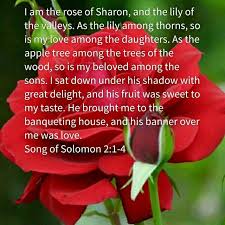
“As the lily among thorns, so is my love among the daughters” (Song 2.2). “Behold, thou art fair, my love; behold, thou art fair; thou hast doves’ eyes within thy locks: thy hair is as a flock of goats, that appear from mount Gilead” (4.1). The word “love” speaks of the bride, and “beloved” refers to the bridegroom in Song of Solomon. The Shulamite girl in Song of Solomon gave her heart to the shepherd. “As the apple tree among the trees of the wood, so is my beloved among the sons. I sat down under his shadow with great delight, and his fruit was sweet to my taste” (2.3). After she gave her heart to him, they were madly in love. “My beloved is mine, and I am his: he feedeth among the lilies” (2.16). They had a wonderful, personal relationship.

Song2.1-4One time he took her to dinner as he traveled through the country. “He brought me to the banqueting house, and his banner over me was love.” This shepherd spoken of in Song was a shepherd who did not have any sheep that she could see. “Tell me, O thou whom my soul loveth, where thou feedest, where thou makest thy flock to rest at noon: for why should I be as one that turneth aside by the flocks of thy companions” (1.7). Then one day he announced that he was going away but that he would return. “Let not your heart be troubled: ye believe in God, believe also in me. In my Father’s house are many mansions: if it were not so, I would have told you. I go to prepare a place for you. And if I go and prepare a place for you, I will come again, and receive you unto myself; that where I am, there ye may be also” (Jn. 14.1-3).

The days passed and she waited. Finally, her family and friends began to ridicule her. “Knowing this first, that there shall come in the last days scoffers, walking after their own lusts, And saying, Where is the promise of his coming? for since the fathers fell asleep, all things continue as they were from the beginning of the creation” (2 Pe. 3.3-4). Yet, she trusted him, loved him and dreamed of him. “By night on my bed I sought him whom my soul loveth: I sought him, but I found him not” (Song 3.1). Church, is this a picture of your love for our Savior? Do you long for him? Or do you occupy your time with another lover or lovers – the state of your incorporation, the federal government and your 501c3 status, your big buildings (a New Testament church, a heavenly spiritual organization, can own nothing), your security at the expense of Bible doctrine, etc.?

One night she lay restless upon her couch when she noticed a fragrance in the room. In that day it was a custom that a lover would put some myrrh or frankincense in the opening to the door handle. She smelled the perfume and went to the door. “I rose up to open to my beloved; and my hands dropped with myrrh, and my fingers with sweet smelling myrrh, upon the handles of the lock.” Notice that she was alone in her room when this happened – she was not with another lover.

Song2.8One day, she was working in the vineyard with the vines, putting rocks under the vines so that the little foxes would not get to the grapes. “Take us the foxes, the little foxes, that spoil the vines: for our vines have tender grapes.” While she was doing this, down the road there comes a pillar of smoke. “Who is this that cometh out of the wilderness like pillars of smoke, perfumed with myrrh and frankincense, with all powders of the merchant” (3.6). She is busy, and she does not know King Solomon. Someone tells her he is asking for her: “The voice of my beloved! behold, he cometh leaping upon the mountains, skipping upon the hills. My beloved is like a roe or a young hart: behold, he standeth behind our wall, he looketh forth at the windows, shewing himself through the lattice.  My beloved spake, and said unto me, Rise up, my love, my fair one, and come away” (2.8-10). This is the promise of the Lord Jesus. “My sheep hear my voice, and I know them, and they follow me: And I give unto them eternal life; and they shall never perish, neither shall any man pluck them out of my hand” (Jn. 10.27-28). “For the Lord himself shall descend from heaven with a shout, with the voice of the archangel, and with the trump of God: and the dead in Christ shall rise first: Then we which are alive and remain shall be caught up together with them in the clouds, to meet the Lord in the air: and so shall we ever be with the Lord” (1 Thes. 4.16-17). He promised to come again for us. “For, lo, the winter is past, the rain is over and gone; The flowers appear on the earth; the time of the singing of birds is come, and the voice of the turtle is heard in our land; The fig tree putteth forth her green figs, and the vines with the tender grape give a good smell. Arise, my love, my fair one, and come away” (Song 2.11-13).

By the way, how much is your church involved with the world? Do you use worldly ways to do the work of Christ? Is your church incorporated and thereby entwined with worldly rules for operating? Do you and your church submit to the rules of 501c3 in order to obtain worldly favor? Do you bring in people into your church who are not saved? Do you use non-Biblical methods to entertain them? After all, you can keep goats only if they are entertained. Does your church music and light shows put the best of nightclubs to shame. Do you need the help of the lost to pay your bills? Do you have a staff and employees? is your church run like a business. Is it incorporated? Does it have 501(c)(3) status?

Do you try to impress him with your worldly riches, possessions, methods, and alliances? “Many waters cannot quench love, neither can the floods drown it: if a man would give all the substance of his house for love, it would utterly be contemned.” “Contemned” means loathed, despised. God is not asking for our money, our service, and our methods. If we don’t love Him, He despises the so-called Christian work we try to do, our humanistic methods, our unholy affairs with civil government and others, and the money we give.

Song of Solomon, 2.16: “My beloved is mine, and I am his: he feedeth among the lilies.” This Song of Solomon expresses the highest spiritual state of the relationship between the Lord Jesus Christ and the believer. There is no other book of the Bible which portrays this relationship any better that this little book, and there is no higher plane than this right here: “My beloved is mine and I am his.” This is one of the deepest, most profound of all theological truths which our Lord Jesus Christ put into seven simple words: “Ye in me, and I in you” (John 14.20). The bride says, “My beloved is mine, and I am his.” The Lord Jesus said, in effect, ‘Down here I took your place when I died on the cross. I am in you. Now you are to show forth My life down here in this world.” Of course, we can only do that in the power of the Holy Spirit. But we are in him  up there–seated in the heavenlies, accepted in the Beloved, joined to Him, risen with Christ. “If ye then be risen with Christ, seek those things which are above, where Christ sittety on the right hand of God” (Colossians 3.1). How wonderful! Of, my friend, if you are a child of God, why don’t you tell Him that you love Him?

8.14One final note (from Dr. McGee). Song of Solomon 8:14 (the last verse in the book) “Make haste, my beloved, and be thou like to a roe or to a young hart upon the mountains of spices.” The bride is saying to the Lord of the vineyard “Return?” Over in the book of Revelation the last thing she says is ‘Even so, come Lord Jesus.’ My friend, I don’t believe you can honestly say that unless you know Him, unless you love Him, and unless you make Him known. Can you look up and say, ‘Come Lord Jesus, I want you to come’? Paul said that God will give a crown to those who love His appearing. And to love His appearing means to love Him—even as a bride eagerly anticipates and prepares for the coming of the bridegroom, her beloved.

“Let us conclude this marvelous Song of Solomon with the lines of Herbert:

“Come, Lord, my head doth burn, my heart is sick,
While thou  dost ever, ever stay:
Thy long deferrings wound me to the quick,
My Spirit gaspeth me night and day,
O show thyself to me,
Or take me up to thee!

“Yet if thou stayest still, why must I stay?
My God, what is this world to me?
This world of woe? hence all ye clouds, away!
Away! I must get up and see.
O show thyself to me,
Or take me up to thee!

“We talk of harvests; there are no such things,
But when we leave our corn and hay.
There is no fruitful year, but that which brings
The last and loved, though dreadful day.
O show thyself to me,
Or take me up to thee!”

A believer and a church cannot honestly say, “Return,” without loving Him, knowing Him. Loving and knowing Him means seeking to please Him with every bit of one’s existence. Forgive me when I make an application. A church who places herself under any head other than the Lord Jesus Christ (incorporates, gets 501c3 or 508 status, or becomes a legal entity in any way) or knowingly compromises her relationship with her betrothed in any manner does not know and love the Lord Jesus Christ.

“He is altogether lovely. This is my beloved, and this is my friend.”

Do you know of a church who loves the Lord Jesus?

Click the following for one of Dr. McGee’s great teachings from Song of Solomon: The Song of Christ’s Return; The Dove of the Clefts of the Rock. This teaching is from Song of Solomon 2.10-14. “Rise up, my love my fair one, and come away. For, lo, the winter is past, the rain is over and gone; The flowers appear on the earth; the time of the singing of birds is come, and the voice of the turtle is heard in our land. The fig tree putteth forth her green figs, and the vines with the tender grape give a good smell. Arise, my love, my fair one, and come away. O my dove, that art  in the clefts of the rock, in the secret places  of the stairs, let me see thy countenance, let me hear thy voice; for sweet is thy voice, and thy countenance is comely.”

Song 1

1.2There are five brief songs in the book. In the first song, the bride and bridegroom are together in a wonderful relationship. “Let him kiss me with the kisses of his mouth: for thy love is better than wine” (1.2). The kiss was the pledge of peace, a token of peace. Solomon’s name means peace. He was a prince of peace and ruled in Jerusalem, the city of peace. the Shulamite girl is the daughter of peace.

His Kiss

The kiss indicates the existence of a very personal, close relationship. Christ communicates His message to us through the Word of God. He speaks to our hearts through His Word. “Let him kiss me with the kisses of His mouth.” The one who has ears to hear and has heard Him speak peace—peace through the blood of His cross by forgiveness of sin—can take the next step. If you have been reconciled to God by redemption in Christ, He entreats the kiss of the solemn, nuptial covenant. It is the kiss which seals the marriage vow between Christ and the believer.

His Love

“For thy love is better than wine.” Wine speaks of that which brings the highest joy to the heart. “And be not drunk with wine, wherein is excess; but be filled with the Spirit” (Ep. 5.18). This is talking about something that we know little about. We play at church. We talk about being dedicated Christians simply because we are busy as termites, and often have the same effect. We need to come to Peter’s attitude when he wrote: “Whom having not seen, ye love; in whom, though now ye see him not, yet believing, ye rejoice with joy unspeakable and full of glory” (1 Peter 1.8). “Although the fig tree shall not blossom, neither shall fruit be in the vines; the labour of the olive shall fail, and the fields shall yield no meat; the flock shall be cut off from the fold, and there shall be no herd in the stalls:  Yet I will rejoice in the LORD, I will joy in the God of my salvation” (Hab. 3.17-18).

“Because of the savour of thy good ointments thy name is as ointment poured forth, therefore do the virgins love thee” (Song 1.3). The ointment is the perfume. When Christ began His life on earth, myrrh was brought to Him as a gift. When he died, myrrh was brought to put on His body. There was a fragrance in His entire life on earth from His birth to His death. Oh, the fragrance of His love for us when He died upon the cross!

His Drawing Power

“Draw me, we will run after thee: the king hath brought me into his chambers: we will be glad and rejoice in thee, we will remember thy love more than wine: the upright love thee” (1.4). This is the expression of one who is in love with Christ, who desires a close relationship with Him. We say, “Draw me,” because we cannot attain that state. If you are a child of God and have never experienced that wonderful relationship, then listen to the bride, and give her response, “Draw me.” God will answer your cry.

We did not seek after god. God sought after us. “No man can come to me, except the Father which hath sent me draw him: and I will raise him up at the last day” (Jn. 6.44). Jesus said to His own, “Ye have not chosen me, but I have chosen you, and ordained you, that ye should go and bring forth fruit, and that your fruit should remain: that whatsoever ye shall ask of the Father in my name, he may give it you.” (Jn. 15.16). We need the Spirit of God to give us the Water of Life.

“We will run after thee.” We want to run after Him, but He will have to give us the legs to do it. He must give us that enablement, that divine enablement. He must draw us. “Wherefore seeing we also are compassed about with so great a cloud of witnesses, let us lay aside every weight, and the sin which doth so easily beset us, and let us run with patience the race that is set before us, Looking unto Jesus the author and finisher of our faith; who for the joy that was set before him endured the cross, despising the shame, and is set down at the right hand of the throne of God.” (Heb. 12.1-2). “But they that wait upon the LORD shall renew their strength; they shall mount up with wings as eagles; they shall run, and not be weary; and they shall walk, and not faint.” (Is. 40.31).

His Chambers

When we cry “Draw me, we will run after thee,” He responds—“the king hath brought me into his chambers.” The chamber is the secret of His presence, His pavilion. It is the secret place away from the noise of the crowd. It is like Christ’s invitation: “Behold, I stand at the door, and knock: if any man hear my voice, and open the door, I will come in to him, and will sup with him, and he with me” (Re. 3.20).

We withdraw and cry out with Isaiah, “Then said I, Woe is me! for I am undone; because I am a man of unclean lips, and I dwell in the midst of a people of unclean lips: for mine eyes have seen the King, the LORD of hosts” (Is. 6.5). But “the king hath brought me into His chambers”—He provided a redemption. He made the supreme sacrifice.

Believers need more joy in their churches and lives. “The thief cometh not, but for to steal, and to kill, and to destroy: I am come that they might have life, and that they might have it more abundantly” (Jn. 10.10). “And these things write we unto you, that your joy may be full” (1 Jn. 1.4).

God wants to make love real to us. He wants to manifest His love to us. That is a lot better than crawling up on a bar stool. “And be not drunk with wine, wherein is excess; but be filled with the Spirit; Speaking to yourselves in psalms and hymns and spiritual songs, singing and making melody in your heart to the Lord” (Ep. 5.18). “We will be glad and rejoice in thee, we will remember thy love more than wine.

The upright love thee.” The upright are those who belong to Him. They have said, “Draw me.” They are to run to the race of life, looking for Jesus, the author and finisher of their faith.

The Christian life is a love affair. We love him because He first loved us enough to give Himself for us. If you don’t love Him, be honest and chuck the whole thing because it is all meaningless. The believer’s loving response is, “O God, thou art my God; early will I seek thee: my soul thirsteth for thee, my flesh longeth for thee in a dry and thirsty land, where no water is” (Ps. 63.1). “To see thy power and thy glory, so as I have seen thee in the sanctuary” (Ps. 63.2). This is the bride’s secret place of communion. “Because thy lovingkindness is better than life, my lips shall praise thee. Thus will I bless thee while I live: I will lift up my hands in thy name. My soul shall be satisfied as with marrow and fatness; and my mouth shall praise thee with joyful lips” (Ps. 63.3-5). “Because thou hast been my help, therefore in the shadow of thy wings will I rejoice” (Ps. 63.7). “O Jerusalem, Jerusalem, thou that killest the prophets, and stonest them which are sent unto thee, how often would I have gathered thy children together, even as a hen gathereth her chickens under her wings, and ye would not” (Mt. 23.37)! This is a great picture of His love and the great desire to protect the helpless ones from harm.

The Sunburned Slave Girl

I am black but comely, O he daughers of Jerusalem, as the tents of Kedar, as the curtains of Solomon. Look not upon me, because I am black, because the sun hath looked upon me: my mother’s children were angry with me; they made me the keeper of the vineyards; but mine own vineyard have I not kept” (Song 1.5-6). She is sunburned, but beautiful. Black is beautiful when the heart is right with the Lord. No one can come into the holy presence of God without the covering of the righteousness of Christ to protect him.

We are ugly; we are sunburned. We are not attractive to Him as we are, but He says that He is going to make us His beautiful bride. That is the beautiful picture given to us in Ephesians 5. “Husbands, love your wives, even as Christ also loved the church, and gave himself for it; That he might sanctify and cleanse it with the washing of water by the word, That he might present it to himself a glorious church, not having spot, or wrinkle, or any such thing; but that it should be holy and without blemish” (Ep. 5.25-27). Many believers do not wash themselves in His word. Pastors and churches, for example, do not study and apply the Bible doctrines of church and separation of church and state.

The Pasture

I offer the above study to demonstrate the application of the book as to the relationship between Christ and his churches. For a full study, see Ecclesiastes & Song of Solomon by Dr. J. Vernon McGee which is online in audio form at: http://www.oneplace.com/ministries/thru-the-bible-with-j-vernon-mcgee/series/. Most of these studies were taken from Dr. McGee’s teachings.-

Lesson 6 on Colossians: Christ the Head of the Local Church

Christ, the fullness of God, poured out in life through believers, Chapters 3 and 4.
Living of Believers is Holy – Colossians 3.5-4.6
Fellowship of Believers Is Hearty – Colossians 4.7-18
(26 questions with answers following)
Added on  May 15, 2017

Click here to go to the “Bible Studies on the Doctrine of the Church” (Has links to all lessons)
This is the last lesson on Colossians

Answers at the end, following the questions. Those who disagree with anything please see the note at the end. Reasoned dialogue is encouraged and any Bible or fact based comments, if made in a Christian manner in an attempt to get to the truth will be considered.

This is an open book quiz meant to challenge the Bible believer – the saved person who believes the Word of God rather than the person who tries to fit particular Scriptures into a system of interpretation meant to validate one’s desired view of how things should be by philosophizing, allegorizing, or spiritualizing chosen Scriptures. The literal meaning, taken in its immediate context and within the context of all related Scripture is the basis for these studies. It is presented for the glory of God.

Colossians directs our attention to the head of the body who is Christ. The body itself is secondary. Christ is the theme. He is the center of the circle around which all Christian living revolves. Christ is the fullness of God. The dominating thought is that Christ is all I need; He is everything. He is the primary object, and the thought passes downward to the church as the body of Christ.

Colossians was written to the local church at Colosse (with the principles to be applied by all local churches and believers) to counteract the heresy of Gnosticism, the first heresy in the church. There were many forms of Gnosticism, and in Colosse there were the Essenes. There are three points of identification for this group: (1) They had an exclusive spirit. They felt that they were the people—they had knowledge in the jug and held the stopper in their hands. Thus, they felt that they were super-duper in knowledge and knew more than anyone else, including the Apostles. (2) They held speculative tenets on creation. They taught that God did not create the universe directly, but created a creature who in turn created another creature, until one finally created the physical universe. Christ was considered a creature in this long series of creations.  Paul refutes this in Colossians 1:15-19. (3) They practiced asceticism and unrestrained licentiousness. They got the asceticism from the influence of Greek Stoicism and the unrestrained licentiousness from the influence of Greek Epicureanism. Paul refutes this in Colossians 2.16, 23 and 3.5-9.

See, J. Vernon McGee, Colossians for more on this.

Christ, the fullness of God, poured out in life through believers, Chapters 3 and 4.

Colossians 3.5-4.6 is to lengthy to reproduce

Questions:

Christ, the fullness of God, poured out in life through believers, Chapters 3 and 4.
Review the answers to some of the more
difficult fill in the blank questions before attempting to answer:

Colossians 3.5-4.6: Living of Believers is Holy

  1. If we are truly risen with Christ this will be evident in ______ area(s) of our lives which (is)(are):

    a, our personal holiness
    b. our fellowship with others who are about us
    c. our friendship with the world
    d. a and b (a. our personal holiness; b. our fellowship with others who are about us)
  2. Colossians 3.5 tells believers to mortify certain sins. Mortify means to put to _______. Fornication means sexual _____________. Other sins listed in verse 5 are ______________ (includes thoughts, words, gestures, and bad jokes); _____________ ____________ (uncontrolled passion or lust); evil concupiscence (evil desires); and covetousness which is idolatry (wanting more or wanting what belongs to others). “The ______ of money is the root of all evil” (1 Timothy 6.10).
  3. Those things in verse 6 bring “the _______ of God on the children of _______________.” Believers walked in the sins above before they were ________. (See Colossians 3.6-7).
  4. Believers also put off ________ (over the wrong things; some anger is justified), ________ (anger that becomes an unforgiving spirit), _________ (and that tries to take revenge and get even), ____________ (defaming the name of God (blasphemy against God); lying about someone else (blasphemy against another person), _________ ________________ out of their mouths (foul communication that is abusive or filthy). (See verse 8).
  5. The church at Colosse had put off the _____ _____ with his deeds and put on the “_____ _____ which is renewed in knowledge after the image of _____ that created him” (Colossians 3.9-10).
  6. “Where there is neither ________ nor _____, _______________ nor ________________, Barbarian, Scythian, bond nor free: but ________ is all, and in all” (Colossians 3.11).
  7. In the doctrinal section of Colossians, we learned that Christ is the fullness of ______ and head of His ___________. Believers have been made complete in _____, not in any man-made legal or philosophical __________.
  8. Colossians 3.12-17 teaches us that, since we have risen with Christ, it will lead us to holiness in our relationship to _________. Verses 18-21 deal with holiness in the _______. Verses 22-25 and Chapter 4, verse 1deal with holiness on the _____. Paul deals with the same things that he dealt with in Ephesians.

    Many questions could be added on all those verses. However, churches would be advised to study those verses out for themselves. Following are just a few questions.
  9. __________ is the bond of perfectness. The believers at Colosse are called in one _______ (as is every New Testament church). The word of ________ is to dwell in them richly and they are to ________ and ___________ one another in ________ and ________ and spiritual _______. The new man in holiness is exhibited to ________, in the ______, and on the _____ as these verses point out. “Ye serve the ______ ________.”
  10. Chapter 4, verses 2-6 present more important areas of Christian conduct. They are:

    a. prayer
    b. public walk
    c. speech
    d. all of the above
    e. a and c
  11. As Colossians 4.2 makes clear, _________ and ___________ go together. “Nevertheless we made our ________ unto our God, and set a ________ against them day and night, because of them” (Nehemiah 4:9). Watch and pray with _______________.
  12. Pray that God will open unto us (every believer) “a ______ of utterance, to speak the mystery of Christ” (Colossians 4.3, 4). Every believer should seek an open ______ to serve the Lord. “Redeeming the ______” (Colossians 4.5). When the ___________ sees an opportunity to serve the Lord, when a door is opened, he should pray that the Lord will _______
  13. The believer’s speech is to be “always with ________, seasoned with _______, that ye may know how ye ought to answer every _____.”

    Fellowship of Believers Is Hearty (Colossians 4.7-18).
  14. In Colossians 4.7-18, we come to a list of ________ of people whom Paul knew. They were in the midst of ___________, but they were   Paul had a tremendous, far-reaching ministry. Many of the people named here lived in Ephesus. Paul had never been to Rome nor had he been to Colosse, yet he lists people he knew, many of whom were from those two cities. This indicates that he had led many people to Christ who returned home to cities he was never able to reach directly or personally.
  15. ___________” was the pastor of the church in _________ (See Ephesians 6.21, Acts 20.4, 1n3 2 Timothy 4.12)..
  16. ___________” was a slave of ___________ in __________. He had run away from his master, and Paul led him to the Lord. He was now being sent back. Paul calls ___________ his “___________ and __________
  17. ______________” was a _________ __________ with Paul, and he was his friend.
  18. _________” is John _______, the nephew of Barnabas—the son of his sister. He is the writer of the Gospel of ______. ______ left Paul and Barnabas on their first missionary journey, and because of this Paul did not want to take him along on the second missionary journey. Paul was wrong in his judgment of ______ ______, who made good. Paul acknowledges that here (“__________ him”). Paul mentions John Mark again in his second letter to Timothy: “Take Mark, and bring him with thee: for he is ______________ to me for the ministry” (2 Timothy 4:11).
  19. ________ (Justus) was Jewish (of the _______________). The Colossian church was mostly __________, but there were a few Jews in that church. These men are wonderful brethren, helpers of _______, and great missionaries themselves.
  20. ____________ was the pastor in __________. Now he is in prison. His new ministry there is _________.
  21. __________, ___________, and _____________, are close together.
  22. _______ is the beloved physician. When Paul first mentioned Demas (Philemon 1.24), he called him a “_________________.” Later on, _______, will ___________
  23. ______________, at that time, met in _________ (see verse 15). Churches started in the home. True churches are going to come back to the ________, as they have in many countries where they are persecuted.
  24. These epistles of Paul are to be __________ by the churches (See verse 16. Paul does not say that he had written an epistle to the Laodiceans. The letters of Paul were being circulated around.)
  25. We do not know anything more about “______________” than is mentioned here. But the Lord had given him a ____________ and Paul urges him to fulfill it. This advice can be extrapolated to everyone to whom the Lord has given a ___________. Of course, if possible, that ministry is to be fulfilled under the authority of a local New Testament ________.
  26. For the second time Paul says, “Remember my ________—or pray for me. “________ be with you. Amen.” Paul wrote to a church he had never __________, but he knew many of the people and led them to knowledge of the _______ _________ ___________.

Answers

Colossians 3.5-4.6: Living of Believers is Holy

  1. If we are truly risen with Christ this will be evident in two area(s) of our lives which (is)(are):

    d. a and b (a. our personal holiness; b. our fellowship with others who are about us)
  2. Colossians 3.5 tells believers to mortify certain sins. Mortify means to put to death. Fornication means sexual immorality. Other sins listed in verse 5 are uncleanness (includes thoughts, words, gestures, and bad jokes); inordinate affection (uncontrolled passion or lust); evil concupiscence (evil desires); and covetousness which is idolatry (wanting more or wanting what belongs to others). “The love of money is the root of all evil” (1 Timothy 6.10).
  3. Those things in verse 6 bring “the wrath of God on the children of disobedience.” Believers walked in the sins above before they were saved. (See Colossians 3.6-7).
  4. Believers also put off anger (over the wrong things; some anger is justified), wrath (anger that becomes an unforgiving spirit), malice (and that tries to take revenge and get even), blasphemy (defaming the name of God (blasphemy against God); lying about someone else (blasphemy against another person), filthy communication out of their mouths (foul communication that is abusive or filthy). (See verse 8).
  5. The church at Colosse had put off the old man with his deeds and put on the “new man which is renewed in knowledge after the image of him that created him” (Colossians 3.9-10).
  6. “Where there is neither Greek nor Jew, circumcision nor uncircumcision, Barbarian, Scythian, bond nor free: but Christ is all, and in all” (Colossians 3.11).
  7. In the doctrinal section of Colossians, we learned that Christ is the fullness of God and head of His churches. Believers have been made complete in Him, not in any man-made legal or philosophical system.
  8. Colossians 3.12-17 teaches us that, since we have risen with Christ, it will lead us to holiness in our relationship to others. Verses 18-21 deal with holiness in the home. Verses 22-25 and Chapter 4, verse 1deal with holiness on the job. Paul deals with the same things that he dealt with in Ephesians.

    Many questions could be added on all those verses. However, churches would be advised to study those verses out for themselves. Following are just a few questions.
  9. Charity is the bond of perfectness. The believers at Colosse are called in one body (as is every New Testament church). The word of Christ is to dwell in them richly and they are to teach and admonish one another in psalms and hymns and spiritual songs. The new man in holiness is exhibited to others, in the home, and on the job as these verses point out. “Ye serve the Lord Christ.”
  10. Chapter 4, verses 2-6 present more important areas of Christian conduct. They are:

    d. all of the above (prayer, public walk, speech)
  11. As Colossians 4.2 makes clear, prayer and watching go together. “Nevertheless we made our prayer unto our God, and set a watch against them day and night, because of them” (Nehemiah 4:9). Watch and pray with thanksgiving.
  12. Pray that God will open unto us (every believer) “a door of utterance, to speak the mystery of Christ” (Colossians 4.3, 4). Every believer should seek an open door to serve the Lord. “Redeeming the time” (Colossians 4.5). When the believer sees an opportunity to serve the Lord, when a door is opened, he should pray that the Lord will lead
  13. The believer’s speech is to be “always with grace, seasoned with salt, that ye may know how ye ought to answer every man.”

    Fellowship of Believers Is Hearty (Colossians 4.7-18).
  14. In Colossians 4.7-18, we come to a list of names of people whom Paul knew. They were in the midst of paganism, but they were   Paul had a tremendous, far-reaching ministry. Many of the people named here lived in Ephesus. Paul had never been to Rome nor had he been to Colosse, yet he lists people he knew, many of whom were from those two cities. This indicates that he had led many people to Christ who returned home to cities he was never able to reach directly or personally.
  15. Tychicus” was the pastor of the church in Ephesus (See Ephesians 6.21, Acts 20.4, 1n3 2 Timothy 4.12)..
  16. Onesimus” was a slave of Philemon in Colosse. He had run away from his master, and Paul led him to the Lord. He was now being sent back. Paul calls Onesimus his “faithful and beloved
  17. Aristarchus” was a fellow prisoner with Paul, and he was his friend.
  18. Marcus” is John Mark, the nephew of Barnabas—the son of his sister. He is the writer of the Gospel of Mark. Mark left Paul and Barnabas on their first missionary journey, and because of this Paul did not want to take him along on the second missionary journey. Paul was wrong in his judgment of John Mark, who made good. Paul acknowledges that here (“receive him”). Paul mentions John Mark again in his second letter to Timothy: “Take Mark, and bring him with thee: for he is profitable to me for the ministry” (2 Timothy 4:11).
  19. Jesus (Justus) was Jewish (of the circumcision). The Colossian church was mostly Gentile, but there were a few Jews in that church. These men are wonderful brethren, helpers of Paul, and great missionaries themselves.
  20. Epaphras was the pastor in Colosse. Now he is in prison. His new ministry there is prayer.
  21. Colosse, Laodicea, and Hierapolis, are close together.
  22. Luke is the beloved physician. When Paul first mentioned Demas (Philemon 1.24), he called him a “fellowlaborer.” Later on, Demas, will forsake
  23. Christians, at that time, met in homes (see verse 15). Churches started in the home. True churches are going to come back to the home, as they have in many countries where they are persecuted.
  24. These epistles of Paul are to be shared by the churches (See verse 16. Paul does not say that he had written an epistle to the Laodiceans. The letters of Paul were being circulated around.)
  25. We do not know anything more about “Árchippus” than is mentioned here. But the Lord had given him a ministry and Paul urges him to fulfill it. This advice can be extrapolated to everyone to whom the Lord has given a ministry. Of course, if possible, that ministry is to be fulfilled under the authority of a local New Testament church.
  26. For the second time Paul says, “Remember my bonds—or pray for me. “Grace be with you. Amen.” Paul wrote to a church he had never visited, but he knew many of the people and led them to knowledge of the Lord Jesus Christ.

Should you disagree with an answer given, please explain why you disagree in the comment section below the article. All reasoned comments will be published, perhaps with reply. The purpose of this website is the Glory of God. God cannot be glorified by shutting out honest disagreement in the search for truth. The author would be interested in your explanation. The comments are required by the website to be approved or disapproved. The author is very busy with many matters and may or may not immediately notice your comment. He will address it as soon as he notices it. He almost always approves comments presented with a godly spirit. He never alters comments. Sometimes, he replies to comments.

Lesson 5 on Colossians: Christ the Head of the Local Church

Christ the Answer to Ritual (For the Heart) – Colossians 2.16-23
Christ, the fullness of God, poured out in life through believers, Chapters 3 and 4.

Colossians 3.1-4: Thoughts and Affections of Believers are Heavenly
(18 questions with answers following)
Added on  May 11, 2017

Click here to go to the “Bible Studies on the Doctrine of the Church” (Has links to all lessons)
Click here to go to Lesson 6

Answers at the end, following the questions. Those who disagree with anything please see the note at the end. Reasoned dialogue is encouraged and any Bible or fact based comments, if made in a Christian manner in an attempt to get to the truth will be considered.

This is an open book quiz meant to challenge the Bible believer – the saved person who believes the Word of God rather than the person who tries to fit particular Scriptures into a system of interpretation meant to validate one’s desired view of how things should be by philosophizing, allegorizing, or spiritualizing chosen Scriptures. The literal meaning, taken in its immediate context and within the context of all related Scripture is the basis for these studies. It is presented for the glory of God.

Colossians directs our attention to the head of the body who is Christ. The body itself is secondary. Christ is the theme. He is the center of the circle around which all Christian living revolves. Christ is the fullness of God. The dominating thought is that Christ is all I need; He is everything. He is the primary object, and the thought passes downward to the church as the body of Christ.

Colossians was written to the local church at Colosse (with the principles to be applied by all local churches and believers) to counteract the heresy of Gnosticism, the first heresy in the church. There were many forms of Gnosticism, and in Colosse there were the Essenes. There are three points of identification for this group: (1) They had an exclusive spirit. They felt that they were the people—they had knowledge in the jug and held the stopper in their hands. Thus, they felt that they were super-duper in knowledge and knew more than anyone else, including the Apostles. (2) They held speculative tenets on creation. They taught that God did not create the universe directly, but created a creature who in turn created another creature, until one finally created the physical universe. Christ was considered a creature in this long series of creations.  Paul refutes this in Colossians 1:15-19. (3) They practiced asceticism and unrestrained licentiousness. They got the asceticism from the influence of Greek Stoicism and the unrestrained licentiousness from the influence of Greek Epicureanism. Paul refutes this in Colossians 2.16, 23 and 3.5-9.

See, J. Vernon McGee, Colossians for more on this.

Colossians 2.16-23 [Christ, the Answer to Philosophy (For the Head):] “16 Let no man therefore judge you in meat, or in drink, or in respect of an holyday, or of the new moon, or of the sabbath days: 17 Which are a shadow of things to come; but the body is of Christ. 18 Let no man beguile you of your reward in a voluntary humility and worshipping of angels, intruding into those things which he hath not seen, vainly puffed up by his fleshly mind, 19 And not holding the Head, from which all the body by joints and bands having nourishment ministered, and knit together, increaseth with the increase of God. 20 Wherefore if ye be dead with Christ from the rudiments of the world, why, as though living in the world, are ye subject to ordinances, 21 (Touch not; taste not; handle not; 22 Which all are to perish with the using;) after the commandments and doctrines of men? 23 Which things have indeed a shew of wisdom in will worship, and humility, and neglecting of the body; not in any honour to the satisfying of the flesh.”

Christ, the fullness of God, poured out in life through believers, Chapters 3 and 4.

Colossians 3.1-4: Thoughts and Affections of Believers are Heavenly: “1 If ye then be risen with Christ, seek those things which are above, where Christ sitteth on the right hand of God. 2 Set your affection on things above, not on things on the earth. 3 For ye are dead, and your life is hid with Christ in God. 4 When Christ, who is our life, shall appear, then shall ye also appear with him in glory.”

Questions:

Christ, the Answer to Ritual 2.16-23
Review the answers to some of the more
difficult fill in the blanks before attempting to answer:

  1. God gave his people in the Old Testament ______________ that are only _________ (a religious or solemn ceremony consisting of a series of actions performed according to a prescribed order.) and liturgical (relating to a form or formulary according to which public religious worship is conducted). Paul explains that those were merely “a ________ of things to come” (verse 17). They were pictures of ________. Since ________ has come, there is no need to go back to the picture. “To whom God would make known what is the riches of the glory of this mystery among the Gentiles; which is ________ in you, the ______ of glory” (Colossians 1:27).
  2. Colossians 2.18, 19 is a warning against mysticism (belief that union with or absorption into the Deity or the absolute, or the spiritual apprehension of knowledge inaccessible to the intellect, may be attained through contemplation and self-surrender). Paul here is condemning the Gnostics who made a pretense of _________. Today, some in churches assume a pious _______________. They are “spiritual snobs.” These people, generally, are very ignorant of the ________. “____________ into those things which he hath not seen.” That is a pretense, putting on, _________ like you have something that you don’t really have.
  3. “And not holding the Head” means that their head is not screwed on. Such people have

    a. a loose relationship with Christ
    b. psychological problems
    c. both a and b
    d. neither a nor b
  4. Those spoken of in the question 3, are not “holding the ______, from which all the ______ by joints and bands having nourishment ministered, and knit ___________, increaseth with the increase of God” (Colossians 2:19). What a description!
  5. Colossians 2.20-23 is against the error of asceticism (severe self-discipline and avoidance of all forms of indulgence, typically for religious reasons). Here, Paul says “if ye be _______ with Christ.” In other words, since you have died when ________ died, do not return to pre-________ religious living. What we are dealing with here is the pride that apes (imitates in behavior) ___________.” “I deny myself, and I don’t do these things. Just look at me. I’m sprouting wings.”

Christ, the fullness of God, poured out in life through believers, Chapters 3 and 4.
Colossians 3.1-4: Thoughts and Affections of Believers are Heavenly

  1. Chapters 3 and 4 are the practical section of Colossians. In chapters 1 and 2 we saw the preeminence of Christ. We saw Him as who He is, a member of the __________. He is very man of very _____, but He is very God of very _____. He is preeminent in creation because He is the __________. He is preeminent in redemption because He is the ___________. He is preeminent in the churches because He is the One who gave Himself for the _________. Now we come to the place where God, through Paul, insists that He must be made _____________ in our lives.
  2. So far, in Colossians, Paul has discussed the different things that lead people away from ________. The Christian life is to live out the life of ________. ________ ________ is all we need. This practical section shows the believer ________, the fullness of _____, poured out in life through ____________—that is the only way He can be poured out.
  3. The “if” of Colossians 3.1, was, like the “if” of Colossians 1.23, the “if” of argument, not the if of condition. The Colossian believers had risen with ________. Their lives evidenced their ____________.
  4. The fruit of the Spirit was in their lives. The evidence of their salvation was (See Colossians 1.4, 5)

    a. their faith
    b. their hope (the coming of the Lord Jesus)
    c. their love
    d. all of the above
    e. b and c
  5. They showed their ______ they had for all the saints (See Colossians 1.4). A practical example is a church member’s ______ for the other church members. He shows that ______ by supporting the Bible ministries of the pastor and other church members, by supporting the church which is the whole body of believers and every member of the church. A pastor, for example, shows his ______ for the church member by edifying each church member and by supporting and encouraging each member in their ministries. All bestowing the most honor on the least honorable.

    1 Corinthians 12:22-26: “22 Nay, much more those members of the ______, which seem to be more feeble, are ____________: 23 And those members of the ______, which we think to be less honourable, upon these we bestow more abundant honour; and our uncomely parts have more abundant comeliness. 24 For our comely parts have no need: but God hath tempered the body together, having given more abundant honour to that part which lacked: 25 That there should be no schism in the body; but that the members should have the same care one for another. 26 And whether one member suffer, all the members suffer with it; or one member be honoured, all the members rejoice with it.

    Thus, every church member is to recognize not only his own part, but also the part of every other member of the local church ______, putting all others in the local church ______ before __________ and before every one who is not in the local church _______. The member who is not a pastor is to primarily support and promote his pastor, not some other pastor; he is to first support the other members of his church ______ and their gifts, not those of outsiders, whether believer or not. One is not to grieve his pastor by giving his primary adulation, attention, and support to some other pastor or teacher. Likewise, a pastor who honors New Testament church doctrine will give his first support, attention, consideration, and promotion to the members of his church _______, not to pastors, teachers, believers, and others who are not a part of the local church ______ which ________ made him a part of—there is no universal ________ at this time. Yes, he is to love everyone, and every believer. He can glean from others. However, his first and primary love, consideration, and support is to be given the other members of his church ______, ________ being the head. God gave very special rules for the local church ______. “That there should be no ________ in the body; but that the members should have the same ______ one for another.” Ephesians emphasizes that the local church is a spiritual ______. That ______ can become the victim of self-inflicted disease caused by lack of love by members of the church body. 1 Corinthians 13 teaches on God’s love (_________); the context is the church body and the gifts of the body—1 Corinthians 12. Of course, that love is to extend to everyone, but the body is the focus and primary. Others outside the local body are not part of the same spiritual ______, not part of the same organism. It would be wise to notice that every church body is not a ____________ organism only; many are either worldly organizations or hybrids, part __________ and part ____________. Everyone who is a member of a church is a member of one of these types of ___________. It is wise to consider that aspect of every believer, pastor, and teacher. Any pastor, teacher, or other believer who knows the Bible doctrines of church, state, and separation of church and state and leaves the church he is a member of in a compromised state does not love His Lord with all his ________, ______, mind and ___________. Such a believer is partly (or maybe wholly) ____________ at the very least and is not to be applauded by other believers. By compromised state is meant, the state of being a _________ entity such as a corporation, 501c3 or 508 tax exempt religious organization.
  6. In verse 1, the believer is told to “_______ those things which are above.” Where is Christ today?

    a. on earth
    b. in the grave
    c. sitting on the right hand of God
    d. none of the above
  7. Where is the believer to set his affections?

    a. on things on the earth
    b. on things above (the things of Christ)
    c. on things below
    d. both a and b
  8. “If ye then be risen with Christ, seek those things which are _______, where ________ sitteth on the right hand of _____ (Colossians 3:1).
  9. “Set your affection on things ________, not on things on the ________ (Colossians 3:2).
  10. ______ and set your ____________ on the things of Christ. The things of Christ are ______, _________, ______, ______, _________, and of ______ _________ (See Philippians 4.8).
  11. “For ye are ______, and your life is hid with ________ in _____” (Colossians 3:3).
  12. When does a believer die? Give a Bible explanation for your answer.

    a. when his body ceases to function
    b. when he gives up
    c. when he is crucified
    d. a and c
  13. Whose life is the life of the believer? Give a Bible explanation of your answer.

    a. that of his family
    b. his own
    c. Christ’s life
    d. that of his country

Answers

Christ, the Answer to Ritual 2.16-23:

  1. God gave his people in the Old Testament ordinances that are only ritual (a religious or solemn ceremony consisting of a series of actions performed according to a prescribed order.) and liturgical (relating to a form or formulary according to which public religious worship is conducted). Paul explains that those were merely “a shadow of things to come” (verse 17). They were pictures of Christ. Since Christ has come, there is no need to go back to the picture. “To whom God would make known what is the riches of the glory of this mystery among the Gentiles; which is Christ in you, the hope of glory” (Colossians 1:27).
  2. Colossians 2.18, 19 is a warning against mysticism (belief that union with or absorption into the Deity or the absolute, or the spiritual apprehension of knowledge inaccessible to the intellect, may be attained through contemplation and self-surrender). Paul here is condemning the Gnostics who made a pretense of wisdom. Today, some in churches assume a pious superiority. They are “spiritual snobs.” These people, generally, are very ignorant of the Bible. “Intruding into those things which he hath not seen.” That is a pretense, putting on, acting like you have something that you don’t really have.
  3. “And not holding the Head” means that their head is not screwed on. Such people have

    a. a loose relationship with Christ
  4. Those spoken of in the question 3, are not “holding the Head, from which all the body by joints and bands having nourishment ministered, and knit together, increaseth with the increase of God” (Colossians 2:19). What a description!
  5. Colossians 2.20-23 is against the error of asceticism (severe self-discipline and avoidance of all forms of indulgence, typically for religious reasons). Here, Paul says “if ye be dead with Christ.” In other words, since you have died when Christ died, do not return to pre-Christ religious living. What we are dealing with here is the pride that apes (imitates in behavior) humility.” “I deny myself, and I don’t do these things. Just look at me. I’m sprouting wings.”

Christ, the fullness of God, poured out in life through believers, Chapters 3 and 4.
Colossians 3.1-4: Thoughts and Affections of Believers are Heavenly

  1. Chapters 3 and 4 are the practical section of Colossians. In chapters 1 and 2 we saw the preeminence of Christ. We saw Him as who He is, a member of the Trinity. He is very man of very man, but He is very God of very God. He is preeminent in creation because He is the Creator. He is preeminent in redemption because He is the Redeemer. He is preeminent in the churches because He is the One who gave Himself for the church. Now we come to the place where God, through Paul, insists that He must be made preminent in our lives.
  2. So far, in Colossians, Paul has discussed the different things that lead people away from Christ. The Christian life is to live out the life of Christ. Christ Jesus is all we need. This practical section shows the believer Christ, the fullness of God, poured out in life through believers—that is the only way He can be poured out.
  3. The “if” of Colossians 3.1, was, like the “if” of Colossians 1.23, the “if” of argument, not the if of condition. The Colossian believers had risen with Christ. Their lives evidenced their salvation.
  4. The fruit of the Spirit was in their lives. The evidence of their salvation was (See Colossians 1.4, 5)

    d. all of the above (a. their faith, b. their hope (the coming of the Lord Jesus), c. their love)
  5. They showed their love they had for all the saints (See Colossians 1.4). A practical example is a church member’s love for his pastor and the other church members. He shows that love by supporting the Bible ministries of the pastor and other church members, by supporting the church which is the whole body of believers and every member of the church. A pastor, for example, shows his love for the church member by edifying each church member and by supporting and encouraging each member in their ministries. All bestowing the most honor on the least honorable.

    1 Corinthians 12:22-26: “22 Nay, much more those members of the body, which seem to be more feeble, are necessary: 23 And those members of the body, which we think to be less honourable, upon these we bestow more abundant honour; and our uncomely parts have more abundant comeliness. 24 For our comely parts have no need: but God hath tempered the body together, having given more abundant honour to that part which lacked: 25 That there should be no schism in the body; but that the members should have the same care one for another. 26 And whether one member suffer, all the members suffer with it; or one member be honoured, all the members rejoice with it.

    Thus, every church member is to recognize not only his own part, but also the part of every other member of the local church body, putting all others in the local church body before himself and before every one who is not in the local church body. The member who is not a pastor is to primarily support and promote his pastor, not some other pastor; he is to first support the other members of his church body and their gifts, not those of outsiders, whether believer or not. One is not to grieve his pastor by giving his primary adulation, attention, and support to some other pastor or teacher. Likewise, a pastor who honors New Testament church doctrine will give his first support, attention, consideration, and promotion to the members of his church body, not to pastors, teachers, believers, and others who are not a part of the local church body which Christ made him a part of—there is no universal church at this time. Yes, he is to love everyone, and every believer. He can glean from others. However, his first and primary love, consideration, and support is to be given the other members of his church body, Christ being the head. God gave very special rules for the local church body. “That there should be no schism in the body; but that the members should have the same care one for another.” Ephesians emphasizes that the local church is a spiritual body. That body can become the victim of self-inflicted disease caused by lack of love by members of the church body. 1 Corinthians 13 teaches on God’s love (charity); the context is the church body and the gifts of the body—I Corinthians 12. Of course, that love is to extend to everyone, but the body is the focus and primary. Others outside the local body are not part of the same spiritual body, not part of the same organism. It would be wise to notice that every church body is not a spiritual organism only; many are either worldly organizations or hybrids, part worldly and part spiritual. Everyone who is a member of a church is a member of one of these types of churches. It is wise to consider that aspect of every believer, pastor, and teacher. Any pastor, teacher, or other believer who knows the Bible doctrines of church, state, and separation of church and state and leaves the church he is a member of in a compromised state does not love His Lord with all his heart, soul, mind and strength. Such a believer is partly (or maybe wholly) worldly at the very least and is not to be applauded by other believers. By compromised state is meant, the state of being a legal entity such as a corporation, 501c3 or 508 tax exempt religious organization.
  6. In verse 1, the believer is told to “seek those things which are above.” Where is Christ today?

    c. sitting on the right hand of God
  7. Where is the believer to set his affections?

    b. on things above (the things of Christ)
  8. “If ye then be risen with Christ, seek those things which are above, where Christ sitteth on the right hand of God (Colossians 3:1).
  9. “Set your affection on things above, not on things on the earth (Colossians 3:2).
  10. Seek and set your affection on the things of Christ. The things of Christ are true, honest, just, pure, lovely, and of good report (See Philippians 4.8).
  11. “For ye are dead, and your life is hid with Christ in God” (Colossians 3:3).
  12. When does a believer die? Give a Bible explanation for your answer.

    c. when he is crucified. E.g., Galatians 2.20.
  13. Whose life is the life of the believer? Give a Bible explanation of your answer.

    c. Christ’s life. E.g., Colossians 3.4.

Should you disagree with an answer given, please explain why you disagree in the comment section below the article. All reasoned comments will be published, perhaps with reply. The purpose of this website is the Glory of God. God cannot be glorified by shutting out honest disagreement in the search for truth. The author would be interested in your explanation. The comments are required by the website to be approved or disapproved. The author is very busy with many matters and may or may not immediately notice your comment. He will address it as soon as he notices it. He almost always approves comments presented with a godly spirit. He never alters comments. Sometimes, he replies to comments.

Lesson 4 on Colossians: Christ the Head of the Local Church

Christ the Answer to Philosophy (For the Head) – Colossians 2.1-15
(19 questions with answers following)
Added on  May 11, 2017

Click here to go to the “Bible Studies on the Doctrine of the Church” (Has links to all lessons)
Click here to go to Lesson 5

Answers at the end, following the questions. Those who disagree with anything please see the note at the end. Reasoned dialogue is encouraged and any Bible or fact based comments, if made in a Christian manner in an attempt to get to the truth will be considered.

This is an open book quiz meant to challenge the Bible believer – the saved person who believes the Word of God rather than the person who tries to fit particular Scriptures into a system of interpretation meant to validate one’s desired view of how things should be by philosophizing, allegorizing, or spiritualizing chosen Scriptures. The literal meaning, taken in its immediate context and within the context of all related Scripture is the basis for these studies. It is presented for the glory of God.

Colossians directs our attention to the head of the body who is Christ. The body itself is secondary. Christ is the theme. He is the center of the circle around which all Christian living revolves. Christ is the fullness of God. The dominating thought is that Christ is all I need; He is everything. He is the primary object, and the thought passes downward to the church as the body of Christ.

Colossians was written to the local church at Colosse (with the principles to be applied by all local churches and believers) to counteract the heresy of Gnosticism, the first heresy in the church. There were many forms of Gnosticism, and in Colosse there were the Essenes. There are three points of identification for this group: (1) They had an exclusive spirit. They felt that they were the people—they had knowledge in the jug and held the stopper in their hands. Thus, they felt that they were super-duper in knowledge and knew more than anyone else, including the Apostles. (2) They held speculative tenets on creation. They taught that God did not create the universe directly, but created a creature who in turn created another creature, until one finally created the physical universe. Christ was considered a creature in this long series of creations.  Paul refutes this in Colossians 1:15-19. (3) They practiced asceticism and unrestrained licentiousness. They got the asceticism from the influence of Greek Stoicism and the unrestrained licentiousness from the influence of Greek Epicureanism. Paul refutes this in Colossians 2.16, 23 and 3.5-9.

See, J. Vernon McGee, Colossians for more on this.

 Colossians 2.1-15 [Christ, the Answer to Philosophy (For the Head)] “1 For I would that ye knew what great conflict I have for you, and for them at Laodicea, and for as many as have not seen my face in the flesh; 2 That their hearts might be comforted, being knit together in love, and unto all riches of the full assurance of understanding, to the acknowledgement of the mystery of God, and of the Father, and of Christ; 3 In whom are hid all the treasures of wisdom and knowledge. 4 And this I say, lest any man should beguile you with enticing words. 5 For though I be absent in the flesh, yet am I with you in the spirit, joying and beholding your order, and the stedfastness of your faith in Christ. 6 As ye have therefore received Christ Jesus the Lord, so walk ye in him: 7 Rooted and built up in him, and stablished in the faith, as ye have been taught, abounding therein with thanksgiving. 8 Beware lest any man spoil you through philosophy and vain deceit, after the tradition of men, after the rudiments of the world, and not after Christ. 9 For in him dwelleth all the fulness of the Godhead bodily. 10 And ye are complete in him, which is the head of all principality and power: 11 In whom also ye are circumcised with the circumcision made without hands, in putting off the body of the sins of the flesh by the circumcision of Christ: 12 Buried with him in baptism, wherein also ye are risen with him through the faith of the operation of God, who hath raised him from the dead. 13 And you, being dead in your sins and the uncircumcision of your flesh, hath he quickened together with him, having forgiven you all trespasses; 14 Blotting out the handwriting of ordinances that was against us, which was contrary to us, and took it out of the way, nailing it to his cross; 15 And having spoiled principalities and powers, he made a shew of them openly, triumphing over them in it.”

Questions:

Christ, the Answer to Philosophy 2.1-15
Review the answers to some of the more
difficult fill in the blanks before attempting to answer:

  1. Christianity has, on one extreme, always been in danger of either evaporating into a philosophy, in which case it becomes nothing but steam. An example of this is the philosophy of John Calvin which, among other things, redefines the Sovereignty of God and denies the free will of man. On the other hand, the opposite danger is that it will freeze into a form and become nothing more than a ritual. Christ is neither steam nor ice, neither of which can sustain life. Rather, He is water. That is why we need to guard against following a ______________ (e.g., Roman Catholicism or the Calvinism of John Calvin) or a ________ (e.g., Roman Catholicism and Protestantism). Christianity is ________. Christ is the answer to man’s head and his _______. Paul deals with five errors that endangered the Colossian church in Chapter 2: Enticing ________ (verses 4-7); b. ______________ (verses 8-13); c. ___________ (verses 14-17); d. ____________ (verses 18, 19) e. _____________ (verses 20-23). These are dangers today. Many _______ believers have slipped into one or more of these errors.
  2. Paul had great conflict (agony) in his heart for the churches at ________ and _________. He had not been to _________ and ________—they and others had not seen Paul. Paul saw that there was great ________ and it caused great conflict in Paul’s _______.
  3. “That their hearts might be comforted, being knit together in love.” Heart indicates the entire inner _____, the whole propulsive nature of _____, their whole person.
  4. Paul desires that they will be drawn together in:

    a. spirituality
    b. gifts
    c. love
    d. knowledge
  5. “Unto all riches of the full assurance of understanding.” Nothing but ________ can lead the believer to truth. “Sanctify them through thy _______: thy word is _______” (John 17:17).
  6. The mystery spoken of in verse 2 is the institution of the ________. It is a mystery because it had not been revealed in the _____ ___________. Baptism brings unity since all members of a local New Testament church are ________ into one ______. A body must be local and connected to all other parts. Otherwise, it is not a body. We are told to “endeavor to keep the unity of the spirit in the bond of _______” (Ephesians 4.3). How? By doing all the things God’s Word instructs us to do, not by falling prey to enticing _______, _____________, __________, ___________ , or ___________; by remaining in ________. ________ is the reservoir of all ____________.
  7. Paul warns them, in verse 4, not to let any man “beguile you with __________ _______.” __________ _______ are a lot of oratory or sweet talk. “_________” means to victimize. Believers are to follow the Word of God and not a ____________ or an _____________. The purpose of a church or believer is not to make one feel ______ all over. One purpose of a pastor is to preach the Word of God and make application for the _____________ of the body (See, e.g. 1 Corinthians 10.8, 13.10, 14.4-5, 12, 26; 2 Timothy 4.1-5; 1 Thessalonians 5.11; 1 Peter 5, 2). Believers are to follow the pastor as the pastor follows the ______ of God, in charity shepherding and overseeing the body so that all members may exercise their God-given gifts and function as a healthy ______ accomplishing their God-given goal (See, e.g. Romans 12.4-8, 1 Corinthians 12-13, Ephesians 4).
  8. At the time this epistle was written the church at Colosse were in proper _______ and they were “_________” in their faith (verse 5).. Church members ought to be ___________ shoulder to shoulder, not undermining or taking advantage of other church members.
  9. Steadfast means:

    a. to have a solid front
    b. to be immovable
    c. always abounding in the work of the Lord
    d. all the above

    “Therefore, my beloved brethren, be ye ___________, _____________, always ____________ in the work of the Lord, forasmuch as ye know that your ________ is not in vain in the Lord” (1 Corinthians 15:58)
  10. Paul instructs believers to ______ in Christ, “________ and _______ up in him, and stablished in the _______ as ye have been ________, abounding therein with _______________.” Walk in _________, walk in the _________.
  11. Philosophers such as Kant, Locke, and Bultmann do not have a high view of the inspiration of the ______ of _____. Some very prominent theologies are based upon philosophy and not on a literal reading of the ______ of God. They look for the answers to the problems of life which are not found in _____________, in ________ knowledge. _________ is the answer to philosophy. “But of him are ye in Christ Jesus, who of God is made unto us ________, and righteousness, and sanctification, and redemption” (1 Corinthians 1:30). Christ told the religious leaders of his day: “Why do ye also transgress the commandment of God by your ____________?” (Matthew 15:3).
  12. Verse 9 is a clear statement of the ________ of Christ.
  13. Verse 10 makes clear that only in Christ alone are you ___________. What is your question? ________ is the answer. What is your need? Turn to ________. Are you carried away by enticing words? Turn to ________. Are you carried away by the systems and traditions of men? Turn to ________.
  14. Verse 11 teaches that the real circumcision is the new _______. “For in Christ Jesus neither _______________ availeth any thing, nor __________________, but a _____ creature” (Galatians 6:15). Therefore if any man be in Christ, he is a _____ creature: old things are passed away; behold, all things are become _____” (2 Corinthians 5:17).
  15. Salvation is accomplished (verse 12) by

    a. the resurrection power of God.
    b. some philosophy.
    c. some gimmick.
    d. taking some course that will enable you to live for God.
  16. Salvation is, contrary to men’s philosophies (verse 13)

    a. improvement of the old nature.
    b. impartation of a new nature.
    c. both a and b
    d. neither a nor b
  17. One philosophy is, then as now, that men can live so nobly that death cannot matter—one is not to be uplifted by good fortune nor cast down by adversity” (Stoicism). Another philosophy, Epicureanism, teaches that all is uncertain so it is vain to deny ourselves any present joy in view of possible future ill; let us eat and drink until we die (Epicureanism). Both those systems address the _____ man who is in the flesh, not the _____ man. Those systems have gimmicks and systems set before them to enable them to live a “spiritual” or a “good” life. No manmade _____________ works. The answer is to come into a personal relationship with _______ ________.
  18. What did Christ write on the cross?

    a. The Ten Commandments
    b. a law which I cannot keep
    c. ordinances which I am guilty of breaking
    d. ordinances which Christ kept
    e. all of the above
    f. a, b, and c
  19. “And having ___________ principalities and powers, he made a shew of them openly, _____________ over them in it” (Colossians 2:15). Hallelujah!

Answers

Christ, the Answer to Philosophy 2.1-15:

  1. Christianity has, on one extreme, always been in danger of either evaporating into a philosophy, in which case it becomes nothing but steam. An example of this is the philosophy of John Calvin which redefines the Sovereignty of God and the free will of man. On the other hand, the opposite danger is that it will freeze into a form and become nothing more than a ritual. Christ is neither steam nor ice, neither of which can sustain life. Rather, He is water. That is why we need to guard against following a philosophy (Roman Catholicism or John Calvin) or a ritual (e.g., Roman Catholicism). Christianity is Christ. Christ is the answer to man’s head and his heart. Paul deals with five errors that endangered the Colossian church in Chapter 2:  Enticing words (verses 4-7); b. Philosophy (verses 8-13); c. Legality (verses 14-17); d. Mysticism (verses 18, 19) e. Asceticism (verses 20-23). These are dangers today. Many Bible believers have slipped into one or more of these errors.
  2. Paul had great conflict (agony) in his heart for the churches at Colosse and Laodicea. He had not been to Laodicea and Colosse—they and others had not seen Paul. Paul saw that there was great danger and it caused great conflict in Paul’s heart.
  3. “That their hearts might be comforted, being knit together in love.” Heart indicates the entire inner man, the whole propulsive nature of man, their whole person.
  4. Paul desires that they will be drawn together in:

    c. love (love is the glue that holds a church together)
  5. “Unto all riches of the full assurance of understanding.” Nothing but Christ can lead the believer to truth. “Sanctify them through thy truth: thy word is truth” (John 17:17).
  6. The mystery spoken of in verse 2 is the institution of the church. It is a mystery because it had not been revealed in the Old Testament. Baptism brings unity since all members of a local New Testament church are baptized into one body. A body must be local and connected to all other parts. Otherwise, it is not a body. We are told to “endeavor to keep the unity of the spirit in the bond of peace” (Ephesians 4.3). How? By doing all the things God’s Word instructs us to do, not by falling prey to enticing words, philosophy, legality, mysticism , or asceticism; by remaining in Christ. Christ is the reservoir of all knowledge.
  7. Paul warns them, in verse 4, not to let any man “beguile you with enticing words.” Enticing words are a lot of oratory or sweet talk. “Beguile” means to victimize. Believers are to follow the Word of God and not a philosophy or an individual. The purpose of a church or believer is not to make one feel good all over. One purpose of a pastor is to preach the Word of God and make application for the edification of the body (See, e.g. 1 Corinthians 10.8, 13.10, 14.4-5, 12, 26; 2 Timothy 4.1-5; 1 Thessalonians 5.11; 1 Peter 5, 2). Believers are to follow the pastor as the pastor follows the Word of God, in charity shepherding and overseeing the body so that all members may exercise their God-given gifts and function as a healthy body accomplishing their God-given goal (See, e.g. Romans 12.4-8, 1 Corinthians 12-13, Ephesians 4).
  8. At the time this epistle was written the church at Colosse were in proper order and they were “steadfast” in their faith (verse 5).. Church members ought to be standing shoulder to shoulder, not undermining or taking advantage of other church members.
  9. Steadfast means:

    d. all the above (to have a solid front, to be immovable, always abounding in the work of the Lord)

    “Therefore, my beloved brethren, be ye stedfast, unmoveable, always abounding in the work of the Lord, forasmuch as ye know that your labour is not in vain in the Lord” (1 Corinthians 15:58)
  10. Paul instructs believers to walk in Christ, “rooted and built up in him, and stablished in the faith as ye have been taught, abounding therein with thanksgiving.” Walk in Christ, walk in the Spirit.
  11. Philosophers such as Kant, Locke, and Bultmann do not have a high view of the inspiration of the Word of God. Some very prominent theologies are based upon philosophy and not on a literal reading of the Word of God. They look for the answers to the problems of life which are not found in philosophy, in human knowledge. Christ is the answer to philosophy. “But of him are ye in Christ Jesus, who of God is made unto us wisdom, and righteousness, and sanctification, and redemption” (1 Corinthians 1:30). Christ told the religious leaders of his day: “Why do ye also transgress the commandment of God by your tradition?” (Matthew 15:3).
  12. Verse 9 is a clear statement of the deity of Christ.
  13. Verse 10 makes clear that only in Christ alone are you complete. What is your question? Christ is the answer. What is your need? Turn to Christ. Are you carried away by enticing words? Turn to Christ. Are you carried away by the systems and traditions of men? Turn to Christ.
  14. Verse 11 teaches that the real circumcision is the new birth. “For in Christ Jesus neither circumcision availeth any thing, nor uncircumcision, but a new creature” (Galatians 6:15). Therefore if any man be in Christ, he is a new creature: old things are passed away; behold, all things are become new” (2 Corinthians 5:17).
  15. Salvation is accomplished (verse 12) by

    a. the resurrection power of God.
  16. Salvation is, contrary to men’s philosophies (verse 13)

    b. impartation of a new nature.
  17. One philosophy is, then as now, that men can live so nobly that death cannot matter—one is not to be uplifted by good fortune nor cast down by adversity” (Stoicism). Another philosophy, Epicureanism, teaches that all is uncertain so it is vain to deny ourselves any present joy in view of possible future ill; let us eat and drink until we die (Epicureanism). Both those systems address the old man who is in the flesh, not the new man. Those systems have gimmicks and systems set before them to enable them to live a “spiritual” or a “good” life. No manmade philosophy works. The answer is to come into a personal relationship with Jesus Christ.
  18. What did Christ write on the cross?

    e. all of the above (a. The Ten Commandments, a law which I cannot keep’ ordinances which I am guilty of breaking, ordinances which Christ kept)
  19. “And having spoiled principalities and powers, he made a shew of them openly, triumphing over them in it” (Colossians 2:15). Hallelujah!

Should you disagree with an answer given, please explain why you disagree in the comment section below the article. All reasoned comments will be published, perhaps with reply. The purpose of this website is the Glory of God. God cannot be glorified by shutting out honest disagreement in the search for truth. The author would be interested in your explanation. The comments are required by the website to be approved or disapproved. The author is very busy with many matters and may or may not immediately notice your comment. He will address it as soon as he notices it. He almost always approves comments presented with a godly spirit. He never alters comments. Sometimes, he replies to comments.

Lesson 3 on Colossians: Christ the Head of the Local Church

Subjective Work of Christ for Saints – Colossians 1.24-29
(12 questions with answers following)
Added on  May 9, 2017

Click here to go to the “Bible Studies on the Doctrine of the Church” (Has links to all lessons)
Click here to go to Lesson 4

Answers at the end, following the questions. Those who disagree with anything please see the note at the end. Reasoned dialogue is encouraged and any Bible or fact based comments, if made in a Christian manner in an attempt to get to the truth will be considered.

This is an open book quiz meant to challenge the Bible believer – the saved person who believes the Word of God rather than the person who tries to fit particular Scriptures into a system of interpretation meant to validate one’s desired view of how things should be by philosophizing, allegorizing, or spiritualizing chosen Scriptures. The literal meaning, taken in its immediate context and within the context of all related Scripture is the basis for these studies. It is presented for the glory of God.

Colossians directs our attention to the head of the body who is Christ. The body itself is secondary. Christ is the theme. He is the center of the circle around which all Christian living revolves. Christ is the fullness of God. The dominating thought is that Christ is all I need; He is everything. He is the primary object, and the thought passes downward to the church as the body of Christ.

Colossians was written to the local church at Colosse (with the principles to be applied by all local churches and believers) to counteract the heresy of Gnosticism, the first heresy in the church. There were many forms of Gnosticism, and in Colosse there were the Essenes. There are three points of identification for this group: (1) They had an exclusive spirit. They felt that they were the people—they had knowledge in the jug and held the stopper in their hands. Thus, they felt that they were super-duper in knowledge and knew more than anyone else, including the Apostles. (2) They held speculative tenets on creation. They taught that God did not create the universe directly, but created a creature who in turn created another creature, until one finally created the physical universe. Christ was considered a creature in this long series of creations.  Paul refutes this in Colossians 1:15-19. (3) They practiced asceticism and unrestrained licentiousness. They got the asceticism from the influence of Greek Stoicism and the unrestrained licentiousness from the influence of Greek Epicureanism. Paul refutes this in Colossians 2.16, 23 and 3.5-9.

See, J. Vernon McGee, Colossians for more on this.

Colossians 1: 24-29 [Subjective Work of Christ for the Saints] “24 Who now rejoice in my sufferings for you, and fill up that which is behind of the afflictions of Christ in my flesh for his body’s sake, which is the church: 25 Whereof I am made a minister, according to the dispensation of God which is given to me for you, to fulfil the word of God; 26 Even the mystery which hath been hid from ages and from generations, but now is made manifest to his saints: 27 To whom God would make known what is the riches of the glory of this mystery among the Gentiles; which is Christ in you, the hope of glory: 28 Whom we preach, warning every man, and teaching every man in all wisdom; that we may present every man perfect in Christ Jesus: 29 Whereunto I also labour, striving according to his working, which worketh in me mightily.”

Questions:

Subjective Work of Christ for Saints: 1.24-29:

  1. 1.24 says “Who now rejoice in my sufferings for you, and fill up that which is behind of the afflictions of Christ in my flesh for his body’s sake, which is the church.” Paul was ____________ in his body for the sake of Christ’s body. When Paul (and other believers) ________ for the body (the local church), it completes the ____________ of Christ. Thus, there is still something to be ______. Paul is writing from prison and here he says he has fulfilled all his _____________ in fulfillment of Ac. 9.15-16: “15 But the Lord said unto him, Go thy way: for he is a chosen vessel unto me, to bear my name before the Gentiles, and kings, and the children of Israel: 16 For I will shew him how great things he must ________ for my name’s sake.” These _____________ of Paul were not redemptive.
  2. There are two kinds of _____________: ministerial ____________ and mediatorial ____________. Christ’s sufferings were mediatorial. Meditorial sufferings are of two kinds: Those which Christ endured and in which we ________ This is His human ____________ which he endured as a _____. These sufferings would include:

    (1) hunger and thirst
    (2) loneliness
    (3) anguish, pain, and sorrow
    (4) weariness
    (5) all of the above
    (6) none of the above

    Click here to listen to a teaching by Dr. J. Vernon McGee which gives the answers to the questions 3a. and 3b: The Subjective Work of Christ for Saints – His (and the Believer’s) Sufferings
  3. Christ experienced two types of suffering which He could not share:

    a. The first suffering which Christ could not share was His human suffering. Paul wrote, “For every man shall bear his own burden” (Ga. 6.5). Thus, there are certain burdens we must each bear _______. We are born _______, feel pain _______. We must face certain problems _______. There is a sorrow that comes which no one can share with us. No one can take our place when we become sick. You cannot take your child’s place when he or she becomes sick. No one can go through the valley of the shadow of death for another.

    b. The second ____________ which Christ could not share was His ____________ as the Son of God. We see this suffering in Psalm 69. In verses 11 and 12, we learn that He was the song of ___________ and that He made ___________ His garment. Because He was the son of God, He was __________ by the Roman soldiers. The soldiers of the high priest _________ Him. They played a game in which they _____________ him, and all the soldiers _____ him with their fists. Even when he named the right one, they would not admit it but would ___________ him again and play the same game. He was marred more than any man. His face was beaten to a ______. He ___________ in a way no man has ever ___________ because he ___________ as the Son of God.
  4. Christ also endured sufferings which we can share:

    a. There is the suffering for _____________’ sake. Jesus suffered for _____________’ sake. “But now ye seek to kill me, a man that hath told you the _______, which I have heard of God” (John 8:40). Believers are to continue in the example of Paul and the other Apostles. When they do so, they will experience ministerial suffering. They will suffer _____________. “Yea, and all that will live godly in Christ Jesus shall suffer _____________” (2 Timothy 3:12). If you are going to live for God, if you are going to take a stand for the right, you will find that you will be passed by. God’s men are passed by today in the distribution of ___________ honors. “The world and many ‘Christians’ will damn the man of God with faint ________, and they will praise him with faint _______.” That is the way many believers as well as lost people treat _______ men. Athletes are lauded; people in the entertainment world are praised; politicians are praised; professors are honored; Christian __________ who have forsaken Bible truth concerning church _______________ teach their ______ at seminaries, Bible __________, and ___________ and sell their heretical books to Christians who _________ follow their teachings; and heretical __________ and _________ within the “Christian” sphere are lauded, praised, and looked up to by millions and their books, sermons, ____________ and __________ teachings, etc. are believed and followed. But the believer who teaches the truth about certain matters is ___________. If you stand for the things that are right in this world, you will suffer for righteousness’ sake. Paul understood this. That will be the lot for anyone who stands for _____ using _______ methods.

    b. Then there is the suffering in the measure we identify ourselves with Christ for the proclamation of the _________ The Lord Jesus made this clear, “If the _______ ______ you, ye know that it hated me before it hated you. If ye were of the ________, the _______ would love his own: but because ye are not of the _______, but I have chosen you out of the ________, therefore the world _________ you” (John 15:18-19). “The popularity of the world and the ‘Christian’ community is in inverse ration with his popularity with Christ.” If you are popular with the world and with the general “Christian” community in America, you will not be popular with Christ. The child of God is to take his rightful place and identify himself with Christ. When we suffer for Christ, the Lord Jesus is also suffering through us, through His local church you are a member of.

    Remember what the Lord Jesus said to Saul on the road to __________, “Saul, Saul, why ______________ thou me” (Acts 9.4). Saul thought he was ______________ Christians. He was shocked to learn that he was actually ______________ the Lord Jesus Christ. The Lord Jesus suffers when His children are ____________.

    If the Gospel and the truths of the Word of God are to go forward today, someone must _________. Believers who take the Word of God seriously and act upon the truths therein will _________. Local churches who take the Word of God seriously will understand that they “are no more ____________ and _____________, but _________________ with the saints, and of the ___________ of God; And are built upon the ______________ of the apostles and prophets, ________ ________ himself being the chief ________ _______; In whom all the ___________ fitly framed together groweth unto an holy temple in the Lord: In whom ye also are builded together for an _____________ of God through the Spirit” (Ep. 2:19-22).
  5. “ Whereof I am made a ___________, according to the _______________ of God which is given to me for you, to fulfil the ______ of God” (Col. 1.25). “Dispensation means:

    a. age
    b. economy
    c. financing
    d. none of the above
  6. How many of God’s dispensations have been based on the redemption that is in Christ Jesus?
  7. In Colossians 1.25, Paul makes clear that this is a new dispensation of _____, given ______, “for ______” (____________).
  8. A mystery is something that had not been revealed in the _____ ___________ but is now revealed. The mystery spoken of in Colossians 1.26 that is that God would now put _________ on the same basis as the __________. God is now saving both ______ and __________, people of all _______, and making them part of the ________ of God. God also ordains local autonomous New Testament __________ made up of born again _____________. This mystery was now made manifest not only to Paul, but also to his ________.
  9. Christ in the believer is the “______ of ________” (Colossians 1.27).
  10. The gospel is (see Colossians 1.28):

    a. what we preach
    b. whom we preach
    c. both a and b
    d. neither a nor b
  11. “Whom we preach, warning every man, and teaching every man in all wisdom; that we may present every man perfect in Christ Jesus” (Colossians 1.28). This verse commands believers:

    a. to preach the gospel in order to win sinners to Christ and to save them from the wrath that is to come.
    b. to build up believers so that they may grow in grace and be faithful members of and serve Christ in the local assembly.
    c. both of the above
    d. neither of above
  12. According to Colossians 1.29, Paul is laboring according to _____ working, which worked in Paul ___________, to do the things commanded in verse 28. Oh, would the desire of every believer be to

    a. get out the gospel that men might be saved
    b. baptize them into a local New Testament church
    c. build them up in the faith
    d. all of the above.

Answers

Subjective Work of Christ for Saints: 1.24-29:

  1. 1.24 says “Who now rejoice in my sufferings for you, and fill up that which is behind of the afflictions of Christ in my flesh for his body’s sake, which is the church.” Paul was suffering in his body for the sake of Christ’s body. When Paul (and other believers) suffer for the body (the local church), it completes the suffering of Christ. Thus, there is still something to be done. Paul is writing from prison and here he says he has fulfilled all his sufferings in fulfillment of Ac. 9.15-16: “15 But the Lord said unto him, Go thy way: for he is a chosen vessel unto me, to bear my name before the Gentiles, and kings, and the children of Israel: 16 For I will shew him how great things he must suffer for my name’s sake.” These sufferings of Paul were not redemptive.
  2. There are two kinds of sufferings: ministerial suffering and mediatorial suffering. Christ’s sufferings were mediatorial. Meditorial sufferings are of two kinds: Those which Christ endured and in which we cannot This is His human suffering which he endured as a man. These sufferings would include:

    (5) all of the above (hunger and thirst; loneliness; anguish, pain, and sorrow; weariness)

    Click here to listen to a teaching by Dr. J. Vernon McGee which gives the answers to the questions 3a. and 3b: The Subjective Work of Christ for Saints – His (and the Believer’s) Sufferings
  3. Christ experienced two types of suffering which He could not share:

    a. The first suffering which Christ could not share was His human suffering. Paul wrote, “For every man shall bear his own burden” (Ga. 6.5). Thus, there are certain burdens we must each bear alone. We are born alone, feel pain alone. We must face certain problems alone. There is a sorrow that comes which no one can share with us. No one can take our place when we become sick. You cannot take your child’s place when he or she becomes sick. No one can go through the valley of the shadow of death for another.

    b. The second suffering which Christ could not share was His suffering as the Son of God. We see this suffering in Psalm 69. In verses 11 and 12, we learn that He was the song of drunkards and that He made sackcloth His garment. Because He was the son of God, He was arrested by the Roman soldiers. The soldiers of the high priest mocked Him. They played a game in which they blindfolded him, and all the soldiers hit him with their fists. Even when he named the right one, they would not admit it but would blindfold him again and play the same game. He was marred more than any man. His face was beaten to a pulp. He suffered in a way no man has ever suffered because he suffered as the Son of God.
  4. Christ also endured sufferings which we can share:

    a. There is the suffering for righteousness’ sake. Jesus suffered for righteousness’ sake. “But now ye seek to kill me, a man that hath told you the truth, which I have heard of God” (John 8:40). Believers are to continue in the example of Paul and the other Apostles. When they do so, they will experience ministerial suffering. They will suffer persecution. “Yea, and all that will live godly in Christ Jesus shall suffer persecution” (2 Timothy 3:12). If you are going to live for God, if you are going to take a stand for the right, you will find that you will be passed by. God’s men are passed by today in the distribution of earthly honors. “The world and many ‘Christians’ will damn the man of God with faint praise, and they will praise him with faint damns.” That is the way many believers as well as lost people treat God’s men. Athletes are lauded; people in the entertainment world are praised; politicians are praised; professors are honored; Christian lawyers who have forsaken Bible truth concerning church organization teach their lies at seminaries, Bible Colleges, and churches and sell their heretical books to Christians who blindly follow their teachings; and heretical teachers and pastors within the “Christian” sphere are lauded, praised, and looked up to by millions and their books, sermons, heretical and apostate teachings, etc. are believed and followed. But the believer who teaches the truth about certain matters is vilified. If you stand for the things that are right in this world, you will suffer for righteousness’ sake. Paul understood this. That will be the lot for anyone who stands for God using God’s methods.

    b. Then there is the suffering in the measure we identify ourselves with Christ for the proclamation of the Gospel. The Lord Jesus made this clear, “If the world hate you, ye know that it hated me before it hated you. If ye were of the world, the world would love his own: but because ye are not of the world, but I have chosen you out of the world, therefore the world hateth you” (John 15:18-19). “The popularity of the world and the ‘Christian’ community is in inverse ration with his popularity with Christ.” If you are popular with the world and with the general “Christian” community in America, you will not be popular with Christ. The child of God is to take his rightful place and identify himself with Christ. When we suffer for Christ, the Lord Jesus is also suffering through us, through His local church you are a member of.

    Remember what the Lord Jesus said to Saul on the road to Damascus, “Saul, Saul, why persecuteth thou me” (Acts 9.4). Saul thought he was persecuting Christians. He was shocked to learn that he was actually persecuting the Lord Jesus Christ. The Lord Jesus suffers when His children are persecuted.

    If the Gospel and the truths of the Word of God are to go forward today, someone must suffer. Believers who take the Word of God seriously and act upon the truths therein will suffer. Local churches who take the Word of God seriously will understand that they “are no more strangers and foreigners, but fellowcitizens with the saints, and of the household of God; And are built upon the foundation of the apostles and prophets, Jesus Christ himself being the chief corner stone; In whom all the building fitly framed together groweth unto an holy temple in the Lord: In whom ye also are builded together for an habitation of God through the Spirit” (Ep. 2:19-22).
  5. “Whereof I am made a minister, according to the dispensation of God which is given to me for you, to fulfil the word of God” (Col. 1.25). “Dispensation means:

    b. economy
  6. All of God’s dispensations have been based on the redemption that is in Christ Jesus.
  7. In Colossians 1.25, Paul makes clear that this is a new dispensation of God, given Paul, “for you” (believers).
  8. A mystery is something that had not been revealed in the Old Testament but is now revealed. The mystery spoken of in Colossians 1.26 is that God would now put Israel on the same basis as the Gentiles. God is now saving both Jews and Gentiles, people of all races, and making them part of the family of God. God also ordains local autonomous New Testament churches made up of born again believers. This mystery was now made manifest not only to Paul, but also to his saints.
  9. Christ in the believer is the “hope of glory” (Colossians 1.27).
  10. The gospel is (see Colossians 1.28):

    b. whom we preach
  11. “Whom we preach, warning every man, and teaching every man in all wisdom; that we may present every man perfect in Christ Jesus” (Colossians 1.28). This verse commands believers:

    c. both of the above (to preach the gospel in order to win sinners to Christ and to save them from the wrath that is to come, and to build up believers so that they may grow in grace and be faithful members of and serve Christ in the local assembly)
  12. According to Colossians 1.29, Paul is laboring according to his working, which worked in Paul mightily, to do the things commanded in verse 28. Oh, would the desire of every believer be to

    d. all of the above (get out the gospel that men might be saved, baptize them into a local New Testament church, build them up in the faith).

Should you disagree with an answer given, please explain why you disagree in the comment section below the article. All reasoned comments will be published, perhaps with reply. The purpose of this website is the Glory of God. God cannot be glorified by shutting out honest disagreement in the search for truth. The author would be interested in your explanation. The comments are required by the website to be approved or disapproved. The author is very busy with many matters and may or may not immediately notice your comment. He will address it as soon as he notices it. He almost always approves comments presented with a godly spirit. He never alters comments. Sometimes, he replies to comments.

Lesson 2 on Colossians: Christ the Head of the Local Church

Person of Christ and Objective Work of Christ for Sinners – Colossians 1.15-23
(10 questions with answers following)
Added on  April 29, 2017

Click here to go to the “Bible Studies on the Doctrine of the Church” (Has links to all lessons)
Click here to go to Lesson 3

Answers at the end, following the questions. Those who disagree with anything please see the note at the end. Reasoned dialogue is encouraged and any Bible or fact based comments, if made in a Christian manner in an attempt to get to the truth will be considered.

This is an open book quiz meant to challenge the Bible believer – the saved person who believes the Word of God rather than the person who tries to fit particular Scriptures into a system of interpretation meant to validate one’s desired view of how things should be by philosophizing, allegorizing, or spiritualizing chosen Scriptures. The literal meaning, taken in its immediate context and within the context of all related Scripture is the basis for these studies. It is presented for the glory of God.

Colossians directs our attention to the head of the body who is Christ. The body itself is secondary. Christ is the theme. He is the center of the circle around which all Christian living revolves. Christ is the fullness of God. The dominating thought is that Christ is all I need; He is everything. He is the primary object, and the thought passes downward to the church as the body of Christ.

Colossians was written to the local church at Colosee (with the principles to be applied by all local churches and believers) to counteract the heresy of Gnosticism, the first heresy in the church. There were many forms of Gnosticism, and in Colossee there were the Essenes. There are three points of identification for this group: (1) They had an exclusive spirit. They felt that they were the people—they had knowledge in the jug and held the stopper in their hands. Thus, they felt that they were super-duper in knowledge and knew more than anyone else, including the Apostles. (2) They held speculative tenets on creation. They taught that God did not create the universe directly, but created a creature who in turn created another creature, until one finally created the physical universe. Christ was considered a creature in this long series of creations.  Paul refutes this in Colossians 1:15-19. (3) They practiced asceticism and unrestrained licentiousness. They got the asceticism from the influence of Greek Stoicism and the unrestrained licentiousness from the influence of Greek Epicureanism. Paul refutes this in Colosians 2.16, 23 and 3.5-9.

See, J. Vernon McGee, Colossians for more on this.

Colossians 1:15-19 [PERSON OF CHRIST] “15 Who is the image of the invisible God, the firstborn of every creature: 16 For by him were all things created, that are in heaven, and that are in earth, visible and invisible, whether they be thrones, or dominions, or principalities, or powers: all things were created by him, and for him: 17 And he is before all things, and by him all things consist. 18 And he is the head of the body, the church: who is the beginning, the firstborn from the dead; that in all things he might have the preeminence. 19 For it pleased the Father that in him should all fulness dwell;”

Colossians 1.20-23 [OBJECTIVE WORK OF CHRIST FOR SINNERS] “20 And, having made peace through the blood of his cross, by him to reconcile all things unto himself; by him, I say, whether they be things in earth, or things in heaven. 21 And you, that were sometime alienated and enemies in your mind by wicked works, yet now hath he reconciled 22 In the body of his flesh through death, to present you holy and unblameable and unreproveable in his sight: 23 If ye continue in the faith grounded and settled, and be not moved away from the hope of the gospel, which ye have heard, and which was preached to every creature which is under heaven; whereof I Paul am made a minister;”

Questions:

PERSON OF CHRIST : COLOSSIANS 1.15-19:

  1. Paul is specifically attempting to answer one of the oldest heresies of the church, ____________. Other heresies included Arianism. Arius of Alexandria said that the Lord Jesus Christ was a creature, a __________ being. Socinus later propagated the heresy that Jesus was not God and that mankind did not need a Saviour from _____, that man is not totally ___________. This is the basis of Unitarianism and some of the ________, including Jehovah’s Witnesses.
  2. There are here ______ marks of identification given here which make Him different from and superior to any other person who has ever lived:

    (1) He is “the ________ of the invisible _____.” He (God) was born flesh. (See Jn. 1.1, 14). If He were not _____, He could not have been the image of the invisible _____.
    (2) “He is the ____________ of every __________.” This reveals His relationship to the Father and His position in the Trinity. His “goings forth have been from of old, from everlasting” (Mic. 5.2). The child (Jesus) was born, but the son is given (Is. 9.6). Paul is destroying one of the ______________ of that day—that God created a creature, then that creature created a creature, etc.; until finally a creature created this universe. Paul is answering that and saying that Jesus Christ is the firstborn of all ____________; He is back of all ___________. The Greek word is prōtotokos meaning before all creation (See Jn. 1.1-3). God the Father is the ______________ God the son is the _____________ son. The Lord Jesus is called the ____________ from the dead (Col. 1.18). This is what the psalmist spoke of in Psalm 2.7 and explained by Paul in his sermon at Antioch of Pisidia (See Ac. 13.32, 33). Christ ___________ all things. Other verses that make clear that Christ was not a mere creature include Hebrews 1.3 (the second person of the Godhead); Hebrews 1.7, 8 (Speaking of Jesus: “Thy throne, O _____ is for ever and ever….”); Matthew 16.16 and Luke 1.35 (He is the _________, the Son of the living God).
    (3) “By him were all things __________” (verse 16). Thus, he was the one who did the ___________. There are two kinds of creation, the __________ and the ____________. Paul mentions different graduations of rank in spiritual intelligences: __________, ____________, _________________, ________. Our spiritual enemies, Satan and his followers, have different gradations of rank.
    (4) All things were created “for _____.” This all shows that this is _____’s universe. And we are ______________ with the Lord Jesus Christ!
    (5) “He is before all things.” All _________ dwells in the preincarnate and the incarnate _________ (Col.2.9).
    (6) “By him all things consist.” He holds everything together. He maintains and directs __________. He is the Elmer’s Glue of the ___________. See also, He. 1.3.
    (7) “He is the head of the body, the church.” In Ephesians, the emphasis was on the fact that a church is a _______________ _______. In Colossians, the emphasis is on the _______ of the body, the person of the _______ _________ ____. In Philippians we see a church with feet, walking through the world—we see the experience of a church, of a believer. “The firstborn of from the dead.” When a saved loved one dies, the _______ is put to sleep, but the _______________ has gone to be with the Lord. The body, sown in _______________, will be raised in __________________ (1 Co. 15.42) on the basis of His _______________. We shall be as He is (1 Jn. 3.2).
    (8) “That is all things He might have the preeminence.” God is moving toward one goal—to put _________ on the throne of this world which is today in rebellion against _____. He will achieve that goal (See, e.g., Ps. 2.6).
    (9) “It pleased the Father that in him should all the fullness dwell.” In Philippians, Christ __________ Himself of His glory, not his ________, and became a __________. Here, we see that Jesus was _____% God.
  3. Another way to outline Colossians 1.14 -20 would be:

    (1) Christ’s relationship to the __________—verse 15
    (2) Christ’s relationship to __________—verses 16, 17
    (3) Christ’s relationship to the __________—verses 18, 19
    (4) Christ’s relationship to ________—verse 20

    OBJECTIVE WORK OF CHRIST FOR SINNERS: COLOSSIANS 1.20-23:
  4. “Having made peace through the blood of his cross” means that by His paying the penalty on the cross for your _____ and my _____, peace has been made between God and the __________. “Therefore being justified by ________, we have ________ with God through our _______ __________ __________” (Ro.5.1).
  5. “By him to reconcile all things unto himself.” Reconciliation is toward _____; redemption is toward _____. 2 Co. 5.28-20: “18 And all things are of God, who hath _______________ us to himself by Jesus Christ, and hath given to us the ministry of _________________; 19 To wit, that God was in Christ, _______________ the world unto himself, not imputing their trespasses unto them; and hath committed unto us the word of ____________________. 20 Now then we are ambassadors for Christ, as though God did beseech you by us: we pray you in Christ’s stead, be ye _______________ to God.” God is _______________. He is asking man to be _______________ to Him.

    “Reconcile all things.” The “all things” is limited to all things that are to be _______________, those which are appointed to __________________.
  6. “Whether they be things in earth, or things in heaven.” Notice that Paul does not mention things _________ the earth as he did in Phil. 2.10. The things _________ the earth are not reconciled to Him at all. Notice that __________ must also be reconciled.
  7. (See v. 21) God reconciled us to Himself when

    a. our good works outweighed our bad works
    b. we were in rebellion against God
    c. we were baptized and started going to church
    d. we were doing wicked works
    e. a and c
    f. b and d
  8. “”The body of his flesh.” Christ suffered in a real ______.
  9. “To present you holy and unblameable and unreproveable in his sight.” _______________ means without blemish. _______________ means unaccusable or unchargeable. He is able to present us unblameable because:

    a. we are righteous.
    b. He took our place.
    c. we do good works.
    d. we have good character.

    Explain your answer. Sample explanation given in answer below.
  10. If you are a _______ of God today, you will ___________ in the faith grounded and settled. The “if” in verse 23 is the “if” of argument. It means that something was if something else is true. Paul’s point is that we have been ______________—it is an accomplished ______.

Answers

PERSON OF CHRIST: COLOSSIANS 1.15-19:

  1. Paul is specifically attempting to answer one of the oldest heresies of the church, Gnosticism. Other heresies included Arianism. Arius of Alexandria said that the Lord Jesus Christ was a creature, a created being. Socinus later propagated the heresy that Jesus was not God and that mankind did not need a Saviour from sin, that man is not totally depraved. This is the basis of Unitarianism and some of the cults, including Jehovah’s Witnesses.
  2. There are here nine marks of identification given here which make Him different from and superior to any other person who has ever lived:

    (1) He is “the image of the invisible God.” He (God) was born flesh. (See Jn. 1.1, 14). If He were not God, He could not have been the image of the invisible God.
    (2) “He is the firstborn of every creature.” This reveals His relationship to the Father and His position in the Trinity. His “goings forth have been from of old, from everlasting” (Micah 5.2). The child (Jesus) was born, but the son is given (Isaiah 9.6). Paul is destroying one of the philosophies of that day—that God created a creature, then that creature created a creature, etc.; until finally a creature created this universe. Paul is answering that and saying that Jesus Christ is the firstborn of all creation; He is back of all creation. The Greek word is prōtotokos meaning before all creation. See John 1.1-3. God the Father is the everlasting God the son is the everlasting son. The Lord Jesus is called the firstborn from the dead (Col. 1.18). This is what the psalmist spoke of in Psalm 2.7 and explained by Paul in his sermon at Antioch of Pisidia (See Ac. 13.32, 33). Christ created all things. Other verses that make clear that Christ was not a mere creature include Hebrews 1.3 (the second person of the Godhead); Hebrews 1.7, 8 (Speaking of Jesus: “Thy throne, O God is for ever and ever….”); Matthew 16.16 and Luke 1.35 (He is the Christ, the Son of the living God).
    (3) “By him were all things created” (verse 16). Thus, he was the one who did the creating. There are two kinds of creation, the visible and the invisible. Paul mentions different graduations of rank in spiritual intelligences: thrones, dominions, principalities, powers. Our spiritual enemies, Satan and his followers, have different gradations of rank.
    (4) All things were created “for Him.” This all shows that this is God’s universe. And we are jointheirs with the Lord Jesus Christ!
    (5) “He is before all things.” All fullness dwells in the preincarnate and the incarnate Christ (Col.2.9).
    (6) “By him all things consist.” He holds everything together. He maintains and directs creation. He is the Elmer’s Glue of the universe. See also, He. 1.3.
    (7) “He is the head of the body, the church.” In Ephesians, the emphasis was on the fact that a church is a spiritual body. In Colossians, the emphasis is on the head of the body, the person of the Lord Jesus Christ. In Philippians we see a church with feet, walking through the world—we see the experience of a church, of a believer. “The firstborn of from the dead.” When a saved loved one dies, the body is put to sleep, but the individual has gone to be with the Lord. The body, sown in corruption, will be raised in incorruption (1 Co. 15.42) on the basis of His resurrection. We shall be as He is (1 Jn. 3.2).
    (8) “That is all things He might have the preeminence.” God is moving toward one goal—to put Jesus on the throne of this world which is today in rebellion against God. He will achieve that goal (See, e.g., Ps. 2.6).
    (9) “It pleased the Father that in him should all the fullness dwell.” In Philippians, Christ emptied Himself of His glory, not his diety, and became a servant. Here, we see that Jesus was 100% God.
  3. Another way to outline Colossians 1.14 -20 would be:

    (1) Christ’s relationship to the Father—verse 15
    (2) Christ’s relationship to creation—verses 16, 17
    (3) Christ’s relationship to the church—verses 18, 19
    (4) Christ’s relationship to the cross—verse 20

OBJECTIVE WORK OF CHRIST FOR SINNERS: COLOSSIANS 1.20-23:

  1. “Having made peace through the blood of his cross” means that by His paying the penalty on the cross for your sin and my sin, peace has been made between God and the sinner. “Therefore being justified by faith, we have peace with God through our Lord Jesus Christ” (Ro.5.1).
  2. “By him to reconcile all things unto himself.” Reconciliation is toward man; redemption is toward God. 2 Co. 5.28-20: “18 And all things are of God, who hath reconciled us to himself by Jesus Christ, and hath given to us the ministry of reconciliation; 19 To wit, that God was in Christ, reconciling the world unto himself, not imputing their trespasses unto them; and hath committed unto us the word of reconciliation. 20 Now then we are ambassadors for Christ, as though God did beseech you by us: we pray you in Christ’s stead, be ye reconciled to God.” God is reconciled. He is asking man to be reconciled to Him.

    “Reconcile all things.” The “all things” is limited to all things that are to be reconciled, those which are appointed to reconciliation.
  3. “Whether they be things in earth, or things in heaven.” Notice that Paul does not mention things under the earth as he did in Phil. 2.10. The things under the earth are not reconciled to Him at all. Notice that heaven must also be reconciled.
  4. (See v. 21) God reconciled us to Himself when

    b (we were in rebellion against God) and d (we were doing wicked works)
  5. “”The body of his flesh.” Christ suffered in a real body.
  6. “To present you holy and unblameable and unreproveable in his sight.” Unblameable means without blemish. Unreproveable means unaccusable or unchargeable. He is able to present us unblameable because:

    He took our place.

    Sample explanation: 2 Co. 5.21: “For he hath made him to be sin for us, who knew no sin; that we might be made the righteousness of God in him.”
  7. If you are a child of God today, you will continue in the faith grounded and settled. The “if” in verse 23 is the “if” of argument. It means that something was if something else is true. Paul’s point is that we have been reconciled—it is an accomplished fact.

Should you disagree with an answer given, please explain why you disagree in the comment section below the article. All reasoned comments will be published, perhaps with reply. The purpose of this website is the Glory of God. God cannot be glorified by shutting out honest disagreement in the search for truth. The author would be interested in your explanation. The comments are required by the website to be approved or disapproved. The author is very busy with many matters and may or may not immediately notice your comment. He will address it as soon as he notices it. He almost always approves comments presented with a godly spirit. He never alters comments. Sometimes, he replies to comments.

Lesson 1 on Colossians: Christ, the Head of the Local Church

Introduction and Paul’s Prayer – Colossians 1.1-14
(14 questions with answers following)
Added on  April 28, 2017

Click here to go to the “Bible Studies on the Doctrine of the Church” (Has links to all lessons)
Click here to go to Lesson 2 on Colossians

Answers at the end, following the questions. Those who disagree with anything please see the note at the end. Reasoned dialogue is encouraged and any Bible or fact based comments, if made in a Christian manner in an attempt to get to the truth will be considered.

This is an open book quiz meant to challenge the Bible believer – the saved person who believes the Word of God rather than the person who tries to fit particular Scriptures into a system of interpretation meant to validate one’s desired view of how things should be by philosophizing, allegorizing, or spiritualizing chosen Scriptures. The literal meaning, taken in its immediate context and within the context of all related Scripture is the basis for these studies. It is presented for the glory of God.

Colossians directs our attention to the head of the body who is Christ. The body itself is secondary. Christ is the theme. He is the center of the circle around which all Christian living revolves. Christ is the fullness of God. The dominating thought is that Christ is all I need; He is everything. He is the primary object, and the thought passes downward to the church as the body of Christ.

Colossians was written to the local church at Colosee (with the principles to be applied by all local churches and believers) to counteract the heresy of Gnosticism, the first heresy in the church. There were many forms of Gnosticism, and in Colossee there were the Essenes. There are three points of identification for this group: (1) They had an exclusive spirit. They felt that they were the people—they had knowledge in the jug and held the stopper in their hands. Thus, they felt that they were super-duper in knowledge and knew more than anyone else, including the Apostles. (2) They held speculative tenets on creation. They taught that God did not create the universe directly, but created a creature who in turn created another creature, until one finally created the physical universe. Christ was considered a creature in this long series of creations.  Paul refutes this in Colossians 1:15-19. (3) They practiced asceticism and unrestrained licentiousness. They got the asceticism from the influence of Greek Stoicism and the unrestrained licentiousness from the influence of Greek Epicureanism. Paul refutes this in Colosians 2.16, 23 and 3.5-9.

See, J. Vernon McGee, Colossians for more on this.

Colossians 1:1-8 [Introduction] “1 Paul, an apostle of Jesus Christ by the will of God, and Timotheus our brother, 2 To the saints and faithful brethren in Christ which are at Colosse: Grace be unto you, and peace, from God our Father and the Lord Jesus Christ. 3 We give thanks to God and the Father of our Lord Jesus Christ, praying always for you, 4 Since we heard of your faith in Christ Jesus, and of the love which ye have to all the saints, 5 For the hope which is laid up for you in heaven, whereof ye heard before in the word of the truth of the gospel; 6 Which is come unto you, as it is in all the world; and bringeth forth fruit, as it doth also in you, since the day ye heard of it, and knew the grace of God in truth: 7 As ye also learned of Epaphras our dear fellowservant, who is for you a faithful minister of Christ; 8 Who also declared unto us your love in the Spirit. For this cause we also, since the day we heard it, do not cease to pray for you, and to desire that ye might be filled with the knowledge of his will in all wisdom and spiritual understanding;”

Colossians 1.9-14 [Paul’s Prayer] “9 That ye might walk worthy of the Lord unto all pleasing, being fruitful in every good work, and increasing in the knowledge of God; 10 Strengthened with all might, according to his glorious power, unto all patience and longsuffering with joyfulness; 12 Giving thanks unto the Father, which hath made us meet to be partakers of the inheritance of the saints in light: 13 Who hath delivered us from the power of darkness, and hath translated us into the kingdom of his dear Son: 14 In whom we have redemption through his blood, even the forgiveness of sins:”

Questions:

INTRODUCTION: COLOSSIANS 1.1-8:

  1. Paul

    a. was an apostle of Jesus Christ
    b. was in his position by the will of God
    c. had decided to go to work for the Lord Jesus Christ in order to be saved
    d. both a and b
  2. ____ made Paul an apostle. He was therefore in the ______ of God when he was an apostle. It is important for a believer to function in a local New Testament church ______ of believers in the _______ way. Our gifts are ___________. Therefore, and we are each going to function ____________. Make the application as to a local church body and the treatment of a brother in the church you are a member of. A sample application is included in the answer below.
  3. Paul is talking to one group of people.

    a. to the saints at Colosee
    b. to the faithful brethren at Colosee
    c. both a and b
    d.  neither a nor b

    Explain your answer.
  4. Those to whom Paul is speaking are “___ ________” and “___ _________.” They had an address in ________ and on the _______.
  5. “Grace be unto you, and peace, from God our Father and the Lord Jesus Christ” [Co. 1.2b]. We must know the _______ of God in order to experience the _______ of God.
  6. “We give thanks to God and the Father of our Lord Jesus Christ, praying always for you” [ 1.3]. We can go directly to ____ through our ______ _______ _______.
  7. In Colossians 1.4, 5, Paul links the trinity of graces for believers: (1) _______—past, (2) ______—present, and (3) ______—future. Paul lists these three graces in 1 Corinthians 13.13 where he puts ______ first because ______ is then only thing that is to abide. ______ is for the present, but it will make it to eternity. _______ rests upon historical fact—the truth of the Gospel. Too many saints, no matter their God-given role, look down on their fellow believers for one reason or another. If we have disagreements with our brethren, we are to bear with them, ______ for them, to honor them, and to ______. The “hope that is laid up in heaven” is the blessed hope.
  8. Paul, in Colossians 1.6, says that the gospel has come to the Colossians as it has come to “_____ _____ _______.”
  9. Paul, in Colossians 1.7, calls Epaphras our “______ _____________.” Apparently, Epaphras was the leader or the _________ of the church in Colosee.
  10. Paul, in Colossians 1.8, emphasizes the ______ ________. He makes clear that the Colossian believers would not have been able to exhibit this love unless it were by the ______ _________.

    PAUL’S PRAYER: COLOSSIANS 1.9-14:
  11. The first thing (verse 9) Paul prayed was that they might be filled with ____________. The Gnostics, the heretics there at Colosse, boasted that they had a super knowledge. But Paul confines this knowledge to knowledge of the will of _____ “in all ________ and spiritual ____________.”
  12. The second petition (verse 10) is that they might be ___________ to God. His third request is that they might be “___________ in every good ______.” His fourth request is that they be “increasing in the ____________ of God” (growing in the ______ of God).
  13. The fifth request (verse 11) is that they be “____________ with all might, according to his glorious _______, unto all __________ and ________________ with _____________.”
  14. In verses 12, 13, and 14, Paul gives a list of things for which Paul is thankful: (1) for God’s grace which has given us an “_____________ of the saints in light,” (2) that we have been delivered from the “_______ of darkness,” (3) that we have been translated into the ____________ of his dear Son,” and (4) that we have been redeemed “through his _______, even the forgiveness of _____.”

Answers

INTRODUCTION: COLOSSIANS 1.1-8:

  1. Paul: d. both a and b (was an apostle of Jesus Christ and was in his position by the will of God
  2. God made Paul an apostle. He was therefore in the will of God when he was an apostle. It is important for a believer to function in a local New Testament church body of believers in the right way. Our gifts are different. Therefore, and we are each going to function differently. If you have a brother who has a gift, do not belittle or marginalize him because you do not like his style, because you do not like the way he does things, or because you are jealous. If he speaks the truth from the Word of God according to knowledge, love him and give him the freedom and encouragement to exercise his gift.
  3. Paul is talking to one group of people: c. both a and b (to the saints and the faithful brethren at Colosee).

    Explanation: to the saints and the faithful brethren at Colosee, who are the same group of people.
  4. Those to whom Paul is speaking are “in Christ” and “at Colosee.” They had an address in heaven and on the earth.
  5. “Grace be unto you, and peace, from God our Father and the Lord Jesus Christ” [Co. 1.2b]. We must know the grace of God in order to experience the peace of God.
  6. “We give thanks to God and the Father of our Lord Jesus Christ, praying always for you” [ 1.3]. We can go directly to God through our Lord Jesus Christ.
  7. In Colossians 1.4, 5, Paul links the trinity of graces for believers: (1) faith—past, (2) love—present, and (3) hope—future. Paul lists these three graces in 1 Corinthians 13.13 where he puts love first because love is then only thing that is to abide. Love is for the present, but it will make it to eternity. Faith rests upon historical fact—the truth of the Gospel. Too many saints, no matter their God-given role, look down on their fellow believers for one reason or another. If we have disagreements with our brethren, we are to bear with them, pray for them, to honor them, and to love them. The “hope that is laid up in heaven” is the blessed hope.
  8. Paul, in Colossians 1.6, says that the gospel has come to the Colossians as it has come to “all the _________.”
  9. Paul, in Colossians 1.7, calls Epaphras our “dear fellowservant.” Apparently, Epaphras was the leader or the pastor of the church in Colosee.
  10. Paul, in Colossians 1.8, emphasizes the Holy Spirit. He makes clear that the Colossian believers would not have been able to exhibit this love unless it were by the Holy Spirit.

    PAUL’S PRAYER: COLOSSIANS 1.9-14:
  11. The first thing (verse 9) Paul prayed was that they might be filled with knowledge. The Gnostics, the heretics there at Colosse, boasted that they had a super knowledge. But Paul confines this knowledge to knowledge of the will of God “in all wisdom and spiritual understanding.”
  12. The second petition (verse 10) is that they might be pleasing to God. His third request is that they might be “fruitful in every good work.” His fourth request is that they be “increasing in the knowledge of God” (growing in the Word of God).
  13. The fifth request (verse 11) is that they be “Strengthened with all might, according to his glorious power, unto all patience and longsuffering with joyfulness.”
  14. In verses 12, 13, and 14, Paul gives a list of things for which Paul is thankful: (1) for God’s grace which has given us an “inheritance of the saints in light,” (2) that we have been delivered from the “power of darkness,” (3) that we have been translated into the kingdom of his dear Son,” and (4) that we have been redeemed “through his blood, even the forgiveness of sins.”

Should you disagree with an answer given, please explain why you disagree in the comment section below the article. All reasoned comments will be published, perhaps with reply. The purpose of this website is the Glory of God. God cannot be glorified by shutting out honest disagreement in the search for truth. The author would be interested in your explanation. The comments are required by the website to be approved or disapproved. The author is very busy with many matters and may or may not immediately notice your comment. He will address it as soon as he notices it. He almost always approves comments presented with a godly spirit. He never alters comments. Sometimes, he replies to comments.

Lesson 14: A Church Is To Be a Good Soldier of Jesus Christ: The Soldier’s Protection and Example

A Church Is To Be a Good Soldier of Jesus Christ: The Soldier’s Protection and Example – Ephesians 6.10-24
(15 questions with answers following)

For help in answering the questions, you may refer to Outline and Teaching on Ephesians.

Click here to go to the links to 14 lessons on Ephesians – a Local Church is a Body (Questions and Answers)

Click here to go to Bible Studies: The Doctrine of the Church

Added on April 14, 2017

Answers at the end, following the questions
Those who disagree with anything please see the note at the end. Reasoned dialogue is encouraged and any Bible or fact based comments, if made in a Christian manner in an attempt to get to the truth will be considered.

These are open book quizzes. Refer to your Bible for answers.

Ephesians 6:13-24: [THE SOLDIER’S PROTECTION]: 13 Wherefore take unto you the whole armour of God, that ye may be able to withstand in the evil day, and having done all, to stand. 14 Stand therefore, having your loins girt about with truth, and having on the breastplate of righteousness; 15 And your feet shod with the preparation of the gospel of peace; 16 Above all, taking the shield of faith, wherewith ye shall be able to quench all the fiery darts of the wicked. 17 And take the helmet of salvation, and the sword of the Spirit, which is the word of God: 18 Praying always with all prayer and supplication in the Spirit, and watching thereunto with all perseverance and supplication for all saints;

[THE SOLDIER’S EXAMPLE]: “19 And for me, that utterance may be given unto me, that I may open my mouth boldly, to make known the mystery of the gospel, 20 For which I am an ambassador in bonds: that therein I may speak boldly, as I ought to speak. 21 But that ye also may know my affairs, and how I do, Tychicus, a beloved brother and faithful minister in the Lord, shall make known to you all things: 22 Whom I have sent unto you for the same purpose, that ye might know our affairs, and that he might comfort your hearts. 23 Peace be to the brethren, and love with faith, from God the Father and the Lord Jesus Christ. 24 Grace be with all them that love our Lord Jesus Christ in sincerity. Amen.” <>

  1. The key to this section – Ephesians 6.13-18, are the words ___ s________. When the Bible speaks of believers as fighters, it says we are to s_________.
  2. The enemy (Satan and his demons) is working where

    a. people are drinking and partying.
    b. the Gospel is given out.
    c. Word of God is preached.
    d. b and c.
  3. _______ therefore, having your loins girt about with the _______, and having on the breastplate of _________________” Ep. 6.14. This is the _________ time he gives this exhortation (“________”) to believers. The _________, in that day, held in place every other part of the uniform of the soldier. The girdle here is ________ which is the ______ of _____.
  4. The ________, in that day, held in place every other part of the uniform of the soldier. The girdle here is _______ which is the ______ of _____.
  5. “Having on the breastplate of righteousness.” Here, the righteousness spoken of is

    a. the self-righteousness of the believer.
    b. Christ.
    c. the practical righteousness of the believer.
    d. b and c
  6. “Your feet shod with the preparation of the gospel of peace.” We need a good, solid foundation. In hand to hand combat, the army teaches soldiers to have their feet anchored. The feet of the believer are to be anchored in:

    a. the Rock.
    b. Christ.
    c. the church.
    d. a and b.
  7. “Above all, taking the ________ of _______, wherewith ye shall be able to quench all the fiery _______ of the _________.” The _________ covered all the armor. Faith enables a believer to stand behind that shield (C_______) which will quench all the fiery darts of the w_________ When someone asks a question about the Bible, or you have such a question, which you cannot answer at the time, put on the ________ of _______. You can rest assured that the question has an ________ which will verify the Bible.
  8. “And take the helmet of salvation.” The helmet protects the ______. God appeals not only to the heart, but also to the ____________. Throughout the Scriptures, God uses ________ with man. Is. 1:18 says, “Come now, and let us _________ together, saith the LORD: though your sins be as scarlet, they shall be as ________ as ______; though they be red like crimson, they shall be as ______.” Paul reasoned with Felix. He appealed to the mind of this man as well as the heart. “And as he ____________ of righteousness, temperance, and judgment to come, Felix trembled, and answered, Go thy way for this time; when I have a convenient season, I will call for thee” Ac. 24:25. “So then faith cometh by __________, and hearing by the ______ of ____.” Romans 10:17.
  9. The salvation of the sinner is:

    a. good works.
    b. baptism and the sacraments administered by a priest.
    c. Christ.
    d. a and c.
  10. All parts of the armor mentioned in these verses are for d_________. Everything is in ________ of the individual. There is no protection for his ______. Nothing is provided for __________. A retreating believer is open season for the __________.
  11. The weapons of the believer for offense are:

    a. the Word of God.
    b. prayer.
    c. church attendance.
    d. a and b
  12. __________ always with all ________ and supplication in the _________.”
  13. In verses 19-22 ______ was a good soldier of _______ ________.
  14. Paul entrusted __________ to carry the epistle to the ___________, to give a personal account of his conditions and the prospects, and to __________ their hearts.
  15. In verses 23 and 24 are most of the great words of the Gospel: _______, ______, _______, and _______. One must know the grace of God before he can know the _______ of God. The love spoken of in verse 23 is love for other _____________. The love spoken of in verse 24 is for the _____ _______ ________. “Faith” means faith in _________ which produces love. “_______” is the key word of the epistle. It opened the epistle (1.2) and now it concludes the epistle.

Answers

  1. The key to this section – Ephesians 6.13-18, are the words to stand. When the Bible speaks of believers as fighters, it says we are to stand.
  2. d
  3. Stand therefore, having your loins girt about with the truth, and having on the breastplate of righteousness” Ep. 6.14. This is the fourth time he gives this exhortation (“stand”) to believers.
  4. The girdle, in that day, held in place every other part of the uniform of the soldier. The girdle here is truth which is the Word of God.
  5. d
  6. d (the Rock being Christ)
  7. “Above all, taking the shield of faith, wherewith ye shall be able to quench all the fiery darts of the wicked.” The shield covered all the armor. Faith enables a believer to stand behind that shield (Christ) which will quench all the fiery darts of the wicked When someone asks a question about the Bible, or you have such a question, which you cannot answer at the time, put on the shield of faith. You can rest assured that the question has an answer which will verify the Bible.
  8. “And take the helmet of salvation.” The helmet protects the head. God appeals not only to the heart, but also to the intellect. Throughout the Scriptures, God uses reason with man. Is. 1:18 says, “Come now, and let us reason together, saith the LORD: though your sins be as scarlet, they shall be as white as snow; though they be red like crimson, they shall be as wool.” Paul reasoned with Felix. He appealed to the mind of this man as well as the heart. “And as he reasoned of righteousness, temperance, and judgment to come, Felix trembled, and answered, Go thy way for this time; when I have a convenient season, I will call for thee” Ac. 24:25. “So then faith cometh by hearing, and hearing by the word of God.” Romans 10:17.
  9. c
  10. All parts of the armor mentioned in these verses are for defense. Everything is in front of the individual. There is no protection for his back. Nothing is provided for retreat. A retreating believer is open season for the enemy.
  11. d (See, e.g., as to the Word of God, the sword of the Spirit, Hebrews 4.12; Re. 1,16, 19.21 (Christ uses the Word of God to meet Satan.)).
  12. Praying always with all prayer and supplication in the Spirit.”
  13. In verses 19-22 Paul was a good soldier of Jesus Christ.
  14. Paul entrusted Tychicus to carry the epistle to the Ephesians, to give a personal account of his conditions and the prospects, and to comfort their hearts.
  15. In verses 23 and 24 are most of the great words of the Gospel: peace, love, faith, and grace. One must know the grace of God before he can know the peace of God. The love spoken of in verse 23 is love for other believers. The love spoken of in verse 24 is for the Lord Jesus Christ. “Faith” means faith in Christ which produces love. “Grace” is the key word of the epistle. It opened the epistle (1.2) and now it concludes the epistle.

Should you disagree with an answer given, please explain why you disagree in the comment section below the article. All reasoned comments will be published, perhaps with reply. The purpose of this website is the Glory of God. God cannot be glorified by shutting out honest disagreement in the search for truth. The author would be interested in your explanation. The comments are required by the website to be approved or disapproved. The author is very busy with many matters and may or may not immediately notice your comment. He will address it as soon as he notices it. He almost always approves comments presented with a godly spirit. He never alters comments. Sometimes, he replies to comments.

Lesson 13: The Church Is To Be a Good Soldier of Jesus Christ: The Soldier’s Enemy (Ephesians)

A Church Is To Be a Good Soldier of Jesus Christ: The Soldier’s Enemy – Ephesians 6.10-12
(16 questions with answers following)

For help in answering the questions, you may refer to Outline and Teaching on Ephesians.

Click here to go to Lesson 14

Click here to go to the links to 14 lessons on Ephesians – a Local Church is a Body (Questions and Answers)

Click here to go to Bible Studies: The Doctrine of the Church

Added on April 13, 2017

Answers at the end, following the questions
Those who disagree with anything please see the note at the end. Reasoned dialogue is encouraged and any Bible or fact based comments, if made in a Christian manner in an attempt to get to the truth will be considered.

These are open book quizzes. Refer to your Bible for answers.

Ephesians 6:10-12: “10 Finally, my brethren, be strong in the Lord, and in the power of his might. 11 Put on the whole armour of God, that ye may be able to stand against the wiles of the devil. 12 For we wrestle not against flesh and blood, but against principalities, against powers, against the rulers of the darkness of this world, against spiritual wickedness in high places.

  1. To this point in Ephesians 6, we have seen the soldier’s basic training which takes place in the _______. We have seen that God also had something to say to him when he goes into the ________ either as employee or employer. Of course, we are looking at the believer who is to fight for the h_____, for s_________, and for the c_______ as a soldier for Christ. Now, in verses 10-12, we learn of the soldier’s _________.
  2. The believer is in a battle which is fought along s_________ lines using s_________ weapons. Remember, we are seated in the h___________ but we are living in the w________. If a believer is not living a life that pleases Christ, he is wasting his time studying his B______ and going to c________. In fact, he is doing the cause of Christ more _______ than _______ if his teaching is exalted but his l_______ is low.
  3. The devil wants to destroy the witness of
    _
    a. skid row, the nightclub, the underworld and the mafia
    b. the believer
    c. the church
    d both b and c
  4. The spiritual soldier for Christ, to please God, must

    a. obey God as to method
    b. obey God as to weaponry
    c. walk in the spirit
    d. all of the above
    e. none of the above
  5. Sometimes, the most dangerous place to be is (explain your answer)

    a. in church
    b. in the nightclub
    c. in a casino
    d. none of the above
  6. The believer is instructed: “[B]e strong in the Lord, and in the power of his might. Put on the _________ armour of _____, that ye may be able to stand against the ________ of the _________. For we wrestle not against ________ and ________, but against ____________________, against __________, against the rulers of _______________ in this world, against _____________ ______________ in _______ places (Ep. 6.10-12).”
  7. The believer needs spiritual power because the enemy is s_____________ and the warfare is s_____________.
  8. The flesh of the believer is not the ________ to be fought. The way of __________ over the flesh is outlined in Romans 6.
  9. Only God’s armor can withstand the strategy and onslaught of S________ who has all kinds of w________, spiritual missiles. The believer’s enemy is not f_________ and ________ and he is not to fight other m______. The ________ is the enemy of every man. The way to victory over the devil is:
    _
    a. to obey the commands
    b. to “put on the whole armour of God”
    c. “to stand”
    d. none of the above
    e. all of the above
  10. We now live in a demonic world. Demonism is a popular ____________. There are many churches of S________. Strange things are happening in many of these weird, way-out groups. People are being ensnared and led into all kinds of d________. Evil s______________ forces are working against b____________, G____, C_______, and ch________ who seek to honor God. _________, as recorded in the book of Daniel, had been praying and did not get an answer. __________ had been in conflict with a demon and had to go back for reinforcement. There was a _____________ battle going on, and we have one today. See Daniel 10.2-13.
  11. Principalities are:

    a. demons who seek to mislead silly women
    b. demons with oversight of nations
    c. both of the above
    d. neither of the above
  12. Powers are

    a. demons who want to possess human beings
    b. demons who want to lead the church of Satan
    c. both of the above
    d. neither of the above
  13. The rulers of the darkness of this world are:

    a. demons who have charge of cities
    b. demons who have charge of nations
    c. demons who have charge of Satan’s worldly business
    d. all of the above
  14. Spiritual wickedness in high places are

    a. the demons who reign in the celestial kingdom
    b. the demons in the heavenlies who have charge of religion
    c. both of the above
    d. neither of the above
  15. The heartbreak, the heartache, the suffering, and the tragedies of life are the other problems that are in the world today are the cause of ________. ________ heads up the demonic forces.
  16. As to the spiritual warfare that God calls churches and believers to fight, many have lost sight of

    a. the fact that they are to build bigger buildings.
    b. the fact that they are to build up people in the Word of God.
    c. the fact that they are called to fight a spiritual battle.
    d. the principle that they are to cooperate in a spirit of love and get rid of the spirit of criticism, bitterness, and hatred so that the Spirit can work.
    e. a-c
    f. b-d

Answers

  1. To this point in Ephesians 6, we have seen the soldier’s basis training which takes place in the home. The God had something to say to him when he goes into the world either as employee or employer. Of course, we are looking at the believer who is to fight for the home, for society, and for the church as a soldier for Christ. Now, in verses 10-12, we learn of the soldier’s enemy.
  2. The believer is in a battle which is fought along spiritual lines using spiritual weapons. Remember, we are seated in the heavenlies but we are living in the world. If a believer is not living a life that pleases Christ, he is wasting his time studying his Bible and going to church. In fact, he may be doing the cause of Christ more harm than good if his teaching is exalted but his living is low.
  3. d
  4. d
  5. The devil is in the church. The devil was in the upper room with Jesus. The devil entered into Judas Iscariot to betray Jesus. The devil is a deceiver who comes to us as an angel of light. 2 Co. 11:14-15 “And no marvel; for Satan himself is transformed into an angel of light. Therefore it is no great thing if his ministers also be transformed as the ministers of righteousness; whose end shall be according to their works.” The devil does not say, “I’m the devil. I’m here to take you in and fool you.” He will use every possible way to deceive you. If you are in an apostate church, the devil will say, “Remember, grandpa had a pew in the church and that window over there is named for grandma. You can’t afford to leave this church because you have so much invested here.” The word of God says, “Wherefore come out from among them, and be ye separate, saith the Lord, and touch not the unclean thing; and I will receive you, (2 Co. 6:17)”
  6. The believer is instructed: “[B]e strong in the Lord, and in the power of his might. Put on the whole armour of God, that ye may be able to stand against the wiles of the devi For we wrestle not against flesh and blood, but against principalities, against powers, against the rulers of darkness in this world, against spiritual wickedness in high places (Ep. 6.10-12).”
  7. The believer needs spiritual power because the enemy is spiritual and the warfare is spiritual.
  8. The flesh of the believer is not the enemy to be fought. The way of victory over the flesh is outlined in Romans 6.
  9. Only God’s armor can withstand the strategy and onslaught of Satan who has all kinds of weapons, spiritual missiles. The believer’s enemy is not flesh and blood and he is not to fight other men. The devil is the enemy of every man. The way to victory over the devil is
    _
    e (See Ep. 6.11, 13, 14)
  10. We now live in a demonic world. Demonism is a popular subject (other correct answers such as “pastime, religion, etc. are also correct). There are many churches of Satan. Strange things are happening in many of these weird, way-out groups. People are being ensnared and led into all kinds of demonism. Evil spiritual forces are working against believers, God, Christ, and churches who seek to honor God. Daniel, as recorded in the book of Daniel, had been praying and did not get an answer. Daniel had been in conflict with a demon and had to go back for reinforcement. There was a spiritual battle going on, and we have one today. See Daniel 10.2-13.
  11. b
  12. a
  13. d
  14. b
  15. The heartbreak, the heartache, the suffering, and the tragedies of life are the other problems that are in the world today are the cause of Satan. Satan heads up the demonic forces.
  16. f

Should you disagree with an answer given, please explain why you disagree in the comment section below the article. All reasoned comments will be published, perhaps with reply. The purpose of this website is the Glory of God. God cannot be glorified by shutting out honest disagreement in the search for truth. The author would be interested in your explanation. The comments are required by the website to be approved or disapproved. The author is very busy with many matters and may or may not immediately notice your comment. He will address it as soon as he notices it. He almost always approves comments presented with a godly spirit. He never alters comments. Sometimes, he replies to comments.