Tag Archives: ELC

Chapter 8: Analysis of “The Questions will keep coming”

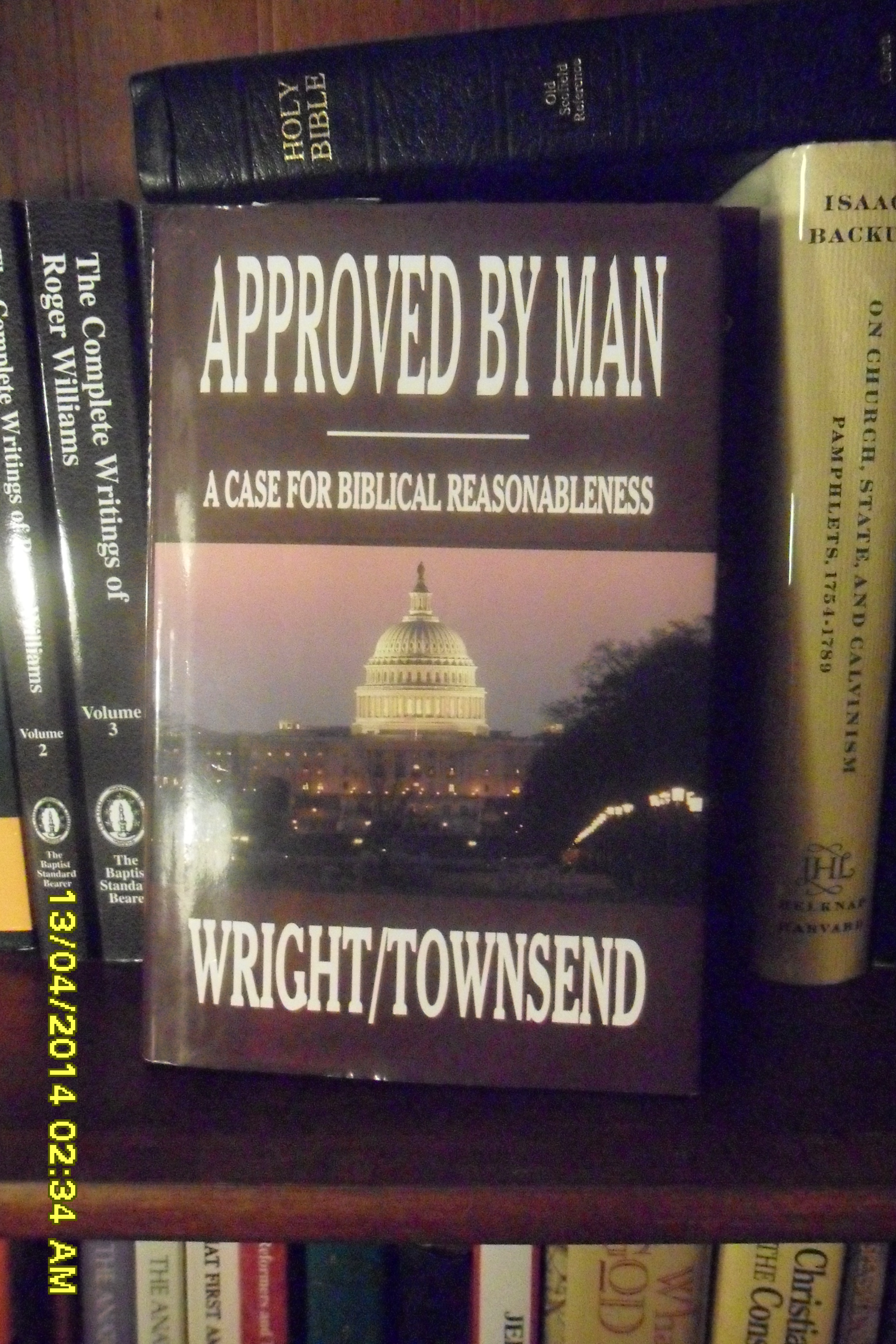
CoverApprovedByMan

Contents:

Related articles:

Chapter 8: Analysis of “The Questions will keep coming”

Jerald Finney
Copyright © November, 2014

Note. This is a continuation of the examination of Chapter 18 of Approved by God  written by Ben Townsend of thd Ecclesiastical Law Center (“ELC”), a chapter which attacks the ordinary trust.

One may be thinking, “Why should anyone get into this? It seems complex and it looks like Jerald Finney and the ELC each have a vendetta.” Or you may be a pastor of a church who has organized according to the recommendations of the ELC or according those of the Biblical Law Center (“BLC”) or those of the Old Paths Baptist Church “Separation of Church and State Law” ministry (“SCSLM”) and believe your leaders. The reason for a believer to take these matters seriously is that there is nothing more important than keeping the bride and wife of Christ pure and chaste. Ephesians 5.23-27, 30-32 states:

Is the church you are a member of being prepared for His coming?

 “For the husband is the head of the wife, even as Christ is the head of the church: and he is the saviour of the body. Therefore as the church is subject unto Christ, so let the wives be to their own husbands in every thing. Husbands, love your wives, even as Christ also loved the church, and gave himself for it; That he might sanctify and cleanse it with the washing of water by the word, That he might present it to himself a glorious church, not having spot, or wrinkle, or any such thing; but that it should be holy and without blemish…. For we are members of his body, of his flesh, and of his bones. For this cause shall a man leave his father and mother, and shall be joined unto his wife, and they two shall be one flesh. This is a great mystery: but I speak concerning Christ and the church.”

The ELC states in this section:

“The Director of the Biblical Law Center stated that Indianapolis Baptist Temple did not lease the property that the church now occupies, but the lease contract was made with the Pastor/Trustee and not the church. This is also an incorrect statement. The lease was made by the church and signed by the Pastor/Trustee. It seems like they would love to have the best of both worlds: entangle as much as possible, all the while convincing everyone that they are not entangled.” Robin Wright and Ben Townsend, Approved by Man: A Case for Biblical Reasonableness (Mesick, Michigan: Adorn Books 2009), p. 182.
CoverApprovedByGodAs amazing as this may sound, the ELC in the above paragraph explains the state of affairs that would exist had Indianapolis Baptist Temple organized according to the manner prescribed by the ELC, and not the state of affairs that exists due to the Declaration of Trust adopted by Indianapolis Baptist Temple and the ordinary trust thereby created. According to the declarations of the ELC, they recommend a type of trust (a business trust) by which “property should be held by the church in trust for the Lord Jesus Christ, who is the true and beneficial owner.(See, Robin Wright and Ben Townsend, Approved by God: A Case for Modern Disestablishment (Mesick, Michigan: Adorn Books 2004), p. 149.) Those are their actual words, and their surrounding words dig them into a deeper pit. See below for a more thorough analysis of their statements (which are in red below) and the ramifications of those statements.

Should any reader believe not believe this, get the ELC books, Approved by Men, and read Chapter 18 and also pages 149-150 of Approved by God. Then study these matters out. It is obvious that the author of Chapter 18 did not have a clue about the ramifications of ELC recommendations for church organization or the truths concerning the things they attack – the Declaration of Trust and the ordinary trust thereby created.

One can clearly understand these matters by correct study and analysis.

The trust document which creates an ordinary trust into which Indianapolis Baptist Temple places tithes, offerings, gifts, and properties is administered by the pastor/trustee for the benefit of the true owner of the money/property. The document lays out the power of the trustee which would certainly include provisions for a meeting place for the church body. Exactly what the law says concerning whether or not an ordinary trust is a legal entity is explained in the article: Is the ordinary trust a legal entity? That article quotes the relevant law and includes a page directly from 76 AM. JUR. 2D which states that the ordinary trust is not a legal entity with supporting case citations. The law makes clear that the type trust described in 76 AM. JUR. 2D is not a legal entity. It also makes clear that the trustee of the ordinary trust  is the legal owner of the trust estate and that the true, equitable, and beneficial owner is the Lord Jesus Christ (the beneficiary), and that the trustee has the fiduciary duty to administer the money/property in the trust estate for the benefit of the Lord Jesus Christ. The church is the trustor or settlor of the trust. That simply means that the church gives their tithes, offerings, and gifts to the Lord Jesus Christ. They do this by placing tithes, offerings, and gifts in the trust estate. The trustee administers the trust estate, not the church. The church does not hold, control, or administer the trust estate. The trustee administers the money/properties for the benefit of the Lord Jesus Christ, not for the church. The church who creates an ordinary trust through a properly worded Declaration of Trust does not become a legal entity thereby. Of course, such a church must be careful not to do anything which will declare themselves to be a legal entity (e.g., hold a bank account or take out insurance in the name of the church). For a quick look at some of the matters involved see Quick Reference Guide for Churches Seeking to Organize According to New Testament Guidelines.

On the other hand, the organization recommended by the ELC makes the church a legal entity, since according to their own unknowledgeable arguments against the Declaration of Trust used by the BLC and this ministry, they in effect attack their own method of holding property. This may require some study for the novice in these matters, but once one gets a grasp on these concepts, the truth is obvious. However, without studying these matters out and carefully analyzing what the ELC is stating, one can be deceived by their language.

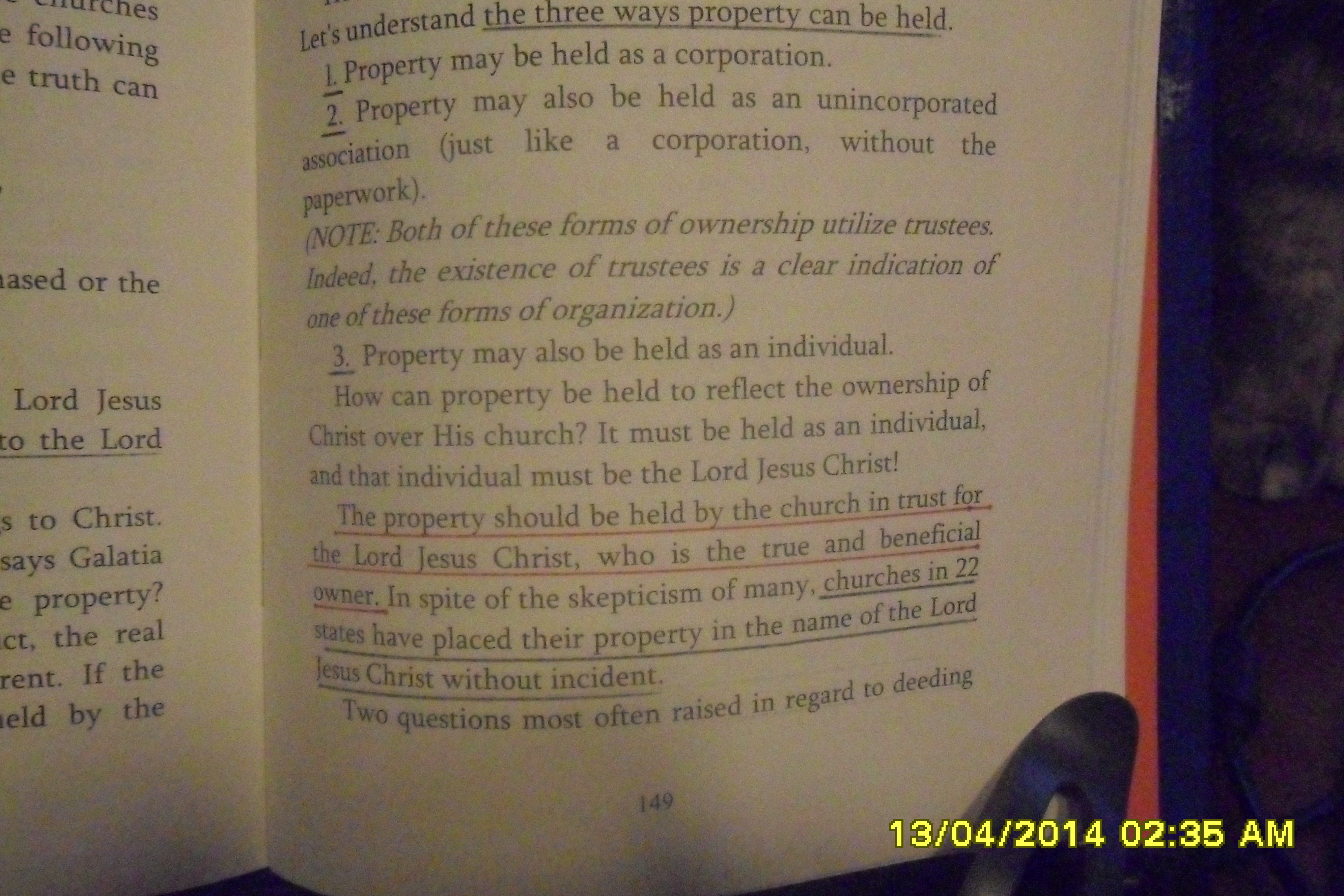
The ELC states that for property be held to reflect the ownership of Christ over His church “the property should be held by the church in trust for the Lord Jesus Christ, who is the true and beneficial owner.” (Robin Wright and Ben Townsend, Approved by God: A Case for Modern Disestablishment (Mesick, Michigan: Adorn Books 2004), p. 149).
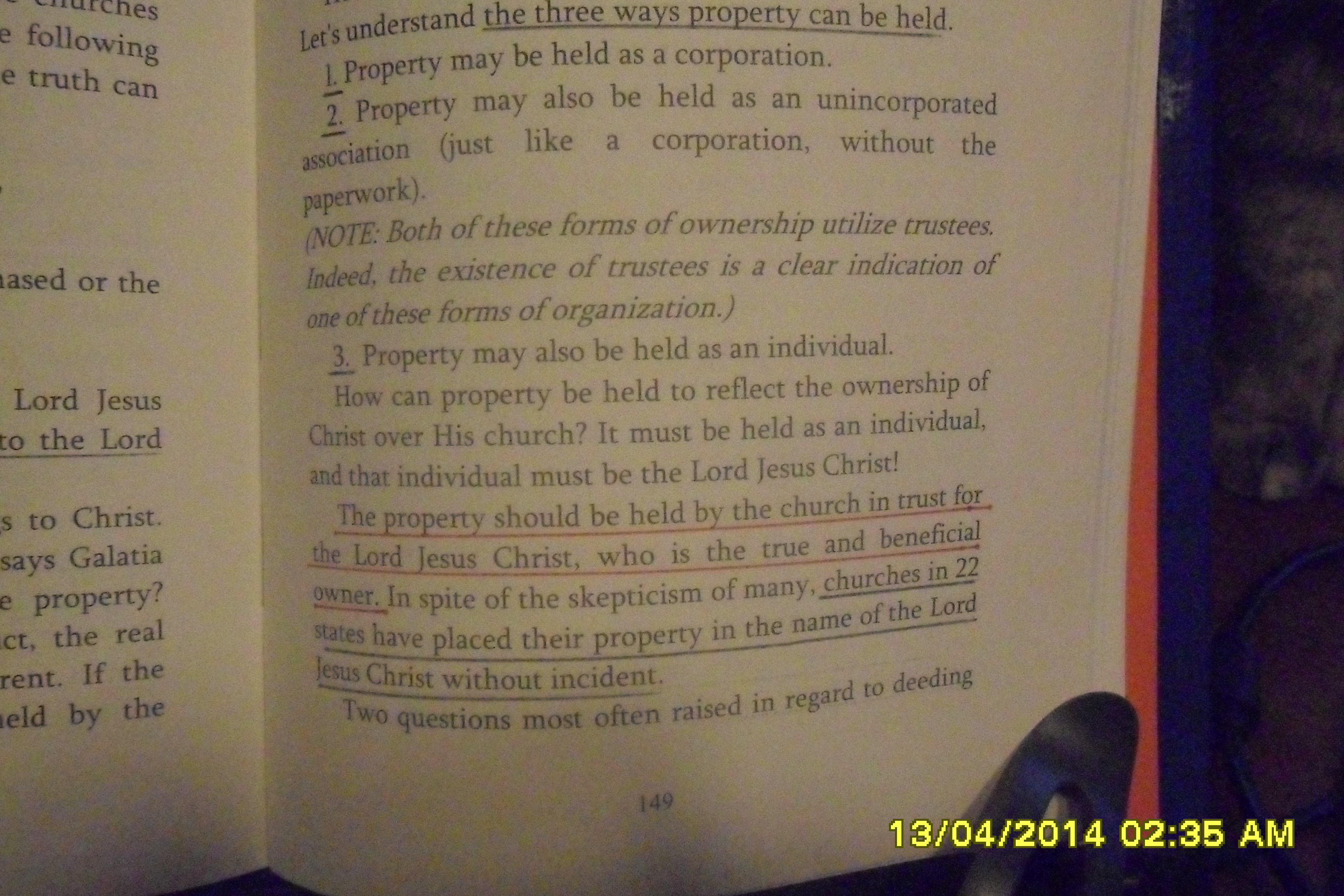
Approved by God, p. 149

The ELC states that property may be held in three ways “(1) as a corporation, (2) as an unincorporated association and:

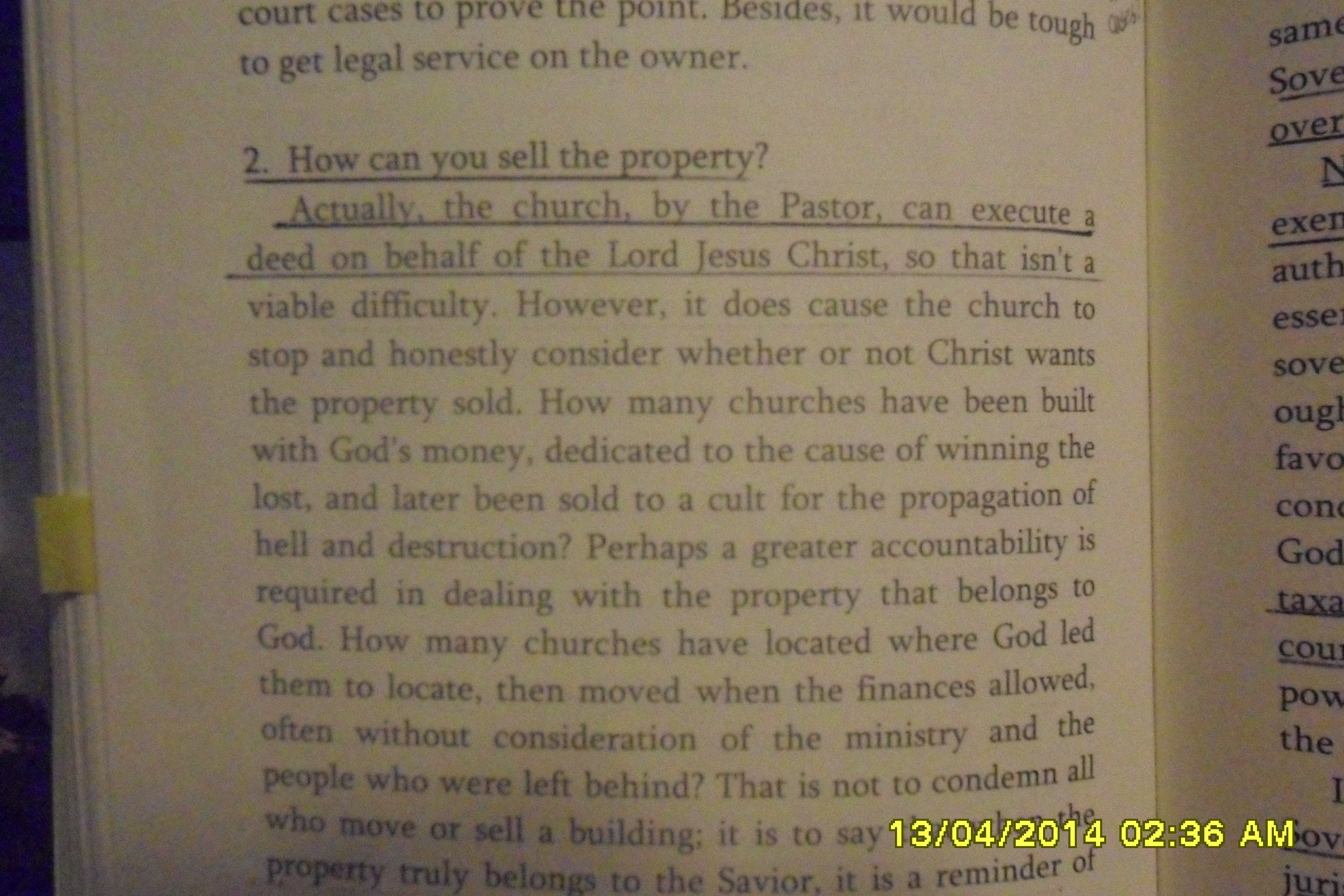
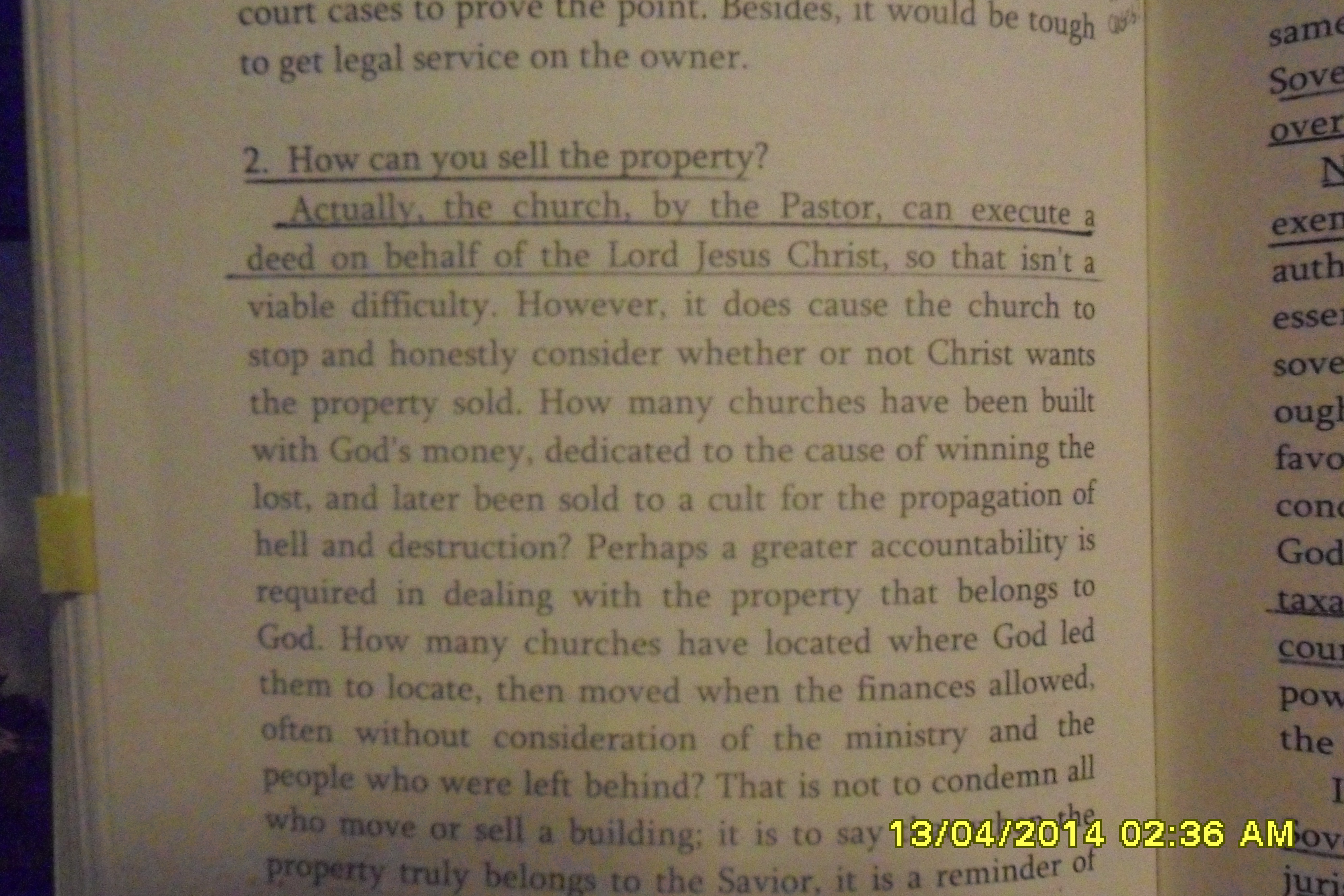
“(3) as an individual. How can property be held to reflect the ownership of Christ over His church? It must be held as an individual, and that individual must be the Lord Jesus Christ! The property should be held by the church in trust for the Lord Jesus Christ, who is the true and beneficial owner. In spite of the skepticism of many, churches in 22 states have placed their property in the name of the Lord Jesus Christ without incident.” Approved by God: A Case for Modern Disestablishment, p. 149. The book goes on to say that “the church, by the Pastor, can execute a deed on behalf of the Lord Jesus Christ.” Ibid., 150.

Approved by God, p. 150

The ELC is confused since they first say that the property must be held by the Lord Jesus Christ and then they say that the property should be held by the church in trust for the Lord Jesus Christ. Of course, legal earthly title to property and money cannot, at this point in time, be held by the Lord Jesus Christ since he left all earthly temporal property and assets to be held in trust by man and has given earthly civil government temporal jurisdiction. If a nation honors God and His precepts, that nation will also honor God’s churches, and vice versa. If a believer or church is found out in North Korea (and many other nations), any properties and assets will be confiscated and the believers will probably be executed. God allows individuals, families, churches, and nations free will to honor or dishonor him, for the time being.  The ELC, in the above statement, also says that the church is to hold the property.

The ELC states the elements of a trust, but then compromises the legal position of their trust by always referring to the law of trusts which are legal entities, not to the law of the non-legal entity ordinary trust. Some of the words of the ELC quoted above is taken straight out of legal books which define the trust. But then they say, “Held by the church in trust for the Lord Jesus Christ.” (Bold emphasis mine). For a church to hold property violates biblical principle. (See The Biblical Doctrine of the Church and The Biblical Doctrine of Separation of Church and State). Not only that, only a legal entity can hold property. There must be a legal owner of property, even if the legal and true and beneficial owner are not the same. They do not realize that they are in effect stating that the church is a legal entity.

This all clearly shows that the ELC recommends compromising the position of a church who uses their method. They state the church is to hold the property” in trust for the Lord Jesus Christ, who is the true and beneficial owner.” By so stating, they open the door to a rational argument that the church is the trustee of the property which is held in a business trust, a legal entity; this argument is strengthened by the fact that, in their attacks against the ordinary trust they incorrectly rely on the law of business trusts.

The ELC teaches that the trust is a legal entity. They are partially correct in that some types of trusts are legal entities. However, the ELC does not quote from the law concerning ordinary trusts as to the legal entity status of the ordinary trust (see above). They do this to establish their incorrect position that the trust utilized by the BLC and the ordinary Bible trust used by SCSLM are legal entities. They quote from the law concerning, for example, business trusts. See pages 175-177 of Approved by Man: A Case for Biblical Reasonableness by Wright/Townsend, for an example of where they quote from the law of business trusts and apply it to the ordinary trust. In American Jurisprudence, the law of business trusts is covered in volume 13 whereas the law concerning ordinary trusts is covered in volume 76. The two types of trusts are very distinct types of trusts.

Thus, the ELC in their zeal to discredit the ordinary trust, reveal that they have created a type of  trust, a business trust, which is a legal entity. A business trust is a legal entity which can act legally, sue, be sued, go into debt if so desired, and enter into contracts (the ELC teaches against a church going into debt and entering into contracts.). Since they declare that the church is to hold the property for the true owner, they are declaring that the church holds the property through a trustee; therefore, the church has to be a legal entity since only a legal entity can hold legal title to property; a spiritual entity cannot hold title to property. The trustee of an ordinary trust holds legal title and the beneficiary of the trust holds true, beneficial or equitable title to property.

The ELC then states that “the church, by the pastor, can execute a deed on behalf of the Lord Jesus Christ.” Ibid.

The ELC claims that the church can execute a deed. Only a legal entity can execute a deed. At the same time, they state that the church executes the deed by the pastor. Thus, the pastor of an ELC church effectively serves as trustee for the church, but trustee of what? Not a non-legal entity ordinary trust which is something they do not understand. He serves as trustee of a legal entity and that legal entity is the church he signs for.

Public sentiment and the lack of legal action against churches protects churches from legal scrutiny. For the foreseeable future, ELC churches do not have to worry about attacks. Consider the situation in which the owner of property has been dead for years and the man living on the property has paid the taxes since. As long as he keeps up on the taxes and no one takes the issue to court, the man will be able to enjoy the property. Should an ELC church ever be in the legal sights of government lawyers, the ELC has subjected churches who use its methods to a compromised position and sharp government lawyers who study this out should have no trouble in piercing their armor. More importantly, the ELC, by not proceeding according to knowledge, wisdom, and understanding, has unknowingly dishonored the Lord.

As a sidenote, I believe that it is incorrect to say that property may be held as an individual, corporation, or unincorporated association. I believe that the correct way of putting it is that property may be held by or in the name of an individual, corporation, or association.

In the second paragraph, the ELC states:

“Now, I am not saying these people are ‘evil.’ I am saying they are ‘wrong.’ I’m saying they do not know Trust law. And their ‘wrongness’ has caused them to continue to misunderstand the facts, and misrepresent their Trust document. To perform a Declaration of Trust is a wrong position to take for any church. We believe that it will do more damage to unincorporated churches in the long-run than the ‘help’ and ‘accommodation’ it may give in the short run.”

Now, this author is not saying these ELC people are ‘evil.’ He is saying they are ‘wrong.’ He is stating the obvious: The ELC and Ben Townsend do not know Trust law. And their ‘wrongness’ has caused them to continue to misunderstand the facts, the relevant Bible precepts, and the law, and to recommend a manner by which a church should hold property thereby putting the church in the position of being a some type of legal entity. They rely on the law concerning business trusts to attack the ordinary trust and the Declaration of Trust which creates the ordinary trust. The ELC method has the potential do more damage to churches in the long-run than the ‘help’ and ‘accommodation’ it may give in the short run. As long as no one rocks the boat, and as long as the civil government does not zero in on churches organized according to the ELC method, those churches should have no problems. However, the Lord is grieved since the ELC has proceeded hastily without knowledge, understanding and wisdom. They do not know how to do legal research and  analysis nor can they correctly apply the law to the facts. If they do not believe the conclusions of this author, he challenges them to ask the local property tax board, the lawyer of the person who was hurt on ELC church property, or the lawyer on the other side of any dispute involving ELC church money or property to contact this attorney for advice on how to include the ELC church in the action. For this author to help would not dishonor the Lord since such help might wake all those believers and pastors up who are unknowingly dishonoring the Lord by depending upon the ELC for help.

Chapter 1: Analysis of the title to and first two paragraphs of Chapter 18 of “Approved by Man”

CoverApprovedByMan

Related articles:

Chapter 1: Analysis of the title to and first two paragraphs of Chapter 18 of “Approved by Man”

Thank you, ELC, for waking up our brain cells.

Jerald Finney
Copyright © November 6, 2014

The ELC article, Chapter 18 of Betrayed by Man, begins with two paragraphs. Thereafter, it is divided into titled sections. This chapter will analyze the title and then the first two paragraphs.

The reader should especially notice that this chapter reveals that the ELC method of church organization has, by published ELC admission and according to ELC criteria for what gets a church into trouble, gotten ELC churches into trouble. The ELC method gets churches into the legal system, whereas the BLC method they attack does not.

Approved by Man: A Case for Biblical Reasonableness” by John R. Wright and Benjamin E. Townsend, leaders of the Ecclesiastical Law Center (“ELC”)), was published in 2009. Concerning the ordinary trust and the DOT, only the teachings of the Biblical Law Center (“BLC”) and this Old Paths Baptist Church “Separation of Church and State Law” ministry or those of the ELC are correct – the teachings are mutually exclusive. The ELC has publicly made this an issue. The ELC has also publicly attacked people who promote the ordinary trust including pastors, churches, and the Biblical Law Center. This booklet corrects the false ELC teachings concerning the ordinary trust and Declaration of trust; and also exposes the ill advised recommendations for church organization by the ELC for what they are.

This chapter analyzes the title to and first two paragraphs of Chapter 18, “Should a Church Be Placed In a Declaration of Trust?” which is also on the home page of the ELC website (ELC website: http://lordshipchurches.info/). Chapter 18 is analyzed paragraph by paragraph and section by section.

Analysis of the title to the chapter

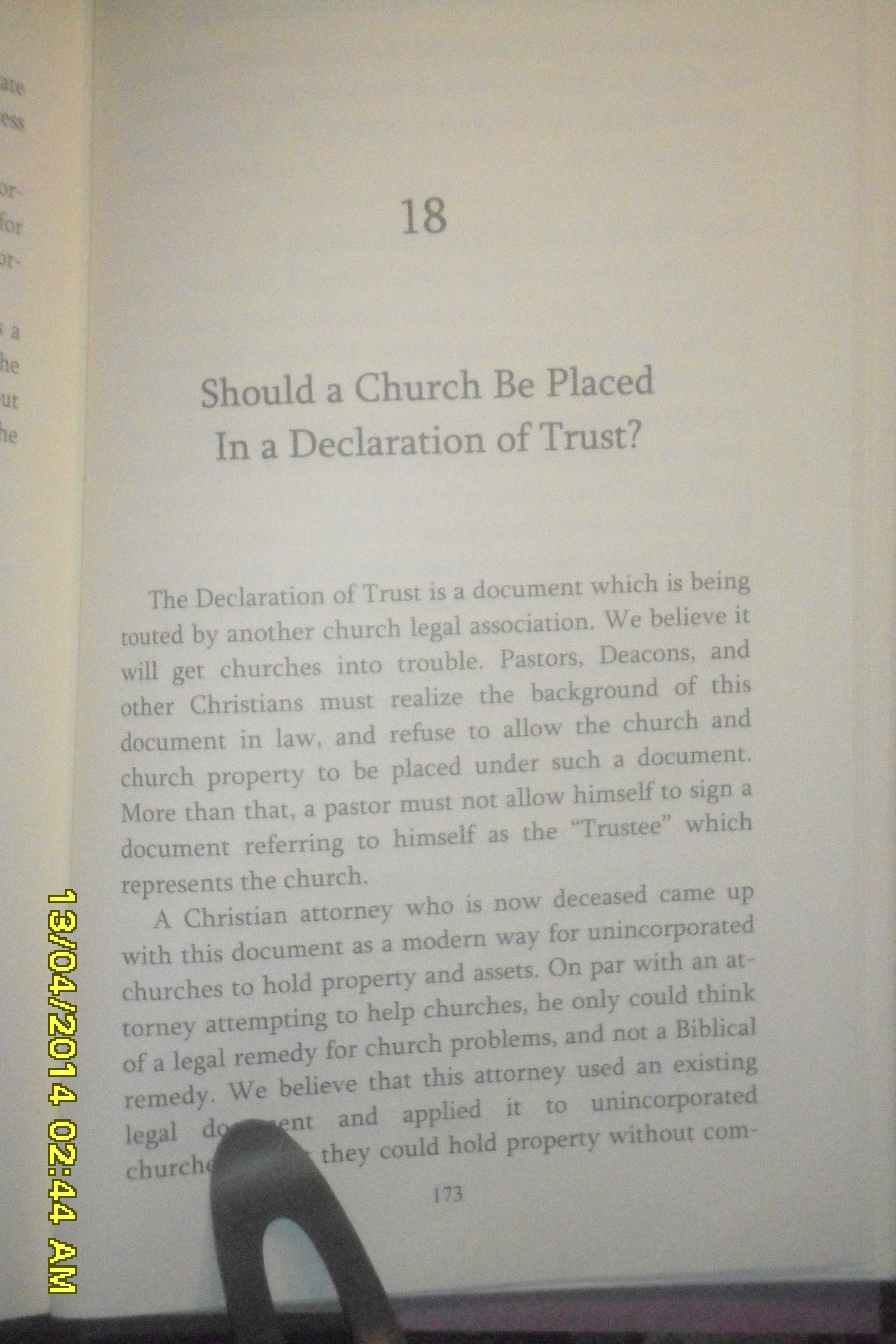
173FlashABManThe title to Chapter 18 – “Should a Church Be Placed In a Declaration of Trust?” – should alert anyone with any knowledge of the subject that the author of the chapter may not understand the ordinary trust and the Declaration of trust. One cannot “place a church in a Declaration of Trust.” A Declaration of Trust (“DOT”) is merely a document which creates an ordinary trust, a relationship whereby a trustee is to hold property for the benefit of the true or equitable owner of the property. The DOT is one manner in which one may set up an ordinary trust which is not a legal entity (or some other type of trust such as a Business Trust or Charitable Trust, both of which are legal entities). One may establish an ordinary trust with or without a DOT. In fact, when a church – as does an ELC church – entrusts tithes, offerings, gifts and/or property to a pastor or other person(s) for the benefit of the true owner, the Lord Jesus Christ, that church has established a trust with the pastor as a trustee; for a church to so establish a trust relationship without a DOT is unwise. For example, when an ELC church holds property in the name of the Lord Jesus Christ, the church, by the pastor, acts as a legal entity by signing the deed; that pastor is the trustee of a trust. This will be explained in detail in this series of articles. The better practice is to declare an ordinary, non-legal entity trust through a properly executed DOT.

The ordinary trust is described in Volume 76 of the legal encyclopedia AMERICAN JURISPRUDENCE 2d. “Is the ordinary trust a legal entity?” explains why this ordinary trust is not a legal entity; this question is important because the ELC insisted for years that the ordinary trust utilized by BLC churches and the Old Paths Baptist Church Separation of Church and State Law Ministry (SCSLM) was a legal entity. Only after the first 8 chapters of this booklet were published online did Ben Townsend, against public revelation of solid fact which cannot be refuted, relent and admit that the ordinary trust is not a legal entity. Chapter 13 of this booklet addresses an article written by Ben Townsend after the first 8 chapters of this booklet was published in which he finally admitted that the “trust” is not a legal entity.” Read chapter 13 to find Townsend’s ridiculous slant after that admission and this author’s response: this author actually countered Townsend’s slant in 2008 as chapter 13 reveals.

Other articles in this series fully explain the ordinary trust which is also explained in Section VI, Chapter 7 of God Betrayed/Separation of Church and State: The Biblical Principles and the American Application which is available free in online and PDF form. See Order Information for Books by Jerald Finney should you desire to get a softback copy. One of the many flaws in the legal research and analyses of the ELC is that they indiscriminately grab out of context statements from court cases, legal encyclopedias, etc. and just make up fictitious and incorrect law to attack the ordinary trust and DOT. As will be seen as Chapter 18 of Townsend’s book is analyzed in this and subsequent chapters, the ELC, for example, uses the law of business trusts and incorrectly applies it to the ordinary trust.

Analysis of the first paragraph

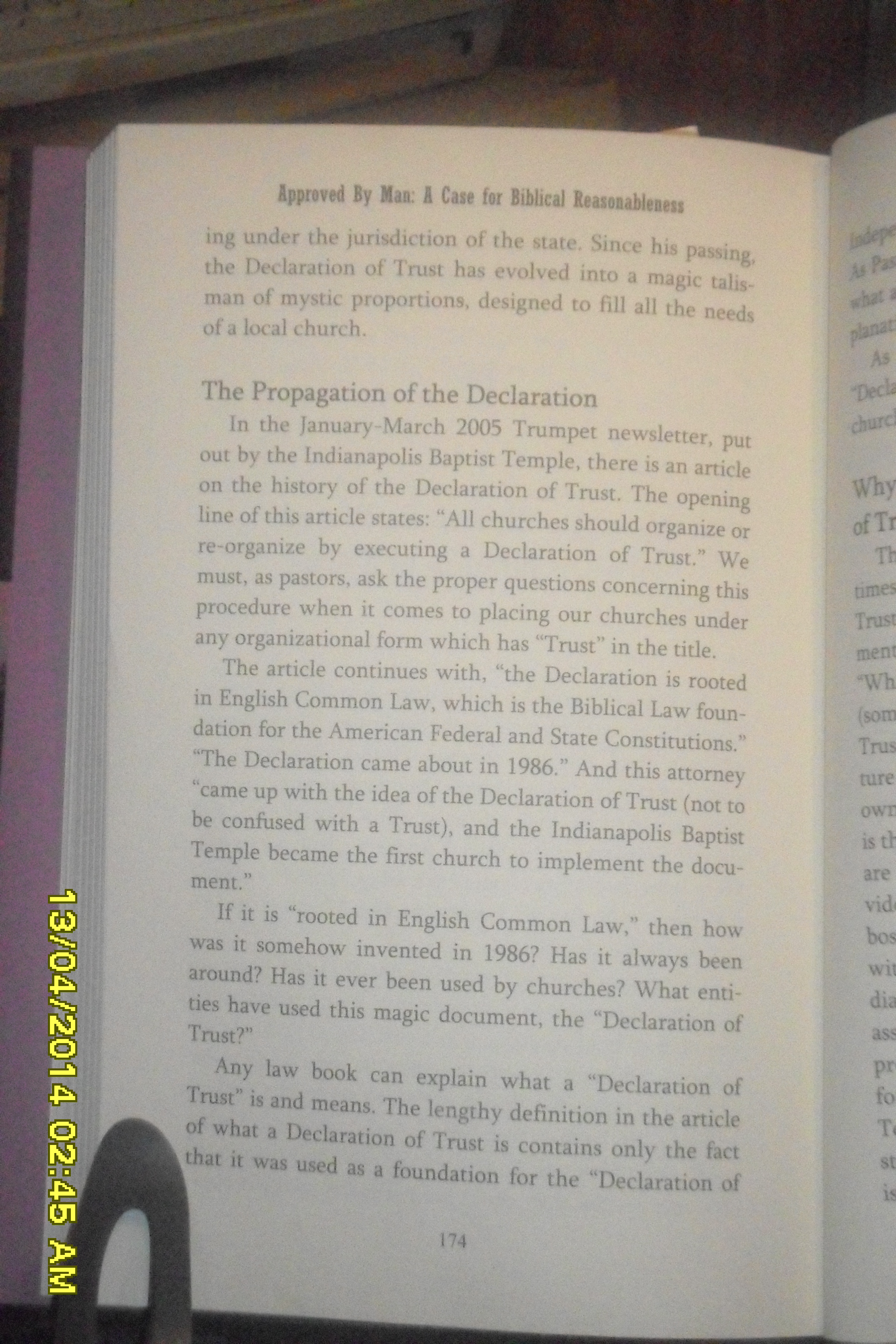
174FlashABManThe article begins by saying, “We believe it [the DOT] will get churches into trouble.” Ben Townsend, an ELC leader, has gone so far as to mount a dishonest online attack against a church which places tithes, offerings, gifts and property in a trust whereby the trustee of that trust has a fiduciary duty to use the monies and properties for the benefit of the true owner of the property. The DOT has never gotten any church into trouble, although Ben Townsend has lied and stated that it has. ELC churches have to, as Wright/Townsend state in Chapter 3, page 35 of Approved by Man, “handle legal church problems.” In that chapter, Townsend not only reveals that ELC churches must go to court but also falsely leads one to believe that he can represent churches in court. He is not an attorney and he cannot represent anyone or any entity in court because he is not a lawyer. Furthermore, he is not qualified to do so; nor is he qualified, as is obvious from the analysis of Chapter 18, to do legal research, especially, as he puts it, “intense legal research.”

In Chapter 3 of Approved by Man, Townsend speaks of lawsuits involving ELC churches, tax on property of an unincorporated church, and inspections of the “church’s building.” Using Townsend’s reasoning, the ELC method admitedly gets churches into trouble all the time. Unlike the ELC churches referred to in Chapter 8, a church which places tithes, offerings, and gifts into an ordinary trust as recommended by the BLC and the SCSLM is not a legal entity which cannot be taken into court or agency process; the DOT and the ordinary trusts thereby created have kept BLC churches out of legal problems and legal actions. Chapter 3 makes clear that an ELC churches own property, can and have been taken to court, and are therefore legal entities. Because churches in general enjoy favorable public sentiment and have protections which no other institution or entity has, there has not been an in depth and dedicated study of ELC methods by government lawyers and ELC churches have not been called for what they are – legal entities who have given up much of their biblical and First Amendment protections. One should note that governments still allow sales and property tax exemptions for all churches whether legal entities or not. When a local tax board challenges a “religious use” tax exemption on property on which a local church meets, the ELC church must go through the agency process (and appeal to court, if necessary); but in a property tax challenge against trust property utilized by a BLC or SCSLM church, the church cannot be brought into the process – rather, the pastor/trustee of the trust represents the trust in obtaining the property tax exemption. To this point, no property utilized by a BLC or SCSLM trust has been denied the exemption.

The third sentence to the paragraph then states: “Pastors, Deacons, and other Christians must realize the background of this document in law, and refuse to allow the church and church property to be placed into such a document.” This sentence is totally wrong. What is important for believers to know about the ordinary trust are the biblical principles regarding trust and what the ordinary trust and the document establishing it are. See Spurious rationale for incorporating: to hold property for a biblical and legal analysis of the ordinary trust.  Contrary to the ELC assertions, believers do not place any money or property in the document, the DOT. The DOT merely declares the trust. If a church is organized according to biblical principles, there is no church property. Rather, the members of the church (who are the church) give tithes, offerings, and gifts to God and those monies/properties make up the trust estate. The true owner, as declared in the DOT, is the Lord Jesus Christ. The person who is to administer the monies/properties is the trustee (the legal owner – the person who signs deeds, vehicle titles (if any), etc. as trustee. This is necessary since the Lord is not now physically present on earth and has therefore left believers with the fiduciary duty to handle His property and monies for His benefit (for the Glory of God). The trustee has a fiduciary duty to manage the monies/properties for the benefit of the true owner.

The last sentence of the first paragraph in Chapter 18 of Townsend’s article states: “More than that, a pastor must not allow himself to sign a document referring to himself as the ‘Trustee’ which represents the church.”

From page 149 of ELC book
From page 149 of ELC book “Approved by God”

First, that sentence is ludicrous when delivered by Townsend because pastors of Townsend’s ELC churches are trustees who represent the church. On pages 149 and 150 of the ELC book Approved by God are the following statements: “The property [of an ELC church should be held in trust for the Lord Jesus Christ, who is the true and beneficial owner (p. 149); and “Actually, the church, by the Pastor, can execute a deed on behalf of the Lord Jesus Christ, so that isn’t a viable difficulty (p. 150). These statements make clear that the church is set up to be a legal entity because the church is the legal owner of the property and the true and beneficial owner is the Lord Jesus Christ.

From page 150 of
From page 150 of “Approved by God”

On the other hand, the last sentence of the first paragraph of Townsend’s article above is wrong on two accounts as applied to the ordinary trust: (1) it is wise for a pastor/trustee of an ordinary trust to hold money and property for the benefit of the true owner, the Lord Jesus Christ; (2) the pastor/trustee is the legal owner of the property and the Lord Jesus Christ is the true and beneficial owner:

“The trustee of an ordinary trust is the person appointed to execute a trust, and the one in whom an estate, interest, or power is vested, under an express or implied agreement to administer or exercise it for the benefit of another. In other words, a trustee is a person who holds legal title to property under an express or implied agreement to apply it, and the income arising from it, to the benefit of another.” [Bold emphasis mine.]

In other words, the trustee of the ordinary (Bible) trust has a fiduciary duty to administer or exercise the property for the benefit of the true or equitable owner of the property, the Lord Jesus Christ. This is something entirely different from “representing the church.” A pastor/trustee who holds tithes, offerings, gifts, and property in the name of (for the benefit of) the Lord Jesus Christ has this fiduciary duty in the trust relationship established by a Declaration of Trust.

On the other hand, as Townsend admits in his writings, the pastor of an ELC church acts as the trustee of “church property” even though such declaration is not in a DOT (See, e.g. pp. 149-150 of the ELC book Approved by God which are photographed and inserted above.). ELC publications demonstrate that the ELC methodology clearly establishes a type of trust which is a legal entity, relegates ELC churches to legal entity status, makes the pastor of the ELC church trustee of “church property” thereby representing the church. One could admonish Townsend as follows: “The results of the first microscopic examination of ELC methodology now published in this booklet clearly prove:

“Legally and biblically, the ELC, under your leadership, puts pastors in the position of trustees who represent ELC churches – the very thing you wrongly accuse the BLC of doing through the use of the DOT and the ordinary trust thereby created. Because of this and other flaws pointed out in this booklet, the ELC needs a Bible believing, born-again lawyer who is motivated by the love of God, not money, to help you straighten out the mess established by the ELC.”

Both the BLC and the SCSLM utilize the impeccable method which was conceived by Attorney Al Cunningham who obviously put the system under a legal and biblical microscope before implementation. The BLC and now the ELC method have both been put under a legal microscope by another attorney, Jerald Finney. Finney published his conclusions concerning the BLC methodology a long time before taking on the task of microscopic examination of the ELC attacks against the BLC and the ordinary trust recommended by the BLC.  He found that the law and the Bible prove that Al Cunningham’s ordinary trust arrangement is on solid biblical grounds and keeps a church out of the legal system. To have lied about his conclusions and the law would have dishonored the Lord. Had Finney concluded that the BLC methods were flawed, he would have informed the BLC, just as he is now informing the ELC that they have created a mess.

Microscopic examination by two lawyers has proved the BLC method to be flawless. Microscopic examination by one lawyer has proven the ELC method to be flawed both biblically and legally. The biblical and legal reasoning supporting the conclusions concerning the problems with the ELC way of doing things are clearly stated in this booklet. ELC responses to the arguments in this booklet have been facetious at best.

Understanding that the ordinary trust is not the  church and the church is not the ordinary trust is important. The church does not own the money/property held in the trust (the trust estate). Church members give to God and what they give is held in the trust estate. Money/property has to be held somewhere, by someone. In this case the trust estate holds the money/property which is owned by the equitable owner, the beneficiary. The trustee has legal title to the money/property, but he is to use it for the benefit of the true and equitable owner, the Lord Jesus Christ. Again, this is in contrast to the unbiblical method used by the ELC by which tithes and offerings are given to the church, not to God, and “church property” is held by the church through a pastor/trustee.

Analysis of the second paragraph

The ELC then alleges that the attorney who “came up with this document” (the DOT) “could only think of a legal remedy for church problems, and not a Biblical remedy.” No one should  speculate as to the thought processes of that attorney who is now deceased. What is important is the applicability of the method from a biblical perspective. As has already been shown in this chapter, the remedy of the ELC is legal, not biblical and only the unqualified could have come up with such totally chaotic methodology. They have gotten away with their nonsense because no one, until this time, has examined some of their teachings with a “legal microscope.” One can imagine what examination of all their teachings by a qualified legal analyst would reveal.

On the other hand, the trust utlized by this ministry is based upon a biblical concept. For explanation, see The Bible Trust Relationship with Property is Not Something New: It was God’s plan starting with Adam and Eve (Chapter 6 of  Simply Church: The Holy Union of Christ and His Local Church, a concise booklet which explains the trust in detail). The facts, citations, and reasoning supporting the conclusion that the ordinary trust is ideal for an American church are in the books, essays, and teachings on this website.

The ELC then states, “We believe that this attorney used an existing legal document and applied it to unincorporated churches so that they could hold property without coming under the jurisdiction of the state.”

Wrong. A Declaration of Trust as executed with the help of this ministry is not a legal document as is a Declaration declaring a charitable or Business Trust. See, for a concise and complete explanation, The Basics and Elements of a Church Bible Trust  Relationship with Property (Chapter 2 of Simply Church). The attorney took the concepts of ordinary trust and drafted a Declaration of Trust which declared an ordinary trust. The church who places tithes, offerings, and gifts into the estate of such a trust does not hold property. The trust estate holds the property. The true, beneficial, and equitable owner of the property is the Lord Jesus Christ. Placing God’s money and property in an ordinary trust keeps a church under the Lord Jesus Christ only and out from under civil government jurisdiction if the church is careful not to place herself under state jurisdiction in some other way. Remember also that a church who holds property, opens a bank account, takes out insurance, or does some other legal act forfeits her New Testament and First Amendment status.

The purpose of the ordinary trust is to assure that there is no church property and that all properties and monies in the trust estate are administered by the trustee for the benefit of the true owner of the property (the Lord Jesus Christ). A properly worded “Resolution to Adopt a DOT” and a properly worded DOT makes clear that the trust estate is owned by the Lord and that there is no church property; and that the trustee of the trust, not the church as with the ELC method, is the legal owner of the property .

A court/agency will assume jurisdiction over a controversy concerning money or property only if the dispute is properly brought to attention of the court/agency with jurisdiction over the matter. If a proper action is properly brought to the attention of an appropriate court or agency, the court or agency will assume jurisdiction no matter how the property/money is held and no matter who owns the property/money. In such an action, the court will seek out the legal owner and if none is found, the court or agency will take the necessary steps to get the property/money to a legal owner. Should a church hold/money property, that church is the legal owner and the church is a legal entity; this is the case of an ELC church, but not so with a BLC or SCSLM church. When money/property is put into the trust estate of an ordinary trust, the trustee is the legal owner and the Lord Jesus Christ is the equitable owner. A court cannot bring a church into such a legal controversy if that church places tithes, offerings, and gifts into a trust administered by a trustee where the beneficiary is the Lord Jesus Christ (as long as the church does nothing that makes that church a legal entity).

The elements of the ordinary trust and the DOT recommended by this ministry not only comply with Bible principles, but also incorporate the elements of a DOT and “trust” recognized but not created by American law and explained in American lawbooks such as 76 AM. JUR. 2D, Trusts and the DOT guidelines in the accompanying forms volume. “Declaration” means: “Publication, manifestation; as the declaration of the greatness of Mordecai. Esth. X.; A public annunciation; proclamation; as the Declaration of Independence, July 4, 1776” (MERRIAM WEBSTER’S AMERICAN DICTIONARY OR THE ENGLISH LANGUAGE (1828) definition of “DECLARATION.”). Declaration of Trust is defined as follows:

“The act by  which the person who holds the legal title to property or an estate acknowledges and declares that he holds the same in trust to the use of another person or for certain specified purposes. The name is also used to designate the deed or other writing embodying such a declaration” (BLACK’S LAW DICTIONARY 408 (6th ed. 1990) under definition of “Declaration.” This definition is consistent with the definitions in more authoritative legal references such as AM. JUR. 2D and C.J.S.).

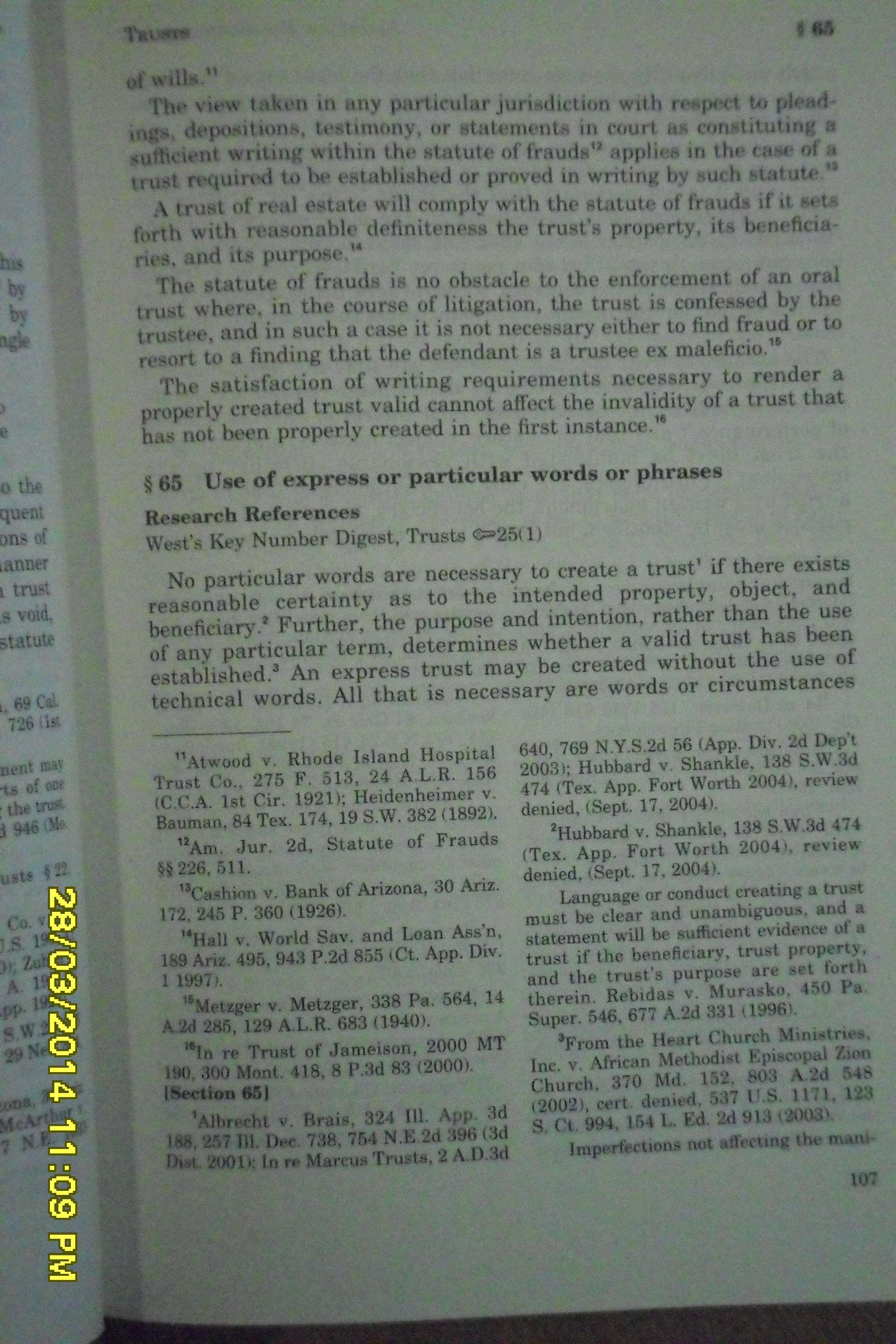
76 AM. JUR. 2D Trusts § 65

The words in the DOT  are unique and are not found in any lawbook. As to the use of express or particular words or phrases to create a trust:

  • “No particular words are necessary to create a trust if there exists reasonable certainty as to the intended property, object, and beneficiary. Further, the purpose and intention, rather than the use of any particular term, determines whether a valid trust has been established. An express trust may be created without the use of technical words. All that is necessary are words or circumstances which unequivocally show an intention that the legal estate is vested in one person, to be held in some manner or for some purpose on behalf of another.
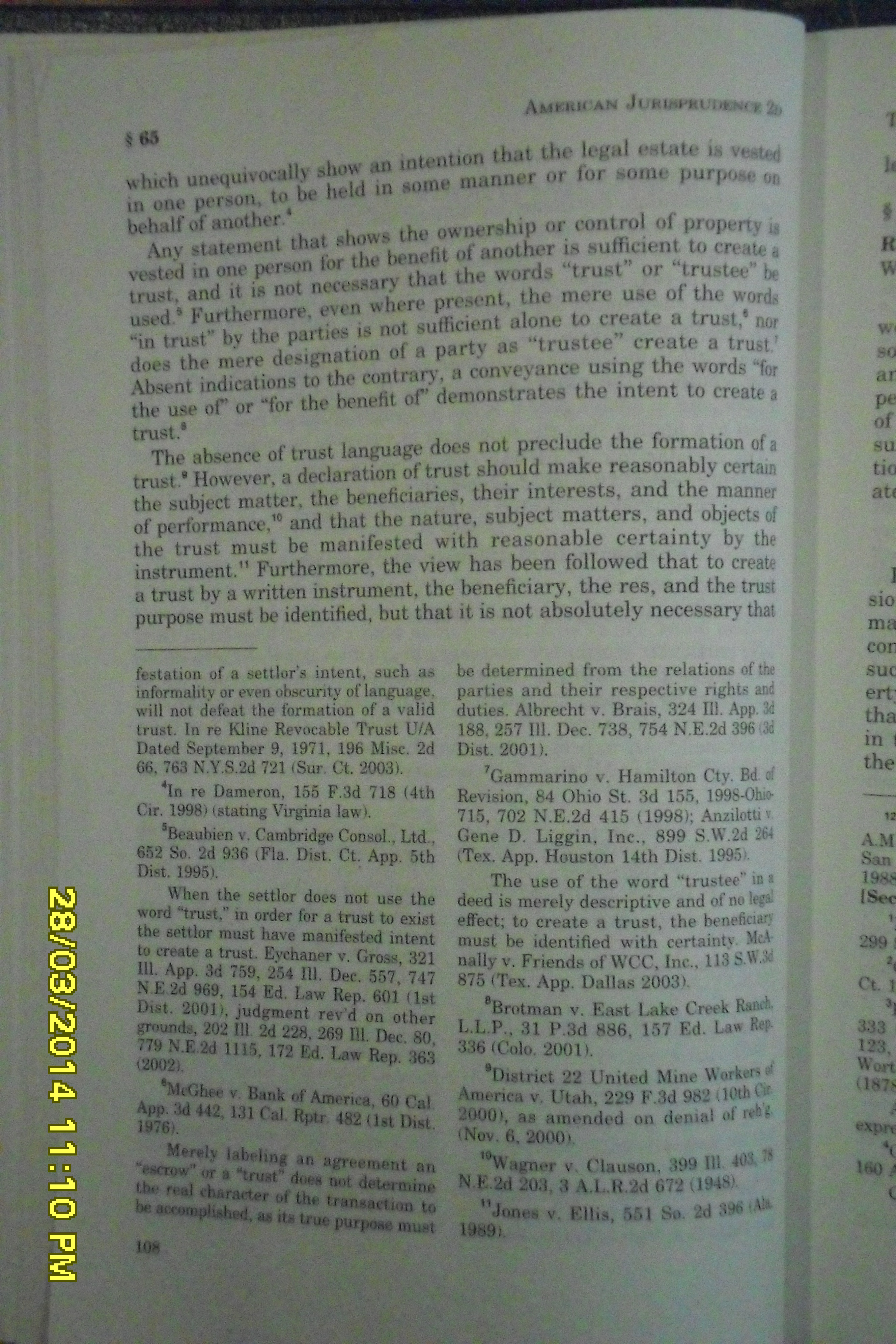
  • “Any statement that shows the ownership or control of property is vested in one person for the benefit of another is sufficient to create a trust, and it is not necessary that the words ‘trust’ or ‘trustee’ be used. Furthermore, even where present, the mere use of the words ‘in trust’ by the parties is not sufficient alone to create a trust, nor does the mere designation of a party as ‘trustee’ create a trust. Absent indications to the contrary, a conveyance using the words ‘for the use of’ or ‘for the benefit of’ demonstrates the intent to create a trust.” (76 AM. JUR. 2D Trusts § 65 (2007)).

As will be shown below, the a church which utilizes the ELC method creates a trust which is a legal entity (perhaps a charitable trust or business trust). The trust which is recommended by the “Separation of Church and State Law” ministry is not a legal entity as explained in the article Is the ordinary trust a legal entity?

Thus, the holding of property by a person (trustee) “in the name of the Lord Jesus Christ,” creates a trust. This is a very important for ELC churches to understand since the ELC recommends that property be held by the church (pastor) in trust for the Lord Jesus Christ, the true and beneficial owner and that the church can hold property (e.g., execute a deed) by the pastor, in trust for the Lord Jesus Christ. (See their exact wording below.) The legal system requires a legal tie to real estate as expressed in a deed. If no such tie to real estate exists, and this fact is brought to the attention of the proper court, the court will make sure that a legal entity, such as a person, assumes ownership of the property. Should a controversy arise as to ownership of the real estate, the legal system when properly petitioned will take jurisdiction over the matter. When real property is put up for sale, the buyer is going to want legal assurances that he is getting valid, enforceable legal and equitable ownership.

76 AM. JUR. 2D Trusts § 65 continued

The ELC states that property may be held in three ways “(1) as a corporation, (2) as an unincorporated association and:

“(3) as an individual. How can property be held to reflect the ownership of Christ over His church? It must be held as an individual, and that individual must be the Lord Jesus Christ! The property should be held by the church in trust for the Lord Jesus Christ, who is the true and beneficial owner. In spite of the skepticism of many, churches in 22 states have placed their property in the name of the Lord Jesus Christ without incident” (Approved by God: A Case for Modern Disetablishment, by Wright/Townsend, page 149). The book goes on to say that “the church, by the Pastor, can execute a deed on behalf of the Lord Jesus Christ.” Ibid., 150.
From ELC book
From ELC book “Approved by God,” p. 149

The ELC are confused since they first say that the property must be held by the Lord Jesus Christ and then they say that the property should be held by the church in trust for the Lord Jesus Christ. Of course, property cannot be held by the Lord Jesus Christ since he left all earthly temporal property to be held in trust by man and has given civil government the ultimate jurisdiction over that land. If a nation honors God and His precepts, that nation will also honor God’s churches, and vice versa. If a believer or church is found out in North Korea (and many other nations), any properties which the believer owns will be confiscated and the believers will probably be executed. God allows individuals, families, churches, and nations free will to honor or dishonor him, for the time being.  The ELC, in the above statement, also says that the church, is to hold the property.

From ELC book,
From ELC book, “Approved by God,” p. 150

The ELC states the elements of a trust, and then make clear that the trust they recommend is a legal entity through which the church holds property thereby making the church the legal owner of the property. Some of the words of the ELC quoted above is taken straight out of legal books which define the ordinary trust, but other words compromise the trust and establish it as a lega entity. They then say, “Held by the church in trust for the Lord Jesus Christ.” (Bold emphasis mine). For a church to hold property violates biblical principle. (See The Biblical Doctrine of the Church and The Biblical Doctrine of Separation of Church and State). Not only that, only a legal entity can hold property. There must be a legal owner of property, even if the legal and true and beneficial owner are not the same. They do not realize that they are in effect stating that the church is a legal entity.

The above illustrates that the ELC recommends compromising the position of a church who uses their method. They state that the church is to “hold the property in trust for the Lord Jesus Christ, who is the true and beneficial owner.” By so stating, they make clear that the church is the trustee of the property which is held in a legal entity type of trust; this argument is strengthened by the fact that, in their attacks against the ordinary trust they incorrectly rely on the law of business trusts as will be shown below. To repeat:

“The ELC teaches that the trust is a legal entity. They are partially correct in that some types of trusts are legal entities. However, the ELC does not quote from the law concerning ordinary trusts as to the legal entity status of the ordinary trust (see above). They do this to establish their incorrect position that the trust utilized by the BLC and this ministry are legal entities. They quote from the law concerning, for example, business trusts. See pages 175-177 of Approved by Man: A Case for Biblical Reasonableness by Wright/Townsend, for an example of where they quote from the law of business trusts and apply it to the ordinary trust. In American Jurisprudence, the law of business trusts is covered in volume 13 whereas the law concerning ordinary trusts is covered in volume 76. The two types of trusts are very distinct types of trusts.”

Thus, the ELC, in their zeal to discredit the ordinary trust, have in fact discredited their own methodology; they create a type of  trust which is a legal entity which can act legally, sue, be sued, go into debt if so desired , and enter into contracts (the ELC teaches against a church going into debt and entering into contracts.). Since they declare that the church is to hold the property for the true owner, they are declaring that the church is the trustee and, therefore the church has to be a legal entity. Only a legal entity can hold property; a spiritual entity cannot hold property. The trustee of a trust holds legal title and the beneficiary holds true or equitable title to property.

The ELC then states that “the church, by the pastor, can execute a deed on behalf of the Lord Jesus Christ.” Suffice it here to say that the ELC claims that the church can execute a deed. Only a legal entity can execute a deed. At the same time, they state that the church executes the deed by the pastor. Thus, the pastor effectively serves as trustee, but trustee of what kind of trust? Not a non-legal entity ordinary trust which is something they do not understand and therefore attack. He serves as trustee of a legal entity and that legal entity is the church he signs for.

Public sentiment and the lack of legal action against churches protects churches from legal scrutiny. For the foreseeable future, ELC churches do not have to worry about attacks. There are many situations, even outside the church-state context, where the legal system has not been alerted to some improprieties and therefore has not taken action. Consider the actual situation in which the owner of property has been dead for years and the man living on the property has paid the taxes for years. As long as he keeps up on the taxes and no one takes the issue to court, the man will be able to enjoy the property. Should an ELC church ever be in the legal sights of government lawyers, the ELC has subjected churches who use its methods to a compromised position and sharp government lawyers may pierce their armor. More importantly, the ELC, by not proceeding according to knowledge, wisdom, and understanding, has unknowingly dishonored the Lord.

As a sidenote, it is incorrect to say that property may be held as an individual, corporation, or unincorporated association. The correct way of putting it is that property may be held by or in the name of an individual, corporation, or association.

Finally, the last sentence in the paragraph says, “Since his passing, the Declaration of Trust has evolved into a magic talisman of mystic proportions, designed to fill all the needs of a local church.” That sentence is patently absurd. The author, the pastors, and the believers the author knows and who place tithes, offerings, and gifts into an ordinary trust established by a Declaration of Trust do not believe in magic. Those who put their tithes and offerings in an ordinary trust estate for the benefit of the true owner of all properties, the Lord Jesus Christ, know that the trust established by the DOT is only one piece of the puzzle. There are many ways in which a church can compromise the headship of the Lord Jesus Christ over a church. And even though they believe that the Lord Jesus Christ is the only one who can fulfill all their needs, their focus is not on themselves and their needs but on obedience to His statutes and precepts. More importantly, they believe that all they do should be for the Glory of God.