
A Publication of Simply Church Ministry
If you miss one part of the puzzle that is being put together in these studies, you will never see and understand the whole picture.
Previous Lesson:
5. Christ, the Head/Bridegroom/Husband of the Local Church
Next Lesson:
7. Other Bible Metaphors for a Church: Family, Etc.
Click here to go to all lessons on the Bible Doctrine of the Church.
Click here to go to the written lessons.
Click here to go to the 5 minute video lectures.
Jerald Finney
Copyright © January 4, 2018
 This lesson will prove, from the Bible, that most American churches do not love the Lord.
Christ, the bridegroom, purchased the church “with his own blood” (Acts 20:28) “and gave himself for it” (Ephesians 5:25). He is, in love, sanctifying the church, and will present the church to Himself as a reward for His sacrifice and labor of love, a glorious church, not having spot, or wrinkle, or any such thing, a perfect church without spot or blemish, “one pearl of great price” (Mt. 13.45-46).
Jesus is the Father’s love-gift to the world.[i] The believer, the church member, is His reward, given Him as a love-gift by the Father.[ii]
Just as a bridegroom gives gifts to his earthly bride, so Christ gives gifts to His bride, to those whom the Father gave Him. See En [iii] for a list of those gifts with verses quoted.
Loving God is preeminent for a believer and for a church. One does not love God by just asserting that he loves God. Jesus said, “If ye love me, keep my commandments” (Jn. 14.15). The greatest commandment is to love the Lord with all one’s heart, soul, mind, and strength (Mt. 22.37; Mk. 12.30; Lu. 10.27).
This love between Christ and His church is seen in the Song of Solomon. The Song of Solomon, primarily, is the expression of pure marital love as ordained of God in creation, and the vindication of that love as against both asceticism and lust—the two profanations of the holiness of marriage. The secondary and larger interpretation is of Christ, the Son and His heavenly bride, the Church.
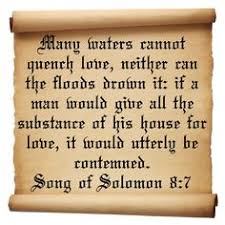 “Many waters cannot quench love, neither can the floods drown it: if a man would give all the substance of his house for love, it would be utterly contemned” (Song of Solomon 8.7). See 1 En [iv] for definition of “Contemned.” God despises, scorns, slights, neglects, or rejects with disdain all that a church does, whatever professions of love she makes, if those acts and/or professions are without love. See Revelation 2:1-7.
A church who does not honor Christ as a wife is to honor her bridegroom and her husband, by remaining pure and chaste, does not display love for the Lord. Loving one’s neighbor by witnessing to him, sending missionaries to him, helping him materially or any other way in obedience to the second commandment—“Thou shalt love thy neighbor as thyself”—is vanity in God’s eyes if one ignores the greatest commandment. The love of the temporal, the worldly—e. g., worldly organization, ownership of property, worldly power and prestige, etc.–by a church infringe the total love (charity) which Christ desires of his churches.
This fact is also articulated in the New Testament. The Lord Jesus is jealous over His church. If we do not love the Lord Jesus, He despises all the “Christian” work we do and the money we put in the offering plate. 1 Corinthians 13.1-3, quoted in En [v] along with definition of “charity,” makes this clear.
Love of a church and of a believer is an act of the will (See, I Corinthians 13:1-7). A church refutes its proclamations of love for the Lord when it wholly or partially combines with or submits to any other entity in anything or acts in any manner which is contrary to the principles for a church given in God’s word. Christ desires to be over a church in “all things” (Ephesians 2:22), to have the preeminence in “all things” (Colossians 1:28).
1 Corinthians 13 explains the kind of love God wants from his children and churches. Love “[r]ejoiceth not in iniquity, but rejoiceth in the truth” (1 Co. 13.6). Iniquity means “Injustice, unrighteousness, … [w]ant of rectitude [rightness in principle or practice], … a sin or crime; wickedness…”[vi] Bible truth makes clear that the love of Christ for His church is immense, that He wants to be the only Head and companion of the church who is likened to His bride and wife, and that for a church to even partially put herself under or associate with another entity is a great wickedness and repudiates all professions of love for the Lord. As will be seen by the believer who follows these teachings to the end, the church who incorporates and secures a 501(c)(3) tax exemption commits wicked sinful acts in violation of biblical principle, and rejoices in iniquity by putting herself partially under two other heads (the state of incorporation and the federal government).
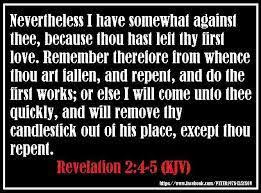 The Lord Jesus warned the church at Ephesus that she had left her first love, the Lord Jesus Christ. See En [vii] for that warning. The Lord instructed that church, “Repent, and do the first works; or else I will come unto thee quickly, and will remove thy candlestick out of his place, except thou repent” (Re. 2.4-5). This warning was for every church who has lost her love for the Lord Jesus.[viii]
As the Lord Jesus Christ is jealous over His churches, so should pastors and church members be jealous, with a godly jealousy, over the church they belong to, just as Paul was: “For I am jealous over you with godly jealousy: for I have espoused you to one husband, that I may present you as a chaste virgin to Christ. But I fear, lest by any means, as the serpent beguiled Eve through his subtilty, so your minds should be corrupted from the simplicity that is in Christ. For if he that cometh preacheth another Jesus, whom we have not preached, or if ye receive another spirit, which ye have not received or another gospel, which ye have not accepted, ye might well bear with him” (2 Co. 11.2-4; Lu. 18.8; 2 Ti. 3.1-8).
The church who really loves her Husband, the Lord Jesus Christ, will seek to maintain her purity, to be subject to her Husband in all things. All the professions of love, all the good deeds, the hymns sung, and the messages preached by a church who does not totally submit herself in all things to her Husband, are contemned by the Lord.
Most pastors, believers and churches do not know what God tells us about this love relationship, nor to thy understand its application. Thus, they combine with, or submit to, another entity, (civil government) in various ways. They obtain, for example, 501(c)(3) or 508(c)(1)(A) federal “tax-exemption,” state incorporation, license to do certain things, or a permit from the state. In short, the choose to become a temporal, earthly, entity subject to the jurisdiction of earthly powers, the state and/or federal government. Such a “church,” in spite of any professions of love for the Lord, according to her acts, shows that she does not love the Lord Jesus Christ.
Click the following to go to Bible study: The Love Relationship between Christ and His Churches as Depicted in Song of Solomon
Endnotes
[i] “For God so loved the world, that he gave his only begotten Son, that whosoever believeth in him should not perish, but have everlasting life” (Jn. 3.16).
[ii] “As thou hast given him power over all flesh, that he should give eternal life to as many as thou hast given him” (Jn. 17.2). “I have manifested thy name unto the men which thou gavest me out of the world: thine they were, and thou gavest them me; and they have kept thy word” (Jn. 17.6). “I pray for them: I pray not for the world, but for them which thou hast given me; for they are thine” (Jn. 17.9). “And now I am no more in the world, but these are in the world, and I come to thee. Holy Father, keep through thine own name those whom thou hast given me, that they may be one, as we are. While I was with them in the world, I kept them in thy name: those that thou gavest me I have kept, and none of them is lost, but the son of perdition; that the scripture might be fulfilled” (Jn. 17.11-12). “Father, I will that they also, whom thou hast given me, be with me where I am; that they may behold my glory, which thou hast given me: for thou lovedst me before the foundation of the world” (Jn. 17.24).
[iii] 1. He gives His bride eternal life: “As thou hast given him power over all flesh, that he should give eternal life to as many as thou hast given him” (Jn. 17.2).
2. The Father’s name: “I have manifested thy name unto the men which thou gavest me out of the world: thine they were, and thou gavest them me; and they have kept thy word…. And I have declared unto them thy name, and will declare it: that the love wherewith thou hast loved me may be in them, and I in them…. Jesus saith unto her, Touch me not; for I am not yet ascended to my Father: but go to my brethren, and say unto them, I ascend unto my Father, and your Father; and to my God, and your God” (Jn. 17.6, 26; 20.17).
3. The Father’s words: “For I have given unto them the words which thou gavest me; and they have received them, and have known surely that I came out from thee, and they have believed that thou didst send me…. I have given them thy word; and the world hath hated them, because they are not of the world, even as I am not of the world” (Jn. 17.8, 14).
4. His own joy: “And now come I to thee; and these things I speak in the world, that they might have my joy fulfilled in themselves” (Jn 1.7.13).
5. His own glory: “And the glory which thou gavest me I have given them; that they may be one, even as we are one” (Jn. 17.22).
[iv] “Contemned” means “despised, scorned, slighted, neglected, or rejected with disdain” (AMERICAN DICTIONARY OF THE ENGLISH LANGUAGE, NOAH WEBSTER (1828), definition of “CONTEMNED”).
[v] “Though I speak with the tongues of men and of angels, and have not charity, I am become as sounding brass, or a tinkling cymbal. And though I have the gift of prophecy, and understand all mysteries, and all knowledge; and though I have all faith, so that I could remove mountains, and have not charity, I am nothing. And though I bestow all my goods to feed the poor, and though I give my body to be burned, and have not charity, it profiteth me nothing” (1 Co. 13.1-3). “Charity” speaks of God’s kind of love. “In a theological sense, [‘charity’] “includes supreme love to God and a universal good will to men. 1 Cor. xiii. Col. iii. 1 Tim. i” (AMERICAN DICTIONARY OF THE ENGLISH LANGUAGE, NOAH WEBSTER (1828), definition of “CHARITY”).
[vi] (AMERICAN DICTIONARY OF THE ENGLISH LANGUAGE, NOAH WEBSTER (1828), definitions of “INIQUITY” and “RECTITUDE”).
[vii] “I know thy works, and thy labour, and thy patience, and how thou canst not bear them which are evil: and thou hast tried them which say they are apostles, and are not, and hast found them liars: And hast borne, and hast patience, and for my name’s sake hast laboured, and hast not fainted. Nevertheless, I have somewhat against thee, because thou hast left thy first love. Remember therefore from whence thou art fallen, and repent, and do the first works; or else I will come unto thee quickly, and will remove thy candlestick out of his place, except thou repent” (Re. 2.2-5).
[viii] “It was a warning of danger of getting away from a personal and loving relationship with Jesus Christ. The real test of any believer, especially those who are attempting to serve Him, is not your little method or mode or system, or your dedication, or any of the things that are so often emphasized today. The one question is: Do you love Him? Do you love the Lord Jesus? When you love Him, you will be in a right relationship with Him, but when you begin to depart from the person of Christ, it will finally lead to lukewarmness. The apostate church was guilty of lukewarmness. It may not seem to be too bad, but it is the worst condition that anyone can be in. A great preacher in upper New York state said: ‘Twenty lukewarm Christians hurt the cause of Christ more than one blatant atheist.’ A lukewarm church is a disgrace to Christ” (J. Vernon McGee, Revelation, Volume I (Pasadena, California: Thru the Bible Books, 1982), pp. 121-122).
 “For the husband is the head of the wife, even as Christ is the head of the church: and he is the savior of the body. Therefore as the church is subject unto Christ, so let the wives be to their own husbands in everything. Husbands, love your wives, even as Christ also loved the church, and gave himself for it; That he might sanctify and cleanse it with the washing of water by the word. That he might present it to himself a glorious church, not having spot, or wrinkle, or any such thing; but that it should be holy and without blemish. For no man ever hated his own flesh; but nourisheth and cherisheth it, even as the Lord the church: For we are members of his body, of his flesh, and of his bones. For this cause shall a man leave his father and mother, and shall be joined unto his wife, and they two shall be one flesh. This is a great mystery: but I speak concerning Christ and the church. Nevertheless let every one of you in particular so love his wife even as himself; and the wife see that she reverence her husband” (Ep. 5.23, 25-27, 29-33)
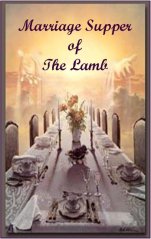 At the marriage of the Lamb, Christ will marry His bride, and all members of the family of God will become part of a universal church or assembly. (Revelation 19:6-8) quoted in En
 The bridegroom is without fault. What about the local church? Has she joined with any other lover? If she is incorporated, has federal tax-exempt status, or is united with the state or any other lover in any way, she has committed spiritual fornication. If so, why not repent and return to your first love?
 Simply Church