A Publication of Simply Church Ministry
 Miss one part of the puzzle that is being put together in these studies and you will never see and understand the whole picture.
Previous Chapter:
B. Bible Doctrine of Church
Next Lesson:
2. Definitions of “Separation of Church and State,” “Established Church,” and “Religious Freedom or Soul Liberty”
Click here to go to all lessons on the Bible doctrine on the relationship of Church and State.
Click here to go to links to all written lessons.
Click here to go to the 3 1/2 to 6 minute video lectures.
Jerald Finney
Copyright © January 20, 2018
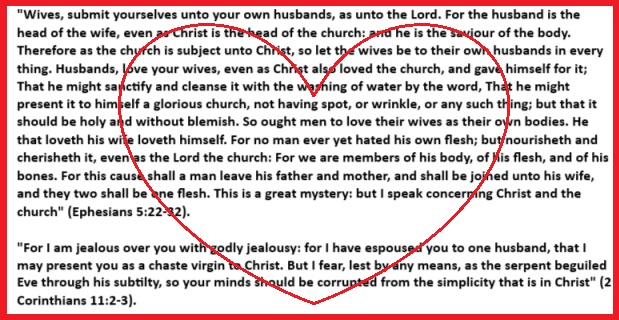 As these studies have already shown, God, the Supreme Ruler, ordained civil government and the church at different times, for different purposes, and for peoples with different natures. God ordained the state, the civil government, to deal with earthly matters, and the church to deal with spiritual matters. God’s word reveals distinct differences, some of which have already been explored in prior lessons, which render church and the state mutually exclusive. God’s desires a special, exclusive, loving relationship with churches. As we have seen from Scripture, God is jealous over his espoused, his churches. See, for example, 2 Corinthians 11:1-3.
God leaves no doubt: the methods used by individuals, families, churches, and nations matter to God. When church and state combine, the earthly combines with the spiritual and trouble lies ahead.
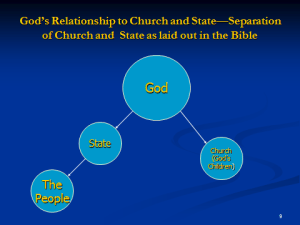
God desires that both civil governments and churches choose to be under Him, to operate according to His principles. His principles for churches are very distinct from those for the government of nations. Thus, God desires separation of church and state—that is, He desires that neither the church nor the Gentile state work with or be under the other. A church who does not understand this proper relationship will be easily influenced to take earthly benefits from the state in return for forsaking her purely spiritual status and calling under Christ. Most American churches have corporate 501(c)(3) legal status; both combine church and state for earthly temporal legal reasons. Such churches are established churches, legal creatures of the state. See, EN.[i]
It is the responsibility of every church, not the state—regardless of all persecutions by the state, by the church-state alliance, and/or by the world in general—to be a light and stand for and proclaim truth. This is so because a church is the only institution made up of people privy to God’s spiritual insights, and only the church can be “the pillar and ground of the truth.” See, EN [ii] When churches leave truth in the dust, they become apostate and there is no longer any support for God’s truth. When that happens, individuals, families, churches, and the nation are headed for trouble, ultimately God’s judgment.
The first union of church in state occurred in the early fourth century. Augustine developed a theology justifying union of church and state. History proves that church state union has always resulted in the corruption of the church, the state, and the people and the persecution of those deemed to be heretics through imprisonment, torture, murder, taking of property, banishment, and other means. Catholic and Protestant establishments, when in exclusive union with the state, viciously persecute and murder those who will not bow down to their ungodly union. See, EN [iii]
The persecutions of the Old World were brought to America. Established churches in the colonies—notably, the Puritans and Anglicans—persecuted heretics. Due to constraints by England, their persecutions were not as severe as in the Old World. In the English colonies, those who refused to bow down to the established churches could not be killed; they could only be jailed, fined, imprisoned, humiliated, etc. As always, faithful Bible believers peacefully stood against the establishments. Due to the circumstances in the colonies, those heroes of the faith ultimately prevailed when the First Amendment was ratified and added to the United States Constitution.
The Covenant Theology of the Puritans, a modified form of Calvinism, which is derived from Catholic church/state theology, spiritualizes and allegorizes much of the Bible. The Puritans in New England prescribed a union of church and state where the church controls the state. Anglican colonial establishments practiced a form of Augustinianism in which the state (the King) controls the church.
The main opponents of union of church and state and persecution of “heretics” in the colonies were the Baptists. Their writings and history has survived. The writings of men such as Roger Williams, Dr. John Clarke, Isaac Backus, and others reveal the colonial spiritual warfare that led to the First Amendment. Sadly, Christian Revisionists like David Barton and William Federer, have revised that history in their attempts to implement their false Presbyterian Calvinist union of church and state theology. They have deceived the great majority of believers since they control “Christian” media and Christian political activism.
Many pastors and believers come up with false reasons for uniting with the state through incorporation, federal tax-exempt status and/or other means. Many take Bible verses taken out of context to prop up their false church/state theology. They have reworded and/or misinterpreted God’s word to justify unholy union of churches with civil government. Many are just ignorant of any Bible reasoning and application and blindly follow tradition .
God’s gives clear warning to churches against building upon the wrong foundation. By the grace of God, this Simply Church Ministry will continue to sound the alarm in the midst of the almost universal hersey and apostasy of American churches. We invite those who have an ear to hear to join with us
1 Corinthians 3:9-17 (KJV) “For we are labourers together with God: ye are God’s husbandry, ye are God’s building. According to the grace of God which is given unto me, as a wise masterbuilder, I have laid the foundation, and another buildeth thereon. But let every man take heed how he buildeth thereupon. For other foundation can no man lay than that is laid, which is Jesus Christ. Now if any man build upon this foundation gold, silver, precious stones, wood, hay, stubble; Every man’s work shall be made manifest: for the day shall declare it, because it shall be revealed by fire; and the fire shall try every man’s work of what sort it is. If any man’s work abide which he hath built thereupon, he shall receive a reward. If any man’s work shall be burned, he shall suffer loss: but he himself shall be saved; yet so as by fire. Know ye not that ye are the temple of God, and that the Spirit of God dwelleth in you? If any man defile the temple of God, him shall God destroy; for the temple of God is holy, which temple ye are” (1 Corinthians 3:9-17).
Endnotes
[i] See What is an established church?
[ii] 1 Ti. 3.15. Many earthly relationships and behaviors involve the application of spiritual insights. For example, God teaches, in His Word, the responsibilities of husbands to wives, wives to husbands, parents to children, children to parents, civil government to marriages and the men and women joined in marriage, civil government to children, and so forth. Although these are spiritual teachings, they are to be applied in earthly relationships to which there is a spiritual parameter. In other words, God is involved in all relationships and has outlined the ultimate consequences for behaviors, and therefore, everything is spiritual even though it may have an earthly dimension. The trouble comes when man tries to exclude God and His principles, an impossible task.
Also, every sphere of ordained government has its own God-given jurisdiction. God desires the state to stay out of family affairs unless criminal acts are involved. He wants civil government to stay out of church affairs, and the church, as an institution to stay out of state affairs. At the same time, he wants Christians to be in authority since only Christians can apply His principles in the realm of government (of course this has almost never happened). Likewise, a church has no God-given jurisdiction over a family.
[iii] Some resources which cover history of the union of church and state under Catholic and Protestant legal establishments (established church/states) are: The History of the First Amendment, The Trail of Blood of the Martyrs of Jesus, and Introduction to the biblical doctrine of “Separation of Church and State (Covers persecution from the crucifixion of Christ by Jews, Rome (the Catholic/Roman establishment), to the Reformation, to the American colonies).
 Simply Church