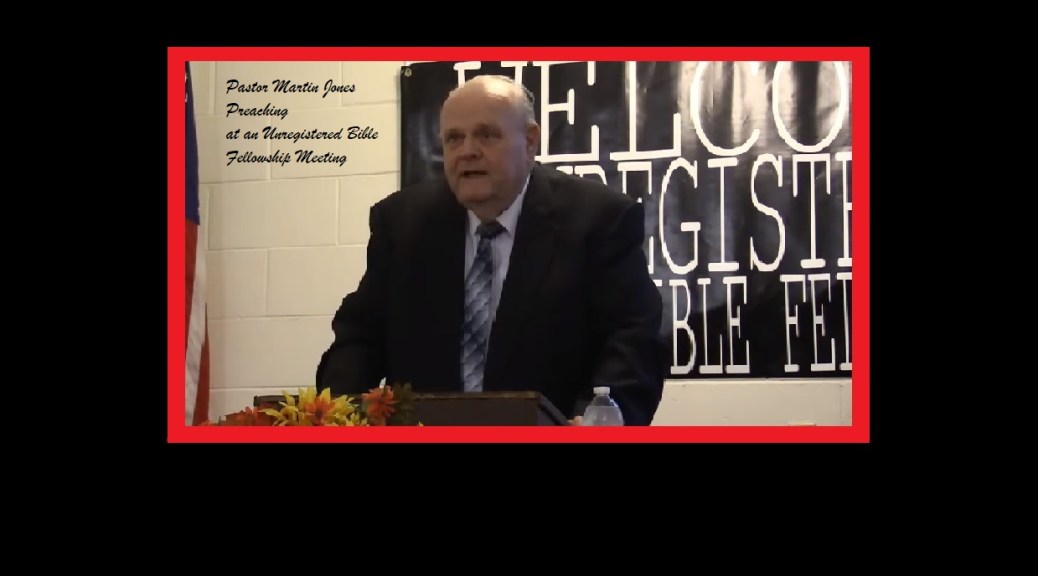
Pastor Martin Jones, pastor of Trinity Springs Baptist Church in Shoal Indiana, is a hero of the faith. He decided long ago that churches should come out from among them, the corporate 501(c)(3) churches, and become separate, set apart for the glory of God. He is trustee of the Trinity Springs Baptist Church Trust which was declared in the 1980’s. He has fought government intrusion into God’s churches for 46 years. He gives his testimony in the following sermons.
In Part 1, he tells of fighting spiritual battles against civil government intrusion into God’s churches starting in the 1970s and 1980s:
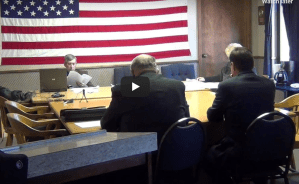
Click the above to go directly to the Youtube of the hearing.
Jerald Finney
January 23, 2019
* See Endnote for Indiana Tax Code for Religious Property Tax Exemption
Trinity Springs Baptist Church had executed a Declaration of Trust in accordance with the First Amendment to the United States Constitution and corresponding Indiana Constitutional provisions. The county tax board had honored the tax exemption on the real property held in the trust estate for some years. However, in 2013 the local property tax board denied the exemption.
The issues in the case were:
whether the the church had to be incorporated and obtain Internal Revenue Code § 501(c)(3) status in order to qualify for the property tax exemption;
whether a church which files a letter of notification stating the that the sole purpose of the property was for worship and explaining that filing an exemption application was against the Church’s religious precepts instead of the state application for property tax exemption is disqualified from receiving the property tax exemption.
Martin Jones, Pastor of Trinity Springs Baptist Church requested an administrative hearing in accordance with Indiana law to contest the denial. That hearing was video recorded. The video is linked to in the following online article: Trinity Springs Baptist Church Wins Tax Case. The two witnesses for Trinity Springs at the hearing were Pastor Jones and Greg Dixon, Pastor of Indianapolis Baptist Temple. Pastor Dixon testified as to a property tax exemption issue involved with IBT which had been unincorporated and organized using the Declaration of Trust since the 1980s. Pastor Jones’ testimony is very instructive. The state offered testimony and argument at the hearing. The facts and issues were well explained by Pastor Jones at the hearing. Pastor Jones’ Defense is a transcript of the defense testimony given by Pastor Jones at the hearing.
Pastor Jones entered the following exhibits into the record at the hearing before the local tax board:
Petitioner Exhibit A – Trinity Springs Baptist Church Congregational Resolution,
Petitioner Exhibit B – The Trail of Blood, J.M. Carroll,
Petitioner Exhibit C – Trinity Springs Baptist Church Letter of Notification to Assessor, 2006
Petitioner Exhibit D – Trinity Springs Baptist Church Letter of Notification to Assessor, 2013
Petitioner Exhibit E – 1989 Memorandum from State Board of Tax Commissioners to County Auditors regarding exemption of religious property,
Petitioner Exhibit G – 2007 pay 2008 tax statement.
The local tax board denied the property tax exemption after the hearing. Pastor Jones appealed to the Indiana Board of Tax Review who held for Pastor Jones in all matters. Go to the PDF of the Final Determination of the Board of Tax Review by clicking the following: FINAL DETERMINATION OF THE INDIANA BOARD OF TAX REVIEW. That determination lays out the facts, procedural history, issues, and analysis of the case.
The Indiana property tax exemption hearing process is much more friendly to those who wish to contest property tax matters than that of some states. Minnesota, for example, has no agency hearing process and property tax payers must petition the Minnesota Tax Court in their attempts to obtain relief, a much more cumbersome and time consuming process. It can take years for the Minnesota Tax Court to get to a case and the rules of civil procedure involved are much more cumbersome than those of the Indiana agency approach. So much so that it would be very difficult for one such as Pastor Jones to deal with the case pro se in Minnesota and some other states. Of course, had Pastor Jones lost in the agency process he could have appealed to state court.
Sec. 21. (a) The following tangible property is exempt from property taxation if it is owned by, or held in trust for the use of, a church or religious society:
(1) A building that is used for religious worship.
(2) The pews and furniture contained within a building that is used for religious worship.
(3) The tract of land upon which a building that is used for religious worship is situated.
(b) The following tangible property is exempt from property taxation if it is owned by, or held in trust for the use of, a church or religious society:
(1) A building that is used as a parsonage.
(2) The tract of land, not exceeding fifteen (15) acres, upon which a building that is used as a parsonage is situated.
(c) To obtain an exemption for parsonages, a church or religious society must provide the county assessor with an affidavit at the time the church or religious society applies for the exemptions. The affidavit must state that:
(1) all parsonages are being used to house one (1) of the church’s or religious society’s rabbis, priests, preachers, ministers, or pastors; and
(2) none of the parsonages are being used to make a profit.
The affidavit shall be signed under oath by the church’s or religious society’s head rabbi, priest, preacher, minister, or pastor.
(d) Property referred to in this section shall be assessed to the extent required under IC 6-1.1-11-9.
Formerly: Acts 1975, P.L.47, SEC.1. As amended by Acts 1981, P.L.68, SEC.1; P.L.74-1987, SEC.5; P.L.198-2001, SEC.30; P.L.264-2003, SEC.2.
The local church sanctified and cleansed by the washing of water by the word——————–A ministry of Charity Baptist Tabernacle of Amarillo, Texas led by Pastor Ben Hickam. "Would to God ye could bear with me a little in my folly: and indeed bear with me. For I am jealous over you with godly jealousy: for I have espoused you to one husband, that I may present you as a chaste virgin to Christ. But I fear, lest by any means, as the serpent beguiled Eve through his subtilty, so your minds should be corrupted from the simplicity that is in Christ" (2 Corinthians 11:1-3). ————————————Jerald Finney, a Christian Lawyer and member of Charity Baptist Tabernacle, having received this ministry in the Lord, explains how a church in America can remain under the Lord Jesus Christ and Him only. "As every man hath received the gift, even so minister the same one to another, as good stewards of the manifold grace of God. If any man speak, let him speak as the oracles of God; if any man minister, let him do it as of the ability which God giveth: that God in all things may be glorified through Jesus Christ, to whom be praise and dominion for ever and ever. Amen" (1 Peter 4:10-11; See also, Ephesians 4::1-16 and 1 Corinthians 12:1-25). "Take heed to the ministry which thou hast received in the Lord, that thou fulfil it" (Colossians 4:17). "And hath put all things under his feet, and gave him to be the head over all things to the church" (Ephesians 1.22; See also, e.g. Colossians 1:18).
 Simply Church