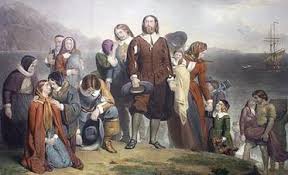
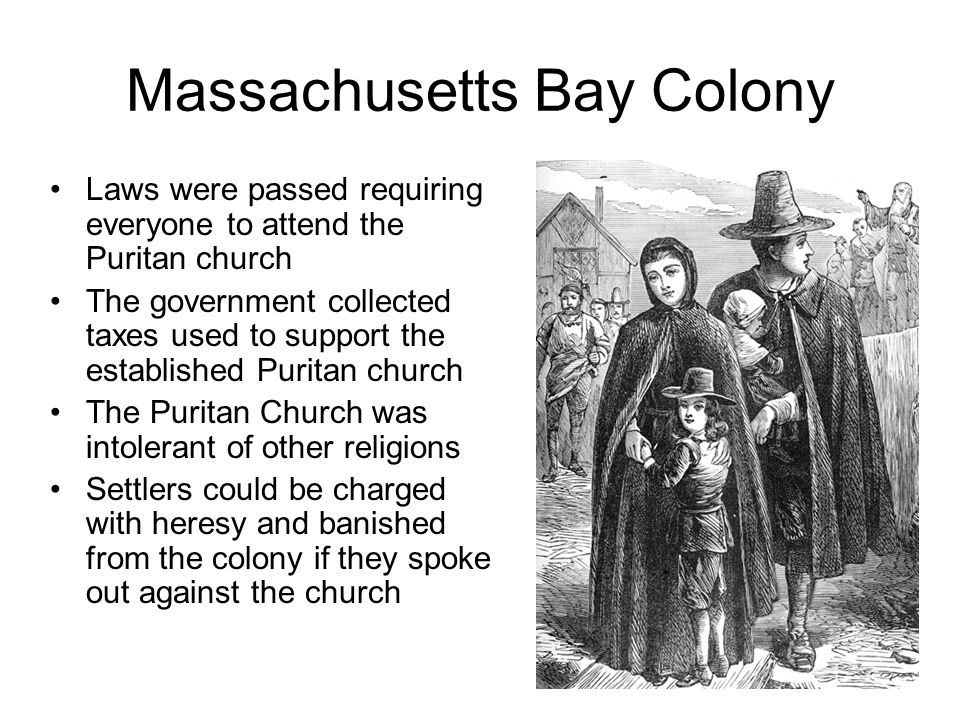
“But this people brought two other principles with them from their native country, in which they did not differ from others; which are, that natural birth, and the doings of men, can bring children into to the Covenant of Grace; and, that it is right to enforce and support their own sentiments about religion with the magistrate’s sword.”[1] Compulsive uniformity “was planted at a General Court in Boston, May 18, 1631 when it was ordered that no one could be admitted ‘to the freedom of [the] body politic’ who was not a member of a church.”[2] “This test in after times had such influence, that he who ‘did not conform, was deprived of more civil privileges than a nonconformist is deprived of by the test in England.’”[3] Since rulers, however selected, received their authority from God, not from the people, and were accountable to God, not to the people, their business was to enforce the nation’s covenant with God.[4] Ministers were not to seek or hold public office, but were counted on to give the people sound advice and to instruct them about the kind of men who were best fitted to rule.[5] Although only church members had political rights, this was a larger group than had political rights in England.[6]
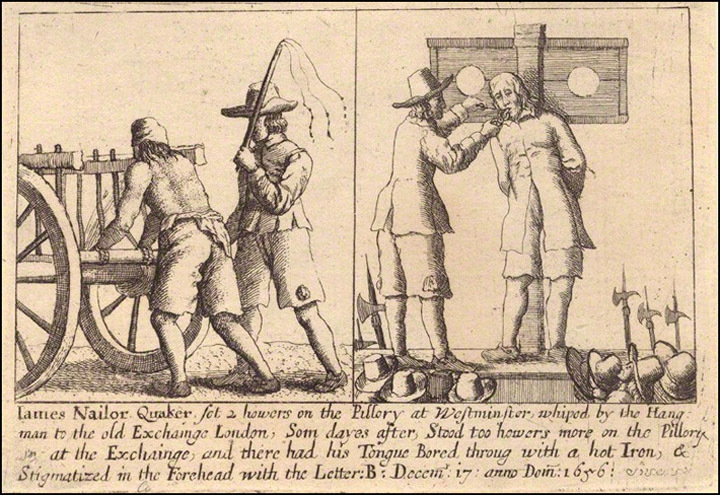
Two Men of the Puritan faith punished.
Since the Puritans believed that every nation existed by virtue of a covenant with God in which it promised to obey His commands, as a modern legal scholar has pointed out, “They knew, in the most elementary terms, that they must punish every sin committed in Massachusetts. And punish they did, with the eager cooperation of the whole community, who knew that sin unpunished might expose them all the wrath of God.”[7] Sins punished included those in the first four commandments, those dealing strictly with man’s relationship to God, as well as other sins, including those dealing with man’s relationship to man. Thus, the churches were thronged every Sunday with willing and unwilling worshipers—everyone was required to attend.[8] Although the church could not enforce the commandments, the state, which was charged with the colony’s commission, had the final and supreme responsibility for suppressing heresy as well as drunkenness and theft and murder.[9]
The Court continued to put its theology into force by act of law. At the General Assembly held March 3, 1636, it was held (1) that no church would form and meet without informing the magistrates and elders of the majority of the churches of their intentions and gaining their approval and (2) that no one who was a member of a church not approved by the magistrates and the majority of state-churches would be admitted to the freedom of the commonwealth.[10]
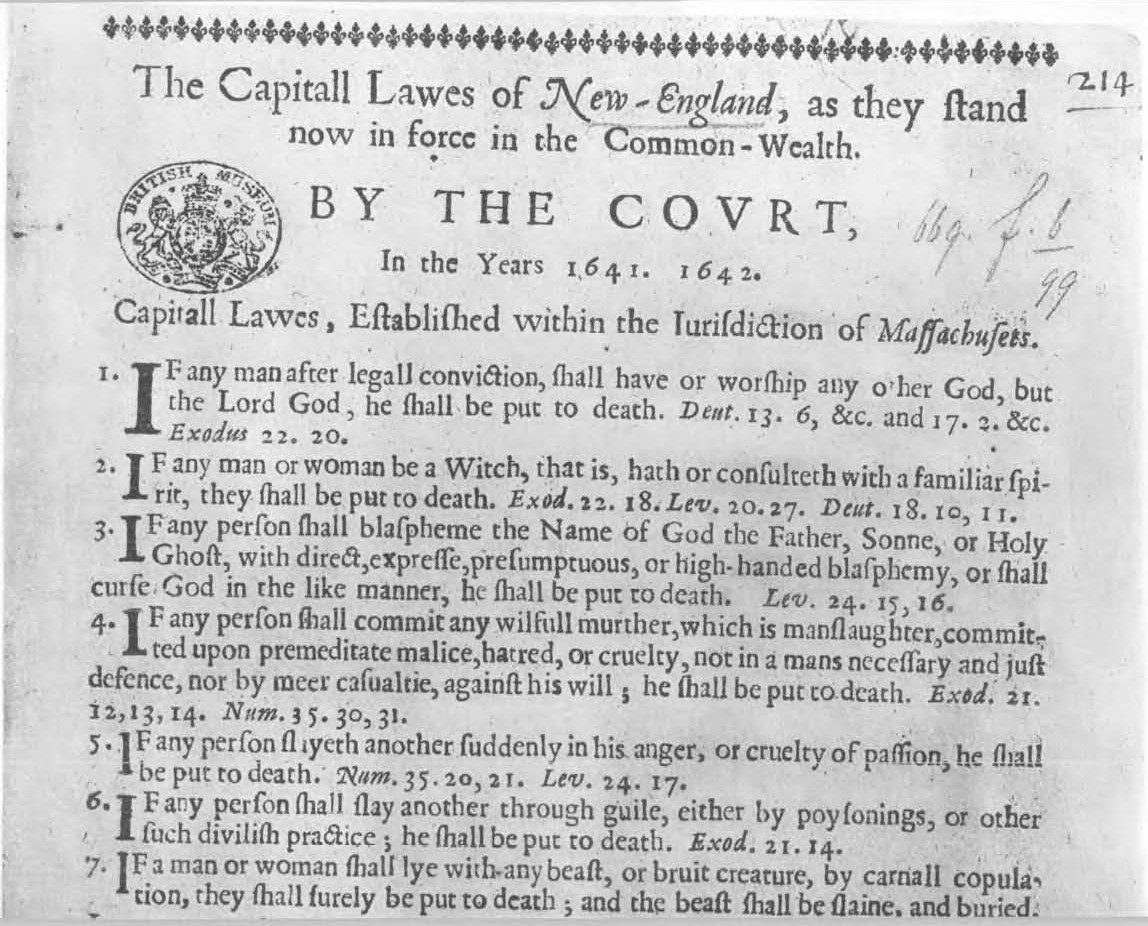
Soon thereafter, the Court passed an act that stated that they were entreated to make “a draught of laws agreeable to the Word of God, which may be the fundamentals of this commonwealth, and to present the same to the next General Court,” and that “in the mean time the magistrates and their associates shall proceed in the courts to hear and determine all causes according to the laws now established, and where there is no law, then as near the laws of God as they can.”[11] This act immediately led to the persecution by banishment, disfranchisement and the forbidding of speaking certain things, removal from public office, fines, and the confiscation of arms.[12] Soon to that act was added that anyone convicted of defaming any court, “or the sentence or proceedings of the same, or any of the magistrates or other judges of any such court, would be punished by ‘fine, imprisonment, or disfranchisement of banishment, as the quality and measure of the offence shall deserve.’”[13]
The banishment and the voluntary exile of many dissidents “did not put an end to the unhappy divisions and contentions in [] Massachusetts.”[14] As a result of animosities and contentions between what were called the Legalists and the Familists or Antinomians, a synod was held, eighty erroneous opinions were presented, debated, and condemned; and a court was held which “banished a few of the chief persons, among those who were aspersed with those errors, and censured several that had been the most active, not it seems, for their holding those opinions, but for their pretended seditious carriage and behavior; and the church at Boston likewise excommunicated at least one of her members, not for those opinions, but for denying they ever held them, and the behavior which these heats occasioned.”[15]
On September 6, 1638, the Assembly at Boston made 2 laws: (1) anyone excommunicated lawfully from a church would, after six months and if not restored, be presented to the Court and there fined, imprisoned, banished or further “as their contempt and obstinacy upon full hearing shall deserve;” and (2) that every inhabitant would be taxed to pay for all common charges as well as for upholding the ordinances of the churches; and, if not so doing, would be compelled thereto by assessment and distress, to be levied by the constable or other officer of the town. The first law was repealed the next fall, but the second remained.[16]
[1] Isaac Backus, A History of New England With Particular Reference to the Denomination of Christians called Baptists, Volume 1 (Eugene, Oregon: Wipf & Stock Publishers, Previously published by Backus Historical Society, 1871), pp. 34-35.
[4] Mark Douglas McGarvie, One Nation Under Law: America’s Early National Struggles to Separate Church and State (DeKalb, Illinois: Northern Illinois University Press, 2005), p. 94.
On March 13, 1639, acts were passed which fined, disenfranchised if no repentance made, and/or committed certain men for certain acts or pronouncements against the established churches.[1] On November 13, 1644, the General Court passed an act which provided
“that if any person or persons, within this jurisdiction, shall either openly condemn or oppose the baptizing of infants, or go about secretly to seduce others from the approbation or use thereof, or shall purposely depart the congregation at the ministration of the ordinance, or shall deny the ordinance of magistry, or their lawful right and authority to make war, or to punish the outward breaches of the first table, and shall appear to the court willfully and obstinately to continue therein after due time and means of conviction, every such person or persons shall be sentenced to banishment.”[2]
As to this law, Isaac Backus appropriately commented:
The beating of Obadiah Holmes by the Puritans in Massachusetts
“A like method of treating the Baptists, in Courts, from pulpits and from the press has been handed down by tradition ever since. And can we believe that men so knowing and virtuous in other respects, as men on that side have been, would have introduced and continued in a way of treating their neighbors, which is so unjust and scandalous, if they could have found better arguments to support that cause upon? I have diligently searched all the books, records and papers I could come at upon all sides, and have found a great number of instances of Baptists suffering for the above points that we own; but not one instance of the conviction of any member of a Baptist church in this country, in any Court, of the errors or evils which are inserted in this law to justify their making of it, and to render our denomination odious. Much has been said to exalt the characters of those good fathers; I have no desire of detracting from any of their virtues; but the better the men were, the worse must be the principle that could ensnare them in such bad actions.”[3]
In 1644 a law against the Baptists was passed asserting that the Anabaptists “have been the incendiaries of the commonwealths, and the infectors of persons in main matters of religion, and the troublers of churches in all places where they have been.”[4]
Two Men of the Puritan faith punished.
In 1646 the General Court adopted the Act, imposing “banishment on any person denying the immortality of the soul, or the resurrection, or sin in the regenerate, or the need of repentance, or the baptism of infants, or ‘who shall purposely depart the congregation at the administration of that ordinance’ or endeavor to reduce others to any of these heresies.” Also, in 1646 an act against “contemptuous conduct toward’ preachers and nonattendance on divine service were made punishable, the former by ‘standing on a block four feet high’ having on the breast a placard with the words ‘An Open and Obstianate Contemner of God’s Holy Ordinances.’”[5]
The magistrates passed a bill in March, 1646 which required “the calling a synod to settle … ecclesiastical affairs,”[6] the synod to be convened not by command, but to motion only to the churches (This was agreed because some questioned the power of civil magistrates over the churches.). In August 1648 the synod met and “completed the Cambridge platform; the last article of which sa[id]:
“If any church, one or more, shall grow schismatical, rending itself from the communion of other churches, or shall walk incorrigibly or obstinately in any corrupt way of their own, contrary to the rule of the word; in such case the magistrate [Josh. 22,] is to put forth his coercive power, as the matter shall require.
“This principle the Baptists and others felt the cruel effects of for many years after.”[7]
The Assembly passed laws against gathering churches without the consent of the assembly, and another “wherein they enacted, ‘that no minister would be called unto office, without the approbation of some of the magistrates, as well as the neighboring churches.’”[8]
In 1657 laws were passed which imposed fine or whipping on those who entertained a Quaker, required citizens to report Quakers, fined those who allowed Quakers to meet on their property, and fined anyone who brought in a Quaker or notorious heretic.[9] Although these laws were repealed on June 30, 1660, they were reenacted immediately, “with slight modifications, or to give place to new laws quite as oppressive.”[10] In September, 1658, the Commissioners of the United Colonies recommended that all the New England colonies “make a law, that all Quakers formerly convicted and punished as such, shall (if they return again) be imprisoned, and forthwith banished or expelled out of the said jurisdiction, under pain of death.”[11] In October 1658, the Assembly at Boston passed a law banishing “Quakers on pain of death” but no other colony passed such a law.[12]
“Many [Quakers] were whipped, some were branded, and Holder, Copeland and Rouse, three single young men, had each his right ear cut off in the prison at Boston….” Three of them who were banished, on pain of death returned again to Boston, and were condemned to die. Two of them, men, were executed. One, Mary Dyre, was released and sent away. She returned and was hanged on June 1, 1660. William Leddra was hanged on March 14, 1661. Charles II ordered that such persecutions cease, and that Quakers that offended were to be sent to England to be tried. “How justly then did Mr. Williams call the use of force in such affairs, ‘The bloody tenet!’” (Ibid., fn. 1, p. 252; pp. 258, 262-263, 265).
Members of the first Baptist church in Boston were imprisoned. Thomas Gould, Thomas Osborne, William Turner, Edward Drinker and John George were imprisoned for starting that Baptist church without approbation from other ministers and their rulers…. Isaac Backus recorded:
“But when their ministers were moved to exert such force against Baptists, though they saw the chief procurers of that sentence struck dead before the time came for its execution, and many more of them about that time, yet their posterity have approved their sayings even to this day. Robert Mascall of England wrote his Congregationalist brethren in Massachusetts pointing out that they, in England, admitted those who practiced believer’s baptism to their churches as required by the Love of God, that their persecutions of the Baptists were contrary to Scripture, that they themselves had been persecuted, and now their brethren were persecuting so that ‘Whatever you can plead for yourselves against those that persecute you, those whom you persecute may plead for themselves against you,’ and ‘Whatever you can say against these poor men, your enemies say against you;’ that ‘[Y]ou cast a reproach upon us, that are Congregational in England, and furnish our adversaries with weapons against us;” and ‘Persecution is bad in wicked men, but it is most abominable in good men, who have suffered and pleaded for liberty of conscience themselves.’”[13]
The persecutions of the Baptists in Massachusetts for withdrawing from public meetings continued.
“On May 15, 1672, the Assembly ordered their law-book to be revised and reprinted.” In it, banishment was required for those who broached and maintained any damnable heresies among which were denying justification by faith alone, denial of the fourth commandment, condemnation of or opposition to infant baptism, denial of the power of the magistrate to punish breaches of the first four commandments, and endeavoring to influence others to any of the errors and heresies mentioned in the law.[14]
After some Baptists organized a church in Boston, and erected a meeting house there, the General Court ordered:
“That no persons whatever, without the consent of the freemen of the town where they live, first orderly had, and obtained, at a public meeting assembled for that end, and license of the County Court, or in defect of such consent, a license by the special order of the General Court, shall erect or make use of any house as above said; and in case any person or persons shall be convicted of transgressing this law, every such house or houses wherein such persons shall so meet more than three times, with the land whereon such house or houses stand, and all private ways leading thereto, shall be forfeited to the use of the county, and disposed of by the County Treasurer, by sale or demolishing, as the Court that gives judgment in the case shall order.”[15]
However, a special act was procured to exempt Boston “from any compulsive power for the support of any religious ministers.” As a result, the Baptist church in Boston, which had begun in 1665, was able to build a meeting-house.[16] Thus Baptist churches in Boston had equal liberties with other denominations since 1693, but this liberty was denied throughout the rest of Massachusetts.[17]
As a result of these repressive laws, the king of England sent a letter requiring that liberty of conscience should be allowed to all Protestants, that they be allowed to take part in the government, and not be fined, subjected to forfeiture, or other incapacities, “whereas,” he said, “liberty of conscience was made a [one] principle motive for your first transportation to these parts.”[18]
Soon a synod was called which condemned Quakers and Anabaptists. The General Court agreed. The magistrates had the doors of the Baptist meeting house boarded up, fined some of their members, forbade the Baptists to meet anywhere else, and fined some who were found to have gone to Baptist meetings. Following this came much controversy between the Baptists and the establishment. [19]
The established church ignored pleas to leniency toward those with whom it disagreed. For example, they ignored the plea Sir Henry Vane wrote John Winthrop, governor of Massachusetts, in 1645: “The exercise and troubles which God is pleased to lay upon these kingdoms, and the inhabitants in them teaches us patience and forbearance one with another in some measure, though there be difference in our opinions, which makes me hope that, from the experience here, it may also be derived to yourselves….”[20]
Because of their strong bias, the Congregationalists wrote much against the dissenters, their method being asserting the disputed point taken by them:
“for truth, without any evidence, they blended that with many known facts recorded in Scripture, and thereupon rank the opposers to that point with the old serpent the devil and Satan, and with his instruments Cain, Pharoah, Herod, and other murderers; yea, with such as sacrifice their children to devils! This history contains abundant evidence of their adding the magistrate’s sword to all these hard words, which were used in their prefaces before they came to any of the Baptists arguments” (Ibid., p. 151. Mr. Backus gives examples of such establishment arguments on pp. 148-150. On pp. 151-153 he thoroughly debunks the argument for infant baptism as well as arguments that the subjects of the new covenant are the same. For example, Backus points out that “God says his new covenant is not according to that he made with Israel. Heb. viii. 8-11…. By divine institution a whole family and a whole nation were then taken into covenant; now none are added to the church by the Lord but believers who shall be saved. Acts ii.41, 47….”).[21]
Endnotes
[1] Isaac Backus, A History of New England With Particular Reference to the Denomination of Christians called Baptists, Volume 1 (Eugene, Oregon: Wipf & Stock Publishers, Previously published by Backus Historical Society, 1871), pp. 93-94.
[16] Isaac Backus, A History of New England With Particular Reference to the Denomination of Christians called Baptists, Volume 2 (Eugene, Oregon: Wipf & Stock Publishers, Previously published by Backus Historical Society, 1871), p. 418
[21]Ibid., p. 151. Mr. Backus gives examples of such establishment arguments on pp. 148-150. On pp. 151-153 he thoroughly debunks the argument for infant baptism as well as arguments that the subjects of the new covenant are the same. For example, Backus points out that “God says his new covenant is not according to that he made with Israel. Heb. viii. 8-11…. By divine institution a whole family and a whole nation were then taken into covenant; now none are added to the church by the Lord but believers who shall be saved. Acts ii.41, 47….”
The local church sanctified and cleansed by the washing of water by the word——————–A ministry of Charity Baptist Tabernacle of Amarillo, Texas led by Pastor Ben Hickam. "Would to God ye could bear with me a little in my folly: and indeed bear with me. For I am jealous over you with godly jealousy: for I have espoused you to one husband, that I may present you as a chaste virgin to Christ. But I fear, lest by any means, as the serpent beguiled Eve through his subtilty, so your minds should be corrupted from the simplicity that is in Christ" (2 Corinthians 11:1-3). ————————————Jerald Finney, a Christian Lawyer and member of Charity Baptist Tabernacle, having received this ministry in the Lord, explains how a church in America can remain under the Lord Jesus Christ and Him only. "As every man hath received the gift, even so minister the same one to another, as good stewards of the manifold grace of God. If any man speak, let him speak as the oracles of God; if any man minister, let him do it as of the ability which God giveth: that God in all things may be glorified through Jesus Christ, to whom be praise and dominion for ever and ever. Amen" (1 Peter 4:10-11; See also, Ephesians 4::1-16 and 1 Corinthians 12:1-25). "Take heed to the ministry which thou hast received in the Lord, that thou fulfil it" (Colossians 4:17). "And hath put all things under his feet, and gave him to be the head over all things to the church" (Ephesians 1.22; See also, e.g. Colossians 1:18).
 “But this people brought two other principles with them from their native country, in which they did not differ from others; which are, that natural birth, and the doings of men, can bring children into to the Covenant of Grace; and, that it is right to enforce and support their own sentiments about religion with the magistrate’s sword.”[1] Compulsive uniformity “was planted at a General Court in Boston, May 18, 1631 when it was ordered that no one could be admitted ‘to the freedom of [the] body politic’ who was not a member of a church.”[2] “This test in after times had such influence, that he who ‘did not conform, was deprived of more civil privileges than a nonconformist is deprived of by the test in England.’”[3] Since rulers, however selected, received their authority from God, not from the people, and were accountable to God, not to the people, their business was to enforce the nation’s covenant with God.[4] Ministers were not to seek or hold public office, but were counted on to give the people sound advice and to instruct them about the kind of men who were best fitted to rule.[5] Although only church members had political rights, this was a larger group than had political rights in England.[6]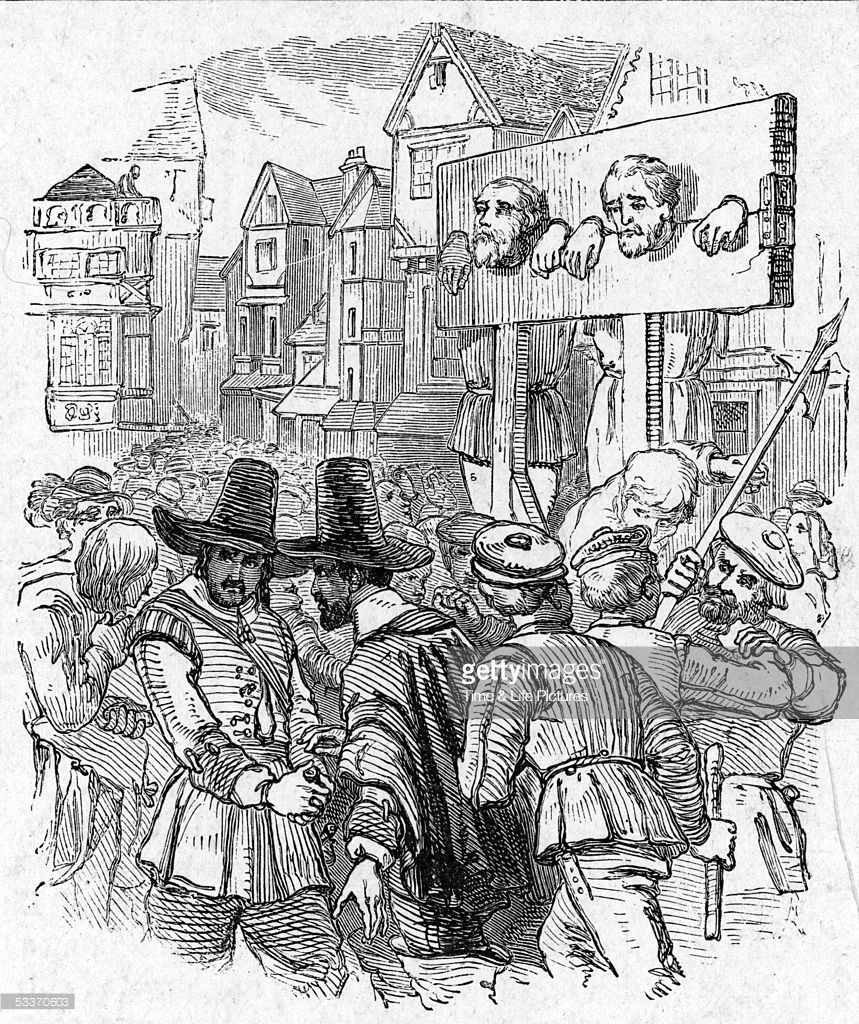
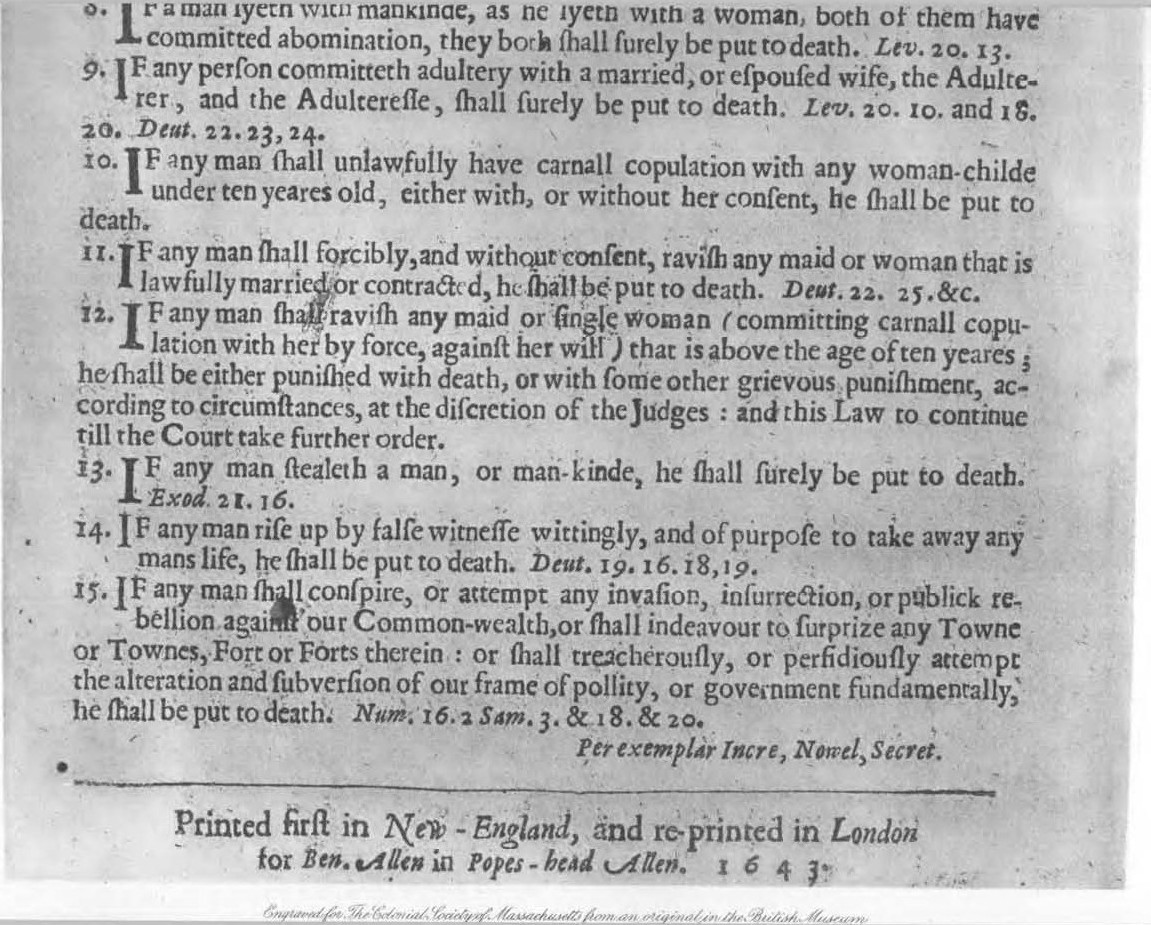
 Soon thereafter, the Court passed an act that stated that they were entreated to make “a draught of laws agreeable to the Word of God, which may be the fundamentals of this commonwealth, and to present the same to the next General Court,” and that “in the mean time the magistrates and their associates shall proceed in the courts to hear and determine all causes according to the laws now established, and where there is no law, then as near the laws of God as they can.”[11] This act immediately led to the persecution by banishment, disfranchisement and the forbidding of speaking certain things, removal from public office, fines, and the confiscation of arms.[12] Soon to that act was added that anyone convicted of defaming any court, “or the sentence or proceedings of the same, or any of the magistrates or other judges of any such court, would be punished by ‘fine, imprisonment, or disfranchisement of banishment, as the quality and measure of the offence shall deserve.’”[13]
 The banishment and the voluntary exile of many dissidents “did not put an end to the unhappy divisions and contentions in [] Massachusetts.”[14] As a result of animosities and contentions between what were called the Legalists and the Familists or Antinomians, a synod was held, eighty erroneous opinions were presented, debated, and condemned; and a court was held which “banished a few of the chief persons, among those who were aspersed with those errors, and censured several that had been the most active, not it seems, for their holding those opinions, but for their pretended seditious carriage and behavior; and the church at Boston likewise excommunicated at least one of her members, not for those opinions, but for denying they ever held them, and the behavior which these heats occasioned.”[15]
 Simply Church