Tag Archives: spiritual body

4. The Holy Spirit Forms a Church which Is a Temple, a Spiritual Body, the Body of Christ


A Publication of Simply Church Ministry


If you miss one part of the puzzle that is being put together in these studies, you will never see and understand the whole picture.


Previous Lesson:
3. A Church Is a Mystery, an Assembly, a Spiritual Body

Next Lesson:
Christ, the Head/Bridegroom/Husband of the Local Church

Click here to go to all lessons on the Bible Doctrine of the Church.

Click here to go to the written lessons.

Click here to go to the 5 minute video lectures.


Jerald Finney
Copyright © January 2, 2018

The Bible expressly declares that the Holy Spirit is a divine Person (e.g., Jn. 14.16, 16, 26; 15.26; 16.7-15; Mt. 28.19). This is everywhere implied.

The Holy Spirit forms a church. When Peter opened the door of the kingdom to the Gentiles (Ac. 10), the Holy Spirit, without delay, or other condition than faith, was given to those who believed (Ac. 10.44; 11.15-18). This is the permanent fact for the entire church-age. Every believer is born of the Spirit (Jn. 3.3, 6; 1 Jn. 5.1), indwelt by the Spirit, whose presence makes the believer’s body a temple (Ga. 4.6, Ro. 8.9-15 (“if any man have not the Spirit of Christ, he is none of his”); 1 Co. 3.16-17; 1 Co. 6.19; 1 Jn. 2.27;), thus sealing him for God (Ep. 1.13; 4.30). The Holy Spirit imparts gifts for service to every member of that body (1 Co. 12.7-11, 27, 30; Ep. 4.3-4; 11, 16), guides the members in their service and is Himself the power of that service (Lk. 2.27; 4.1; Ac. 1.8; 2.4; Ac. 16.6, 7; 1 Co. 2.4; 12.4-11). The Spirit abides in the company of believers who constitute a local church, making of them, corporately, a temple (1 Co. 3.16, 17; 2 Co. 6.16; Ep. 2.21).

A church is called the body of Christ, and therefore a living organism a spiritual body. Paul gives two metaphors of the body, the living spiritual body or organism. The first is in 1 Corinthians 12.12-27, quoted in En [i]. The second is in Ephesians 4:4-16, quoted in En [ii]

In other passages, Christ is depicted as the head of the church and the earthly members as the body. Remember that these passages are from Epistles written to local churches for their instruction.

  1. “And hath put all things under his feet, and gave him to be the head over all things to the church, Which is his body, the fulness of him that filleth all in all” (Ep. 1.22-23).
  2. “But speaking the truth in love, may grow up into him in all things, which is the head, even Christ:  From whom the whole body fitly joined together and compacted by that which every joint supplieth, according to the effectual working in the measure of every part, maketh increase of the body unto the edifying of itself in love” (Ep. 4.15-16).
  3. “And not holding the Head, from which all the body by joints and bands having nourishment ministered, and knit together, increaseth with the increase of God” (Col. 2.19).
A church is a holy temple for the habitation of God through the Spirit (Ep. 2.21, 22); is “one flesh” with Christ (Ep. 5.30, 31); and espoused to Him as a chaste virgin to one husband (2 Co. 11.2-4). By speaking the truth in love, a church “may grow up into him in all things, which is the head, even Christ.”


For more details, to include an examination of conflicting views, see Definition, Organization, and Purposes of a Church.

Click here to go to Bible Study of Ephesians. Ephesians reveals the institution of the church as God’s masterpiece. It is more wonderful that any temple made with hands, constructed of living stones, indwelt by the Holy Spirit. Ephesians 1 presents the church as a body.

Articles, Essays, and Other Resources Related to the Doctrine of the Church, Incorporation, 501c3, Etc.

The Local Church: A Building or What?

Bible Studies of various Books on the Doctrine of the Church.

The Biblical Doctrine of the Church


Endnotes

[i] 1 Corinthians 12.12-27: “For as the body is one, and hath many members, and all the members of that one body, being many, are one body: so also is Christ. For by one Spirit are we all baptized into one body, whether we be Jews or Gentiles, whether we be bond or free; and have been all made to drink into one Spirit. For the body is not one member, but many. If the foot shall say, Because I am not the hand, I am not of the body; is it therefore not of the body? And if the ear shall say, Because I am not the eye, I am not of the body; is it therefore not of the body? If the whole body were an eye, where were the hearing? If the whole were hearing, where were the smelling? But now hath God set the members every one of them in the body, as it hath pleased him. And if they were all one member where were the body? But now are they many members, yet but one body. And the eye cannot say unto the hand, I have no need of thee: nor again the head to the feet, I have no need of you.  Nay, much more those members of the body, which seem to be more feeble, are necessary: And those members of the body, which we think to be less honourable, upon these we bestow more abundant honour; and our uncomely parts have more abundant comeliness. For our comely parts have no need: but God hath tempered the body together, having given more abundant honour to that part which lacked: That there should be no schism in the body: but that the members should have the same care one for another. And whether one member suffer, all the members suffer with it; or one member be honoured, all the members rejoice with it. Now ye are the body of Christ, and members in particular” (1 Co. 12.12-27)

[ii] Ephesians 4:4-16: “There is one body, and one Spirit, even as ye are called in one hope of your calling; One Lord, one faith, one baptism, One God and Father of all, who is above all, and through all, and in you all. But unto every one of us is given grace according to the measure of the gift of Christ. Wherefore he saith, When he ascended up on high, he led captivity captive, and gave gifts unto men.  (Now that he ascended, what is it but that he also descended first into the lower parts of the earth? He that descended is the same also that ascended up far above all heavens, that he might fill all things.)  And he gave some, apostles; and some, prophets; and some, evangelists; and some, pastors and teachers; For the perfecting of the saints, for the work of the ministry, for the edifying of the body of Christ: Till we all come in the unity of the faith, and of the knowledge of the Son of God, unto a perfect man, unto the measure of the stature of the fulness of Christ:  That we henceforth be no more children, tossed to and fro, and carried about with every wind of doctrine, by the sleight of men, and cunning craftiness, whereby they lie in wait to deceive; But speaking the truth in love, may grow up into him in all things, which is the head, even Christ:  From whom the whole body fitly joined together and compacted by that which every joint supplieth, according to the effectual working in the measure of every part, maketh increase of the body unto the edifying of itself in love.”
3. A Church Is a Mystery, an Assembly, a Spiritual Body


A Publication of Simply Church Ministry


If you miss one part of the puzzle that is being put together in these studies, you will never see and understand the whole picture.


Previous Lesson:
2. Christ Ordained the Church and Builds It upon the Rock

Next Lesson:
4. The Holy Spirit Forms a Church which Is a Temple, a Spiritual Body, the Body of Christ

Click here to go to all lessons on the Bible Doctrine of the Church.

Click here to go to links to all written lessons.

Click here to go to the 5 minute video lectures.


Jerald Finney
Copyright © January 1, 2018


Note. For more on this, see Stewards of the Mystery of the Church Found Lacking, Except for a Remnant (033020)

Members of a New Testament Church under Christ alone are stewards of the mysteries of God; therefore, stewards of the mystery of the church. God requires that His stewards be found faithful. (1 Co. 4.1-2).

The institution of the New Testament church, made  up of local assemblies, is a mystery hidden in past ages and, therefore, not revealed in the Old Testament; but now “made known unto the sons of men, as it is now revealed unto his holy apostles and prophets by the Spirit” (Ep. 3.5). A mystery in Scripture means that God is revealing something that, up to that time, he had not revealed. Such a mystery has two elements: (1) It cannot be discovered by human reason. (2) It is revealed at the proper time and not concealed; and enough is revealed to establish the fact without all the details being given. Believers in a local church may understand this mystery of Christ, when they read the words of God penned by the Apostle Paul (Ep. 3:4).

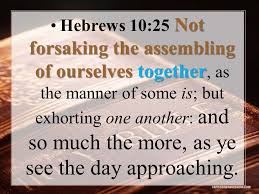
Just as the church in the wilderness was an assembly called out by God, an ecclesia (see Ac. 7.38), so a New Testament church is an assembly of called-out ones. Israel, in the wilderness, was a church or assembly, but in striking contrast with the New Testament assembly. Israel in the land is never called a church; they were not all assembled after they entered the land. Born-again believers are admonished not to forsake the assembling of themselves together, not to forsake the local church, the only assembly of believers on earth (He. 10.25).

That the Gentiles were to be saved was no mystery (Ro. 9.24-33; 10.19-21).[i] The mystery was the divine purpose to make of Jew and Gentile a wholly new thing—the church made up of local autonomous New Testament bodies in this age—and in which the earthly distinction of Jew and Gentile disappears. (Ep. 2.14, 15; Co. 3.10, 11). Jesus Christ established His local assembly while he walked as the God Man on earth and appointed His local assembly as executor of His Will or Testament. For more on this, see, e.g., The New Testament of Jesus Christ:  His Executor Named and Empowered. The revelation of this mystery which was foretold but not explained by Christ (Mt. 16.18) was committed to Paul.

The institution of the New Testament church is solely made up of local spiritual bodies, made up of an assembly of believers (See, e.g., Ep. 4). Christ will gather all members of his earthly family together in a general or universal assembly in the heavenly Jerusalem (He. 12.22-24) at the marriage of the Lamb (Re. 19.7-10). Before that, there will be no universal assembly.

All Bible references to a church here on the earth refer to a local body of Jewish and/or Gentile believers and not to a universal or catholic church. Nowhere in the New Testament is a church here on the earth ever referred to as anything other than a local spiritual body and nowhere does Scripture teach that a church is to have any type authority above it other than the Lord Jesus Christ. Some examples of references to churches as they existed in the New Testament are listed and quoted in endnote [ii].

Adherents can do no more than quote Matthew 16.18, 1 Corinthians 12.12-13, or other verses taken misinterpreted and taken out of context in support of the universal church doctrine. 1 Corinthians was written to a local autonomous church, with principles to be applied by all churches. One must analyze the verse in context of all immediate verses as well as all New Testament doctrine to ascertain its meaning; such an examination gives absolutely no support to a universal church doctrine for this age. See [iii] for links to more resources, a webpage with teachings and links to more sermons, and an article on C. I. Schofield’s “True Church” doctrine.

In his seven letters to seven local autonomous Gentile churches (in Rome, Corinth, Galatia, Ephesus, Philippi, Colosse, and Thessalonica), the church, the “mystery from the beginning of the world hath been hid in God,” (Ep. 3.9) is fully revealed, and fully instructed as to her unique place in the counsels and purposes of God. Through Paul alone, we know that a church is not an organization, but an organism instinct with His life, and heavenly in calling promise and destiny. Through him alone, we know the nature, purpose, and form of organization of local churches, the right conduct of such assemblies, and the commandments for the earthly walk of the members.

A church is a spiritual body made up individual believing members (Ep. 4, 1 Co. 12). Each member is indwelt by the Holy Spirit and has a proper place in the local body. Christ sets some in the body as apostles,[iv] prophets,[v] evangelists, pastors, and teachers; “For the perfecting of the saints, for the work of the ministry, for the edifying of the body of Christ” (Ep. 4.12). The members of the local body are to speak the truth in love, that they “may grow up into him in all things, which is the head, even Christ. From whom the whole body fitly joined together and compacted by that which every joint supplieth, according to the effectual working in the measure of every part, maketh increase of the body unto the edifying of itself in love” (Ep. 4.15-16).


Click here to go to Bible Study of Ephesians. Ephesians reveals the local church as God’s masterpiece. It is more wonderful that any temple made with hands, constructed of living stones, indwelt by the Holy Spirit. Ephesians 1 presents the local church as a body.

Articles, Essays, and Other Resources Related to the Doctrine of the Church, Incorporation, 501c3, Etc.

The Local Church: A Building or What?

Bible Studies of various Books on the Doctrine of the Church.

The Biblical Doctrine of the Church


Endnotes

[i] A mystery in Scripture is a previously hidden truth, now divinely revealed, but in which a supernatural element still remains despite the revelation.

[ii] New Testament verses:

  • “Then had the churches rest throughout all Judaea and Galilee and Samaria, and were edified; and walking in the fear of the Lord, and in the comfort of the Holy Ghost, were multiplied” (Ac. 9.31).
  • Paul said, “Likewise greet the church that is in their house. (Ro. 16.5)” Notice that the church refers to the local body of baptized believers. The house was just the place where they met; it was not a church.
  • Paul wrote to the church in Corinth, “Paul … Unto the church of God which is at Corinth, to them that are sanctified in Christ Jesus, called to be saints, with all that in every place call upon the name of Jesus Christ our Lord, both their’s and our’s” (1 Co. 1.1-2).
  • “If therefore the whole church be come together into one place….” (1 Co. 14.23).
  • “The churches [Not “the church of Asia”] of Asia salute you. Aquila and Priscilla salute you much in the Lord, with the church that is in their house” (1 Co. 16.19).
  • “Paul … unto Philemon … and to the church in thy house” (Phil. 1-2).
  • “… [T]hat thou mayest know how thou oughtest to behave thyself in the house of God, which is the church of the living God, the pillar and ground of the truth” (1 Ti. 3.15).
  • The Bible defines “house of God”: “For every house is builded by some man; but he that built all things is God. And Moses verily was faithful in all his house; as a servant, for a testimony of those things which were to be spoken of after; But Christ as a son over his own house; whose house are we, if we hold fast the confidence and the rejoicing of the hope firm unto the end” (He. 3.4-6).
  • In Revelation, the Lord speaks to “the church of Ephesus” (Re. 2.1) “the church in Smyrna” (Re. 2.8), “the church in Pergamos” (Re. 2.12), “the church in Thyatira” (Re. 2.18), “the church in Sardis” (3.18), “the church in Philadelphia” (Re. 3.7), and “the church of the Laodiceans” (Re. 3.14).

[iii] Defining the word Church: Local, Visible, Institutional, never Universal; Origin of the Universal Church Exposed: Constantine, Augustine & Scofield; Rightly Dividing Baptisms: Is 1 Corinthians 12:13 Spirit baptism or water baptism?. For more in depth teachings and sermons on the church, go to the following webpage and scroll down: The Biblical Doctrine of the Church. See also, the article, Scofield’s headnote to “Ephesians” and margin notes on his false “true church” doctrine.

[iv] The word apostle, means “one sent forth,” and is is used of our Lord He. 3:1. Elsewhere it is used for the twelve who were called to that office by our Lord during His earth ministry; of Paul, called to the apostleship by the risen and ascended Lord, and of Barnabas Ac. 14:14 specially designated by the Holy Spirit Ac. 13:2. Of Matthias, chosen by lot by the eleven to take the place of Judas Iscariot, Ac .1:16-26: “And he was numbered with the eleven.” Ac. 1:26
The “signs” of an apostle were (1) They were chosen directly by the Lord Himself, or, as in the case of Barnabas, by the Holy Spirit (Mt. 10:1-2; Mk. 3:13-14; Lk. 6:13; Ac. 9:6; 13:2; 22:10,14-15; Ro. 1:1). (2) They were endued with sign gifts, miraculous powers which were the divine credentials of their office (Mt. 10:1; Ac 5:15; 16:16-18; Mt 28:8-9). (3) Their relation to the kingdom was that of heralds, announcing to Israel only Mt. 10:5-6 the kingdom as at hand and manifesting kingdom powers Mt. 10:7-8. (4) To one of them, Peter, the keys of the kingdom of heaven, viewed as the sphere of Christian profession, as in Mt. 13, were given Mt 16:19. (5) Their future relation to the king will be that of judges over the twelve tribes Mt 19:28. (6) Consequent upon the rejection of the kingdom, and the revelation of the mystery hid in God (Mt .16:18; Ep. 3:1-12), the Church, the apostolic office was invested with a new enduement, the baptism with the Holy Spirit Ac. 2:1-4; a new power, that of imparting the Spirit to Jewish-Christian believers; a new relation, that of foundation stones of the new temple (Ep. 2:20-22) and a new function, that of preaching the glad tidings of salvation through a crucified and risen Lord to Jew and Gentile alike. (7) The indispensable qualification of an apostle was that he should have been an eye-witness of the resurrection (Ac. 1:22; 1 Co. 9:1).

[v] The church was “built on the foundation of the apostles and prophets, Jesus Christ himself being the chief corner stone (Ep. 2.20). These “prophets” were New Testament prophets; to the Old Testament prophets, the church remained a mystery.

  • The mystery of the church, “Which in other ages was not made known unto the sons of men, as it is now revealed unto his holy apostles and prophets by the Spirit” (Ep. 3.5).
  • “To whom coming, as unto a living stone, disallowed indeed of men, but chosen of God, and precious, Ye also, as lively stones, are built up a spiritual house, an holy priesthood, to offer up spiritual sacrifices, acceptable to God by Jesus Christ. Wherefore also it is contained in the scripture, Behold, I lay in Sion a chief corner stone, elect, precious: and he that believeth on him shall not be confounded” (1 Pe. 2.4-6).