A Publication of Simply Church Ministry
If you miss one part of the puzzle that is being put together in these studies, you will never see and understand the whole picture.
Previous Lesson:
1. Introduction
Click here to go to all lessons on the Bible doctrine on the relationship of Church and State.
Click here to go to links to all written lessons.
Click here to go to the 3 1/2 to 6 minute video lectures.
Jerald Finney
Copyright © January 22, 2018
Separation of church and state,” “established church” and “religious freedom and soul liberty (the two go hand in hand),” are inherent in the establishment clause of the First Amendment to the United States Constitution. This lesson will define those phrases. The remaining studies and cited authorities, especially the studies on the history of the First Amendment, will make perfectly clear that the definitions given here are accurate.
1. Definition of Separation of Church and State
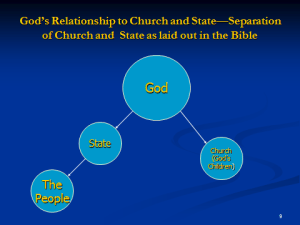
The biblical principle of “separation of church and state” is that God desires both a church and the state to choose to be under God, but desires neither to be over or to work hand in hand with the other. According to God’s word, different principles apply to church and state. A church has spiritual responsibilities. The state has earthly responsibilities. God desires the two to be totally separate entities, both ordained by God who desires both to submit to Him in love and to be guided by His principles as stated in His Word. God’s principle of separation applies to church and state. As Jesus explained to the Pharisees, “Render therefore unto Caesar the things which are Caesar’s; and unto God the things that are God’s” ()Matthew 22:21).
A church under God remains an eternal spiritual entity only so long as she does not inadvertently or intentionally change her status to an earthly temporal entity by placing herself under the law of man, under civil government. By placing herself under the law of man, she combines church and state and makes herself, at least partially and sometimes wholly, a temporal, legal, earthly entity.
The incorporated and federal tax exempt (501(c)(3) or 508(c)(1)(A)) church is the main type of state/church union. The rules of civil government for such a church are secular and such a church agrees, when she applies for and accepts the status, to the rules which come with state non-profit corporation law and the rules that come with her tax-exempt status. She also agrees that any disputes over violation of the rules will be decided by her chosen authority—the state of incorporation or, for 501(c)(3) and 501(c)(3)(A) purposes, the federal government. God and the Bible will have no part in disputes deemed by the state to be under their authority.
In other words, man, not God, has authority over much of what the corporate 501(c)(3) or 508(c)(1)(A) church, being an established church, does. For many activities, the First Amendment and corresponding provisions of the particular state constitution which are statements of the Bible principle of separation of church and state (not separation of God and state) no longer apply. Such a church has chosen to become a legal person under the Fourteenth Amendment. See, Incorporated Church: A Human Being with No Soul.
2. Definition of “Established Church”
 An established church is a church who is an integral part of the state and receives state support. She does this by choosing to become a legal entity. The church and state reach an agreement or enter into a contract whereby either the state runs the church, the church runs the state, or the church and state work hand in hand, as equal partners, to enforce earthly and spiritual laws and principles. In modern America state-churches are influenced, perverted, and/or perhaps dominated by state enforced satanic principles.
Historically, the established church has either been over the state, or the state has been over the established church. When the state has been over the church, the state directs the affairs of the church to a greater or lesser degree and vice-versa. In either case, the spiritual affairs of the church are mixed with the earthly responsibilities of the state. In the past, in either a church/state or state/church, leaders of both church and state operated under a false theology based upon false biblical principles. The results were (1) corruption of the church, corruption of the state, corruption of the clergy and political leaders and the members of society and the church, and (2) torture, imprisonment, confiscation of property, and/or the killing of those who refused to bow down to the theology of the church-state or state-church. We see the former results in the church-state activities in America today. The latter results occuried in the American colonies.
3. Definition of Religious Freedom or Soul Liberty
“By religious freedom, or soul liberty, is meant the natural and inalienable right of every soul to worship God according to the dictates of his own conscience, and to be unmolested in the exercise of that right, so long, at least, as he does not infringe upon the rights of others; that religion is, and must be a voluntary service; that only such service is acceptable to God; and, hence that no earthly power, whether civil or ecclesiastical, has any right to compel conformity to any creed or to any species of worship, or to tax a man for its support.”
Religious freedom exists when every citizen has, by law, the choice, without persecution, of choosing God, false gods or a false god, or no god at all. Religious freedom, as shown in God’s Word, is what He desires in a Gentile nation. Even though He desires Gentile nations to provide for religious liberty, He also wants them to submit themselves to Him and His principles, and recognize that Jesus Christ is the Supreme Sovereign. Thus a nation modeled after biblical principles will provide for religious liberty while also operating under God and His principles for civil government.
“This principle gives to ‘Caesar’ ‘the things that are Caesar’s,’ but it denies to Caesar ‘the things that are God’s.’ It does not make it a matter of indifference what a man believes or how he acts, but it places all on the same footing before God, the only lord of the conscience, and makes us responsible to him alone for our faith and practice. [By 1900 this doctrine was] very generally accepted, not only in Virginia, but also throughout the United States. It [had] been incorporated into our National and State Constitutions, and it [was ] the basis for our civil liberties” (Charles F. James, Documentary History of the Struggle for Religious Liberty in Virginia (Harrisonburg, VA.: Sprinkle Publications, 2007; First Published Lynchburg, VA.: J. P. Bell Company, 1900), p. 9.)
 Simply Church