All posts by Jerald Finney

Jerald Finney was the lead counsel for the Biblical Law Center ("BLC") from May, 2005 until 2011. The BLC helps churches who desire to organize according to New Testament principles. In 2016, he again worked with the BLC and still does, but he now heads up the Churches under Christ Ministry which is under the authority of Charity Baptist Tabernacle of Amarillo TX. Finney is a licensed attorney who can be reached at 512-785-8445 jerald.finney@sbcglobal.net. Over the last few years he has lectured and preached on the issues concerning government, church, and separation of church and state. God called Finney, a Christian and fundamental Baptist since his salvation, to enter the University of Texas School of Law in 1990 at the age of 43 to stand in the gap concerning legal issues facing Christians. Since being saved, he has been a faithful and active member of a local fundamental, Bible-believing Baptist church. He received his JD degree in 1993 and has followed the Lord in the practice of law since that time. Finney received his law license in November 1993 and began practicing law in January, 1994. All along he was seeking the Lord’s direction. The Lord initially led Finney to practice criminal law. He knew that not many, if any, of the Christian law firms dealt with or specialized in criminal law, and that some Christians were being charged with crimes for their Christian behavior and for taking a stand for God’s principles. The Lord confirmed Finney's choice. Very soon after he started practicing, he helped an Eastern Orthodox priest with a criminal charge. He was charged under a criminal statute for trying to expose the promotion of sodomy and other sins within a Catholic Church. God gave the victory in that case. Then Steve, a Christian who counseled outside abortion clinics, called Finney. He was charged with a crime under the Austin, Texas Sign Ordinance for his activities outside an abortion clinic. Being a new lawyer, Finney called the Rutherford Institute. They asked him to send them a summary of the facts and a copy of the Sign Ordinance. Then they told him that the case could not be won and that they would not help. Steve lost at trial, but God gave the victory on appeal. The Austin Police Department immediately cited Steve for violation of the state sign ordinance. The Lord gave the victory at trial. Finney's first felony trial came about a year and six months after he started practicing law. A single Christian mother was charged with third degree felony injury to a child for spanking her six year old son. She left some prominent stripes across his rear end and also a stripe across his face when he turned suddenly during the spanking. The Lord gave the victory at trial. At the same time, Finney was also representing another Christian married lady who was charged with the same crime for spanking her little girl with a switch. On the date the trial in that case was to begin, the prosecutor, with prompting by the judge, lowered the offer to deferred adjudication probation of short duration on a misdemeanor charge with very few conditions on the probation. In a deferred adjudication in Texas, there is never a judgment of guilt if the probationer successfully completes the term of the probation, (and, with successful completion of the probation, the probationer can now file a Motion for Nondisclosure which, if granted, requires the file to be sealed so that the general public has no access to it). The mother decided to take the offer. The Lord has also allowed Finney to help Christian parents in numerous situations involving Child Protective Services (“CPS”) infringement into parental rights. God has given the victory in all those situations. The Lord has also used Finney to intervene in numerous situations where government officials or private companies tried to deny certain Christians their rights to do door-to-door evangelization, preach on the street, hand out gospel literature in the public forum, and pass out gospel tracts and communicate the gospel at their place of employment. Finney has also fought other legal spiritual battles including a criminal case in San Antonio. A peaceful pro-life advocate was arrested and charged with criminal trespass for handing pro-life literature giving information about the development of the unborn baby, places to go for help, and other information to women entering an abortion clinic. All the above-mentioned cases as well as others not mentioned were handled free of charge (except the last spanking case for which Finney received $750). In 2005 Finney became lead counsel for the Biblical Law Center. Since his early Christian life, he has considered the issue of separation of church and state as taught in the Bible to be one of the primary issues facing New Testament churches today. He believes, based upon what the Bible teaches, that operating as a corporation (sole or aggregate), unincorporated association, or any other type of legal entity and/or getting a tax exempt status from the federal government at the very least puts the church under the headship of both the Lord and the state, and may even take the church from under the headship of Christ and put the church under the headship of the state. He believes that taking scriptures out of context and applying human reasoning contrary to biblical teaching (such as “Obey every ordinance of man,” or “We should be good stewards and incorporation is good stewardship”) in order to justify unbiblical marriage with the state causes our Lord much grief. Once he took on the position as counsel for the BLC, it was necessary to do an in-depth study of the issue of separation of church and state. He began with the Bible. He initially read through the Bible at least five times (and many more times since then) primarily seeking the answer to the question, “Does the Bible have anything to say about this issue?” He was amazed at what He learned. The Bible gives God’s principles concerning separation of church and state, the purpose of a church, the purpose of the civil government, the headship of church, the headship of civil government, the principles by which each is to be guided, and much more concerning these two God ordained institutions. He continued to read the Bible daily seeking insights into these and other issues. He also began to read other books. he had already read starting shortly after being saved, books and other information by Christian authors. For example, he had read, among other works, A Christian Manifesto[1], The Light and the Glory,[2] From Sea to Shining Sea,[3] The Myth of Separation and some other works by David Barton, [4]Rewriting America’s History,[5] and America’s God and Country.[6] These resources inspired, influenced and guided him and millions of other Christians, gave them philosophical and historical underpinning, and led them into battlefields such as politics, law, and education armed with what they learned from those resources. Sometime in 2006 he began to realize that some of the books by Christian authors which he had come to depend upon were misleading, at the very least. Other books revealed to him that some of the above mentioned books had misinformed and misled sincere Christians by revising and/or misrepresenting the true history of separation of church and state in America. In 2006, he read One Nation Under Law[7] which cites a wealth of resources for one seeking to understand the history of separation of church and state in the United States and of the First Amendment to the United States Constitution.[8] Reading One Nation Under Law, some of the books it cited, and some other books was a launching pad into the universe of historical information which he never dreamed existed. He had expected to be misled in the secular law school he attended. He was amazed that he had been misled by Christian brothers. I asked myself, “How could Peter Marshall and others have missed this vital information?” At an Unregistered Baptist Fellowship conference in Indianapolis, Indiana, James R. Beller, a Baptist historian, gave a PowerPoint presentation which gave him the answer to this question. Finney bought two of Beller's books and read them. Those books filled in the details not mentioned in Pastor Beller’s concise PowerPoint presentation. Since that time, God has led Finney into an in depth study of the issues of government, church, and separation of church and state. God Betrayed/Separation of Church and State: The Biblical Principles and the American Application and the other books he has written and listed on this website were written as a result of those studies. God Betrayed is not a rehash of the same information that has been circulated in the Fundamental Baptist and Christian community through sermons, books, seminars, etc. since at least 1982, the year Finney was saved. God Betrayed and Finney's other books reveal facts and information that must be understood in order for a pastor and other Christians to begin to successfully (in God's eyes) fight the spiritual warfare we are engaged in according to knowledge. Finney believes that the lack of attention to the biblical doctrines concerning government, church (which is likened to the wife and bride of Christ), and separation of church and state, has had dire consequences for individuals, families, churches, and America. Unless pastors educate themselves on these doctrines and their application in America, the rapid downhill slide will continue at an accelerating pace. [1] Francis A. Schaeffer, A Christian Manifesto, (Westchester, Illinois: Crossway Books, 1981). [2] Peter Marshall and David Manuel, The Light and the Glory, (Old Tappan, New Jersey: Fleming H. Revell Company, 1977). [3] Peter Marshall and David Manuel, From Sea to Shining Sea (Old Tappan, New Jersey: Fleming H. Revell Company, 1986). [4] David Barton, The Myth of Separation, What is the Correct relationship between Church and State? (Aledo, Texas: Wallbuilder Press, 1992). [5] Catherine Millard, Rewriting America’s History (Camp Hill, Pennsylvania: Horizon House Publishers, 1991). [6] William J. Federer, America’s God and Country, Encyclopedia of Quotations (Coppell, Texas: FAME Publishing, Inc., 1994). [7] Mark Douglas McGarvie, One Nation Under Law: America’s Early National Struggles to Separate Church and State (DeKalb, Illinois: Northern Illinois University Press, 2005). [8] The First Amendment to the United States Constitution states: “Congress shall make no law respecting an establishment of religion, or prohibiting the free exercise thereof; or abridging the freedom of speech, or of the press; or the right of the people peaceably to assemble, and to petition the Government for a redress of grievances.” The religion clause, properly interpreted, as is shown in God Betrayed, is a correct application of the biblical principle of separation of church and state.

Lesson 6: Introduction to The Church Is a New Man and Must Walk as a New Man(Ephesians)

Introduction to The Church Is a New Man and Must Walk as a New Man – Ephesians 4
(13 questions with answers following)

For help in answering the questions, you may refer to Outline and Teaching on Ephesians.

Click here to go to Lesson 7

Click here to go to the links to 14 lessons on Ephesians – a Local Church is a Body (Questions and Answers)

Click here to go to Bible Studies: The Doctrine of the Church

Added on  March 24, 2017

Answers at the end, following the questions
Those who disagree with anything please see the note at the end. Reasoned dialogue is encouraged and any Bible or fact based comments, if made in a Christian manner in an attempt to get to the truth will be considered.

Study Introduction to Study of Ephesians 4 for answers to these questions
Audio of Introduction to Study of Ephesians 4

  1. The theme of Ephesians 4 is: The church is a _____ _____; therefore the church must walk as a _____ _____.
  2. The subjects of Ephesians 4-6 are the __________ of the church and the __________ of the believer.
  3. Ephesians 1-3 considered the _________, ______________, and the ______________ of the church.
  4. Ephesians 3-6 considers the __________ of the church, the ____________ of the church, and the __________ of the church.
  5. In chapters 1-3 we have been on the __________ peak of the transfiguration, probably the _________ point in the New Testament.
  6. In chapters 4-6, we descend to the plane of living where we confront a __________________ world and a ___________ _____.
  7. It has been said that the book of Ephesians occupies the same position theologically as the book of ________ in the Old Testament.
  8. Joshua entered the land of promise on the basis of _________ made to _________, Isaac, Jacob, and _______.
  9. Joshua had to appropriate the land by taking ____________ of it for the enjoyment of it and for __________ in the land.
  10. __________ was a key word in the first half of Ephesians—God has blessed us “with all spiritual blessings.” God has given them over to us, but are we walking down here in ____________ of them?
  11. Now the believer is privileged to move in and occupy the “all spiritual blessings in the heavenlies.” However, the unsearchable riches in Christ must be searched out with the spiritual Geiger counter, which is the ______ ____ ______.
  12. In Ephesians 4-6, we have come to the __________ side of Ephesians, the earthly ________ of the church; and in chapter 4 the church is portrayed as the ______ ______.
  13. This is restricted to those who have become ________ of God through _______ in Christ. ______ men cannot walk no matter how insistently they are urged to walk. ______ men must first be made alive.

Answers

  1. The theme of Ephesians 4 is: The church is a new man; therefore the church must walk as a new man.
  2. The subjects of Ephesians 4-6 are the conduct of the church and the vocation of the believer.
  3. Ephesians 1-3 considered the calling, construction, and the constitution of the church.
  4. Ephesians 3-6 considers the conduct of the church, the confession of the church, and the conflict of the church.
  5. In chapters 1-3 we have been on the mountain peak of the transfiguration, probably the highest point in the New Testament.
  6. In chapters 4-6, we descend to the plane of living where we confront a demonpossessed world and a skeptical mob.
  7. It has been said that the book of Ephesians occupies the same position theologically as the book of Joshua in the Old Testament.
  8. Joshua entered the land of promise on the basis of promise made to Abraham, Isaac, Jacob, and Moses.
  9. Joshua had to appropriate the land by taking possession of it for the enjoyment of it and for blessing in the land.
  10. Position was a key word in the first half of Ephesians—God has blessed us “with all spiritual blessings.” God has given them over to us, but are we walking down here in possession of them?
  11. Now the believer is privileged to move in and occupy the “all spiritual blessings in the heavenlies.” However, the unsearchable riches in Christ must be searched out with the spiritual Geiger counter, which is the Word of God.
  12. In Ephesians 4-6, we have come to the practical side of Ephesians, the earthly conduct of the church; and in chapter 4 the church is portrayed as the new man.
  13. This is restricted to those who have become children of God through faith in Christ. Dead men cannot walk no matter how insistently they are urged to walk. Dead men must first be made alive.

Should you disagree with an answer given, please explain why you disagree in the comment section below the article. All reasoned comments will be published, perhaps with reply. The purpose of this website is the Glory of God. God cannot be glorified by shutting out honest disagreement in the search for truth. The author would be interested in your explanation. The comments are required by the website to be approved or disapproved. The author is very busy with many matters and may or may not immediately notice your comment. He will address it as soon as he notices it. He almost always approves comments presented with a godly spirit. He never alters comments. Sometimes, he replies to comments.

Introduction to Study of Ephesians 4

This is a sample of Dr. McGee’s excellent Bible teachings.
Click here go to all Dr. McGee’s audio teachings on the books of the Bible.
Dr. J. Vernon McGee

Ep.4.22-24_1We have now come to a new section of the Epistle to the Ephesians. The subjects of these last three chapters are the conduct of the church and the vocation of the believer. We have learned of the heavenly calling of the believer, and now we come to the believer’s manner of life, his earthly walk. This is not a worldly walk but it is an earthly walk. The true believers [are] seated in the heavenlies in Christ. Christ is the Head of the body and He is seated at God’s right hand. But the church is to live down here on this earth.

In chapters 1-3 we have considered the calling, construction, and the constitution of the church. In this last section of the epistle we shall consider the conduct of the church, the confession of the church, and the conflict of the church. The church is a new man; in the future the church will be a bride; and the church is also a good soldier of Jesus Christ.

In the first three chapters we have been on a mountain peak of the transfiguration, probably the highest spiritual point in the New Testament. That is the reason we spent so much time in those chapters. In this last division, we descend to the plane of living where we confront a demon-possessed world and a skeptical mob. It is right down where the rubber meets the road. Are we able to translate the truths of the mountain top into shoe leather? Are we able to stand and walk through the world in a way that is pleasing to God. Our Lord said that we are in the world but not of the world.

It has been stated that Ephesians occupies the same position theologically as the book of Joshua does in the Old Testament. Now we come to the position where this truth is manifest. Joshua entered the land of promise on the basis of the promise made to Abraham, Isaac, Jacob, and Moses. It was his be right of promise, and he led the children of Israel over the Jordan into the land. Passing over Jordan is symbolic of the death, burial, and resurrection of Christ. We as believers have been brought into the promised land. that is where you and I live—at least we should be living in resurrection territory today.

Joshua had t appropriate the land by taking possession of it for the enjoyment of it and for blessing in the land. Possession is the great word in the book of Joshua. Although enemies and other obstacles stood in his way, Joshua had to overcome and occupy.

Position was a key word in the first half of Ephesians—God has blessed us “with all spiritual blessings.” God has given them over to us, but are we walking down here in possession of them? The children of Israel had been promised their land, but it remained a “never-never” land to them until they entered it. “Every place that the sole of your foot shall tread upon, that have I given unto you, as I said unto Moses” (Joshua 1.3). God says, “Joshua, all of it is yours, but you will enjoy only that which you lay hold of.”

Now the believer is privileged to move in and occupy the “all spiritual blessings in the heavenlies.” However, the unsearchable riches in Christ must be searched out with the spiritual Geiger counter, which is the Word of God. Up until now the epistle has been glorious declarations, but now there will be commands. Those who have been called to such an exalted place are now commanded to a way of life which is commensurate with the calling.

Some people dwell on the first part of the epistle and become rather super-duper saints, very spiritual. I remember a family like this when I first came to Southern California. They attended the church which I pastored but were not members. They were lovely, active people. I asked them one day why they didn’t join the church. They looked up to the ceiling and said, “We’re members of the invisible church,” and fluttered their eyelids. I have learned that a lot of these folk who are members of the “invisible” church are really invisible—invisible on Sunday night and invisible on Wednesday night. In fact, they are invisible when you need help from them. Now, my friend, let’s be practical about this: the invisible church is to make itself visible in a local assembly.

We have come to the practical side of Ephesians, the earthly conduct of the church; and in this chapter the church is portrayed as a new man. The new man is to exhibit himself down here. The members of the invisible church are to make themselves visible. They are to be extroverts, if you please, and they are to get out the Word of God.

What follows here is restricted to those who are in Christ. The Spirit of God is talking to saved people. If you are not a Christian, God is not asking you to do the commands in this epistle. First, you must become a child of His through faith in Christ; you must become a member of His [family]. What follows in this epistle is for those who have been redeemed and have heard the Word of truth. Dead men cannot walk no matter how insistently they are urged to walk. The dead man must first be made alive. Paul has told us that we were dead in trespasses and sins. That is the condition of all who are lost. The top sergeant doesn’t go out to the cemetery and yell, “”Attention! Forward march!” If he did, there certainly wouldn’t be any marching. Nobody would move. They first must have life. It is interesting that the religions are saying to a dying world, “Do something and you will be somebody.” God says just the opposite: “Be somebody and then you can do something.” If you are not a Christian, you just stay on the sidelines and listen. You will learn what God would ask of you if you were going to become a believer; and when you look around you, you will know whether or not the saints are living as God want them to live.

For a complete study of Ephesians, see Bible Doctrine of the Church.

Lesson 5: The Church Is a Mystery

The Church Is a Mystery – Ephesians 3
(9 questions with answers following)

For help in answering the questions, you may refer to Outline and Teaching on Ephesians.

Click here to go to Lesson 6

Click here to go to the links to 14 lessons on Ephesians – a Local Church is a Body (Questions and Answers)

Click here to go to Bible Studies: The Doctrine of the Church

Added on March 23, 2017

Answers at the end, following the questions
Those who disagree with anything please see the note at the end. Reasoned dialogue is encouraged and any Bible or fact based comments, if made in a Christian manner in an attempt to get to the truth will be considered.

  1. The theme of Ephesians 3 is that the church is a __________.
  2. The meaning of mystery in this context is “something that had not ____________ been revealed but is currently made __________.” This mystery being revealed by Paul was made known to him by the ________. (See Ep. 3.3-5).

    “Which in other ages was not made known unto the sons of men, as it is now revealed unto his holy apostles and prophets by the Spirit” (Ep. 3.5).

    “ Now to him that is of power to stablish you according to my gospel, and the preaching of Jesus Christ, according to the revelation of the _________, which was kept secret since the world began” (Ro. 16.25).

    Even the _________ which hath been hid from ages and from generations, but now is made manifest to his saints” (Col. 1.26).
  1. The institution of the ________ was not revealed in the _____ Testament but is solely revealed in the _____ ____________.
  2. Paul, unlike the other apostles, was sent to the ___________. He became a prisoner because he took the Gospel to the ___________.

    For this cause I Paul, the prisoner of Jesus Christ for you ___________” (Ep. 3.1).
  3. A brand _____thing is taking place. It is a new ________________or _________ from what they had in the Old Testament.

    ”If ye have heard of the _______________ of the grace of God which is given me to you-ward” (Ep. 3:2).
  4. This mystery had not been made known before, “as it is now revealed unto his holy __________ and __________by the ________” (Ep. 3.5).
  5. The mystery was not that the Gentiles would be __________. (See, e.g., Is. 11.10; 42.6; Zec. 2.11; Mal. 1.11).
  6. This new mystery was not to be __________or argued, but___________!

    “And to make all men ______what is the fellowship of the___________, which from the beginning of the world hath been hid in God, who created all things by Jesus Christ” (Ep. 3.9).
  7. Another purpose of the mystery is revealed. God’s created intelligences are learning something of the _________ of God through the_________. They not only see the love of God displayed and lavished upon us, but the _________of God is revealed to his angels.

    “To the intent that now unto the principalities and powers in heavenly places might be known by the church the manifold _________of God, According to the eternal purpose which he purposed in Christ Jesus our Lord” (Ep. 3.10-11).

Answers

  1. The theme of Ephesians 3 is that the church is a mystery.
  2. The meaning of mystery in this context is “something that had not previously been revealed but is currently made manifest.” This mystery being revealed by Paul was made known to him by the Spirit. (See Ep. 3.3-5).

    “Which in other ages was not made known unto the sons of men, as it is now revealed unto his holy apostles and prophets by the Spirit” (Ep. 3.5).

    “Now to him that is of power to stablish you according to my gospel, and the preaching of Jesus Christ, according to the revelation of the mystery, which was kept secret since the world began” (Ro. 16.25).

    Even the mystery which hath been hid from ages and from generations, but now is made manifest to his saints” (Col. 1.26).
  1. The institution of the church was not revealed in the Old Testament but is solely revealed in the New Testament.
  2. Paul, unlike the other apostles, was sent to the Gentiles. He became a prisoner because he took the Gospel to the Gentiles

    “For this cause I Paul, the prisoner of Jesus Christ for you Gentiles” (Ep. 3.1).
  3. A brand new thing is taking place. It is a new dispensation or economy from what they had in the Old Testament.

    “If ye have heard of the dispensation of the grace of God which is given me to you-ward” (Ep. 3:2).
  4. This mystery had not been made known before, “as it is now revealed unto his holy apostles and prophets by the Spirit” (Ep. 3.5).
  5. The mystery was not that the Gentiles would be saved. (See, e.g., Is. 11.10; 42.6; Zec. 2.11; Mal. 1.11).
  6. This new mystery was not to be debated or argued, but preached!

    “And to make all men see what is the fellowship of the mystery, which from the beginning of the world hath been hid in God, who created all things by Jesus Christ” (Ep. 3.9).
  7. Another purpose of the mystery is revealed. God’s created intelligences are learning something of the wisdom of God through the church. They not only see the love of God displayed and lavished upon us, but the wisdom of God is revealed to his angels.

    “To the intent that now unto the principalities and powers in heavenly places might be known by the church the manifold wisdom of God, According to the eternal purpose which he purposed in Christ Jesus our Lord” (Ep. 3.10-11).

Should you disagree with an answer given, please explain why you disagree in the comment section below the article. All reasoned comments will be published, perhaps with reply. The purpose of this website is the Glory of God. God cannot be glorified by shutting out honest disagreement in the search for truth. The author would be interested in your explanation. The comments are required by the website to be approved or disapproved. The author is very busy with many matters and may or may not immediately notice your comment. He will address it as soon as he notices it. He almost always approves comments presented with a godly spirit. He never alters comments. Sometimes, he replies to comments.

Lesson 4: A Church Is a Temple and the Method and Materials of Construction

A Church Is a Temple and the Method and Materials of Construction – Ephesians 2
(17 questions with answers following)

For help in answering the questions, you may refer to Outline and Teaching on Ephesians.

Click here to go to Lesson 5

Click here to go to the links to 14 lessons on Ephesians – a Local Church is a Body (Questions and Answers)

Click here to go to Bible Studies: The Doctrine of the Church

Added on March 23, 2017

Answers at the end, following the questions
Those who disagree with anything please see the note at the end. Reasoned dialogue is encouraged and any Bible or fact based comments, if made in a Christian manner in an attempt to get to the truth will be considered.

  1. To whom was Ephesians written?
  2. What is the theme of Ephesians 2?
  3. Paul said to the church at Ephesus:

    “19 Now therefore ye are no more _________ and _________, but _________ with the saints, and of the _________ of God; 20 And are built upon the foundation of the _________ and__________________, Jesus Christ himself being the chief _________ _________; 21 In whom all the _________ fitly framed together groweth unto an holy _________ in the Lord: 22 In whom ye also are _________ together for an _________ of God through the _________.” (Ep. 2:19-22).

    Verses 19-22 tell us that the “saints which are at Ephesus and the faithful in Christ Jesus” are identified three distinct ways: (1) As ___________________ (of heaven-see verses 6-7) (2) who are of the household (_________) of God along with all the saints no matter which local church they are members of. They are also identified as (3) a ________ or spiritual ___________ or _______ made up of the _________ of the ________ at Ephesus who are united together by the ________ to be an habitation of ________. All believers, individually, are indwelt by the Holy Spirit and are an individual temple of God (See 1 Co. 3.16-17, 6.19. Ep. 2.1-10). Paul says, “ye also are _________ together.” Who is the ye he is speaking to? They are, in context, the saints which are at _________ and the faithful in Christ Jesus to whom he is writing (Ep. 1.1); and, in applicability, to all individual believers and all New Testament churches from that day until the marriage of the lamb.
  4. Thus, the saints at Ephesus and the faithful in Christ Jesus are builded ________ for an ___________ of God through the _______. (Ep. 2.22). They are built upon the foundation of the ________ and _______, _______ _______ himself being the chief corner stone. Every local New Testament ________ fits this model.
  5. Paul’s epistles were always written to a________ assembly, a local _______, but the principles he spoke were and are applicable to every New Testament ______ body and the saints in each _________.
  6. Thus, as to the local “habitation of God,” “the saints at Ephesus and the faithful in Christ Jesus” were builded _________ for an habitation of God through the Spirit. (Ep. 2.22). They are “_________ _________” All parts of a building must be connected—they must be “_________—that is, __________  __________, each being a part of the same _________ organism (See also, Ep. 2.21, Ep. 4, and 1 Co. 12). Every local New Testament ________ fits this model. If they are not “________,” they are not a ________, they are not a ________. A believer in China may or may not be a member of a church. He definitely is not a member of a church such as Old Paths Baptist Church in Minnesota, a church he has never heard of.
  7. Paul’s epistles were always to a local church whose members were connected. The members came together spiritually for _________, _________, _________, and ___________. Every member attended _________ meetings unless sick or for some other acceptable absence. They were members of a particular local _______ (such as the Church at Ephesus).
  8. The principles Paul spoke were and are ___________ to every New Testament ___________ body and the saints in each ___________.
  9. All Bible references to a church here on the earth refer to an local autonomous ________ of Jewish and/or Gentile believers and not to a ___________or catholic church. Nowhere in the New Testament is a ___________ here on the ________ever referred to as anything other than a local spiritual body and nowhere does Scripture teach that a church is to have any type __________ above it other than the Lord Jesus Christ. Some examples of references to churches as they existed in the New Testament follow:

    “Then had the churches rest throughout all Judaea and Galilee and Samaria, and were edified; and walking in the fear of the Lord, and in the comfort of the Holy Ghost, were multiplied” (Ac. 9.31).

    Paul said, “Likewise greet the church that is in their house. (Ro. 16.5)” Notice that the church refers to the local body of baptized believers. The house was just the place where they met; it was not a church.

    Paul wrote to the church in Corinth, “Paul … Unto the church of God which is at Corinth, to them that are sanctified in Christ Jesus, called to be saints, with all that in every place call upon the name of Jesus Christ our Lord, both their’s and our’s” (1 Co. 1.1-2).”

    “If therefore the whole church be come together into one place…” (1 Co. 14.23).

    “The churches [Not “the church of Asia”] of Asia salute you. Aquila and Priscilla salute you much in the Lord, with the church that is in their house” (1 Co. 16.19).

    “Paul … unto Philemon … and to the church in thy house” (Philemon 1-2).

    In Revelation, the Lord speaks to “the church of Ephesus” (Re. 2.1), “the church in Smyrna” (Re. 2.8), “the church in Pergamos” (Re. 2.12), “the church in Thyatira” (Re. 2.18), “the church in Sardis” (Re. 3.1), “the church in Philadelphia” (Re. 3.7), and “the church of the Laodiceans” (Re. 3.14).
  10. Those believers who spiritually unite together in a local body are a ________. A body must be __________; without unification and connection to the other parts, a ________ cannot exist.
  11. The building which Paul is speaking of is___________, ___________, and ___________, not ___________, ___________, and ___________.“Wherein in time past ye walked according to the course of this world, according to the prince of the power of the air, the spirit that now worketh in the children of disobedience: Among whom also we all had our conversation in times past in the lusts of our flesh, fulfilling the desires of the flesh and of the mind; and were by nature the children of wrath, even as others. (Ep. 2:2-3)”“But God, who is rich in mercy, for his great love wherewith he loved us, Even when we were dead in sins, hath quickened us together with Christ, (by grace ye are saved;) And hath raised us up together, and made us sit together in heavenly places in Christ Jesus: That in the ages to come he might shew the exceeding riches of his grace in his kindness toward us through Christ Jesus.” (Ep. 2:4-7)

    “In whom ye also are builded together for an habitation of God through the Spirit” (Ep. 2.22).
  12. The material for the construction of a church does not include those:

    “who were ______ in trespasses and ______; Wherein in time past ye walked according to the course of this ________, according to the ________ of the power of the air, the spirit that now worketh in the children of ______________: Among whom also we all had our _______________ in times ______ in the lusts of our _______, fulfilling the desires of the ________ and of the ________; and were by nature the children of _________, even as others” (Ep. 2.1-3).
  13. The material for the construction of a church is:

    Those (speaking in context to the members of the Church at Ephesus, but also in applicability to all believers) whom He hath _______________. See Ep. 2.1, 5 et seq.
  14. Thus, a church is a __________ organism, since it is built by bringing together __________beings. “Ye also, as lively stones, are built up a ___________ house, an holy priesthood, to offer up __________ sacrifices, acceptable to God by Jesus Christ” (1 Pe. 2:5).
  15. The first step in the construction of a church is the combining of believers, Jew and _________, into a ______ ______ (See Ep. 2.11-16).
  16. The new man has a new citizenship and family. All believers, including the “saints which are at Ephesus, and the faithful in Jesus Christ” are, along with all believers, no matter their local church affiliation, “________________ with the _________, and of the ______________of God,” who sit in “___________ places in Christ Jesus.” Ep. 2.1, 5, 19. Being a _______________ and “of the household of God,” speaks of _______________ and _________, not of local _________ body. All believers are therefore citizens of heaven and members of the family or household of God.
  17. Those believers in the church at Ephesus are (1) ________________ with the saints, (2) members of a new _________, the household of God, and (3) a local New Testament church assembly, an holy _________ of the Lord.

    “19 Now therefore ye are no more ___________ and _________, but _______________ with the saints, and of the _______________ of God; 20 And are built upon the foundation of the apostles and prophets, Jesus Christ himself being the chief ________ ________; 21 In whom all the building fitly framed together ___________ unto an holy ________ in the Lord: 22 In whom ye also are _________ together for an___________ of God through the ___________” (Ep. 2:19-22).

Answers

  1. Ephesians was written to “to the saints which are at Ephesus, and to the faithful in Christ Jesus” (Ep. 2.1.)
  2. The theme of Ephesians 2 is that “A church is an holy temple in the Lord.” (The answers below which examine Ephesians 2 will make this clear.)
  3. Paul said to the church at Ephesus:

    “19 Now therefore ye are no more strangers and foreigners, but fellowcitizens with the saints, and of the household of God; 20 And are built upon the foundation of the apostles and prophets, Jesus Christ himself being the chief corner stone; 21 In whom all the building fitly framed together groweth unto an holy temple in the Lord: 22 In whom ye also are builded together for an habitation of God through the Spirit.” (Ep. 2:19-22).

    Verses 19-22 tell us that the “saints which are at Ephesus and the faithful in Christ Jesus” are identified three distinct ways: (1) As fellowcitizens (of heaven-see verses 6-7) (2) who are of the household (family) of God along with all the saints no matter which local church they are members of. They are also identified as (3) a temple or spiritual building or body made up of the members of the church at Ephesus who are united together by the Spirit to be an habitation of God. All believers, individually, are indwelt by the Holy Spirit and are an individual temple of God (See 1 Co. 3.16-17, 6.19. Ep. 2.1-10). Paul says, “ye also are builded together.” Who is the ye he is speaking to? They are, in context, the saints which are at Ephesus and the faithful in Christ Jesus to whom he is writing (Ep. 1.1); and, in applicability, to all individual believers and all New Testament churches from that day until the marriage of the lamb.
  4. Thus, the saints at Ephesus and the faithful in Christ Jesus are builded together for an habitation of God through the Spirit. (Ep. 2.22). They are built upon the foundation of the apostles and prophets, Jesus Christ himself being the chief corner stone. Every local New Testament church fits this model.
  5. Paul’s epistles were always written to a local assembly, a local church, but the principles he spoke were and are applicable to every New Testament church body and the saints in each church.
  6. Thus, as to the local “habitation of God,” “the saints at Ephesus and the faithful in Christ Jesus” were builded together for an habitation of God through the Spirit. (Ep. 2.22). They were “builded together.” All parts of a building must be connected—they must be “together”—that is, connected spiritually, each being a part of the same spiritual organism (See also, Ep. 2.21, Ep. 4, and 1 Co. 12). Every local New Testament church fits this model. If they are not “together,” they are not a body, they are not a church. A believer in China may or may not be a member of a church. He definitely is not a member of a church such as Old Paths Baptist Church in Minnesota, a church he has never heard of.
  7. Paul’s epistles were always to a local church whose members were connected. The members came together spiritually for worship, preaching, teaching, and fellowship. Every member attended church meetings unless sick or for some other acceptable absence. They were members of a particular local church (such as the Church at Ephesus).
  8. The principles Paul spoke were and are applicable to every New Testament church body and the saints in each church.
  9. All Bible references to a church here on the earth refer to an local autonomous body of Jewish and/or Gentile believers and not to a universal or catholic church. Nowhere in the New Testament is a church here on the earth ever referred to as anything other than a local spiritual body and nowhere does Scripture teach that a church is to have any type authority above it other than the Lord Jesus Christ. Some examples of references to churches as they existed in the New Testament follow:

    “Then had the churches rest throughout all Judaea and Galilee and Samaria, and were edified; and walking in the fear of the Lord, and in the comfort of the Holy Ghost, were multiplied” (Ac. 9.31).

    Paul said, “Likewise greet the church that is in their house” (Ro. 16.5). Notice that the church refers to the local body of baptized believers. The house was just the place where they met; it was not a church.

    Paul wrote to the church in Corinth, “Paul … Unto the church of God which is at Corinth, to them that are sanctified in Christ Jesus, called to be saints, with all that in every place call upon the name of Jesus Christ our Lord, both their’s and our’s” (1 Co. 1.1-2).

    “If therefore the whole church be come together into one place…” (1 Co. 14.23).

    “The churches [Not “the church of Asia”] of Asia salute you. Aquila and Priscilla salute you much in the Lord, with the church that is in their house” (1 Co. 16.19).

    “Paul … unto Philemon … and to the church in thy house” (Philemon 1-2).

    In Revelation, the Lord speaks to “the church of Ephesus” (Re. 2.1), “the church in Smyrna” (Re. 2.8), “the church in Pergamos” (Re. 2.12), “the church in Thyatira” (Re. 2.18), “the church in Sardis” (Re. 3.1), “the church in Philadelphia” (Re. 3.7), and “the church of the Laodiceans” (Re. 3.14).
  10. Those believers who spiritually unite together in a local body are a church. A body must be united; without unification and connection to the other parts, a body cannot exist.
  11. The building which Paul is speaking of is spiritual, heavenly, and eternal, not fleshly, earthly, and temporal.“Wherein in time past ye walked according to the course of this world, according to the prince of the power of the air, the spirit that now worketh in the children of disobedience: Among whom also we all had our conversation in times past in the lusts of our flesh, fulfilling the desires of the flesh and of the mind; and were by nature the children of wrath, even as others. (Ep. 2:2-3)”“But God, who is rich in mercy, for his great love wherewith he loved us, Even when we were dead in sins, hath quickened us together with Christ, (by grace ye are saved;) And hath raised us up together, and made us sit together in heavenly places in Christ Jesus: That in the ages to come he might shew the exceeding riches of his grace in his kindness toward us through Christ Jesus.” (Ep. 2:4-7)

    “In whom ye also are builded together for an habitation of God through the Spirit” (Ep. 2.22).

    The Testament temple (the church) will be contrasted with the Old Testament temple in Lesson 6.
  12. The material for the construction of a church does not include those:

    “who were dead in trespasses and sins; Wherein in time past ye walked according to the course of this world, according to the prince of the power of the air, the spirit that now worketh in the children of disobedience: Among whom also we all had our conversation in times past in the lusts of our flesh, fulfilling the desires of the flesh and of the mind; and were by nature the children of wrath, even as others” (Ep. 2.1-3).
  13. The material for the construction of a church are:

    Those [speaking in context to the members of the Church at Ephesus, but also in applicability to all believers] whom He hath quickened. See Ep. 2.1, 5 et seq.
  14. Thus, a church is a spiritual organism, since it is built by bringing together spiritual beings. “Ye also, as lively stones, are built up a spiritual house, an holy priesthood, to offer up spiritual sacrifices, acceptable to God by Jesus Christ” (1 Pe. 2:5).
  15. The first step in the construction of a church is the combining of believers, Jew and Gentile, into a new man (See Ep. 2.11-16).
  16. The new man has a new citizenship and family. All believers, including the “saints which are at Ephesus, and the faithful in Jesus Christ” are, along with all believers, no matter their local church affiliation, “fellowcitizens with the saints, and of the household of God,” who sit in “heavenly places in Christ Jesus.” Ep. 2.1, 5, 19. Being a fellowcitizen and “of the household of God,” speaks of citizenship and family, not of local church. All believers are citizens of heaven and members of the family or household of God. All believers are not members of a church.
  17. Those believers in the church at Ephesus were (1) fellowcitizens with the saints, (2) members of a new family, the household of God, and (3) a local New Testament church assembly, an holy temple of the Lord.

    “19 Now therefore ye are no more strangers and foreigners, but fellowcitizens with the saints, and of the household of God; 20 And are built upon the foundation of the apostles and prophets, Jesus Christ himself being the chief corner stone; 21 In whom all the building fitly framed together groweth unto an holy temple in the Lord: 22 In whom ye also are builded together for an habitation of God through the Spirit.” (Ep. 2:19-22).

For more on the universal church doctrine, see
C.I. Scofield’s “true church” doctrine

Should you disagree with an answer given, please explain why you disagree in the comment section below the article. All reasoned comments will be published, perhaps with reply. The purpose of this website is the Glory of God. God cannot be glorified by shutting out honest disagreement in the search for truth. The author would be interested in your explanation. The comments are required by the website to be approved or disapproved. The author is very busy with many matters and may or may not immediately notice your comment. He will address it as soon as he notices it. He almost always approves comments presented with a godly spirit. He never alters comments. Sometimes, he replies to comments.

Lesson 3: The Work of the Holy Spirit in Protecting the Church

The Work of the Holy Spirit in Protecting the Church – Ephesians 1.13-14
(14 questions with answers following)

For help in answering the questions, you may refer to Outline and Teaching on Ephesians.

Click here to go to Lesson 4

Click here to go to the links to 14 lessons on Ephesians – a Local Church is a Body (Questions and Answers)

Click here to go to Bible Studies: The Doctrine of the Church

Added on March 21, 2017

Answers at the end, following the questions
Those who disagree with anything please see the note at the end. Reasoned dialogue is encouraged and any Bible or fact based comments, if made in a Christian manner in an attempt to get to the truth will be considered.

The work of the Holy Spirit in protecting the church

  1. Ephesians 1:13-14: “In whom ye also trusted, after that ye heard the word of truth, the gospel of your salvation: in whom also after that ye believed, ye were ________ with that holy Spirit of __________, Which is the earnest of our inheritance until the redemption of the ___________ ___________, unto the praise of his glory.”
  2. The believer is a purchased possession, as explained in Ephesians 1.14.
  3. The body of the believer is the __________ of the ________ __________.
  4. To whom does the body of the believer belong?
  5. Who is in the body of the believer?
  6. Ephesians 4:30: “And grieve not the holy Spirit of God, whereby ye are sealed unto the _____ of _____________.”
  7. From the above, it is clear that one who has been saved is regenerated. He is not the same as before. 2 Corinthians 5.17: “Therefore if any man be in Christ, he is a new creature: old things are passed away; behold, all things are become new.”

    Romans 8:16 “The _________ itself beareth witness with our spirit, that we are the __________ of ______:”

    Romans 8:21 “Because the___________ itself also shall be___________ from the ___________ of ___________ into the glorious __________ of the ________ of _____.”
  1. Before, (2) the believer did not ________ to _____; (2) he was not the _______ of God; (3) the ____ _________ did not live in him; (5) he was not a ___ _________; (4) ____ things had not passed away; (5) all things had not become _____; (6) he was not a _____ of God; (7) he had not been delivered from the_________ of _________ into the glorious ________ of the _________ of God.
  2. There is a two-fold purpose in the sealing work of the Holy Spirit. He implants the _________ of God upon the heart to give reality to the believer. When a seal is put down on a document, that document has the ________ of the seal on it. John 3:33: “He that hath received his testimony hath set to his _________ that God is true.”
  3. The second purpose of sealing is to denote rightful ___________. 2 Timothy 2:19 “Nevertheless the foundation of God standeth sure, having this ________, The Lord __________ them that are _______. And, Let every one that nameth the name of Christ depart from iniquity.”
  4. The ______ ________ is the seal, and that guarantees that God is going to ________ We are _________ unto the day of redemption. The day will come when the _______  _________will _________ us to Christ.
  5. The third and final work of the Holy Spirit in protecting the church is to serve as the ______ _______ for the __________ and the ______. The Holy Spirit is our ________ ________.

    Ephesians 1:14 “Which is the _________ of our ___________ until the redemption of the ___________ ______________, unto the praise of his glory.”
  6. Earnest money is put down as a ____ ________ and _______ on a piece of property to _______ the property for the ________. It also promises more ________ to follow. He has been given as a pledge and token that there is more to follow in the way of ___________ ___________.
  7. Believers in a _________ _________, as in the church at Ephesus, combine to build up a spiritual house, the local New Testament _________.

    1 Peter 2:5 “Ye also, as lively stones, are built up a ________ _________, an holy _____________, to offer up ___________ sacrifices, acceptable to_________ by Jesus Christ.”

Answers

  1. Ephesians 1:13-14: “In whom ye also trusted, after that ye heard the word of truth, the gospel of your salvation: in whom also after that ye believed, ye were sealed with that holy Spirit of promise, Which is the earnest of our inheritance until the redemption of the purchased possession, unto the praise of his glory.”

    1 Corinthians 6.19 “What? know ye not that your body is the temple of the Holy Ghost which is in you, which ye have of God, and ye are not your own? 1 Corinthians 6:20 “For ye are bought with a price: therefore glorify God in your body, and in your spirit, which are God’s.”
  1. The believer is a purchased possession, as explained in Ephesians 1.14.
  2. The body of the believer is the temple of the Holy Ghost?
  3. The body of the believer belongs to God (not to the believer)?
  4. The Holy Ghost is in the body of the believer?
  5. Ephesians 4:30: “And grieve not the holy Spirit of God, whereby ye are sealed unto the day of redemption.”
  6. From the above, it is clear that one who has been saved is regenerated. He is not the same as before. 2 Corinthians 5.17: “Therefore if any man be in Christ, he is a new creature: old things are passed away; behold, all things are become new.”

    Romans 8:16 “The Spirit itself beareth witness with our spirit, that we are the children of God:”

    Romans 8:21 “Because the creature itself also shall be delivered from the bondage of corruption into the glorious liberty of the children of God.”
  7. Before, (2) the believer did not belong to God; (2) he was not the temple of God; (3) the Holy Ghost did not live in him; (5) he was not a new creature; (4) old things had not passed away; (5) all things had not become new; (6) he was not a child of God; (7) he had not been delivered from the bondage of corruption into the glorious liberty of the children of God.
  8. There is a two-fold purpose in the sealing work of the Holy Spirit. He implants the image of God upon the heart to give reality to the believer. When a seal is put down on a document, that document has the image of the seal on it. John 3:33: “He that hath received his testimony hath set to his seal that God is true.”
  9. The second purpose of sealing is to denote rightful ownership. 2 Timothy 2:19 “Nevertheless the foundation of God standeth sure, having this seal, The Lord knoweth them that are his. And, Let every one that nameth the name of Christ depart from iniquity.”
  10. The Holy Spirit is the seal, and that guarantees that God is going to deliver We are sealed unto the day of redemption. The day will come when the Holy Spirit will deliever us to Christ.
  11. The third and final work of the Holy Spirit in protecting the church is to serve as the earnest money for the believer and the church. The Holy Spirit is our earnest money.

    Ephesians 1:14 “Which is the earnest of our inheritance until the redemption of the purchased possession, unto the praise of his glory.”
  12. Earnest money is put down as a down payment and pledge on a piece of property to hold the property for the buyer. It also promises more money to follow. He has been given as a pledge and token that there is more to follow in the way of spiritual blessings.
  13. Believers in a church body, as in the church at Ephesus, combine to build up a spiritual house, the local New Testament church.

    1 Peter 2:5 “Ye also, as lively stones, are built up a spiritual house, an holy priesthood, to offer up spiritual sacrifices, acceptable to God by Jesus Christ.”

Should you disagree with an answer given, please explain why you disagree in the comment section below the article. All reasoned comments will be published, perhaps with reply. The purpose of this website is the Glory of God. God cannot be glorified by shutting out honest disagreement in the search for truth. The author would be interested in your explanation. The comments are required by the website to be approved or disapproved. The author is very busy with many matters and may or may not immediately notice your comment. He will address it as soon as he notices it. He almost always approves comments presented with a godly spirit. He never alters comments. Sometimes, he replies to comments.

Lesson 2: The Work of the Son of God on Behalf of the Church (Ephesians)

The Work of the Son of God on Behalf of the Church –
Ephesians 1.7-12
(9 questions with answers following)

For help in answering the questions, you may refer to Outline and Teaching on Ephesians.

Click here to go to Lesson 3

Click here to go to the links to 14 lessons on Ephesians – a Local Church is a Body (Questions and Answers)

Click here to go to Bible Studies: The Doctrine of the Church

Added on March 21, 2017

Answers at the end, following the questions
Those who disagree with anything please see the note at the end. Reasoned dialogue is encouraged and any Bible or fact based comments, if made in a Christian manner in an attempt to get to the truth will be considered.

  1. What was the first work of God the Son on behalf of the church? (See Ephesians 1.7)
  2. What was the second work of God the Son on behalf of the church? (See Ephesians 1.8-10)
  3. How many mysteries are there in the New Testament?
  4. A mystery in Scripture means that God is ______________ something that, up to that time, He had not ___________. There are two elements which always enter into a New Testament mystery: (1) It cannot be discovered by __________ agencies, for it is always a revelation of _________; (2) It is _____________ to establish the _______ without all the ___________ being disclosed.
  5. The mystery of the church was ______ _________ in the Old Testament.
  6. What was the third work of God the Son on behalf of the church? (See Ephesians 1.11, 12)
  7. In the third work of God the Son on behalf of the church, Christ gives us an inheritance. He ________ us for something ___ ______ _______ ________.
  8. Paul writes in Romans 8.17: “And if children, then _______; _______ of God, and joint-______ with Christ; if so be that we _________ with him, that we may be also _________ _________.”
  9. 1 Corinthians 3:21-23: Therefore let no man ________ in men. For all things are _________; Whether ________, or Apollos, or Cephas, or the _________, or _________ or _________, or things _________, or __________ to come; all are ___________; And ye are ___________; and Christ is ___________.

Answers

  1. The first work of God the Son on behalf of the church was redemption. He paid the price for the sin of church members. (Ephesians 1.7). Remember, Ephesians is addressed to “the saints which are at Ephesus” (Ephesians 1.1); that is the body of believers at Ephesus over which He is the Head (See Ephesians 1.22).
  2. The second work of God the Son on behalf of the church was to reveal the mystery of His will. (Ephesians 1.8-10).
  3. There are eleven mysteries in the New Testament. They are: (1) The mysteries of the kingdom of heaven (Mt. 13.3-50); (2) the mystery of Israel’s blindness during this age (Ro. 11.25, with context); (3) the mystery of the translation of living saints at the end of this age (1 Co. 15.51, 52; 1 Thes. 4.14-17); (4) the mystery of the NT church as one body composed of Jew and Gentile (Ep. 3.1-11; Ro. 16.25; Ep. 6.19; Col. 4.3); (5) the mystery of the church as the bride of Christ (Ep. 5.28-32); (6) the mystery of the inliving Christ (Ga. 2.20; Col. 1.26, 27); (7) the “mystery of God even Christ,” i.e., Christ as the incarnate fullness of the Godhead embodied, in whom all the divine wisdom for man subsists (Col. 2.2, 9; 1 Co. 2.7); (8) the mystery of the processes by which godlikeness is restored to man (1 Ti. 3.16); (9) the mystery of iniquity (2 Thes. 2.7; Mt. 13.33); (10) the mystery of the seven stars (Re. 1.20); (11) the mystery of Babylon (Re. 17.5, 7).
  4. A mystery in Scripture means that God is revealing something that, up to that time, He had not revealed. There are two elements which always enter into a New Testament mystery: (1) It cannot be discovered by human agencies, for it is always a revelation of God; (2) It is revealed to establish the fact without all the details being disclosed. The mystery of the church was not revealed in the Old Testament.
  5. The mystery of the church was not revealed in the Old Testament.
  6. The third work of God the Son on behalf of the church was that Christ rewards us with an inheritance.
  7. In the third work of God the Son on behalf of the church, Christ gives us an inheritance. He rewards us for something we have not done.
  8. Paul writes in Romans 8.17: “And if children, then heirs; heirs of God, and joint-heirs with Christ; if so be that we suffer with him, that we may be also glorified together.”
  9. 1 Corinthians 3:21-23: Therefore let no man glory in men. For all things are yours; Whether Paul, or Apollos, or Cephas, or the world, or life, or death, or things present, or things to come; all are yours; And ye are Christ’s; and Christ is God’s.

Should you disagree with an answer given, please explain why you disagree in the comment section below the article. All reasoned comments will be published, perhaps with reply. The purpose of this website is the Glory of God. God cannot be glorified by shutting out honest disagreement in the search for truth. The author would be interested in your explanation. The comments are required by the website to be approved or disapproved. The author is very busy with many matters and may or may not immediately notice your comment. He will address it as soon as he notices it. He almost always approves comments presented with a godly spirit. He never alters comments. Sometimes, he replies to comments.

Short Explanation of “Dispensation”

From J. Vernon McGee, Ephesians, p. 47 (teaching on Ephesians 1.9-10)

Dispensation is another word like mystery. It is often misunderstood, and a great many people think it is a dirty word. It is a great word! Some Bible teachers won’t even use the word because it is a word that is hated. There are a lot of words in the Bible that are hated—words like blood, and redemption, and the cross. Paul says the cross is an offense, but that cannot keep us from preaching about it. The Bible teaches dispensations, and so we will not avoid the subject at all.

“Let me say first of all that a dispensation is not a period of time. That is where dispensation differs from the word age. We hear the ‘age of grace’—that is a period of time. Dispensation is an altogether different word that is translated in several different ways. It can mean ‘a stewardship,’ ‘an order,’ or ‘an administration.’ An English transliteration of the Greek word would be ‘economy.’ It is an order or a system that is put into effect. It is a way of doing things.

“For example, girls in school take a course called home economics or domestic economy. They learn how to run a household. When a woman has her own home, she may decide to have baked beans one night and a roast the next night. She set up the order of meals and that is the way she organizes her schedule. Down the street the mother in another family decides they won’t have a roast that night, but they will have fish. That is the way she runs her house, and she has a right to run it like that.

“There is also a political economy—a subject that is taught in our colleges today. A lot of young men go into that field, and they learn how to run a government, the way to run a nation. England runs her government differently than we do over here. Each has a right to its own system and I wouldn’t say that either place has the right system. Russia has an entirely different system, and we certainly wouldn’t better ourselves by taking theirs. Countries even have different systems of running traffic. In England, they drive down the left side of the street! I enjoyed kidding our driver when we were in England, ‘Look out, there comes a car on the wrong side of the street!’ ‘That’s all right,’ he would say, ‘I’m going on the wrong side myself.’ In England the right side is the left side. Now that is confusing to a poor American visiting over there.”

“A dispensation may fit into a certain period of time, but it actually means the way God runs something at a particular time; it is the way God does things. It is evident that God had Adam on a different arrangement than He has for you and me. I thing even the most ardent anti-dispensationalist can understand that the Garden of Eden was different from Southern California today. And God dealt with Adam in a different way than he deals with us. (Now, I will admit that when people first moved out to Southern California, they thought it was a Garden of Eden. I thought so, too, when I first came here, but now it is filled with smog and traffic [and sinful abominations]!

“Now God has never had but one method to save folk; everything rests upon one method of salvation. The approach and the man under the system have been different, however. For example, Abel offered a lamb to God, and so did Abraham. The Old Testament priests offered lambs to God. God had said that was the right way. But I hope you did not bring a lamb to church last Sunday! That is not the way God tells us to approach Him today. We are under a different economy.

“‘Of the fulness of times.’ [Ephesians 1.10]. What is the ‘fulness of times’? I can’t go into all phases of that, but God is moving everything forward to the time when Christ will rule over all things in heaven and earth. This is the fulness, the pleroma, when everything is going to be brought under the rulership of Jesus Christ. The pleroma  is like a vast receptacle into which centuries and millenniums have been falling. All that is past, present, and future is moving toward the time when every knee must bow and every tongue must confess that Jesus is Lord. This is the mystery that is revealed to us, ‘That in the dispensation of the fulness of times he might gather together in one all things in Christ, both which are in heaven, and which are on earth; even in him.’ We learn this about Christ, that God ‘hast put all things in subjection under his feet. For in that he put all in subjection under him, he left nothing that is not put under him. But now we see not yet all things put under him; (Hebrews 2.8). This states very clearly that we have not yet come to that time. We are under a different dispensation today; we live under a different economy. But God has revealed this to us that is to come to pass, something that had not been revealed in the past.

“Heaven and earth are not in tune today—we are playing our own little tune. We have our rock music going down here, while the only Rock up there is the Lord Jesus. He is the Rock: He is that precious Stone that is the foundation upon which the church rests today. And the day will come when heaven and earth will be in tune and all things will be gathered together in Christ.”

For more on dispensationalism see Dispensation Theology versus Covenant Theology

Note. That universality of the church will begin at the marriage of the Lamb. See Revelation 19.7-10; Hebrews 19.22-24.

Lesson 1: The Church Is a Spiritual Body (Ephesians)

The Church is a Body – Ephesians 1
(38 questions on the Bible Doctrine of the Church and the American application of that Doctrine with answers at the end)

For help in answering the questions, you may refer to Outline and Teaching on Ephesians.

Click here to go to Lesson 2
Added on March 20, 2017

Click here to go to the links to 14 lessons on Ephesians – a Local Church is a Body (Questions and Answers)

Click here to go to Bible Studies: The Doctrine of the Church

Answers follow the questions.
Those who disagree with anything please see the note at the end. Reasoned dialogue is encouraged and any Bible or fact based comments, if made in a Christian manner in an attempt to get to the truth will be considered.

1. The theme of Ephesians chapter 1 is that a church is a ___________.

Questions 2-7 below are from Ephesians 1.1 which says: “Paul, an apostle of Jesus Christ by the will of God, to the saints which are at Ephesus, and to the faithful in Christ Jesus:”

  1. Paul says he is an apostle. An apostle is the highest ____________ a church has ever had.
  2. A church today cannot have an apostle today because they cannot meet _____ ____________.
  3. The requirements of an apostle are that: (a) The apostles received their commission directly from the living lips of __________. Paul made that claim. He said in Galatians 1.1, “_______, an apostle, (not of men, neither by man, but by Jesus Christ, and God the Father, who raised him from the dead;)” The disciples named___________, but the word of God never states that Jesus made him an apostle. (b) The apostles saw the ______________ after His resurrection. Paul could meet that requirement. 1 Corinthians 9.1. (c) The apostles spoke directly with the Savior. Paul met that requirement. Acts 9.3-6. (d) They expounded and wrote Scripture. See John 14.26, 16.13; Galatians 1.11, 12. (e) They exercised supreme authority. See John 20.22, 23; 2 Corinthians 10.8. (f) The badge of their authority was the power to work miracles. Mark 6.13; Luke 9.1, 2; Acts 2.43. (g) They were given a universal commission to found churches. 2 Corinthians 11.28.
  1. Paul rested his apostleship on the _________ of ______ rather than any personal ambition or will of ______ or request of a _____________. For more on this, see, e.g., Galatians 1.15, 16; 1 Timothy 1. 12, 13; 1 Corinthians 1.1; 2 Corinthians 1.1; 1 Colossians 1.1; 2 Timothy 1.1.
  2. Paul addressed this epistle to the ___________ which are at ____________ and to the ___________ in Christ Jesus.
  3. A saint is a ___________ and a believer is a ___________.
  4. In Ephesians 1.3-6, we learn that God the _______________ planned the church.
  5. In Ephesians 1.7-12, we learn that God the _________ paid the price for the church.
  6. In Ephesians 1.13, 14, we learn that God the ________ ____________ protects the church.
  7. God the Father set ___________ “at his own right hand in the heavenly places, Far above all _____________ and ___________, and _____________, and _______________, and every ________________ that is named, not only in this world, but also in that which is to come: And hath put _____________ things under his feet, and gave him to be the _____________ over ____ _____________ to the ___________, Which is his ___________, and the fullness of him that filleth all in all.” Ephesians 1.20-23.
  8. God clearly states in His word that He wants to be over _____ things to the church.
  9. Which church in the New Testament was under any authority other than Jesus Christ?
  10. What church in the New Testament went to any civil government for non-profit corporation and/or tax exempt status or for recognition, organization, favor, power, or any other perceived advantage?
  11. Who provides the basis for non-profit corporation and/or Internal Revenue Code § 501(c)(3) status?
  12. Who creates the corporate part of a church who is a non-profit corporation?
  13. Who defines a non-profit corporation church?
  14. Who is the authority or authorities over a non-profit corporation?
  15. Who is over a church who is a non-profit corporation?
  16. Is any church in America required by civil law to attain and receive non-profit corporation and/or Internal Revenue Code § 501(c)(3) status?
  17. Does any civil law require a church to obtain non-profit corporation and/or Internal Revenue Code § 501(c)(3) status?
  18. When a church asks for and receives non-profit corporation status, does the state of her incorporation become her authority for many matters?
  19. If the answer to the last question is “yes,” will the authority allow Bible arguments in deciding the controversy?
  20. What is the term for the relationship created by non-profit corporation status?
  21. What is a non-profit corporation contract?
  22. Which New Testament church in the Bible contracted with the state through incorporation and/or tax exempt status?
  23. Who is the controlling party of the contract created between the non-profit corporation and the state of incorporation?
  24. What rules come with 501(c)(3) status?
  25. Who officiates over a dispute which a non-profit corporation takes to her state authority?
  26. According to whose plan is a church who is a non-profit corporation operated?
  27. To whom does a church who is a non-profit corporation report?
  28. To whom does a church who is a non-profit corporation pay a yearly fee?
  29. To whom does a church who is a non-profit corporation go for resolution of many matters?
  30. What officers does a non-profit corporation have?
  31. What are the only church officers authorized by the New Testament?
  32. What New Testament church had any of the following officers: CEO, President, Secretary?
  33. What New Testament church had corporate trustees?
  34. Does corporate and/or 501(c)(3) or 508 status combine church and state?

Answers

For help with questions 15-38 click here to go to Separation of Church and State/God’s Churches: Spiritual or Legal Entities?

  1. The theme of Ephesians Chapter 1 is that a church is a body.
  2. Paul says he is an apostle. An apostle is the highest office a church has ever had.
  3. A church today cannot have an apostle today because they cannot meet the requirements.
  4. The requirements of an apostle are that: (a) The apostles received their commission directly from the living lips of Jesus. Paul made that claim. He said in Galatians 1.1, “Paul, an apostle, (not of men, neither by man, but by Jesus Christ, and God the Father, who raised him from the dead;)” The disciples named Matthias, but the word of God never states that Jesus made him an apostle. (b) The apostles saw the Saviour after His resurrection. Paul could meet that requirement. 1 Corinthians 9.1. (c) The apostles spoke directly with the Savior. Paul met that requirement. Acts 9.3-6. (d) They expounded and wrote Scripture. See John 14.26, 16.13; Galatians 1.11, 12. (e) They exercised supreme authority. See John 20.22, 23; 2 Corinthians 10.8. (f) The badge of their authority was the power to work miracles. Mark 6.13; Luke 9.1, 2; Acts 2.43. (g) They were given a universal commission to found churches. 2 Corinthians 11.28.
  1. Paul rested his apostleship on the will of God rather than any personal ambition or will of man or request of a church. For more on this, see, e.g., Galatians 1.15, 16; 1 Timothy 1. 12, 13; 1 Corinthians 1.1; 2 Corinthians 1.1; 1 Colossians 1.1; 2 Timothy 1.1.
  2. Paul addressed this epistle to the saints which are at Ephesus and to the faithful in Christ Jesus.
  3. A saint is a believer and a believer is a saint.
  4. In Ephesians 1.3-6, we learn that God the Father planned the church.
  5. In Ephesians 1.7-12, we learn that God the Son paid the price for the church.
  6. In Ephesians 1.13, 14, we learn that God the Holy Spirit protects the church.
  7. God the Father set Christ “at his own right hand in the heavenly places, Far above all principality, and power, and might, and dominion, and every name that is named, not only in this world, but also in that which is to come: And hath put all things under his feet, and gave him to be the head over all things to the church, Which is his body, and the fullness of him that filleth all in all.” Ephesians 1.20-23.
  8. God clearly states in His word that He wants to be over all things to the church.
  9. No church in the New Testament was under any authority other than Jesus Christ.
  10. No church in the New Testament went to any civil government for non-profit corporation and/or tax exempt status or for recognition, organization, favor, power, or any other perceived advantage.
  11. The state of incorporation provides the basis for non-profit corporation and/or Internal Revenue Code § 501(c)(3) status.
  12. The law of the state of incorporation creates the corporate part of a church who is a non-profit corporation.
  13. The state of incorporation defines a non-profit corporation church.
  14. The state of incorporation through her courts (and maybe the Lord Jesus Christ for some churches in some matters) is the authority or authorities over a non-profit corporation.
  15. The state of incorporation through her courts (and maybe the Lord Jesus Christ for some churches in some matters) is over a church who is a non-profit corporation.
  16. No church in America is required by civil law to attain and receive non-profit corporation and/or federal (Internal Revenue Code § 501(c)(3)) tax exempt status.
  17. No civil law in America requires a church to obtain non-profit corporation and/or Internal Revenue Code § 501(c)(3) status. On the other hand, the First Amendment to the United States Constitution and corresponding state constitutional provisions protect churches from civil government entanglement (corporate and/or tax exempt status). Churches must seek such status, of their own free will, from the civil government.
  18. When a church asks for and receives non-profit corporation status, the state of her incorporation becomes her authority for many matters.
  19. If the answer to the last question is “yes,” the state authority will not allow Bible arguments in deciding the controversy.
  20. The term for the relationship created by non-profit corporation status is contract.
  21. A non-profit corporation contract is an agreement between the state and the church.
  22. No New Testament church contracted with the state through incorporation and/or tax exempt status.
  23. The state is the controlling party of the contract created between the non-profit corporation and the state of incorporation.
  24. What rules come with 501(c)(3) status? Five rules come with the status. I have listed and explained those rules in my writings.
  25. A court of the state of incorporation officiates over a dispute which a non-profit corporation takes to her state authority.
  26. A church who is a non-profit corporation is operated according to the non-profit corporation laws of the state of incorporation.
  27. A church who is a non-profit corporation reports to the state of her incorporation.
  28. A church who is a non-profit corporation pays a yearly fee to the state of her incorporation.
  29. A church who is a non-profit corporation goes to the courts of her state of incorporation for resolution of many matters.
  30. A non-profit corporation must have officers such as President, CEO, treasurer, etc.
  31. The only church officers authorized by the New Testament are pastors, deacons, and elders.
  32. No New Testament church had any of the following officers: CEO, President, Secretary, etc.
  33. No New Testament church had corporate trustees.
  34. Church corporate and/or 501(c)(3) or 508 status combines church and state.

Should you disagree with an answer given, please explain why you disagree in the comment section below the article. All reasoned comments will be published, perhaps with reply. The purpose of this website is the Glory of God. God cannot be glorified by shutting out honest disagreement in the search for truth. The author would be interested in your explanation. The comments are required by the website to be approved or disapproved. The author is very busy with many matters and may or may not immediately notice your comment. He will address it as soon as he notices it. He almost always approves comments presented with a godly spirit. He never alters comments. Sometimes, he replies to comments.

Introductory Lesson on Ephesians

Introductory Lesson on Ephesians
(9 questions with answers at the end)
Added on March 20, 2017

For help in answering the questions, you may refer to Outline and Teaching on Ephesians.

Click here to go to
Lesson 1: A Church is a Body – Ephesians 1

Click here to go to the links to 14 lessons on Ephesians – a Local Church is a Body (Questions and Answers)

Click here to go to Bible Studies: The Doctrine of the Church

Answers at the end, following the questions
Those who disagree with anything please see the note at the end. Reasoned dialogue is encouraged and any Bible or fact based comments, if made in a Christian manner in an attempt to get to the truth will be considered.

  1. In what verse(s) does the Bible record the out calling of the church?
  2. Please quote the verse(s) referred to in question 1.
  3. Those verses (in the prior 2 questions) record the words of whom?
  4. What New Testament writer explains, as inspired by the Holy Spirit, how, when, or of what materials, that church would be built?
    a. Jude.
    b. Luke.
    c. John.
    d. Paul.
  5. What New Testament writer, as inspired by the Holy Spirit, explains what should be the position, relationships, privileges, and duties of that church?
    a. Jude.
    b. Luke.
    c. John.
    d. Paul.
  6. Where is the doctrine of the church developed?
    a. The book of Jude.
    b. The writings of Luke.
    c. The writings of John.
    d. The Epistles of Paul.
  7. What Epistles present a composite picture of the Christ, the church, the Christian life, and the interrelationship and functioning of all?
    a. Galatians, Ephesians, Philippians, Philemon
    b. Ephesians, Philippians, Colossians, Philemon (the prison epistles)
    c. Galatians, Philippians, Colossians, Titus
    d. Ephesians, Colossians, 1 Timothy, Philemon
  8. The epistle to the Ephesians is written to the church at _________________.
  9. The church, as an institution is made up of _____________, autonomous, _______________ bodies.

Answers

1. Matthew 16.18.
2. Matthew 16:18-19: “18 And I say also unto thee, That thou art Peter, and upon this rock I will build my church; and the gates of hell shall not prevail against it. 19  And I will give unto thee the keys of the kingdom of heaven: and whatsoever thou shalt bind on earth shall be bound in heaven: and whatsoever thou shalt loose on earth shall be loosed in heaven.”
3. Jesus.
4. d. Paul, in his Epistles. In his letters to seven Gentile churches (in Rome, Corinth, Galatia, Ephesus, Philippi, Colosse, and Thessalonica).
5. d. Paul, in his Epistles. In his letters to seven Gentile churches (in Rome, Corinth, Galatia, Ephesus, Philippi, Colosse, and Thessalonica).
6. d. The Epistles of Paul.
7. b. Ephesians, Philippians, Colossians, Philemon (the prison epistles)
8. The epistle to the Ephesians is written to the church at Ephesus.
9. The church, as an institution is made up of local, autonomous, spiritual bodies.

Should you disagree with an answer given, please explain why you disagree in the comment section below the article. All reasoned comments will be published, perhaps with reply. The purpose of this website is the Glory of God. God cannot be glorified by shutting out honest disagreement in the search for truth. The author would be interested in your explanation. The comments are required by the website to be approved or disapproved. The author is very busy with many matters and may or may not immediately notice your comment. He will address it as soon as he notices it. He almost always approves comments presented with a godly spirit. He never alters comments. Sometimes, he replies to comments.

Audio Teachings on the Bible

To download a segment (“Preface” or Chapter), left click the segment. That will take you to the audio page. Right click anywhere on the audio page that appears. Then click “save as.” You will be able to navigate to the file you want to save it in. When there, click “Save.”

How does God feel about pride (to include and pride in the ministry as well as sodomite pride)? Click here  (or Segment 28 below) to find out.


Listing of teachings linked to below. For more introductory material on these teachings, scroll down:

29. The God of the Second Chance. Dr. McGee’s Teaching on Jonah 2.1-2 citing real life and Bible examples of this wonderful truth.
28.
 “The Proud Pigmy Versus the Humble Human Being.” On pride and its destructive power.
27. Click here to go to Dr. McGee’s audio teaching on Ep. 8-11. He explains “mystery (including the mysteries in the New Testament),” “dispensation (a word like “blood,” “cross” that is hated), “fullness of time toward which God is moving all things,” “believers’ inheritance,” which God had purposed and “predestined.” Christ paid for the church. 
Ephesians 1:8-11 “Wherein he hath abounded toward us in all wisdom and prudence; Having made known unto us the mystery of his will, according to his good pleasure which he hath purposed in himself: That in the dispensation of the fulness of times he might gather together in one all things in Christ, both which are in heaven, and which are on earth; even in him: In whom also we have obtained an inheritance, being predestinated according to the purpose of him who worketh all things after the counsel of his own will.”

Scroll down past foundational teachings for links to the following studies:

26. Ephesians 1:7: “In whom we have redemption through his blood, the forgiveness of sins, according to the riches of his grace.” Wonderful explanation of the blood of Christ, its importance, value, etc.
25.
 The Law, Salvation, Love, Mercy, and Grace. Excerpts from Dr. McGee’s teaching on 1 Timothy 1.1-2.
24.
“1 Thessalonians 1:9-10 “For they themselves shew of us what manner of entering in we had unto you, and how ye turned to God from idols to serve the living and true God; And to wait for his Son from heaven, whom he raised from the dead, even Jesus, which delivered us from the wrath to come.” On repentance, the believer’s labor of love, and waiting for the return of Jesus.
23.
“Remembering without ceasing (1) your work of faith, (2) lobour of love, and (3) patience of hope in our Lord Jesus Christ.” 1 Thessalonians 1.3. This trinity is marvelously explained in this teaching by Dr. J. Vernon McGee.
22.
The Song of Christ’s Return; The Dove of the Clefts of the Rock. Song of Solomon 2.11-14.
21.
The Love of Christ for His Church and that of the Husband and Wife – a teaching from The Song of Solomon
20.
The sufferings of Christ (2 types-those we can and cannot share).
19. Two very important but related teachings. One deals with salvation, what you bring Christ. The other deals with the effect of salvation upon the believer.
18. What about drinking wine and strong drink. What does the Bible teach?
17. The Holiness of Marriage.
16. What does the Bible mean when it says to church members “Submitting yourselves one to another in the fear of God. What does it mean to a husband and wife when it says, “Wives, submit yourselves unto your own husbands, as unto the Lord.”
15. Learn the meaning of the following words: instruction, understanding, wisdom, justice, judgment, equity, subtilty, knowledge, discretion.
14. Tremendous introductory teaching on Ephesians 4.
13. This is a great teaching on the faith that saves as excerpted from teaching on Ephesians 2, specifically Ephesians 2.8. Some blame God for not giving faith to them. Others, object, “God has not given me the gift of faith.” Is that his problem? When is one given the faith? Others object that they don’t believe because they have intellectual problems. What about preoccupation with past mistakes and failures, looking to oneself and not to Christ? This short 4 min. 36 sec. study handles all these objections and excuses in line with Bible teaching.
12. This is a great Bible teaching on imprecatory prayer and other matters from Psalm 137.
11. This teaching speaks of plastic twinkies for spiritual kiddies. Dr. McGee says, “There has been a famine of spiritual bread for years. Jesus is being served up as sugar and spice and everything that is nice. Jesus is made a piece of merchandise to sell to people in seminars, books, radio, and TV shows. The Bible is only a prop to use as bait to catch the unwary believer.”
10. What would the Lord have a believer to do?
9. What is the God-given purpose of missions, of all that a believer does? Is it to win souls? Is it to give out the word of God? What is it?
8a. Another short (7 min. 59 sec.) powerful teaching from Ps. 55 on what God wants a believer to do when someone near to him in the church, a confidant, stabs him in the back, betrays him.
8. Are Christians to take vengeance or pray for God to take vengeance (pray imprecatory prayers)? The first imprecatory prayer in Psalms is Psalm 5.10.
7. What is the primary business of the believer and a church? Is it soul winning? What does the word of God say about this? Get the answer by listening to this short 6 min. 56 sec. study on Psalm 1.3-6 which also looks at 2 men, 2 ways, and 2 destinies.
6. In this study from Job, we find Job’s problem. We find his secret sin.
5. Did Solomon succeed in doing what God had told him to do in being a witness to the world? The way that Israel was to witness was different than the way that the church is to witness. Learn that difference and more on this matter by listening to this short 12 min. 4 sec. teaching by Dr. J. Vernon McGee on 2 Chronicles 9.
4. 2 Chronicles 7:14 says, “If my people, which are called by my name, shall humble themselves, and pray, and seek my face, and turn from their wicked ways; then will I hear from heaven, and will forgive their sin, and will heal their land.” Many times American Christians will misapply this verse, sometimes to America. Learn the true meaning of the verse by listening to this short 12 min. 12 sec. audio teaching by Dr. J. Vernon McGee.
3. The Shekinah glory was removed from the earth (from Israel). Then God gave His people, the Jews, into the hands of the Gentiles and sent them into captivity. He dissolved the theocracy of Israel and became the God of heaven. … God returned in the flesh, although the Shekinah glory was not visible – He was veiled in the flesh. To hear an excellent 7 min. 49 sec. study on this from Ezra 1.2 click the link below.
2. In this study, Dr. McGee examines one of the great prayers of Scripture which is recorded in Ezra 9. Ezra returned to Jerusalem after the temple had been rebuilt. He found there that the people had committed great wickedness. What did he do? What he did is very relevant for all time. It is relevant for a church.
1. After the division of Israel, Judah had 5 outstanding kings – Asa, Jehoshaphat, Joash, Hezekiah, and Josiah. Each brought reformation and revival. Studying these kings and the revivals they brought reveals the steps to revival. Individual, family, church, national revival cannot occur without crossing some bridges. Learn what the first bridge, the first step to revival is by listening to this short 8 min. 19 sec. teaching.

Click here to go to all Dr. McGee’s online teachings on his Thru the Bible Program.


 Foundational Teachings (The Mind of Christ: His 7 Steps Down; The Mind of Christ: His 7 Steps Up; The Minds of Some Men of God: Paul, Timothy, and Epaphroditis as Our Examples):
Ph.2.5-8_1Christ’s 7 Steps Downward. This tremendous teaching  on Philippians 2.5-8 by Dr. J. Vernon McGee reveals, among other things: (1) Who Jesus was. (2) What He laid aside when He came to earth. (3) What form he took. (4) Why He came to earth. (5) What mindset was in Christ Jesus. (6) The kind of mind God instructs believers to have. (7) When Jesus was not God. (8) What Jesus emptied himself of. (9) What Jesus came to reveal. (10) What likeness Jesus took. (11) Who humbled Jesus. (12) For what reason did the Lord Jesus come to earth? (13) Why did Jesus choose the death of the cross? (14) Did Jesus do all this for himself or others?

The Mind of Christ, His 7 Steps Down
Phill.2.9-11Christ’s 7 steps upward. Learn some important lessons from this short 7 min. 55 sec. teaching on Philippians 2.9-11. Learn (1) what the mind of God is; (2) the thing that makes the earth significant and important; (3) what man is; (4) what lends dignity to  man; (5) to whom all knees will bow; (6) who will acknowledge Jesus’ Lordship; etc. One needs to be careful calling Jesus Lord if he is not his Lord. Jesus is not the Lord of everyone. Whom is He Lord of?

Click here to learn God’s Plan of Salvation. 

The Mind of God, Christ’s 7 Steps Up
8The mind that is to be in the believer. In Philippians 2.5-11, we saw the mind of Christ and the mind of God. Now, in verses 12-30, we are presented with the minds of Paul (the apostle), his beloved and faithful follower, Timothy, and the pastor of the church at Philippi, Epaphroditus (Paul loved him because he could trust him). Church members are given many important lessons in this short teaching. Here are some examples. Believers are instructed to “Do all things without murmuring and disputings.” Paul trusted Timothy. When two men have the mind of Christ, they are together. Paul called Timothy his spiritual son. There were those Paul could not trust; they were attempting to make a name for themselves. Rejoice over the fact that Jesus Christ died for us and that we can serve Him. Walk in humility. Rejoice at the success of others in the church. Do not criticize pastors who stand on the Word of God. Paul says he cannot trust men who criticize another man who stands for Christ. You can judge a church by its attitude toward a pastor who preaches and teaches the Word of God—a bad attitude by church members toward a Bible-preaching preacher is the death knell of many churches. The devil attacks such a man; he does not attack the Word of God. The real test of a church is its attitude toward its pastor. We should respect the one who is teaching the Word of God. Epaphroditus was nigh unto death because of the work of Christ. The two things that should characterize the Christian today. There are several other very important lessons in this teaching.

The Minds of Some Men of God: Paul, Timothy, and Epaphroditis as Our Examples


29. The God of the Second Chance. Dr. McGee’s Teaching on Jonah 2.1-2 citing real life and Bible examples of this wonderful truth. God is gracious and merciful. He gives everyone more than one chance. I, as an old man, still need God’s mercy. I still fail Him. He has given me many second chances.


328. The Proud Pigmy Versus the Humble Human Being.” This is Dr. McGees introductory comments to his study of Galatians 6.1-5. Pride is in the heart of the natural man. Pride is number one on God’s hate parade. It is one of the polite sins. It leaves no evidence that a crime has been committed. Pride is a sin for which you will never be arrested. It does not leave fingerprints, but it does leave face prints. It leaves shattered lives and wrecked churches. It caused God to drive Adam and Eve from the Garden of Eden. They wanted to be God. “Pride goeth before destruction and a haughty spirit before a fall.” Prides blinds one to his miserable condition. Pride destroys a nation. Pride goes to church every Sunday and receives a royal welcome. It should be treated as a plague, but it is not. “The fear of the LORD is to hate evil: pride, and arrogancy, and the evil way, and the froward mouth, do I hate.” The great sin of the ministry is pride, and it has destroyed many ministers. The opposite of pride is humility. Jesus humbled himself, as did Paul, James and the other apostles. Put on humility.
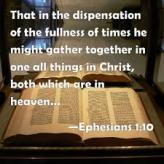

127. Ephesians 1:8-11 “Wherein he hath abounded toward us in all wisdom and prudence; Having made known unto us the mystery of his will, according to his good pleasure which he hath purposed in himself: That in the dispensation of the fulness of times he might gather together in one all things in Christ, both which are in heaven, and which are on earth; even in him: In whom also we have obtained an inheritance, being predestinated according to the purpose of him who worketh all things after the counsel of his own will.” Click here to go to Dr. McGee’s audio teaching on Ep. 8-11. He explains “mystery (including the mysteries in the New Testament),” “dispensation (a word like “blood,” “cross” that is hated), “fullness of time toward which God is moving all things,” “believers’ inheritance,” which God had purposed and “predestined.” Christ paid for the church.

126. Ephesians 1:7: “In whom we have redemption through his blood, the forgiveness of sins, according to the riches of his grace.” Wonderful explanation of the blood of Christ, its importance, value, the meaning of sin and the payment for forgiveness of sin, the meaning of forgiveness of man and the forgiveness of God, etc. The righteousness of the law demands that a penalty must be paid. Human forgiveness is always based upon the fact that a penalty is deserved and the penalty is not imposed. It simply means that one wipes out the account. God is holy and righteous. Therefore, divine forgiveness is always based on the fact that there has been the execution of the penalty and the price has been paid. Human forgiveness comes before the penalty has been executed. A righteous God forgives on the basis that a penalty has been executed. It was executed when Jesus Christ shed His blood on the cross. Etc.

125. The Law, Salvation, Love, Mercy, and Grace. Excerpts from Dr. McGee’s teaching on 1 Timothy 1.1-2. God found a way that He might  be just and the justifier of him that believeth in Jesus. Acts 13:38-39  “Be it known unto you therefore, men and brethren, that through this man is preached unto you the forgiveness of sins: And by him all that believe are justified from all things, from which ye could not be justified by the law of Moses.” The law of Moses was a ministration of death; the law condemned them. The law wasn’t given to save us, but to reveal that God is holy and that you and I are not holy. The way God saves us in the way of the cross. Christ is the way. …

1Thess1.924. Turning to God from idols. 1 Thessalonians 1:9-10: “For they themselves shew of us what manner of entering in we had unto you, and how ye turned to God from idols to serve the living and true God; And to wait for his Son from heaven, whom he raised from the dead, even Jesus, which delivered us from the wrath to come.” The church in Thessalonica turned to God from idols to serve the living and true God. See v. 3. Work of faith (turned to God from idols), labour of love (to serve the living God), patience of hope (to wait for His Son from heaven). Paul preached Christ and they turned to God from idols (not they turned from idols to God). When they turned to God, that is the work of faith; that is what faith did. John 6:29 “Jesus answered and said unto them, This is the work of God, that ye believe on him whom he hath sent.” When they turned to God, they automatically turned from idols—that is repentance. The turning from something is repentance. You can’t turn to Christ without turning from sin. Jesus Christ saves from sin. When a man turns to Christ, he turns from his sin. The message of repentance needs to be preached to the church, as it was preached to the 7 churches in Revelation 2 and 3. The Thessalonians were now serving God, the labor of love. You cannot serve Christ unless you love him. See Jn. 14.15. If you do not love Him, forget trying to serve Him. Waiting for His Son from heaven doesn’t mean sit down and relax. It means get busy for the Lord. A believer is to labor in love.

123. The trinity of faith, hope, and love. “Remembering without ceasing (1) your work of faith, (2) lobour of love, and (3) patience of hope in our Lord Jesus Christ.” 1 Thessalonians 1.3. This trinity is marvelously explained in this teaching by Dr. J. Vernon McGee. Learn both the abstract and the concrete meanings of this trinity and how they relate together where the rubber meets the road. Paul here gives 3 graces of Christian life. The past is the work of faith. The present is a labour of love. The future is the patience of hope.

1Thes4.16-1822. The Song of Christ’s Return; The Dove of the Clefts of the Rock. Song of Solomon 2.10-14. “Rise up, my love my fair one, and come away. For, lo, the winter is past, the rain is over and gone; The flowers appear on the earth; the time of the singing of birds is come, and the voice of the turtle is heard in our land. The fig tree putteth forth her green figs, and the vines with the tender grape give a good smell. Arise, my love, my fair one, and come away. O my dove, that art  in the clefts of the rock, in the secret places  of the stairs, let me see thy countenance, let me hear thy voice; for sweet is thy voice, and thy countenance is comely.”

Song2.1-421 (Notice there are two parts to this teaching, 21a and 21b below). Every believer should have a hot passionate love relationship with the Lord Jesus Christ. The Lord Jesus is not pleased with this cool, lukewarm condition which exists today in the churches among so-called dedicated Christians. Dear believer, are there evidences of the fragrance and the perfume of Christ in your life today? Don’t be satisfied with religious gimmicks. Is the fragrance of Christ in your life today? Listen to this tremendous introductory teaching on the Song of Solomon. This little book is not for the lost. It is for the blood-tipped ear of the man who wants to have a personal relationship with the Lord Jesus Christ.

21a. lick here for Introductory teaching on the Song of Solomon

8Salvation if a love affair, as is the marriage of man and woman and the marriage of Christ and His church. Learn about that love affair by listening to these teachings. See the picture of the Bridegroom and what He thinks of His betrothed. Click here to hear the four meanings found in the book and the story outline of the Song of Solomon. There are four different meanings found in this book. The book (1) sets forth the glory of wedded love; (2) sets forth the love of Jehovah for Israel; (3) is a picture of Christ and the church; and (4) depicts the communion of Christ and the individual believer.

21b. lick here for this continued teaching on Song of Solomon.

Click here for links to Dr. J. Vernon McGee’s teachings on Song of Solomon from Thru the Bible Radio.

Co.1.2420. There are 2 types of sufferings of Christ which He endured and in which we cannot share. Likewise, you suffer some things which I cannot share – we cannot take some sufferings for others; no one can suffer certain things for you no matter how much they would like to do so. Every person must suffer some things which no one can share. Christ suffered as no man has or every will suffer. On the other hand, there are sufferings Christ endured which we can share. For example, He suffered for righteousness’ sake. Also, there is the suffering in the measure we identify ourselves with Christ for the proclamation of the gospel. The popularity of the Christian with the world is in inverse relation to his popularity with Jesus Christ. If the Word of God is to go out to the world, someone is going to suffer. Learn about this by listening to this 14 min. 20 sec. audio teaching by Dr. J Vernon McGee based upon Colossians 1.24.

20. The Subjective Work of Christ for Saints – His (and the Believer’s) Sufferings.
Click here to go to Bible Study and other resources concerning Christian Persecution and Suffering


119. Two very important but related teachings follow. One deals with savlvation, what you bring Christ. The other deals with the effect of salvation upon the believer.

19a. Philippians 3.7-9. What a person brings to Christ when he gets saved. Maybe great talent, great knowledge, wealth, works? What does one have to offer Him? How do you come to Christ? Is one attractive to God? Click here for short answers to that question.

19.b. Philippians 3.10-14. What does saving faith do? If you have saving faith, does it affect you motivation, your life purpose, your life cycle? Can you be saved without being changed! What does coming to Christ really mean? Once saved, what are to do with our past? Click here to hear the answers to these questions and more.


118. Proverbs 20:1 says, ‘Wine is a mocker, strong drink is raging: and whosoever is deceived thereby is not wise.” But did not our Lord make wine at the wedding of Cana of Galilee? Is it OK to drink booze? Hear the truthful answer in this short 7 min. 30 sec. teaching by Dr. J. Vernon McGee. See also, Proverbs 23.29-35: “Who hath woe? who hath sorrow? who hath contentions? who hath babbling? who hath wounds without cause? who hath redness of eyes? They that tarry long at the wine; they that go to seek mixed wine. Look not thou upon the wine when it is red, when it giveth his colour in the cup, when it moveth itself aright. At the last it biteth like a serpent, and stingeth like an adder.  Thine eyes shall behold strange women, and thine heart shall utter perverse things. Yea, thou shalt be as he that lieth down in the midst of the sea, or as he that lieth upon the top of a mast.  They have stricken me, shalt thou say, and I was not sick; they have beaten me, and I felt it not: when shall I awake? I will seek it yet again.”

18. Is it OK to drink wine and liquor according to the Bible?


17. The holiness of marriage. Wonderful 6 min. 15 sec. teaching by Dr. J. Vernon McGee from Proverbs 5.15-17, verses which describe love in marriage. The Word of God makes it very clear that physical love and sexual love in marriage is to be sanctified and brought to a very high level.
17. Holiness of Marriage


Marriage16. What does the Bible mean when it says to church members “Submitting yourselves one to another in the fear of God. What does it mean to a husband in wife when it says, “Wives, submit yourselves unto your own husbands, as unto the Lord,” etc. Learn the truth about the love of church members, the love of husbands and wives, and more on this tremendous 19 min., 10 sec. audio teaching based upon Ephesians 5.21-31.

16. Submission of church members, submission of wives, love of husbands and more from Ephesians 5.21-31
Click here to go to all of Dr. J. Vernon McGee’s teachings on Ephesians.


15.  Learn the meaning of the following words: instruction, understanding, wisdom, justice, judgment, equity, subtilty, knowledge, discretion. The book of Proverbs starts out with the instructions God gives the boy in the home starting out in life. This lesson speaks to several very important matters. It speaks, in part, to the know-it-all. It speaks to discipline and the purpose of discipline. Plus more.  18 min. 55 sec.

15. Click here to listen to this great teaching from Proverbs.
Click here to go to all Dr. McGee’s teachings on Proverbs.


14. This 8 min. 43 sec. introductory teaching on Ephesians 4 by Dr. J. Vernon McGee is tremendous. The subject of the first 3 chapters of Ephesians considered the calling, construction, and constitution of the church. The last three chapters deal with the conduct, confession and conflict of the church. In the last three chapters, we descend to the plane of living  where we confront a demon-possessed world and a skeptical mob. It is where the rubber meets the road. Position was the key word in the 1st half of Ephesians – God has given us spiritual blessings. Have we taken possession of them? This teaching is not for dead men. It is for those who are redeemed.

14. Click here to listen to excerpt from “Introduction to Ephesians 4” by Dr. J. Vernon McGee
Click here for written transcript of teaching no. 14.
Click here to listen to the entire online teaching
Click here to go to online quiz on this teaching: 
Lesson 7 on the Doctrine of the Church: Introduction to The Church Is a New Man and Must Walk as a New Man (Ephesians 4)


13. This is a great teaching on the faith that saves as excerpted from teaching on Ephesians 2, specifically Ephesians 2.8. Some blame God for not giving faith to them. Others, object, “God has not given me the gift of faith.” Is that his problem? When is one given the faith? Others object that they don’t believe because they have intellectual problems. What about preoccupation with past mistakes and failures, looking to oneself and not to Christ? This short 4 min. 36 sec. study handles all these objections and excuses in line with Bible teaching.

13. Click here to listen to this short teaching on faith.


12. This is a great Bible teaching on Psalm 137. It is an imprecatory and an historical Psalm. It touches on many matters such as imprecatory prayer (is it for today?), singing the Lord’s song in a strange land, three reasons people lose their song, a glimpse of the history of the Jews in the 70 year captivity, vengeance in both the Old and New Testament, the law of retribution, and repentance. Click the link below to hear this tremendous study.

12. Click here to hear this Bible teaching on Psalm 137. 
Click here to hear the entire broadcast from Thru the Bible Radio.


11. This teaching was recorded many years ago, in the 1970s or 1980s. It speaks of plastic twinkies for spiritual kiddies. Dr. McGee says, “There has been a famine of spiritual bread for years. Jesus is being served up as sugar and spice and everything that is nice. Jesus is made a piece of merchandise to sell to people in seminars, books, radio, and TV shows. The Bible is only a prop to use as bait to catch the unwary believer.” For the whole 6 min. 50 sec. teaching go to the link below.

11. Click here and to hear this audio teaching
(This teaching was at the beginning of Dr. McGee’s broadcast on Psalm 114-116 which can be heard by clicking here.)


10. What would the Lord have a believer to do? This great 3 min. 45 sec. teaching applies Ps. 86.11 to the Christian. We would do good to heed it.

10. Click here to hear this teaching on what the Lord would have the believer to do.


9. What is the God-given purpose of missions, of all that a believer does? Is it to win souls? Is it to give out the word of God? What is it? Learn the answer in this short 3 min. 23 second teaching: 

9. Click here to learn the purpose of missions and of all that a believer does.

For more on this, go to: The Motivation and the Goal


8a. Another short (7 min. 59 sec.) powerful teaching from Ps. 55 on what God wants a believer to do when someone near to him in the church, a confidant, stabs him in the back, betrays him.

8a. Click here to hear this teaching from Ps. 55.

8. Are Christians to take vengeance or pray for God to take vengeance (pray imprecatory prayers)? The first imprecatory prayer in Psalms is Psalm 5.10. Hear Dr. McGee’s short 3 min. 45 sec. teaching on this verse.

8. Click here to hear this teaching on imprecatory prayer for Christians.


7. What is the primary business of the believer and a church? Is it soul winning? What does the word of God say about this? Get the answer by listening to this short 6 min. 56 sec. study on Psalm 1.3-6 which also looks at 2 men, 2 ways, and 2 destinies.

7. Click here to discover the main business of the believer according to the Bible.


6. In this study from Job, we find Job’s problem. We find his secret sin. His 3 friends had not revealed it; though they spoke a lot of truth, none of what they said revealed Job’s problem. They did not know Job’s problem because they did not know themselves, they did not know Job, and they did not know God. Likewise, Job did not know himself, nor did he know God.  But, don’t be too proud because you and I also have the same problem Job had. Learn about that problem in this excellent teaching.

6. Click here to learn what Job’s problem was.

Click here to go to other teachings on Job, all of which are of great benefit.
I suggest going to Chapter 31.1-32.3 after listening to the above.


5. Did Solomon succeed in doing what God had told him to do in being a witness to the world? The way that Israel was to witness was different than the way that the church is to witness. Learn that difference and more on this matter by listening to this short 12 min. 4 sec. teaching by Dr. J. Vernon McGee on 2 Chronicles 9.

5. To hear that short audio teaching, click here.


4. 2 Chronicles 7:14 says, “If my people, which are called by my name, shall humble themselves, and pray, and seek my face, and turn from their wicked ways; then will I hear from heaven, and will forgive their sin, and will heal their land.” Many times American Christians will misapply this verse, sometimes to America. Learn the true meaning of the verse by listening to this short 12 min. 12 sec. audio teaching by Dr. J. Vernon McGee. 

4. To hear that short audio teaching, click here.


3. The Shekinah glory was removed from the earth (from Israel). Then God gave His people, the Jews, into the hands of the Gentiles and sent them into captivity. He dissolved the theocracy of Israel and became the God of heaven. … God returned in the flesh, although the Shekinah glory was not visible – He was veiled in the flesh. To hear an excellent 7 min. 49 sec. study on this from Ezra 1.2 click the link below.

3. To hear that short audio teaching, click here.


2. In this study, Dr. McGee examines one of the great prayers of Scripture which is recorded in Ezra 9. Ezra returned to Jerusalem after the temple had been rebuilt. He found there that the people had committed great wickedness. What did he do? What he did is very relevant for all time. It is relevant for a church.

2. To hear this audio teaching, click here.

Click here for great additional teaching on this click here (teaching from Ezra 10 on church repentance, revival, etc.)


1. After the division of Israel, Judah had 5 outstanding kings – Asa, Jehoshaphat, Joash, Hezekiah, and Josiah. Each brought reformation and revival. Studying these kings and the revivals they brought reveals the steps to revival. Individual, family, church, national revival cannot occur without crossing some bridges. Learn what the first bridge, the first step to revival is by listening to this short 8 min. 19 sec. teaching.

1. The First Step to Revival (A study from 2 Chronicles 15) 

For the second and Third Steps to Revival click here.
Listen to the end of Dr. McGee’s teaching to get all the invaluable information.  

Click here to hear all these studies through all 5 of the kings mentioned above.
The last study went though 2 Chronicles 35.27.