Self-exam Questions: Introduction to “The Biblical Doctrine of the Church”

Give as many Bible verses (where appropriate), comments, and explanations as you can to support your answers. Click here to go to “Introduction to ‘The Biblical Doctrine of the Church’

  1. These teachings are based upon a _______________________ interpretation of Scripture.
  2. The Bible uses ____________, ______________________, _________________, and other figures of speech.
  3. Untold damage to the cause of Christ has been caused by unbridled _____________________ or _____________________ of Scripture by _______________, ________________, _______________’s ______________________ and others.
  4. Some of those religions, due to their heinous theologies (false interpretations of Scripture) have violently __________________ and ______________________ others, including ________ ______________ who stood on God’s Word in spite of persecutions and ___________________, down through the last 2,000 years.
  5. Sadly, perversions of Scripture by such religions and the resulting atrocities based upon false interpretations have been attributed to ________ ___________________ by the world in general—________ ___________________ and churches have been lumped together with imposters by both secular and Christian _________________.
  6. In order to understand why church incorporation and 501(c)(3) status violates biblical principles and grieves our Lord Jesus Christ, one must first be __________. Second, he must understand the biblical principles of ___________________, ____________, and _____________________ of ___________ and __________.
  7. He must then understand the facts about and ______________________ of incorporation and 501(c)(3).
  8. Finally, he must apply ____________________ to __________ and ______.
  9. To fully understand this requires a lot of time and study, and God wants His children, and especially ______________, to take the time to do the studying (1 Ti. 2.15).
  10. Most pastors are so consumed with their ministries that they need to rely on specialists within the local church body-for example, born again, Bible believing, God honoring ________________ or others who have the _________, ___________, __________________, and ________ for the Lord necessary to examine these matters.
  11. As foretold by Isaiah (Is. 40.3), John the Baptist announced: “____________ ye: for the ______________ of heaven is at hand. For this is he that was spoken of by the Prophet ______________, saying, The voice of one crying in the wilderness, Prepare ye the way of the ________, make his __________ straight” (Mt. 3.2-3. See also, Mk. 1.2-3; Lu. 3.4; and Jn. 1.23).
  12. The phrase “______________ of heaven” “is peculiar to ______________ and signifies the Messianic earth rule of __________ ____________, the Son of David.
  13. Why is it called called the kingdom of the heavens?
  14. From which Old Testament book is the phrase “kingdom of heaven” derived?
  15. How does Daniel define “kingdom of heaven?”
  16. The “kingdom of heaven” is covenanted to whose seed?
  17. After Israel morally rejected the kingdom of heaven, Jesus predicted judgment on the places chosen for the testing of the nation, _________________, ___________________, and __________________, “wherein most of his mighty works were done, because they ________________ not” (Mt. 11.20-24). Jesus, at that point, turned from the rejecting nation, offered rest and service to ________________ in the nation, and turned to the _________________.
  18. Just as God ordained __________ government, He also ordained His ________________ after the nation ____________ rejected ______ and the ______________ of ____________.
  19. The power given by God to His churches on earth was to secure a ________________ good for their members.
  20. When Christ asked His ____________________ whom they thought Him to be (Mt. 16.15, Mk. 8.29, Lu. 9.20), Peter answered, “Thou art the ____________, the ______ of the living ______”. At that point, our Lord announced the out calling of the ____________ when He said: “And I say also unto thee, [t]hat thou art Peter, and upon this ________ I will build my ____________; and the gates of ________ shall not prevail against it. And I will give unto thee the ________ of the kingdom of heaven: and whatsoever thou shalt ________ on earth shall be bound in heaven: and whatsoever thou shalt loose on earth shall be loosed in heaven.”
  21. Upon whom is Christ’s church built?
  22. Peter made clear that the cornerstone of the church is whom?
  23. Peter made clear that the rock upon which the Lord will build the institution of the church which is made to be made up of __________, ____________________ churches, which are ________________ houses made up of __________________ beings offering up _________________ sacrifices, and not ________________ houses made by man, is Christ Himself:

“To whom coming, as unto a _______________ stone, disallowed indeed of men, but chosen of God, and precious, Ye also, as ____________ stones, are built up a __________________ house, an holy priesthood, to offer up ___________________ sacrifices, acceptable to God by Jesus Christ. Wherefore also it is contained in the scripture, Behold, I lay in Sion a __________ ____________ stone, elect, precious: and he that believeth on him shall not be confounded. Unto you therefore which believe he is precious: but unto them which be disobedient, the stone which the builders disallowed, the same is made the ________ of the corner. And a stone of ________________, and a rock of ________________, even to them which stumble at the word, being disobedient: whereunto also they were appointed” (1 Pe. 2.4-9).

“This is the stone which was set at nought of you builders, which is become the ________of the corner” (Ac. 4.11, part of Peter’s address to the Sanhedrin).

  1. From the context of the above verses, it is obvious that Peter is speaking of the ________ as being the chief corner stone. Nowhere in the Bible is there any indication that Peter was the cornerstone of a ____________________ visible or invisible church. The words used also make clear that Christ was referring to ______________ as the ________ on which the church would be built. “There is in the Greek [in Matthew 16.18] a play upon the words, “thou art Peter [petros—literally, ‘a ____________ rock’], and upon this rock [Petra] I will build my church.” He does not promise to build His church upon __________, but upon ______________, as Peter himself is careful to tell us (1 Pet. 2.4-9).”
  2. Jesus Christ, Head of the church, “__________ the church and gave ______________ for it” (Ep. 5.25).
  3. Jesus did not give ____________ the keys—a key being a badge of power or authority (see, e.g., Is. 22.22 and Re. 3.7)—to the church, but to “the kingdom of heaven,” the keys in the sense of Matthew 13, that is of the sphere of Christian ______________________.
  4. Peter assumed no other authority. In the council at Jerusalem as recorded in Acts 15, ___________ seems to have presided. Peter claimed nothing more than to be an ______________ by gift and an __________ by office. The power of binding and loosing was shared by ______ ____________ _________________. Since only ____________ held the keys of death and the place of departed spirits, “this did not involve the determination of the eternal destiny of souls.” I [__________ ____________] am he that liveth, and was dead; and, behold, I am alive for evermore, Amen; and have the ________ of ________ and of __________” (Re. 1.18).
  5. Isaac Backus, the great Baptist leader in New England, elaborated upon the faith confessed by Peter:

“This __________ is the foundation of the _________________; against this __________ the gates of hell shall not prevail; this __________ hath the keys of the kingdom of heaven; what this __________ shall loose or bind on earth, is bound and loosed in heaven…. Now it followeth, that whatsoever person hath received the same precious __________ with Peter, as all the faithful have, 2 Pet. i. 1, that person hath a part in this gift of Christ. Whosoever doth confess, publish, manifest or make known Jesus to be the Christ, the Son of the living God, and Saviour of the world, that person opens heavens gates, looseth sin, and partakes with Peter in the use of the ________; and hereupon it followeth necessarily, that one faithful man, yea, or woman either, may loose and bind, both in heaven and earth, as all the ministers in the world.”

  1. God’s Word describes the church as being the __________ of Christ and the ________ of Christ. What connotations do those designations carry? The Word of God gives ample _____________________to alert churches to what this relationship entails.
  2. To whom did the Lord reveal how, when, or of what materials local church bodies on this earth should be built, or what should be their position, relationships, privileges or duties. Instead?
  3. The Lord revealed to ________ the mystery of the churches who were to be made up of both ____________ and ____________ believers in ___________________ __________ assemblies. Paul’s epistles develop the _______________ to be followed by the churches. God, through the Apostle Paul, explained the ______________, ___________________, ________-____, and __________________ of the churches, and the relationship of His churches to the ________ __________. Through Paul alone we know that churches are not organizations, but ___________________, local ___________________ bodies.
  4. The Bible makes clear that churches here on earth are to be ______________ ___________ ____________________ bodies, each operating under the principles of the ________ of ______. Paul wrote to local __________________ or _______________—the church of God which is at ______________ (1 Co. 1.2, 2 Co. 2.1), the churches of _______________ (Ga. 1.2), the church at _____________ (See Re. 2.1), the church of the _______________________________ (1 Th. 1.1; 2 Th. 2.1). Christ stood in the in the midst of __________ ____________ ______________________ (local ________________ still on earth) (Re. 1.11-13); and He instructed ________ to write to those seven ________________ (Re. 1.19-20). The Lord delivered individual messages to each of those local assemblies (Re. 2.1-3.22).
  5. Although the Lord made clear that He wants every church to be under ______ in all things, God allows men in a church ________-________ to decide whether to do things His way. Our Lord warned against false __________________ to come and some writers of the New Testament warned of already existing ________________ in the church and revealed that before the return of Christ true believers would all be _________________ and those left behind in the visible “church” would go into total ________________, be called a __________ and not a church, and be destroyed by the nations. Religious _______________ of some churches in America began with the importation from Europe of modernism and has recently accelerated as seen in the recent Church _____________ Movement and, after that, the Emerging ____________ Movement.
  6. Christ is described as the only ________, ______________, and ______________________, of His churches. He will conduct a _________________ ceremony, the wedding of the ________ (Re. 19.7-10), prior to His second coming in glory. The __________ who will be called to the marriage supper of the Lamb will be arrayed in fine __________, which is the _________________________ of the saints. Because of the signs of the times, as related to biblical prophecy, true believers should be vigilant in seeking ______ __________________ ____ ______ since it appears that the Lord will return soon. Only true believers have the ________________ ________: they will __________ with the Lord. The Holy Spirit is now calling out, not the subjects, but the co-__________ and co-_______________ of the kingdom. Since the Lord told believers to ________ others, since believers will be ___________________ with God, and since nonbelievers will be ___________________ _______ God for all eternity, those who are saved should have a great burden for the _____________________ of the lost.
  7. In order to maximize the witness of the local church, believers should be careful to do all they do as individuals, families, as a church body, and as citizens according to the principles of the ________ ____ ______. Initial ____________________ of God’s principles on the church level inevitably leads to further ____________________, to _____________, and in most cases to _______________. ____________________ introduces leaven which in turn infects the whole body. Thus, for example, the initial ____________________ of many ______________ churches after the adoption of the United States Constitution in getting corporate status introduced a little poison into churches. Corporate ________________, generally speaking, had no problem with further _____________________ such as the abandonment of God’s Word in English, and Internal Revenue Code § 501(c)(3) status. The religious __________________ in America among God’s churches has accelerated at an alarming pace.
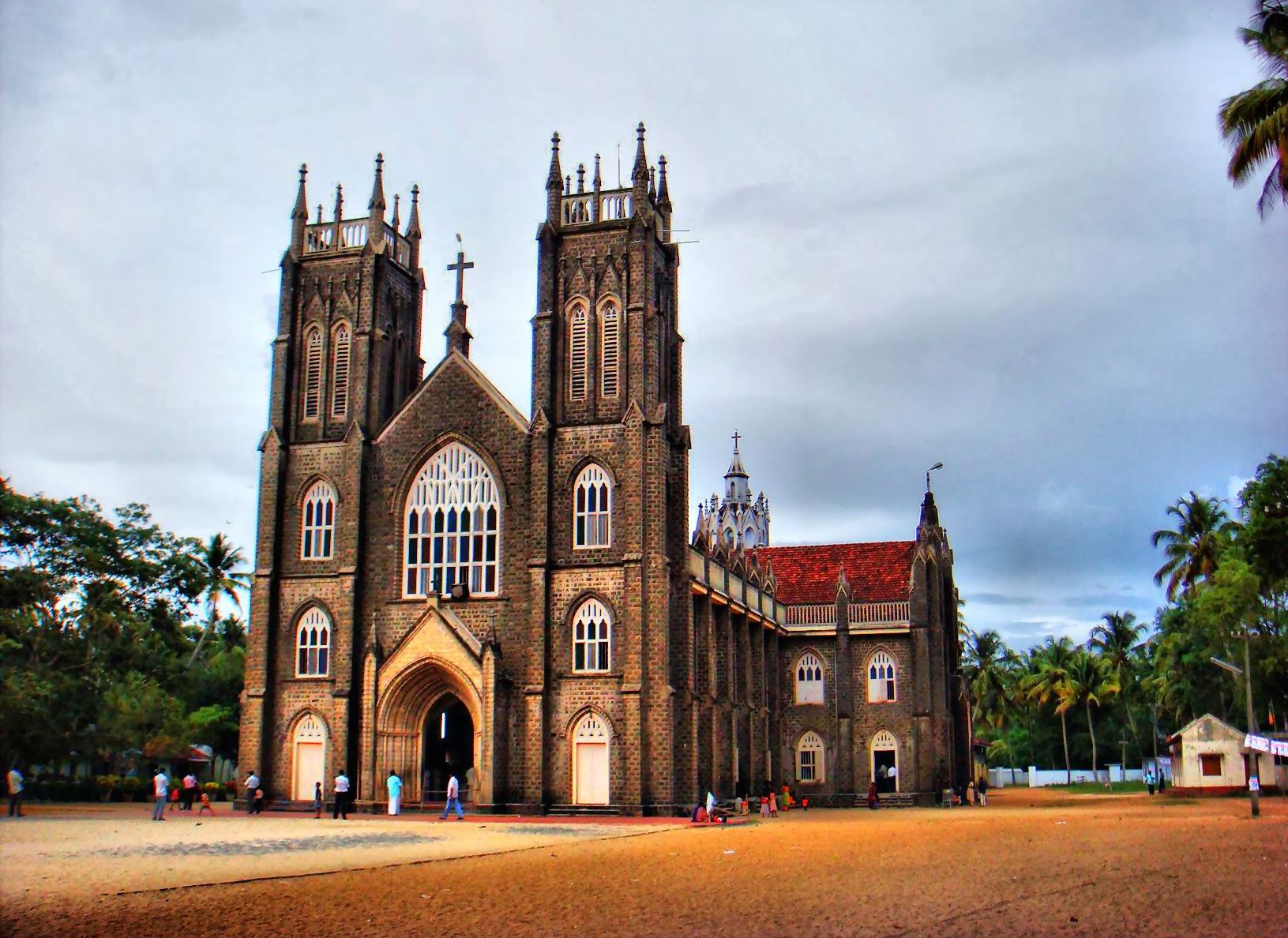
The Local Church: A Building or What?

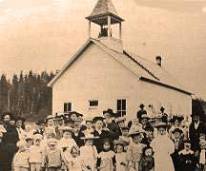
Is this a church?
Is this a church?

Many call the building they meet in a “church.” According to the Bible, is that building really a church? Or is the church something else according to the word of God? What is a church? Read the Scriptures cited below then listen to the study which is partially quoted and linked to below for some answers.

Ephesians 2:19-22 “Now therefore ye are no more strangers and foreigners, but fellowcitizens with the saints, and of the household of God; And are built upon the foundation of the apostles and prophets, Jesus Christ himself being the chief corner stone; In whom all the building fitly framed together groweth unto an holy temple in the Lord: In whom ye also are builded together for an habitation of God through the Spirit.”

2 Corinthians 11.3 “But I fear, lest by any means, as the serpent beguiled Eve through his subtilty, so your minds should be corrupted from the simplicity that is in Christ.”

Hebrews 9:1-15:  “Then verily the first covenant had also ordinances of divine service, and a worldly sanctuary.  For there was a tabernacle made; the first, wherein was the candlestick, and the table, and the shewbread; which is called the sanctuary.  And after the second veil, the tabernacle which is called the Holiest of all; Which had the golden censer, and the ark of the covenant overlaid round about with gold, wherein was the golden pot that had manna, and Aaron’s rod that budded, and the tables of the covenant; And over it the cherubims of glory shadowing the mercyseat; of which we cannot now speak particularly. Now when these things were thus ordained, the priests went always into the first tabernacle, accomplishing the service of God. But into the second went the high priest alone once every year, not without blood, which he offered for himself, and for the errors of the people: The Holy Ghost this signifying, that the way into the holiest of all was not yet made manifest, while as the first tabernacle was yet standing: Which was a figure for the time then present, in which were offered both gifts and sacrifices, that could not make him that did the service perfect, as pertaining to the conscience; Which stood only in meats and drinks, and divers washings, and carnal ordinances, imposed on them until the time of reformation.  But Christ being come an high priest of good things to come, by a greater and more perfect tabernacle, not made with hands, that is to say, not of this building; Neither by the blood of goats and calves, but by his own blood he entered in once into the holy place, having obtained eternal redemption for us. For if the blood of bulls and of goats, and the ashes of an heifer sprinkling the unclean, sanctifieth to the purifying of the flesh: How much more shall the blood of Christ, who through the eternal Spirit offered himself without spot to God, purge your conscience from dead works to serve the living God?  And for this cause he is the mediator of the new testament, that by means of death, for the redemption of the transgressions that were under the first testament, they which are called might receive the promise of eternal inheritance.”

Thus, one can see that God does not dwell in a building and never has. He did not dwell in the Temple. See, e.g., 1 Kings 8.27. Today, the Holy Spirit dwells in believers. When they come together, they are a church (an assembly) who form a spiritual organism. See 1 Corinthians 12 and Ephesians 4. When they leave the building, if indeed they are meeting in a building, when they turn off the lights and go home, the Holy Spirit (God) is not in that building and the church is no longer in that building. If they meet under a bridge, the church is under that bridge while they meet there. If none of those who come together are born again believers, baptized into that church, then they are not a Bible church since the Holy Spirit indwells none of them.

Some excerpts from a radio teaching by Dr. J. Vernon McGee on 1 Kings 5 (the complete teaching is linked to at the end):

“Man has been a builder from the beginning. In Genesis 4.17 we are told that Can “builded a city and called the name of the city, after the name of his son, Enoch.” The face of the earth is scarred by great mounds that hide the ruins of great cities and splendid buildings of the past. The spade of the Archaeologist has penetrated into the depths, and you can judge each civilization by the height of the buildings. There are those who say that the cave men of the Stone Age (if they ever existed) were barbarians and uncivilized. They were not builders but sought refuge in caves. The Egyptians, the Assyrians, the Babylonians, the Greeks, and the Romans are all counted as civilized, and it is evidenced in their architecture. Modern man claims a high degree of culture because he has built subdivisions and shopping centers, apartment buildings, and tall office buildings. Today man is building his own cave in which to live and work—like a gopher. The rest of the time he crawls on the freeway like a worm. As long as he can push a button and turn a switch, he says he is living. That is modern man.

“The first buildings of impressive design were the temples. All pagan peoples had temples. Some temples were crude; others, such as the Parthenon in Greece, were the highest expression of beauty. All of this building stems from the Tower of Babel, which was a monument to man’s gargantuan resistance to God. Pagan temples have always been the highest architectural expression, but the pagans who have attended, both civilized and uncivilized, have been on the lowest spiritual level. These temples have been elaborate, large, ornate, rich, and impressive. The temples of the kings on the River Nile, Asshur of Ninevah, Marduk of Babylon, the ziggurats in the Tigris-Euphrates Valley, Baal of the Phoenicians, Athena of the Greeks, and in Athens the Parthenon, Jupiter of the Romans, the Aztec temples of Mexico—all of them are manifestations of rebellion against God.

“Because that, when they knew God, they glorified him not as God, neither were thankful; but became vain in their imaginations, and their foolish heart was darkened” (Romans 1:21). What did they do? They built temples, changing “the glory of uncorruptible God into an image made like to corruptible man, and to birds, and fourfooted beasts, and creeping things” (Romans 1.23). Each made a house for his god to live in. They put their gods in a box like a jack-in-the box.

“The temple Solomon built was never considered in Scripture as a house in which God would live….

“The temple was complicated. The simplicity of the tabernacle was lost…. There is an application for us. We are living in a day when the emphasis in put on methods rather than on the word of God. The church is filled with new programs and new methods.

“When I first began my ministry I pastored a little white church on a red clay hill in Georgia, surrounded by a cotton patch….

“The second thing to notice about the Temple was that Solomon made little windows of narrow lights. There had been no windows in the tabernacle. … The people no longer depended upon divine light as they had in the tabernacle….

“ … The temple was more ornate and gaudy than the tabernacle, and there was more ceremony and ritual connected to it.

“Notice how complicated the temple is in comparison to the tabernacle. …”

For the full study go to the Dr. J. Vernon McGee’s teaching on 1 Kings 5 by clicking here.

For more on the misconception of the meaning of church, see “Sustaining Property Tax,” an article by Winnie Varghese which shows her complete misunderstanding of the meaning of “church.” Her type of church is a place of pagan worship.

For a more thorough study, see The Biblical Doctrine of the Church.

END


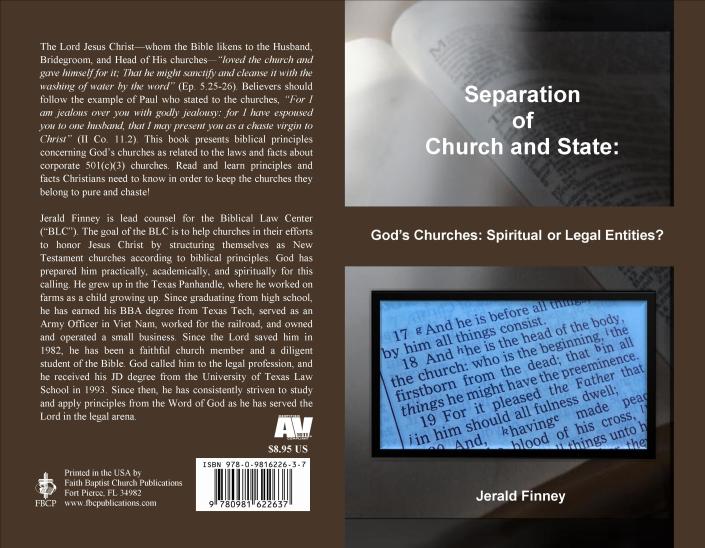
Audio: Separation of Church and State/God’s Churches: Spiritual or Legal Entities?

This audio is a recently updated version of the book, Separation of Church and State/God’s Churches: Spiritual or Legal Entities. To go to an audio teaching, click the blue chapter name.

The PDF of the 2nd edition is at:  PDF of 2nd edition of Separation of Church and State/God’s Churches: Spiritual or Legal Entities. Two new chapters have been added to the 2nd Edition. The 1st edition of the book can be ordered at amazon.com ordering page for Separation of Church and State/God’s Churches: Spiritual or Legal Entitites?  Other in print books written by Jerald Finney are available at Books by Jerald Finney at amazon.com. Free online versions (and PDFs of some) of all books, whether in print or not, may be accessed at: Books Parent Page.

The 2nd edition has some modifications (includes updated understanding of IRC 508 status, adds 2 new chapters, etc.).

To download a segment (“Preface” or Chapter), left click the segment. That will take you to the audio page. Right click anywhere on the audio page that appears. Then click “save as.” You will be able to navigate to the file you want to save it in. When there, click “Save.”

Preface (7 min. 0 sec. Starts with hymn, “Be Thou My Vision.”)

CONTENTS

Chapter 1: Introduction (20 min. 17 sec. Starts with hymn, “All Glory, Laud, and Honor.”) 

Chapter 2: Spiritual versus Legal Entities (13 min. 44 sec. Starts with hymn, “A Throne of Grace.”)

Chapter 3: Incorporation of Churches (42 min. 29 sec. Starts with hymn, “In Times like These.”)

Chapter 4: Federal Government Control of Churches through 501(c)(3) or 508 Tax Exemption (34 min. 46 sec. Starts with hymn, “Close the Books.”)

Chapter 5: The Incorporation-501(c)(3) Control Scheme (22 min. 37 sec. Starts with the hymn, “The Love of God.”)

Chapter 6: Spurious Rational for Incorporating: Limited Liability (18 min. 28 sec. Starts with the hymn, “All Hail the Power of Jesus’ Name.”) 

Chapter 7: Spurious Rationale for Incorporating: to Hold Property  (45 min. 8 sec. Starts with the hymn, “O Sacred Lamb.”) 

Chapter 8: Spurious Rationale for Corporate-501(c)(3) or 508 Status: Tax Exemption and Tax Deduction for Contributions (31 min. 38 sec. Starts with hymn, “There Will Be a Happy Meeting in Heaven I Know.”)

Chapter 9: Spurious Rationale for Incorporating: One’s Convictions (30 min. 39 sec. Starts with song, “All the Way My Savior Leads Me.”)

Chapter 10: The Most Important Thing: Loving God or Winning Souls? (31 min. 44 sec. Starts with song, “And Can It Be.”)

Chapter 11: Conclusion (6 min. 4 sec. Starts with song, “All the Way My Savior Leads Me”)

Click here to go to order information, free PDF, and free online version
form of each book.

Click the following (cover of the 1st edition) to go to the PDF of the 2nd edition.
The above audio series is of the 2nd edition which is not yet published.

The cover of the First Edition. Click the above to go to the PDF of the 1st Edition.

Audio series on God Betrayed/Separation of Church and State: The Biblical Principles and the American Application

Just click blue link to go to audio teaching:Self

1. The Biblical Principles of Government

a. Introduction
b. The proper motivation and goal
c. Self-government
d. Family government and conscience
e. Civil government
f. God desires nations to glorify Him
g. Israel – the only theocracy ordained by God
h. God is the God of Israel
i. God desires Gentile nations to glorify Him
j. God judges nations
k. Satan orchestrates the world system
l. Conclusion

2. The Biblical Doctrine of the Church

a. Introduction
b. Definition, organization, and purposes of a church
c. Christ, the Bridegroom/Husband/Head of the  church
d. Heresy and  apostasy
e. Recent accelerated apostasy in America
f. Apostasy at the end of the church age
g. The church will reign with the Lord
h. Conclusion

3. The Biblical Doctrine of Separation of Church and State

Click the above to go to the article,
Click the above to go to the article, “Is Separation of Church and State Found in the Constitution?

a. Introduction
b. Definitions
c. Dispensational theology versus covenant theology
d. Distinct differences between church and state
e. Render unto God the  things that are  His
f. Christ-church, Husband-wife, Bridegroom-Bride
g. Conclusion

The First Amendment to the U.S. Constitution4. History of the First Amendment

a. Introducton
b. The Pilgrims and Puritans in Massachusetts
c. The Baptists in Rhode Island
d. The Separates and  Baptists in New England e. From New England to the South
f. To Virginia
g. To the New Nation
h. Conclusion

5. Supreme Court Religion Clause Jurisprudence

6. God Betrayed: Union of Church and State

a. Introduction
b. Spiritual versus legal entities
c. Incorporation of churches
d. Federal government control of churches
through 501(c)(3) tax
exemption
e. The incorporation 501(c)(3) control scheme
f. Spurious rationale for incorporating: limited liability
g. Spurious rationale for incorporating: to hold property
h. Spurious rationale for incorporating: tax exemption
and tax deduction for contributions
i. Conclusion

Self-exam questions: Conclusion to the Biblical Doctrine of Government

Self-exam questions:
Conclusion to the Biblical Doctrine of Government
Part ONE, Section I, Chapter 12 of God Betrayed

Give as many Bible verses (where appropriate), comments, and explanations as you can to support your answers. Click here to review “Conclusion to ‘The biblical doctrine of government.’”

  1. Salvation is the beginning of a ______ __________.
  2. What is one’s purpose after salvation?
  3. Jesus said to Peter who rebuked Him for speaking of His coming sufferings and death at the hands of the elders and chief priests and scribes:

“Get thee behind me _______________: thou art an _________________ unto me: for thou savourest not the things that be of _________, but those that be of _______. If any man will come after me, let him deny ______________, and take up his _____________, and follow ________. For whosoever will ________ his life shall lose it: and whosoever will _________ his life for my sake shall __________ it. For what is a man profited if he shall gain the ______________ __________________ and lose _____ _____ _______ For the Son of man shall _____________ in the glory of the ______________ with his _______________; and then he shall reward every man according to _______ _________” (Mt. 16.23-27).

  1. Where does hope begin?
  2. Who has hope?
  3. A saved individual has rejected _______ and _____________ and ____________ rule and turned to ____________ and _____ principles.
  4. One who is saved, continues in God’s Word, and seeks to live according to biblical principles has the promise of wwhat while on this earth?
  5. “Yea, and all that will live ___________ in Christ Jesus shall _________ _______________” (2 Ti. 3.12).
  6. Some Christians forget that although every saved person will go to heaven, there they will still be rewarded according to ____________ __________:

“For other _________________ can no man lay than that is laid, which is ___________ ___________. Now if any man build upon this foundation ________, ___________, precious _____________, _________, ______ ______________-; Every man’s ______ shall be made manifest: for the ______ shall declare it, because it shall be revealed by _______; and the ________ shall try every man’s ________ of what sort it is. If any man’s work ____________ which he hath built thereupon, he shall receive a ______________. If any man’s work shall be burned, he shall suffer ___________: but he himself shall be saved: yet so as by ___________” (Mt. 3.11-15).

  1. A _______, a ____________, or a ______________ made up of Christians (those who are saved and follow the principles of God) has ____________.
  2. According to 2 Peter 1.3-13, what 8 things does a believer need to prevent himself from being barren and unfruitful and to keep himself from falling?
  3. God would have us exercise these qualities in _____ ___________. “According as his divine power hath given unto us_____ ___________that pertain unto life and ________________, through the ___________________ of him that hath called us to ___________ and __________: Whereby are given unto us exceeding great and precious _______________: that by these ye might be partakers of the __________ __________, having escaped the ________________ that is in the world through ________” (2 Pe. 1.3-4).
  4. All things would include all ______________ of the Word of God: The _____________ of church, state, and separation of church and state are therefore to be _____________ diligently and ____________ by the Christian. Unfortunately, most Christians are deficient, especially in _______________.
  5. The principle of Hosea 4.6-19 concerning rejection of _________________ and the inevitable ____________________ thereof, although directed immediately to the children of ____________, is also a general principle which applies to ___________________ today. Sadly, in any nation, the lost and the saved who are not seeking to ______________ after God’s ________ ________. As a result, no civil ______________________as ever been under God for any length of time, and every _________ government has been or will be judged by God before He sets up His kingdom.
  6. Did God give us all the principles people need for success as individuals, as families, as churches, and as nations knowing that we would always ultimately fail?
  7. Since when did God know that man would ultimately fail?
  8. God knew we would totally ______________ ourselves even with all His ______________ at our disposal. He knew that we would ultimately totally _____________ all His ____________, _____________, and __________________________. And along the way, He knew that _____ _______, at any time, would ever fully comprehend ________ and __________’s ways. Yet, because of His ________, He sent His own Son to pay the price for our _______________ _______. He gave each and every person a _______ _______. That way was not _____________, one’s ________________, one’s ______________, one’s ________________, one’s _________ _______________, one’s _______________ __________________, one’s _______________, or one’s ________ _______________. That way was _______ _______. Period.

END

Self-test Questions: Satan Orchestrates the World System

Self-exam questions: Satan orchestrates the World System
Part ONE, Section I, Chapter 11 of God Betrayed

Give as many Bible verses (where appropriate), comments, and explanations as you can to support your answers. Click here to go to “Satan Orchestrates the World System.”

  1. Who introduced sin to the universe? How?
  2. List the five “I wills” of Satan.
  3. God said, “How art thou fallen from heaven, O _______________, _____ __ ____ _________!howart thou ____ _____ __ ____ ______, which didst _________ the nations!  For thou hast said in thine heart, I will _________ into _____________, I will exalt my ___________ above the _________ of God: I will sit also upon the mount of the ______________, in the sides of the ____________: I will ascend above the heights of the ____________; I will be like the _________ __________. Yet thou shalt be brought down to _________, to the sides of the _____. They that see thee shall narrowly look upon thee, and consider thee, sayingIs this the man that made the earth to ___________, that did shake ______________; That made the world as a ________________, and destroyed the ____________ thereof; that opened not the house of his ________________” (Is. 14.12-17)?
  4. Satan’s __ __________ marks the introduction of sin into the universe.
  5. Satan makes __________ and ______ the scene of his tireless activity
  6. After the creation of man Satan entered into the _____________.
  7. How did Satan beguile Eve?
  8. He secured the downfall of ____________, and through him of the __________, and the entrance of _______ into the world of ________.
  9. Satan seduced Eve with the same temptation whereby he was tempted: “____________________.” He said to Eve:” “For God doth know that in the day ye _____ thereof, then your eyes shall be __________, and ye shall be as __________, knowing _______ and ________.” (Ge. 3.5). Since that day, Satan has been the ______ of this world.
  10. The ____________ ________________ promised the ultimate destruction of ___________ through the ‘_______ of the woman.’
  11. Upon what principles is the present world system organized? Whose are these principles, God’s or Satan’s?
  12. As ‘prince of the power of the air’ (Eph. 2:2) ____________ is at the head of vast host of demons.
  13. To _______________, under God, was committed upon _____________ the power of death.
  14. Cast out of heaven as his proper sphere and ‘first estate,’ _____________ still has access to God as the ‘______________ of the brethren’ (Rev. 12:10)
  15. ______________ is permitted a certain power of sifting or testing the self-confident and carnal among believers. (Job 1:6-11; Lk. 22:31-32; 1 Cor. 5:5; 1 Tim. 1:20) This is strictly __________ and ____________ power, and believers so sifted are kept in faith through the advocacy of ___________ (Lk. 22:31-32; 1 John 2:1,note).
  16. When will Satan’s privilege of access to God as accuser will be withdrawn?.
  17. When will Satan be bound for one thousand years?
  18. When will Satan be ‘loosed for a little season.’
  19. When Satan is loosed, he will become the __________ of final effort to ____________ the kingdom. Defeated in this, he will be finally cast into ____ _____ ____ _______, his final doom.
  20. Men, except for the ______________, and nations always choose the principles of ________ over the principles of ________, and men and nations will always suffer the __________.
  21. To what does “Kosmos[translated ‘world’ in Revelation 13.8] in the sense of the present world-system, the ethically bad sense of the word, refers to what?
  22. The god of this world blinds people to the __________.
  23. At the same time Satan is blinding people to truth, he indoctrinates people into ____ ________ ____________.
  24. A specific instance of God directly addressing Satan is recounted in ____________ 28. Although speaking to the king of Tyre, as in Isaiah 14.12, the language goes beyond the King of Tyre to __________, inspirer and unseen ruler of such pomp and pride as that of Tyre…. The _____________ state of Satan is here described; his fall in Isa. 14.12-14.. But there is more. The vision is not of Satan in his own person, but of Satan fulfilling himself in and through an __________ king who arrogates to himself divine honours, so that the prince of Tyrus foreshadows the ___________ (Dan. 7.8; Rev. 19.20).
  25. Does God desire that a government be under Satan?
  26. Pursuant to the Word of God, God desires every government—______-government, __________ government, _________ government, and ____________ government—to be under ______. But He gives every government a ________.
  27. Even a nation (civil government) can _________ and turn to God at any time.
  28. Just as the doom of self, family, and churches is directed by _____________, so will the downfall of all ___________ be orchestrated by Satan. It is important to remember, however, that God gives every __________, every ________, every _________, and every ____________ a choice between going by ________ or ____________ principles. All individuals and institutions are ___________ if they let _______________ principles of force, greed, selfishness, ambition, and/or pleasure influence them to give in to their lusts and follow __________.
  29. Ultimately, as the __________ reveals, one’s only hope is to come to _____ with a ______ and contrite spirit, ___________ of sins, and trust the ______ ________ _______ as his/her personal __________. This will be the beginning of a new life in which one who continues in His Word will become His disciple and will know the __________ which will make him _________.

END

Self-exam questions: God judges nations

Self-exam questions: God judges nations
Part ONE, Section I, Chapter 10 of God Betrayed

Give as many Bible verses (where appropriate), comments, and explanations as you can to support your answers. Click here to review “God Judges Nations.”

  1. Does God judge nations?

2.Did God warn Israel and Judah that he was going to judge them if they did not keep His commandments and His statutes, before he used __________________ and _______________ to take them into captivity?

  1. Did He warn them in advance of exactly what he was going to do (See, e.g., Je. 25.11)?
  2. Of what did God’s prophets repeatedly warn the Jews?. As you read the Old Testament, make note of the many relevant prophecies of warning to Israel. Review those given in the lesson.
  3. Does God judge Gentile nations?
  4. Who gave Gentile nations their authority (Da. 2.37-40)? Who will hold Gentile nations to account? As you read the Old Testament, make note of the many relevant scriptures which deal with these matters. Review those given in the lesson.
  5. What is the test for a Gentile nation?
  6. According to ___________ and ___________ evidence and __________ __________, what has happened to Gentile nations who bless Israel? What happens to a nation who “curses” the nation Israel?
  7. What is the meaning of the “times of the Gentiles?”
  8. When did “times of the Gentiles begin? Since that beginning who has Jerusalem been ruled by?
  9. Only a _____________ returned to Israel after seventy years in captivity. That ____________ remained until ________________ was destroyed and the Jews were ____________ throughout all nations.
  10. What did Christ foretell concerning the future of Israel and Jerusalem (see Lu. 21.24)?
  11. The whole world system, made up of the Gentile nations after the dispersion of the Jews, fell into and will remain in _________________ until the Lord returns.
  12. In the prophets “Babylon,” when not referring to the city [as in Is. 13], is used symbolically to denote the ______________________________________________________________.
  13. Who will conquer the nations with a crushing blow (Da. 2.45, Da. 7.9-11; Re. 19.11-21), and set up His kingdom?
  14. Ultimately, ____________ will return and gather the nation Israel, from all nations where He has scattered them, and bring them into the land He has given them.
  15. What nation is referred to in the Bible as the “the apple of the eye of the Lord of hosts.”
  16. Christ will establish His kingdom by ________________, not persuasion.
  17. Christ will establish His kingdom after the divine ____________ upon the ___________ world powers.
  18. In addition to His treatment of Israel at His return, Christ will ______________ the present political world-system (Da. 2.34, 35; Re. 19.11-21) and _____________ the nations (Jl. 3.1-8; Mt. 25.31-46). Then there will follow world-wide Gentile _______________ and ________________ in the blessings of the kingdom.
  19. God will use _________________ to “break in pieces the nations” (See Je. 51.19-23).
  20. The order of events [of the last days] is:

“(1) We are now at the ___________ of the times of the Gentiles. The end began in _______ when ____________ became a nation.

  1. What nation was born in one day?

24.What scripture recorded the prophecy that a nation would be born in a day?

  1. In what or whom did the Jews trust in their return to the land in 1948?
  2. Without the Holy Spirit the Jews are nothing but __________________ (Eze. 37.1-14).
  3. At this time, Israel is returning to the land in _____________.
  4. ‘Now learn a parable of the fig tree; When his branch is yet tender, and putteth forth leaves, ye know that summerisnigh: So likewise ye, when ye shall see all these things, know that it is near, even at the doors. Verily I say unto you, This generation shall not pass, till all these things be fulfilled. Heaven and earth shall pass away, but my words shall not pass away’ (Mt. 24.32-35). The fig tree is _______________ (Jud. 9.11; Jl. 1.7; Mt. 21.18-19).”
  5. Israel will be invaded by ________________ and ________________ allies – ___________ (Rosh), _________________ (Moscow-Eastern Capitol), _______________ –(Western Capitol), __________ – (Iran), ________________, __________________, _______________ (Southern Russia), ________________ (Eze. 38-39). This alliance includes ___________, ________________ (Persia) and their Moslem allies.  These nations will be miraculously defeated by _____________.
  6. The invasion of Palestine by Gentile world powers will be headed up under the ________________ and _______________ ________________.
  7. The destruction of the invaders will be by the _______________’s army.
  8. After the above events Judah will ______________ in the land.
  9. The answer of Jehovah to the repentence will be the pouring out of the ________________.
  10. Then the Lord will return in _____________ and ________________ by the regathering of ____________________ and the judgment of the _____________________.
  11. Finally will come ____________ and permanent _________________ blessing.

END

Self-exam Quetions: God Desires that Gentile Nations Glorify Him

Self-exam questions:
God desires Gentile nations to glorify Him
Part ONE, Section I, Chapter 9 of God Betrayed

Give as many Bible verses (where appropriate), comments, and explanations as you can to support your answers. Click here to go to “God Desires that Gentile Nations Glorify Him.”

  1. Does God force civil governments to choose to proceed under Him?
  2. Name some nations in which the Old Testament that illustrate that God wants Gentile civil governments to recognize Him as who He is.
  3. Did King David speak to the issue of rulers and the guidelines for rulers?
  4. What did God do to Nebuchadnezzar so that he would come to know that the most High ruleth in the kingdom of men, and giveth it to whomsoever he will” (Da. 4.32b).
  5. What did Nebuchadnezzar come to be called as to his relationship with Jehovah?
  6. How did God judge King Belshazzar, Nebuchadnezzar’s son, because he did not humble his heart and “lifted up [himself] against the Lord of heaven” and had not glorified God “in whose hand [Belshazzar’s] breath [was]and whose [were]all his ways,” knowing what God had done to his father (See Da. 5.17-31)?
  7. What did Darius, after seeing that God miraculously delivered Daniel when he was thrown into the den of lions, decree?
  8. What did Cyrus choose to do as to serving God?
  9. What designation is given Cyrus that has never been given any other Gentile by God?
  10. What mission did God Jonah as recorded in the Old Testament book of “Jonah.”
  11. What did Jonah cry as he went through the city of Nineveh?
  12. What was the response of the people of Ninevah to Jonah’s message?
  13. After God saw the good works of the people of Ninevah and that they turned from their evil way in response to Jonah’s message what did He do?
  14. What message did Nahum deliver to Ninevah more than a century after Ninevah? Why?
  15. Was Ninevah destroyed as prophesied by Nahum?
  16. Does God wish each civil government to choose to rule for His glory under His precepts; that is, to establish free will for every individual while ruling under biblical principles, but not to enforce God’s rules concerning man’s relationship with God?
  17. Why are civil governments without excuse for failing to rule under God?

END

Self-test Questions: God Is the God of Israel

Self-test questions: God is the God of Israel
Part ONE, Section I, Chapter 8 of God Betrayed

Give as many Bible verses (where appropriate), comments, and explanations as you can to support your answers. Click here to review “God Is the God of Israel.”

  1. What did God promise the nation Israel he would do to nations that blessed her?
  2. For how long was the promise mentioned in the last question?
  3. To what other nation was the promise mentioned in question 1 above given?
  4. Who made the following statement as recorded in 2 Samuel 7.23-26? “And what one nation in the earth islike thy people, evenlike Israel, whom God went to redeem for a people to himself, and to make him a name, and to do for you great things and terrible, for thy land, before thy people, which thou redeemedst to thee from Egypt, from the nations and their gods? For thou hast confirmed to thyself thy people Israel to be a people unto thee for ever: and thou, LORD, art become their God. And now, O LORD God, the word that thou hast spoken concerning thy servant, and concerning his house, establish it for ever, and do as thou hast said…. And let thy name be magnified for ever, saying, The LORD of hosts is the God over Israel: and let the house of thy servant David be established before thee” (2 S. 7.23-26)
  5. After the giving of what covenant was the statement in the last question made?
  6. What did God distinctively tell Israel as recorded in Leviticus 20.24, 26 and Numbers 23.9?
  7. Why did God tell Israel the things mentioned in Leviticus 20.24, 26 and Numbers 23.9?
  8. What did God promise repeatedly to Israel, an example being Jeremiah 30.10-11?
  9. How many times does the Bible identify God as “the God of Israel?” “The God of Jacob?” “The God of Abraham?” “The God of Isaac’?”
  10. God is called (in the Bible) the God of what ethnic group other than the Jews?
  11. To whom was the land of Israel unconditionally given?
  12. Who gave the land of Israel unconditionally to Abraham and his seed?
  13. In what covenant was land of Israel given to Abraham and his seed?
  14. The Abrahamic Covenant as formed (Gen. 12.1-4) and confirmed (Gen. 13.14-17; 15.1-7; 17.1-8) is in how many distinct parts?
  15. List the distinct parts of the Abrahamic Covenant.
  16. How many dispossessions and restorations of Israel to the land modify the gift of the land?
  17. How many dispossessions and have been accomplished?
  18. Israel is now in which dispersion?
  19. What event will mark the restoration of Israel to the land at the end of the third dispersion?
  20. When was the nation Israel reestablished?
  21. Was the reestablishment of Israel as a nation in 1948 a complete restoration to all the land that God gave to the Jews?
  22. Did God Himself perform that 1948 restoration although Isaiah prophesied it (See Isaiah 66)?
  23. What three kinds of promises did God make the Abrahamic Covenant?
  24. Which promises made by God in the Abrahamic Covenant have not yet been fulfilled?
  25. Was the Abrahamic Covenant an everlasting or a temporary covenant?
  26. Upon whom did the Abrahamic covenant depend?
  27. Explain why the Bible teaches that the Abrahamic Covenant is an everlasting covenant (of not, if you disagree and believe that it is a temporary covenant).
  28. Israel entered the land under the leadership of whom? Under what Covenant?
  29. In conjunction with the Palestinian Covenant, what significant promises did God make to Israel?
  30. When will God return and gather the children of Israel from all nations into which he has scattered them?
  31. When will the Jews return to the LORD their God, obey His voice according to all that He has commanded them with all their heart and soul?
  32. When the Jews return to the LORD their God, obey His voice according to all that He has commanded them with all their heart and soul, what will the LORD their God do in response?
  33. When the Lord their God returns Israel to their land, what will the LORD their God will put upon their enemies, and on them that hate them, which persecuted them?
  34. When the Lord returns the Jews to their land what will the Jews do in regards to the voice of the LORD and all his commandments which I command thee this day.
  35. Were the promises made to Israel by God to be fulfilled with literal or spiritual Israel? Explain.
  36. Is the final fulfillment of these promises to Israel is in the future or have these promises already been fulfilled?
  37. What does God’s intent to fulfill these promises to Israel when all the curse of Deuteronomy 28 concerning the nation Israel has been completed show?
  38. What does God’s promise to restore Israel to the land which he gave to Abraham and his descendents when allthe curse of Deuteronomy 28 has been fulfilled guarantee as to Israel’s permanent ownership of that land?
  39. What does the Word of God in the promises of the Palestinian Covenant guarantee?
  40. What does the future blessing of Israel as a nation rests upon? What does this give to predictive prophecy?
  41. When will the exaltation of Israel be secured?
  42. From whom does the kingdom takes its power?
  43. What is the interpretation of “Emmanuel?”
  44. When did God make a covenant with David?
  45. Does 2 Samuel 7.8-17 call God’s promises to David a covenant?
  46. Do other passages clearly indicate that God was establishing a covenant with His servant?
  47. What 5 things does the Davidic Covenant “upon which the glorious kingdom of Christ ‘of the seed of David according to the flesh’ is to be founded secure?
  48. After Israel utterly violated the conditions of the Palestinian Covenant, what happened to Israel?
  49. Why was Israel dispersed?
  50. What 2 dispersions were prophesied?
  51. Which dispersion does the following verse prophecy? “The LORD shall bring thee, and thy king which thou shalt set over thee, unto a nation which neither thou nor thy fathers have known; and there shalt thou serve other gods, wood and stone” (De. 28.36).
  52. After the Babylonian captivity of 70 years prophesied by Jeremiah what did God, through his prophet Jeremiah, promise he would do to the king of Babylon and the nation Babylon?
  53. What did God, through Moses, tell Israel that her continued disobedience would be punished by?
  54. In what verse did The Lord Jesus confirmed Moses’ words referred to in question number 53?:
  55. After the siege and total destruction of Jerusalem in 70 A.D. what did almost all Judea become for nineteen-hundred and fifty years until 1948?
  56. Does the same covenant unconditionally promises a national restoration of Israel which is yet to be fulfilled? Review the verses in the lesson which show this in many prophesies.
  57. Where is Israel at prophetically at this time?
  58. What will mark the end of  Jerusalem being trodden down of the Gentiles?
  59. To whom did God speak these words: “If my people which are called by my name, shall humble themselves and pray, and seek my face, and turn from their wicked ways; then will I hear from heaven, and will forgive their sin, and will heal their land” (2 Chr. 7.14)?
  60. When Israel repents in the future will she still be in the dispersion?
  61. What will God’s reaction be to Israel’s repentence?

END

Self-test Questions: Israel—The Only Theocracy Ordained by God

Self-test questions:
Israel—the only theocracy ordained by God
Part I, Section I, Chapter 7 of God Betrayed

Give as many Bible verses (where appropriate), comments, and explanations as you can to support your answers. Click here to review “Israel—The Only Theocracy Ordained by God.”

  1. What nation was called out by God for Himself?
  2. What are nations other than Israel called in the Bible?
  3. Under what covenant did God lay out the original plan for nations?
  4. What was the only nation which was not to proceed under that plan?
  5. Who was called out by God and obtained a promise of God?
  6. Where did Abraham sojourn?
  7. Why did God institute what is called by some the Dispensation of Promise?
  8. To whom were the promises of God made?
  9. Can the law, given 430 years after the promises, disannul the promises given in the covenant of God with Abraham?
  10. How did God give Abraham the inheritance, by law or by promise?
  11. Why was the law added?
  12. Until when was the law to be in effect?
  13. Who ordained the law?
  14. Is the law against the promises of God?
  15. Could a law have been given which could have given life?
  16. Who are under sin?
  17. Why has the Scripture concluded all under sin?
  18. When God made promise to Abraham, by whom did He swear and why?
  19. To whom did God say, “Surely blessing I will bless thee, and multiplying I will multiply thee?”
  20. Who obtained the promise after he had patiently endured?
  21. What did God promise Abraham?
  22. What followed after the Jewish patriarchs failed in the responsibilities God gave them?
  23. What had been their responsibilities?
  24. Who provided all material and spiritual resources requisite to inspire the Jewish patriarchs to do their responsibilities?
  25. Who led the children of Israel to Egypt? Who delivered them?
  26. When did God gave Israel the Mosaic law?
  27. After God gave Israel the Mosaic law, upon what 5 things did God deal with Israel?
  28. What was this new way of dealing with man (by the law) called by some?
  29. Did the law disannul the promise?
  30. Galatians 3 distinguishes between what 2 things?

“For as many as are of the works of the law are under the curse: for it is written, Cursed is every one that continueth not in all things which are written in the book of the law to do them. But that no man is justified by the law in the sight of God, it is evident: for, The just shall live by faith. And the law is not of faith: but, The man that doeth them shall live in them. Christ hath redeemed us from the curse of the law, being made a curse for us: for it is written, Cursed is every one that hangeth on a tree: That the blessing of Abraham might come on the Gentiles through Jesus Christ; that we might receive the promise of the Spirit through faith. Brethren, I speak after the manner of men; Though it be but a man’s covenant, yet if it be confirmed, no man disannulleth, or addeth thereto. Now to Abraham and his seed were the promises made. He saith not, And to seeds, as of many; but as of one, And to thy seed, which is Christ. And this I say, that the covenant, that was confirmed before of God in Christ, the law, which was four hundred and thirty years after, cannot disannul, that it should make the promise of none effect. For if the inheritance be of the law, it is no more of promise: but God gave it to Abraham by promise” (Ga. 3.10-18).

31 What period did the Mosaic Law cover?

  1. Were the Jews responsible for keeping the whole law under the Mosaic Covenant?

“For whosoever shall keep the whole law, and yet offend in one point, he is guilty of all” (Ja. 2.10).

  1. Did they succeed in their responsibility?

“Brethren, my heart’s desire and prayer to God for Israel is, that they might be saved. For I bear them record that they have a zeal of God, but not according to knowledge. For they being ignorant of God’s righteousness, and going about to establish their own righteousness, have not submitted themselves unto the righteousness of God” (Ro. 10.1-3).

  1. What was the result of the failure of Judah and Israel to keep the law?
  2. When were the Jews scattered over the entire world?

Jesus lamented, “O Jerusalem, Jerusalem, thou that killest the prophets, and stonest them which are sent unto thee, how often would I have gathered thy children together, even as a hen gathereth her chickens under her wings, and ye would not! Behold, your house is left unto you desolate. For I say unto you, Ye shall not see me henceforth, till ye shall say, Blessed is he that cometh in the name of the Lord” (Mt. 23.37-39).

  1. How has God dealt with Israel during their many periods of declension and backsliding?
  2. Did the law abrogate the promises of a glorious future for Israel? By what is the future of Israel guaranteed?
  3. Was the law a means of justification or condemnation?
  4. What was the external moral restrainer for Israel?
  5. The law was a schoolmaster whose ultimate purpose was what?
  6. How is a person justified?
  7. After faith is come, is one still under a schoolmaster (the law)?
  8. When Israel went into the Promised Land, under what covenant did she operate? Under what covenant did all other nations (the Gentile nations) continue?
  9. What are the seven parts to the Palestinian Covenant?
  10. Has Israel ever taken or possessed the whole land given her by God under the unconditional Abrahamic Covenant?
  11. How was Israel originally set up? Under whom was she set up and for what purposes?
  12. How many theocracies have ever existed?
  13. To whom did God speak directly in the theocracy?
  14. Does God speak directly to Gentile nations?
  15. How does God speak to Gentile nations?
  16. Does God force Gentile nations to operate under His principles as laid down in the Bible or does He give them a choice?
  17. What institutions did God establish to be directly under God and His principles only
  18. Is the church a state? Therefore, is the church a theocracy?

The word “theocracy” comes from two Greek words, theos meaning God and kratos meaning ruler. “Theocracy” means:

“Government of a state by the immediate direction of God; or the state thus governed. Of this species the Israelites furnish an illustrious example. The theocracy lasted till the time of Saul” (AMERICAN DICTIONARY OF THE ENGLISH LANGUAGE, NOAH WEBSTER (1828), definition of “THEOCRACY.”).

  1. What did God promise Abraham, Isaac, Jacob, and their seed?
  2. To what nation do The Gentile nations look as God’s chosen nation?
  3. Although Gentile nations were not directly under the leadership of God, what was their responsibility under God? Were there to be consequences for Gentile nations which do not uphold their God-given responsibilities?
  4. What was the responsibility of Israel’s government, working in conjunction with the Jewish religious leaders, as to enforcement of the Ten Commandments, as well as all of God’s moral law?
  5. Under what plan do Gentile nations proceed?

59.What is the highest function of Gentile nations, from which all other governmental powers may be implied?

  1. For what specific purposes was Israel called by God?
  2. What nation is the key to everything regarding the nations of this world.
  3. True of false [only one false statement renders the entire statement false. If your answer is false, please indicate which statement(s) are false and explain]:

“Over and over, Israel was ordained to be a theocracy under the direct rule of God, through His judges. God was directly over the state. This type civil government was unique to Israel. We see how this type of civil government was applied by Israel in the book of Judges. Over and over again, especially in Deuteronomy, the Jews were told to follow God’s law, to keep his commandments and statutes. ‘These are the statutes and judgments, which ye shall observe to do in the land, which the LORD God of thy fathers giveth thee to possess it, all the days that ye live upon the earth’ (De. 12.1)…. God’s laws covered everything, including idolatry. As mentioned above, the Ten Commandments exemplified the law, and the whole of the Ten Commandments, including the first four, were to be enforced in the nation Israel.”

  1. Did God give Israel free will?
  2. Ultimately Israel rejected God’s plan under which God himself ruled over the nation of Israel and demanded a king like the Gentile nations. What is the first Scripture that records this rejection (Book and Chapter)?
  3. Did God inform the people of the ill consequences of being ruled by a king?
  4. In spite of God’s warning, did Israel still demand a king?
  5. What were the reasons they gave for demanding a king?
  6. Before the Israelites rejected God, how did Israel behave under God as explained in the book of Judges?
  7. When kings started to rule, who dominated [kings, prophets, or priests]?
  8. After the division of the nation into 2 nations, Judah and Israel, and before the captivities, how many good kings did Judah have? How many good kings did Israel have?
  9. Why were Judah and Israel eventually taken into captivity?
  10. Whom did God send to warn the kings of both Israel and Judah to cast down their idols and return to the ways of the Lord and to proclaim the consequences that would surely come if they did not do so?
  11. Generally speaking, did the kings heed the warnings of those prophets?
  12. What ultimately happened to Israel and Judah because of their rebellion against God?
  13. What was the result of the Jewish rejection of Christ?
  14. Why did God institute the Dispensation of Grace?
  15. Under the Dispensation of Grace, what are the things God uses to govern people?
  16. Is the law a ruling factor for the believer during the dispensation of grace?

“Wherefore then serveth the law? It was added because of transgressions, till the seed should come to whom the promise was made; and it was ordained by angels in the hand of a mediator…. But before faith came, we were kept under the law, shut up unto the faith which should afterwards be revealed. Wherefore the law was our schoolmaster to bring us unto Christ, that we might be justified by faith. But after that faith is come, we are no longer under a schoolmaster” (Ga. 3.19, 23-25).

“For sin shall not have dominion over you: for ye are not under the law, but under grace” (Ro. 6.14).

“And unto the Jews I became as a Jew, that I might gain the Jews; to them that are under the law, as under the law, that I might gain them that are under the law” (1 Co. 9.20).

  1. Grace as a ruling factor for the believer consists of what two things?

First:

“For I delight in the law of God after the inward man” (Ro. 7.22).

Forasmuch as ye are manifestly declared to be the epistle of Christ ministered by us, written not with ink, but with the Spirit of the living God; not in tables of stone, but in fleshy tables of the heart. And such trust have we through Christ to God-ward: Not that we are sufficient of ourselves to think any thing as of ourselves; but our sufficiency is of God; Who also hath made us able ministers of the new testament; not of the letter, but of the spirit: for the letter killeth, but the spirit giveth life.  But if the ministration of death, written and engraven in stones, was glorious, so that the children of Israel could not stedfastly behold the face of Moses for the glory of his countenance; which glory was to be done away: How shall not the ministration of the spirit be rather glorious? For if the ministration of condemnation be glory, much more doth the ministration of righteousness exceed in glory. For even that which was made glorious had no glory in this respect, by reason of the glory that excelleth. For if that which is done away was glorious, much more that which remaineth is glorious” (2 Co. 3.3-11).

“For finding fault with them, he saith, Behold, the days come, saith the Lord, when I will make a new covenant with the house of Israel and with the house of Judah: Not according to the covenant that I made with their fathers in the day when I took them by the hand to lead them out of the land of Egypt; because they continued not in my covenant, and I regarded them not, saith the Lord. For this is the covenant that I will make with the house of Israel after those days, saith the Lord; I will put my laws into their mind, and write them in their hearts: and I will be to them a God, and they shall be to me a people:  And they shall not teach every man his neighbour, and every man his brother, saying, Know the Lord: for all shall know me, from the least to the greatest. For I will be merciful to their unrighteousness, and their sins and their iniquities will I remember no more” (He. 8.8-12).

Second:

“What? know ye not that your body is the temple of the Holy Ghost which is in you, which ye have of God, and ye are not your own? For ye are bought with a price: therefore glorify God in your body, and in your spirit, which are God’s” (1 Co. 6.19-20).

  1. Do the majority of Jews and Gentiles accept the gift of righteousness offered by God in the Dispensation of Grace?
  2. Does organized Christendom fulfill its mission given it by God in the New Testament—does it “fulfill the Great Commission, maintain a pure membership, discipline unruly members, prevent false teaching from existing within it, and contend earnestly for the true faith”

82, As a result, what will follow (i.e., will  man fail again and will judgment follow?)?

END

The local church sanctified and cleansed by the washing of water by the word——————–A ministry of Charity Baptist Tabernacle of Amarillo, Texas led by Pastor Ben Hickam. "Would to God ye could bear with me a little in my folly: and indeed bear with me. For I am jealous over you with godly jealousy: for I have espoused you to one husband, that I may present you as a chaste virgin to Christ. But I fear, lest by any means, as the serpent beguiled Eve through his subtilty, so your minds should be corrupted from the simplicity that is in Christ" (2 Corinthians 11:1-3). ————————————Jerald Finney, a Christian Lawyer and member of Charity Baptist Tabernacle, having received this ministry in the Lord, explains how a church in America can remain under the Lord Jesus Christ and Him only. "As every man hath received the gift, even so minister the same one to another, as good stewards of the manifold grace of God. If any man speak, let him speak as the oracles of God; if any man minister, let him do it as of the ability which God giveth: that God in all things may be glorified through Jesus Christ, to whom be praise and dominion for ever and ever. Amen" (1 Peter 4:10-11; See also, Ephesians 4::1-16 and 1 Corinthians 12:1-25). "Take heed to the ministry which thou hast received in the Lord, that thou fulfil it" (Colossians 4:17). "And hath put all things under his feet, and gave him to be the head over all things to the church" (Ephesians 1.22; See also, e.g. Colossians 1:18).