The Only Way a Church Can Organize to Remain a New Testament Church (050616 article which explains that why trust is a Bible concept and why it is the only way a church can organize in accord with New Testament principles and the wisdom of using a properly worded and executed Declaration of Trust with supporting documents.)
See Spurious rationale for church incorporation: to hold property (Section VI, Chapter 7 of God Betrayed; Chapter 7 of Separation of Church and State) for an explanation of the ordinary trust. That chapter shows how the ordinary trust comports perfectly with Bible principle and why this author now co-labels the ordinary trust a Bible trust.
Chapter 9: Ben Townsend Explains Chapter 18 of Approved by Man: He admits that he did not know what he was talking about
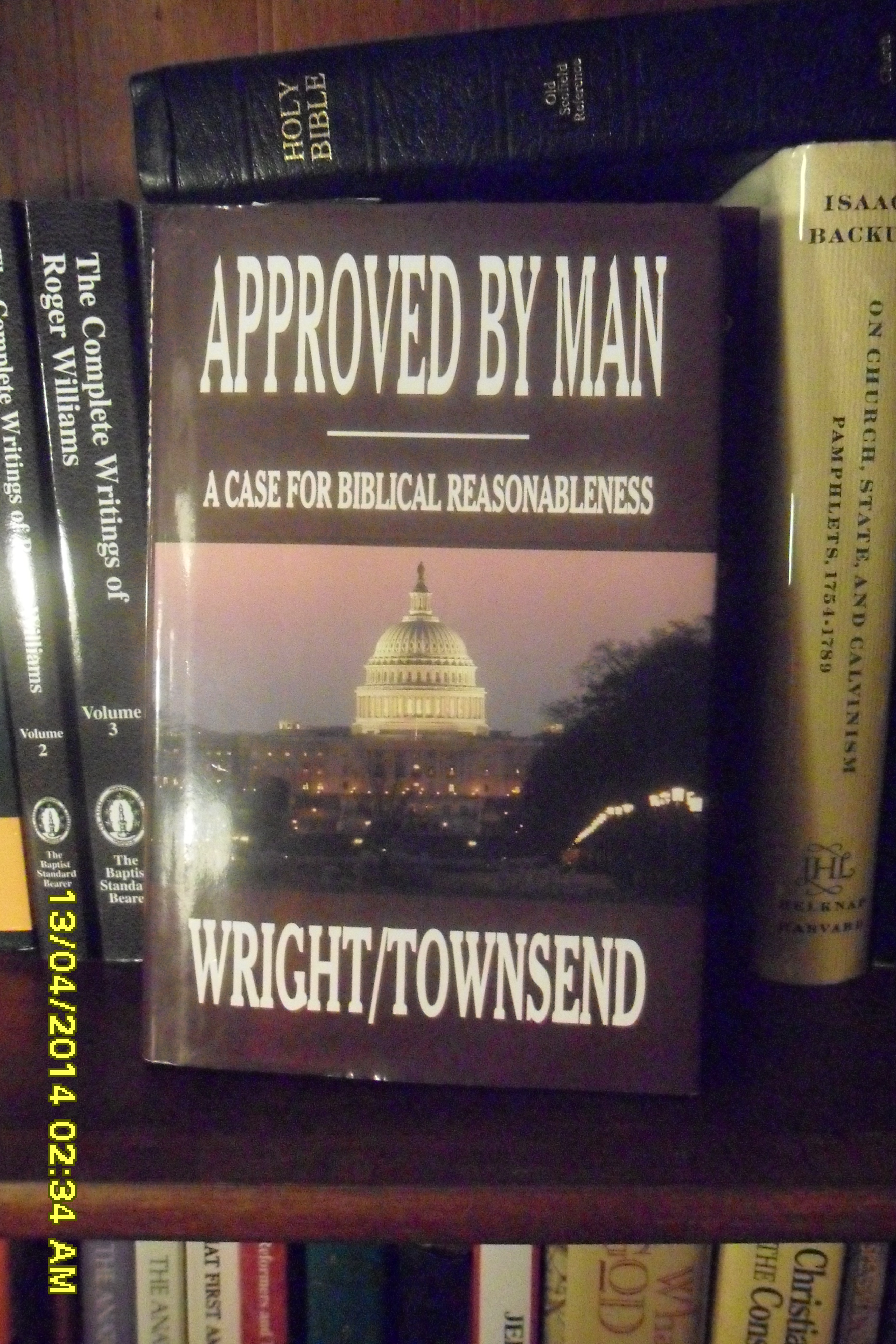
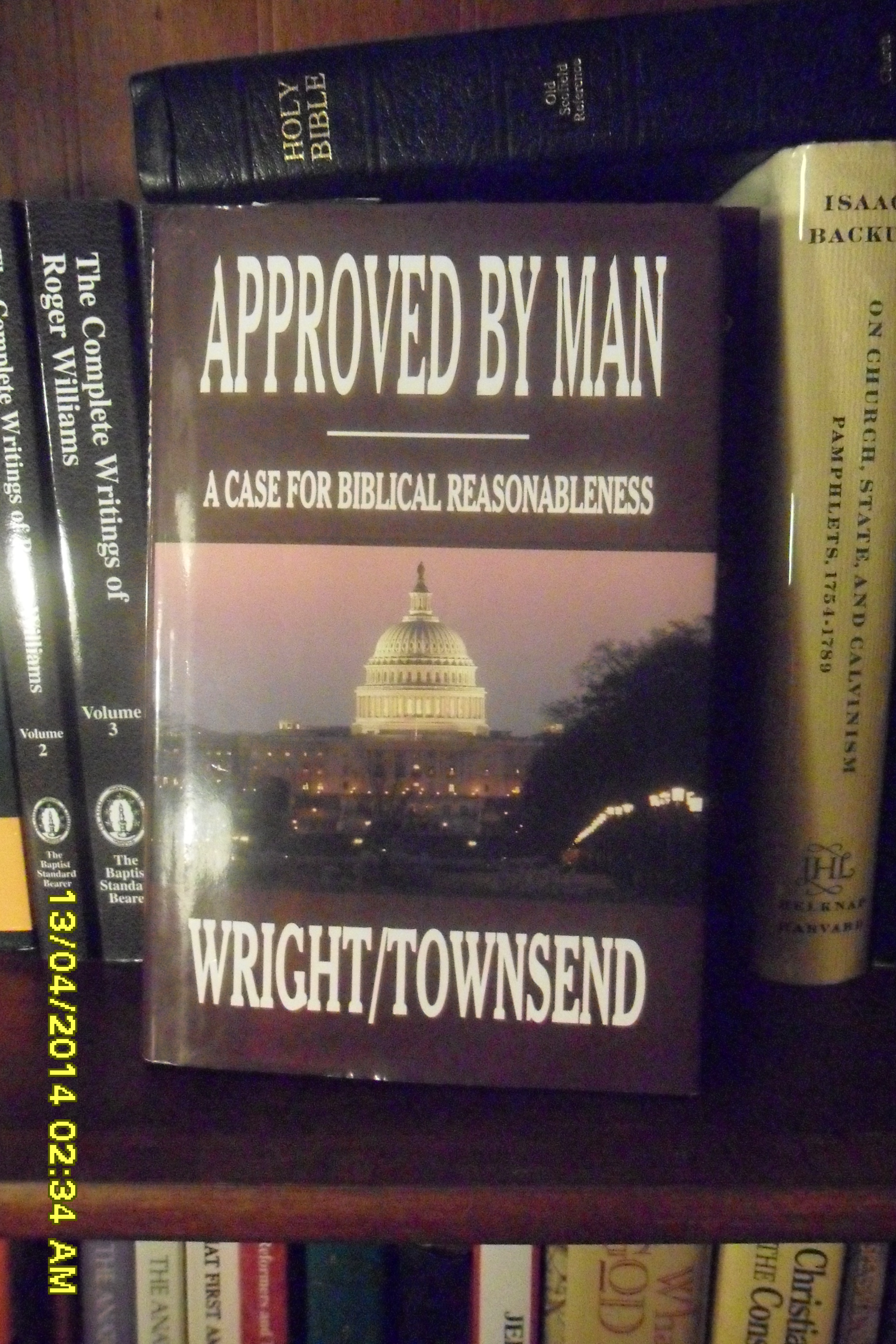
As was obvious to this author when he read and analyzed Chapter 18 of Approved by Man, Townsend did not know what he was talking about regarding trust law. He wondered why Townsend would make such outrageous statements and legal arguments. Ben Townsend partially explained his foolish writing in Give and Take. In that article he stated:
“Okay, I admit it. And when pastors are questioning the ‘other’ attorney from the ‘other’ really good law ministry, he can actually have my blessing to say, ‘Dr. Townsend admits that he does not know much about Trusts’” (See the Endnote for the complete section where he makes this admission. Click Give and Takefor this author’s replies to the entirety of that article.).
Townsend goes on to say that Robin Wright, now deceased, was the ELC brains behind the law of trusts. This infers that the ELC is now going forward without anyone with any knowledge of trust law. The ELC, as when Dr. Wright was alive, (1) organizes churches as legal entities through the use of some kind of trust and (2) relentlessly attacks the Biblical Law Center (“BLC”) and the DOT and the ordinary trust thereby created. All this is explained in the Preface, Introduction, and Chapters 1-8 of this booklet.
Give and Take raises a very important question: Why would Townsend write Chapter 18 of Approved by Man when he admits that he does not know much about trusts? The fact is, as shown by Chapters 1-8 of this booklet, he knows nothing about trusts. In Chapter 18, Townsend speaks as though he is an authority on the Declaration of Trust and the trusts thereby created. Pastors have explained Townsend’s reason for his unlearned and virulent attacks to this author. The quote of one pastor (not Dr. Greg Dixon and not a pastor who had, at the time of his quote, utilized the DOT and the ordinary trust) as to Townsend’s motive follows: ““[Out of courtesy, this author will not publish the pastor’s statement.]” Mr. Townsend needs to repent and ask for help in correcting the flaws of the ELC as to church organization for the sake of all the good men of God who depend upon him for leadership.
No one can defend the ELC position against the Declaration of Trust and the ordinary trust thereby created. Townsend certainly has made no rational attempt to do so. Should he make such an attempt, this author will be glad to read and analyze his offering. This author will repent should he be proven wrong concerning any matter.
Section 2 of Give and Take: “GIVE – ‘Ben Townsend does not know much about Trusts.’ – Ben Townsend” follows:
Okay, I admit it. And when pastors are questioning the “other” attorney from the “other” really good law ministry, he can actually have my blessing to say, “Dr. Townsend admits that he does not know much about Trusts.” Then he can snort through his nose a little giggle, and the pastors in the audience can smile and nod to each other and chuckle. They can even designate one of their own pastors (at that moment) to cackle out loud. I would like him to stipulate that at that point he will tell the congregation of pastors, “Dr. Townsend has the same amount of knowledge on Trusts as Paul, Peter, John, and all the other writers of the Bible.” Whenever anyone would call the ELC and ask about Trusts, I would say, “Dr. Wright, phone call,” and hand the phone to Dr. Wright. Mainly, those would be people whom Dr. Wright had set up their Trust as an individual. He personally set up hundreds of those Trusts. Some were Unincorporated Business Organizations (UBOs), some were Bare Trusts to just hold properties and assets, and one he set up for me to hold money to be used to help other missionaries and ministries in my son Jeremy’s name after his death. He sincerely tried to show me how it all worked once, and I smiled and nodded and said “Hmmm…” a lot. And with Dr. Wright having a B.A. in History, graduating from Central Baptist Seminary, and a Ph.D. in Business Administration, I figured he knew what he was talking about. Besides, I am a pastor. The only thing I really knew about Trusts was “Trust in the Lord with all thine heart.” I was not confused into thinking that was a legal Trust though.
The Only Way a Church Can Organize to Remain a New Testament Church (050616 article which explains that why trust is a Bible concept and why it is the only way a church can organize in accord with New Testament principles and the wisdom of using a properly worded and executed Declaration of Trust with supporting documents.)
See Spurious rationale for church incorporation: to hold property (Section VI, Chapter 7 of God Betrayed; Chapter 7 of Separation of Church and State) for an explanation of the ordinary trust. That chapter shows how the ordinary trust comports perfectly with Bible principle and why this author now co-labels the ordinary trust a Bible trust.
Chapter 4:Analysis of the third section of Chapter 18, “Biblical Law Center Bulletins”
Note. This is a continuation of the examination of Chapter 18 of Approved by Man, an Ecclesiastical Law Center (“ELC”) Publication, which attacks the ordinary trust. This article looks at the third section of that chapter “Biblical Law Center Bulletins.”
Thank you, ELC, for waking up our brain cells.
In the following analysis, ELC quotes will be in red in quotation marks and analysis of their statements in black. This chapter exposes and defeats the false, virulent, hostile accusations and conclusions of the ELC in this section of their article.
The third section of chapter 18 starts out:
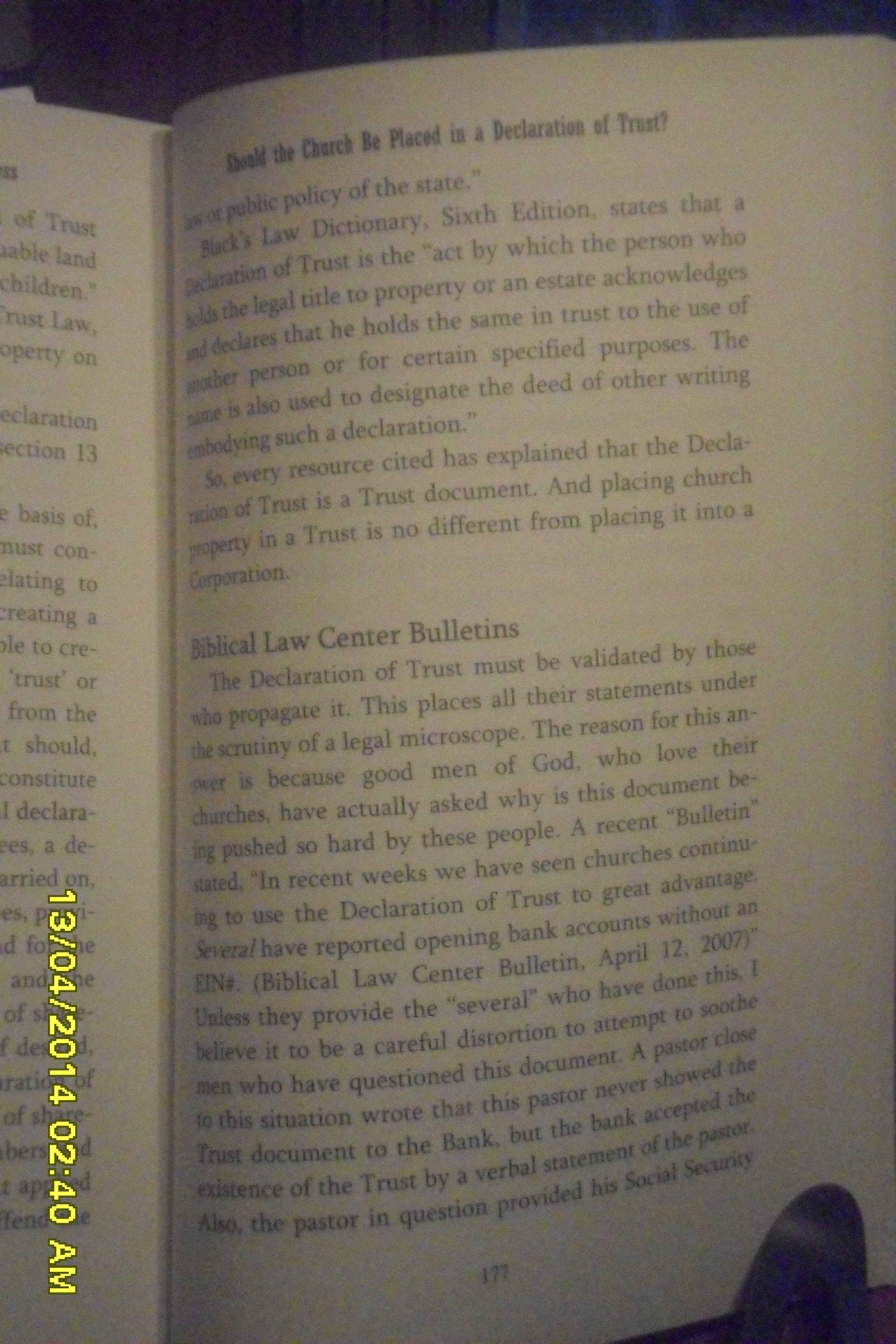
Approved by Man, p. 177
“The Declaration of Trust must be validated by those who propagate it. This places all their documents under the scrutiny of a legal microscope. The reason for this answer is because good men of God, who love their churches, have actually asked why is this document being pushed so hard by these people.”
This author, an attorney, has placed BLC documents under a “legal microscope.” His qualifications: legal research at Jr. College prior to going to law school, graduation from one of the best law schools in the country (The University of Texas School of Law), continuing to study and apply legal research and analysis, and practicing law for twenty-one years. In addition to that, he, a born-again believer, has spent just as much time studying the biblical doctrines of government, church, separation of church and state and the application of those principles in the United States. Studying and growing in knowledge, understanding, and wisdom are prescribed by God’s word, but some will make fun of someone who actually obeys these directives.
A pastor is just one member of a church body. The other members are told to exercise their gifts and work with the other members, including the pastor, in fighting the spiritual warfare believers and churches are involved with. Sadly, some pastors think they know it all and can do it all just because they are the pastor. They cannot possibly know it all and do it all. Hence the need for a member who, according to God’s call, studied legal, as well as, Bible matters.
This author finds nothing out of order with the basic concepts concerning the Declaration of Trust (“DOT”) and the ordinary trust thereby created. A properly worded and executed Resolution and DOT and the ordinary (Bible) trust thereby created implement biblical principle, conform to the biblical doctrine of trust, are provided for in American law, and allow a church to remain under God only. The analysis below again shows that the ELC will say anything to support their attack on the DOT and the ordinary (Bible) trust.
The ELC constantly approaches pastors and others about their ideas concerning church organization. They try to recruit people to their way and condemn other methodologies. This is a good thing as to church corporate (including corporation sole), unincorporated association, and 501(c)(3) status. However, the ELC method is seriously flawed, and yet they incessantly attack the use of the ordinary (Bible) trust and the DOT which creates it. Their attacks are wrong and not according to knowledge, as this series of articles shows. One can certainly ask why the ELC method is being pushed so hard by those who promote it; the answer is bias, motive and lack of knowledge.
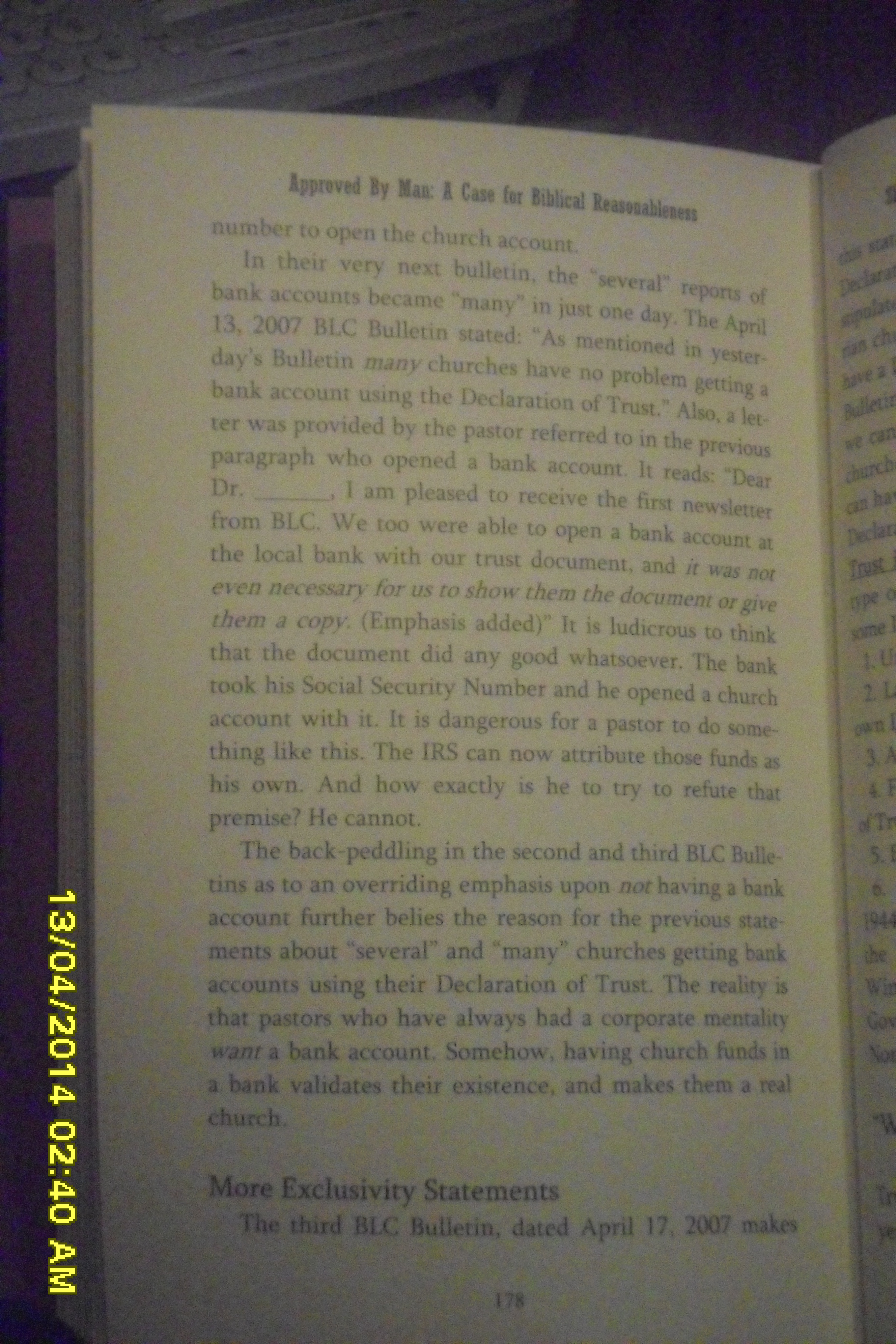
Approved by Man, p. 178
The ELC article continues:
“A recent ‘Bulletin’ stated, ‘In recent weeks we have seen churches continuing to use the DOT to great advantage. Several have reported opening bank accounts without an EIN#. (Biblical Law Center Bulletin, April 12, 2007)’ Unless they provide the ‘several’ who have done this, I believe it to be a careful distortion to attempt to soothe men who have questioned the document. A pastor close to this situation wrote that this pastor never showed the Trust document to the Bank, but the bank accepted the existence of the Trust by a verbal statement of the pastor. Also, the pastor in question provided his Social Security Number to open the church account.”
Contrary to what the ELC asserts in the above paragraph, the pastor/trustee of an ordinary (Bible) trust does not open a church account. He opens a trust account. The church who used the DOT and ordinary trust thereby created is not a legal entity and cannot open a bank account; for a church to open a bank account makes the church a legal entity. Although the ELC method uses cash only, a church which utilizes the ELC method is a legal entity as is proved in other parts of this booklet.
When this author was lead counsel for the BLC, a number of churches adopted the DOT and the ordinary trust which was recommended by the BLC. A bank account was opened for the trust by the Pastor/trustee in each instance; the pastors were able to do so using their social security number. One of those pastors is now the pastor of the church to which this author now belongs, Pastor Jason Cooley, who opened a trust account for the trust created by the DOT. Pastor Cooley provided his Social Security Number in opening the account. He did not open a bank account in the name of the church. To have done so would have made the church a legal entity.
When Pastor Jason looked at incorporation and IRS tax exempt status he realized that such devices violate New Testament church doctrine. A mutual friend referred Pastor Jason to this attorney concerning church organization. They spent many hours discussing the DOT and the trust thereby created as Pastor Cooley studied the Bible doctrine of the church, the DOT, and the ordinary trust. Prior to discussing these matters with this attorney, he had talked with ELC men. He studied both the ELC recommended methods and those of the BLC. The church (Old Paths Baptist Church) resolved to adopt the DOT and ordinary trust recommended by the BLC. The BLC helped him do this.
This Old Paths Baptist Church “Separation of Church and State Law” ministry has helped other churches execute a DOT and ordinary (Bible) trust with no problems in opening a bank account for the trust. In each case the pastor/trustee provided his social security number in opening the account.
The ELC is confused and does not understand that the a church who creates a trust recommended by the ELC is a legal entity; nor do they understand that ta church which establishes an ordinary (Bible) trust is not a legal entity as long as that church does not compromise her position in some other manner. The ELC does not understand that their trust can be classified as a legal entity whereas the ordinary (Bible) trust cannot. The ELC is against bank accounts for their church trust (a legal entity). This “Separation of Church and State Law Ministry” has no problem with opening a Bible trust bank account since (1) it can find nothing wrong with so doing, biblically or legally (Since the legal system recognizes the principle of the Bible trust); (2) the trustee opens the account for the trust, not for the church since the church is a non-legal entity which holds no money or property; (3) ordinary Bible trusts are administered by pastors/trustees with integrity who wish to be light to the world and have nothing to hide. These matters are explained more thoroughly in other articles in this series.
The pastor/trustee of either an ELC trust or an ordinary Bible trust is a legal entity. Every citizen in his right mind is a legal entity who can act legally in many ways. As pastor/trustee, he can do things which subject him to the civil government legal system (criminal and/or civil) should someone file a complaint (criminal) or initiate a lawsuit (civil). Civil government will take jurisdiction (criminal or civil) to any dispute over money or property to which the government is alerted and which contravenes criminal or civil law. As long as one does right, according to the law, he can only be brought into the legal arena as a defendant (either criminal or civil) by lies or misleading circumstances. The church which places tithes, offerings, and gifts into an ordinary Bible trust to be held by the trustee for the benefit of the true owner of the property, the Lord Jesus Christ, cannot be brought into a lawsuit or charged with a crime since it is not a legal entity; this is not true of the church organized according to ELC methods. Someone who is a member of a church, no matter how the church is organized, can be the subject of a criminal charge or civil suit should a proper criminal complaint be made or civil lawsuit filed.
The ELC continues:
“In their very next bulletin, the ‘several’ reports of bank accounts became ‘many’ in just one day.” The ELC then quotes from a letter from a pastor/trustee who had followed the BLC recommendation in which the pastor opened a trust bank account and states that he had no problem opening a trust bank account with his social security number only. Then the ELC states: “It is ludicrous to think that the document did any good whatsoever. The bank took his Social Security Number and he opened a church account with it. It is dangerous for a pastor to do something like this. The IRS can now attribute those funds as his own. And how exactly is he to try to refute that premise? He cannot.”
Again, the ELC does not know what they are talking about. The pastor did not open a church account. The pastor opened a trust account. The government already had his social security number as well as that of anyone who has a social security number. Should a pastor open an account in his name as an individual, the IRS can attribute the funds to that pastor. However, when a pastor/trustee of a Bible trust opens a trust account, those funds cannot be attributed to the pastor. A properly worded and executed Declaration of Trust and supporting documents validates and explains the Bible trust so that the bank, the IRS, and anyone else may examine the documents if allowed to do so by the pastor/trustee. American law which recognizes the Bible trust rather than providing for the creation of such a trust and the elements thereof. State law does not provide for creation of a Bible trust whereas state law provides for creation of a corporation which is a creature of the state. The ordinary trust for which he opened the account is not a legal entity as is, for example, a corporation. (See, Is the ordinary trust a legal entity?). The Resolution Adopting the DOT and the DOT make clear that the trust is not a legal entity and that the trust creates nothing more than a means, recognized by the legal system, to hold and manage money and property. The law says an ordinary trust is not a legal entity: the law says this because the very nature of the ordinary trust is clear – by its very nature, such a trust cannot be a legal entity. Always remember, the ordinary Bible trust is not the church, the church is not the the trust or the trustee, and the church does not hold property by a trustee as in the case of the ELC trust.
This attorney recommends that the pastor/trustee take the Resolution and the DOT which creates the ordinary Bible trust with him to the bank when he goes in to open a trust account. Should the bank wish to see the documents, the pastor/trustee should show the documents to the bank. There is nothing wrong with doing so. He has nothing to hide. In fact, by shining light, he glorifies the Lord Jesus Christ.
As to the bank taking his social security number (“SSAN”), if the pastor/trustee has a social security number, he should show it to the bank. If he has never had, or has tried to disown, a SSAN, he is fighting another battle which this author has considered but concluded that that fight involves something about which he is not convicted. The pastor/trustee should show his SSAN to the bank because it is an identifying number for which he has not had to betray the Lord; he is stuck with it, but by using it in this context, he does not implicate a church nor does he endanger himself. Whether one has a SSAN or not, he is a legal entity and he can be held accountable by the civil government for wrongdoing brought to the attention of the civil government. See The Biblical Doctrine of Government for more insights on the jurisdictional boundaries of each type of God-ordained government.
The bank will not attribute those funds as being “his own” (belonging to the pastor). Most banks understand trust law and the different types of trusts. Many have their own trust departments. They know that this type trust is an ordinary trust. They know that the pastor/trustee merely administers the funds for the benefit of the true, equitable, beneficial owner of the money. The IRS also understands trust law. Neither the banks nor the IRS are bound by ELC’s perverted statements of what the ELC says is the law. The banks and the IRS are bound by established law. The Resolution and the DOT refute ELC perversions of the law and are there to dispel any doubts.
In conclusion, one could rationally conclude that the writer of Chapter 18 is a half-postmodernist. A postmodernist believes he can create reality through his rhetoric, but also believes that all truth-claims are equal – The first half can be applied to ELC teaching but the second half cannot since the ELC believes that only its truth claims are true when in fact they are nonsense. The ELC articulates a case not according to the facts. I would love to face their pseudo lawyers in a court proceeding called to determine the truth about their ridiculous assertions. They would not stand the chance of a snowball in hell. Fortunately for them, they appeal to many good believers who are duped by their con and do not have the expertise to examine ELC lies and distortions. This booklet serves as a guide to those who take the time to study these matters out. The important thing is truth, not ad hominem attacks by ELC leaders desperate to defend their unlearned positions.
Note. Much of this chapter explains aspects of the ordinary trust and Declaration of Trust utilized by this ministry in helping churches who want to please God in their organization. When I wrote this chapter and this booklet, I had not published Simply Church: The Holy Union of Christ and His Local Church which concisely explains the “ordinary” trust, which is a relationship with property only, not an entity of any kind, and the importance of a written Declaration of Trust.
The Only Way a Church Can Organize to Remain a New Testament Church(050616 article which explains that why trust is a Bible concept and why it is the only way a church can organize in accord with New Testament principles and the wisdom of using a properly worded and executed Declaration of Trust with supporting documents.)
See Spurious rationale for church incorporation: to hold property (Section VI, Chapter 7 of God Betrayed; Chapter 7 of Separation of Church and State) for an explanation of the ordinary trust. That chapter shows how the ordinary trust comports perfectly with Bible principle and why this author now co-labels the ordinary trust a Bible trust.
Introduction: Ecclesiastical Law Center Exposed
For many years, the Ecclesiastical Law Center (“ELC”) has publicly attacked the Biblical Law Center (“BLC”) and the BLC method whereby churches establish an ordinary (Bible) trust by adopting a Declaration of Trust (“DOT”). The position of this author for many years has been that churches should look at all points of view, study to make sure they are not being misled, and then proceed according to Bible principle for the Glory of God. He had been asked to respond to ELC misinformation and attacks several times over the years, most recently by his pastor, Pastor Jason Cooley after he read Chapter 18 of Betrayed by Man,a book by Robin Wright and Ben Townsend of the ELC. Motivated by the obvious falsehoods in ELC writings which are disseminated to many sincere and good men of God and which attack and misrepresent the DOT and the ordinary trust thereby created while promoting a very ill-advised method for a church to hold property in trust for the Lord Jesus by the pastor for the church, this author finally decided to take on the task.
This is not about the ELC, the BLC, or this ‘Separation of Church and State Law’ ministry. This is about the Lord Jesus Christ and his churches and the truth; that is why believers should be concerned about these matters, even though the issues and answers may initially seem complex. You may be a pastor of a church who has organized according to the recommendations of the ELC or according to those of the BLC or this Old Paths Baptist Church “Separation of Church and State Law” ministry (“SCSLM”). You may believe the literature and teachings of your particular leaders. However, the ELC teachings are so different from those of this ministry that only one can be valid legally and biblically. For that reason, churches and pastors who are concerned about the biblical doctrine of the church need to find out which one is right. The author humbly submits that there is nothing more important than keeping the bride and wife of Christ pure and chaste and that all sides of this controversy must set aside their pride and diligently seek the truth in order that the church you are a member of may be prepared in the matter of church organization for His coming.”
Is the church you are a member of being prepared for His coming?
Is the church you are a member of being prepared for His coming?
Ephesians 5.23-27, 30-32 states:
“For the husband is the head of the wife, even as Christ is the head of the church: and he is the saviour of the body. Therefore as the church is subject unto Christ, so let the wives be to their own husbands in every thing. Husbands, love your wives, even as Christ also loved the church, and gave himself for it; That he might sanctify and cleanse it with the washing of water by the word, That he might present it to himself a glorious church, not having spot, or wrinkle, or any such thing; but that it should be holy and without blemish…. For we are members of his body, of his flesh, and of his bones. For this cause shall a man leave his father and mother, and shall be joined unto his wife, and they two shall be one flesh. This is a great mystery: but I speak concerning Christ and the church.”
As the informed believer reads the articles which examine the parts of Chapter 18 of Betrayed by Manand related ELC writings, he will see the good, the bad, and the ugly about the ELC position for church organization.
The good:
The ELC method – as proven by written declaration in their books, writings, and practice some of which will be cited, copied and pasted into this booklet – creates a trust arrangement, places property in the legal name of a trustee for the church who holds and administers property and monies (the trust estate) for the Lord Jesus Christ the true, equitable, and beneficial owner of the property (and money). The trustee(s) has (have) a fiduciary duty under God and man to manage the trust estate, not for the benefit of the trustee(s), but for the benefit of the true, equitable, beneficial owner, the Lord Jesus Christ. As long as no disputes over, for example, ownership of property or some other property dispute, tort claims for injures sustained on church property, or use of funds (tithes, offerings, and gifts) arise, the ELC method will work fine and the inherent weaknesses of the ELC method and the inaccuracies in ELC teachings will not come to the forefront. Even then, unless the issues are tackled by one who is knowledgeable about ELC writings which expose the truth about their trust arrangement, the weaknesses and inaccuracies of the ELC method may not be discerned. However, should a lawyer study their writings and the relevant law, he will likely uncover his line of attack. Should he find out about and study this booklet, he will definitely discover how to mount an effective attack, unless the ELC corrects the flaws in their self-created and self-acclaimed system.
The bad:
The ELC trust arrangement negatively implicates the church who utilizes their method by declaring that “The property should be held by the church in trust for the Lord Jesus Christ, who is the true and beneficial owner,” “Actually, the church, by the Pastor, can execute a deed on behalf of the Lord Jesus Christ,” etc. These written declarations are not included in a Declaration of Trust to be adopted by a church which organizes under the method recommended by the ELC; rather, the declarations are in publications which teach ELC methods. Needless to say, their published declarations do not adequately describe the type of trust intended, the duties of the trustee, provisions for successor trustee in the event the trustee resigns, dies, etc., and other matters. These written declarations, especially when studied in conjunction with other ELC teachings, effectively set the church up as a legal entity, as opposed to a spiritual entity only. Their system is not a Bible system, as they like to say, but a legal system which establishes a church as a legal entity It would be far better for an ELC church to adopt a properly written DOT declaring exactly the nature of the trust established, the legal status of the church, etc. Should attacks against an ELC church arise, a properly worded DOT which establishes an ordinary trust, not the type trust now established by the ELC methods, could be produced to establish that the church is not a legal entity, that the trust is an ordinary (Bible) trust (as it now stands, the logical conclusion from ELC teachings is that the church utilizing ELC methods is a legal entity and therefore can sue, be sued and act legally).The ELC method is not according to knowledge and it therefore grieves our Lord and can result in problems for ELC churches. The articles which follow in this series delve more deeply into the matters asserted in this paragraph.
The ugly:
The ELC runs a continuing campaign to convince others that the BLC (and now this SCSLM) are liars and that their methods are bad, should not be used, etc. Nothing could be farther from the truth. The ordinary (Bible) trust (and a properly worded DOT which creates it) recommended by this ministry and the BLC, as will be shown (and already has been shown in books and online writings) is biblical and has been recognized by the American law as a non-legal entity, a relationship with property and assets. Thankfully, churches can utilize an ordinary trust without placing themselves under the jurisdiction of civil government–the church is not the trust nor is the trust the church. The church remains a spiritual entity as long as she does not in some manner act legally; and she remains separate from the ordinary trust.
ELC attacks include sloppy false legal arguments (at best), lies, distortions, personal attacks, etc. Some of those will be exposed for what they are in the accompanying chapters. Straight forward language is the only way to get at the truth and, as will be shown in this series, the ELC has no problem either directly or indirectly, without any proof, calling truthful BLC statements lies, no problem with fabricating false, bad motivations on the part of the BLC for the alleged lies, no problem formulating ridiculous legal arguments, no problem with distorting, lying, and publishing recommendations for church organization without knowledge, understanding, and wisdom. This booklet will prove all this.
This author has seen no ELC written or online publication which, for example, looks at the law of ordinary trusts, the law upon which DOT and ordinary trust thereby created and which the BLC and the “Separation of Church and State Law” ministry recommend. Instead, the ELC mischaracterizes the ordinary trust recommended by the BLC and by this ministry as a business or charitable trust. Business and charitable trusts are legal entities. The ordinary trust is not; yet, relying on business trust and charitable trust law instead of ordinary trust law, the ELC continues to claim, against clear truth, that the ordinary trust is a legal entity. Here are two of many ludicrous examples of false ELC claims:
“The Ecclesiastical Law Center advises churches to not use a Declaration of Trust, a corporation, an unincorporated association, or any legal entity to hold their church assets and property.” (From ELC book, Betrayed by Man, page 180)(My comments: Here again, the ELC not only misrepresents the ordinary trust, but also condemns their own method. The ordinary trust is not a legal entity. Furthermore, the church who places tithes, offerings and gifts into an ordinary trust has no assets. The ELC church has assets which are held in trust for the benefit of the true owner of the property, the Lord Jesus Christ. The ELC church is a legal entity since she holds property and has assets.)
“And placing church property in Trust is no different from placing it into a Corporation.” (From Betrayed by Man, page 177)
By “Trust” in the above statements, the ELC means all trusts, thereby including the ordinary trust (a fiduciary relationship with property which is a non-legal entity) with trusts which are legal entities such as business trusts and charitable trusts. In other words, the ELC again misrepresents the ordinary trust by effectively stating that all trusts are the same. The statement also equates placing a church in trust with incorporating a church; this is ridiculous because an ordinary trust has no resemblance to a corporation. An incorporated church is a legal entity. The ELC, in attacking the ordinary trust, cites 13 (“13” is the volume number) AM. JUR. 2D (AM. JUR. 2D is the abbreviated form of American Jurisprudence 2d, a highly regarded legal encyclopedia) Business Trusts and 15 AM. JUR. 2D Charitable Trusts. They never refer to 76 AM. JUR. 2D Trustswhich covers ordinary trust law. 61 large volumes separate volumes 15 and 76 of American Jurisprudence and that separation corresponds with the difference between the ordinary trust and business and charitable trusts. They also cite reported cases which mention charitable trusts and business trusts in attacking ordinary trust law. This type analysis by the ELC is either completely dishonest or the result of incompetence in dealing with legal matters. This booklet will thoroughly analyze, in detail, all these matters. The assertions of this author will be proven beyond any doubt.
The ELC, in its church organization methodology, relies on trust law. The language used by the ELC in its published declaration makes that clear; language such as “property held in trust,” “for the Lord Jesus Christ, who is the true and beneficial owner,” and “the Pastor, can execute a deed on behalf of the Lord Jesus Christ.” All of the elements of a trust are in that language. Since Robin Wright, the brains behind the ELC, had some knowledge of trust law, this reliance is not without knowledge (See Section 2 Give and Take, an article by Ben Townsend of the ELC that was published after Chapters 1-8 of this booklet were published online). However, the ELC disqualifies their method as creating an ordinary (Bible) trust by saying that “The property should be held in trust for the Lord Jesus Christ,” “Actually, the church, by the Pastor, can execute a deed on behalf of the Lord Jesus Christ,” etc. This is ugly because the ELC proposes a trust which sets a church up as a legal entity while virulently opposing the ordinary trust which keeps a church in its spiritual only status (non-legal entity status). This booklet will prove all this beyond all doubt.
This brings up a very important question: If the ELC is what they set themselves up to be – experts in trust law – then why do they always cite law and cases which deal with business and charitable trusts and never from the law of ordinary trust in their attacks against the ordinary trust promoted by the BLC and this “Separation of Church and State Law” ministry? Could it be that they knowingly wish to mislead others as they attack the ordinary trust with accusations that it is a legal entity? Business and charitable trusts are legal entities and the ordinary trust is not. Or could it be that they have never read the law of ordinary trusts? Or could it be that they got the language and ideas for their form of trust from the law of business trusts and/or the law of charitable trusts, but then attempted to distinguish their “trust” arrangement from those laws? Or could it be that they got the language and ideas for their method from the law of ordinary trust but do not wish to bring it up because they do not wish to bring attention to the fact that they have created some type of trust, something which they may have done because they do not understand these matters? Or could it be that a man who was later to start the ELC talked at length with Al Cunningham, while attorney Cunningham was alive and while the to be ELC leader was still a member of Indianapolis Baptist Temple, and – as a novice to legal matters – tried to create something with the elements of the ordinary trust which Attorney Cunningham recommended to churches but with changes which make the church which utilizes the method a legal entity, and then claim that what they were creating was biblical and not legal and that the concoction has all kinds of alleged benefits for a church? Al Cunningham was a great friend to Indianapolis Baptist Temple and Dr. Greg Dixon and spent a lot of time there.
In one place in their writings, they make the confused argument that there will be no lawsuits because you cannot take the true or equitable owner, the Lord Jesus Christ, to court (See Approved by God, p. 150). They state that this is so because lawsuits can be leveled against legal entities only, not spiritual ones. That statement is partly true – lawsuits can only be taken against legal, not spiritual entities. However, when money or property are taken to court, the legal owner, not the true, beneficial, or equitable owner in the trust situation, will be made a party to the action. ELC churches, by published ELC admission, are legal entities which can be taken to court (See, e.g., Approved by God, pp. 149-150 (ELC churches “hold property in trust for the Lord Jesus Christ;” “the church, by the Pastor, can execute a deed on behalf of the Lord Jesus Christ;” etc. See also, Chapter 3 of Approved by Man where the ELC makes clear that it handles “legal church problems”). A church can hold property (in trust or otherwise), execute a deed (by a pastor or anyone else), or be taken into court only if she is a legal entity. ELC churches are legal entities. BLC and SCSLM are New Testament churches; they are not legal entities; and they cannot be taken to court.
Anytime anyone initiates a lawsuit for damages (slips on the ice at the church entrance and is damaged, etc.), a property tax challenge, or any type challenge involving a legitimate dispute over property (especially real estate) or money, the appropriate court (or agency) will assume jurisdiction and decide the dispute. Effectively, there can be no legal action for damages on property, if there is no one with a duty, or if there is no legal owner. In the case of one damaged because of the knowing, intentional, or negligent action of another who has a duty to maintain safety of a facility, the probable course of action will probably be to sue the church (which means those in the church) (1) if there is no clearly worded declaration that makes clear that the church owns nothing and is not a legal entity or (2) if there is proof that the church is a legal entity. The latter can be established as to the ELC church as well as other types of legal entity churches such as incorporated (including corporation sole) churches. In other types of disputes, if there is no legal owner, the court (or agency) will take jurisdiction over the property or money and decide to whom it belongs if ownership is at issue or whether a crime or tort was committed in the handling of the property or money. In the case of a church who is places tithes, offerings, gifts, and properties into an ordinary (Bible) trust, the church is a legal entity and cannot be sued; the legal owner of the property is the pastor/trustee.
Consider in more detail liability for damages to someone injured on the property due to the negligence of someone in charge. For example, suppose a person falls on ice while entering the premises of the real estate used as the church meetinghouse due to the negligence of the one (the legal entity/trustee) in charge of the property (the legal owner) and/or the person delegated to remove the ice from the entrance, if any. The injured party’s lawyer will seek out the legal owner, who will not be hard to find. An investigation will be done. That is when the ELC church can be, due to the published statements of the ELC, implicated as the legal entity who holds legal title to the property. When the church is implicated, the members are implicated since the members are the church. Should that scenario arise, the church would be better off incorporated, from a worldly perspective (but see, Spurious rationale for church incorporation: limited liability/incorporation increases liability of church members(Section VI, Chapter 6 of God Betrayed; Chapter 6 of Separation of Church and State) for the heavenly perspective). However, when the recommendations of the BLC and this “Separation of Church and State Law” ministry are followed, the church cannot be implicated and the insurance company from whom the trust (not the church) has bought liability insurance on the real estate will take care of the damages. Of course, should the party responsible for the real estate be proven negligent or responsible for not removing the ice, he and anyone given the responsibility to remove the ice can also be included in the lawsuit; this is true no matter how the church is organized. And this is as it should be. It is biblical and it is legal to hold one who intentionally, knowingly, recklessly, or with negligence injures another or causes another to be injured.
Should a lawyer who knows the ELC teaching and the basic law of the various types of trusts be involved in any legal action against land, money, or against one responsible for injury and damages to another, that lawyer could establish that the ELC church is a legal entity and include the church in the dispute, something which ELC publications establish; an impossibility for the church which places tithes, offerings, and gifts into an ordinary trust which is a non-legal entity in which a trustee administers the trust estate for the benefit of the true, equitable, beneficial owner or the property, the Lord Jesus Christ and is careful not to inadvertently act legally and thereby set herself up as a legal entity. Fortunately for the ELC, no lawyer before the publication of this booklet was called to take the time to study out ELC teaching.
These matters will be explained in much more detail, with cited authority, in the accompanying articles, the links to which will be included at the beginning of this article as they are completed. May everyone put aside their pride and seek the truth, for His Glory. Addressing all these matters will be require a little time and study by the novice. You who are interested in these things must patiently go through these articles and do some self-study to determine the truth. Following this teaching as it develops piecemeal will give the interested party time to check the assertions of this author and sources and do some study yourself. If anyone who has studied the teachings of the ELC or the teachings of this “Separation of Church and State Law” ministry is confused or has an honest disagreement based on in-depth studies, this author will be glad to examine an issue with you. Again, if this author can be shown to be wrong, he will publicly repent and present corrections.
The local church sanctified and cleansed by the washing of water by the word——————–A ministry of Charity Baptist Tabernacle of Amarillo, Texas led by Pastor Ben Hickam. "Would to God ye could bear with me a little in my folly: and indeed bear with me. For I am jealous over you with godly jealousy: for I have espoused you to one husband, that I may present you as a chaste virgin to Christ. But I fear, lest by any means, as the serpent beguiled Eve through his subtilty, so your minds should be corrupted from the simplicity that is in Christ" (2 Corinthians 11:1-3). ————————————Jerald Finney, a Christian Lawyer and member of Charity Baptist Tabernacle, having received this ministry in the Lord, explains how a church in America can remain under the Lord Jesus Christ and Him only. "As every man hath received the gift, even so minister the same one to another, as good stewards of the manifold grace of God. If any man speak, let him speak as the oracles of God; if any man minister, let him do it as of the ability which God giveth: that God in all things may be glorified through Jesus Christ, to whom be praise and dominion for ever and ever. Amen" (1 Peter 4:10-11; See also, Ephesians 4::1-16 and 1 Corinthians 12:1-25). "Take heed to the ministry which thou hast received in the Lord, that thou fulfil it" (Colossians 4:17). "And hath put all things under his feet, and gave him to be the head over all things to the church" (Ephesians 1.22; See also, e.g. Colossians 1:18).





 Simply Church