Tag Archives: Roger Williams

(2) Colonial Theological Warfare—Separation of Church and State


A Publication of Simply Church Ministry


If you miss one part of the puzzle that is being put together in these studies, you will never see and understand the whole picture.


Jerald Finney
Copyright © February 7, 2018


A complete analysis of Dispensationalism and Covenant Theology requires a long and deep study of the Bible. FN [i] These short lessons will briefly look at some of the characteristics of each and distinctions between the two. The differences were debated in the colonies during a spiritual warfare that began in the early 1630’s. Fortunately, the dispensationalist view prevailed. This resulted in the adoption of the First Amendment to the United States Constitution which, among other things, separates church and state (not God and state).

The two theologies have distinct “philosophies of history.” FN [ii] The two main systems which Bible-believing scholars have developed to exposit the Bible’s philosophy of history, Dispensationalism or Dispensational Theology and Covenant Theology, have produced two systems of theology. Dispensational Theology contains all the necessary elements of a valid philosophy of history. “Dispensationalism, [which] can be defined very simply as a system of theology which attempts to develop the Bible’s philosophy of history on the basis of the sovereign rule of God, represents the whole of Scripture and history as being covered by several dispensations[, economies, or stewardships] of God’s rule.” FN [iii]

“The essence of dispensationalism … is the distinction between Israel and the church. This grows out of the dispensationalist’s consistent employment of normal or plain or historical-grammatical interpretation, and it reflects an understanding of the basic purposes of God in all His dealings with mankind as that of glorifying Himself through salvation and other purposes as well.” FN [iv]

Covenant theologians teach that the church has replaced Israel. The Bible literally teaches that the rules for the church and state are different than the rules God ordained for the theocracy in Israel. Distinct rules, as discussed in the articles under Distinct Differences between Church and State that Render Them Mutually Exclusive, are laid down in the Bible concerning Judaism and Israel and the church and state.

Covenant theologians believe that God is through with Israel, that the church replaces Israel. This is a grave mistake to Judaize the church, a mistake which has many consequences.

“It may safely be said that the Judaizing of the Church has done more to hinder her progress, pervert her mission, and destroy her spiritually, than all other causes combined. Instead of pursuing her appointed path of separation from the world and following the Lord in her heavenly calling, she has used Jewish Scriptures to justify herself in lowering her purpose to the civilization of the world, the acquisition of wealth, the use of an imposing ritual, the erection of magnificent churches, the invocation of God’s blessing upon the conflicts of armies, and the division of an equal brotherhood into ‘clergy’ and ‘laity.’” FN [v]

The “Judaizing” of the church is based upon false biblical interpretation, upon a false philosophy of history.

The main issue in the theological warfare in the colonies was the relationship of church and state. Other issues such as believer’s baptism (Dispensational) versus infant baptism (Covenant Theology)—an issue closely related to the issue of separation of church and state—were also hotly debated. Covenant theologians believe in union of church and state. Dispensationalists take the literal meaning of the Bible on this issue—that God desires church and state to be separate in Gentile nations; both under God, but neither working over, with, or under the other. The arguments of both sides in the colonies are still available. Both secular and Christian histories of the theological warfare and the accompanying persecutions of dissenters is undeniable. Sadly, Calvinist, Protestant, and Catholic revisionism has done a masterful job of both promoting a revised version of history while hiding the truth from untold millions of “Christians.”


Endnotes

[i] For much more in-depth look at these matters, see Dispensational Theology versus Covenant Theology.

[ii] “Karl Lowith defines ‘a philosophy of history as ‘a systematic interpretation of universal history in accordance with a principle by which historical events and successions are unified and directed toward ultimate meaning’” (Charles C. Ryrie, Dispensationalism (Chicago: Moody Press, 1995), p. 17, citing Karl Lowith, Meaning in History (Chicago: Univ. of Chicago Press, 1949), p. 1; see also, Renald E. Showers, There Really Is a Difference: A Comparison of Covenant and Dispensational Theology (Bellmawr, New Jersey: The Friends of Israel Gospel Ministry, 1990), p.  1). This definition “centers on three things: (1) the ultimate goal of history; (2) the unifying principle; and (3) the recognition of ‘historical events and successions,’ or a proper concept of the progress of revelation in history” (Ryrie, p. 17). The Bible contains a philosophy of history because it deals with the issue of meaning, offers a systematic interpretation of history, covers the entire scope of history from beginning to end, including the what and why of the future, presents a unifying principle which ties together and makes sense of the whole gamut of events, distinctions, and successions, and demonstrates that history has an ultimate goal or purpose (Showers, p. 2; Ryrie, p. 17).

[iii] Renald E. Showers, There Really Is a Difference: A Comparison of Covenant and Dispensational Theology (Bellmawr, New Jersey: The Friends of Israel Gospel Ministry, 1990), p. 27.

[iv] Charles C. Ryrie, Dispensationalism (Chicago: Moody Press, 1995), p. 41.

[v] Dr C. I. Scofield, Rightly Dividing the Word of Truth (New Jersey: Loizeaux Brothers, First Edition, January, 1896), p. 12.

Introduction: Dispensation Theology versus Covenant Theology


If you miss one part of the puzzle that is being put together in these studies, you will never see and understand the whole picture.


A publication of Simply Church Ministry


Click here to go to Dispensation Theology versus Covenant Theology and Their Importance to the Issue of Church and State Relationship in America.
Click here to go to the written lessons.
Click here to go to the 3 1/2 to 6 minute video lectures.


Jerald Finney
Copyright © January 29, 2018


In order to understand religious liberty and the history of the First Amendment to the United States Constitution (freedom of speech, press, association, religion (or religious liberty); conscience; soul liberty; separation of church and state; and the right to petition the government for a redress of grievances), one must understand Dispensational Theology and Covenant Theology. This is because proponents of these two theologies fought a spiritual warfare in the colonies which led to the adoption of the First Amendment to the United States Constitution.

The Puritans were Covenant Theologians. Historic Baptists were Dispensationalists in belief, although the term Dispensational Theology was not coined until sometime in the last few hundred years. These two theologies clashed in the English colonies of America, the Baptist view prevailing at the federal level with the adoption of the First Amendment.

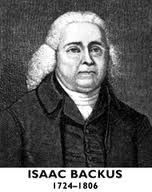
Christian and Secular Revisionists, as always, continue to deceive the general population in America with a revised history of the First Amendment. The contrived version of “Christian” revisionist history predominates the American Christian landscape. Endnote [i] The historical section of these studies will summarize that history, which scholars have recorded from the colonial period until this day. Endnote [ii] Contemporary Christian Revisionists use the same techniques as did their Calvinist forefathers. As Isaac Backus noted, concerning the revisionism and lies of the leaders of the established churches in the colonies:

  • “[I] appeal to the conscience of every reader, whether he can find three worse things on earth, in the management of controversy, than, first, to secretly take the point disputed for truth without any proof; then, secondly, blending that error with known truths, to make artful addresses to the affections and passions of the audience, to prejudice their minds, before they hear a word that the respondent has to say; and thirdly, if the respondent refuses to yield to such management, then to call in the secular arm to complete the argument?”[iii]

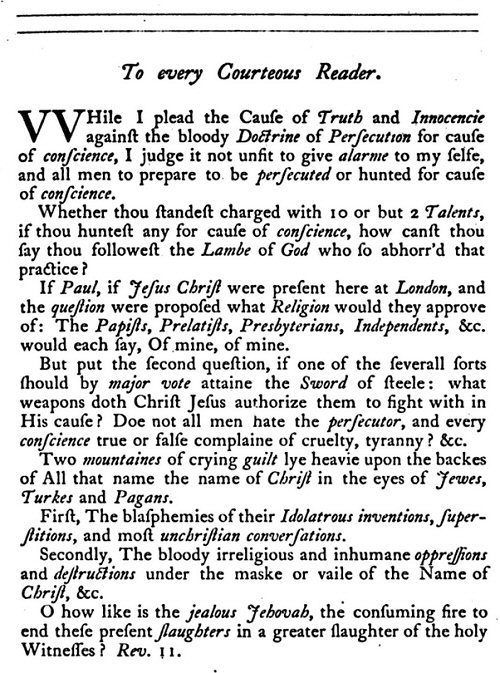
See Isaac Backus Quoted in God Betrayed to get a little understanding of the importance of his efforts and writings in the colonies for the cause of separation of church and state and religious liberty. The first major threat to the colonial establishments was instituted by Roger Williams in New England. His activities and writings forcefully revealed fallacies of Puritan (Calvinist) theology and Puritan persecution of “heretics” and led the founding of the first civil government in history with any lasing influence with religious liberty. See Roger Williams: Quotes and Other Information from God Betrayed.

Baptists in the colonies fought the Puritan and Anglican establishments. Isaac Backus came out of the Congregational (Puritan) Church, became a Baptist, and fought against establishment of churches, infant baptism, etc. His Bible studies led him to disregard significant portions of Calvinist allegorized interpretations of Scripture. He still called himself a Calvinist,  but rejected much of classic Calvinism. Through his extensive writing and activities, he fought for separation of church and state, baptismal regeneration, and other issues in the colonies.  These studies, especially the advanced studies, extensively quote Isaac Backus, and others such as Roger Williams—another hero of the faith who, as a Congregational pastor arrived in Massachusetts from England in the 1630s and soon clashed with Puritanism. It is obvious from their writings that these men took a literal view of Scripture and rejected the allegorized interpretation of Catholicism and Protestantism. Their writings totally dismantled the teachings of Puritans such as John Cotton. At the same time, Cotton and other Puritans, true to form and according to their theology, lied and misrepresented truth as always. They justified lying based upon false interpretations of Scriptures such as those dealing with Rahab the harlot and the midwives in Egypt.

The warfare between various biblical theologies continues and will continue until the kingdom of heaven is established by our Lord. Most “Baptists,” not to mention members of denominations and religions, have unknowingly succumbed to false religious beliefs and philosophies as end-time prophesy unfolds as foretold in Scripture.

This and the next few teachings will, in a nutshell, explain Dispensational Theology and Covenant Theology, distinguish them, and will be invaluable in one’s quest for understanding of the biblical principle of separation of church and state and the American application thereof. To fully understand these matters will not be the goal; only the most important matters will be covered, and those in summary form. see the citations and references for more in depth analysis and study.

Covenant theology allegorizes and spiritualizes Scripture and teaches union of church and state. Covenant theology applies selected principles regarding the theocracy of Israel to Gentile civil government and the church. Dispensational theology is based upon a literal belief in Scripture which accordingly teaches separation of church and state. Although many biblical principles run from Genesis to Revelation, the rules for church and state and for the Jewish religion-state are not the same. Under Judaism (the Jewish religion as ordained by God), religion and state operated hand-in-hand under God; that is, the religion and state were unified by God, both religion and state instructed by God to work together directly under God for the same goals.

Keep in mind that there are many variations of Covenant Theology. Likewise, Dispensationalist systems of theology deviate, some alarmingly, from accurate and literal understanding and teaching on Scripture. God will not call every believer to totally understand these systems. The best thing a believer can do with God’s Word is to study it, believing what it says. When one does that, he will by definition be a dispensationalist. The important thing is that the believer read his own Bible and verify any Bible teaching. It is a serious mistake to blindly follow anyone, especially traditional Calvinist, Reformed, Catholic, Charismatic, JW, Mormon, or similar cultic teachings and teachers.


Endnotes

[i] See, The history and Meaning of the First Amendment or The Trail of Blood of the Martyrs of Jesus/Christian Revisionism on Trial which also explains why those revisionists lie about history and seek to intentionally deceive Christians.

[ii] See, Legal and Scholarly Resources and Authorities. See also, The Trail of Blood of the Martyrs of Jesus/Christian Revisionism on Trial.

[iii] Backus, A History of New England…, Volume 1, p. 150. This comment followed and preceded illustrations of how those in favor of church/state marriage, infant baptism, etc. advance their cause.  On pp. 151-152, Mr. Backus illustrated how those in favor of infant baptism argued their position, pointing out the fallacies of their arguments. Their tactics have not changed, although in America, due to the First Amendment to the United States Constitution, they no longer can call upon civil government to enforce their beliefs. Click here for Quotes of Isaac Backus in God Betrayed.

The Pilgrims and the Puritans in Massachusetts


Jerald Finney
Copyright © December 31, 2012


Click here to go to the entire history of religious liberty in America.


Note. This is a modified version of Section IV, Chapter 5 of God Betrayed: Separation of Church and State/The Biblical Principles and the American Application. Audio Teachings on the History of the First Amendment has links to the audio teaching of Jerald Finney on the history of the First Amendment.


The Pilgrims and the Puritans in Massachusetts

Contents:

I. Introduction: from the storm resulting from the Reformation emerged separation of church and state
II.
John Calvin’s belief’s about the relationship of church and state, his influence in the colonies upon the issue; John Knox’s beliefs on the subject and the impact in America
III.
Old World patterns of church-state union were transplanted to the colonies through the Puritans, Episcopalians, and others; the story of the Pilgrims who arrived in America in 1620, the Mayflower Compact; the theology and goals of the Puritans who arrived in America in 1629
IV.
The application of the Puritan theology included laws which enforced the whole table of the law and thus persecution of dissenters (banishment, jail, confiscation of personal property, unjust taxes, hanging, etc.); the results of the theology of the Puritans soon came to fruition
V.
The atmosphere in Massachusetts begins to shift toward toleration and even freedom of tolerance; the second Massachusetts charter which provided for freedom of conscience to all Christians except Papists was secured in 1691; nonetheless, only in Boston was freedom of conscience honored; establishment remained in Massachusetts until 1833


I. Introduction: from the storm resulting from the Reformation emerged separation of church and state

Being the continuation of the religious upheaval in Europe, the early history of New England was one of religious turmoil:

“It is acknowledged, on all hands, the first settlements of New-England were a consequence of the disputes which attended the Reformation in England; and therefore we must observe, that during this time, viz. 1517, learning having revived all over Europe, the Reformation was begun by Luther, and others in Germany, and carried on in several parts of Christendom, particularly in England, where, after a long struggle, it was finally established, by act of Parliament, under Queen Elizabeth, who began to reign November 17, 1558.
“As the whole Christian religion had been corrupted and disfigured by the inventions and impositions of Popery … it could not but be expected that many, who were justly and equally offended, at the horrid corruptions of Popery, should yet be unable entirely to agree in their sentiments, of what things were to be reformed, or how far they should carry the Reformation at the first” (John Callender, The Civil and Religious Affairs of the Colony of Rhode-Island (Providence: Knowles, Vose & Company, 1838), pp. 60-61).

The theological turmoil that resulted from the Reformation continued in the new world, and out of that storm emerged a separation of church and state that had never before existed in any nation in the history of the world.


II. John Calvin’s belief’s about the relationship of church and state in America, his influence in America upon the issue; John Knox’s beliefs on the subject and the impact in America

John Calvin had the greatest influence of any continental reformer on the relationship of church and state in America. The founders of the Massachusetts Bay Company modeled the Massachusetts church-state after the church-state constructed by Calvin. Calvin taught predestination—that God predestined men to heaven or hell—and effectively denied freedom of human will. He further taught that the Prince, to whom God grants his power and who is responsible directly to God, is God’s leader on earth, and men had a duty to absolutely honor and obey him. Those who rebel against the ruler rebels against God, even if the ruler rules contrary to the Word of God.

The state, according to Calvin, must enforce God’s spiritual and moral laws. That is, the state is responsible for enforcing all of the commandments, including the first four. Therefore, the state must suppress, for example, “idolatry, blasphemy, and other scandals to religion.” Church and state must work together although the church is “competent to declare what is the godly life.” Calvin believed that “there is but one possible correct interpretation of the Word of God, and it is the only interpretation possible for an honest man of sound intelligence to reach” (Ibid., pp. 21-28; see also, Verduin, Anatomy of a Hybrid, pp. 198-211 for insight into Calvin’s church-state theology.).

At the same time, “we should obey God rather than men;” when the law of the ruler contradicts the law of God, according to Calvin, man should obey God, but only passively. The Calvinistic ideal, the superiority of an aristocratic republic form of civil government, led naturally to election of both pastors and civil rulers and was implemented in the Mayflower Compact the night before the Pilgrims first came onto shore in America. Subsequent leaders of Calvinistic thought “added the right of rebellion against the wicked Prince to their spiritual arsenal. The United States of America was born when that right was exercised, and none exercised it with greater enthusiasm that the Calvinists of Boston” (William H. Marnell, The First Amendment: Religious Freedom in America from Colonial Days to the School Prayer Controversy (Garden City, New York: Doubleday & Company, Inc., 1964), pp. 21-28).

One inheritor of Calvinism, John Knox, most forcefully added:

“the one conviction at which the legalistic mind of Calvin quailed…. If the Prince does not perform [his God given duty] said Knox, the people have the duty to put him to the sword of vengeance. In Calvinism the Church is the State, but in Knox far more than in Calvin the State and the Church both are the People. In neither man is there the faintest glimmer that even suggests to the backward-looking eye the distant dawn of tolerance. But in Knox the sword of the Almighty’s vengeance in the hands of an outraged People is the first strange symbol of what some day will be democracy” (Ibid., pp. 28-30).


III. Old World patterns of church-state union were transplanted to the colonies through the Puritans, Episcopalians, and others; the story of the Pilgrims who arrived in America in 1620, the Mayflower Compact; the theology and goals of the Puritans who arrived in America in 1629

Jesus said, “They shall put you out of the synagogues: yea, the time cometh, that whosoever killeth you will think that he doeth God service” (Jn. 16.2) In fulfillment of prophecies of the Lord, the established churches thought they were doing God’s will. “And these things will they do unto you, because they have not known the Father, nor me” (Jn. 16.3). The Old World patterns of church-state union and religious oppression were transplanted to the New World with all their rigor (Leo Pfeffer, Church, State, and Freedom (Boston: The Beacon Press, 1953), p. 63).  Eleven of the original thirteen colonies established a church prior to the Revolution. One of those eleven was Massachusetts which was founded by Puritans who were Congregationalists. All New England colonies, except Rhode Island, had established churches based upon the same theology. As noted by the Rhode Island Baptist, John Callender, in the early nineteenth century:

“[The Puritans] were not the only people who thought they were doing God good service when smiting their brethren and fellow-servants. All other Christian sects generally, as if they thought this was the very best way to promote the gospel of peace, and prove themselves the true and genuine disciples of Jesus Christ—‘sic,’ who hath declared, his kingdom was not of this world, who had commanded his disciples to call no man master on earth, who had forbidden them to exercise lordship over each other’s consciences, who had required them to let the tares grow with the wheat till the harvest, and who had, in fine, given mutual love, peace, long-suffering, and kindness, as the badge and mark of his religion” (Callender, p. 71).

The fight for religious liberty started in the New England colonies and then spread throughout the other colonies. The seventeenth century ended with firmly established church-states in all New England colonies except Rhode Island. The ecclesiocracies there were as absolute as the world has known, with persecution of “heretics” but, because of intervention by England, not as brutal as past ecclesiocracies in Europe.

The Church of England was established in the southern colonies. In the Southern colonies, “the church enjoyed the favor of the colonial governors but it lacked the one pearl without prce which the Congregational Church had. No Anglican ever left England to secure freedom of worship; no Virginia Episcopalean had the fervent motivation of a Massachusetts Puritan. In Massachusetts the church was the state. In Virginia and, to a lesser degree, in the rest of the South the Church was formally part of the State although hardly a part that loomed large in southern minds” (Marnell, pp. 63-64).

The theology of the established churches in Massachusetts, Connecticut, and New Hampshire led to a combining of church and state; infant baptism; taxing for payment of clergy, church charities, and other church expenses; persecution of dissenters such as Baptists; and many other unscriptural practices (William L. Lumpkin, Baptist Foundations in the South (Eugene, Oregon: Wipf & Stock Publishers, 2006), p. 1; Edmund S. Morgan, The Puritan Dilemma: The Story of John Winthrop (Boston, Mass., Toronto, Canada: Little, Brown and Company, 1958). Persecution of dissenters follows the example of the theocracy in Israel where, for example, Moses killed the three thousand who turned from the Lord into idolatry and immorality while he was on the mountain receiving the Ten Commandments (Ex. 32.27), and Elijah had the four hundred and fifty false prophets of Baal killed (1 K. 18.40).

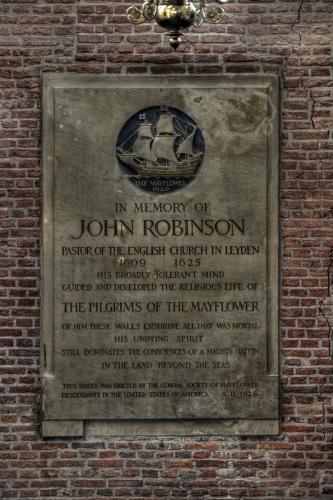
The original settlers of Massachusetts were the Pilgrims who landed at what was to become Plymouth, Massachusetts in 1620. The Pilgrims were Separatists in England who had left the Church of England in the Autumn of 1608 and formed their own church. They were considered dangerous radicals by the Bishops of the Church of England. “They believed that the Reformation had not gone far enough, that the Reformers had assumed an infallibility no more palatable when lodged in a ruler than when lodged in the Pope, that the Church of England had rejected the Pope but not Popery, that the bishops of the Church of England had no more authority than the bishops of the Church of Rome” (Marnell, p. 44).

Under James I, the Bishops were given a free hand to suppress the less than a thousand Separatists before they got out of hand. Peter Marshall and David Manuel, who approved of the persecutions of the dissenters by the Puritan established churches in the colonies, complained that these were “dedicated followers of the Lord” who were:

“hounded, bullied, forced to pay assessments to the Church of England, clapped into prison on trumped-up charges, and driven underground. They met in private homes, to which they came at staggered intervals and by different routes, because they were constantly being spied upon. In the little Midlands town of Scrooby, persecution finally reached the point where the congregation to which William Bradford belonged elected to follow those other Separatists who had already sought religious asylum in Holland” (Peter Marshall and David Manuel, The Light and the Glory, (Old Tappan, New Jersey: Fleming H. Revell Company, 1977), pp. 108-109).

As a result of the persecution in England, some Separatists went elsewhere, going first to Leyden, Holland. After over ten years of a hard life in Holland, they decided to try to go to America. They reached an agreement with an English merchant named Thomas Weston under which they were able to set sail. They could not obtain assurance of liberty of their consciences. “However, they determined at length to remove, depending on some general promises of connivance, if they behaved themselves peaceably, and hoping that the distance and remoteness of the place, as well as the public service they should do the King and Kingdom, would prevent their being disturbed” (Callender, p. 64).  One hundred and one Pilgrim souls sailed from Plymouth, England, on September 6, 1620, arriving at Cape Cod on November 11, 1620, and at a place they named Plymouth, in December, 1620 (Isaac Backus, A History of New England With Particular Reference to the Denomination of Christians called Baptists, Volume 1 (Eugene, Oregon: Wipf & Stock Publishers, Previously published by Backus Historical Society, 1871), pp. 27-28). Upon arrival, they drafted the Mayflower Compact:

“In the name of God, amen. We whose names are under-written, the loyall subjects of our dread Soveraigne Lord King James by ye Grace of God of Great Britain, France, Ireland king, defender of the Faith, etc., having undertaken, for ye glorie of God, and advancemente of ye Christian faith and honour of our king & countrie, a voyage to plant ye first colonie in ye Northerne parts of Virginia, doe by these presents solemnly and mutually in ye presence of God, and one of another, covenant and combine our selves together into a civill body politick, for our better ordering & preservation & furtherance of the ends aforesaid; and by vertue hereof to enacte, constitute, and frame such just and equall lawes, ordinances, acts, constitutions and offices, from time to time, as shall be thought most meete & convenient for the generall good of ye colony, unto which we promise all due submission and obedience. In witness whereof we have hereunder subscribed our names at Cap-Codd, ye 11. of November, in ye year of ye raigne of our soveraigne lord, King James of England, France, & Ireland, ye eighteenth, and by Scotland ye fiftie fourth. Ano: Dom. 1620.”

As a matter of human compassion, the Pilgrims were hospitable to all; and, at first, grudgingly tolerated those of other creeds. However, they gradually began to close their doors to those of other creeds. “Plymouth was a Church-State ruled by a governor and a small and highly select theological aristocracy, a Church-State with various grades of citizenship and non-citizenship” (Marnell, p. 48). By 1651 the government of Plymouth colony was enforcing the laws of Congregationalist Massachusetts. “By the time Plymouth was united with Massachusetts in 1691 all major differences between the two had disappeared” (Pfeffer, p. 66, citing Sanford H. Cobb, The Rise of Religious Liberty in America (New York: The McMillan Co., 1902), pp. 70-71).

The Pilgrims overcame much adversity, such as hunger, drought, and heat which caused their corn to wither, and the failure of delivery of much needed supplies from England (Backus, A History of New England…, Volume 1, pp. 28-29).  They increased to three hundred souls and obtained a patent from the New England Company on January 13, 1630. The comparative handful of Pilgrims who were eventually absorbed by the Puritans are much admired by Americans.

The Puritans, unlike the Pilgrims who wanted to separate from the Church of England, wanted to purify the Church from within. “The State, in their view, had the duty to maintain the true Church; but the State was in every way subordinate to the Church” (Marnell, p. 40).  King James I was far more belligerently opposed to the Calvinistic church-state than even Queen Elizabeth had been, and his “determination toward the Puritans was to make them conform or to harry them out of the land” (Ibid., p. 42).  The Puritans who suffered under the combined pressure of accelerated persecution and the advanced moral decay in their society began to flee England for the new world (Marshall and Manuel, The Light and the Glory, p. 146).  “There was no ground at all left them to hope for any condescension or indulgence to their scruples, but uniformity was pressed with harder measures than ever” (Callender, p. 66).  Cheating, double-dealing, the betrayal of one’s word were all part of the game for London’s financial district. Mercantile power brokers loved, honored, and worshipped money, and accumulated as much of it as possible and as fast as possible.  The ends justified the means. “London was an accurate spiritual barometer for the rest of the country, for England had become a nation without a soul” (Ibid., p. 148). England was morally awful, and this came about under the auspices of a state-church practicing its theology (Ibid., pp. 147-148).  1628 marked the beginning of the Great Migration that lasted sixteen years in which twenty thousand Puritans embarked for New England and forty-five thousand other Englishmen headed for Virginia, the West Indies, and points south (Ibid., p. 148).

A young Puritan minister named John Cotton preached a farewell sermon to the departing Puritans:

  • “He preached on 2 Samuel 7.10 (KJV): ‘Moreover, I will appoint a place for my people Israel, and will plant them, that they may dwell in a place of their own and move no more; neither shall the children of wickedness afflict them any more, as beforetime.’
  • “‘Go forth,’ Cotton exhorted, ‘… With a public spirit,’ with that ‘care of universal helpfulness…. Have a tender care … to your children, that they do not degenerate as the Israelites did….’
  • “Samuel Eliot Morison put it thus: ‘Cotton’s sermon was of a nature to inspire these new children of Israel with the belief that they were the Lord’s chosen people; destined, if they kept the covenant with Him, to people and fructify this new Canaan in the western wilderness’” (Ibid., p. 157).

The Puritans landed at Salem at the end of June, 1629. They were motivated by religious principles and purposes, seeking a home and a refuge from religious persecution (Roger Williams and Edward Bean Underhill, The Bloudy Tenent of Persecution for Cause of Conscience Discussed and Mr. Cotton’s Letter Examined and Answered (London: Printed for the Society, by J. Haddon, Castle Street, Finsbury, 1848), p. v).  Having suffered long for conscience sake, they came for religious freedom, for themselves only. “They believed [in] the doctrine of John Calvin, with some important modifications, in the church-state ruled on theocratic principles, and in full government regulation of economic life” (Marnell, p. 48). The Puritan churches “secretly call[ed] their mother a whore, not daring in America to join with their own mother’s children, though unexcommunicate: no, nor permit[ed] them to worship God after their consciences, and as their mother hath taught them this secretly and silently, they have a mind to do, which publicly they would seem to disclaim, and profess against” (Williams and Underhill, p. 244). In 1630, 1500 more persons arrived, several new settlements were formed, and the seat of government was fixed at Boston. Thinking not of toleration of others,” they were prepared to practice over other consciences the like tyranny to that from which they had fled” (Ibid., p. vii).

Although they differed from the Church of England and others on some doctrines, “[t]he Puritans brought 2 principles with them from their native country, in which they did not differ from others; which are, that natural birth, and the doings of men, can bring children into the Covenant of Grace; and, that it is right to enforce & support their own sentiments about religion with the magistrate’s sword” (Backus, A History of New England, Volume 1, pp. 34-35).

John Cotton was called upon to arrange the civil and ecclesiastical affairs of the colony (Williams and Underhill, p. xii).  They set up a ecclesiocracy in which no one could hold office who was not a member of an approved church (Backus, A History of New England…, Volume 1, p. 35; Williams and Underhill, pp. x-xi). “The civil laws were adjusted to the polity of the church, and while nominally distinct, they supported and assisted each other” (Williams and Underhill, pp. xii-xiii).

“‘It was requested of Mr. Cotton,’ says his descendant Cotton Mather, ‘that he would from the laws wherewith God governed his ancient people, form an abstract of such as were of a moral and lasting equity; which he performed as acceptably as judiciously….  He propounded unto them, an endeavour after a theocracy, as near as might be to that which was the glory of Israel, the peculiar people’”(Ibid., footnote 8, pp. xii-xiii, citing sources).

The goal of the Puritans was to build the Kingdom of God on Earth. Two modern day Covenant Theologians wrote:

  • “They determined to change their society in the only way that could make any lasting difference: by giving it a Christianity that worked. And this they set out to do, not by words but by example, in the one place where it was still possible to live the life to which Christ had called them: three thousand miles beyond the reach of the very Church they were seeking to purify.
  • “[T]he legacy of Puritan New England to this nation, which can still be found at the core of our American way of life, may be summed up in one word: covenant….  [O]n the night of the Last Supper, to those who were closest to Him, Jesus said, “This is my blood of the new covenant, which is poured out for many for forgiveness of sins…” (Marshall and Manuel, The Light and the Glory, p. 146).

Covenant cannot be found, as understood by the Puritan theologians, now or anytime in the past, at the core of our American way of life. The idea of covenant at the core of our American way of life was that of the Baptists as expressed by the Warren Association at the close of the War for Independence:

“The American Revolution is wholly built upon the doctrine, that all men are born with an equal right to what Providence gives them, and that all righteous government is founded in compact or covenant, which is equally binding upon the officers and members of each community…. And as surely as Christianity is true, Christ is the only lawgiver and head of his church…” (Isaac Backus, A History of New England With Particular Reference to the Denomination of Christians called Baptists, Volume 2 (Eugene, Oregon: Wipf & Stock Publishers, Previously published by Backus Historical Society, 1871), pp. 265-266).

Nor is there a biblical principle that allows a nation to covenant with God contrary to the principles laid down in God’s Word. The Puritans incorrectly believed that every nation is in covenant with the Lord to enforce his principles, all of them. They misunderstood the biblical teachings that God gives every nation a choice as to whether to follow His rules, and that nowhere in Scripture is there authority for a nation to initiate a non-biblical covenant with God. God alone initiated the Old Testament covenants to which He was a party, thereby, among other things, establishing Israel as a theocracy, and He made no such covenant with any other nation. All other nations, as is shown in Section I of God Betrayed which is reproduced on this website, are called Gentile, and are judged by God primarily based upon their treatment of Israel.

As has been pointed out, Covenant Theology asserts that there are only two covenants, or three, in the Bible, with the other covenants which came after the Covenant of Grace being only a continuation thereof. The Covenant of Law, according to the covenant theologian, was made in the Garden of Eden. Covenant Theology superimposes the New Testament over the Old. Herein lies some of the fatal flaws in this interpretation of the Bible. In the Puritan formulation of those covenants, the principles and practices of the nation Israel and the Jewish religion were applied to the church and state. As has been shown, this presents irreconcilable conflicts with Old and New Testament teachings concerning law and grace and the relationship of church and state.

God permits a mutual compact or covenant between a ruler or the rulers and the people—a covenant that does not include God and His principles and that is not initiated or ordained by God.  God allowed even the people of the theocracy of Israel to reject Him and, like the Gentile nations, to have a king (See 1 S. 8).  Isaac Backus taught as follows:

“Now the word of God plainly shows, that this way of mutual compact or covenant, is the only righteous foundation for civil government. For when Israel must needs have a king like the rest of the nations, and he indulged them in that request, yet neither Saul nor David, who were anointed by his immediate direction, ever assumed the regal power over the people, but by their free consent. And though the family of David had the clearest claim to hereditary succession that any family on earth ever had, yet, when ten of the twelve tribes revolted from his grandson, because he refused to comply with what they esteemed a reasonable proposal, and he had collected an army to bring them back by force, God warned him not to do it, and he obeyed him therein. Had these plain precedents been regarded in later times, what woes and miseries would they have prevented? But the history of all ages and nations shows, that when men have got the power into their hands, they often use it to gratify their own lusts, and recur to nature, religion or the constitution (as they think it will best serve) to carry, and yet cover, their wretched designs” (Backus, A History of New England…, Volume 1, APPENDIX B, p. 530).

The Puritan ideal is disproved by correct interpretation of the Word of God, by biblical history and prophecy, and secular history, including the history of the colony of Massachusetts. Israel, populated by God’s chosen race, was directly under God, yet the Israelites rejected His theocracy so that they could have a king like all the other nations. Israel fared ill when they did things their way and were ruled by kings. Under both God and king, Israel refused to do things God’s way, and rejected his commandments and statutes. After the death of King Solomon, the nation divided in two. All of the kings of the northern kingdom, Israel, were bad. The southern Kingdom, Judah, had twenty kings—eight were good (Mannessa started out bad, was judged of God, then did good, making him the only bad king in Judah or Israel to repent and turn from his wicked ways. See 2 K. 21.1-18; 2 Chr. 33.1-20.) and twelve were bad.  Both Israel and Judah, in accord with God’s philosophy of history, experienced religious apostasy, moral awfulness, and political anarchy. They failed to keep the commandments and statutes of God and were taken into captivity as a result.

The Puritans failed to correctly interpret both the Old and New Testaments and secular history which clearly show that all nations that have ever existed have been judged by God, are in the process of being judged by God, or will be judged by God. They misinterpreted prophecy concerning the end times to say that the church, working hand in hand with the state will establish the kingdom of heaven on earth. Oh, had and would they (have) realize(d) that the New Covenant for the church had so much better promises and procedures than the Old Testament covenants. “But now hath he [Jesus Christ] obtained a more excellent ministry, by how much also he is the mediator of a better covenant, which was established upon better promises” (He. 8.6; See all of He. 8).

The Puritans wrongly, but truly, believed they could build the Kingdom of God on earth, in their lifetime—all they needed, they felt, was “the right time, the right place, and the right people” who “were willing to commit themselves totally” (Marshall and Manuel, The Light and the Glory,  pp. 145-146).  The Puritans did not realize that the philosophy of history in the Bible and the basic nature of man rendered their goal impossible. God describes the cycle of every civil government, Jewish and Gentile.

  • “The book of Judges is a philosophy of history. ‘Righteousness exalteth a nation; but sin is a reproach to any people’ (Proverbs 14.34)” (J. Vernon McGee, Joshua and Judges (Pasadena, California: Thru the Bible Books, 1980), p. 111).
  • “We see that philosophy in the book of Judges. Israel at first, for a short time, served God.  Then they did evil in the sight of the Lord and served Baal and Ashtaroth. The anger of the Lord was hot against Israel, and He delivered them into the hands of their enemies. Israel then entered into a time of servitude. Israel cried out to God in their plight and distress.  They turned to God and repented. God heard their prayers and raised up judges through whom they were delivered.
  • “This cycle was repeated over and over. The book of Isaiah opens with God giving his philosophy of history.  Isaiah outlines three steps that cause the downfall of a nation: (1) spiritual apostasy, (2) moral awfulness, (3) and political anarchy” (Ibid., pp. 112-113)
  • “Every nation goes down in this order: (1) religious apostasy; (2) moral awfulness; (3) political anarchy. Deterioration begins in the [church], then to the home, and finally to the state.  That is the way a nation falls” (Ibid, pp. 113, 203).
  • “In Judges 17-21, we have presented that philosophy of history [that was mentioned above]. In Judges 17-18, we see spiritual apostasy. In Judges 19, we see moral awfulness.  In Judges 20-21, we see political anarchy. This period ends in total national corruption and confusion. ‘In those days there was no king in Israel; every man did that which was right in his own eyes. (Judges 21.25)’ (Ibid., pp. 203-214).
  • “If you want to know just how up-to-date the book of Judges is, listen to the words of the late General Douglas McArthur: ‘In this day of gathering storms, as moral deterioration of political power spreads its growing infection, it is essential that every spiritual force be mobilized to defend and preserve the religious base upon which this nation is founded; for it has been that base which has been the motivating impulse to our moral and national growth.  History fails to record a single precedent in which nations subject to moral decay have not passed into political and economic decline.  There has been either a spiritual reawakening to overcome the moral lapse, or a progressive deterioration leading to ultimate national disaster’” (Ibid., p. 113).

All nations, prior to the establishment of the kingdom of heaven, are doomed to judgment because of the depravity of man which always seeks the lowest common denominator, the principles of the god of this world. As to the nature of man, the Word of God points out that “all have sinned and come short of the glory of God” (Ro. 3.23. The fact of the depravity of man is shown throughout the Bible.).  Even after salvation, men have a great struggle with the flesh. False teachers from within and without the church immediately began to introduce heresy and apostasy into the first churches. God’s people, led by compromising pastors, have been deceived by many pernicious doctrines. The church, as is shown in Section II of God Betrayed and which is reproduced on this website, will become lukewarm before the rapture and many professing members of the church will be unregenerate.

The Puritans felt that they were dedicated to serving the Lord and to doing things His way. They believed that they could set up a civil government modeled after biblical principles. They did not realize that even should they have been upright in God’s eyes, future leaders would depart from the faith and lead the  church and the civil government downhill into depravity just as happened in Israel and in all church-state marriages starting with the Catholics and up to the established churches after the Reformation, including the Church of England from which they were fleeing.


IV. The application of the Puritan theology results in persecution of dissenters (banishment, jail, confiscation of personal property, unjust taxes, hanging, etc.); the results of the theology of the Puritans which soon came to fruition

Soon after the founding of Massachusetts, events there proved the folly of their false theology and the truth of accurate biblical and historical interpretation. As Isaac Backus reported, by 1660 or 1670 Puritan theologians and pastors in New England were pointing out the “general religious declension” that was already taking place as the first generation of settlers passed away (Backus, A History of New England…, Volume 1, pp. 457-464. Examples of what the religious leaders were saying are given in those pages).  “Mr. Willard published a discourse in the year 1700 entitled, ‘The Perils of the Times Displayed,’ in which he said:

  • “That there is a form of godliness among us is manifest; but the great inquiry is, whether there be not too much of a general denying of the power of it.  Whence else is it, that there be such things as these that follow, to be observed? that there is such a prevalency of so many immoralities among professors? that there is so little success of the gospel? How few thorough conversions [are] to be observed, how scarce and seldom…. It hath been a frequent observation that if one generation begins to decline, the next that follows usually grows worse, and so on, until God pours out his Spirit again upon them.  The decays which we do already languish under are sad; and what tokens are on our children, that it is like to be better hereafter…. How do young professors grow weary of the strict profession of their fathers, and become strong disputants for the [those] things which their progenitors forsook a pleasant land for the avoidance of.
  • “And forty years after, Mr. Prince said, ‘We have been generally growing worse and worse ever since.’  The greatest evils that [the founders of New England] came here to avoid were the mixture of worthy and unworthy communicants in the churches, and the tyranny of secular and ministerial Courts over them; but these evils were now coming in like a flood upon New England” (Ibid., p. 461).

The Halfway Covenant, established by the Massachusetts synod in 1662, was witness to the spiritual decline of the Puritan Congregationalist church. This resulted in a large number of church members being baptized into the church without conversion. Any person who professed belief in the doctrines of Calvinism and who lived an upright, moral life was allowed to join the parish church and sign the covenant or membership contract. Such persons were only allowed halfway into the church—they could have their children baptized but they could not take communion or vote in church affairs. This was the method practiced in the church to which Isaac Backus’ parents belonged (Ibid., pp. 264-268; Lumpkin, pp. 1-2; William G. McLoughlin, Isaac Backus and the American Piestic Tradition (Boston: Little, Brown and Company, 1967), pp. 5-6).

The Puritans, unlike the Separatists, although continuing to acknowledge canonical authority, desired to purify the church from within. Puritans were enlisted by the Massachusetts Bay Company, a trading corporation with powers of ownership and government over a specified area. The leaders of this company devised a plan to effectively remove the colony of Massachusetts from control of the Crown (Mark Douglas McGarvie, One Nation Under Law: America’s Early National Struggles to Separate Church and State (DeKalb, Illinois: Northern Illinois University Press, 2005), p. 46). Their purpose was to become a self-governing commonwealth able to enforce the laws of God and win divine favor—a citadel of God’s chosen people, a spearhead of world Protestantism, a government of Christ (Ibid., pp. 46-47, 48).  They believed this was a common goal which all must seek together, with church and state working side by side (Ibid., p. 132).  They believed that the pure church they intended to establish in New England would someday, somehow, rescue its English parent from the mire of corruption (Ibid., p. 51).

Since the Puritans believed that every nation existed by virtue of a covenant with God in which it promised to obey His commands, as a modern legal scholar has pointed out, “They knew, in the most elementary terms, that they must punish every sin committed in Massachusetts. And punish they did, with the eager cooperation of the whole community, who knew that sin unpunished might expose them all the wrath of God” (Ibid., p. 71) Sins punished included those in the first four commandments, those dealing strictly with man’s relationship to God, as well as other sins, including those dealing with man’s relationship to man. Thus, the churches were thronged every Sunday with willing and unwilling worshipers—everyone was required to attend (Ibid.). Although the church could not enforce the commandments, the state, which was charged with the colony’s commission, had the final and supreme responsibility for suppressing heresy as well as drunkenness and theft and murder (Ibid., p. 82).

In 1629 the trading company in Massachusetts was transformed into a commonwealth (Ibid., pp. 84-100). According to the Puritan theology of these early Massachusetts settlers, after the people joined in covenant with God, agreeing to be bound by his laws, they had to establish a government to see those laws enforced, for they did not have enough virtue to carry out their agreement without the compulsive force of government (Ibid., p. 93).

  • “[They] soon discovered themselves as fond of uniformity, and as loath to allow liberty of conscience to such as differed from themselves, as those from whose power they had fled. Notwithstanding all their sufferings and complaints in England, they seemed incapable of mutual forbearance; perhaps they were afraid of provoking the higher powers at home, if they countenanced other sects; and perhaps those who differed from them took the more freedom, in venting and pressing their peculiar opinions, from the safety and protection they expected, under a charter that had granted liberty of conscience.
  • “In reality, the true grounds of liberty of conscience were not then known, or embraced by any sect or party of Christians; all parties seemed to think that as they only were in the possession of the truth, so they alone had a right to restrain, and crush all other opinions, which they respectively called error and heresy, where they were the most numerous and powerful; and in other places they pleaded a title to liberty and freedom of their consciences. And yet, at the same time, all would disclaim persecution for conscience sake, which has something in it so unjust and absurd, so cruel and impious, that all men are ashamed of the least imputation of it. A pretence of public peace, the preservation of the Church of Christ from infection, and the obstinacy of the heretics, are always made use of, to excuse and justify that, which stripped of all disguises, and called by its true name, the light of nature, and the laws of Christ Jesus condemn and forbid, in the most plain and solemn manner…” (Callender, pp. 69-70).

After arriving in Massachusetts, they quickly formed churches. Mainly under the leadership of the Reverend John Cotton, they arranged ecclesiastical and state matters. “Whatever he delivered in the pulpit was soon put into an order of court, if of a civil, or set up as a practice in the church, if of an ecclesiastical concernment” (Backus, A History of New England…, Volume 1, p. 33).  The established Congregational church differed from other churches in four main points:

  1. “The visible church was to consist of those who made an open profession of faith, and did not ‘scandalize their profession by an unchristian conversation.’
  2. “A particular visible church should preferably explicitly covenant to walk together in their Christian communion, according to the rules of the gospel.
  3. “Any particular church ought not to be larger in number than needed to meet in one place for the enjoyment of all the same numerical ordinances and celebrating of divine worship, nor fewer than may conveniently carry on church work.
  4. “Each particular church was subject to no other jurisdiction (Ibid., pp. 33-34).

“But this people brought two other principles with them from their native country, in which they did not differ from others; which are, that natural birth, and the doings of men, can bring children into to the Covenant of Grace; and, that it is right to enforce and support their own sentiments about religion with the magistrate’s sword(Ibid., pp. 34-35).”  Compulsive uniformity “was planted at a General Court in Boston, May 18, 1631 when it was ordered that no one could be admitted ‘to the freedom of [the] body politic’ who was not a member of a church” (Ibid., p. 35).  “This test in after times had such influence, that he who ‘did not conform, was deprived of more civil privileges than a nonconformist is deprived of by the test in England’” (Ibid., p. 35). Since rulers, however selected, received their authority from God, not from the people, and were accountable to God, not to the people, their business was to enforce the nation’s covenant with God (McGarvie, p. 94). Ministers were not to seek or hold public office, but were counted on to give the people sound advice and to instruct them about the kind of men who were best fitted to rule (Ibid., pp. 95-96).  Although only church members had political rights, this was a larger group than had political rights in England (Ibid., p. 92).

By 1635, the General Court regulated the affairs of the local churches and passed on the qualifications of preachers and elders, since:

“[t]he civil authority … hath the power and liberty to see the peace, ordinances, and rules of Christ observed in every Church, according to His word…. It is the duty of the Christian magistrate to take care that the people be fed with wholesome and sound doctrine” (Pfeffer, p. 66).

The Court continued to put its theology into force by act of law. At the General Assembly held March 3, 1636, it was held (1) that no church would form and meet without informing the magistrates and elders of the majority of the churches of their intentions and gaining their approval and (2) that no one who was a member of a church not approved by the magistrates and the majority of state-churches would be admitted to the freedom of the commonwealth (Backus, A History of New England…, Volume 1, p. 61).

Soon thereafter, the Court passed an act that stated that they were entreated to make “a draught of laws agreeable to the Word of God, which may be the fundamentals of this commonwealth, and to present the same to the next General Court,” and that “in the mean time the magistrates and their associates shall proceed in the courts to hear and determine all causes according to the laws now established, and where there is no law, then as near the laws of God as they can” (Ibid., pp. 62-63). This act immediately led to the persecution by banishment, disfranchisement and the forbidding of speaking certain things, removal from public office, fines, and the confiscation of arms (Ibid., pp. 64-70).  Soon to that act was added that anyone convicted of defaming any court, “or the sentence or proceedings of the same, or any of the magistrates or other judges of any such court, would be punished by ‘fine, imprisonment, or disfranchisement of banishment, as the quality and measure of the offence shall deserve’” (Ibid., pp. 69-70).

The banishment and the voluntary exile of many dissidents “did not put an end to the unhappy divisions and contentions in [] Massachusetts” (Callender, p. 75).  As a result of animosities and contentions between what were called the Legalists and the Familists or Antinomians, a synod was held, eighty erroneous opinions were presented, debated, and condemned; and a court was held which “banished a few of the chief persons, among those who were aspersed with those errors, and censured several that had been the most active, not it seems, for their holding those opinions, but for their pretended seditious carriage and behavior; and the church at Boston likewise excommunicated at least one of her members, not for those opinions, but for denying they ever held them, and the behavior which these heats occasioned”(Ibid., pp. 75-76).

On September 6, 1638, the Assembly at Boston made 2 laws: (1) anyone excommunicated lawfully from a church would, after six months and if not restored, be presented to the Court and there fined, imprisoned, banished or further “as their contempt and obstinacy upon full hearing shall deserve;” and (2) that every inhabitant would be taxed to pay for all common charges as well as for upholding the ordinances of the churches; and, if not so doing, would be compelled thereto by assessment and distress, to be levied by the constable or other officer of the town. The first law was repealed the next fall, but the second remained (Backus, A History of New England…, Volume 1, pp. 79-80).

On March 13, 1639, acts were passed which fined, disenfranchised if no repentance made, and/or committed certain men for certain acts or pronouncements against the established churches (Ibid., pp. 93-94). On November 13, 1644, the General Court passed an act which provided

“that if any person or persons, within this jurisdiction, shall either openly condemn or oppose the baptizing of infants, or go about secretly to seduce others from the approbation or use thereof, or shall purposely depart the congregation at the ministration of the ordinance, or shall deny the ordinance of magistry, or their lawful right and authority to make war, or to punish the outward breaches of the first table, and shall appear to the court willfully and obstinately to continue therein after due time and means of conviction, every such person or persons shall be sentenced to banishment” (Ibid., p. 126).

As to this law, Isaac Backus appropriately commented:

“A like method of treating the Baptists, in Courts, from pulpits and from the press has been handed down by tradition ever since.  And can we believe that men so knowing and virtuous in other respects, as men on that side have been, would have introduced and continued in a way of treating their neighbors, which is so unjust and scandalous, if they could have found better arguments to support that cause upon? I have diligently searched all the books, records and papers I could come at upon all sides, and have found a great number of instances of Baptists suffering for the above points that we own; but not one instance of the conviction of any member of a Baptist church in this country, in any Court, of the errors or evils which are inserted in this law to justify their making of it, and to render our denomination odious. Much has been said to exalt the characters of those good fathers; I have no desire of detracting from any of their virtues; but the better the men were, the  worse must be the principle that could  ensnare them in  such bad actions” (Ibid., p. 127).

In 1644 a law against the Baptists was passed asserting that the Anabaptists “have been the incendiaries of the commonwealths, and the infectors of persons in main matters of religion, and the troublers of churches in all places where they have been” (Ibid., p. 205).

In 1646 the General Court adopted the Act, imposing “banishment on any person denying the immortality of the soul, or the resurrection, or sin in the regenerate, or the need of repentance, or the baptism of infants, or ‘who shall purposely depart the congregation at the administration of that ordinance’ or endeavor to reduce others to any of these heresies.” Also, in 1646 an act against “contemptuous conduct toward’ preachers and nonattendance on divine service were made punishable, the former by ‘standing on a block four feet high’ having on the breast a placard with the words ‘An Open and Obstianate Contemner of God’s Holy Ordinances’” (Pfeffer, pp. 66-67, citing Cobb, pp. 176-177).

The magistrates passed a bill in March, 1646 which required “the calling a synod to settle … ecclesiastical affairs” (Backus, A History of New England…, Volume 1, p. 155), the synod to be convened not by command, but to motion only to the churches (This was agreed because some questioned the power of civil magistrates over the churches.). In August 1648 the synod met and “completed the Cambridge platform; the last article of which sa[id]:

  • “If any church, one or more, shall grow schismatical, rending itself from the communion of other churches, or shall walk incorrigibly or obstinately in any corrupt way of their own, contrary to the rule of the word; in such case the magistrate [Josh. 22,] is to put forth his coercive power, as the matter shall require.”

“This principle the Baptists and others felt the cruel effects of for many years after” (Ibid., p. 159).

The Assembly passed laws against gathering churches without the consent of the assembly, and another “wherein they enacted, ‘that no minister would be called unto office, without the approbation of some of the magistrates, as well as the neighboring churches’” (Ibid., fn. 1, p. 214).

In 1657 laws were passed which imposed fine or whipping on those who entertained a Quaker, required citizens to report Quakers, fined those who allowed Quakers to meet on their property, and fined anyone who brought in a Quaker or notorious heretic(Ibid., fn. 3, pp. 263-264). Although these laws were repealed on June 30, 1660, they were reenacted immediately, “with slight modifications, or to give place to new laws quite as oppressive” (Ibid.). In September, 1658, the Commissioners of the United Colonies recommended that all the New England colonies “make a law, that all Quakers formerly convicted and punished as such, shall (if they return again) be imprisoned, and forthwith banished or expelled out of the said jurisdiction, under pain of death” (Ibid., p. 253). In October 1658, the Assembly at Boston passed a law banishing “Quakers on pain of death” but no other colony passed such a law (Ibid., fn. 1, p. 249; pp. 254-255).

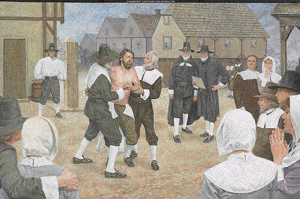
“Many [Quakers] were whipped, some were branded, and Holder, Copeland and Rouse, three single young men, had each his right ear cut off in the prison at Boston….”  Three of them who were banished, on pain of death returned again to Boston, and were condemned to die. Two of them, men, were executed. One, Mary Dyre, was released and sent away. She returned and was hanged on June 1, 1660. William Leddra was hanged on March 14, 1661. Charles II ordered that such persecutions cease, and that Quakers that offended were to be sent to England to be tried. “How justly then did Mr. Williams call the use of force in such affairs, ‘The bloody tenet!’” (Ibid., fn. 1, p. 252; pp. 258, 262-263, 265).

Members of the first Baptist church in Boston were imprisoned. Thomas Gould, Thomas Osborne, William Turner, Edward Drinker and John George were imprisoned for starting that Baptist church without approbation from other ministers and their rulers…. Isaac Backus recorded:

“But when their ministers were moved to exert such force against Baptists, though they saw the chief procurers of that sentence struck dead before the time came for its execution, and many more of them about that time, yet their posterity have approved their sayings even to this day. Robert Mascall of England wrote his Congregationalist brethren in Massachusetts pointing out that they, in England, admitted those who practiced believer’s baptism to their churches as required by the Love of God, that their persecutions of the Baptists were contrary to Scripture, that they themselves had been persecuted, and now their brethren were persecuting so that ‘Whatever you can plead for yourselves against those that persecute you, those whom you persecute may plead for themselves against you,’ and ‘Whatever you can say against these poor men, your enemies say against you;’ that ‘[Y]ou cast a reproach upon us, that are Congregational in England, and furnish our adversaries with weapons against us;” and ‘Persecution is bad in wicked men, but it is most abominable in good men, who have suffered and pleaded for liberty of conscience themselves’” (Ibid., pp. 287, 298, 299, 311-313).

The persecutions of the Baptists in Massachusetts for withdrawing from public meetings continued.

“On May 15, 1672, the Assembly ordered their law-book to be revised and reprinted.” In it, banishment was required for those who broached and maintained any damnable heresies among which were denying justification by faith alone, denial of the fourth commandment, condemnation of or opposition to infant baptism, denial of the power of the magistrate to punish breaches of the first four commandments, and endeavoring to influence others to any of the errors and heresies mentioned in the law (Ibid. pp. 321-322).

After some Baptists organized a church in Boston, and erected a meeting house there, the General Court ordered:

“That no persons whatever, without the consent of the freemen of the town where they live, first orderly had, and obtained, at a public meeting assembled for that end, and license of the County Court, or in defect of such consent, a license by the special order of the General Court, shall erect or make use of any house as above said; and in case any person or persons shall be convicted of transgressing this law, every such house or houses wherein such persons shall so meet more than three times, with the land whereon such house or houses stand, and all private ways leading thereto, shall be forfeited to the use of the county, and disposed of by the County Treasurer, by sale or demolishing, as the Court that gives judgment in the case shall order” (Ibid., pp. 383-384).

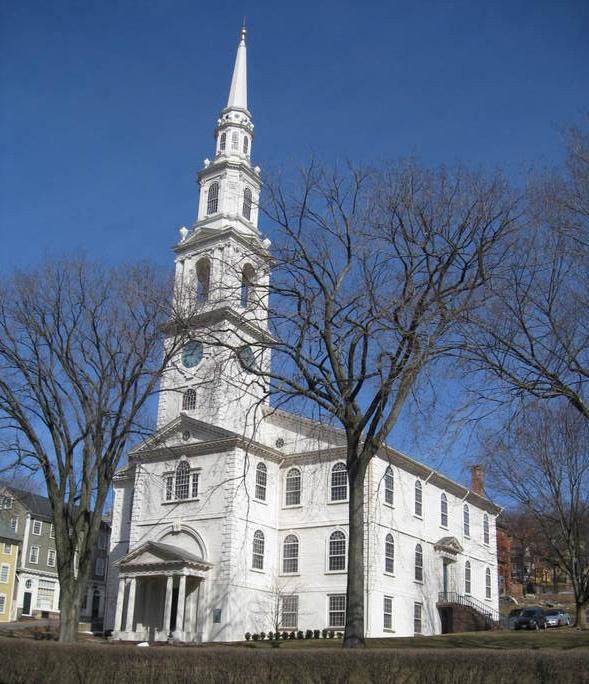
However, a special act was procured to exempt Boston “from any compulsive power for the support of any religious ministers.” As a result, the Baptist church in Boston, which had begun in 1665, was able to build a meeting-house (Backus, A History of New England…, Volume 2, p. 418).  Thus Baptist churches in Boston had equal liberties with other denominations since 1693, but this liberty was denied throughout the rest of Massachusetts (Ibid., p. 424).

As a result of these repressive laws, the king of England sent a letter requiring that liberty of conscience should be allowed to all Protestants, that they be allowed to take part in the government, and not be fined, subjected to forfeiture, or other incapacities, “whereas,” he said, “liberty of conscience was made a [one] principle motive for your first transportation to these parts” (Backus, A History of New England…, Volume 1, p. 384).

Soon a synod was called which condemned Quakers and Anabaptists. The General Court agreed. The magistrates had the doors of the Baptist meeting house boarded up, fined some of their members, forbade the Baptists to meet anywhere else, and fined some who were found to have gone to Baptist meetings. Following this came much controversy between the Baptists and the establishment(Ibid., pp. 384-404).

The established church ignored pleas to leniency toward those with whom it disagreed. For example, they ignored the plea Sir Henry Vane wrote John Winthrop, governor of Massachusetts, in 1645: “The exercise and troubles which God is pleased to lay upon these kingdoms, and the inhabitants in them teaches us patience and forbearance one with another in some measure, though there be difference in our opinions, which makes me hope that, from the experience here, it may also be derived to yourselves…” (Ibid., p. 147).

Because of their strong bias, the Congregationalists wrote much against the dissenters, their method being asserting the disputed point taken by them:

“for truth, without any evidence, they blended that with many known facts recorded in Scripture, and thereupon rank the opposers to that point with the old serpent the devil and Satan, and with his instruments Cain, Pharoah, Herod, and other murderers; yea, with such as sacrifice their children to devils! This history contains abundant evidence of their adding the magistrate’s sword to all these hard words, which were used in their prefaces before they came to any of the Baptists arguments” (Ibid., p. 151. Mr. Backus gives examples of such establishment arguments on pp. 148-150. On pp. 151-153 he thoroughly debunks the argument for infant baptism as well as arguments that the subjects of the new covenant are the same.  For example, Backus points out that “God says his new covenant is not according to that he made with Israel. Heb. viii. 8-11…. By divine institution a whole family and a whole nation were then taken into covenant; now none are added to the church by the Lord but believers who shall be saved. Acts ii.41, 47….”).


V. The atmosphere in Massachusetts begins to shift toward toleration and even freedom of tolerance; the second Massachusetts charter which provided for freedom of conscience to all Christians except Papists was secured in 1691; nonetheless, only in Boston was freedom of conscience honored; establishment remained in Massachusetts until 1733

The atmosphere in Massachusetts, amidst the persecutions and debate of the issues, began to shift toward toleration and even freedom of conscience. Even Governor John Winthrop, who had been a leader of the Puritans from the beginning of the colony, refused on his death bed in 1649 to sign a warrant to banish a Welsh minister, “saying, ‘I have had my hand too much in such things already’” (Ibid., p. 436).  “The second Massachusetts charter, which was dated October 7, 1691, allowed equal liberty of conscience to all Christians, except Papists” (Ibid., p. 445).

Many of the establishment resisted the allowance of liberty of conscience contained in the 1691 charter. The ministers of the established churches construed the liberty of conscience provided for in the 1691 charter to mean “that the General Court might, by laws, encourage and protect that religion which is the general profession of the inhabitants” (Ibid., APPENDIX B, p. 532).  “For thirty-six years after … Massachusetts received [the 1691 charter], they exerted all their power, both in their legislative and executive courts, with every art that ministers could help them to, in attempts to compel every town to receive and support such ministers as they called orthodox.” Thus, despite the new charter, on October 12, 1692, in 1695, 1715, and 1723, the Assembly in Massachusetts enacted new laws requiring that every town provide a minister to be chosen and supported by all the inhabitants of the town, gave the Assembly and General Court power to determine, upon recommendation of three approved ministers, the pastor of a church, and a law requiring the towns of Dartmouth and Tiverton to tax to support ministers.  In 1693, the 1692 law was changed to allow each church to choose its own minister and exempted Boston from the requirement that all citizens be taxed to support that pastor (Ibid., pp. 446-448, 499-505).

Thus, equal religious liberty was enjoyed in Boston, but was denied in the country. Many, including Baptists and Quakers, were taxed to support paedobaptist ministers. Those who did not pay the tax were imprisoned for failing to pay the tax, and some officials were taxed for failing to assess the tax. The cattle, horses, sheep, corn, and household goods of Quakers were from time to time taken from them by violence to support the approved ministers. In 1723, Richard Partridge presented a memorial to King George requesting that inasmuch as the Massachusetts charter allowed equal liberty of conscience to all Christians except Papists, the laws contravening the charter be declared null and void, and the prisoners who refused to pay the tax be released. In 1724, the King ordered that the prisoners be released and the taxes remitted. The Massachusetts assembly passed an act in November 1724 requiring the release of the prisoners held for failing to assess the tax (Ibid., pp. 501-505, n. 1 pp. 501-503).

In 1728, the Assembly passed a law exempting poll tax for ministerial support and forbidding imprisonment of those Baptists and Quakers, who gave their names and regularly attended their church meetings, for failure to pay ministerial taxes assessed on their “estates or faculty.” In November 1729, an act was added that exempted their estates and faculties also, under the same conditions (Ibid., pp. 517-519 and appendix B, pp. 534-535).

The law exempting Baptists was renewed when it expired and persecutions continued. The law exempting taxes to Baptists expired in 1747, but was renewed for ten years. Nonetheless, the establishment found ways to persecute members of Baptist churches in various towns in Massachusetts for not paying the tax—some imprisoned, and property such as cows, geese, swine, oxen, cooking utensils, implements of occupation such as carpenter’s tools and spinning wheel, etc. of some was confiscated (Backus, A History of New England…, Volume 2, pp. 94-98 and fn. 1, p. 97).  The law expired in 1757, but a new one to continue in force thirteen years was made which exempted Baptists and Quakers if certain requirements were met. The law was renewed in 1771, even though Isaac Backus wrote Samuel Adams, never a supporter of separation of church and state, warning that the Baptists “might carry their complaints before those who would be glad to hear that the Legislature of Massachusetts deny to their fellow servants that liberty which they so earnestly insist upon for themselves’” (McLoughlin, The American Pietistic Tradition, p. 128). Isaac Backus said of the oppressions under this law, “[N]o tongue nor pen can fully describe all the evils that were practiced under it” (Backus, A History of New England…, Volume 2, p. 141). Baptists, including single mothers with children, were unjustly taxed in violation of the law, property was unjustly taken from Baptists to pay established ministers, lies were disseminated about Baptists and their beliefs, and courts of law conducted grossly unfair trials and rendered obviously unjust opinions against Baptists (Ibid., pp. 141-166).

In 1786 the legislature passed a law which allowed each town to tax for the support of ministry, schools, and the poor, and other necessary charges arising within the same town.  This tax resulted in collectors’ efforts to get their taxes, which caused much business in courts, and a great increase in lawyers. Some citizens arose in arms but were subdued by force of arms. Before fourteen men who were condemned for their rebellion could be hanged, the Governor and over half the legislature were voted out and the men were all pardoned (Ibid., pp. 330-331).

On February 6, 1788, delegates from Massachusetts who were meeting in Boston voted to adopt the newly drafted and proposed constitution for the states. One of the greatest objections against it had been that no religious test for any government officer was required. During debate, prior to adoption, a Congregational minister, Reverend Philips Payson, of Chelsea, arose and said, “… I infer that God alone is the God of the conscience, and consequently, attempts to erect human tribunals for the consciences of men, are impious encroachments upon the prerogatives of God” (Ibid., p. 336).  Isaac Backus arose also and said:

“Nothing is more evident, both in reason, and in the Holy Scriptures, than that religion is ever a matter between God and individuals; and therefore no man or men can impose any religious test, without invading the essential prerogatives of our Lord Jesus Christ. Ministers first assumed this power under the Christian name; and then Constantine approved of the practice, when he adopted the profession of Christianity as an engine of State policy. And let the history of all nations be searched, from that day to this, and it will appear that the imposing of religious tests hath been the greatest engine of tyranny in the world…. The covenant of circumcision gave the seed of Abraham a right to destroy the inhabitants of Canaan, and to take their houses, vineyards, and all their estates as their own; and also to buy and hold others as servants.  And as Christian privileges are much greater than those of the Hebrews were, many have imagined that they had a right to seize upon the lands of the heathen, and to destroy or enslave them as far as they could extend their power.  And from thence the mystery of iniquity carried many into the practice of making merchandise of slaves and souls of men” (Ibid.).

By 1794, very few if any were collecting taxes to pay ministers (Ibid., p. 379), but establishment remained in Massachusetts until 1833.

The First Amendment to the United States Constitution did not prevent establishment on the state level. Opponents of establishment in Massachusetts never gained a majority. Rather, law, under the contract clause of Article I, Section 10 of the Constitution of the United States of America proved to be the tool used by the legal system to bring about disestablishment in that state. Massachusetts held a constitutional convention in 1820, but declined to eliminate a religious test for officeholders, control of Harvard, and public support for religion. However,

“[i]n 1821, the Massachusetts Supreme Court, in [Baker v. Fales, 16 Mass. 487 (1821) (known as the Dedham case),] a holding consistent with the Supreme Court of the United States in Trustees of Dartmouth College v. Woodward, 17 U.S. (3 Wheat) 1 (1819), ruled that only corporations could hold property, not amorphous societies of believers. Only in response to these court decisions did the citizens support disestablishment, putting all the churches on equal footing in 1833. Contract law succeeded where politics would not, in overcoming support of religion (McGarvie, pp. 17-18).”

It should be noted that even with disestablishment, a church was not forced to incorporate and other methods of possessing (not owning) property on which to assemble as a body of believers were available. In reality as shown in Section II of God Betrayed which is reproduced on this website, a true church is a spiritual, not an earthly, entity. Therefore, a New Testament church cannot own property. Said another way, an entity that owns property cannot be a New Testament church. This concept is developed further in Section VI.
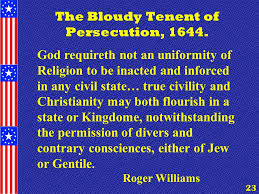
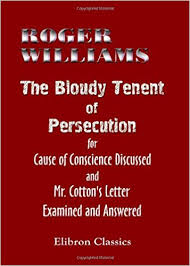
The Baptists in Rhode Island


Jerald Finney
Copyright © December 31, 2012


Click here to go to the entire history of religious liberty in America.


Note. This is a modified version of Section IV, Chapter 6 of God Betrayed: Separation of Church and State/The Biblical Principles and the American Application. Audio Teachings on the History of the First Amendment has links to the audio teaching of Jerald Finney on the history of the First Amendment.


The Baptists in Rhode Island

Contents

I. Introduction
II.
Treatment of Roger Williams by Covenant Theologians
III.
Roger Williams: His arrival in Massachusetts; beliefs and differences with the Puritans; banishment; founding of Rhode Island, the first government in history with complete religious freedom
IV.
Rhode Island: Settlement, hated by Massachusetts, Dr. John Clarke, the Portsmouth and Providence Compacts, the question of the first Baptist church in America, the 1644 and 1663 Rhode Island charters
V.
More on Puritan persecutions including the beating of Obadiah Holmes and Puritan rationale for persecution
VI.
Dr. John Clarke’s beliefs concerning separation of church and state and his successful efforts to secure 1663 Charter of Rhode Island which granted “unprecedented liberties in religious matters”
VII.
Conclusion: The effect of the Rhode Island government thus established


I. Introduction

As pointed out by John Callender in 1838:

“Bishop Sanderson says [] that ‘the Rev. Archbishop Whitgift, and learned Hooker, men of great judgment, and famous in their times, did long since foresee and declare their fear, that if ever Puritanism should prevail among us, it would soon draw in Anabaptism after it.—This Cartwright and the Disciplinarians denied, and were offended at.—But these good men judged right; they considered, only as prudent men, that Anabaptism had its rise from the same principles the Puritans held, and its growth from the same course they took; together with the natural tendency of their principles and practices toward it especially that ONE PRINCIPLE, as it was then by them misunderstood that the scripture was adequate agendorum regula, so as nothing might be lawfully done, without express warrant, either from some command or example therein contained…” (John Callender, The Civil and Religious Affairs of the Colony of Rhode-Island (Providence: Knowles, Vose & Company, 1838), pp. 113-114).

History certainly proves that to have been the case in the English colonies, as shown by the establishment of Rhode Island. Biblical disagreement with Puritan theology was the force behind the creation of the first government in history with religious freedom, the government of the colony of Rhode Island.

“Mr. R[oger] Williams and Mr. J[ohn] Clark[e], two fathers of [Rhode Island], appear among the first who publicly avowed that Jesus Christ is king in his own kingdom, and that no others had authority over his subjects, in the affairs of conscience and eternal salvation” (Ibid., p. 70). “Roger Williams was the first person in modern Christendom to maintain the doctrine of religious liberty and unlimited toleration” (Ibid., Appendix IV, p. 190).  Although America owes its present form of government to Roger Williams, along with Dr. John Clarke, as much or more than to any men, Mr. Williams is vilified and Dr. Clarke is generally ignored by Peter Marshall and David Manuel, who assert, against the facts, that the “Puritans were the people who, more than any other, made possible America’s foundation as a Christian nation” (Peter Marshall and David Manuel, The Light and the Glory, (Old Tappan, New Jersey: Fleming H. Revell Company, 1977), p. 146).


II. Treatment of Roger Williams by Covenant Theologians

Because Roger Williams disagreed with those in the established church in Massachusetts, Marshall and Manuel condemn him as a hopeless heretic. For example, Marshall and Manuel, in condemning and lying about Williams, reveal that the Christian nationalist or revisionist condemns, in a way that praises their own views, anyone who disagrees with their contorted interpretation of Scripture and justifies the intervention of the civil government, at the behest of the established church, into spiritual matters. Marshall and Manuel sharply criticize Williams for his views and for refusing to change his views because those views were contrary to those of the established church in Massachusetts:

  • “Williams insistence upon absolute purity in the church, beyond all normal extremes, grew out of his own personal obsession with having to be right—in doctrine, in conduct, in church associations—in short, in every area of life. This need to be right colored everything he did or thought; indeed, it drove him into one untenable position after another. For the alternative—facing up to one’s self-righteousness and repenting of it on a continuing basis—was more than he could bring himself to accept.
  • “For Williams, then, Christianity became so super-spiritualized that it was removed from all contact with the sinful realities of daily living. In his view, the saints of New England belonged to a spiritual Israel, in the same way as did all Christians everywhere. But there should be no talk of any attempt on God’s part to build His Kingdom on earth through imperfect human beings. For Winthrop and the others to even suggest that God might be creating a new Israel in this Promised Land of America was to ‘… pull God and Christ and Spirit out of Heaven, and subject them unto natural, sinful, inconstant men…’ (Ibid., p. 193).”

Never do they glorify Roger Williams, as they glorified the Puritans for disagreeing with the established Church in England. Never do they condemn the Puritans for persecuting dissenters as they condemn the Church of England for persecuting the Puritans and Pilgrims.

Their account of Williams not only is given from their incorrect theological point of view which believes that the church, working with the civil government, is going to bring in the millennium before the return of Christ but also is a downright distortion of facts. Williams did not super-spiritualize Christianity. He just pointed out that the church operates under different rules than did Judaism. He did not remove Christianity from all contact with the sinful realities of daily living. He just correctly argued that the church and a Gentile nation is directed by the Word of God to deal with those realities in a manner differing from that of Judaism and the nation Israel in the theocracy. He did believe that Christians everywhere belonged to a “spiritual Israel” called the church. He did not believe that there should be no talk of any attempt on God’s part to build His kingdom on earth through imperfect human beings. Rather, he believed that man should have freedom of conscience in all things spiritual, a concept diametrically opposed to the theology of the established church of Massachusetts. He believed that the state should punish those who violate penal laws which should deal only with man’s relationship with his fellow man. He also believed, contrary to Puritan theology, that the church should not merge with the state for any reason, and that the church should not use the arm of the state to enforce the first four of the Ten Commandments which deal with man’s relationship to God and that the state was to punish only matters involving man’s relationship to man.

Marshall and Manuel continue their distortions and inaccuracies. They define liberty of conscience as meaning, “Nobody is going to tell me what I should do or believe” (Ibid.). As to the issue of “liberty of conscience” they state:

“Liberty of conscience is indeed a vital part of Christianity—as long as it is in balance with all the other parts. But taken out of balance and pursued to its extremes (which is where Williams, ever the purist, invariably pursued everything), it becomes a license to disregard all authority with which we do not happen to agree at the time.  This was the boat which Williams was rowing when he landed at Boston. Since, at its extreme, liberty of conscience stressed freedom from any commitment to corporate unity, Williams was not about to hear God through Winthrop or anyone else. (And tragically, he never did.)” (Ibid., p. 194).

Williams did not believe that liberty of conscience becomes a license to disregard all authority with which we do not happen to agree. Rather he believed, contrary to the beliefs of John Winthrop and the other leaders of the establishment in Massachusetts, that the church and state were separate—that is, that God ordained both church and state, each with its sphere of authority, the church over spiritual matters and the state over earthly matters, and both with totally different God-given guidelines.

Williams believed that both church and state were to be under God. He wrote and taught this extensively. Here is one example:

“I acknowledge [the civil magistrate] ought to cherish, as a foster-father, the Lord Jesus, in his truth, in his saints, to cleave unto them himself, and to countenance them even to the death, yea, also, to break the teeth of the lions, who offer civil violence and injury to them.
“But to see all his subjects Christians, to keep such church or Christians in the purity of worship, and see them do their duty, this belongs to the head of the body, Christ Jesus, and [to] such spiritual officers as he hath to this purpose deputed, whose right it is, according to the true pattern. Abimelech, Saul, Adonijah, Athalia, were but usurpers: David, Solomon, Joash, &c., they were the true heirs and types of Christ Jesus, in his true power and authority in his kingdom” (Roger Williams and Edward Bean Underhill, The Bloudy Tenent of Persecution for Cause of Conscience Discussed and Mr. Cotton’s Letter Examined and Answered (London: Printed for the Society, by J. Haddon, Castle Street, Finsbury, 1848), pp. 100-101. In this book, The Bloudy Tenent …, Williams addresses the arguments presented by Covenant Theology.).

Marshall and Manuel attribute the qualities of the leaders of the established church in Massachusetts to Roger Williams instead. They assert that he “desperately needed to come into reality and see his sin—how arrogant and judgmental and self-righteous he was” (Marshall and Manuel, The Light and the Glory, p.194).  They assert that he could have been “a great general in Christ’s army” since “he was tremendously gifted: in intellect, preaching, personality, and leadership ability” (Ibid., pp. 194-195). But he had one tragic flaw: he believed in freedom of conscience and held other views contrary to that of the established church and could not be persuaded otherwise, or, as Marshall and Manuel put it:

“[H]e would not see his wrongness, and he was so bound up in his intellect that no one could get close to the man, because he was forever hammering home points on ‘the truth.’ Trying to relate to him on a personal level was like trying to relate to cold steel—highly polished and refined” (Ibid., p. 195).

As to the Puritans on the other hand, Marshall and Manuel have nothing but praise. Every page of The Light and the Glory dealing with the Puritans and their leaders are filled with praise and notations as to how the providence of God was opening the door for the right people, at the right time, in the right place to correct all the errors of Christendom. For example, they write:

  • “Since God’s will was made known to them [the Puritans] through His inspired Word in the Bible, they naturally wanted to get as close to a Scriptural order of worship as possible. Indeed, what they ultimately wanted was to bring the Church back to something approximating New Testament Christianity.
  • “The Puritan dilemma was similar to that of many newly regenerate Christians of our time. They faced a difficult choice: should they leave their seemingly lifeless churches to join or start a live one, or should they stay where they were, to be used as that one small candle to which William Bradford referred?
  • “God was bringing the Puritans into compassion and humility.
  • “As historian Perry Miller would say, ‘Winthrop and his colleagues believed … that their errand was not a mere scouting expedition: it was an essential maneuver in the drama of Christendom. The [Massachusetts] Bay Company was not a battered remnant of suffering Separatists thrown up on a rocky shore; it was an organized task force of Christians, executing a flank attack on the corruptions of Christendom. These Puritans did not flee to America; they went in order to work out that complete reformation which was not yet accomplished in England and Europe’” (Ibid., pp. 150, 151, 152, 159).

The Puritans grew into such compassion and humility that they were able to horribly persecute Christians and others who did not agree with their unbiblical doctrines which the Puritans proudly believed to be inerrant.

Williams, in his relationship to the religious leaders of Massachusetts, was a lot like the Lord Jesus and the apostles in their relationship to the religious Jews. The religious leaders of Massachusetts made a mistake—they did not call upon the civil government (which was at their disposal) to kill Williams as they did with some other dissenters. Had they done so, we might not have our present form of civil government. They only banished him, a tragic error of highest proportions from their point of view.

As to the issue of persecution by the established church, Marshall and Manuel are hypocrites. They condemn the persecution of the Separatists (later called Pilgrims) and the Puritans in England, but then glorify the Puritans when they were persecuted and when they became the persecutors and persecuted those dissenters such as the Baptists and Quakers who did not conform to their theology in the New World. They complain that the Separatists:

  • “were hounded, bullied, forced to pay assessments to the Church of England, clapped into prison on trumped-up charges, and driven underground. They met in private homes, to which they came at staggered intervals and by different routes, because they were constantly being spied upon. In the little Midlands town of Scrooby, persecution finally reached the point where the congregation to which Bradford belonged elected to follow those other Separatists who had already sought religious asylum in Holland”(Ibid., pp. 108-109).
  • As to the Puritans … they write, “[The Puritans accepted the pressure of the mounting persecution] with grace and, as persecution often does, it served to rapidly deepen and mature the movement, bonding them together in common cause and making them more determined than ever to live as God had called them…. For a number of Puritans, [the marking of the Puritans for suppression by Charles I] was a watershed. It appeared no longer possible to reform the Church of England from within” (Ibid., p. 152).

Marshall and Manuel condemn the Church of England for persecuting Puritans and Pilgrims, but glorify the Puritans for persecuting Baptists.

Under the theology of Marshall and Manuel, and those of like mind, the government of Rhode Island—the first civil government in history which guaranteed religious liberty and freedom of conscience and which provided much more a model for the First Amendment to the Constitution of the United States of America than did the government of the Puritans or that of any other established church—would not have existed nor would the United States exist in its present form. America would have no First Amendment to the United States Constitution, the amendment which was written to guarantee freedom of conscience. Men would still be forced to accept infant baptism, pay taxes to support the established church, attend the established church, proclaim allegiance to the established church, etc. Dissenters would still be persecuted. The church would still be working with the state to “bring in the kingdom,” something that the Word of God teaches is never going to happen.


III. Roger Williams: His arrival in Massachusetts; beliefs and differences with the Puritans; banishment; founding of Rhode Island, the first government in history with complete religious freedom

Roger Williams, like the Puritans, fled tyranny over thought and conscience and sought refuge for conscience amid the wilds of America. He arrived in Boston on February 5, 1631. He was highly educated and well acquainted with the classics and original languages of the Scriptures, and had been in charge of a parish in England. Immediately upon arrival, Mr. Williams, not being a man who could hide his views and principles, declared that “the magistrate might not punish a breach of the Sabbath, nor any other offence, as it was a breach of the first table” (Isaac Backus, A History of New England With Particular Reference to the Denomination of Christians called Baptists, Volume 1 (Eugene, Oregon: Wipf & Stock Publishers, Previously published by Backus Historical Society, 1871), p. 41; Williams and Underhill, p. ix, noting in fn. 1 that “Such is Governor Winthrop’s testimony. Knowles, p. 46.”).  He also, contrary to the practice of the church at Boston, hesitated to hold communion with any church who held communion with the Church of England. “He could not regard the cruelties and severities, and oppression, exercised by the Church of England, with any feelings but those of indignation” (Williams and Underhill, p. x).

Mr. Williams remained at odds with the established church and government ministers in Massachusetts. He was accepted by the church at Salem, but that was blocked by the General Court of the Colony. Plymouth warmly received him into the ministry where he labored two years. Exercising their right under congregational governance, the church at Salem called him, over the objections of the magistrates and ministers, to be their settled teacher. At Salem he filled the place with principles of rigid separation tending to Anabaptism (Backus, A History of New England, Volume 1, p. 44).  In spite of the fact that “Mr. Williams appears, by the whole course and tenor of his life and conduct [], to have been one of the most disinterested men that ever lived, a most pious and heavenly minded soul” (Callender, p. 72), the Court soon summoned him “for teaching publicly ‘against the king’s patent, and our great sin in claiming right thereby to this country’” by taking the land of the natives without payment (Backus, A History of New England, Volume 1, pp. 44-46. Williams and Underhill, p. xiii). The colonies held their land under the royal patent. Under the royal right of patent, Christian kings (so called) were given the right to take and give away the lands and countries of other men (Thomas Armitage, The History of the Baptists, Volumes 2 (Springfield, Mo.: Baptist Bible College, 1977 Reprint),pp. 638-639)); “and for terming the churches of England antichristian” (Williams and Underhill, pp. xiii-xiv).  Charges were brought. “He was accused of maintaining:

“(1) That the magistrate ought not to punish the breach of the first table of the law, otherwise in such cases as did disturb the civil peace.
“(2) That he ought not to tender an oath to an unregenerate man.
“(3) That a man ought not to pray with the unregenerate, though wife or child.
“(4) That a man ought not to give thanks after the sacrament nor after meat” (Ibid, p. xiv; Callender, p. 72; Backus, A History of New England…, Volume I, p. 53 (Backus adds item 2, as, according to footnote 1, p. 53, his is from Governor Winthrop’s Journal, Vol. 1, pp. [162, 163])).

The ministers of the Court, when Mr. Williams appeared before them, “had already decided ‘that any one was worthy of banishment who should obstinately assert, that the civil magistrate might not intermeddle even to stop a church from apostasy and heresy’” (Williams and Underhill, pp. xv, 387-389). The “grand difficulty they had with Mr. Williams was, his denying the civil magistrate’s right to govern in ecclesiastical affairs” (Backus, A History of New England…, Volume 1, p. 53; Armitage, The History of the Baptists, Volume 2, pp. 627-640).

He was banished from the colony and ordered to board ship for England. Instead, he went, in the dead of winter, to what was to become Rhode Island where he was supported by the Indians whom he, throughout his long life, unceasingly tried to benefit and befriend (Williams and Underhill., p. xxiii).  He bought land from the Indians and founded the town of Providence where persecution has never “sullied its annals” (Ibid.).  “[T]he harsh treatment and cruel exile of Mr. Williams seem designed by his brethren for the same evil end [as that of the brethren of Joseph when they sold him into slavery], but was, by the goodness of the same overruling hand [of divine providence] turned to the most beneficent purposes” (Backus, A History of New England…, Volume 1, p. 59).

“[W]hat human heart can be unaffected with the thought that a people who had been sorely persecuted in their own country, so as to flee three thousand miles into a wilderness for religious liberty, yet should have that imposing temper cleaving so fast to them, as not to be willing to let a godly minister, who testified against it, stay even in any neighboring part of this wilderness, but it moved them to attempt to take him by force, to send him back into the land of their persecutors” (Ibid., p. 56)!

Thirty-five years later Mr. Williams wrote, “Here, all over this colony, a great number of weak and distressed souls, scattered, are flying hither from Old and New England, the Most High and Only Wise hath, in his infinite wisdom, provided this country and this corner as a shelter for the poor and persecuted, according to their several persuasions” (Williams and Underhill, p. xxv, citing in fn. 5: Letter to Mason. Knowles, p. 398).  By 1838 in Rhode Island there were no less than thirty-two distinct societies or worshipping assemblies of Christians of varying denominations, including eight of the Quaker persuasion, eight Baptist churches, four Episcopal, and three Presbyterian or Congregationalist (Callender, pp. 121-122).

Roger Williams has been praised for his contributions in the quest for religious freedom. For example:

  • Isaac Backus wrote that Rhode Island “was laid upon such principles as no other civil government had ever been, as we know of, since antichrist’s first appearance; “and ROGER WILLIAMS justly claims the honor of having been the first legislator in the world, in its latter ages, that fully and effectually provided for and established a free, full and absolute LIBERTY OF CONSCIENCE” (Backus, A History of New England…, Volume 1, pp. 75-76).
  • “We cannot forbear to add the oft-quoted tribute paid to Roger Williams by the historian Bancroft:—‘He was the first person in modern Christendom to assert in its plentitude the doctrine of liberty of conscience, the equality of opinions before the law; and in its defence he was the harbinger of Milton, the precursor and the superior of Jeremy Taylor. For Taylor limited his toleration to a few Christian sects; the philanthropy of Williams compassed the earth. Taylor favored partial reform, commended lenity, argued for forbearance, and entered a special plea in behalf of each tolerable sect; Williams would permit persecution of no opinion, of no religion, leaving heresy unharmed by law, and orthodoxy unprotected by the terrors of penal statutes…. If Copernicus is held in perpetual reverence, because, on his deathbed, he published to the world that the sun is the centre of our system; if the name of Kepler is preserved in the annals of human excellence for his sagacity in detecting the laws of the planetary motion; if the genius of Newton has been almost adored for dissecting a ray of light, and weighing heavenly bodies in a balance,—let there be for the name of Roger Williams, at least some humble place among those who have advanced moral science and made themselves the benefactors of mankind’” (Ibid., p. 76, fn. 1; Armitage, The History of the Baptists, Volume 2, p. 644).

IV. Rhode Island: Settlement, hated by Massachusetts, Dr. John Clarke, the Portsmouth and Providence Compacts, the question of the first Baptist church in America, the 1644 and 1663 Rhode Island charters

Rhode Island was settled in 1638 by others who were driven from Massachusetts by the ruling clerical power. Massachusetts had such great hate for Rhode Island that it passed a law prohibiting the inhabitants of Providence from coming within its bounds.

Another leader instrumental in the formation of the government of the Rhode Island colony was Dr. John Clarke, a physician. Dr. John Clarke of England moved to Boston in November of 1637. He proposed to some friends “for peace sake, and to enjoy the freedom of their consciences, to remove out of that jurisdiction” (Ibid., p. 71. See also, John Clarke, Ill News from New-England or A Narative of New-Englands Persecution (Paris, Ark.: The Baptist Standard Bearer, Inc., Reprint: 1st printed in 1652), pp. 22-25).  Their motion was granted & Dr. Clarke and eighteen families went to New Hampshire which proved too cold for their liking. They left and stopped in Rhode Island, intending to go to Long Island or Delaware Bay. There Dr. Clarke met Roger Williams. The two “immediately became fast friends and associates, working together in a most harmonious manner, both socially and politically, throughout the remainder of Clarke’s life” (Louis Franklin Asher, John Clarke (1609-1676): Pioneer in American Medicine, Democratic Ideals, and Champion of Religious Liberty (Paris, Arkansas: The Baptist Standard Bearer, Inc.), p. 27; Clarke).  With the help of Mr. Williams they settled in that colony at Aquidneck. “The first settlement on the Island was called Pocasset; after the founding of Newport, it was renamed Portsmouth” (Asher, p. 29; Clarke).

Perhaps Marshall and Manuel had good reason, from their point of view, for making not a single mention of Dr. Clarke in The Light and the Glory. Isaac Backus found it to be very extraordinary that he could find from any author or record no reflection cast upon Dr. Clarke by any one (Backus, A History of New England…, Volume 1, p. 349).  Dr. Clarke left as spotless a character as any man [Isaac Backus] knew of, that ever acted in any public station in this country (Ibid., p. 348).  “The Massachusetts writers have been so watchful and careful, to publish whatever they could find, which might seem to countenance the severities, they used towards dissenters from their way, that [Mr. Backus] expected to find something of that nature against Mr. Clarke”(Ibid., p. 349)

The first government in history that was to have complete freedom of conscience and religious liberty also declared that the government was to be under the Lord Jesus Christ. Signed on March 7, 1638, the Portsmouth Compact read:

  • “We whose names are underwritten do swear solemnly, in the presence of Jehovah, to incorporate ourselves into a body politic, and as he shall help us, will submit our persons, lives and estates, unto our Lord Jesus Christ, the King of kings, and Lord of lords, and to all those most perfect and absolute laws of his, given us in his holy word of truth, to be guided and judged thereby” (Ibid., pp. 77, 427.  On p. 427 is the exact copy from Rhode Island records.  In the margin are citations to Exodus 34.3, 4; II Chronicles 11.3, and II Kings 11, 17). [19 signatures followed: Thomas Savage, William Dyre, William Freeborne, Philip Sherman, John Walker, Richard Carder, William Baulstone, Edward Hutchinson, Sen., Henry Bull, Randal Holden, William Coddington, John Clarke, William Hutchinson, John Coggshall, William Aspinwall, Samuel Wilbore, John Porter, Edward Hutchinson, Jun., and John Sanford.].
    Three passages were marked in support of the compact: Exodus 24.3, 4; II Chronicles 11.3; and II Kings 11.17.

The chief architect of this concise and powerful piece of political history was either William Aspinwall or Dr. John Clarke, probably Dr. Clarke (Asher, p. 23; James R. Beller, America in Crimson Red (Arnold, Missouri: Prairie Fire Press, 2004), p. 24. Mr. Beller states that the author was John Clarke. Mr. Asher asserts that Clarke was probably the writer since the passages referenced in support of the agreement were marked in Dr. Clarke’s Bible).  This compact placed Rhode Island under the one true God, the Lord Jesus Christ and His principles and laws given in the Bible. That Dr. Clarke “sought to help establish a government free of all religious restriction, one which in no way infringed upon the freedom of any religious conscience” is “evident from his remarks to the leaders of the established colonies upon his first arrival in Boston and by his subsequent activities throughout New England” (Asher, p. 27). A civil government under Jesus Christ with freedom of religion is consistent with biblical principles.

Isaac Backus commented on this compact:

This was doubtless in their view a better plan than any of the others had laid, as they were to be governed by the perfect laws of Christ. But the question is, how a civil polity could be so governed, when he never erected any such state under the gospel” (Backus, A History of New England…, Volume 1, p. 78)?

Mr. Backus asked a good question. Too bad our founding fathers did not find and apply the answer.

On the same day the Portsmouth Compact was signed, “[n]ineteen men incorporated into a body politic, and chose Mr. Coddington to be their judge or chief magistrate” (Ibid., p. 72; Asher, p. 27).  The first General Meeting of the Portsmouth government convened on May 13, 1638. “The apportionment of land, a mutual defense of territory, and provision for a ‘Meeting House’ were ordered” (Asher, p. 29).

Soon, a civil government was formed which invested power in the freemen, none of whom were to be “accounted delinquents for doctrine,” “provided it be not directly repugnant to or laws established” (Williams and Underhill, pp. xxvii-xxviii).  In August of 1638, the people of Providence approved the first public document establishing government without interference in religious matters, the Providence Compact:

“We whose names are here underwritten being desirous to inhabit in the town of Providence, do promise to submit ourselves in active or passive obedience to all such orders or agreement as shall be made for public good to the body in an orderly way, by the major consent of the present inhabitants, masters of families, incorporated together into a township, and such others whom they shall admit into the same, only in civil things” (Backus, A History of New England…, Volume 1, p. 74; cited in Beller, America in Crimson Red, p. 13; Armitage, A History of the Baptists,  Volume 2, p. 643). [Signed by Stukely Westcoat, William Arnold, Thomas James, Robert Cole, John Greene, John Throckmorton, William Harris, William Carpenter, Thomas Olney, Francis Weston, Richard Watearman, and Ezekiel Holliman.]

As James R. Beller proclaims, the document was “the first of a series of American political documents promulgating government by the consent of the governed and liberty of conscience” (Beller, America in Crimson Red, p. 13).  Thus, liberty of conscience was the basis for legislation in Rhode Island, and its annals have remained to this day [when Underhill wrote this] unsullied by the blot of persecution (Williams and Underhill, p. xxviii).

Rhode Island was ruled according to the original covenant, “til on January 2, 1639, an assembly of the freemen said:

“By the consent of the body it is agreed that such who shall be chosen to the place of Eldership, they are to assist the Judge in the execution of the justice and judgment, for the regulating and ordering of all offences and offenders, and for the drawing up and determining of all such rules and laws as shall be according to God, which may conduce to the good and welfare of the commonweal; and to them is committed by the body the whole care and charge of all the affairs thereof; and that the Judge together with the Elders, shall rule and govern according to the general rules [rule] of the word of God, when they have no particular rule from God’s word, by the body prescribed as a direction unto them in the case. And further, it is agreed and consented unto, that the Judge and [with the] Elders shall be accountable unto the body once every quarter of the year, (when as the body shall be assembled) of all such cases, actions or [and] rules which have passed through their hands, by they to be scanned and weighed by the word of Christ; and if by the body or any of them, the Lord shall be pleased to dispense light to the contrary of what by the Judge or [and] Elders hath been determined formerly, that then and there  it shall be repealed as the act of the body; and if it be otherwise, that then it shall stand, (till further light concerning it) for the present, to be according to God, and the tender care of indulging [indulgent] fathers” (Backus, A History of New England…, Volume 1, pp. 427-428).

In March 1639 Mr. Williams became a Baptist, together with several more of his companions in exile (Williams and Underhill, p. xxvi; Isaac Backus, A History of New England…, Volume 1, pp. 86-89).  Mr. Williams, who was baptized by one Holliman, in turn baptized ten others. Thus, according to some accounts,was founded the first Baptist church in America.

“Others suspect “that Mr. Williams did not form a Church of the Anabaptists, and that he never joined with the Baptist Church there. Only, that he allowed them to be nearest the scripture rule, and true primitive practice, as to the mode and subject of baptism.  [Some who] were acquainted with the original settlers never heard that Mr. Williams formed the Baptist Church there, but always understood that [certain others] were the first founders of that church….  [Some asserted that this church hereupon crumbled to pieces.] But [John Callender] believe[d] this to be a mistake, in fact, for it certainly appears, there was a flourishing church of the Baptists there, a few years after the time of the supposed breaking to pieces; and it is known by the names of the members, as well as by tradition, they were some of the first settlers at Providence[.]” (Callender, p. 110-111). Since writing God Betrayed, the author has done more study on the matter of the First Baptist church in America was founded by Roger Williams (See Did Roger Williams Start The First Baptist Church In America? Is the “Baptist Church the Bride of Christ? What About Landmarkism or the Baptist Church Succession Theory By Jim Fellure and Baptist History IN AMERICA Vindicated: The First Baptist Church in America/A Resurfaced Issue of Controversy/The Facts and Importance By Pastor Joshua S. Davenport for more on these matters.).

Mr. Williams stepped down as pastor of the church after only a few months because his baptism was not administered by an apostle, but the church continued (Williams and Underhill, p. xxvii; Isaac Backus, A History of New England…, Volume 1, p. 89). Isaac Backus commented on the requirement of apostolic succession for baptism at length, stating, “And if we review the text (II Tim. ii. 2-Ed.) that is now so much harped upon, we shall find that the apostolic succession is in the line of ‘faithful men;’ and no others are truly in it, though false brethren have sometimes crept in unawares” (Backus, A History of New England…, Volume 1, p. 91).

Mr. Williams “turned seeker, i.e. to wait for the new apostles to restore Christianity.  He believed the Christian religion to have been so corrupted and disfigured in what he called the ‘apostasy, as that there was no ministry of an ordinary vocation left in the church, but prophecy,’ and that there was need of a special commission, to restore the modes of positive worship, according to the original institution. It does not appear to [Mr. Callender], that he had any doubt of the true mode, and proper subjects of baptism, but that no man had any authority to revive the practice of the sacred ordinances, without a new and immediate commission” (Callender, pp. 110-111).

Mr. Williams set sail for England in June 1643, to attempt to secure a charter for Rhode Island. With help from his friend, Sir Henry Vane, he quickly obtained a charter, dated March 14, 1644 which empowered the Providence Plantations “to rule themselves, and such as should inhabit within their bounds, by such a form of civil government as by the voluntary agreement of all, or the greater part, shall be found most serviceable, in their estate and condition; and to make suitable laws, agreeable to the laws of England, so far as the nature and constitution of the place shall admit, &c” (Ibid., p. 98).

The knowledge which was being disseminated through the power of the press was affecting the religious leaders as well as the general population in America. People were now able to read the Bible and other works and thereby make decisions as to the accuracy of what others were asserting. “Many books [were] coming out of England in the year 1645, some in defence of anabaptism and other errors, and for liberty of conscience, as a shelter for a general toleration of all opinions, &c…” (Backus, A History of New England…, Volume 1, p. 145, quoting Hubbard, [413-415.]).  Mr. Williams wrote The Bloudy Tenent of Persecution for Cause of Conscience which was published in London in 1644. “In this work he maintains the absolute right of every man, to a ‘full liberty in religious concernments,’ supported by the most luminous and powerful reasoning … [w]hich have excited admiration in the writings of Jeremy Taylor, Milton, Locke and Furneau” (Callender, Appendix IV, p. 191).  John Cotton’s reply, The Bloody Tenent washed, and made white in the Blood of the Lamb, was printed in London in 1649. Mr. Williams reply entitled The Bloody Tenent yet more Bloody, was published in 1652 (For an excellent summary of some of the more important arguments presented by both sides see Backus, A History of New England…, Volume 1, pp. 134-145).  “The same clear, enlarged and consistent views of religious freedom are maintained in this last work, as in his preceding, with additional arguments, evincing an acute, vigorous, and fearless mind, imbued with various erudition and undissembled piety” (Callender, pp. 191-192).

“To the point we have arrived, the history of Roger Williams and the state he founded were indissolubly allied together. Others imbued with his principles henceforth took part in working out the great and then unsolved problem—how liberty, civil and religious, could exist in harmony with dutiful obedience to rightful laws” (Williams and Underhill, p. xxx).

The first Baptist church in Newport was formed under the ministry of Dr. John Clarke. According to some who suppose that the church was founded by Clarke and his company upon their arrival in Rhode Island, it could have been established as early as 1638 (Backus, A History of New England…, Volume 1, pp. 125-26 and fn. 1, p. 125; see also, Beller, America in Crimson Red, pp. 31-33 (Mr. Beller argues that the Baptist church in Newport, meeting in the wilderness in 1637 with Dr. John Clarke as pastor, was the first Baptist church to meet in America.  Mr. Beller considers the writings of Isaac Backus, John Callender, and John Winthrop on this subject.)).


V. More on Puritan persecutions including the beating of Obadiah Holmes and Puritan rationale for persecution

Under the leadership of Dr. Clarke, Rhode Island became a government of religious liberty. Dr. Clarke added law and politics to his already crowded professions of medicine and religious ministry when he was elected General Treasurer and General Assistant for Newport in 1650. “As a servant of the people, Dr. Clarke would steer the colony toward a government of unprecedented civil and religious liberty—convinced that any other move would be in the direction of a self-centered autocratic theocracy” (Asher, p. 35).  Under his leadership, the people followed him as he steered a course between democracy with its “attending threat of anarchy and all of its evils of disorder, violence, and ultimate chaos,” and aristocracy and its restrictions on all forms of liberty (Ibid., pp. 35-36).

When Dr. Clarke and two friends went to Massachusetts they were persecuted. In 1651, he, Obadiah Holmes, and John Crandal went to visit a friend in Boston. (Obadiah Holmes moved from England to Massachusetts. He and several others decided the Baptist way was right and were baptized. He and others were excommunicated in 1650. They moved to Rhode Island where Mr. Holmes became a member of the church pastored by Dr. John Clarke.) They were on “an errand of mercy and had traveled all the way from their church in Newport to visit one of their aging and blind members, William Witter” (Asher, p. 57; See Clarke, pp. 27-65 for a full account of the event).  They stayed over, and held a service on Sunday. During that service, they were arrested and jailed. Before they were brought to trial, they were forced to attend a Congregational Puritan religious meeting. There, they refused to remove their hats, and Dr. Clarke stood and explained why they declared their dissent from them. They were charged with denying infant baptism, holding a public worship, administering the Lord’s Supper to an excommunicated person, to another under admonition, proselytizing the Baptist way and rebaptizing such converts, and failing to post security or bail and other ecclesiastical infractions. He asked for a public debate on his religious views, which the Puritans avoided. “Clarke said they were examined in the morning of July 31 and sentenced that afternoon without producing any accuser or witness against them,” and that “Governor John Endicott even insulted the accused and denounced them as ‘trash’” (Ibid., p. 59, citing John Clarke, Ill News from New England: or a Narative of New-Englands Persecution…Also four conclusions touching the faith and order of the Gospel of Christ out of his last Will and Testament, confirmed and justified (London: Printed by Henry Hills, 1652), pp. 30-31, 33).  Dr. Clarke was “fined twenty pounds or to be well whipped;” Mr. Crandal was fined five pounds, only for being with the others; and Mr. Holmes was held in prison, where sentence of a fine of thirty pounds or to be well whipped was entered (Backus, A History of New England…, Volume 1, pp. 180, 187; Asher, p. 60).  A friend paid Mr. Clarke’s fine. Mr. Clarke and Mr. Crandal were released.

Mr. Holmes was beaten mercilessly. His infractions were denying infant baptism, proclaiming that the church was not according to the gospel of Jesus Christ, receiving the sacrament while excommunicated by the church, and other spiritual infractions (Ibid., fn. 1, p. 189).  Mr. Holmes refused to pay his fine, prepared for the whipping by “communicat[ing] with [his] God, commit[ting] himself to him, and beg[ging] strength from him” (Ibid., p. 190).  Holmes was confined over two months before his whipping. He related the experience of being whipped for the Lord as follows, in part:

“And as the man began to lay the strokes upon my back, I said to the people, though my flesh should fail, and my spirit should fail, yet my God would not fail. So it please the Lord to come in, and so to fill my heart and tongue as a vessel full, and with an audible voice I broke forth praying unto the Lord not to lay this sin to their charge; and telling the people, that now I found he did not fail me, and therefore now I should trust him forever who failed me not; for in truth, as the strokes fell upon me, I had such a spiritual manifestation of God’s presence as the like thereof I never had nor felt, nor can with fleshly tongue express; and the outward pain was so removed from me, that indeed I am not able to declare it to you, it was so easy to me, that I could well bear it, yea, and in a manner felt it not although it was grievous as the spectators said, the man striking with all his strength (yea spitting in [on] his hand three times as many affirmed) with a three-corded whip, giving me therewith thirty strokes. When he had loosed me from the post, having joyfulness in my heart, and cheerfulness in my countenance, as the spectators observed, I told the magistrates, You have struck me as with roses; and said moreover, Although the Lord hath made it easy to me, yet I pray God it may not be laid to your charge” (Ibid., p. 192; Clarke, pp. 50-51).

Mr. Holmes “could take no rest but as he lay upon his knees and elbows, not being able to suffer any part of his body to touch the bed whereupon he lay” (Ibid., fn. 1, p. 193. (This from a manuscript of Governor Joseph Jencks)).

Beating of Obadiah Holmes

Pastor Jason Cooley, “Sermon Commentary on Dr. John Clarke, Obadiah Holmes, the Articles of Faith of the First Baptist Church in America (the Newport, R.I. Baptist Church),” December 26, 2012

Two men who shook Mr. Holmes’ hand after the beating were, without trial and without being informed of any written law they had broken, sentenced to a fine of forty shillings or to be whipped. Although they refused to pay the fines, others paid their fines and they were released (See Clarke, pp. 55-62 for the personal accounts of John Spur and John Hazell).

Of course, the Puritans were fully persuaded of the righteousness of persecution. Here are two examples of their reasoning. Sir Richard Saltonstall wrote to Messrs. Cotton and Wilson of Boston condemning them for this tyranny in Boston, for “compelling any in matters of worship to do that whereof they are not fully persuaded” thus making “them sin, for so the apostle (Rom. 14 and 23) tells us, and many are made hypocrites thereby,” etc. (Backus, A History of New England…, Volume 1,pp. 198-199).  Mr. Cotton replied in part:

“If it do make men hypocrites, yet better be hypocrites than profane persons.  Hypocrites give God part of his due, the outward man, but the profane person giveth God neither outward nor inward man.  We believe there is a vast difference between men’s inventions and God’s institutions; we fled from men’s inventions, to which we else should have been compelled; we compel none to men’s inventions.  If our ways (rigid ways as you call them) have laid us low in the hearts of God’s people, yea, and of the saints (as you style them) we do not believe it is any part of their saintship” (Ibid., p. 200).

A second example occurred when some protested being taxed to support the state-church with which they did not agree. The main point of the answer received was as follows:

“What we demand of you is equal and right; what you demand of us is evil and sinful; and hence we have the golden rule upon our side, while you are receding and departing from it; for if we were in an error, and out of the right way, as we see and know that you are in several respects, and you see and know it is of us, as we do of you, we think the golden rule would oblige you to tell us of our error, and not let us alone to go on peaceably in it, that is without proper means to recover and reclaim us; whether by the laws of God, or the good and wholesome laws of the land, as we now treat you” (Ibid., p. 201).


VI. Dr. John Clarke’s beliefs concerning separation of church and state and his successful efforts to secure 1663 Charter of Rhode Island which granted “unprecedented liberties in religious matters”

In November 1651, Dr. Clarke went to England with Roger Williams to promote the interests of Rhode Island. The objects of their commissions were different, but they mutually aided each other in removing a dangerous threat to their experiment of democracy—a Parliamentary Commission granted Governor Coddington, whose autocratic rule threatened the future of Rhode Island, on April 3, 1751, which installed him as governor of Aquidneck for life. “Mr. Clark[e] was the sole agent of the island towns, to procure a repeal of Mr. Coddington’s commission” and “Mr. Williams was the sole agent of Providence and Warwick, to procure a new charter for these two towns” (Asher, p. 72).

Dr. Clarke published his book Ill News from New-England: or a Narative of New-Englands Persecution…Also four conclusions touching the faith and order of the Gospel of Christ out of his last Will and Testament, confirmed and justified shortly after he arrived in London.

The work clearly demonstrated “Clarke’s subjection to an orderly state” showing that, to “him the secular rule is ordained of God, but it should not interfere with one’s religious convictions” (Ibid.).  “Both the church and the status of mankind, he argue[d], are ‘a two fold administration of power suitable to the two fold state of being of man.’ Love and conscience are emphasized by Clarke as inducements toward state honor and subjection rather than as engagements by force and fear. He implore[d] rulers to distinguish between these two ‘administrations of Christ’s power here on earth’ and to leave the spiritual realm to the control of God’s Spirit” (Ibid.).

“The book combines a spirited defense on liberty of individual conscience toward God in religious matters, with pleas directed to England’s consideration in such matters” (Ibid., p. 66). “While the letter appears as an apology for the Baptist faith, it seems that Clarke probably intends it as a timely and effective instrument, aimed at drawing British sympathy” (Ibid., p. 67).  Of Dr. Clarke’s book, Louis Franklin Asher commented, in part:

“Clearly and forcefully, Clarke calls attention to what he conceives as the necessary separation between the two real administrations of Christ’s power as exercised in the world—that is, the sword of steel, ‘whose Sword-bearers you are,’ as he styles the magistrates. The other administration he calls Scripture, the ‘sword that proceeds out of the mouth of his servants, the word of truth.’ Thus Clarke views ‘this spiritual administration as far as it concerns the outward man…[as] managed not by a sword of Steel,’ he argues, but by the Scripture of truth.
“In a bold but subservient manner, Clarke sets forth four simple but imploring proposals to the British Counsel of State. He begs the magistracy not to forcibly inhibit spiritual ministers but allow time to minister according to each one’s own conscience toward God. In so doing, he advises—even if they are heretics—they merely represent the tares among the wheat, to which Christ referred in his prohibition of their harvest or persecution by the secular arm of government. Clarke then asks that the secular power or ‘sword’ be withheld from use against the spiritual ‘tares’ rather than heaping abuse on them. In the fourth proposal, Clarke compares his majesty to that of a prophetic nursing Father in the Old Testament; thus he pleads for encouragement by spiritual ministers….
“[Included in the book is a letter to the Puritan clergy at Massachusetts.] [That] letter served as a fitting climax to Clarke’s encounter with the Bay officials and, it seems, he made use of it to maneuver the Rhode Island Colony into an advantageous posture with the English government. [He pointed out his persecution, contrasting it with] “the much kinder treatment and other ‘curtesies with far greater liberties in point of conscience,’ which previously the Puritan messengers had enjoyed on their tour through Rhode Island….
“[He also] denounces the Puritan church order …, and [t]he firm allegiance of the Puritans to the magistrates in matters of religion…. Clarke’s entire letter appears as a scorching public censure against the Massachusetts Puritanical system and its integrated form of civil power over ecclesiastical liberties.
“Never, under any circumstances, Clarke preached, should Christians force their persuasion on others nor should they resort to obeying magistrates in matters of religious concerns” (Ibid., pp. 67-68).

Through Mr. Clarke’s mediation and statesmanship, Coddington’s commission was revoked in 1652. Mr. Clarke was then further commissioned to stay in England to obtain a better and more substantial safeguard against “any further encroachments on their new [] way of life” (Ibid., p. 73). Mr. Williams returned to New England in the early summer of 1654.

Mr. Clarke remained in England until, on July 8, 1663, he secured a new charter from Charles II. “By this Charter all the powers of government were conferred on the Colony, the King not having reserved to himself the right of revising its proceedings” (Callender, Appendix XXI, pp. 261-262).  This charter was in effect until the constitution, which was adopted in November, 1842, became operative the first Tuesday of May, 1843. In addition to other matters, the charter cleared up land disputes with Massachusetts and some of the other colonies, provided for the organization of the government, and provided for freedom of conscience (Backus, A History of New England…, Volume 1, pp. 277-280). That charter stated, in part:

Inhabitants of Rhode Island “pursuing, with peaceable and loyal minds, their sober, serious, and religious intentions, of godly edifying themselves, and one another, in the holy Christian faith and worship, as they were persuaded … did … transport themselves out of this kingdom of England into America,” and did then “leave their desirable stations and habitations, and with excessive labor and travel, hazard and charge did transport themselves into the midst of Indian natives” … “whereby, as is hoped, there may, in time, by the blessing of God upon their endeavors be laid a sure foundation of happiness to all America: And whereas, in their humble address, they have freely declared, that it is much on their hearts (if they may be permitted) to hold forth a lively experiment, that a most flourishing civil state may stand and best be maintained, and that among our English subjects, with a full liberty in religious concernments; and that true piety rightly grounded upon gospel principles, will give the best and greatest security to sovereignty, and will lay in the hearts of men the strongest obligations to true loyalty:… and to secure them in the free exercise and enjoyment of all their civil and religious rights, appertaining to them, as our loving subjects; and to preserve unto them that liberty in true Christian faith and worship of God, … that no person within the said colony, at any time hereafter shall be any wise molested, punished, disquieted, or called in question, for any differences in opinion in matters of religion, and do not actually disturb the civil peace of our said colony” (See Callender, Appendix No. XXI, pp. 241-262 for the complete charter; see also, Beller, America in Crimson Red, Appendix D, pp. 505-506). [Emphasis mine.]

The charter granted:

“unprecedented liberties in religious concerns. Moreover representation for the people and the limit of power to public officials provided a basic check and balance to popular sovereignty. The Royal Charter of 1663 proved to be distinctive, installing safeguards in the election process through the governing body of the State Assembly, made up of a governor, deputy-governor, assistants, and representatives from each of the towns” (Asher, pp. 78-79), each elected by the people.

The most important biblical principle of the government they founded was incorporated into the supreme law of the United States of America by the First Amendment to United States Constitution. Sadly, America’s founding documents, although the best governing documents ever conceived, as a whole fell short of the ideal. For example, the Declaration of Independence and the Constitution blended some enlightenment with many biblical principles. The Founding Fathers hoped for virtue, not piety. The Founding Fathers desire was to secure the “happiness of man,” whereas, under the Portsmouth Compact and the Rhode Island Charter, the goal was the Glory of God; that is, they desired that the colony be under God and His principles contained in the Bible.

VII. Conclusion: The effect of the Rhode Island government thus established

As to the effect of the Rhode Island government thus established, John Callender wrote in 1838:

  • “The civil State has flourished, as well as if secured by ever so many penal laws, and in inquisition to put them to execution. Our civil officers have been chosen out of every religious society, and the public peace has been as well preserved, and the public counsels as well conducted, as we could have expected, had we been assisted by ever so many religious tests.
  • “All profaneness and immorality are punished by the laws made to suppress them; and while these laws are well executed, speculative opinions or modes of worship can never disturb or injure the peace of a State that allows all its subjects an equal liberty of conscience. Indeed, it is not variety of opinions, or separation in worship, that makes disorders and confusions in government. It is the unjust, unnatural, and absurd attempt to force all to be of one opinion, or to feign and dissemble that they are; or the cruel and impious punishing those, who cannot change their opinions without light or reason, and will not dissemble against all reason and conscience. It is the wicked attempt to force men to worship God in a way they believe He hath neither commanded nor will accept; and the restraining them from worshipping Him in a method they think He has instituted and made necessary for them, and in which alone they can be sincere worshippers, and accepted of God; in which alone, they can find comfort and peace of conscience, and approve themselves before God; in which alone, they can be honest men and good Christians.  Persecution will ever occasion confusion and disorder, or if every tongue is forced to confess, and every knee to bow to the power of the sword: this itself is the greatest of all disorders, and the worst of confusions in the Kingdom of Christ Jesus.
  • “[T]his Colony with some since formed on the same model, have proved that the terrible fears that barbarity would break in, where no particular forms of worship or discipline are established by the civil power, are really vain and groundless; and that Christianity can subsist without a national Church, or visible Head, and without being incorporated into the State. It subsisted for the first three hundred years; yea, in opposition and defiance to all the powers of hell and earth. And it is amazing to hear those who plead for penal laws, and the magistrate’s right and duty to govern the Church of Christ, to hear such persons call those early times the golden age of Christianity” (Callender, pp. 163-164).

Mr. Clarke, on his return to Rhode Island, was elected Deputy-Governor three successive years. “He continued the esteemed pastor of the first Baptist Church of Newport, till his death” on April 20, 1676 (Ibid., Appendix IX, p. 211).  Of Mr. Clarke, Isaac Backus wrote: He “left as spotless a character as any man I know of” (Backus, A History of New England…, Volume 1, p. 348).  “The testimony which Backus proceeds to give of the purity of [Mr. Clarke’s] character and to his good name, even among his enemies, has been fully corroborated by later writers” (Ibid., fn. 1, pp. 348-349).  “To no man, except Roger Williams, is Rhode Island more indebted than to him” (Callender, p. 212).

“An eminent American historian justly observed:

“The annals of Rhode-Island, if written in the spirit of philosophy, would exhibit the forms of society under a peculiar aspect.  Had the territory of the State corresponded to the importance and singularity of the principles of its early existence, the world would have been filled with wonder at the phenomena of its early history” (Ibid., Appendix XVI, p. 230, citing Bancroft’s History of the United States, vol. 1, p. 380).

An example of the manner in which Rhode Island honored the doctrine of freedom of conscience is the way they upheld the standard in regards to the Quakers. Other colonies persecuted the Quakers from 1656 until 1661. Massachusetts hanged four Quakers who returned to the colony after being banished. The Commissioners of the United Colonies threatened Rhode Island with cutting off all commerce or trade with them if Rhode Island did not likewise persecute the Quakers by enacting penal legislation against them. Rhode Island “refused, and pointed out that it had no law for punishing people because of their utterances ‘concerning the things and ways of God, as to salvation and to eternal condition’” (Leo Pfeffer, Church, State, and Freedom (Boston: The Beacon Press, 1953), p. 75, citing Evarts B. Greene, Religion and the State :(New York: New York University Press, 1941), pp. 24-25). The Commissioners of Rhode Island notified John Clarke. As a result, King Charles II ordered that “neither capital nor corporal punishment should be inflicted on Quakers, but that offenders should be sent to England” (Callender, Appendix XIX, pp. 234-236).  This decree of the King probably saved the lives of other dissenters.

All that was happening was not for naught. Isaac Backus wrote, “It is readily granted that the sentiments of Mr. Williams and Mr. Clarke, about religious liberty, have had a great spread since that day, so that men of a contrary mind cannot carry their oppressive schemes so far now as they did then” (Backus, A History of New England…, Volume 1, pp. 202-203), but they still had a ways to go to achieve religious liberty.  It was not until 1838 that John Callender declared “[t]he principles of religious freedom, which they [of Rhode Island] clearly and consistently maintained, are now the rule of action adopted by all Christian sects” (Callender, Appendix XIX, p. 238).


Introduction to Section VI, Chapter 1 of God Betrayed: Separation of Church and State/The Biblical Principles and the American Application


Jerald Finney
Copyright © December 10, 2012


Note. This is a modified version of Section VI, Chapter 1 of God Betrayed: Separation of Church and State/The Biblical Principles and the American Application.


Many factors have contributed to the attacks on God’s Word and the apostasy of the church—for example, the enlightenment, the industrial revolution, and Darwinism. Enlightenment thought or humanism was brought into the church as religious modernism. Humanistic principles infiltrated most churches, including fundamental Bible believing churches, which moved from acting and preaching with the goal of glorifying God to acting and preaching with the goal being the happiness of man.

Religious apostasy was followed by moral awfulness which resulted in political anarchy. First, God and His principles were attacked and religious apostasy grew. Then followed moral depravity and then the denial by civil government of God’s authority and any established order under God. As to the first stage in the downfall of America, the states of the new nation invited the churches to an ungodly relationship with civil government through incorporation. Then, in the twentieth century the legislative and executive branches of the federal government, through the Internal Revenue Code (“IRC”), extended another invitation to churches to become more entangled and controlled by government. Most churches eagerly accepted that invitation. In the midst of these unions with civil government, religious modernism and revisions and interpretations of the Word of God were infiltrating churches and Christian educational institutions to one degree or another.

Jesus Christ is the head of His church in all things. However, God will permit a church to betray Him and take herself from under Christ in one thing, some things, or all things. Placing a church under some person or power in only one thing greatly displeases the Lord because doing so violates biblical precept. God’s Word did not say, “and gave him to be the head over all things to the church except one thing” or “all things except secular or earthly matters,” or “all things except property.” God’s Word says, “all things.”

“If Christ Jesus have left such power with the civil rulers of the world, [kingdoms and counties, or] for the establishing, governing, and reforming his church, what is become of his care and love, wisdom and faithfulness, since in all ages since he left the earth, for the general [beyond all exception] he hath left her destitute of such qualified princes and governors, and in the course of his providence furnished her with such, whom he knew would be [and all men find] as fit as wolves to protect and feed his sheep and people” (Isaac Backus, A History of New England With Particular Reference to the Denomination of Christians called Baptists, Volume 1 (Eugene, Oregon: Wipf & Stock Publishers, Previously published by Backus Historical Society, 1871),  p. 158, quoting from Roger Williams and Edward Bean Underhill, The Bloudy Tenent of Persecution for Cause of Conscience Discussed and Mr. Cotton’s Letter Examined and Answered (London: Printed for the Society, by J. Haddon, Castle Street, Finsbury, 1848).)!

It is impossible for a New Testament Church to remain a New Testament church if that church chooses to do one thing which may result in legal subjection to the civil government. In other words, when a New Testament church does anything contrary to Scripture which gives even partial claim of sovereignty over that church to the state, that church has committed a wicked act which subjects her to another head, thereby greatly displeasing the Lord. That church has betrayed the Lord.

Doing one thing that subjects a church to the state creates a legal entity. “Legal entity” means:

“Legal existence. An entity, other than a natural person, who has sufficient existence in legal contemplation that it can function legally, be sued or sue and make decisions through agents as in the case of corporations” (BLACK’S LAW DICTIONARY 893-894 (6th ed. 1990), definition of “legal entity.”).

Corporations are legal entities. On the other hand, a pastor/trustee may hold legal title to real and/or corporal personal property for the benefit of the Lord Jesus Christ through a Declaration of Trust without having created a legal entity. “Any kind of property, whether real or personal, freehold or leasehold, and any interest therein, whether legal or equitable, may be impressed with a trust. While the question of what property is made subject to a trust is determined by the terms of the trust, as a general proposition a property interest must be transferable to be the subject of an express trust.” (76 AM. JUR. 2D Trusts § 247 (2007)). Real property includes movable and tangible things such as furniture, merchandise, etc. (BLACK’S LAW DICTIONARY 1217, definition of “Property.”). Such a trust is not the church, and the church remains a purely spiritual entity. The pastor/trustee merely holds the property, as fiduciary, for the benefit of the beneficiary, the Lord Jesus Christ. In other words, such a trust is merely a way for a trustee to hold property for someone else’s benefit. It is important to understand that some types of trusts such as business trusts and charitable trusts are legal entities which differ legally from this type of pure trust. Some pseudo legal scholars who are above their heads in dealing with legal matters have referred to legal principles for those types of trusts in his analysis of this type of pure trust.

Furthermore, although there is no precedent in Scripture for a New Testament church, a strictly spiritual entity, to own property, a New Testament church obviously must occupy real property to exist. “Real property” means: “Land, and generally whatever is erected or growing upon or affixed to land” (Ibid., p. 1219, definition of “Real property.”). Hereinafter, the author will use the term “property” in referring to “real property.” In America, a New Testament church may occupy property in a manner consistent with biblical principle in at least three ways. As will be shown in Chapter 7 infra, a church may use property held by a pastor/trustee, under a Declaration of Trust, for the benefit of the Lord Jesus Christ. Second, a church may use and occupy property if the owner gives the church permission to do so. Or third, a pastor/trustee, under a Declaration of Trust, may lease property to be used by a church for the benefit of the Lord Jesus Christ.

A church who holds real and/or personal property through a corporation has partially placed herself under the control of someone other than the Lord Jesus Christ. Such a church is not under Christ in “all things,” and operates with two heads. A church who further seeks tax exemption under IRC § 501(c)(3) (26 U.S.C. § 501(c)(3) (2007)) (“501(c)(3)”) has agreed to further limitations and controls by a secular head.

True born again Christians in America have been blessed beyond measure. The First Amendment provided for religious liberty. Christians in America had the opportunity to keep God’s church pure and undefiled and to perform the great commission (“Go ye into all the world, and preach the gospel to every creature” (Mk. 16.15) without persecution from state or federal governments. What did they do? First, many churches ignored the sound biblical advice of men like Isaac Backus and entered into contracts with the state; that is, they incorporated. Then, when given the opportunity starting in the twentieth century, churches further submitted themselves to another head when they sought 501(c)(3) tax exemption.

To Baptists, passing from persecution to religious liberty without persecution was like God delivering the Israelites from Egyptian bondage and entering the Promised Land. God said to the Israelites in Egypt, “And I am come down to deliver them out of the hand of the Egyptians, and to bring them up out of that land unto a good land and a large, unto a land flowing with milk and honey” (Ex. 3.8a). God did deliver them into that Promised Land. God gave them many instructions and warnings prior to their entry into that land:

“And it shall be, when the LORD thy God shall have brought thee into the land which he sware unto thy fathers, to Abraham, to Isaac, and to Jacob, to give thee great and goodly cities, which thou buildedst not, And houses full of all good things, which thou filledst not, and wells digged, which thou diggedst not, vineyards and olive trees, which thou plantedst not; when thou shalt have eaten and be full; Then beware lest thou forget the LORD, which brought thee forth out of the land of Egypt, from the house of bondage.  Thou shalt fear the LORD thy God, and serve him, and shalt swear by his name. Ye shall not go after other gods, of the gods of the people which are round about you; (For the LORD thy God is a jealous God among you) lest the anger of the LORD thy God be kindled against thee, and destroy thee from off the face of the earth. Ye shall not tempt the LORD your God, as ye tempted him in Massah. Ye shall diligently keep the commandments of the LORD your God, and his testimonies, and his statutes, which he hath commanded thee. And thou shalt do that which is right and good in the sight of the LORD: that it may be well with thee, and that thou mayest go in and possess the good land which the LORD sware unto thy fathers” (De. 6.10-18).
“When the LORD thy God shall bring thee into the land whither thou goest to possess it, and hath cast out many nations before thee, the Hittites, and the Girgashites, and the Amorites, and the Canaanites, and the Perizzites, and the Hivites, and the Jebusites, seven nations greater and mightier than thou; And when the LORD thy God shall deliver them before thee; thou shalt smite them, and utterly destroy them; thou shalt make no covenant with them, nor shew mercy unto them: Neither shalt thou make marriages with them; thy daughter thou shalt not give unto his son, nor his daughter shalt thou take unto thy son. For they will turn away thy son from following me, that they may serve other gods: so will the anger of the LORD be kindled against you, and destroy thee suddenly. But thus shall ye deal with them; ye shall destroy their altars, and break down their images, and cut down their groves, and burn their graven images with fire. For thou art an holy people unto the LORD thy God: the LORD thy God hath chosen thee to be a special people unto himself, above all people that are upon the face of the earth” (De. 7.1-6).

The children of Israel did not do as the Lord had commanded them:

“And it came to pass, when Israel was strong, that they put the Caananites to tribute, and did not utterly drive them out” (Jud. 1.28).
“They did not destroy the nations, concerning whom the LORD commanded them: But were mingled among the heathen, and learned their works. And they served their idols: which were a snare unto them. Yea, they sacrificed their sons and their daughters unto devils, And shed innocent blood, even the blood of their sons and of their daughters, whom they sacrificed unto the idols of Canaan: and the land was polluted with blood. Thus were they defiled with their own works, and went a whoring with their own inventions. Therefore was the wrath of the LORD kindled against his people, insomuch that he abhorred his own inheritance. And he gave them into the hand of the heathen; and they that hated them ruled over them” (Ps. 106.34-41).

As shown in Section IV, Americans owe their religious liberty primarily to the Baptists. But many of those same Baptists who had been persecuted for so long in the fight for religious liberty proved again that man never changes—they never saw or they ignored the fact that incorporation entangled churches with the state contrary to biblical principle. Baptists—like the Israelites who, after God brought them into the Promised Land—did not complete the job God had given them. With religious freedom and material prosperity, many Baptists stopped searching the Bible for God’s truth in all matters and betrayed Christ by using their newly acquired freedom to partially subjugate themselves to an earthly power—the state. They practiced pragmatism and introduced a little leaven into many of their churches. They decided that they would proceed according to that which “worked.” God became a means, not an end. Their goal, at least partially, in the beginning became the happiness of man and not the glory of God. They had more important work to do than worrying about contending further for the sovereignty of God over His wife, the church. To remain totally under God and thereby glorify Him would be inconvenient. To incorporate would provide certain earthly benefits and give protection under the contract clause of the United States Constitution.

The results of Israel not obeying God took hundreds of years to play out. At first, the theocracy of Israel was directly under God who ruled through judges:

“[The period of the theocracy of Israel under the judges was] a time of deep declension of the people as they turned from God, the unseen Leader, and descended to the low level of ‘In those days there was no king in Israel: every man did that which was right in his own eyes’ (compare Judges 1.1 with 20.18). This should have been an era of glowing progress, but it was a dark day of repeated failure.
“The ‘hoop’ of Israel’s history [began] with the nation serving God. Then they took certain steps downward. They did evil in the sight of the Lord and served Baalim (see Judges 2.11). They forsook the Lord and they served Baal and Ashtaroth. The anger of the Lord was hot against Israel, and He delivered them into the hands of their enemies. Israel entered a time of servitude. Soon Israel cried out to God in their sad plight and distress. They turned to God and repented. God heard their prayers and raised up judges through whom they were delivered. Then again the nation served God.
“Soon the same old story repeated itself” (J. Vernon McGee, Joshua and Judges (Pasadena, California: Thru the Bible Books, 1980), p. 112-113).

Judges 17 through 21 chronicles events in Israel which represented the state of society at that time. In Judges 17 and 18 God presents the low spiritual state in Israel due to apostasy. In Judges 19 God gives an example of the moral awfulness to which Israel had descended. In Judges 20 and 21 God records the political anarchy of Israel, the final step down by a nation.

After that, the Israelites rejected the headship of God and demanded a king like the other nations. God allowed their request. Even though the nation Israel rejected God’s perfect will, Israel, before the nation split, and Judah, after the division, were blessed by God when ruled by good kings. Israel after the division never had a good king.

As long as the population at least honored the Word of God in most respects, the consequences were not dire. Why? The Bible teaches that God permits deviation from his perfect or directive will:

“It is important to distinguish between the directive and the permissive will of God…. God will take up His people and, so far as possible, bless them, even when they are out of His best. In Israel’s choice of a king (1 Sam. 8:7-9); in the turning back from Kadesh (Deut. 1:19-22); in the sending of the spies; in the case of Balaam—illustrations of this principle are seen. It is needless to say that God’s permissive will never extend to things morally wrong. The highest blessing is ever found in obedience to His directive will” (1917 Scofield Reference Edition, n. 1 to Genesis 46.3, p. 65).

Will a believer and/or a church say to God, “Thy will be done;” or will a believer and/or a church set its goal as the happiness of man and not the glory of God? God allows men to choose. He will say to a particular person and/or church who deviates from His will, “Go ahead and do it your way.” What kind of person are you? What kind of church do you belong to?

The experience of the Israelites in rejecting God and demanding a king is very similar to a church rejecting God as her only Head and seeking incorporation and 501(c)(3) status. When Samuel was judge over Israel, the Israelites demanded a king to rule over them so that they might also, as they put it, “be like all the nations; and that our king may judge us, and go out before us, and fight our battles” (1 S. 8.19). “[T]he LORD said unto Samuel, Hearken unto the voice of the people in all that they say unto thee: for they have not rejected thee, but they have rejected me, that I should not reign over them. According to all the works which they have done since the day that I brought them up out of Egypt even unto this day, wherewith they have forsaken me, and served other gods, so do they also unto thee. Now therefore hearken unto their voice: howbeit yet protest solemnly unto them, and shew them the manner of the king that shall reign over them” (1 S. 8.7-9).

Samuel, at God’s direction, told the people the bad consequences of rejecting the theocracy and choosing to be ruled by a king (1 S. 8.10-17). “Nevertheless the people refused to obey the voice of Samuel; and they said, Nay; but we will have a king over us; That we also may be like all the nations; and that our king may judge us, and go out before us, and fight our battles” (1 S. 8.19-20). Samuel later reminded them that the Lord had always, through His appointed judges, delivered them from their oppressors when  they repented of their evil (See 1 S. 12.6-11) and of their reason for seeking a king: “And when ye saw that Nahash the king of the children of Ammon came against you, ye said unto me, Nay; but a king shall reign over us: when the LORD your God was your king” (1 S. 12.12).

Although Israel’s demanding a king was called a “great wickedness” (1 S. 12.17), which they perceived after Samuel foretold and God sent “thunder and rain” (1 S. 12.17-18) on the day of the wheat harvest, the people did not repent of that evil. The people acknowledged their wickedness and asked Samuel to pray to God “that [they] die not” (1 S. 12.19), but they did not repent. Knowing that asking for a king was a great evil, they said to Samuel, “Pray for thy servants unto the LORD thy God, that we die not: for we have added unto all our sins this evil, to ask for a king” (1 S. 12.19). They were only concerned about their own temporal selves, their own happiness, and not the glory of God. Would not God have been greatly pleased and glorified had they repented, rejected their king, and asked God to rule over them as before? Samuel replied to them:

“Fear not: ye have done all this wickedness: yet turn not aside from following the LORD, but serve the LORD with all your heart; And turn ye not aside: for then should ye go after vain things, which cannot profit nor deliver; for they are vain. For the LORD will not forsake his people for his great name’s sake: because it hath pleased the LORD to make you his people. Moreover as for me, God forbid that I should sin against the LORD in ceasing to pray for you: but I will teach you the good and the right way: Only fear the LORD, and serve him in truth with all your heart: for consider how great things he hath done for you.  But if ye shall still do wickedly, ye shall be consumed, both ye and your king” (1 S. 12.20-25).

The contrast between God as King and a man as king became readily apparent. Samuel said, “Now therefore behold the king whom ye have chosen, and whom ye have desired! and, behold, the LORD hath set a king over you” (1 S. 12.13). Saul, as king, quickly revealed the contrast. David (David, with all his faults, was called a man after God’s own heart.), and Solomon to a degree, were good kings of Israel before the division; and a few good kings (but mostly bad kings) ruled Judah, and all the kings of Israel after the division were bad. Furthermore, all the administrations under the kings, as the people had been warned (See 1 S. 8.11-18), consumed resources and the services of citizens that could have been enjoyed by the people and directed toward the glory of God. Israel separated from Judah because Rehoboam, the son of Solomon, in answer to their request to “make thou the grievous service of thy father, and his heavy yoke which he put upon us, lighter and we will serve thee” (1 K. 12.4),replied to them, “And now whereas my father did lade you with a heavy yoke, I will add to your yoke: my father hath chastised you with whips, but I will chastise you with scorpions” (1 K. 12.1). With time, the people and the kings continued to sink further into evil, the nation divided, and ultimately, after hundreds of years, the nations of Israel and Judah, as God had warned them, were taken into captivity.

Many churches in America have reached the point that Israel eventually reached after rejecting God. After Judah was taken into captivity, some were not taken into captivity, but were permitted to stay in Israel. Jeremiah warned them:

“And now therefore hear the word of the LORD, ye remnant of Judah; Thus saith the LORD of hosts, the God of Israel; If ye wholly set your faces to enter into Egypt, and go to sojourn there; Then it shall come to pass, that the sword, which ye feared, shall overtake you there in the land of Egypt, and the famine, whereof ye were afraid, shall follow close after you there in Egypt; and there ye shall die.  So shall it be with all the men that set their faces to go into Egypt to sojourn there; they shall die by the sword, by the famine, and by the pestilence: and none of them shall remain or escape from the evil that I will bring upon them” (Je. 42.15-17).

Against the warnings of God’s prophet, Jeremiah, they decided to go to Egypt (See Je. 42-44). They declared (falsely as to the blessings for worshipping the queen of heaven):

As for the word that thou hast spoken unto us in the name of the LORD, we will not hearken unto thee. But we will certainly do whatsoever thing goeth forth out of our own mouth, to burn incense unto the queen of heaven, and to pour out drink offerings unto her, as we have done, we, and our fathers, our kings, and our princes, in the cities of Judah, and in the streets of Jerusalem: for then had we plenty of victuals, and were well, and saw no evil.  But since we left off to burn incense to the queen of heaven, and to pour out drink offerings unto her, we have wanted all things, and have been consumed by the sword and by the famine. And when we burned incense to the queen of heaven, and poured out drink offerings unto her, did we make her cakes to worship her, and pour out drink offerings unto her, without our men?” (Je. 44.16-19)

Jeremiah pointed out God’s judgment of Israel for their idolatry which left Israel a land of “desolation, and an astonishment, and a curse, without an inhabitant” (Je. 44.22).

Like that remnant, some churches in America who know the truth refuse to repent of their evil. Their goal remains the happiness of man, not the glory of God. Many others simply do not know how to proceed to disentangle themselves.

The spiritual apostasy of churches in America has resulted in moral awfulness (which is obvious to any American Christian) and political anarchy. America is experiencing political anarchy because God has been discarded by the federal government. The philosophy of history exemplified by Israel in the Old Testament has played out in America. America is being judged and will be judged more severely, and the fault lies at the door of believers and churches.

As shown in Section I, Christ, the prophets and other men of God, have warned individuals, families, churches, America and every nation of the consequences of failure to submit to Him and His principles. Deviation from God’s directive will always bring bad consequences, sooner or later. To dishonor God on the highest level is soon followed by dishonor in many other ways, and God’s patience and mercy extend only so far. The overall trend after disobedience to God in Israel and in America’s churches and America today was and is always downward, away from God. This principle applies to a corporate 501(c)(3) religious organization in America. With a good pastor (in matters other than the headship issue), as with Judah when she had a good king, an incorporated 501(c)(3) religious organization may still be blessed by God, but not as she would be had she honored her marriage to the Lord Jesus Christ. Even with a good pastor, such an organization does not enjoy the full power of God, since, by her own choice, part of her power and blessings come from the state. Most likely such a church will begin to compromise the Word of God and the principles of God. Sooner or later that church will have a pastor who is not good. As more people are attracted by liberal churches, the number of Bible believing individuals and churches diminishes. The remnant grows smaller by the day. This is demonstrated by the growth of liberal “Bible believing churches,” and the churches of the Faith Movement, the Church Growth Movement, and the Emerging Church Movement as shown in Section II. Many of the churches in those movements are either incorporated 501(c)(3) religious organizations with God-fearing pastors (who did not understand the importance of keeping the marriage to the Lord pure and undefiled) or religious organizations started by new pastors such as Rick Warren.  This state of affairs has been reached in a relatively short time. America, as of 2007, has, since the Constitution, existed only two hundred eighteen years, not nearly as long as Israel had been in the land before the dispersion.

Originally, before and after the ratification of the United States Constitution, the only church involvement with the state was through incorporation. Any incorporation of churches at any time was and is wicked, and modern incorporation significantly subjects churches to the state. Churches rationalized that to incorporate was the pragmatic thing to do. By incorporating, they received protection from the state. They could contract—for example, they could contract with their pastors for his salary. Churches could hold property and receive bequests. As pointed out in “Recent Accelerated Apostasy in America” and other articles on this website, their goal was the happiness of man, not the glory of God. God became a means to an end, not the end. Churches reasoned, without examining Scripture, that doing certain things “worked” and therefore that doing those things was good or even of God.

In the twentieth century incorporated churches further freely submitted to civil government in both earthly and spiritual matters. The federal government took advantage of the new status of churches in order to control, educate, and define them. 26 United States Code (“U.S.C.”)(IRC) § 501(c)(3), an unconstitutional law which violates the First Amendment religion clause when applied to churches, has lured churches into entanglement with the federal government. As did the Israelites, God’s people in America turned from serving Him fully and entered into unholy alliances with the state and federal governments. Although churches may claim that incorporation only subjects a church to civil government in earthly matters, it is obvious that corporate 501(c)(3) churches submit to the civil government in some spiritual matters. Not only that, churches and church members become entangled in satanic rules and procedures that, if honored (and they should be honored by such an incorporated church since God’s people should always strive to keep their agreements, even anti-biblical contracts they willingly enter into), consume tremendous physical and material resources. The modern American incorporated 501(c)(3) religious organization many times contends with their new sovereign over what she may say and do. (See “1,000 Pastors who pledge to defy IRS and preach on politics from pulpit ahead of election misunderstand the law and the hierarchy of lawfor more on this matter.)

By incorporating, a church creates numerous contracts—a contract between the church and the state, a contract between the members or stockholders of a corporation, and between the corporation and its members or its stockholders—which substantially affect the church and the members. Contract, as opposed to biblical covenant, is a satanic/ humanistic/enlightenment principle. A contract is “a binding agreement between two or more persons or parties; esp., one legally enforceable” (WEBSTER’S COLLEGIATE DICTIONARY 251 (10th ed. 1995), definition of “contract.”). God is not included in a civil contract, whereas biblical covenant always includes God and His principles.

Just as marriage of man and woman is a biblical covenant which includes God, the marriage of Christ and His church is a biblical covenant. The Bible compares not only Christ and His church but also Jehovah and Israel to husband and wife. “For thy maker is thine husband; the LORD of hosts is his name; and thy Redeemer the Holy one of Israel; The God of the whole earth shall he be called” (Is. 54.5).  Experience and the Word of God teach man how a husband feels when his wife is unfaithful. The Old Testament teaches that God the Father felt the same way when Israel committed spiritual whoredom. Ezekiel 16 speaks of the harlotry of Jerusalem. God said to Jerusalem: “But as a wife that committeth adultery, which taketh strangers instead of her husband! They give gifts to all whores: but thou givest thy gifts to all thy lovers, and hirest them, that they may come unto thee on every side for thy whoredom” (Eze. 16.32-33).  “Surely as a wife treacherously departeth from her husband, so have ye dealt treacherously with me, O house of Israel, saith the LORD” (Je. 3.20)  God pleaded with Israel and his people to return unto Him. “… [T]hou has played the harlot, with many lovers; yet return again to me saith the Lord…” (Je. 3.1). “Turn, O Backsliding children saith the LORD; for I am married unto you…” (Je. 3.14). God’s grief over Jerusalem was displayed by Jesus when He lamented the rebellion of Jerusalem: “O Jerusalem, Jerusalem, which killest the prophets, and stonest them that are sent unto thee; how often would I have gathered thy children together, as a hen doth gather her brood under her wings, and ye would not!” (Lu. 13.34).

God gave some object lessons as to the way He felt about Israel’s spiritual fornication. Ezekiel was made a sign to Israel: God told him not to mourn the death of his wife (Eze. 24.15-27). Likewise, God used Hosea to communicate His feelings. Hosea was told to marry a woman who, after they had children, left him and became a harlot. “For their mother hath played the harlot: she that conceived them hath done shamefully: for she said, I will go after my lovers, that give me my bread and my water, my wool and my flax, mine oil and my drink. Therefore, behold, I will hedge up thy way with thorns, and make a wall, that she shall not find her paths. And she shall follow after her lovers, but she shall not overtake them; and she shall seek them, but shall not find them: then shall she say, I will go and return to my first husband: for then was it better with me than now. For she did not know that I gave her corn, and wine, and oil, and multiplied her silver and gold, which they prepared for Baal” (Ho. 2.5-8).

Like He will restore Israel, God told Hosea to restore his wife.

The Lord Jesus, as Husband of His church, likewise grieves at the unfaithfulness of His church. Christ and His wife, the church, are one flesh. He loves the church as Himself. “Husbands, love your wives, even as Christ also loved the church, and gave himself for it; That he might sanctify and cleanse it with the washing of water by the word, That he might present it to himself a glorious church, not having spot, or wrinkle, or any such thing; but that it should be holy and without blemish. So ought men to love their wives as their own bodies. He that loveth his wife loveth himself. For no man ever yet hated his own flesh; but nourisheth and cherisheth it, even as the Lord the church” (Ep. 5.25-29).

Obviously, God, through Scripture and practical experience, has conveyed to born again believers all they need to know in order to understand Christ’s extreme love for His Church and the grief He suffers when His wife places herself, even partially, under another head.

Most churches in America, in choosing to place themselves under the state through incorporation and 501(c)(3) tax exempt status, made the same choice that the Israelites made—they chose to place themselves under someone besides God so that their new “king” may judge them, go out before them, fight their battles. They entered into an illicit relationship with the state. Good pastors who now understand church-state issues have been called to some of those churches. They are presented with a dilemma.

As could have been predicted from “rightly dividing the Word of Truth,” the civil government is doing the opposite of what the church wished (except for temporal benefits which increase the temporary “happiness of man”); and most incorporated 501(c)(3) religious organizations and members do not realize what is happening. The civil government has educated many or most “Christians” in anti-biblical principles and used the church to further its satanic purposes. In effect, many churches have become mere arms of the state. Civil government officials, who have absolutely no understanding of Romans 13 point out to miseducated or willfully ignorant church pastors and members—many of whom eagerly follow the directions of their illegitimate master—that under Romans 13 it is the duty of the church to serve the state at the whim of the state. In effect, churches have “rendered unto Caesar the things that are God’s.” Many such religious organizations use tithes and offerings, government money, money obtained from begging on street corner, and/or money from advertisements on television, radio, and elsewhere to carry on their ministries, giving donors tax-deduction acknowledgements available because of 501(c)(3) status. In other words, these incorporated 501(c)(3) religious organizations depend upon the power, authority, reasoning, and techniques of civil government to achieve their goals. Can you imagine our Lord, when Satan offered Him all the kingdoms of the world (See En1), if the Lord would bow down and worship him—that is, if the Lord would operate under satanic principles—accepting Satan’s offer (See Mt. 4.8-9; Lu. 4.5-7)? Instead, the Lord gave us the correct example by quoting Scripture: “Then saith Jesus unto him, Get thee hence, Satan; for it is written, Thou shalt worship the Lord thy God, and him only shalt thou serve” (Mt. 4.10; Lu. 4.8). Can you imagine the Apostle Paul, any other apostle, or persecuted Christians down through the ages when asked “by what authority do you these things,” responding, “by the authority of the state.”

“Churches” which operate even partially by authority of the state get some of their power from the state, not from God. If the power is not of God, it is of Satan. At least a portion of their power is earthly and temporary, not heavenly and eternal. They cannot say as did Peter to the man lame from birth, “Silver and gold have I none; but such as I have give I thee: In the name of Jesus Christ of Nazareth rise up and walk” (See Ac. 3.6). In fact, many churches have turned to another gospel, the social gospel, as their sole or primary offer to mankind. They give mankind temporary “help” but either leave out eternal spiritual matters or depend upon their methods, instead of those methods prescribed by God’s Word, to lead men to earthly “salvation.” They “[h]av[e] a form of godliness, but deny[] the power thereof” (See 2 Ti. 3.5). Paul told Christians to turn away from such (Ibid.).

Without God’s power spearheaded by New Testament churches, there will be no great revivals like those which occurred around the time of the adoption of the Constitution and for years thereafter. Without renewed and more active attention and awakening to the things of God, individuals, families, churches, and the nation will continue down the road to destruction.

Related to this issue of separation of church and state is the issue of the relationship of God and state. How would a nation under God operate? First, the goal of such a nation—the glory of God—would be clearly and emphatically stated in its constitution. According to its stated purpose, a nation under God would totally implement the principle of biblical covenant which includes two or more people or a nation and God in any agreement unleavened in any way by enlightenment principles such as the principle of contract or any other unbiblical principle. A nation under God would make known that all men have freedom of conscience as proscribed by the Word of God, but that the nation would proceed under the principles of the Word of God, the principles of Christianity, when addressing issues within its God-given jurisdiction in the criminal or civil law. Biblical principle would be used to determine the jurisdiction of civil government and civil government would operate only within the jurisdiction given it by God in His Word. A nation under God would recognize the sovereignty of God and would open up all civil government activities in Jesus name and only in Jesus name. A nation under God, although inherently recognizing the legitimacy of the New Testament church by recognizing the one true God and His principles, would not grant any type material benefits to false religions or to any churches. Such a nation would legitimately proclaim to its citizens and to all nations in the world that it is “one nation under God” whose goal was “the glory of God.”

After God called Israel to be a theocracy directly under Him, the Gentile nations continued under the dispensations of conscience and human government. “For when the Gentiles, which have not the law, do by nature the things contained in the law, these, having not the law, are a law unto themselves: Which shew the work of the law written in their hearts, their conscience also bearing witness, and their thoughts the mean while accusing or else excusing one another” (Ro. 2.14-15).

God still desired Gentile nations to choose to be under Him, but sadly both Israel and Gentile nations have governed for self and not God. The Word of God makes clear that Gentile nations, like Israel, are without excuse. “For the wrath of God is revealed from heaven against all ungodliness and unrighteousness of men, who hold the truth in unrighteousness; Because that which may be known of God is manifest in them; for God hath shewed it unto them.  For the invisible things of him from the creation of the world are clearly seen, being understood by the things that are made, even his eternal power and Godhead; so that they are without excuse” (Ro. 1.18-20). Romans 1.21-23 gives the seven stages of Gentile world apostasy, and Romans 1.24-32 gives the results of Gentile world apostasy.

Since America is not a nation under God, America has subverted the biblical concept of the relationship of church and state, God and state, and God and the church. Churches, even most “fundamental Bible believing churches,” have been willing, or willingly ignorant accomplices in this subversion. As will be shown, the states through incorporation and the Federal Government through the IRC have moved into the spiritual arena and invited churches to become established state religious organizations which are to a great degree controlled by the state. Most churches have eagerly accepted the invitations.

Civil government has no authority over a New Testament church, but it does have authority over incorporated 501(c)(3) religious organizations. Although the IRS recognizes that there is a distinction between churches and other types of religious organizations, a Moslem mosque, a Hindu temple, a “church” of Satan, a Wiccan “church,” Planned Parenthood, and any type religious organization that meets the test laid down by the Internal Revenue Service is treated exactly as or better than an incorporated 501(c)(3) “church” is treated. In the IRC, a 501(c)(3) church is included with a group of “religious organizations.” At the same time, the IRS and civil government have become involved with the exercise of religion, so that there is no “free exercise thereof” for the 501(c)(3) religious organization as intended by those who ratified the First Amendment. Some organizations which are not churches are classified as churches.

Through offering incorporation and later the 501(c)(3) tax exemption to churches, almost all of the states and the federal government opened the door, and most churches promptly entered and became incorporated 501(c)(3) religious organizations. Incorporation of churches was offered by states and did not violate the First Amendment because originally the First Amendment applied only to the federal government. However, the federal government was given some authority over the contracts created by incorporation because of the contract clause of Article I, Section 10 of the United States Constitution. Churches sought incorporation partly to gain federal government protection of the contract with the state.  The 501(c)(3) tax exemption further tied the church to the federal government. Through those devices, state and federal governments have successfully tempted most churches to entangle themselves with civil government, thereby removing themselves partially or totally from under the Headship of Christ and the First Amendment and placing themselves under the jurisdiction of the state of incorporation and the federal government.

Even though the civil government made an offer, churches did not have to accept it. Most did. Since the ratification of the First Amendment, the federal government has never forced a church to incorporate or get 501(c)(3) status. The Supreme Court still understands that the state cannot legally interfere with a church who does not willingly submit itself to the state. Inevitably, the population of America became more and more corrupted; and a time came when most Americans and most civil leaders were lost and without any understanding whatsoever of biblical principles and the nature of God. Furthermore, many or most church members were either lost or were spiritual babies who sought convenience rather than the truths of the Word of God concerning the issue of separation of church and state. As a result, churches have run to the civil government seeking incorporation and 501(c)(3) tax exempt status and put themselves under bondage to civil government.

In effect, as will be shown in this section, the incorporation-501(c)(3) tax exemption is nothing more than an exemption-education-control scheme. The state knows that it cannot control and educate a New Testament church. Civil government cannot tell a New Testament church what to believe, say, or do. The state has no control over such a church. A New Testament church will submit to only one Husband—the Lord Jesus Christ. She gets her spiritual orders from God’s Word, not the civil government. A New Testament church believes and acts upon God’s Words. On the other hand, an incorporated, 501(c)(3) religious organization, in addition to being involved in a wicked act against her Husband, is subject to the teaching and control of civil government.

Saved individuals and churches choose either to be free under God or to be in bondage under Satan. God wants His children and churches to be free. “Then said Jesus to those Jews which believed on him, If ye continue in my word, then are ye my disciples indeed; And ye shall know the truth, and the truth shall make you free…. If the Son therefore shall make you free, ye shall be free indeed” (Jn. 8.31-32, 36).

Anyone who is not saved is in bondage to sin and the devil. “A Christian is free from the guilt of sin, condemnation (Jn. 3.18, 5.24), the power of darkness (Col. 1.13), the sting of death (1 Co. 15.54-57), the law of sin and death (Ro. 8.1), the power of indwelling sin (Ro. 6), the curse of the law (Ga. 3.13), and pride (Ro. 3.27).” (Insights from a sermon by Dr. Roy Thompson at Capitol City Baptist Church in Austin, Texas, on April 20, 2008).

After salvation, one still has to make choices. A church who incorporates and gets 501(c)(3) status chooses to place herself partially under the civil government and loses part of her freedom.

This does not mean that members of a church are free to commit crimes. As to infractions against another or society, the Bible provides that the state is there “to punish evildoers.” Christians are told not to do evil. “If ye be reproached for the name of Christ, happy are ye; for the spirit of glory and of God resteth upon you: on their part he is evil spoken of, but on your part he is glorified. But let none of you suffer as a murderer, or as a thief, or as an evildoer, or as a busybody in other men’s matters” (1 Pe. 4.14-15).

How many times do Christians and churches allow fear to control, paralyze, and enslave them? God desires to deliver those “who through fear of death were all their lifetime subject to bondage” (See He. 2.15). “For he that is called in the Lord, being a servant, is the Lord’s freeman: likewise also he that is called, being free, is Christ’s servant.  Ye are bought with a price; be not ye the servants of men” (1 Co. 7.22-23).

Although the lost man should fear God, the Christian is not to be subject to fear, even the fear of death for practicing his faith. “And fear not them which kill the body, but are not able to kill the soul: but rather fear him which is able to destroy both soul and body in hell” (Mt. 10.28). “For God hath not given us the spirit of fear; but of power, and of love, and of a sound mind” (2 Ti. 1.7). If death is no cause for fear to the Christian, why should anything else frighten, control, paralyze, and/or enslave him against the will of God?

Since the founding of the nation, Christians in America have suffered little persecution. When persecution for the Lord’s sake comes, the true Christian should rejoice as did persecuted apostles and Christians down through the ages: “Blessed are ye, when men shall revile you, and persecute you, and shall say all manner of evil against you falsely, for my sake.  Rejoice, and be exceeding glad: for great is your reward in heaven: for so persecuted they the prophets which were before you” (Mt. 5.11-12).

Jesus said to the church in Smyrna, the suffering persecuted church, and only one of two churches against which the Lord had nothing bad to say: “Fear none of those things which thou shalt suffer: behold, the devil shall cast some of you into prison, that ye may be tried; and ye shall have tribulation ten days: be thou faithful unto death, and I will give thee a crown of life” (Re. 2.10).Unfortunately, most church members are more American than they are Christian; submission to biblical principles only is impractical and too contrary to the American way of life. The laws passed by the civil government provide that the church who submits to state authority will be able to attract and keep members who are more concerned about their material than their spiritual well-being; who are more concerned with temporary happiness and the absence of fear than with the glory of God. Many church members, including many pastors, either due to biblical ignorance and/or motivated by fear and greed, have misinterpreted or ignored fundamental Bible principles in order to become an arm of the state. Many times good pastors led the move to combine the churches they pastored with the state because they blindly followed their Bible college or seminary education. Also, many good pastors have inherited state-entangled churches and cannot decide what to do about it.

Endnote

The 1917 Scofield Reference Edition, n. 2 to Mt. 4.8, p. 998: “The Greek word kosmos means ‘order,’ ‘arrangement,’ and so, with the Greeks, ‘beauty’; for order and arrangement in the sense of system are at the bottom of the Greek conception of beauty.

      “When used in the N.T. of humanity, the ‘world’ of men, it is organized humanity–humanity in families, tribes, nations–which is meant. The word for chaotic, unorganized humanity–the mere mass of man is thalassa, the ‘sea’ of men (e.g. Rev. 13:1). For ‘world’ (kosmos) in the bad ethical sense, ‘world system’ John 7.7, refs.

Book Review: [The first Baptist church in America: Two recent books reviewed] Did Roger Williams Start The First Baptist Church In America? Is the “Baptist Church the Bride of Christ? What About Landmarkism or the Baptist Church Succession Theory and Baptist History IN AMERICA Vindicated: The First Baptist Church in America/A Resurfaced Issue of Controversy/The Facts and Importance

Book Review:

Did Roger Williams Start The First Baptist Church In America? Is the “Baptist Church the Bride of Christ? What About Landmarkism or the Baptist Church Succession Theory?
By Jim Fellure

Baptist History IN AMERICA Vindicated: The First Baptist Church in America/A Resurfaced Issue of Controversy/The Facts and Importance
By Pastor Joshua S. Davenport

For information on other books click: Books page of “Church and State Law”

Jerald Finney
Copyright © July 30, 2012

Preface

After this “Preface,” Finney will review (1) Did Roger Williams Start The First Baptist Church In America? Is the “Baptist Church the Bride of Christ? What About Landmarkism or the Baptist Church Succession Theory by Jim Fellure; and (2) Baptist History IN AMERICA Vindicated: The First Baptist Church in America/A Resurfaced Issue of Controversy/The Facts and Importance by Joshua S. Davenport. This preface will explain the importance of writing this review including important issues which are raised by Jim Fellure’s booklet and Finney’s belief as to which was the first Baptist church in America.

Jim Fellure wrote in Did Roger Williams Start the First Baptist Church In America? Is the “Baptist Church the Bride of Christ? What About Landmarkism or the Baptist Church Succession Theory: “Now brethren, please believe me when I say that it is not our intention to create contention and strife…. I will, however, as have historical Baptists, fight for one’s right to freedom of conscious, but I will also ‘earnestly contend for the faith which was once delivered unto the saints.’”  Jerald Finney, the reviewer, seconds that by writing this review because the truth and the Glory of God are preeminent. Our Lord has instructed believers to “earnestly contend for the faith which was once delivered unto the saints.”

Jim Fellure’s booklet started a debate in that it summarily deals with issues at the very heart of the faith which was once delivered to the saints. Joshua Davenport entered the debate and countered Brother Fellure with the publication of Baptist History IN AMERICA Vindicated: The First Baptist Church in America/A Resurfaced Issue of Controversy/The Facts and Importance.

The reviewer, Jerald Finney, attended the April 17-20, 2012 Baptist Heritage Revival Tour which was planned and executed by Evangelist Ted Alexander. A few days before he left for the tour, he came across a book he had in his library entitled Did Roger Williams Start the First Baptist Church In America? by Jim Fellure. Finney did not ask for or buy the book. Brother Fellure handed him a copy of the book in April, 2011 at a camp meeting, explaining that he did not realize that the publication of the book would start a firestorm. Perhaps reading the book just before attending the tour was a coincidence, or perhaps God wanted Finney to read it at that very time. At any rate, after reading the book, further study of relevant historical facts and consideration of biblical principles surrounding issues raised in the book was placed on his agenda. Fortunately, others, as he was to discover very soon, had already done and published such studies concerning, especially, Brother Fellure’s historical conclusions and the facts upon which he based those conclusions.

On the tour, Finney bought several books, two of which addressed the issue of which was the first Baptist church in America: Baptist History IN AMERICA Vindicated: The First Baptist Church in America/A Resurfaced Issue of Controversy/The Facts and Importance by Joshua S. Davenport and The First Baptist Church in America: Not Started by Roger Williams by J. R. Graves, first published in 1887. Finney read Baptist History IN AMERICA Vindicated on the tour bus. He later read The First Baptist Church in America: Not Started by Roger Williams. Brother Ted Alexander, the tour organizer and leader, did not ever address or discuss Brother Jim Fellure or his booklet, either to the entire group or to Finney individually.

Finney is always seeking truth on important issues relevant to the topic of separation of church and state. The subject of this book review is one which God has impressed upon him as a result of the above-mentioned events. In earnestly contending for the faith, Finney was compelled to write this review. As will become apparent as one reads this review, the issues raised by the search to find out which was the first Baptist church started in America are extremely important both doctrinally and historically. An open-minded honest search for truth in the matter should be the goal. Finney has based his conclusions on the Bible and historical facts, nothing more. He knows both Jim Fellure and Joshua Davenport and loves them both. Brother Fellure has been a friend for many years. Finney has known Brother Davenport only a short time, but has grown to love him as well.

The first Baptist church in America was started by either Roger Williams at Providence, Rhode Island, or Dr. John Clarke at Newport, Rhode Island. Searching for the answer to the question as to which of these churches was first is of immense significance because Roger Williams, when he arrived in Rhode Island, was immersed by a man who was not only himself unbaptized, unordained, and a member of no church; and then Williams, after being thus baptized and also being unordained except by the Anglican Church in England, baptized others and started what he temporarily called a Baptist church in Providence, Rhode Island. Dr. John Clarke was baptized and ordained a Baptist and started a Baptist church in Newport, Rhode Island.

Brother Fellure concludes, among other things, that Roger Williams started the first Baptist church in America at Providence, Rhode Island. Brother Davenport concludes that Dr. John Clarke started the first Baptist church in America at Newport, Rhode Island. Two questions are inherent in the debate: (1) Was the church Roger Williams started a Baptist church in name only? (2) Which church was started first?

In answering the question of whether the church Roger Williams started was a Baptist church, other very important questions are implicated:

(1) Have the gates of hell prevailed against Christ’s church such that there was no continual succession of true churches? In other words, were there time periods in history since the beginning of New Testament churches during which no true churches existed?
(2) Are all so-called churches valid and biblically ordered, according to God and the Bible? If not, which churches are biblically valid and ordered? Is there a biblical order for the planting of a local church? If so, what is that order?
(3) Does the Bible teach an order for the ordination of pastors? For example, is it within God’s perfect will for a man to ordain himself? Is it within God’s perfect will for an unbaptized, unordained person to baptize and/or ordain another man? Is mail order ordination valid and/or within God’s perfect will?
(4) Is an ordination valid if administered by a man who believes that there is no biblical order for ordination?
(5) Is an ordination valid if conducted by some who were biblically ordained and baptized and some who were not (if there is a biblical order for ordination and baptism)?
(6) Did God set up a biblical order for baptism? Can a man who was unordained and unbaptized be baptized by an unordained, unbaptized man then administer valid baptism to others and form a biblically ordered church?  Quoting from The First Baptist Church in America: Not started by Roger Williams by J. R. Graves:

“Suppose a person, baptized by a man, who takes upon himself to preach the gospel, and proceeds to administer the ordinances without a regular call or ordination from any church, whether the person so baptized may be admitted into any orderly church—yea or nay?”

Can a person get saved, have a friend baptize him, baptize that person and others, and from that group form and pastor a biblically ordered church? Can an unsaved person have a friend baptize him, baptize that person and others, and from that group form and pastor a biblically ordered church?

(7) Can orderly ordinances come from disorderly ones (if there is a biblical order for ordinances)?
(8) Can orderly churches be planted by a disorderly church (if there is a biblical order for churches)?
(9) Does the Bible teach that God established both a universal invisible church and local autonomous churches (assemblies), or does the Bible teach the concept of the institution of the church and local autonomous churches?
(10) What are the true historical facts concerning the formation of the church in Providence by Roger Williams, Roger Williams’ view of the validity of that church, and the subsequent history of that church?
(11) What are the historical facts concerning the formation of the Baptist church at Newport and the subsequent history of that church?

Of course, some facts about history are subject to debate, and sometimes one cannot prove a fact or issue by a preponderance of the evidence, by clear and convincing evidence, or beyond a reasonable doubt (the highest standard in the legal system). The only way one can know some facts beyond all doubt is by being a witness. Sometimes, even then, one cannot know the truth for sure. One can correctly understand biblical principles but still be misled (1) by inaccurate facts, facts taken out of context, only some of the facts, or by a distortion of true facts; (2) by failing to look at all arguments (unless one looks at all facts and arguments, he definitely is in danger of coming to the wrong conclusion(s)); (3) or by failing to apply the true principles in the Word of God to the facts.

Finney is always open-minded on any issue and will consider all facts, doctrines, and positions in reaching his conclusions. After reading the books which are the subject of this review, having already built a sound foundation in the religious history of the colonies through thousands of hours of study, Finney is convinced beyond a reasonable doubt that Dr. John Clarke started the first Baptist Church in America. His conclusion is based upon facts and biblical principles. Furthermore, this question of who started the first Baptist church in America can be answered without resort to a reference to the Baptist Bride, Landmark, or Baptist church succession beliefs. Finney has not studied the Baptist Bride, Church succession, or Landmark positions, although he believes that the Bible teaches a continuing succession of true New Testament churches; in other words, by faith alone Finney believes in such a succession. He also believes that many facts, both circumstantial and concrete, demonstrate that there has never been a time in history that New Testament churches and the institution of the church (as opposed to false or non-New Testament churches and false institutions which label themselves “churches” and “the church”) since ordained by the Lord Jesus were non-existent. Finney believes Christ’s promise that the “gates of hell will not prevail against his church [that is, when correctly and contextually interpreted, the institution of the church and his local churches].”

Did Roger Williams Start The First Baptist Church In America? Is the “Baptist Church the Bride of Christ? What About Landmarkism or the Baptist Church Succession Theory?
by Jim Fellure

The title and subtitle to Brother Fellure’s booklet present not only one, but three, very important questions for a serious student of history and the Word of God. Does Brother Fellure successfully and convincingly answer the primary and secondary questions presented in his short, 22 page, double-spaced pamphlet? Is it necessary to address the sub-questions in order to answer the primary question?

Two important questions in the debate over which was the first Baptist church in America are:

(1) Was Roger Williams qualified to start a Baptist church or, put another way, was the church he started Baptist?
(2) Did Roger Williams start the church in Providence before John Clarke started the church in Newport?

The first question is important because Roger Williams was not ordained in a Baptist church (he was only ordained as an Anglican) and because of the order of his baptism. Williams was baptized by one of the men who joined him in Rhode Island. Williams then baptized that man and the others who became part of the church he started.

Roger WilliamsConcerning question 1 above, Brother Fellure concluded in his booklet that the church Roger Williams started was Baptist. He certainly did not biblically support that conclusion in any way except through explicit or implicit assertions such as: “Just trust me since I have studied these matters;” “You certainly can’t rationally believe otherwise because anyone who is saved is a member of the universal invisible church;” and “as a saved person, one is qualified to baptize.” Furthermore, he most likely understands that his short and perfunctory defense of the “universal invisible church” position and his selective references to the Baptist Bride position and Landmarkism or Baptist Church Succession theory and his conclusions based thereon are in no way adequate to convince a serious student of history and the Word of God.

He asserts that opposition to his conclusions on these matters “has come from those who follow the Baptist Bride, Landmark, or the Baptist Church Succession philosophy.” However, those are not the only sources of opposition. Interestingly, among those who opposed Fellure’s conclusions concerning the authenticity of the church Williams started, as a matter of historical fact, was Roger Williams himself who made known his belief that the church was not authentic and withdrew therefrom a few weeks after starting it, as pointed out in many reliable historical works including the opposing work which is the subject of this review. This reviewer is among many who are not Baptist Briders, Landmarkers, or per se Baptist Successionists who are convinced that Brother Fellure’s conclusions are wrong. Brother Fellure also has asserted that James Beller, a pastor who opposes his view that Roger Williams started the First Baptist Church in America, is a “Brider.” Brother Beller wrote an open letter and published it over the internet. In that letter, Brother Beller replies to certain assertions made by Brother FellureSee En4 for the entire letter and the online link.

Brother Fellure’s analysis indicates that he believes that any baptism by a saved person, and even a baptism by an unsaved man, may be valid; perhaps he does not believe the latter, but if not, he needs to make clear what he believes concerning that issue and why. He also needs to give some convincing biblical reasoning to support his belief that one who is saved, yet unbaptized, can perform a biblically acceptable baptism. He quotes a few verses and states some conclusions and selected facts concerning baptism, ordination, the church, and other doctrines but does not give the issue and his conclusions anywhere near the degree of analysis needed to support his positions.

As to question 2, Brother Fellure concludes that Roger Williams started the church in Providence before Dr. John Clarke started the church at Newport. Even if one assumes or concludes, as does Brother Fellure, that the answer to question 1 above is that Williams was qualified to start a Baptist church, historical facts which are available from various  sources and which are presented in Joshua Davenport’s book which is reviewed below prove that Clarke started the Newport church before Williams started the Providence church. Fellure states on page 14 of his booklet:

“[O]ut of all the books and documents I have read, I have not found one historical record stating Dr. John Clarke started any Baptist church before 1644. Some historians claim 1639 as the most probable date, but all records I have found agree Roger Williams did start the First Baptist Church in America.”

First Baptist Church Building of Providence, Rhode Island

That statement alone totally discredits his analysis and proves that he is not qualified to write on the subject. There are many historical records which refute the conclusion that Roger Williams started the church in Providence before Dr. John Clarke started the Baptist church at Newport. In other words, Brother Fellure was not qualified to comment on the issue because, by his own admission as applied to all the facts, he did not know of and consider all the facts.

Brother Fellure not only fails to consider all the historical facts concerning the issue of who started the first Baptist church in America, he also, within this 22 page, 5 ¼ by 8 ½ inch double spaced book, addresses many other matters. 22 double spaced pages are woefully inadequate for such a task. In 22 short pages, Brother Fellure, among other things:

  1. attempts to discredit the followers of Baptist Bride, Landmark or Baptist Church succession “philosophies” who opposed his position that Roger Williams started the first Baptist church in America, proclaiming that their conclusions are guided by ulterior motives only. This was completely off point and unnecessary and to have any credibility would require a very voluminous and painstaking study and written refutation and not a few paragraphs interspersed within a very short, 22 page book;
  2.  attempts to discredit the history utilized by the Baptist Succession theory (the author in his own studies has encountered facts which would refute some of Fellure’s cursory historical assertions about Baptist Succession);
  3. attempts to explain some parts of his version of the biblical doctrine of the church. The universal church doctrine of the Catholic and Protestant churches may not be the same as Brother Fellure’s version in all respects, but understanding and explaining any version of the doctrine requires a lot more than a few paragraphs out of a 22 page pamphlet. He summarily describes his versions of both a universal invisible church versus local autonomous New Testament churches. All these matters have been painstakingly analyzed by serious students of the Word over the centuries. Brother Fellure does a disservice to the cause of Christ in this ill-conceived effort. Serious biblical study (perhaps aided by the study of relevant scholarly works) would be required for a believer to arrive at correct conclusions concerning the issues he raises.

To comprehensively address the universal invisible church theory would be a voluminous undertaking, but one of Brother Fellure’s statements will be summarily addressed. On page 4, he writes:

“Where Victory Baptist Press differs with such a philosophy is that out of the fifteen times the word ‘Baptist’ is used in the Bible, it is always referring to John, the man who was baptizing, and there is no indication John was starting a church, and when Jesus said ‘upon this rock I will build my church…’ (Matthew 16.18), He was not referring to a local Baptist Church, He was referring to the ‘church of the firstborn, which are written in heaven…’ (Hebrews 12:23). ‘…written is heaven’ is a very interesting phrase. It would be hard to support the idea that God will wait until a saved person is baptized in water by a ‘qualified Baptist’ to write their name in heaven.”

The reviewer agrees that when one is saved, his name is written in the “book of life.” However, please notice that Brother Fellure makes a quantum leap in his statement in the above paragraph in his supposed identification of the church Jesus was referring to in Matthew 16.18. He quotes one verse, Hebrews 12.23, to make his point, but he does not refer to any context. Hebrews 12.22-24, which includes the immediate contest of Hebrews 12.23, states:

“22 But ye are come unto mount Sion, and unto the city of the living God, the heavenly Jerusalem, and to an innumerable company of angels. 23  To the general assembly and church of the firstborn, which are written in heaven, and to God the Judge of all, and to the spirits of just men made perfect, 24 And to Jesus, the mediator of the new covenant, and to the blood of sprinking, that speaketh better things than that of Abel.”

Clearly, “the church of the firstborn” spoken of in verse 23 exists at the time of “the city of the living God and the heavenly Jerusalem,” and in the presence of “an innumerable company of angels” (see verse 22). Historic Baptists have never believed that a universal visible or invisible church, a city of God and the Kingdom operate at present. From what he says in his booklet, it appears that Brother Fellure, at least to some degree, agrees with Catholic and Protestant doctrines of the church; while necessarily disagreeing with the historical Baptist and biblical position. Finney believes that not only the verses surrounding Hebrews 12.23, but also all verses in the New Testament which deal with the doctrine of the church, disprove his version of “church of the firstborn,” and universal invisible church.” For example, the Lord Jesus stood among the seven golden candlesticks and wrote a message to each.  (See Revelation 1.9-3.22; those “candlesticks” are local churches, not a universal invisible church (Revelation 1.20). That said, the reviewer knows that this brief review is no more adequate to explain the doctrine of the church than are the few paragraphs in Brother Fellure’s booklet, but a few insights are appropriate.)

Furthermore, the name “Baptist” is just an identifier used by many Baptist authors to refer to those churches, although not always called “Baptist,” which, since the time of Christ, held to, at all costs, certain principles which have been called “Baptist distinctives.”

For the last ten years, the reviewer has done and continues to do extensive biblical studies and, during the course of those studies, has pondered upon on the doctrine of the church. He agrees with Pastor Jason Cooley that the New Testament speaks of no “true” church (as it is called by C. I. Scofield), or “universal invisible (or visible) church” terms adopted by Catholicism, Protestantism, and by many modern churches including so-called Fundamental Independent Baptist churches.  When the Bible speaks of “the church,” it is referring to the institution of the church which consists of all local autonomous assemblies in which born again believers are instructed to be baptized, to be added to the institution of the church (in a local autonomous assembly), to observe the Lord’s supper, and to exercise their God-given gifts as they glorify God by growing in spiritual knowledge and obeying and following the Lord Jesus Christ and his precepts.

In other words, when the New Testament refers to “the church,” it is referring to the institution of the church. Can a universal visible or invisible church have a pastor, teachers, etc. who are functioning? How can they function as an all-encompassing visible or invisible institution? Are the local churches then subject to or part of an alleged “universal visible or invisible church?” If so, how can that be since the Bible in no way explains the organization, methods, jurisdiction, etc. of such such a universal institution—only local autonomous churches? Does God desire that a person be saved and remain only in a universal church and not a local autonomous New Testament church? Is it within God’s perfect will for a person to be saved and then to become, or remain, a member of a spiritual harlot who claims to be a church (but only God can remove a candlestick, but he has warned that He will do so in some cases) or even a non-New Testament church? Of course, there are no perfect churches, but one can glean principles from the Bible to guide him in his search for a New Testament church or to help him disciple new converts on finding and joining with a New Testament church and many other important matters. Is it God’s will for one, in his attempts to lead others to the Lord, to state, “I am not concerned about which church you attend. I am only concerned about your eternal salvation”?

The questions and insights in the preceding paragraph are very important because one must believe in some type of “universal church” in order to buy the conclusion that Roger Williams started a Baptist church. Finney believes that “universal church” doctrine makes no sense biblically or in reality.

(4) states (notice, in relation to local autonomous churches), “If a Church is found today believing and practicing the same thing the churches believed and practiced 2000 years ago, I would not assume they were linked to each other through an unbroken chain of Baptist Church Succession. My assumption would be that both churches had been influenced by the truths of the same Book.” Must one’s conclusion on this matter be based upon Jim Fellure’s or any other person’s assumption? One can be influenced by the truths of the Bible but still be in error on any number of biblical doctrines. How much does a church have to be “influenced” by the truths of the Bible to be either within or outside the will of God as to organization, practice, methodology, etc.? In examining whether a church believes and practices the same thing the churches believed and practiced 2000 years ago, one must answer many questions such as:

(a) What was the New Testament model for planting a church? What New Testament church was first started by an unordained man who was baptized by another unordained unbaptized man, and who then baptized that man and others and formed a church which believed and practiced the things a New Testament church was to believe and practice?
(b) What is to be the biblically acceptable motive of church members for giving: one’s love for God or for some other reason such as, partially or wholly, a tax deduction? Biblically, to whom are tithes and offerings given: to the Lord Jesus Christ for His purposes or to, for example, a non-profit, incorporated, 501(c)(3) tax exempt organization? Is the church (which is the body made up of individual members) the giver or the receiver?
(c) What is the biblically correct view of pastoral leadership?
(d) What about the exercise of gifts by members of the local church body? Certainly exercise of such gifts cannot take place in an invisible organization; the exercise must be in a local assembly.
(e) What is the role of deacons? What place would deacons have in an invisible body?
(f) What is the biblical order, if any, concerning, for example, ordination, baptism, the Lord’s Supper, the marriage of a man and a woman, the marriage of Christ and His church, etc.?
(g) What about the doctrine of separation including separation of church and state? All New Testament churches in the Bible and thereafter have believed in and practiced separation of church and state. Is a church which combines with state through incorporation and/or through 501(c)(3) tax exempt status practicing the same thing the churches believed and practiced 2000 years ago?
(h) What are the biblical principles for organization of a church?
(i) Is there a biblical order concerning the methods practiced by a church? For example, is it within God’s perfect will for a church to utilize business and/or worldly methods which conflict with the methodology laid out in the Bible in reaching its goals? To what extent?

(5) raises the issue of the definition of a Baptist church.
(6) raises the issue of whether the Baptist Bride, Landmark, and Baptist Church Succession theories are true. Can this debate be decided upon biblical teaching and/or facts? Does one have to trash the Baptist Bride position, Landmarkism, and the belief in church Succession to prove that Roger Williams started the First Baptist church in America?
(7) raises the issue of whether there is a proper order for churches, baptism, ordination, etc. What should a church do should she, from a study of Scripture, decide that she is not biblically ordered? See Endnotes 1 and 2 examples of what some churches have done if out of order as to ordination and baptism.
(8) quotes from doctrinal statements of two Baptist churches who follow the “Baptist Bride of Baptist Church Succession” theory (pp. 2-3). He assumes that those brief statements will be sufficient to discredit those theories.

In addition to his conclusions about the “universal invisible church,” the Baptist Bride position and Landmarkism or the Baptist Succession theory which raise the above questions, Brother Fellure presents quotes from some records of history to support his position that Roger Williams started the church at Providence before Dr. John Clarke started the church at Newport. Finney, in his book God Betrayed (see pages 241-242) which was published in 2008, pointed out that the issue was factually disputed and that Dr. John Clarke may have started a Baptist church in Newport Rhode Island in 1838, but did not do further study on the issue at that time. That was written in the midst of a voluminous study of the issue of separation of church and state in which Finney came across, in the natural course of his studies, some disputed facts on the issue of which was the first Baptist church in America. Certainly one who has done a serious historical study of the facts would have come across at least some of those facts.

Brother Fellure states on page 20 of his booklet: “At Victory Press we have no intention of ‘revising’ history or reading into the historical records events that did not happen in order to promote our agenda,” yet he does just that plus more which is not in the interest of serious study in the name of Christ. This is a hard thing to say to a man the reviewer loves, but it is something that must be said. Brother Fellure’s booklet is a result of either a biased selection of facts or incomplete research. Now that Brother Davenport has published his reply, Brother Fellure has access to many facts which he did not consider when writing his book.

Brother Fellure is put on alert, by this review, of the folly of his offering. He states that his pamphlet is an “expanded edition;” but a study of his booklet by one who has some understanding of biblical doctrine and Baptist history reveals that he has bitten off more than he can chew in such a short publication. The task he assumes requires a treatise, not a tract. Whether he will do the research needed to uphold his conclusions and publish the results thereof remains to be seen. This reviewer believes that the Bible, history, and honesty render that an impossible task.

Baptist History IN AMERICA Vindicated: The First Baptist Church in America/A Resurfaced Issue of Controversy/The Facts and Importance
by Pastor Joshua S. Davenport

First Baptist Church building of Newport, Rhode Island

Pastor Joshua Davenport’s book shows a keen understanding of the issue presented and its importance. He backs up his position that Dr. John Clarke founded the first Baptist church in America with studied facts and analyses. Davenport bases his conclusion that the Newport church started by Dr. John Clarke in 1638 was the first Baptist church in America on historical research and facts. His conclusions are enhanced by correctly recorded citations of the historical sources he relies upon. Many other sources could be cited to support Brother Davenport’s conclusion, but the reviewer does not expect that anyone has the time to cover all possible sources. Finney is convinced beyond a reasonable doubt that Baptist History IN AMERICA is correct factually and historically and proves that the church started by Dr. John Clarke in Newport, Rhode Island was the first Baptist church in America, even should one consider the church started by Roger Williams to be a Baptist church.

Dr. John Clarke
Dr. John Clarke

Brother Davenport does not address Landmarkism, the Baptist Bride theory, or Baptist Church succession, but “a matter of mere historical correctness and facts.” Like any good advocate who believes in the factual and doctrinal truth of his position on a very important issue, he considers some facts concerning Jim Fellure’s possible personal motivation for writing his booklet. Then he gives the four necessary categories of facts that need to be considered in order for the issue to be correctly understood. His well-documented facts are very persuasive in supporting his conclusion.

In addition to the facts, Davenport explains the importance of the issue and the importance of accurate facts. He correctly and with great insight points out that “Once one starts changing history, one changes who he is, where he came from and where he is going.” As he explains, (1) “Integrity for Historical Correctness is at Stake. (2) Proper Examples of Doctrinal Soundness is at Stake. In this section, Davenport gives his argument for a biblical order for baptism. (3) Regard for our Baptist Heritage and Identity is at Stake. (4) Historical Influence on American Principles is at Stake.” In this last section, Davenport declares something which Finney discovered himself after an intensive study over several years: “One cannot truly understand American history until he understands Baptist history.”

Finney, without equivocation, recommends that all true Baptists read and study Davenport’s jewel, Baptist History IN AMERICA Vindicated: The First Baptist Church in America/A Resurfaced Issue of Controversy/The Facts and Importance. This booklet is the kind of writing and teaching those seeking the truth of the matter need to read and digest, and the quality of writing that needs to come forth from one who is contending for the faith. From a foundation of intense study over many years, Finney attests to Davenport’s biblical, historical, and analytical acuity. See En3 for information on books by Jerald Finney.

Endnotes

En1. The following concerning ordination is from J. A. Shackelford, Compendium of Baptist History (Louisville, Kentucky: Press Baptist Book Concern, 1892 (Reprint), pp. 123-124. (Can be ordered from Local Church Bible Publishers):

“‘Commenius, who published a synopsis of the discipline of the churches of Bohemia, dwells particularly upon this article and shows that ‘a stated ministry was always considered as a matter of great importance among the Waldensean churches.’ A dreadful persecution broke out among the Bohemian brethren in the days of Commenius, which produced such havoc among them that he himself ‘was the only surviving bishop that escaped.’ The scattered brethren, in process of time, elected three persons as qualified for the pastoral office, but ‘found themselves greatly perplexed about their ordination.’

“‘Having understood that there were some Waldensean churches on the confines of Moravia and Austria, to satisfy their own scruples, as well as those of others, they resolved to send Michael Zambergius, one of their pastors, with two other persons to find out those Waldenses, and give them an account of what has passed among them, and especially to ask their advice upon the matter in hand. They met with one Stephen, a Waldensean bishop, who sent for others also residing in that quarter, with whom they had a conference upon the doctrines of the gospel, and the state of their churches, and by them the said three pastors were ordained by the imposition of hands. ‘Hence,’ says Dr. Allix, ‘it is abundantly evident, that as the Waldenses have preserved the faith that was committed to them, so have they been as careful to preserve entire among them the ancient discipline of the church.’

“These Waldensean brethren regarded regular ordination so much of importance, that they sent the three brethren some five or six hundred miles that they might be ‘examined upon the doctrines of the gospel,’ and receive ordination at the hands of a regularly ordained ministry. In this way have the pure doctrines of the gospel been preserved through all ages.”

En2. From the May 12 entry concerning baptism of This Day in Baptist History Past, “The Conversion of a Church”:

The Congregational church in Sedgwick, Maine, had enjoyed the ministry of the Reverend Danil Merrill for twelve years. During which time it became one of the largest of the denomination’s churches in the state. However, when several of his ministerial students became Baptists, the rev. Mr. Merrill determined to restudy the matter of baptism and write a book on the subject which would protect against such losses, and such a volume would be invaluable to many in refuting what he considered heresy taught by the Baptists. After more than two years of studying the scriptures he concluded that the Bible did not support his long-held position of sprinkling.

The matter came to a head when a group of children were presented to be sprinkled and the pastor could no longer with good conscience perform the rite. For several months Merrill continued in agony of heart for, as he confessed, he “could not bear the idea of being called one .

On February 28, 1805, after a series of sermons on the biblical mode of baptism, the congregation voted unanimously to call for a council of Baptist ministers to administer New Testament immersion, to constitute them as a Baptist church, and to ordain Daniel Merrill as their pastor. In all, sixty-six candidates were baptized on May 13, 1805, and nineteen more were baptized on the following day.

En3. Notice that two of Finney’s books listed below have already been fully reproduced on the “Separation of Church and State Law” website; links are included below. Also, God Betrayed has already been reproduced in audio form on the website, and much of the book is already reproduced, in written form, on the website. Soon, all the books will be in written form on the website. Finney is concerned with imparting truth, not with making money, in his God-called “Separation of Church and State Law” ministry. If one does not want to buy the books, but wishes to read them, he can do so at no cost.

God Betrayed/Separation of Church and State: The biblical Principles and the American Application (Link to preview of God Betrayed): may be ordered from Amazon by clicking the following link: God Betrayed on Amazon.com or from Barnes and Nobel by clicking the following link: God Betrayed on Barnes and Noble. All books by Jerald Finney as well as many of the books he has referenced and read may also be ordered by left clicking “Books” (on the “Church and State Law” website) or directly from Amazon by going to the following links: (1) Render Unto God the Things that Are His: A Systematic Study of Romans 13 and Related Verses (Kindle only) which has been reproduced on the “Separation of Church and State Law” website at Render Unto God the Things that Are His: A Systematic Study of Romans 13 and Related Verses; (2) The Most Important Thing: Loving God and/or Winning Souls (Kindle only) which has been reproduced on the “Separation of Church and State Law” website at The Most Important Thing: Loving God and/or Winning Souls; (3) Separation of Church and State/God’s Churches: Spiritual or Legal Entities? (Link to preview of Separation of Church and State/God’s Churches: Spiritual or Legal Entities?) which can also be ordered by clicking the following Barnes and Noble link: Separation of Church and State on Barnes and Noble.

En4. Letter from James Beller replying to assertions made by Jim Fellure in his booklet. The online link to this e-mail is: http://www.21tnt.com/index.php?view=article&catid=47:ancient-nature-of-the-baptists&id=25:a-letter-to-jim-fellure-of-victory-baptist-press&format=pdf

1 / 3A Letter to Jim Fellure of Victory Baptist Press

March 13, 2011

Bro. Fellure,

Thank you for your time on the phone on March 3, 2011. I had called to clarify some things with you concerning the “Open Letter To Those Who have Questioned Our Stand On The Baptist Bride, Lankmarkism, or Baptist Church Succession Theory,” which was dated March 3, 2011. This email letter was sent to over 15,000 recipients and, as I shared with you, had references to me, describing me as a Baptist “brider.” In this you linked me with a group of people I do not represent. I mean no disrespect in this short answer and I believe you to be a good man, but I mean to try to set the record straight.

Even though I am not a part of this group, nor have I ever denominated myself as a “landmarker,” you painted me as such. As I mentioned on the phone, I would have wished you had contacted me before you painted me with such a broad brush.  I will say that some of what is called “landmarkism” I embrace, as do a large number of independent Baptists. For instance, our church does not accept immersions for membership from any organization that has its roots in the Roman Catholic, or catholic Reformed. This is an ancient practice. We also believe in the local church as the only church found in the Bible. We also believe strongly that churches are to birth churches. We also, like many, many Baptists believe in the succession of principles. This was believed by Henry D’Anvers, Theilman Van Braght, Charles Spurgeon and the late David L. Cummins. This is nothing new. You seem to misunderstand both “brider” and “landmark” positions, mixing them together.  I am going to answer your letter in detail at a latter time, but you promised me a retraction:

1. On page 2 you write:

“The Baptist Bible Fellowship, the Bible Baptist Fellowship, the World Baptist Fellowship, and the Independent Baptist Fellowship International can all trace their history back to Dr. J. Frank Norris, an ordained Southern Baptist pastor who left the SBC and promoted and influenced the independent, fundamental Baptist movement. Men such as Dr. John R. Rice, Dr. Jack Hyles, Dr. Lee Roberson, Dr. Harold Sightler, Dr. Shelton Smith, Lester Roloff and many others had their roots in the Southern Baptist Convention, and the Southern Baptist Convention has its roots in the American Baptist Convention, which is linked back to Roger Williams and the First Baptist Church in America at Providence, Rhode, Island.“ It is a grievous error to claim “the independent, fundamental Baptist movement…had their roots in the Southern Baptist Convention, and the Southern Baptist Convention has its roots in the American Baptist Convention, which is linked back to Roger Williams and the First Baptist Church in America at Providence, Rhode, Island.” ANY Baptist historian, Cathcart, Armitage, McBeth, etc. knows the SBC has its roots in the Separate Baptist Revival through Shubal Stearns. Stearns was baptized by Wait Palmer and the line of baptism does go back to Newport, Rhode Island. However, all that aside, you…

2. On page 3 state:

“The Landmark theory would teach that not one of the pastors mentioned previously, or the converts that were saved and baptized under their ministry, are legitimate Baptists, and none of them will be in the Bride of Christ.”

I know of no “landmarker” that believes this and even if they did, I don’t believe it and have never said such a thing. But you make me one of the number that would say this by…

3. Writing on page 3:

“Some writers that follow the Landmark theory have some great historical information. Examples of two of these mens’ books are, The Trail of Blood, by J. M. Carroll, which VBP prints and sells, and America in Crimson Red, by Brother James Beller which we sell in our bookstore.”

You have made me a companion of those you claim “would teach that not one of the pastors mentioned previously, or the converts that were saved and baptized under their ministry, are legitimate Baptists, and none of them will be in the Bride of Christ.”

I do not believe this, nor do I know of any “landmarker” who believes it either. You made me out to say things I have never said, nor believed.

Bro. Fellure, you said you would print a retraction, but instead you re-sent the same email letter on March 10 (even though it was still dated March 3). Is this a retraction?

James Beller

Distinct Differences between Church and State Render Them Mutually Exclusive

Jerald Finney
Copyright © April 2, 2012
Revised July 24, 2014


Click here to go to “Self-Exam Questions: Distinct Differences between Church and State Render Them Mutually Exclusive” [To be added when time permits]


Jerald Finney’s audio teaching on Distinct differences between church and state render them mutually exclusive


Distinct Differences between Church and State Render Them Mutually Exclusive

Combining church and state has had dire consequences, as history shows (See (1) Section 4 of God Betrayed/Separation of Church and State: The Biblical Principles and the American Application which is available free in both PDF and online form or may be ordered in softback and Kindle by going toOrder information for books by Jerald Finney”; (2) the section on the history of the First Amendment; and/or (3) An Abridged History of the First Amendment.). Catholic and Protestant theology historically justified (and continue to justify) the union of church and state by examining Scripture not literally, but allegorically or spiritually, when and where convenient to support a desired conclusion. Thus, those religious organizations interpret Scripture in such a way as to apply the principles for Israel and Judaism to Gentile nations and the established church of that nation.

JamesMadisonOnC&SMany of America’s founding fathers, most especially James Madison and Thomas Jefferson, understood that church and state should be separate. From a worldly common sense point of view they arrived at their understanding by studying the consequences of such unions both historically and also contemporaneously. Isaac Backus and some other Baptists understood both the problems created by combining church and state and the true reasons for those problems. Backus wrote: “Christians must be careful not to apply God’s principles for the Jewish religion and the nation Israel to church and state. The principles for the two are so distinct that they are mutually exclusive. The government of the Church of Christ is as distinct from all worldly governments, as heaven is from earth” (Isaac Backus, A History of New England With Particular Reference to the Denomination of Christians called Baptists, Volume 2 (Eugene, Oregon: Wipf & Stock Publishers, Previously published by Backus Historical Society, 1871), p. 561)! Indeed, union of church and state is contrary to biblical principles; and, therefore, the consequences of church-state union have always been dire and will be so until the return of Christ and the establishment of the Kingdom.

Virginia Bill for Religious Liberty drafted by Thomas Jefferson in 1779 and enacted in 1786.

God gave both church and state certain powers. God gave the state earthly and temporal power within jurisdictional boundaries which He set out.

“EARTH’LY, a. Pertaining to the earth, or to this world.
Our earthly house of this tabernacle. 2 Cor. v.
“2. Not heavenly; vile; mean,
This earthly load
Of death called life.          Milton.
“3. Belonging to our present state; as earthly objects; earthly residence.
“4. Belonging to the earth or world; carnal; vile; as opposed to spiritual or heavenly.
Whose glory is in their shame, who mind earthly things. Phil. iii.
“5. Corporeal; not mental.             Spenser”(AMERICAN DICTIONARY OF THE ENGLISH LANGUAGE, NOAH WEBSTER (1828)).

The power given a church was meant to provide a spiritual and eternal good.

“SPIRITUAL,
“1. Consisting of spirit; not material; incorporeal; as a spiritual substance or being. The   soul of man is spiritual.
“2. Mental; intellectual; as spiritual armor.
“3. Not gross; refined from external things; not sensual; relative to mind only; as a spiritual and refined religion.
“4. Not lay or temporal; relating to sacred things; ecclesiastical; as the spiritual functions of the clergy; the lords spiritual and temporal; a spiritual corporation.
“5. Pertaining to spirit or to the affections; pure; holy.
God’s law is spiritual; it is a transcript of the divine nature, and extends its authority to the acts of the soul of man.
“6. Pertaining to the renewed nature of man; as spiritual life.
“7. Not fleshly; not material; as spiritual sacrifices. 1 Peter ii.
“8. Pertaining to divine things; as spiritual songs…. Ephesians v. (Ibid.)”

Ep.4.22-24Spiritual beliefs determine earthly actions. Much of God’s spiritual word deals with actions of individuals, families, churches, and nations here upon the earth. Civil governments are not given jurisdiction over many areas of life which are governed by the Word of God. A civil government which ignores God and His Word is setting itself up for judgment.

God ordained a church under God, not a business under civil government, an entity that is to work hand in hand with or perhaps over the state to bring in the kingdom of God, or an entity that is to work under state rules. Admittedly, the ultimate God-given purpose of both a church and a civil government is to glorify God, each acting under God, but neither acting with or under the other. However, the underlying purposes of a church and the state are significantly different: the underlying purpose of a church is heavenly or spiritual; the underlying purpose of a civil government is earthly.

2The purpose of the Gentile civil government is fleshly or earthly. See the section “The biblical doctrine of government for more on the jurisdiction and purposes of the various God-ordained governments including civil government. Gentile civil government, according to God, was ordained by God to deal with those temporal earthly matters assigned it by God. God gave man certain authority over man. He gave man the responsibility to rule over man under His rules. Gentile civil government has authority to punish those who commit certain crimes against their fellow man and to reward those who do good. The purpose of the Gentile civil government is to control evil men thereby maintaining some degree of peace in this present world. A civil government, as defined by God, is made up of men under God ruling over man in earthly matters.

Ep.5.23-27A church is a local autonomous body of believers; and, as such, it is a holy temple for the habitation of God through the Spirit (Ep. 2.21, 22); is “one flesh” with Christ (Ep. 5.30, 31); and espoused to Him as a chaste virgin to one Husband (2 Co. 11.2-4). A church, under God, owes no allegiance to any tribunal in the universe, except to that of the Lord Jesus Christ unless she willingly and wrongly places herself under the jurisdiction of another (Mt. 16.13-18), and is the body of Christ of which He is the Head (Ep. 1.22, 23). See the section “The biblical doctrine of the church” for a thorough examination of the doctrine of the church.

Neither a church nor the state was given authority from God to rule over or with the other. Christians are told to obey civil government as regards certain earthly matters. But Christians and churches are not to be under the civil government with regard to spiritual matters, which include many activities and actions as shown in the Bible. God gave churches free will, and churches can therefore choose to disobey God and voluntarily put themselves under the authority of civil government.

2Civil government does not meet the qualifications needed to rule over a church and those matters assigned the church by God. Civil government does not have the authority given it from God to oversee or rule a church. Since civil government is usually led by the unregenerate, it does not have the nature or wisdom to handle spiritual matters; and, therefore, when a church combines with the state, both are corrupted. Christians do have such nature and wisdom, as proclaimed by Paul: “Having made known unto us the mystery of his will, according to his will, according to his good pleasure which he hath proposed in himself” (Ep. 1.9).

Paul was a very well-educated man. He was a Pharisee of Pharisees. Before his conversion, he studied in Tarsus under Gamaliel (Ac. 22.3).

“Tarsus was actually the center of Greek learning to that day. The finest Greek university in Paul’s day was in Tarsus, not in Athens or Corinth which had passed their zenith. Tarsus was a thriving Greek city and an educational center. Undoubtedly Paul had been brought up in that university in Tarsus and had a Greek background, but he had also been in Jerusalem where he had studied under Gamaliel. He had worked on his doctorate in Jerusalem under the outstanding scholar of that day, Gamaliel” (J. Vernon McGee, Acts, Volume II (Pasadena, California: Thru the Bible Books, 1984), p. 258).

Despite his worldly education, which he obtained before his conversion, Paul declared:

“And I, brethren, when I came to you, came not with excellency of speech or of wisdom, declaring unto you the testimony of God. For I determined not to know any thing among you, save Jesus Christ, and him crucified. And I was with you in weakness, and in fear, and in much trembling. And my speech and my preaching was not with enticing words of man’s wisdom, but in demonstration of the Spirit and of power. Howbeit we speak wisdom among them that are perfect: yet not the wisdom of this world, nor of the princes of this world, that come to nought: But we speak the wisdom of God in a mystery, even the hidden wisdom, which God ordained before the world unto our glory: Which none of the princes of this world knew: for had they known it, they would not have crucified the Lord of glory. But as it is written, Eye hath not seen, nor ear heard, neither have entered into the heart of man, the things which God hath prepared for them that love him. But God hath revealed them to us by his Spirit: for the Spirit searcheth all things, yea, the deep things of God. For what man knoweth the things of a man, save the spirit of man which is in him? even so the things of God knoweth no man, but the Spirit of God. Now we have received, not the spirit of the world, but the spirit which is of God; that we might know the things that are freely given to us of God. Which things also we speak, not in the words which man’s wisdom teacheth, but which the Holy Ghost teacheth; comparing spiritual things with spiritual. But the natural man receiveth not the things of the Spirit of God: for they are foolishness unto him: neither can he know them, because they are spiritually discerned. But he that is spiritual judgeth all things, yet he himself is judged of no man.  For who hath known the mind of the Lord, that he may instruct him? But we have the mind of Christ” (1 Co. 2.1-16). [Bold emphasis mine].

Paul persecuted Christians before his conversion and was present at the martyrdom of Stephen,

Thus Paul first made clear that, as a spiritual man, he discarded his worldly education gained as a lost carnal man. After he got saved he relied only upon his knowledge of God; and he made clear that only the born-again believer, led by the Spirit, was qualified to handle spiritual matters. Paul also asserted that rulers, “the princes of this world,” do not possess spiritual wisdom, indicating that most leaders are not Christians (undoubtedly, almost all leaders, and almost all leaders of civil government when he wrote the above words, are not and were not Christians) and are blind to spiritual matters.

  • “InScripture theology, wisdom is true religion; godliness; piety; the knowledge and fear of God, and sincere and uniform obedience to his commands. This is the wisdom which isfrom above. Ps. xc. Job xxviii”….
  • The wisdom of this world, mere human erudition; or the carnal policy of men, their craft and artifices in promoting their temporal interests; called alsofleshly wisdom. 1 Cor. ii., 2 Cor. i” (AMERICAN DICTIONARY OF THE ENGLISH LANGUAGE, NOAH WEBSTER (1828), definition of “WISDOM.”).

Persecuted Christians down through the ages have understood this and therefore have refused, even under penalty of torture, imprisonment, and/or death to submit the church and spiritual matters to the ungodly, usually the civil government, and/or the state-church. This was apparent under the Roman Empire at the time of Christ and after. Roger Williams correctly observed, as have other students of unrevised history:

  • RomePersecution“Scripture and all history tell us, that those Caesars were not only arrogant, without God, without Christ, &c.; but professed worshippers, or maintainers, of the Roman gods or devils; as also notorious for all sorts of wickedness; and lastly, cruel and bloody lions and tigers toward the Christians for many hundred years.
  • “Hence I argue from the wisdom, love, and faithfulness of the Lord Jesus in his house, it was impossible that he should appoint such ignorant, such idolatrous, such wicked, and such cruel persons to be his chief officers and deputy lieutenants under himself to keep the worship of God, to guard his church, his wife. No wise and loving father was ever known to put his child, no not his beasts, dogs, or swine, but unto fitting keepers.
  • “Men judge it matter of high complaint, that the records of parliament, the king’s children, the Tower of London, the great seal, should be committed to unworthy keepers! And can it be, without high blasphemy, conceived that the Lord Jesus should commit his sheep, his children, yea, his spouse, his thousand shields and bucklers in the tower of his church, and lastly, his great and glorious broad seals of baptism and his supper, to be preserved pure in their administrations—I say, that the Lord Jesus, who is wisdom and faithfulness itself, should deliver these to such keepers? …
  • “[W]hen the Lord appointed the government of Israel after the rejection of Saul, to establish a covenant of succession in the type unto Christ, let it be minded what pattern and precedent it pleased the Lord to set for the after kings of Israel and Judah, in David, the man after his own heart.
  • “But now the Lord Jesus being come himself, and having fulfilled the former types, and dissolved the national state of the church, and established a more spiritual way of worship all the world over, and appointed a spiritual government and governors, it is well known what the Roman Caesars were, under whom both Christ Jesus himself, and his servants after him, lived and suffered; so that if the Lord Jesus had appointed any such deputies—as we find not a title to that purpose, nor have a shadow of true reason so to think—he must, I say, in the very first institution, have pitched upon such persons for thesecustodies utriusque tabulae, keepers of both tables, as no man wise, or faithful or loving, would have chosen in any of the former instances, or cases of a more inferior nature…” (Roger Williams and Edward Bean Underhill, The Bloudy Tenent of Persecution for Cause of Conscience Discussed and Mr. Cotton’s Letter Examined and Answered (London: Printed for the Society, by J. Haddon, Castle Street, Finsbury, 1848), pp. 204-205).
  • “Christ never delivered His sheep or children to these wolves, his wife and spouse to such adulterers, his precious jewels to such great thieves and robbers of the world, as the Roman emperors were. Paul never appealed to Caesar as judge appointed by Christ Jesus to give definitive sentence in any spiritual or church controversy; but against the civil violence and murder which the Jews intended against him, Paul justly appealed. For otherwise, if in a spiritual cause he should have appealed, he should have overthrown his own apostleship and power given him by Christ Jesus in spiritual things, above the highest kings or emperors of the world beside…” (Ibid., p. 209).
  • “A civil magistrate may be a good subject, a good magistrate, in respect of civil or moral goodness, which thousands want; and where it is, it is commendable and beautiful, though godliness, which is infinitely more beautiful, be wanting, and which is only proper to the Christian state, the commonweal of Israel, the true church the holy nation, Ephes. ii.; 1 Pet. ii” (Ibid., p. 212).

How can it be that a Christian can be godly, while a non-Christian as a hopeless lost sinner can only have some degree of virtue? Once a person is born again, he becomes a new creature, a spiritual being who is instructed by God to walk in the Spirit:

  • “Except a man be born again, he cannot see the kingdom of God” (Jn. 3.3).
  • “Except a man be born of water (SeeEN1) and of the Spirit (John the Baptist said, “I indeed baptize you with water, but he shall baptize you with the Holy Ghost.” Mk. 1.8.  See also, Mt. 3.11 and Lu. 3.16), he cannot enter the kingdom of God” (Jn. 3.5).
  • “That which is born of the flesh is flesh; and that which is born of the Spirit is spirit” (Jn. 3.6).
  • “Therefore if any manbe in Christ, he is a new creature: old things are passed away; behold, all things are become new” (1 Co. 5.17).

Ga.5.16-17The Word of God instructs the believer as to his walk:

  • “And you hath he quickened, who were dead in trespasses and sins: Wherein in time past ye walked according to the course of this world, according to the prince of the power of the air, the spirit that now worketh in the children of disobedience: Among whom also we all had our conversation in times past in the lusts of our flesh, fulfilling the desires of the flesh and of the mind; and were by nature the children of wrath, even as others. But God, who is rich in mercy for his great love wherewith he loved us, Even when we were dead in sins, hath quickened us together with Christ, (by grace ye are saved;) And hath raised us up together and made us sit together in heavenly places in Christ Jesus” (Ep. 2.1-6).
  • Ga.5.19-21Ga.5.22-23“Walk in the Spirit, and ye shall not fulfil the lust of the flesh. For the flesh lusteth against the Spirit, and the Spirit against the flesh: and these are contrary the one to the other: so that ye cannot do the things that ye would. But if ye be led of the Spirit, ye are not under the law. Now the works of the flesh are manifest, which arethese; Adultery, fornication, uncleanness, lasciviousness, Idolatry, witchcraft, hatred, variance, emulations, wrath, strife, seditions, heresies, Envyings, murders, drunkenness, revellings, and such like: of the which I tell you before, as I have also told you in time past, that they which do such things shall not inherit the kingdom of God. But the fruit of the Spirit is love, joy, peace, longsuffering, gentleness, goodness, faith, Meekness temperance: against such there is no law. And they that are Christ’s have crucified the flesh with the affections and lusts. If we live in the Spirit, let us also walk in the Spirit” (Ga. 5.16-25; see also, Ep. 5.1-17, Jn. 6.63, Ro. 8.1-13).

Thus, the lost man, the man who has not been born again, is a fleshly man, who walks in the flesh without the indwelling Spirit of God. He is subject only to the law. The believer, a member of a church, a part of the body, is a heavenly man, and a stranger and pilgrim on the earth who is told to be led of the Spirit. He is told that if he is led of the Spirit, he is not subject to the law.

  • “Blessed be the God and Father of our Lord Jesus Christ, who hath blessed us with all spiritual blessings in heavenly places in Christ” (Ep. 1.3).
  • “But God, who is rich in mercy, for his great love wherewith he loved us, Even when we were dead in sins, hath quickened us together with Christ, (by grace are ye saved;) And hath raised us up together, and made us sit together in heavenly places in Christ Jesus” (Ep. 2.4-5).
  • “If I have told you earthly things, and ye believe not, how shall ye believe, if I tell youof heavenly things” (Jn. 3.12)?
  • “WHEREFORE, holy brethren, partakers of the heavenly calling, consider the High Priest of our profession, Christ Jesus” (He. 3.1).
  • “Dearly beloved, I beseech you as strangers and pilgrims, abstain from fleshly lusts, which war against the soul” (1 Pe. 2.11).

The word “heavenly” signifies that which is heavenly in contradistinction to that which is “earthly”:

“‘The heavenlies’ [or ‘heavenly places’] may be defined as the sphere of the believer’s spiritual experience as identified with Christ in nature (2 Pet. 1.4 [‘Whereby are given unto us exceeding great and precious promises: that by these ye might be partakers of the divine nature, having escaped the corruption that is in the world through lust.’]); life (Col. 3.4 [‘When Christ, who is our life, shall appear, then shall ye also appear with him in glory.’]; 1 John 5.12 [‘He that hath the Son hath life; and he that hath not the Son of God hath not life.’]); relationships (John 20.17 [‘Jesus saith unto her, Touch me not; for I am not yet ascended to my Father: but go to my brethren, and say unto them, I ascend unto my Father, and your Father; and to my God, and your God.’]; Heb. 2.11 [‘For both he that sanctifieth and they who are sanctified are all of one: for which cause he is not ashamed to call them brethren,’])service (John 17.18 [‘As thou hast sent me into the world, even so have I also sent them into the world.’]; Mt. 28.20 [‘Teaching them to observe all things whatsoever I have commanded you: and, lo, I am with you alway, even unto the end of the world. Amen.’]); suffering (Phil. 1.29 [‘For unto you it is given in the behalf of Christ, not only to believe on him, but also to suffer for his sake;’]; 3.10 [‘That I may know him, and the power of his resurrection, and the fellowship of his sufferings, being made conformable unto his death;’]; Col. 1.24 [‘Who now rejoice in my sufferings for you, and fill up that which is behind of the afflictions of Christ in my flesh for his body’s sake, which is the church:’]); inheritance (Rom. 8.16, 17 [‘The Spirit itself beareth witness with our spirit, that we are the children of God: And if children, then heirs; heirs of God, and joint-heirs with Christ; if so be that we suffer with him, that we may be also glorified together.’]); and future glory in the kingdom (Rom. 8.18-21 [‘For I reckon that the sufferings of this present time are not worthy to be compared with the glory which shall be revealed in us. For the earnest expectation of the creature waiteth for the manifestation of the sons of God. For the creature was made subject to vanity, not willingly, but by reason of him who hath subjected the same in hope, Because the creature itself also shall be delivered from the bondage of corruption into the glorious liberty of the children of God.’]; 1 Pet. 2.9 [‘But ye are a chosen generation, a royal priesthood, an holy nation, a peculiar people; that ye should shew forth the praises of him who hath called you out of darkness into his marvellous light:’]; Rev. 1.6 [‘And hath made us kings and priests unto God and his Father; to him be glory and dominion for ever and ever. Amen.’]; 5.10 [‘And hast made us unto our God kings and priests: and we shall reign on the earth.’]). The believer is a heavenly man, and a stranger and pilgrim on the earth (Heb. 3.1 [‘Wherefore, holy brethren, partakers of the heavenly calling, consider the Apostle and High Priest of our profession, Christ Jesus;’]; 1 Pet. 2.11 [‘Dearly beloved, I beseech you as strangers and pilgrims, abstain from fleshly lusts, which war against the soul;’])” (1917 Scofield Reference Edition, n. 2 to Ep. 1.3, p. 1249).

3The church is made up of believers. “And the Lord added to the church daily such as should be saved” (Ac. 2.47).  The church, made up of spiritual beings, is a spiritual or heavenly body whose ultimate purpose is to glorify God. “The word ‘spiritual,’ found 23 times in the Bible, always means heavenly minded, godly, holy, never self-centered” (Questions and Answers, The Berean Call, January 2007, Volume XXII, No. 1, p. 5, available at www.thebereancall.org.).  “Whether therefore ye eat, or drink, or whatsoever ye do, do all to the glory of God” (1 Co. 10.31). As was pointed out in “The biblical doctrine of the church”  and further explained in “God Betrayed/Church Corporate-501c3 Status: Union Of Church and State”, a church, as the spiritual body of Christ, is told to be subject to Christ, the Head of the body, in all things.

Spiritual matters include all things involving a church, such as the use of (not ownership of by the church) property for the assembly of the saints. These matters are all related to the primary purpose of loving and glorifying God and the Lord Jesus Christ who is likened to the Head, the Husband, and the Bridegroom of the church, and loving our neighbor as well. Jesus stated, concerning the commandments concerning man’s relationship with God, in response to “[A] lawyer, [who] asked a question, tempting [Jesus], and saying Master, which is the great commandment in the law? Jesus said unto him, Thou shalt love the Lord thy God with all thy heart, and with all thy soul, and with all thy mind. This is the first and great commandment. And the second is like unto it, Thou shalt love thy neighbour as thyself. On these two commandments hang all the law and prophets” (Mt. 22.37-40. See also, Mk. 12.28-34 and Lu. 10.25-28).

Love is shown by action—that is, it is an act of the will and not lust or just an emotion or a verbal profession. Jesus said, “He that hath my commandments, and keepeth them, he it is that loveth me: and he that loveth me shall be loved of my Father, and I will love him, and will manifest myself to him” (Jn. 14.21). “If ye keep my commandments, ye shall abide in my love; even as I have kept my Father’s commandments, and abide in his love…. Ye are my friends, if ye do whatsoever I command you” (Jn. 15.10, 14).

1Co.13.2Only God’s people can exhibit God’s love. Again, the first and great commandment of God is to “love the Lord thy God with all thy heart, and with all thy soul, and with all thy mind;” and the second, like unto it, is “Thou shalt love thy neighbour as thyself” (Mt. 22.37-40. See also, Mk. 12.28-34 and Lu. 10.25-28). This is repeated to emphasize God’s greatest commandments. These commandments were also in the Old Testament (See De. 6.5, 30.6 and Lek 19.18). If one loves God and his neighbor as commanded by God, he will automatically keep the Old Testament Commandments.  Thus, rulers, when they forbid a church and/or individual believers to perform their God given functions to love God and to love their neighbors and usurp that role for themselves, have not only assumed an illegitimate role not given them by God, but also have assumed a role they are unqualified to assume because of both a lack of spiritual wisdom and a lack of the most important ingredient—love given the believer by the Spirit of God.

“They are of the world: therefore speak they of the world, and the world heareth them. We are of God: he that knoweth God heareth us; he that is not of God heareth not us. Hereby know we the spirit of truth, and the spirit of error. Beloved, let us love one another: for love is of God; and every one that loveth is born of God, and knoweth God. He that loveth not knoweth not God; for God is love. In this was manifested the love of God toward us, because that God sent his only begotten Son into the world, that we might live through him. Herein is love, not that we loved God, but that he loved us, and sent his Son to be a propitiation for our sins. Beloved, if God so loved us, we ought also to love one another. No man hath seen God at any time. If we love one another, God dwelleth in us, and his love is perfected in us. Hereby know we that we dwell in him, and he in us, because he hath given us of his Spirit. And we have seen and do testify that the Father sent the Son to be the Saviour of the world…. There is no fear in love; but perfect love casteth out fear: because fear hath torment. He that feareth is not made perfect in love. We love him, because he first loved us. If a man say, I love God, and hateth his brother, he is a liar: for he that loveth not his brother whom he hath seen, how can he love God whom he hath not seen? And this commandment have we from him, That he who loveth God love his brother also” (1 Jn. 4.5-14, 18-21). [Emphasis mine.]

JohnRobinson3John Robinson, one of those called Separatist (one who withdrew from the established Church of England), defined the difference between civil and ecclesiastical government leaders in 1610:

  1. “Civil officers [are, and] are called in the word of God, princes, heads, captains, judges, magistrates, nobles, lords, kings, them in authority, principalities and powers, yea, in their respect, gods; and according to their names so are their offices.  But on the contrary, ecclesiastical officers are not capable of these, or the like titles, which can neither be given without flattery to them, nor received by them without arrogancy. Neither is their office an office of lordship, sovereignty or authority, but of labor and service, and so they, the laborers and servants of the church, as of God. 2. Cor. iv.5; 1 Tim. iii.1. [This same principle applies to government entities such as incorporated churches which, by secular or earthly law, must have officers with certain non-biblical titles. See Section VI.]
  2. “Magistrates may publish and execute their own laws in their own names. Ezra i.1 &c; Esther viii.8; Matt. xx.25. But ministers are only interpreters of the laws of God, and must look for no further respect at the hands of any to the things they speak, that as they manifest the same to the commandments of the Lord. 1 Cor. xvi. 37. [Officers of incorporated churches are subject to and must apply the laws of their sovereign, the state. See Section VI.]
  3. “Civil administrators, and their forms of government, may be and ofttimes are altered, for the avoiding of inconveniences, according to the circumstances of time, place and persons.  Exod. xviii.13 &c.But the church is a kingdom which cannot be shaken, Heb. xii.28, wherein may be no innovation in office, or form of administration, from that which Christ hath left, for any inconveniency whatsoever.
  4. “Civil magistrates have authority by their offices to judge offenders, upon whom also they may execute bodily vengeance, using their people as their servants and ministers for the same purpose; but in the church the officers are the ministers of the people, whose service the people is to use for the administering of the judgments of the church, and of God first, against the obstinate, which is the utmost execution the church can perform…. But here it will be demanded of me, if the elders be not set over the church for her guidance and government? Yes, certainly, as the physician is set over the body, for his skill and faithfulness, to minister unto it, to whom the patient, yea though his lord and [or] master, is to submit; the lawyer over his cause, to attend unto it; the steward over his family, even his wife and children, to make provision for them: yea, the watchman over the whole city, for the safe keeping thereof. Such, and none other, is the elder’s or bishop’s government” (John Robinson,A Justification of Separation from the Church of England (1610), quoted in Isaac Backus, A History of New England…, Volume 1, pp. 19-20). [Bold emphasis mine.]

Mr. Robinson’s distinctions between civil and church government are relevant in America today.

A church is to sit together in heavenly places. God wants His churches to be run according to His spiritual principles. Sadly, most churches are not run according to God’s principles. A “church” run as a corporation, unincorporated association, corporate sole, or charitable trust with an Internal Revenue Code (“IRC”) 501(c)(3) tax exemption is, to a greater or lesser degree, earthly. It is designed and operated, at the very least partially, under the earthly rules of man which are contrary to the spiritual rules of God.

The contrast between how God treats earthly and heavenly concerns is shown in many ways. This article will examine a few: first, the contrasts between the manner of redemption of the nation of Israel and the manner of redemption of the individual; second, the contrasts between the new law of Christ in the renewed heart and the external law of Moses; third, the contrasts between the weapons and means of nations to attain their ends and the weapons and means of a believer and a church to attain their ends; fourth, the contrasts between the different punishments ordered by God for the church and for the state; fifth, the contrasts between Old and New Testament prayer; sixth, the contrasts between the hope of nations as seen in the Old Testament and the hope of the church as seen in the New Testament; seventh, the contrasts between the promises to the nation Israel for obedience and the promises to the Christian for obedience; eighth, the contrasts between the position and fate of the nation Israel and the position and fate of the church; and ninth, the contrasts between the different houses of God for Israel and the church—the Old Testament tabernacle was earthly, the New Testament church is spiritual. A discussion of each of these contrasts follows.

2First, the manner of redemption of the nation Israel and that of the individual are different. The book of Exodus teaches that:

“redemption is essential to any relationship with a holy God; and that even a redeemed people cannot have fellowship with Him unless constantly cleansed from defilement.

“In Exodus, God, hitherto connected with the Israelitish people only through His covenant with Abraham, brings them to Himself nationally through redemption, puts them under the Mosaic Covenant. In the Commandments God taught Israel His just demands. Experience under the Commandments convicted Israel of sin: and the provision of priesthood and sacrifice (filled with precious types of Christ) gave a guilty people a way of forgiveness, cleansing, restoration to fellowship and worship” (1917 Scofield Reference Edition, headnote to Ex., p. 71).

In Galatians, Paul demonstrates: “that justification is through the Abrahamic Covenant (Gen. 15.18), and that the law, which was four hundred and thirty years after the confirmation of that covenant, and the true purpose of which was condemnation, not justification, cannot disannul a salvation which rests upon the earlier covenant.” Paul [also vindicates] the office of the Holy Spirit as Sanctifier.”

TenCommandmentsSecond, the new law of Christ and the external law of Moses are significantly different:

The new ‘law of Christ’ is the divine love, as wrought into the renewed heart by the Holy Spirit (Rom. 5.5 [‘And hope maketh not ashamed; because the love of God is shed abroad in our hearts by the Holy Ghost which is given unto us.’]; Heb. 10.16 [‘This is the covenant that I will make with them after those days, saith the Lord, I will put my laws into their hearts, and in their minds will I write them.[.]]’); and out flowing in the energy of the Spirit, unforced and spontaneous, toward the objects of the divine love (2 Cor. 5.14-20 [‘For the love of Christ constraineth us; because we thus judge, that if one died for all, then were all dead: And that he died for all, that they which live should not henceforth live unto themselves, but unto him which died for them, and rose again. Wherefore henceforth know we no man after the flesh, yet now henceforth know we him no more. Therefore if any man be in Christ, he is a new creature: old things are passed away; behold, all things are become new….’]; 1 Thes. 2.7-8 [‘But we were gentle among you, even as a nurse cherisheth her children; So being affectionately desirous of you, we were willing to have imparted unto you, not the gospel of God only, but also our own souls, because ye were dear unto us.’]).  It is, therefore, the law of liberty (Jas. 1.25 [‘But whoso looketh into the perfect law of liberty, and continueth therein, he being not a forgetful hearer, but a doer of the work, this man shall be blessed in his deed.’]; 2.12 [‘So speak ye, and so do, as they that shall be judged by the law of liberty..’]); in contrast with the external law of Moses.  Moses’ law demands love (Lev. 19.18 [‘Thou shalt not avenge, nor bear any grudge against the children of thy people, but thou shalt love thy neighbor as thyself: I am the LORD.’]; Deut. 6.5 [‘And thou shalt love the LORD thy God with all thine heart, and with all thy soul, and with all thy might.’]; Lk. 10.27 [‘And he answering said, Thou shalt love the Lord thy God with all thy heart, and with all thy soul, and with all thy strength, and with all thy mind; and thy neighbour as thyself.’]); Christ’s law is love (Rom. 5.5 [‘And hope maketh not ashamed; because the love of God is shed abroad in our hearts by the Holy Ghost which is given unto us.”]; 1 John 4.7, 19, 20 [‘Beloved, let us love one another: for love is of God; and every one that loveth is born of God, and knoweth God. We love him, because he first loved us. If a man say, I love God, and hateth his brother, he is a liar: for he that loveth not his brother whom he hath seen, how can he love God whom he hath not seen?’]), and so takes the place of the external law by fulfilling it (Rom. 13.10 [’Love worketh no ill to his neighbour: therefore, love is the fulfilling of the law.’]; Gal. 5.14 [’For all the law is  fulfilled in one word, even in this; Thou shalt love thy neighbor as thyself.’].  It is the ‘law written in the heart’ under the New Covenant (Heb. 8.8, note)” (Ibid., n. 1 to 2 Jn. 5, p. 1326). [Bold emphasis mine.]

The old law kills, the new law saves. “Who also hath made us able ministers of the new testament; not of the letter, but of the spirit: for the letter killeth, but the spirit giveth life…. Now the Lord is that Spirit: and where the Spirit of the Lord is there is liberty” (2 Co. 3.6, 17). When God told Moses to get down from the mountain, he brought the law down, and three thousand were killed (Ex. 32.28).  When Jesus rejoined his disciples after the resurrection, He told them to “wait for the promise of the Father, which, saith he, ye have heard of me. For John truly baptized with water; but ye shall be baptized with the Holy Ghost not many days hence” (Ac. 1.4-5). They waited, the Holy Spirit came down, and three thousand were saved (Ac. 1.6-2.41).

6_Ep.6_Third, the weapons of a church and Christians, who are fighting a spiritual warfare against a spiritual enemy, are spiritual, not carnal, and their goal is spiritual:

  • “For though we walk in the flesh, we do not war after the flesh: (For the weapons of our warfare are not carnal, but mighty through God to the pulling down of strong holds.)” (2 Co. 10.3-4).
  • “Finally, my brethren, be strong in the Lord, and in the power of his might. Put on the whole armour of God, that ye may be able to stand against the wiles of he devil. For we wrestle not against flesh and blood, but against principalities, against powers, against the rulers of darkness of this world, against spiritual wickedness in high places. Wherefore take unto you the whole armour of God, that ye may be able to withstand in the evil day, and having done all, to stand. Stand therefore, having your loins girt about with truth, and having on the breastplate of righteousness; And your feet shod with the preparation of the gospel of peace; Above all, taking the shield of faith, wherewith ye shall be able to quench all the fiery darts of the wicked. And take the helmet of salvation, and the sword of the Spirit, which is the word of God: Praying always with all prayer and supplication in the Spirit, and watching thereunto with all perseverance and supplication for all saints” (Ep. 6.10-18).
  • “For the word of God is quick, and powerful, and sharper than any two edged sword, piercing even to the dividing asunder of soul and spirit, and of the joints and marrow, and is a discerner of the thoughts and intents of the heart” (He. 4.12).

The weapons of Israel as a nation were carnal, although the real secret to success in their earthly battles was obedience to and faith in God. Their goal as a nation was earthly—possession of and prosperity in the land promised them by God (See, e.g., De.). When they entered the land they had to take it by force. For example, they “utterly destroyed all that was in [Jericho], both man and woman, young and old, and ox, and sheep, and ass, with the edge of the sword” (Jo. 6.21). The children of Israel, under Joshua, continued to do battle and “took the whole land, according to all that the LORD said unto Moses; and Joshua gave it for an inheritance unto Israel according to their divisions by their tribes. And the land rested from war” (Jo. 11.23). However, they did not expel all the inhabitants as instructed, nor did they possess all the land God had given them (See, e.g., Jo. 13.13). Joshua, before his death, instructed the children of Israel to expel those remaining of the nations in the land, with penalty of banishment from the land should they fail to keep his instructions (Jo. 23.4-16).  They did not drive out all the inhabitants of the land as instructed nor did they take all the land the Lord had given them to possess (Ju. 1).

Roger WilliamsWeapons used for spiritual warfare are not suitable for earthly warfare and vice versa. Roger Williams, the founder of Rhode Island, the first government in history to have religious liberty (See Section IV, Chapter 6 of God Betrayed) pointed out:

  • “[T]o take a stronghold, men bring cannon, culverins, saker, bullets, powder, muskets, swords, pikes, &c., and these to this end are weapons effectual and proportionable.
  • “On the other side, to batter down idolatry, false worship, heresy, schism, blindness, hardness, out of the soul and spirit, it is vain, improper, and unsuitable to bring those weapons which are used by persecutors, stocks, whips, prisons, swords, gibbets, stakes, &c., (where these seem to prevail with some cities or kingdoms, a stronger force sets up again, what a weaker pulled down); but against these spiritual strongholds in the souls of men, spiritual artillery and weapons are proper, which are mighty through God to subdue and bring under the very thought to obedience, or else to bind fast the soul with chains of darkness, and lock it up in the prison of unbelief and hardness to eternity” (Williams, The Bloudy Tenent of Persecution, pp. 119-120).

Roger Williams maintained that the civil power has five proper political means to attain its end:

  • “First, the erecting and establishing what form of civil government may seem in wisdom most meet, according the general rules of the word, and state of the people….  The magistrate has power to publish and apply such civil laws in a state, as either are expressed in the word of God in Moses’s judicials—to wit, so far as they are of general and moral equity, and so binding all nations in all ages—to be deducted by way of general consequence and proportion from the word of God.
  • “For in a free state no magistrate hath power over the bodies, goods, lands, liberties of a free people, but by their free consents. And because free men are not free lords of their own estates, but are only stewards unto God, therefore they may not give their free consents to any magistrate to dispose of their bodies, goods, lands, liberties, at large as themselves please, but as God, the sovereign Lord of all, alone. And because the word is a perfect rule, as well of righteousness as of holiness, it will be therefore necessary that neither the people give consent, nor that the magistrate take power to dispose of the bodies, goods, lands, liberties of the people, but according to the laws and rules of the word of God….
  • “Secondly, the making, publishing, and establishing of wholesome civil laws, not only such as concern civil justice, but also the free passage of true religion: for outward civil peace ariseth and is maintained from them both, from the latter as well as from the former.
  • “Civil peace cannot stand entire where religion is corrupted, 2 Chron. xv. 3, 5, 6; Judges viii. And yet such laws, though conversant about religion may still be counted civil laws; as on the contrary, an oath doth still remain religious, though conversant about civil matters.
  • “Thirdly, election and appointment of civil officers to see execution of those laws.
  • “Fourthly, civil punishments and rewards of transgressors and observers of these laws.
  • “Fifthly, taking up arms against the enemies of civil peace” (Ibid., pp. 212-213. See pp. 219-223 concerning the power of the magistrate in making laws.).

On the other hand, according to Mr. Williams,

  • “the means whereby a church may and should attain her ends, are only ecclesiastical, which are chiefly five. First, setting up that form of church government only of which Christ hath given them a pattern in his word.
  • “Secondly, acknowledging and admitting of no lawgiver in the church but Christ, and the publishing of his laws.
  • “Thirdly, electing and ordaining of such officers only as Christ hath appointed in his word.
  • “Fourthly, to receive into their fellowship them that are approved, and inflicting spiritual censures against them that offend.
  • “Fifthly, prayer and patience in suffering any evil from them that be without, who disturb their peace.
  • “So that magistrates, as magistrates, have no power of setting up the form of church government, electing church officers, punishing with church censures; but to see the church doth her duty herein. And on the other side, the churches, as churches, have no power, though as members of the commonweal they may have power, of erecting or altering forms of civil government, electing of civil officers, inflicting civil punishments—no, not on persons excommunicated—as by deposing magistrates from their civil authority, or withdrawing the hearts of the people against them, to their laws, no more than to discharge wives, or children, or servants, from due obedience to their husbands, parents, or masters: or by taking up arms against their magistrates, though they persecute them for conscience; for though members of churches, who are public officers, also of the civil state, may suppress by force the violence of usurpers, as Jehoiada did Athaliah, yet this they do not as members of the church, but as officers of the civil state” (Ibid., pp. 213-214).

2Fourth,the Bible lays out different punishments to be administered by church and state. As to the church, there is no example in Scripture of the church physically punishing anyone for any type infraction or of the church turning either one guilty of sin (not classified by the state as penal) or one guilty of spiritual wrongdoing over to the state for punishment:

“But as the civil magistrate hath his charge of the bodies and goods of the subject: so have the spiritual officers, governors, and overseers of Christ’s city or kingdom, the charge of their souls, and soul safety. Hence that charge of Paul to Timothy, 1 Tim. v. 20, Them that sin rebuke before all, that others may learn to fear. This is, in the church of Christ, a spiritual means for the healing of a soul that hath sinned, or taken infection, and for the preventing of the infecting of others, that others may learn to fear, &c” (Ibid., p. 99).

Paul instructed the church at Corinth to deliver a church member who was guilty of fornication with his father’s wife “to Satan for the destruction of the flesh, that the spirit may be saved in the day of the Lord Jesus” (1 Co. 6.1-5). He goes on to tell them that “a little leaven leaveneth the whole lump” and that they are not to “company with fornicators” “or with the covetous, or extortioners, or with idolaters” “or a railer, or a drunkard, or an extortioner” (1 Co. 6.7-11). The Corinthian church did expel the man and he repented and was restored (See 2 Co. 7.8-11). As Roger Williams points out, “Where it is observable, that the same word used by Moses for putting a malefactor to death, in typical Israel, by sword, stoning, &c., Deut. xiii.5, is here used by Paul for the spiritual killing, or cutting off by excommunication, 1 Cor. [5] v.13, Put away that evil person, &c” (Williams and Underhill, p. 62).

Paul tells the church that members of the church are not to go to law against each other for non-criminal actions, rather to take wrong, to “suffer [themselves] to be defrauded” (I Co. 6.1-8).  He tells the church that they are to judge among themselves (Ibid.).  Titus was instructed by Paul: “A man that is an heretick after the first and second admonition reject” (Tit. 3.10). Roger Williams’ insights into this verse are instructive:

  • “[F]or an erroneous and blind conscience, (even in fundamental and weighty points) it is not lawful to persecute any, til after admonition once or twice” (Williams and Underhill, p. 20).
  • “First then Titus, unto whom this epistle and these directions were written, and in him to all that succeed him in the like work of the gospel to the world’s end, was no minister of the civil state, armed with the majesty and terror of a material sword, who might for offenses against the civil state inflict punishments upon the bodies of men by imprisonments, whippings, fines, banishment, death.  Titus was a minister of the gospel, or glad tidings, armed only with the spiritual sword of the word of God, and [with] such spiritual weapons as (yet) through God were mighty to the casting down of strongholds, yea, every high thought of the highest head and heart in the world, 2. Cor. x. 4.
  • “Therefore, these first and second admonitions were not civil or corporal punishments on men’s persons or purses, which courts of men may lawfully inflict upon malefactors; but they were the reprehensions, convictions, exhortations, and persuasions of the word of the eternal God, charged home to the conscience in the name and presence of the Lord Jesus, in the midst of the church. Which being despised and not hearkened to, in the last place follows rejection; which is not a cutting off by heading, hanging, burning, &c., or an expelling of the country and coasts; neither [of] which (no, nor any lesser civil punishment) Titus, nor the church at Crete, had any power to exercise. But it was that dreadful cutting off from that visible head and body, Christ Jesus and his church; that purging out of the old leaven from the lump of the saints; the putting away of the evil and wicked person from the holy land and commonwealth of God’s Israel, 1 Cor. v. [6, 7.]  Where it is observable, that the same word used by Moses for putting a malefactor to death, in typical Israel, by sword, stoning, &c.,, Deut. xiii. 5, is here used by Paul for the spiritual killing, or cutting off by excommunication, 1 Cor. v. 13,Put away that evil person, &c.
  • “Now, I desire the answerer, and any, in the holy awe and fear of God, to consider that—
    “From whom the first and second admonition was to proceed, from them also was the rejecting or casting out to proceed, as before. But not from the civil magistrate, to whom Paul writes not this epistle, and who also is not bound once and twice the admonish, but may speedily punish, as he sees cause, the persons or purses of delinquents against his civil state; but from Titus, the minister or angel of the church, and from the church with him, were these first and second admonitions to proceed.
  • “And therefore, at last also, this rejecting: which can be no other but a casting out, or excommunicating of him from their church society.
  • “Indeed, this rejecting is no other than that avoiding which Paul writes of to the church of Christ at Rome, Rom. xvi. 17; which avoiding, however woefully perverted by some to prove persecution, belonged to the governors of Christ’s church and kingdom in Rome, and not to the Roman emperor, for him to rid and avoid the world of them by bloody and cruel persecution” (, pp. 61-63).

A heretic in the church who continues in his heresy after the first and second admonition “is subverted, and sinneth, being condemned of himself” (Tit. 3.11).

The state, on the other hand, is to punish men for certain carnal infractions against their fellow man, not for spiritual infractions against God.

4Fifth, Old and New Testament prayer are distinct:

“Prayer in the O.T. is in contrast with prayer in the N.T. in 2 respects: (1) in the former the basis of prayer is a covenant of God, or an appeal to his revealed character as merciful, gracious, etc. In the latter, the basis is relationship: ‘When ye pray, say, Our Father’ (Mt. 6.9). (2) A comparison, e.g., of the prayers of Moses and Paul, e.g. will show that one was praying for an earthly people whose dangers and blessings were earthly; the other for a heavenly people whose dangers and blessings were spiritual” (1917 Scofield Reference Edition, n. 2 to Hab. 3.1, p. 957).

Whereas, in the Old Testament, prayers were made for temporal destruction of those God had a purpose to pluck up, Christians are to pray for all men:

“Jeremy had a commission to plant and build, to pluck up and destroy kingdoms, Jer. i.10; therefore he is commanded not to pray for that people whom God had a purpose to pluck up, Jer. xiv.11, and he plucks up the whole nation by prayer, Lament. iii.66. thus Elijah brought fire from heaven to consume the captains and the fifties, 2 Kings i. And the apostles desired also so to practise against the Samaritans, Luke ix.54, but were reproved by the Lord Jesus. For, contrarily, the saints, and servants, and churches of Christ, are to pray for all men, especially for all magistrates, of what sort or religions soever, and to seek the peace of the city, whatever city it be, because in the peace of the place God’s people have peace also, Jer. xxix.7; 2 Tim. ii., &c (Williams and Underhill, p. 86).”

3Sixth, nations as seen in the Old Testament and churches as seen in the New Testament have different hopes. Every nation is on probation (if it violates its probation, it loses its land and identity as a nation); believers in a church are a family awaiting glory:

“The scene that happened while Moses was on the mount where the children of Israel broke the law, made a golden calf, etc., affords a striking contrast between law and grace.  Cf. Moses’s intercession with Christ’s (John 17).  Israel was a nation, under probation [earthly] (Ex. 19.5,6); believers under grace are a family, awaiting glory [heavenly] (John 20.17; Rom. 5.1, 2). For them there is “an advocate with the Father,’’ whose propitiatory sacrifice never loses efficacy (1 John 2.1, 2).  Moses pleads a covenant (Ex. 32.13); Christ points to a sacrifice (John 17.4)” (See Ex. 32 and 1917 Scofield Reference Edition, n. 1 to Ex. 32.10, p. 113).

1Seventh, the promises to the nation Israel and its people and the promises to the Christian are different. The Christian was promised, “Yea, and all that will live godly in Christ Jesus shall suffer persecution” (2 Ti. 3.12).  Israel was given conditional promises of material blessings for obeying God’s commands, for keeping His statutes and judgments. Under the Palestinian Covenant, they were told that they would prosper materially if they kept and did all the words of that covenant (De. 30.9).  God repeated this promise to other leaders of Israel. For example, the LORD spoke to Solomon, King of Israel saying,

“And if thou walk before me, as David thy father walked, in integrity of heart, and in uprightness, to do according to all that I have commanded thee, and wilt keep my statutes and my judgments: Then I will establish the throne of thy kingdom upon Israel for ever, as I promised to David thy father, saying, There shall not fail thee a man upon the throne of Israel. But if ye shall at all turn from following me, ye or your children, and will not keep my commandments and my statutes which I have set before you, but go and serve other gods, and worship them: Then will I cut off Israel out of the land which I have given them; and this house, which I have hallowed for my name, will I cast out of my sight; and Israel shall be a proverb and a byword among all people: And at this house, which is high, every one that passeth by it shall be astonished, and shall hiss; and they shall say, Why hath the LORD done this to this land and to this house? And they shall answer, Because they forsook the LORD their God, who brought their fathers out of the land of Egypt, and have taken hold upon other gods, and have worshipped them, and served them: therefore hath the LORD brought upon them all this evil” (1 K. 9.4-9).

1Eighth, the position and fate of the nation Israel and the position and fate of the church are distinct. God called the nation Israel the wife of Jehovah to be restored on this earth; the church is symbolized as the bride and wife of Christ:

“That Israel is the wife of Jehovah (see [Hosea 2.] 16-23), now disowned but yet to be restored, is the clear teaching of [Hosea 2:14-23].  This relationship is not to be confounded with that of the Church to Christ (John 3.29, refs.). In the mystery of the Divine tri-unity both are true. The New Testament speaks of the Church as a virgin espoused to one husband (2 Cor. 11.1, 2); which could never be said of an adulterous wife, restored in grace. Israel is, then, to be the restored and forgiven wife of Jehovah, the Church the virgin wife of the Lamb (John 3.29; Rev. 19.6-8); Israel Jehovah’s earthly wife (Hos. 2.23); the Church the Lamb’s heavenly bride (Rev. 19.7))” (1917 Scofield Reference Edition, n. 1 to Ho. 2.2, p. 922).

2Ninth, the different houses of God for Israel and the church are distinct—the tabernacle was earthly, the Christian and the church heavenly, a spiritual house, not an earthly house:

  • “Then verily the first covenant had also ordinances of divine service, and a worldly sanctuary. For there was a tabernacle made; the first, wherein was the candlestick, and the table, and the shewbread; which is called the sanctuary…. But Christ, being come an high priest of good things to come, by a greater and more perfect tabernacle, not made with hands, that is to say, not of this building” (He. 9.1-2, 11).
  • “Know ye not that ye are the temple of God, and that the Spirit of God dwelleth in you? If any man defile the temple of God, him shall God destroy; for the temple of God is holy, which temple ye are”  (1 Co. 3.16-17. “In the N.T. the usual Gk. word for sanctuary (naos) is used of (1) the temple in Jerusalem (Mt. 23.16); (2) of the believer’s body (I Cor. 3.16, 17; 6.19); (3) and of the local church (2 Cor. 6.16; Eph. 2.21). But in all these instances the thought is simply of a habitation of God. No reference to the structure of the temple, as in the case of the tabernacle (Heb. 9.-10), is traceable.”
  • “Now therefore ye [church members] are no more strangers and foreigners, but fellowcitizens with the saints, and of the household of God; And are built upon the foundation of the apostles and prophets, Jesus Christ himself being the chief cornerstone; In whom all the building fitly framed together groweth into an holy temple in the Lord: In whom ye also are builded together for an habitation of God through the Spirit” (Ep. 2.19-22).
  • “Know ye not that your bodies are the members of Christ? shall I then take the members of Christ, and make them the members of an harlot? God forbid….  know ye not that he which is joined to an harlot is one body? for two, saith he, shall be one flesh. But he that is joined to the Lord is one spirit…  What? know ye not that your body is the temple of the Holy Ghost which is in you, which ye have of God, and ye are not your own? …” (1 Co. 6.15-20).
  • “But Christ as a son over his own house; whose house are we, if we hold fast the confidence and the rejoicing of the hope firm unto the end” (He. 3.6).
  • “[Y]e are the temple of the living God: as God hath said, I will dwell in them and walk in them: and I will be their God, and they shall be my people” (2 Co. 6.16).
  • “To whom coming, as unto a living stone, disallowed indeed of men, but chosen of God, and precious, Ye also, as lively stones, are built up a spiritual house, an holy priesthood, to offer up spiritual sacrifices, acceptable to God by Jesus Christ” (1 Pe. 2.4-5).

JohnTheBaptist_Lk3.16John the Baptist announced the coming of something new. He spent no time in the temple. With him, a new system that required a decision began. “Jesus’ real temple—as … with John the Baptist—was the desert” (Leonard Verduin, The Anatomy of a Hybrid (Grand Rapids, Michigan: William B. Derdmans Publishing Co., 1976), fn W, p. 61). “Some of the negative miracles he performed (e.g., the cursing of the fig tree so that it withered) were a reflection of his attitude toward the temple and the concept of which it was the rallying point” (Ibid.). Jesus foretold the destruction of the temple (Mt. 24.2), and failed to endorse Jerusalem and the Jewish system of worship stating that the time was coming when she would neither worship in “this mountain, nor yet at Jerusalem,” but that “the hour cometh, and now is when true worshippers shall worship the Father in spirit and in truth. For the Father seeketh such to worship him” (Jn. 4.21, 23).

The resources and manpower needed to build the temple (earthly and tremendous, provided by man) and the church (heavenly, provided by God) are distinct (He. 9.1-2, 11). In the Old Testament, we learn that the shekinah-glory of the LORD came to fill the house of the LORD, built by man’s hands. The Holy Spirit comes to live in the believer, who is born again by the spirit of God. As has been shown, the church is a spiritual building, made up of spiritual stones (believers) built on the cornerstone (Jesus Christ).

5America has seduced most churches to submit to the state through incorporation and 501(c)(3) status. The civil government has convinced Americans, saved and lost, to embrace its illegitimate authority, and has taught them that people are to worship and glorify God and spread the Gospel only within the four walls of a building. Today, in America, the civil government has made it impossible for an incorporated 501(c)(3) religious organization and Christians to exercise, in many instances, the second great commandment. For example, the state will not allow a corporate 501(c)(3) religious organization to run a home for children without being licensed and controlled by the state.

Observing most churches—with no civil law purportedly requiring state control of churches as in Communist China and other nations throughout the world—running to seek affiliation with the state, and born-again believers putting churches under state control is vexing to the Christian who knows that such actions displease God.  A church in the United States is not required to affiliate with the state. No one will be persecuted if a church refuses to affiliate with the state unless the church, in some circumstances, attempts to exercise the second great commandment to love one’s neighbor as oneself. Many, probably the majority of born-again church members, love the Lord and would reject civil government entanglement with the church if taught by their pastors and other teachers the biblical truths about the matter. Yet the vast majority of churches affiliate with the state. Why? Because of false teachers—“Christian” lawyers and unregenerate pastors as well as saved pastors who have never studied biblical principles concerning separation of church and state—and the itching ears of some of God’s people; because some church members love the world and what it teaches and offers more than they love the Lord and what He offers; and because some “Christian churches” led by false theologies such as Calvinism and Catholicism teach that church and state are to combine and work together. Of course, they dislike the present state of the church relationship because the state controls the church whereas they believe the church should control the state; they like to say, “Incorporation in America today is not what it should be or “Incorporation is not what it once was.” The Lord taught us:

1Jn.2.15-17“Love not the world, neither the things that are in the world. If any man love the world, the love of the Father is not in him. For all that is in the world, the lust of the flesh, and the lust of the eyes, and the pride of life, is not of the Father, but is of the world. And the world passeth away, and the lust thereof: but he that doeth the will of God abideth for ever” (1 Jn. 2.15-17).

Endnotes

EN1. The water which is spoken of here is the Word of God.  This is consistent with all of Scripture, and is specifically stated in the Bible. “Being born again, not of corruptible seed, but of incorruptible, by the Word of God which liveth and abideth for ever.” 1 Pe. 1.23. Jesus, in talking to the Samaritan woman said, “If thou knowest the gift of God, and who it is that saith to thee, give me to drink; thou wouldest have asked of him and he would have given thee living water….  Whosoever drinketh of this water shall thirst again. But whosover drinketh of the water that I give him shall never thirst; but the water that I shall give him shall be in him a well of water springing up into everlasting life.” Jn. 4.10, 13-14. “Husbands, love your wives, even as Christ also loved the church, and gave himself for it; That he might sanctify and cleanse it with the washing of water by the word.” Ep. 5.26

EN 2. Why should believers, and especially pastors, be concerned about the area of church and state law? Because only through knowledge can they avoid dishonoring the Husband/Bridegroom/Head of their local church body and thereby failing to achieve their God-given goal—glorifying God and pleasing Him.

These articles systematically examine the biblical doctrines of church, state, separation of church and state and the application of those doctrines in America. For believers and churches, the information presented is—according to God’s Word—of great importance to our Lord. By reading and studying each article using the Bible as the standard, a believer will discover that the biblical principles are correct as presented. By studying the historical and legal facts presented—without bias, prejudice, illicit motive, or an overriding opposing agenda which has a vested interest in maintaining a status quo due to loss of finances, support or something else—and examining those facts in light of biblical principle, a qualified believer (a believer who has the necessary biblical, historical, and legal qualifications and education) can understand that the conclusions are correct.

That said, understanding the biblical principles, relevant history, and legal principles and facts is, first, impossible for one who is not a born again believer who is walking in the Spirit, and, second, daunting for even the spirit filled follower of Christ. Years of honest, open minded study is required to achieve the correct knowledge and understanding of all facets of church and state law. First, one must interpret Scripture correctly (See 2 Ti. 2:15) as to the relevant topics. After mastering the biblical principles, one must then labor through the annals of history, and the intricacies of law. In order to be qualified to comment upon the law, one must have an extensive legal education. He must understand how to do legal research and how to reach correct legal conclusions. Legal commentary by a pseudo lawyer can sound good to the untrained, while he may be correctly understood as frivolous and unlearned and probably heretical by the educated believer.

This is not to say that a non-lawyer cannot understand the legal and historical aspects of spiritual matters. In fact, the author knows some pastors and other believers who, having already correctly divided the Word of Truth and determined to seek to please God in all matters, have open minds and who have eagerly sought truth in the historical and legal church and state law arena. He is working with such a young pastor at this very moment. He is a brilliant young man who had mastered the Scriptures and Baptist history before the author met him. He excels the author in those matters, as do some other pastors and believers known by the author. Unlike most pastors, he does not have the disadvantages of having gone to either a secular or ecclesiastical (Baptist or otherwise) institution of higher learning. Secular colleges and universities usually corrupt even the most devout child of God; and religious colleges, institutions, and seminaries generally (with few exceptions, one of which the author has personal knowledge of)—by either mixing an ample dose of humanism with whatever biblically correct teaching they dose out; or by having totally having abandoned truth—likewise usually corrupt their students to one degree or another.

On the other hand, the author is vexed by what he reads in some books and websites concerning church and state law; particularly by some vicious, unfounded attacks upon the Biblical Law Center Declaration of Trust by unqualified, biased assailants who are attempting to mislead believers and churches through incorrect biblical and legal analyses and personal attacks upon and outright lies about those with whom they disagree in such matters.

Being a believer alone, even a pastor, does not by itself qualify one to teach on church and state law. The author has been a believer and faithful member of independent Baptist churches since his salvation. He was called by God to go to law school for His glory and to please Him. As a result of that calling, he obtained a Doctor of Jurisprudence degree from one of the best law schools in the country and has practiced law for seventeen years. He has no motive for dishonesty. By design, he has never made a dime above expenses in his work in the church and state law arena. In fact, he has spent tens of thousands of dollars with total income of at most three to four thousand dollars in all the years he has worked in this area of law. Because of this he is beholden to no one and nothing but the truth and his Lord and Savior. Since becoming a lawyer, he has devoted untold thousands of hours in biblical, historical, and legal study and analysis of church and state law.

As always, he declares that if anyone can show him where he is in error, he will recant. Honest, loving believers have taught him much and caused him to modify some of his positions. He has also, in his continued studies, modified some of his conclusions and positions. However, he maintains his primary positions because neither he, through his continued studies, or others have shown him to be wrong about his basic church and state law principles and conclusions.

EN 3 All books, except An Abridged History of the First Amendment, by Jerald Finney are available free in both PDF and online form. One may go to Order information for books by Jerald Finney should he desire to order any of the books which are in print.

God Betrayed/Separation of Church and State: The Biblical Principles and the American Application (Link to preview of God Betrayed)(PDF; online form) may be ordered from Amazon by clicking the following link: God Betrayed on Amazon.com or from Barnes and Nobel by clicking the following link: God Betrayed on Barnes and Noble. All books by Jerald Finney as well as many of the books he has referenced and read may also be ordered by left clicking Order Information for Books by Jerald Finney or directly from Amazon by going to the following links:

  1. Render Unto God the Things that Are His: A Systematic Study of Romans 13 and Related Verses (Kindle only)(PDF; online form);
  2. The Most Important Thing: Loving God and/or Winning Souls (Kindle only from Amazon.com; see Order information for books by Jerald Finney to order directly from Kerygma Publishing Co.)(PDF; online form) ;
  3. Separation of Church and State/God’s Churches: Spiritual or Legal Entities? (Link to preview of Separation of Church and State/God’s Churches: Spiritual or Legal Entities?) which can also be ordered by clicking the following Barnes and Noble link: Separation of Church and State on Barnes and Noble (PDF; online form)
  4. An Abridged History of the First Amendment is available in PDF only.
  5. Tract on the legality of street preaching is available in PDF only.
  6. “Quick Reference Guide for Churches Seeking to Organize According to the Principles of the New Testament” is available in PDF only.
  7. Miscellaneous articles by Jerald Finney.
  8. Links to some of Jerald Finney’s writings on legal issues.

Click here to see for updated list of Finney’s books. This Endnote is complete up to August 1, 2014.

Dispensation Theology versus Covenant Theology


Jerald Finney
Copyright © March 10, 2012


Preface

This article is a continuation of Jerald Finney’s systematic development of the doctrines, application, history, and legalities of “separation of church and state.” See EN1 for more on this matter. This article is an edited version of Section III, Chapter 3 of the book God Betrayed/Separation of Church and State: The Biblical Principles and the American Application (Link to preview of God Betrayed). (Link to Contents of “Separation of Church and State Law” Blog which has links so that the new follower can start his study at the beginning. “Line upon line, precept upon precept.”). See EN2 for information on books by Jerald Finney which thoroughly examine “separation of church and state law.”


Dispensation Theology versus Covenant Theology

In order to understand religious liberty and the history of the First Amendment to the United States Constitution (freedom of speech, press, association, religion (or religious liberty), and conscience; soul liberty; separation of church and state; and the right to petition the government for a redress of grievances), one must understand Dispensational Theology and Covenant Theology. The Puritans were  Covenant Theologians. Historic Baptists were Dispensationalists (in belief, although the term “Dispensational Theology” was not coined until sometime in the last few hundred years). These two theologies clashed in the English colonies of America, the Baptist view prevailing with the adoption of the First Amendment. Unknown to most contemporary “Baptists” the warfare between various biblical theologies continues and will continue until the kingdom of heaven is established by our Lord. Most “Baptists,” not to mention members of denominations and religions, have unknowingly succumbed to false religious beliefs and philosophies as end-time prophesy unfolds as foretold in Scripture. This article explains Dispensational Theology and Covenant Theology, distinguishes them, and will be invaluable in one’s quest for understanding of the biblical principle of separation of church and state and the American application thereof.

Although many biblical principles run from Genesis to Revelation, the rules for church and state and for the Jewish religion-state are not the same. Under Judaism (the Jewish religion as ordained by God), religion and state operated hand-in-hand under God; that is, the religion and state were unified by God, both religion and state instructed by God to work together directly under God for the same goals. The church has not replaced Israel, and the rules for the church and state are different than the rules God ordained for the theocracy in Israel. Distinct rules, as discussed in Chapter 4 of God Betrayed and also in the next article to be published on this website (entitled “Distinct differences between church and state”), are laid down in the Bible concerning Judaism and Israel and the church and state. It is a grave mistake to Judaize the church, a mistake which has many consequences. Dr. C. I. Scofield was correct in his assertion that:
“It may safely be said that the Judaizing of the Church has done more to hinder her progress, pervert her mission, and destroy her spiritually, than all other causes combined. Instead of pursuing her appointed path of separation from the world and following the Lord in her heavenly calling, she has used Jewish Scriptures to justify herself in lowering her purpose to the civilization of the world, the acquisition of wealth, the use of an imposing ritual, the erection of magnificent churches, the invocation of God’s blessing upon the conflicts of armies, and the division of an equal brotherhood into ‘clergy’ and ‘laity.’” (Dr C. I. Scofield, Rightly Dividing the Word of Truth (New Jersey: Loizeaux Brothers, First Edition, January, 1896), p. 12).

The “Judaizing” of the church is based upon false biblical interpretation, upon a false philosophy of history. “Karl Lowith defines ‘a philosophy of history as ‘a systematic interpretation of universal history in accordance with a principle by which historical events and successions are unified and directed toward ultimate meaning’” (Charles C. Ryrie, Dispensationalism (Chicago: Moody Press, 1995), p. 17, citing Karl Lowith, Meaning in History (Chicago: Univ. of Chicago Press, 1949), p. 1; see also, Renald E. Showers, There Really Is a Difference: A Comparison of Covenant and Dispensational Theology (Bellmawr, New Jersey: The Friends of Israel Gospel Ministry, 1990), p.  1). This definition “centers on three things: (1) the ultimate goal of history; (2) the unifying principle; and (3) the recognition of ‘historical events and successions,’ or a proper concept of the progress of revelation in history” (Ryrie, p. 17). The Bible contains a philosophy of history because it deals with the issue of meaning, offers a systematic interpretation of history, covers the entire scope of history from beginning to end, including the what and why of the future, presents a unifying principle which ties together and makes sense of the whole gamut of events, distinctions, and successions, and demonstrates that history has an ultimate goal or purpose (Showers, p. 2; Ryrie, p. 17).

The two main systems which Bible-believing scholars have developed to exposit the Bible’s philosophy of history over the last three or four hundred years, Dispensationalism or Dispensational Theology and Covenant Theology, have produced two systems of theology. Dispensational Theology contains all the necessary elements of a valid philosophy of history. “Dispensationalism, [which] can be defined very simply as a system of theology which attempts to develop the Bible’s philosophy of history on the basis of the sovereign rule of God, represents the whole of Scripture and history as being covered by several dispensations of God’s rule” (Showers, p. 27).

“The essence of dispensationalism … is the distinction between Israel and the church. This grows out of the dispensationalist’s consistent employment of normal or plain or historical-grammatical interpretation, and it reflects an understanding of the basic purposes of God in all His dealings with mankind as that of glorifying Himself through salvation and other purposes as well” (Ryrie, p. 41).

Although Dispensationalism was not developed as a scheme in a systematic fashion until the 17th century, early church leaders did recognize some of the biblical principles basic to Dispensational Theology. The word from which dispensation is translated, oikonomia, appears nine times in the New Testament. Only once is it translated dispensation. It refers to a responsible office or ministry entrusted to one’s care by a higher authority in six passages and to a particular way of God’s administering His rule over the world in three other passages. “[T]he term dispensation as it relates to Dispensational Theology could be defined as a particular way of God’s administering His rule over the world as He progressively works out His purpose of world history” (Showers, pp. 27-30; see also, Ryrie, pp. 28-31). Another way to define “dispensation” is “a distinguishable economy in the outworking of God’s purpose” (Ryrie, p. 28). “Dispensationalism views the world as a household run by God” (Ibid., p. 29; see pp. 29-31 for definitions of “dispensation” by various scholars).

There are important characteristics and considerations concerning dispensations. There are three characteristics of each dispensation necessary to make it distinct from all other dispensations. First, each dispensation is characterized by a unique ruling factor or combination of ruling factors. “Second, it must involve a particular responsibility for man.” “Third, it must be characterized by divine revelation which had not been given before.” Three secondary characteristics are that each dispensation applies a test to man to see whether or not man will perfectly obey God’s rule, each dispensation demonstrates the failure of man to obey the particular rule of God of that dispensation, and each dispensation involves divine judgment because of man’s failure (Showers, pp. 30-31; see also, Ryrie, pp. 33-35).

Some important considerations are first, the different dispensations are different ways of God’s administering His rule over the world, not different ways of salvation. Since the fall, individuals have always been saved by grace through faith. The sacrifices of the Israelites in the Old Testament did not provide salvation. “For it is not possible that the blood of bulls and of goats should take away sin” (He. 10.4). “The Israelite’s offering implied confession of sin and of its due desert, death; and God ‘covered’ [or ‘passed over,’ ] his sin, in anticipation of Christ’s sacrifice, which did, finally, ‘put away’ the sins ‘done aforetime in the forbearance of God’” (1917 Scofield Reference Edition, n. 1 to Ex. 29.33, p. 110).

“For all have sinned, and come short of the glory of God: Being justified freely by his grace through the redemption that is in Christ Jesus: Whom God hath set forth to be a propitiation through faith in his blood, to declare his righteousness for the remission of sins that are past, through the forbearance of God” (Ro. 3.23-25. See 1917 Scofield Reference Edition, n. 2 to Ro. 3.25, p. 1195.).

And for this cause he is the mediator of the new testament, that by means of death, for the redemption of the transgressions that were under the first testament, they which are called might receive the promise of eternal inheritance” (Hebrews 9.15).

Second, “[a] dispensation is a particular way of God’s administering His rule, but an age is a particular period of time”—hence a dispensation is not an age of history. Third, a dispensation may involve God’s administering His rule over all mankind or over only one segment of mankind. “Fourth, a dispensation may continue or discontinue some ruling factors of previous dispensations, but it will have at least one new ruling factor never introduced before.” “Fifth, each new dispensation requires new revelation” (Showers, pp. 31-32).

Dispensations have characteristics. Primarily, dispensations are stewardships. All in a particular dispensational economy are stewards, although one man usually stands out. For example, Paul was used by God more than any other to reveal His grace. Nonetheless, all the apostles and every other believer are also stewards of God’s grace. All have a responsibility to respond to that grace. God will judge those who fail to do so (See Ryrie, pp. 56-57).

Most theologians recognize seven dispensations: “Innocence (Gen. 1.28); Conscience (Gen. 3.23); Human Government (Gen. 8.20); Promise (Gen. 12.1); Law (Ex. 19.8); Grace (John 1.17); Kingdom (Eph. 1.10)” (The 1917 Scofield Reference Edition, see the notes accompanying the quoted verses. See also, Showers pp. 33-49 and Ryrie, pp. 45-57 (Showers and Ryrie call the Dispensation of Law the Dispensation of Mosaic Law and the Dispensation of Kingdom the Dispensation of the Millennium; Ryrie calls the Dispensation of Human Government the Dispensation of Civil Government.)).

In each dispensation, God used or uses a ruling factor to govern man. Man failed or will fail in every dispensation, even in the last dispensation in which Christ Himself will rule over a perfect government and exceptional conditions. Man’s failure in that dispensation will bring God’s judgment. Those who rebel outwardly during that time will be executed (See, Is. 11.3-4; 29.20-21; Je. 31.29-30), and “God will crush the huge revolt which will take place immediately after the seventh dispensation sending fire to destroy the human rebels and casting Satan into the lake of fire for everlasting torment (Rev. 20:9-10)” (Showers, pp. 33-49).

Dispensational Theology recognizes distinctions of things which differ in history by asserting that distinctions are the result of God’s administering His rule in different ways at different periods of history. “There is no interpreter of the Bible who does not recognize the need for certain basic distinctions in the Scriptures” (Ryrie, p. 16). The Covenant Theologian also makes rather important dispensational distinctions even though he views them as related to the unifying and underlying Covenant of Grace. For example, Louis Berkhof, after rejecting the usual dispensational scheme of Bible distinctions, enumerates his own scheme of dispensations or administrations—the Old Testament dispensation and the New Testament dispensation. “However, within the Old Testament dispensation Berkhof lists four subdivisions, which although he terms them ‘stages in the revelation of the covenant of grace,’ are distinguishable enough to be listed.’” Thus, he recognizes five dispensations—four in the Old Testament and the New Testament dispensation (Ibid., citing Louis Berkhof, Systematic Theology (Grand Rapids: Eerdmans, 1941), pp. 293-301).

“[T]he way in which the two systems meet [the] requirements [for a valid philosophy of history] affirms that dispensationalism is the more valid and helpful system” (Ibid., p. 17). First, Dispensationalists find the goal of history in the establishment of the millennial kingdom on earth, an optimistic view which insists that the glory of the sovereign God must be seen in the present heavens and earth. According to Dispensational Theology, all history moves toward the ultimate goal for God to glorify Himself by demonstrating that He alone is the sovereign God. Throughout Scripture, God is glorified. The First of the Ten Commandments, “Thou shalt have no other Gods before me,” an absolute, rock-hard rule, indicates that God wants to be glorified. Everything is seen in the Bible as being for His glory (See Showers pp. 50-51 for an excellent overview of Scripture that substantiates this point.). The successive dispensations glorify God by (1) demonstrating that God is sovereign throughout history despite Satan’s attempts to overthrow God’s rule and man’s rebellion against God since God can “hold man responsible to obey His methods of administering His rule and can judge man for his” disobedience; (2) “displaying the disorder and tragedy which result from the rejection of God’s rule;” and (3) by “progressively [moving] history toward the fulfillment of its God-intended climax” (Showers, pp. 50-51).

On the other hand, the Covenant Theologian seems pessimistic and sees the present struggle between good and evil terminated by the beginning of eternity at which point there will come catastrophe and divine judgment (Ryrie, pp. 17-18 citing Alva J. McClain, “A Premillennial Philosophy of History,” Bibliotheca Sacra 113 (April 1956): 113-14).

Second, in Covenant Theology, the unifying principle for the philosophy of history is the Covenant of Grace, a soteriological principle. Dispensational Theology has a unifying principle—the sovereign rule of God—which “ties the distinctions and progressive stages of revelation together and directs them toward the fulfillment of purpose in history” (Showers, p. 52). Dispensational Theology recognizes that the redemption of the elect plus many other programs are all parts of God’s purpose for history.

“In dispensationalism the [unifying] principle is theological or eschatological or doxological, for the differing dispensations reveal the glory of God as He manifests His character in the differing stewardships, which culminate in history with the millennial glory. This is not to say that dispensationalism fails to give salvation its proper place in the purpose of God…. If the goal of history is the earthly Millennium and if the glory of God will be manifest at that time in the personal presence of Christ in a way hitherto unknown, then the unifying principle of dispensationalism may be said to be eschatological (if viewed from the goal toward which we are moving) or theological (if viewed from the self-revelation of God in every dispensation) or doxological (if viewed from the perspective of the overall manifestation of the glory of God)” (Ryrie, pp. 17-18; see also, Showers, p. 53).

Third, Dispensationalism gives a proper place to the idea of development, whereas Covenant Theology does not. In Covenant Theology in practice there is extreme rigidity even though Covenant Theology does include in its system different modes of administration of the Covenant of Grace, and although those modes would give an appearance of an idea of progressiveness in revelation. Dispensational Theology states that each new dispensation requires a new revelation, thereby supplying the element of a proper concept of the progress of revelation. According to Dispensationalism, under different economies, God gives new revelation which is increasingly progressive in scope. The similarities in different dispensations are part of a progression of development by God rather than

  • “a result of employing the unifying principle of the covenant of grace…. Only dispensationalism can cause historical events and successions to be seen in their own light and not to be reflected in the artificial light of an overall covenant.
  • “Thus a correct philosophy of history with its requirements of a proper goal, a proper unifying principle, and a proper concept of progress is best satisfied by the dispensational system. Like the need for biblical distinctions, the proper concept of the philosophy of history leads to dispensationalism” (Ryrie, p. 19).

Three factors are indispensable to Dispensational Theology.

  1. First, Dispensational Theology recognizes the distinction between the nation Israel and the Church. Covenant Theology is convinced that Israel and the church are essentially the same. “The theological liberal, no matter how much he speaks of the Judaistic background of Christianity, recognizes that Christianity is different from Judaism” (Ryrie, p. 16; Showers, p. 52).
  2. Second, Dispensational Theology, unlike Covenant Theology, uses a single hermeneutic or method of interpreting Scripture—the historical-grammatical method. “If plain or normal interpretation is the only valid hermeneutical principle and if it is consistently applied, it will cause one to be a dispensationalist” (Ryrie, p. 16, see also, Showers, p. 53). “Covenant Theologians are well known for their use of nonliteral interpretation, especially when interpreting prophecy, and they are equally well known for their amillennialism, which is only the natural outcome of such a hermeneutic” (Ryrie, p. 20; Showers, p. 53).  Thus, the 144,000 of Revelation 7 cannot refer “to literal Israel, but the spiritual Israel, or the church, [etc.]” (Ryrie, p. 20, citing George E. Ladd, The Blessed Hope (Grand Rapids: Eardmans, 1956), 126).
  3. Third, Dispensational Theology recognizes that the ultimate purpose of history is the glory of God through the demonstration that He alone is the sovereign God, unlike Covenant Theology which advocates that the ultimate purpose of history is the glory of God through the redemption of the elect. “[A]lthough Dispensational Theology recognizes that the redemption of elect human beings is a very important part of God’s purpose for history, it is convinced that it is only one part of that purpose.” God is working out many other programs in addition to the program of redeeming people, all of which must be contributing something to the ultimate purpose of history (Showers, pp. 52-53).

Covenant Theology, “a system of theology which attempts to develop the Bible’s philosophy of history on the basis of two or three covenants,” “represents the whole of Scripture and history as being covered by those two or three covenants.” Covenant Theology began as a system in the 16th or 17th century and was introduced into America primarily through the Puritans (Ibid., pp. 7-8; see also, Ryrie, pp. 183-184).

This chapter will not examine Covenant Theology in detail, but some explanation is necessary. Some information will repeat some of the concepts discussed supra. This book is primarily concerned with Covenant Theology, as practiced in the American colonies by established churches (more on this in Section IV), and the resulting unbiblical practices including persecution of dissenters. The two or three covenants involved are called the Covenant of Redemption, the Covenant of Works, and the Covenant of Grace. One version of Covenant Theology combines the Covenant of Redemption with the Covenant of Grace. Covenant Theology teaches that God established the Covenant of Redemption in eternity past when God determined to provide redemption during the course of history for the elect. This Covenant placed requirements on the Lord Jesus Christ. God the Father gave the Son the responsibility of paying for the sin of Adam and His elect (those the Father had given Him). He could do that by keeping the law thereby assuring eternal life for His children (See, e.g., Showers, p. 9).

According to Covenant Theology, the Covenant of Works and the Covenant of Grace came after God created man. These covenants are deduced by Covenant Theologians and are not specified in Scripture. The Covenant of Works was established between the creation and fall of man. It required “implicit and perfect obedience of Adam” (Ibid., p. 10; see also, Ryrie, pp. 188-189). Adam broke the Covenant of Works after which God established the Covenant of Grace.

The Covenant of Grace has been defined as “that gracious agreement between the offended God and the offending but elect sinner, in which God promises salvation through faith in Christ, and the sinner accepts this believingly, promising a life of faith and obedience” (Showers, pp. 10-11; see also, Ryrie, p. 184 citing Berkhof, p. 277)  God is the first party to the covenant, and, depending upon the theologian, the second party is the sinner, the elect, or the elect sinner in Christ. Some people who never become regenerate are included in the Covenant of Grace since it exists as both ‘a communion of life’ experienced by only the regenerate and as a ‘purely legal relationship’ experienced by both believers and their children. The children of believers experience the Covenant of Grace as a legal relationship in four ways: They are in the Covenant (1) “as far as their responsibility [to repent and believe] is concerned;” (2) “in the sense that they may lay claim to the promises which God gave when He established His covenant with believers and their seed;” (3) “in the sense that they are subject to the ministrations of the covenant;” and (4) “as far as the common covenant blessings are concerned.” A person who is a child of the regenerate is regarded as a member of the covenant even if he does not enter into the communion of life aspect through a confession of faith (Showers, pp. 11-13).  As one Puritan preacher, in an attempt to remove objections of some against partaking of the Lord’s Supper because of fears of not being born again, preached in order to persuade them:

“The children of those who are members of the visible church are, by the constitution of God, from their first coming into existence, members of his kingdom in common with their parents. So it was under the Jewish dispensation; and so it is now, [under the Christian] if there is any validity in one of the principal arguments, by which we vindicate our practice, in baptizing the infants of those who are members of Christ’s church” (Isaac Backus, A History of New England With Particular Reference to the Denomination of Christians called Baptists, Volume 2 (Eugene, Oregon: Wipf & Stock Publishers, Previously published by Backus Historical Society, 1871), p. 171).

According to Covenant Theology, the main promise God made in the Covenant of Grace was: “I will … be a God unto thee, and to thy seed after thee (Ge. 17.7);” and “includes the following promises: temporal blessings, justification, adoption, eternal life, the Spirit of God with His many ministries, and final glorification” (Showers, p. 14, citing Berkhof, p. 277). Establishment of religion in Christianity depends upon this covenant. Isaac Backus taught, “All establishments of worship by human laws, that ever were erected under the Christian name, were built upon calling the covenant in Gen. xvii the covenant of grace.”

Mr. Backus goes on to point out that “Those who have seen the nature of original sin, cannot tell how to keep up the idea of children’s being born in the covenant of grace, without some regard to grace in their parents. And in the same chapter where the unbelieving consort is said to be sanctified by the believer, a widow is required to marry only in the Lord….” [He then refers to a parable wherein to make his point the author thereof describes a church which advised a member to marry a certain woman of grace in the church rather than a woman he loves who is not of grace. Of the woman of grace, the church says:]

  • “As to some trifles, which a carnal man would object to, it becomes you as a spiritual man, to make no objection. It is true, she is of a mean family, and a very weak understanding; she is peevish and fretful to the highest degree; her shape is semicircular; she is what the world calls monstrous ugly; every feature is adapted to mortify carnal desires, which is much better than to have them gratified; she is the queen of sluts, and without any polite education. But she has grace, saving grace; she is regenerated; let your grace wed with hers, and a sweet bride she will be. Moreover, she is past the flower of her age, and we suppose need so requires.”
  • Backus goes on to say that this parable can be applied to no church on earth, but says “[H]ow mean and spiteful it is to treat the Word Grace [in the manner treated by Covenant Theologians]! Affixing the word to the covenant of circumcision, where God never put it, is the source of [a difficulty of a church at Stockbridge where to be sanctified by the believer, a widow is required to marry only in the Lord]”. (Backus, A History of New England…, Volume 2, pp. 238-241.)

Most Covenant Theologians have divided postfall history into two dispensations, the Mosaic dispensation sometimes called the “Old Covenant,” and the Christian dispensation, usually called the “New Covenant;” and they claim that the Covenant of Grace, although administration of that covenant differed between the dispensations, exists throughout these dispensations. “[E]ach dispensation or covenant named in the Bible is simply another stage of the progressive revelation of the nature of the Covenant of Grace” (Showers, pp. 14-16, citing Berkhof, pp. 282-283 and Ernest Frederick Kevan, “Dispensation,” in Baker’s Dictionary of Theology, editor-in-chief, Everett F. Harrison (Grand Rapids; Baker Book House, 1960), p. 168).

Covenant Theology has both commendable and problem features. It is commendable in that it emphasizes the grace of God, the redemptive work of Christ, and salvation by grace through faith, recognizes Jesus Christ as the central figure of world history, and has exhibited a commendable motive in that it has made an honest attempt to be faithful to the Scriptures while expositing the biblical philosophy of history (Showers, p. 19).

On the other hand, Covenant Theology has many problems. Many of them are pointed out in this chapter as well as throughout this book. Several significant shortcomings of Covenant Theology follow, repeating some already discussed supra:

  1. First its “ultimate goal of history[, also discussed supra, the Glory of God through the redemption of the elect,] is too narrow….
  2. Second, Covenant Theology denies or weakens some of the distinctions which are in the Bible by insisting that distinctions are simply different phases of the same Covenant of Grace…. In addition, Covenant theology denies the existence of distinctive gospels in the Bible…. Covenant Theology insists that there is no essential distinction between the Mosaic Covenant (the Law) and the New Covenant…. Covenant theology also denies the distinction between the nation of Israel and the Church.…
  3. Third, Covenant Theology is mistaken when it teaches that each of the biblical covenants is a continuation and newer phase of the Covenant of Grace….
  4. Fourth, Covenant Theology’s unifying principle is too limited or narrow. [First, Covenant Theology is too limited in that it unifies history through the Covenant of Grace from either the fall of man or the time of Abraham. It is too narrow because it deals only with God’s redemption of the elect, and it does not unify the program of redemption with all God’s other programs.] Second, … it does not unify prefall history with postfall history, which a valid exposition of the biblical philosophy of history must do….
  5. Fifth, in order to make its system work, Covenant Theology must employ a double hermeneutic (a double system of interpretation)…” (Ibid., pp. 19-25 citing Berkof, pp. 298, 300; Bernhard W. Anderson, “The New Covenant and The Old,” in The Old Testament and Christian Faith, ed. by Bernard W. Anderson (New York: Herder and Herder, 1969), p. 232; and Johannes Behm, “kainos,” Theological Dictionary of the New Testament, Vol. III, ed. by Gerhard Kittel, trans. and ed. by Geoffrey W. Bromiley (Grand Rapids: Wm. B. Eerdmans Publishing Company, 1965, pp. 447, 448, 449. See Showers for a more detailed explanation of the deficiencies listed.).

According to the Covenant Theologian, “the idea of dual covenants functioned as a warning against reliance on good works for salvation.” The Covenant of Works required obedience for salvation. According to the Covenant of Grace one could only be saved by faith in Christ (E. Brooks Holifield, Theology in America: Christian Thought from the Age of the Puritans to the Civil War (Ann Arbor, Michigan: Sheridan Books, 2003), p. 40).

Yet, the Covenant of Works remained in effect.

“This meant, first, that New Englanders whom God had not yet called effectually into salvation remained entirely under a covenant of works and subject to its moral restraint. It meant also, according to Cotton, that the burden of moral expectation should drive the sensitive conscience to Christ. It was ‘the usuall manner of God to give a Covenant of Grace by leading men first into a Covenant of works.’ Living under the covenant of works, Shepard explained, they would discover their sinfulness, and their ‘terrors, and fears, and hopes’ would turn them to Christ. And it meant, third, that even Christians safely within the covenant of grace remained subject to the moral substance of the first covenant. Abolished as a ‘covenant of life,’ Shepard said, the law still remained a ‘Rule of Life.’ These were the traditional three uses of the law in Reformed theology; covenantal language provided a lively way to restate them” (Ibid.).

Covenant Theologians teach that God’s commands are “too severe even for Adam in innocency, and that grace[, through the covenant of circumcision and its successor, baptism,] gives an exemption from that severity,” under the Covenant of Grace.

Covenant Theology, which does not recognize or correctly analyze the roles of the Old and New Covenants, is at odds with a correct interpretation of the Bible on this issue. Isaac Backus explained:

“[The law is holy, just, and good]; it [is] spiritual; but [man] a carnal slave to sin, instead of having such high dignity and liberty as he before imagined he had…. A false imagination of good in the forbidden fruit, drew our first parents into rebellion against God; and such imaginations are the only source of sin in all their children. James i. 14, 15. Good is still their pursuit, but they have lost the knowledge of who can give it, or of what it is; but the regenerate soul knows both, and this is the precise difference between them. Psalm iv. 6, 7. Who does not know that debtors and criminals are not fit judges in their own causes? [Y]et that is the case with all reasoners against the truth and perfection of God’s written word…. And to hear many speaking evil of things they know not, but what they know naturally as brute beasts, and in those things to corrupt themselves; to see them tread down the good pastures, and foul the deep waters, and thrust others with side and shoulder, serves to confirm believers in the truth of revelation, and in the hope of a speedy deliverance from such evil beasts. Jude 10. Ezek. xxxiv. 18, 25” (Backus, A History of New England…, Volume 2, p. 254).

To show that God has “disannulled the national covenant which he made with Abraham,” Backus offered the following insights:

  1. “First, Abraham had no right to circumcise any stranger, until he had bought him as a servant for money. Gen. xvii. 12, 13. But God says to his children, Ye are bought with a price, be not ye the servants of men. I Cor. vii. 23. And he says to his ministers, Feed the church of God which he hath purchased with his own blood. Acts xx. 28. He also says, Ye have sold yourselves for nought, and ye shall be redeemed without money. And this is the gospel of peace. Is. lii. 3, 7; Rom. x. 15. Thus do the apostles explain the prophets.
  2. Secondly, The children of Israel had no right to receive strangers into the church by households, until the day in which they came out of Egypt, when the Passover was instituted. And then God said, Every man’s servant that is bought for money, when thou hast circumcised him, then shall he eat thereof. Exod. xii. 44—48. Circumcision and the Passover were as binding upon servants as children; and both ordinances pointed to the blood of Christ, which he was to shed for his people. And in reference to that, God said, Behold, the days come, saith the Lord, that I will make a new covenant with the house of Israel, and with the house of Judah; not according to the covenant that I made with their fathers, in the day that I took them by the hand, to bring them out of the land of Egypt. Jer. xxxi. 31, 32. And an inspired apostle says, In that he saith, A new covenant, he hath made the first old. Now that which decayeth and waxeth old is ready to vanish away. He taketh away the first, that he may establish the second.  Heb. viii. 7—13; x. 9.  And can old and new, first and second, mean but one covenant? Surely no.
  3. Thirdly, Circumcision is the name which God gave to his covenant with Abraham. Acts vii. 8. And though Jews and Mahometans are still zealous for it, yet all Christians allow that circumcision is repealed. But after the apostolic age, men took away the name which God gave to that covenant, and added the name Grace to it; and they held that dominion is founded in grace. And from thence the nations have made merchandise of all the vanities of time, and of slaves and souls of men. But the plagues of Babylon will come upon all men who add to the word of God, and take away from the words of his book, if they refuse to come out of that practice. Rev. xviii. 4—13; xxii. 18, 19. And there is not a word in all the Bible for bringing any child to baptism without his own profession of faith in Christ, nor for forcing any man to support any religious minister; and all national churches are built upon these two superstitions.
  4. Fourthly, Circumcision was the shedding of human blood; and when Abraham received it, it was a seal of righteousness of the faith which he before had in Christ, in whom believers are justified by his blood. Rom. iv. 11, 23; v. 9; Gal. iii. 16; Gen. xv. 6; xvii. 24. It was a seal to him; but neither circumcision nor baptism are ever called seals to any other person in the Bible. But God says to true believers in Christ, In whom also after that ye believed, ye were sealed with that Holy Spirit of promise. And he also says, Grieve not the Holy Spirit of God, whereby ye are sealed unto the day of redemption. Eph. i. 13; iv. 30. After believing in Christ, the Holy Spirit seals the merits of his death, and the promises of his grace to the soul. And all believers from the beginning, looked through the bloody ordinances which God appointed, to the blood of Christ for justification. And after the beast arose out of the bottomless pit, God said, All that dwell upon the earth shall worship him, whose names are not written in the book of life of the Lamb slain from the foundation of the world. Rev. xiii. 8. Force and cruelty is the general character of the beast; but Jesus, who is the root and offspring of David, will cause all evil beasts to cease out of the land. Ezek. xxxiv. 4, 25; Rev. xxii. 16.
  5. Fifthly, the believing Jews were suffered to go on in circumcision for a number of years past the death of Christ, and then God said to them, If ye be circumcised, Christ shall profit you nothing. …. Whosoever of you are justified by the law, ye are fallen from grace. Gal. v.2—4. So far was the covenant of circumcision from being the covenant of grace. That bloody sign not only pointed to the death of Christ, but also to the death of all true believers in him. Therefore Paul says, I through the law am dead to the law, that I might live unto God. I am crucified with Christ, nevertheless I live; yet not I, but Christ liveth in me; and the life which I now live in the flesh, I live by the faith of the Son of God, who loved me, and gave himself for me. … The fruit of the Spirit is love, joy, peace, long-suffering, gentleness, goodness, faith, meekness, temperance, against such there is no law. And they that are Christ’s, have crucified the flesh, with the affections and lusts. Gal. ii. 19, 20; v. 22-24. Adam and Christ are the only two public heads of mankind, as to the great affairs of the soul and eternity. For as by one man’s disobedience, many were made sinners; so by the obedience of one, shall many be made righteous. Rom. v. 19. For parents to bring up their children in the nurture and admonition of the Lord, is of infinite importance; but we can find no warrant for any to bring them to baptism without a personal profession of faith in Christ….
    “God said of Abraham, I know him, that he will command his children and his household after him, and they shall keep the way of the Lord, to do justice and judgment; that the Lord may bring upon Abraham that which he hath spoken of him. Gen. xviii. 19. He will and They shall, was the language of God’s covenant with Abraham; but I will, and They shall, is the language of the new covenant, since the death of Christ. Heb. viii. 10; x. 9. It was the will of God that the visible church should continue in the line of Abraham’s posterity, until Christ came and died for his people, and then the holy spirit was given, and believing Jews and Gentiles were united in his church. And they never were called Christians, until believing Gentiles were received into the church without circumcision….
    “[T]he holding that the children of believers are born into the covenant of grace, or that baptism can bring them into it, without their own knowledge or choice, is such a confounding of grace and works together as holds multitudes in blindness and bondage.” (Ibid., pp. 364-366, 371-372, 373).

We should look at the Dispensation of Grace to find the duties of believers today.

Who are the true seed of Abraham? Mr. Backus again correctly divided the Word of Truth in answering this question:

“Circumcision was only for males, but females are equally the subjects of baptism, which proves an essential change of the covenant. And our Lord gave the gospel commission to the eleven, who were all born again; and he said to them, Go teach all nations, baptizing them in the name of the Father, and of the Son, and of the Holy ghost; teaching them to observe all things, whatsoever I have commanded you; and lo, I am with you always, even unto the end of the world. Amen. Matt. xxviii. 16—20. This promise is only to his children, in the way of obedience to all his commandments. And as the covenant of circumcision gave Israel a right to buy the heathen for servants, and circumcision was only for the males, the gospel says to believers, Ye are all the children of God by faith in Christ Jesus. For as many of you as have been baptized into Christ have put on Christ. There is neither Jew nor Greek, there is neither bond nor free, there is neither male nor female; for ye are all one in Christ Jesus. And if ye be Christ’s then ye are Abraham’s seed, and heirs according to the promise. Gal. iii.26—29. Abraham was an eminent type of Christ, and none are his spiritual seed but believers in Christ.” (Ibid., pp. 370-371).

Dispensationalism correctly explains the Covenants of Law and Grace. God made a covenant with the children of Israel called the Mosaic Covenant. The Mosaic Covenant of Law applied to an earthly people.

“The Mosaic Covenant (1) given to Israel (2) in three divisions, each essential to the others, and together forming the Mosaic Covenant, viz.: the Commandments, expressing the righteous will of God (Ex. 20.1-26; the ‘judgments,’ governing the social life of Israel (Ex. 21.1-24.11); and the ‘ordinances,’ governing the religious life of Israel (Ex. 24.12-31.18). These three elements form ‘the law,’ as that phrase is generically used in the New Testament (e.g. Mt. 5.17, 18). The Commandments and the ordinances formed one religious system. The Commandments were a ‘ministry of condemnation’ and of ‘death’ (2 Cor. 3.7-9); the ordinances gave, in the high priest, a representative of the people with Jehovah; and in the sacrifices a ‘cover’ (see ‘Atonement,’ Lev. 16.6 note) for their sins in anticipation of the Cross (Heb. 5.1-3; 9.6-9; Rom. 3.25, 26). The Christian is not under the conditional Mosaic Covenant of works, the law, but under the unconditional New Covenant of grace (Rom. 3.21-27; 6.14, 15; Gal. 2.16, 3.10-14, 16-18, 24-26; 4.21-31; Heb. 10.11-17).” (1917 Scofield Reference Edition, n. 1 to Ex. 20.4, p. 95).

Christ was the mediator of a better covenant, called the New Covenant “But now hath he obtained a more excellent ministry, by how much also he is the mediator of a better covenant, which was established upon better promises” (He. 8.6. He.8.1-5 speaks of the Mosaic Covenant of Law).

“The New Covenant, Summary:

(1) “‘Better’ than the Mosaic Covenant, not morally, but efficaciously [or ‘as of having the power to produce the desired effect’] (Heb. 7.19 [‘For the law made nothing perfect, but the bringing in of a better hope did; by the which we draw nigh unto God.’]; Rom. 8.3-4 [‘For what the law could not do in that it was weak through the flesh, God sending his own Son in the likeness of sinful flesh, and for sin, condemned sin in the flesh: That the righteousness of the law might be fulfilled in us, who walk not after the flesh, but after the Spirit.’]).
(2)  “Established on ‘better’ (i.e., unconditional) promises. In the Mosaic Covenant God said, ‘If ye will’ (Ex. 19.5-6a [‘Now therefore, if ye will obey my voice indeed, and keep my covenant, then ye shall be a peculiar treasure unto me above all people: for all the earth is mine; And ye shall be unto me a kingdom of priests, and an holy nation.’]); in the New Covenant, He says, ‘I will’ (Heb. 8.10, 12-13 [‘By the which we are all sanctified through the offering of the body of Jesus Christ once for all. But this man, after he had offered one sacrifice for sins for ever, sat down on the right hand of God; From henceforth expecting till his enemies be made his footstool.’]).
(3)  “Under the Mosaic Covenant obedience sprang from fear (Heb. 2.2 [‘For if by the word spoken by angels was stedfast, and every transgression and disobedience received a just recompence of reward’]; 12.25-27 [‘See that ye refuse not him that speaketh. For if they escaped not who refused him that spake on earth, much more shall not we escape if we turn away from him that speaketh from heaven: Whose voice then shook the earth: but now he hath promised, saying, Yet once more I shake not the earth only, but also heaven. And this word, Yet once more, signifieth the removing of those things that are shaken, as of things that are made, that those things which cannot be shaken may remain.’]); under the New, from a willing heart and mind ([Heb. 8.]9-10 [‘Not according to the covenant that I made with their fathers in the day when I took them by the hand to lead them out of the land of Egypt; because they continued not in my covenant, and I regarded them not, saith the Lord. For this is the covenant that I will make with the house of Israel after those days, saith the Lord; I will put my laws into their mind, and write them in their hearts: and I will be to them a God, and they shall be to me a people:’]).
(4) “The New Covenant secures the personal revelation of the Lord to every believer (Heb. 8.11 [‘And they shall not teach every man his neighbour, and every man his brother, saying, Know the Lord: for all shall know me, from the least to the greatest.’]);
(5) “the complete oblivion of sins ([Heb. 8.]12 [‘For I will be merciful to their unrighteousness, and their sins, and their iniquities will I remember no more’]; Heb. 10.17 [‘And their sins and iniquities will I remember no more.’]; cf. Heb. 10.3 [‘But in those sacrifices there is a remembrance again made of sins every year.’]);
(6)  “rests upon an accomplished redemption (Mt. 26.27, 28 [‘And he took the cup, and gave thanks, and gave it to them, saying Drink ye all of it; For this is my blood of the new testament, which is shed for many for the remission of sins.’]; 1 Cor. 11.25 [‘After the manner also he took the cup, when he supped, saying, This cup is the new testament in my blood: this do ye, as oft as ye drink it, in remembrance of me’]; Heb. 9.11, 12, 18-23 [‘But Christ being come an high priest of good things to come, by a greater and more perfect tabernacle, not made with hands, that is to say, not of this building; Neither by the blood of goats and calves, but by his own blood he entered in once into the holy place, having obtained eternal redemption for us. Whereupon neither the first testament was dedicated without blood. For when Moses had spoken every precept to all the people according to the law, he took the blood of calves and of goats, with water, and scarlet wool, and hyssop, and sprinkled both the book, and all the people. Saying, This is the blood of the testament which God hath enjoined unto you. Moreover he sprinkled with blood both the tabernacle, and all the vessels of the ministry. And almost all things are by the law purged with blood; and without shedding of blood is no remission. It was therefore necessary that the patterns of things in the heavens should by purified with these; but the heavenly things themselves with better sacrifices than these.’]);
(7) “and secures the perpetuity, future conversion, and blessing of Israel (Jer. 31.31-40 [‘Behold, the days come, saith the LORD, that I will make a new covenant with the house of Israel, and with the house of Judah: Not according to the covenant that I made with their fathers in the day that I took them by the hand to bring them out of the land of Egypt; which my covenant they brake, although I was an husband unto them, saith the LORD:  But this shall be the covenant that I will make with the house of Israel; After those days, saith the LORD, I will put my law in their inward parts, and write it in their hearts; and will be their God, and they shall be my people. And they shall teach no more every man his neighbour, and every man his brother, saying, Know the LORD: for they shall all know me, from the least of them unto the greatest of them, saith the LORD: for I will forgive their iniquity, and I will remember their sin no more. Thus saith the LORD, which giveth the sun for a light by day, and the ordinances of the moon and of the stars for a light by night, which divideth the sea when the waves thereof roar; The LORD of hosts is his name: If those ordinances depart from before me, saith the LORD, then the seed of Israel also shall cease from being a nation before me for ever. Thus saith the LORD; If heaven above can be measured, and the foundations of the earth searched out beneath, I will also cast off all the seed of Israel for all that they have done, saith the LORD. Behold, the days come, saith the LORD, that the city shall be built to the LORD from the tower of Hananeel unto the gate of the corner. And the measuring line shall yet go forth over against it upon the hill Gareb, and shall compass about to Goath. And the whole valley of the dead bodies, and of the ashes, and all the fields unto the brook of Kidron, unto the corner of the horse gate toward the east, shall be holy unto the LORD; it shall not be plucked up, nor thrown down any more for ever.]; see also ‘Kingdom (O.T.),’ and 2 Sam. 7.8-17). The New Covenant is the eighth, thus speaking of resurrection and of eternal completeness.” (1917 Scofield Reference Edition, n. 1 to He. 8.8, p.1297).

“In that he saith, A new covenant, he hath made the first old. Now that which decayeth and waxeth old is ready to vanish away” (He. 8.12).

Covenant Theology has had clear consequences. Roger Williams pointed out, concerning the religious persecution based upon Covenant Theology: “He [that is, the established churches] that kills and he [those defined as heretics by the established churches] that is killed, they both cry out, ‘It is for God, and for their conscience” (Roger Williams and Edward Bean Underhill, The Bloudy Tenent of Persecution for Cause of Conscience Discussed and Mr. Cotton’s Letter Examined and Answered (London: Printed for the Society, by J. Haddon, Castle Street, Finsbury, 1848), p. 33, First published in 1644.). Only one side can be right, and the Bible shows that side to be the persecuted Baptists. Both protestants and papists, Williams continued, “pretend they have spoke with Moses and the prophets, who all, say they, before Christ came, allowed such holy persecutions [and] holy wars against the enemies of holy church” (Ibid., p. 34).
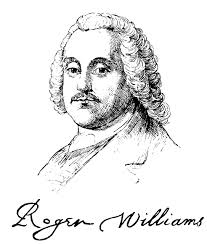
It is impossible for a Gentile nation prior to the return of Christ to operate as a true theocracy. As seen in Section I, Chapter 6 of God Betrayed (which is published on this website in an edited version), a theocracy is a “Government of a state by the immediate direction of God; or the state thus governed.” All alleged “Christian” theocracies (church over state, state over church, or a combination of church and state; called ecclesiocracies by the author) are only poor imitators of the one true God-ordained theocracy in Israel. God never told the church to work with the state, over the state, or under the state.

Israel, the only theocracy which has ever existed, operated as a theocracy only until the Israelites rejected God and demanded a king, and God acted on their request and gave them King Saul. In the theocracy, all ten of the commandments were enforced. While operating as a theocracy, Israel was directly under God, and God initially spoke directly to the leaders of the nation of Israel. After God allowed Israel, at Israel’s request, to be ruled by a king, the Jewish religion and the civil government no longer worked together, although God spoke to the kings of Israel through his chosen prophets.

God no longer speaks directly to leaders of civil government, to the leaders of church government, or to others. He speaks to believers, led by the Holy Spirit, through His Word, the Bible. This is consistent with the fact that He only ordained one theocracy, Israel, prior to the second return of Christ. Yet Covenant Theology united church and state, with the church taking the place of God in speaking directly to the civil government. As a result, the “church” used the strong arm of the state to enforce its own particular brand of religion, or the state itself enforced its preferred religion. The only way to justify such a union is to use a false interpretation of Scripture, an interpretation which, since it is based upon Satan’s principles, must have been developed by Satan himself and implemented either by his children or by children of God who were not walking in the spirit according to knowledge.

The most noticeable and atrocious consequence of all church-state and state-church unions has been the confiscation of property, dissemination of lies about “heretics” as defined by the state-church, and other persecutions such as the beating, torture, imprisonment, and killing of untold millions of people who have dissented from the views of the state-church. The ultimate result of church-state or state-church alliances is always the same—the alliance of church and state called for by a perverted interpretation of Scripture forces others to profess allegiance to the doctrines of the official church under penalty of persecution, thereby attempting to stamp out those who practice free will. The state-church or church-state enforces its own peculiar doctrines including all of the Ten Commandments among which are the first four commandments which deal with man’s relationship to God. In effect, it requires many to be dishonest with both man and God. Since no one can be forced to choose to believe a particular religious belief in their heart, a lot of religious hypocrites are thereby created.

As history shows, the official corrupted “church” was vile to the core. The reformers became especially aware of the corruption within the Roman “church.” Corruption is inevitable when church and state are intermixed.

To quote a great Bible teacher: “The church that sets out to spiritualize the world will soon find that the world will secularize the church. When wheat and tares compromise, it is the wheat that suffers. Light and darkness, right and wrong, good and evil, truth and error are incompatibles, and when they compromise it is the light, the right, the good, and the truth that are damaged” (W. Graham Scroggie, born 1877, twelve times the Bible teacher at the famous Keswick, England conference, They Knew Their God, Vol. 5, 194 cited in The Berean Call, February 2006, p. 5, available at www.thebereancall.org. Separation is a Biblical principle that runs throughout scripture—Pastor Hank Thompson gave a tremendous sermon on “Separation” on Sunday evening,February 12, 2006. Ask for notes on that sermon.).

As Pastor Hank Thompson, has preached: “Holy means set apart for God.  You cannot bring that which is holy and unholy together without making the holy things unholy. Holy things combined with unholy things do not make the unholy holy. It always makes the holy unholy. Being around someone who is sick may make a well person sick. Being around a well person won’t make a sick person well. If you are grounded and touch the ground and a power line at the same time, you are cooked. If you try to touch God and touch the world, you will be corrupted.” (“Separation.” Sermon preached at Capitol City Baptist Church in Austin, Texas by Pastor Hank Thompson,February 12, 2006).

The Holy Bible, the basic source for all truth proclaims: “Be ye not unequally yoked together with unbelievers: for what fellowship hath righteousness with unrighteousness? and what communion hath light with darkness? And what concord hath Christ with Belial? or what part hath he that believeth with an infidel? And what agreement hath the temple of God with idols? for ye are the temple of the living God: as God hath said, I will dwell in them and walk in them: and I will be their God, and they shall be my people. Wherefore, come out from among them, and be ye separate, saith the Lord, and touch not the unclean thing; and I will receive you. And will be a Father unto you, and ye shall be my sons and daughters saith the Lord Almighty.” (2 Co. 6.14-18. The doctrine of separation is taught extensively in the Word of God.).

Just as the union of church and state corrupted the Roman “church” and society, it also corrupted the established Protestant churches and the nations which had established Protestant churches.

The church proceeded under the New Covenant, whereas the Jewish theocracy operated under the Mosaic covenant. Isaac Backus, in pointing out that Jesus did away with the Old Testament Covenant of Law, wrote:

“When our Savior came, he fulfilled the law, both moral and ceremonial, and abolished those hereditary distinctions among mankind. But in the centuries following, deceitful philosophy took away the name which God has given to that covenant, (Acts vii.8) [the covenant of circumcision] and added the name Grace to it; from whence came the doctrine, that dominion is founded in grace. And although this latter name has been exploded by many, yet the root of it has been tenaciously held fast and taught in all colleges and superior places of learning, as far as Christianity has extended, until the present time; whereby natural affection, education, temporal interest and self-righteousness, the strongest prejudices in the world, have all conspired to bind people in that way, and to bar their minds against equal liberty and believer’s baptism.” (Isaac Backus, An Abridgement to the Church History of New England (Boston: Harvard University, 1804; reprinted. 1935), p. 136. cited in Beller, America in Crimson Red…, p. 446).

Scriptures, other than those already cited to show that the church and state are not to wed or to enter into any kind of relationship, especially for persecution of those who do not submit to the official religion, teach that the church is not to enforce spiritual laws in society in general, even with the help of civil government. The Lord commanded that men not remove the tares “lest [they] root up also the wheat [the children of the kingdom]” (Mt. 13.24-30, 37-43). Instead, they are to be permitted to grow together until the harvest when the Lord shall send forth his angels to gather the tares and cast them into a furnace of fire (Ibid.). The Lord commanded His disciples to leave the Pharisees, whom He referred to as the “blind leading the blind,” alone because “every plant, which [His] heavenly father hath not planted, shall be rooted up” (Mt. 15.13-14). He told his disciples: “Let them alone: they be blind leaders of the blind. And if the blind lead the blind, both shall fall in the ditch” (Mt. 15.14).

As Roger Williams noted, “This sentence against [the blind Pharisee], the Lord Jesus only pronounceth in his church, his spiritual judicature, and executes this sentence in part at present, and hereafter to all eternity. Such a sentence no civil judge can pass, such a death no civil sword can inflict” (Williams and Underhill, p. 97).

Other relevant scriptures dealing with the actions of a Christian against his enemies, those who curse, hate, despitefully use, persecute and disagree with him include:

  • “But I say unto you, Love your enemies, bless them that curse you, do good to them that hate you, and pray for them which despitefully use you, and persecute you; That ye may be the children of your Father which is in heaven: for he maketh his sun to rise on the evil and the good, and sendeth rain on the just and on the unjust. For if ye love them which love you, what reward have ye? do not even the publicans the same? And if ye salute your brethren only, what do ye more than others? do not even the publicans so” (Mt. 5.44-47)?
  • The Lord said to his disciples, “Behold, I send you forth as sheep in the midst of wolves: be ye therefore wise as serpents, and harmless as doves. But beware of men: for they will deliver you up to the councils, and they will scourge you in they synagogues; [a]nd ye shall be brought before governors and kings for my sake, for a testimony against them and the Gentiles” (Mt. 10.16-18). What sheep ever attacked a wolf or anything else?
  • “And John answered him, saying, Master, we saw one casting out devils in thy name, and he followeth not us: and we forbad him, because he followeth not us. But Jesus said, Forbid him not: for there is no man which shall do a miracle in my name, that can lightly speak evil of me. For he that is not against us is on our part. For whosoever shall give you a cup of water to drink in my name, because ye belong to Christ, verily I say unto you, he shall not lose his reward” (Mk. 9.38. See also Lu. 9.49-50).
  • The Lord Jesus said to his disciples, James and John, who desired to command fire down from heaven to devour Samaritans who would not receive Him, “Ye know not what manner of spirit ye be of. For the Son of man is not come to destroy men’s lives, but to save them” (Lu. 9.55-56).
  • “The thief cometh not, but for to steal, and to kill, and to destroy: I am come that they might have life, and that they might have it more abundantly. I am the good shepherd: the good shepherd giveth his life of the sheep” (Jn. 10.10-11).
  • “And the servant of the Lord must not strive; but be gentle unto all men, apt to teach, patient, [i]n meekness instructing those that oppose themselves; if God peradventure will give them repentance to the acknowledging of the truth; [a]nd they may recover themselves out of the snare of the devil, who are taken captive by him at his will” (2 Ti. 2.24-26).

The reason for not attempting to remove heretics, the tares, from the world seems to be, as Roger Williams noted:

  • “because they who now are tares, may hereafter become wheat; they who are now blind, may hereafter see; they that now resist him may hereafter receive him; that that are now in the devil’s snare, in adverseness to the truth, may hereafter come to repentance; they that are now blasphemers and persecutors, as Paul was, may in time become faithful as he; they that are now idolaters, as the Corinthians once were, 1 Cor. vi. 9, may hereafter become true worshippers as they; they that are now no people of God, nor under mercy, as the saints sometimes were 1 Pet. ii. 10, may hereafter become the people of God, and obtain mercy, as they.
  • “Some come not till the eleventh hour, Matt. xx. 6: if those that come not till the last hour should be destroyed, because they come not at the first, then should they never come, but be prevented” (Williams and Underhill, pp. 11-12).

Persecution of “heretics” is contrary to many New Testament teachings. True believers were promised that they would be persecuted, and never were told to persecute anyone. Jesus told the disciples that “the time cometh that whosoever killeth you will think that he doeth God service” (Jn. 16.2. This was spoken directly to the apostles, but the Bible and history show that it is applicable to all believers who have been persecuted or will be persecuted for Christ’s sake. Christ is actually speaking to all who are not of the world, but are the chosen of God. See, e.g., Jn. 15.).

The promises to the Jew in the Old Testament were significantly different than the promises to the Christian in the New Testament. No greater example can be cited than the contrast between the Old Testament promises that Israel would prosper and be blessed materially if they would keep God’s commandments and statutes or that they would be judged if they failed to do so (See, e.g., Ex. 15.26; 19.5-8; 24.3, 7; 34.18-35.3; Le. 18.3-20.27; 20.22-23; 26 (read in conjunction with De. 28-30); De. 4-11; 12.30-31; 28-30; 28.1-68; I S. 12.1-5; 1 K. 6.12-13; 9.1-9; 2 Chr. 7.12-22; 15.1-7; etc.) and the New Testament promise to Christians that “all that will live godly in Christ Jesus shall suffer persecution” (2 Ti. 3.12).

The church and state wed at the invitation of the Roman Emperor Constantine early in the fourth century. Some churches married the state and became the officially recognized “church.” After that unholy union, the established Roman Catholic “church,” working hand in hand with the state, persecuted believers. The persecution was continued by the Protestant churches which came out of Roman Catholicism, and finally was brought to America and our colonies by the Puritans, Anglicans, and others.

Throughout these teachings, Scripture and arguments are presented which refute Covenant Theology. Section I, which deals with government, explains that God, because of His covenants with Israel, will establish Israel in the land he has given them. Section II, which deals with the church, shows that Christ desires to be the only head of the church, that He loves the church and gave Himself for it, and that the church is the bride and wife of Christ. The distinct differences between the church and state, as will be shown in Chapter 4 infra, render the two mutually exclusive, operating in different spheres—the civil government or the state operates in the earthly sphere and the church operates in the spiritual realm (although application of spiritual principles affect earthly actions).

The Covenant Theology examined in this book cannot coexist with free will. As will be shown in Section IV, the established churches in almost all the American colonies advocated either a church-state or state-church, unions of church and state under which the strong arm of the state punished, sometimes by death, (execution of dissidents in the colonies was forbidden by England after four Quakers were hanged in Massachusetts as will be explained in Section IV) those the state-church labeled as “heretics.” Had the official churches prevailed, America would not have the First Amendment to the United States Constitution. Thank God that Baptist dissenters led the fight that resulted in liberty of conscience guaranteed by the First Amendment to the United States Constitution.

Endnotes

EN1 Why should believers, and especially pastors, be concerned about the area of church and state law? Because only through knowledge can they avoid dishonoring the Husband/Bridegroom/Head of their local church body and thereby failing to achieve their God-given goal—glorifying God and pleasing Him.

These articles systematically examine the biblical doctrines of church, state, separation of church and state and the application of those doctrines in America. For believers and churches, the information presented is—according to God’s Word—of great importance to our Lord. By reading and studying each article using the Bible as the standard, a believer will discover that the biblical principles are correct as presented. By studying the historical and legal facts presented—without bias, prejudice, illicit motive, or an overriding opposing agenda which has a vested interest in maintaining a status quo due to loss of finances, support or something else—and examining those facts in light of biblical principle, a qualified believer (a believer who has the necessary biblical, historical, and legal qualifications and education) can understand that the conclusions are correct.

That said, understanding the biblical principles, relevant history, and legal principles and facts is, first, impossible for one who is not a born again believer who is walking in the Spirit, and, second, daunting for even the spirit filled follower of Christ. Years of honest, open minded study is required to achieve the correct knowledge and understanding of all facets of church and state law. First, one must interpret Scripture correctly (See 2 Ti. 2:15) as to the relevant topics. After mastering the biblical principles, one must then labor through the annals of history, and the intricacies of law. In order to be qualified to comment upon the law, one must have an extensive legal education. He must understand how to do legal research and how to reach correct legal conclusions. Legal commentary by a pseudo lawyer can sound good to the untrained, while he may be correctly understood as frivolous and unlearned and probably heretical by the educated believer.

This is not to say that a non-lawyer cannot understand the legal and historical aspects of spiritual matters. In fact, the author knows some pastors and other believers who, having already correctly divided the Word of Truth and determined to seek to please God in all matters, have open minds and who have eagerly sought truth in the historical and legal church and state law arena. He is working with such a young pastor at this very moment. He is a brilliant young man who had mastered the Scriptures and Baptist history before the author met him. He excels the author in those matters, as do some other pastors and believers known by the author. Unlike most pastors, he does not have the disadvantages of having gone to either a secular or ecclesiastical (Baptist or otherwise) institution of higher learning. Secular colleges and universities usually corrupt even the most devout child of God; and religious colleges, institutions, and seminaries generally (with few exceptions, one of which the author has personal knowledge of)—by either mixing an ample dose of humanism with whatever biblically correct teaching they dose out; or by having totally having abandoned truth—likewise usually corrupt their students to one degree or another.

On the other hand, the author isvexed by what he reads in some books and websites concerning church and state law; particularly by some vicious, unfounded attacks upon the Biblical Law Center Declaration of Trust by unqualified, biased assailants who are attempting to mislead believers and churches through incorrect biblical and legal analyses and personal attacks upon and outright lies about those with whom they disagree in such matters.

Being a believer alone, even a pastor, does not by itself qualify one to teach on church and state law. The author has been a believer and faithful member of independent Baptist churches since his salvation. He was called by God to go to law school for His glory and to please Him. As a result of that calling, he obtained a Doctor of Jurisprudence degree from one of the best law schools in the country and has practiced law for seventeen years. He has no motive for dishonesty. By design, he has never made a dime above expenses in his work in the church and state law arena. In fact, he has spent tens of thousands of dollars with total income of at most three to four thousand dollars in all the years he has worked in this area of law. Because of this he is beholden to no one and nothing but the truth and his Lord and Savior. Since becoming a lawyer, he has devoted untold thousands of hours in biblical, historical, and legal study and analysis of church and state law.

As always, he declares that if anyone can show him where he is in error, he will recant. Honest, loving believers have taught him much and caused him to modify some of his positions. He has also, in his continued studies, modified some of his conclusions and positions. However, he maintains his primary positions because neither he, through his continued studies, or others have shown him to be wrong about his basic church and state law principles and conclusions.

EN2. God Betrayed/Separation of Church and State: The Biblical Principles and the American Application (Link to preview of God Betrayed): may be ordered from Amazon by clicking the following link: God Betrayed on Amazon.com or from Barnes and Nobel by clicking the following link: God Betrayed on Barnes and Noble. All books by Jerald Finney as well as many of the books he has referenced and read may also be ordered by left clicking “Books” (on the “Church and State Law” website) or directly from Amazon by going to the following links: (1) Render Unto God the Things that Are His: A Systematic Study of Romans 13 and Related Verses (Kindle only); (2) The Most Important Thing: Loving God and/or Winning Souls (Kindle only); (3) Separation of Church and State/God’s Churches: Spiritual or Legal Entities? (Link to preview of Separation of Church and State/God’s Churches: Spiritual or Legal Entities?) which can also be ordered by clicking the following Barnes and Noble link: Separation of Church and State on Barnes and Noble.

Radio Broadcasts of Jerald Finney’s teaching on “The History of the Religious Freedom in America”

One can find links to all articles on this blog by going to the following link: “Separation of Church and State Law Blog: Links to all articles” (This link is to the “Blog” page of churchandstatelaw.com.).

As this study progresses, the Christian who has listened closely to the previous broadcasts will begin to understand the importance of all the prior broadcasts to the issue of separation of church and state and the history of the First Amendment. The historical facts presented in this section should be taught in every American History class. Only when one knows history (plus biblical theology and law) can he understand where he came from, where he is, and where he is going. Only when one knows the facts presented in these studies and included in books by Jerald Finney in more detail, can he understand how we got our First Amendment to the United States Constitution.

This begins the study of the American application of the biblical principle of separation of church and state. Since the beginning of the church, Christians believed and practiced separation of church and state. They paid dearly for this practice. In the fourth century certain religious leaders were seduced by Constantine to join hands with the state. Over a thousand years of the worst persecutions imaginable followed as religion worked hand in hand with the state to enforce all ten of the commandments. Anyone who did not bow down to the theology of the state church was imprisoned, horriby tortured, burned alive, drowned, buried alive, beheaded, etc. as the state religion tried to stamp out all forms of what they called “heresy.” The Protestant churches followed the theology of their mother in this matter and continued the persecution. However, forces and circumstances were such in the American colonies that the final result was the first nation, the second civil government behind the colony of Rhode Island, to have religious liberty.

Jerald Finney’s broadcasts on Liberty Works Radio Network are aired and streamed over the internet on Sunday mornings at 8:00 a.m. Central Time (7:00 a.m. ET, 9:00 a.m. MT, 10 a.m. PT). Click the following link and scroll to the bottom to go to LWRN radio: LWRN (this link is also on the “Radio Broadcast” page of churchandstatelaw.com).

God Betrayed/Separation of Church and State: The Biblical Principles and the American Application (Link to Preview of God Betrayed) is a comprehensive study of the issue of separation of church and state and may be ordered from Amazon by clicking the following link: God Betrayed on Amazon.com or from Barnes and Nobel by clicking the following link: God Betrayed on Barnes and Noble. All books by Jerald Finney as well as many of the books he has referenced and read may also be ordered by left clicking “Books” (on the “Church and State Law” website) or directly from Amazon by going to the following links: (1) Render Unto God the Things that Are His: A Systematic Study of Romans 13 and Related Verses (Kindle only); (2) The Most Important Thing: Loving God and/or Winning Souls (Kindle only); (3) Separation of Church and State/God’s Churches: Spiritual or Legal Entities? Separation of Church and State/God’s Churches: Spiritual or Legal Entities? can also be ordered by clicking the following Barnes and Noble link: Separation of Church and State on Barnes and Noble.

Introduction to the History of the First Amendment (August 23, 2009 and July 25, 2010, 3rd 15 min. segment):

Introduction to the History of the First Amendment and The Light Begins to Shine (August 30, 2009 and August 1, 2010, 1st 15 min. segment):

The light begins to shine (August 30, 1009 and August 1, 2010, 2nd 15 min. segment):

The Pilgrims and Puritans in Massachusetts (1) (August 30, 2009 and August 1, 2010, 3rd 15 min. segment):

The Pilgrims and Puritans in Massachusetts (2) (September 6, 2009 and August 8, 2010, 1st 15 min. segment):

The Pilgrims and Puritans in Massachusetts (3) (September 6, 2009 and August 8, 2010, 2nd 15 min. segment):

The Pilgrims and Puritans in Massachusetts (4) (September 6, 2009 and August 8, 2010, 3rd 15 min. segment):

The Pilgrims and Puritans in Massachusetts (5) (September 13, 2009 and August 15, 2010, 1st 15 min. segment):

The Baptists in Rhode Island (1) (September 13, 2009 and August 15, 2010, 2nd 15 min. segment):

The Baptists in Rhode Island (2) (September 13, 2009 and August 15, 2010, 3rd 15 min. segment):

The Baptists in Rhode Island (3) (September 20, 2009, August 22, 2010, 1st 15 min. segment):

The Baptists in Rhode Island (4) (September 20, 2009, August 22, 2010, 2nd 15 min. segment):

The Baptists in Rhode Island (5) , the Separates and Baptists in New England (1) (September 20, 2009, August 22, 2010, 3rd 15 min. segment):

The Separates and Baptists in New England (2) (September 27, 2009, August 29, 2010, 1st 15 min. segment):

The Separates and Baptists in New England (3) (September 27, 2009, August 29, 2010, 2nd 15 min. segment):

The Separates and Baptists in New England (3) (September 27, 2009, August 29, 2010, 3rd 15 min. segment):

From New England to the South (October  4, 2009, September 5, 2010, 1st 15 min. segment):

To Virginia (1) (October 4, 2009, September 5, 2010, 2nd 15 min. segment):

To Virginia (2) (October 4, 2009, September 5, 2010, 3rd 15 min. segment):

To Virginia (3) (October 11, 2009, September 12, 2010, 1st 15 min. segment):

To Virginia (4) (October 11, 2009, September 12, 2010, 2nd 15 min. segment):

To Virginia (5) (October 11, 2009, September 12, 2010, 3rd 15 min. segment):

To the new nation and conclusion (October 18, 2009, September 19, 2010, 1st 15 min. Segment):

END

History of the First Amendment

Jerald Finney
© October, 2009

Do you know the history of how America got her First Amendment which gives Americans freedom of religion, press, speech, assembly, and the right to petition their government for a redress of grievances? If not, you can learn that history by listening to the following audio teachings. You can learn what happened in the colonies between the time of the arrival of the Pilgrims, Puritans, and others that led to the ratification of the First Amendment. You will learn what Baptists as opposed to Protestants such as the Pilgrims, Puritans, and Anglicans believed about the issue of separation of church and state. You will learn of the theological warfare that went on in the colonies that led to the First Amendment. Every American, and especially every Christian, should know this history.

This blog is made up of the edited radio broadcasts of Jerald Finney which follow the outline of Section IV of God Betrayed/Separation of Church and State: The Biblical Principles and the American Application (Ordering information on this and other books is on the “Books” page of churchandstatelaw.com)The broadcasts are an edited version of God Betrayed.

To play, just click the link. To download, right click link and then left click “Save link as.”

I. Introduction to “History of the First Amendment” Introduction (20 min. 44. sec).

II. The Light Begins to shine The Light Begins to Shine (22 min. 26 sec. Includes introductory song, remarks, and prayer).

III. The Pilgrims and Puritans in Massachusetts  (62 min.).

IV. The Baptists in Rhode Island (63 min. 14 sec.).

V. The Separates and the Baptists in New England (45 min. 42 sec.).

VI. From New England to the South (14 min. 36 sec.).

VII. To Virginia (70 min. 6 sec.).

VIII. To the new nation (10 min. 43 sec.).

IX. Conclusion of “The History of the First Amendment” (3 min. 17 sec.).

End

For His Glory,
Jerald Finney
Christian and practicing attorney