The Way in Which the Two Systems Meet the Requirements for a Philosophy of History


A Publication of Churches Under Christ Ministry


If you miss one part of the puzzle that is being put together in these studies, you will never see and understand the whole picture.


Click here to go to the written lessons.
Click here to go to the 3 1/2 to 6 minute video lectures.


Click here to go to Dispensation Theology versus Covenant Theology and Their Importance to the Issue of Church and State Relationship in America


Jerald Finney
Copyright © February 9, 2018


“[T]he way in which the two systems meet [the] requirements [for a valid philosophy of history] affirms that dispensationalism is the more valid and helpful system.”[i] First, Dispensationalists find the goal of history in the establishment of the millennial kingdom on earth, an optimistic view which insists that the glory of the sovereign God must be seen in the present heavens and earth. According to Dispensational Theology, all history moves toward the ultimate goal for God to glorify Himself by demonstrating that He alone is the sovereign God.

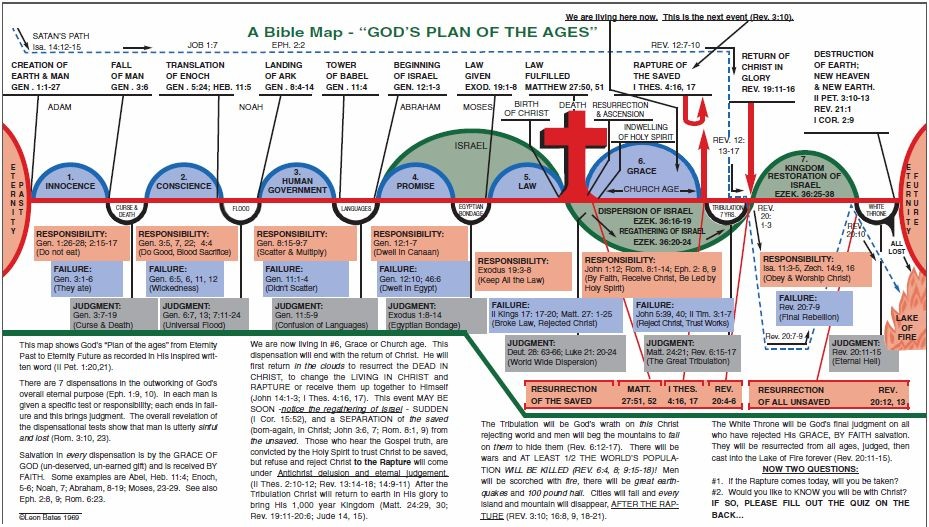
Throughout Scripture, God is glorified. The First of the Ten Commandments, “Thou shalt have no other Gods before me,” an absolute, rock-hard rule, indicates that God wants to be glorified. Everything is seen in the Bible as being for His glory.[ii] The successive dispensations glorify God by (1) demonstrating that God is sovereign throughout history despite Satan’s attempts to overthrow God’s rule and man’s rebellion against God since God can “hold man responsible to obey His methods of administering His rule and can judge man for his” disobedience; (2) “displaying the disorder and tragedy which result from the rejection of God’s rule;” and (3) by “progressively [moving] history toward the fulfillment of its God-intended climax.”[iii]

On the other hand, the Covenant Theologian seems pessimistic and sees the present struggle between good and evil terminated by the beginning of eternity at which point there will come catastrophe and divine judgment.[iv]

Second, in Covenant Theology, the unifying principle for the philosophy of history is the Covenant of Grace, a soteriological principle. Dispensational Theology has a unifying principle—the sovereign rule of God—which “ties the distinctions and progressive stages of revelation together and directs them toward the fulfillment of purpose in history.”[v] Dispensational Theology recognizes that the redemption of the elect plus many other programs are all parts of God’s purpose for history.

“In dispensationalism the [unifying] principle is theological or eschatological or doxological, for the differing dispensations reveal the glory of God as He manifests His character in the differing stewardships, which culminate in history with the millennial glory. This is not to say that dispensationalism fails to give salvation its proper place in the purpose of God…. If the goal of history is the earthly Millennium and if the glory of God will be manifest at that time in the personal presence of Christ in a way hitherto unknown, then the unifying principle of dispensationalism may be said to be eschatological (if viewed from the goal toward which we are moving) or theological (if viewed from the self-revelation of God in every dispensation) or doxological (if viewed from the perspective of the overall manifestation of the glory of God).”[vi]

Third, Dispensationalism gives a proper place to the idea of development, whereas Covenant Theology does not. In Covenant Theology in practice there is extreme rigidity even though Covenant Theology does include in its system different modes of administration of the Covenant of Grace, and although those modes would give an appearance of an idea of progressiveness in revelation. Dispensational Theology states that each new dispensation requires a new revelation, thereby supplying the element of a proper concept of the progress of revelation. According to Dispensationalism, under different economies, God gives new revelation which is increasingly progressive in scope. The similarities in different dispensations are part of a progression of development by God rather than:

  • “a result of employing the unifying principle of the covenant of grace…. Only dispensationalism can cause historical events and successions to be seen in their own light and not to be reflected in the artificial light of an overall covenant.
  • “Thus a correct philosophy of history with its requirements of a proper goal, a proper unifying principle, and a proper concept of progress is best satisfied by the dispensational system. Like the need for biblical distinctions, the proper concept of the philosophy of history leads to dispensationalism.”[vii]

Endnotes

[i] Charles C. Ryrie, Dispensationalism (Chicago: Moody Press, 1995), p. 17.

[ii] See Renald E. Showers, There Really Is a Difference: A Comparison of Covenant and Dispensational Theology (Bellmawr, New Jersey: The Friends of Israel Gospel Ministry, 1990), pp. 50-51 for an excellent overview of Scripture that substantiates this point.

[iii] Ibid., pp. 50-51.

[iv] Ryrie, pp. 17-18 citing Alva J. McClain, “A Premillennial Philosophy of History,” Bibliotheca Sacra 113 (April 1956): 113-14.

[v] Showers, p. 52.

[vi] Ryrie, pp. 17-18; see also, Showers, p. 53.

[vii] Ryrie, p. 19.
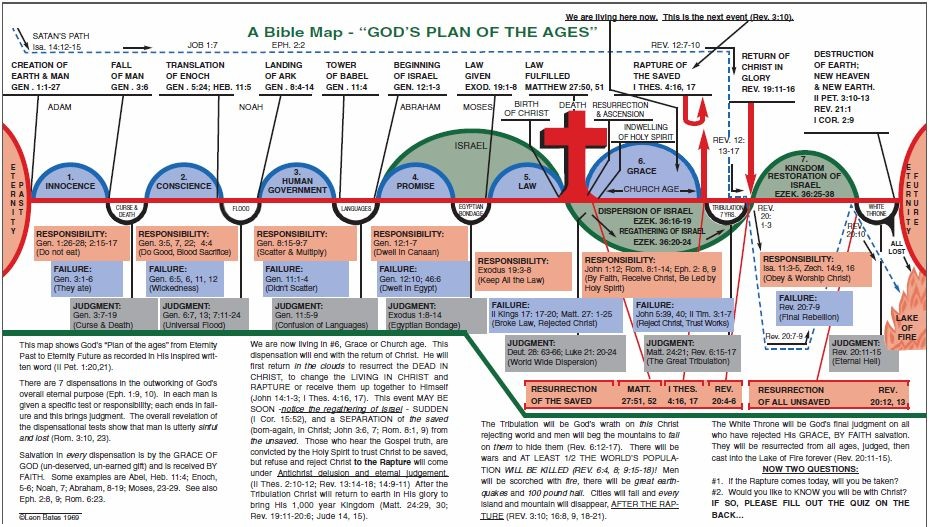
The Essence of Dispensationalism


A Publication of Churches Under Christ Ministry of Charity Baptist Tabernacle of Amarillo, Texas


If you miss one part of the puzzle that is being put together in these studies, you will never see and understand the whole picture.


Click here to go to Dispensation Theology versus Covenant Theology and Their Importance to the Issue of Church and State Relationship in America


Click here to go to the written lessons.
Click here to go to the 3 1/2 to 6 minute video lectures.


Jerald Finney
Copyright © February 8, 2018


“[T]he term dispensation as it relates to Dispensational Theology could be defined as a particular way of God’s administering His rule over the world as He progressively works out His purpose of world history.[i] Another way to define “dispensation” is “a distinguishable economy in the outworking of God’s purpose.”[ii] “Dispensationalism views the world as a household run by God.”[iii]

There are important characteristics and considerations concerning dispensations. There are three characteristics of each dispensation necessary to make it distinct from all other dispensations. First, each dispensation is characterized by a unique ruling factor or combination of ruling factors. “Second, it must involve a particular responsibility for man.” “Third, it must be characterized by divine revelation which had not been given before.” Three secondary characteristics are that each dispensation applies a test to man to see whether or not man will perfectly obey God’s rule, each dispensation demonstrates the failure of man to obey the particular rule of God of that dispensation, and each dispensation involves divine judgment because of man’s failure.[iv]

Some important considerations are first, the different dispensations are different ways of God’s administering His rule over the world, not different ways of salvation. Since the fall, individuals have always been saved by grace through faith. The sacrifices of the Israelites in the Old Testament did not provide salvation. “For it is not possible that the blood of bulls and of goats should take away sin” (He. 10.4). The Israelite’s offering implied confession of sin and of its due desert, death; and God ‘covered’ [or ‘passed over,’ ] his sin, in anticipation of Christ’s sacrifice, which did, finally, ‘put away’ the sins ‘done aforetime in the forbearance of God.

“For all have sinned, and come short of the glory of God: Being justified freely by his grace through the redemption that is in Christ Jesus: Whom God hath set forth to be a propitiation through faith in his blood, to declare his righteousness for the remission of sins that are past, through the forbearance of God” (Ro. 3.23-25).

And for this cause he is the mediator of the new testament, that by means of death, for the redemption of the transgressions that were under the first testament, they which are called might receive the promise of eternal inheritance” (He. 9.15).

Second, “[a] dispensation is a particular way of God’s administering His rule, but an age is a particular period of time”—hence a dispensation is not an age of history. Third, a dispensation may involve God’s administering His rule over all mankind or over only one segment of mankind. “Fourth, a dispensation may continue or discontinue some ruling factors of previous dispensations, but it will have at least one new ruling factor never introduced before.” “Fifth, each new dispensation requires new revelation.”[v]

Dispensations have characteristics. Primarily, dispensations are stewardships. All in a particular dispensational economy are stewards, although one man usually stands out. For example, Paul was used by God more than any other to reveal His grace. Nonetheless, all the apostles and every other believer are also stewards of God’s grace. All have a responsibility to respond to that grace. God will judge those who fail to do so.[vi]

Most theologians recognize seven dispensations: Innocence (Gen. 1.28); Conscience (Gen. 3.23); Human Government (Gen. 8.20); Promise (Gen. 12.1); Law (Ex. 19.8); Grace (John 1.17); Kingdom (Eph. 1.10).[vii]

In each dispensation, God used or uses a ruling factor to govern man. Man failed or will fail in every dispensation, even in the last dispensation in which Christ Himself will rule over a perfect government and exceptional conditions. Man’s failure in that dispensation will bring God’s judgment. Those who rebel outwardly during that time will be executed (See, Is. 11.3-4; 29.20-21; Je. 31.29-30), and “God will crush the huge revolt which will take place immediately after the seventh dispensation sending fire to destroy the human rebels and casting Satan into the lake of fire for everlasting torment (Rev. 20:9-10).”[viii]

Dispensational Theology recognizes distinctions of things which differ in history by asserting that distinctions are the result of God’s administering His rule in different ways at different periods of history. “There is no interpreter of the Bible who does not recognize the need for certain basic distinctions in the Scriptures.”[ix] The Covenant Theologian also makes rather important dispensational distinctions even though he views them as related to the unifying and underlying Covenant of Grace. For example, Louis Berkhof, after rejecting the usual dispensational scheme of Bible distinctions, enumerates his own scheme of dispensations or administrations—the Old Testament dispensation and the New Testament dispensation. “However, within the Old Testament dispensation Berkhof lists four subdivisions, which although he terms them ‘stages in the revelation of the covenant of grace,’ are distinguishable enough to be listed.’” Thus, he recognizes five dispensations—four in the Old Testament and the New Testament dispensation.[x]


Endnotes

[i] Renald E. Showers, There Really Is a Difference: A Comparison of Covenant and Dispensational Theology (Bellmawr, New Jersey: The Friends of Israel Gospel Ministry, 1990), pp. 27-30; see also, Charles C. Ryrie, Dispensationalism (Chicago: Moody Press, 1995), pp. 28-31.

[ii] Ryrie, p. 28.

[iii] Ibid., p. 29; see pp. 29-31 for definitions of “dispensation” by various scholars.

[iv] Showers, pp. 30-31; see also, Ryrie, pp. 33-35.

[v] Showers, pp. 31-32.

[vi] See Ryrie, pp. 56-57.

[vii] See Showers pp. 33-49 and Ryrie, pp. 45-57 (Showers and Ryrie call the Dispensation of Law the Dispensation of Mosaic Law and the Dispensation of Kingdom the Dispensation of the Millennium; Ryrie calls the Dispensation of Human Government the Dispensation of Civil Government.

[viii] Showers, pp. 33-49.

[ix] Ryrie, p. 16.

[x] Ibid., citing Louis Berkhof, Systematic Theology (Grand Rapids: Eerdmans, 1941), pp. 293-301.

(2) Colonial Theological Warfare—Separation of Church and State


A Publication of Simply Church Ministry


If you miss one part of the puzzle that is being put together in these studies, you will never see and understand the whole picture.


Jerald Finney
Copyright © February 7, 2018


A complete analysis of Dispensationalism and Covenant Theology requires a long and deep study of the Bible. FN [i] These short lessons will briefly look at some of the characteristics of each and distinctions between the two. The differences were debated in the colonies during a spiritual warfare that began in the early 1630’s. Fortunately, the dispensationalist view prevailed. This resulted in the adoption of the First Amendment to the United States Constitution which, among other things, separates church and state (not God and state).

The two theologies have distinct “philosophies of history.” FN [ii] The two main systems which Bible-believing scholars have developed to exposit the Bible’s philosophy of history, Dispensationalism or Dispensational Theology and Covenant Theology, have produced two systems of theology. Dispensational Theology contains all the necessary elements of a valid philosophy of history. “Dispensationalism, [which] can be defined very simply as a system of theology which attempts to develop the Bible’s philosophy of history on the basis of the sovereign rule of God, represents the whole of Scripture and history as being covered by several dispensations[, economies, or stewardships] of God’s rule.” FN [iii]

“The essence of dispensationalism … is the distinction between Israel and the church. This grows out of the dispensationalist’s consistent employment of normal or plain or historical-grammatical interpretation, and it reflects an understanding of the basic purposes of God in all His dealings with mankind as that of glorifying Himself through salvation and other purposes as well.” FN [iv]

Covenant theologians teach that the church has replaced Israel. The Bible literally teaches that the rules for the church and state are different than the rules God ordained for the theocracy in Israel. Distinct rules, as discussed in the articles under Distinct Differences between Church and State that Render Them Mutually Exclusive, are laid down in the Bible concerning Judaism and Israel and the church and state.

Covenant theologians believe that God is through with Israel, that the church replaces Israel. This is a grave mistake to Judaize the church, a mistake which has many consequences.

“It may safely be said that the Judaizing of the Church has done more to hinder her progress, pervert her mission, and destroy her spiritually, than all other causes combined. Instead of pursuing her appointed path of separation from the world and following the Lord in her heavenly calling, she has used Jewish Scriptures to justify herself in lowering her purpose to the civilization of the world, the acquisition of wealth, the use of an imposing ritual, the erection of magnificent churches, the invocation of God’s blessing upon the conflicts of armies, and the division of an equal brotherhood into ‘clergy’ and ‘laity.’” FN [v]

The “Judaizing” of the church is based upon false biblical interpretation, upon a false philosophy of history.

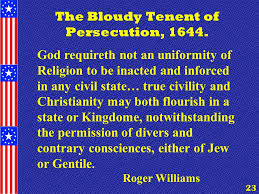
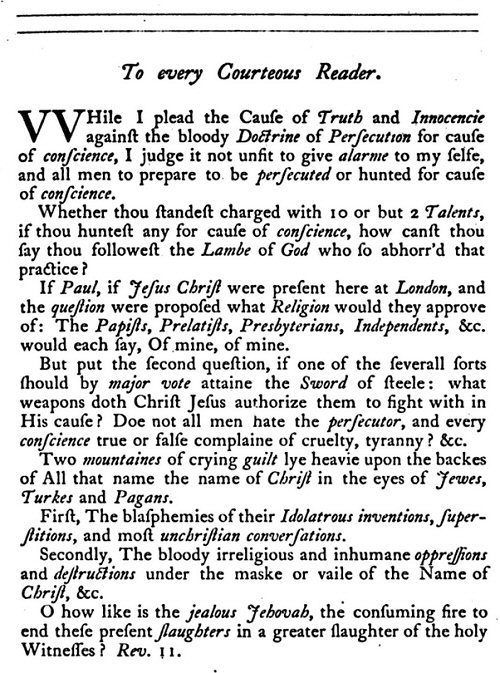
The main issue in the theological warfare in the colonies was the relationship of church and state. Other issues such as believer’s baptism (Dispensational) versus infant baptism (Covenant Theology)—an issue closely related to the issue of separation of church and state—were also hotly debated. Covenant theologians believe in union of church and state. Dispensationalists take the literal meaning of the Bible on this issue—that God desires church and state to be separate in Gentile nations; both under God, but neither working over, with, or under the other. The arguments of both sides in the colonies are still available. Both secular and Christian histories of the theological warfare and the accompanying persecutions of dissenters is undeniable. Sadly, Calvinist, Protestant, and Catholic revisionism has done a masterful job of both promoting a revised version of history while hiding the truth from untold millions of “Christians.”


Endnotes

[i] For much more in-depth look at these matters, see Dispensational Theology versus Covenant Theology.

[ii] “Karl Lowith defines ‘a philosophy of history as ‘a systematic interpretation of universal history in accordance with a principle by which historical events and successions are unified and directed toward ultimate meaning’” (Charles C. Ryrie, Dispensationalism (Chicago: Moody Press, 1995), p. 17, citing Karl Lowith, Meaning in History (Chicago: Univ. of Chicago Press, 1949), p. 1; see also, Renald E. Showers, There Really Is a Difference: A Comparison of Covenant and Dispensational Theology (Bellmawr, New Jersey: The Friends of Israel Gospel Ministry, 1990), p.  1). This definition “centers on three things: (1) the ultimate goal of history; (2) the unifying principle; and (3) the recognition of ‘historical events and successions,’ or a proper concept of the progress of revelation in history” (Ryrie, p. 17). The Bible contains a philosophy of history because it deals with the issue of meaning, offers a systematic interpretation of history, covers the entire scope of history from beginning to end, including the what and why of the future, presents a unifying principle which ties together and makes sense of the whole gamut of events, distinctions, and successions, and demonstrates that history has an ultimate goal or purpose (Showers, p. 2; Ryrie, p. 17).

[iii] Renald E. Showers, There Really Is a Difference: A Comparison of Covenant and Dispensational Theology (Bellmawr, New Jersey: The Friends of Israel Gospel Ministry, 1990), p. 27.

[iv] Charles C. Ryrie, Dispensationalism (Chicago: Moody Press, 1995), p. 41.

[v] Dr C. I. Scofield, Rightly Dividing the Word of Truth (New Jersey: Loizeaux Brothers, First Edition, January, 1896), p. 12.