All posts by Jerald Finney

Jerald Finney was the lead counsel for the Biblical Law Center ("BLC") from May, 2005 until 2011. The BLC helps churches who desire to organize according to New Testament principles. In 2016, he again worked with the BLC and still does, but he now heads up the Churches under Christ Ministry which is under the authority of Charity Baptist Tabernacle of Amarillo TX. Finney is a licensed attorney who can be reached at 512-785-8445 jerald.finney@sbcglobal.net. Over the last few years he has lectured and preached on the issues concerning government, church, and separation of church and state. God called Finney, a Christian and fundamental Baptist since his salvation, to enter the University of Texas School of Law in 1990 at the age of 43 to stand in the gap concerning legal issues facing Christians. Since being saved, he has been a faithful and active member of a local fundamental, Bible-believing Baptist church. He received his JD degree in 1993 and has followed the Lord in the practice of law since that time. Finney received his law license in November 1993 and began practicing law in January, 1994. All along he was seeking the Lord’s direction. The Lord initially led Finney to practice criminal law. He knew that not many, if any, of the Christian law firms dealt with or specialized in criminal law, and that some Christians were being charged with crimes for their Christian behavior and for taking a stand for God’s principles. The Lord confirmed Finney's choice. Very soon after he started practicing, he helped an Eastern Orthodox priest with a criminal charge. He was charged under a criminal statute for trying to expose the promotion of sodomy and other sins within a Catholic Church. God gave the victory in that case. Then Steve, a Christian who counseled outside abortion clinics, called Finney. He was charged with a crime under the Austin, Texas Sign Ordinance for his activities outside an abortion clinic. Being a new lawyer, Finney called the Rutherford Institute. They asked him to send them a summary of the facts and a copy of the Sign Ordinance. Then they told him that the case could not be won and that they would not help. Steve lost at trial, but God gave the victory on appeal. The Austin Police Department immediately cited Steve for violation of the state sign ordinance. The Lord gave the victory at trial. Finney's first felony trial came about a year and six months after he started practicing law. A single Christian mother was charged with third degree felony injury to a child for spanking her six year old son. She left some prominent stripes across his rear end and also a stripe across his face when he turned suddenly during the spanking. The Lord gave the victory at trial. At the same time, Finney was also representing another Christian married lady who was charged with the same crime for spanking her little girl with a switch. On the date the trial in that case was to begin, the prosecutor, with prompting by the judge, lowered the offer to deferred adjudication probation of short duration on a misdemeanor charge with very few conditions on the probation. In a deferred adjudication in Texas, there is never a judgment of guilt if the probationer successfully completes the term of the probation, (and, with successful completion of the probation, the probationer can now file a Motion for Nondisclosure which, if granted, requires the file to be sealed so that the general public has no access to it). The mother decided to take the offer. The Lord has also allowed Finney to help Christian parents in numerous situations involving Child Protective Services (“CPS”) infringement into parental rights. God has given the victory in all those situations. The Lord has also used Finney to intervene in numerous situations where government officials or private companies tried to deny certain Christians their rights to do door-to-door evangelization, preach on the street, hand out gospel literature in the public forum, and pass out gospel tracts and communicate the gospel at their place of employment. Finney has also fought other legal spiritual battles including a criminal case in San Antonio. A peaceful pro-life advocate was arrested and charged with criminal trespass for handing pro-life literature giving information about the development of the unborn baby, places to go for help, and other information to women entering an abortion clinic. All the above-mentioned cases as well as others not mentioned were handled free of charge (except the last spanking case for which Finney received $750). In 2005 Finney became lead counsel for the Biblical Law Center. Since his early Christian life, he has considered the issue of separation of church and state as taught in the Bible to be one of the primary issues facing New Testament churches today. He believes, based upon what the Bible teaches, that operating as a corporation (sole or aggregate), unincorporated association, or any other type of legal entity and/or getting a tax exempt status from the federal government at the very least puts the church under the headship of both the Lord and the state, and may even take the church from under the headship of Christ and put the church under the headship of the state. He believes that taking scriptures out of context and applying human reasoning contrary to biblical teaching (such as “Obey every ordinance of man,” or “We should be good stewards and incorporation is good stewardship”) in order to justify unbiblical marriage with the state causes our Lord much grief. Once he took on the position as counsel for the BLC, it was necessary to do an in-depth study of the issue of separation of church and state. He began with the Bible. He initially read through the Bible at least five times (and many more times since then) primarily seeking the answer to the question, “Does the Bible have anything to say about this issue?” He was amazed at what He learned. The Bible gives God’s principles concerning separation of church and state, the purpose of a church, the purpose of the civil government, the headship of church, the headship of civil government, the principles by which each is to be guided, and much more concerning these two God ordained institutions. He continued to read the Bible daily seeking insights into these and other issues. He also began to read other books. he had already read starting shortly after being saved, books and other information by Christian authors. For example, he had read, among other works, A Christian Manifesto[1], The Light and the Glory,[2] From Sea to Shining Sea,[3] The Myth of Separation and some other works by David Barton, [4]Rewriting America’s History,[5] and America’s God and Country.[6] These resources inspired, influenced and guided him and millions of other Christians, gave them philosophical and historical underpinning, and led them into battlefields such as politics, law, and education armed with what they learned from those resources. Sometime in 2006 he began to realize that some of the books by Christian authors which he had come to depend upon were misleading, at the very least. Other books revealed to him that some of the above mentioned books had misinformed and misled sincere Christians by revising and/or misrepresenting the true history of separation of church and state in America. In 2006, he read One Nation Under Law[7] which cites a wealth of resources for one seeking to understand the history of separation of church and state in the United States and of the First Amendment to the United States Constitution.[8] Reading One Nation Under Law, some of the books it cited, and some other books was a launching pad into the universe of historical information which he never dreamed existed. He had expected to be misled in the secular law school he attended. He was amazed that he had been misled by Christian brothers. I asked myself, “How could Peter Marshall and others have missed this vital information?” At an Unregistered Baptist Fellowship conference in Indianapolis, Indiana, James R. Beller, a Baptist historian, gave a PowerPoint presentation which gave him the answer to this question. Finney bought two of Beller's books and read them. Those books filled in the details not mentioned in Pastor Beller’s concise PowerPoint presentation. Since that time, God has led Finney into an in depth study of the issues of government, church, and separation of church and state. God Betrayed/Separation of Church and State: The Biblical Principles and the American Application and the other books he has written and listed on this website were written as a result of those studies. God Betrayed is not a rehash of the same information that has been circulated in the Fundamental Baptist and Christian community through sermons, books, seminars, etc. since at least 1982, the year Finney was saved. God Betrayed and Finney's other books reveal facts and information that must be understood in order for a pastor and other Christians to begin to successfully (in God's eyes) fight the spiritual warfare we are engaged in according to knowledge. Finney believes that the lack of attention to the biblical doctrines concerning government, church (which is likened to the wife and bride of Christ), and separation of church and state, has had dire consequences for individuals, families, churches, and America. Unless pastors educate themselves on these doctrines and their application in America, the rapid downhill slide will continue at an accelerating pace. [1] Francis A. Schaeffer, A Christian Manifesto, (Westchester, Illinois: Crossway Books, 1981). [2] Peter Marshall and David Manuel, The Light and the Glory, (Old Tappan, New Jersey: Fleming H. Revell Company, 1977). [3] Peter Marshall and David Manuel, From Sea to Shining Sea (Old Tappan, New Jersey: Fleming H. Revell Company, 1986). [4] David Barton, The Myth of Separation, What is the Correct relationship between Church and State? (Aledo, Texas: Wallbuilder Press, 1992). [5] Catherine Millard, Rewriting America’s History (Camp Hill, Pennsylvania: Horizon House Publishers, 1991). [6] William J. Federer, America’s God and Country, Encyclopedia of Quotations (Coppell, Texas: FAME Publishing, Inc., 1994). [7] Mark Douglas McGarvie, One Nation Under Law: America’s Early National Struggles to Separate Church and State (DeKalb, Illinois: Northern Illinois University Press, 2005). [8] The First Amendment to the United States Constitution states: “Congress shall make no law respecting an establishment of religion, or prohibiting the free exercise thereof; or abridging the freedom of speech, or of the press; or the right of the people peaceably to assemble, and to petition the Government for a redress of grievances.” The religion clause, properly interpreted, as is shown in God Betrayed, is a correct application of the biblical principle of separation of church and state.

Dispensation Theology versus Covenant Theology


Jerald Finney
Copyright © March 10, 2012


Preface

This article is a continuation of Jerald Finney’s systematic development of the doctrines, application, history, and legalities of “separation of church and state.” See EN1 for more on this matter. This article is an edited version of Section III, Chapter 3 of the book God Betrayed/Separation of Church and State: The Biblical Principles and the American Application (Link to preview of God Betrayed). (Link to Contents of “Separation of Church and State Law” Blog which has links so that the new follower can start his study at the beginning. “Line upon line, precept upon precept.”). See EN2 for information on books by Jerald Finney which thoroughly examine “separation of church and state law.”


Dispensation Theology versus Covenant Theology

In order to understand religious liberty and the history of the First Amendment to the United States Constitution (freedom of speech, press, association, religion (or religious liberty), and conscience; soul liberty; separation of church and state; and the right to petition the government for a redress of grievances), one must understand Dispensational Theology and Covenant Theology. The Puritans were  Covenant Theologians. Historic Baptists were Dispensationalists (in belief, although the term “Dispensational Theology” was not coined until sometime in the last few hundred years). These two theologies clashed in the English colonies of America, the Baptist view prevailing with the adoption of the First Amendment. Unknown to most contemporary “Baptists” the warfare between various biblical theologies continues and will continue until the kingdom of heaven is established by our Lord. Most “Baptists,” not to mention members of denominations and religions, have unknowingly succumbed to false religious beliefs and philosophies as end-time prophesy unfolds as foretold in Scripture. This article explains Dispensational Theology and Covenant Theology, distinguishes them, and will be invaluable in one’s quest for understanding of the biblical principle of separation of church and state and the American application thereof.

Although many biblical principles run from Genesis to Revelation, the rules for church and state and for the Jewish religion-state are not the same. Under Judaism (the Jewish religion as ordained by God), religion and state operated hand-in-hand under God; that is, the religion and state were unified by God, both religion and state instructed by God to work together directly under God for the same goals. The church has not replaced Israel, and the rules for the church and state are different than the rules God ordained for the theocracy in Israel. Distinct rules, as discussed in Chapter 4 of God Betrayed and also in the next article to be published on this website (entitled “Distinct differences between church and state”), are laid down in the Bible concerning Judaism and Israel and the church and state. It is a grave mistake to Judaize the church, a mistake which has many consequences. Dr. C. I. Scofield was correct in his assertion that:

“It may safely be said that the Judaizing of the Church has done more to hinder her progress, pervert her mission, and destroy her spiritually, than all other causes combined. Instead of pursuing her appointed path of separation from the world and following the Lord in her heavenly calling, she has used Jewish Scriptures to justify herself in lowering her purpose to the civilization of the world, the acquisition of wealth, the use of an imposing ritual, the erection of magnificent churches, the invocation of God’s blessing upon the conflicts of armies, and the division of an equal brotherhood into ‘clergy’ and ‘laity.’” (Dr C. I. Scofield, Rightly Dividing the Word of Truth (New Jersey: Loizeaux Brothers, First Edition, January, 1896), p. 12).

The “Judaizing” of the church is based upon false biblical interpretation, upon a false philosophy of history. “Karl Lowith defines ‘a philosophy of history as ‘a systematic interpretation of universal history in accordance with a principle by which historical events and successions are unified and directed toward ultimate meaning’” (Charles C. Ryrie, Dispensationalism (Chicago: Moody Press, 1995), p. 17, citing Karl Lowith, Meaning in History (Chicago: Univ. of Chicago Press, 1949), p. 1; see also, Renald E. Showers, There Really Is a Difference: A Comparison of Covenant and Dispensational Theology (Bellmawr, New Jersey: The Friends of Israel Gospel Ministry, 1990), p.  1). This definition “centers on three things: (1) the ultimate goal of history; (2) the unifying principle; and (3) the recognition of ‘historical events and successions,’ or a proper concept of the progress of revelation in history” (Ryrie, p. 17). The Bible contains a philosophy of history because it deals with the issue of meaning, offers a systematic interpretation of history, covers the entire scope of history from beginning to end, including the what and why of the future, presents a unifying principle which ties together and makes sense of the whole gamut of events, distinctions, and successions, and demonstrates that history has an ultimate goal or purpose (Showers, p. 2; Ryrie, p. 17).

The two main systems which Bible-believing scholars have developed to exposit the Bible’s philosophy of history over the last three or four hundred years, Dispensationalism or Dispensational Theology and Covenant Theology, have produced two systems of theology. Dispensational Theology contains all the necessary elements of a valid philosophy of history. “Dispensationalism, [which] can be defined very simply as a system of theology which attempts to develop the Bible’s philosophy of history on the basis of the sovereign rule of God, represents the whole of Scripture and history as being covered by several dispensations of God’s rule” (Showers, p. 27).

“The essence of dispensationalism … is the distinction between Israel and the church. This grows out of the dispensationalist’s consistent employment of normal or plain or historical-grammatical interpretation, and it reflects an understanding of the basic purposes of God in all His dealings with mankind as that of glorifying Himself through salvation and other purposes as well” (Ryrie, p. 41).

Although Dispensationalism was not developed as a scheme in a systematic fashion until the 17th century, early church leaders did recognize some of the biblical principles basic to Dispensational Theology. The word from which dispensation is translated, oikonomia, appears nine times in the New Testament. Only once is it translated dispensation. It refers to a responsible office or ministry entrusted to one’s care by a higher authority in six passages and to a particular way of God’s administering His rule over the world in three other passages. “[T]he term dispensation as it relates to Dispensational Theology could be defined as a particular way of God’s administering His rule over the world as He progressively works out His purpose of world history” (Showers, pp. 27-30; see also, Ryrie, pp. 28-31). Another way to define “dispensation” is “a distinguishable economy in the outworking of God’s purpose” (Ryrie, p. 28). “Dispensationalism views the world as a household run by God” (Ibid., p. 29; see pp. 29-31 for definitions of “dispensation” by various scholars).

There are important characteristics and considerations concerning dispensations. There are three characteristics of each dispensation necessary to make it distinct from all other dispensations. First, each dispensation is characterized by a unique ruling factor or combination of ruling factors. “Second, it must involve a particular responsibility for man.” “Third, it must be characterized by divine revelation which had not been given before.” Three secondary characteristics are that each dispensation applies a test to man to see whether or not man will perfectly obey God’s rule, each dispensation demonstrates the failure of man to obey the particular rule of God of that dispensation, and each dispensation involves divine judgment because of man’s failure (Showers, pp. 30-31; see also, Ryrie, pp. 33-35).

Some important considerations are first, the different dispensations are different ways of God’s administering His rule over the world, not different ways of salvation. Since the fall, individuals have always been saved by grace through faith. The sacrifices of the Israelites in the Old Testament did not provide salvation. “For it is not possible that the blood of bulls and of goats should take away sin” (He. 10.4). “The Israelite’s offering implied confession of sin and of its due desert, death; and God ‘covered’ [or ‘passed over,’ ] his sin, in anticipation of Christ’s sacrifice, which did, finally, ‘put away’ the sins ‘done aforetime in the forbearance of God’” (1917 Scofield Reference Edition, n. 1 to Ex. 29.33, p. 110).

“For all have sinned, and come short of the glory of God: Being justified freely by his grace through the redemption that is in Christ Jesus: Whom God hath set forth to be a propitiation through faith in his blood, to declare his righteousness for the remission of sins that are past, through the forbearance of God” (Ro. 3.23-25. See 1917 Scofield Reference Edition, n. 2 to Ro. 3.25, p. 1195.).

And for this cause he is the mediator of the new testament, that by means of death, for the redemption of the transgressions that were under the first testament, they which are called might receive the promise of eternal inheritance” (Hebrews 9.15).

Second, “[a] dispensation is a particular way of God’s administering His rule, but an age is a particular period of time”—hence a dispensation is not an age of history. Third, a dispensation may involve God’s administering His rule over all mankind or over only one segment of mankind. “Fourth, a dispensation may continue or discontinue some ruling factors of previous dispensations, but it will have at least one new ruling factor never introduced before.” “Fifth, each new dispensation requires new revelation” (Showers, pp. 31-32).

Dispensations have characteristics. Primarily, dispensations are stewardships. All in a particular dispensational economy are stewards, although one man usually stands out. For example, Paul was used by God more than any other to reveal His grace. Nonetheless, all the apostles and every other believer are also stewards of God’s grace. All have a responsibility to respond to that grace. God will judge those who fail to do so (See Ryrie, pp. 56-57).

Most theologians recognize seven dispensations: “Innocence (Gen. 1.28); Conscience (Gen. 3.23); Human Government (Gen. 8.20); Promise (Gen. 12.1); Law (Ex. 19.8); Grace (John 1.17); Kingdom (Eph. 1.10)” (The 1917 Scofield Reference Edition, see the notes accompanying the quoted verses. See also, Showers pp. 33-49 and Ryrie, pp. 45-57 (Showers and Ryrie call the Dispensation of Law the Dispensation of Mosaic Law and the Dispensation of Kingdom the Dispensation of the Millennium; Ryrie calls the Dispensation of Human Government the Dispensation of Civil Government.)).

In each dispensation, God used or uses a ruling factor to govern man. Man failed or will fail in every dispensation, even in the last dispensation in which Christ Himself will rule over a perfect government and exceptional conditions. Man’s failure in that dispensation will bring God’s judgment. Those who rebel outwardly during that time will be executed (See, Is. 11.3-4; 29.20-21; Je. 31.29-30), and “God will crush the huge revolt which will take place immediately after the seventh dispensation sending fire to destroy the human rebels and casting Satan into the lake of fire for everlasting torment (Rev. 20:9-10)” (Showers, pp. 33-49).

Dispensational Theology recognizes distinctions of things which differ in history by asserting that distinctions are the result of God’s administering His rule in different ways at different periods of history. “There is no interpreter of the Bible who does not recognize the need for certain basic distinctions in the Scriptures” (Ryrie, p. 16). The Covenant Theologian also makes rather important dispensational distinctions even though he views them as related to the unifying and underlying Covenant of Grace. For example, Louis Berkhof, after rejecting the usual dispensational scheme of Bible distinctions, enumerates his own scheme of dispensations or administrations—the Old Testament dispensation and the New Testament dispensation. “However, within the Old Testament dispensation Berkhof lists four subdivisions, which although he terms them ‘stages in the revelation of the covenant of grace,’ are distinguishable enough to be listed.’” Thus, he recognizes five dispensations—four in the Old Testament and the New Testament dispensation (Ibid., citing Louis Berkhof, Systematic Theology (Grand Rapids: Eerdmans, 1941), pp. 293-301).

“[T]he way in which the two systems meet [the] requirements [for a valid philosophy of history] affirms that dispensationalism is the more valid and helpful system” (Ibid., p. 17). First, Dispensationalists find the goal of history in the establishment of the millennial kingdom on earth, an optimistic view which insists that the glory of the sovereign God must be seen in the present heavens and earth. According to Dispensational Theology, all history moves toward the ultimate goal for God to glorify Himself by demonstrating that He alone is the sovereign God. Throughout Scripture, God is glorified. The First of the Ten Commandments, “Thou shalt have no other Gods before me,” an absolute, rock-hard rule, indicates that God wants to be glorified. Everything is seen in the Bible as being for His glory (See Showers pp. 50-51 for an excellent overview of Scripture that substantiates this point.). The successive dispensations glorify God by (1) demonstrating that God is sovereign throughout history despite Satan’s attempts to overthrow God’s rule and man’s rebellion against God since God can “hold man responsible to obey His methods of administering His rule and can judge man for his” disobedience; (2) “displaying the disorder and tragedy which result from the rejection of God’s rule;” and (3) by “progressively [moving] history toward the fulfillment of its God-intended climax” (Showers, pp. 50-51).

On the other hand, the Covenant Theologian seems pessimistic and sees the present struggle between good and evil terminated by the beginning of eternity at which point there will come catastrophe and divine judgment (Ryrie, pp. 17-18 citing Alva J. McClain, “A Premillennial Philosophy of History,” Bibliotheca Sacra 113 (April 1956): 113-14).

Second, in Covenant Theology, the unifying principle for the philosophy of history is the Covenant of Grace, a soteriological principle. Dispensational Theology has a unifying principle—the sovereign rule of God—which “ties the distinctions and progressive stages of revelation together and directs them toward the fulfillment of purpose in history” (Showers, p. 52). Dispensational Theology recognizes that the redemption of the elect plus many other programs are all parts of God’s purpose for history.

“In dispensationalism the [unifying] principle is theological or eschatological or doxological, for the differing dispensations reveal the glory of God as He manifests His character in the differing stewardships, which culminate in history with the millennial glory. This is not to say that dispensationalism fails to give salvation its proper place in the purpose of God…. If the goal of history is the earthly Millennium and if the glory of God will be manifest at that time in the personal presence of Christ in a way hitherto unknown, then the unifying principle of dispensationalism may be said to be eschatological (if viewed from the goal toward which we are moving) or theological (if viewed from the self-revelation of God in every dispensation) or doxological (if viewed from the perspective of the overall manifestation of the glory of God)” (Ryrie, pp. 17-18; see also, Showers, p. 53).

Third, Dispensationalism gives a proper place to the idea of development, whereas Covenant Theology does not. In Covenant Theology in practice there is extreme rigidity even though Covenant Theology does include in its system different modes of administration of the Covenant of Grace, and although those modes would give an appearance of an idea of progressiveness in revelation. Dispensational Theology states that each new dispensation requires a new revelation, thereby supplying the element of a proper concept of the progress of revelation. According to Dispensationalism, under different economies, God gives new revelation which is increasingly progressive in scope. The similarities in different dispensations are part of a progression of development by God rather than

  • “a result of employing the unifying principle of the covenant of grace…. Only dispensationalism can cause historical events and successions to be seen in their own light and not to be reflected in the artificial light of an overall covenant.
  • “Thus a correct philosophy of history with its requirements of a proper goal, a proper unifying principle, and a proper concept of progress is best satisfied by the dispensational system. Like the need for biblical distinctions, the proper concept of the philosophy of history leads to dispensationalism” (Ryrie, p. 19).

Three factors are indispensable to Dispensational Theology.

  1. First, Dispensational Theology recognizes the distinction between the nation Israel and the Church. Covenant Theology is convinced that Israel and the church are essentially the same. “The theological liberal, no matter how much he speaks of the Judaistic background of Christianity, recognizes that Christianity is different from Judaism” (Ryrie, p. 16; Showers, p. 52).
  2. Second, Dispensational Theology, unlike Covenant Theology, uses a single hermeneutic or method of interpreting Scripture—the historical-grammatical method. “If plain or normal interpretation is the only valid hermeneutical principle and if it is consistently applied, it will cause one to be a dispensationalist” (Ryrie, p. 16, see also, Showers, p. 53). “Covenant Theologians are well known for their use of nonliteral interpretation, especially when interpreting prophecy, and they are equally well known for their amillennialism, which is only the natural outcome of such a hermeneutic” (Ryrie, p. 20; Showers, p. 53).  Thus, the 144,000 of Revelation 7 cannot refer “to literal Israel, but the spiritual Israel, or the church, [etc.]” (Ryrie, p. 20, citing George E. Ladd, The Blessed Hope (Grand Rapids: Eardmans, 1956), 126).
  3. Third, Dispensational Theology recognizes that the ultimate purpose of history is the glory of God through the demonstration that He alone is the sovereign God, unlike Covenant Theology which advocates that the ultimate purpose of history is the glory of God through the redemption of the elect. “[A]lthough Dispensational Theology recognizes that the redemption of elect human beings is a very important part of God’s purpose for history, it is convinced that it is only one part of that purpose.” God is working out many other programs in addition to the program of redeeming people, all of which must be contributing something to the ultimate purpose of history (Showers, pp. 52-53).

Covenant Theology, “a system of theology which attempts to develop the Bible’s philosophy of history on the basis of two or three covenants,” “represents the whole of Scripture and history as being covered by those two or three covenants.” Covenant Theology began as a system in the 16th or 17th century and was introduced into America primarily through the Puritans (Ibid., pp. 7-8; see also, Ryrie, pp. 183-184).

This chapter will not examine Covenant Theology in detail, but some explanation is necessary. Some information will repeat some of the concepts discussed supra. This book is primarily concerned with Covenant Theology, as practiced in the American colonies by established churches (more on this in Section IV), and the resulting unbiblical practices including persecution of dissenters. The two or three covenants involved are called the Covenant of Redemption, the Covenant of Works, and the Covenant of Grace. One version of Covenant Theology combines the Covenant of Redemption with the Covenant of Grace. Covenant Theology teaches that God established the Covenant of Redemption in eternity past when God determined to provide redemption during the course of history for the elect. This Covenant placed requirements on the Lord Jesus Christ. God the Father gave the Son the responsibility of paying for the sin of Adam and His elect (those the Father had given Him). He could do that by keeping the law thereby assuring eternal life for His children (See, e.g., Showers, p. 9).

According to Covenant Theology, the Covenant of Works and the Covenant of Grace came after God created man. These covenants are deduced by Covenant Theologians and are not specified in Scripture. The Covenant of Works was established between the creation and fall of man. It required “implicit and perfect obedience of Adam” (Ibid., p. 10; see also, Ryrie, pp. 188-189). Adam broke the Covenant of Works after which God established the Covenant of Grace.

The Covenant of Grace has been defined as “that gracious agreement between the offended God and the offending but elect sinner, in which God promises salvation through faith in Christ, and the sinner accepts this believingly, promising a life of faith and obedience” (Showers, pp. 10-11; see also, Ryrie, p. 184 citing Berkhof, p. 277)  God is the first party to the covenant, and, depending upon the theologian, the second party is the sinner, the elect, or the elect sinner in Christ. Some people who never become regenerate are included in the Covenant of Grace since it exists as both ‘a communion of life’ experienced by only the regenerate and as a ‘purely legal relationship’ experienced by both believers and their children. The children of believers experience the Covenant of Grace as a legal relationship in four ways: They are in the Covenant (1) “as far as their responsibility [to repent and believe] is concerned;” (2) “in the sense that they may lay claim to the promises which God gave when He established His covenant with believers and their seed;” (3) “in the sense that they are subject to the ministrations of the covenant;” and (4) “as far as the common covenant blessings are concerned.” A person who is a child of the regenerate is regarded as a member of the covenant even if he does not enter into the communion of life aspect through a confession of faith (Showers, pp. 11-13).  As one Puritan preacher, in an attempt to remove objections of some against partaking of the Lord’s Supper because of fears of not being born again, preached in order to persuade them:

“The children of those who are members of the visible church are, by the constitution of God, from their first coming into existence, members of his kingdom in common with their parents. So it was under the Jewish dispensation; and so it is now, [under the Christian] if there is any validity in one of the principal arguments, by which we vindicate our practice, in baptizing the infants of those who are members of Christ’s church” (Isaac Backus, A History of New England With Particular Reference to the Denomination of Christians called Baptists, Volume 2 (Eugene, Oregon: Wipf & Stock Publishers, Previously published by Backus Historical Society, 1871), p. 171).

According to Covenant Theology, the main promise God made in the Covenant of Grace was: “I will … be a God unto thee, and to thy seed after thee (Ge. 17.7);” and “includes the following promises: temporal blessings, justification, adoption, eternal life, the Spirit of God with His many ministries, and final glorification” (Showers, p. 14, citing Berkhof, p. 277). Establishment of religion in Christianity depends upon this covenant. Isaac Backus taught, “All establishments of worship by human laws, that ever were erected under the Christian name, were built upon calling the covenant in Gen. xvii the covenant of grace.”

Mr. Backus goes on to point out that “Those who have seen the nature of original sin, cannot tell how to keep up the idea of children’s being born in the covenant of grace, without some regard to grace in their parents. And in the same chapter where the unbelieving consort is said to be sanctified by the believer, a widow is required to marry only in the Lord….” [He then refers to a parable wherein to make his point the author thereof describes a church which advised a member to marry a certain woman of grace in the church rather than a woman he loves who is not of grace. Of the woman of grace, the church says:]

  • “As to some trifles, which a carnal man would object to, it becomes you as a spiritual man, to make no objection. It is true, she is of a mean family, and a very weak understanding; she is peevish and fretful to the highest degree; her shape is semicircular; she is what the world calls monstrous ugly; every feature is adapted to mortify carnal desires, which is much better than to have them gratified; she is the queen of sluts, and without any polite education. But she has grace, saving grace; she is regenerated; let your grace wed with hers, and a sweet bride she will be. Moreover, she is past the flower of her age, and we suppose need so requires.”
  • Backus goes on to say that this parable can be applied to no church on earth, but says “[H]ow mean and spiteful it is to treat the Word Grace [in the manner treated by Covenant Theologians]! Affixing the word to the covenant of circumcision, where God never put it, is the source of [a difficulty of a church at Stockbridge where to be sanctified by the believer, a widow is required to marry only in the Lord]”. (Backus, A History of New England…, Volume 2, pp. 238-241.)

Most Covenant Theologians have divided postfall history into two dispensations, the Mosaic dispensation sometimes called the “Old Covenant,” and the Christian dispensation, usually called the “New Covenant;” and they claim that the Covenant of Grace, although administration of that covenant differed between the dispensations, exists throughout these dispensations. “[E]ach dispensation or covenant named in the Bible is simply another stage of the progressive revelation of the nature of the Covenant of Grace” (Showers, pp. 14-16, citing Berkhof, pp. 282-283 and Ernest Frederick Kevan, “Dispensation,” in Baker’s Dictionary of Theology, editor-in-chief, Everett F. Harrison (Grand Rapids; Baker Book House, 1960), p. 168).

Covenant Theology has both commendable and problem features. It is commendable in that it emphasizes the grace of God, the redemptive work of Christ, and salvation by grace through faith, recognizes Jesus Christ as the central figure of world history, and has exhibited a commendable motive in that it has made an honest attempt to be faithful to the Scriptures while expositing the biblical philosophy of history (Showers, p. 19).

On the other hand, Covenant Theology has many problems. Many of them are pointed out in this chapter as well as throughout this book. Several significant shortcomings of Covenant Theology follow, repeating some already discussed supra:

  1. First its “ultimate goal of history[, also discussed supra, the Glory of God through the redemption of the elect,] is too narrow….
  2. Second, Covenant Theology denies or weakens some of the distinctions which are in the Bible by insisting that distinctions are simply different phases of the same Covenant of Grace…. In addition, Covenant theology denies the existence of distinctive gospels in the Bible…. Covenant Theology insists that there is no essential distinction between the Mosaic Covenant (the Law) and the New Covenant…. Covenant theology also denies the distinction between the nation of Israel and the Church.…
  3. Third, Covenant Theology is mistaken when it teaches that each of the biblical covenants is a continuation and newer phase of the Covenant of Grace….
  4. Fourth, Covenant Theology’s unifying principle is too limited or narrow. [First, Covenant Theology is too limited in that it unifies history through the Covenant of Grace from either the fall of man or the time of Abraham. It is too narrow because it deals only with God’s redemption of the elect, and it does not unify the program of redemption with all God’s other programs.] Second, … it does not unify prefall history with postfall history, which a valid exposition of the biblical philosophy of history must do….
  5. Fifth, in order to make its system work, Covenant Theology must employ a double hermeneutic (a double system of interpretation)…” (Ibid., pp. 19-25 citing Berkof, pp. 298, 300; Bernhard W. Anderson, “The New Covenant and The Old,” in The Old Testament and Christian Faith, ed. by Bernard W. Anderson (New York: Herder and Herder, 1969), p. 232; and Johannes Behm, “kainos,” Theological Dictionary of the New Testament, Vol. III, ed. by Gerhard Kittel, trans. and ed. by Geoffrey W. Bromiley (Grand Rapids: Wm. B. Eerdmans Publishing Company, 1965, pp. 447, 448, 449. See Showers for a more detailed explanation of the deficiencies listed.).

According to the Covenant Theologian, “the idea of dual covenants functioned as a warning against reliance on good works for salvation.” The Covenant of Works required obedience for salvation. According to the Covenant of Grace one could only be saved by faith in Christ (E. Brooks Holifield, Theology in America: Christian Thought from the Age of the Puritans to the Civil War (Ann Arbor, Michigan: Sheridan Books, 2003), p. 40).

Yet, the Covenant of Works remained in effect.

“This meant, first, that New Englanders whom God had not yet called effectually into salvation remained entirely under a covenant of works and subject to its moral restraint. It meant also, according to Cotton, that the burden of moral expectation should drive the sensitive conscience to Christ. It was ‘the usuall manner of God to give a Covenant of Grace by leading men first into a Covenant of works.’ Living under the covenant of works, Shepard explained, they would discover their sinfulness, and their ‘terrors, and fears, and hopes’ would turn them to Christ. And it meant, third, that even Christians safely within the covenant of grace remained subject to the moral substance of the first covenant. Abolished as a ‘covenant of life,’ Shepard said, the law still remained a ‘Rule of Life.’ These were the traditional three uses of the law in Reformed theology; covenantal language provided a lively way to restate them” (Ibid.).

Covenant Theologians teach that God’s commands are “too severe even for Adam in innocency, and that grace[, through the covenant of circumcision and its successor, baptism,] gives an exemption from that severity,” under the Covenant of Grace.

Covenant Theology, which does not recognize or correctly analyze the roles of the Old and New Covenants, is at odds with a correct interpretation of the Bible on this issue. Isaac Backus explained:

“[The law is holy, just, and good]; it [is] spiritual; but [man] a carnal slave to sin, instead of having such high dignity and liberty as he before imagined he had…. A false imagination of good in the forbidden fruit, drew our first parents into rebellion against God; and such imaginations are the only source of sin in all their children. James i. 14, 15. Good is still their pursuit, but they have lost the knowledge of who can give it, or of what it is; but the regenerate soul knows both, and this is the precise difference between them. Psalm iv. 6, 7. Who does not know that debtors and criminals are not fit judges in their own causes? [Y]et that is the case with all reasoners against the truth and perfection of God’s written word…. And to hear many speaking evil of things they know not, but what they know naturally as brute beasts, and in those things to corrupt themselves; to see them tread down the good pastures, and foul the deep waters, and thrust others with side and shoulder, serves to confirm believers in the truth of revelation, and in the hope of a speedy deliverance from such evil beasts. Jude 10. Ezek. xxxiv. 18, 25” (Backus, A History of New England…, Volume 2, p. 254).

To show that God has “disannulled the national covenant which he made with Abraham,” Backus offered the following insights:

  1. “First, Abraham had no right to circumcise any stranger, until he had bought him as a servant for money. Gen. xvii. 12, 13. But God says to his children, Ye are bought with a price, be not ye the servants of men. I Cor. vii. 23. And he says to his ministers, Feed the church of God which he hath purchased with his own blood. Acts xx. 28. He also says, Ye have sold yourselves for nought, and ye shall be redeemed without money. And this is the gospel of peace. Is. lii. 3, 7; Rom. x. 15. Thus do the apostles explain the prophets.
  2. Secondly, The children of Israel had no right to receive strangers into the church by households, until the day in which they came out of Egypt, when the Passover was instituted. And then God said, Every man’s servant that is bought for money, when thou hast circumcised him, then shall he eat thereof. Exod. xii. 44—48. Circumcision and the Passover were as binding upon servants as children; and both ordinances pointed to the blood of Christ, which he was to shed for his people. And in reference to that, God said, Behold, the days come, saith the Lord, that I will make a new covenant with the house of Israel, and with the house of Judah; not according to the covenant that I made with their fathers, in the day that I took them by the hand, to bring them out of the land of Egypt. Jer. xxxi. 31, 32. And an inspired apostle says, In that he saith, A new covenant, he hath made the first old. Now that which decayeth and waxeth old is ready to vanish away. He taketh away the first, that he may establish the second.  Heb. viii. 7—13; x. 9.  And can old and new, first and second, mean but one covenant? Surely no.
  3. Thirdly, Circumcision is the name which God gave to his covenant with Abraham. Acts vii. 8. And though Jews and Mahometans are still zealous for it, yet all Christians allow that circumcision is repealed. But after the apostolic age, men took away the name which God gave to that covenant, and added the name Grace to it; and they held that dominion is founded in grace. And from thence the nations have made merchandise of all the vanities of time, and of slaves and souls of men. But the plagues of Babylon will come upon all men who add to the word of God, and take away from the words of his book, if they refuse to come out of that practice. Rev. xviii. 4—13; xxii. 18, 19. And there is not a word in all the Bible for bringing any child to baptism without his own profession of faith in Christ, nor for forcing any man to support any religious minister; and all national churches are built upon these two superstitions.
  4. Fourthly, Circumcision was the shedding of human blood; and when Abraham received it, it was a seal of righteousness of the faith which he before had in Christ, in whom believers are justified by his blood. Rom. iv. 11, 23; v. 9; Gal. iii. 16; Gen. xv. 6; xvii. 24. It was a seal to him; but neither circumcision nor baptism are ever called seals to any other person in the Bible. But God says to true believers in Christ, In whom also after that ye believed, ye were sealed with that Holy Spirit of promise. And he also says, Grieve not the Holy Spirit of God, whereby ye are sealed unto the day of redemption. Eph. i. 13; iv. 30. After believing in Christ, the Holy Spirit seals the merits of his death, and the promises of his grace to the soul. And all believers from the beginning, looked through the bloody ordinances which God appointed, to the blood of Christ for justification. And after the beast arose out of the bottomless pit, God said, All that dwell upon the earth shall worship him, whose names are not written in the book of life of the Lamb slain from the foundation of the world. Rev. xiii. 8. Force and cruelty is the general character of the beast; but Jesus, who is the root and offspring of David, will cause all evil beasts to cease out of the land. Ezek. xxxiv. 4, 25; Rev. xxii. 16.
  5. Fifthly, the believing Jews were suffered to go on in circumcision for a number of years past the death of Christ, and then God said to them, If ye be circumcised, Christ shall profit you nothing. …. Whosoever of you are justified by the law, ye are fallen from grace. Gal. v.2—4. So far was the covenant of circumcision from being the covenant of grace. That bloody sign not only pointed to the death of Christ, but also to the death of all true believers in him. Therefore Paul says, I through the law am dead to the law, that I might live unto God. I am crucified with Christ, nevertheless I live; yet not I, but Christ liveth in me; and the life which I now live in the flesh, I live by the faith of the Son of God, who loved me, and gave himself for me. … The fruit of the Spirit is love, joy, peace, long-suffering, gentleness, goodness, faith, meekness, temperance, against such there is no law. And they that are Christ’s, have crucified the flesh, with the affections and lusts. Gal. ii. 19, 20; v. 22-24. Adam and Christ are the only two public heads of mankind, as to the great affairs of the soul and eternity. For as by one man’s disobedience, many were made sinners; so by the obedience of one, shall many be made righteous. Rom. v. 19. For parents to bring up their children in the nurture and admonition of the Lord, is of infinite importance; but we can find no warrant for any to bring them to baptism without a personal profession of faith in Christ….
    “God said of Abraham, I know him, that he will command his children and his household after him, and they shall keep the way of the Lord, to do justice and judgment; that the Lord may bring upon Abraham that which he hath spoken of him. Gen. xviii. 19. He will and They shall, was the language of God’s covenant with Abraham; but I will, and They shall, is the language of the new covenant, since the death of Christ. Heb. viii. 10; x. 9. It was the will of God that the visible church should continue in the line of Abraham’s posterity, until Christ came and died for his people, and then the holy spirit was given, and believing Jews and Gentiles were united in his church. And they never were called Christians, until believing Gentiles were received into the church without circumcision….
    “[T]he holding that the children of believers are born into the covenant of grace, or that baptism can bring them into it, without their own knowledge or choice, is such a confounding of grace and works together as holds multitudes in blindness and bondage.” (Ibid., pp. 364-366, 371-372, 373).

We should look at the Dispensation of Grace to find the duties of believers today.

Who are the true seed of Abraham? Mr. Backus again correctly divided the Word of Truth in answering this question:

“Circumcision was only for males, but females are equally the subjects of baptism, which proves an essential change of the covenant. And our Lord gave the gospel commission to the eleven, who were all born again; and he said to them, Go teach all nations, baptizing them in the name of the Father, and of the Son, and of the Holy ghost; teaching them to observe all things, whatsoever I have commanded you; and lo, I am with you always, even unto the end of the world. Amen. Matt. xxviii. 16—20. This promise is only to his children, in the way of obedience to all his commandments. And as the covenant of circumcision gave Israel a right to buy the heathen for servants, and circumcision was only for the males, the gospel says to believers, Ye are all the children of God by faith in Christ Jesus. For as many of you as have been baptized into Christ have put on Christ. There is neither Jew nor Greek, there is neither bond nor free, there is neither male nor female; for ye are all one in Christ Jesus. And if ye be Christ’s then ye are Abraham’s seed, and heirs according to the promise. Gal. iii.26—29. Abraham was an eminent type of Christ, and none are his spiritual seed but believers in Christ.” (Ibid., pp. 370-371).

Dispensationalism correctly explains the Covenants of Law and Grace. God made a covenant with the children of Israel called the Mosaic Covenant. The Mosaic Covenant of Law applied to an earthly people.

“The Mosaic Covenant (1) given to Israel (2) in three divisions, each essential to the others, and together forming the Mosaic Covenant, viz.: the Commandments, expressing the righteous will of God (Ex. 20.1-26; the ‘judgments,’ governing the social life of Israel (Ex. 21.1-24.11); and the ‘ordinances,’ governing the religious life of Israel (Ex. 24.12-31.18). These three elements form ‘the law,’ as that phrase is generically used in the New Testament (e.g. Mt. 5.17, 18). The Commandments and the ordinances formed one religious system. The Commandments were a ‘ministry of condemnation’ and of ‘death’ (2 Cor. 3.7-9); the ordinances gave, in the high priest, a representative of the people with Jehovah; and in the sacrifices a ‘cover’ (see ‘Atonement,’ Lev. 16.6 note) for their sins in anticipation of the Cross (Heb. 5.1-3; 9.6-9; Rom. 3.25, 26). The Christian is not under the conditional Mosaic Covenant of works, the law, but under the unconditional New Covenant of grace (Rom. 3.21-27; 6.14, 15; Gal. 2.16, 3.10-14, 16-18, 24-26; 4.21-31; Heb. 10.11-17).” (1917 Scofield Reference Edition, n. 1 to Ex. 20.4, p. 95).

Christ was the mediator of a better covenant, called the New Covenant “But now hath he obtained a more excellent ministry, by how much also he is the mediator of a better covenant, which was established upon better promises” (He. 8.6. He.8.1-5 speaks of the Mosaic Covenant of Law).

“The New Covenant, Summary:

(1) “‘Better’ than the Mosaic Covenant, not morally, but efficaciously [or ‘as of having the power to produce the desired effect’] (Heb. 7.19 [‘For the law made nothing perfect, but the bringing in of a better hope did; by the which we draw nigh unto God.’]; Rom. 8.3-4 [‘For what the law could not do in that it was weak through the flesh, God sending his own Son in the likeness of sinful flesh, and for sin, condemned sin in the flesh: That the righteousness of the law might be fulfilled in us, who walk not after the flesh, but after the Spirit.’]).
(2)  “Established on ‘better’ (i.e., unconditional) promises. In the Mosaic Covenant God said, ‘If ye will’ (Ex. 19.5-6a [‘Now therefore, if ye will obey my voice indeed, and keep my covenant, then ye shall be a peculiar treasure unto me above all people: for all the earth is mine; And ye shall be unto me a kingdom of priests, and an holy nation.’]); in the New Covenant, He says, ‘I will’ (Heb. 8.10, 12-13 [‘By the which we are all sanctified through the offering of the body of Jesus Christ once for all. But this man, after he had offered one sacrifice for sins for ever, sat down on the right hand of God; From henceforth expecting till his enemies be made his footstool.’]).
(3)  “Under the Mosaic Covenant obedience sprang from fear (Heb. 2.2 [‘For if by the word spoken by angels was stedfast, and every transgression and disobedience received a just recompence of reward’]; 12.25-27 [‘See that ye refuse not him that speaketh. For if they escaped not who refused him that spake on earth, much more shall not we escape if we turn away from him that speaketh from heaven: Whose voice then shook the earth: but now he hath promised, saying, Yet once more I shake not the earth only, but also heaven. And this word, Yet once more, signifieth the removing of those things that are shaken, as of things that are made, that those things which cannot be shaken may remain.’]); under the New, from a willing heart and mind ([Heb. 8.]9-10 [‘Not according to the covenant that I made with their fathers in the day when I took them by the hand to lead them out of the land of Egypt; because they continued not in my covenant, and I regarded them not, saith the Lord. For this is the covenant that I will make with the house of Israel after those days, saith the Lord; I will put my laws into their mind, and write them in their hearts: and I will be to them a God, and they shall be to me a people:’]).
(4) “The New Covenant secures the personal revelation of the Lord to every believer (Heb. 8.11 [‘And they shall not teach every man his neighbour, and every man his brother, saying, Know the Lord: for all shall know me, from the least to the greatest.’]);
(5) “the complete oblivion of sins ([Heb. 8.]12 [‘For I will be merciful to their unrighteousness, and their sins, and their iniquities will I remember no more’]; Heb. 10.17 [‘And their sins and iniquities will I remember no more.’]; cf. Heb. 10.3 [‘But in those sacrifices there is a remembrance again made of sins every year.’]);
(6)  “rests upon an accomplished redemption (Mt. 26.27, 28 [‘And he took the cup, and gave thanks, and gave it to them, saying Drink ye all of it; For this is my blood of the new testament, which is shed for many for the remission of sins.’]; 1 Cor. 11.25 [‘After the manner also he took the cup, when he supped, saying, This cup is the new testament in my blood: this do ye, as oft as ye drink it, in remembrance of me’]; Heb. 9.11, 12, 18-23 [‘But Christ being come an high priest of good things to come, by a greater and more perfect tabernacle, not made with hands, that is to say, not of this building; Neither by the blood of goats and calves, but by his own blood he entered in once into the holy place, having obtained eternal redemption for us. Whereupon neither the first testament was dedicated without blood. For when Moses had spoken every precept to all the people according to the law, he took the blood of calves and of goats, with water, and scarlet wool, and hyssop, and sprinkled both the book, and all the people. Saying, This is the blood of the testament which God hath enjoined unto you. Moreover he sprinkled with blood both the tabernacle, and all the vessels of the ministry. And almost all things are by the law purged with blood; and without shedding of blood is no remission. It was therefore necessary that the patterns of things in the heavens should by purified with these; but the heavenly things themselves with better sacrifices than these.’]);
(7) “and secures the perpetuity, future conversion, and blessing of Israel (Jer. 31.31-40 [‘Behold, the days come, saith the LORD, that I will make a new covenant with the house of Israel, and with the house of Judah: Not according to the covenant that I made with their fathers in the day that I took them by the hand to bring them out of the land of Egypt; which my covenant they brake, although I was an husband unto them, saith the LORD:  But this shall be the covenant that I will make with the house of Israel; After those days, saith the LORD, I will put my law in their inward parts, and write it in their hearts; and will be their God, and they shall be my people. And they shall teach no more every man his neighbour, and every man his brother, saying, Know the LORD: for they shall all know me, from the least of them unto the greatest of them, saith the LORD: for I will forgive their iniquity, and I will remember their sin no more. Thus saith the LORD, which giveth the sun for a light by day, and the ordinances of the moon and of the stars for a light by night, which divideth the sea when the waves thereof roar; The LORD of hosts is his name: If those ordinances depart from before me, saith the LORD, then the seed of Israel also shall cease from being a nation before me for ever. Thus saith the LORD; If heaven above can be measured, and the foundations of the earth searched out beneath, I will also cast off all the seed of Israel for all that they have done, saith the LORD. Behold, the days come, saith the LORD, that the city shall be built to the LORD from the tower of Hananeel unto the gate of the corner. And the measuring line shall yet go forth over against it upon the hill Gareb, and shall compass about to Goath. And the whole valley of the dead bodies, and of the ashes, and all the fields unto the brook of Kidron, unto the corner of the horse gate toward the east, shall be holy unto the LORD; it shall not be plucked up, nor thrown down any more for ever.]; see also ‘Kingdom (O.T.),’ and 2 Sam. 7.8-17). The New Covenant is the eighth, thus speaking of resurrection and of eternal completeness.” (1917 Scofield Reference Edition, n. 1 to He. 8.8, p.1297).

“In that he saith, A new covenant, he hath made the first old. Now that which decayeth and waxeth old is ready to vanish away” (He. 8.12).

Covenant Theology has had clear consequences. Roger Williams pointed out, concerning the religious persecution based upon Covenant Theology: “He [that is, the established churches] that kills and he [those defined as heretics by the established churches] that is killed, they both cry out, ‘It is for God, and for their conscience” (Roger Williams and Edward Bean Underhill, The Bloudy Tenent of Persecution for Cause of Conscience Discussed and Mr. Cotton’s Letter Examined and Answered (London: Printed for the Society, by J. Haddon, Castle Street, Finsbury, 1848), p. 33, First published in 1644.). Only one side can be right, and the Bible shows that side to be the persecuted Baptists. Both protestants and papists, Williams continued, “pretend they have spoke with Moses and the prophets, who all, say they, before Christ came, allowed such holy persecutions [and] holy wars against the enemies of holy church” (Ibid., p. 34).

It is impossible for a Gentile nation prior to the return of Christ to operate as a true theocracy. As seen in Section I, Chapter 6 of God Betrayed (which is published on this website in an edited version), a theocracy is a “Government of a state by the immediate direction of God; or the state thus governed.” All alleged “Christian” theocracies (church over state, state over church, or a combination of church and state; called ecclesiocracies by the author) are only poor imitators of the one true God-ordained theocracy in Israel. God never told the church to work with the state, over the state, or under the state.

Israel, the only theocracy which has ever existed, operated as a theocracy only until the Israelites rejected God and demanded a king, and God acted on their request and gave them King Saul. In the theocracy, all ten of the commandments were enforced. While operating as a theocracy, Israel was directly under God, and God initially spoke directly to the leaders of the nation of Israel. After God allowed Israel, at Israel’s request, to be ruled by a king, the Jewish religion and the civil government no longer worked together, although God spoke to the kings of Israel through his chosen prophets.

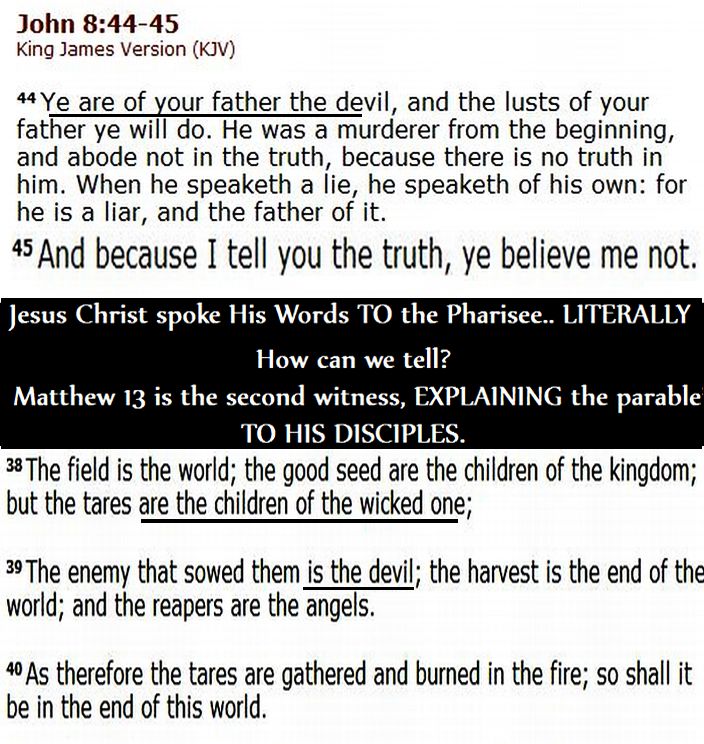
God no longer speaks directly to leaders of civil government, to the leaders of church government, or to others. He speaks to believers, led by the Holy Spirit, through His Word, the Bible. This is consistent with the fact that He only ordained one theocracy, Israel, prior to the second return of Christ. Yet Covenant Theology united church and state, with the church taking the place of God in speaking directly to the civil government. As a result, the “church” used the strong arm of the state to enforce its own particular brand of religion, or the state itself enforced its preferred religion. The only way to justify such a union is to use a false interpretation of Scripture, an interpretation which, since it is based upon Satan’s principles, must have been developed by Satan himself and implemented either by his children or by children of God who were not walking in the spirit according to knowledge.

The most noticeable and atrocious consequence of all church-state and state-church unions has been the confiscation of property, dissemination of lies about “heretics” as defined by the state-church, and other persecutions such as the beating, torture, imprisonment, and killing of untold millions of people who have dissented from the views of the state-church. The ultimate result of church-state or state-church alliances is always the same—the alliance of church and state called for by a perverted interpretation of Scripture forces others to profess allegiance to the doctrines of the official church under penalty of persecution, thereby attempting to stamp out those who practice free will. The state-church or church-state enforces its own peculiar doctrines including all of the Ten Commandments among which are the first four commandments which deal with man’s relationship to God. In effect, it requires many to be dishonest with both man and God. Since no one can be forced to choose to believe a particular religious belief in their heart, a lot of religious hypocrites are thereby created.

As history shows, the official corrupted “church” was vile to the core. The reformers became especially aware of the corruption within the Roman “church.” Corruption is inevitable when church and state are intermixed.

To quote a great Bible teacher: “The church that sets out to spiritualize the world will soon find that the world will secularize the church. When wheat and tares compromise, it is the wheat that suffers. Light and darkness, right and wrong, good and evil, truth and error are incompatibles, and when they compromise it is the light, the right, the good, and the truth that are damaged” (W. Graham Scroggie, born 1877, twelve times the Bible teacher at the famous Keswick, England conference, They Knew Their God, Vol. 5, 194 cited in The Berean Call, February 2006, p. 5, available at www.thebereancall.org. Separation is a Biblical principle that runs throughout scripture—Pastor Hank Thompson gave a tremendous sermon on “Separation” on Sunday evening,February 12, 2006. Ask for notes on that sermon.).

As Pastor Hank Thompson, has preached: “Holy means set apart for God.  You cannot bring that which is holy and unholy together without making the holy things unholy. Holy things combined with unholy things do not make the unholy holy. It always makes the holy unholy. Being around someone who is sick may make a well person sick. Being around a well person won’t make a sick person well. If you are grounded and touch the ground and a power line at the same time, you are cooked. If you try to touch God and touch the world, you will be corrupted.” (“Separation.” Sermon preached at Capitol City Baptist Church in Austin, Texas by Pastor Hank Thompson,February 12, 2006).

The Holy Bible, the basic source for all truth proclaims: “Be ye not unequally yoked together with unbelievers: for what fellowship hath righteousness with unrighteousness? and what communion hath light with darkness? And what concord hath Christ with Belial? or what part hath he that believeth with an infidel? And what agreement hath the temple of God with idols? for ye are the temple of the living God: as God hath said, I will dwell in them and walk in them: and I will be their God, and they shall be my people. Wherefore, come out from among them, and be ye separate, saith the Lord, and touch not the unclean thing; and I will receive you. And will be a Father unto you, and ye shall be my sons and daughters saith the Lord Almighty.” (2 Co. 6.14-18. The doctrine of separation is taught extensively in the Word of God.).

Just as the union of church and state corrupted the Roman “church” and society, it also corrupted the established Protestant churches and the nations which had established Protestant churches.

The church proceeded under the New Covenant, whereas the Jewish theocracy operated under the Mosaic covenant. Isaac Backus, in pointing out that Jesus did away with the Old Testament Covenant of Law, wrote:

“When our Savior came, he fulfilled the law, both moral and ceremonial, and abolished those hereditary distinctions among mankind. But in the centuries following, deceitful philosophy took away the name which God has given to that covenant, (Acts vii.8) [the covenant of circumcision] and added the name Grace to it; from whence came the doctrine, that dominion is founded in grace. And although this latter name has been exploded by many, yet the root of it has been tenaciously held fast and taught in all colleges and superior places of learning, as far as Christianity has extended, until the present time; whereby natural affection, education, temporal interest and self-righteousness, the strongest prejudices in the world, have all conspired to bind people in that way, and to bar their minds against equal liberty and believer’s baptism.” (Isaac Backus, An Abridgement to the Church History of New England (Boston: Harvard University, 1804; reprinted. 1935), p. 136. cited in Beller, America in Crimson Red…, p. 446).

Scriptures, other than those already cited to show that the church and state are not to wed or to enter into any kind of relationship, especially for persecution of those who do not submit to the official religion, teach that the church is not to enforce spiritual laws in society in general, even with the help of civil government. The Lord commanded that men not remove the tares “lest [they] root up also the wheat [the children of the kingdom]” (Mt. 13.24-30, 37-43). Instead, they are to be permitted to grow together until the harvest when the Lord shall send forth his angels to gather the tares and cast them into a furnace of fire (Ibid.). The Lord commanded His disciples to leave the Pharisees, whom He referred to as the “blind leading the blind,” alone because “every plant, which [His] heavenly father hath not planted, shall be rooted up” (Mt. 15.13-14). He told his disciples: “Let them alone: they be blind leaders of the blind. And if the blind lead the blind, both shall fall in the ditch” (Mt. 15.14).

As Roger Williams noted, “This sentence against [the blind Pharisee], the Lord Jesus only pronounceth in his church, his spiritual judicature, and executes this sentence in part at present, and hereafter to all eternity. Such a sentence no civil judge can pass, such a death no civil sword can inflict” (Williams and Underhill, p. 97).

Other relevant scriptures dealing with the actions of a Christian against his enemies, those who curse, hate, despitefully use, persecute and disagree with him include:

  • “But I say unto you, Love your enemies, bless them that curse you, do good to them that hate you, and pray for them which despitefully use you, and persecute you; That ye may be the children of your Father which is in heaven: for he maketh his sun to rise on the evil and the good, and sendeth rain on the just and on the unjust. For if ye love them which love you, what reward have ye? do not even the publicans the same? And if ye salute your brethren only, what do ye more than others? do not even the publicans so” (Mt. 5.44-47)?
  • The Lord said to his disciples, “Behold, I send you forth as sheep in the midst of wolves: be ye therefore wise as serpents, and harmless as doves. But beware of men: for they will deliver you up to the councils, and they will scourge you in they synagogues; [a]nd ye shall be brought before governors and kings for my sake, for a testimony against them and the Gentiles” (Mt. 10.16-18). What sheep ever attacked a wolf or anything else?
  • “And John answered him, saying, Master, we saw one casting out devils in thy name, and he followeth not us: and we forbad him, because he followeth not us. But Jesus said, Forbid him not: for there is no man which shall do a miracle in my name, that can lightly speak evil of me. For he that is not against us is on our part. For whosoever shall give you a cup of water to drink in my name, because ye belong to Christ, verily I say unto you, he shall not lose his reward” (Mk. 9.38. See also Lu. 9.49-50).
  • The Lord Jesus said to his disciples, James and John, who desired to command fire down from heaven to devour Samaritans who would not receive Him, “Ye know not what manner of spirit ye be of. For the Son of man is not come to destroy men’s lives, but to save them” (Lu. 9.55-56).
  • “The thief cometh not, but for to steal, and to kill, and to destroy: I am come that they might have life, and that they might have it more abundantly. I am the good shepherd: the good shepherd giveth his life of the sheep” (Jn. 10.10-11).
  • “And the servant of the Lord must not strive; but be gentle unto all men, apt to teach, patient, [i]n meekness instructing those that oppose themselves; if God peradventure will give them repentance to the acknowledging of the truth; [a]nd they may recover themselves out of the snare of the devil, who are taken captive by him at his will” (2 Ti. 2.24-26).

The reason for not attempting to remove heretics, the tares, from the world seems to be, as Roger Williams noted:

  • “because they who now are tares, may hereafter become wheat; they who are now blind, may hereafter see; they that now resist him may hereafter receive him; that that are now in the devil’s snare, in adverseness to the truth, may hereafter come to repentance; they that are now blasphemers and persecutors, as Paul was, may in time become faithful as he; they that are now idolaters, as the Corinthians once were, 1 Cor. vi. 9, may hereafter become true worshippers as they; they that are now no people of God, nor under mercy, as the saints sometimes were 1 Pet. ii. 10, may hereafter become the people of God, and obtain mercy, as they.
  • “Some come not till the eleventh hour, Matt. xx. 6: if those that come not till the last hour should be destroyed, because they come not at the first, then should they never come, but be prevented” (Williams and Underhill, pp. 11-12).

Persecution of “heretics” is contrary to many New Testament teachings. True believers were promised that they would be persecuted, and never were told to persecute anyone. Jesus told the disciples that “the time cometh that whosoever killeth you will think that he doeth God service” (Jn. 16.2. This was spoken directly to the apostles, but the Bible and history show that it is applicable to all believers who have been persecuted or will be persecuted for Christ’s sake. Christ is actually speaking to all who are not of the world, but are the chosen of God. See, e.g., Jn. 15.).

The promises to the Jew in the Old Testament were significantly different than the promises to the Christian in the New Testament. No greater example can be cited than the contrast between the Old Testament promises that Israel would prosper and be blessed materially if they would keep God’s commandments and statutes or that they would be judged if they failed to do so (See, e.g., Ex. 15.26; 19.5-8; 24.3, 7; 34.18-35.3; Le. 18.3-20.27; 20.22-23; 26 (read in conjunction with De. 28-30); De. 4-11; 12.30-31; 28-30; 28.1-68; I S. 12.1-5; 1 K. 6.12-13; 9.1-9; 2 Chr. 7.12-22; 15.1-7; etc.) and the New Testament promise to Christians that “all that will live godly in Christ Jesus shall suffer persecution” (2 Ti. 3.12).

The church and state wed at the invitation of the Roman Emperor Constantine early in the fourth century. Some churches married the state and became the officially recognized “church.” After that unholy union, the established Roman Catholic “church,” working hand in hand with the state, persecuted believers. The persecution was continued by the Protestant churches which came out of Roman Catholicism, and finally was brought to America and our colonies by the Puritans, Anglicans, and others.

Throughout these teachings, Scripture and arguments are presented which refute Covenant Theology. Section I, which deals with government, explains that God, because of His covenants with Israel, will establish Israel in the land he has given them. Section II, which deals with the church, shows that Christ desires to be the only head of the church, that He loves the church and gave Himself for it, and that the church is the bride and wife of Christ. The distinct differences between the church and state, as will be shown in Chapter 4 infra, render the two mutually exclusive, operating in different spheres—the civil government or the state operates in the earthly sphere and the church operates in the spiritual realm (although application of spiritual principles affect earthly actions).

The Covenant Theology examined in this book cannot coexist with free will. As will be shown in Section IV, the established churches in almost all the American colonies advocated either a church-state or state-church, unions of church and state under which the strong arm of the state punished, sometimes by death, (execution of dissidents in the colonies was forbidden by England after four Quakers were hanged in Massachusetts as will be explained in Section IV) those the state-church labeled as “heretics.” Had the official churches prevailed, America would not have the First Amendment to the United States Constitution. Thank God that Baptist dissenters led the fight that resulted in liberty of conscience guaranteed by the First Amendment to the United States Constitution.

Endnotes

EN1 Why should believers, and especially pastors, be concerned about the area of church and state law? Because only through knowledge can they avoid dishonoring the Husband/Bridegroom/Head of their local church body and thereby failing to achieve their God-given goal—glorifying God and pleasing Him.

These articles systematically examine the biblical doctrines of church, state, separation of church and state and the application of those doctrines in America. For believers and churches, the information presented is—according to God’s Word—of great importance to our Lord. By reading and studying each article using the Bible as the standard, a believer will discover that the biblical principles are correct as presented. By studying the historical and legal facts presented—without bias, prejudice, illicit motive, or an overriding opposing agenda which has a vested interest in maintaining a status quo due to loss of finances, support or something else—and examining those facts in light of biblical principle, a qualified believer (a believer who has the necessary biblical, historical, and legal qualifications and education) can understand that the conclusions are correct.

That said, understanding the biblical principles, relevant history, and legal principles and facts is, first, impossible for one who is not a born again believer who is walking in the Spirit, and, second, daunting for even the spirit filled follower of Christ. Years of honest, open minded study is required to achieve the correct knowledge and understanding of all facets of church and state law. First, one must interpret Scripture correctly (See 2 Ti. 2:15) as to the relevant topics. After mastering the biblical principles, one must then labor through the annals of history, and the intricacies of law. In order to be qualified to comment upon the law, one must have an extensive legal education. He must understand how to do legal research and how to reach correct legal conclusions. Legal commentary by a pseudo lawyer can sound good to the untrained, while he may be correctly understood as frivolous and unlearned and probably heretical by the educated believer.

This is not to say that a non-lawyer cannot understand the legal and historical aspects of spiritual matters. In fact, the author knows some pastors and other believers who, having already correctly divided the Word of Truth and determined to seek to please God in all matters, have open minds and who have eagerly sought truth in the historical and legal church and state law arena. He is working with such a young pastor at this very moment. He is a brilliant young man who had mastered the Scriptures and Baptist history before the author met him. He excels the author in those matters, as do some other pastors and believers known by the author. Unlike most pastors, he does not have the disadvantages of having gone to either a secular or ecclesiastical (Baptist or otherwise) institution of higher learning. Secular colleges and universities usually corrupt even the most devout child of God; and religious colleges, institutions, and seminaries generally (with few exceptions, one of which the author has personal knowledge of)—by either mixing an ample dose of humanism with whatever biblically correct teaching they dose out; or by having totally having abandoned truth—likewise usually corrupt their students to one degree or another.

On the other hand, the author isvexed by what he reads in some books and websites concerning church and state law; particularly by some vicious, unfounded attacks upon the Biblical Law Center Declaration of Trust by unqualified, biased assailants who are attempting to mislead believers and churches through incorrect biblical and legal analyses and personal attacks upon and outright lies about those with whom they disagree in such matters.

Being a believer alone, even a pastor, does not by itself qualify one to teach on church and state law. The author has been a believer and faithful member of independent Baptist churches since his salvation. He was called by God to go to law school for His glory and to please Him. As a result of that calling, he obtained a Doctor of Jurisprudence degree from one of the best law schools in the country and has practiced law for seventeen years. He has no motive for dishonesty. By design, he has never made a dime above expenses in his work in the church and state law arena. In fact, he has spent tens of thousands of dollars with total income of at most three to four thousand dollars in all the years he has worked in this area of law. Because of this he is beholden to no one and nothing but the truth and his Lord and Savior. Since becoming a lawyer, he has devoted untold thousands of hours in biblical, historical, and legal study and analysis of church and state law.

As always, he declares that if anyone can show him where he is in error, he will recant. Honest, loving believers have taught him much and caused him to modify some of his positions. He has also, in his continued studies, modified some of his conclusions and positions. However, he maintains his primary positions because neither he, through his continued studies, or others have shown him to be wrong about his basic church and state law principles and conclusions.

EN2. God Betrayed/Separation of Church and State: The Biblical Principles and the American Application (Link to preview of God Betrayed): may be ordered from Amazon by clicking the following link: God Betrayed on Amazon.com or from Barnes and Nobel by clicking the following link: God Betrayed on Barnes and Noble. All books by Jerald Finney as well as many of the books he has referenced and read may also be ordered by left clicking “Books” (on the “Church and State Law” website) or directly from Amazon by going to the following links: (1) Render Unto God the Things that Are His: A Systematic Study of Romans 13 and Related Verses (Kindle only); (2) The Most Important Thing: Loving God and/or Winning Souls (Kindle only); (3) Separation of Church and State/God’s Churches: Spiritual or Legal Entities? (Link to preview of Separation of Church and State/God’s Churches: Spiritual or Legal Entities?) which can also be ordered by clicking the following Barnes and Noble link: Separation of Church and State on Barnes and Noble.
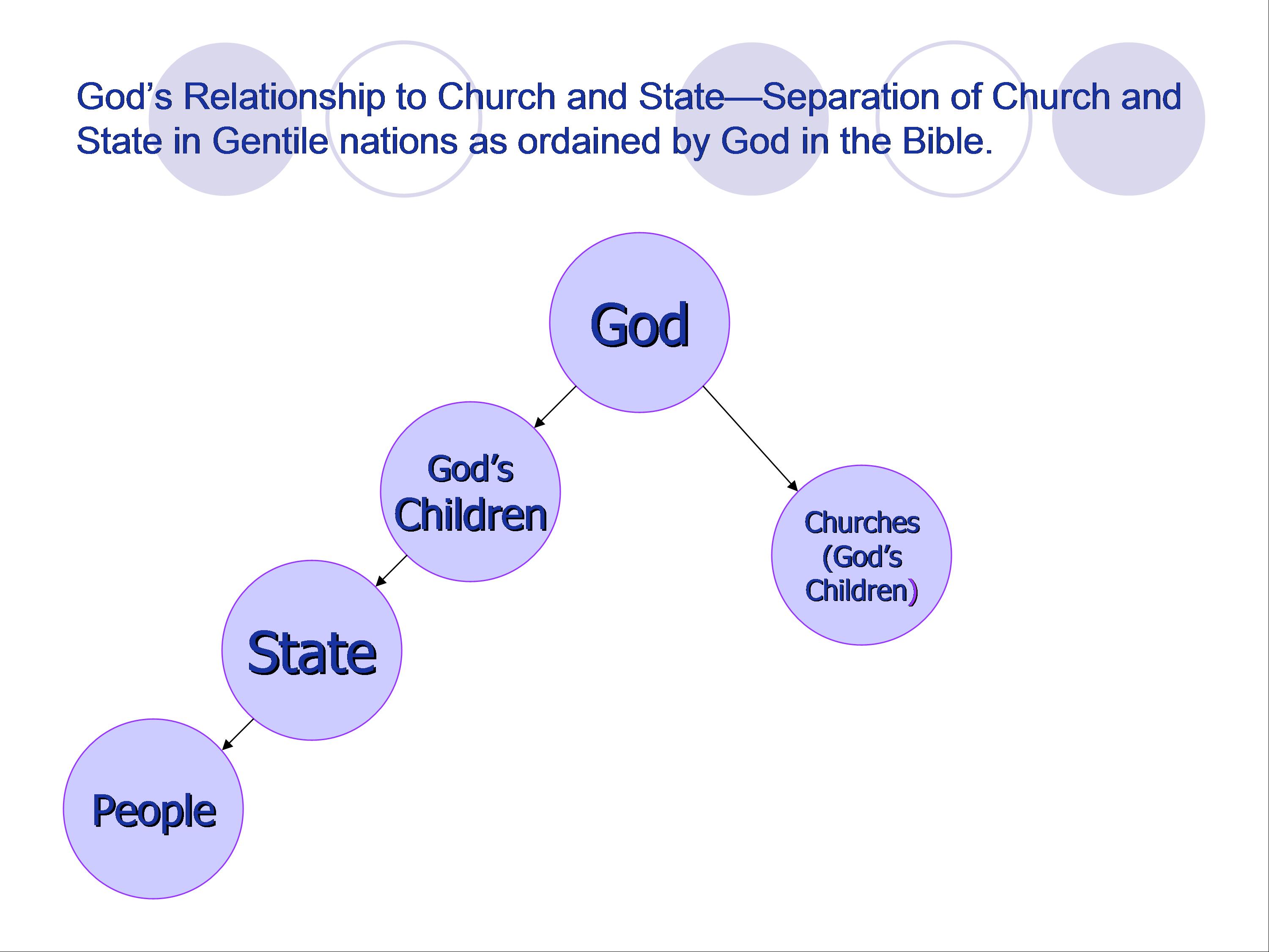
Definitions of “Separation of Church and State,” “Established Church,” and “Religious Freedom or Soul Liberty”


Jerald Finney
Copyright © March 10, 2012
Revised July 27, 2014


Click here to go to Jerald Finney’s audio teachings on this material.
This article somewhat modifies that audio teaching.


Definitions of “Separation of Church and State,” “Established Church,” and “Religious Freedom or Soul Liberty”

Study Bible to verify this teaching which is explained in the writings and teachings of Jerald Finney.
Study the King James Bible to verify this principle which is explained in the writings and teachings of Jerald Finney.

Definitions of “separation of church and state,” “established church” and “religious freedom or soul liberty,” are necessary in order to understand the principle of separation of church and state. The biblical principle of “separation of church and state” is that God desires both a church and the state to choose to be under God, but desires neither to be over or to work hand in hand with the other. A church has spiritual responsibilities. The state has earthly responsibilities. The Bible contains different principles for a church and the state. God desires the two to be totally separate entities, both ordained by God who desires both to submit to Him in love and to be guided by His principles as stated in His Word.

This statement by Mark Twain is correct.

An established church is a church who is an integral part of the state and receives state support. The established church and state reach an agreement or enter into a contract whereby either the state aids the church in attaining earthly and/or spiritual goals or vice-versa and, to one degree or another, the state runs the church or the established church runs the state. The church and state work hand in hand to enforce earthly and spiritual laws and principles. In modern America state-churches are influenced, perverted, and/or perhaps dominated by state enforced satanic principles.

Historically, the established church has either been over the state, or the state has been over the established church. When the state has been over the church, the state directs the affairs of the church to a greater or lesser degree and vice-versa. In either case, the spiritual affairs of the church are mixed with the earthly responsibilities of the state. In the past, in either a church-state or state-church, leaders of both church and state operated under a false theology based upon false biblical principles. The results were (1) corruption of the church, corruption of the state, corruption of the clergy and political leaders and the members of society and the church, and (2) torture, imprisonment, and/or the killing of those who refused to bow down to the theology of the church-state or state-church. We see the former results in the church-state activities in America today. The latter results are coming.

6Religious freedom exists when every citizen has, by law, the choice, without persecution, of choosing God, false gods or a false god, or no god at all. Religious freedom, as shown in God’s Word, is what He desires in a Gentile nation. Even though He desires Gentile nations to provide for religious liberty, He also wants them to submit themselves to Him and His principles, and recognize that Jesus Christ is the Supreme Sovereign. Thus a nation modeled after biblical principles will provide for religious liberty while also operating under God and His principles.

8In today’s incorporated 501(c)(3) church in America, the rules of civil government for the church are secular and the civil government enforces certain public policies even when those policies go against biblical principles. Christians in America suffer a very mild degree of persection.

10“By religious freedom, or soul liberty, is meant the natural and inalienable right of every soul to worship God according to the dictates of his own conscience, and to be unmolested in the exercise of that right, so long, at least, as he does not infringe upon the rights of others; that religion is, and must be a voluntary service; that only such service is acceptable to God; and, hence that no earthly power, whether civil or ecclesiastical, has any right to compel conformity to any creed or to any species of worship, or to tax a man for its support.

5

Click the above to go to the online version of the book.

“This principle gives to ‘Caesar’ ‘the things that are Caesar’s,’ but it denies to Caesar ‘the things that are God’s.’ It does not make it a matter of indifference what a man believes or how he acts, but it places all on the same footing before God, the only lord of the conscience, and makes us responsible to him alone for our faith and practice. [By 1900 this doctrine was] very generally accepted, not only in Virginia, but also throughout the United States. It [had] been incorporated into our National and State Constitutions, and it [was] the basis for our civil liberties” (Charles F. James, Documentary History of the Struggle for Religious Liberty in Virginia (Harrisonburg, VA.: Sprinkle Publications, 2007; First Published Lynchburg, VA.: J. P. Bell Company, 1900), p. 9.).

Introduction to the Biblical Doctrine of “Separation of Church and State”


Jerald Finney
Copyright © January 3, 2012


Click here to go to “Self-exam Questions: Introduction to the Biblical Doctrine of Separation of Church and State” [To be added when time permits]


Preface

This article is a continuation of Jerald Finney’s systematic development of the doctrines, application, history, and legalities of “separation of church and state.” See EN29 for more on this matter. This article is an edited version of Section III, Chapter 1 of the book God Betrayed/Separation of Church and State: The Biblical Principles and the American Application (Link to preview of God Betrayed). (Link to Contents of “Separation of Church and State Law” Blog which has links so that the new follower can start his study at the beginning. “Line upon line, precept upon precept.”). See EN30 for information on books by Jerald Finney which thoroughly examine “separation of church and state law.”


Introduction to the biblical doctrine of “Separation of Church and State”

Historically, Christians, as warned by Jesus and the apostles, have been persecuted. Christians were persecuted from the beginning of the church. After union of church and state in the fourth century, the established “church,” in conjunction with the state, persecuted Christians.

Jesus preached to the multitudes concerning persecution of His followers: “Blessed are they which are persecuted for righteousness’ sake: for theirs is the kingdom of heaven. Blessed are ye when men shall revile you, and persecute you, and shall say all manner of evil against you falsely, for my sake. Rejoice, and be exceeding glad: for great is your reward in heaven: for so persecuted they the prophets which were before you” (Mt. 5.10-12).

Jesus warned the disciples that His followers would be persecuted: “If the world hate you, ye know that it hated me before it hated you. If ye were of the world, the world would love his own: but because ye are not of the world, but I have chosen you out of the world, therefore the world hateth you. Remember the word that I said unto you, The servant is not greater than his lord. If they have persecuted me, they will also persecute you; if they have kept my saying, they will keep yours also. But all these things will they do unto you for my name’s sake, because they know not him that sent me” (Jn. 15.18-21). [Emphasis mine.]

At first the persecution of Christians was by the Jewish religious leaders. Paul (then called Saul) was present at the stoning of Stephen, the first Christian martyr (Ac. 8.1). Paul, before salvation, was actively involved in persecution: “As for Saul, he made havock of the church, entering into every house, and haling men and women committed them to prison” (Ac. 8.3). After Paul’s salvation, he was persecuted and finally beheaded. He was seized by the Jews during his last visit to Jerusalem. They would have killed him, but as they were beating him, the chief captain of the Romans took soldiers and centurions, intervened, and held him. At that time Paul was allowed to speak to the people. He said, “I am verily a man which am a Jew, born in Tarsus, a city in Cilicia, yet brought up in this city at the feet of Gamaliel, and taught according to the perfect manner of the law of the fathers, and was zealous toward God, as ye all are this day. And I persecuted this way unto the death, binding and delivering into prisons both men and women” (Ac. 22.3-4).

Following the crucifixion of the Savior “in rapid succession fell many other martyred heroes [in addition to Stephen and Paul, already mentioned]: … Matthew was slain in Ethiopia, Mark dragged through the streets until dead, Luke hanged, Peter and Simeon were crucified, Andrew tied to a cross, James beheaded, Philip crucified and stoned, Bartholomew flayed alive, Thomas pierced with lances, James, the less, thrown from the temple and beaten to death, Jude shot to death with arrows, Matthias stoned to death…” EN1.

Rome persecuted Christians off and on until the early fourth century. The persecution varied in extent and duration with various emperors. EN2. Then, some “churches” were recognized by the state and formed a union with the state and became the official state “church.” “[U]nder the leadership of Emperor Constantine there [came] a truce, a courtship and proposal of marriage. The Roman Empire through its emperor [sought] a marriage with Christianity. Give us your spiritual power and we will give you of our temporal power…. In A.D. 313, a call was made for a coming together of the Christian churches or their representatives. Many but not all came. The alliance was consummated. A Hierarchy was formed. In the organization of the Hierarchy, Christ was dethroned as head of the churches and Emperor Constantine enthroned (only temporarily, however) as head of the church. [This was the beginning of what became the Catholic church.] Let it be definitely remembered that when Constantine made his call for the council, there were very many of the Christians … and of the churches, which declined to respond. They wanted no marriage with the state, and no centralized religious government, and no higher ecclesiastical government of any kind, than the individual church.” EN3.

Before the union of church and state, both Judaism and Paganism had persecuted Christians. After the union, “Christians” began to persecute Christians. “Thus [began] the days and years and even centuries of a hard and bitter persecution against all those Christians who were loyal to the original Christ and Apostolic teachings.” EN4. Some leaders of that new state “church” who had supported liberty, “forgot what they had preached in their youth” and supported persecution of dissenters. The most significant of these was St. Augustine. “Augustine made much use of the passage in Luke 14.23: ‘Go out into the highways and hedges, and compel them to come in, that my house may be filled.’ His position on religious liberty has been summarized in the maxim commonly (though erroneously) ascribed to him: ‘When error prevails, it is right to invoke liberty of conscience; but when, on the contrary, the truth predominates, it is just to use coercion.’ Augustine’s influence on the course of religious liberty and the relationship of church and state can hardly be measured. Fifteen hundred years have passed since his death, yet his teachings are still a potent factor in the position of the Catholic Church on the subject of religion and government. As a result of his teaching, “The principle that religious unity ought to be imposed in one way or another dominates the whole of the Christian Middle Ages and finds a concise and rigorous sanction in civil as well as in ecclesiastical legislation. “Because of Augustine, more than any other person,“the Medieval church was intolerant, was the source and author of persecution, justified and defended the most violent measures which could be taken against those who differed from it.” EN5.

The Middle Ages reflected the thinking of “Augustine and Aquinas, who taught that salvation could be achieved through compulsion, and that oppression and persecution of heretics was not merely the right but the holy duty of the Church.” EN6. “Over 50,000,000 Christians died martyr deaths … during the period of the ‘dark ages’ alone—about twelve or thirteen centuries” EN7.

The Inquisition was instituted in 1215 A.D. at a Council called by Pope Innocent III. “[P]robably the most cruel and bloody thing ever brought upon any people in all the world’s history was what is known as the ‘Inquisition,’ and other similar courts, designed for trying what was called ‘heresy.’ The whole world is seemingly filled with books written in condemnation of that extreme cruelty, and yet it was originated and perpetuated by a people claiming to be led and directed by the Lord. For real barbarity there seems to be nothing, absolutely nothing in all history that will surpass it.” EN8.

The atrocities and heresies of the Catholic “church” eventually led to an effort to reform that “church” from within. Among the greatest of the reformers were Martin Luther, who started the Lutheran church (which became the state-church of Germany), and John Calvin, founder of the Presbyterian church (which became the state-church of Scotland). During this period of reformation, there always existed those who dissented from Catholic and Reformation theology. In early sixteenth century Germany, two currents flowed in opposite directions. One, fostered by the established church, was toward a state-church. The other, promoted by dissenters, was toward separation of church and state. When a Protestant church became an established church it continued the persecution practiced by the harlot church.

“Both the Lutheran and Presbyterian Churches brought out of their Catholic Mother many of her evils, among them her idea of a State Church. They both soon became Established Churches. Both were soon in the persecuting business, falling little if any, short of their Catholic Mother.” EN9. (Ibid., p. 33).

Martin Luther wrote:

“It is out of the question that there should be a common Christian government over the whole world. Nay, over even one land or company of people since the wicked always outnumber the good. A man who would venture to govern an entire country or the world with the Gospel would be like a shepherd who would place in one fold wolves, lions, eagles, and sheep together and let them freely mingle with one another and say, ‘Help yourselves, and be good and peaceful among yourselves. The fold is open, there is plenty of food, have no fear of dogs and clubs.’ The sheep forsooth would keep the peace and would allow themselves to be fed and governed in peace; but they would not live long nor would any beast keep from molesting another. For this reason, these two kingdoms must be sharply distinguished and both be permitted to remain. The one to produce piety, the other to bring about external peace and prevent evil deeds. Neither is sufficient to the world without the other.” EN10.

“When Luther was expecting excommunication and assassination, he pleaded that: “Princes are not to be obeyed when they command submission to superstitious error, but their aid is not to be invoked in support of the Word of God. “Heretics, he said, must be converted by the Scriptures, and not by fire. With passion he asserted:

“I say, then neither pope, nor bishop, nor any man whatever has the right of making one syllable binding on a Christian man, unless it be done with his own consent. Whatever is done otherwise is done in the spirit of tyranny…. I cry aloud on behalf of liberty and conscience, and I proclaim with confidence that no kind of law can with any justice be imposed on Christians, except so far as they themselves will; for we are free from all.” EN11.

Nonetheless, Luther later, when he had made an effective alliance with the secular power, advocated that the magistrate, who does not make the law of God, enforce the law of God. According to Luther:

  • “The law is of God and from God. The State is the law-enforcing agency, administering a law of God that exists unchangeably from all eternity….
    “The need for a state arises from the fact that all men do not hear the word of God in a spirit of obedience. The magistrate does not make the law, which is of God, but enforces it. His realm is temporal, and the proper ordering of it is his responsibility. Included in the proper ordering the maintenance of churches where the word of God is truly preached and the truly Christian life is taught by precept and example. In his realm, subject to the law of God, the Prince is supreme, nor has man the right to rebel against him. But if the Prince contravenes the law of God, man may be passively disobedient, in obedience to a higher and the only finally valid law.” EN12.
  • “Heretics are not to be disputed with, but to be condemned unheard, and whilst they perish by fire, the faithful ought to pursue the evil to its source, and bathe their hands in the blood of the Catholic bishops, and of the Pope, who is the devil in disguise.” EN13. (Acton, pp. 102-103, quoted in Pfeffer, p. 21; see also, Verduin, Anatomy of a Hybrid, pp. 158-160, 163-168, 186-198; Leonard Verduin, The Reformers and Their Stepchildren (Grand Rapids, Wm. B. Erdsmans Pub. Co., 1964) and Thomas Armitage, The History of the Baptists, Volumes 1 and 2 (Springfield, Mo.: Baptist Bible College, 1977 Reprint). ().

Luther espoused that coercion by the state to achieve religious unity was justifiable. This was an expansion of Erastian philosophy—“the assumption of state superiority in ecclesiastical affairs and the use of religion to further state policy.” Erastianism … pervaded all Europe, with the exception of Calvin’s ecclesiocratic Geneva, after the Reformation. EN14. Erastianism achieved its greatest triumph in England. EN15. See Ibid., pp. 24-25 for a concise history of Erastianism in England.

Luther’s position resulted in persecution of dissenters such as Anabaptists who believed in believer’s baptism. Although there is no reason to believe that the Anabaptists were explicit believers in a separation of church and state and in religious tolerance, opposition to a state-church follows logically from the thinking behind adult baptism:

“Believer’s baptism [was] the key to religious thought of the Anabaptists. Infant baptism implies that a child may be admitted into the Church without his understanding or personal consent. Such a church must be a formal organization, with sponsored membership possible for those whose years permit neither faith nor understanding. Adult baptism implies a different concept of the Church. The anabaptized are the elect of a visible church which is essentially a religious community of the elect. But obviously such a church could in no sense be a State Church. The Prince could neither bring it into being, regulate it, nor enforce membership in it; indeed, any connection between the State and such a church could only be injurious to the Church. Adult baptism on the surface is remote from the concept of a separated Church and State, yet such separation is implicit in the rationale of Anabaptism. The call to such a church can never come from the palace of the Prince; it must come from the Kingdom of Heaven…” EN16. [Emphasis mine.]

John Calvin pointed out that “these two [church and state] … must always be examined separately; and while one is being considered, we must call away and turn aside the mind from thinking about the other.” He followed this approach in order to expound the “[d]ifferences between spiritual and civil government,” insisting that “we must keep in mind the distinction … so that we do not (as so commonly happens) unwisely mingle these two, which have a completely different nature.” EN17. “[Calvin] also wrote: ‘But whosoever knows how to distinguish between body and soul, between the present fleeting life and that future eternal life, will without difficulty know that Christ’s spiritual Kingdom of Christ and the civil government are things completely distinct.’” EN18.”

He taught that “the church does not assume to itself what belongs to the magistrate, nor can the magistrate execute that which is executed by the Church.” EN19.

However, when he established his ecclesiocracy (the author uses this term to denote a civil government in which the church and state work together to enforce spiritual and earthly laws unlike the theocracy in Israel in which God himself was directly over the state) in Geneva, absence from the sermon, and missing the partaking of the Sacrament were punished. “Criticism of the clergy was included in the crime of blasphemy and blasphemy was punishable by death” as was the contention that “it is unjust to put heretics and blasphemers to death.” EN20. Government had “‘the duty of rightly establishing religion’ and had as its ‘appointed end’ to ‘cherish and protect the outward worship of God, to defend sound doctrine of piety and the position of the church.’” EN21. Calvin’s ecclesiocratic relationship of church and state was “based on ecclesiastical supremacy and the use of state machinery to further religious interests.” EN22.

During this same period the Church of England arose from a split or division in the Catholic ranks. Henry VIII, king of England, “threw off papal authority and made himself head of the Church of England” when the Pope refused to grant him a divorce from Catherine of Spain so that he could marry Anne Boelyn. Henry’s successor, Mary, reinstated Catholicism, but her successor, Elizabeth, re-established the Church of England.

“Thus, before the close of the Sixteenth Century, there were five established Churches—churches backed up by civil governments—the Roman and Greek Catholics [the Greek Catholics separated from the Roman Catholics in the ninth century] counted as two, then the Church of England; then the Lutheran, or Church of Germany, then the Church of Scotland now known as the Presbyterian. All of them were bitter in their hatred and persecution of the people called Ana-Baptists, Waldenses and all other non-established churches, churches which never in any way had been connected with the Catholics…. Many more thousands, including both women and children were constantly perishing every day in the yet unending persecutions. The great hope awakened and inspired by the reformation had proven to be a bloody delusion. Remnants now [found] an uncertain refuge in the friendly Alps and other hiding places over the world.” EN23.

Sometime in the early seventeenth century, the Congregational church began. That church repudiated preacher rule and returned “to the New Testament democratic idea” while retaining many other “Catholic made errors such as infant baptism, pouring or sprinkling for baptism, and later adopted and practiced to an extreme degree the church and state idea. And, after refugeeing to America, themselves, became very bitter persecutors.” EN24.

The persecution of dissenters moved to America along with colonization. Section IV will cover this topic.

The final persecution is planned for those who, prior to the rapture, remain ‘separate’ by denying the divinity of man—they are to be ‘driven’ from this planet.” This persecution is being planned by Maitreya, who claims that he is a Christ and is simply waiting for humanity to call him forth. Another New Age leader, Barbara Marx Hubbard, wrote that she was told

“that her ‘Christ’ specifically described this purposeful elimination process as ‘the selection process.’ Like Maitreya, she stated that the selection process will be the penalty for anyone who persists in the ‘self-centered’ belief that humanity is not divine and is ‘separate’ from God. By this definition, Bible-believing Christians—the ones who really are Bible believing—would be defined as among those who are ‘self-centered’ and ‘separate.’ In what would be a fulfillment of the prophecy that the Antichrist will ‘make war with the saints’ (Revelation 13:7), Hubbard’s ‘Christ’—sounding much like Maitreya—states that he will ‘make war’ on those who are ‘fearful’ and ‘self-centered.’” EN25.

Ms. Hubbard wrote: “At the co-creative stage of evolution, one self-centered soul is like a lethal cancer cell in a body: deadly to itself and to the whole.” EN26. Ibid., p. 163.

The struggle over separation of church and state moved from the old world to the new, and is probably the most important topic in the history of America. For the first time, God’s truth concerning government, church, and separation of church and state was destined to prevail, first in Rhode Island and then in the United States. Prior to this struggle and since the union of church and state in the fourth century, both Catholic and Protestant sacral doctrine which had seen church and state as a single entity had tried unsuccessfully to stamp out all “heretics” who had never deviated from the true biblical doctrine of “separation of church and state.”

This section will address the biblical principle of separation of church and state. Does a church love and honor the Lord Jesus Christ enough to seek God’s guidance from the Bible concerning the issue of separation of church and state and then to act according to the principles in the Word of God? “Christ loved the church and gave himself for it,” and God “gave [Christ] to be the head over all things to the church.” (See Ep. 5.25 and 1.22); many Christians do not have the knowledge of what this entails.

Even “Christians” who believe in a literal interpretation of Scripture incorrectly interpret certain scriptures out of context to justify union of church and state and perhaps submission of church to the state or state to church. Covenant Theologians, as will be specifically addressed in another article in this section entitled “Dispensational Theology versus Covenant Theology,” to be taken from Section III, Chapter 3 of God Betrayed/Separation of Church and State: The Biblical Principles and the American Application, believe in union of church and state. EN27. For example, many incorrectly interpret the scripture wherein Christ explained that the state is under God when He said, “Render therefore unto Caesar the things which be Caesar’s, and unto God the things which be God’s” (See Lu. 20.19-26; also Mt. 22.15-22; and Mk. 12.13-17).  Many believers, having been Americanized, interpret this statement out of context and on its face to mean that one is to obey every law of the civil government because God gave civil government authority over all matters, spiritual and earthly, except perhaps the matter of salvation. Correctly understanding this statement of Christ requires a thorough understanding of the context in which the statement was made as well as an understanding of the Old and New Testaments.

Romans 13 and I Peter 2.13 are other primary scriptures cited out of context to support unlimited submission to the state in all earthly matters, and in all spiritual matters, with the possible exception of preaching salvation. The true interpretation of Romans 13 and other related verses has already been addressed in the audio teaching “American Abuse of Romans 13.1-2 and Related Verses” which is posted on this website. Additional written articles will be added to this website teaching in the future.

To correctly understand “separation of church and state” a Christian must put aside America’s teaching concerning and understanding of the concept of civil government as the supreme power. Today’s American “Christians” have been indoctrinated by America’s public schools, institutions of higher learning, media, seminaries, Bible colleges, and many churches concerning the doctrines of the church, the state or civil government, God and state, and separation of church and state. Most American “Christians” are far more American than they are Christian. They choose America and America’s principles which are mostly satanic more often than they choose the doctrines of the Word of God. To a great degree, many traditional churches and “Christians” along with many heretical and apostate “Christians” in America have become Erastian in their belief and practice.

Several topics will be examined in this Section of articles dealing with the biblical principle of “Separation of Church and State”: (1) Dispensational Theology as opposed to Covenant Theology which teaches that the principles of the theocracy in Israel are to be applied by the church thereby requiring a union of church and state; (2) some distinct differences between the church and the state which render them mutually exclusive EN28; (3) Christ’s statement concerning Caesar and God; (3) the false interpretation of Romans 13 and I Peter 2.13 which prevails in America and in churches today; (4) and the church’s relationship with Christ. Covenant Theology will be briefly and directly addressed in this Section, and much of what is written by the author in the sections on the biblical doctrine of government, the biblical doctrine of the church, this section on the biblical doctrine of separation of church and state, and the section on the history of religious freedom in America address many of the major shortcomings of Covenant Theology.

God, the Supreme Ruler of the supreme government, ordained both the church and the state. God desires that civil government choose to be under Him, and to operate according to His principles. God also desires that churches also choose to operate under Him, according to His principles. Our Lord explained through the Apostle Paul that God is over both the church and the state:

“And what is the exceeding greatness of his power to us-ward who believe, according to the working of his mighty power. Which he wrought in Christ, when he raised him from the dead, and set him at his own right hand in the heavenly places, For above all principality, and power, and might, and dominion, and every name that is named, not only in this world, but also in that which is to come: and hath put all things under his feet, and gave him to be the head over all things to the church, which is his body, and the fullness of him that filleth all in all” (Ep. 1.19-22).

At the same time, God desires separation of church and state—that is, He desires that neither the church nor the Gentile state work with or be under the other. Understanding the proper biblical relationship of church and state is of utmost importance because Christ who is likened to the Husband of the church is jealous of His wife the church, as should the Christian likewise be jealous over the church. In today’s America, a church who does not understand this proper relationship will be easily influenced to work hand in hand with the state or to put herself under the state, especially, as will be shown in the section on “God Betrayed: Union of Church and State,” through incorporation and civil government tax exemption provisions.

God ordained civil government and the church at different times, for different purposes, and for peoples with different natures. God ordained the state, the civil government, to deal with earthly matters, and the church to deal with spiritual matters. When either a church or a civil government acts outside its God given authority, trouble lies ahead.

It is the responsibility of every church, not the state—regardless of all persecutions by the state, by the church-state alliance, and/or by the world in general—to be a light and stand for and proclaim truth. This is so because a church is the only institution made up of people privy to God’s spiritual insights, and is “the pillar and ground of the truth” (1 Ti. 3.15).

Many earthly relationships and behaviors involve the application of spiritual insights. For example, God teaches, in His Word, the responsibilities of husbands to wives, wives to husbands, parents to children, children to parents, and so forth. Although these are spiritual teachings, they are to be applied in earthly relationships to which there is a spiritual parameter. In other words, God is involved in all relationships and has outlined the ultimate consequences for behaviors, and therefore, everything is spiritual even though it may have an earthly dimension. The trouble comes when man tries to exclude God and His principles, an impossible task.

Every sphere of ordained government has its own God-given jurisdiction. God desires the state to stay out of family affairs unless criminal acts are involved. He wants civil government to stay out of church affairs, and the church, as an institution to stay out of state affairs. Although only mature born again believers who have rightly divided the Word of truth can apply His principles in the realm of government, rarely are such individuals involved in civil government. Generally speaking, those who run civil government cannot know spiritual and ultimate truth since most leaders in civil government are unregenerate (or, in rare instances, Christians who usually are still spiritual babies). A church has no God-given jurisdiction over a family, although church preaching and teaching should teach the biblical rules for parent-child and husband-wife relationships.

Endnotes

EN1. J. M. Carroll, The Trail of Blood, (Distributed by Ashland Avenue Baptist Church, 163 N. Ashland Avenue, Lexington KY 40502, 606-266-4341), p. 11.

EN2. See, e.g., Leo Pfeffer, Church, State, and Freedom (Boston: The Beacon Press, 1953), pp. 10-12

EN3. Carroll, p. 16.

EN4. Ibid., p. 17.

EN5. Pfeffer, p. 14 citing Bates, M. Searle, Religious Liberty: An Inquiry, New Your and London, International Missionary Council, 1945, p. 139; Rufinni, Francesco, Religious Liberty, New York, The Macmillan Co., 1949, p. 36; and Carlyle, Alexander J., The Christian Church and Liberty, London, J. Clarke, 1924, p. 96; See also, Leonard Verduin, The Anatomy of a Hybrid (Grand Rapids, Michigan: William B. Derdmans Publishing Co., 1976), pp. 105-111 and other excerpts.

EN6. Pfeffer, p. 18; Verduin, Anatomy of a Hybrid.

EN7. Carroll, p. 14.

EN8. Ibid., p. 28.

EN9. Ibid., p. 33.

EN10. Works of Martin Luther, Volume 4 (Philadelphia: A. H. Holman Co., 1931), p. 265 cited in Philip Hamburger, Separation of Church and State (Cambridge, Massachusetts: Harvard University Press, 2002), p. 22.

EN11. Pfeffer, p. 21, citing Acton, “The Protestant Theory of Persecution,” in Essays on Freedom and Power, p. 92, and Wace, Henry, and Bucheim, C. A., Luther’s Primary Works, Lutheran Publication Society, Philadelphia, 1885, pp. 194-195, quoted in Noss, John B., Man’s Religions, New York, The Macmillan Co., 1949, p. 92.

EN12. William H. Marnell, The First Amendment: Religious Freedom in America from Colonial Days to the School Prayer Controversy (Garden City, New York: Doubleday & Company, Inc., 1964), pp. 13-14.

EN13. Acton, pp. 102-103, quoted in Pfeffer, p. 21; see also, Verduin, Anatomy of a Hybrid, pp. 158-160, 163-168, 186-198; Leonard Verduin, The Reformers and Their Stepchildren (Grand Rapids, Wm. B. Erdsmans Pub. Co., 1964) and Thomas Armitage, The History of the Baptists, Volumes 1 and 2 (Springfield, Mo.: Baptist Bible College, 1977 Reprint).

EN14. Pfeffer, pp. 23-24.

EN15. See Ibid., pp. 24-25 for a concise history of Erastianism in England.

EN16. Marnell, pp. 18-20.

EN17. Calvin, Institutes of the Christian Religion, 1:847 (IV.xix.15) 2: 1486 (IV.xx.1), trans. Ford Lewis Battles (Philadelphia: Westminster Press, 1960) cited in Hamburger, pp. 22-23.

EN18. Ibid., 2: 1488 (IV.xx.1).

EN19. Pfeffer, p. 22, citing Institutes of the Christian Religion¸ quoted in Stokes, Anson Phelps, Church and State in the United States, New York, Harper & Brothers, 1950, I. p. 110.

EN20. Pfeffer, p. 22.

EN21. Philip Hamburger, Separation of Church and State (Cambridge, Massachusetts: Harvard University Press, 2002), p.  23, citing Institutes of the Christian Religion, 2: 1211 (IV.xi.1; ibid., 2: 1487-1488 (IV.xx.2-3).

EN22. Pfeffer, pp. 23-24.

EN23. Carroll, p. 34.

EN24. Ibid., pp. 37-38.

EN25. Warren Smith, Deceived on Purpose (Magalia, CA: Mountain Stream Press, 2004), pp. 151, 162-164 referring to Barbara Marx Hubbard, The Revelation: A Message of Hope for the New Millennium (Novato, California: Nataraj Publishing, 1995).

EN26. Ibid., p. 163.

EN27. (Link to preview of God Betrayed): God Betrayed may be ordered from Amazon by clicking the following link: God Betrayed on Amazon.com or from Barnes and Nobel by clicking the following link: God Betrayed on Barnes and Noble. All books by Jerald Finney as well as many of the books he has referenced and read may also be ordered by going to the “Books” page on the “Church and State Law” website or directly from Amazon by going to the following links: (1) Render Unto God the Things that Are His: A Systematic Study of Romans 13 and Related Verses (Kindle only); (2) The Most Important Thing: Loving God and/or Winning Souls (Kindle only); (3) Separation of Church and State/God’s Churches: Spiritual or Legal Entities? (Link to preview of Separation of Church and State/God’s Churches: Spiritual or Legal Entities?) which can also be ordered by clicking the following Barnes and Noble link: Separation of Church and State on Barnes and Noble.

EN28. Jesus said in Mt. 16.18: “And I say also unto thee, That thou art Peter, and upon this rock I will build my church; and the gates of hell shall not prevail against it.” The Greek word for church in this verse, “ecclesia (ek = ‘out of,’ kaleo = ‘to call’), an assembly of called out ones. The word is used of any assembly; the word itself implies no more, as, e.g., the town-meeting at Ephesus (Ac. 19:39) and Israel, called out of Egypt and assembled in the wilderness (Ac. 7:38). Israel was a true ‘church,’ but not in any sense the N.T. church—the only point of similarity being that both were ‘called out’ and by the same God. All else is contrast. See Ac. 7:38, note; He. 12:23 note.1917 Scofield Reference Edition, n. 2 to Matthew 16.18, p. 1021.

EN29. Why should believers, and especially pastors, be concerned about the area of church and state law? Because only through knowledge can they avoid dishonoring the Husband/Bridegroom/Head of their local church body and thereby failing to achieve their God-given goal—glorifying God and pleasing Him.

These articles systematically examine the biblical doctrines of church, state, separation of church and state and the application of those doctrines in America. For believers and churches, the information presented is—according to God’s Word—of great importance to our Lord. By reading and studying each article using the Bible as the standard, a believer will discover that the biblical principles are correct as presented. By studying the historical and legal facts presented—without bias, prejudice, illicit motive, or an overriding opposing agenda which has a vested interest in maintaining a status quo due to loss of finances, support or something else—and examining those facts in light of biblical principle, a qualified believer (a believer who has the necessary biblical, historical, and legal qualifications and education) can understand that the conclusions are correct.

That said, understanding the biblical principles, relevant history, and legal principles and facts is, first, impossible for one who is not a born again believer who is walking in the Spirit, and, second, daunting for even the spirit filled follower of Christ. Years of honest, open minded study is required to achieve the correct knowledge and understanding of all facets of church and state law. First, one must interpret Scripture correctly (See 2 Ti. 2:15) as to the relevant topics. After mastering the biblical principles, one must then labor through the annals of history, and the intricacies of law. In order to be qualified to comment upon the law, one must have an extensive legal education. He must understand how to do legal research and how to reach correct legal conclusions. Legal commentary by a pseudo lawyer can sound good to the untrained, while he may be correctly understood as frivolous and unlearned and probably heretical by the educated believer.

This is not to say that a non-lawyer cannot understand the legal and historical aspects of spiritual matters. In fact, the author knows some pastors and other believers who, having already correctly divided the Word of Truth and determined to seek to please God in all matters, have open minds and who have eagerly sought truth in the historical and legal church and state law arena. He is working with such a young pastor at this very moment. He is a brilliant young man who had mastered the Scriptures and Baptist history before the author met him. He excels the author in those matters, as do some other pastors and believers known by the author. Unlike most pastors, he does not have the disadvantages of having gone to either a secular or ecclesiastical (Baptist or otherwise) institution of higher learning. Secular colleges and universities usually corrupt even the most devout child of God; and religious colleges, institutions, and seminaries generally (with few exceptions, one of which the author has personal knowledge of)—by either mixing an ample dose of humanism with whatever biblically correct teaching they dose out; or by having totally having abandoned truth—likewise usually corrupt their students to one degree or another.

On the other hand, the author is vexed by what he reads in some books and websites concerning church and state law; particularly by some vicious, unfounded attacks upon the Biblical Law Center Declaration of Trust by unqualified, biased assailants who are attempting to mislead believers and churches through incorrect biblical and legal analyses and personal attacks upon and outright lies about those with whom they disagree in such matters.

Being a believer alone, even a pastor, does not by itself qualify one to teach on church and state law. The author has been a believer and faithful member of independent Baptist churches since his salvation. He was called by God to go to law school for His glory and to please Him. As a result of that calling, he obtained a Doctor of Jurisprudence degree from one of the best law schools in the country and has practiced law for seventeen years. He has no motive for dishonesty. By design, he has never made a dime above expenses in his work in the church and state law arena. In fact, he has spent tens of thousands of dollars with total income of at most three to four thousand dollars in all the years he has worked in this area of law. Because of this he is beholden to no one and nothing but the truth and his Lord and Savior. Since becoming a lawyer, he has devoted untold thousands of hours in biblical, historical, and legal study and analysis of church and state law.

As always, he declares that if anyone can show him where he is in error, he will recant. Honest, loving believers have taught him much and caused him to modify some of his positions. He has also, in his continued studies, modified some of his conclusions and positions. However, he maintains his primary positions because neither he, through his continued studies, or others have shown him to be wrong about his basic church and state law principles and conclusions.

EN30. God Betrayed/Separation of Church and State: The Biblical Principles and the American Application (Link to preview of God Betrayed): may be ordered from Amazon by clicking the following link: God Betrayed on Amazon.com or from Barnes and Nobel by clicking the following link: God Betrayed on Barnes and Noble. All books by Jerald Finney as well as many of the books he has referenced and read may also be ordered by left clicking “Books” (on the “Church and State Law” website) or directly from Amazon by going to the following links: (1) Render Unto God the Things that Are His: A Systematic Study of Romans 13 and Related Verses (Kindle only); (2) The Most Important Thing: Loving God and/or Winning Souls (Kindle only); (3) Separation of Church and State/God’s Churches: Spiritual or Legal Entities? (Link to preview of Separation of Church and State/God’s Churches: Spiritual or Legal Entities?) which can also be ordered by clicking the following Barnes and Noble link: Separation of Church and State on Barnes and Noble.
Book Review: The Word: God Will Keep It/The 400 Year History of the King James Bible Only Movement and accompanying sermon

TheWord_JoeyFaustby Pastor Joey Faust; available to be purchased at http://www.sermonaudio.com/source_prodinfo.asp?PID=ki941185535 or from Amazon (click here or on the picture on the left to go to Amazon ordering page)
To hear Pastor Faust’s sermon on “The Occultic Conspiracy to Replace the King James Bible” click:
http://www.sermonaudio.com/playpopupvideo.asp?SID=11611843213

Jerald Finney
Copyright © January 4, 2012

Click here to hear an interview of Pastor Joey Faust concerning his book,
The Word: God Will Keep It/The 400 Year History of the King James Bible Only Movement
(This is an eye-opening show for those who want the truth)

To listen to a radio interview of scholar John Hinton concerning the KJV conflict click: May 18, 2013 radio interview of John Hinton.

Just two nights ago (December 1, 2011), on weekly Wednesday night visitation, I met a believer who explained that the King James Version (“KJV”) was not a good version, that he always referred to Greek and Hebrew lexicons for clarifications in his Bible studies. In our conversation, he also revealed that he was a promoter of other heresies as well. I was not surprised at what this man said. Many church goers have been indoctrinated to believe the same lies that this man espoused.

In my library, I have several books which explain the problems and imperfections with interpretations of the Bible and the reasons that prove that the KJV is God’s Word in the English language. See Endnote. However, The Word: God Will Keep It is the only book I have come across that traces the history of the Satanic plot that attempts to discredit and replace the KJV. In fact, The Word: God Will Keep It is the most dynamic book I have read that deals with the KJV controversy. This book will fortify the understanding of the believer who loves and understands God and His Word and the ability of God to do all things, including the power to preserve His Word in English. Pastor Faust’s arguments and reasoning are supported by facts and quotes with relevant Bible verses and comments interspersed, all building into a mighty crescendo whose peak is an explanation of the Jericho scholars who “shipwreck the faith of Christians in the infallibility of the Bible.”

Pastor Faust explains how the attempted plot to destroy the KJV has been and is being carried out; how the Satanic plan used in the Garden of Eden to convince Eve that God’s Word was not to be trusted has been very successful in leading many to reject the infallibility of the KJV. He quotes from many writers over the past 400 years and applies Scripture to the spiritual warfare surrounding the KJV. He proves the great use infidels have made and continue to make of the new, revised versions; and he shows how the doctrine of the infallibility was opposed by Unitarians, Liberals, Modernists, Catholics, and other infidels as a barrier to what they deemed to be progress (called by the Bible, the “falling away” in preparation for the coming of the Antichrist). The Word: God Will Keep It:

  1. shows how Satan, through men, has sown doubt in the Word of God in English, the KJV.  Tragically, the “end result is an ‘emerging church’ that is sure of nothing, with people lurking in the shadows of Dark Age liturgies and traditions, searching for stability and certainty. Along with this, worldliness is increased as others turn from the foundation of the Holy Scriptures to their own subjective hearts (Proverbs 18:2; 2 Timothy 4:3-4)” (p. 28; all quotations are from The Word: God Will Keep It unless otherwise indicated.);
  2. traces the origin of the seriously flawed “originals only scheme” to Roman Catholicism whose goal is to drive people to the alleged “stability and final authority of the Roman Catholic Church;”
  3. refutes the claim that the KJV only arguments are new;
  4. quotes from and analyzes the teachings of those who planned to use new Bible versions to bring about a final, one-world religion. These men viewed KJV Onlyism as a major roadblock to the goal of ushering in a one world religion. As knowledgeable Catholics realized over a century ago, the destruction of “King Bible-and-Bible-Only” is dead, having turned destructive critic and sawn off the bough whereon he sat.”  As a result of the effectiveness of the attacks on the KJV and the turn to the new perversions, many people have flocked to the Roman Catholic Church, or liturgical forms of worship, as they search for the final authority that they no longer see in the Bible;
  5. reveals the beliefs of how the Pilgrims and Puritans, John Bunyan, Michael Faraday (one of the greatest scientists who ever lived), Charles Spurgeon, John Glas, Henry Venn, Alexander Campbell (the founder of the Church or Christ), C. I. Scofield, W. A. Criswell, Dr. John R. Rice, Jack Hyles, Jack T. Chick, William P. Grady, Dr. Curtis Hutson (Dr. Rice’s successor as editor of the Swore of the Lord), Samuel C. Gipp, Sarah Moore Grimke (an early feminist), William Newcome (a nineteenth century Unitarian), Manly P. Hall (influential Lucifer worshiping occult writer and leader and 33° Mason), Helena Petrovna Blavatsky (a Satanist and early leader of the occult Theosophy movement), President Harry S. Truman, the Jehovah’s Witnesses, Catholics, homosexuals, and many others felt and  feel about the KJV;
  6. gives the biblical answer to the question, “Can translations be infallible?”;
  7. uses the writings of unbelievers—including Unitarians, Catholics, Modernists, Universalists, Theosophists, Rationalists, Jehovah’s Witnesses, Occultists, and other infidels whose doctrines are disproved by the KJV—beginning in the days of the KJV translators to show the views of Bible believers in their days and the abundance of KJV only believers throughout the past 400 years. He documents the fact that “some popular, early Christian leaders are quoted as if their statements concerning the King James Bible represent the only viewpoint among believers in their day. The historical sections … document that these teachers were largely outnumbered by the many Christians who believed that the King James Bible is infallible.”
  8. examines the principle men behind the Revised Version (Westcott, Hort, Lightfoot, etc.) upon which modern “Bible” versions like the NIV and NASB are rooted;
    (9) etc.

In short, The Word supports the conclusion of the whole matter: “We have the literary, historic, moral, and spiritual demonstration that our Bible is the Word of God, and the word of God is our Bible” (Thomas H. Skinner, in The Preacher and the Homiletic Monthly, Volume 3, 1879, quoted on p. 118.).

Endnote. The KJV is not an interpretation, but a translation, the perfect, infallible, pure Word of God in the English language. All other versions are interpretations.

The Legality of Door-to-Door Evangelism

Jerald Finney
Copyright © December 10, 2011

Two versions of the article are presented. The first is an abbreviated version of the second, more detailed article which follows below. See En1.

The Legality of Door-to-Door Evangelism

Brother David Muralt was one of the most humble dedicated soul winners I have ever known.

Given all the God-given freedoms that the courts have taken from Americans, it is surprising that Americans still have the right to communicate freely in America.  The First Amendment protects American Christians as they communicate the Gospel door-to-door and through street preaching, carrying signs, and handing out tracts and other literature in the public forum. In this article, the author of this essay, a lawyer and a believer in Christ, addresses God’s commands for doing door-to-door evangelism, and the earthly consequences of obeying those commands in the United States.

God’s Word tells believers what He wants them to do.  If He tells them to do something, it is legal and the issue becomes whether the government rules regarding that activity are legal.  “We ought to obey God rather than men” (Acts 5:29).  The Bible says it is legal, and God told us to do it. See EN2. As a lawyer, the author addresses only the earthly consequences of door-to-door evangelism in the United States.

Door-to-door evangelism is also legal under the law of man in America. For the time being believers who go door-to-door spreading the Gospel can rest easy because Christians practicing door-to-door evangelism are still protected from persecution. Christians owe this protection to the First Amendment and the efforts of Jehovah’s Witnesses (“JWs”), a cult.  Because of the JWs’ stand for door-to-door communication on behalf of their cult, Baptists, if they are not already doing so, can begin to go out and do what God has told them to do—the government cannot persecute them for doing so.  A law enforcement officer may give one who does door-to-door evangelism a citation for allegedly violating a law prohibiting his efforts and take him to court (probably will not, especially if he calls a Christian attorney familiar with the issue should the government threaten him), but as it now stands, he will prevail should the government illegally  interfere with his activity.

May the author present to you one brief example of government infringement of this constitutionally protected activity  from his personal case file? The case was resolved and never went to court. Near the end of the year 2000, a police officer of the city of West Lake Hills, Texas, a suburb of Austin, Texas, informed members of Capitol City Baptist Church that they could not continue their activity without a permit. The author was asked to handle the case. He called the Westlake Hills city administrator, researched the law (the city ordinance being relied on by the police officer and relevant Constitutional law), and drafted a letter to the city administrator. As a result, the city attorney agreed with this author and notified the police department that the activity was constitutionally protected. See the more lengthy article below for more information, including a copy of the letter sent to the Westlake Hills city administrator. Note. A copy of the letter which the author sent to the city administrator is included as EN22 of the longer version of this article below.

DSCN1574This issue went all the way to the United States Supreme Court. In 2002, the Court again dealt with the issue of door-to-door evangelism in Watchtower Bible and Tract Society of New York v. Village of StrattonStratton reaffirms the right of every citizen to engage in face-to-face conversation with his neighbors.  The Court reminded us that the American people do not require the government’s protection from speech, recognizing that the proper response to the unwelcome door-to-door canvasser is not government regulation but the homeowner’s absolute right to shut the door.  Government lacks the authority to stop Americans from talking to each other–even if they don’t want to.  Liberty ensures one’s right to speak to his neighbors even when his speech annoys them.

There is a caveat. Although one can evangelize door-to-door in America without a permit and without being punished by the state, a homeowner can tell someone to leave his property and not come back.  If one does not leave after being told to leave or comes back after being told not to come back, he can be punished under the law of criminal trespass.  To go onto another’s property marked by a “no-trespassing” sign is also punishable under the criminal law.  Also, other criminal laws such as those regarding “disorderly conduct” still apply to one’s activities.

“For most of modern American history, we’ve worked very hard to legislate, regulate and agitate to get the true believers out of sight and out of mind. We’ve tried to license them out of existence, put them in jail, limit them to certain public places, forbid them from all public places.” EN3 . The secular law journal note from which the last statement was taken also states: “The strongest challenge to individual liberty in this nation may not be dramatic displays of force, similar to terrorism or totalitarianism, but instead, the intolerance of some Americans for day-to-day annoyances and unorthodox forms of self-expression. As the Stratton ordinance [the ordinance being challenged in the Stratton case] demonstrates, the character of this nation is defined not just in the legislative chamber and in the courtroom but also on the doorstep.” EN4.  Christians should be even more concerned than a secular writer about our ability to freely communicate without persecution.  What are Christians in this free society doing to define the nature of this nation on the doorsteps of our neighbors?  How do our efforts compare with those of the early Christians who suffered persecution and death for their obedience to God’s directions?

Thank God that, due to the efforts of the JWs, the United States Supreme Court has held that Christians can, without persecution by civil government – federal, state, county, or city – go to door-to-door and offer to communicate truth.

Endnotes

EN1 Many Christians have not taken the time to study as they should.  They have so often settled for simple answers without gaining an understanding of not only temporal facts, but also the reasoning and rationale needed to counter the complex arguments constantly being published by Satan and his followers.  It is one thing to sit in church and listen to sermons aimed at God’s people.  Sermons have a distinct purpose, and, to paraphrase Doctor J. Vernon McGee, “The cookies should be on the bottom shelf so the children can reach them.”  It is another thing to go into the world as a good soldier of the Lord Jesus Christ, fully armed for the particular battles the Lord calls us to engage in.

The Bible deals with both simple and complex issues.  If everything in God’s Word is simple, why is it that God saw the necessity of having pastors and other church members to “[s]tudy to shew thyself approved unto God, a workman that needeth not to be ashamed, rightly dividing the word of truth (2 Timothy 2:15)” and to be diligent to grow in knowledge among other virtues (2 Peter 1:3-10)?  Why are so many so easily deceived about how to be saved?  Why do we have doctrines such as Calvinism with its variations?  Why are there so many different cults which claim to know the truth of the Bible?  Why are so many of us saved people unable to answer questions concerning many biblical principles and are therefore not only ineffective witnesses for the true Gospel, but also ignorant of biblical principles concerning witnessing, helping our neighbors, the biblical guidelines concerning the role of civil government, the role of the church, the role of the family, the role of the individual in relation to himself, the family, and the government, husband-wife and parent-child relationships, etc.?

The article above deals with door-to-door evangelism.  The shortened version basically says that the government cannot punish a person for engaging in that activity.  That version will not equip a believer to do anything other than assert that the law allows you to go door-to-door.  Reading the longer article below will help one to gain a deeper understanding of the issue; to counter verbal attacks while going door-to-door; to turn the attacks toward a discussion of the Gospel and the role of the Gospel in the development of this nation and the God-given freedoms we enjoy, including the freedom of speech which includes the freedom to evangelize door-to-door without persecution; and finally to go into a discussion of salvation.  The longer article not only gives a much more in-depth analysis of the issue, it also paves the way for an even further study.

EN2 To gain deeper understanding of biblical teachings concerning public ministry, one can consult the writings of men like Dr. Gerald Sutek—who has written several books on the subject, helped many churches and Christians to become involved in Street preaching, and practices what he preaches.

EN3 Laurence D. Cohen, Editorial, With God (and the Supreme Court) on Their Side, Hartford Courant, July 11, 2002, at A9 cited in Proselytizers, Pamphleteers, Pests, and Other First Amendment Champions: Watchtower Bible and Tract Society of New York, Inc. v. Village of Stratton , 18 BYU J. Pub. L. 229, 233-234 (2003).

EN4 Id. at 234.


The Legality of Door-to-Door Evangelism (Full version) See EN1

SAM_0058God’s Word tells believers what God wants them to do.  If He tells believers to do it, it is legal.  If He tells believers to do something, the issue becomes whether the government rules regarding that activity are legal.  “We ought to obey God rather than men.” EN2. Door-to-door evangelism is legal.  The Bible tells us it is legal, and we are told to do it.  For the most part, I the author leaves an in-depth biblical explanation of what Scripture says regarding public ministry, including door-to-door evangelism, to men like Dr. Gerald Sutek EN3, and addresses earthly consequences of the activity in the United States.  Regardless of the latter, door-to-door evangelism is legal and God says do it.  Should someone wish to take such scriptures as, “Obey every ordinance of man,” out of context, or misinterpret scriptures such as “Blessed are the meek,” or use their own reasoning to the effect that Christians are not to offend any man, and use them as an excuses not to obey God, the author suggests that they examine their faith and understanding very carefully.

Christians who decide to obey God in the area of public ministry can rest easy because they are still protected in this enterprise due to the efforts of members of the Jehovah’s Witnesses (“JWs”), a cult. EN4. Because of the JWs’, Baptists, if they are not already doing so, can begin to go out and do what God has told them to do and the government cannot persecute them for doing so.  It may cite a person for some alleged offense and take take to court (probably will not, especially if a Christian attorney familiar with the issue is consulted); but, as it now stands, a person who practices door-to-door evangelism will prevail should the government interfere with his activity.

May the author present to you a brief example of government infringement of this constitutionally protected activity from his personal case file? The case was successfully resolved by the author and never went to court. Near the end of the year 2000, a police officer of the city of West Lake Hills, Texas, a suburb of Austin, Texas, informed members of Capitol City Baptist Church that they could not continue their activity without a permit. The author was asked to handle the case. He called the Westlake Hills city administrator, researched the law (the city ordinance being relied on by the police officer and relevant Constitutional law), and drafted a letter to the city attorney. EN22 is a copy of the letter sent by the author sent to the city administrator. As a result, the city administrator agreed with this author and notified the police department that the activity was constitutionally protected.

In 2002, the United States Supreme Court again dealt with the issue of door-to-door evangelism in Watchtower Bible and Tract Society of New York v. Village of Stratton. EN5.  Stratton reaffirms the right of every citizen to engage in face-to-face conversation with his neighbors.  The Court reminds us that the American people do not require the government’s protection from speech, recognizing that the proper response to the unwelcome door-to-door canvasser is not government regulation but the homeowner’s absolute right to shut the door.  Government lacks the authority to stop us from talking to each other–even if we don’t want to.  Liberty ensures us the right to speak to our neighbors even when our speech annoys them.

Although one can evangelize door-to-door without a permit and without being punished by the state, a homeowner can tell anyone to leave his property and not come back. If one does not leave after being told to leave or comes back after being told not to come back, he can be punished under the law of criminal trespass.  To go onto another’s property marked by a “no-trespassing” sign is also punishable under the criminal law. Also, other criminal laws such as laws regarding “disorderly conduct” still apply to one’s activities.

SUMMARY OF STRATTON

The following is from 153 L.Ed. 205 and is a good summary of Stratton:

SYLLABUS: Respondent Village of Stratton (Village) promulgated an ordinance that, inter alia, prohibits ‘canvassers’ from ‘going in and upon’ private residential property to promote any ‘cause’ without first obtaining a permit from the mayor’s office by completing and signing a registration form. Petitioners, a society and a congregation of Jehovah’s Witnesses that publish and distribute religious materials, brought this action for injunctive relief, alleging that the ordinance violates their First Amendment rights to the free exercise of religion, free speech, and freedom of the press. The District Court upheld most provisions of the ordinance as valid, content-neutral regulations, although it did require the Village to accept narrowing constructions of several provisions. The Sixth Circuit affirmed. Among its rulings, that court held that the ordinance was content neutral and of general applicability and therefore subject to intermediate scrutiny; rejected petitioners’ argument that the ordinance is overbroad because it impairs the right to distribute pamphlets anonymously that was recognized in McIntyre v. Ohio Elections Comm’n, 514 U.S. 334, 131 L. Ed. 2d 426, 115 S. Ct. 1511; concluded that the Village’s interests in protecting its residents from fraud and undue annoyance and its desire to prevent criminals from posing as canvassers in order to defraud its residents were sufficient bases on which to justify the regulation; and distinguished this Court’s earlier cases protecting the Jehovah’s Witnesses ministry.

Held: The ordinance’s provisions making it a misdemeanor to engage in door-to-door advocacy without first registering with the mayor and receiving a permit violate the First Amendment as it applies to religious proselytizing, anonymous political speech, and the distribution of handbills.

a)     “For over 50 years, this Court has invalidated on First Amendment grounds restrictions on door-to-door canvassing and pamphleteering by Jehovah’s Witnesses. See, e.g.,   Murdock v. Pennsylvania, 319 U.S. 105, 87 L. Ed. 1292, 63 S. Ct. 870, 891. Although those cases do not directly control the question at issue, they yield several themes that guide the Court. Among other things, those cases emphasize that the hand distribution of religious tracts is ages old and has the same claim as more orthodox practices to the guarantees of freedom of religion, speech, and press, e.g., id., at 109; discuss extensively the historical importance of door-to-door canvassing and pamphleteering as vehicles for the dissemination of ideas, e.g., Schneider v. State (Town of Irvington), 308 U.S. 147, 164, 84 L. Ed. 155, 60 S. Ct. 146, but recognize the legitimate interests a town may have in some form of regulation, particularly when the solicitation of money is involved, e.g.,   Cantwell v. Connecticut, 310 U.S. 296, 306, 84 L. Ed. 1213, 60 S. Ct. 900, or the prevention of burglary is a legitimate concern, Martin v. City of Struthers, 319 U.S. 141, 144, 87 L. Ed. 1313, 63 S. Ct. 862; make clear that there must be a balance between such interests and the effect of the regulations on First Amendment rights; e.g., ibid.; and demonstrate that the Jehovah’s Witnesses have not struggled for their rights alone, but for those many who are poorly financed and rely extensively upon this method of communication, see, e.g.,   id., at 144-146, including nonreligious groups and individuals, see, e.g.,   Thomas v. Collins, 323 U.S. 516, 539-540, 89 L. Ed. 430, 65 S. Ct. 315.

b)     “The Court need not resolve the parties’ dispute as to what standard of review to use here because the breadth of speech affected by the ordinance and the nature of the regulation make it clear that the Sixth Circuit erred in upholding it. There is no doubt that the interests the ordinance assertedly serves — the prevention of fraud and crime and the protection of residents’ privacy — are important and that the Village may seek to safeguard them through some form of regulation of solicitation activity. However, the amount of speech covered by the ordinance raises serious concerns. Had its provisions been construed to apply only to commercial activities and the solicitation of funds, arguably the ordinance would have been tailored to the Village’s interest in protecting its residents’ privacy and preventing fraud. Yet, the Village’s administration of its ordinance unquestionably demonstrates that it applies to a significant number of noncommercial “canvassers” promoting a wide variety of ‘causes.’ The pernicious effect of the permit requirement is illustrated by, e.g., the requirement that a canvasser be identified in a permit application filed in the mayor’s office and made available for public inspection, which necessarily results in a surrender of the anonymity this Court has protected. Also central to the Court’s conclusion that the ordinance does not pass First Amendment scrutiny is that it is not tailored to the Village’s stated interests. Even if the interest in preventing fraud could adequately support the ordinance insofar as it applies to commercial transactions and the solicitation of funds, that interest provides no support for its application to petitioners, to political campaigns, or to enlisting support for unpopular causes. The Village’s argument that the ordinance is nonetheless valid because it serves the two additional interests of protecting residents’ privacy and the prevention of crime is unpersuasive. As to the former, an unchallenged ordinance section authorizing residents to post ‘No Solicitation’ signs, coupled with their unquestioned right to refuse to engage in conversation with unwelcome visitors, provides ample protection for unwilling listeners. As to the latter, it seems unlikely that the lack of a permit would preclude criminals from knocking on doors and engaging in conversations not covered by the ordinance, and, in any event, there is no evidence in the record of a special crime problem related to door-to-door solicitation.

“240 F.3d 553, reversed and remanded.”

OBSERVATIONS ABOUT THE CONTENT OF STRATTON

Some aspects of Stratton are of special interest to the Christian.  For example, a section of the ordinance that was not challenged provided that should a resident file a “No Solicitation Registration Form” with the mayor, and post a “No Solicitation” sign on his property, no uninvited canvassers could enter his property, unless they are specifically authorized to do so in the “No Solicitation Registration Form” itself. EN6.  Each of the forms in the record contained a list of 19 suggested exceptions. EN7.  Those listed on the form included “Jehovah’s Witnesses” “Little League,” “Police,” “Campaigners,” “Camp Fire Girls,” and “Political Candidates.” EN8.  Not included in the suggested exceptions were “Christians,” “Baptists,” “Fundamental Baptists,” nor members of any other “Christian” denomination.  Apparently, it never entered the minds of the authors of the bill that members of any of those groups would be going door-to-door to spread the Gospel. Or perhaps the lawmakers were Baptists who did not understand the biblical principles concerning soul liberty.

The Jehovah’s Witnesses “explained at trial that they did not apply for a permit because they derive their authority to preach from Scripture. ‘For us to seek a permit from a municipality to preach we feel would almost be an insult to God.’”EN9.  “Specifically”, they said, “from the Book of Matthew chapter 28, verses 19 and 20, which we take as our commission to preach. . . . So Jesus, by example, instituted a house-to-house search for people so as to preach the good news to them. And that’s the activity that Jehovah’s Witnesses engage in, even as Christ’s apostles did after his resurrection to heaven.” EN10.

The Court commented on prior law dealing with religiously motivated action:

  • “The only decisions in which we have held that the First Amendment bars application of a neutral, generally applicable law to religiously motivated action have involved not the Free Exercise Clause alone, but the Free Exercise Clause in conjunction with other constitutional protections, such as freedom of speech and of the press, see Cantwell v. Connecticut, 310 U.S. at 304-307 (invalidating a licensing system for religious and charitable solicitations under which the administrator had discretion to deny a license to any cause he deemed nonreligious); Murdock v. Pennsylvania, 319 U.S. 105, 87 L. Ed. 1292, 63 S. Ct. 870 (1943) (invalidating a flat tax on solicitation as applied to the dissemination of religious ideas); Follett v. McCormick, 321 U.S. 573, 88 L. Ed. 938, 64 S. Ct. 717 (1944) (same), or the right of parents, acknowledged in Pierce v. Society of Sisters, 268 U.S. 510, 69 L. Ed. 1070, 45 S. Ct. 571 (1925), to direct the education of their children, see Wisconsin v. Yoder, 406 U.S. 205, 32 L. Ed. 2d 15, 92 S. Ct. 1526 (1972) (invalidating compulsory school-attendance laws as applied to Amish parents who refused on religious grounds to send their children to school).” Smith, 494 U.S. at 881 (footnote omitted by Court).” EN11.
  • “For over 50 years, the Court has invalidated restrictions on door-to-door canvassing and pamphleteering. (footnote with citations omitted by me). It is more than historical accident that most of these cases involved First Amendment challenges brought by Jehovah’s Witnesses, because door-to-door canvassing is mandated by their religion. As we noted in Murdock v. Pennsylvania, 319 U.S. 105, 108, 87 L. Ed. 1292, 63 S. Ct. 870 (1943), the Jehovah’s Witnesses ‘claim to follow the example of Paul, teaching ‘publicly, and from house to house.’ Acts 20:20. They take literally the mandate of the Scriptures, ‘Go ye into all the world, and preach the gospel to every creature.’ Mark 16:15. In doing so they believe that they are obeying a commandment of God.’ Moreover, because they lack significant financial resources, the ability of the Witnesses to proselytize is seriously diminished by regulations that burden their efforts to canvass door-to-door.” EN12.
  • “From [our past cases involving Jehovah‘s Witnesses], several themes emerge that guide our consideration of the ordinance at issue here.
  • ‘First, the cases emphasize the value of the speech involved.  For example, in Murdock v. Pennsylvania, the Court noted that ‘hand distribution of religious tracts is an age-old form of missionary evangelism — as old as the history of printing presses. It has been a potent force in various religious movements down through the years . . . . This form of religious activity occupies the same high estate under the First Amendment as do worship in the churches and preaching from the pulpits. It has the same claim to protection as the more orthodox and conventional exercises of religion.  It also has the same claim as the others to the guarantees of freedom of speech and freedom of the press.’ 319 U.S. at 109.
  • ‘In addition, the cases discuss extensively the historical importance of door-to-door canvassing and pamphleteering as vehicles for the dissemination of ideas. In Schneider v. State (Town of Irvington), 308 U.S. 147, 84 L. Ed. 155, 60 S. Ct. 146 (1939), the petitioner was a Jehovah’s Witness who had been convicted of canvassing without a permit based on evidence that she had gone from house to house offering to leave books or booklets. Writing for the Court, Justice Roberts stated that ‘pamphlets have proved most effective instruments in the dissemination of opinion. And perhaps the most effective way of bringing them to the notice of individuals is their distribution at the homes of the people. On this method of communication the ordinance imposes censorship, abuse of which engendered the struggle in England which eventuated in the establishment of the doctrine of the freedom of the press embodied in our Constitution. To require a censorship through license which makes impossible the free and unhampered distribution of pamphlets strikes at the very heart of the constitutional guarantees.’” Id., at 164 (emphasis added). EN13.
  • ‘Finally, the cases demonstrate that efforts of the Jehovah’s Witnesses to resist speech regulation have not been a struggle for their rights alone. In Martin, after cataloging the many groups that rely extensively upon this method of communication, the Court summarized that ‘door-to-door distribution of circulars is essential to the poorly financed causes of little people.’ 319 U.S. at 144-146.’” EN14.
  • “If the exercise of the rights of free speech and free assembly cannot be made a crime, we do not think this can be accomplished by the device of requiring previous registration as a condition for exercising them and making such a condition the foundation for restraining in advance their exercise and for imposing a penalty for violating such a restraining order. So long as no more is involved than exercise of the rights of free speech and free assembly, it is immune to such a restriction. If one who solicits support for the cause of labor may be required to register as a condition to the exercise of his right to make a public speech, so may he who seeks to rally support for any social, business, religious or political cause. We think a requirement that one must register before he undertakes to make a public speech to enlist support for a lawful movement is quite incompatible with the requirements of the First Amendment. (citations omitted).” EN15.
  • “The mere fact that the ordinance covers so much speech raises constitutional concerns. It is offensive — not only to the values protected by the First Amendment, but to the very notion of a free society — that in the context of everyday public discourse a citizen must first inform the government of her desire to speak to her neighbors and then obtain a permit to do so. Even if the issuance of permits by the mayor’s office is a ministerial task that is performed promptly and at no cost to the applicant, a law requiring a permit to engage in such speech constitutes a dramatic departure from our national heritage and constitutional tradition. Three obvious examples illustrate the pernicious effect of such a permit requirement.” EN16.
  • “First, as our cases involving distribution of unsigned handbills demonstrate, there are a significant number of persons who support causes anonymously.  “The decision to favor anonymity may be motivated by fear of economic or official retaliation, by concern about social ostracism, or merely by a desire to preserve as much of one’s privacy as possible.” McIntyre v. Ohio Elections Comm’n, 514 U.S. at 341-342. The requirement that a canvasser must be identified in a permit application filed in the mayor’s office and available for public inspection necessarily results in a surrender of that anonymity.” EN17.
  • “Second, requiring a permit as a prior condition on the exercise of the right to speak imposes an objective burden on some speech of citizens holding religious or patriotic views. As our World War II-era cases dramatically demonstrate, there are a significant number of persons whose religious scruples will prevent them from applying for such a license. There are no doubt other patriotic citizens, who have such firm convictions about their constitutional right to engage in uninhibited debate in the context of door-to-door advocacy, that they would prefer silence to speech licensed by a petty official.” EN18.
  • “Third, there is a significant amount of spontaneous speech that is effectively banned by the ordinance. A person who made a decision on a holiday or a weekend to take an active part in a political campaign could not begin to pass out handbills until after he or she obtained the required permit. Even a spontaneous decision to go across the street and urge a neighbor to vote against the mayor could not lawfully be implemented without first obtaining the mayor’s permission.  In this respect, the regulation is analogous to the circulation licensing tax the Court invalidated in Grosjean v. American Press Co., 297 U.S. 233, 80 L. Ed. 660, 56 S. Ct. 444 (1936). In Grosjean, while discussing the history of the Free Press Clause of the First Amendment, the Court stated that “‘the evils to be prevented were not the censorship of the press merely, but any action of the government by means of which it might prevent such free and general discussion of public matters as seems absolutely essential to prepare the people for an intelligent exercise of their rights as citizens.’ (citations omitted by me).” EN19.

CONCLUSION

It is surprising that Americans still have the right to communicate freely.  The government still cannot punish us for communicating the Gospel door-to-door. “For most of modern American history, we’ve worked very hard to legislate, regulate and agitate to get the true believers out of sight and out of mind. We’ve tried to license them out of existence, put them in jail, limit them to certain public places, forbid them from all public places.” EN20.

A secular law journal note states: “The strongest challenge to individual liberty in this nation may not be dramatic displays of force, similar to terrorism or totalitarianism, but instead, the intolerance of some Americans for day-to-day annoyances and unorthodox forms of self-expression. As the Stratton ordinance demonstrates, the character of this nation is defined not just in the legislative chamber and in the courtroom but also on the doorstep.” EN21.  Christians should be even more concerned than a secular writer about their ability to freely communicate without persecution.  What are Christians in this free society doing to define the nature of this nation on the doorsteps of their neighbors?  How do their efforts compare with those of the early Christians who suffered persecution and death for their obedience to God’s directions?

Thank God that, due to the efforts of the JWs, Christians can go to all doors, including those of JWs, and offer them the whole truth.


Endnotes

EN1 The reader can get the point in the first three paragraphs.  Those who want to delve deeper into the subject may read further into the paper and go to other sources such as cases and law review articles.  I have not eliminated legal citations or legalese in parts of the paper–e.g., in the summary from Lawyer’s Edition.  This allows the more serious student to examine the issues to whatever depth he desires.

EN2 Acts 5:29, KJV.  I am not unaware that one can find a verse of scripture taken by itself to support about anything.  However, this scripture, when taken in context of the entire book of Acts and the entire Bible, definitely supports the principle that God lays out the guidelines for the Christian walk.  When God tells Christians to do something, then it is legal for them to do it.  For example, notice the verses preceding and following Acts 5:29.  The disciples were commanded not to teach in the name of Jesus.  Their response was “We ought to obey God rather than men” and immediately did what they had just been told by man not to do–that is, they immediately preached Jesus [and the Gospel, by implication] to those who had just told them not to do so.  “When [the officials] heard that, they were cut to the heart, and took counsel to slay them.” Acts 5:33.  It is interesting to note that the people to whom they spoke were offended, yet they spoke the truth nonetheless.  Another example of the fact that the Word of God is up to date: in these verses we see, if we have obeyed God and presented the Gospel to others outside the settings of our church buildings, that the attitudes and actions of the religious crowd in response to the preaching of the Gospel has not changed.   Of note also is the fact that the apostles were commanded not to teach in the name of Jesus.  Today churches line up at the door of the government to get incorporations and 501(c)(3) tax exemptions so that they can preach in the name of the government, to be told what they can and cannot preach by the government.  If the government allows a church to preach in the name of Jesus, the issue is still “by whose authority do you do this?”  Of course, it is by the authority of the state and not by the authority of Jesus.

EN3 Dr. Gerald Sutek is a great man of God who has been a leader in “public ministry” for many years.  He has preached and evangelized on the street and in pulpits all over the world and has published several biblically based books on the subject of “public ministry.”

EN4 I speak satirically at times.  To paraphrase Hank Hanagraph, “It’s too bad Christians won’t do for the truth what the cults do for a lie.”  Of course, cults sometimes are correct about some principles while wrong about others.

EN5 536 U.S. 150 (2002).

EN6 Stratton at 156.

EN7 Id. at 157.

EN8 Id.

EN9 Id. at 157-158.

EN10 Id. at 158 fn 7.

EN11 Id. at 159 fn 8.

EN12 Id. at 160-161.

EN13 Id. at 161-162.

EN14 Id. at 163.

EN15 Id. at 164.

EN16 Id. at 165-166.

EN 17 Id. at 166.

EN18 Id. at 167.

EN19 Id. at 167-168.

EN20 Laurence D. Cohen, Editorial, With God (and the Supreme Court) on Their Side, Hartford Courant, July 11, 2002, at A9 cited in Proselytizers, Pamphleteers, Pests, and Other First Amendment Champions: Watchtower Bible and Tract Society of New York, Inc. v. Village of Stratton , 18 BYU J. Pub. L. 229, 233-234 (2003).

EN21 Id. at 234.

EN22 Letter sent to the Westlake Hills city attorney:

Jerald c. Finney
Attorney at Law
P.O. Box 1346
Austin, Texas 78767
Phone: (512)385-0761
Fax: (512)385-0761

[Name of Westlake Hills City Administrator]
City Administrator
911 Westlake Drive
Westlake Hills, Texas 78746

RE:  Door to door communication of the Gospel..

Dear Mr. []:

            I am writing this letter pursuant to our telephone conversation on November 22, 2000. I apologize for not getting back with you sooner, but I needed to copy and study your City Ordinance concerning the licensing of solicitation, and the applicable caselaw.

            As you know, some people from Capitol City Baptist Church were going door to door communicating the Gospel of the Lord Jesus Christ to residents of Westlake Hills. They were informed by a West Lake Hills police officer that they could not continue without a permit. Of course, the police officer was just doing his job as he understood the law.

            I was contacted by one of the men from that church concerning the legality of their activity. They are waiting for a resolution between the City of Westlake Hills and me, their attorney, before resuming their door to door communications.

            After reading your statute, I find no division of the Code of Ordinances of the City of Westlake Hills, Texas that requires people involved in door to door communication of the Gospel to ask the City of Westlake Hills for a permit. Section 58-32 states:

“The regulations contained in this division shall apply to all solicitors, peddlers, and other persons conducting solicitations and whose activities are governed under division 2, 3, 4, or 5 of this article.”

            Division 2 requires a permit for “Commercial Solicitations by Peddlers and Itinerant Merchants.” Division 3 requires a permit for doing “Charitable Solicitations.” Division 4 requires a permit for “Political Advocacy Solicitations.” Division 5 requires a permit for “Mobile Food Peddlers.” None of these divisions govern communication of the Gospel. It might seem that the people involved are soliciting for charity, but that is not the case. They request nothing from any resident of the City of Westlake Hills. They knock on a door, politely explain their purpose, perhaps offer a Gospel tract and engage in verbal communication concerning the Gospel if the inmate of the house is receptive. If not, they go to the next door. They are not abusive or discourteous. They honor the desires of the inmates to whom they come in contact. They never ask for money or anything else. They merely make known, to those who wish to communicate, the Gospel of the Lord Jesus Christ.

            As you know, there are many criminal laws on the books that protect people from intrusion onto their property—for example, criminal trespass, disorderly conduct, criminal mischief, obstructing a passageway or highway and many others. If a resident tells someone to leave their property and that person refuses, the person can be cited for criminal trespass, not a minor offense.

            Allowing freedom of speech and religion produces positive consequences for a governmental entity. The courts have acknowledged this by recognizing the importance of freedom of speech and religion. The United States Supreme Court has dealt with the issue of door to door communication by religious people in numerous cases. In the following cases, legislation regulating canvassing and soliciting, as applied to the noncommercial activities by members of the Society of Jehovah’s Witnesses, was held to violate the First Amendment guaranties of free speech and press, and freedom of religion.

  1. Schneider v. State, 308 U.S. 147, 146 S. Ct. 146, 84 L. Ed. 155 (1939).
  2. Caldwell v. Connecticut, 310 U.S. 296, 60 S. Ct. 900, 84 L. Ed. 1213 (1940).
  3. Largent v. Texas, 318 U.S. 418, 63 S. Ct. 667, 87 L. Ed. 873 (1943).
  4. Martin v. Struthers, 319 U.S. 141, 63 S. Ct. 862, 87 L. Ed. 1313 (1943).

As I recall, those cases are fairly succinct and answer many questions one may have concerning this issue. As the Supreme Court has recognized, the freedom of religion and freedom of communication are pillars of our nation. Noncommercial speech, especially religious speech, is given more protection than other types of speech.

            Our early leaders recognized the importance of religion to a nation. George Washington said, “It is impossible to rightly govern the world without God and the Bible.” In his Farewell Speech on September 19, 1776, he said:

“Of all the dispositions and habits which lead to political prosperity, Religion and morality are indispensable supports….  In vain would that man claim the tribute of Patriotism, who should labor to subvert these great pillars of human happiness, these firmest props of the duties of Men and Citizens.”

            The law of our land still protects the freedom of those who, for nothing in return, give of their time and labor to communicate the Gospel in a peaceful manner. To hinder those involved in such activity is prohibited by the Constitution of the United States.

            My clients wish to resolve this issue as expeditiously as possible. I will contact you in a day or two to see if you agree with their position. If you do, I would appreciate your notifying the West Lake Hills Police Department that their activities are not governed by the Solicitation Ordinance of the City of West Lake Hills.

            The people involved are peaceful law abiding citizens and are willing to cooperate in any reasonable manner to address any concerns you may have. They have a high regard for the police department and for government officials and appreciate the job they do. They would be glad to give you their identities and any other information you desire. However, they cannot, according to their beliefs, ask for a permit, nor is a permit required under your present statute as I understand it.

            Please do not hesitate to contact me for any reason.

Very truly yours,

Jerald C. Finney

jcf

Conclusion to “The Biblical Doctrine of Government”


Jerald Finney
Copyright © December 10, 2011


Click here to go to “Self-exam Questions: Conclusion to the Biblical Doctrine of Government”

Click here to go to Jerald Finney’s audio teaching on “Conclusion to ‘The Biblical Doctrine of Government'”


Preface

This article is a continuation of Jerald Finney’s systematic development of the doctrines, application, history, and legalities of “separation of church and state.” See En1 for more on this matter. This article is an edited version of Section I, Chapter 12 of the book God Betrayed/Separation of Church and State: The Biblical Principles and the American Application (Link to preview of God Betrayed). (Link to Contents of “Separation of Church and State Law” Blog which has links so that the new follower can start his study at the beginning. “Line upon line, precept upon precept.”). See En2 for information on books by Jerald Finney which thoroughly examine “separation of church and state law.”


Conclusion to “The biblical doctrine of government”

2Co.5.17

Salvation is the beginning of a new life. After salvation, one’s purpose is to glorify God.  Jesus said to Peter who rebuked Him for speaking of His coming sufferings and death at the hands of the elders and chief priests and scribes:

5“Get thee behind me Satan: thou art an offence unto me: for thou savourest not the things that be of God, but those that be of men. If any man will come after me, let him deny himself, and take up his cross, and follow me. For whosoever will save his life shall lose it: and whosoever will lose his life for my sake shall find it. For what is a man profited if he shall gain the whole world and lose his own soul? For the Son of man shall come in the glory of the Father with his angels; and then he shall reward every man according to his works” (Mt. 16.23-27).

2Hope begins with the individual, with self-government. A saved individual has hope. He has rejected sin and Satan and his rule and turned to Christ and His principles.

One who is saved continues in God’s Word and seeks to live according to biblical principles has the promise of persecution while on this earth: “Yea, and all that will live godly in Christ Jesus shall suffer persecution” (2 Ti. 3.12). Some Christians forget that although every saved person will go to heaven, there they will still be rewarded according to their works:

4“For other foundation can no man lay than that is laid, which is Jesus Christ. Now if any man build upon this foundation gold, silver, precious stones, wood, hay stubble; Every man’s work shall be made manifest: for the day shall declare it, because it shall be revealed by fire; and the fire shall try every man’s work of what sort it is. If any man’s work abide which he hath built thereupon, he shall receive a reward. If any man’s work shall be burned, he shall suffer loss: but he himself shall be saved: yet so as by fire” (Mt. 3.11-15).

A individual, a family, a church, or a nation made up of Christians (those who are saved and follow the principles of God) has hope. (For more on this, see Study on 1 Thessalonians and Study on 2 Thessalonians.) Peter makes clear he will keep his brethren in remembrance that a believer needs certain things to prevent himself from being barren and unfruitful and to keep himself from 4falling—faith, virtue, knowledge, temperance, patience, godliness, brotherly kindness, and charity (2 Pe. 1.3-13). God would have us exercise these qualities in all things. “According as his divine power hath given unto us all things that pertain unto life and godliness, through the knowledge of him that hath called us to glory and virtue: Whereby are given unto us exceeding great and precious promises: that by these ye might be partakers of the divine nature, having escaped the corruption that is in the world through lust” (2 Pe. 1.3-4). [Bold emphasis mine.]

All things would include all principles of the Word of God: the doctrines of church, state, and separation of church and state are therefore to be studied diligently and applied by the Christian. Unfortunately, most Christians are deficient, especially in knowledge. The principle of Hosea 4.6-Ho.4.6_219 concerning rejection of knowledge and the inevitable consequences thereof, although directed immediately to the children of Israel, is also a general principle which applies to believers today. Sadly, in any nation, the lost and the saved who are not seeking to follow after God’s principles always outnumber Christians, at least in the long run. As a result, no civil government has ever been under God for any length of time, and every civil government has been or will be judged by God before He sets up His kingdom.

Did God give us all the principles people need for success as individuals, as families, as churches, and as nations knowing that we would always ultimately fail? Yes. He knew it from the beginning. He knew we would totally destroy ourselves even with all His wisdom at our disposal. He knew that we would ultimately totally reject all His wisdom, statutes, and commandments. And along the way, He knew that no one, at any time, would ever fully comprehend God and God’s ways. He knew man would blow it. Yet, because of His love, He sent His own Son to pay the price for our monstrous sins. He gave each and every person a way out. That way was not oneself, one’s conscience, one’s family, one’s virtue, one’s good deeds, one’s church membership, one’s baptism, or one’s civil government. That way was His Son. Period.

Endnotes

En1 Why should believers, and especially pastors, be concerned about the area of church and state law? Because only through knowledge can they avoid dishonoring the Husband/Bridegroom/Head of their local church body and thereby failing to achieve their God-given goal—glorifying God and pleasing Him.

These articles systematically examine the biblical doctrines of church, state, separation of church and state and the application of those doctrines in America. For believers and churches, the information presented is—according to God’s Word—of great importance to our Lord. By reading and studying each article using the Bible as the standard, a believer will discover that the biblical principles are correct as presented. By studying the historical and legal facts presented—without bias, prejudice, illicit motive, or an overriding opposing agenda which has a vested interest in maintaining a status quo due to loss of finances, support or something else—and examining those facts in light of biblical principle, a qualified believer (a believer who has the necessary biblical, historical, and legal qualifications and education) can understand that the conclusions are correct.

That said, understanding the biblical principles, relevant history, and legal principles and facts is, first, impossible for one who is not a born again believer who is walking in the Spirit, and, second, daunting for even the spirit filled follower of Christ. Years of honest, open minded study is required to achieve the correct knowledge and understanding of all facets of church and state law. First, one must interpret Scripture correctly (See 2 Ti. 2:15) as to the relevant topics. After mastering the biblical principles, one must then labor through the annals of history, and the intricacies of law. In order to be qualified to comment upon the law, one must have an extensive legal education. He must understand how to do legal research and how to reach correct legal conclusions. Legal commentary by a pseudo lawyer can sound good to the untrained, while he may be correctly understood as frivolous and unlearned and probably heretical by the educated believer.

This is not to say that a non-lawyer cannot understand the legal and historical aspects of spiritual matters. In fact, the author knows some pastors and other believers who, having already correctly divided the Word of Truth and determined to seek to please God in all matters, have open minds and who have eagerly sought truth in the historical and legal church and state law arena. He is working with such a young pastor at this very moment. He is a brilliant young man who had mastered the Scriptures and Baptist history before the author met him. He excels the author in those matters, as do some other pastors and believers known by the author. Unlike most pastors, he does not have the disadvantages of having gone to either a secular or ecclesiastical (Baptist or otherwise) institution of higher learning. Secular colleges and universities usually corrupt even the most devout child of God; and religious colleges, institutions, and seminaries generally (with few exceptions, one of which the author has personal knowledge of)—by either mixing an ample dose of humanism with whatever biblically correct teaching they dose out; or by having totally having abandoned truth—likewise usually corrupt their students to one degree or another.

On the other hand, I am vexed by what I read in some books and websites concerning church and state law; particularly by some vicious, unfounded attacks upon the Biblical Law Center Declaration of Trust by unqualified, biased assailants who are attempting to mislead believers and churches through incorrect biblical and legal analyses and personal attacks upon and outright lies about those with whom they disagree in such matters.

Being a believer alone, even a pastor, does not by itself qualify one to teach on church and state law. The author has been a believer and faithful member of independent Baptist churches since his salvation. He was called by God to go to law school for His glory and to please Him. As a result of that calling, he obtained a Doctor of Jurisprudence degree from one of the best law schools in the country and has practiced law for seventeen years. He has no motive for dishonesty. By design, he has never made a dime above expenses in his work in the church and state law arena. In fact, he has spent tens of thousands of dollars with total income of at most three to four thousand dollars in all the years he has worked in this area of law. Because of this he is beholden to no one and nothing but the truth and his Lord and Savior. Since becoming a lawyer, he has devoted untold thousands of hours in biblical, historical, and legal study and analysis of church and state law.

As always, he declares that if anyone can show him where he is in error, he will recant. Honest, loving believers have taught him much and caused him to modify some of his positions. He has also, in his continued studies, modified some of his conclusions and positions. However, he maintains his primary positions because neither he, through his continued studies, or others have shown him to be wrong about his basic church and state law principles and conclusions.

En2 God Betrayed/Separation of Church and State: The Biblical Principles and the American Application (Link to preview of God Betrayed): may be ordered from Amazon by clicking the following link: God Betrayed on Amazon.com or from Barnes and Nobel by clicking the following link: God Betrayed on Barnes and Noble. All books by Jerald Finney as well as many of the books he has referenced and read may also be ordered by left clicking “Books” (on the “Church and State Law” website) or directly from Amazon by going to the following links: (1) Render Unto God the Things that Are His: A Systematic Study of Romans 13 and Related Verses (Kindle only); (2) The Most Important Thing: Loving God and/or Winning Souls (Kindle only); (3) Separation of Church and State/God’s Churches: Spiritual or Legal Entities? (Link to preview of Separation of Church and State/God’s Churches: Spiritual or Legal Entities?) which can also be ordered by clicking the following Barnes and Noble link: Separation of Church and State on Barnes and Noble.
Book Review: The Writings of John Leland

Book Review
The Writings of John Leland
Edited by L.F. Greene, ARNO PRESS & THE NEW YOUR TIMES, New  York, 1969,
Reprinted 2010 by Local Church Bible Publishers, http://www.LocalChurchBiblePublishers.com

Jerald Finney
Copyright © December 2, 2011

Recommended reading: Outcome Based Religion (Click to see review)

TheWritingsOfJohnLeland

Preface

Truth is as essential to history as the soul is to the body.—Frederick.
Quoted on 92 of The Writings of John Leland
“Truth needs no apology, and error deserves none. Prefatory lies have often atoned for ignorance and ill-will in the Eastern and European worlds; but let the sons of America be free. It is more essential to learn how to believe, than to learn what to believe” (92)

Note. Unless otherwise indicated, all quotes are from the book The Writings of John Leland, and only the page numbers are noted. Several years ago, I tried to find a copy of the writings of John Leland. I discovered a two volume set of the writings of John Leland online, but the price was $200.00. Two days later, I decided to “bite the bullet” and pay the $200.00. It was too late. The books were no longer available, and I could not find any other sources. Recently, Pastor Jason Cooley informed me that John Leland’s writings are now available for $20.00 from Local Church Bible Publishers, www.LocalChurchBiblePublishers.com. I bought the book from that source.

Book Review: The Writings of John Leland

John Leland was both a Baptist hero and an American hero. His contributions to religious liberty in America should be known by every American, and especially to every American Baptist. He was a constant and effective promoter the Baptist distinctive of separation of church and state, soul liberty, or religious liberty both before and after the ratification of the United States Constitution. His exploits and thoughts on liberty should stand next to those of George Washington, James Madison, and Thomas Jefferson.

Before the adoption of the Constitution, he was a leader for religious liberty in Virginia: “The Baptists fought to have the act incorporating the Episcopal church repealed. Reuben Ford and John Leland attended the first 1787 assembly meeting as agents in behalf of the Baptist General Committee (Charles F. James, Documentary History of the Struggle for Religious Liberty in Virginia (Harrisonburg, Virginia: Sprinkle Publications, 2007; first published in Lynchburg, Virginia: J. P. Bell Company, 1900), pp. 142-146). On August 10, 1787, the act incorporating the Episcopal church was repealed, and until 2001—when Jerry Falwell and trustees of the Thomas Road Baptist Church, who were joined by the American Civil Liberties Union, challenged the Virginia Constitutional provision forbidding the incorporation of churches in federal district court—no church in Virginia could be incorporated (See Falwell v. Miller, 203 F. Supp. 2d 624 (W.D. Va. 2002).”  God Betrayed, p. 282.

“It is sad that Christian revisionists, in their successful effort to deceive the entire Christian community and advance their agenda by combining church and state, so that the resulting union of church and state can bring in the kingdom of heaven, have belittled, misrepresented, and/or totally ignored great men such as Roger Williams, Dr. John Clarke, Isaac Backus, Shubal Stearns, John Leland and others. Their efforts have done great and irreparable damage to the cause of Christ.” God Betrayed/Separation of Church and State: The Biblical Principles and the American Application (Austin, Texas: Kerygma Publishing Company, 2008), p. 208; See EN for more information on books by Jerald Finney; God Betrayed/Separation of Church and State: The Biblical Principles and the American Application (Link to preview of God Betrayed). Tragically, even most Baptists have been deceived by the revisionists, and believe and teach the revisionist lies.

“John Leland, the most popular preacher in Virginia, was chosen by the Baptists as candidate of Orange County to the state ratification convention opposed to ratification of the United States Constitution, and his opponent was to be James Madison. Mr. Leland likely would have been elected had he not later withdrawn. Mr. Madison, when he returned from Philadelphia, stopped by Mr. Leland’s house and spent half a day communicating to him about ‘the great matters which were then agitating the people of the state and the Confederacy’ and relieving Baptist apprehensions as to the question of religious liberty. As a result of this meeting, Mr. Leland withdrew in favor of Mr. Madison and the Baptists of Orange County were won over to the side of Madison” (Charles F. James, Documentary History of the Struggle for Religious Liberty in Virginia (Harrisonburg, Virginia: Sprinkle Publications, 2007; first published in Lynchburg, Virginia: J. P. Bell Company, 1900), pp. 150-158; William P. Grady, What Hath God Wrought: A Biblical Interpretation of American History. (Knoxville, Tennessee: Grady Publications, Inc., 1999) pp. 166-167.” God Betrayed, p. 285.

In compiling The Writings of John Leland, “Great care has been taken to ascertain truth, and few assertions have been made that are not sustained by documentary evidence of undoubted authenticity.” The book combines what the Elder Leland believed, preached and lived with evidences of a pious character, preaching style, life history and accomplishments, personal demeanor, and his effect on those whom he converted and those to whom he preached” (65).

Reading John Leland’s writings reveals the mind of a brilliant believer. His political insights were, for like of a better word, awesome. His historical and biblical knowledge were of the highest order, but, more importantly, his analyses were brilliant, reflecting the mind of God. Through a short biography, compilation of letters, speeches to political bodies, essays, sermons, etc., The Writings of John Leland reveals, of special interest to this author, the political and spiritual life and beliefs of John Leland. Mr. Leland’s spiritual activities resulted in the salvation of many souls; and, as already noted, he was very instrumental in the adoption of the First Amendment the United States Constitution. He remained active until  his death. He wrote, “I [John Leland] close, by observing that here is an arm seventy years old, which, as long as it can rise to heaven in prayer, or wield a pen on earth, shall never be inactive, when the religious rights of men are in jeopardy. Was there a vital fibre in my heart, that did not plead for rational religious liberty, I would chase the felon from his den, and roast him in the flames” (507).

The remainder of this review will consist of two parts: (1) A summary of Events in the Life of John Leland,” and (2) “A sampling of quotes and matters which Leland addresses in the essays, sermons, addresses, poems, etc. which are included in the book”.

Events in the Life of John Leland (9-40)

Born in Grafton, Massachusetts on May 14, 1754. As a boy, he lost all desire for youthful diversions and, due to conviction in his mind, and would talk on no subject but religion. “Reading the Bible and meditating on the shortness of time, and the importance of being prepared for death and judgment, occupied the chiefest of [his] time.” He began to earnestly seek the Lord (11), and reached conclusions about salvation. While less than twenty years old, he, although naturally bashful publically disputed on the matter of salvation freely by grace with a very respectable preacher (13), then prayed and gave the people present a word of exhortation. The next day, reproaching himself for his forwardness and presumption, he told some that they need not mind anything that he had said, since he was a poor unconverted sinner. He and another young man about his age began to set up evening meetings, to sing, pray, and speak according to their proportion of faith as the Spirit gave them utterance (15). He struggled with his moral evil in himself and “want of will,” and worried about preaching. He was baptized in June, 1774 (16).  He preaches from Malachi 9: “If ye will not hear, and if ye will not lay it to heart, to give glory unto my name saith the Lord of Hosts, I will even send a curse upon you ——.” He continued to preach and doors opened. He finally surrendered to the ministry, without any condition, evasion, or mental reservation (18). [Lady blamed him for being a closed communicant; he asked why he should be blamed for not communing with those who have no fellowship with him (18-19). Joined Bellingham church which gave him a license to do that which he had been doing for a year (19). Oct. 1775 went to Virginia for 8 mo. Married Sally Devine on 9/30/1776. Moved to Culpepper, Virginia. Ordained by the choice of the church, travelled and preached.  Moved to Orange county. Travailed in the desire for salvation of sinners, prays much, baptizes (130), preaches from Orange to York. (20-21). This continues through p. 40.

Pp 41- “Further sketches of the Life of John Leland.” Additional incidents from the editor which continue the history to the time of Leland’s death (1835 to the death of John Leland), including more on the life and character of Mrs. Leland (liberality, courage (e.g., saved her husband from a murderer’s sword (42), life of unceasing toil, always busy, always quiet (43), more on her life history on (43), , her faith firm in Christ, etc. Sketch of John Leland’s last sermon preached 1/8/1841 (46-47). “Thus died John Leland—a man eminent above many for piety and usefulness, whose name is connected with all that is pure in patriotism, lovely in the social and domestic virtues, philanthropic in feeling and action, arduous, disinterested, and self-denying in the labors of the ministerial calling; one whose place in society, in the church, and in the ranks of the ministry, will not soon be filled—in the hearts of those who knew him, never (49).

He died as a witness for the truth, testifying, with his last breath, the value of religion, and that only, which has its seat in the heart. His life had been unostentatious; his aspirations after worldly honors, ever low and feeble; his humility and sense of dependence on God, deep-felt and abiding—and thus he died….” His tombstone read: “Here lies the body of the Rev. John Leland, who labored 67 years to promote piety and vindicate the civil and religious rights of all  men. He died January, 14, 1841, aged 86 years and 8 months (50).” His religious creed (50-1).

“Through a long life, Elder Leland sustained, with uniform consistency, the two-fold character of the Patriot and the Christian. For His religious creed he acknowledged no director but the Bible. He loved the pure, unadulterated word of truth and as a minister of that word, zealous and faithful, he preached it, as far as he was able, unmixed with the doctrines and commandments of men, ‘not for filthy lucre, but of a ready mind.’ He was clear in exposition, happy in illustration, often powerful and eloquent in appeals to the conscience and heart. He insisted, in absolute and unqualified terms, on the great fundamental truths of the gospel, the necessity of regeneration, faith and repentance; but, on points not essential to salvation, though his opinions were no less firmly established, and he never shrunk from advocating them on proper occasions, yet he did not censure or denounce those who differed from him, nor  exclude from fellowship, ass Christians, any who gave evidence of a gracious change, whatever might be their peculiar doctrinal views. He never engaged in controversy; and when any of his published opinions were disputed, or commented upon, as was sometimes the case, with severity, he preferred to  ‘let the matter rest a little, and then give another thrust,’ as he expressed it, to the wwast of time, repetitions, and tediousness of reviews and replies.” (51-52).

His political creed was based upon those ‘sufficient truths’ of equality, and of inherent and inalienable rights recognized by the master spirits of the revolution as the principles for the support of which they pledged ‘their lives, their fortunes, and their sacred honor.’ As a politician, he was above the influence of any but sincere and patriotic motives. He was a statesman, rather than a politician. He studied the fundamental principles of government, and drew his conclusions directly from them, without any intervening medium of self or party interest…. His sentiments, on particular measures, it is unnecessary to comment upon, as they are clearly expressed in his writings. His feelings on the subject of slavery may be gathered from the fact that, during his fourteen years’ residence in Virginia he never owned a slave, as well as from his remarks in the Virginia Chronicle, and from the resolution offered by him, when a member of the Baptist General Committee, and passed by them, in 1789, in the following words: …” (51-52).

 “The great object, (next in importance to his mission as a preacher of Christ,) for which he seems to have been raised up by a special Providence, was to promote the establishment of religious liberty in the United States. His efforts, perhaps, contributed as much  as those of any other man, to the overthrow of ecclesiastical tyranny in Virginia, the state of his adoption, and exerted a beneficial influence, though less successful, towards the promotion of the same end in that of his nativity. In the former, in the years 1786-7-8, we find his name in the doings of the Baptist General Committee, with which he stood connected, as messenger to the General Assembly, appointed to draft and present memorials respecting the Incorporating  act, the application of the glebe lands to public use, etc. Though the cause of religious freedom was the common cause of all dissenters, yet the Baptists, as a sect, took the lead in those active, energetic, and persevering measures, which at length prevailed in its establishment. Many individuals of other denominations took an active part, and aided materially in bringing about the glorious result; nay, that even many of the more conscientious and patriotic among the members of the established church, made praiseworthy exertions in its favor, is a fact too honorable to themselves, and to the state that produced them, to be passed unnoticed. Enrolled among the ardent champions of religious liberty, are the names of Virginia’s most illustrious sons—of Washington, Henry, Jefferson, Madison. To particularize, in regard to the efforts made, and the good accomplished by each, is unnecessary in this place; the following Address an Reply, which are inserted entire, will serve to exhibit the enlarged views and the unselfish spirit of the patriots of that day, as well as the harmony, one might almost say identity, of sentiment that prevailed among them.” … (Address to President Washington: see pp. 52-54.). George Washington’s reply on pp. 54-55, says, in part: “If I could have entertained the slightest apprehension that the Constitution framed by the Convention where I  had the honor to preside, might possibly endanger the  religious  rights of any ecclesiastical society, certainly I would never have placed my signature to it; and if I could now conceive that the  general government might even be so administered, as to render the liberty of conscience insecure, I beg you will be persuaded, that no one would be more zealous than myself, to establish effectual barriers against the horrors of spiritual tyranny, and every species of religious persecution. For you, doubtless, remember, I have often expressed my sentiments, that any man, conducting himself as a good citizen, and being accountable to God alone for his religious opinions, ought to be protected  in worshiping the Deity according to the dictates of his own conscience… (52).”

Leland moved to New England in 1791. Immediately “commenced anew the warfare against religious  intolerance, and the defence of the cause that had so signally triumphed in Virginia. During his stay in New London, he published his ‘Rights of Conscience Inalienable,’ and afterwards, from time to time, other works of the same character; some of which will be found in [this volume], and others it has been impossible to obtain. “Our limits do not allow us to enter upon the history and progress of religious liberty in Massachusetts. This may be found elsewhere…. At length, in the beginning of 1811, a decision by Judge Parsons, that no society, not incorporated by law, could claim even the pitiful privilege of drawing back money, awakened the fears of the dissenters, and a circular Address, accompanied by a petition to the legislature, praying for a revision of the laws respecting public worship, was circulated through the state. At the solicitation of the people of Cheshire, Mr. Leland accepted a seat in the legislature, for the special purpose of aiding the measures petitioned for. His speech, delivered during the debate on the subject, may be found in another part of the work (55).”

“A law was finally passed that gave some relief, but not complete satisfaction. The ‘stump’ of the tree of ecclesiastical oppression, so carefully preserved ‘with a band of iron and brass,’ continued, therefore to furnish a subject for his animadversion, in various essays, addresses, etc.  and he improved such opportunities as were offered him, as a matter of duty, and in fulfillment of the public pledge he had  given, that ‘as long as he could speak with his tongue, wield a pen, or heave a cry to heaven, whenever the rights of men, the liberty of conscience, or the good of his country were invaded by fraud or force, his feeble efforts should not lie dormant.’”

A sampling of quotes and matters which Leland addresses in the book

59- His views on church discipline, communion, etc.
65 – Excerpt from Semple’s Virginia Baptists on John Leland.
68- 69 Leland on God’s Sovereignty vs. free will.
69 – 70 Criticisms of John Leland.

 70 “There is evidently a wide difference between searching the Scriptures to find a system of truth, and searching them for evidence to support one already adopted….”

78 (In Preface to “The Bible Baptist): “Truth needs no apology, and error deserves none. Prefatory lies have often atoned for ignorance and ill-will in the Eastern and European worlds; but let the sons of America be free. It is more essential to learn how to believe, than to learn what to believe.
“The doctrine and spirit of the following remarks, are left for the reader to judge of for himself. Truth is in the least danger of being lost, when free examination is allowed.”

78 “Christian writers generally agree to reproach the Jews, for treating the Rabbies with as much respect as they did the prophets; giving as great credit to their traditions as they did to the sacred volume. But many Christian writers are guilty of the same absurdity. It is no more significant for Jews to quote the Talmud or the Targum, to prove a Mosaic rite, than it is for Christians to depend on Tertullian, Cyprian, Origen, and the other fathers of the church, for a gospel ordinance.”

73-77 “The History of Jack Nips”: (The boy Leland examiners the teaching of the church; also state constitutions) This examines doctrines of the Presbyterian church: preaching in tones, their orthography, infant baptism of non-believers (who gave their child to God) 73-, baptism of infants who are out of the church and of infants of those who are enemies of the church (75). He does his Bible study of baptism 76. His dad intended him for a minister. His question: “But does God. Those who are sent by men to preach, must look to men for their pay; but those that are sent by God, must depend on him.” He studies all the state constitutions at age 22. He found that “there were not two of them that agreed. What said I, do great men differ? Boys, women, and little souls do; but can learned wise patriots disagree so much in judgment? If so, they cannot all be right, but they may all be wrong, and therefore, Jack Nipps for himself. What encouraged me to search and judge for myself, was this: when I was a small boy, I fancied that I stood in the middle of the world, and that the earth extended no further than my eye-sight explored: but people told me that I was wrong in my judgment; but after a few years study, I found I was half right. That the earth exceeded my eye-sight, I soon found by experience; herein I was wrong. But that I am always on the centre spot of the surface of the globe, is an undeniable truth. And as mature experience convinced me that my boyish thoughts were some of them right, I concluded it might be so with my study in politics” 77.

78- Excellent examination of “baptism” including infant baptism. John the Baptist 79. Inconsistencies of those who promote infant baptism 81. On “Mk. 16.15-16 “Go ye into all the world, and preach the gospel to every creature. He that believeth and is baptized, shall be saved; but he that believeth not, shall be damned” 81-2. On Peter’s teaching on baptism 82-3. On Philip 83-4. The next baptizer, Ananias 84. Then Paul 84-6. Baptism of the Holy Ghost 87. The argument that many great reformers and preachers, in past ages, believed and practiced infant sprinkling; if error, would not God have convinced them of it, when he was with them, in so great a degree 89?

91- :The Virginia Chronicle.” Account of the different religious sects in Virginia. Settlement, population 94-95.  The Quakers (persecuted by not put to death) 94. Of the slaves 94-8. Wishes its dissolution, but points out the great problems in so doing. Briefly on their religious worship etc. “THE UNIFORMITY OF RELIGION FOR ONE HUNDRED AND THIRTY YEARS 98-99. OF THE PRESBYTERIANS 99-100. OF THE METHODISTS (Armenian) (Tremendous footnote on 101 about baptism) 100-1. OF THE TUNKERS 102-3. OF THE MENNONISTS 103-4 (Excellent comments on civil government). OF THE BAPTISTS 104-5. THE PERSECUTION OF BAPTISTS (Excellent reasons why no religious test should be required for office) 105-7. THE REASONS FOR THEIR DISSENT (107-109). THREE GREAT PRINCIPLES (The 3 great principles which divide the Christian world) 109-11. OF MARRIAGE 111-2. THE DECLENSION AMONG THE BAPTISTS (“But as they gained this piece of freedom, so the cares of war, the spirit of trade, and moving to the western waters, seemed to bring on a general declension. The ways of Zion mourned. They obtained their hearts’ desire, (freedom,) but had leanness in their souls. Some of the old watchmen stumbled and fell, iniquity did abound, and the love of many waxed cold…. FN 9N 114 WHY A CONFESSION OF FAITH?) 112-4. THE GREAT WORK (The declension ended in 1785 with revival) 114-6. THE NUMBER OF BAPTISTS 116-7. ON DRESS 117. THE EXCESS OF CIVIL POWER ESPLODED (Tremendous insights on freedom of conscience, chaplains paid by govt. (in army or legislature or elsewhere, the extent of power of civil govt. (can’t use Israel as example), govt. maintenance of religion) 117-9. WASHING OF FEET AND DRY CHRISTENING 120. THE VIRGINIA BAPTISTS COMPARED WITH THE GERMAN 120-1. SOME REMARKS 121-2. THE RIGHTS AND BONDS OF CONSCIENCE 122-3. THOUGHTS ON SYSTEMS 123-4.

125-171 “The First Rise of Sin.” “If the decalogue (the Ten Commandments) is all of a moral nature, the injunction is binding on all nations; and if all nations were under the bond of regarding the seventh day in a holy manner, it is strange that St. Paul never had occasion to reprove the Gentiles, for the breach of it, fas the Jewish prophet had to reprove their own nation; and, besides … If, in the New Testament, Christians are commanded to keep the first day, by Christ or his apostles, that divine appointment is sufficient; human legislatures have nothing to do in ordaining fixed holy days, establishing creeds of faith, requiring religious tests, certificates, or anything of the kind. 146.” [God could not have prevented sin. God decreed that angels and men should not sin. No law was given men or angels to sin. If it was the design, decree, or secret will of God, that creatures should sin, how can it be sin? for sin is the transgression of his will…. If sin is the cause of general good, all creatures should love it; and if creatures should love it, why are they called upon to repent of, and hate it? … And as it was not possible for God to sin, or make creatures sin, so, likewise, (considering him in the character of a moral governor, it was not possible for him to prevent it. Should a legislature do more than make laws, forbidding crimes; … the only means he could make use of to prevent it, would make them entirely miserable…. So it was with God; he loved his creatures, and sought to make them happy; and, as rational creatures cannot be happy without the freedom of their will, this freedom was established in them by God; and, in this point of view, it was not possible for God to have prevented their sin; as the only means that would have secured them from sin, would have made them completely miserable. 141-2.]

171-75: “Letter of Valediction on Leaving Virginia, in 1791.” To slave owners and slaves 173-4.

177-192 “The Rights of Conscience Inalienable, and therefore, Religious Opinions not Cognizable by Law. 1791.” “Did not the Christian religion prevail during the first three centuries, in a more glorious manner than ever it has since, not only without the aid of law, but in opposition to all the laws of haughty monarchs? And did not religion receive a deadly wound by being fostered in the arms of civil power and regulated by law? These things are so 181.” … “To say that ‘religion cannot stand without a state establishment,’ is not only contrary to fact, (as has been already proved), but is a contradiction in phrase. Religion must have stood a time before any law could have been made about it; and if it did stand almost three hundred years without law, it can still stand without it (182).” “… The evils of establishment are many. First, second, third (Uniformity. “Millions of men, women, and children, have been tortured to death, to produce uniformity, and tet the world has not advanced one inch towards it…. The duty of the magistrates is, not to judge of the divinity or tendency of doctrines; but when those principles break out into overt acts of violence, then to use the civil sword and punish the vagrant for what he has done, and not for the religious phrenzy that he acted from. 184), fourth (Leland completely obliterates the objection “that the ignorant part of the community are not capacitated to judge for themselves” which “supports the Popish hierarchy, and all Protestant, as well as Turkish and Pagan establishments in idea.”), fifth(182-6). He shows the biblical problems with the establishment of religion in Conn. (186-90).

193-95. The Modern Priest.

Circular Letter of the Stratsbury Association, 1794. 196-99. The deists and infidels are] “equally-assiduous in declaring what is not true, and never tell us what truth is. With all their boasted illumination in the ground and laws of nature, they never tell us what natural religion is, nor how the God of nature is to be worshiped (197). Tremendous!

213- .The Yankee Spy …, 1794. By Jack Nips. Answers questions about civil govt. including pre-flood, post flood (Nimrod, Gentile nations, the nation of Israel. Sample question with part answer: “Q. Has the ecclesiastical part of the Mosaic constitution ever been abused as well as the political part? A. Yes, and that to a degree. The church of Israel took in the whole nation, and none of that nation: Whereas, Christi’s church takes no whole nation, but those who fear God and work righteousness in every nation….” Circumcision and baptism 217-18. About English govt. 218-19. About the U.S. Const. 219-20. Const. of Mass. 220. A Bill of Rights with that of Mass. examined 22029. “If a  man worships one God, three Gods, twenty Gods, or not God—if he pays adoration one day in a week seven days, or no day—wherein does he injure the life, liberty or property of another? Let any or all these actions be supposed to be religious evils of an enormous size, yet they are not crimes to be punished by the laws of state, which extend no further, in justice, that to punish the man who works ill to his neighbor. (221).”

233-55. A Blow at the Root: Being a Fashionable Fast-Day Sermon Delivered 0409 1801. On liberty of conscience 239-. On persecution and murder of heretics by Papists, by Protestants, in Eng., in Mass. (Roger Williams banned, persecution, art. 3 of Mass. Const.), the  reasons given for establishment (to prevent error, to effect and preserve uniformity of sentiment, to support the gospel) examined.

273-81. The Government of Christ a Christocracy, 1804. [On Mass. 279-81].
283-300.An Elective Judiciary, with other things recommended in a speech…, 1805. Addresses the two arguments against electing judges: (1) the people have not wisdom and sedateness enough to select from among themselves , those who are best qualified to be judges and (2) if judges hold their office by t tenure of periodical elections, they will have such strong temptations to please  the strongest party, in order to secure their next election, that they will not judge uprightly.
301-314. Ordination Sermon. Isaiah/s seraphims, Ezekiel’s cherubims, John’s four beasts are the same. What do they represent?
322-29. Various poems.
330-. Essays, 1810. [Why Christ was God 331-2].

[353-358. SPEECH: DELIVERED I THE HOUSE OF REPRESENTATIVES OF MASSACHUSETTS, ON THE SUBJECT OF RELIGIOUS FREEDOM, 1811. “Let Christianity stand upon its on basis, it is the greatest blessing that ever was among men; but incorporate it into the civil code and it becomes the mother of cruelties” 356.

356. “If, to escape this-dilemma, we adopt Papal maxim, that government is founded in grace, and, therefore, none but gracious men have a right to rule; and that these gracious rulers have both right and knowledge to legislate about religion, we shall find, what other nations have found, that these divine rulers, will be the most cruel tyrants: under this notion, Mr. Chairman, the crusades were formed in the eleventh century, which lasted about two hundred years, and destroyed nearly two millions of lives. In view of all this, and ten thousand times as much, is it to be wondered at, that the present petitioners, should be fearful of attaching corporate power to religious societies…. The interference of legislatures and magistrates, in the faith, worship, or support of religious worship, is the first step in the case, which leads in regular progression to inquisition; the principle I the same, the only difference is  in the degree of usurpation…” 357.the Gospel, was now the point at issue. On which I reasoned thus: the New Testament I in existence: it as written either by bad men or by good men: to believe that bad men wrote it, requires a a faith more marvelous that it does to believe the truth of any article contained in it. Or bad men to form a book that condemns every species of sin—that lays the honors, pleasures, and wealth of the world in t dust—that enjoins patience under injury, and goof for evil—in short, to sacrifice everything that is pleasing to bad men: who can believe it? … The belief of the gospel never makes good men worse, but often makes bad men better…. 363. Proof of the resurrection 366. What the Bible teaches about disembodied spirits 369-70.

373-5: ADDRESS TO THE ASSOCIATIO OF THE SONS OF LIBERTY, CHESHIRE, MARCH 4, 1813.
381-405. THE JARRING INTERESTS OF HEAVEN RECONCILED BY THE BLOOD OF THE CROSS, 1814. [396-405. The works which were necessary for Christ to accomplish.]
406-39. MISCELLANEOUS ESSAYS, IN PROSE AND VERSE. [419-20. Age and Egotism. “We come into the world ignorant. To aa child, every thing is new and impressive, and more so to a young man, that one of a greater age. The young man of genius, is charmed with the logic of his author, and feels impressed with his own arguments. He lays down his thesis, supports it with metaphysical [metaphysics means “a study of what is outside objective experience”] arguments, forms his syllogism, and draws his conclusion, with little or no doubt of the reality of the whole….” If I use this, continue with the rest on p420.][423 “So it is with metaphysical reasoning: the smallest error, in the outset, though undiscovered by the writer or reader, if pursued, under the pretext of consistency, will lead to an amazing distance from the truth.”][426-28: !!!!!!!! NIMROD, MOSES, CHRIST, AND THE UNITED STATES!!!!!!!!!!!!!!][440-46. ON SABBATICAL LAWS!!!!!!!!!!!!!!!!!!][450-53: CATECHISM!!!!!!!!!!!!!!!!][496-7. EXTRACT OF AA LETTER FROM J. L. TO HIS INQUISITIVE FRIEND][497-9. SHORT REFLECTIONS.][499-500. THE THIRD EPISTLE OF JOHN][501-7. ADDRESS DELIVERED AT THE REQUEST OF THE REPUBLICAN COMMITTEE OF ARRANGEMENTS, AT PITTSSFIELD, ON THE ANNIVERSARY OF AMERICAN  INDEPENDENCE, JULY 4, 1824][508-16.FORM OF A CHARGE TO A CNADIDATE AT HIS ORDINATION]

 [572-82. SHORT SAYINGS ON TIMES, MEN, MEASURES AND RELIGION, EXHIBITED IN AN ADDRESS, DELIVERED AT CHESHIRE, JULY 5, 1830. On the national debt, the population, the office of Pope created in 606, (religious freedom, marriage of church and state 579-80), ][583-96. THE RESULT OF OBSERVATION, 1830. “In some governments, universal toleration is granted to all kinds of religious opinions. This sounds humane and benevolent, but has a deadly root. If government has power to grant it as a favor, it has equal power to withhold it. In such cases, the citizens enjoy their liberty by a tenure no better than the good will of those in power. But the freedom of religious opinions, not only with societies, but with individuals, is a right inalienable, that cannot be surrendered. Of course, no government can tolerate or prohibit it but by tyrannical usurpation. If men commit overt acts under a pretence of religious impression, let the magistrate punish them for the overt acts, and pity them for their delusion” 594. On the kingdom and also on Daniel Marshall 594.]

[597-9. OATHS, 1830.]

Etc.

Endnote

God Betrayed/Separation of Church and State: The Biblical Principles and the American Application (Link to preview of God Betrayed): may be ordered from Amazon by clicking the following link: God Betrayed on Amazon.com or from Barnes and Nobel by clicking the following link: God Betrayed on Barnes and Noble. All books by Jerald Finney as well as many of the books he has referenced and read may also be ordered by left clicking “Books” (on the “Church and State Law” website) or directly from amazon.com at the following links: (1) Render Unto God the Things that Are His: A Systematic Study of Romans 13 and Related Verses (Kindle only); (2) The Most Important Thing: Loving God and/or Winning Souls (Kindle only); (3) Separation of Church and State/God’s Churches: Spiritual or Legal Entities? (Link to preview of Separation of Church and State/God’s Churches: Spiritual or Legal Entities?) which can also be ordered by clicking the following Barnes and Noble link: Separation of Church and State on Barnes and Noble.
Satan Orchestrates the World System


Jerald Finney
Copyright © December 2, 2011


Click here to go to “Self-exam Questions: Satan Orchestrates the World System”


Preface

video
Click the above image to go to the video.

This article is a continuation of Jerald Finney’s systematic development of the doctrines, application, history, and legalities of “separation of church and state.” See En1 for more on this matter. This article is an edited version of Section I, Chapter 11 of the book God Betrayed/Separation of Church and State: The Biblical Principles and the American Application (Link to preview of God Betrayed). (Link to Contents of “Separation of Church and State Law” Blog which has links so that the new follower can start his study at the beginning. “Line upon line, precept upon precept.”). See En2 for information on books by Jerald Finney which thoroughly examine “separation of church and state law.”


Satan orchestrates the world-system

Click here to go to Jerald Finney’s audio teachings on “Satan orchestrates the world system”

Click here to go to “Advanced Sermons, Radio Shows, Etc. on Spiritual Warfare”
(On this page, one has access to resources which will give him much more information than does the lesson below on what the Bible teaches concerning Satan and spiritual warfare)

For links to many sermons on Satan, click the following link and scroll down to “11. Satan“:
Sermons by Pastor Jason Cooley

15

Sometime long ago, Satan rebelled against God, thereby introducing sin to the universe. “How art thou fallen from heaven, O Lucifer, son of the morning! how art thou cut down satanfato the ground, which didst weaken the nations!  For thou hast said in thine heart, I will ascend into heaven, I will exalt my throne above the stars of God: I will sit also upon the mount of the congregation, in the sides of the north: I will ascend above the heights of the clouds; I will be like the most High. Yet thou shalt be brought down to hell, to the sides of the pit. They that see thee shall narrowly look upon thee, and consider thee, sayingIs this the man that made the earth to tremble, that did shake kingdoms; That made the world as a wilderness, and destroyed the cities thereof; that opened not the house of his prisoners” (Is. 14.12-17)?

Notice Satan’s five “I wills” in the verses quoted above. His “I will” (Isa. 14:13) marks the introduction of sin into the universe. Cast out of heaven (Lk. 10:18) he makes earth and air the scene of his tireless activity (Eph. 2:2; 1 Pet. 5:8). After the creation of man he entered into the serpent. (Gen. 3:1,note) and, beguiling Eve by his subtlety, secured the downfall of Adam and through him of the race, and the entrance of sin into the world of men (Rom. 5:12-14).

Satan seduced Eve with the same temptation whereby he was tempted: “I will be like the most High.” He said to Eve:” “For 1God doth know that in the day ye eat thereof, then your eyes shall be opened, and ye shall be as gods, knowing good and evil” (Ge. 3.5). Since that day, Satan has been the god of this world. After the fall, God said to Satan, “And I will put enmity between thee and the woman, and between thy seed and her seed; it shall bruise thy head, and thou shalt bruise his heel” (Genesis 3:15)(By “her seed” and “his heel” God was referring to the Lord Jesus Christ).

“The Adamic Covenant (Gen 3:14, note) promised the ultimate destruction of Satan through the ‘Seed of the woman.’ Then began his long warfare against the work of God in behalf of humanity, which still continues. The present world-system (Rev. 13:8) organized upon the principles of force, greed, selfishness, ambition, and sinful pleasure, is his work and was the bribe which he offered to Christ (Mt. 4:8-9). Of that world-system he is prince (John 14:30; 16:11) and god (2 Cor. 4:4). As ‘prince of the power of the air’ (Eph. 2:2) he is at the head of vast host of demons. (Mt. 7:22, note). To him, under God, was committed upon earth the power of death (Heb. 2:14). Cast out of TemptationOfChristheaven as his proper sphere and ‘first estate,’ he still has access to God as the ‘accuser of the brethren’ (Rev. 12:10) and is permitted a certain power of sifting or testing the self-confident and carnal among believers (Job 1:6-11; Lk. 22:31-32; 1 Cor. 5:5; 1 Tim. 1:20) but this is strictly permissive and limited power, and believers so sifted are kept in faith through the advocacy of Christ (Lk. 22:31-32; 1 John 2:1, note). At the beginning of the great tribulation Satan’s privilege of access to God as accuser will be withdrawn (Rev. 12:7-12). At the return of Christ in glory Satan will be bound for one thousand years (Rev. 20:2) after which he will be ‘loosed for a little season’ (Rev. 20:3, 7-8) and will become the head of final effort to overthrow the kingdom. Defeated in this, he will be finally cast into the lake of fire, his final doom. The notion that he reigns in hell is Miltonic, not biblical. He is prince of this present world-system, but will be tormented in the lake of fire” (1917 Scofield Reference Edition, n. 2 to Re. 20.10, p. 1350).

2Co.11.14Men, families, churches (except for a remnant), and nations always choose the principles of Satan over the principles of God and will always suffer the consequences.  “Kosmos [translated ‘world’ in Revelation 13.8] in the sense of the present world-system, the ethically bad sense of the word, refers to the ‘order,’ ‘arrangement,’ under which Satan has organized the world of unbelieving mankind upon his cosmic principles of force, greed, selfishness, ambition, and pleasure:

  1. “Mt. 4.8, 9 [‘Again, the devil taketh him up into an exceeding high mountain, and sheweth him all the kingdoms of the world, and the glory of them; And saith unto him, All these things  will I give thee, if thou wilt fall down and worship me. Then saith Jesus unto him, Get thee hence, Satan: for it is written, Thou shalt worship the Lord thy God, and him only shalt thou serve.’];
  2. “John 12.31 [[Jesus said] ‘Now is the judgment of this world: now shall the prince of this world be cast out.’]; 14.30 [[Jesus said] ‘Hereafter I will not talk much with you: for the prince of this world cometh, and hath nothing in me.’];
  3. 2“John 14.30 [‘Hereafter I will not talk much with you: for the prince of this world cometh, and hath nothing in me.’]
  4. “John 18.36 [‘Jesus answered, My kingdom is not of this world: if my kingdom were of this world, then would my servants fight, that I should not be delivered to the Jews: but now is my kingdom not from hence.’]
  5. “Eph. 2.2 [‘Wherein in time past ye walked according to the course of this world, according to the prince of the power of air, the spirit that now worketh in the children of disobedience.’ Ephesians 4.3 goes on to say, ‘Among whom also we all had our conversation in times past in the lusts of our flesh, fulfilling the desires of the flesh and of the mind; and were by nature the children of wrath, even as others.’];
  6. “Eph. 6.12 [‘For we wrestle not against flesh and blood, but against principalities, against powers, against the rulers of the darkness of this world, against spiritual wickedness in high places.’];
  7. “I John 2.15-17 [‘Love not the world, neither the things that are in the world. If any man love the world, the love of the Father is not in him. For all that isin the world, the lust of the flesh, and the lust of the eyes, and the pride of life, is not of the Father, but is of the world. And the world passeth away, and the lust thereof: but he that doeth the will of God abideth for ever.’]
  8. “This world-system is imposing and powerful with armies and fleets; is often outwardly religious, scientific, cultured, and elegant; but, seething with national and commercial rivalries and ambitions, is upheld in any real crisis only by armed force, and is dominated by satanic principles” (1917 Scofield Reference Edition, n. 2 to Re. 13.8, p 1342).

1813The god of this world blinds people to the truth. “But if our gospel be hid, it is hid to them that are lost: In whom the god of this world hath blinded the minds of them which believe not, lest the light of the glorious gospel of Christ, who is the image of God, should shine unto them” (2 Co. 4.3-4). At the same time Satan is blinding people to truth, he indoctrinates people into his world principles.

A specific instance of God directly addressing Satan is recounted in Ezekiel 28. Although speaking to the king of Tyre, “as in Isaiah 14.12, the language goes beyond the King of Tyre to Satan, inspirer and unseen ruler of such pomp and pride as that of Tyre…. The unfallen state of Satan is here described; his fall in Isa. 14.12-14 [supra]. (See Rev. 20.10, note). But there is more. The vision is not of Satan in his own person, but of Satan fulfilling himself in and through an earthly king who arrogates to himself divine honours, so that the prince of Tyrus foreshadows the beast (Dan. 7.8; Rev. 19.20)” (1917 Scofield Reference Edition, n. 1 to Ez. 28.12, p. 871).

Does God desire that a government be under Satan? No! Pursuant to the Word of God, God desires every government—self-government, family government, civil government, and church government—to be under Him. But He gives every government a choice. To verify this, look at the verses cited above and then read through the Bible looking at how God deals with governments. Even a nation (civil government) can repent and turn to God at any time. God through Jeremiah said:

At what instant I shall speak concerning a nation, and concerning a kingdom, to pluck up, and to pull down, and to destroy it; If that nation, against whom I have pronounced, turn from their evil, I will repent of the evil that I thought to do unto them. And at what instant I shall speak concerning a nation, and concerning a kingdom, to build and to plant it; If it do evil in my sight, that it obey not my voice, then I will repent of the good, wherewith I said I would benefit them” (Je. 18.7-10).

3Escape-from-Hell-107184169122Just as the doom of self, family, and churches (except for a remnant) is directed by Satan, so will the downfall of all nations be orchestrated by Satan. It is important to remember, however, that God gives every individual, every family, every church, and every nation a choice between going by His or Satan’s principles. All individuals and institutions are doomed if they let Satan’s principles of force, greed, selfishness, ambition, and/or pleasure influence them to give in to their lusts and follow Satan. Ultimately, as the Bible reveals, one’s only hope is to come to God with a humble and contrite spirit, repent of sins, and trust the Lord Jesus Christ as his/her personal savior. This will be the beginning of a new life in which one who continues in His Word will become His disciple and will know the truth which will set him free (See Jn. 8.31-32).

The way to the God of this world: to death, , hopelessness, hate, destruction, and eternal torment
The way to the God of this world: to death, hopelessness, hate, destruction, and eternal torment
The way To God: to faith, hope, love, edification, eternity with God
The way to God: to faith, hope, love, edification, eternity with God

Click here to learn how to be saved.

Click here for more on the responsibilities of those who have been saved.

Endnotes

En1 Why should believers, and especially pastors, be concerned about the area of church and state law? Because only through knowledge can they avoid dishonoring the Husband/Bridegroom/Head of their local church body and thereby failing to achieve their God-given goal—glorifying God and pleasing Him.

These articles systematically examine the biblical doctrines of church, state, separation of church and state and the application of those doctrines in America. For believers and churches, the information presented is—according to God’s Word—of great importance to our Lord. By reading and studying each article using the Bible as the standard, a believer will discover that the biblical principles are correct as presented. By studying the historical and legal facts presented—without bias, prejudice, illicit motive, or an overriding opposing agenda which has a vested interest in maintaining a status quo due to loss of finances, support or something else—and examining those facts in light of biblical principle, a qualified believer (a believer who has the necessary biblical, historical, and legal qualifications and education) can understand that the conclusions are correct.

That said, understanding the biblical principles, relevant history, and legal principles and facts is, first, impossible for one who is not a born again believer who is walking in the Spirit, and, second, daunting for even the spirit filled follower of Christ. Years of honest, open minded study is required to achieve the correct knowledge and understanding of all facets of church and state law. First, one must interpret Scripture correctly (See 2 Ti. 2:15) as to the relevant topics. After mastering the biblical principles, one must then labor through the annals of history, and the intricacies of law. In order to be qualified to comment upon the law, one must have an extensive legal education. He must understand how to do legal research and how to reach correct legal conclusions. Legal commentary by a pseudo lawyer can sound good to the untrained, while he may be correctly understood as frivolous and unlearned and probably heretical by the educated believer.

This is not to say that a non-lawyer cannot understand the legal and historical aspects of spiritual matters. In fact, the author knows some pastors and other believers who, having already correctly divided the Word of Truth and determined to seek to please God in all matters, have open minds and who have eagerly sought truth in the historical and legal church and state law arena. He is working with such a young pastor at this very moment. He is a brilliant young man who had mastered the Scriptures and Baptist history before the author met him. He excels the author in those matters, as do some other pastors and believers known by the author. Unlike most pastors, he does not have the disadvantages of having gone to either a secular or ecclesiastical (Baptist or otherwise) institution of higher learning. Secular colleges and universities usually corrupt even the most devout child of God; and religious colleges, institutions, and seminaries generally (with few exceptions, one of which the author has personal knowledge of)—by either mixing an ample dose of humanism with whatever biblically correct teaching they dose out; or by having totally having abandoned truth—likewise usually corrupt their students to one degree or another.

On the other hand, I am vexed by what I read in some books and websites concerning church and state law; particularly by some vicious, unfounded attacks upon the Biblical Law Center Declaration of Trust by unqualified, biased assailants who are attempting to mislead believers and churches through incorrect biblical and legal analyses and personal attacks upon and outright lies about those with whom they disagree in such matters.

Being a believer alone, even a pastor, does not by itself qualify one to teach on church and state law. The author has been a believer and faithful member of independent Baptist churches since his salvation. He was called by God to go to law school for His glory and to please Him. As a result of that calling, he obtained a Doctor of Jurisprudence degree from one of the best law schools in the country and has practiced law for seventeen years. He has no motive for dishonesty. By design, he has never made a dime above expenses in his work in the church and state law arena. In fact, he has spent tens of thousands of dollars with total income of at most three to four thousand dollars in all the years he has worked in this area of law. Because of this he is beholden to no one and nothing but the truth and his Lord and Savior. Since becoming a lawyer, he has devoted untold thousands of hours in biblical, historical, and legal study and analysis of church and state law.

As always, he declares that if anyone can show him where he is in error, he will recant. Honest, loving believers have taught him much and caused him to modify some of his positions. He has also, in his continued studies, modified some of his conclusions and positions. However, he maintains his primary positions because neither he, through his continued studies, or others have shown him to be wrong about his basic church and state law principles and conclusions.

En2 God Betrayed/Separation of Church and State: The Biblical Principles and the American Application (Link to preview of God Betrayed): may be ordered from Amazon by clicking the following link: God Betrayed on Amazon.com or from Barnes and Nobel by clicking the following link: God Betrayed on Barnes and Noble. All books by Jerald Finney as well as many of the books he has referenced and read may also be ordered by left clicking “Books” (on the “Church and State Law” website) or directly from Amazon by going to the following links: (1) Render Unto God the Things that Are His: A Systematic Study of Romans 13 and Related Verses (Kindle only); (2) The Most Important Thing: Loving God and/or Winning Souls (Kindle only); (3) Separation of Church and State/God’s Churches: Spiritual or Legal Entities? (Link to preview of Separation of Church and State/God’s Churches: Spiritual or Legal Entities?) which can also be ordered by clicking the following Barnes and Noble link: Separation of Church and State on Barnes and Noble.
FREE THOUGHTS ON WAR

An essay on pages 457-68 of The Writings of John Leland
Edited by L.F. Greene, ARNO PRESS & THE NEW YOUR TIMES, New  York, 1969,
Reprinted 2010 by Local Church Bible Publishers, www.LocalChurchBiblePublishers.com

If Christianity forbids national war—if the precepts of Christ, “I say unto you that ye resist not evil,” etc., were intended for the nations of the earth, and are binding on them, as political bodies, it follows, of course, that all the wars that have been since the introduction of Christianity, have been in direct rebellion against God.

Taking this to be the case, what ought to be done to remedy evil, and make an atonement for the long perpetuated crime? Those nations of savages, who have never heard the precepts of Christ, are excepted from present animadversion, but those nations that have been favored with the gospel, and now call themselves Christian nations, are particularly addressed.

A reformation, acceptable to God, consists in a disavowal of crimes—turning to the way of future righteousness—and restoring to the injured that which was wrongfully taken away. In this view of the subject, it becomes the kings and rulers, kingdoms and states, of this world, to confess the sin of war—turn to a course of perpetual peace—and restore all the dominion and territory, that has been taken by war, to those from whom they wrested them. Anything short of this would be hypocritical reformation. It is true, that this procedure, in a retrospective chain, would carry most of the nations and territories back to Rome, with Tiberius Cæsar at their head; in which condition the world was when Christianity was introduced.

This would be utterly impracticable. But the now existing kings and rulers, kingdoms and states, have it in their power to make restoration of the dominion and territory, which they now possess, that were taken from others by the horrid crime of war. And for such rulers and states to plead for peace without a restoration, is like the felon who wishes all others to be  at peace, that he may quietly possess his stolen goods.

When two men are in single combat, and one casts the other, and holds him, he cries, “Will you be peaceable?” But if the master was in the place of the underling, he would think more of extricating himself than he would of peace.

It is now rumored that the great powers of Europe, particularly Russia and Great Britain, are for giving peace to the world. Russia is the strongest power, by land, in Europe, and likely in the world. Great Britain commands the sea, with her navy, which is far superior to that of any other nation, if not to all other nations. Should these nations, therefore, unite to extirpate war from the earth, and establish universal peace, the poor and needy would resound their praise—the widows and fatherless would bless them. But while they proclaim peace, is it their intention to keep their navies, armies and garrisons in such repairs, that other nations cannot effectually resist them? If so, it is but the boast of complete despotism. The plain language of it is this: “We are masters, and intend to be so; we command you all to be peaceable one with another, and with us in particular; if not, see the rod in our hands, by  which we will scourge you until you are peaceable, for we are determined that all others shall be in peace, on the conditions that we prescribe.” Did Napoleon ever wish for more? Can a tyrant ask for more? If this state of the world is desirable, why did not Russia, Great Britain, Austria, Prussia, and other powers adopt it seventeen years past? What scenes of horror, and seas of blood it would have prevented.

If the now triumphant kingdoms are convinced of the moral evils of war, and wish to make an atonement for the treasure which they have consumed, the powers which they have overturned, and the lives which they have destroyed, let them now confess, reform, and restore all that they can; but, if they justify their past wars, under the pretense that they were necessary, in order to free the world from the tyranny of Napoleon, and bring it  into the happy state which it is now in, other nations may justify future wars, to deliver the world from its  present masters, and bring it into a happier state than it is in at present. But if the conviction of the now triumphant kingdoms is genuine, and their desire is to free the world from the cause of war, without seeking their own supremacy, then let them disband all their troops, and dismiss their military officers—demolish all their garrisons—destroy every ship of war—and convert every implement of war into instruments of mechanism and husbandry. Let them, moreover, restore the provinces and territories, with their respective jurisdictions, which they have taken from others, and make declaration that every section of the world shall attach itself to what government they choose, establish that form of government which is most congenial to their wishes, and have those to administer it whom they prefer, and that every man shall be free in his religion, to worship whom, when, and as he pleases, without any interruption. Let this proclamation be made, and put into effect by the great powers, and followed by all the smaller dominions, and all but tyrants, pensioners, and covetous priests, who make merchandise of what they preach, and the souls of men would hail the halcyon day. For princes to talk about peace, without coming to this standard, is but mocking the people—seeking to be emblazoned for noble generosity after they have killed and taken possession, without restoring to nations their liberties, and guaranteeing to individuals their inalienable rights.

As the project has never assumed the character of system, and been put in operation, it is unknown whether the members that are to compose this congress are to be chosen by the people, or appointed by the sovereigns—whether they are to hold their offices for life, during good behavior, or for limited terms—whether each kingdom and state shall have an equal number of members, or whether kingdoms and states shall be represented according to their numbers—whether, in all cases, a majority shall rule, or in some cases more than a majority should be necessary to carry a point—whether the non-submission of a single power, or several of them in concert, shall be suppressed by force  of arms, or by non-intercourse only.

Should all these questions, and all others that might arise, be cordially adjusted, and a congress assemble in style, it would remind one of what a barbarian said to the senate of Rome: “My own countrymen are hydras, but the senate is an assembly of the gods.”

In a congress thus formed, it is presumed that every member would have the views and wishes of their respective governments at heart. So long as unity continued among them, so long harmony would remain among the confederate nations but in case of disagreement, the same evils that now infest the world would arise in all their baleful aspects. From a knowledge of the physical strength of the greater powers, the smaller ones would feel afraid, as they now do; but supposing the decrees of congress should be contrary to the will of Russia or Great Britain, or against both these powers in connection, would those great powers succumb to the little states for the sake of peace, or would they not more naturally resist? If war is declared to subject the powers that will not acquiesce, the design of the congress, which is to prevent war, will be defeated. If an embargo is appealed to, that none of the confederate nations shall buy or sell any article to the obstinate states, could they enforce it? Would not the avarice and enterprise of the merchant defeat all the laws of congress? It is hard to conceive of any advantage that would arise from a congress thus formed, that does not now exist by friendly embassy, but it is easy to foresee what pomp and expense would attend it.

To prepare a way for a congress to be appointed, to prevent the horrors of war, peace societies are forming to facilitate the grand event. If these societies lay the foundation of their appeal upon this condition: “That on the           day of                              in the year                         all nations, by their agents, shall meet at
for the purpose fo affixing the day, when all armies shall be disbanded—all ships of war be sunk in the sea—alll forts and garrisons be destroyed—all instruments of war broken to pieces—all territory and dominion, taken by force of arms, restored to their best claimants_-all legal establishments of religion repealed, with a pledge that war never shall be appealed to for any purpose, and that no law shall ever be made to regulate religion, all good men, who understand the genius of Christianity, will give them their support. But if their exertions tend only to prevent the military exertions of one nation of the world, while other nations are waxing stronger and stronger, they must not judge that all those who withhold their support are enemies to human happiness.

The remarks already made originated from the supposition that the precept of Christianity, “resist not evil,” was a prohibition of national war; but the precept, connected as it is, looks as much like a prohibition of legal resistance, as it does of military force. If you are compelled, stripped of your coat, persecuted or smitten, never make use of the law to resist the evil, or get redress. Rather than go to law, why do ye not take wrong? Why do ye not rather suffer yourselves to be defrauded? … That the precepts of Christianity, which enjoin non-resistence on the disciples, were not intended as maxims of state policy or civil law, appears pretty evident, from the consideration, that Christ never assumed the character of a worldly king, or civil judge. He said his kingdom was not of this world, and he refused to act as judge, in dividing the inheritance of two brethren, and in pronouncing the penalty of the law against the adulterous woman. The direct tendency of Christ’s kingdom was the eternal salvation of souls; the systems of civil law and national war, have nothing to do with souls and eternity. In the case of the dying thief, both governments show their nature and distinctness. The government of men condemned him to death, which he himself said was just, and the government of Christ pardoned his sin. Christ did not deliver him from the penalty of the law, and the decision of the law did not interfere with the government of Christ, which was wonderously displayed in saying, “This day shalt thou be with me in paradise.” The civil judge is not to question whether the criminal is saint or sinner, or how it will fare with him in the world to come; but these characteristics are all important in the kingdom of Christ.

In war, also, which is the same among nations that courts of trial are among individuals, the moral state, and worth of the soul is out of the question, and national justice is all that is (or ought to be) in view. Nothing can be more preposterous and presumptuous than to declaim, or conceive that all who fall in battle, will undoubtedly go to heaven. The agriculturist, the mechanic, the merchant, the sailor, the scholar and the soldier, in this respect, stand on even ground. The truth is, those who fear God and work righteousness, will be accepted of their Maker, and all others will not. The soldier, therefore, who is a devout saint, if he falls in battle, will go from the field of battle to the regions of glory; but he who is a hardened sinner, falling in battle, will sink where he will lift up his eyes in torment.

Christianity was not designed by its author, to be characteristic of the nations of the earth, in their political state; nor was the name given in the days of its purity, to any but the meek disciples of Christ. The name however, has been filched by the enemies of Christ, and Christianity has been prostituted to the vilest purposes. Since Christianity became national, Christian nations have been equally cruel and bloodthirsty, and more unjust and perfidious than Turks or heathens. Nevertheless, Christ has a people among these nations, whom he redeemed and washed with his blood—a peculiar people, zealous of good works; they are not of this world, and the world knows them not. These are his disciples indeed. And to these disciples, there are so many commands of non-resistence, patience, forgiveness of offenses, praying for enemies, rendering good for evil, and blessing for cursing, that if these disciples are not to be considered in a two-fold capacity, it is notoriously wicked for them to bear arms and go to war, prosecute any one for smiting or robbing them, suing any man for debt, or applying to any legal office to secure the titles on their lands.

By their two-fold capacity, is intended, first, their being members of Christ’s body, which is the church; and secondly, their being subjects of the government where they reside.

As members of Christ’s body, or kingdom, their weapons are all spiritual. Force and recrimination are forbidden them. Their law is love. Their armor is the word of God for a sword—faith for a shield, and hope for a helmet. Where legal force, and carnal weapons are used among nominal Christians, to convert heathen, punish heretics, establish creeds of faith and forms of worship, collect money, compel attendance on worship, etc. under a religious covert, the commands of Christ to his disciples are broken. If they think they are serving God in it, they know not what manner of spirit they are of.

In the government of Christ among his members, commonly called church discipline, no force or resisting of evil is to be used. The church is to restore such as are overtaken with faults, in the spirit of meekness, warn the unruly, with all the gentleness of Christ—admonish and reject heretics, and cast from among them wicked persons; but church censure extends no farther than non-fellowship. Fines, imprisonments, punishments and civil incapacities, are not imposed by church censure. A declaration of who and what is fellowshipped, and who and what is not fellowshipped, is all that the church is to do.

But, if the desciples of Christ are considered in the second capacity that has been suggested, members of civil society, other things may be said. Civil society ….

That war, famine, and pestilence, have continued their ravages among men, since the introduction of Christianity, as much as they did before, will be generally granted, it is presumed; and the same is true of earthquakes, eruptions, etc. But for Christ, in his dediatorial character, to direct national war, would be meddling with the government of this world, which does not appear to be included in his mission. He did not come into the world to teach men the arts of husbandry, mechanism or science. He gave no code of laws for the government of nations, nor pointed out the best mode of administration. He left no orders, whether all nations should adopt the ancient Theocracy of the Israelites, or whether they should govern themselves as reason and justice dictate. He came into the world with the avowed purpose, “To glorify God on earth—to seek and save that which was lost—to lay down his life for his sheep—to wash sinners from their sins in his own blood—to magnify the law, make an atonement for sin, and bring in everlasting righteousness—to abolish death, and open a new and living way into the kingdom of glory—to save men ay the washing of regeneration and renewing of the Holy Ghost,” etc. Having these great works to finish, (all of which tended to the eternal salvation of the souls of men,) he did not intermeddle with the affairs of this world, but left the wheels of commerce and government to roll on as Providence led the way.

The great silence, however, in the New Testament, about war, has more sifnification than words could have. Had Christ given a precept that, in certain cases, it was the duty of kingdoms and states to wage war, every nation would make such cases their own, though the war which they waged was ever so unjust. Had he, on the other hand, given a precept that every species of war was criminal, the whole would have been exposed by robbery and death, by the cruelty of an individual, or a few, at most. But, although there is no direct precept in the New Testament, for or against national war, yet there are some useful hints given to direct our minds in research.

John was the forerunner of Christ, and his ministry is called “the beginning of the gospel of Christ.” He admitted those to his baptism, who repented of their sins, and gave evidence of their repentance, by bringing forth its fruits. Some of these were soldiers, who asked the divine teacher “what they should do?”  John never suggested to them that a military life was incompatible with the gospel, and that they must quit the sword, if they would follow the Lamb of God who stood among them; but prudently answered them,  “Do violence  to no man, (who is a private citizen,) neither accuse any falsely, (for a pretence to kill him,) and be content with your wages.” If your work was unjust, your wages would be unrighteous; but, while you do your duty, be content with your pay, and not covet more.

A centurion (captain of an hundred men) sent to Christ, requesting him to speak a healing word, that his favorite sick servant might live. The condescending Saviour answered his request—healed his servant—gave him no reproof for bearing the sword—no orders to relinquish the army; but said of him, “ I have not found so great faith in Israel.”

Another centurion we read of, who was a devout man, that feared God with all his house, wh gave much alms to the people, and prayed to God always. The character given him is excellent; but he had not, as yet heard of the gospel way of salvation. As he was at prayer, he was warned opf God, bu a holy angel, to send for a New Testament preacher; and the preacher was also warned by a vision to go to the centurion, and tell him the way of salvation, and what he ought to do. Peter came, accordingly, and preached to him the forgiveness of sins, in the name of Jesus; and, when the Holy ghost fell on him, and those that were assembled with him, Peter commanded them to be baptized in the name of the Lord; but gave him no reproof for bearing a military commission—no orders to resign  his command of the Italian band.

The parable of the marriage made for the king’s son, and the dinner made ready, is so self-evident in its meaning, that all interpreters are agreed about it. The king’s son, is Christ. The sumptuous dinner, intends the blessings of grace in the gospel, including forgiveness of sins and eternal life. The first bidden guests were the Jews, who made light of it, and murdered the servants of the king: they both killed the Lord Jesus and their own prophets—persecuted the apostles—pleased not God, and were contrary unto all men. For their opposition to the truth, and malice prepense against the messengers of it, He (the king) sent forth his armies, and destroyed those murderers, and burnt up their city. That these armies intend the Roman legions, the murderers, the Jews, and the city, Jerusalem, there seems to be no real doubt. This event took place more than three score years after the beginning of the Christian era. Here, then is one instance in which the Almighty made use of war, after the gospel dispensation took place; and wars and rumors of wars have been in the world ever since. Many of the sore calamities, which God inflicts on wicked nations, (spoken of in the book of Revelations,) are evidently effected by the scourge of war.

But one thing should be particularly noticed, viz., that war was never appointed by God, by an original statute. Laws of civil government—putting away wives—war and such like precepts, were not from the beginning. As they all presuppose SIN in creatures, they could not have been appointed until sin had taken place. But after rebellious creatures had kindled the fire of hatred and war, the Almighty varied his precepts to meet their condition, and of course appointed war, which rebellious creatures had made, to punish them for their rebellion. This was the case in Old Testament times, and is as true in these days.

The Old Testament seems to be a kind of accommodation of God to fallen barbarous men, containing the best rules that the condition and general good of the world would admit of, having its special bearings towards the Jews.

The New Testament is not fraught with a code of civil laws, or national maxims, but has the salvation of souls as its object.

It appears, therefore, proper to examine the rise and rage of war among men, and whether any or all wars can be justified, on the principle of eternal right and wrong. Acknowledging this, however, in our examination, that the principle of eternal right and wrong, like a golden cord, runs through the Old and New Testaments, and shines with a thousand times more effulgence, than human reason can paint it with.

It is reasonable to conclude that the parent of all rational beings allots to each of them a certain degree of national right and independence, which no other individual, nor many individuals, in concert, ought to deprive him of. If this was not the case, individuals would never feel guilt for what they do, nor be accountable to their Maker for their deeds; but society must bear the whole. But as guilt preys upon individuals, for overt acts, and as every one must give an account of himself to his Maker, the argument is conclusive that each has a measure of original right, of whie he cannot justly be deprived. In this measure of natural right, exists life, liberty and property. Should one individual, therefore, be attacked by another individual, or a number of them in connection, in quest of life, liberty or property, the injured individual has a just right to use his weapon to defend himself, and if blood and life are lost in the contest, the guilt falls upon the assailants.

If no resistence can be justly offered to repel violence, it would follow of course, that one or two individuals might arm themselves, and destroy whole nations.

This kind of assault began with the first men that ever was born of a woman. His works were evil, and he slew his brother, and has ever since been called a murderer.

In process of time, individuals found it necessary to form into collective bodies, to withstand the aggressions of daring individuals and banditti. And what was unjust or expedient among individuals at first, became unjust or expedient among these collective bodies, now called governments and nations of earth.

As an individual who assaults and kills another, is a guilty murderer, s the nation that wages war, out of vain glory, from enmity, through covetousness, or from any other motive than self-defence, is guilty of murder, and will be treated by the King of kings as such. For notwithstanding any use that the Almighty may make of war, as a scourge to wicked nations, yet the nation that plunges voluntarily into it, is always criminal. Let all unrighteous, offensive wars cease, and there cannot be any righteous defensive wars on earth: for, if there is no assailant, there can be no defendant.

When one nation or government encroaches upon the territory or property of another government, dictates the other about her laws or rulers, or sheds the blood and enslaves the persons of her citizens, whether it is done under a proclamation of war or not, it is offensive war. And after the injured government has remonstrated the exercised all becoming patience, if a cessation and restitution do not follow, a defensive war seems not only justifiable but imperious; for the nation that does not contend for its own right, contends for the wrong of the encroaching nation.

Although Christianity, in its purest state, was not national, but personal and ecclesiastic, yet it is now become a national characteristic, to distinguish those nations where Christianity is professed, from Pagans, Turks and Jews.

Granting the propriety of the title, (which in fact is very disputable,) these nations, as bodies politic, may wage war upon the same footing as other nations, and on no other, viz., to defend their lives, liberty and property from the hands of those who assault them without cause. Nothing can be more horrid and wicked, than for these Christian nations to form their crusades and holy wars to convert the heathen, violently take away the land of the savages and make slaves of the prisoners.

But supposing there was a kingdom or commonwealth, of not only nominal Christians, but of real disciples of Jesus, whose hearts and practices were as perfect as this state of the world admits of, would it be lawful and duty for them to proclaim war, on any account?

This question is predicated upon a supposition which has never existed, it is presumed, since Christianity was introduced among men. The tares and the wheat have grown together, and will continue to do so until the harvest. Some colonies, however, have been settled by companies that made some advances towards it; but Roger Williams, Mr. Davenport and William Penn, with their respective associates, in Rhode Island, New Haven and Pennsylvania found so many tares among themselves, that they were obliged to have civil law (which is always sanctioned by the sword) to govern by. And notwithstanding Williams and Penn were great favorites of the savages, yet those colonies were involved in war.”

There is no doubt but many of those good people, who condemn national war of every description, are sincere in their profession; but should there be a commonwealth, in which all the leading characters, who control the destinies of bodies politic, were real saints, and conscience  bound against all war, should that commonwealth be invaded by a hostile army, of less physical strength than the commonwealth possessed, is there any doubt but what the citizens of said commonwealth would sincerely change their opinion? Would they not be guilty of neglecting the means which were in their hands, to defend themselves from the wrong of others, if they did not? Could not the most pious saint meet the hostile foe, in such a case, with the high praises of God in his mouth, and a two edged sword in his hand? Could he not do as a venerable old man did at Deerfield, in an Indian war? Said he, “I met an Indian, and I loved him; but to defend my right from his wrong, after praying the Lord to have mercy on his soul, I shot a bullet through his heart.”

We may reason from a unit to a universe: that which is right or wrong in an individual, would be the same in a government. Such kind of defensive war, is the only war that can be justified upon the principle of eternal right; all other wars are robbery, piracy and murder. And yet, the misanthropy and barbarity of fallen men are so great, that wars waged in avarice, on purpose to plunder—in ambition to rise high in esteem—or through hatred to a rival, are called honorable wars; and the more they can slaughter, the more splendid is the battle; while those who fall of their own, are said to be covered with glory; and, if they succeed to deprive the nation with whom they are at war, of all its sovereignty and rights, Te Deum is chanted, and the leaders of the war are led in triumph.

Military force, whether armed with staves, stones, battle-axes, swords or fire-arms, should never be called forth, but to repel invasions, suppress insurrections, and enforce the laws. The words of Washington, in his last will and testament, breathe forth the spirit of a good citizen. In bequeathing his sword to his kinsman, he adds, “Never draw it but in defence of your contryu’s rights; and, when drawn, never sheath it until the object is attained.”

It is a melancholy thought, that, in all ages, men, as individuals and as nations, have been so ungrateful, covetous, and full of misanthropy, that justice and goodness could not restrain them without the scourge of severity; but, when the King of kings gives orders to “loose the four angels, which are prepared to kill the third part of men,” it is “in righteousness—HE doth judge and make war.” So individuals, in prosecuting other individuals, and nations, in warring with other nations, should do it out of love to right, and not from a spirit of hatred.

The man who prosecutes his neighbor before a legal bar, does, in fact, declare war with him, as much as one nation does with another when it commences military hostilities. How happy it would be for the world, if there was so much virtue in it, that no kind of war would be necessary! If every man and every nation would do right to their neighbors, there would not and could not be any war on earth. But the reasoning is irrefutable, that those individuals who conduct in a manner that justifies a legal prosecution against them, when collected together in a political body, would conduct so as to justify a war of hostilities against them.

The path is plain before us: let no individual work ill to his neighbor, and let no nation be unjust to another, and war will cease forever.

As things are managed at present, if not in individual, yet a frw control the destinies of each nation. The mass of the people are so ignorant that they know not why war is proclaimed, or so circumstanced that they cannot help it. In such cases, some fight for a living, and others because they are forced to. To conquer or to be conquered leaves them in the same predicament. This is a sore evil under the sun, but it is common among men.

The religion of Jesus, in its genuine course, fills men with such meekness and philanthropy, that, if it was universally possessed, there would be no prosecution at law, nor any wars among men. But, when Christianity is prostituted, to be the characteristic of an unhallowed nation—a principle of state policy—a test to office—a footstool to promotion—a sinecure to religious orders, and a piece of merchandise, it ever will be, as it ever has been, followed by war and slaughter.

Among nations, as among individuals, it frequently happens that each party has injured the other; and, if they plunge into war in that predicament, it is like the potsherds of the earth striving with the potsherds of the earth. Innocency has nothing to plead; justice has nothing to hope. If they mutually make confession and restoration, war will be prevented. If one party only makes all reasonable concessions, and the other party makes none, but rushes into war, the offence lies on the side of the last party, and the first is the defendant.

In this wrong world, right does not always take place. “Truth faileth in the streets, and equity cannot enter;” hence, victory and triumph often attend the basest tyrant, while the unoffending are trodden down like the mire of the street. The king of Babylon conquered and subjugated more than twenty-five kingdoms (see Jeremiah XXV.) and made them drink the bitter cup. The Lord used him as a scourge to those wicked nations; but, as they had done the king of Babylon no harm, he was wicked in his offensive wars upon them; and, therefore, in his turn, the king of Sheshach (Babylon) was made to drink after the.

RIGHT will finally take place. Though the contest between truth and error, right and wrong, is long, and, to appearance, very doubtful in its issue, yet truth and right must triumph at last.

END

God Judges Nations


1Jerald Finney
Copyright © November 5, 2011

Click here to go to “Self-exam Questions: God Judges Nations?


Preface

This article is a continuation of Jerald Finney’s systematic development of the doctrines, application, history, and legalities of “separation of church and state.” See En1 for more on this matter; See En2 for information on books by Jerald Finney which thoroughly examine “separation of church and state law.” This article is an edited version of Section I, Chapter 10 of the book God Betrayed/Separation of Church and State: The Biblical Principles and the American Application (Link to preview of God Betrayed). (Link to Contents of “Separation of Church and State Law” Blog which has links so that the new follower can start his study at the beginning. “Line upon line, precept upon precept.”).


God judges nations

G1od judges nations, both Gentile nations and the nation of Israel. God cast out the nations in the promised land because of their abominations (See Le. 18). He did not drive them out before then, because their iniquity was not yet full (Ge. 15.16). Before that point, as God promised (Ge. 15.13-14), Israel was a servant to the Egyptians who afflicted them four hundred years, after which time God judged Egypt and delivered the Israelites from Egyptian bondage (Ge. 15.13-14; 42-50; Ex.).

God then told Israel to go in and possess the promised land.  Israel, except for Joshua and Caleb, did not believe God could give them the promised land (See Nu. 13-14).   God sentenced all but those who were less than twenty years old and Joshua and Caleb to die in the wilderness because of their unbelief (Nu. 14.28-35). They wandered in the wilderness forty years, until all the unbelievers were dead.

God did not cast the nations in the promised land out from before Israel because Israel was righteous, for they were a stiffnecked people (De. 9.4-6). He did so because of their abominations (See Le. 18) and wickedness (De. 9:4); and so that He could “perform the word which [He] sware unto … Abraham, Isaac, and Jacob (De. 9.4-6). He did not drive them out before then because their iniquity was not yet full (Ge. 15.16; Le. 20.23).

God commanded Israel to obey His commandments and judgments, not to follow and serve the gods of the nations being driven out (Le. 18, De. 12.30-32), and not to commit the abominations of the nations He was driving out. He commanded them to be separate (De. 7:1-11). He promised victory and blessings for obedience (De. 7.12-26; 12; 28). God warned and exhorted them (De. 8-12). He promised chastisement for failing to “hearken unto voice of the LORD …, to observe to do all his commandments and his statutes.” He promised that continued disobedience would be punished by a world wide dispersion (De. 28.63-69).

Israel failed God and He judged them by sending Israel and Judah into captivity because of their repeated failure, despite many warnings from God, to keep His commandments and His statutes.  His prophets repeatedly pointed out their specific sins and warned them of the consequences of their sins, He warned them of the seventy years captivity and their dispersion among all peoples. Here are a few of the many relevant prophecies of warning to Israel:

  1. 1He warned them of the seventy years captivity (Je. 25.1-14).
  2. “… [F]or the LORD hath a controversy with the inhabitants of the land, because there is no truth, nor mercy, nor knowledge of God in the land. By swearing, and lying, and killing, and stealing, and committing adultery, they break out, and blood toucheth blood. Therefore shall the land mourn, and every one that dwelleth therein shall languish, with the beasts of the field, and with the fowls of heaven; the fishes of the sea also shall be taken away…. ”  (Ho. 4.1-3).  Israel was willfully ignorant: “… because thou hast rejected knowledge, I will also reject thee, that thou shalt be no more priest to me: seeing thou hast forgotten the  law of thy God, I will also forget thy children…. (See Ho. 4.6-11).”
  3. God reminds Israel through his prophet Amos of all His judgments against Israel and in spite of those judgments, “yet have ye not returned unto me, saith the LORD.”  God says, “Prepare to meet thy God, O Israel” (Am. 4.6-13 (part of verses 10 and 12 quoted)).
  4. God wanted Amos to preach 3 things to Israel: (1) the people did not respect the preaching of the word of God (Am. 7.10-13, 16); (2) Israel did not honor the Sabbath (Am. 8.5); (3) they did not detest sin any more (Am. 8.14).  God also wanted Amos to tell Israel exactly what he was about to do. They rejected his message. In fact, they didn’t even want to hear him preach. They rebelled at the message and the messenger.

13God also judges Gentile nations. He has given them their authority (Da. 2.37-40), and will hold them to account:

  1. “The wicked shall be turned into hell, and all the nations that forget God. Put them in fear, O LORD: that the nations may know themselves to be but men. Selah” (Ps. 9.17, 20).
  2. “For the LORD most high is terrible; he is a great King over all the earth. He shall subdue the people under us, and the nations under our feet” (Ps. 47.2-3).
  3. Psalm 135.6-12. “Whatsoever the LORD pleased, that did he in heaven, and in earth, in the seas, and all deep places…. Who smote great nations, and slew mighty kings; Sihon king of the Amorites, and Og king of Bashan, and all the kingdoms of Canaan….” (Ps. 135.6, 10-11).
  4. “To him which smote great kings: for his mercy endureth forever; And slew famous kings, for his mercy endureth forever; [kings named]” (Ps. 136.17-21).

3God used Assyria to judge Israel and then judged Assyria for its pride in boasting that Assyria did this (Is. 10.5-19).

God, through his prophets, told of the coming judgments on all nations, and the reasons for those judgments:

  1. destruction of Moab (Is. 10.5-19);
  2. destruction of Damascus (Is. 17);
  3. burden of Egypt (Is. 19);
  4. prophecy that Assyria will waste Egypt and Ethiopia (Is. 20);
  5. 9burden of Tyre (Is. 23);
  6. woe of Ephriam (Is. 28);
  7. Armageddon: “the indignation of the LORD is upon all nations, and his fury upon all their armies: he hath utterly destroyed them…. (Is. 34);”
  8. judgment of Babylon (Is.. 47);
  9. judgment on Israel’s oppressors (Is. 49.22-26; 51);
  10. all nations to be judged—many nations listed to be judged (Je. 25.11-14, 15-38; Je. 45-50);
  11. destruction of Egypt, Philistia, Tyre, Moab, Ammonites, Edom, Damascus, Elam, Babylon, Chaldea, etc.—read through Jeremiah 46-51 and notice the reasons given for destroying these nations;
  12. Babylon destroyed because Nebuchadnezzar, king of Babylon, scattered Israel (Je. 50.17-18); because they [strove] against the LORD (Je. 50.24);
  13. the judgment against Babylon and all the inhabitants of Chaldea because of the violence and evil done to Israel (Je. 51.24, 35-36);
  14. judgments against various nations in Ezekiel 25-32—the reason for each judgment given and the judgment;
  15. judgment of the Gentile nations in Joel 3.2-8 after Armageddon;
  16. judgments on people surrounding Israel prophesied in Amos 1.1-2.3;
  17. judgments on certain nations prophesied in Zephaniah 2.4-15;
  18. Zechariah, more than Haggai or Malachi, gives God’s thoughts about the treatment of Israel by nations surrounding Israel—He has given them their authority and will hold them to account, the test being their treatment of Israel. “For thus saith the LORD of hosts; After the glory hath he sent me unto the nations which spoiled you: for he that toucheth you toucheth the apple of his eye” (Zec. 2.8).

TreatmentOfIsraelThe ultimate test for a Gentile nation, as always, is the way a nation treats Israel. “And I will make of thee [Israel] a great nation, and I will bless thee, and make thy name great; and thou shalt be a blessing; And I will bless them that bless thee, and curse him that curseth thee: and in thee shall all families of the earth be blessed (Ge. 12.2-3).” “Let people serve thee, and nations bow down to thee: cursed be every one that curseth thee, and blessed be he that blesseth thee” (Ge. 27.29).  “He couched, he lay down as a lion, and as a great lion: who shall stir him up? Blessed is he that blesseth thee, and cursed is he that curseth thee (Nu. 24.9).”

Thus, nations that blessed Israel have invariably been blessed, those that have persecuted Israel have suffered ill (See Ge. 15.13, 14; De. 30.5-7; Is. 14.1, 2; Jl. 3.1-8; Mi. 5.7-9; Mt. 25.31-40). A careful study of ancient history and of current events reveals that disaster follows when a nation “curses” the nation Israel (See John McTeman and Bill Koenig, Israel: The Blessing or the Curse (Oklahoma City, Oklahoma: Heathstone Publishing, 2002), cited in William P. Grady, How Satan Turned America Against God (Knoxville, Tennessee: Grady Publications 2005), pp. 1-13.).

The “times of the Gentiles,” a period during which Jerusalem is under Gentile rule, began when Nebuchadnezzar carried Zedekiah into Babylon (2 Chr. 36.1-21; Je. 38.7; Mt. 21.24 (speaking of the time after the destruction of Jerusalem in 70 A.D.)), since which time Jerusalem has been under Gentile rule. Only a remnant returned to Israel after seventy years in captivity. That remnant remained until Jerusalem was destroyed and the Jews were dispersed throughout all nations.  Christ foretold: “And they shall fall by the edge of the sword, and shall be led away captive into all nations: and Jerusalem shall be trodden down of the Gentiles, until the times of the Gentiles be fulfilled” (Lu. 21.24).

BabylonConfusionThe whole world system, made up of the Gentile nations after the dispersion of the Jews, fell into and will remain in confusion until the Lord returns (See 1917 Scofield Reference Edition, n. 2 to Is. 13.1, p. 724; Scofield is right about this):

In the prophets “Babylon,” when not referring to the city [as in Is. 13], is used symbolically to denote the confusion “into which the whole social order or the world has fallen under Gentile world domination.”), conquers the nations with a crushing blow (Da. 2.45, Da. 7.9-11; Re. 19.11-21), and sets up His kingdom (Da. 2.44).

3Israel is “the apple of the eye of the Lord of hosts” “For thus saith the LORD of hosts; After the glory hath he sent me unto the nations which spoiled you: for he that toucheth you toucheth the apple of his eye” (Zec. 2.8). In two other verses, God calls Israel the “apple of His eye:” De. 32.10; Lam. 2.18).

Ultimately, Christ will return and gather the Jews from all nations where He has scattered them, and bring them into the land He has given them: “Thus saith the LORD of hosts: Behold, I will save my people from the east country, and from the west country; And I will bring them, and they shall dwell in the midst of Jerusalem: and they shall be my people, and I will be their God, in truth and in righteousness” (Zec. 8.7-8. See also, Zec. 8.1-8, De. 30.1-9 (God declared the Palestinian Covenant), Ps. 110, Ro. 11.25-27). He will establish His kingdom by power, not persuasion. This will be after the divine judgment upon the Gentile world powers:

  1. “And in the days of these kings shall the God of heaven set up a kingdom, which shall never be destroyed: and the kingdom shall not be left to other people, but it shall break in pieces and consume all these kingdoms, and it shall stand forever.” “And the kingdom and dominion, and the greatness of the kingdom under the whole heaven, shall be given to the people of the saints of the most High, whose kingdom is an everlasting kingdom, and all dominions shall serve and obey him” (Da. 2.44 and 7.27; see also, Da. 2.34, 35, 45; Ps. 2.4-9; Is. 9.7; Zec. 14.1-9).
  2. In addition to His treatment of Israel at His return, Christ will destroy the present political world-system (Da. 2.34, 35; Re. 19.11-21) and judge the nations (Jl. 3.1-8; Mt. 25.31-46). Then there will follow world-wide Gentile conversion and participation in the blessings of the kingdom:
  3. “Then shall he speak unto them in his wrath, and vex them in his sore displeasure. Yet have I set my king upon my holy hill of Zion. I will declare the decree: the LORD hath said unto me, Thou art my son; this day have I begotten thee. Ask of me, and I shall give thee the heathen for thine inheritance, and the uttermost parts of the earth for thy possession” (Ps. 2.5-8).
  4. 1“And it shall come to pass in the last days, that the mountain of the LORD’S house shall be established in the top of the mountains, and shall be exalted above the hills; and all nations shall flow into it. And many people shall go and say, Come ye, and let us go up to the mountain of the LORD, to the house of the God of Jacob; and he will teach us of his ways, and we will walk in his paths: for out of Zion shall go forth the law, and the word of the LORD from Jerusalem. And he shall judge among the nations, and shall rebuke many people: and they shall beat their swords into plowshares, and their spears into pruninghooks: nation shall not lift up sword against nation, neither shall they learn war any more” (Is. 2.2-4).
  5. “And in that day there shall be a root of Jesse, which shall stand for an ensign of the people; to it shall the Gentiles seek: and his rest shall be glorious” (Is. 11.10).
  6. “And the Gentiles shall come to thy light, and kings to the brightness of thy rising” (Is. 60.3).
  7. “Thus saith the LORD; I am returned unto Zion, and will dwell in the midst of Jerusalem: and Jerusalem shall be called a city of truth; and the mountain of the LORD of hosts the holy mountain…. Thus saith the LORD of hosts; It shall come to pass, that there shall come people, and the inhabitants of many cities: … Thus saith the LORD of hosts; In those days it shall come to pass that ten men shall take hold out of all languages of the nations, even shall take hold of the skirt of him that is a Jew, saying, We will go with you: for  we have heard that God is with you” (Zec. 8.3, 20, 23).
  8. LionLamb“And it shall come to pass, that every one that is left of all the nations which came against Jerusalem shall even go up from year to year to worship the King, the LORD of hosts, and to keep the feast of tabernacles. And it shall be, that whoso will not come up of all the families of the earth unto Jerusalem to worship the king, the LORD of hosts, even upon them shall be no rain. And if the family of Egypt go not up, and come not, that have no rain; there shall be the plague, wherewith the LORD will smite the heathen that come not up to keep the feast of tabernacles. This shall be the punishment of all nations that come not up to keep the feast of the tabernacles. In that day shall there be upon the bells of the horses, HOLINESS UNTO THE LORD; and the posts in the LORD’S house shall be like the bowls before the altar. Yea, every pot in Jerusalem and in Judah shall be holiness unto the LORD of hosts: and all they that sacrifice shall come and take of them, and seethe therein: and in that day there shall be no more the Canaanite in the house of the LORD of hosts” (Zec. 4.16-21).
  9. “For then [in context, after the Lord crushes the nations] will I turn to the people a pure language, that they may all call upon the name of the LORD, to serve him with one consent” (Zep. 3.9).
  10. “And to this agree the words of the prophets: as it is written, After this I will return, and will build again the tabernacle of David, which is fallen down; and I will build again the ruins thereof, and I will set it up: That the residue of men might seek after the Lord, and all the Gentiles, upon whom my name is called, saith the Lord, who doeth all these things” (Ac. 15.15-17).
  11. “And I saw the beast, and the kings of the earth, and their armies, gathered together to make war against him that sat on the horse, and against his army. And the beast was taken, and with him the false prophet that wrought miracles before him, with which he deceived them that had received the mark of the beast, and them that worshipped his image. These both were cast alive into a lake of fire burning with brimstone. And the remnant were slain with the sword of him that sat upon the horse, which sword proceeded out of his mouth: and all the fowls were filled with their flesh. And I saw an angel come down from heaven, having the key of the bottomless pit and a great chain in his hand. And he laid hold on the dragon, that old serpent, which is the Devil, and Satan, and bound him a thousand years, And cast him into the bottomless pit, and shut him up, and set a seal upon him, that he should deceive the nations no more, till the thousand years should be fulfilled: and after that he must be loosed a little season. And I saw thrones, and they sat upon them, and judgment was given unto them: and I saw the souls of them that were beheaded for the witness of Jesus, and for the word of God, and which had not worshipped the beast, neither his image, neither had perceived his mark upon their foreheads, or in their hands; and they lived  and reigned with Christ a thousand years. But the rest of the dead lived not again until the thousand years were finished. This is the first resurrection. Blessed and holy is he that that part in the first resurrection: on such the second death hath no power, but they shall be priests of God and of Christ, and shall reign with him a thousand years” (Re. 19.19-20.6).

God will use Israel to “break in pieces the nations” (See Je. 51.19-23). The order of events [of the last days] is:

(1)    We are now at the end of the times of the Gentiles. The end began in 1948 when Israel became a nation. A nation was born in one day. The return was a miraculous event fulfilling the scripture that a nation would be ‘Born in a day:’ ‘Who hath heard such a thing? who hath seen such things? Shall the earth be made to bring forth in one day? or shall a nation be born at once? for as soon as Zion travailed, she brought forth her children’ (Is. 66.8). They returned in unbelief; the Prophet Ezekiel foretold this return of the Jews without God, trusting in their own strength. Without the Holy Spirit the Jews are nothing but ‘dry bones’ (Eze. 37.1-14). The yearning in Re.21.1-2the heart of the Jews for their land—‘Next Year in Jerusalem’—has been the watch cry of Jews for 2000 years. They started going back at the beginning of the 13th Century because of persecution. A trickle in the beginning has reached around 5 million today. Israel is returning to the land in unbelief. ‘Now learn a parable of the fig tree; When his branch is yet tender, and putteth forth leaves, ye know that summer is nigh: So likewise ye, when ye shall see all these things, know that it is near, even at the doors. Verily I say unto you, This generation shall not pass, till all these things be fulfilled. Heaven and earth shall pass away, but my words shall not pass away’ (Mt. 24.32-35). The fig tree is Israel (Jud. 9.11; Jl. 1.7; Mt. 21.18-19).” (Dr. Greg Dixon pointed out these insights to the author.).

(2)   Invasion of Israel by Russia and Moslem allies –– Magog (Rosh), Meshech (Moscow-Eastern Capitol), Tubal –(Western Capitol), Persia – (Iran), Ethiopia, Libya, Gomer-(Southern Russia), Togarmah (Eze. 38-39). This alliance includes Russia, Iran (Persia) and their Moslem allies.  These nations will be miraculously defeated by Israel (Eze.).

(3)   The invasion of Palestine by Gentile world powers headed up under the Beast and false prophet (Jl. 2.1-10, 18-20; “Armageddon:” Re. 16.13-16; Zec. 12.1-9).

(4)   The destruction of the invaders by the Lord’s army (Jl. 2.11; Re. 19.11-21), and the repentance of Judah in the land (Jl. 2.12-17).

(5)    The answer of Jehovah (Jl. 2.18-27).

(6)   The pouring out of the Spirit (Jl. 2.28, 29)

(7)    The return of the Lord in glory and the setting up of the kingdom (Jl. 2.30-32; Ac. 15.15-17) by the regathering of the nation and the judgment of the nations (Jl. 3.1-16)

(8)   Full and permanent kingdom blessing (Jl. 3.17-21; Zec. 14.1-21).

Endnotes

En1 Why should believers, and especially pastors, be concerned about the area of church and state law? Because only through knowledge can they avoid dishonoring the Husband/Bridegroom/Head of their local church body and thereby failing to achieve their God-given goal—glorifying God and pleasing Him.

These articles systematically examine the biblical doctrines of church, state, separation of church and state and the application of those doctrines in America. For believers and churches, the information presented is—according to God’s Word—of great importance to our Lord. By reading and studying each article using the Bible as the standard, a believer will discover that the biblical principles are correct as presented. By studying the historical and legal facts presented—without bias, prejudice, illicit motive, or an overriding opposing agenda which has a vested interest in maintaining a status quo due to loss of finances, support or something else—and examining those facts in light of biblical principle, a qualified believer (a believer who has the necessary biblical, historical, and legal qualifications and education) can understand that the conclusions are correct.

That said, understanding the biblical principles, relevant history, and legal principles and facts is, first, impossible for one who is not a born again believer who is walking in the Spirit, and, second, daunting for even the spirit filled follower of Christ. Years of honest, open minded study is required to achieve the correct knowledge and understanding of all facets of church and state law. First, one must interpret Scripture correctly (See 2 Ti. 2:15) as to the relevant topics. After mastering the biblical principles, one must then labor through the annals of history, and the intricacies of law. In order to be qualified to comment upon the law, one must have an extensive legal education. He must understand how to do legal research and how to reach correct legal conclusions. Legal commentary by a pseudo lawyer can sound good to the untrained, while he may be correctly understood as frivolous and unlearned and probably heretical by the educated believer.

This is not to say that a non-lawyer cannot understand the legal and historical aspects of spiritual matters. In fact, the author knows some pastors and other believers who, having already correctly divided the Word of Truth and determined to seek to please God in all matters, have open minds and who have eagerly sought truth in the historical and legal church and state law arena. He is working with such a young pastor at this very moment. He is a brilliant young man who had mastered the Scriptures and Baptist history before the author met him. He excels the author in those matters, as do some other pastors and believers known by the author. Unlike most pastors, he does not have the disadvantages of having gone to either a secular or ecclesiastical (Baptist or otherwise) institution of higher learning. Secular colleges and universities usually corrupt even the most devout child of God; and religious colleges, institutions, and seminaries generally (with few exceptions, one of which the author has personal knowledge of)—by either mixing an ample dose of humanism with whatever biblically correct teaching they dose out; or by having totally having abandoned truth—likewise usually corrupt their students to one degree or another.

On the other hand, I am vexed by what I read in some books and websites concerning church and state law; particularly by some vicious, unfounded attacks upon the Biblical Law Center Declaration of Trust by unqualified, biased assailants who are attempting to mislead believers and churches through incorrect biblical and legal analyses and personal attacks upon and outright lies about those with whom they disagree in such matters.

Being a believer alone, even a pastor, does not by itself qualify one to teach on church and state law. The author has been a believer and faithful member of independent Baptist churches since his salvation. He was called by God to go to law school for His glory and to please Him. As a result of that calling, he obtained a Doctor of Jurisprudence degree from one of the best law schools in the country and has practiced law for seventeen years. He has no motive for dishonesty. By design, he has never made a dime above expenses in his work in the church and state law arena. In fact, he has spent tens of thousands of dollars with total income of at most three to four thousand dollars in all the years he has worked in this area of law. Because of this he is beholden to no one and nothing but the truth and his Lord and Savior. Since becoming a lawyer, he has devoted untold thousands of hours in biblical, historical, and legal study and analysis of church and state law.

As always, he declares that if anyone can show him where he is in error, he will recant. Honest, loving believers have taught him much and caused him to modify some of his positions. He has also, in his continued studies, modified some of his conclusions and positions. However, he maintains his primary positions because neither he, through his continued studies, or others have shown him to be wrong about his basic church and state law principles and conclusions.

En2 God Betrayed/Separation of Church and State: The Biblical Principles and the American Application (Link to preview of God Betrayed): may be ordered from Amazon by clicking the following link: God Betrayed on Amazon.com or from Barnes and Nobel by clicking the following link: God Betrayed on Barnes and Noble. All books by Jerald Finney as well as many of the books he has referenced and read may also be ordered by left clicking “Books” (on the “Church and State Law” website) or directly from Amazon by going to the following links: (1) Render Unto God the Things that Are His: A Systematic Study of Romans 13 and Related Verses (Kindle only); (2) The Most Important Thing: Loving God and/or Winning Souls (Kindle only); (3) Separation of Church and State/God’s Churches: Spiritual or Legal Entities? (Link to preview of Separation of Church and State/God’s Churches: Spiritual or Legal Entities?) which can also be ordered by clicking the following Barnes and Noble link: Separation of Church and State on Barnes and Noble.