Category Archives: Uncategorized

The Rules and Regulations that Come with Church IRS Code Sections 501(c)(3) and 508(c)(1)(A) Tax-Exempt Status

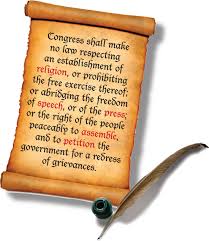
The First Amendment to the United States Constitution. Fact: Internal Revenue Code Sections 501(c)(3) and 508(c)(1)(A) are laws made by Congress respecting an establishment of religion and preventing the free exercise thereof, and  prohibit  freedom of speech and press.

Jerald Finney
Copyright © March 17, 2022

Contents:

  1. How a church becomes tax exempt (under man-made federal law) as opposed to non-taxable (Under the First Amendment to the United States Constitution (“First Amendment”).
  2. An overview of the fundamental changes which result when a church is granted 501(c)(3) or claims 508(c)(1)(A) status
  3. List of rules and regulations which come with tax exempt status.

1. How a church becomes tax exempt (under man-made federal law) as opposed to non-taxable (Under the First Amendment to the United States Constitution).

A First Amendment church—a church who has not applied for and been granted tax exempt status and who has not acted as a legal entity in any way so as to forfeit her status as a church under Christ alone—is non-taxable. The only way a civil government can tax is by law or edict. The First Amendment religion clause forbids  federal law taxing churches (religion) in America. The establishment and free exercise clauses of the First Amendment, consistent with the Bible doctrine of separation of church and state, protect those churches who decide to obey God and refuse federal tax-exempt status. The First Amendment religion clause is consistent with the Bible doctrine of separation of church and state. Although 501(c)(3) and 508(c)(1)(A) are laws passed by Congress with violate the religion clause, they do not force churches to become tax exempt; rather, the give churches a choice of whether to be tax exempt as opposed to non-taxable.
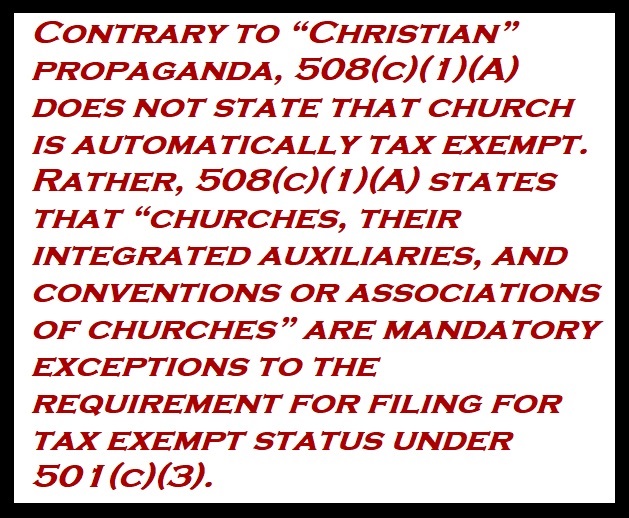
Contrary to “Christian” propaganda, 508(c)(1)(A) does not state that a church is automatically tax exempt. Rather, 508(c)(1)(A) states that “churches, their integrated auxiliaries, and conventions or associations of churches” are mandatory exceptions to the requirement for filing for tax exempt status under 501(c)(3). To mandate automatic church tax exempt status would violate the First Amendment which states, in part, that “Congress shall make no law respecting an establishment of religion or prohibiting the free exercise thereof.” Both 501(c)(3) and 508(c)(1)(A) are laws passed by Congress which establish a religion and prevent the free exercise thereof. Because of the First Amendment, churches cannot be forced to become tax exempt.
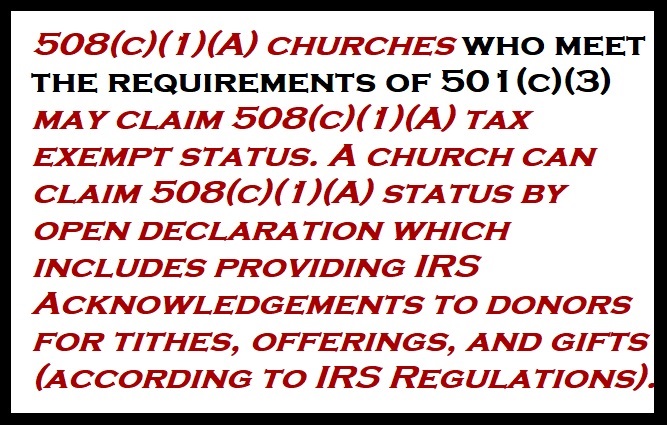
508(c)(1)(A) churches who meet the requirements of 501(c)(3) may claim 508(c)(1)(A) tax exempt status. See, Church Internal Revenue Code § 508(c)(1)(A) Tax Exempt Status for explanation and links to relevant IRS Regulations. A church can claim 508(c)(1)(A) status by open declaration which includes providing IRS Acknowledgements to donors for tithes, offerings, and gifts (according to IRS Regulations). The real purpose of tax-exempt status is to attract those who give for easy tax deduction claims and not because of their love for the Lord.

If the IRS audits a donor to a 501(c)(3) tax exempt “church,” the church will be on the IRS list and the acknowledgement from the church will verify his giving. If a church claims 508(c(1)(A) tax exempt status, the IRS may likely require the donor to prove that the donee was a church since the church is not on the IRS list. Internal Revenue Code Section 170 and IRS Regulations deal with the matter of tax exempt deductions for gifts to non-501(c(3) or 508(c)(1)(A) churches. A donor concerned about this matter may see, Separation of Church and State/God’s Churches: Spiritual or Legal Entities, Chapter 8, pp. 85-96, “Spurious Rationale for Corporate-501(c)(3) or 508 Status: Tax Exemption and Tax Deduction for Contributions.” Note, the law may have changed since publication of that book. Refer to IRS Code Section 170 for updates and changes in the law.

To become tax exempt (a “501(c)(3) or 508(c)(1)(A)” church), as opposed to non-taxable (a church solely under the protection of the First Amendment to the United States Constitution) a church may apply for Internal Revenue Code Section 501(c)(3) tax exempt status by completing IRS Form 1023 (See En[i] for more information of Form 1023) or claim “508(c)(1)(A)” tax exempt status. A church may claim 508(c)(1)(A) tax exempt status by declaring that tithes, offerings, and gifts are tax exempt and providing IRS acknowledgements to the donors. When the church claims 508(c)(1)(A) status, she is subject to the rules and regulations that come with 501(c)(3); she is now tax exempt as opposed to non-taxable and therefore loses much of her first Amendment protections. See, Church Internal Revenue Code § 508(c)(1)(A) Tax Exempt Status.

Any non-tax-exempt church should inform all givers, in advance, that it is not tax exempt and that it does not give IRS acknowledgements for tithes, offerings and gifts.

 2. An overview of the fundamental changes which result when a church is granted 501(c)(3) or claims 508(c)(1)(A) status

A church who is not a legal entity of any kind has the total protection of the First Amendment: She can do things God’s way without control or persecution by any civil government, city to national.

A non-legal entity is not controlled by civil government. Of course, a tyrannical government can declare that any entity, whether legal or not, is under their control. Korea, for example, persecutes and kills any one caught speaking the name of Jesus in a positive way, possessing a Bible or Gospel tract, holding a church meeting, etc.

Legal entities are under the authority of of civil government for many purposes. As “persons” under Fourteenth Amendment for many purposes, churches have given up much of their First Amendment status. Corporations (aggregate of sole), unincorporated associations, charitable trusts, business trusts, individuals, and federal tax-exempt organizations are among the list of legal entities.

Whether or not a civil government can enforce an edict against a believer or a church who is not a legal entity depends upon the individual or church. A Christian (one who believes in, loves and follows Christ, His commandments and Word as opposed to one who merely “believes in” Christ) will obey God rather than man when obeying man’s law requires one to disobey God. American believers and churches do not have to face control and punishment by civil government for loving and honoring God and His Word, as of yet.

A church who chooses to become a legal entity places herself under the authority, wholly or partially, other than the Lord Jesus Christ. She no longer has all (or maybe, any) of her First Amendment protections. She is no longer a totally First Amendment Church. She is now, as a legal person, a Fourteenth Amendment Church. See, Corporation: A Human Being with No Soul; see also, Separation of Church and State/God’s Churches: Spiritual or Legal Entities? for further explanation of much of what is said in this section.

A church, as a legal entity, can sue, be sued, enter into contracts, pay salaries, be charged with a crime (if she or any or her agents commit crime), hold property and insurance in the name of the church, etc. In other words, she has transformed herself into a worldly enterprise, a business. She is organized like and operates as a business, to one degree or another. She is subject to the laws and accompanying regulations of her creator(s), the state and/or federal government.

As a legal person, a church acts to one degree or another—usually to a greater degree—like a temporal, worldly, fleshly entity ruled by tradition of men and the rudiments of the world as opposed to a spiritual entity ruled by God’s Word. She has a new sovereign or sovereigns; she employs business techniques of organization, operation, and doctrines. Many have become apostate. Their goal is to find out what people want and give it to them rather that finding out what God, in His Word, wants and giving it to Him. They may honor the Lord with their tongues, but their heart is far from Him as they keep the commandments of men rather than those of God.

A church who has chosen legal entity status is subject to civil government. She has agreed that the controlling party, in the case of disputes, is the civil government; and she has agreed to follow all rules and regulations contained in the law they agreed to. A church which chooses to become a legal entity such as a corporation has agreed that the controlling party for many purposes is the court of the state of incorporation. Churches who choose to become tax exempt agree that they will follow accompanying rules and regulations.

Many incorporated churches follow none of, or only some of, the rules and procedures in the non-profit corporation law they agreed to when getting the status. Many churches openly violate some or all of the rules and regulations coming with 501(c)(3) or 508(c)(1)(a) status because they know that the IRS does not have the resources to enforce them; by so doing, they dishonor both God (by dishonoring their legal agreement with the federal government) and man (by entering into a legal agreement which dishonors God). Believers who dishonor their agreements, their word, are not “Christians;” and by their actions, they cause men to blaspheme God.

For more information on church 501(c)(3) and 508(c)(1)(A) status, see:

  1. Federal government control of churches through 501(c)(3) tax exemption(Section VI, Chapter 4 of God Betrayed; Chapter 4 of Separation of Church and State);
  2. The church incorporation-501(c)(3) control scheme(Section VI, Chapter 5 of God Betrayed; Chapter 5 of Separation of Church and State); and
  3. Church Internal Revenue Code § 508(c)(1)(A) Tax Exempt Status.

 3. List  of rules and regulations which come with tax exempt status.

Under the terms of 501(c)(3) and 508(c)(1)(A) and IRS interpretation thereof, a church agrees to the rules and regulations that come with the status. The church agrees to abide by the following rules:

“1. must be organized and operated exclusively for religious, educational, scientific, or other charitable purposes,
“2. net earnings must not inure to the benefit of any private individual or shareholder,
“3. no substantial part of its activity may be attempting to influence legislation,
“4. the organization may not intervene in political activity,
“5. the organization’s purposes and activities may not be illegal or violate fundamental public policy.”

See, IRS Publication 1828. This and all IRS publications may be accessed at irs.gov. Just mentioning a candidate may violate proscription #4. Detailed guidelines with consequences of violation of proscription #4 given in Pub. 1828. As to proscription #5, public policy is determined by the courts. What is fundamental public policy regarding same-sex marriage? This policy has not been enforced against tax exempt churches, but that may be coming. The real issue is, does church tax exempt or legal status of any kind please God. See also, , Internal Revenue Code  508(c)(1)(A).

Rules and regulations for 501(c)(3) and 508(c)(1)(A) churches are made by the legislative and executive branch, by the IRS, and by the courts. Rules one through four above are stated in 501(c)(3). Rule four was added by legislation sponsored by Lyndon Johnson. The last requirement—“may not violate fundamental public policy” was first implemented by the IRS and then upheld by the United States Supreme Court in Bob Jones University v. United States, 461 U.S. 574 (1983). See, PDF of Separation of Church and State/God’s Churches: Spiritual or Legal Entities? pages 35-37.

501(c)(3) and 508(c)(1)(A) tax exempt status not only come with five government imposed rules, such status also invokes a myriad of regulations. See and read, e.g.,

The interested believer and church who love the Lord may go directly to those regulations by clicking the links above, if this is essay is opened online. Check them out for yourselves and ask yourself, “Does this status glorify and please God?”


En[i] Instructions for Form 1023. On page 2 of the December 2017 Instructions is stated: “Completed Form 1023 required for section 501(c)(3) exemption. Form 1023 is filed by organizations to apply for recognition of exemption from federal income tax under section 501(c)(3). Upon approval, we will issue a determination letter that provides written assurance about the organization’s tax-exempt status, and its qualification to receive tax-deductible charitable contributions. Every organization qualifying for exemption under section 501(c)(3) will also be classified as either a “public charity” or a “private foundation.”

A Bible believer may get much greater understanding of the anti-Christ agreement he is entering into by seeking and obtaining 501(c)(3) status by reading Form 1023 and the instructions.Internal Revenue Code § 508(c)(1)(A) places the church in the same position as 501(c)(3) status. See, Church Internal Revenue Code § 508(c)(1)(A) Tax Exempt Status See, . For more information from the IRS on Form 1023, see About Form 1023.

See, Basics of the Bible Trust Relationship and How a Church Can Nullify the Trust Relationship

For an understanding of how a church can organize and operate God’s prescribed way, as a spiritual entity under Christ only, see The CUCM Bible Trust.


Can Psychology Deal With the New Nature of the Believer?

1 John 3:4-24 deals with the two natures of the believer in action. 1 John 3:9 says, “Whosoever is born of God doth not commit sin; for his seed remaineth in him: and he cannot sin, because he is born of God.” Commit means, in this context, “to do some act, or make some declaration, which may bind the person in honor, good faith, or consistency, to pursue a certain course of conduct, or to adhere to the tenor of that declaration.” The passage does not say, “doth not sin.” It says, “doth not commit sin.” The new nature cannot sin, but the old nature can. Dr. J. Vernon McGee thoroughly explains this matter in his studies on 1 John.

Can psychology deal with the old nature? What about all the books written and sermons preached to deal with the old nature? The following short audio of teaching by Dr. J. Vernon McGee, in this short 3 minute 13 second audio, addresses these questions and more:

Dr. McGee on psychology and controlling the new nature.

Click here to go to the complete program (1 John 3:17-4:1) from which the above was taken.

Click here to go to links to all Dr. McGee’s Thru the Bible studies.

The Love of God Perfected

February 12, 2022

In 1 John, 2:1-4:21, the theme is “God is love” or “walking in love.”

1 John 2:3-5 says: “And hereby we do know that we know him, if we keep his commandments. He that saith, I know him, and keepeth not his commandments, is a liar, and the truth is not in him. But whoso keepeth his word, in him verily is the love of God perfected: hereby know we that we are in him.”

In the above verses, what is the meaning of “his commandments?” “What is the meaning of “his word?” How is the love of God perfected?

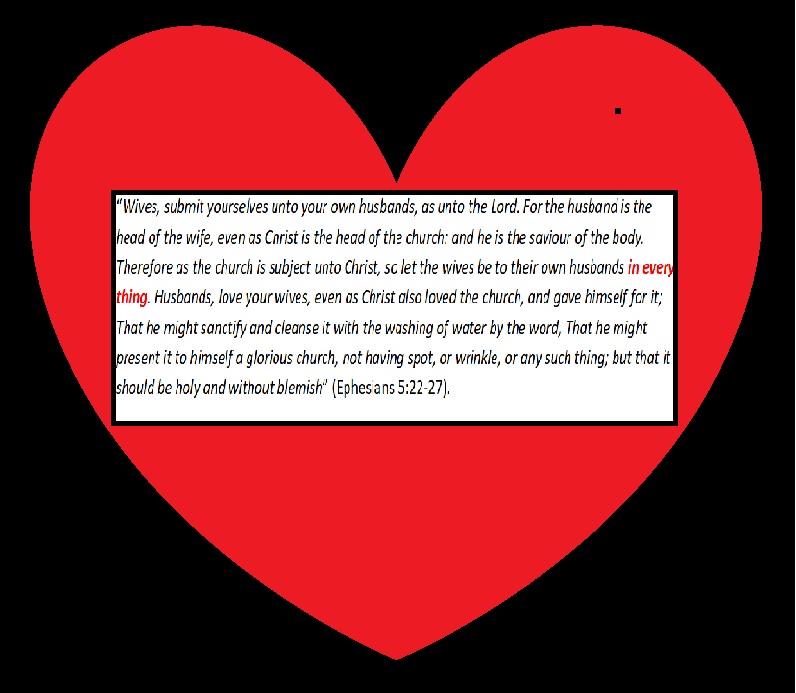
The Holy Spirit, through Paul, commanded, “Husbands, love your wives, even as Christ also loved the church, and gave himself for it” (Ephesians 5:25). He did not also say, “wives love your husbands,” or “Churches love Christ.” Why? This brief Bible lesson by Dr. J. Vernon McGee gives an answer. Click here to go to the study on audio.

For Dr. McGee’s complete audio study of 1 John 2:3-8, click here.

Intro. to 2 John/Love and Truth

What are the 2 marks of a Christian? Christians are to love brothers and sisters in Christ. Are we to also love the lost? How about false teachers (apostates who deny the deity of Christ)? Are we to love them? Which is to prevail, love or truth? Which comes first? In what bounds and context can love be expressed?

These are preeminent matters. This study, by Dr. J. Vernon McGee, looks at those issues and much more.

To hear a 14 minute excerpt from the study click Intro to 2 John.

To go to the entire online study, go to Thru the Bible Radio, Intro. to 2 John; and for links to all of Dr. McGee’s 5 year program of Bible Study, click here.

Lesson 6: The church Bible Trust relationship is not something new. Churches under Christ in every thing (under Christ alone) have, by definition, always honored it.

Jerald Finney
Copyright © January 1, 2022

Go to the following webpage for links to additional lessons:
Lessons on the Bible (Common Law) Trust

The purpose of this lesson and all ministry lessons is to glorify God. When one seeks Bible truth and presents what he believes to reflect that truth, the only motive that pleases God is love for the Lord and His truth. If you disagree with anything in this lesson, open minded debate is encouraged. Please do not become angry. Rather, engage this ministry in a Bible based search for truth (See, Ephesians 4:11-16), with the goal of glorifying God and finding the truth. Reasoning together should include the Bible principles and analysis of the common law or Bible trust as applied to the Bible principles. Open debate and honest study, with the Bible as the foundation, glorifies God, especially when considering the institution God loved and gave himself for. Respond in love as this and all lessons are inspired by love for God and His truth. I will publicly repent of any error which is revealed to me by love-centered discourse. God bless.
Ephesians 4:11-16: “And he gave some, apostles; and some, prophets; and some, evangelists; and some, pastors and teachers; For the perfecting of the saints, for the work of the ministry, for the edifying of the body of Christ: Till we all come in the unity of the faith, and of the knowledge of the Son of God, unto a perfect man, unto the measure of the stature of the fulness of Christ:  That we henceforth be no more children, tossed to and fro, and carried about with every wind of doctrine, by the sleight of men, and cunning craftiness, whereby they lie in wait to deceive; But speaking the truth in love, may grow up into him in all things, which is the head, even Christ:  From whom the whole body fitly joined together and compacted by that which every joint supplieth, according to the effectual working in the measure of every part, maketh increase of the body unto the edifying of itself in love.”

This short lesson, and the cited resources, explain:

  • That the Church Bible Trust Relationship recommended by this ministry is not new; the Lord Jesus originated it, describes it, and prescribes it in His Word.
  • New Testament churches, from the beginning of the church until this day, have always practiced the Bible trust relationship with property.
  • New Testament Churches, by honoring Christ “in every thing” have been vilified, abased, and persecuted, by other “churches,” and church-state establishments, to include those in America who combine with the state through incorporation (sole or aggregate), charitable trust status, Internal Revenue Code 501(c)(3) or § 508(c)(1)(A) tax exempt status, etc.

When a church organizes according to New Testament Church Doctrine, that church, as a spiritual organism under the authority of Christ in every thing, applies the Biblical concept of trust. See, Trust is a Bible Concept for explanation of the Bible Trust, its origins, and application by a New Testament Church. A church who wishes to remain under Christ in every thing has no other option; there is only one way for a church to organize according to God’s Word. The organization can be explained in terms used by this ministry, in terms of the concept of the Bible (common law) trust. God’s Word is clear: a church who practices the concept pleases and glorifies God, and a church who does not do so arrogates the prerogatives of (blasphemes) God.

Churches in the New Testament, the first church—the Church at Jerusalem and all other churches in the New Testament—established and practiced a Bible trust relationship with property.  All property was owned by God, not the church. The churches remained spiritual entities only.

No church owned property; only a worldly temporal legal entity can own property. See, Short Answers to Some Important Questions. Churches never met on property they owned. Members gave to God, not to the church. They gave of God’s own, not of their own (See, Exodus 19:5; Leviticus 25:23; 1 Chronicles 29:10-13; Psalm 24:1; Psalm 50:10; Psalm 89:11; Haggai 2:8; Trust is a Bible Concept explains this in some detail). When they gave to God, their gifts were held and managed by a person or persons, according to the will of our Lord as given in His Word (See, e.g., Acts 4:32-5:11 as to the church at Jerusalem and the sin and death of Ananias and Sapphira). The church at Jerusalem remained holy—totally set apart for God and under God; as a result, the church had great spiritual power and multitudes of women and men were saved and added to the Lord (Acts 4:12-5:16).

Since New Testament times, there has always existed a remnant of churches who remained spiritual entities under Christ in all things. They were true to Bible distinctives concerning many matters, including the matter of separation of church and state. To be separate from the state, a church cannot own property or act as a legal entity in any other manner. Churches refused to contract with the state and the state religion.

Historically, Christians in such churches, as warned by Jesus and the apostles, have been persecuted. Christians were persecuted from the beginning of the church. After union of church and state in the fourth century, the original established “church” as well as her offspring, the Protestant establishments, working with the state, tried to stamp out “heretics” and eliminate all other religions, including authentic New Testament churches, and their members. See, God Betrayed/Separation of Church and State: The Biblical Principles and the American Application, pp. 127-132 for a brief history of those persecutions; see also, Persecution: A Consequence of Covenant Theology.

This persecution continued in the American colonies where a spiritual warfare between the dissenters, mainly Baptists, were persecuted by colonial established church-state unions. The result of that conflict was the First Amendment to the United States Constitution. America, with the adoption of the First Amendment became the second government in world history, of any lasting consequence, to grant religious freedom and soul liberty. Ibid., “History of Religious Freedom in America,” pp. 189-289.

Scores of churches in America have come to understand that Christ desires to be the only head or authority over churches who name His name; and, consequently, have established the Bible trust relationship with property. This Churches under Christ ministry has helped many churches to do so. Starting in the 1980’s, the Biblical Law Center, under the leadership of Attorney Al Cunningham, began to help churches come out from under civil government and establish Bible trust relationships with property.

A church can establish the relationship without a writing. However, should the trustee of the property owned by the Lord Jesus Christ wish to open a bank account to hold the funds in the trust estate, the trustee must show a written Declaration of Trust and related documents to the bank. Should the trustee wish to purchase real estate for a meetinghouse, the property owned by the Lord Jesus Christ, it is wise to have a Declaration of Trust which provides for the appointment of a trustee, and transfer of the powers of the trustee to a successor trustee when the need arises. Successor trustees will have the authority to hold and manage the property. Merely holding title in the name of the Lord Jesus Christ, the title signed by “deacons” or some others, can lead to problems down the line. No matter the position given on the title, these deacons or others are acting as trustees. What happens should one or more of the trustees pass away? How will the property be transferred twenty-five or fifty years after purchase, the trustees are gone and the property needs to be sold or transferred?

Many of the trustees of trusts helped by this ministry have opened trust bank accounts or purchased real estate in the name of the trust. In every instance, they have showed the bank  or the seller of the real estate, title companies and lawyers, tax assessors (for property tax exemption purposes) the trust documents for their inspection. Those documents shine the light of Bible truth on many matters, thereby educated those in the world who had no idea of what a true New Testament church is. See, Lesson 4: The wisdom of a written Declaration of Trust. 

Courts in America have recognized the common law trust relationship with property, acknowledging that the relationship is not a legal entity but a defined relationship with property. Courts have held that property tax exemption cannot be withheld from property held in trust by churches and other religious organizations. See EN[i] for excerpts from and links to such cases. Here are some excerpts from the Endnote:

Indiana property tax exemption law specifically recognizes the trust relationship. Indiana Code Title 6. Taxation § 6-1.1-10-21 states:

Sec. 21 .  (a) The following tangible property is exempt from property taxation if it is owned by, or held in trust for the use of, a church or religious society:

(1) A building that is used for religious worship.

(2) The pews and furniture contained within a building that is used for religious worship.

(3) The tract of land upon which a building that is used for religious worship is situated.

Etc.

See, The Indiana Board of Tax Review Determines that Property Held in Trust for the Lord Jesus Christ Must Be Granted Property Tax Exemption for an essay chronicling a case testing the  church use of the Bible trust and a legal examination and decision by the Indiana Board of Tax Review. The Endnote also covers this in more detail. Property tax exemption on property used by churches, unlike federal tax exempt status, comes with no strings attached. It is just a courtesy which every state grants churches and other religious organizations.

WAUSHARA COUNTY v. Sherri L. GRAF, 157 Wis.2d 539 (1990), 461 N.W.2d 143, Court of Appeals of Wisconsin. Submitted on briefs December 8, 1989. Decided August 2, 1990states (see Endnote for more): 

  • “Church” and “Congregation.” A church consists of those who are communicants, have made a public profession of religion and are united by a religious bond of common spiritual welfare. It is the spiritual body, not the legal one.
  • In Franke v. Mann,106 Wis. 118, 131, 81 N.W. 1014, 1018-19 (1900), the court further said that “[w]hat has been said is in harmony with the law regarding trusts for religious uses, whether the trustees be officers of a religious corporation or of an unincorporated ecclesiastical body. . . .” Id.at 131-32, 81 N.W. at 1019 (emphasis added).
  • In Holm v. Holm,81 Wis. 374, 382, 51 N.W. 579, 581 (1892), the facts included that the Norwegian Evangelical Lutheran Church of Roche-a-Cree was a voluntary association until February 7, 1889. The court noted that “[p]rior to that date the title to the churches in which the members of the association worshiped was vested in trustees named in . . . deeds, and their successors in office. . . . The trusts imposed by such deeds appear to have been valid upon the principles stated by this court in adness v. Braunborg. . . .” Id.
  • In Franke v. Mann,106 Wis. 118, 131, 81 N.W. 1014, 1018-19 (1900), the court further said that “[w]hat has been said is in harmony with the law regarding trusts for religious uses, whether the trustees be officers of a religious corporation or of an unincorporated ecclesiastical body. . . .” Id. at 131-32, 81 N.W. at 1019 (emphasis added).
  • . We conclude that the trust constituted an “entity” which could claim tax exemption under sec. 70.11(4), Stats., for the benefit of the Basic Bible Church. We further conclude that the legislative history of the pertinent statutes does not disclose a legislative intent to require that a church or religious association be incorporated before it may claim tax exemption under sec. 70.11(4).

Note: In a Biblically correct trust relationship with property, the property is held in trust for the Lord Jesus Christ to be used according to His will as given in the Word of God. The church does not hold the property.

God’s desires that churches should be holy, set apart for the Lord alone, totally separate from any worldly entanglement(s). See, for full Bible explanation, God Betrayed, pp. 1-188. The established church, the church who chooses to unite with civil government by contracting with the state, submits herself, to one degree or another, to an authority other than the Lord Jesus Christ. She works over, under, or with the state. Establishment contracts in America are unilaterally written into state law, and can be changed unilaterally, by the state or federal government without input from the church. The state makes an offer for churches to accept. The offer is written in a state or federal law.. The church can ignore the offer or accept it. When accepted, the completed contract—offer, consideration on the part of both parties (the state gets stated authority over the accepting church for many purposes and the church gets the “advantages” that come with being an artificial person under the Fourteenth Amendment; a person who can sue, be sued, enter into contracts, own property, pay salaries to hireling pastors, etc.), and acceptance. The contract gives the state authority over the church, but gives the church no authority over the state. The church is an established church.

An established church is unholy. She profaned herself by entering into an unholy union. Ibid., 125-188. She rejected God in order to be like the other churches. She became, in many ways, like other established churches, a business; and, with time, she becomes more and more business oriented, more and more worldly, and less and less heavenly. She has more and more earthly power, supposedly, but less and less heavenly power. A slide toward apostasy began when she chose to unite with the state by becoming a legal entity (a corporation (sole or aggregate), a charitable trust, of an Internal Revenue Code § 501(c)(3) or § 508(c)(1)(A) tax exempt religious organization, etc. See, Separation of Church and State/God’s Churches: Spiritual or Legal Entities? for explanation of legal entities and examination of church incorporation, and Internal Revenue Code § 501(c)(3) or § 508(c)(1)(A) tax exempt religious churches).

American believers, churches, Bible colleges, and seminaries who support state church establishment have ignored or never studied, and certainly have never applied, Bible doctrine which explains the Bible principles regarding the relationship of church and state. To them, the substance of this essay appears to be something new and never thought of before. They, as to these matters, are like the Jewish religious leaders in the New Testament who proclaimed to the Lord, and to the early Christians, that they were the authorities on Scripture. Their authority was tradition and they ignored Christ’s admonitions to “search the Scriptures,” for they thought they had done so. God could not convince those heretics of their error. Likewise, God (in His Word) cannot convince those who refuse to study Scripture to learn the truth about church organization as to the relationship of Christ and His churches. Instead, they attack those who proclaim the truth in the same ways as the Jewish religious leaders attacked Jesus and the apostles. The nature of the attacks never change.

Established churches are like Israel, the only God-ordained theocratic nation, who rejected God’s sole authority in order to be like “all the nations, … in order that [their king might judge them, go out before them and fight their battles].” (1 Samuel 8). They have chosen to give “Caesar” authority that belongs to God. God allows them, as He allowed Israel, to do this. As Israel lost the favor of God, so have most American churches who betrayed Him by choosing another head or heads. As Israel started down the road to apostasy, so have American churches except for a small remnant. Many American churches are at the end of that road. Many others are fast approaching it. See, The Biblical Doctrine of the Church, sections on apostasy. In the process, they cause the world to blaspheme God.


EN[i] A. Another Victory for a Church under Christ (092419) A local property tax board in Minnesota denied the property tax exemption for real estate used as a meeting house for a church which had established a trust relationship with property. The property was used 100% for church purposes. The only recourse, after trying to reason with the local assessor and county attorney, was for the trustee to file petition in court. The trustee prevailed, after filing of Motion/brief and oral argument, and without trial. The property tax exemption was granted. The redacted Motion/brief is linked to for one to examine.

  1. The Indiana Board of Tax Review Determines that Property Held in Trust for the Lord Jesus Christ Must Be Granted Property Tax Exemption (012319). This article involves a property tax exemption for a Trinity Baptist Springs Church in Trinity Baptist Springs, Indiana organized under a Declaration of Trust. The Pastor, with the help of the Biblical Law Center, represented himself. The article links to the video of the property tax hearing held by the local property tax board who decided against the exemption. The case was appealed to the Indiana Board of Tax Review who reversed and order that the tax exemption be granted.

Indiana property tax exemption law specifically recognizes the trust relationship. Indiana Code Title 6. Taxation § 6-1.1-10-21 states:

Sec. 21 .  (a) The following tangible property is exempt from property taxation if it is owned by, or held in trust for the use of, a church or religious society:

(1) A building that is used for religious worship.

(2) The pews and furniture contained within a building that is used for religious worship.

(3) The tract of land upon which a building that is used for religious worship is situated.

(b) The following tangible property is exempt from property taxation if it is owned by, or held in trust for the use of, a church or religious society:

(1) A building that is used as a parsonage.

(2) The tract of land, not exceeding fifteen (15) acres, upon which a building that is used as a parsonage is situated.

(c) To obtain an exemption for parsonages, a church or religious society must provide the county assessor with an affidavit at the time the church or religious society applies for the exemptions.  The affidavit must state that:

(1) all parsonages are being used to house one (1) of the church’s or religious society’s rabbis, priests, preachers, ministers, or pastors;  and

(2) none of the parsonages are being used to make a profit.

The affidavit shall be signed under oath by the church’s or religious society’s head rabbi, priest, preacher, minister, or pastor.

(d) Property referred to in this section shall be assessed to the extent required under IC 6-1.1-11-9

  1. KOPSOMBUT-MYINT BUDDHIST CENTER, v. STATE BOARD OF EQUALIZATION, 728 N.W. 2d 327 (1986) Court of Appeals of Tennessee, Middle Section, at Nashville. Permission to Appeal Denied, April 6, 1987. IMPORTANT POINT: Property held in trust for a Buddhist Temple qualifies for a property tax exemption, if the property is used for religious purposes and the owner, any stockholder, officer, member or employee of such institution is not lawfully entitled to receive and pecuniary profit from the operations of that property in competition with like property owned by others which is not exempt. Property held in trust and which otherwise qualifies for the exemption is to be exempted from property tax.  Of note, for emphasis, it was obvious that corporate, 501(c)(3) status was not a prerequisite for religious property tax exemption. Also, this case deals with a “trust,” not a “business trust” “charitable trust” or some other type of trust that is a legal entity.” As to the trust relationship, the court stated:
  • “A valid trust need not be in writing. It can be created orally unless the language of the written conveyance excludes the existence of a trust. Sanderson v. Milligan,585 S.W.2d 573, 574 (Tenn. 1979); Linder v. Little,490 S.W.2d 717, 723 (Tenn. Ct. App. 1972); and Adrian v. Brown, 29 Tenn. App. 236, 243, 196 S.W.2d 118, 121 (1946). However, when a party seeks to establish an oral trust, it must do so by greater than a preponderance of the evidence. Sanderson v. Milligan, 585 S.W.2d 573, 574 (Tenn. 1979); Hunt v. Hunt, 169 Tenn. 1, 9, 80 S.W.2d 666, 669 (1935); and Browder v. Hite, 602 S.W.2d 489, 493 (Tenn. Ct. App. 1980).
  • “The existence of a trust requires proof of three elements: (1) a trustee who holds trust property and who is subject to the equitable duties to deal with it for the benefit of another, (2) a beneficiary to whom the trustee owes the equitable duties to deal with the trust property for his benefit, and (3) identifiable trust property. See G.G. Bogert & G.T. Bogert, The Law of Trusts and Trustees 1, at 6 (rev. 2d ed. 1984) and Restatement (Second) of Trusts § 2 comment h (1957). We find that the Kopsombut-Myint Buddhist Center has proved the existence of each of these elements by clear and convincing evidence.” [p. 333].
  1. WAUSHARA COUNTY v. Sherri L. GRAF, 166 Wis.2d 442 (1992), 480 N.W.2d 16, Supreme Court of Wisconsin. Submitted on briefs October 4, 1991.Decided February 17, 1992.The Supreme Court of Wisconsin reviewed the evidence and concluded that “The evidence indicates that Basic Bible was established to evade taxation. Basic Bible failed to meet its burden of proving that it is a “church” or “religious association” under [Wisconsin law]. The court held that Basic Bible was not property tax exempt.” The fact that the church held “in trust” the property for which a property tax exemption was sought was not a factor in the decision.The Court concluded that incorporation and 501(c)(3) status is not a prerequisite for church property tax exemption; and, again, made clear that the fact that the church held the property “in trust” did not disqualify the church from property tax exemption. [My note. Many, many cases are on the record involving denials of “church,” or “religious organization” property tax exemption for incorporated 501(c)(3) tax scams. See, for some examples, III below. This is the only case I have found in which a “church” or “religious organization or society” which held property and/or money in trust was held to be such a scam. Also, by reading this entire case with knowledge, one versed in these matters readily sees that Basic Bible did not understand the law nor the Bible. One could write a lengthy analysis proving that. Also very interesting is the analysis of the pro se representation in this case.]

The Wisconsin Supreme Court stated, in its opinion from which the above was taken that:

  • The court of appeals had no obligation to look beyond the issues raised by Bible Baptist, but had the discretion to do so. The “church” was organized as a trust. The principle issue which it in its discretion addressed was the circuit court’s conclusion that for a ‘church’ to claim a tax exemption, it must be incorporated under the laws of Wisconsin or another state. The Supreme Court of Wisconsin agreed with the conclusion of the appeals court that the church need not be incorporated to claim a tax exemption.The Court stated: “We need not reiterate the excellent discussion and analysis underpinning that conclusion that appears in the court of appeals opinion. 157 Wis. 2d at 539-49” [the citation for this case].

The opinion from the court of appeals referred to by the Wisconsin Supreme Court was WAUSHARA COUNTY v. Sherri L. GRAF, 157 Wis.2d 539 (1990), 461 N.W.2d 143, Court of Appeals of Wisconsin. Submitted on briefs December 8, 1989. Decided August 2, 1990Here are some very important points made on pp. 539-49 of that decision:

We hold … that the church was not required to show that it was incorporated as a religious society or corporation under ch. 187, Stats., or otherwise, to establish that its property is exempt from taxation under sec. 70.11(4).

The court examined the legislative history of the pertinent statutes to determine if a church or religious organization must be incorporated for its property to be tax exempt [under state law]. The court started with examination of the first exemption from taxation of the property of churches and religious organizations—in sec. 24, ch. 47, Revised Statutes of 1849. Chapter 47 prescribed the procedure by which persons belonging to a church congregation or religious society, “not already incorporated,” could incorporate. … The exemption was not limited to religious societies incorporated under ch. 47.

The court then looked at Chapter 130, Laws of 1868 which provided for the assessment of property for taxation and for exemptions therefrom. Section 2, 3d exempted “[p]ersonal property owned by any religious, scientific, literary or benevolent association, used exclusively for the purposes of such association, and the real property necessary for the location and convenience of the buildings of such association . . . not exceeding ten acres. . . .” Chapter 130 did not define “association.” The court then went to Wisconsin Statutes of 1898. Section 1038, subd. 3 was renumbered sec. 70.11(4), Stats., by sec. 16, ch. 69, Laws of 1921. Throughout its history, the exemption from taxation of property of churches and religious associations has been accorded in substantially the same language. No “linkage” has existed between the exemption statutes and those affecting the organization of churches and religious associations or societies.

Chapter 411, Laws of 1876, provided for the incorporation of religious societies. Apparently this act replaced ch. 47 of the revised statutes of 1849. Chapter 411 is silent as to the taxation or exemption of the property of religious societies incorporated thereunder.

The procedures for the incorporation of religious societies were included in ch. 91, Revised Statutes of 1878. Nash’s Wisconsin Annotations (1914), sec. 1990, ch. 91 at 753, states:

The revisers of 1878 in their note said: “Chapter 411, 1876, is taken to have been intended as a revision of the law for the incorporation of religious societies. The privilege of organizing a corporation is extended to all classes and denominations, it not being supposed the law means to be intolerant of any religious belief or to be partial in its offer of privileges.”

The same annotation at page 755 states:

“Church” and “Congregation.” A church consists of those who are communicants, have made a public profession of religion and are united by a religious bond of common spiritual welfare. It is the spiritual body, not the legal one. But a religious society or congregation, under the statute, is a voluntary association of persons, generally but not necessarily in connection with a church proper, united for the purpose of having a common place of worship and to provide a proper teacher to instruct them in doctrines and duties, etc. [Citations omitted.]

Decisions interpreting ch. 91, Revised Statutes of 1878, make plain that failure of a church or religious organization to incorporate thereunder did not affect the power of the church or religious organization to hold title to property. “Under the repeated decisions of this court, we must hold that the mere fact that [a] church or religious society had not yet been incorporated at the time of the delivery of [a] deed in no way frustrated the trust thereby created, if such trust was otherwise valid.” Fadness v. Braunborg, 73 Wis. 257, 278-79, 41 N.W. 84, 90 (1889) (emphasis in original).

In Holm v. Holm, 81 Wis. 374, 382, 51 N.W. 579, 581 (1892), the facts included that the Norwegian Evangelical Lutheran Church of Roche-a-Cree was a voluntary association until February 7, 1889. The court noted that “[p]rior to that date the title to the churches in which the members of the association worshiped was vested in trustees named in . . . deeds, and their successors in office. . . . The trusts imposed by such deeds appear to have been valid upon the principles stated by this court in adness v. Braunborg. . . .” Id.

In Franke v. Mann, 106 Wis. 118, 131, 81 N.W. 1014, 1018-19 (1900), the court further said that “[w]hat has been said is in harmony with the law regarding trusts for religious uses, whether the trustees be officers of a religious corporation or of an unincorporated ecclesiastical body. . . .” Id. at 131-32, 81 N.W. at 1019 (emphasis added).

It is plain from these decisions that the court did not consider that the legislature, by offering to ecclesiastical bodies the advantages of incorporation, intended to impose corporate structure upon such bodies. The property of unincorporated ecclesiastical bodies was commonly held in trust for the benefit of the members.

The Basic Bible Church established that title to the real estate subject to foreclosure was held in the name of the trustees for the benefit of the church. We conclude that the trust constituted an “entity” which could claim tax exemption under sec. 70.11(4), Stats., for the benefit of the Basic Bible Church. We further conclude that the legislative history of the pertinent statutes does not disclose a legislative intent to require that a church or religious association be incorporated before it may claim tax exemption under sec. 70.11(4).

Lesson 5: Which term, “STEWARD” OR “TRUSTEE,” is more appropriate in declaring a church bible trust relationship?

Copyright © by Jerald Finney
December 15, 2021

Go to the following webpage for links to additional lessons:
Lessons on the Bible (Common Law) Trust.

Over the years, several have suggested that “steward” is more appropriate. “Why not use the term ‘steward’ instead of ‘trustee’?” For example, a gentleman at an Unregistered Baptist Fellowship Conference said to me something others have commented on over the years, “We use the term steward because Biblical law is over man’s law.”  This article will look at Bible teaching to address this and related matters:  the meanings of the words “steward,” “trust,” “trustee,” “beneficiary,” “trust estate;” the eternal and temporal applications of the relationship; just versus unjust stewardship according to God; and the consequences of just and unjust application of the relationship. This lesson will explain (1) why the term “trustee,” a derivative of the word “trust,” is, in only one context which will be differentiated below near the end of this lesson, the equivalent of the term “steward,” and, therefore, (2) why the use of “trustee” is preferable.

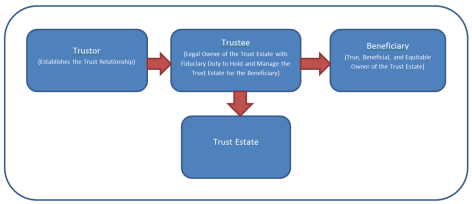
The Bible explains the God-ordained trust relationship with all property and the functions of each party to the trust relationship. See, Trust is a Bible Concept. That relationship has a trustor, a trustee or steward, and a beneficiary. The term “trust” is used in the Bible; “trustee” is explained but the term “trustee” is not used in the Bible. “Steward” is used in the Bible. “Steward” refers to the person to whom someone commits the care and management of his goods for his benefit.

One use of term “trust” references a relationship with property. “Trust,” in the context of the common law trust relationship with property, means:

“Property committed to a person’s care for use or management, and for which an account must be rendered. Every man’s talents and advantages are a trust committed to him by his Maker, and for the use or employment of which he is accountable.”

The suffix -or means a person who is something, such as lessor (a person who leases property) or trustor (a person who declares or establishes a trust relationship with property). A trustor, as used in the Bible trust relationship with property, commits to the care of someone God’s property for the sole benefit of God, the owner of the property, the owner of the property held in the trust estate.

New Testament churches never owned or falsely claimed ownership of property; they were spiritual entities only, entirely separate from civil government and worldly entanglements. See, Is a Church a Spiritual or Legal Entity? In the context of the Bible trust established by a church, the trustor, a derivative of the term “trust,” declares the trust relationship, not with property of the church, since the church, when in obedience to the Word of God, claims ownership of no property, but with property of God, the true owner of all things.

The suffix -ee is used (1) with some verbs to make nouns meaning someone who is affected by an action—as a trainee or an employee-and (2) with some verbs to make nouns meaning someone who performs an action—as a lessee, escapee. When added to the word trust, we have “trustee,” someone who performs an action. A trustee holds and manages property for the benefit of the owner of the property. Thus, even though the term “trustee” is not specifically mentioned in the Bible, trustee accurately describes the one to whom God has entrusted His property.

The beneficiary – that is, the true, equitable, and beneficial owner – of the property held in a Bible trust is the Lord Jesus Christ, and all of the properties of the trust estate are held in trust, by the trustee, solely for the benefit of the Lord Jesus Christ who is the true, equitable, and beneficial owner of all property including all property held in the Trust. The trustor, in establishing the church Bible trust relationship with property is not naming or making the Lord Jesus Christ the Beneficiary or the Trust Estate; Christ is the Beneficiary–the true, equitable, and beneficial owner of the earth and all that is in it (Exodus 19:5, Leviticus 25:23, 1 Chronicles 29:11-12, Psalm 24:1, Psalm 50:10, Psalm 89:11, Haggai 2:8).

The term “trust” refers to both temporal/earthly and eternal/heavenly or spiritual relationships. Trust relationships are found throughout the Bible, even when the word “trust,” “trustee,” or “steward” is not mentioned. Luke 16 speaks of a temporal material trust, and relates that trust to an eternal spiritual trust. 1 Thessalonians 2.4, and Titus 1.11 speak specifically and solely of the eternal spiritual trust.

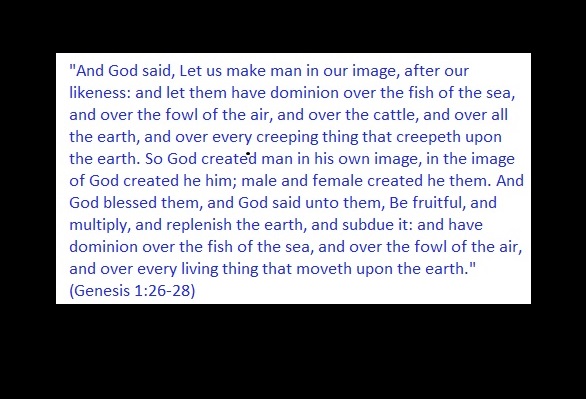
The first time the relationship is mentioned is in Genesis 1.27-31, where obviously, although not explicitly stated, the relationship is both earthly and spiritual:

  • “27 So God created man in his own image, in the image of God created he him; male and female created he them. 28 And God blessed them, and God said unto them, Be fruitful, and multiply, and replenish the earth, and subdue it: and have dominion over the fish of the sea, and over the fowl of the air, and over every living thing that moveth upon the earth. 29 And God said, Behold, I have given you every herb bearing seed, which is upon the face of all the earth, and every tree, in the which is the fruit of a tree yielding seed; to you it shall be for meat. 30 And to every beast of the earth, and to every fowl of the air, and to every thing that creepeth upon the earth, wherein there is life, I have given every green herb for meat: and it was so. 31 And God saw every thing that he had made, and, behold, it was very good. And the evening and the morning were the sixth day.”

All such earthly and spiritual relationships have several essentials: the possession(s); the true, equitable, and beneficial owner of the possession(s); the commitment by the true owner of the possession(s) to another’s care and management; and the one to whom is entrusted the care and management of the possession(s) for the benefit of the true owner. Every Bible dispensation presents a specific stewardship under God.

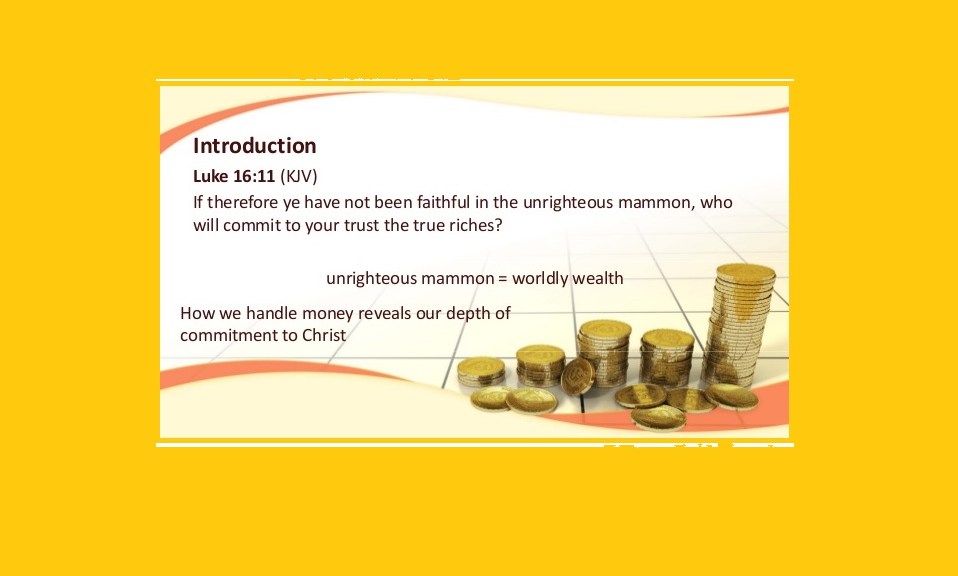
Only once in the Bible, in Luke 16.1-13, are the words “steward” and “trust” used in the same passage. That passage is concerned with an earthly steward dealing with earthly possessions of his earthly master, the true owner of the possessions. There, “steward” refers to the person who has a duty to manage the goods of his master, for his master’s benefit. However, the Lord makes a connection between one’s earthly stewardship and his eternal stewardship (“Stewardship” means the office of a steward). The Lord says, “If therefore ye have not been faithful in the unrighteous mammon, who will commit to your trust the true riches? … “Ye cannot serve God and mammon” (Lk. 16.11, 13).

As has been pointed out, “steward,” in one context, has the same meaning as “trustee.” So why not use “steward” instead of using derivatives of the word “trust,” to include “trustee.” The conclusion will answer this question; but first, this brief article takes a further look at “steward” and “trust.”

God entrusted mankind with all possessions, real and personal as well as spiritual. He owned all things—even the body, soul and spirit of man—but left all things, including the real estate, to man to be used for Him. God trusted man with all His earthly and eternal possessions. God committed all to his trust. He was “steward” or “trustee,” the one to whom God entrusted management and care of His possessions.

Now, let us examine the term “steward” and “stewardship” from a Bible perspective. Then we will look more at “trust” and related terms—“trustor,” “trustee,” and “trust estate.”

The term “steward” is found in Genesis 15.2, 43.19, 44.1, 44.4; 1 Kings 16.9; Daniel 1.11; Matthew 20.8; Luke 8.3, 12.42; 16.1,2, 3, 8; 1 Corinthians 4.1,2; Titus 1:7. The word “stewardship” is used only three times in the Bible, all in Luke 16, verses 2, 3, and 4. “Stewardship” simply means “The office of a steward.”

A steward is a man who has charge of another’s goods. As defined in the Webster’s 1828 Dictionary, “steward” means: “(1) A man employed in great families to manage the domestic concerns, superintend the other servants, collect the rents or income, keep the accounts, &c. See Gen. xv. 2—xliii. (2) In Scripture and theology, a minister of Christ, whose duty is to dispense the provisions of the gospel, to preach its doctrines and administer its ordinances. It is required in stewards, that a man be found faithful. 1 Cor. iv.”

The first meaning of “steward” is reflected in several passages of the Bible: Genesis 15.2, 43.19, 44.1, 44.4; 1 Kings 16.9; Matthew 20.8; Luke 8.3, 12.42, 16.1-13 (parable of the unjust steward). Certainly, although not directly dealing with the eternal meaning, many of those stewardships have spiritual applications: Matthew 20.8; Luke 12.42-48 (levels of punishment based upon whether or not the steward knew the Lord’s will), 16.1-13.

The eternal application alone is seen in 1 Corinthians 4.1, 2: “Let a man so account of us, as of the ministers of Christ, and stewards of the mysteries of God.  Moreover it is required in stewards, that a man be found faithful.”; and Titus 1.7: “For a bishop must be blameless, as the steward of God; not selfwilled, not soon angry, not given to wine, no striker, not given to filthy lucre.”.

The story of a rich man and his unjust steward, which is related in Luke 16.1-13, is very instructive. The terms “trust” and “steward” are used in that parable. The master committed his goods to the steward’s trust (verses 1 and 11). The master was the beneficiary, “the true, beneficial, and equitable owner.”

The steward in this parable was an out-and-out-crook. He was guilty of malfeasance in office and misappropriation of funds. He wasted the goods of his master. His day of reckoning had come (Lk. 16.3). He was afraid of losing his stewardship, felt he could not do manual work, and was ashamed to beg. However, he, like many, was not ashamed to steal (verse 3). He did not repent, nor did he have regret or remorse for his actions. He was crooked—called “clever” by the world’s standards. He had no training for other work, his age was probably against him, he was too proud to beg, but he was not ashamed to be dishonest. He called all his master’s debtors and gave them big discounts.

The Bible tells us that the world loves its own but hates those who belong to God. “If the world hate you, ye know that it hated me before it hated you. If ye were of the world, the world would love his own: but because ye are not of the world, but I have chosen you out of the world, therefore the world hateth you” (Jn. 15:18-19). In Galatians 1.3-4, Paul says, “Grace be to you and peace from God the Father, and from our Lord Jesus Christ, Who gave himself for our sins, that he might deliver us from this present evil world, according to the will of God and our Father.” Again, in Romans 12.2, Paul says, “And be not conformed to this world: but be ye transformed by the renewing of your mind, that ye may prove what is that good, and acceptable, and perfect, will of God.” “Love not the world, neither the things that are in the world. If any man love the world, the love of the Father is not in him” (1 Jn. 2:15).

The first commandment of the world is “self-preservation.” A shady business deal is winked at, questionable practices countenanced, and a clever crook is commended by the world. The law is on the side of the crook and the criminal many times. Every man, according to the world’s law, is innocent until proven guilty. God takes the opposite approach. God says that a man is guilty until proven innocent. “For all have sinned and come short of the glory of God” (Ro. 3.23). A man can never be innocent before God, but he can be justified before Him. When a man trusts Jesus Christ as his Savior, he is justified by faith. See, e.g., Ro. 8.1.

The master did not punish the unjust steward, but commended him. Apparently the rich man got rich using the same kind of principles that his unjust steward used and he commended him, saying that the steward had done wisely. In what way? According to the principles of the world. This is the world that hates Christ. It makes its own rules. The law of the world is “dog eat dog.” The worldly master commended his worldly steward for his worldly wisdom according to his worldly dealings. The Lord Jesus said, “… For the children of this world are in their generation wiser than the children of light.” That is, the children of this world, of this age, use their money more wisely than do the children of light.

Then, our Lord makes the most shocking and startling statement of all. It concerns the relationship of the “mammon of righteousness,” that is, riches, money: “Make to yourselves friends of the mammon of unrighteousness; that, when ye fail, they may receive you into everlasting habitations” (Lk. 16.9). Money is not evil in itself; it is amoral. The love of money is the root of all evil. For believers, money is to be spiritual. Our Lord said that we should lay up for ourselves treasures in heaven. We should be wise in the way we use our money. Then when we “fail” or come to the end of life, we will be welcomed in heaven.

Believers are spiritual stewards (trustees) of all that God commits to their trust; all of which is spiritual. We own nothing as believers. We are responsible to God for how we use His goods. We are to use the “mammon of unrighteousness” to gather spiritual wealth:

  • “He that is faithful in that which is least is faithful also in much: and he that is unjust in the least is unjust also in much. If therefore ye have not been faithful in the unrighteous mammon, who will commit to your trustthe true riches?  And if ye have not been faithful in that which is another man’s, who shall give you that which is your own. No servant can serve two masters: for either he will hate the one, and love the other; or else he will hold to the one, and despise the other. Ye cannot serve God and mammon.” (Lk. 16.10-13).

In this parable, the Lord Jesus is saying, “Do you think God is going to trust you with heavenly riches if you are not using properly or rightly the earthly possessions which He has given you?” Are you serving God or mammon? You cannot serve both.

Now, let us review and supplement “trust” and related terms. “Trustor,” “trustee,” and “trust estate” are derivatives of the word “trust,” a concept found throughout the Bible. The suffix “-ee” added to trust results in a new word meaning a person with to whom something is entrusted. A “trustor” is one who entrusts monies and properties to a “trustee” who holds the money and property entrusted to him in “trust” for the benefit of the true, equitable, and beneficial owner, the “beneficiary.”

Some meanings of trust, as given in the 1828 Webster’s Dictionary, are: “(1) Confidence; a reliance or resting of the mind on the integrity, veracity, justice, friendship or other sound principle of another person. He that putteth his trust in the Lord shall be safe. Proverbs 20.25. (2) Something committed to a person’s care for use or management, and for which an account must be rendered. Every man’s talents and advantages are a trust committed to him by his Maker, and for the use or employment of which he is accountable.” In the context of definition (2), the word “trust” is mentioned four times in the Bible:

  1. “But as we were allowed of God to be put in trust with the gospel, even so we speak; not as pleasing men, but God, which trieth our hearts” (1 Thes. 2.4).
  2. “According to the glorious gospel of the blessed God, which was committed to my trust” (1 Ti. 1:11).
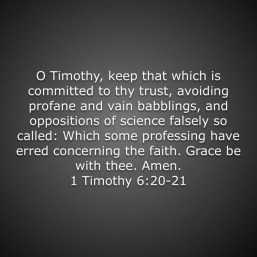
  3. “O Timothy, keep that which is committed to thy trust, avoiding profane and vain babblings, and oppositions of science falsely so called” (1 Ti. 6:20).
  4. “If therefore ye have not been faithful in the unrighteous mammon, who [what trustor] will commit to your trust the true riches? And if ye have not been faithful in that which is another man’s, who shall give you that which is your own” (Lk. 16:11-12)?

In all these references, that which God entrusted was not material and spiritual, but spiritual only—“the true riches.”

The Lord spoke of this concept of trust, in conjunction with an earthly temporal example, in Matthew 25.14-30 and Luke 19.12-27, although He used neither the word “trust” nor “steward or stewardship.” He spoke of an earthly master leaving certain amounts of his goods or money with his servants, according to their abilities. Actually, the more important parallel spiritual meaning was to the Lord and His servants. The master had an absolute right to his own goods, but he distributed to his servants to be used for the benefit of the master, the servants to be awarded according to their profitable use of the property entrusted to them. Some used the money productively and upon the master’s return presented him with a profit. The property belonged to the master, and the servants were to use it for the master’s benefit, not for their own benefit. Of course, they would be rewarded if they used the property wisely for the benefit of the master. One servant in each example returned only the original amount left in trust with them. The master instructed that the goods which he had left with the unprofitable servants be taken from them, and they were left with nothing. The profitable servants were rewarded by the master. In the story found in Matthew, the Master said, “[C]ast ye the unprofitable servant into outer darkness: there shall be weeping and gnashing of teeth” (Mt. 25.30). Men, as servants of the Master are likewise left in trust of all things for His benefit and will be rewarded or punished according to their use of His goods.

In conclusion, the words “steward” and “trustee” signify the same thing. However, the use of the term “trustee,” a word derived from the word “trust” by adding the suffix “-ee”  is preferable to the use of “steward” when describing the entire relationship. Why? For six reasons taken together. First, in only one context do the terms “steward” and “trustee” mean the same thing.

Second, the one time “trust” and “steward” are used in the same immediate verses, “steward” denotes the person with the responsibility over another’s goods and “trust” is used to signify the fiduciary relationship with the master’s goods or property (Lk. 16). Even though “steward” is the one with the duty to rightly administer the goods the master commits to his trust, the name given to the arrangement is “trust.”

Third, nowhere in the Bible are all the terms involved in the relationship reduced to singular (as “trustor”) or modified terms (as “trust estate”); yet, those terms accurately explain elements of the trust relationship even though the specific terms are not in the Bible.

Thus, fourth, the use of “trust” and derivatives is more practical. The term “trust” as a noun (and as an adjective) and its derivatives, more succinctly describe all aspects of the relationship: “trustor,” “trustee,” and “trust estate.” On the other hand, the term “stewardship” is less adaptable: one can interchange “steward” and “trustee;” but the word “trust” describes the overall relationship. No word derived from “steward” describes the person who establishes the stewardship (the “trustor”). No word derived from “steward” describes the estate the steward is responsible for (“trust estate”)—er, perhaps the “stewardship estate?”; but stewardship means the office of a steward. Parallel words leave less room for argument and misunderstanding. Imagine trying to explain these matters to a lost person.

Fifth, the church, not God declares a Bible Trust relationship with property. To repeat: “Steward” refers to the person to whom someone commits the care and management of his goods for his benefit. In the church Bible Trust context, the church, the trustor, not God, commits the care and management of God’s goods for God’s benefit.

Finally, American law, although not establishing the Bible concept of trust, recognizes it. See, The Bible Trust Relationship with Property is Not Something New: It was God’s plan starting with Adam and Eve and/or Trust is a Bible Concept. In so doing, American law uses the Bible term “trust” and its derivatives.  For example, American Jurisprudence 2d Trusts, a highly regarded encyclopedia of American law, describes “trust” in § 1, as follows:

  • “The fundamental nature of a trust is the division of title, with the trustee being the holder of legal title and the beneficiary that of equitable title. By definition, the creation of a trust must involve a conveyance of property.
  • “A ‘trust’ exists where the legal title to property is held by one or more persons, under an equitable obligation to convey, apply, or deal with such property for the benefit of other persons. A trust has been defined as a fiduciary relationship with respect to property, subjecting the person by whom the title to the property is held to equitable duties to deal with the property for the benefit of another person, which arises as a result of a manifestation of an intention to create it. The Restatement definition is similar, providing that a trust, when not qualified by the word ‘resulting’ or ‘constructive,’ is a fiduciary relationship with respect to property, arising from a manifestation of intention to create that relationship and subjecting the person who holds title to the property to duties to deal with it for the benefit of charity or for one or more persons, at least one of whom is not the sole trustee.
  • “Caution: A trust consists not only of property, but also of the trust instrument, the trust’s beneficiaries and trustees, and the trust administrator [if any].”

American Jurisprudence 2d, Trusts § 2 makes clear that a “trust” is not a legal entity, but merely a fiduciary relationship with property. For one thing, this means that the one cannot sue the trust, since it is not recognized as a legal entity. This is not true of a “business trust,” a “charitable trust” or some other legal extensions of the “trust” relationship. See, FORWARD: A CHURCH WHO ESTABLISHES A BIBLE TRUST RELATIONSHIP WITH PROPERTY IS NOT ORGANIZING AS A TRUST.

Even though particular words are not necessary to create the Bible Trust relationship, as a study of God’s Word reveals, using certain words is a simplified way of declaring the Bible Trust relationship. “No particular words are necessary to create a trust if there exists reasonable certainty as to the intended property, object, and beneficiary. Further, the purpose and intention, rather than the use of any particular term, determines whether a valid trust has been established.” American Jurisprudence 2d, Trusts § 65. The preservation of God’s Word exactly as inspired by the Holy Spirit is very important to God. See, e.g., Psalm 12:6-7, Deuteronomy 4:1-2, Proverbs 30:5-6; Revelation 22:19. Within those Words are concepts which God wishes His children to understand, apply, and obey.

The important thing for the born again believer, regardless of the terms used, is that he handle the use of God’s properties, all of which are spiritual to a born again believer, according to the principle of trust as described in the Bible. Those faithful and wise churches who remain under God only will be blessed by their Lord. However, churches who choose to leave their first love by placing themselves at least partially under the state (for example, corporate (aggregate of sole) 501(c)(3) or 508 churches), have left their first love and betrayed their Lord’s trust. They are unfaithful and act unwisely; they act either knowingly or unknowingly and will  punished accordingly (see Lk. 12.42-48; see also Lk. 16 discussed above).

Section II, Chapter 2: The Wisdom of a Written Declaration of Trust

Copyright © by Jerald Finney
December 14, 2021

Click here to go to the following webpage for Table of Contents with links to all chapters ofSimply Church: The Holy Union of Christ and His Local Church

Wisdom dictates that the best course of action for a church organized according to New Testament Church Doctrine is to properly write and execute a declaration, with supporting document(s), of the principles behind and terms of their Bible Trust agreement. One good name for this type of writing is “Declaration of Trust (‘DOT’).” A “declaration” is a publication or manifestation. Such a declaration will keep a church out of trouble as long as the terms of the trust are  honored and maintained. An oral church Bible trust relationship with property will most likely, sooner or later, get a church into trouble. Contact me should you wish to discuss this matter; some who are not educated on this matter will mislead you and contend that the trust relationship should not be declared in written documents. This lesson will cover the main reasons why wisdom recommends the use of a written declaration and supporting documents.

The Resolution To Adopt the Declaration of Trust utilized by many churches includes the following statement:

  • “WHEREAS: The church body of [Name of Church], a local New Testament church—in order to perpetually benefit, educate, and set an example for present and future members of [Name of Church], other churches, the general public, and the world—desires to execute and implement comprehensive documents which obey, glorify, and please God by, among other matters:
    “1. Defining the nature of Bible Trust which is not a legal or spiritual entity of any kind, but merely a relationship with property which conforms to Bible doctrine, principle, and example.
    “2. Stating the New Testament Bible doctrines and principles upon which [Name of Church] relies for church organization under Christ and Him alone.
    “3. Stating Bible doctrines and principles concerning church, state, and the God-ordained relationship between church and state.
    “4. Stating the American legal basis upon which Southwest Bible Baptist Church relies for church organization under the authority of Christ and Him alone.
    “5. Stating and implementing the elements of the Bible Trust, commonly called the common law trust.”

Should a church repent of an unbiblical church organization—such as incorporation, unincorporated association, Internal Revenue Code § 501(c)(3) or § 508(c)(1)(a) status—biblically correct and comprehensive documents set the stage for implementation of the new, Christ-ordered direction and organization of the church. For churches already organized and operating according to New Testament Church Doctrine (for example, the church owns or leases no property whatsoever, holds no bank account or money, holds no insurance, etc.), a written declaration agreed to by church members educates and eliminates ignorance concerning New Testament Church Doctrine. Proper documents perpetually benefit, educate, and set an example for present and future members of a church, other churches, the general public, and the world. Comprehensive and correct documents obey, glorify, and please God by, among other matters:

  • Stating the New Testament doctrines and principles relied on for church organization under Christ and Him alone;
  • Stating New Testament doctrine concerning church, state, and the God-ordained relationship between church and state;
  • Stating the legal basis upon which a church relies for church organization under the authority of Christ and Him alone;
  • Stating and defining the elements of the Bible trust; and
  • Defining the nature of the Bible trust, a relationship with property only, a non-legal entity.

A DOT which declares a Bible Trust relationship totally conforms to Scriptural principles and guidelines. See Chapter 6: The Bible Trust Relationship with Property is Not Something New: It was God’s plan starting with Adam and Eve. It, with supporting documents, makes clear to all that the church, as trustor or settlor, remains a spiritual entity and closes the door to all legitimate arguments that the church is a legal, as opposed to a spiritual, entity.

Some churches who apply the trust relationship with property without properly executed documents set the church up as the legal owner of the property held in the trust estate. They state that the church holds the property in the trust estate through a trustee (or perhaps, trustees). When any entity holds property, she is a legal entity, since only a legal entity can hold or own property. By naming the Lord Jesus Christ as owner of real estate, someone, as “legal owner” has to sign the deed. Sometimes a church member, usually deacons or the pastor of the church will sign the deed and hold property on behalf of a church; the deed naming Christ as owner. The signer(s) are actually acting as trustees of the church, no matter what you call them. The law and reason are clear: the terminology does not alter the reality of the function served. The church becomes the legal owner of the property. Such churches are legal entities subject to the jurisdiction of civil court. As such, they can sue, be sued, contract, etc. Should such a church be named in a lawsuit, and should the opposing attorney have sufficient knowledge, he can prove to the court that the church is a legal entity because the church is the legal owner of the property held in trust.

Other problems can arise with the church who holds property in the name of a trustee or trustees (no matter what they are called) without executed documents explaining the relationship. For example, this ministry helped a church who had held a meetinghouse for 20 or so years. The church wanted to sell the property and move to a better facility. Two deacons had signed the title deed for the church. They were no longer with the church and had not been for many years. Since there were no written documents providing for successor trustees to take over the duties and powers of the original trustees, the process of transferring the property became a complex matter. The longer the time involved from the original purchase, the more cumbersome a sale will become. With a properly written DOT, this problem would not have existed.

If the trust relationship is understood, honored, declared, and correctly applied and managed, a correct DOT and supporting documents settle arguments about the intent and terms of the trust; the principles and facts relied upon; powers of the trustor and trustee; the intended ownership and management of the trust estate; and more. No disgruntled church member can rewrite or control the terms of the trust agreement. No such member can argue that any type of contract, charitable trust, or other legal arrangement was intended or implemented.

Remember, only a legal entity can be sued or charged with a crime. A court has no jurisdiction over a church which is not a legal entity, a church under Christ alone, a First Amendment church. See Chapter 3: How a Church Can Nullify the Bible Trust Relationship with Property. Should a misguided member attempt to sue the church, a designated church member, probably the pastor, should make a special appearance in court contesting jurisdiction. The representative should point out that the church is a First Amendment church as opposed to a Fourteenth Amendment church which is a legal entity such as a church which is a legal entity such as an incorporated (sole or aggregate) church, an Internal Revenue Code Section 501(c)(3) or 508(c)(1)(A) tax exempt church, a charitable trust church, or an unincorporated association church. He should point out that the church has no constitution, by-laws, employees, salaries, bank accounts, etc.; that the church owns or leases no property. The church itself judges all matters within the church. See, 1 Corinthians 5 and 6.

The door is closed for church member to control Lord’s property and/or to control the spiritual direction of the church. the Declaration makes clear (1) that the trust property and monies belong to God, not to the church and are to be administered by the trustee solely for the benefit of the Lord Jesus Christ, the owner of the trust estate, according to His will as given in the Word of God, not the benefit of the trustee, and (2) the duties and powers of the trustee. Of course, Ephesians 4:1-16 explains the correct manner of dealing with differences Endnote [i].

No government law, court, agent, or officer can argue the type of trust created or the intent of the creator(s) of the trust agreement. The state cannot order the church to shut down or place other rules on the church. Of course, God allows free will to every civil government; He allows a state to exert tyrannical authority over individuals, but the state cannot exert any authority over a church under Christ alone.  Nor can a state control or take authority over the trust because the trust is not a legal entity. The trust is a relationship with property. A tyrannical state can exert unlawful control over property.

The written Declaration, if in conformity to Bible principles, serves as the light and authority as to intent and terms. Should anyone dispute the terms of the trust relationship, the Declaration serves as the standard. The declaration and supporting documents make clear that all trust property belongs to the Lord Jesus Christ and is to be used solely for His benefit according to His will given in the Word of God. The DOT makes clear that the trustee may not utilize, sell, or encumber any trust property for his own benefit.

A properly worded and executed declaration and supporting document(s) are solid proof that neither the trust agreement thereby declared nor the trustor church are legal entities subject to the authority of man. The documents make clear that (1) the church is organized according to Bible doctrine, a spiritual entity under God alone, not  creature of the state—a business, a business trust, charitable trust, non-profit corporation, unincorporated association, Internal Revenue Code § 501(c)(3) or § 508(c)(1)(A) tax exempt religious organization and that (2) the church is  not a two-headed monster, at best partially under the state and partially under God, or partially or totally under the state.

Keep in mind that a church can assume the status of a legal entity by hiring employees, paying salaries, holding a church bank account, purchasing property or insurance, leasing property, submitting to court jurisdiction, or acting legally in any other way. A church under Christ is organized and operates within the parameters of New Testament church doctrine.

The church under Christ alone can do all that a church under man, a church which is a legal entity, can do and more. Unlike the compromised church under God and man (the church which is a legal entity), she can glorify and please God in her organization and operation. She can have the use of a meetinghouse, vehicles, pews, seats, computers, etc. owned by the Lord not by the church.

In all matters, she can honor both God and man. For example, church members can resolve that a certain weekly, bi-weekly, monthly gift from the trust estate (which is owned by the Lord) will go to support the pastor and his family since this corresponds to the will of the Lord as given in His Word. The pastor can report this on his income tax return, but not on Schedule C, or not as wages, tips or salaries. He should report the gifts received as “other” on Schedule 1 to Form 1040.

The trust arrangement honors both God and man. God’s light shines through and God is glorified by biblically correct documents which declare the Bible Trust relationship. A church declaration of trust, whether oral or written, as long as not compromised through improper church action, sets in place the Biblical principle of separation of church and state. America’s highest man made law, the First Amendment religion clause, is a statement of the Biblical principle of separation of church and state. See, for explanation, Is Separation of Church and State found in the Constitution?

________________________________________________________________


Endnote [i] Ephesians 4:1-16: “I therefore, the prisoner of the Lord, beseech you that ye walk worthy of the vocation wherewith ye are called, With all lowliness and meekness, with longsuffering, forbearing one another in love; Endeavouring to keep the unity of the Spirit in the bond of peace. There is one body, and one Spirit, even as ye are called in one hope of your calling; One Lord, one faith, one baptism, One God and Father of all, who is above all, and through all, and in you all. But unto every one of us is given grace according to the measure of the gift of Christ. Wherefore he saith, When he ascended up on high, he led captivity captive, and gave gifts unto men. (Now that he ascended, what is it but that he also descended first into the lower parts of the earth? He that descended is the same also that ascended up far above all heavens, that he might fill all things.) And he gave some, apostles; and some, prophets; and some, evangelists; and some, pastors and teachers; For the perfecting of the saints, for the work of the ministry, for the edifying of the body of Christ: Till we all come in the unity of the faith, and of the knowledge of the Son of God, unto a perfect man, unto the measure of the stature of the fulness of Christ: That we henceforth be no more children, tossed to and fro, and carried about with every wind of doctrine, by the sleight of men, and cunning craftiness, whereby they lie in wait to deceive; But speaking the truth in love, may grow up into him in all things, which is the head, even Christ: From whom the whole body fitly joined together and compacted by that which every joint supplieth, according to the effectual working in the measure of every part, maketh increase of the body unto the edifying of itself in love.”

Mysticism (Foundational to the coming one-world religion)

Our Website: thebereancall.org | Store: store.thebereancall.org

October 10, 2021
The Berean Call; 541-382-6210; customerservice@thebereancall.org
Hello Jerald,

Undermining sound doctrine is Satan’s primary goal in his attempt to shipwreck the faith and fruitfulness of believers. The strategy involves corrupting the Word of God by adding to it or subtracting from it. Thus the Scriptures are distorted through the input of fallen, finite man and the contributions of seducing spirits and doctrines of demons (1Tm 4:1). Such modifications demolish the objective truth of Scripture. The Bible no longer stands as God’s Word when “adjustments” are made by other sources. This is taking place today in unprecedented fashion, especially through the introduction (or re-introduction) of mysticism.

The antithesis of the objective Word of God, mysticism is defined by The Merriam-Webster Dictionary as “the belief that direct knowledge of God, spiritual truth, or ultimate reality can be attained through subjective experience such as intuition or insight,” and adds that it is “vague speculation, a belief without sound basis.” Google gives this definition: “belief characterized by self-delusion or dreamy confusion of thought, especially when based on the assumption of occult qualities or mysterious agencies.” A mystical worldview, which is intensifying in both the world and its religions, will be foundational to the coming one-world religion.
Among many reasons, the primary one is that mysticism has a universal appeal that will attract and unify all the religions of the world. Why? Because it avoids doctrine (rules, regulations, commandments, obligations, requirements, etc.). The doctrines of the Bible are given by God and are to be obeyed; not obeying them is rebellion, which is the state of the world as well as the state of many within the church. The religions of the world also have doctrines, albeit false ones, against which their followers often rebel. Doctrines divide because people don’t particularly like rules that demand obedience. The stricter the rules, the less attractive the religion. That’s a potential problem for the religion of the Antichrist because its goal is to attract other belief systems and draw all people into its spiritual web.
The Berean Call; 541-382-6210; customerservice@thebereancall.org


Questions and Responses about Mysticism

Church Spiritual Fornication Does Not Matter?

Jerald Finney
October 25, 2021
All citations are to the King James Bible

4I recently posted a link to a webpage which explains the Bible principles of government, church, God’s prescribed relationship between civil government and church, and the American application of those principles. I added to the post the picture at right, “501-c-3 Church/This Means Your Church Places Government Over God!” One comment to the post stated, “Nothing to worry about…the world is fixin to end any moment…(Duh…)” The comment could mean various things, but I will assume that the author agreed with me and that the statement was a satire for harlot churches to consider.

A ”Christian” lawyer who once was a force for the truth about the relationship of church and state until the 1980’s turned coat when some of the big-boy pastors met with him. They told him that they were looked to and followed by thousands of incorporated 501(c)(3) churches, that they were not going to change, and that they would make sure that he, and the law firm he represented, would be taken care of by them, all the churches and Bible colleges and seminaries that were part of their religious associations. After he defected to serve the god of this world, he eventually began to teach that all churches should incorporate and get 501(c)(3) or 508(c)(1)(A) status. Needless to say, untold numbers of uneducated churches, Bible colleges, Bible seminaries, Bible institutes and believers follow him and his pernicious ways. This attorney said to numerous pastors of unregistered (non-incorporated, non-501(c)(3), etc.) churches that they might as well join them since the government was going to eventually get them all anyway. Needless to say, that lawyer is well fixed materially for the time being although poorly prepared for eternity.

Due to the efforts of pastors, “Christian” attorneys, and their cohorts, most churches, even so-called “Bible-believing” churches in America, are spiritual harlots. They are married to the state through incorporation and the federal government through Internal Revenue Code Section 501(c)(3) or 508(c)(1)(A) tax exempt status. They have chosen to enter into an unholy relationship with the state of incorporation and the federal government (actually the Internal Revenue Service).

A church is espoused to the Lord Jesus Christ. God is jealous over the local church “with godly jealousy” for, as He inspired Paul to write, “I have espoused you to one husband, that I may present you as a chaste virgin to Christ” (2 Corinthians 11:2). But Paul feared, “lest by any means, as the serpent beguiled Eve through his subtilty, so your minds should be corrupted from the simplicity that is in Christ” (2 Corinthians 11:3).

Paul knew that Christ, the Bridegroom, wanted to be head over his churches, the bride, in all things (Matthew 18:16, Ephesians 1:22-23, Colossians 1:18). Christ purchased the church with his own blood (Acts 20:28). He “loved the church and gave himself for it That he might sanctify and cleanse it with the washing of the water by the word, That he might present it to himself a glorious church, not having spot or wrinkle, or any such thing; but that it should be holy [set apart for God] and without blemish” (Ephesians 5:25-26).

In spite of these clear Bible admonitions, most American so-called Bible-believing churches marry a state, through incorporation, and the federal government (the Internal Revenue Service) through tax exempt status. They are spiritual whores. “Nothing to worry about…the world is fixin to end any moment…(Duh…).” They may as well choose to commit spiritual fornication since the government is going to get all the churches anyway. I wonder how our Lord, the Bridegroom feels about that. Wonder if they will feel shame after this life on earth is ended and they stand before Him in judgment (1 Corinthians 3:12-17, 2 Corinthians 5:8-11, Philippians 2:9-10, Revelation 20:11-15).

Lesson 2: The Elements of a Church Bible Trust Relationship with Property

 Jerald Finney
Churches Under Christ Ministry
September 30, 2021

Go to the following webpage for links to additional lessons:
Lessons on the Bible (Common Law) Trust.

Trust

Specific terms are not necessary for a church Bible Trust relationship, a fiduciary relationship with property, to exist. However, as with any relationship, terms facilitate communication. Since a Bible Trust relationship is one in which church reaches an agreement with a person to hold and manage property for the benefit of the owner of the property, the Lord Jesus Christ, convenient terms for the elements of the relationship are trustor, trustee, beneficiary, and trust estate. This lesson will use those terms in explaining the church Bible trust relationship.

Re.4.11According to God’s Word in the Old Testament, God entrusted man with His earth and all that is in it. God created the heavens and the earth, and all that is in the earth, including man and woman. He gave man the duty to hold and manage His earthly creations. A trustor or settlor is the one who establishes a trust agreement. God was trustor of all things. He appointed man as trustee. The earth and the things that are in it compose the earthly trust estate of the trust established by God, the beneficiary (true, equitable, and beneficial owner).
God entrusts man with the earth and all material things in it. He entrusts His children with spiritual matters. God’s churches, churches under Christ and Christ alone, are spiritual organisms totally under the authority of the Lord Jesus Christ, not worldly organizations partially under the authority of Christ and partially under the authority of civil government. Any church who submits herself to man’s laws of incorporation, charitable trust, tax exemption, etc. is not a church under Christ and Christ alone and is not organized and managed solely under the authority of the Lord Jesus Christ according to New Testament church doctrine.

According to New Testament principle and example, a church under Christ alone is a purely spiritual organization (See, e.g., the Book of Ephesians) made up of spiritual beings (See 1 Corinthians 2:14-16). God’s Word defines New Testament churches as spiritual organisms, not worldly organizations (See, e.g., Ephesians 4 and 1 Corinthians 12). Their concern is not to be for this world and worldly possessions. Their purpose is eternal and spiritual, not temporal and earthly. Thus, no church in the New Testament owned or held property, real or personal. Members of New Testament churches gave offerings to God to be used for purposes consistent with His will as revealed in His Word, but they did not give to the church they were part of; doing that would have been giving to themselves. A New Testament church under Christ alone, a heavenly organism, has no employees, pays no salaries, holds no real or personal property, has no insurance, and acts legally in no other way.

How can a church remain true to Christ in the matter of property? By holding or owning none. Property is both real (real estate) and personal. Personal property includes money and bank accounts. A church under Christ alone must meet on real estate, but she cannot own the real estate. She can meet in a person’s home, in his building, or under his tree. Or, a church can meet on public property, under a bridge, in a park, etc. Or, a church (trustor) can reach an agreement with a person (trustee) whereby the church gives to God (to the trust estate owned by God) and meets on property owned by the Lord Jesus Christ (the beneficiary). The trust estate, which can hold real estate used for church purposes only, money, and/or a bank checking account held and managed by a person or persons (trustee(s)) solely for the benefit and will of the owner.

Members of a New Testament church give to God a portion of His property which he has entrusted to them, not to the church, since they are the church. When they give to God, their gift is put in God’s trust estate and is irrevocable (See, Acts 5:1-11).

The trustor church declares the trust relationship and appoints a trustee. The trustee agrees to become the legal (earthly, temporal) owner of the trust estate. He agrees to hold and manage the trust estate solely for the benefit of the Lord Jesus Christ, the owner of the trust estate. He receives no compensation for serving as Trustee.

The pastor should be trustee named in a church Bible trust agreement. A pastor, deacon or elder man in the church can serve as trustee. The pastor should be as qualified or more qualified as any man in the church to hold and manage God’s earthly property. See EN[i].

A trust document should include language which prohibits the trustee from using any property, or proceeds from the conveyance of any property in the trust estate, for the benefit of himself or anyone else. Language such as:

  • “In no event will the ownership of any or all real or personal property or money in the Trust Estate ever be transferred to any member or members of Bible Baptist Church or to any other person, except as provided in this document for …, or for other purposes consistent with Bible guidelines.”

The beneficiary is the true, equitable, and beneficial owner of everything in the trust estate. All property in the trust estate is to be held and managed by the legal (earthly) owner of the trust estate solely according to the will of the true, equitable and beneficial owner of the property, the Lord Jesus Christ. The trustee has a fiduciary duty to use the estate for purposes consistent with the will of God as laid out in God’s Word.

A church Declaration of Trust should include language such as:

  • “The Beneficiary of this Trust is the Lord Jesus Christ, and all of the properties of the Trust Estate are held in Trust, by the Trustee, solely for the benefit of the Lord Jesus Christ who is the true, equitable, and beneficial owner of all property including all property held in Trust. This Declaration of Trust is not naming or making the Lord Jesus Christ the Beneficiary or the Trust Estate; He is the true, equitable, and beneficial owner of the earth and all that is in it (Exodus 19:5, Leviticus 25:23, 1 Chronicles 29:11-12, Psalm 24:1, Psalm 50:10, Psalm 89:11, Haggai 2:8). This document is merely declaring that truth.”

Some Concluding Comments to This Lesson

A church can remain a spiritual entity only by utilizing the Bible concept of trust, by declaring and practicing an irrevocable common law or Bible trust, whether declared in writing or not. The church is trustor since the church (the members) return portions of that which God has entrusted to them to the Lord, to God. What is given to God constitutes the trust estate. The  appointed temporal legal owner of the trust estate is the trustee. The Lord Jesus Christ is the beneficiary, the true, beneficial, and equitable owner of the property held in the trust estate. Gifts, tithes, and offerings are to God (to the trust estate which is owned by God), not to the church.

This type of trust arrangement is Scriptural. The church is declaring and practicing a relationship with property, not organizing as a trust. The church does not apply to the state, according to state law, for trust status, as with a charitable or business trust. No papers are filed with the state. The trust relationship is private. The church remains totally under the authority of the Lord Jesus Christ and His word as long as she does not act legally. The trustee does not hold the property in the trust estate for the church. The trustee holds and manages the property in the trust estate solely for the owner of the property, the Lord Jesus Christ, according to His will. The trustee is the legal (temporary earthly) owner of the property and the Lord Jesus Christ is the true, equitable, and beneficial owner.

As to property on which a church meets, the state will declare someone to be legal owner of that property if no one holds legal title and if it is brought to the attention of the state. The law, and the Lord, requires someone to hold temporary earthly title to real property.

A New Testament church is a spiritual entity only. Therefore, a New Testament church cannot hold title to property. Should a church hold title to property through a trustee or trustees, that church is no longer a spiritual entity only because she has entwined herself with the legal system. A title is a legal declaration of ownership.

Only a legal entity can act legally, sue, be sued, enter into contracts, be charged with a crime, or act legally in some other way. To assume ownership of property is to act legally. Every American citizen in his right mind is a legal entity. Likewise, corporations (aggregate of sole, profit or non-profit), charitable trusts, business trusts, and Internal Revenue Code § 501(c)(3) and § 508 organizations are legal entities. A church who owns property through one of these legal devises is asserting ownership. A church who does not hold property, to include money, but puts property into a trust estate of a properly structured irrevocable common law or Bible trust is not acting legally. The trustee of such a trust holds legal or earthly title to the money are property, if any, in the trust estate. He is to administer the money and property, if any, for the benefit of the true owner of the property, the Lord Jesus Christ. On the other hand, a church who holds property through a trustee for the benefit of the Lord Jesus Christ is a legal or earthly entity.

Holding property in the recommended manner has additional benefits. Not only does holding property in this manner comport with biblical principles, it also lessens the chances that the property, and especially the buildings, will become idols. “Their idols are … the work of men’s hands.  … They that make them are like unto them; so is every one that trusteth in them.” (Ps. 115.4-8). Likewise, monetary riches and other worldly possessions can become idolatrous.  Finally, holding property in this way assures that a church has chosen not to be structured like a business or a government created organization; that church can operate according to the principles in the New Testament.

As God, our Lord owned everything. As a man, our Lord God owned no worldly property. No New Testament church owned any property. What about the church you are a member of?


Endnote

EN[i] Timothy was a preacher with a special position of trust. Timothy was a trustee of a spiritual heritage: “O Timothy, keep that which is committed to thy trust, avoiding profane and vain babblings, and oppositions of science falsely so called:” (1 Ti. 6.20). Likewise, elders, which includes pastors, must meet specific requirements which not every man in a church can meet. (See, for example, Tit. 1.5-9). An elder must hold fast the Word of God, “that he may be able by sound doctrine both to exhort and to convince the gainsayers” (Tit. 1.9-16, 2.2; see also, Ac. 11.30, 14.23, (ordained elders in every church), 15.2, 4, 6, 22-23, 16.4, 20.17, 21.18; 1 Ti. 5.1 (“rebuke not an elder, but entreat him as a father”), 1 Ti. 5.17-19; Ja. 5.14-15; He. 13.7, 17; 1 Pe. 5.1 (Peter the Apostle was an elder, here writing to “the elders who are among you”; 1 Pe. 5.5 (younger to submit to the elder, and all to submit to one another); 2 Jn. 1 and 3 Jn. 1 (John the Apostle was also an elder);

Biblically, a pastor must meet stringent God-given requirements:

  • “This is a true saying, If a man desire the office of a bishop [pastor], he desireth a good work. A bishop then must be blameless, the husband of one wife, vigilant, sober, of good behaviour, given to hospitality, apt to teach; Not given to wine, no striker, not greedy of filthy lucre; but patient, not a brawler, not covetous; One that ruleth well his own house, having his children in subjection with all gravity; (For if a man know not how to rule his own house, how shall he take care of the church of God?) Not a novice, lest being lifted up with pride he fall into the condemnation of the devil.  Moreover he must have a good report of them which are without; lest he fall into reproach and the snare of the devil.” (1 Ti. 3.1-7).
  • “For a bishop must be blameless, as the steward of God; not selfwilled, not soon angry, not given to wine, no striker, not given to filthy lucre;” (Tit. 1.7).

These requirements are strict because a pastor, and every member of a church, is entrusted by God to “take care of the church of God.” (1 Ti. 3.5).

“The elders [pastors included] which are among you I exhort, who am also an elder, and a witness of the sufferings of Christ, and also a partaker of the glory that shall be revealed: Feed the flock of God which is among you, taking the oversight thereof, not by constraint, but willingly; not for filthy lucre, but of a ready mind; Neither as being lords over God’s heritage, but being ensamples to the flock. And when the chief Shepherd shall appear, ye shall receive a crown of glory that fadeth not away.” (1 Pe. 5.1-5).

The Bible proclaims: “Remember them which have the rule over you, who have spoken unto you the Word of God: whose faith follow, considering the end of their conversation.” (He. 13.7). “Obey them that have the rule over you, and submit yourselves: for they watch for your souls, as they that must give account, that they may do it with joy, and not with grief: for that is unprofitable for you.” ( He. 13.17). “Salute all them that have the rule over you, and all the saints….” (He. 13.24). “Them” is plural, and includes the pastor and other elders of a church.

The elders, including the pastor, are to oversee a church: “Take heed therefore unto yourselves, and to all the flock, over the which the Holy Ghost hath made you overseers, to feed the church of God, which he hath purchased with his own blood.” (Ac. 20.28). Paul was speaking to the elders of the church at Ephesus (Ac. 20.17-18).

A pastor is responsible to act as a ruler, trustee, steward, and overseer of a church. As such, he should be as qualified as any other church member to be the trustee of God’s trust estate.