Puritan Covenant Theology Exposed in the American Colonies


A Publication of Simply Church Ministry


If you miss one part of the puzzle that is being put together in these studies, you will never see and understand the whole picture.


Click here to go to the written lessons.
Click here to go to the 3 1/2 to 6 minute video lectures.


Click here to go to Dispensation Theology versus Covenant Theology and Their Importance to the Issue of Church and State Relationship in America


Jerald Finney
Copyright © February 9, 2018


This lesson will discuss some shortcomings of Covenant Theology and give a few examples of the exposure of the Puritan Covenant Theology by colonial dissenters. Some of the quotes are quite long, so the lesson is not as condensed as in other lessons in this short course.

As one Puritan preacher, in an attempt to remove objections of some against partaking of the Lord’s Supper because of fears of not being born again, preached in order to persuade them:

“The children of those who are members of the visible church are, by the constitution of God, from their first coming into existence, members of his kingdom in common with their parents. So it was under the Jewish dispensation; and so it is now, [under the Christian] if there is any validity in one of the principal arguments, by which we vindicate our practice, in baptizing the infants of those who are members of Christ’s church.”[i]

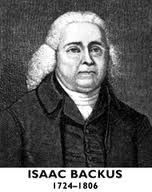
According to Covenant Theology, the main promise God made in the Covenant of Grace was: “I will … be a God unto thee, and to thy seed after thee (Ge. 17.7);” and “includes the following promises: temporal blessings, justification, adoption, eternal life, the Spirit of God with His many ministries, and final glorification.”[ii] Establishment of religion in Christianity depends upon this covenant. Isaac Backus taught, “All establishments of worship by human laws, that ever were erected under the Christian name, were built upon calling the covenant in Gen. xvii the covenant of grace.”

Mr. Backus goes on to point out that “Those who have seen the nature of original sin, cannot tell how to keep up the idea of children’s being born in the covenant of grace, without some regard to grace in their parents. And in the same chapter where the unbelieving consort is said to be sanctified by the believer, a widow is required to marry only in the Lord….” [He then refers to a parable wherein to make his point the author thereof describes a church which advised a member to marry a certain woman of grace in the church rather than a woman he loves who is not of grace. Of the woman of grace, the church says:]

  • “As to some trifles, which a carnal man would object to, it becomes you as a spiritual man, to make no objection. It is true, she is of a mean family, and a very weak understanding; she is peevish and fretful to the highest degree; her shape is semicircular; she is what the world calls monstrous ugly; every feature is adapted to mortify carnal desires, which is much better than to have them gratified; she is the queen of sluts, and without any polite education. But she has grace, saving grace; she is regenerated; let your grace wed with hers, and a sweet bride she will be. Moreover, she is past the flower of her age, and we suppose need so requires.”
  • Backus goes on to say that this parable can be applied to no church on earth, but says “[H]ow mean and spiteful it is to treat the Word Grace [in the manner treated by Covenant Theologians]! Affixing the word to the covenant of circumcision, where God never put it, is the source of [a difficulty of a church at Stockbridge where to be sanctified by the believer, a widow is required to marry only in the Lord].”[iii]

Most Covenant Theologians have divided postfall history into two dispensations, the Mosaic dispensation sometimes called the “Old Covenant,” and the Christian dispensation, usually called the “New Covenant;” and they claim that the Covenant of Grace, although administration of that covenant differed between the dispensations, exists throughout these dispensations. “[E]ach dispensation or covenant named in the Bible is simply another stage of the progressive revelation of the nature of the Covenant of Grace.”[iv]

Covenant Theology has many problems. Many of them are pointed out in more thorough studies by Jerald Finney such as God Betrayed/Separation of Church and State: The Biblical Principles and the American Application. Several significant shortcomings of Covenant Theology follow, repeating some already discussed:

  • First its “ultimate goal of history[, also discussed supra, the Glory of God through the redemption of the elect,] is too narrow…. Second, Covenant Theology denies or weakens some of the distinctions which are in the Bible by insisting that distinctions are simply different phases of the same Covenant of Grace…. In addition, Covenant theology denies the existence of distinctive gospels in the Bible…. Covenant Theology insists that there is no essential distinction between the Mosaic Covenant (the Law) and the New Covenant…. Covenant theology also denies the distinction between the nation of Israel and the Church.… Third, Covenant Theology is mistaken when it teaches that each of the biblical covenants is a continuation and newer phase of the Covenant of Grace…. Fourth, Covenant Theology’s unifying principle is too limited or narrow. [First, Covenant Theology is too limited in that it unifies history through the Covenant of Grace from either the fall of man or the time of Abraham. It is too narrow because it deals only with God’s redemption of the elect, and it does not unify the program of redemption with all God’s other programs.] Second, … it does not unify prefall history with postfall history, which a valid exposition of the biblical philosophy of history must do…. Fifth, in order to make its system work, Covenant Theology must employ a double hermeneutic (a double system of interpretation)….”[v]

According to the Covenant Theologian, “the idea of dual covenants functioned as a warning against reliance on good works for salvation.” The Covenant of Works required obedience for salvation. According to the Covenant of Grace one could only be saved by faith in Christ.[vi]

Yet, the Covenant of Works remained in effect.

  • “This meant, first, that New Englanders whom God had not yet called effectually into salvation remained entirely under a covenant of works and subject to its moral restraint. It meant also, according to Cotton, that the burden of moral expectation should drive the sensitive conscience to Christ. It was ‘the usuall manner of God to give a Covenant of Grace by leading men first into a Covenant of works.’ Living under the covenant of works, Shepard explained, they would discover their sinfulness, and their ‘terrors, and fears, and hopes’ would turn them to Christ. And it meant, third, that even Christians safely within the covenant of grace remained subject to the moral substance of the first covenant. Abolished as a ‘covenant of life,’ Shepard said, the law still remained a ‘Rule of Life.’ These were the traditional three uses of the law in Reformed theology; covenantal language provided a lively way to restate them.”[vii]

Covenant Theologians teach that God’s commands are “too severe even for Adam in innocency, and that grace[, through the covenant of circumcision and its successor, baptism,] gives an exemption from that severity,” under the Covenant of Grace.

Covenant Theology, which does not recognize or correctly analyze the roles of the Old and New Covenants, is at odds with a correct interpretation of the Bible on this issue. Isaac Backus, in exposing the New England Puritan theology, explained:

  • “[The law is holy, just, and good]; it [is] spiritual; but [man] a carnal slave to sin, instead of having such high dignity and liberty as he before imagined he had…. A false imagination of good in the forbidden fruit, drew our first parents into rebellion against God; and such imaginations are the only source of sin in all their children. James i. 14, 15. Good is still their pursuit, but they have lost the knowledge of who can give it, or of what it is; but the regenerate soul knows both, and this is the precise difference between them. Psalm iv. 6, 7. Who does not know that debtors and criminals are not fit judges in their own causes? [Y]et that is the case with all reasoners against the truth and perfection of God’s written word…. And to hear many speaking evil of things they know not, but what they know naturally as brute beasts, and in those things to corrupt themselves; to see them tread down the good pastures, and foul the deep waters, and thrust others with side and shoulder, serves to confirm believers in the truth of revelation, and in the hope of a speedy deliverance from such evil beasts. Jude 10. Ezek. xxxiv. 18, 25.”[viii]

To show that God has “disannulled the national covenant which he made with Abraham,” Backus offered the following insights:

  • “First, Abraham had no right to circumcise any stranger, until he had bought him as a servant for money. Gen. xvii. 12, 13. But God says to his children, Ye are bought with a price, be not ye the servants of men. I Cor. vii. 23. And he says to his ministers, Feed the church of God which he hath purchased with his own blood. Acts xx. 28. He also says, Ye have sold yourselves for nought, and ye shall be redeemed without money. And this is the gospel of peace. Is. lii. 3, 7; Rom. x. 15. Thus do the apostles explain the prophets. Secondly, The children of Israel had no right to receive strangers into the church by households, until the day in which they came out of Egypt, when the Passover was instituted. And then God said, Every man’s servant that is bought for money, when thou hast circumcised him, then shall he eat thereof. Exod. xii. 44—48. Circumcision and the Passover were as binding upon servants as children; and both ordinances pointed to the blood of Christ, which he was to shed for his people. And in reference to that, God said, Behold, the days come, saith the Lord, that I will make a new covenant with the house of Israel, and with the house of Judah; not according to the covenant that I made with their fathers, in the day that I took them by the hand, to bring them out of the land of Egypt. Jer. xxxi. 31, 32. And an inspired apostle says, In that he saith, A new covenant, he hath made the first old. Now that which decayeth and waxeth old is ready to vanish away. He taketh away the first, that he may establish the second. viii. 7—13; x. 9.  And can old and new, first and second, mean but one covenant? Surely no. Thirdly, Circumcision is the name which God gave to his covenant with Abraham. Acts vii. 8. And though Jews and Mahometans are still zealous for it, yet all Christians allow that circumcision is repealed. But after the apostolic age, men took away the name which God gave to that covenant, and added the name Grace to it; and they held that dominion is founded in grace. And from thence the nations have made merchandise of all the vanities of time, and of slaves and souls of men. But the plagues of Babylon will come upon all men who add to the word of God, and take away from the words of his book, if they refuse to come out of that practice. Rev. xviii. 4—13; xxii. 18, 19. And there is not a word in all the Bible for bringing any child to baptism without his own profession of faith in Christ, nor for forcing any man to support any religious minister; and all national churches are built upon these two superstitions. Fourthly, Circumcision was the shedding of human blood; and when Abraham received it, it was a seal of righteousness of the faith which he before had in Christ, in whom believers are justified by his blood. Rom. iv. 11, 23; v. 9; Gal. iii. 16; Gen. xv. 6; xvii. 24. It was a seal to him; but neither circumcision nor baptism are ever called seals to any other person in the Bible. But God says to true believers in Christ, In whom also after that ye believed, ye were sealed with that Holy Spirit of promise. And he also says, Grieve not the Holy Spirit of God, whereby ye are sealed unto the day of redemption. Eph. i. 13; iv. 30. After believing in Christ, the Holy Spirit seals the merits of his death, and the promises of his grace to the soul. And all believers from the beginning, looked through the bloody ordinances which God appointed, to the blood of Christ for justification. And after the beast arose out of the bottomless pit, God said, All that dwell upon the earth shall worship him, whose names are not written in the book of life of the Lamb slain from the foundation of the world. Rev. xiii. 8. Force and cruelty is the general character of the beast; but Jesus, who is the root and offspring of David, will cause all evil beasts to cease out of the land. Ezek. xxxiv. 4, 25; Rev. xxii. 16. Fifthly, the believing Jews were suffered to go on in circumcision for a number of years past the death of Christ, and then God said to them, If ye be circumcised, Christ shall profit you nothing. …. Whosoever of you are justified by the law, ye are fallen from grace. Gal. v.2—4. So far was the covenant of circumcision from being the covenant of grace. That bloody sign not only pointed to the death of Christ, but also to the death of all true believers in him. Therefore Paul says, I through the law am dead to the law, that I might live unto God. I am crucified with Christ, nevertheless I live; yet not I, but Christ liveth in me; and the life which I now live in the flesh, I live by the faith of the Son of God, who loved me, and gave himself for me. … The fruit of the Spirit is love, joy, peace, long-suffering, gentleness, goodness, faith, meekness, temperance, against such there is no law. And they that are Christ’s, have crucified the flesh, with the affections and lusts. Gal. ii. 19, 20; v. 22-24. Adam and Christ are the only two public heads of mankind, as to the great affairs of the soul and eternity. For as by one man’s disobedience, many were made sinners; so by the obedience of one, shall many be made righteous. Rom. v. 19. For parents to bring up their children in the nurture and admonition of the Lord, is of infinite importance; but we can find no warrant for any to bring them to baptism without a personal profession of faith in Christ….
  • “God said of Abraham, I know him, that he will command his children and his household after him, and they shall keep the way of the Lord, to do justice and judgment; that the Lord may bring upon Abraham that which he hath spoken of him. Gen. xviii. 19. He will and They shall, was the language of God’s covenant with Abraham; but I will, and They shall, is the language of the new covenant, since the death of Christ. Heb. viii. 10; x. 9. It was the will of God that the visible church should continue in the line of Abraham’s posterity, until Christ came and died for his people, and then the holy spirit was given, and believing Jews and Gentiles were united in his church. And they never were called Christians, until believing Gentiles were received into the church without circumcision….
  • “[T]he holding that the children of believers are born into the covenant of grace, or that baptism can bring them into it, without their own knowledge or choice, is such a confounding of grace and works together as holds multitudes in blindness and bondage.”[ix]

We should look at the Dispensation of Grace to find the duties of believers today.

Who are the true seed of Abraham? Mr. Backus again correctly divided the Word of Truth in answering this question:

  • “Circumcision was only for males, but females are equally the subjects of baptism, which proves an essential change of the covenant. And our Lord gave the gospel commission to the eleven, who were all born again; and he said to them, Go teach all nations, baptizing them in the name of the Father, and of the Son, and of the Holy ghost; teaching them to observe all things, whatsoever I have commanded you; and lo, I am with you always, even unto the end of the world. Amen. Matt. xxviii. 16—20. This promise is only to his children, in the way of obedience to all his commandments. And as the covenant of circumcision gave Israel a right to buy the heathen for servants, and circumcision was only for the males, the gospel says to believers, Ye are all the children of God by faith in Christ Jesus. For as many of you as have been baptized into Christ have put on Christ. There is neither Jew nor Greek, there is neither bond nor free, there is neither male nor female; for ye are all one in Christ Jesus. And if ye be Christ’s then ye are Abraham’s seed, and heirs according to the promise. Gal. iii.26—29. Abraham was an eminent type of Christ, and none are his spiritual seed but believers in Christ.” (, pp. 370-371).

Again, this is only a small sampling. For more, see Isaac Backus Quotes from God Betrayed; Roger Williams: Quotes and Other Information from God Betrayed; or, for the most thorough treatment God Betrayed/Separation of Church and State: The Biblical Principles and the American Application.


Endnotes

[i] Isaac Backus, A History of New England With Particular Reference to the Denomination of Christians called Baptists, Volume 2 (Eugene, Oregon: Wipf & Stock Publishers, Previously published by Backus Historical Society, 1871), p. 171.

[ii] Renald E. Showers, There Really Is a Difference: A Comparison of Covenant and Dispensational Theology (Bellmawr, New Jersey: The Friends of Israel Gospel Ministry, 1990), p. 14, citing Berkhof, p. 277.

[iii] Backus, A History of New England…, Volume 2, pp. 238-241.

[iv] Showers, pp. 14-16, citing Berkhof, pp. 282-283 and Ernest Frederick Kevan, “Dispensation,” in Baker’s Dictionary of Theology, editor-in-chief, Everett F. Harrison (Grand Rapids; Baker Book House, 1960), p. 168.

[v] Showers, pp. 19-25 citing Berkof, pp. 298, 300; Bernhard W. Anderson, “The New Covenant and The Old,” in The Old Testament and Christian Faith, ed. by Bernard W. Anderson (New York: Herder and Herder, 1969), p. 232; and Johannes Behm, “kainos,” Theological Dictionary of the New Testament, Vol. III, ed. by Gerhard Kittel, trans. and ed. by Geoffrey W. Bromiley (Grand Rapids: Wm. B. Eerdmans Publishing Company, 1965, pp. 447, 448, 449. See Showers for a more detailed explanation of the deficiencies listed.

[vi] E. Brooks Holifield, Theology in America: Christian Thought from the Age of the Puritans to the Civil War (Ann Arbor, Michigan: Sheridan Books, 2003), p. 40.

[vii] Ibid.

[viii] Backus, A History of New England…, Volume 2, p. 254.

[ix] Ibid., pp. 364-366, 371-372, 373.

Some Basic Teachings of Covenant Theology


A Publication of Churches Under Christ Ministry


If you miss one part of the puzzle that is being put together in these studies, you will never see and understand the whole picture.


Click here to go to the written lessons.
Click here to go to the 3 1/2 to 6 minute video lectures.


Click here to go to Dispensation Theology versus Covenant Theology and Their Importance to the Issue of Church and State Relationship in America


Jerald Finney
Copyright © February 9, 2018


This chapter will not examine Covenant Theology in detail, but some explanation is necessary. Some information will repeat some of the concepts already discussed. This study is primarily concerned with Covenant Theology, as practiced in the American colonies by established churches and the resulting unbiblical practices including persecution of dissenters.

Covenant Theology is “a system of theology which attempts to develop the Bible’s philosophy of history on the basis of two or three covenants,” the Covenant of Redemption, the Covenant of Works, and the Covenant of Grace. Covenant Theology began as a system in the 16th or 17th century and was introduced into America primarily through the Puritans.[i] One version of Covenant Theology combines the Covenant of Redemption with the Covenant of Grace. Covenant Theology teaches that God established the Covenant of Redemption in eternity past when God determined to provide redemption during the course of history for the elect. This Covenant placed requirements on the Lord Jesus Christ. God the Father gave the Son the responsibility of paying for the sin of Adam and His elect (those the Father had given Him). He could do that by keeping the law thereby assuring eternal life for His children.[ii]

According to Covenant Theology, the Covenant of Works and the Covenant of Grace came after God created man. These covenants are deduced by Covenant Theologians and are not specified in Scripture. The Covenant of Works was established between the creation and fall of man. It required “implicit and perfect obedience of Adam.”[iii] Adam broke the Covenant of Works after which God established the Covenant of Grace.

The Covenant of Grace has been defined as “that gracious agreement between the offended God and the offending but elect sinner, in which God promises salvation through faith in Christ, and the sinner accepts this believingly, promising a life of faith and obedience.”[iv] God is the first party to the covenant, and, depending upon the theologian, the second party is the sinner, the elect, or the elect sinner in Christ. Some people who never become regenerate are included in the Covenant of Grace since it exists as both ‘a communion of life’ experienced by only the regenerate and as a ‘purely legal relationship’ experienced by both believers and their children.

The children of believers experience the Covenant of Grace as a legal relationship in four ways: They are in the Covenant (1) “as far as their responsibility [to repent and believe] is concerned;” (2) “in the sense that they may lay claim to the promises which God gave when He established His covenant with believers and their seed;” (3) “in the sense that they are subject to the ministrations of the covenant;” and (4) “as far as the common covenant blessings are concerned.” A person who is a child of the regenerate is regarded as a member of the covenant even if he does not enter into the communion of life aspect through a confession of faith.[v]


Endnotes

[i] Showers, pp. 7-8; Charles C. Ryrie, Dispensationalism (Chicago: Moody Press, 1995), pp. 183-184.

[ii] See, e.g., Renald E. Showers, There Really Is a Difference: A Comparison of Covenant and Dispensational Theology (Bellmawr, New Jersey: The Friends of Israel Gospel Ministry, 1990), p. 9.

[iii] Showers., p. 10; see also, Ryrie, pp. 188-189.

[iv] Showers, pp. 10-11; see also, Ryrie, p. 184 citing Berkhof, p. 277.

[v] Showers, pp. 11-13.

The Way in Which the Two Systems Meet the Requirements for a Philosophy of History


A Publication of Churches Under Christ Ministry


If you miss one part of the puzzle that is being put together in these studies, you will never see and understand the whole picture.


Click here to go to the written lessons.
Click here to go to the 3 1/2 to 6 minute video lectures.


Click here to go to Dispensation Theology versus Covenant Theology and Their Importance to the Issue of Church and State Relationship in America


Jerald Finney
Copyright © February 9, 2018


“[T]he way in which the two systems meet [the] requirements [for a valid philosophy of history] affirms that dispensationalism is the more valid and helpful system.”[i] First, Dispensationalists find the goal of history in the establishment of the millennial kingdom on earth, an optimistic view which insists that the glory of the sovereign God must be seen in the present heavens and earth. According to Dispensational Theology, all history moves toward the ultimate goal for God to glorify Himself by demonstrating that He alone is the sovereign God.

Throughout Scripture, God is glorified. The First of the Ten Commandments, “Thou shalt have no other Gods before me,” an absolute, rock-hard rule, indicates that God wants to be glorified. Everything is seen in the Bible as being for His glory.[ii] The successive dispensations glorify God by (1) demonstrating that God is sovereign throughout history despite Satan’s attempts to overthrow God’s rule and man’s rebellion against God since God can “hold man responsible to obey His methods of administering His rule and can judge man for his” disobedience; (2) “displaying the disorder and tragedy which result from the rejection of God’s rule;” and (3) by “progressively [moving] history toward the fulfillment of its God-intended climax.”[iii]

On the other hand, the Covenant Theologian seems pessimistic and sees the present struggle between good and evil terminated by the beginning of eternity at which point there will come catastrophe and divine judgment.[iv]

Second, in Covenant Theology, the unifying principle for the philosophy of history is the Covenant of Grace, a soteriological principle. Dispensational Theology has a unifying principle—the sovereign rule of God—which “ties the distinctions and progressive stages of revelation together and directs them toward the fulfillment of purpose in history.”[v] Dispensational Theology recognizes that the redemption of the elect plus many other programs are all parts of God’s purpose for history.

“In dispensationalism the [unifying] principle is theological or eschatological or doxological, for the differing dispensations reveal the glory of God as He manifests His character in the differing stewardships, which culminate in history with the millennial glory. This is not to say that dispensationalism fails to give salvation its proper place in the purpose of God…. If the goal of history is the earthly Millennium and if the glory of God will be manifest at that time in the personal presence of Christ in a way hitherto unknown, then the unifying principle of dispensationalism may be said to be eschatological (if viewed from the goal toward which we are moving) or theological (if viewed from the self-revelation of God in every dispensation) or doxological (if viewed from the perspective of the overall manifestation of the glory of God).”[vi]

Third, Dispensationalism gives a proper place to the idea of development, whereas Covenant Theology does not. In Covenant Theology in practice there is extreme rigidity even though Covenant Theology does include in its system different modes of administration of the Covenant of Grace, and although those modes would give an appearance of an idea of progressiveness in revelation. Dispensational Theology states that each new dispensation requires a new revelation, thereby supplying the element of a proper concept of the progress of revelation. According to Dispensationalism, under different economies, God gives new revelation which is increasingly progressive in scope. The similarities in different dispensations are part of a progression of development by God rather than:

  • “a result of employing the unifying principle of the covenant of grace…. Only dispensationalism can cause historical events and successions to be seen in their own light and not to be reflected in the artificial light of an overall covenant.
  • “Thus a correct philosophy of history with its requirements of a proper goal, a proper unifying principle, and a proper concept of progress is best satisfied by the dispensational system. Like the need for biblical distinctions, the proper concept of the philosophy of history leads to dispensationalism.”[vii]

Endnotes

[i] Charles C. Ryrie, Dispensationalism (Chicago: Moody Press, 1995), p. 17.

[ii] See Renald E. Showers, There Really Is a Difference: A Comparison of Covenant and Dispensational Theology (Bellmawr, New Jersey: The Friends of Israel Gospel Ministry, 1990), pp. 50-51 for an excellent overview of Scripture that substantiates this point.

[iii] Ibid., pp. 50-51.

[iv] Ryrie, pp. 17-18 citing Alva J. McClain, “A Premillennial Philosophy of History,” Bibliotheca Sacra 113 (April 1956): 113-14.

[v] Showers, p. 52.

[vi] Ryrie, pp. 17-18; see also, Showers, p. 53.

[vii] Ryrie, p. 19.

The Essence of Dispensationalism


A Publication of Churches Under Christ Ministry of Charity Baptist Tabernacle of Amarillo, Texas


If you miss one part of the puzzle that is being put together in these studies, you will never see and understand the whole picture.


Click here to go to Dispensation Theology versus Covenant Theology and Their Importance to the Issue of Church and State Relationship in America


Click here to go to the written lessons.
Click here to go to the 3 1/2 to 6 minute video lectures.


Jerald Finney
Copyright © February 8, 2018


“[T]he term dispensation as it relates to Dispensational Theology could be defined as a particular way of God’s administering His rule over the world as He progressively works out His purpose of world history.[i] Another way to define “dispensation” is “a distinguishable economy in the outworking of God’s purpose.”[ii] “Dispensationalism views the world as a household run by God.”[iii]

There are important characteristics and considerations concerning dispensations. There are three characteristics of each dispensation necessary to make it distinct from all other dispensations. First, each dispensation is characterized by a unique ruling factor or combination of ruling factors. “Second, it must involve a particular responsibility for man.” “Third, it must be characterized by divine revelation which had not been given before.” Three secondary characteristics are that each dispensation applies a test to man to see whether or not man will perfectly obey God’s rule, each dispensation demonstrates the failure of man to obey the particular rule of God of that dispensation, and each dispensation involves divine judgment because of man’s failure.[iv]

Some important considerations are first, the different dispensations are different ways of God’s administering His rule over the world, not different ways of salvation. Since the fall, individuals have always been saved by grace through faith. The sacrifices of the Israelites in the Old Testament did not provide salvation. “For it is not possible that the blood of bulls and of goats should take away sin” (He. 10.4). The Israelite’s offering implied confession of sin and of its due desert, death; and God ‘covered’ [or ‘passed over,’ ] his sin, in anticipation of Christ’s sacrifice, which did, finally, ‘put away’ the sins ‘done aforetime in the forbearance of God.

“For all have sinned, and come short of the glory of God: Being justified freely by his grace through the redemption that is in Christ Jesus: Whom God hath set forth to be a propitiation through faith in his blood, to declare his righteousness for the remission of sins that are past, through the forbearance of God” (Ro. 3.23-25).

And for this cause he is the mediator of the new testament, that by means of death, for the redemption of the transgressions that were under the first testament, they which are called might receive the promise of eternal inheritance” (He. 9.15).

Second, “[a] dispensation is a particular way of God’s administering His rule, but an age is a particular period of time”—hence a dispensation is not an age of history. Third, a dispensation may involve God’s administering His rule over all mankind or over only one segment of mankind. “Fourth, a dispensation may continue or discontinue some ruling factors of previous dispensations, but it will have at least one new ruling factor never introduced before.” “Fifth, each new dispensation requires new revelation.”[v]

Dispensations have characteristics. Primarily, dispensations are stewardships. All in a particular dispensational economy are stewards, although one man usually stands out. For example, Paul was used by God more than any other to reveal His grace. Nonetheless, all the apostles and every other believer are also stewards of God’s grace. All have a responsibility to respond to that grace. God will judge those who fail to do so.[vi]

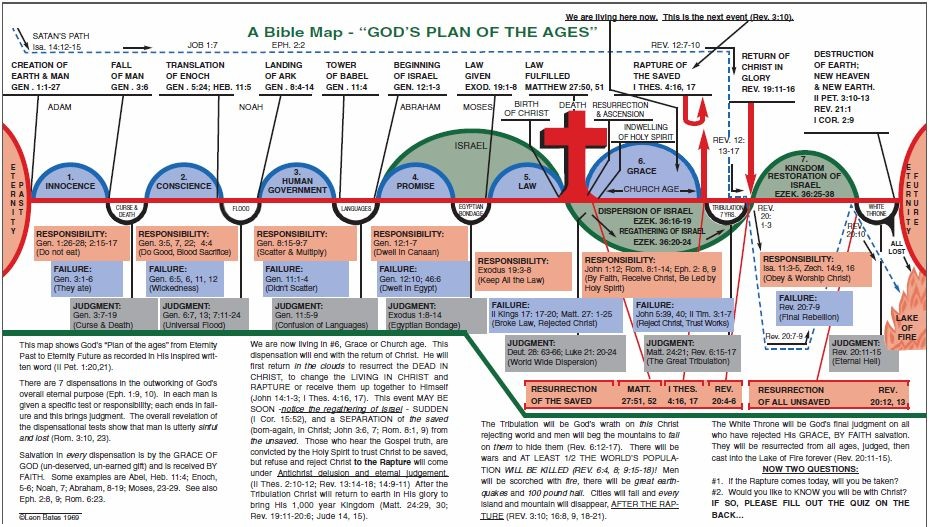
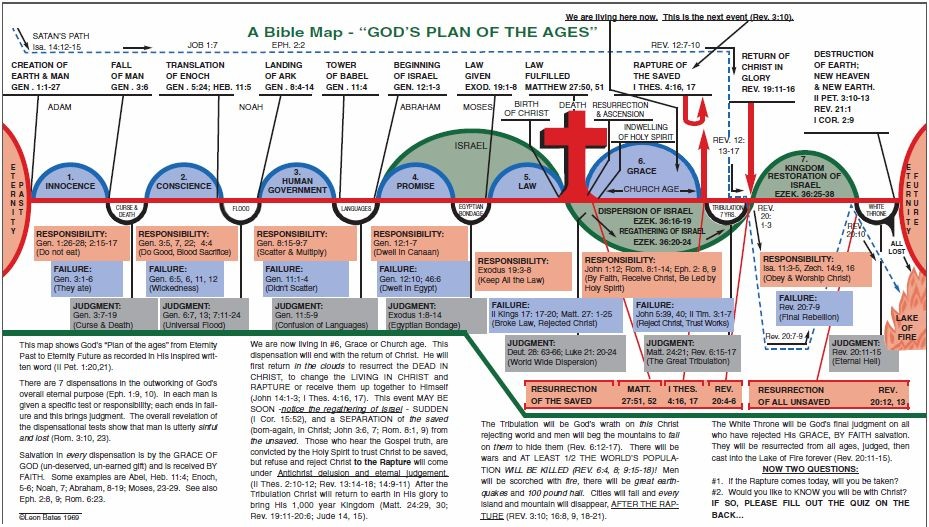
Most theologians recognize seven dispensations: Innocence (Gen. 1.28); Conscience (Gen. 3.23); Human Government (Gen. 8.20); Promise (Gen. 12.1); Law (Ex. 19.8); Grace (John 1.17); Kingdom (Eph. 1.10).[vii]

In each dispensation, God used or uses a ruling factor to govern man. Man failed or will fail in every dispensation, even in the last dispensation in which Christ Himself will rule over a perfect government and exceptional conditions. Man’s failure in that dispensation will bring God’s judgment. Those who rebel outwardly during that time will be executed (See, Is. 11.3-4; 29.20-21; Je. 31.29-30), and “God will crush the huge revolt which will take place immediately after the seventh dispensation sending fire to destroy the human rebels and casting Satan into the lake of fire for everlasting torment (Rev. 20:9-10).”[viii]

Dispensational Theology recognizes distinctions of things which differ in history by asserting that distinctions are the result of God’s administering His rule in different ways at different periods of history. “There is no interpreter of the Bible who does not recognize the need for certain basic distinctions in the Scriptures.”[ix] The Covenant Theologian also makes rather important dispensational distinctions even though he views them as related to the unifying and underlying Covenant of Grace. For example, Louis Berkhof, after rejecting the usual dispensational scheme of Bible distinctions, enumerates his own scheme of dispensations or administrations—the Old Testament dispensation and the New Testament dispensation. “However, within the Old Testament dispensation Berkhof lists four subdivisions, which although he terms them ‘stages in the revelation of the covenant of grace,’ are distinguishable enough to be listed.’” Thus, he recognizes five dispensations—four in the Old Testament and the New Testament dispensation.[x]


Endnotes

[i] Renald E. Showers, There Really Is a Difference: A Comparison of Covenant and Dispensational Theology (Bellmawr, New Jersey: The Friends of Israel Gospel Ministry, 1990), pp. 27-30; see also, Charles C. Ryrie, Dispensationalism (Chicago: Moody Press, 1995), pp. 28-31.

[ii] Ryrie, p. 28.

[iii] Ibid., p. 29; see pp. 29-31 for definitions of “dispensation” by various scholars.

[iv] Showers, pp. 30-31; see also, Ryrie, pp. 33-35.

[v] Showers, pp. 31-32.

[vi] See Ryrie, pp. 56-57.

[vii] See Showers pp. 33-49 and Ryrie, pp. 45-57 (Showers and Ryrie call the Dispensation of Law the Dispensation of Mosaic Law and the Dispensation of Kingdom the Dispensation of the Millennium; Ryrie calls the Dispensation of Human Government the Dispensation of Civil Government.

[viii] Showers, pp. 33-49.

[ix] Ryrie, p. 16.

[x] Ibid., citing Louis Berkhof, Systematic Theology (Grand Rapids: Eerdmans, 1941), pp. 293-301.

(2) Colonial Theological Warfare—Separation of Church and State


A Publication of Simply Church Ministry


If you miss one part of the puzzle that is being put together in these studies, you will never see and understand the whole picture.


Jerald Finney
Copyright © February 7, 2018


A complete analysis of Dispensationalism and Covenant Theology requires a long and deep study of the Bible. FN [i] These short lessons will briefly look at some of the characteristics of each and distinctions between the two. The differences were debated in the colonies during a spiritual warfare that began in the early 1630’s. Fortunately, the dispensationalist view prevailed. This resulted in the adoption of the First Amendment to the United States Constitution which, among other things, separates church and state (not God and state).

The two theologies have distinct “philosophies of history.” FN [ii] The two main systems which Bible-believing scholars have developed to exposit the Bible’s philosophy of history, Dispensationalism or Dispensational Theology and Covenant Theology, have produced two systems of theology. Dispensational Theology contains all the necessary elements of a valid philosophy of history. “Dispensationalism, [which] can be defined very simply as a system of theology which attempts to develop the Bible’s philosophy of history on the basis of the sovereign rule of God, represents the whole of Scripture and history as being covered by several dispensations[, economies, or stewardships] of God’s rule.” FN [iii]

“The essence of dispensationalism … is the distinction between Israel and the church. This grows out of the dispensationalist’s consistent employment of normal or plain or historical-grammatical interpretation, and it reflects an understanding of the basic purposes of God in all His dealings with mankind as that of glorifying Himself through salvation and other purposes as well.” FN [iv]

Covenant theologians teach that the church has replaced Israel. The Bible literally teaches that the rules for the church and state are different than the rules God ordained for the theocracy in Israel. Distinct rules, as discussed in the articles under Distinct Differences between Church and State that Render Them Mutually Exclusive, are laid down in the Bible concerning Judaism and Israel and the church and state.

Covenant theologians believe that God is through with Israel, that the church replaces Israel. This is a grave mistake to Judaize the church, a mistake which has many consequences.

“It may safely be said that the Judaizing of the Church has done more to hinder her progress, pervert her mission, and destroy her spiritually, than all other causes combined. Instead of pursuing her appointed path of separation from the world and following the Lord in her heavenly calling, she has used Jewish Scriptures to justify herself in lowering her purpose to the civilization of the world, the acquisition of wealth, the use of an imposing ritual, the erection of magnificent churches, the invocation of God’s blessing upon the conflicts of armies, and the division of an equal brotherhood into ‘clergy’ and ‘laity.’” FN [v]

The “Judaizing” of the church is based upon false biblical interpretation, upon a false philosophy of history.

The main issue in the theological warfare in the colonies was the relationship of church and state. Other issues such as believer’s baptism (Dispensational) versus infant baptism (Covenant Theology)—an issue closely related to the issue of separation of church and state—were also hotly debated. Covenant theologians believe in union of church and state. Dispensationalists take the literal meaning of the Bible on this issue—that God desires church and state to be separate in Gentile nations; both under God, but neither working over, with, or under the other. The arguments of both sides in the colonies are still available. Both secular and Christian histories of the theological warfare and the accompanying persecutions of dissenters is undeniable. Sadly, Calvinist, Protestant, and Catholic revisionism has done a masterful job of both promoting a revised version of history while hiding the truth from untold millions of “Christians.”


Endnotes

[i] For much more in-depth look at these matters, see Dispensational Theology versus Covenant Theology.

[ii] “Karl Lowith defines ‘a philosophy of history as ‘a systematic interpretation of universal history in accordance with a principle by which historical events and successions are unified and directed toward ultimate meaning’” (Charles C. Ryrie, Dispensationalism (Chicago: Moody Press, 1995), p. 17, citing Karl Lowith, Meaning in History (Chicago: Univ. of Chicago Press, 1949), p. 1; see also, Renald E. Showers, There Really Is a Difference: A Comparison of Covenant and Dispensational Theology (Bellmawr, New Jersey: The Friends of Israel Gospel Ministry, 1990), p.  1). This definition “centers on three things: (1) the ultimate goal of history; (2) the unifying principle; and (3) the recognition of ‘historical events and successions,’ or a proper concept of the progress of revelation in history” (Ryrie, p. 17). The Bible contains a philosophy of history because it deals with the issue of meaning, offers a systematic interpretation of history, covers the entire scope of history from beginning to end, including the what and why of the future, presents a unifying principle which ties together and makes sense of the whole gamut of events, distinctions, and successions, and demonstrates that history has an ultimate goal or purpose (Showers, p. 2; Ryrie, p. 17).

[iii] Renald E. Showers, There Really Is a Difference: A Comparison of Covenant and Dispensational Theology (Bellmawr, New Jersey: The Friends of Israel Gospel Ministry, 1990), p. 27.

[iv] Charles C. Ryrie, Dispensationalism (Chicago: Moody Press, 1995), p. 41.

[v] Dr C. I. Scofield, Rightly Dividing the Word of Truth (New Jersey: Loizeaux Brothers, First Edition, January, 1896), p. 12.

3. Dispensation Theology versus Covenant Theology and their importance to the issue of church and state relationship in America

A Publication of Churches Under Christ Ministry


If you miss one part of the puzzle that is being put together in these studies, you will never see and understand the whole picture.


Previous Lesson:
2. Definitions of “Separation of Church and State,” “Established Church,” and “Religious Freedom or Soul Liberty”2

Next Series of Lessons:
 4. Distinct Differences between Church and State Which Render Them Mutually Exclusive

Click here to go to all lessons on the Bible doctrine on the relationship of Church and State.

Click here to go to the written lessons.

Click here to go to the 3 1/2 to 6 minute video lectures.


A student may not choose to delve into all the matters concerning Dispensationalism versus Covenant Theology. Some of the studies below are optional and not necessary for a basic understanding of the spiritual or theological warfare that went on between established and dissenting, mainly Baptist, churches and their representatives in the colonies. Therefore, some of the studies noted below are noted to be “Optional.”

(1) Introduction
(2) Colonial Theological Warfare–Separation of Church and State
(3) The Essence of Dispensationalism (Optional)
(4) The Way in Which the Two Systems Meet the Requirements for a Philosophy of History (
Optional)
(5) Some Basic Teachings of Covenant Theology (Optional)
(6) Puritan Covenant Theology Exposed in the American Colonies
(7) Three Critical Factors Upon Which Dispensationalism and Covenant Theology Disagree (Optional)
(8) Dispensationalism Correctly Explains the Covenants of Law and Grace (Optional)
(9) Persecution: A Consequence of Covenant Theology
(10) History Proves Established Churches Are Vile, Viciously Persecute Heretics, and Corrupt the State, the Church, and the People (Optional)
(11) New Testament Teaching against Persecution of Heretics (Optional)
(12) Conclusion to “Dispensation Theology versus Covenant Theology and their importance to the issue of church and state relationship in America”

Click here to go to the written lessons.
Click here to go to the 3 1/2 to 6 minute video lectures.

Introduction: Dispensation Theology versus Covenant Theology


If you miss one part of the puzzle that is being put together in these studies, you will never see and understand the whole picture.


A publication of Simply Church Ministry


Click here to go to Dispensation Theology versus Covenant Theology and Their Importance to the Issue of Church and State Relationship in America.
Click here to go to the written lessons.
Click here to go to the 3 1/2 to 6 minute video lectures.


Jerald Finney
Copyright © January 29, 2018


In order to understand religious liberty and the history of the First Amendment to the United States Constitution (freedom of speech, press, association, religion (or religious liberty); conscience; soul liberty; separation of church and state; and the right to petition the government for a redress of grievances), one must understand Dispensational Theology and Covenant Theology. This is because proponents of these two theologies fought a spiritual warfare in the colonies which led to the adoption of the First Amendment to the United States Constitution.

The Puritans were Covenant Theologians. Historic Baptists were Dispensationalists in belief, although the term Dispensational Theology was not coined until sometime in the last few hundred years. These two theologies clashed in the English colonies of America, the Baptist view prevailing at the federal level with the adoption of the First Amendment.

Christian and Secular Revisionists, as always, continue to deceive the general population in America with a revised history of the First Amendment. The contrived version of “Christian” revisionist history predominates the American Christian landscape. Endnote [i] The historical section of these studies will summarize that history, which scholars have recorded from the colonial period until this day. Endnote [ii] Contemporary Christian Revisionists use the same techniques as did their Calvinist forefathers. As Isaac Backus noted, concerning the revisionism and lies of the leaders of the established churches in the colonies:

  • “[I] appeal to the conscience of every reader, whether he can find three worse things on earth, in the management of controversy, than, first, to secretly take the point disputed for truth without any proof; then, secondly, blending that error with known truths, to make artful addresses to the affections and passions of the audience, to prejudice their minds, before they hear a word that the respondent has to say; and thirdly, if the respondent refuses to yield to such management, then to call in the secular arm to complete the argument?”[iii]

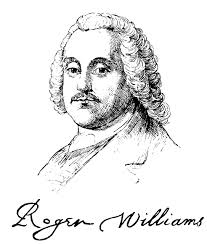
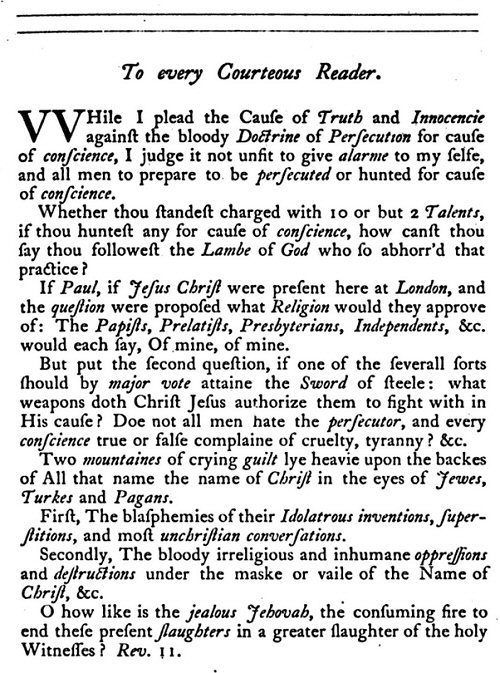
See Isaac Backus Quoted in God Betrayed to get a little understanding of the importance of his efforts and writings in the colonies for the cause of separation of church and state and religious liberty. The first major threat to the colonial establishments was instituted by Roger Williams in New England. His activities and writings forcefully revealed fallacies of Puritan (Calvinist) theology and Puritan persecution of “heretics” and led the founding of the first civil government in history with any lasing influence with religious liberty. See Roger Williams: Quotes and Other Information from God Betrayed.

Baptists in the colonies fought the Puritan and Anglican establishments. Isaac Backus came out of the Congregational (Puritan) Church, became a Baptist, and fought against establishment of churches, infant baptism, etc. His Bible studies led him to disregard significant portions of Calvinist allegorized interpretations of Scripture. He still called himself a Calvinist,  but rejected much of classic Calvinism. Through his extensive writing and activities, he fought for separation of church and state, baptismal regeneration, and other issues in the colonies.  These studies, especially the advanced studies, extensively quote Isaac Backus, and others such as Roger Williams—another hero of the faith who, as a Congregational pastor arrived in Massachusetts from England in the 1630s and soon clashed with Puritanism. It is obvious from their writings that these men took a literal view of Scripture and rejected the allegorized interpretation of Catholicism and Protestantism. Their writings totally dismantled the teachings of Puritans such as John Cotton. At the same time, Cotton and other Puritans, true to form and according to their theology, lied and misrepresented truth as always. They justified lying based upon false interpretations of Scriptures such as those dealing with Rahab the harlot and the midwives in Egypt.

The warfare between various biblical theologies continues and will continue until the kingdom of heaven is established by our Lord. Most “Baptists,” not to mention members of denominations and religions, have unknowingly succumbed to false religious beliefs and philosophies as end-time prophesy unfolds as foretold in Scripture.

This and the next few teachings will, in a nutshell, explain Dispensational Theology and Covenant Theology, distinguish them, and will be invaluable in one’s quest for understanding of the biblical principle of separation of church and state and the American application thereof. To fully understand these matters will not be the goal; only the most important matters will be covered, and those in summary form. see the citations and references for more in depth analysis and study.

Covenant theology allegorizes and spiritualizes Scripture and teaches union of church and state. Covenant theology applies selected principles regarding the theocracy of Israel to Gentile civil government and the church. Dispensational theology is based upon a literal belief in Scripture which accordingly teaches separation of church and state. Although many biblical principles run from Genesis to Revelation, the rules for church and state and for the Jewish religion-state are not the same. Under Judaism (the Jewish religion as ordained by God), religion and state operated hand-in-hand under God; that is, the religion and state were unified by God, both religion and state instructed by God to work together directly under God for the same goals.

Keep in mind that there are many variations of Covenant Theology. Likewise, Dispensationalist systems of theology deviate, some alarmingly, from accurate and literal understanding and teaching on Scripture. God will not call every believer to totally understand these systems. The best thing a believer can do with God’s Word is to study it, believing what it says. When one does that, he will by definition be a dispensationalist. The important thing is that the believer read his own Bible and verify any Bible teaching. It is a serious mistake to blindly follow anyone, especially traditional Calvinist, Reformed, Catholic, Charismatic, JW, Mormon, or similar cultic teachings and teachers.


Endnotes

[i] See, The history and Meaning of the First Amendment or The Trail of Blood of the Martyrs of Jesus/Christian Revisionism on Trial which also explains why those revisionists lie about history and seek to intentionally deceive Christians.

[ii] See, Legal and Scholarly Resources and Authorities. See also, The Trail of Blood of the Martyrs of Jesus/Christian Revisionism on Trial.

[iii] Backus, A History of New England…, Volume 1, p. 150. This comment followed and preceded illustrations of how those in favor of church/state marriage, infant baptism, etc. advance their cause.  On pp. 151-152, Mr. Backus illustrated how those in favor of infant baptism argued their position, pointing out the fallacies of their arguments. Their tactics have not changed, although in America, due to the First Amendment to the United States Constitution, they no longer can call upon civil government to enforce their beliefs. Click here for Quotes of Isaac Backus in God Betrayed.

Colossians

Click here to go to “Bible Studies on the Doctrine of the Church” from other books of the Bible.

Click here to go to 6 lessons on Colossians (Questions and Answers).

Contents:

DATE
CHURCH AT COLOSSE
PROBLEM AT COLOSSE
THE MESSAGE OF COLOSSIANS
COMMENTS
OUTLINE
NOTES


NOTE. For more details see, McGee, Colossians. This study is taken from that book with some modifications. The study is also available online in audio at: Colossians.


DATE A.D. 62. Four men left Rome in A.D. 62 bound for Turkey. These men had four of the most sublime compositions of the Christian faith. When these men bade farewell to the Apostle Paul, each was given an epistle to bear to his particular constituency. These four letters are in the Word of God, and they are designated the “Prison Epistles of Paul,” since he wrote them while he was imprisoned in Rome. He was awaiting a hearing before Caesar Nero. The four men and their respective places of abode were: (1) Epaphroditus from Philippi who had the Epistle to the Philippinans (Philippians 4.18). (2) Tychicus from Ephesus who had the Epistle to the Ephesians (Ephesians 6.21). (3) Epaphras from Colosse who had the Epistile to the Colossians (Colossians 4.12). (4) Onesimus, a runaway slave from Colosse, who had the Epistle to Philemon, his master (Philemon 10).

These epistles present a composite picture of Christ, the church, the Christian life, and the interrelationship and functioning of all. These different facets present the Chritian life on the highest plane.

Colossians directs our attention ot the head of the body who is Christ. The body itself is secondary. Christ is the Theme. He is the center of the circle around which all Christian living revolves. Colossians emphasizes that Christ is the fullness of God.

Ephesians, Philippians, Colossians, and Philemon  have been called the anatomy of the church. They belong together to make a whole.


CHURCH AT COLOSSE

The church at Colosse met in the home of Philemon. A great civilization and a great population were in that area. East and West meet there. Colosse was more a less a door to the Orient, to the East.

Colosse, Laodicea, Philadelphia, Sardis, Thyatira, and Pergamum were fortress cities. They had all been great cities of defense against invasion from the East. By the time of Paul, the danger had been relieved because the Roman Empire was pretty much in charge of the world by then. Pelple had lapsed into paganism and gross immorality at the time of Paul. Colosse was typical.

Paul never visited Colosse. Nonetheless, he founded the church there. Converts from Paul’s ministry at Ephesus very definitely could have come to Colosse to form the nucleus of that church. Colosse is just 75 to 100 miles east of Ephesus.


PROBLEM AT COLOSSE

Asia Minor was a center for heathenism, paganism, and the mystery religions. There was already abroad the first heresy of the church, Gnosticism. There are many forms of Gnosticism, and in Colosse there were the Essenes. There are 3 points of identification of this group:

  • They had an exclusive spirit. They were the aristocrats in wisdom. They felt that they were the They felt they had a monopoly on knowledge. They thought that they knew more than the apostles. Paul will issue them a warning in the first chapter: Colossians 1:28: “Whom we preach, warning every man, and teaching every man in all wisdom; that we may present every man perfect in Christ Jesus:” Perfection is not found in any cult or any heresy, but in Christ Jesus. All wisdom is found in Him.
  • They held speculative tenets on creation. They taught that God did not create the universe directly, but created a creature who in turn created another creature, until one finally created the physical universe. Christ was considered a creature in this long series of creations. This was known in pantheistic Greek philosophy as the demiurge. Paul refutes this in Colossians 1.15-19 and 2.18.
  • Ethically, the practiced asceticism and unrestrained licentiousness. They got the asceticism from the influence of Greek Stoicism and the unrestrained licentiousness from the influence of Greek Epicureanism. Paul refutes this in Colossians 2.16, 23 and 3.5-9.

THE MESSAGE OF COLOSSIANS

Colossains is the chart and compass which enables the believer to sail between the ever present Scylla and Charybdis. On the one hand there is always the danger of Christianity freezing into a form, into a ritual. It has done that in many areas and in many churches so that Christianity involves nothing more than going through a routine. On the other hand is the danger that Christianity will evaporate into a philosophy. The Word of God is the revelation of God as it says it is. That is not a “theory.” We find people talking about theories of inspiration and theories of atonement—that is the evaporation of Christianity into a philosophy.

So there are two dangers. One is to freeze into form and become nothing but a ritualistic church; the other is to evaporate into steam and be lost in liberalism and false philosophy. The Lord Jesus said that He was the water of life, not the ice of life or the steam of life.

The Water of Life is “Christ in you, the hope of glory” (Co. 1.27). Christianity is Christ down where we live, Christ in the nitty-gritty of life, down where the rubber meets the road.

There has always been the danger of adding something to or subtracting something from Christ—the oldest heresy is the newest heresy. Christianity is not a mathematical problem of adding or subtracting. Christianity is Christ. This is what Paul teaches in this epistle: Colossians 2:9 “For in him dwelleth all the fulness of the Godhead bodily.” All you need is to be found in Christ.


COMMENTS

William Sunday said: “In the Ephesian epistle, the church is the primary object, and the thought passes upward to Christ as the head of the church. In the Colossian epistle, Christ is the primary object, and the thought passes downward to the church as the body of Christ.”

The dominating thought in the epistle is that Christ is all. He is all I need. He is everything. Charles Wesley said it like this in a hymn: “Thou, O Christ, art all I want; more than all in Thee I find.”

Charles Spurgeon said, “Look on thine own nothingness; be humble, but look at Jesus, thy great representative, and be glad. It will save thee many pangs if thou will learn to think of thyself as being in him”—accepted in the Beloved, finding Him our all in all.

If you are resting in Him, you will find that you don’t need to go through a ritual. You won’t need to do a lot of gyrations and genuflections. You won’t be discussing the theories of inspiration. You either believe the Bible is the Word of God, or you don’t believe the Bible is the Word of God.

The so-called intellectual approach we find in our churches today is no good. Be a genuine you and not an imitation of someone else. Don’t try to imitate intellectual men you admire. We need to get down off our high horses. The Lord Jesus is feeding sheep, not giraffes.

The practical section of Colossians shows us Christ, the fullness of God, poured out in the life of believers. The alabaster box of ointment needs to be broken today. The world not only needs to see something, it needs to smell something. The pollution of this world is giving a very bad odor in these days. We need something of the fragrance and loveliness of Jesus Christ, and only the church is permitted to break that alabaster box of ointment and let out the fragrance.


OUTLINE

  1. DOCTRINAL: Christ, the fullness of God; in Christ we are made full, Chapters 1, 2
    A. Introduction, 1.1-8
    B. Paul’s Prayer, 1.9-14
    C. Person of Christ, 1.15-19
    D. Objective Work of Christ for Sinners, 1.20-23
    E. Subjective Work of Christ for Saints, 1.24-29
    F. Christ, the Answer to Philosophy (For the Head), 2.1-15
    G. Christ, the Answer to Ritual (For the Heart), 2.16-23
  2. PRACTICAL: Christ, the fullness of God, poured out in the life through believers, Chapters 3, 4.
    A. Thoughts and Affections of Believers are Heavenly, 3.1-4
    B. Living of Believers is Holy, 3.4-4.6
    C. Fellowship of Believers is Hearty, 4.7-18

NOTES

Chapter 1

INTRODUCTION (vs1-8)

vs1-2 “An apostle of Jesus Christ,” “by the will of God.” Every church member should be functioning, doing what God has called him to do. Our gifts are different and we are each going to function a little differently.

“To the saints and faithful brethren of Christ which are at Colosse.” This saints and faithful brethren are the same. We are not saints because of what we do. We are saints because of our position. The word means to be set apart for God.

Notice that they are “in Christ,” but they are at “Colosse.” We should have an address down here, but also an address up yonder also: in Christ.

“Grace be unto you, and peace, from God our Father and the Lord Jesus Christ.” The gnostics relegated God to a place far removed from man and taught that one had to go through emanations to get to God. Paul says here that grace and peace come directly “from God our Father.” We can come directly to Him through Christ.

v3 Anyone who is in Christ Jesus has access to God the Father. “Praying always for you.”

vs4-5 Here Paul links to trinity of graces for believers: (1) faith—past; (2) love—present; and (3) hope—future. Paul talks about the good points of these believers. Faith rests upon historical facts; it is believing God. Romans 10:17 “So then faith cometh by hearing, and hearing by the word of God.”

It is nonsense to boast of our fundamentalism and then to spend our time crucifying our brethren and attempting to find fault with them. There are too many “wonderful saints” looking down on their fellow believers who have not measured up to their high standard and are not separated like they are separated. The world is looking to see whether Christians love each other or not.

In 1 Co. 13.13, Paul lists these 3 graces, but lists them differently. He puts hope in the 2nd position and love is listed last. Why? Because love is the only thing that is going to abide. Love is for present, but it will make it to eternity.

The “hope which is laid up for you in heaven” is the blessed hope. We are to love Christ’s appearing.

The gospel is a simple message which God simply asks you to believe.

v6 Paul says the gospel has come to the Colossians as it has come to “all the world.” The gospel had penetrated into the farthest reaches of the Roman Empire of that day.

“And bringeth forth fruit.” Whereever the gospel is preached, it will bring forth fruit.

v7 Apparently, Epaphras “our dear fellowservant” is the pastor of the church at Colossee.

v8 Paul makes it clear to these Colossian believers that they would not have been able to exhibit this love unless it were by the Holy Spirit. It was to the Galatians that Paul wrote that the fruit of the Spirit is love. In this epistle, Paul dwells on the person of Christ. As he does that, the Spirit of God will take the things of Christ and will show them unto us.

PAUL’S PRAYER (vs. 9-14)

This is one of the most wonderful prayers in Scripture. He will make seven petitions, and then he will thank the Lord for the things He has already done for us.

v9 First, Paul prayed that they might be filled with knowledge “of his will in all wisdom and spiritual understanding.” Wisdom occurs forty times in this epistle.

v10 He prays that they might be pleasing to God. Third, he prays that they might be “fruitful in every good work.” The Christian is a fruit bearing branch. Christ is the vine, and we should bring froth fruit.

“Increasing in the knowledge of God.” (4th request) A Christian should not be static, but growing in the word of God.

v11 (5th) For strength and power which can only come from God; produced by the Holy Spirit. They are to be strengthened with all might “unto all patience and longsuffering” “with joyfulness.”

v12-14 Here is the list of things for which Paul is thankful.

PERSON OF CHRIST (vs15-19)

In Colossians, we come in close on the person of Christ and learn the theology of it. This is a very lofty, very exalted, and very grand section of this epistle. This provides an answer to those who would deny the deity of Jesus Christ. Paul is answering one of the oldest heresies in the church—Gnosticism.

Paul gives here 9 marks of identification of Christ which make Him different from and superior to any other person who has ever lived.

  • The “image of the invisible God.” See John 1.1, 14. Christ was born flesh. That is the way that He became the image of the invisible God. How could that be? Because He is God. If He were not God, He could not have been the image of the invisible God.
  • He is “the firstborn of every creature.” This reveals His relationship to the Father and His position in the Trinity. God is the everlasting Father. Christ is the everlasting Son. “Firstborn” indicates His priority before all creation. Nowhere does Scripture teach that Jesus Christ had his beginning at Bethlehem. In Micah 5.2 we are told that He would be born in Bethlehem, but that he came forth from everlasting. Is. 9.6 tells us that “the child is born” but the “son is given.” He came out of eternity and took on Himself our humanity. Gnosticism taught that Jesus was a creature who came out of a line of created creatures, emanations from God. Paul says Jesus Christ was the firstborn of all creation, that He is back of all creation.

There are several places in Scripture where Christ is called the firstborn. He is called the firstborn of all creation; the firstborn from the dead; and the only begotten.  See Co. 1.18, Ps. 2.7; Ac. 13.32, 33.

When Christ is called the firstborn of all creation, it is not referring to His birth at Bethlehem. It means it has top priority of position. See Ps. 89.27.

Some other verses that speak of the person of Christ. He. 1.3; 1.7, 8.

This says Jesus Christ was God. See Lk. 1.35; Mt. 16.16.

  • “By hi were all things created.” He was the creator. There are two types of creation, visible and invisible. He mentions different gradations of rank in spiritual intelligences: thrones, dominions, principalities, powers. There are gradations in angelic hosts. Other verses te us that there are seraphim and cherubim, and also the archangels. Then there are just the common, everyday, vegetable variety of angels. In Ephesians, we see that our enemy is a spiritual enemy. Satan has a spiritual host that rebelled with him. There are different gradations and ranks of our spiritual enemies too.
  • All things were created “for him.” We are joint heirs of God and joint heirs with the Lord Jesus Christ. We will have a new body free from gravity. We will be able to travel throughout God’s universe. We live in tabernacles, tents. 2 Co. 5.1. 2 Co. 5.8: “willing rather to be absent from the body, and to be present with the Lord.” Eternity is the prospect ahead for us.
  • “He is before all things” (v17).
  • “By him all things consist” (v17). He holds everything together. See also He. 1.3.
  • “He is the head of the body, the church” (v18). In Ephesians, the emphasis was on the church as the body of Christ in this world. In Colossians, the emphasis is on Christ, the Head of the body. Ephesians 1:22: “And hath put all things under his feet, and gave him to be the head over all things to the church.” Finally, in Philippians we see the church with feet walking through the world—we see the experience of the church, the experience of the believer.

“The firstborn from the dead.” There is only one man who has a glorified body today. He is the firstfruits of them that sleep. When a believer dies, the body is put to sleep, but the individual has gone to be with the Lord. When Christ comes to take His church out of the world, then that body is going to be raised on the basis of His resurrection. It is sown in corruption, but it will be raised in incorruption (1 Co. 15.42). We shall be just as He is (1 Jn. 3.2).

  • “That in all things he might have the preminence” (v18). God’s intention is that the will of Christ must prevail throughout all of God’s creation. Ps. 2.6. God is moving forward today undeviatingly, unhesitatingly, uncompromisingly toward one goal—to put Jesus Christ on the throne of this world which today is in rebellion against God. That is the objective of God.
  • “It pleased the Father that in him should all fullness dwell” (v19). In Philippians, Christ emptied Himself and became a servant; He emptied Himself of the glory that He had with the Father. He did not empty Himself of His deity—He was God when He came to this earth.

Here we see that the fullness of God dwells in Him. When He was on the earth, He was 100% God.

Another outline of these verses is:

  • Christ’s relationship to the Father—v 15.
  • Christ’s relationship to the creation—vs 16, 17.
  • Christ’s relationship to the church—vs. 18, 19.
  • Christ’s relationship to the cross—v. 10.

OBJECTIVE WORK OF CHRIST FOR SINNERS (vs. 20-23)

We see here the things Christ has done for us.

v20 “Having made peace through the blood of his cross” means that by His paying the penalty on the cross for your sin and my sin, peace has been made between God and the sinner. God is saying, “I have already borne the punishment, I have already paid the penalty for all your sin. I want you to know that you can come to me. Peace has already been made in Christ Jesus, if you will just turn and come to Me.” This is what Paul meant in Romans 5:1 “Therefore being justified by faith, we have peace with God through our Lord Jesus Christ.”

“By him to reconcile all things unto himself.” Reconciliation is toward man; redemption is toward God. Man must make a decision to be reconciled to God. Paul explains this very clearly in 2 Co. 5.18-20. God is asking man to be reconciled to Him.

“Reconcile all things.” “All things” are those which are appointed to reconciliation. Philippians 3:8 “Yea doubtless, and I count all things but loss for the excellency of the knowledge of Christ Jesus my Lord: for whom I have suffered the loss of all things, and do count them but dung, that I may win Christ.” This refers to all things Paul had to lose.

“Whether they be things in earth, or things in heaven.” He does not mention things under the earth.  Ephesians 1:22 “And hath put all things under his feet, and gave him to be the head over all things to the church.” What are the “all things that are going to be put nder His feet? Philippians 2:10 “That at the name of Jesus every knee should bow, of things in heaven, and things in earth, and things under the earth.”

Things in heaven and earth are reconciled to God, but not things under the earth. One needs to be reconciled to him in this place and in this life.

“Things in heaven.” Heaven is being made ready to receive us. John 14:2  “…I go to prepare a place for you.” By the blood of Jesus, man is brought to God. This blood also purifies things in heaven according to He. 9.23-24.

v21 A man is lost because he wants to be lost, because he is in rebellion against God. The reason people are lost is because their minds are alienated from God. There is an open hatred and hostility toward God.

v22 Here is an explicit declaration that Christ suffered in a real body. This directly countered one of the heresies of Gnosticism. Unblamable means without blemish. “Unreproveable” means unaccusable or unchargeable. God justifies the believer. He is the One who has cleared us of all guilt.

v23 The if Paul uses here is the if or argument. It means that something was if something else is true. Paul’s point is that we have been reconciled—it is an accomplished fact. If you are a child of God, you will continue in the faith grounded and settled.

SUBJECTIVE WORK OF CHRIST FOR SAINTS (vs24-29)

v24 Paul is saying that it was necessary for him to full up in suffering that which was lacking in the suffering of Christ. That is, Paul was suffering in his body for the sake of Christ’s body. It would seem to say that there was something lacking in the suffering of Christ. A second implication is that it is necessary for all believers to make up that which is lacking. Here it would seem that there is still something to be done. Paul had fulfilled Acts 9:15-16 “But the Lord said unto him, Go thy way: for he is a chosen vessel unto me, to bear my name before the Gentiles, and kings, and the children of Israel: For I will shew him how great things he must suffer for my name’s sake.”

The sufferings of Paul were not redemptive. There are two kinds of suffering: ministerial and mediatorial. Christ’s sufferings for us was mediatorial.

  • There are two sufferings of Christ which He endured and in which we cannot share.

He suffered as a man. He endured human suffering. As when He was born, He cried like other babies He was clad in the frail flesh and garment we as humans have. He could get hungry and thirst. He experienced loneliness. He suffered anguish and pain and sorrow. He could go to sleep in the boat because He was weary and tired.

Galatians 6:5 “For every man shall bear his own burden.” We are born alone. We feel pain alone. We each must face certain problems in life, and we face them alone. There is a sorrow that comes that no one can share with us. We become sick, and no one can take our place. Humanly speaking, we will die alone.

The second suffering He could not share was His suffering as the son of God. No mortal has ever had to endure what He went through. We see this suffering in Ps. 69.

And then He suffered as the sacrifice for the sin of the world. None of us can do that. He is the Lamb of God that takes away the sin of the world, and none of us can enter into that suffering at all. He alone went to the cross. He was forsaken by God and forsaken by man. His blood was not the blood of martyrdom; His was the blood of sacrifice.

That is a suffering man cannot bear; He could not share that with anyone else.

  • On the other hand, there are the sufferings Christ endured which we can share. These are the sufferings Paul refers to in v24.

There is the suffering for righteousness’ sake. He suffered for righteousness’ sake. See Jn. 8.40. 1 Peter 3:14 :But and if ye suffer for righteousness’ sake, happy are ye: and be not afraid of their terror, neither be troubled.” 2 Timothy 3:12 “Yea, and all that will live godly in Christ Jesus shall suffer persecution.” In the world today, athletes are lauded, people in entertainment are praised, politicians are praised, and professors are honored; but the man of God is not praised. Romans 8:36 “As it is written, For thy sake we are killed all the day long; we are accounted as sheep for the slaughter.”

Then there is the suffering in the measure we identify ourselves with Christ for the proclamation of the gospel. “Because as he is, so are we in this world” (1 Jn. 4.17; see also, Jn. 15.18-19). If you are not of the world, the world will hate you. If you are popular with the world, you are not popular with Christ and vice versa. When we suffer for Christ, the Lord Jesus is also suffering though us. Jesus asked Saul, “Saul, Saul, why persecutes thou me?”

See 1 Pe. 4.12-13. One thing is certain: If the gospel is to go forward today, someone must suffer. Suffering is not popular.

v25 “Dispensation” means economy. It is a stewardship. God deals with the world on the basis of different economies or stewardships. but they have always been based on the redemption which is in Christ Jesus.

Paul writes to the Gentile people in Colosse. They are a part of this new dispensation. The Gentiles are to be included in the church.

“To fulfil the word of God.” This is something that had been hidden in the Old Testament. Now God has declared that the gospel must go to the Gentiles.

v26 A “mystery” is something that had not been revealed in the OT, but is now revealed. It was known in the OT that the Gentiles would be saved. The mystery, the new thing, was that God would now put Israel on the same basis as the Gentiles. God is taking both Jews and Gentiles and putting them into a new body which is the church.

v27 “Christ in you, the hope of glory”—we are in Christ.

v28 The gospel is not what we preach, but who we preach. Jesus Christ is the gospel. He is eternal life. John wrote that he was going to show us eternal life, that he had seen eternal life (see 1 J. 1.1, 2). He had seen Christ.

“Warning every man, and teaching every man in all wisdom.” “That we may present every man perfect in Christ Jesus.” Perfect means complete or mature.

v29 “Striving” means to agonize. Paul is strving to do this. “According to his working, which worketh in me mightily.” This should be the desire of everyone who is working for Christ—that He would work in us  mightily to do two things: to get out the gospel that men might be saved and then to build them up in the faith. That is the two things the church should be doing today.


Chapter 2

In vs1-15 we will see that Christ is the answer to philosophy. The remainder of the chapter will show that Christ is the answer to ritual. The answer to philosophy is for the head; the answer to ritual is for the heart.

Christianity has always been in danger of evaporating into philosophy—it becomes nothing but steam; or that it will freeze into a form and become nothing more than a ritual. But Jesus Christ is the water of life. He is neither steam nor ice; neither can sustain life.  Christianity is Christ!

There were 5 errors that endangered the Colossian church which Paul will deal with in this chapter:

  • Enticing words—vs4-7
  • Philosophy—vs8-13
  • Legality—vs14-17
  • Mysticism—vs18-19
  • Asceticism—vs20-23

CHRIST, THE ANSWER FOR PHILOSOPHY (For the Head)(vs1-15)

v1 Laodicea was near Colosse. In Re. Laodicea is described as “luke warm.” “Conflict” is agony. MacPhail calls this a prayer of agony. Paul knew there was a grave danger in Colosse and Laodicea. They were in danger of going off in one of two directions. In Re., the Laodiceans were described as lukewarm. They had lost sight of the person of Christ who is the answer to both man’s head and man’s heart. Dr. McGee believes Paul meant by “For as many as have not seen my face in the flesh” means he had never been there.

v2 “Heart” indicates the entire inner man, the whole propulsive nature of man. He is praying that their hearts, their humanity, their whole persons might be comforted.  “Being knit together in love” means compacted in love. Love will draw them together. The bond that unites believers is love.

Full assurance of understanding means that believers should be moving along spiritually—they should be moving along for God. The “mystery of of God, even Christ” is the church. On the Day of Pentecost God started a new thing. He began to call out a group of people int0 the body of believers, baptized into this body. Christ has a physical body while he was on earth and he has a spiritual body here today, the church, which is made of local autonomous assemblies made up of believers.

v3 All that we need is Christ. He is the reservoir of all knowledge.

Now Paul will discuss the error of enticing words.

v4 Philosophy and psychology have been substituted for the Bible and this is the thing that is enticing to so many young preachers in our seminaries today. Many know all about Bultmann and Kant and Plato, but not much about the Word of God. There was that same danger in Colosse and Laodicea. Paul says, “Don’t let anyone beguile (victimize) you by enticing words (oratory or sweet talk).” These words cause many people to follow a certain individual instead of the Word of God. Like the Pied Piper of Hamin, he starts playing, and they start following.

v5 Paul knew that this church was standing. “Beholding your order.” Order is a  military term. Believers should be standing shoulder to shoulder. Instead, many are trying to undermine or take advantage of another believer.

“Steadfastness” means to have a solid front, to be immovable. 1 Corinthians 15:58: “Therefore, my beloved brethren, be ye stedfast, unmoveable, always abounding in the work of the Lord, forasmuch as ye know that your labour is not in vain in the Lord.”

v6 Salvation is a person, the Lord Jesus Christ. We are to walk in Him, to walk in the Spirit. The Christian life is in the home, the office, the schoolroom, on the street. The way you get around in this life is to walk. You are to walk in Christ.

v7 “Rooted” means rooted like a tree, and a tree is a living thing. And we are to be “built up” as a house. “And stablished in the faith.” Faith is the way you and I lay hold on Christ.

Paul now moves on to discuss the danger of philosophy.

“Beware”—Look out! Stop, look, and listen! If you were to follow the history of philosophy beginning with Plato, including many of the church fathers, and coming down to more recent times (Kant, Locke, and Bultmann etc. who seems to be more crazy that some theologians right now), you would find that none of them have a high view of the inspiration of the Word of God. They are looking for answers to the problems of life, but they will not be found in philosophy.

A true philosopher is a seeker of truth, but truth is not found in human wisdom. Christ is the answer, the answer to philosophy (1 Co. 1.30). But false philosophy is like a blind man looking in a dark room for a black cat that isn’t there—there is no hope for its search for truth. Paul warns the Colossians to beware of this.

“After the tradition of men.” The Lord Jesus condemned the religious rulers in His day because they taught the tradition of men rather than the Word of God.

“After the rudiments of the world and not after Christ.” “Rudiments” means that which is basic, the A B C’s. Some try to build their Christian living on a simple worldly system.

Now Paul will speak of Christ.

v9 A clear cut statement of the deity of Christ.

v10 Ye “are complete in him.” You are ready for the voyage of life in Christ, and whatever you need for the voyage of life you will find in Him.

v11 Paul is telling to get rid of that which is outward. the real circumcision is the new birth. See Ga. 6.15). We become a new creature when we come to Christ and trust Him as Savior. We rest in Him; we are identified with Him.

v12 The death and resurrection of Christ is an historical fact. When Christ died, you and I died with Him; He took our place. And when He was raised, we were raised with Him, and we are now joined to a living Christ.

No outward ceremony can bring us to Christ. Salvation is accomplished by the resurrection power of God. It is not some philosophy; it’s not some gimmick; it’s not some little system; it is not the taking of some course that will enable you to live for God.

v13 Salvation is not the improvement of the old nature; it is the impartation of a new nature. Paul had to deal with two Greek philosophies—Stoicism, and Epicureanism. The Stoic taught that man was to live nobly and that death cannot matter. Hold the appetites in check and become indifferent to changing conditions. They believed that man is more than circumstances and that the soul is greater than the universe. It was a brave philosophy. The problem was how to live it.

The Epicurean taught that all is uncertain. We know not whence we came; we know not whither we go. We only know that after a brief life we disappear from this scene, and it is vain to deny ourselves any present joy in view of the possible future ill. Let us eat and drink for tomorrow we die.

Both these systems attempted to deal with the flesh.—the old nature we all have, not the meat on our bones.

If you are joined to Christ, you are going to live as if you are. How close are you to Him? Do you walk with Him? Do you turn to Him in all the emergencies of this life? Is He the center of your life?

The warning against legality (vs14-17).

v14 When Christ died on the Cross, he did not die because He had broken the Ten Commandments. It was because you and I broke them, because everyone is a sinner. If Christ has saved you, you should not go back to a law you could not keep. The law was given to discipline the old nature. The believer has been given a new nature, and the law has been removed as a way of life.

v15 The spiritual victory that Christ won for the believer is of inestimable value.

CHRIST, THE ANSWER TO RITUAL (For the Heart)(vs 16-23)

vs16-17 A believer is not to observe ordinances that are only ritual and liturgical; they have no present value. God did give certain rituals in the OT. But Paul explains they were merely a “shadow of things to come.” The OT rituals were just pictures of Christ.

We come not to the warning against mysticism.

vs18-19 Paul is here condemning the Gnostics who made a pretense of wisdom.

The final warning is against asceticism.

vs 20-21 Since you have died with Christ, do not return to pre-cross living. Paul is talking about the pride that says, “I deny myself, and I don’t do these things. Just look at me. I’m really sprouting wings, and I shine my halo every morning.” “Not in any houour” means it is not of any value. If you are going to walk with Christ, you are going to have a good time.


Chapter 3

Now we come to the practical section, chapters 3 and 4. We have seen the preeminence of Christ in chapters 1 and 2.

Now we come to the place where Paul will insist that He must be made preeminent in our lives. Dedication is Christ preeminent in our lives. If Christ is preeminent in your life, then you are going to live out His life down here on earth. Paul made this clear in Co. 2.9, 10. Christ is the solution to all the problems in life.

Paul has discussed the different things that lead people away from the person of Christ—enticing words, philosophy, legality, mysticism, and asceticism.

The Christian life is to live out the life of Christ.

THOUGHTS AND AFFECTIONS OF BELIEVERS ARE HEAVENLY (vs1-4)

v1 This is the if  of argument, not the if of condition. The lives of these Colossian Christians evidenced their salvation. The evidence was faith, hope, and love—the fruit of the Spirit was in their lives. They loved the believers (Co. 1.4). Love among the believers was so important. They also had hope (Co. 1.5) which is the coming of the Lord Jesus for His children.

“Seek those things which are above, where Christ sitteth on the right hand of God.” “Seek” means an urgency, desire, and ambition. The “things which are above” are the things of Christ. Paul doesn’t say here to seek out and listen to any preacher or teacher. Don’t make Dr. McGee or any man your idol. Look for a man who is just like you are.

The pastor is to preach the Word of God. Every pastor has fallen flat on his face. The Bible is the one Book which reveals the living Christ, and that should be a pastor’s purpose in teaching it.

When you read the Bible, you are looking at the real, living Christ. We are to seek Him. Real study of the Word of God will get you through to the living Christ.

v2 “Set your affection on things above, not on things on the earth.”

v3 “For ye are dead, and your life is hid with Christ in God.” You died more than 1900 years ago when Christ died. I have been taken out of the old Adam by baptism (of the Holy Spirit).

v4 If you have any life it is Christ’s life. Christ is eternal life.

LIVING OF BELIEVERS IS HOLY (vs. 3.5-4.6)

If we are truly risen with Christ this will be evident in two areas of our lives: (1) our personal holiness, and (2) our fellowship with others who are about us. If ‘Christians’ were as afraid of sin and they are of holiness, it would be a wonderful thing.” If you have accepted Christ as your Savoiur, that is going to show in your life down here.

v5 “Mortify” means to put to death, or put in the place of death. Colossians 3:5 “Mortify therefore your members which are upon the earth; fornication, uncleanness, inordinate affection, evil concupiscence, and covetousness, which is idolatry.” “Fornication” means sexual immorality. “Uncleanness” includes thoughts, words, looks, gestures and the jokes we tell. “Inordinate affection” means uncontrolled passion or lust. “Evil concupiscence” means evil desires. “Covetousness, which is idolatry” means when we always must have more.

Dr. McGee says that covetousness is the root of most of the problems in our country today. 1 Timothy 6:10 “For the love of money is the root of all evil: which while some coveted after, they have erred from the faith, and pierced themselves through with many sorrows.”

v6-7 Men are lost bc they are sinners. God’s wrath comes on “the children of disobedience.”

v8 Believers put off all these things “anger, wrath, malice, blasphemy, filthy communication out of your mouth.” Anger becomes wrath when we develop an unforgiving spirit. Malice is an anger that has been nursed along, and anger that tries to take revenge and get even. There is blasphemy against God (defaming the name of God, misrepresenting Him, hating Him) and blasphemy against man (for example, saying something about another Christian that is not true). “Filthy communication out of your mouth” means foul communication and includes both that which is abusive and that which is filthy.

v9 Christians are not to lie.

v10 “Put on the new man which is renewed in knowledge after the image of him that created him.”

v11 In church, there is neither Greek nor Jew, circumcision nor uncircumcision, Barbarian, Scythina, bond nor free: but Christ is all, and in al” All are brethren. Barbarian, Scythian – the most barbaric the world has known. Some of them had been won to Christ. “Christ is all and in all.”

We are in the practical section of Colossians.

v12 “The elect of God” are those who have been saved. These are clothed in the righteousness of Christ. The garments Paul is talking of are the fruit of the Holy Spirit. We can’t attain this wonderful position that I have in Christ. So you and I find ourselves cast upon Him. As it says in Song of Solomon, “Draw me, draw me.”

“Bowels of mercies” means heart of compassion. “Kindness” means to be helpful to others. “Humbleness” is meekness. “Meekness:” the emphasis here is meekness of spirit. “Longsuffering” means it burns a long time. We should not have a short fuse. We should not make snap judgments.

v13 Quarrel” means complaint. Paul is including situations where there is blame involved and the complaint is justified. What are we to do in such situations? “Even as Christ forgave you, so also do ye.”  We are to go to the one we have a complaint against and try to work it out. But there are some with whom y0ou cannot work out things.  When our Lord denounced the Pharisees, there is no mention of forgiveness—He just denounced them. They did not seek His forgiveness, of course. Paul’s thought here is that Christ has forgiven us so much that it won’t hurt us to forgive somebody who has stepped on our toes. We are to forgive others the same way that Christ has forgiven us.

vs14-15 “Charity” is love. We have in these 2 verses two fruits of the Spirit: love and peace. The peace of God should “rule,” govern, our hearts.

v16 “The word of Christ.” John 15:3 “Now ye are clean through the word which I have spoken unto you.” “Dwell” means to be at home, to be given the run of the house.

“Let the peace of God rule your hearts”—let it be an umpire. Then “let the word of Christ dwell in you richly in all wisdom”—let it be at home. Know Him. Be familiar with the Word of Christ; study it and know what He is saying to you. He speaks to you in His Word.

“Teaching and admonishing  one another in psalms and hymns and spiritual songs.” “Singing with grace in your hearts to the Lord.”

v17 Paul here does not say what we should or should not do. He simply says, “Do all in the name of the Lord Jesus, giving thanks to God and the Father by him.” All you do at home, in the workplace, in relationships with others, can you say, “I am doing this in the name of the Lord Jesus.” If so, go ahead and do it.

Now Paul comes to the subject of holiness in the home. Notice he is dealing with the same things he dealt with in Ephesians. Now, he gives instructions for living.

The Word of God is inspired by the Holy Spirit. If the Word of God dwells in you richly, then you are filled with the Spirit of God. You cannot be filled with the Holy Spirit or serve Christ until you are filled with the knowledge of His Word. If God’s Word dwells in you richly, it will work itself out in your life, and it will have an effect on your home.

v18 This is for the purpose of order in the home, not for the purpose of a browbeating husband. A wife should not stay with a drunken husband and maybe beats her. She loses her own personality she loses her own dignity, and she will find herself being brought down to his level is she submits to that. She is to submit “as it is fit in the Lord.”

v19 The husband who loves his wife is the one to whom the wife is to submit.

v20 Children are to obey their parents, to honor their parents all their lives. However, the child needs to grow up. This verse is for children, for minor.

v21 Proverbs reveals that the responsibility to find God’s will for the child has been given to the parents. Proverbs 22:6 “Train up a child in the way he should go: and when he is old, he will not depart from it.”

Now Paul moves to the subject of holiness on the job at the place of employment.

v22 “Don’t keep your eye on the clock. Keep your eye on Christ. He is the one you are serving.” If you are lazy, you are not dedicated to Christ. Paul had one goal: Philippians 3:13-14: “Brethren, I count not myself to have apprehended: but this one thing I do, forgetting those things which are behind, and reaching forth unto those things which are before, I press toward the mark for the prize of the high calling of God in Christ Jesus.” He had his eye, his mind, his heart, and his total affections fixed upon Jesus Christ.

v23 Work from your soul, with enthusiasm unto the Lord. This applies to everything you do. Even if you cannot go to church with enthusiasm, Dr. McGee recommends that you quit going to that church. Do everything “as to the Lord,” not to men. We are not to be menpleasers.

v24 The Lord sees all that you do. You have to give an account of your life to Him. He is going to ask that His representative be found faithful. There are a lot of humble, little-known people down here that we know nothing about that have been faithful on the job, to their employer, to their church, to their homes. They will receive a reward. “For ye serve the Lord Christ.”

v25 He is going to straighten out everything in your life and in my life that we don’t straighten out down here. It is a privilege to be in God’s service. But don’t ever think that makes you something special. When the Lord judges you, He will judge you on faithfulness.

Only the Holy Spirit working in me can attain this high and holy calling. He wants me to mirror Him in every relationship I have down here.


Chapter 4

Chapter 3 concluded with exhortations to servants or to employees. Chapter 4 will continue with exhortations to masters or to employers.

v1 The master is to do right by the servant. “Knowing that ye also have a Master in heaven.” The master will stand with Christ someday. Every Christian employer, as well as employee, will stand before God some day. This gets down to where the rubber meets the road.

The next few verses present 3 more areas of Christian conduct which are important: prayer, our public walk, and speech.

v2 Pray and watch. Reminds us of Nehemiah. He prayed, worked and watched. He said, “Nevertheless we made our prayer unto our God, and set a watch against them day and night, because of them” (Ne. 4.9). “With thanksgiving.” Always thank God because He is always going to answer your prayer. Maybe it won’t be the answer you wanted, but He will answer.

vs3-4 Paul says, “Don’t forget to pray for us.” “That God would open unto us a door of utterance, to speak the mystery of Christ, for which I am in bonds.”

v5 The child of God has a responsibility before the world today to walk in wisdom. “Redeemin the time.”

v6 Speak with grace, “seasoned with salt.”

FELLOWSHIP OF BELIEVERS IS HEARTY (vs7-)

We come to a remarkable list of names of people Paul knew. This reveals that Paul had led many people to Christ who returned home to cites he was never able to reach directly or personally.

vs7-8 Tychicus was the pastor of the church in Ephesus. He is mentioned in Ep. 6.21, Ac. 20.4, and 2 Ti. 4.12.

v9 Onesimus was a slave of Philemon in Colosse.

v10 Aristarchus was a fellow prisoner with Paul. Marcus is John Mark, the nephew of Barnabas.  He is the writer of the gospel of Mark.

v11 “Jesus which is called Justus” is “of the circumcision.” He is one of the few Israelites in the church in Colosse, which was mostly Gentile.

v12 Epaphras was the pastor in Colosse. Now he is in prison.

v13 v14 “Luke, the beloved physician.” Paul called Demas a fellow workker when he first mentioned him. Here he simply says, “… and Demas.” This may indicate Paul isn’t sure about him. Later, Demas forsakes Paul.

v15 Christians met in homes.

v16 This epistle is to be read also in the church of Laodicea, as the letter to Laodicea is to be read in the church at Colosse.

v17 Archippus. Paul is telling him to use his gift.

v18 This is the 2nd time Paul says, “Remember my bonds.” “Grace be with you Amen.”
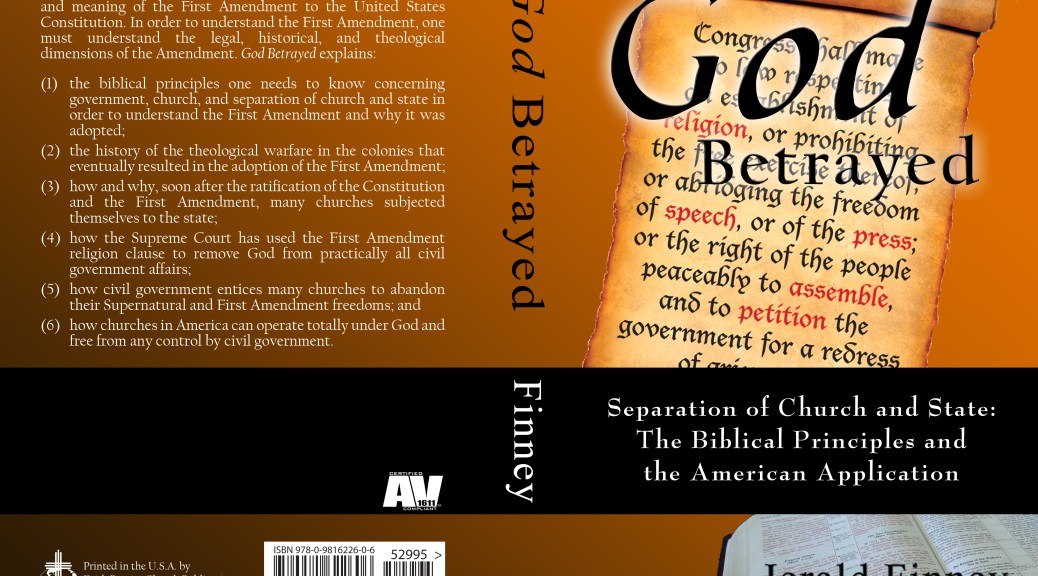
The local church sanctified and cleansed by the washing of water by the word——————–A ministry of Charity Baptist Tabernacle of Amarillo, Texas led by Pastor Ben Hickam. "Would to God ye could bear with me a little in my folly: and indeed bear with me. For I am jealous over you with godly jealousy: for I have espoused you to one husband, that I may present you as a chaste virgin to Christ. But I fear, lest by any means, as the serpent beguiled Eve through his subtilty, so your minds should be corrupted from the simplicity that is in Christ" (2 Corinthians 11:1-3). ————————————Jerald Finney, a Christian Lawyer and member of Charity Baptist Tabernacle, having received this ministry in the Lord, explains how a church in America can remain under the Lord Jesus Christ and Him only. "As every man hath received the gift, even so minister the same one to another, as good stewards of the manifold grace of God. If any man speak, let him speak as the oracles of God; if any man minister, let him do it as of the ability which God giveth: that God in all things may be glorified through Jesus Christ, to whom be praise and dominion for ever and ever. Amen" (1 Peter 4:10-11; See also, Ephesians 4::1-16 and 1 Corinthians 12:1-25). "Take heed to the ministry which thou hast received in the Lord, that thou fulfil it" (Colossians 4:17). "And hath put all things under his feet, and gave him to be the head over all things to the church" (Ephesians 1.22; See also, e.g. Colossians 1:18).