Tag Archives: church

Does God and/or Civil Government Require Churches to Get 501(c)(3) Status?

The First Amendment to the U.S. Constitution: God’s law honored by man’s law

Jerald Finney
Copyright © March, 2010
Revised on April 10, 2013

Does the Word of God teach that churches in America should get Internal Revenue Code Section 501(c)(3) (“501c3”) status? What about civil law? Does American law purportedly require that churches get 501c3 status? This article will answer those questions.

Since you will probably want to know something about Jerald Finney before you give any consideration to his positions, this article will begin by providing you with a brief profile of Finney. At the end of the article are links to important Internal Revenue Code laws concerning churches as well as an important note.

The author is a Christian first and a lawyer second. He has no motive to mislead you. In fact, his motivation is to tell you the truth about this matter, and he guards himself against temptation on this and other issues by doing all he does at no charge. He does not seek riches. His motivation is his love for God first and for others second. His goal is the Glory of God. Jerald Finney has been saved since 1982. God called him to go to law school for His Glory. In obedience, Finney entered the University of Texas School of Law in 1990, was licensed and began to practice law, for the Glory of God, in November of 1993.  To learn more about the author click the following link: About Jerald Finney.

The Bible makes clear that God desires that Christians love Him and He tells them what it means to love God. The relationship between God and his children is very important to Him. Likewise, the love relationship between God and His churches is preeminent to Him. After all, “Christ loved the church and gave himself for it” (Ep. 5:25). Do you understand God’s definition of love? Jerald Finney has covered this subject in the booklet, The Most Important Thing: Loving God and/or Winning Souls? which is available on the Order Information on Books by Jerald Finney page of this website, and also free on this website at The Most Important Thing: Loving God and/or Winning Souls in online form as well as in PDF form. Of course, if one loves God, he will win souls.

The author realizes that there are different interpretations of Scripture on any given subject—there are false interpretations and one true interpretation. Christians, including the author, should do everything possible to make sure they correctly divide Scripture since the Bible commands them to do so. In fact, the biblical way for a Christian to make sure that he is right about an issue was given to Timothy and to all Christians by Paul: “Study to shew thyself approved unto God, a workman that needeth not to be ashamed, rightly dividing the word of truth” (2 Ti. 2.15). Most Christians rely totally or heavily upon their pastors for leadership in instruction in spiritual matters. Sometimes, as is the case with the author, they rely upon their pastors and others, and are also called themselves to deal specifically with an issue.

To totally understand all the issues and sub-issues involved with the 501c3, one must not only have extensive knowledge of biblical principles, but he must also have an understanding of history and law. You see, the issue of the relationship between church and state is very important to God and His Word completely explains His desired relationship. Historically, true Christians understood the importance of this relationship, and they stood up for their relationship even though they suffered greatly for their stand on this issue—they were imprisoned, drowned, beheaded, burned at the stake, hung, tortured, etc. because they loved their Savior and were willing to do all that He asked them to do.

With that said, let us now go to the issues—first the issue of the truth about civil government requirement that churches get 501c3 status. The unabashed truth is that civil government does not require churches in America to get 501c3 status. They do so completely voluntarily, just as they incorporate on a voluntary basis. Since there is absolutely no law that requires a church to get 501c3 status, no attorney, pastor, or anyone else can show you such a law.
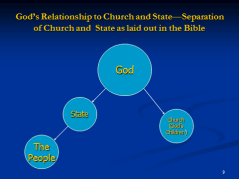
Click the above to go to the article, “Is Separation of Church and State Found in the Constitution?

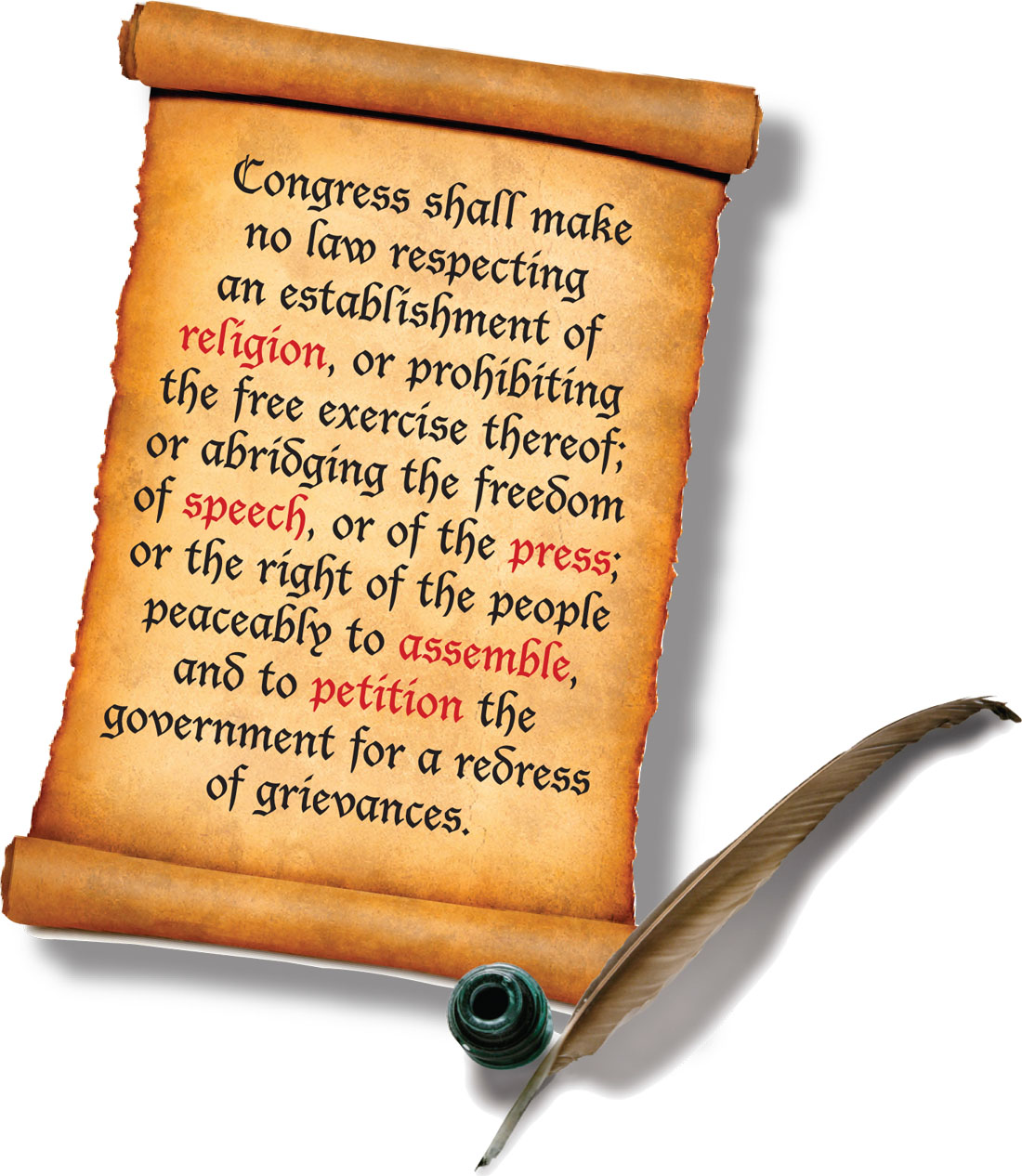
In fact, there is a law that clearly states that you do not have to get 501c3 status: The First Amendment to the United States Constitution. The First Amendment to the United States Constitution prohibits the making of any law respecting an establishment of religion, impeding the free exercise of religion, abridging the freedom of speech, infringing on the freedom of the press, interfering with the right to peaceably assemble or prohibiting the petitioning for a governmental redress of grievances. It was adopted on December 15, 1791, as one of the ten amendments that constitute the Bill of Rights. The First Amendment states, “Congress shall make no law respecting an establishment of religion, or prohibiting the free exercise thereof; or abridging the freedom of speech, or of the press; or the right of the people peaceably to assemble, and to petition the Government for a redress of grievances.

The religion clause of the First Amendment, in conjunction with the other clauses of the First Amendment, is a statement of the biblical principle of separation of church and state. To understand this, read An Abridged History of the First Amendment or the more complete version (Section IV of God Betrayed, or Part II of The Trail of Blood of the Martyrs of Jesus which are available free or can be purchased in softback. (See Order information, free PDF, and free online version page for books by Jerald Finney) or. The First Amendment commands that the federal government make no law respecting an establishment of religion or preventing the free exercise thereof.

When I first wrote this article, I stated that Internal Revenue Code § 508 (“508”) is a law that protects churches and states that churches are an exception to getting 501c3 status. That law explicitly states that churches are an exception to the requirement that certain organizations get 501c3 status. However, after years of study, I am convinced that a church should never claim 508 status. A church should rely on the First Amendment to the United States Constitution, not on 508.

508 is a law made by the federal government that regards and establishment of religion and prevents the free exercise thereof. Therefore, a church that agrees to 508 status has agreed to place herself under a law which is unconstitutional as applied to churches (a law which violates the First Amendment when applied to churches) thereby waiving First Amendment status and also weakening the First Amendment. The federal government can also argue that churches who claim 508 status have agreed to the rules of 501c3, since the state may argue that the federal government is granting the exemption under 508 and the church chose to depend upon 508 instead of the First Amendment. The Internal Revenue Service completely understands the First Amendment implications as to churches. The Internal Revenue Service states in Internal Revenue Code Publication 1828: “Unlike churches, religious organizations that wish to be tax exempt generally must apply to the IRS for tax-exempt status unless their gross receipts do not normally exceed $5,000 annually.” One may argue that this interpretation of 508 is too explicit, but the devil is in the details, and the legal system is expert in arguing the details. See, for more thorough explanation, Church Internal Revenue Code § 508 Tax Exempt Status.

501c3 comes with rules that churches agree to honor. Thus, when a church gets 501c3, she places herself under a sovereign other than God to some degree. The author goes into the rules that come along with 501c3 in the following articles: The Internal Revenue Code Section 501(c)(3) Exemption-Definition-Control Scheme, Laws Protecting New Testament Churches in the United States: Read Them for Yourself.

A 501c3 church also has many regulations which it is required to honor. See Publication 4221: Compliance Guide for Tax Exempt Organizations (“Federal tax law provides tax benefits to nonprofit organizations recognized as exempt from federal income tax under section 501(a) of the Internal Revenue Code (the Code). The Code requires that tax-exempt organizations comply with federal tax law to maintain tax-exempt status and avoid penalties….”).

In spite of the irrefutable fact that churches are not required to get 501c3, many Christians will tell you that Romans 13 requires that churches get 501c3 status. Of course, that is a ridiculous statement, since American law clearly gives each church a choice in the matter. No “ordinance of man” requires churches to get 501c3; therefore, churches cannot violate an ordinance which does not exist. To repeat, does God require that a church get 501c3? Of course not, and no “ordinance of man” purportedly requires man to get 501c3.

Another important question, although not at all relevant (as we have seen) to the issue of whether churches in America are required to get 501c3,  is this: “If God is against a church obeying a certain civil law, even if the civil law purportedly requires churches to obey that law, is man to obey the civil law?” When one does an honest and systematic biblical study of the issues involved, the answer becomes very clear. The author has done such a study and has written and taught on this very issue. He has written four books that cover the biblical principles as well as history and law. Again, those books are available free on this website in online form as well as in PDF form or may be ordered in paperback. See Order information, free PDF, and free online version page for books by Jerald Finney.

This article will just mention a few Biblical principles and teachings. Clearly, when a man-made law conflicts with God’s law, Christians are instructed by God to obey God’s law. All the apostles, except John, were martyred for adhering to this principle. Likewise,  as mentioned above, Christians down through the ages in and since the primitive church have stood on this principle.

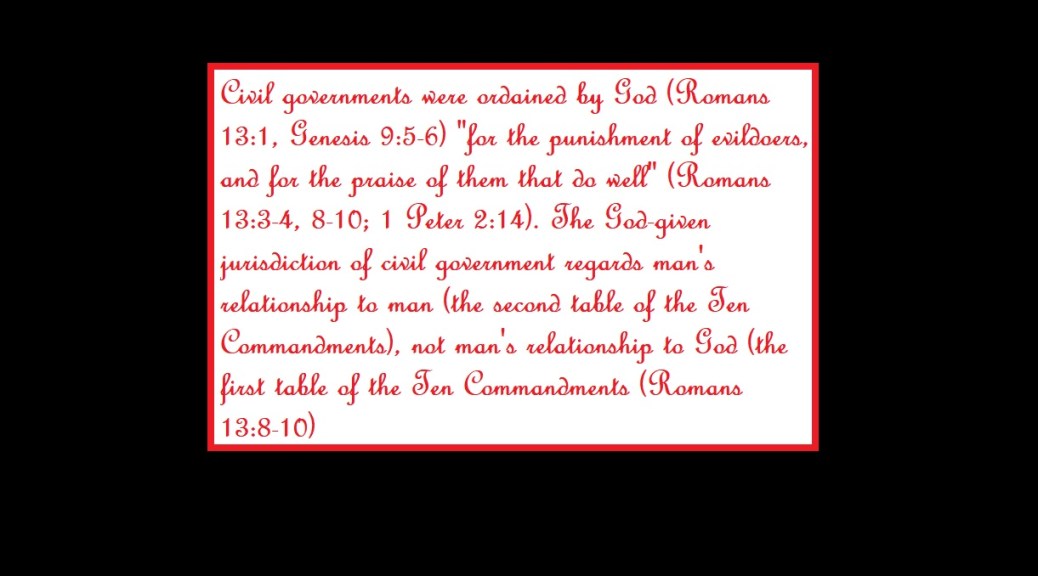
The Bible teaches that God is sovereign over all, and that He ordained all powers that be. Thus, God established or ordained civil government. He gave civil government the responsibility for ruling over men, under Him. He also gave man free will. Since civil government is run by a man, or by men, civil government, like man, is free, under God to honor or dishonor Him and His principles. Of course, God desires that civil government honor Him, but sadly, civil governments rarely do so, and they never permanently do so in this age. This is the clear teaching of history.

To interpret Romans 13 and other verses to mean that Christians are to obey all civil laws which contradict God’s law would mean that Romans 13 is inconsistent in both the immediate and overall context of Scripture. Many Old Testament characters, the apostles, God, God’s own angels, and Christians throughout the last 2000 years who have refused to honor laws of men which require God’s children to submit to man rather than to proceed under God only in certain matters, violated the modern American interpretation of Romans 13. The author goes into all the details on this matter in Render unto God the Things that Are His: A Systematic Study of Romans 13 and Related Verses and in God Betrayed/Separation of Church and State: The Biblical Principles and the American Application (The book is in online form at Render unto God the Things that Are His: A Systematic Study of Romans 13 and Related Verses. Also, click the following links for other articles which teach on this matter: Separation of Church and God, American Abuse of Romans 13:1-2, An Abridged History of the First Amendment.

In conclusion, churches who get 501c3 dishonor the Lord and His principles concerning His desired relationship between church and state. Christians are responsible to God to study His Word and make the practical application of His Word to real life. The relationship between Christ and His churches is very important to Him: “Husbands, love your wives, even as Christ also loved the church, and gave himself for it; That he might sanctify and cleanse it with the washing of water by the word, That he might present it to himself a glorious church, not having spot, or wrinkle, or any such thing; but that it should be holy and without blemish” (Ep. 5.25-27).

That relationship has been so important to Christians since the beginning of the Church that they have been willing to die rather than to dishonor it. How important is that relationship to you and your church?

You can read the following Internal Revenue Code laws online by clicking the following links:

1. § 501(c)(3). Exemption from tax on corporations, certain trusts, etc.
2. § 508. Special rules with respect to section 501(c)(3) organizations
3. § 7611. Restrictions on church tax inquiries and examinations
4.§ 1402. [Dealing with taxes on income of pastors]
5. § 107. Rental value of parsonages
6. § 102. Gifts and inheritances (A
ccording to Internal   Revenue Code § 102 tithes and offerings are                        gifts and, therefore, , not income)
7. § 2503. Taxable gifts
8. § 170. Charitable, etc., contributions and gifts

Note. Should you desire to know how your church can organize according to both biblical principles and also within the parameters of American law contact Jerald Finney, a licensed lawyer. Click here for contact information for Jerald Finney.

All conclusions in this article are opinions of the author. Please do not attempt to act in the legal system if you are not a lawyer, even if you are a born-again Christian. Many questions and finer points of the law and the interpretation of the law cannot be properly understood by a simple facial reading of a civil law. For a born-again Christian to understand American law, litigation, and the legal system as well as spiritual matters within the legal system requires years of study and practice of law as well as years of study of Biblical principles, including study of the Biblical doctrines of government, church, and separation of church and state. You can always find a lawyer or Christian who will agree with the position that an American church should become incorporated and get 501(c)(3) status. Jerald Finney will discuss the matter, as time avails, with any such person, with confidence that his position is supported by God’s Word, history, and law. He is always willing, free of charge and with love, to support his belief that for a church to submit herself to civil government in any manner grieves our Lord and ultimately results in undesirable consequences. He does not have unlimited time to talk to individuals. However, he will teach or debate groups, and will point individuals to resources which fully explain his positions.

END
The Biblical Doctrine of the Church

Jerald Finney
© October, 2009

Have you ever done an in depth study of the biblical doctrine of the church? Every Bible believer, and especially every pastor, should have done such a study. Every Bible institute and college should give priority to such a study. Did not Christ “love the church and give himself for it?” Included in that study should be a study of the application of the doctrine of the church. In other words, a scholarly spirtual study of the church would require an in depth study of the definition, organization, and purposes of a church. This  would require a study of such matters as the organization of churches as corporations, unincorporated associations, corporations sole, etc. and seeking Internal Revenue Code section 501(c)(3) of churches. Do such devices comport with biblical principles? Is our Lord grieved when such devices are employed by churches? What are the consequences to churches, individuals, families and the nation?

The players below will teach on the biblical doctrine of the church. In conjunction with other audio teachings on other pages of this blog, a spirit filled believer will be given the knowledge to answer all the questions in the paragraph above and more. You may or may not agree with all this teaching, but this study will be invaluable to the Bible believing Christian who wants to do things God’s way. This study is patterned after Section II of the book God Betrayed/Separation of Church and State: The Biblical Principles and the American Application (Ordering information for this and other books is on the “Books” page of churchandstatelaw.com.).

To play, just click the link. To download, right click link and then left click “Save link as.”

1. Introduction to the biblical doctrine of the church (Section II, Chapter 1 of God Betrayed) (The audio opens with a song by Brother Rocky Otwell, “Wilt Thou Be Made Whole?” followed by opening remarks and prayer. That portion of the audio is 5 min. 3 sec. in length. The total length is 14 min. 55 sec.).

2. Definition, organization, and purposes of a church (Section II, Chapter 2 of God Betrayed) (27 min. 22 sec.).

3.  The love relationship between Christ and His church (In God Betrayed, but not a specific chapter) (52 min. 16 sec.). This is covered in the booklet which is reproduced on this website at The Most Important Thing: Loving God and/or Winning Souls?)  This may be the most important teaching concerning the issue of separation of church and state. The last few minutes of the audio is of poor quality because of technical difficulties that were later corrected).

4. Heresy and apostasy (Section II, Chapter 4 of God Betrayed) (Begins with a song, “In Times Like These,” sang by Rocky Otwell and prayer. Prayer ends at 3 min. 31 sec. Total length of segment is 28  min. 15 sec.).

5. Recent accelerated apostasy in America (Section II, Chapter 5 of God Betrayed) (14 min. 22 sec.).

6. Apostasy at the end of the church age (Section II, Chapter 6 of God Betrayed) (3 min. 30 sec.)(This audio teaching has been significantly revised. Click “Apostasy at the end of the church age”  to see the revisions).

7. The church will reign with the Lord (Section II, Chapter 7 of God Betrayed) (1 min. 56 sec.)(This audio teaching has been significantly revised. Click “The coming universal church will reign with the Lord”  to see the revisions).

8. Conclusion (Section II, Chapter 8 of God Betrayed) (Conclusion is 5 min. 41 sec. followed by song and prayer. Total length is 8 min. 51 sec.).

I am adding a new study of specific books and teachings on the Bible Doctrine of the Church. Click here to go to that study series.

End

For His Glory,
Jerald Finney
Christian and practicing attorney

American Abuse of Romans 13.1-2 and Related Verses

Jerald Finney
Copyright © September 29, 2009


Click the above to go to book.

Are you interested in understanding what Romans 13 and other related verses really teach about the relationship of a church and of individual Christians and families to civil government? Has your preacher ever preached on the verses? If so, what position did he take on these verses? Did he interpret the verses in their immediate context and in the overall context of Scripture? Did he explain why the first Christians, including the apostles, as well as God’s own angels and many other biblical characters repeatedly violated, and were sometimes rewarded by God for violating, the modern American “interpretation” of those verses? Did he tell you about the Christians since New Testament days who have been subjected to the most cruel tortures and killed (tarred and feathered, twisted on racks, boiling oil poured down their throats, thrown in with wild beasts, beheaded, pulled apart, beheaded, drowned, buried alive, hanged, etc.) for disobeying the powers that be for refusing to recant their faith in the Lord Jesus Christ and in Him alone? Did he explain to you that in America the First Amendment provides for religious liberty and that no church is supposedly required by man’s law to incorporate, get a 501(c)(3) tax exemption, or to become a legal entity of any kind? Did he explain to you the biblical doctrines of church, state, and separation of church and state?

Romans 13.1-2 and related verses are among the most abused Bible verses in America today. I use the word “abused” as opposed to “misinterpreted,” although people also misinterpret the verses while abusing them.  According to Webster’s Dictionary, abuse means “to put to a wrong or improper use” or “to use so as to injure or damage.” Webster’s defines “misinterpret” as “to explain wrongly” or “to understand wrongly.” Those who use Romans 13.1-2 and related verses to justify submission to civil government in all matters, including spiritual matters or matters involving the first four commandments, have abused those verses. They have not considered the immediate and overall context of Scripture in reaching their conclusions. They have assumed state superiority in ecclesiastical affairs and the use of religion to further state policy. Such an assumption has been labeled as Erastianism and this assumption or philosophy pervaded all Europe, with the exception of Calvin’s ecclesiocratic Geneva, after the Reformation, and achieved its greatest triumph in England. Sadly, this assumption is widely accepted in America today.

The verses used to support Erastianism include Romans 13.1-2 (“Let every soul be subject unto the higher powers…. Whosoever resisteth the power, resisteth the ordinance of God: and they that resist shall receive to themselves damnation….”), and other Bible verses such as Matthew 17.24-27 (“Doth not your master pay tribute? …”), Luke 20.25 (“Render unto Caesar….” which is also recorded in Matthew 22.21 and Mark 12.17.), 1 Peter 2.13-14 (“Submit to every ordinance of man….”), and 1 Timothy 2.1-6 (which exhorts Christians to pray for all men, including rulers). Many nonbelievers as well as carnal and/or baby Christians in America confidently quote one or more of these verses out of context to support their position that Christians are to bow down to civil government in all things, or all things except limitations on the preaching of salvation.

Some go further and take the unbelievable position that these verses mean that churches should become state churches by incorporating, becoming unincorporated associations or charitable trusts, operating as corporations sole, getting 501(c)(3) tax exemption, or by some other means and that churches which do not are in sin. Many of those Christians and churches who take this position pressure churches which are under God, and God only, to put themselves under the state through one of the methods mentioned above.

If you are interested in an in-depth study each of the above mentioned verses of Scripture, click on the WordPress Players below. Each segment below is an edited version of a radio broadcast. Click the following links to hear Jerald Finney’s audio teachings (Right click link and left click “Save link as…” to download):

Introduction and Matthew 17.24-27: “Doth not your master pay tribute?” (13 min. 42 sec.)

Luke 20.25, Matthew 22.21, Mark 12.17: “Render therefore unto Caesar the things which be Caesar’s, and unto God, the things which be God’s” (4 min. 47 sec.)

Romans 13: “Let every soul be subject to the higher powers” (24 min. 15 sec.)

I Peter 2.13: “Submit yourselves to every ordinance of man….” (6 min. 6 sec.)

I Timothy 2.1-5: Pray for rulers (8 min. 6 sec.)

You may also be interested in:

More on Romans 13: The Powers/Governments God Has Ordained (article)

Render Unto God the Things that Are His: A Systematic Study of Romans 13 and Related Verses (booklet)

END

The Internal Revenue Code § 501(c)(3) Exemption-Definition-Control Scheme

Jerald Finney
Copyright © September, 2009
Revised January 31, 2020

Click here to go to: ANSWER TO QUESTION REGARDING A LAWYERS FALSE STATEMENTS CONCERNING CHURCH CORPORATE 501(C)(3) STATUS

“And the lord commended the unjust steward, because he had done wisely: for the children of this world are in their generation wiser than the children of light” (Lu. 16.8b).

It is amazing to see that most of the fundamental “Bible believing” pastors and Christians that I know believe that something is wrong with a church who refuses to incorporate and get Internal Revenue Code (“IRC”) §501(c)(3) (“501(c)(3)”) status. Biblical principles are against incorporation and 501(c)(3) for churches, and civil law does not purport to require that churches get either corporate or 501(c)(3) status. In fact, the First Amendment to the United States Constitution, laws, and regulations of the federal government as well as the constitutions, laws, and regulations of the states guarantee that churches may remain free under God without persecution. This article addresses church 501(c)(3) status.

501(c)(3) invites churches to seek a tax exemption from civil government, even though the First Amendment already has erected a “high and impregnable wall” of separation between church and state which forbids civil government from making any law, including any taxing law, respecting a New Testament Church.

The more I study the subject of “separation of church and state,” the more I realize that secular scholars have more insight into the issue than do most of those, including pastors, who call themselves fundamental Bible believers.  Both the Internal Revenue Service and secular scholars know that churches are not required by law to be incorporated and get 501(c)(3) status and that 501(c)(3), as applied to churches, is an exemption-definition-control scheme which is implemented simply by invitation. In this article I give a brief review of the 501(c)(3)  exemption-control-definition scheme and insights from the law, from the Internal Revenue Service, and from legal scholars.

To qualify for tax exempt status under 501(c)(3) religious organizations must meet the following requirements, i.e. abide by the following rules:

1. Must be organized and operated exclusively for religious, educational, scientific, or other charitable purposes,
2. net earnings must not inure to the benefit of any private individual or shareholder,
3. no substantial part of its activity may be attempting to influence legislation,
4. the organization may not intervene in political activity, and
5. the organization’s purposes and activities may not be illegal or violate fundamental public policy.

The above listed rules, except for rule number 5, are stated in 501(c)(3). The original 501(c)(3) law had no accompanying rules, but four of the five were added by legislative enactment, and signed into law by the president. The last one, “may not violate fundamental public policy,”is not stated in the law; that is, it is not listed as a requirement in § 501(c)(3). This requirement was unilaterally implemented by the Internal Revenue Service and upheld as law by the United States Supreme Court in the illogical Bob Jones University, 461 U.S. 574,  (1983) case. The federal government may add additional requirements to the law in the future.

Under these rules, the state controls, defines, and instructs a corporate 501(c)(3) religious organization to a large degree. Control and definition go hand in hand. The federal government wants to control churches, and does so through 501(c)(3) and 508(c)(1)(A).

501(c)(3) and 508(c)(1)(A) tax exempt status not only come with five government imposed rules. Such status also invokes a myriad of regulations. See, e.g., Publication 557 (01/2019), Tax-Exempt Status for Your OrganizationApplication for Recognition of ExemptionExempt Organizations Treasury RegulationsCharities and Nonprofits A-Z Site Index (F-J)Exempt Organization Revenue RulingsPub. 1828, Tax Guide for Churches and Religious Organizations (PDF)Common Tax Law Restrictions on Activities of Exempt OrganizationsExempt Organizations – Ruling and Determinations LettersrExempt Organizations – Private Letter Rulings and Determination LettersExempt Organizations AnnouncementsAnnual Filing Requirements for Supporting OrganizationsExempt Organizations NoticesPublic Disclosure and Availability of Exempt Organizations Returns: Copies of Exempt Organizations Tax DocumentsExempt Organization Revenue ProceduresExempt Organizations UpdateExempt Organizations – Employment TaxesThe Truth About Frivolous Tax Arguments – Section IITermination of Exempt Organization(“… Internal Revenue Code Section 6043(b) and Treasury Regulations Section 1.6043-3 establish rules for when a tax-exempt organization must notify the IRS that it has undergone a liquidation, dissolution, termination, or substantial contraction. Generally, most organizations must notify the IRS when they terminate. Among other things, notice to the IRS of a termination will close the organization’s account in IRS records. …).

A study of relevant law, as well as IRS regulations and legal scholarship reveals that either 501(c)(3) or 508(c)(1)(A) status is voluntary. 501(c)(3) and 508(c)(1)(A) churches are tax exempt, whereas First Amendment churches are non-taxable. See, First Amendment Protection of New Testament Churches/Federal Laws Protecting State Churches (Religious Organizations) (022610).  In addition,  501(c)(3) or 508(c)(1)(A) statuses are control-definition schemes.

IRC § 508(c)(1)(A) declares that churches are an exception to the requirement for filing for 501(c)(3) tax exempt status. According to 508(c)(1)(A), churches are automatically tax exempt if they obey the rules and regulations that come with 501(c)(3). See Church Internal Revenue Code § 508 Tax Exempt Status (042814).

The IRS doesn’t hide the fact that churches are non-taxable under the First Amendment and that the exemption-definition-control scheme is implemented by invitation. The IRS proclaims in IRS Publication 1828 (2007):

“Although there is no requirement to do so, many churches seek recognition of tax-exempt status from the IRS because such recognition assures church leaders, members, and contributors that the church is recognized as exempt and qualifies for related tax benefits…. Unlike churches, religious organizations that wish to be tax exempt generally must apply to the IRS for tax-exempt status unless their gross receipts do not normally exceed $5,000 annually.”

In the exemption and restriction scheme, the government extends an invitation to incorporated “religious organizations” to receive a tax exemption in return for allowing the government to interpret and categorize their expression and activities.

Civil government not only knows what it is doing when encouraging churches to incorporate and seek 501(C)(3) status; it also blatantly belittles the fact that the IRC provisions exempting churches from taxation and providing for certain controls over corporate 501(c)(3) “churches” are contrary to the First Amendment. The federal government flaunts the lack of knowledge and understanding of the average Christian as to both spiritual and earthly matters. IRS Publication 1828 states:

Congress has enacted special tax laws applicable to churches, religious organizations, and ministers in recognition of their unique status in American society and of their rights guaranteed by the First Amendment of the Constitution of the United States.” [Emphasis mine.] …

A comparison of the above statements of the IRS with the words of the religion clause of the First Amendment reveals the fact that the IRS flaunts the fact that Congress has enacted laws “respecting the establishment of religion and preventing the free exercise thereof.” The First Amendment religion clause says:

“Congress shall make no law respecting an establishment of religion, or prohibiting the free exercise thereof….”  [Emphasis mine.]

Some legal scholars who have studied the issue know what the civil government is up to with the exemption-definition-control scheme. For example, Richard Garnett, assistant professor at Notre Dame Law School, wrote in A Quiet Faith? Taxes, Politics, and the Privatization of Religion, published in Volume 42 of B.C. L. Rev. starting on page 771 (this is a paraphrase of selected portions of the article with citations omitted):

  1. “The imposition of a tax is, after all, an assertion of power and an ‘application of force.’ The same is true of the decision not to tax, or to exempt from taxation. A power is no less real that is exercised selectively or indulged with restraint. The decision to exempt certain associations, persons, activities, or things from taxation presupposes and communicates the ability to do otherwise; definitional lines drawn to mark the boundaries of such exemptions implicitly assert the power to draw them differently…. My claim here is that the decision to exempt religious associations from federal taxation may reasonably be regarded as an assertion of power—the power, perhaps, to ‘destroy’—over these communities, their activities, and their expression….
  2. “In other words, maybe the power to tax churches, to exempt them from taxation, and to attach conditions to such exemptions really does as Chief Justice Marshall quipped, ‘involve the power to destroy’ religion. Neither heavy-handed repression nor even overt hostility toward faith is required, but merely the subtly didactic power of the law. Government need only express and enforce its own view of the nature of religion—i.e., that it is a private matter—and of its proper place—i.e., in the private sphere, not in politics—and religious believers and associations may yield to the temptation to embrace, and to incorporate, this view themselves….
  3. “It is an exemption-and-restriction scheme in which the government extends an invitation to ‘religious organizations’ to receive a tax exemption in return for allowing the government to interpret and categorize the expression and activities of the church.  There is the danger that, having made their own the government’s view of religion’s place, now-humbled and no-longer-prophetic religious associations will retreat with their witness to the ‘private’ sphere where—they now agree—they belong, leaving persons to face the state alone in the hollowed-out remains of the public square….
  4. “Still it strikes me that the Internal Revenue Code Section 501(c)(3)’s exemption-and-restriction scheme is noteworthy in the extent to which it invites government to label as ‘propaganda’ or ‘campaign[ing]’ what are, for religious believers and communities, expressions of their faith and responses to their calling. It is far from clear that this is an appropriate task for the liberal state….
    “My concern … is that the premises of the conditional exemption scheme, the labeling it invites, and the monitoring of distinctions it creates will tame religion by saying what it is and identifying what it is not, tempt religion to revise its conception of itself and of its mission, and convince religious consciousness to internalize the state’s own judgment that faith simply does not belong in politics….
  5. “[The tax exemption] is simply the government’s way of paying churches not to talk about certain things, enforce certain beliefs, or engage in certain actions—in other words, it’s the government’s way of privatizing the church….
  6. “By determining for its own purposes the meaning of religious communities’ statements and activities, and by enforcing the distinctions it draws, government subtly reshapes religious consciousness itself. In other words, by telling religion what it may say, really is saying, or will be deemed to have said, and by telling faith where it belongs, government molds religion’s own sense of what it is….
  7. “[Certain pronouncements] led my colleague, Professor Bradley, to suggest in another context that ‘[t]he Court is now clearly committed to articulating and enforcing a normative scheme of ‘private religion.’ Indeed, he argues powerfully that the Court’s post-Everson v. Board of Education cases ‘are most profitably understood as judicial attempts to move religion into the realm of subjective preference by eliminating religious consciousness.’ … [T]he Court turned to privatization ‘as the ‘final solution’ to the problem of religious faction.’ Its ambition—not merely the unintended effect of its decisions—is not only to confine the potentially subversive messages of religion to a ‘nonpublic ghetto,’ but also to revise and privatize the messages themselves. Having acquiesced to judicial declarations that it is a private matter, and accepted that its authority is entirely subjective, religious consciousness is unable to resist the conclusion that its claims to public truth are ‘implausible nonsense,’ and therefore cannot help but concede the field of public life and morality to government….
  8. “[T]his privatization of religion is not simply its institutional disestablishment or an entirely appropriate respect on government’s part for individual freedom of conscience and autonomy of religion institutions. Nor is the claim only that the exemption privatizes religion by deterring political activism and silencing political advocacy by religious believers and communities. It is, instead, that the exemption scheme and its administration subtly re-form religion’s conception of itself. Government evaluates and characterizes what churches say and do, and decides both what it will recognize as religious and what it will label as political….
  9. “[P]rivatization of the church is its remaking by government and its transformation from a comprehensive and demanding account of the world to a therapeutic ‘cacoon wrapped around the individual.’ It is a state-sponsored change in religious believers’ own notions of what their faith means and what it requires…. The government tells faith communities that religion is a private matter, and eventually, they come to believe it.
  10. “And finally, the retreat of religious associations to the private sphere suggests an ill-founded confidence that government will not follow. But it will. The privatization of religion is a one-way ‘ratchet that stems the flow of religious current into the public sphere, but does not slow the incursion of political norms into the private realm.’”

Michael Hatfield, Associate Professor of Law at Texas Tech University School of Law makes some important points in his article published in Volume 20 of Notre Dame Journal of Ethics and Public Policy beginning on page 125. (I suggest that the serious student get the article and study it for himself.):

  1. “There is an assumption among contemporary scholars [&, I might add, among Pastors and other Christians] that a church doing without tax exemption is ‘fundamentally repugnant,’ so there is no need for substantive analysis of the tax issues involved if a church becomes taxable. Instead of analyzing the tax problem, the tax problem tends to be used to introduce ‘bigger’ ideas about the Constitution, religion, and politics. In the current scholarship, the context of the issue – religion and politics – tends to become substituted for the substance: federal income taxation. The critical issue, however, is federal income taxation.”
  2. Professor Hatfield states that he uses the terms ‘Taxable Church’ and ‘Tax Exempt Church’ to make it clear that churches need not be Section 501(c)(3) organizations.…
  3. Professor Hatfield states, “A tax without a cost has no meaning.… Because of the unique treatment churches receive under the Internal Revenue Code, the impact of the revocation is likely to be more symbolic than substantial.”
  4. He states: “Churches ought not make guesses about the value of their assets or their moral convictions. There is no reason to believe that most American churches are eager to claim an express political identity, though there are indications that, more and more, religious and political identities in America are being fused. For churches with a clear moral conviction to campaign, the implication of the Asset Management Analysis is clear: crunch the numbers. Determine the cost of losing tax exemption. Decide if that cost is worth campaigning. Do not be distracted by imaginations as to what tax exemption is about. It is about taxes. It is about money. It is not about the ‘right’ and ‘wrong’ way to be a church, which is a religious issue and not a tax issue. It should be – and presumably is – the religious convictions and not the tax worries of churches that keep them out of politics.”

Thus, a New Testament Church (“NTC”) – that is, a church operating according to New Testament principles – is non-taxable, because even if the term “taxable” is used, civil government cannot, according to its own IRS law, tax a NTC because (1) all her income is from gifts (See Section 102 of the IRS Code; Professor Hatfield points this out in his article), and (2) a NTC spends every dime given in tithes and offerings for church ministries.  Since gifts are not net income, what is left after subtracting expenses from net income? Even a business with no net income pays no taxes. And an individual or a business has to make a certain amount of money before paying any taxes.

How can it be that “Bible believing” Christians have gotten the churches of America so far astray from the principles for churches laid down by God in His Word? Are pastors and Christians ignorant or are they willfully ignorant? We cannot hope to straighten America out unless we first straighten our churches out, but it seems that more Christians are concerned about the state of America than they are about the state of the churches in America. God’s people and God’s churches, as well as America, are being destroyed because of a lack of knowledge.

Note. The sodomites understand what 501(c)(3) for churches means, yet pastors and other Christians continue to ignore the issue because they, like lepers to whom the leprosy has spread to the head, have ‘their understanding darkened, being alienated from the life of God through the ignorance that is in them, because of the blindness of their heart: Who being past feeling have given themselves over to lasciciousness, to work all uncleanness with greediness” (Ephesians 4.18-19).  Here is a link to a sodomite article on the issue: “Equality is what we’re all about in Maine” (110518: Checked link; link is no longer active).  

END