Jerald Finney
Copyright © June 23, 2024
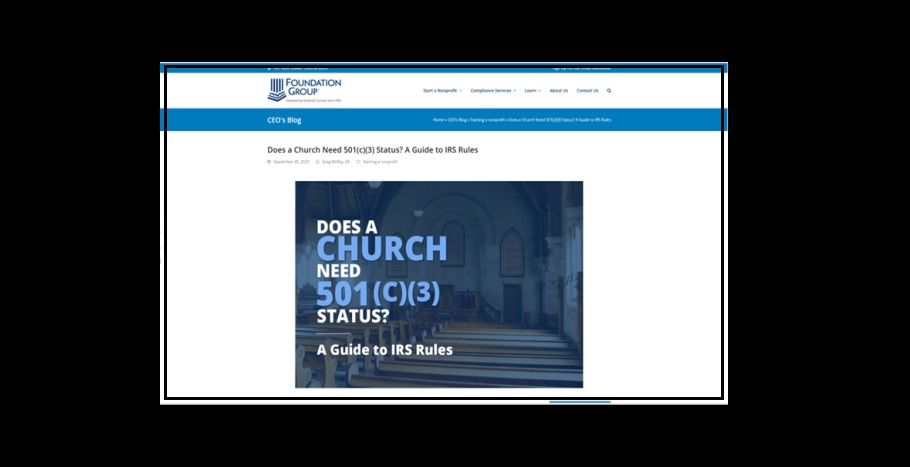
This article will briefly address some, but not all, false and misleading statements in Does a Church Need 501(c)(3) Status? A Guide to IRS Rules, a publication of Foundation Group, that uninformed “Christians” choose to believe and follow. This article applies to Foundation Group, and almost all Christan organizations, lawyers, legal firms, believers and churches; only a small remnant have any understanding of God’s definition of and principles and commandments for God’s churches. Thus, the church they are concerned about is man’s church, not God’s church; they apply man’s, not God’s, definition and principles.
It is apparent that Foundation Group has no concept of what a church-as defined by the word of God-is. Their article defines a church as “an organization with activities that are religious, not commercial.” What a joke! For God’s definition of “church” see, Bible Doctrine of Church.
It is also apparent that the Foundation Group does not understand some other matters. They do not understand that a church who remains solely under the First Amendment is non-taxable. The only way any entity–whether individual, business, religious, etc.–is required to pay taxes is by law. The First Amendment forbids a law taxing churches.
Nor does the Foundation Group understand that the use of the term “tax-exempt” in the context of 501(c)(3) is misleading. Like all other churches, churches who freely choose to dishonor God by accepting the federal government offer for “tax-exempt” status pay no taxes. Churches simply do not pay taxes. That is not why churches choose to become “tax-exempt.” The real reason for their choice is that the Internal Revenue Service will allow deductions claimed on income tax returns by donors to the church.
Their article states: “A tiny handful of churches have given up 501(c)(3) status in order to do and say whatever they choose without regard to limits otherwise placed on charities. However, this comes at the cost of tax exemption and privileges, as well as the ability to have donors give tax-deductible gifts.” This is an admission that churches who reject 501(c)(3) tax exempt status remain free to do and say the things God lays on their heart and that tax-exempt status limits their ability as to what they can to do and say. Unlike 501(c)(3) and 508(c)(1)(A) churches, they are free to follow the commandments, principles, and examples in the word of God. The second part of that quote is addressed below.
The real government purpose for federal tax-exempt status is government control over churches, not to free churches from paying taxes or to give them “tax exemption and privileges.” See, e.g., A Quiet Fatih? Taxes, Politics, and the Privatization of Religion” (Richard W. Garnett, A Quiet Faith? Taxes, Politics, and the Privatization of Religion, 42 B.C.L. Rev. 771 (2001). See also, The Rules and Regulations that Come with Church IRS Code Sections 501(c)(3) and 508(c)(1)(A) Tax-Exempt Status.
Their article states: “By default, the US government considers churches to be 501(c)(3) organizations automatically, simply by virtue of existing. Because no corporate structure is needed, a church (generally) is a 501(c)(3). …” This conclusion has no basis and is patently false. No law or regulation declares such a thing. Such a conclusion would deny the religious liberty guaranteed by the First Amendment. See, Are Churches Automatically Tax Exempt?
The First Amendment to the United States Constitution states:
- “Congress shall make no law respecting an establishment of religion, or prohibiting the free exercise thereof; or abridging the freedom of speech, or of the press; or the right of the people peaceably to assemble, and to petition the Government for a redress of grievances.
Notice that the Amendment says “no law.” As one Supreme Court Justice said, “no law” means “no law.” By the way, 501(c)(3) is a law made by Congress, and, when applied to churches, respects an establishment of religion and prevents the free exercise thereof.
All parts of the First Amendment are related to and the result of the fight for religious (not business) freedom by Baptists in the colonial period. The first clause in the Amendment is the Religion Clause. That clause prohibits union of church and state (the establishment clause) and legislates freedom of conscious (the free exercise clause) on the federal level. For unrevised documented explanation, see:
- Religious Liberty in America;
- The History and Meaning of the First Amendment;
- An Abridged History of the First Amendment;
- The Trail of Blood of the Martyrs of Jesus/Christian Revisionism on Trial.
The Religion Clause applies only to churches (and other religions in this pluralistic society). Churches and businesses have a distinct history and are entirely different types of entities. A church in America has a choice of whether to obtain federal tax-exempt status and become a fake church (if she is not already fake through incorporation or some other union with civil government) or to remain a true non-taxable church modeled after the examples and principles in God’s word and legislated in the highest law of America, the United States Constitution, Amendment 1. A fake tax-exempt church, as does a fake church incorporated under state law, submits herself to an authority other than to the Lord Jesus Christ. She agrees to abide by the rules and regulations that come with tax exempt status. See, The Rules and Regulations that Come with Church IRS Code Sections 501(c)(3) and 508(c)(1)(A) Tax-Exempt Status and Church Internal Revenue Code § 508(c)(1)(A) Tax Exempt Status.
The status of a church who chooses to honor God by maintaining her non-taxable status is protected by the First Amendment; she remains a church and is not classified by the government as a business if she chooses to reject the status. The government has no law or regulation which states that a church who rejects the status is now to be treated as a business; such would be in violation of the First Amendment establishment and free exercise clauses. Even if that were not true, a local church under Christ makes no profit whatsoever and therefore cannot be taxed. Even a business which makes no profit cannot be taxed, even though, unlike a church, it is required to file an income tax return.
The statement in their article, “Because no corporate structure is needed, a church (generally) is a 501(c)(3), ” is nonsensical.
Here is a statement in their article that comes from somewhere in the wild and creative imagination of its author who is obviously preying upon the ignorance of churches in his attempt to convince churches to use the services of Foundation Group: “If for some reason you and your church leadership decide that you don’t want to be a 501(c)(3), you are simply deciding to be treated like a taxable, for-profit business. …” I have already discredited this, so let us move on.
As their article indicates, it may be more convenient for a church to bow down to the federal government. For example:
1. In some few cases it may be less convenient to get the state religious tax exemption on property owned by the Lord Jesus Christ which is held and managed by a trustee (the legal or earthly owner of the property) and used by the church (not owned by the church). This ministry has encountered only two situations in which action by the trustee of God’s property being used for church purposes required legal action by the trustee of God’s property, not by the church. Both resulted in granting of the exemption. See The Indiana Board of Tax Review Determines that Property Held in Trust for the Lord Jesus Christ Must Be Granted Property Tax Exemption and Another Victory for a Church under Christ.
Sometimes glorifying and pleasing God in America can be inconvenient, but not as much so as in many nations to this very day and by followers of Christ for the last two thousand years. Our Lord Jesus Christ, the apostles, and millions of other believers from the beginning of the church age until this day were persecuted, imprisoned, beheaded, drowned, burnt at the stake, have had to hide out from church state establishments, etc. Their only way out of these “inconveniences” was to obey man rather than to God. Note: By the way, all state religious property tax exemption laws come with no strings attached and are just a courtesy from a time in this nation when God and the Bible were revered by almost everyone in the nation.
2. Some donors may not join or remain in a church who does not apply for (IRS Form 1023) and receive 26 U.S. Code (Internal Revenue Code) § 501(c)(3) tax exempt status from their new master. Some donors may not join in or remain in a church who claims IRC § 508(c)(1)(A) status. See, 26 U.S. Code § 508 – Special rules with respect to § 501(c)(3)) organizations. Of course, God desires His children to give for His glory and because they love Him, not because they get a tax deduction.
A believer dishonors God when he joins a church (e.g., a corporate and/or federally tax-exempt church) which serves mammon and is unequally yoked with any entity other than the Lord Jesus Christ.
This author, Jerald Finney, has written extensively on these matters. One who wishes to understand all aspects of the issues from a Bible based perspective can find a wealth of resources on the Simply Church Ministry Website, jeraldfinney.com. A good law review article on the Federal Tax Exemption is IGNORE THE RUMORS-CAMPAIGNING FROM THE PULPIT IS OKAY: THINKING PAST THE SYMBOLISM OF SECTION 501(c)(3) by Michael Hatfield, Associate Professor of Law, Texas Tech University School of Law. LAW REVIEW ARTICLES: 501(C)(3), 1ST AMENDMENT HISTORY, ETC. links to other law review articles on this and related First Amendment matters.
 Simply Church