Tag Archives: Separatists

V. The Theology and Goals of the Puritans Up to Their Arrival in America in 1629


A Publication of Churches Under Christ Ministry


Previous Lesson: IV. The Story of the Pilgrims Who Arrived in America in 1620, the Mayflower Compact

Next Lesson: VI. The Theology and Goals of the Puritans in America

Click here for links to all lessons on The Pilgrims and Puritans in New England.


Jerald Finney
Copyright © February 24, 2018
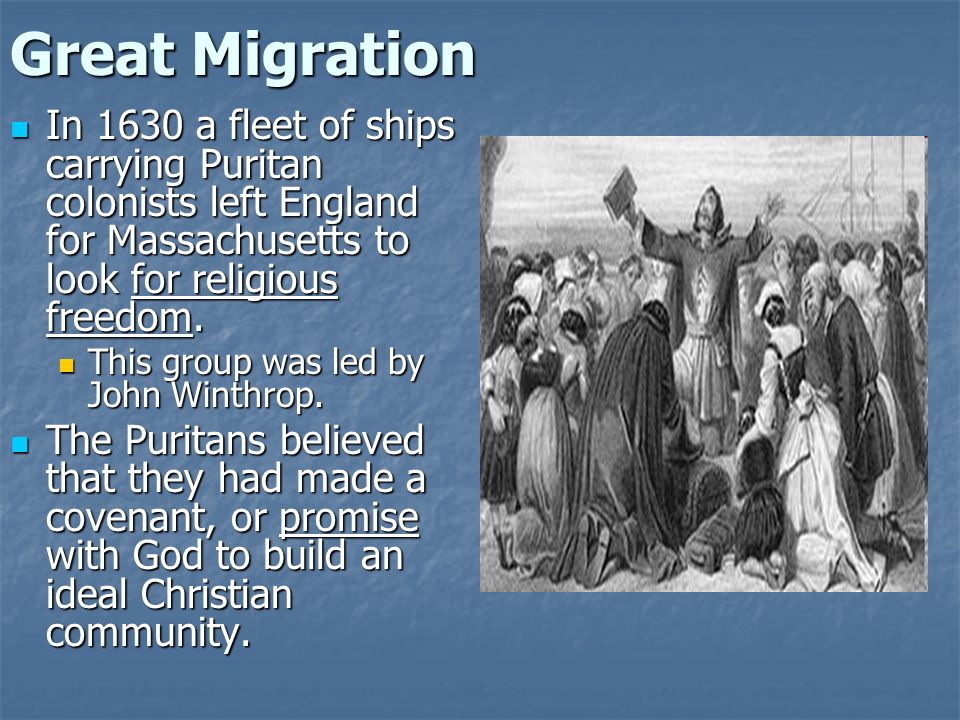

The undeniable truth from history is that the Puritans wanted religious freedom “for themselves only.”

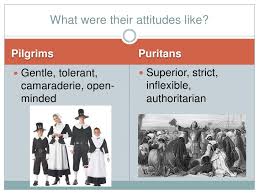
The Puritans, unlike the Pilgrims who wanted to separate from the Church of England, wanted to purify the Church from within. “The State, in their view, had the duty to maintain the true Church; but the State was in every way subordinate to the Church.”[1]

King James I was far more belligerently opposed to the Calvinistic church-state than even Queen Elizabeth had been, and his “determination toward the Puritans was to make them conform or to harry them out of the land.”[2] The Puritans who suffered under the combined pressure of accelerated persecution and the advanced moral decay in their society began to flee England for the new world.[3] “There was no ground at all left them to hope for any condescension or indulgence to their scruples, but uniformity was pressed with harder measures than ever.[4]

Cheating, double-dealing, the betrayal of one’s word were all part of the game for London’s financial district. Mercantile power brokers loved, honored, and worshipped money, and accumulated as much of it as possible and as fast as possible.  The ends justified the means. “London was an accurate spiritual barometer for the rest of the country, for England had become a nation without a soul.”[5] England was morally awful, and this came about under the auspices of a state-church practicing its theology.[6] 1628 marked the beginning of the Great Migration that lasted sixteen years in which twenty thousand Puritans embarked for New England and forty-five thousand other Englishmen headed for Virginia, the West Indies, and points south.[7]

A young Puritan minister named John Cotton preached a farewell sermon to the departing Puritans:

  • “He preached on 2 Samuel 7.10 (KJV): ‘Moreover, I will appoint a place for my people Israel, and will plant them, that they may dwell in a place of their own and move no more; neither shall the children of wickedness afflict them any more, as beforetime.’
  • “‘Go forth,’ Cotton exhorted, ‘… With a public spirit,’ with that ‘care of universal helpfulness…. Have a tender care … to your children, that they do not degenerate as the Israelites did….’
  • “Samuel Eliot Morison put it thus: ‘Cotton’s sermon was of a nature to inspire these new children of Israel with the belief that they were the Lord’s chosen people; destined, if they kept the covenant with Him, to people and fructify this new Canaan in the western wilderness.’”[8]

The Puritans landed at Salem at the end of June, 1629. They were motivated by religious principles and purposes, seeking a home and a refuge from religious persecution.[9] Having suffered long for conscience sake, they came for religious freedom, for themselves only. “They believed [in] the doctrine of John Calvin, with some important modifications, in the church-state ruled on theocratic principles, and in full government regulation of economic life.”[10]

The Puritan churches “secretly call[ed] their mother a whore, not daring in America to join with their own mother’s children, though unexcommunicate: no, nor permit[ed] them to worship God after their consciences, and as their mother hath taught them this secretly and silently, they have a mind to do, which publicly they would seem to disclaim, and profess against.”[11] In 1630, 1500 more persons arrived, several new settlements were formed, and the seat of government was fixed at Boston. Thinking not of toleration of others,” they were prepared to practice over other consciences the like tyranny to that from which they had fled.”[12]


Endnotes

[1] William H. Marnell, The First Amendment: Religious Freedom in America from Colonial Days to the School Prayer Controversy (Garden City, New York: Doubleday & Company, Inc., 1964), p. 40.

[2] Ibid., p. 42.

[3] Peter Marshall and David Manuel, The Light and the Glory, (Old Tappan, New Jersey: Fleming H. Revell Company, 1977), p. 146.

[4] John Callender, The Civil and Religious Affairs of the Colony of Rhode-Island (Providence: Knowles, Vose & Company, 1838), p. 66.

[5] Ibid., p. 148.

[6] Ibid., pp. 147-148.

[7] Ibid., p. 148

[8] Ibid., p. 157.

[9] Roger Williams and Edward Bean Underhill, The Bloudy Tenent of Persecution for Cause of Conscience Discussed and Mr. Cotton’s Letter Examined and Answered (London: Printed for the Society, by J. Haddon, Castle Street, Finsbury, 1848), p. v.

[10] Marnell, p. 48.

[11] Williams and Underhill, p. 244.

[12] Ibid., p. vii.
IV. The Story of the Pilgrims Who Arrived in America in 1620, the Mayflower Compact


A Publication of Churches Under Christ Ministry

Previous Lesson: III. Old World Patterns of Church-State Union Were Transplanted to the Colonies through the Puritans, Episcopalians, and Others

Next Lesson: V. The Theology and Goals of the Puritans Up to Their Arrival in America in 1629


Click here to go to all written lessons.

Click here to go to the 3 1/2 to 6 minute video lectures.

For accompanying study from God Betrayed click here.

Click here for links to all lessons on The Pilgrims and Puritans in New England.


Jerald Finney
Copyright © February 24, 2018


Note. For facts which explain documented truth (not secular or Christian revisionist history) about the influence of the Pilgrims and the Mayflower Compact on the history of the First Amendment (religious freedom and freedom of conscience, assembly, press, and speech), go to the other lessons on this matter at: Religious Liberty in America. Americans, and especially God’s children, need to seek and find truth. Sadly, Christians, as did I for many years, rely on Christian historical revisionism for their understanding of the religious history of America. For more understanding on this matter, see, The Trail of Blood of the Martyrs of Jesus, Christian Revisionism on Trial.

The original settlers of Massachusetts were the Pilgrims who landed at what was to become Plymouth, Massachusetts in 1620. The Pilgrims were Separatists in England who had left the Church of England in the autumn of 1608 and formed their own church. They were considered dangerous radicals by the Bishops of the Church of England. “They believed that the Reformation had not gone far enough, that the Reformers had assumed an infallibility no more palatable when lodged in a ruler than when lodged in the Pope, that the Church of England had rejected the Pope but not Popery, that the bishops of the Church of England had no more authority than the bishops of the Church of Rome.”[1]

Under James I, the Bishops were given a free hand to suppress the less than a thousand Separatists before they got out of hand. Calvinist historical revisionists Peter Marshall and David Manuel, who approved of the persecutions of the dissenters by the Puritan established churches in the colonies, complained that these were “dedicated followers of the Lord” who were:

  • “hounded, bullied, forced to pay assessments to the Church of England, clapped into prison on trumped-up charges, and driven underground. They met in private homes, to which they came at staggered intervals and by different routes, because they were constantly being spied upon. In the little Midlands town of Scrooby, persecution finally reached the point where the congregation to which William Bradford belonged elected to follow those other Separatists who had already sought religious asylum in Holland.”[2]
Contrary to revisionist history, the Mayflower Compact had little to do with the founding principles of America.

As a result of the persecution in England, some Separatists went elsewhere, going first to Leyden, Holland. After over ten years of a hard life in Holland, they decided to try to go to America. They reached an agreement with an English merchant named Thomas Weston under which they were able to set sail. They could not obtain assurance of liberty of their consciences. “However, they determined at length to remove, depending on some general promises of connivance, if they behaved themselves peaceably, and hoping that the distance and remoteness of the place, as well as the public service they should do the King and Kingdom, would prevent their being disturbed.”[3] One hundred and one Pilgrim souls sailed from Plymouth, England, on September 6, 1620, arriving at Cape Cod on November 11, 1620, and at a place they named Plymouth, in December, 1620.[4] Upon arrival, they drafted the Mayflower Compact:

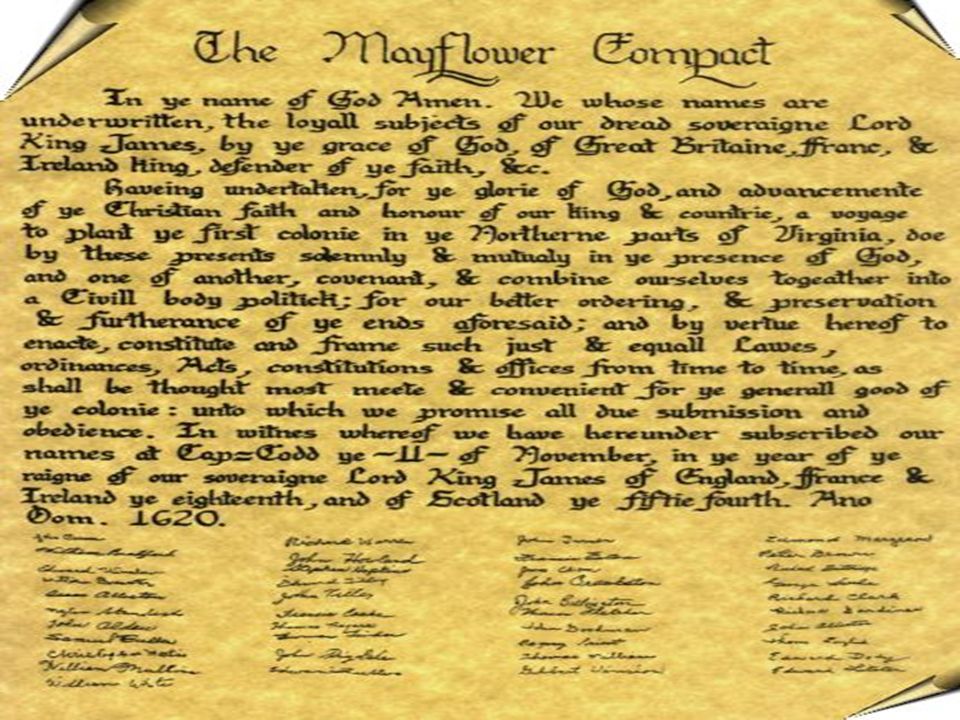
  • “In the name of God, amen. We whose names are under-written, the loyall subjects of our dread Soveraigne Lord King James by ye Grace of God of Great Britain, France, Ireland king, defender of the Faith, etc., having undertaken, for ye glorie of God, and advancemente of ye Christian faith and honour of our king & countrie, a voyage to plant ye first colonie in ye Northerne parts of Virginia, doe by these presents solemnly and mutually in ye presence of God, and one of another, covenant and combine our selves together into a civill body politick, for our better ordering & preservation & furtherance of the ends aforesaid; and by vertue hereof to enacte, constitute, and frame such just and equall lawes, ordinances, acts, constitutions and offices, from time to time, as shall be thought most meete & convenient for the generall good of ye colony, unto which we promise all due submission and obedience. In witness whereof we have hereunder subscribed our names at Cap-Codd, ye 11. of November, in ye year of ye raigne of our soveraigne lord, King James of England, France, & Ireland, ye eighteenth, and by Scotland ye fiftie fourth. Ano: Dom. 1620.”

As a matter of human compassion, the Pilgrims were hospitable to all; and, at first, grudgingly tolerated those of other creeds. However, they gradually began to close their doors to those of other creeds. “Plymouth was a Church-State ruled by a governor and a small and highly select theological aristocracy, a Church-State with various grades of citizenship and non-citizenship.”[5] By 1651 the government of Plymouth colony was enforcing the laws of Congregationalist Massachusetts. “By the time Plymouth was united with Massachusetts in 1691 all major differences between the two had disappeared.”[6]

The Pilgrims overcame much adversity, such as hunger, drought, and heat which caused their corn to wither, and the failure of delivery of much needed supplies from England.[7]  They increased to three hundred souls and obtained a patent from the New England Company on January 13, 1630. The comparative handful of Pilgrims who were eventually absorbed by the Puritans are much admired by Americans. However, they had little to do with the road to religious liberty in America, and the Puritans, by whom they were absorbed, were against religious liberty and established theocracies denying freedom of religion in the colonies they founded. For more on this, see the Note below.

Note. For facts which explain documented truth (not secular or Christian revisionist history) about the influence of the Pilgrims and the Mayflower Compact on the history of the First Amendment (religious freedom and freedom of conscience, assembly, press, and speech), go to the other lessons on this matter at: Religious Liberty in America.


Endnotes

[1] William H. Marnell, The First Amendment: Religious Freedom in America from Colonial Days to the School Prayer Controversy (Garden City, New York: Doubleday & Company, Inc., 1964), p. 44.

[2] Peter Marshall and David Manuel, The Light and the Glory, (Old Tappan, New Jersey: Fleming H. Revell Company, 1977), pp. 108-109.

[3] John Callender, The Civil and Religious Affairs of the Colony of Rhode-Island (Providence: Knowles, Vose & Company, 1838), p. 64.

[4] Isaac Backus, A History of New England With Particular Reference to the Denomination of Christians called Baptists, Volume 1 (Eugene, Oregon: Wipf & Stock Publishers, Previously published by Backus Historical Society, 1871), pp. 27-28.

[5] Marnell, p. 48.

[6] Leo Pfeffer, Church, State, and Freedom (Boston: The Beacon Press, 1953), p. 66, citing Sanford H. Cobb, The Rise of Religious Liberty in America (New York: The McMillan Co., 1902), pp. 70-71

[7] Backus, pp. 28-29.