“The reader of scripture should hold firmly in mind: (1) that from Genesis 12. to Matthew 12.45 the Scriptures have primarily in view Israel, the little rill, not the great Gentile river, though again and again the universality of the ultimate divine intent breaks into view;[1] (2) that the human race, henceforth called Gentile in distinction from Israel, goes on under the covenants given to Adam and Noah; and that for the race (outside Israel) men are guided by conscience and human government continues. The moral history of the great Gentile world is told in Romans 1.21-32, and its moral accountability in Romans 2.1-16. Conscience never acquits: it either ‘accuses’ or ‘excuses.’ Where the law is known to the Gentiles it is to them, as to Israel, ‘a ministration of death,’ a ‘curse.’[2] A wholly new responsibility arises when either Jew or Gentile knows the Gospel.[3]
The Mosaic Law covered the period from Moses until the death and resurrection of Christ, or from Exodus 19.1 to Acts 1.26. Under the covenant God made with Moses, the Jews were to be responsible for keeping the whole law.[4] They did not succeed in their responsibility. Their zeal for God was not according to knowledge; they, being ignorant of God’s righteousness, went about to “establish their own righteousness, and did not submit themselves to the righteousness of God.[5] The result was the captivity of Judah by Babylon and the captivity of Israel by Assyria. After the Jews later rejected the Lord, they were scattered over the entire world. Jesus lamented, “O Jerusalem, Jerusalem, thou that killest the prophets, and stonest them which are sent unto thee, how often would I have gathered thy children together, even as a hen gathereth her chickens under her wings, and ye would not! Behold, your house is left unto you desolate. For I say unto you, Ye shall not see me henceforth, till ye shall say, Blessed is he that cometh in the name of the Lord.”[6]
“All during their many periods of declension and backsliding, God dealt with them graciously from the very first apostasy with the golden calf, when the law was being delivered to Moses, to the gracious promises of final regathering and restoration in the millennial age to come. These promises of a glorious future are guaranteed secure by the Abrahamic promises, which the law in no way abrogated (Gal. 3.3-25). We are also told clearly in the New Testament (Rom. 3.20 [“Therefore by the deeds of the law there shall no flesh be justified in his sight: for by the law is the knowledge of sin.”]) that the law was not a means of justification but of condemnation.”[7]
God declared that Israel would lend to other nations, but would not borrow, that Israel would reign over many nations, but that no nation would reign over Israel.[8] Israel was called the wife of Jehovah.[9] Israel is the “rod for his inheritance,” and God will use Israel to “break into pieces the nations.”[10] Thus, Israel is the key to everything regarding the nations of this world.
Again, Israel was ordained to be a theocracy under the direct rule of God, through His judges. This type civil government was unique to Israel. We see how this type of civil government was applied by Israel in the book of Judges. Over and over again, especially in Deuteronomy, the Jews were told to follow God’s law, to keep his commandments and statutes. “These are the statutes and judgments, which ye shall observe to do in the land, which the LORD God of thy fathers giveth thee to possess it, all the days that ye live upon the earth….”[11] God’s laws covered everything, including idolatry. The Ten Commandments exemplified the law, and the whole of the Ten Commandments, including the first four, were to be enforced in the nation Israel.
God gave Israel free will. Ultimately Israel rejected God’s plan under which God himself ruled over the nation of Israel and demanded a king like the Gentile nations. Israel demanded a king.[12] God told Samuel to hearken unto their demand, that Israel had rejected God and His rule over them:[13]
God also told Samuel to tell the people the ill consequences of being ruled by a king: the king would take their sons and daughters for various services to the king; that the king would give their fields, vineyards, and oliveyards, the best of them to his officers and servants; their menservants, maidservants and their goodliest young men, their asses and put them to work; a tenth of their sheep; that they would be the servants of the king. Finally, Samuel warned them: “And ye shall cry out in that day because of your king which ye shall have chosen you; and the LORD will not hear you in that day.”[14]
But they still demanded a king.[15] They were looking at man, not God, when they made this demand: “And they said unto Samuel, Behold, thou art old, and thy sons walk not in thy ways[.]”[16] They still did not realize that God fulfills His purposes. Had Israel walked in faith and kept His statutes and commandments, God had promised to bless them.
Before the Israelites rejected God, God’s law as transmitted through Moses, then through his successors, was the whole of civil and religious government. God’s chosen people, even in the theocracy, rebelled against God and His ways time and again, were judged by God for so doing, and returned to God.
When kings started to rule, kings dominated prophet and priest. Saul, the first king, disobeyed the command of God through Samuel[17] and even sought to slay Samuel, the prophet of God.[18] David followed Saul as king of Israel. After the death of Solomon, David’s son who became king after the death of King David, the nation of Israel split in two. The northern Kingdom was called Israel, and the southern Judah. Before those two nations were eventually taken into captivity for their failure to proceed under God, all nineteen kings of Israel were evil and only eight of twenty kings of Judah were good (did that which was right in the eyes of the Lord).
During that time, God sent prophets to warn the kings of both Israel and Judah to cast down their idols and return to the ways of the Lord and to proclaim the consequences that would surely come if they did not do so. Rarely did the kings heed the warnings of those prophets. The Jews broke the Mosaic Law repeatedly.[19]
The nation was judged many times during this dispensation. Israel and Judah were both ultimately conquered and the people taken into captivity because of their rebellion against God. Worldwide dispersion resulted from their rejection of Christ.
Israel miserably failed to obey God on the basis of conscience, the restraint of the Holy Spirit, human government, promise, and law. As a result, God instituted a new economy in which He dealt with all mankind on the basis of Grace. Conscience, the restraint of the Holy Spirit, human government, promise, and grace are being used by God to govern people. The law is not a ruling factor for the believer during this time of grace.[20]
Grace as a ruling factor for the believer consists of two things. First, a confirmed favorable disposition toward God, the law of God in the heart.[21] The second thing is the indwelling Holy Spirit: “What? know ye not that your body is the temple of the Holy Ghost which is in you, which ye have of God, and ye are not your own? For ye are bought with a price: therefore glorify God in your body, and in your spirit, which are God’s.”[22]
Sadly, the majority of Jews and Gentiles do not accept the gift of righteousness offered by God through grace. Organized Christendom does not fulfill its mission given it by God in the New Testament—it does not “fulfill the Great Commission, maintain a pure membership, discipline unruly members, prevent false teaching from existing within it, and contend earnestly for the true faith.”[23] Man again will fail, and judgment will follow.
[9] Is. 54.5; Je. 3.14, 20; Ez. 16.26-59; 24.15-27. In Hos., we see the picture given that illustrates to the Jews how God feels when His wife, Israel, commits adultery.
[23] Renald E. Showers, There Really Is a Difference: A Comparison of Covenant and Dispensational Theology (Bellmawr, New Jersey: The Friends of Israel Gospel Ministry, 1990), p. 46.
Originally, all civil governments were under the same guidelines. Although Gentile nations proceeded under the original plan as ordained by God in the covenant He made with Noah, God called out Israel, a nation for Himself. First, Abraham was called out and obtained a promise of God.[1] Since man had failed to obey God on the basis of human conscience, the restraint by the Holy Spirit, and human government, God instituted a new economy, a new way of dealing with man. He made promises to Abraham and his seed, Jesus Christ, which were four hundred years before the law. The inheritance was not of the law which was added because of transgressions, “until the seed should come” who was Jesus Christ.[2] God “sware” this promise “by himself.[3]
God promised Abraham that He would bless him, make his name great, give him many physical descendants, make him the father of many nations, give him the land of Canaan for an everlasting possession, and bless those who blessed him and curse those who cursed him.[4]
God promised Abraham, Isaac, Jacob, and their seed everlasting possession of a physical land on the earth with prescribed boundaries. Israel’s government, working in conjunction with the Jewish religious leaders, was given the responsibility to enforce all ten of the Ten Commandments, as well as all of God’s moral law. The Gentile nations proceeded under the original plan laid down by God and their highest function was the judicial taking of life, from which all other governmental powers may be implied.
Israel was called by God for specific purposes: “Israel was called to be a witness to the unity of God in the midst of universal idolatry;[5] to illustrate the blessedness of serving the true God;[6]) to receive and preserve the divine revelations;[7] and to produce the Messiah.[8]
The Jewish patriarchs (heads of families) failed in the responsibilities God gave them, and judgment followed. Their responsibility was only to believe and serve God who provided all material and spiritual resources requisite to inspire them to do this. God gave them the Promised Land, and blessings were guaranteed while they remained in the land. In spite of this, their future was predominated by failure. Jacob eventually led his children to Egypt where they were enslaved. God delivered them and crushed their taskmasters.
After God delivered Israel from their Egyptian oppressors, He gave them the Mosaic Law. This was, of course, before they entered the Promised Land. He dealt with them now on the basis of that law in addition to conscience, the restraint of the Holy Spirit, civil government, and promise. God’s new economy for Israel was based on law. Promise and law are sharply distinguished in Galatians 3 even though the law did not annul the promise.[9]
The law was written in stone and “was a totally external way of God’s administering His rule over Israel.”[10] It was an external moral restrainer, a “schoolmaster to bring us to Christ.”[11]
When God delivered Israel out of Egyptian bondage, their faith failed and God caused them to wander in the wilderness for forty years. Before God allowed Israel to enter the Promised Land, she operated under a covenant directed solely to the nation Israel. All other nations, the Gentile nations, continued under the covenant God made with Noah. Israel was given covenant declared in Deuteronomy 30.1-10 which gives God’s conditions under which Israel entered the land. Israel has never as yet taken the land under the unconditional Abrahamic Covenant, nor has it ever possessed the whole land.[12] The seven parts to the covenant given in Deuteronomy 30 are:
Dispersion for disobedience, v. 1 (De. 28.63-68. See Ge. 15.18, note).
The future repentance of Israel while in the dispersion, v.2.
The return of the Lord, v.3 (Amos 9.9-14; Ac. 15.14-17).
Restoration to the land, v. 5 (Is. 11.11, 12; Je. 23.3-8; Ez. 37.21-25).
National conversion, v.6 (Ro. 11.26, 27; Hos. 2.14-16).
The judgment of Israel’s oppressors, v. 7 (Is. 14.1,2; Joel 3.1-8; Mt. 25.31-46).
National prosperity, v. 9 (Amos 9.11-14).
Israel in the land was originally a theocracy directly under God. God spoke directly to Moses and Joshua, and then chosen judges in Israel. God does not and never has spoken directly to Gentile nations as He did with Israel.
Israel was a theocracy. The word “theocracy” comes from two Greek words, theos meaning God and kratos meaning ruler. “Theocracy” means “Government of a state by the immediate direction of God; or the state thus governed. Of this species the Israelites furnish an illustrious example. The theocracy lasted till the time of Saul.”[13]
The church, which God instructed to be directly under God and His principles only, is not a state, and therefore not a theocracy. Nor can a church take the place of God over a state; such an arrangement is not a theocracy.
Next, we will take a look at how Israel performed in the theocracy in the land, God’s judgments of Israel, and God’s grace.
In spite of conscience and the restraint of the Holy Spirit, what happened without civil government? Very soon after the fall, God was grieved and repented that he had made man because the imagination of the thoughts of the heart were “only evil continually.” “All flesh had corrupted his way on the earth.” The earth was filled with violence. Remember that God had told men not to take vengeance; and that, if he did so, He would take vengeance on man sevenfold. So God told Noah He would destroy them.[1] The total corruption of mankind, except for Noah and his family, had occurred in a relatively short period of time after the fall of man and his expulsion from the Garden of Eden. The only remedy was God’s judgment and the initiation of an additional direct control over men.
Even man’s God-given common sense will tell a man the need for civil government. For example, “Alexander Hamilton asked and answered his own question: ‘Why has government been instituted at all? Because the passions of men will not conform to the dictates of reason and justice without constraint.'”[2]
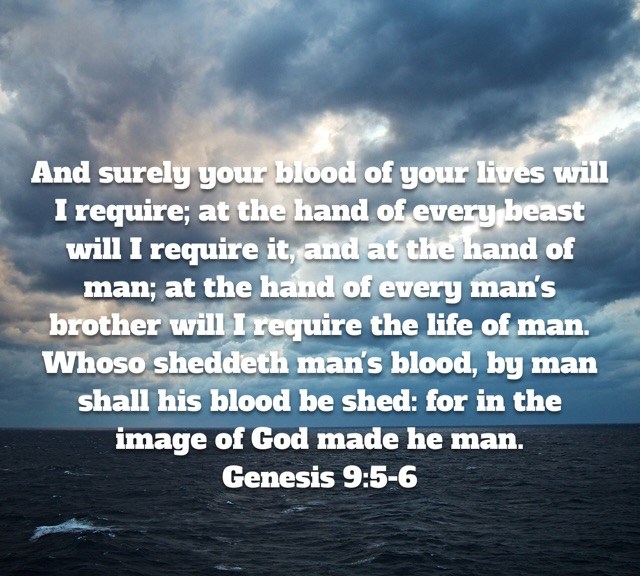
At the flood, for the first time, God made a new covenant with man giving man the responsibility for ruling over man for Him; God ordained human or civil government. “For there is no power but of God: the powers that be are ordained of God.” [3] God gave man the responsibility of taking the life of one who “sheddeth man’s blood,” “for in the image of God made he man.” [4] God gave man the right to take the life of a man, which in the very nature of the case gave man the authority to govern others. Unless [civil] government has the right to the highest form of punishment, its basic authority is questionable and insufficient to protect properly those it governs. He ordained civil government for the earthly benefit of man—to control evil.
Civil government was established within the covenant God made with Noah. The elements of that covenant are:
The relation of man to the earth under the Adamic Covenant is confirmed (Gen. 8.21).
The order of nature is confirmed (Gen. 8.22).
Human government is established (Gen. 9.1-6).
Earth is secured against another universal judgment by water (Gen. 8.21; 9.11).
A prophetic declaration is made that from Ham will descend an inferior and servile posterity (Gen. 9.24, 25).
A prophetic declaration is made that Shem will have a peculiar relation to Jehovah (Gen. 9.26, 27). All divine revelation is through Semitic men, and Christ, after the flesh, descends from Shem.
A prophetic declaration is made that from Japheth will descend the ‘enlarged’ races (Gen. 9.27). Government, science, and art, speaking broadly, are and have been Japhetic, so that history is the indisputable record of the exact fulfillment of these declarations.
God then ordered man to multiply and populate the earth: “And God blessed Noah and his sons, and said unto them, Be fruitful, and multiply, and replenish the earth.”[5]
The covenant God made with Noah was to continue: It was to be an “everlasting covenant” [6] for “perpetual generations.”[7] Thus, the covenant is in effect today.
Would man obey God on the basis of conscience, the restraint of the Holy Spirit, and human government? I will answer that question in the next study.
[2] M. Stanton Evans, The Theme Is Freedom (Washington, D.C.: Regency Publishing, 1994), p. 193 cited in William P. Grady, What Hath God Wrought? (Knoxville, TN: Grady Publications, Inc. 1999), p. 72.
After the fall, God established family government. He said to the woman: “I will greatly multiply thy sorrow and thy conception; in sorrow thou shalt bring forth children; and thy desire shall be to thy husband, and he shall rule over thee.”[1] The Bible teaches that the husband is to be the head of the wife,[2] and children are to be instructed and led by the parents.[3] Parents, not the state, are to care for their children: “But if any provide not for his own, and specially for those of his own house, he hath denied the faith, and is worse than an infidel.”[4] Even an infidel has a love for his children placed there by God.[5] God desires that man satisfy his sexual desire only in marriage. “Thou shalt not commit adultery.”[6] “Nevertheless, to avoid fornication, let every man have his own wife, and let every woman have her own husband.”[7]
God desires parents, not civil government, to provide a God-centered education for their children:
“Hear, O Israel: The LORD our God is one LORD: And thou shalt love the LORD thy God with all thine heart, and with all thy soul, and with all thy might. And these words, which I command thee this day, shall be in thine heart: And thou shalt teach them diligently unto thy children, and shalt talk of them when thou sittest in thine house, and when thou walkest by the way, and when thou liest down, and when thou risest up.”[8]
After the fall, God gave mankind a chance to be directed by his conscience (an awareness of doing wrong), still to be individually controlled only by self-government. God had told man, prior to the fall, “For God doth know that in the day ye eat thereof [of the forbidden fruit], then your eyes shall be opened, and ye shall be as gods, knowing good and evil.”[9] After man ate the forbidden fruit, God told them, “And the LORD God said, Behold, the man is become as one of us, to know good and evil.”[10] Some[11] refer to this economy, this method God uses to deal with individuals, as Conscience, the title being taken from these verses: “For when the Gentiles, which have not the law, do by nature the things contained in the law, these, having not the law, are a law unto themselves: Which shew the work of the law written in their hearts, their conscience also bearing witness, and their thoughts the mean while accusing or else excusing one another[.]”[12] The Holy Spirit also strove with man during the days before the upcoming flood: “And the LORD said, My spirit shall not always strive with man, for that he also is flesh: yet his days shall be an hundred and twenty years.”[13]
Even though God later ordained civil government and church government, every person since the fall is born with a God-given self-conscience (knowledge of who he is) as well as with a God-consciousness[14], a knowledge of who God is.
God gave mankind certain responsibilities:
“During this stewardship man was responsible to respond to God through the promptings of his conscience, and part of a proper response was to bring an acceptable blood sacrifice as God had taught him to do (Gen. 3.21; 4.4). We have a record of only a few responding, and Abel, Enoch, and Noah are especially cited as heroes of faith. We also have the record of those who did not respond and who by their evil deeds brought judgment on the world. Cain refused to acknowledge himself a sinner even when God continued to admonish him (Gen. 4.3, 7). So murder came on the scene of human history.”[15]
In the story of Cain and Abel, we see that God still did not allow civil government. After Cain killed Abel, the Lord told Cain, “And now art thou cursed from the earth, which hath opened her mouth to receive thy brother’s blood from thy hand; When thou tillest the ground, it shall not henceforth yield unto thee her strength; a fugitive and a vagabond shalt thou be in the earth.”[16] Since Cain feared that “every one that findeth me shall slay me,”[17] God said, “… Therefore whosoever slayeth Cain, vengeance shall be taken on him sevenfold. And the Lord set a mark upon Cain, lest any finding him should kill him.”[18] The Supreme Ruler of the universe was telling man that he had no authority to rule over man and that God would take vengeance on him sevenfold if he did.
[11] 3c will deal specifically with the two main methods of Bible understanding, belief versus allegory. “Allegory” means “interpreting the Bible in such a way as to reveal a hidden meaning, a meaning which cannot be seen by believing what the Bible says.” Classic Catholic and covenant theology allegorize or spiritualize much of the Bible. The warfare between those who believe the Bible and those who allegorize it had already started when the New Testament was written (See, e.g., Colossians). As a result, as will be seen by the student who follows these studies, Augustine and his progency (Luther, Calvin, Zwingli, Knox et al) used this method to develop the theology which combined church and state and resulted in the persecution (imprisonment, torture, hanging, burning at the stake, drowning, confiscation of property, and the destruction or confiscation of the writings of the martyrs) of fifty million plus “heretics.” That theology still operates in America even though the proponents do not, at this time, have the power to persecute.
Self-government or individual government was the first government ordained by God and is simply control or direction over oneself.
On the sixth day, God created man in His own image, “male and female created he them.”[1] After creating the man, God created woman out of one of Adam’s ribs to be an “help meet” for him.[2] God brought the woman to Adam and marriage was instituted: “Therefore shall a man leave his father and his mother, and shall cleave unto his wife: and they shall be one flesh.”[3]
After creating them, God blessed them and told them to “be fruitful and multiply, and replenish” and subdue the earth. He gave them dominion over all living things. He put them in the garden of Eden to “dress it and keep it.” And the LORD God commanded the man, saying, Of every tree of the garden thou mayest freely eat: But of the tree of the knowledge of good and evil, thou shalt not eat of it: for in the day that thou eatest thereof thou shalt surely die.”[4]
Thus, God, , made a covenant with man and woman, the first of eight great covenants of Scripture which condition life and salvation, and about which all scripture crystallizes.[5] The covenant God made with them has seven elements. The man and woman in Eden were responsible:
To replenish the earth with a new order—man;
to subdue the earth to human uses;
to have dominion over the animal creation;
to eat herbs and fruits;
to till and keep the garden;
to abstain from eating of the tree of knowledge of good and evil;
the penalty—death.”
God, in the Garden of Eden, gave man an opportunity to operate under self-government, under the constraint of only one simple rule. Man failed. Man was tempted by Satan to disobey the one small rule God had laid down, and mankind failed.[6] Satan came to woman and misquoted the Word of God: “Yea, hath God said, Ye shall not eat of every tree of the garden?”[7] Eve quoted the Word of God back to Satan, but added to it: “We may eat of the fruit of the trees of the garden: But of the fruit of the tree which is in the midst of the garden, God hath said, Ye shall not eat of it, neither shall ye touch it, lest ye die.”[8] Satan then directly challenged the Word of God: “Ye shall not surely die: For God doth know that in the day ye eat thereof, then your eyes shall be opened, and ye shall be as gods, knowing good and evil.”[9]
“And when the woman saw that the tree was good for food, and that it was pleasant to the eyes, and a tree to be desired to make one wise, she took of the fruit thereof, and did eat, and gave also unto her husband with her; and he did eat. And the eyes of them both were opened, and they knew that they were naked; and they sewed fig leaves together, and made themselves aprons.”[10]
At that point, God judged the serpent (the devil), the woman, and the man. [11]
God gave another covenant, a covenant conditions the life of fallen man—conditions which must remain till … “the creation also shall be delivered from the bondage of corruption into the glorious liberty of the sons of God” (Ro. 8.21). The elements of that covenant are:
The serpent, Satan’s tool, is cursed (v.14), and becomes God’s illustration in nature of the effects of sin—from the most beautiful and subtle of creatures to a loathsome reptile.
The first promise of a Redeemer (v.15). Here begins the “highway” that leads to Christ.
The changed state of the woman (v16). In three particulars: (a) Multiplied conception; (b) motherhood linked with sorrow; (c) the headship of the man[12] (cf. Gen. 1.26, 27). The entrance of sin, which is disorder, makes necessary a headship, and it is vested in man (1 Tim. 2.11-14; Eph. 5.22-25; 1 Cor. 11.7-9).
The earth cursed (v17) for man’s sake. It is better for fallen man to battle with a reluctant earth than to live without toil.
The inevitable sorrow of life (v17).
The light occupation of Eden (Gen. 2.15) changed to burdensome labor (vs. 18, 19).
Physical death (v19; Rom. 5.12-21). See ‘Death (spiritual)’ (Gen. 2.17; Eph. 2.5, note).”
God continued to hold man individually responsible for his spiritual decisions. We see this first in the story of Cain and Abel in Genesis 4.
Satan is still successfully deceiving man as to God’s authority and God’s government by manifold attacks on the inerrancy of the Word of God, by the same “Yea, hath God said” strategy he used in the Garden of Eden. This course will show how he has deceived untold millions of Christians with regard to the issue of separation of church and state by misquoting and misinterpreting the Bible.
Thus man makes a choice of his own free will as to how he will respond to God. The principle of freedom of conscience or free will is found throughout the Bible.[13]
Love requires a choice. Without free will, man has no choice and God would be, by force, taking some people to heaven and some to the lake of fire at His discretion. Admittedly, one can do no work to earn his way to heaven, but faith is not a work. “But to him that worketh not, but believeth on him that justifieth the ungodly, his faith is counted for righteousness.”[14]
All other governments, except God’s supreme government, are made up of individuals. God desires the individual(s) who lead(s) a church government, a family government, or a civil government to confine that government to the principles laid down by God for the administration of itself. If a civil government will point individuals, families, businesses, and other institutions to God’s principles without infringing the God-ordained limitations to its authority and the freedom of conscience of individuals to choose God, god, gods, or no god at all, that civil government will guarantee liberty and will be operating in God’s will, as will be shown.
[13] See, e.g., Jn. 3.16, 18 (“For God so loved the world that he gave his only begotten Son, that whosoever believeth in him should not perish, but have everlasting life…. He that believeth on him is not condemned, but he that believeth not is condemned already, because he hath not believed in the name of the only begotten Son of God.); Re. 22.17 (“And the spirit and the bride say, Come. And let him that heareth say, Come. And let him that is athirst come. And whosoever will, let him take the water of life freely.”).
A basic definition of government is “direction, control.” God is the highest Ruler. His government is above all other governments; all other governments derive their authority from God. He, as the Sovereign of the universe ordained and rules over all other governments. “Ordain” means “to establish or order by appointment, decree, or law” (WEBSTER’S COLLEGIATE DICTIONARY 818 (10th ed. 1995)). Men know that God is in control because God put a God-consciousness in every person (See Ro. 1.18-32).
God teaches in many ways, throughout the Bible, that He is the Supreme Ruler and His is the Higher and Highest Power. As possessor of heaven and earth, God has and exercises supreme authority in both the heavenly and earthly sphere.
That God is supreme, the Highest Power, is revealed in the Old Testament through, among other things, His names. The Old Testament reveals the existence of a Supreme Being, the Creator of the universe and of man, the Source of all life and intelligence who is to be worshipped and served by men and angels.
As the Supreme Ruler, He has decreed that men may choose to be guided by His principles or not. However, choices are met by either blessings or judgment. In the final analysis He will either reward or judge all governments according to the degree they abide by His will.
The first government established by God was self-government. Every person exercises self-government, and decides whether he or she will receive the only true and eternal hope which is provided by God, that is the Lord Jesus Christ, as Savior. “And this is the will of him that sent me, that every one which seeth the Son, and believeth on him, may have everlasting life: and I will raise him up at the last day” (Jn. 6.40).
After the fall of man in the Garden of Eden, and man knew “good and evil,” God established family government. Every person within a family – father, mother, and children – in exercising self-government, chooses whether to submit to God’s guidelines concerning family government.
The next type of government ordained by God was human government or civil government. God ordained civil government at the time of the great flood. For the first time, He gave man the responsibility of ruling the world for God. Relatively quickly after Cain killed Abel, all mankind except Noah and his family, guided only by conscience (knowledge of good and evil or an awareness of right and wrong) had become totally corrupted. Civil government provided further and direct control over the evil nature of man.
Some time after ordaining civil government, God called out Abraham to be the father of Israel. Israel was established as a theocracy. All other nations were non-theocratic and were and are called “Gentile.” God established Israel to be directly under Him for specific purposes. Israel was to be the only theocracy that God has ever ordained. The Gentile nations can only look to Israel to see that God is who He claims to be, but God still desires every nation to choose to honor Him and His principles.
The Word of God teaches us that no civil government, Jew or Gentile, since it is made up of sinful men, will, before the return of Christ, ever follow the principles of God for any significant period of time. That both Israel and the Gentiles have governed for self, not God, is sadly apparent. Therefore, every civil government that has ever existed or which will ever come about prior to the return of the Lord will be judged by God.
God used a Gentile nation to take Israel into captivity, and He has already judged and is judging many Gentile nations. The Lord will return and crush the Gentile world-powers existing at the time of His return which, led by the beast and false prophet, will come and besiege Israel (Re. 19.19). The nation Israel will then be restored to the land which God gave them according to his covenant with them (Many verses in the Bible verify this. God will do this for His “holy name’s sake, which [Israel had] profaned among the heathen….” Then Satan will be cast “into the bottomless pit, that he might deceive the nations no more, till the thousand years should be fulfilled,” the nations shall be judged, and God’s kingdom will be set up.
Throughout these studies, the student should keep in mind all governments: first, God’s Supreme Government, then the other governments which God has ordained—self-government, family government, civil government, and church government. Biblical principles of governments other than church government are dealt with in this section, Section 1 with an emphasis on civil government; and biblical principles of church government are dealt with in Section 2. God laid down the boundaries of the authority of each type of government and the principles by which every government should conduct its affairs. He will hold every government responsible for the choices it makes. The reader should also keep in mind that the God-given goal for all governments is the glory of God, not the happiness of man. Joy is a side effect of “loving the Lord thy God with all thy heart, and with all thy soul, and with all thy mind.”
This study is designed for the born again believer who wishes to learn what the Bible teaches about government, church, separation of church and state, and how those principles have been and are applied in America. The topics covered are extremely important to our Lord Jesus Christ, to individuals, to families, to churches, and to the nation. The guiding light is the Bible.
Let me emphasize that a lost person cannot understand the subject matter since it requires spiritual discernment. To learn how to be saved, go to God’s Plan of Salvation Page on this website. Salvation through faith in Jesus Christ is preeminent. It is a choice every person should make, but God leaves the choice up to the individual.
This course is presented at the spiritual grade school level. Each lesson will be only about five to eight minutes in length. The course presents basic knowledge. At first, only an elementary analysis and understanding is taught and required by the student. For those who are already more advanced, they can listen to the study and go to the resources cited in the accompanying written (and probably more thorough, but still grade school level) study for more in depth and detailed studies which will connect to further studies. One can progress as far as he wants, even to the graduate level, if he continues to follow the links to the top studies such as God Betrayed. At that level, meditation, analysis, and study become very important.
In grade school, one accepts what he is told. He begins to think on a basic level, of course, but his instructors can either guide him to truth, to lies, or to a way of thinking that says there is no truth. The underlying basis of this course is truth based on Bible principle, Bible fact, historical fact, and man’s law as tested against the higher law, God’s law. The Bible emphasizes the importance of truth, so truth is the goal of this course.
The only way to arrive at truth in the Bible is to believe what it says. Those religions who have improperly spiritualized and allegorized portions of the Bible have brought havoc to the world, as will be seen in these studies.
A child of God should never just accept what he is told. He should make sure what he is told is in line with the Word of God. Even on the grade school level, some verses will be cited as the basis for a teaching. The more mature student will want to make sure those verses are not taken out of their immediate context and the overall context of Scripture.
As to facts outside the Bible, a mature believer will want to make sure those facts are reliable. At the highest level of these studies, which one can check out by going up the chain of links provided with the teachings, the student will find complete citations and analysis.
Once one has a working knowledge of these studies all the way to the top, he will have achieved the equivalent of four years of college studies, to put it in secular terms. Then, he will be prepared to do his own studies, analysis, etc. at the Masters and Doctoral level. You see, one will understand as he arrives at the graduate level that many of the matters studied in this course have room for further important development.
This initial study is for the believer who has not studied these matters at least to any extent, or who has depended upon
as to spiritual matters: pastors or teachers who never delve into the deeper things of God
as to factual matters, revisionists such as David Barton or Roger Federer, et al.
Again, this study is for born again believers who want to honestly seek truth. God highly esteems truth, along with knowledge, understanding, and wisdom.
The following is an outline of things to come:
First, Foundational Bible Principles. The Bible Doctrines of Church, State, and Separation of Church and State.
Second, the American Application of Those Principles. (1) The History of the First Amendment. (2) Then, a study of Union of Church and State in America.
Finally, how a church can organize according to the principles of organization in the New Testament.
One should not attempt to start with the final phase of the course without understanding the foundational principles and the application of those principles.
The material that you will study in this course fits together like a puzzle. The completed puzzle will present a picture that everyone, and especially the children of God in America should have hidden in their hearts.
God bless you as we grow together in the knowledge, understanding, and wisdom concerning the institution God loved and gave Himself for, the church.
Hello. My name is Jerald Finney. I am first and foremost a humble servant of the Lord Jesus Christ. I was saved and became a member of a Bible believing church in 1982. The Lord saved me from my sin—I did nothing to earn that salvation. He did it all. He paid the price which I cannot pay.
Since then, 35 years ago, the Holy Spirit has directed me, instructed me through Bible study and life, and taken me step by step along the path God had for me. God called me to go to Law School after I had been saved 7 years. In 1990, I entered the University of Texas Law School. I started practicing law in January 1994, following the Lord step by step. In 2005, He called me into the arena of church state relationship. My passion since then has been to help churches do things God’s way, the Bible way.
I have been a member of 3 different churches. I am now a member of Old Paths Baptist Church of Northfield MN. I live in Faribault MN, 13 miles from Northfield. I am licensed to practice law in Minnesota and Texas (inactive).
You can go to the link below this video for much more information about me. However, it is not about me. It is about the Glory of God. The standard for all things, temporal and eternal, earthly and heavenly, legal and spiritual is the Word of God, the Bible. Check out what you are told. If you are lost, check out God’s plan of salvation. The greatest thing anyone can do for himself and others is to be born again into the family of God. If you are saved, study the Word of God, become a member of a local autonomous Bible believing church, be sensitive to the leading of the Holy Spirit, and apply God’s principles and New Testament Commandments in all matters.
The purpose of Bible Trust Ministries is to inform believers and churches on the issues regarding church state relationship. More specifically, the purpose is to show churches how they can organize in America according to the principles in the New Testament. This is a very important matter, according to the Word of God. “Christ loved the church and gave Himself for it” (Ep. 5.25) Ephesians 5:26-27: “That he might sanctify and cleanse it with the washing of water by the word, That he might present it to himself a glorious church, not having spot, or wrinkle, or any such thing; but that it should be holy and without blemish” (Ep. 5.27-27).
Likewise we should have that same love for the churches we are members of. The Apostle Paul, writing as inspired by the Holy Spirit wrote to the church at Corinth: 2 Corinthians 11:1-5 “Would to God ye could bear with me a little in my folly: and indeed bear with me. For I am jealous over you with godly jealousy: for I have espoused you to one husband, that I may present you as a chaste virgin to Christ. But I fear, lest by any means, as the serpent beguiled Eve through his subtilty, so your minds should be corrupted from the simplicity that is in Christ. For if he that cometh preacheth another Jesus, whom we have not preached, or if ye receive another spirit, which ye have not received, or another gospel, which ye have not accepted, ye might well bear with him. For I suppose I was not a whit behind the very chiefest apostles.”
The purpose of Bible Trust Ministries is to help churches present themselves as chaste virgins to Christ.
It is my desire that these broadcasts glorify God, not me. Feel free to call me at any time at the phone number on the “Contact” page of the website linked to below this broadcast.
The overwhelming majority of churches have chosen to incorporate (inc.). Many or most church members of inc. churches do not know that the church they attend is inc., nor do they know what inc. means. This article is meant for their edification.
The following are the main attributes of church non-profit corporation status in a nutshell:
The state creates the corporation through state non-profit corporation law. A corporation is an artificial being, invisible, intangible, and existing only in comtemplation of man’s earthly law.
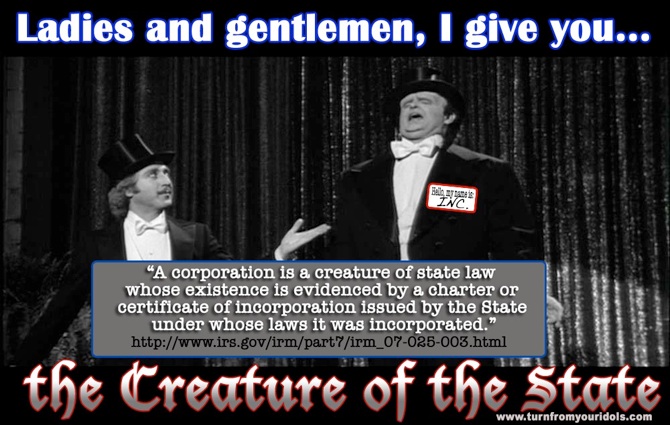
The sovereign of a corporation is the state of incorporation. No corporation can exist without the consent or grant of the sovereign since the corporation is a creature of the state and derives its powers by legislative grant.
The right to act as a corporation is a special privilege conferred by the sovereign power.
An incorporated church is a monstrosity with two heads which are at odds with one another. Whenever there is an incorporated church, there are two entities—the one, the church as such, not owing its ecclesiastical or spiritual existence to the civil law, and the other, the legal corporation, each separate although closely allied. Such a church gets part of her powers from God and part from civil government.
An incorporated church is obligated to have elected officers who conduct business meetings, meet statutory requirements, etc. It has contracted to conduct its business activities in compliance with temporal corporate law, including governmental regulation of its employment relationships, so long as the employment does not depend on doctrinal matters.
The members of a corporate church do not think God’s power and provisions are adequate.
Incorporation excludes God entirely as regards certain matters controlled by the contracts created by incorporation.
The organization of a New Testament Church and an incorporated church are different. The former organizes solely according to God’s New Testament Church principles. The latter according to the non-profit corporation law of the state of incorporation.
An incorporated church and a New Testament Church have different creators. The state creates the former and God creates the latter.
Ownership of a New Testament Church and a corporation differ. Members in a non-profit corporation are the owners of the corporation. Jesus Christ owns a New Testament Church.
The properties utilized by the corporate church and that utilized by the New Testatment church have different owners. The non-profit corporation owns any property used by the incorporated church. The Lord Jesus Christ owns the property held by a New Testament Church.
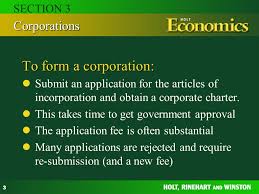
An incorporated church has contracted or agreed to comply with all the government red tape that goes along with incorporation: elect officers, hold business meetings, notify members of those meetings pursuant to statutory requirements, keep records, etc. If the incorporated church honors their word and complies with their agreement or contract with the state of incorporation, these matters take tremendous time, energy, and resources which could be used for the glory of God doing the work God prescribes for his churches in the New Testament.
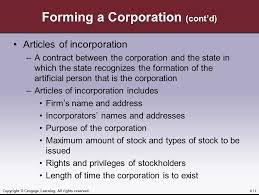
The corporate charter is a contract of threefold nature: a contract between the state and the corporation, a contract between the corporation and its members of stockholders, and a contract between the members inter se. Any contract disputes can be taken to civil court where only man’s law, not the Bible, controls.
The bylaws of the corporation create contracts between the member, and between the corporation and its members. The multiple contracts created by the articles of incorporation and the bylaws entangle the incorporated church with earthly concerns.
As sovereign, the state of incorporation has ultimate authority in interpreting the articles of incorporation.
A corporation is a state “franchise.” Franchises are rights or privileges conferred by grant of a sovereign.
A corporate church is, at best, in God’s permissive will as to organization.
A corporate church is subject to the non-profit corporation laws which created the corporation. A New Testament church is operated solely under the Lord Jesus Christ and His New Testament Church Doctrine.
The sovereign or head of the corporate part of an incorporated church is the state. The sovereign or head of a New Testament Church is the Lord Jesus Christ only.
A corporation is called an artificial person, a legal fiction; it is a temporal organization. A New Testament Church is a spiritual organism, a spiritual body.
Church non-profit corporations agree, when they get their corporate charter, to file an annual report with the state.
The church non-profit corporation loses much of its First Amendment protections by placing itself, as an artificial person, under the Fourteenth Amendment for many purposes.
The church non-profit corporation can be sued in court for civil damages, as when an old lady falls on the ice going into the church building. See Spurious rationale for church incorporation: limited liability/incorporation increases liability of church members. Of course, most or all corporate churches buy insurance in the name of the church. A New Testament Church cannot be sued for damages since she is not a legal entity. She cannot buy insurance, but liability insurance not held by the church will still pay for any liabilities for such damages.
The church non-profit corporation can own property since it is a legal entity. Although a New Testament Church cannot own property, she can still have access to property. Any property utilized by a New Testament church can be held by a non-legal entity, a simple trust which creates a fiduciary relationship with property whereby a trustee is holds all assets in the trust estate for the benefit of the Lord Jesus Christ, the true, beneficial and equitable owner of the properties. See
Non-profit corporations are tax exempt. New Testament Churches are non-taxable under the First Amendment.
Church non-profit corporation status is a choice churches make for various humanist reasons. No law requires a church to incorporate. Is it illegal for a church in America not to incorporate? Does a church have to be a 501c3?,What is a First Amendment Church? The First Amendment and the constitutions of every state make clear that a church can choose either non-legal entity status or legal entity status. The Bible teaches that Christ’s churches are to be spiritual entities only.Is a church a spiritual or legal entity? The Bible does not say, “Churches shall not incorporate;” but principles in the Bible, when applied to the facts about church non-profit corporation status, make clear that church corporate status violates New Testament church principles.
This article will succinctly answer several questions:
What did “establishment or religion” mean in the colonies?
What did “establishment or religion” mean at the time of the adoption of the First Amendment?[i]
What happened with the remaining forced religious establishments after the adoption of the First Amendment?
What does “establishment or religion” mean today?
Contents
I. Introduction: Meaning of “Establishment of Religion” II. The Path to Multiple Establishments in the American Colonies III. State Establishments IV. Conclusion
I. Introduction: Meaning of “Establishment of Religion”
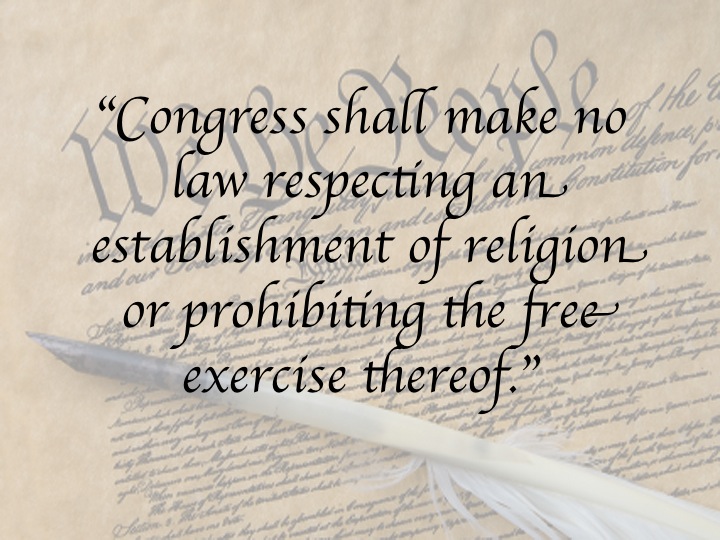
First Amendment Religion Clause
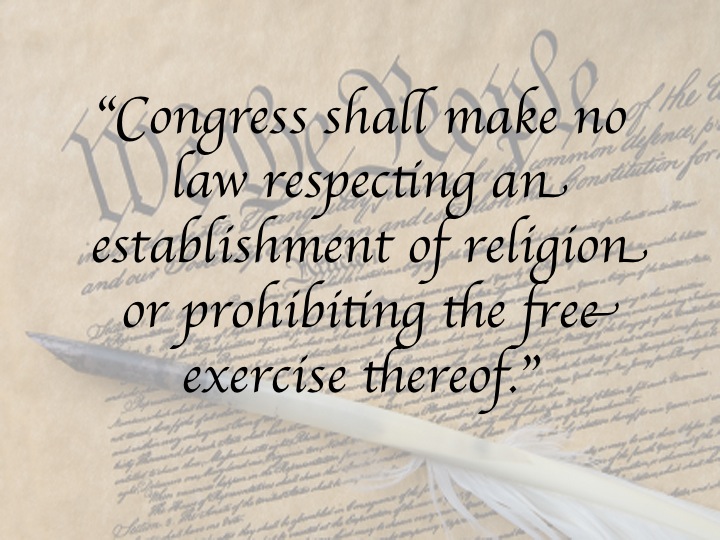
To understand these issues, one must first define “establishment of religion” and understand the meaning of “law ‘respecting’ an ‘establishment of religion.” At the adoption of the First Amendment, “No law respecting” meant “no law concerning or touching the subject of.” That still leaves unresolved the meaning of “establishment of religion.” Prior to colonization and for some time thereafter, “establishment of religion” meant one officially recognized church which worked with, over, or under the state, the civil government. The original meaning of “establishment of religion” which existed prior to and at the founding of America, was replaced by a “multiple establishment” understanding long before the adoption of the First Amendment. “The evidence demonstrates that by an establishment of religion the framers meant any government policy that aided religion and its agencies, the religious establishments.”[ii]
“After the American Revolution, seven of the fourteen states that comprised the Union in 1791 required establishments of religion by law. The other states which originally had established churches, had already done away with forced establishment in favor of chosen establishment and they all provided for multiple establishment. No state maintained a single or preferential establishment of religion. An establishment of religion meant to those who framed and ratified the First Amendment what it meant to the states: support of religion on a nonpreferential basis. It was specifically this support on a nonpreferential basis that the establishment clause of the First Amendment sought to forbid.”[iii]
In 1833, Massachusetts became the last state to replace forced establishment of religion with establishment of religion by choice. The First Amendment forbade establishment of religion in federal jurisdiction.
II. The Path to Multiple Establishments in the American Colonies
Establishment by choice and the free exercise of religion (soul liberty) took different paths in America. Almost all the colonies started out with single establishments of religion. Due to a variety of factors, by the time of the adoption of the First Amendment, all state establishments, whether by force or choice, were general or multiple establishments.
In the conventional sense, before the colonization of America as well as in most of the original colonies when founded, an establishment of religion meant the legal union of government and a single church or denomination such as Catholicism (numerous European countries), Calvinism (Geneva), Presbyterianism (Scotland), Lutheranism (Germany), or the Church of England.
With the founding of the colonies, conventional establishments existed in the southern colonies of Virginia, Maryland, North Carolina, South Carolina, and Georgia. In 1778, South Carolina created an establishment or religion endorsed by William Tennent. “He called it a ‘general establishment’ because it recognized and nurtured the legal equality of all Protestants without preferring one denomination over others.” These general establishments were replaced by multiple establishment.
New England, Massachusetts, New Hampshire, and Connecticut at first had single establishments, Congregationalism. Massachusetts, Connecticut, and New Hampshire were founded and ruled by the Puritans, who came to American for freedom of religion “for themselves only.” The Puritans felt that they were the right people, at the right place, at the right time to establish a “city on a hill” to light the world, to show the world the rightness and resulting blessings of doing things God’s way (according to their Calvinist theology). Their experiment was well on its way to self-destruction by 1660. Gradually, the exclusive establishments in these New England colonies were replaced by multiple establishments.
Persecutions of “heretics,” those whose conscience prohibited them from bowing down to the colonial establishments were well documented. Those who supported establishment of their church were persecuted when in a colony with another established church. For example, Anglicans in New England were persecuted when they went to Massachusetts, and Presbyterians and others were persecuted to one extent or another in Virginia and other southern colonies. However, in opposing the persecuting establishment, they never favored complete separation of church and state and combined church and state when in the majority or in control.
A minority remnant of the Baptists were the only ones who consistently stood against union of church and state. That most Baptists by that time did not oppose total separation of church and state became clear when most of them sought certificates and compromised on the issue when the move toward multiple establishments had taken force.
Among those who stood their ground and led the fight against any establishment were Roger Williams, Dr. John Clarke, Isaac Backus, and John Leland. In New England, Roger Williams, Dr. John Clarke, and later, Isaac Backus wrote extensively against establishment and chronicled the persecutions which continued until the eve of the American Revolution and after, to a lesser extent.[iv] On the eve of the American Revolution, in 1774, eighteen Baptists were jailed in Warwick, Massachusetts for refusing to pay taxes in support of the town’s Congregational minister. To be exempted from paying the ministerial tax, a Baptist had to obtain a certificate that he regularly attended a church of his own denomination. For a copy of the certificate, he had to pay a tax of four pence. Isaac Backus, and some of his followers opposed the tax and the certificate and maintained that they were persecuted by the Congregational majority. John Adams, a Congregationalist (Puritan) leader stated that the establishment was “but a slender one” that did not infringe religious liberty.
In 1774, Baptists still paid ministerial taxes in Virginia and other colonies for building churches and were imprisoned for preaching in unlicensed Houses, preaching without Anglican ordination, and for other infractions. Virginia Baptists were beaten by mobs, fined, and imprisoned for their religious beliefs which prevented them from obeying the laws of the established Anglican Church. The Virginia establishment originated with the colonies first charter in 1606.
Rhode Island not only never had an establishment of any kind, but also commanded complete religious freedom of soul liberty for all. Pennsylvania, Delaware, and New Jersey had no establishment of religion, but did not allow complete religious freedom for all. For example, Pennsylvania did not grant freedom of religion to Catholics.
In New York, Massachusetts, Connecticut, and New Hampshire, the pattern of establishment was diversified and unique. New York was the first example of an establishment very different from the European type, a general establishment without preference to one church over others.
III. State Establishments
The First Amendment, which until 1947 applied only to the federal government, forbade establishment of religion and guaranteed soul liberty at the national level only. After the First Amendment was adopted, states which still had laws requiring establishment gradually amended their constitutions to do away with the requirement that churches be “established.” All state constitutions allow churches to became established, but also provide that a church can make the choice not to become established. State constitutional provisions regarding church and state do not require establishment and also mandate soul liberty or the free exercise of religion.
A remnant of the Baptists continued to stand against any kind of establishment, including establishment by incorporation until all states had done away with forced establishment. John Leland was notable Baptist preacher, writer, and activist against union of church and state during a period starting in the 1780’s in Virginia and later in Massachusetts and Connecticut. The efforts and writings of earlier Baptist leaders, especially those of Isaac Backus, continued their influence during this period. Most Baptists had already been severed from their roots and betrayed God and their historic Baptist forefathers who had stood against the establishment to the death.[v]
New Jersey (1776), Pennsylvania (1776), New York (1777), and Delaware (1776 and 1792) made clear in their Constitutions that there would be no coerced establishment of religion.
North Carolina, by its constitution of 1776, became the first southern state to enact preferential establishment. “In Maryland, Georgia, and South Carolina, ‘an establishment of religion’ meant very much what it did in the three New England states that maintained multiple establishments. However, those three southern states merely permitted but did not create establishment.”[vi]
In six other states, pro-establisment parties were forced to make concessions to the growing sentiment against any forced establishments. Four other states replaced single establishments by authorizing multiple establishments, and two substituted multiple establishments for dual ones. “The evidence relating to each of these six proves that an …an establishment of religion was not restricted in meaning to a state church or to a system of public support of one sect alone; instead, and establishment of religion meant public support of several or all churches, with preference to none.”[vii]
Three of these states—Massachusetts, New Hampshire, and Connecticut—were in New England. The 1780 Massachusetts Constitution allowed for the possibility that a Baptist or some other minority minister might be elected by a town and receive the taxes of his congregation. This happened in several towns where the Baptists became the majority. In those towns, the Baptist ministers, by law, were supposed to receive their salaries from the town treasuries. As the Reverend John Leland pointed out, in towns where Baptists formed a majority, they might “tax all in the town or precincts to part with their money for religious uses,” thereby violating Baptist principles.[viii] A minority of Baptists stood on Bible principles and followed Isaac Backus in refusing to compromise their beliefs; but a majority followed men such as Hezekiah Smith and compromised on the important doctrine of separation of church and state. The conflicts continued until 1833, when Massachusetts became to last state to do away with required establishments.
New Hampshire’s establishment of religion after the Revolution did not significantly differ from that of Massachusetts. Article VI of its 1784 Declaration of Rights created a multiple establishment. The majority of New Hampshire’s Baptists, sometimes sought the incorporation of their churches, as in Massachusetts, to insure tax exemption of their congregants from a local Congregational church. But, says William G. McLoughlin, most of the petitions to incorporate “seemed to originate from the Baptists’ desire to enable their congregations to levy religious taxes on their own members which could be binding in law,” the Baptists as well as Congregationalists also accepted from the state ministerial lands regardless of the demands of some of them for a separation of church and state.[ix] The establishment of religion in New Hampshire fell victim to state politics, not to the drive to separate church and state because of the principle of voluntarism. “Voters, increasingly non-Congregationalist, rallied around the Democrats’ condemnation of the tax system as having promoted an establishment of religion that supposedly favored the prevailing denomination at the expense of the religious liberty of others.” The Democrats passed a Toleration Act in 1919 that ended the system of tax support for religion.[x]
In 1784, Connecticut passed its Toleration Act which allowed certain Protestant denominations to publicly worship “in a way agreeable to their consciences” and be exempted from taxes if they produced certificates. Due to continuing protests and changes in the law which did not satisfy many dissenters who continued to protest, a law was passed that allowed nonconformists to write their own certificates attesting membership in a different religious society which they supported, thus exempting them for the support of the town church. John Leland, in a tract describing the evils of an establishment of religion, did not doubt that Connecticut had one, even though one’s contribution to religion went to the church whose worship one attended.[xi]
The battle in Connecticut continued. In 1802, the Baptists petitioned the legislature to repeal the system of compulsory religious taxes; held a statewide convention remonstrating against Connecticut’s establishment because it favored the Congregationalists and because religion should be left to voluntary support, petitioned the government in 1804 because the required certificates did not apply to the Congregationalists as well as others. The consistent argument of the Baptists, except for a minority led by Isaac Backus, was that the existing church-state relationship preferred Congregationalism and that private donations should be the only source of support to religion, despite Baptist participation in the establishment’s largess. In 1816, Connecticut received a windfall repayment from the United States for its costs incurred in the War of 1812 and divided 6/7 of it among the denominations and the Baptists accepted their share. The Baptists, except for a remnant who stood for complete separation of church and state, compromised when it became “practical.” In 1818, Connecticut provided that no one could be compelled to support any religious society, yet allowed any religious society to tax itself and privately collect the assessment from each member. As with every state, Connecticut provided for voluntary incorporation by churches.
“Maryland’s constitution of 1776 ended the former supremacy of the Episcopalian church, which had an exclusive establishment during the colonial period; but allowed the legislature to legislate multiple or nonpreferential establishment of “Christian,” to include Roman Catholic churches. In 1810, Maryland amended its constitution to remove any taxation for support of any religion. Churches could still incorporate under state law, but no religious taxes were to be collected from anyone.
When the First Amendment was adopted, South Carolina’s constitution permitted multiple establishment and collection of taxes for religious support of the established churches. Under the constitution of 1778, all Protestant denominations were treated equally. “Any religious society of a Protestant denomination might therefore be incorporated and become ‘a church of the established religion of this State’ on condition of subscribing to articles of faith: a belief in God, a promise to worship him publicly, profession of Christianity as ‘the true religion’ and reliance on the Scriptures as divinely inspired.” No one was required to pay toward any church that he did not “freely join.” This was the first religious establishment ever that “did not exact religious assessments.” [xii] The 1790 South Carolina constitution did away with religious taxes altogether, but still allowed incorporation of churches.
The Baptists led the fight for religious liberty in Virginia. Many were abused and jailed for their refusal to bow down to the established church/state in Virginia. They influenced statesmen like Thomas Jefferson, George Washington, and James Madison to fight for religious liberty in Virginia. The result was the 1776 Virginia Bill for Religious Liberty.
Although Virginia still had single establishment before 1776, no state or colony had a statute that included every religion. Three of the states with multiple establishments authorized by law established Protestantism and three established Christianity. The establishments of all six included all denominations and sects with a sufficient number of members to form a church. Protestantism was synonymous with religion because Jews and Roman Catholics were nonexistent or too few to make a difference; “and where Christianity was established, as in Maryland which had many Catholics, Jews were scarcely known.” “Clearly the provisions of these six states show that to understand the American meaning of “an establishment of religion” one cannot adopt a definition based on European experience.”[xiii]
Georgia’s constitution of 1777 permitted multiple establishment without exception, thereby replacing the exclusive establishment of the Anglican church. The establishment of religion meant government tax support of all churches, with preference for none. The 1789 constitution permitted multiple establishments. In 1798, Georgia finally guaranteed nonpreferential establishment of religion and that no person should be “obliged to pay tithes, taxes, or any other rate, for … any place of worship, or for maintenance of any minister or ministry, contrary to what he believes to be right, or hath voluntarily engaged.”
Vermont became the fourteenth state in 1791 and had a multiple establishment. Due largely to the stand of Baptists in Vermont, that state repealed all laws concerning taxation for religion, thus doing away with forced union of church and state.
IV. Conclusion
Every church has a choice – either under God only or under man (civil government).
As establishment became available to all churches, many or the majority of churches incorporated. Today the overwhelming majority of churches, to include Baptist churches, incorporate in order to obtain perceived temporal earthly benefits for the state governments. After the addition of 26 United States Code §§ 501(c)(3) and 508, churches sought perceived benefits from the federal government as well by obtaining “tax exempt” status.
All church state establishments which have ever existed came about as a result of a civil government law which combined church and state. In all cases, a church or churches combined with the state under man’s law for perceived benefits from the state. That is the case in America. Even today, one of the reasons for choosing such arrangements is financial. All reasons given by churches for joining with the state are based upon man’s temporal, fleshly, earthly and legal reasoning. All such reasons, by their very nature, circumvent God’s eternal, spiritual, heavenly, and Biblical principles for His churches. [xiv]
[iv] See, e.g., Isaac Backus. A History of New England With Particular Reference to the Denomination of Christians Called Baptists, Volumes 1 and 2 (Eugene, Oregon: Wipf & Stock, Previously Published by Backus Historical Society, 1871)(originally published in the late 1700’s); Williams, Roger and Underhill, Edward Bean. The Bloudy Tenent of Persecution for Cause of Conscience Discussed and Mr. Cotton’s Letter Examined and Answered. London: Printed for the Society, by J. Haddon, Castle Street, Finsbury, 1848 (Reprint)(originally published in 1644); Clarke, John. Ill News from New-England or A Narative of New-Englands Persecution. Paris, Ark.: The Baptist Standard Bearer, Inc., Reprint: 1stprinted in 1652; List of Scholarly Resources Which Explain and Comprehensively Document the True History of Religious Freedom in America.
[viii] “The Yankee Spy” (1794), in L.F. Greene, ed., The Writings of John Leland (New York, reprint 1969), pp. 225, 227, cited in id., p. 40. John Leland (May 14, 1754 – January 14, 1841) was an American Baptist minister who preached in Virginia,, Massachusetts, and Connecticut, as well an outspoken abolitionist. He was an important figure in the struggle for religious liberty in the United States.
[ix] William G. McLoughlin, New England Dissent1630-1833: The Baptists and the Sepration of Church and State (Cambridge, Mass., 1971, 2 vols.), II, pp. 874, 886, cited in Levy, The Establishment Clause/Religion and the First Amendment, p. 40.
The local church sanctified and cleansed by the washing of water by the word——————–A ministry of Charity Baptist Tabernacle of Amarillo, Texas led by Pastor Ben Hickam. "Would to God ye could bear with me a little in my folly: and indeed bear with me. For I am jealous over you with godly jealousy: for I have espoused you to one husband, that I may present you as a chaste virgin to Christ. But I fear, lest by any means, as the serpent beguiled Eve through his subtilty, so your minds should be corrupted from the simplicity that is in Christ" (2 Corinthians 11:1-3). ————————————Jerald Finney, a Christian Lawyer and member of Charity Baptist Tabernacle, having received this ministry in the Lord, explains how a church in America can remain under the Lord Jesus Christ and Him only. "As every man hath received the gift, even so minister the same one to another, as good stewards of the manifold grace of God. If any man speak, let him speak as the oracles of God; if any man minister, let him do it as of the ability which God giveth: that God in all things may be glorified through Jesus Christ, to whom be praise and dominion for ever and ever. Amen" (1 Peter 4:10-11; See also, Ephesians 4::1-16 and 1 Corinthians 12:1-25). "Take heed to the ministry which thou hast received in the Lord, that thou fulfil it" (Colossians 4:17). "And hath put all things under his feet, and gave him to be the head over all things to the church" (Ephesians 1.22; See also, e.g. Colossians 1:18).
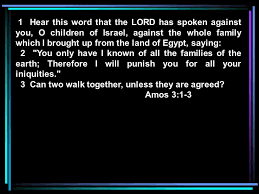
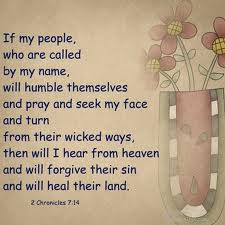 The Mosaic Law covered the period from Moses until the death and resurrection of Christ, or from Exodus 19.1 to Acts 1.26. Under the covenant God made with Moses, the Jews were to be responsible for keeping the whole law.[4] They did not succeed in their responsibility. Their zeal for God was not according to knowledge; they, being ignorant of God’s righteousness, went about to “establish their own righteousness, and did not submit themselves to the righteousness of God.[5] The result was the captivity of Judah by Babylon and the captivity of Israel by Assyria. After the Jews later rejected the Lord, they were scattered over the entire world. Jesus lamented, “O Jerusalem, Jerusalem, thou that killest the prophets, and stonest them which are sent unto thee, how often would I have gathered thy children together, even as a hen gathereth her chickens under her wings, and ye would not! Behold, your house is left unto you desolate. For I say unto you, Ye shall not see me henceforth, till ye shall say, Blessed is he that cometh in the name of the Lord.”[6]
 God gave Israel free will. Ultimately Israel rejected God’s plan under which God himself ruled over the nation of Israel and demanded a king like the Gentile nations. Israel demanded a king.[12] God told Samuel to hearken unto their demand, that Israel had rejected God and His rule over them:[13]
 But they still demanded a king.[15] They were looking at man, not God, when they made this demand: “And they said unto Samuel, Behold, thou art old, and thy sons walk not in thy ways[.]”[16] They still did not realize that God fulfills His purposes. Had Israel walked in faith and kept His statutes and commandments, God had promised to bless them.
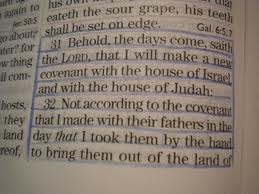 Israel miserably failed to obey God on the basis of conscience, the restraint of the Holy Spirit, human government, promise, and law. As a result, God instituted a new economy in which He dealt with all mankind on the basis of Grace. Conscience, the restraint of the Holy Spirit, human government, promise, and grace are being used by God to govern people. The law is not a ruling factor for the believer during this time of grace.[20]
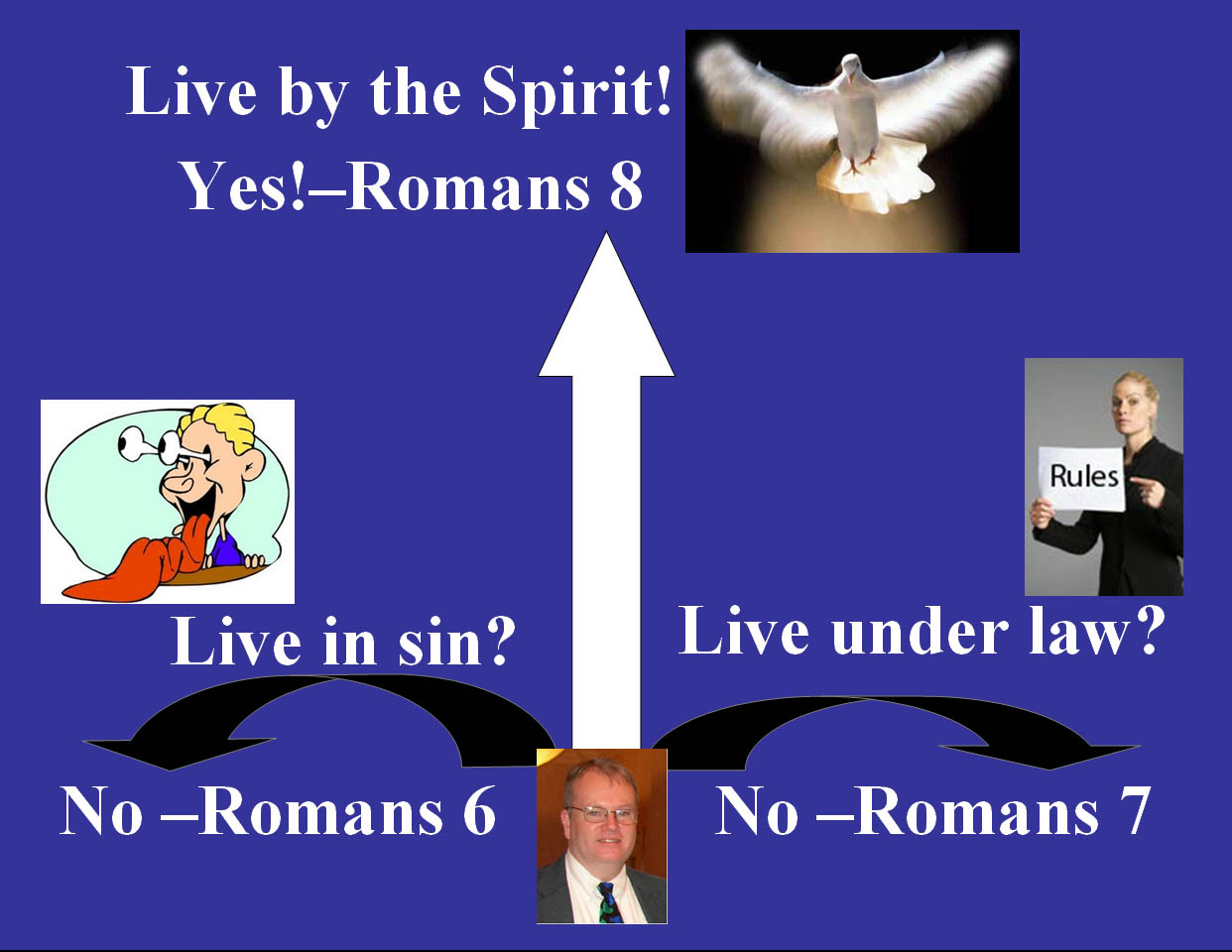 Grace as a ruling factor for the believer consists of two things. First, a confirmed favorable disposition toward God, the law of God in the heart.[21] The second thing is the indwelling Holy Spirit: “What? know ye not that your body is the temple of the Holy Ghost which is in you, which ye have of God, and ye are not your own? For ye are bought with a price: therefore glorify God in your body, and in your spirit, which are God’s.”[22]

 Civil government was established within the covenant God made with Noah. The elements of that covenant are:
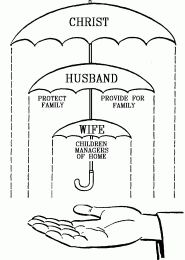 After the fall, God established family government. He said to the woman: “I will greatly multiply thy sorrow and thy conception; in sorrow thou shalt bring forth children; and thy desire shall be to thy husband, and he shall rule over thee.”
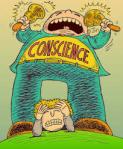 After the fall, God gave mankind a chance to be directed by his conscience (an awareness of doing wrong), still to be individually controlled only by self-government. God had told man, prior to the fall, “For God doth know that in the day ye eat thereof [of the forbidden fruit], then your eyes shall be opened, and ye shall be as gods, knowing good and evil.”

 A basic definition of government is “direction, control.” God is the highest Ruler. His government is above all other governments; all other governments derive their authority from God. He, as the Sovereign of the universe ordained and rules over all other governments. “Ordain” means “to establish or order by appointment, decree, or law” (WEBSTER’S COLLEGIATE DICTIONARY 818 (10th ed. 1995)). Men know that God is in control because God put a God-consciousness in every person (See Ro. 1.18-32).
 This study is designed for the born again believer who wishes to learn what the Bible teaches about government, church, separation of church and state, and how those principles have been and are applied in America. The topics covered are extremely important to our Lord Jesus Christ, to individuals, to families, to churches, and to the nation. The guiding light is the Bible.
 This course is presented at the spiritual grade school level. Each lesson will be only about five to eight minutes in length. The course presents basic knowledge. At first, only an elementary analysis and understanding is taught and required by the student. For those who are already more advanced, they can listen to the study and go to the resources cited in the accompanying written (and probably more thorough, but still grade school level) study for more in depth and detailed studies which will connect to further studies. One can progress as far as he wants, even to the graduate level, if he continues to follow the links to the top studies such as God Betrayed. At that level, meditation, analysis, and study become very important.
 A child of God should never just accept what he is told. He should make sure what he is told is in line with the Word of God. Even on the grade school level, some verses will be cited as the basis for a teaching. The more mature student will want to make sure those verses are not taken out of their immediate context and the overall context of Scripture.
 One should not attempt to start with the final phase of the course without understanding the foundational principles and the application of those principles.
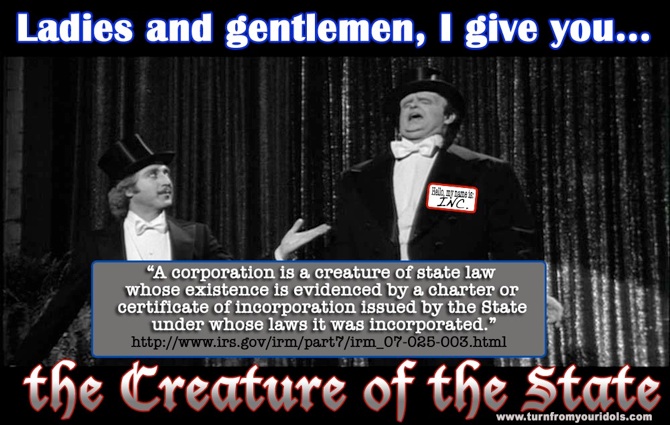
 An incorporated church is a monstrosity with two heads which are at odds with one another. Whenever there is an incorporated church, there are two entities—the one, the church as such, not owing its ecclesiastical or spiritual existence to the civil law, and the other, the legal corporation, each separate although closely allied. Such a church gets part of her powers from God and part from civil government.
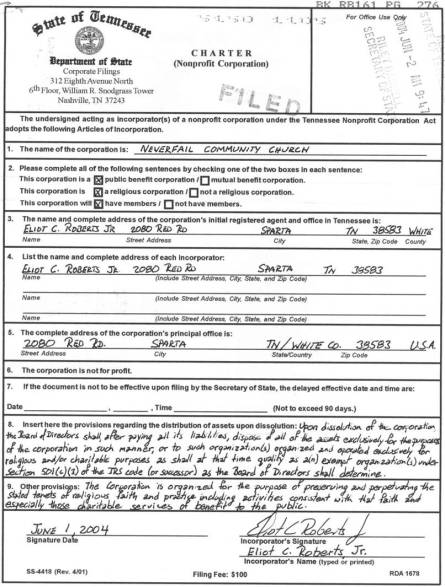 The corporate charter is a contract of threefold nature: a contract between the state and the corporation, a contract between the corporation and its members of stockholders, and a contract between the members inter se. Any contract disputes can be taken to civil court where only man’s law, not the Bible, controls.
 Simply Church