All posts by Jerald Finney

Jerald Finney was the lead counsel for the Biblical Law Center ("BLC") from May, 2005 until 2011. The BLC helps churches who desire to organize according to New Testament principles. In 2016, he again worked with the BLC and still does, but he now heads up the Churches under Christ Ministry which is under the authority of Charity Baptist Tabernacle of Amarillo TX. Finney is a licensed attorney who can be reached at 512-785-8445 jerald.finney@sbcglobal.net. Over the last few years he has lectured and preached on the issues concerning government, church, and separation of church and state. God called Finney, a Christian and fundamental Baptist since his salvation, to enter the University of Texas School of Law in 1990 at the age of 43 to stand in the gap concerning legal issues facing Christians. Since being saved, he has been a faithful and active member of a local fundamental, Bible-believing Baptist church. He received his JD degree in 1993 and has followed the Lord in the practice of law since that time. Finney received his law license in November 1993 and began practicing law in January, 1994. All along he was seeking the Lord’s direction. The Lord initially led Finney to practice criminal law. He knew that not many, if any, of the Christian law firms dealt with or specialized in criminal law, and that some Christians were being charged with crimes for their Christian behavior and for taking a stand for God’s principles. The Lord confirmed Finney's choice. Very soon after he started practicing, he helped an Eastern Orthodox priest with a criminal charge. He was charged under a criminal statute for trying to expose the promotion of sodomy and other sins within a Catholic Church. God gave the victory in that case. Then Steve, a Christian who counseled outside abortion clinics, called Finney. He was charged with a crime under the Austin, Texas Sign Ordinance for his activities outside an abortion clinic. Being a new lawyer, Finney called the Rutherford Institute. They asked him to send them a summary of the facts and a copy of the Sign Ordinance. Then they told him that the case could not be won and that they would not help. Steve lost at trial, but God gave the victory on appeal. The Austin Police Department immediately cited Steve for violation of the state sign ordinance. The Lord gave the victory at trial. Finney's first felony trial came about a year and six months after he started practicing law. A single Christian mother was charged with third degree felony injury to a child for spanking her six year old son. She left some prominent stripes across his rear end and also a stripe across his face when he turned suddenly during the spanking. The Lord gave the victory at trial. At the same time, Finney was also representing another Christian married lady who was charged with the same crime for spanking her little girl with a switch. On the date the trial in that case was to begin, the prosecutor, with prompting by the judge, lowered the offer to deferred adjudication probation of short duration on a misdemeanor charge with very few conditions on the probation. In a deferred adjudication in Texas, there is never a judgment of guilt if the probationer successfully completes the term of the probation, (and, with successful completion of the probation, the probationer can now file a Motion for Nondisclosure which, if granted, requires the file to be sealed so that the general public has no access to it). The mother decided to take the offer. The Lord has also allowed Finney to help Christian parents in numerous situations involving Child Protective Services (“CPS”) infringement into parental rights. God has given the victory in all those situations. The Lord has also used Finney to intervene in numerous situations where government officials or private companies tried to deny certain Christians their rights to do door-to-door evangelization, preach on the street, hand out gospel literature in the public forum, and pass out gospel tracts and communicate the gospel at their place of employment. Finney has also fought other legal spiritual battles including a criminal case in San Antonio. A peaceful pro-life advocate was arrested and charged with criminal trespass for handing pro-life literature giving information about the development of the unborn baby, places to go for help, and other information to women entering an abortion clinic. All the above-mentioned cases as well as others not mentioned were handled free of charge (except the last spanking case for which Finney received $750). In 2005 Finney became lead counsel for the Biblical Law Center. Since his early Christian life, he has considered the issue of separation of church and state as taught in the Bible to be one of the primary issues facing New Testament churches today. He believes, based upon what the Bible teaches, that operating as a corporation (sole or aggregate), unincorporated association, or any other type of legal entity and/or getting a tax exempt status from the federal government at the very least puts the church under the headship of both the Lord and the state, and may even take the church from under the headship of Christ and put the church under the headship of the state. He believes that taking scriptures out of context and applying human reasoning contrary to biblical teaching (such as “Obey every ordinance of man,” or “We should be good stewards and incorporation is good stewardship”) in order to justify unbiblical marriage with the state causes our Lord much grief. Once he took on the position as counsel for the BLC, it was necessary to do an in-depth study of the issue of separation of church and state. He began with the Bible. He initially read through the Bible at least five times (and many more times since then) primarily seeking the answer to the question, “Does the Bible have anything to say about this issue?” He was amazed at what He learned. The Bible gives God’s principles concerning separation of church and state, the purpose of a church, the purpose of the civil government, the headship of church, the headship of civil government, the principles by which each is to be guided, and much more concerning these two God ordained institutions. He continued to read the Bible daily seeking insights into these and other issues. He also began to read other books. he had already read starting shortly after being saved, books and other information by Christian authors. For example, he had read, among other works, A Christian Manifesto[1], The Light and the Glory,[2] From Sea to Shining Sea,[3] The Myth of Separation and some other works by David Barton, [4]Rewriting America’s History,[5] and America’s God and Country.[6] These resources inspired, influenced and guided him and millions of other Christians, gave them philosophical and historical underpinning, and led them into battlefields such as politics, law, and education armed with what they learned from those resources. Sometime in 2006 he began to realize that some of the books by Christian authors which he had come to depend upon were misleading, at the very least. Other books revealed to him that some of the above mentioned books had misinformed and misled sincere Christians by revising and/or misrepresenting the true history of separation of church and state in America. In 2006, he read One Nation Under Law[7] which cites a wealth of resources for one seeking to understand the history of separation of church and state in the United States and of the First Amendment to the United States Constitution.[8] Reading One Nation Under Law, some of the books it cited, and some other books was a launching pad into the universe of historical information which he never dreamed existed. He had expected to be misled in the secular law school he attended. He was amazed that he had been misled by Christian brothers. I asked myself, “How could Peter Marshall and others have missed this vital information?” At an Unregistered Baptist Fellowship conference in Indianapolis, Indiana, James R. Beller, a Baptist historian, gave a PowerPoint presentation which gave him the answer to this question. Finney bought two of Beller's books and read them. Those books filled in the details not mentioned in Pastor Beller’s concise PowerPoint presentation. Since that time, God has led Finney into an in depth study of the issues of government, church, and separation of church and state. God Betrayed/Separation of Church and State: The Biblical Principles and the American Application and the other books he has written and listed on this website were written as a result of those studies. God Betrayed is not a rehash of the same information that has been circulated in the Fundamental Baptist and Christian community through sermons, books, seminars, etc. since at least 1982, the year Finney was saved. God Betrayed and Finney's other books reveal facts and information that must be understood in order for a pastor and other Christians to begin to successfully (in God's eyes) fight the spiritual warfare we are engaged in according to knowledge. Finney believes that the lack of attention to the biblical doctrines concerning government, church (which is likened to the wife and bride of Christ), and separation of church and state, has had dire consequences for individuals, families, churches, and America. Unless pastors educate themselves on these doctrines and their application in America, the rapid downhill slide will continue at an accelerating pace. [1] Francis A. Schaeffer, A Christian Manifesto, (Westchester, Illinois: Crossway Books, 1981). [2] Peter Marshall and David Manuel, The Light and the Glory, (Old Tappan, New Jersey: Fleming H. Revell Company, 1977). [3] Peter Marshall and David Manuel, From Sea to Shining Sea (Old Tappan, New Jersey: Fleming H. Revell Company, 1986). [4] David Barton, The Myth of Separation, What is the Correct relationship between Church and State? (Aledo, Texas: Wallbuilder Press, 1992). [5] Catherine Millard, Rewriting America’s History (Camp Hill, Pennsylvania: Horizon House Publishers, 1991). [6] William J. Federer, America’s God and Country, Encyclopedia of Quotations (Coppell, Texas: FAME Publishing, Inc., 1994). [7] Mark Douglas McGarvie, One Nation Under Law: America’s Early National Struggles to Separate Church and State (DeKalb, Illinois: Northern Illinois University Press, 2005). [8] The First Amendment to the United States Constitution states: “Congress shall make no law respecting an establishment of religion, or prohibiting the free exercise thereof; or abridging the freedom of speech, or of the press; or the right of the people peaceably to assemble, and to petition the Government for a redress of grievances.” The religion clause, properly interpreted, as is shown in God Betrayed, is a correct application of the biblical principle of separation of church and state.

Romans 1.18-32 Lessons Learned from Street Preaching Encounter with a Reprobate


Jerald Finney
December 11, 2017
Attacks on First Amendment Protection of Freedoms (Religion, Speech, Press, and Association)


Romans 1.18-32
“18 For the wrath of God is revealed from heaven against all ungodliness and unrighteousness of men, who hold the truth in unrighteousness; 19 Because that which may be known of God is manifest in them; for God hath shewed it unto them.  20 For the invisible things of him from the creation of the world are clearly seen, being understood by the things that are made, even his eternal power and Godhead; so that they are without excuse: 21 Because that, when they knew God, they glorified him not as God, neither were thankful; but became vain in their imaginations, and their foolish heart was darkened. 22 Professing themselves to be wise, they became fools, 23 And changed the glory of the uncorruptible God into an image made like to corruptible man, and to birds, and fourfooted beasts, and creeping things. 24 Wherefore God also gave them up to uncleanness through the lusts of their own hearts, to dishonour their own bodies between themselves: 25 Who changed the truth of God into a lie, and worshipped and served the creature more than the Creator, who is blessed for ever. Amen. 26 For this cause God gave them up unto vile affections: for even their women did change the natural use into that which is against nature: 27 And likewise also the men, leaving the natural use of the woman, burned in their lust one toward another; men with men working that which is unseemly, and receiving in themselves that recompence of their error which was meet. 28 And even as they did not like to retain God in their knowledge, God gave them over to a reprobate mind, to do those things which are not convenient; 29 Being filled with all unrighteousness, fornication, wickedness, covetousness, maliciousness; full of envy, murder, debate, deceit, malignity; whisperers, 30 Backbiters, haters of God, despiteful, proud, boasters, inventors of evil things, disobedient to parents, 31 Without understanding, covenantbreakers, without natural affection, implacable, unmerciful: 32 Who knowing the judgment of God, that they which commit such things are worthy of death, not only do the same, but have pleasure in them that do them.”


This letter was e-mailed to the person who is unidentified here.

Dear Mr. _____________:

CastingCrowns-8
Learning some lessons while street preaching on December 9, 2017. The man in the blue sports coat is the person this letter was addressed to. I am the one with the mustache who is talking to him.

I am the lawyer you met Saturday night. I thank the Lord for bringing us into contact. In preparing me for our encounter the Lord had been dealing with me about the principles in Romans 1-3 for a couple of weeks prior. Our encounter was a “where the rubber meets the road” revelation of the teachings in Romans 1.18-32. Our discussion was very enlightening about the teachings in Romans 1. Thank the Lord, and thank you, for the light God shined on those verses by bringing you to me and the other street preachers I was working with. Please permit me to explain the lessons I learned.

Scripture applied to any issue will reveal truth to the diligent believing follower of the Lord Jesus Christ. A lot of verses prove this. Romans 1 reveals the truth about the God consciousness which our Lord reveals or shows to every human being. God reveals to everyone “Who He is.” He explains this and the consequences of rejecting that light in Romans 1.18-32.

God offers light to everyone in the same order. The first light He offers is the light of “Who He Is” – step 1 (Ro. 1). If that light is accepted, He then reveals, through one’s conscience, who the individual is – step 2 (Ro. 2-3). If the individual accepts that light, God then offers light as to the way to justification through the Scriptures – step 3 (Ro. 3). If the individual who has accepted the light God gives in steps 1-3 acts on that light, God regenerates him and he becomes a child of God.

I will only look at step 1, Romans 1.18-32, in this letter.

God imparts a God consciousness to every single person who has ever lived or ever will live (vv. 18-20). That consciousness tells everyone who God is. He is a God of wrath (18) and a God of judgment (32). He shows to everyone all that He wishes them to know about Himself (19-20). No one will have an excuse for rejecting God and going to hell (20). Even the invisible things of God are clearly seen and understood, so that they without excuse (20).

Everyone knows God. But some do not glorify Him as God, neither are they thankful (21), even though He created them and gives them all the information they need to know to know “Who He Is.” Rather, they become vain in their imaginations and their foolish hearts are darkened (21). They profess themselves to be wise even though they are fools (22). They “change the glory of the uncorruptible God into an image made like to corruptible man, and to birds, and fourfooted beasts, and creeping things” (23). The result: “Wherefore God also [gives] them up to uncleanness through the lusts of their own hearts, to dishonour their own bodies between themselves” But it is not too late for them to arise and accept the light God offers. If a person does so at any point up to here, God will take him to step 2 – the knowledge of who he (the individual) is.

However, those who do not wake up by this time change “the truth of God into a lie, and worship the creature more than the Creator, who is blessed for ever. Amen” (25). God  then gives them “up unto vile affections: for even their women change the natural use into that which is against nature: And likewise also the men, leaving the natural use of the woman, burn in their lust one toward another; men with men working that which is unseemly, and receiving in themselves that recompence of their error which was meet.” (26-27). I believe that it is possible for an individual who has gone this far to still repent and accept God’s light. If he does so, God will move to step 2.

However, those who do not repent, and since they “do not like to retain God in their knowledge, God gives them over to a reprobate mind, to do those things which are not convenient” (28). At that point, there is no possibility for those persons to ever go to step 2. They will be lost for all eternity with no hope.
All that is left for those individuals is the condition described in verses 29-32: “Being filled with all unrighteousness, fornication, wickedness, covetousness, maliciousness; full of envy, murder, debate, deceit, malignity; whisperers, Backbiters, haters of God, despiteful, proud, boasters, inventors of evil things, disobedient to parents, Without understanding, covenantbreakers, without natural affection, implacable, unmerciful: Who knowing the judgment of God, that they which commit such things are worthy of death, not only do the same, but have pleasure in them that do them.”

Several observable facts indicate that God has turned you over to a reprobate mind:

  1. I asked you to back up what you believed with Scripture. You did not. You held the truth in unrighteousness, not in Scripture. Your authority was “I think.”
  2. You insisted that we are to love everyone and that you do that, not by giving them truth, but by being a friend, joining with them in their debauchery. You had been drinking and carousing with them for hours according to your own admission. Your friend wanted you to leave and go to the “Gay Nineties,” one of the lowest of the low nightclubs in town. After you left, I believe you did just that. God tells us to love the lost primarily by preaching the truth, one-on-one, to groups, publicly, privately, everywhere in the world. Of course, we are also to help them materially as well, but the primary focus is on public evangelism, as did the Apostles and Christians in the New Testament. For doing so, they were hated, run out of town, threatened, and killed. But, at the same time, many were saved and true churches, not apostate religious organizations like “Hope Church,” were organized and built. For example, when Paul went to Ephesus, he conducted a public ministry (there were no church meetinghouses), people were saved, and a church was started. This was the pattern.
  3. You refused to allow me the courtesy to respond to you after I agreed to and did allow you to speak first. I told you my response would be the Word of God. I started reading in Romans 1.18, but you interrupted before I could finish the verse. I tried to continue, pointing out that I was going to read several verses, but you refused to allow it. You kept imposing on me what you thought.
  4. You kept pointing at one of our signs, verbally stating that “haters of God” on one of the signs is not the way to present the Gospel to the lost. “Haters of God” is one of the inconvenient things that a reprodate is given up to do (30). You, according to your own witness the night we met, are also guilty of some of the other inconvenient things mentioned in verses 29-32.
  5. You insisted that God is love. You refused to acknowledge the wrath of God and the judgment of God, two attributes which are central to knowing who God is (18, 32). It grieved you so much when I tried to get into the wrath and judgment of God that you became overbearing to the extent that you immediately verbally seized control at my mere mention of one of those terms.
  6. You equated love and method. Love is a motivational factor for doing something. Method is the way to do something. To equate the two shows total lack of understanding, something displayed by all you said and did (31).
  7. You pushed and controlled a debate (29). Debate is normally an endeavor to find truth. However, in the context of Romans 1.18-32, debate is an attempt to bring others into line with the beliefs and lifestyle of a reprobate. Your “debate” was a one-sided attempt to force your view according to what you thought, not to arrive at Bible truth.
  8. “Filled with unrighteousness” (29). You displayed drinking, carousing in the ultimate “gay” din of iniquity, and who knows what else.
  9. “Wickedness” (29). Ditto.
  10. “Despiteful” (30). (Characterized by intense ill will or spite: black, evil, hateful, malevolent, malicious, malign, malignant, mean, nasty, poisonous, spiteful, venomous, vicious, wicked).
  11. “Proud” (30). Pride means, “Inordinate self-esteem; an unreasonable conceit of one’s own superiority in talents, beauty, wealth, accomplishments, rank or elevation in office, which manifests itself in lofty airs, distance, reserve, and often in contempt of others.” You were so proud of yourself that you approached God’s people, doing God’s work in God’s way, with the obvious assumption that you could convince us to your way of thinking. God protects those who are His, who have put on the armor of God, from the wiles of the devil.
  12. “Without understanding” (31). You have no ability to understand God or God’s truths.

Jude1.3-4Going into gay bars and holding the truth in unrighteousness is sad. I am reminded of Matthew 23:15: “Woe unto you, scribes and Pharisees, hypocrites! for ye compass sea and land to make one proselyte, and when he is made, ye make him twofold more the child of hell than yourselves.”

Sadder still is your revelation that you have a youth ministry in an apostate church. Luke 17:2: “It were better for him that a millstone were hanged about his neck, and he cast into the sea, than that he should offend one of these little ones.”
Jude1.15God revealed Himself to you. You rejected all the light He shined on you about Himself. You appear to be a reprobate. I grieve for anyone who has reached that point. Preaching to you invoked the ire of your father the devil. Of course, if indeed you are a reprobate, this letter will not help you. I am posting it online in the hopes that it may be of some help to someone else so that they progress to step 2, a knowledge of who they are, to step 3, a knowledge of their only hope, and finally to salvation and justification.

Jude “For there are certain men crept in unawares, who were before of old ordained to this condemnation, ungodly men, turning the grace of our God into lasciviousness, and denying the only Lord God, and our Lord Jesus Christ” (4). “And others save with fear, pulling them out of the fire; hating even the garment spotted by the flesh” (23). Read the whole book.

See also, 2 Timothy 2, 2 Peter 2.
Click the above image or click here to go to the webpage, “From Queer to Christ.”

Links to Bible studies on the heresy and apostasy are available at: The Bible Doctrine of the Church.

What is a Legal Entity?


A Publication of Churches Under Christ Ministry


Click here to go to All Written Course Segments
Click here to go to General Questions Answered
Click here To Go to Links to All 5 Minute Youtube Course Segments


Click here to go to video of this lesson


Jerald Finney
Copyright © December 8, 2017


articlesofincorp.jpgA legal entity is a temporal earthly entity created and/or recognized by the law of man. The entity can be charged with a crime, sue and be sued, and act legally by entering into contracts, buying property, etc. Civil government has jurisdiction over legal entities.


Individuals are legal entities which are not created by the laws of man, but recognized by the laws of man. Legal speaks of earthly, temporal, as opposed to heavenly or eternal. A person in his/her right mind is a legal entity. If the person is lost, he is a legal entity only. If he is a born-again believer, he is both a legal entity and a spiritual entity. However, an earthly government cannot assume jurisdiction over his spiritual life. “And fear not them which kill the body, but are not able to kill the soul: but rather fear him which is able to destroy both soul and body in hell” (Matthew 10.28).

There are also legal entities which are created by the laws of man; these entities are made up of organizations of persons. Included are corporations (aggregate or sole, for-profit and non-profit), unincorporated associations, charitable trusts, business trusts, incorporated 501c3 or 508 tax exempt organizations and the list goes on. These type organizations are subject to the agreements made when they organized under man’s law.

Legal entities include associations; corporations; partnerships; proprietorships; and business, charitable, and other kinds of trusts (but not simple trusts, as explained below). Neither God nor the spirit of God have anything to do with their organization and operation. The law calls them “artificial persons.” They can be charged with crime, sue, be sued, assume legal, temporal, earthly obligations, and act legally by entering into contracts, buying property, opening bank accounts, hiring employees, running businesses (like schools, cafes, day care centers, etc.), and so forth. Satan can infiltrate and take over legal entities since they temporal, worldly, and run at least partially by maybe wholly by the laws of man. See Satan is the god of this world who orchestrates the world system.

All legal entities, other than individuals, are created by man-made civil government law. For example, American corporations, including church non-profit corporations, are created by state corporation law. Other legal entities such as sole proprietorships, are not created by man’s law, but are recognized and controlled by man’s law since they are businesses with income; they must, for example, get an assumed name, file income tax returns, get an Employer Identification Number, pay income taxes on profits and social security taxes on employees, register with the state sale tax office and pay sales taxes, etc.

A simple trust established to  manage money and property for the benefit of a beneficiary is not a legal entity. See  Trust Explained and The Bible Trust Relationship: Links to Essays and Other Resources. Other types of trusts which are either established according to man’s law or which have income are legal entities.

Many churches choose to be both legal and spiritual entities and many are legal entities only. Some churches, the remnant, protected by the law in America–the First Amendment and corresponding state constitutional provisions–choose to remain true to New Testament Church Doctrine and Example by remaining spiritual entities only. See Is a church a spiritual or legal entity? for more concerning this matter.

Churches, unlike businesses or charities, are protected by the First Amendment to the United States Constitution and corresponding state constitutional provisions which guarantee freedom of religion. Those laws give churches a choice. Churches choose whether to become a legal entity or remain a spiritual entity only. For more on this, see Is a church a spiritual entity, a legal entity, or a spiritual/legal entity?

What is a Spiritual Entity?


A Publication of Churches Under Christ Ministry


Click here to go to All Written Course Segments
Click here to go to General Questions Answered
Click here To Go to Links to All 5 Minute Youtube Course Segments
Click here to go to video of this lesson 

Here is Love Vast as the Ocean


What is a spiritual entity?


Jerald Finney
Copyright © December 8, 2017


“Beloved, believe not every spirit, but try the spirits whether they are of God: because many false prophets are gone out into the world” (1 John 4.1). The church of Satan and the church of Wicca are guided by spiritual forces, but not of God. In this lesson, “spiritual” refers only to spiritual entities of God, of which there are two.

The Bible teaches that a spiritual entity is eternal and heavenly (like heaven). A spiritual entity is either an individual who—unlike the lost person who is a temporal, earthly entity only—is born again and indwelt by the spirit of God or an assembly of such persons which the Bible calls a church. En[i]

As to the individual, we read in John 3 that to enter the kingdom of God, the spiritual realm, one must be born again, born of the spirit. A born-again believer is therefore a spiritual being. He will be an ideal earthly citizen. God predestines him to be conformed to the image of His Son (Romans 8.29). A born-again believer in Christ has been made alive spiritually, regenerated, a new creature in Christ Jesus. En[ii] The law was not made for such a man since he, being indwelt by the Holy Spirit, is directed by the Holy Spirit.Id. The New Testament gives many commands for the believer. En[iii]

A spiritual man serves the Lord only, not the Lord and the world or the god of this world. “No servant can serve two masters: for either he will hate the one, and love the other; or else he will hold to the one, and despise the other. Ye cannot serve God and mammon” (Luke 16.13).En[iv] By serving the Lord Jesus Christ, a believer will be an ideal citizen of the world.

Before His death, burial, and resurrection, God the son called out His apostles, walked with them, assembled with them, taught them, comforted them (Jn. 14.16), and answered their questions. After His resurrection and before His ascension, He told them to wait at Jerusalem where they would receive power after the Holy Ghost came upon them, after they were baptized with the Holy Ghost (Acts 1.5, 8). They complied, and on the day of Pentecost, were baptized with the Holy Ghost.

After the day of Pentecost there was a transition period when new believers were not immediately indwelt with the Holy Ghost when born again; but after a time, every new believer was and is indwelt by the Holy Ghost at the moment of salvation. Before, God the Son walked with believers. God the Holy Ghost now indwells believers in Christ and connects them to their new Head, the Lord Jesus Christ. They are spiritual beings.

The Lord “added to the church daily” all those saved in Jerusalem after the day of Pentecost (Acts 2.47). Such is the continuing order for all new believers and churches since that time. God desires all individuals who are saved to join with a local assembly of believers, a church ordered according to the principles of the New Testament.

New Testament churches under Christ were and are spiritual entities. Such churches can fall away and become apostate. See, The Biblical Doctrine of the Church. According to the example of New Testament churches and New Testament church doctrine, God desires that a church be a spiritual entity, not a spiritual and legal entity or a legal entity. A church is composed of spiritual beings, born again believers. Of course, a lost person may deceive a church, but he can never be a true member of that church even though he may be viewed as such by those deceived. See, Matthew 7: 15-20; Acts 20:28-31; 2 Corinthians 11:13-15; Galatians 2:4; 2 Timothy 3 (the apostasy predicted); 2 Timothy 5:1-5 (the faithful servant); 2 Peter 2:1-22; 1 John 4:1;  A church ordered after the principles in the New Testament and according to the examples of New Testament churches is a spiritual entity, a spiritual body, a spiritual organism, not an earthly organization.

  • 1 Peter 2:5 says, speaking to born again believers: “Ye also, as lively stones, are built up a spiritual house, an holy priesthood, to offer up spiritual sacrifices, acceptable to God by Jesus Christ.”
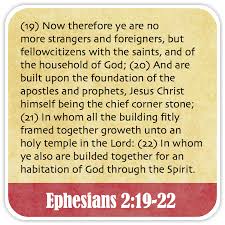
  • Ephesians 2.19-23: “Now therefore ye are no more strangers and foreigners, but fellowcitizens with the saints, and of the household of God; And are built upon the foundation of the apostles and prophets, Jesus Christ himself being the chief corner stone; In whom all the building fitly framed together groweth unto an holy temple in the Lord: In whom ye also are builded together for an habitation of God through the Spirit.”
  • Ephesians 4:16: “From whom the whole body fitly joined together and compacted by that which every joint supplieth, according to the effectual working in the measure of every part, maketh increase of the body unto the edifying of itself in love.” The purpose of the local spritual assembly or body is, “For the perfecting of the saints, for the work of the ministry, for the edifying of the body of Christ” (Ephesians 4:12).  The body spoken of here is the local church.  Read all of Ephesians 4 for complete explanations.
  • I Corinthians 12 also teaches on the this local spiritual assembly or body. 1 Corinthians 12:12 says, “For as the body is one, and hath many members, and all the members of that one body, being many, are one body: so also is Christ.” 1 Corinthians 12.27 says to the church at Corinth, the local visible assembly, “Now ye are the body of Christ, and members in particular.”

No where in the New Testament is any teaching or principle to be found that would lead one to believe that a church is to be an earthly, legal, temporal entity or a spiritual entity plus an earthly, legal, temporal entity. According to the New Testament, God’s order is for a church to be a spiritual entity only. En[v]


Ephesians looks at this issue in some depth. Go to Bible study of Ephesians for a very in depth study. For studies on other books go to Bible Studies on the Doctrine of the Church.


Endnotes

En[i] See, e.g. 1 Corinthians 3:16-17, which, in context, was to the church at Corinth; and 1 Corinthians 6:15-19, which, in context, is speaking to the individual believer.

En[ii] “And you hath he quickened, who were dead in trespasses and sins; Wherein in time past ye walked according to the course of this world, according to the prince of the power of the air, the spirit that now worketh in the children of disobedience: Among whom also we all had our conversation in times past in the lusts of our flesh, fulfilling the desires of the flesh and of the mind; and were by nature the children of wrath, even as others.  But God, who is rich in mercy, for his great love wherewith he loved us, Even when we were dead in sins, hath quickened us together with Christ, (by grace ye are saved;)  And hath raised us up together, and made us sit together in heavenly places in Christ Jesus” (Ephesians 2.1-6).

“There is therefore now no condemnation to them which are in Christ Jesus, who walk not after the flesh, but after the Spirit. For the law of the Spirit of life in Christ Jesus hath made me free from the law of sin and death. For what the law could not do, in that it was weak through the flesh, God sending his own Son in the likeness of sinful flesh, and for sin, condemned sin in the flesh:  That the righteousness of the law might be fulfilled in us, who walk not after the flesh, but after the Spirit. For they that are after the flesh do mind the things of the flesh; but they that are after the Spirit the things of the Spirit. For to be carnally minded is death; but to be spiritually minded is life and peace.  Because the carnal mind is enmity against God: for it is not subject to the law of God, neither indeed can be.  So then they that are in the flesh cannot please God. But ye are not in the flesh, but in the Spirit, if so be that the Spirit of God dwell in you. Now if any man have not the Spirit of Christ, he is none of his. And if Christ be in you, the body is dead because of sin; but the Spirit is life because of righteousness. But if the Spirit of him that raised up Jesus from the dead dwell in you, he that raised up Christ from the dead shall also quicken your mortal bodies by his Spirit that dwelleth in you” (Romans 8.1-11).

“Not by works of righteousness which we have done, but according to his mercy he saved us, by the washing of regeneration, and renewing of the Holy Ghost” (Titus 3.5).

“Therefore if any man be in Christ, he is a new creature: old things are passed away; behold, all things are become new” (2 Corinthians 5.17).

See also, e.g., John 3, Romans 5.15-7.25; Galatians 5; 1 Corinthians 12-13.

“Knowing this, that the law is not made for a righteous man, but for the lawless and disobedient, for the ungodly and for sinners, for unholy and profane, for murderers of fathers and murderers of mothers, for manslayers, For whoremongers, for them that defile themselves with mankind, for menstealers, for liars, for perjured persons, and if there be any other thing that is contrary to sound doctrine; According to the glorious gospel of the blessed God, which was committed to my trust” (1 Timothy 1.9-11). The righteous man here is the born-again believer whose righteousness rests in Christ, not in self-righteousness.

En[iii] See, e.g., John 13.34; Ga. 5.1, 16, 25-26; Ep. 6.1-18; 1 Thes. 5.5-22; 2 Thes. 3.6-15.

En[iv] See What God Has Committed to Man’s Trust: “Ye Cannot Serve God and Mammon”.

En[v] See Is a church a spiritual or legal entity?

What is 508(c)(1)(A)?


A Publication of Churches Under Christ Ministry


Click here to go to All Written Course Segments
Click here to go to General Questions Answered
Click here To Go to Links to All 5 Minute Youtube Course Segments


Jerald Finney
Copyright © December 8, 2017

See Church Internal Revenue Code § 508(c)(1)(A) Tax Exempt Status for full explanation of church 508(c)(1)(A) status. That article explains why 508(c)(1)(A) status puts a church under the same rules and regulations that come with 501(c)(3) and the authority of the Internal Revenue Service regardless of whether the IRS has the resources to enforce the rules and regulations that come with the status. This short article is very basic.

126 United States Code § 508(c)(1)(A), also referred to as Internal Revenue Code § 508(c)(1)(A), is a law which was enacted by Congress and signed by the President.

Some churches rely on this law rather than another law, § 501(c)(3) of the Internal Revenue Code, to establish tax exempt status.

§ 508(c)(1)(A). Special rules with respect to section 501(c)(3) organizations. “(a) New organizations must notify secretary that they are applying for recognition of section 501(c)(3) status. “(c) Exceptions. “(1) Mandatory exceptions. Subsections (a) and (b) shall not apply to— “(A) churches, their integrated auxiliaries, and conventions or associations of churches” (26 U.S.C. § 508). [Emphasis mine.]

508(c)(1)(A) churches are subject to the same rules which 501c3 churches are subject to. En1, En2; En3 (full explantion of church 508(c)(1)(A) status)


The Bible Answer to the Question, “Is an Incorporated 501(c)(3) or 508(c)(1(A) Church a Church of Christ?” (Prepared for a talk given at the September 16-19 Liberty Baptist Church of Albuquerque, NM, Southwest Baptist Heritage Camp Meeting. Click here to go to Part I of the video of that presentationClick here to go to Part II of that presentation, “Why a Church Is Not a Business.” Part II was removed from Part I. In Part II, Jerald Finney invited Evangelist and Pastor Terry Woodside to tell his story which demonstrates that a church which is a non-legal entity cannot be sued in America. Click here to go to the page which has links to all sermons and presentations at that meeting.)


Endnotes


En1 See Should a Church Be a 508(c)(1)(A) Church?

En2 See What is 501(c)(3)?

En3 Church Internal Revenue Code § 508(c)(1)(A) Tax Exempt Status. This article gives a thorough explanation of church 508 status.

What is 501(c)(3)?


A Publication of Churches Under Christ Ministry


Click here to go to All Written Course Segments
Click here to go to General Questions Answered
Click here To Go to Links to All 5 Minute Youtube Course Segments


Click here for video of this lesson.


Jerald Finney
Copyright © December 8, 2017


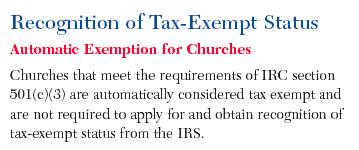
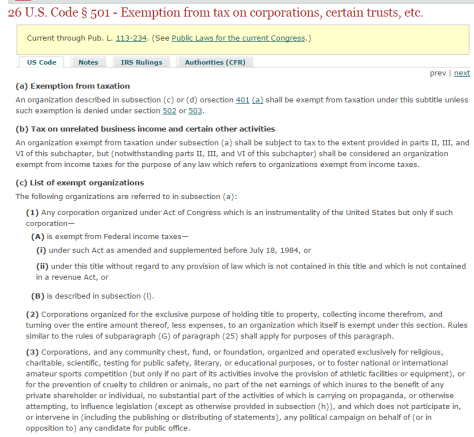
IRC_501c3Internal Revenue Code § 501(c)(3) or 26 United States Code § 501(c)(3) is a law enacted by Congress and signed by President Dwight D. Eisenhower in 1954. It is in Volume 26 of the United States Codes. The government grants tax exempt status to 501(c)(3) organizations and churches who choose to apply for and who are approved for 501(c)(3) status.

As originally passed 501(c)(3) had four commandments or rules to which 501c3 organizations and churches agreed. Those rules are:

“1. must be organized and operated exclusively for religious, educational, scientific, or other charitable purposes,

“2. net earnings must not inure to the benefit of any private individual or shareholder,

“3. no substantial part of its activity may be attempting to influence legislation,

“4. the organization may not intervene in political activity.”

The above rules are listed in the 501(c)(3) law and explained by the IRS at:  Exemption Requirements-501(c)(3) Organizations.

5. In addition, the Internal Revenue Service added another rule in a case involving Bob Jones University. Bob Jones University appealed to the authority for disagreements over IRS rulings, the federal court and the case went all the way to the Supreme court. The Supreme Court upheld the rule. Bob Jones University, 461 U.S. 574 (1983). The applicability of the “fundamental public policy” added in Bob Jones University has never been applied to a church, but many pastors of incorporated 501c3 churches and “Christian” lawyers such as David Gibbs have long feared that it will be so applied. David Gibbs gave this very unwise advice on this issue many 15 or 20 years ago: “Pray about it.”

501(c)(3) and 508(c)(1)(A) tax exempt status not only come with five government imposed rules, such status also invokes a myriad of regulations. See and read, e.g.,

501c3 is 100% voluntary.En1 The First Amendment and corresponding state constitutional provisions guarantee that churches do not have to submit to any man-made law.En2 Most churches choose to apply for 501c3 status. Such status gives the federal government some control over 501c3 organizations, including 501c3 churches. Those applying for the status know the commandments that come with 501c3. They also understand that the sole authority for 501c3 disagreements with the IRS is the IRS agency with appeal to federal court by the losing party an option. They also know that neither God nor His Word will be allowed in any such controversy. In other words, a 501c3 church submits herself partially to an authority or head other than the Lord Jesus Christ. 501c3 is a government education control scheme which has worked, especially as to churches, but also other types of organizations.En3

To obtain 501c3 status, a church or other organization must fill out IRS Form 1023. Any pastor, as a Bible student, should know from looking at the form that he and his church violate Bible Church Doctrine by applying for tax exempt status.

One of several examples of how this affects a church and what a pastor preaches in church is examined in the article, 1,000 Pastors who pledge to defy IRS and preach politics from pulpit ahead of election misunderstand the law and the hierarchy of law. Pastors of 501(c)(3) churches have mounted this challenge several times. The IRS has ignored their actions. The pastors know, or they should have known, that 501(c)(3) is a law passed by Congress which respects an establishment of religion and prevents the free exercise thereof; so why did they voluntarily seek 501(C(3) status, especially considering the fact that the agreed authority which would decide disputes was the IRS subject to appeal to federal court? By agreeing to 501(c)(3) status, they voluntarily gave up their First Amendment status. Yet, they still planned to stand on the First Amendment should the IRS take action against them for violating the rule which prohibits church endorsement of a political candidate by preaching for or against a candidate. They planned to take their stand before their authority on the matter – the Internal Revenue Service subject to appeal to federal court. These pastors do not understand the issue. The issue is one of authority. Their chosen authority or head for the  matter is the federal government, not the Lord Jesus Christ.En 3 and En4 


The Bible Answer to the Question, “Is an Incorporated 501(c)(3) or 508 Church a Church of Christ?” (Prepared for a talk given at the September 16-19 Liberty Baptist Church of Albuquerque, NM, Southwest Baptist Heritage Camp Meeting. Click here to go to Part I of the video of that presentationClick here to go to Part II of that presentation, “Why a Church Is Not a Business.” Part II was removed from Part I. In Part II, Jerald Finney invited Evangelist and Pastor Terry Woodside to tell his story which demonstrates that a church which is a non-legal entity cannot be sued in America. Click here to go to the page which has links to all sermons and presentations at that meeting.)


Endnotes

En1 Is it illegal for a church in America not to incorporate? Does a church have to be a 501c3?

En2 Is it illegal for a church in America not to incorporate? Does a church have to be a 501c3?, What is a First Amendment Church?

En3 Federal government control of churches through 501(c)(3) tax exemptionThe church incorporation-501(c)(3) control scheme

En4  Does God Care if our Church is Incorporated? (The principles in this article also apply to the 501(c)(3) church), Articles, Essays, and Other Resources Related to the Doctrine of the Church, Incorporation, 501c3, Etc., What is an established church?, What is a First Amendment Church?,  A Call to Anguish: Churches Reject God’s Authority (November 21, 2017)(The real meaning of church 501(c)(3) application and status emphasized in analysis of new article: “A New Religion Forms That Will Worship A ‘Godhead’ Based on AI”)A “Christian” Refuge of Lies: An Expose of “The Church that Birthed America” (113017) ,God Betrayed/Separation of Church and State: The Biblical Principles and the American Application (covers all aspects of the relevant issues).

Lessons on Colossians – Christ is the Head of the Local Church

Lessons on Colossians – Christ is the Head of the Local Church

Lesson 1: Introduction and Paul’s Prayer – Colossians 1.1-14 (14 questions with answers following).
Lesson 2: 
Person of Christ and Objective Work of Christ for Sinners – Colossians 1.15-23 (10questions with answers following)
Lesson 3: Subjective Work of Christ for Saints – Colossians 1.24-29 (12 questions with answers following)
Lesson 4: 
Christ the Answer to Philosophy (For the Head) – Colossians 2.1-2.15 (19 questions with answers following)
Lesson 5: Christ the Answer to 
Ritual (For the Heart) – Colossians 2.16-23; Christ, the fullness of God, poured out in life through believers, Chapters 3 and 4 : Colossians 3.1-4: Thoughts and Affections of Believers are Heavenly (18 questions with answers)
Lesson 6: Christ, the fullness of God, poured out in life through believers, Chapters 3 and 4. Living of Believers is Holy – Colossians 3.5-4.6 Fellowship of Believers Is Hearty – Colossians 4.7-18 (26 questions with answers following)

14 lessons on Ephesians – The Local Church Is a Body

14 lessons on Ephesians – The Local Church Is a Body

For help in answering the questions, you may refer to Outline and Teaching on Ephesians.

Introductory Lesson (9 introductory questions and answers)

Lesson 1: A Church Is a Spiritual Body – Ephesians 1 (38 questions on Ephesians 1)

Lesson 2: The Work of the Son of God on Behalf of the Church -Ephesians 1.7-12 (9 questions based on Ephesians 1.7-12 with answers)

Lesson 3: Work of the Holy Spirit in Protecting the Church – Ephesians 1.13-14 (14 questions based on Ephesians 1.13-14 with answers)

Lesson 4: The Church Is a Temple and the Method and Materials of Construction – Ephesians 2 (16 questions with answers based on Ephesians 2)

Lesson 5: The Church Is a Mystery (9 questions with answers based on Ephesians 3)

Lesson 6: Introduction to The Church Is a New Man and Must Walk as a New Man – Ephesians 4 (13 questions with answers)

Lesson 7: The Church Is a New Man: The Exhibition and Inhibition of the New Man – Ephesians 4.1-16 (17 questions with answers following)

Lesson 8: The Prohibition of the New Man – Ephesians 4.17-32 (20 questions with answers following)

Lesson 9: The Church Will Be a Bride: The Engagement of the Church – Ephesians 5.1-17 (13 questions with answers following)

Lesson 10: The Church Will Be a Bride:The Experience of the Church – Ephesians 5.18-24 (15 questions with Answers following)


Lesson 11: 
The Church Will Be a Bride: The Expectation of the Church – Ephesians 5.25-33 (16questions from with answers following)

Lesson 12: The Church Is To Be a Good Soldier of Jesus Christ: The Soldier’s Relationships – Ephesians 6.1-9 (14 questions from with answers following)

Lesson 13: The Church Is To Be a Good Soldier of Jesus Christ: The Soldier’s Enemy – Ephesians 6.10-12 (16 questions with answers following)

Lesson 14: The Church Is To Be a Good Soldier of Jesus Christ: The Soldier’s Protection and Example – Ephesians 6.10-24 (15 questions with answers following)

What is an established church?


A Publication of Churches Under Christ Ministry


Click here to go to All Written Course Segments
Click here to go to General Questions Answered
Click here To Go to Links to All 5 Minute Youtube Course Segments


Click here to go to a much more thorough study:
The History and Meaning of “Establishment of Religion” in America


Click here for video of this lesson.


What is an established church?


Jerald Finney
Copyright © December 4, 2017


I. Introduction

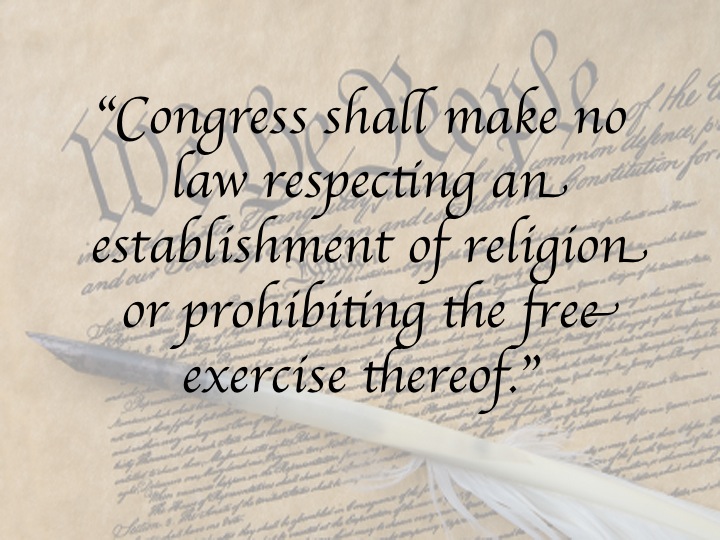
The First Amendment to the United States Constitution says, “Congress shall make no law respecting an establishment of religion….” What did “establishment of religion” mean at the time that First Amendment was drafted? Before it was drafted? What does it mean today?

Establishment refers to a specific relationship between church and state; a union created when church and a civil government unify. A union of church and state can happen only under man’s law, the laws of civil government. When man’s temporal earthly law combines church and state, a church becomes, either partially or totally, a legal, temporal, earthly entity, an established church.[i]  Baptist churches, Protestant churches, Catholic churches, Pentecostal churches, the Church of Satan, and the Church of Wicca and organizations such as Planned Parenthood are able to get perceived benefits from civil government by voluntarily applying for and obtaining temporal, earthly legal recognition through incorporation and tax exempt status under state and federal law.

Prior to colonization, all church state establishments combined one church with a state, a civil government. Of course, only traditional “churches” were eligible for “church” status. In America, this pattern continued, but soon evolved into multiple establishments of churches, Baptist and Protestant, in all the colonies, the establishment of more than one church. By the time of the adoption of the First Amendment, only seven states still had established churches, but they all established more than one church. Some states had already abandoned legally required establishment in favor of chosen establishment. Eventually, the constitutions of all the states gave all churches a choice of whether to combine with the state or not, to become an established church. They did this by offering God’s churches the right to incorporate under state law.

In 1954, the federal government passed the Internal Revenue Code Sections 501(c)(3) and 508(c)(1)(A) which allow God’s churches to claim “tax exempt status.” The federal government gives “benefits” to tax exempt churches. In return, tax exempt churches agree to abide by the rules and regulations that come with the new status. Tax exempt churches are subject to oversight by agents of the new sovereign, the Internal Revenue Service and federal courts.

Website
Click to go to website

This article covers the history of church establishment, but it is worth briefly noting the inevitable consequences of giving a temporal, earthly government control of matters outside its God-ordained jurisdiction, especially spiritual matters which God in His Word clearly intended to be handled only by His churches.

Sadly, churches and believers, except for God’s remnant, in the colonies and early Republic could not understand the problems that could result from combining the temporal and earthly with the eternal and spiritual. They did not understand the implications of giving a civil government the power to define “church.” When an organization claiming to be a church applies for corporate or 501(c)(3) status, civil government must determine if the organization is in fact a “church;”civil government must define “church.” Corruption is inevitable when church and state combine. They did not understand the Bible doctrines of churchstate, and separation of church and state. They did not understand that, as the Bible teaches, Satan orchestrates the world system. They did not understand that churches are to be spiritual entities only, doing God’s work on earth under the headship of the Lord Jesus Christ only. See, God Betrayed, “Dispensational Theology versus Covenant Theology,” especially pp. 149-150 with footnotes (in that chapter, you will see the remnant, led by men such as Isaac Backus, did understand these matters. Sadly, even most Baptists followed the lead of men like Hezekiah Smith).

Established churches corrupted to one degree or another. Temporal, legal, earthly corporate, 501(c)(3) or 508(c)(1)(A) status opened the floodgate for Satanic organizations (e. g., The Church Satan, the Church of Wicca) to also claim “church” status. See also, IRS granted Satanic cult tax exempt status in 10 days (listen to the audio report on the link for more insights), the (click to see the non-profit 501(c)(3) status of the Church of Wicca)) and other worldly organizations (e.g., Planned Parenthood) to choose to become established under federal law. Most churches in America, along with non-profit organizations like  Planned Parenthood, The Church Satan,  and the Church of Wicca, and as well as “Christian” churches are now established together, legally combined with both state and federal governments, operating according to the same legal rules and commandments handed down from their sovereigns. See also, A New Religion Forms That Will Worship A ‘Godhead’ Based On AI  and A Call to Anguish.

II. The different definitions and applications of “established church”

There are different points of view as to the relationship of church and state and various applications of “establishment of religion.” The New Testament teaches that God desires church and state to be totally separate.[ii] Under the New Testament view, God desires and ordained His churches to be eternal, spiritual entities only, walking on earth and doing His work indwelt by the Holy Spirit and connected to only one Head, the Lord Jesus Christ. He ordained Gentile civil governments to exercise temporal earthly jurisdiction under God. Earthly laws made by man are for the lost, not for the saved spiritual man.[iii] A church is to be a spiritual entity, not a legal entity or a legal and spiritual entity.[iv] Catholic/Protestant doctrine teaches and applies, when possible, the establishment (union) of one church with the state. The American reality was, at first in the colonies, establishment of a single church by force or law; this view, due to circumstances, evolved into multiple legal establishments and was the view held at the time of the adoption of the United States Constitution and the First Amendment; and, finally, the universal view  in America became choice of either establishment (union of church and state) or non-establishment (separation of church and state).

A. New Testament Teaching

SeparationOfChurchAndStateNew Testament church doctrine teaches total separation of church and state.[v] The only conclusion one can reach from a literal and Holy Spirit led study of the New Testament is that a church who combines with civil government, “an established church,” has violated New Testament principle. To fully understand this, one must understand the Bible doctrines of civil government, church, and separation of church and state (civil government).[vi]

The Bible teaches separation of church and state, that God wishes his churches to be eternal, spiritual entities under the Lord Jesus Christ only, totally directed by New Testament principles and commandments for His churches. Accordingly, God makes clear in His Word that He desires His churches to choose to be totally separate from any earthly power (such as civil government) or spiritual power other than the God the Father, God the Son, and God the Holy Spirit.[vii]

 B. The Catholic/Protestant doctrine

Several hundred years after the New Testament was completed and the New Testament churches were established, man developed and applied a view, a traditional view, contrary to that of the New Testament. The traditional view is that church and state should be combined. It has taught, from its inception to this day, union of church and state; and it has been and will be applied, when possible, to unify of church and state. Under this view, there can be only one official “established” church. This view was first applied by Catholicism and then by Protestantism, with modifications.

The Catholic view is that man’s temporal earthly law should mandate union of church and state such that the state is an arm of the Catholic church. Church and state, working together with the state under the church, are to enforce the Ten Commandments and much of the Levitical law relating to man’s relationship to God and man. Man’s law, the law of the state, proclaims that the true church is the Catholic church and that all other religions will be stamped out. Of course, Catholicism combines the beliefs and practices with pagan religions who will submit to the establishment with Catholicism. For example, the history of Catholicism explains the pagan roots of Christmas, Santa Claus, and Halloween.

Catholic establishment originated in the early fourth century when Constantine legally established Catholicism as the official religion of the Roman Empire to the exclusion of all other religions. The Catholic church became the established “church” of Rome and, later, that of many nations for over a thousand years. Under the Catholic view, as stated by Augustine, the one official church and the state combine and work together, the church dominating the state. Anyone who refuses to bow down to the official state church is imprisoned, tortured, and viciously executed. The church usually used the arm of the state to persecute “heretics,” reasoning that capital punishment was the duty of the state and that God did not wish the church to bloody its hands. Over fifty million such “heretics” were murdered by the Catholic establishments, many of them my spiritual ancestors.

With the advent of Protestantism, Protestant churches adopted the union of church and state theology of Augustine. When a particular Protestant church and a particular government were legally combined, the recognized Protestant church became the official established church. Examples are the Lutheranism (Germany), Calvinism (Geneva), Presbyterianism (Scotland), and Anglicanism (England). As with Catholicism, Protestantism viciously persecuted those who would not bow down to the official church/state establishment. One official Protestant church was legally combined with the state. In the various nations which combined church and state under a Protestant sect, persecutions of so-called “heretics” continued according to the adopted theology of Augustine.

Catholicism and Protestantism predominated in the Old World when the American colonies were founded. Only Protestant sects were responsible for the founding of America. Catholics were few and far between in the colonies.

C.  From single to multiple establishment in America

The original meaning of “establishment of religion” which existed prior to and at the founding of America, was replaced by a “multiple establishment” understanding long before the adoption of the First Amendment. “The evidence demonstrates that by an establishment of religion the framers meant any government policy that aided religion and its agencies, the religious establishments.”[viii]

The Protestant view was brought to the colonies by the Puritans (the New England colonies) and the Anglicans (the southern colonies). At first, most of the colonies honored the traditional Protestant view of union of church and state. They continued the persecutions which, due to the changed atmosphere and circumstances beyond the control of the establishments, although harsh, were less severe than in the Old World.

Circumstances in the New World caused an evolution in the relationship of church and state. From single church establishments, the colonies gradually moved to multiple establishments, the establishment of more than one church in any one colonial jurisdiction. At the time of the American Revolution, the laws of the seven colonies which  still combined church and state recognized multiple establishments. In those seven colonies, more than one church received benefits from their particular colonial government. This was the concept of “establishment” which was had been in force in the colonies for a long time before, and in the states before and at the adoption of the First Amendment in 1791.[ix]

The Religion Clause of the First Amendment to the United States Constitution separated church and state and guaranteed soul liberty (the free exercise of religion). The First Amendment Religion Clause states: “Congress shall make no law respecting an establishment of religion, or prohibiting the free exercise thereof.” This clause applied only to the federal government until 1947.[x]

Click the above to go to the article, “Is Separation of Church and State Found in the Constitution?

“No law respecting” meant “no law concerning or touching the subject of.” Prior to colonization and for some time thereafter, “establishment of religion” meant one officially recognized church which worked with, over, or under the state, the civil government. However, long before the adoption of the Constitution and the First Amendment, “establishment of religion” in America had come to mean multiple establishments. By the time of the revolution, establishment of church and state referred to multiple establishment—legal establishment of more than one church.

“After the American Revolution, seven of the fourteen states that comprised the Union in 1791 authorized establishments of religion by law. Not one state maintained a single or preferential establishment of religion. An establishment of religion meant to those who framed and ratified the First Amendment what it meant to those seven states, and in all seven it meant public support of religion on a non-preferential basis. It was specifically this support on a non-preferential basis that the establishment clause of the First Amendment sought to forbid.”[xi]

D. American establishment: from mandate to choice

After the adoption of the Constitution and the First Amendment, every state which had a constitution and which had not already done so changed their laws, their constitutions,[xii] to, like those state’s which had already done away with mandated establishments, allow churches a choice: combine with the state (establish) or operate as a spiritual entity under God only, without penalty or persecution.  A church could choose to incorporate or not to incorporate.

State non-profit corporation laws combine church and state. James Madison explained why church incorporation violates the proscription against union of church and state in a note attached to his veto of a bill which would have incorporated a church in Washington D.C. which is under federal, not state, jurisdiction.[xiii] This new type of establishment gives churches no control whatsoever over the state of incorporation. At the same time, the state creates and is the sovereign over the corporate part of the incorporated church. For various earthly reasons, most churches incorporate. What are those reasons? That question will be answered later.

In 1954, the federal government passed another law, Internal Revenue Code Section 501(c)(3). This law allows a church to apply for tax exempt status,  a status which combines church and state at the federal level, attaching the church legally to the federal level. By obtaining both corporate and 501(c)(3) status, a church is established at both the state and federal levels.[xiv]

III. Conclusion

It has been a long road passing through two thousand years: a road

  • from no establishment of church and state of any church in the New Testament according to New Testament doctrine,
  • to a forced union of church and state under Catholicism and Protestantism which killed “heretics” including those who adhered to New Testament doctrine – a doctrine brought to the American colonies by various Protestant establishments,
  • to multiple establishments,
  • and finally to a choice for churches as to whether to combine with the state and federal government or to remain faithful to our Lord without persecution.

All along God’s remnant understood, stood for, proclaimed, were persecuted and died for the truth, the Lord Jesus Christ.

Satan must be temporarily getting great pleasure by pointing out to God, “Look at my churches, working right alongside yours. All made possible by the blindness of your churches. And even with complete religious freedom from persecution protected by the First Amendment, almost all churches choose the precepts of the god of this world.” Satan knows God’s word. He knows that this development is no surprise to God. God told the complete history of the world from beginning to end. He wins. Satan loses. Those who are true to their Lord will one day be rewarded for obeying God. But God grieves at the disobedience of most of His children and churches in America.[xv]


Endnotes

[i] See, Is a church a spiritual or legal entity?; for a much more thorough analysis of the meaning of “establishment of religion, see The History and Meaning of “Establishment of Religion” in America.

[ii] See, Jerald Finney, God Betrayed/Separation of Church and State: The Biblical Principles and the American Application, Sections I-III. See also, Render Unto God the Things that Are His: A Systematic Study of Romans 13 and Related Verses.

[iii] 1 Timothy 1:9-11: “Knowing this, that the law is not made for a righteous man, but for the lawless and disobedient, for the ungodly and for sinners, for unholy and profane, for murderers of fathers and murderers of mothers, for manslayers, For whoremongers, for them that defile themselves with mankind, for menstealers, for liars, for perjured persons, and if there be any other thing that is contrary to sound doctrine; According to the glorious gospel of the blessed God, which was committed to my trust.”

[iv] See, Is a church a spiritual or legal entity?

[v] Op. cit., God Betrayed, Sections I-III. Render Unto God the Things that Are His.

[vi] Id. See also, for a short study, Is a church a spiritual or legal entity?

[vii] See God Betrayed, Section III, Chapter 4.

[viii] Leonard W. Levy, The Establishment Clause/Religion and the First Amendment (London: MacMillan Publishing Co., 1986), p. xiv.

[ix] Id., Chapters 1 and 2. See also, List of Scholarly Resources Which Explain and Comprehensively Document the True History of Religious Freedom in America.

[x] The Supreme Court applied the First Amendment religion clause to the states in Everson v. Board of Education, 330 U.S. 1 (1947).

[xi] Id., p. xvi.

[xii] Prior to 1842, Rhode Island was still governed by the 1663 royal charter. In 1842, Rhode Island adopted a Constitution. Rhode Island had, from its inception, legislated religious liberty and freedom of conscience; the first civil government in history with any lasting influence to do so.

[xiii] President James Madison understood that incorporation of churches exceeds the authority of civil government and violates the First Amendment. Therefore, on February 21, 1811 he vetoed a bill entitled “An Act incorporating the Protestant Episcopal Church in the town of Alexander, in the District of Columbia” the District of Columbia being under federal jurisdiction. He returned the bill with the following objections:

Because the bill exceeds the rightful authority to which governments are limited by the essential distinction between civil and religious functions, and violates in particular the article of the Constitution of the United States which declares ‘Congress shall make no law respecting a religious establishment.

“The bill enacts into and establishes by law sundry rules and proceedings relative purely to the organization and policy of the church incorporated, and comprehending even the election and removal of the minister of the same, so that no change could be made therein by the particular society or by the general church of which it is a member, and whose authority it recognizes.

“This particular church, therefore, would so far be a religious establishment by law, a legal force and sanction being given to certain articles in its constitution and administration. Nor can it be considered that the articles thus established are to be taken as the descriptive criteria only of the corporate identity of the society, inasmuch as this identity must depend on other characteristics, as the regulations established are in general unessential and alterable according to the principles and canons by which churches of the denomination govern themselves, and as the injunctions and prohibitions contained in the regulations would be enforced by the penal consequences applicable to the violation of them according to the local law….”

See also:

What The Father Of The Constitution Thought About ‘Faith-Based’ Government Programs

Irving Brant, MADISON ON SEPARATION OF CHURCH AND STATE, Third Series, Volume 8, Issue 1, James Madsion, 1751-1836: Bicentennial Number (Jan. 1951), 3-24.

[xiv] For more on 501(c)(3) status and incorporation, see Separation of Church and State/God’s Churches: Spiritual or Legal Entities?

[xv] See, Does God Care if our Church is Incorporated?


Did President Trump do away with 501(c)(3) requirements?


A Publication of Churches Under Christ Ministry


Follow-up article published on December 9, 2025:
Have They Gotten Rid of the “Johnson Amendment,
as President Trump Promised?


Click here to go to All Written Course Segments
Click here to go to General Questions Answered
Click here To Go to Links to All 5 Minute Youtube Course Segments


Jerald Finney
Copyright © December 2, 2017


Speech by President Trump: We are giving our churches their voices back


President Trump, desiring to help churches and “Christians,” and according to the advice of those “Christians” and other religious leaders  who surround him, pledged to eliminate the Johnson Amendment which limits all nonprofits from endorsing and opposing political candidates. See Endnote 1 for links to articles on this matter. I believe he is sincerely trying to help churches. Accordingly, he signed an executive order easing restrictions on political activity by non-profits. Of course, he cannot unilaterally change the law; but he did all he could do to help – ease but not eliminate one of the five restrictions which come with 501(c)(3) status. Just as non-profit corporation status puts the state of incorporation over a church for many matters, 501(c)(3), a man made law, still puts the federal government and the IRS agency over churches with respect to certain rules and a multitude of regulations that come with the chosen 501(c)(3) status. See Endnote 2 for list of some of the regulations that come with 501(c)(3) and links to resources which explain 501(c)(3) and 508(c)(1)(A) tax exempt status in some detail.

Does this action by the President correct the problem with 501(c)(3)? No. I explain why in this article.

Click the above to go to the article, “Is Separation of Church and State Found in the Constitution?

One should be aware that the highest man made law in America, the First Amendment to the United States Constitution, and corresponding state constitutional provisions make clear that churches have a choice – remain under Christ only or submit to the state and federal governments through corporate 501(c)(3) status.

Keep in mind, for example:

  • Matthew 16:18 “And I say also unto thee, That thou art Peter, and upon this rock I will build my church; and the gates of hell shall not prevail against it.” Is a church built partially or wholly by man (man’s law) a church of Christ? Is such a church His church?
  • Ephesians 1:22 “And hath put all things under his feet, and gave him to be the head over all things to the church.” Is Christ the head over all things to an incorporated 501(c)(3) or 508 church? The simple to comprehend answer is an emphatic, “No!”
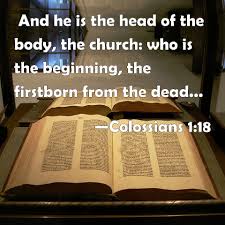
  • Colossians 1:18 “And he is the head of the body, the church: who is the beginning, the firstborn from the dead; that in all things he might have the preeminence.”

Let us first briefly examine or look at what church 501(c)(3) status really is. This will highlight the real issue. We will have to touch on incorporation since the two are intertwined.

Most churches choose to apply for both corporate and 501(c)(3) or 508(c)(1)(A) tax exempt status even though a choice not to do so is protected by the First Amendment and corresponding state constitutional provisions. 508(c)(1)(A) status puts a church in the same position as 501(c)(3) status. See, Church Internal Revenue Code § 508 Tax Exempt Status. Churches who incorporate and/or get 501(c)(3) or 508(c)(1)(A) status are established churches. They combine with civil government under man-made law. They get some perceived “benefits” and powers from civil government. In return, they agree to abide by the non-profit corporation laws of the state of incorporation and the commandments which come with the federal 501(c)(3) law they sought and agreed to. They also agree that, in the event they have issue with a commandment imposed by the law, the authority who will decide the issue is the government through its court systems. Their authority for many matters is the civil government, not the Lord Jesus Christ. One might call those churches who constantly defy and complain about the rules or commandments they agreed to “hypocrites.”

Churches who seek and obtain 501(c)(3) agree to abide by the rules and regulations that come with 501(c)(3), and also to any future rules added by the federal government though legislation, or by the Internal Revenue Service and upheld by the courts. Maybe some do not realize what they are doing when they get such status; some may proceed without knowledge, understanding, and wisdom. Nonetheless, when they get the status, they agree to the rules and commandments which come with the status and they agree that, in the event their authority who will decide the issue is the first the agency process with appeal to federal court available to the losing side, not the Word of God. Corporate 501(c)(3) churches proudly proclaim victory when their authority rules in favor of their position and moan and groan when their authority decides against them. They cannot understand that they lost no matter what their authority decides because they have put themselves under the wrong authority, according to the Word of God; and even their so-called victories are riddled with compromise.

Originally, a church who chose 501(c)(3) status agreed to 4 commandments or rules, added by legislative law. The IRS added a fifth. Prior to Bob Jones University v. United States, 461 U.S. 574 (1983), there were four rules. Bob Jones University upheld the IRS “shall not violate fundamental public policy” rule. Now there are five commandments. The fifth one has not yet been applied, as far as I know, to a church. However, many pastors do not preach of certain matters because they fear that they will be in violation of that rule—they do not wish to offend their master, their authority, by preaching certain matters covered by the Word of God. Many pastors openly preach on prohibited matters knowing that the state may exercise their authority and command them to comply or lose their status and suffer other penalty imposed by their master. The only authority to which a church can appeal, should the IRS agency rule against them, is the civil court system. By the way, the court will not allow such a church to make Bible based arguments.

As one can see, corporate 501(c)(3) status comes with the loss of many of the church’s First Amendment rights. A corporate 501(c)(3) church is a “legal entity,” an artificial person who has placed herself under the Fourteenth Amendment for many purposes thereby giving up much of her First Amendment protection. A First Amendment church cannot be sued for violation of the rules that come with 501(c)(3) or 508(c)(1)(A) because such a church has not submitted herself to the Internal Revenue Code Section 501(c)(3) or Section 508(c)(1)(A). She cannot be forced to get such status because the First Amendment religion clause says, “Congress shall make no law respecting the establishment of religion or prohibiting the free exercise thereof.”

A 501(c)(3) church also agrees to many regulations. See Endnote 2 for list of some of the regulations that come with 501(c)(3) and links to resources which explain 501(c)(3) and 508(c)(1)(A) tax exempt status in some detail.

One who does just a little study can easily understand that the governments of the state of incorporation and the federal government are the authorities, for many purposes, of a corporate 501(c)(3) church. The Lord Jesus Christ is, at most, only one of their authorities or heads. For many churches, Christ is completely eliminated from the equation and their sole authority is civil government. Churches grieve our Lord by submitting to another head. Christ is not over “over all things to” those churches.  According to the Bible, this raises a very important question, “Are corporate 501(c)(3) churches of Christ, built by Christ and Him alone?” They are churches, but are they Christ’s churches? The answer is obvious.

So the main issue is one of authority. Looking beyond that, only the legislature, not the President, can eliminate the Johnson Amendment or any other rule that comes with 501(c)(3) status. It is a law, passed by Congress and signed by the President. The President, of course, is the law enforcer. Like any law enforcer, he can choose to ease or relax his efforts to enforce what he deems to be an unjust law, you might say. He cannot do away with the fact that the authority of the 501(c)(3) church, as to the rules that come with it, is the federal government through its agent, the IRS. The courts, not the President, decide unresolved clashes between 501(c)(3) churches and the IRS. Only the legislature, not the President, can repeal a law subject to his signature of approval. The legislature has taken no action to overrule the Johnson Amendment in the many months since President Trump filed his executive order nor has President Trump encouraged the legislature to do away with either 501(c)(3) status or any of the other rules that come with 501(c)(3).

Even should the Johnson Amendment be eliminated by legislative law signed by the President, there would still be four other rules that churches agreed to comply with when they chose to apply for 501(c)(3) tax exemption. It is no secret that churches and so called “Christian” lawyers have also been worried about rule number five, the fundamental public policy rule, for at least 15 or 20 years. Their advice: “pray about it.” I would like to hear one of their prayers. I do not think they will pray, “Lord, forgive us for dishonoring you and causing you much grief by prostituting your churches. We repent. Help us to honorably withdraw from our unholy alliances.”

I have touched on the main issue. Let me restate some of the above points and list some other matters. President Trump’s speeches and his executive order reflect Christian revisionist history. They:

  1. ignore the fact that churches are required to give up some of their First Amendment protections when they choose to become 501(c)(3) organizations who submit to the federal government as to certain matters;
  2. ignore the fact that churches voluntarily put themselves under 501(c)(3) with all the rules and regulations that accompany their choice ;
  3. ignore the fact that churches voluntarily give up much of their First Amendment protection when they place themselves under a law which commands them not to do certain things;
  4. ignore the fact that churches who incorporate and get 501(c)(3) status put themselves, for many purposes, under the Fourteenth Amendment;
  5. do not take into account that 501(c)(3) was a law implemented in 1954, 164 plus years after the adoption of the First Amendment;
  6. ignore the question of whether 501(c)(3) is even constitutional since the First Amendment religion clause says, “Congress shall make no law respecting an establishment of religion or preventing the free exercise thereof;”
  7. reflect a lack of understanding of the true history of the First Amendment;
  8. reflect the “Christian” revised history of the First Amendment;
  9. misrepresent what church/state establishment meant when the Constitution and First Amendment were adopted;
  10. misrepresent what Thomas Jefferson, for example, stood for (He stood for a secular state with complete separation of church and state); (See, Endnote 3 for links to an unrevised history of the First Amendment)
  11. disregard and go contrary to Bible principles concerning church, state, and the relationship God desires between church and state;
  12. ignorantly work for the end-time one world union of church and state under the beast;
  13. etc.

I wish to make one other point: I believe that freeing 501(c)(3) non-profit organizations to become active in politics will unleash liberal 501(c(3) organizations–atheist, secular, and religious–who will fight for liberal candidates, and that those organizations substantially outnumber and have much more money and power than the conservative churches who constantly attack the rule. Those liberal organizations include Planned Parenthood, Inc. (an organization that gets a lot of government money), the Church of Wicca,  Inc. and many many other incorporated 501(c)(3) organizations and churches who will support liberal candidates.

In conclusion, I believe that President Trump is sincerely trying to help the cause of religious liberty. But he is being misled by certain religious persons and organizations who will use any means necessary to achieve their goals. Their false Biblical interpretations and goals hasten fulfillment of end time prophecies—religion and government will unify and bring in a 3 ½ year of peace followed by 3 ½ year period of great tribulation, and finally the appearance of our Lord who will crush the world powers who are coming against Israel and then establish His 1000 year reign on the earth.


Endnotes

Endnote 1: Links to some articles: Trump Vow: ‘Totally Destroy’ 501(c)(3) Political Activity Ban, February 3, 2017.  President Trump vowed to He signed an executive order easing restrictions on religious participation in politics. See Trump signs executive order to ease restrictions on religious participation in politics, May 4, 2017. TRUMP RELAXES 501(C)(3) POLITICAL ACTIVITY RULES, May 5, 2017.

Endnote 2: 501(c)(3) and 508(c)(1)(A) tax exempt status not only come with five government imposed rules, such status also invokes a myriad of regulations. See, e.g., Publication 557 (01/2019), Tax-Exempt Status for Your OrganizationApplication for Recognition of ExemptionExempt Organizations Treasury RegulationsCharities and Nonprofits A-Z Site Index (F-J)Exempt Organization Revenue RulingsPub. 1828, Tax Guide for Churches and Religious Organizations (PDF)Common Tax Law Restrictions on Activities of Exempt OrganizationsExempt Organizations – Ruling and Determinations LettersrExempt Organizations – Private Letter Rulings and Determination LettersExempt Organizations AnnouncementsAnnual Filing Requirements for Supporting OrganizationsExempt Organizations NoticesPublic Disclosure and Availability of Exempt Organizations Returns: Copies of Exempt Organizations Tax DocumentsExempt Organization Revenue ProceduresExempt Organizations UpdateExempt Organizations – Employment TaxesThe Truth About Frivolous Tax Arguments – Section IITermination of Exempt Organization (“… Internal Revenue Code Section 6043(b) and Treasury Regulations Section 1.6043-3 establish rules for when a tax-exempt organization must notify the IRS that it has undergone a liquidation, dissolution, termination, or substantial contraction. Generally, most organizations must notify the IRS when they terminate. Among other things, notice to the IRS of a termination will close the organization’s account in IRS records. …).

See also, for analysis of 501(c)(3) and 508(c)(1)(A): (1) Questionnaire 2, I. Elementary Questions for Those Who Wish to Organize a Church under Christ Alone as opposed to either a Church under Man or a Church under Christ and Man, (2) Federal government control of churches through 501(c)(3) tax exemption; (3)  The church incorporation-501(c)(3) control scheme.

Endnote 3: The History of the First Amendment; An Abridged History of the First Amendment; List of Scholarly Resources Which Explain and Comprehensively Document the True History of Religious Freedom in America.

Does a church in America need a Tax Id Number?


A Publication of Churches Under Christ Ministry


Click here to go to All Written Course Segments
Click here to go to General Questions Answered
Click here To Go to Links to All 5 Minute Youtube Course Segments


Click here for video of this lesson.


Jerald Finney
Copyright © November 25, 2017


The answer to the question depends on the type of church. Is the church a spiritual entity built by the Lord Jesus Christ only or is the church a temporal earthly legal entity organized and built according to the laws of man. I will answer this question as to the church which is a legal, earthly, temporal entity such the corporate 501c3 or 508 church. I will also answer it as to the church which is a spiritual eternal entity only. I will describe how OPBC is the latter—a spiritual eternal entity—which operates in the light and proclaims to the world exactly what they are doing.

A church that chooses to become a legal entity such as a corporate 501c3 or 508 organization will need a tax number.

A legal entity is an entity that can sue, be sued, act legally, enter into contracts and so forth. A corporation is a “person” in that sense. The essay, Church Internal Revenue Code § 508 Tax Exempt Status gives some insights on the legal fiction that makes a corporation a legal “person.”

Unlike a church who chooses to become a temporal earthly entity such as a corporation with 501c3 or 508 status, the New Testament church, a church which has not voluntarily given up her New Testament and First Amendment status, cannot have an EIN or TIN. Why? Because by doing so that church is acting as an earthly temporal as opposed to eternal spiritual organization. That church is putting money in the bank, for example, in the name of the church.

What is wrong with that? First, the church is acting temporally, legally, earthly. Believers are to give to God, not to an earthly temporal organization created by man. When church members give to an incorporated church, the money is put in the corporate bank account. If the church is not incorporated and the money is put in a bank account in the name of the church, the money is put into an earthly account which belongs to the church. Legally and temporally, the money belongs to the church, not to God. I realize that many people who are in such churches believe in their heart that they are giving to God and I believe that God honors that. However, he is grieved by the fact that they are proceeding without knowledge, understanding and wisdom.

A church that is a New Testament Church, a spiritual entity only, cannot have a Tax or Employment Identification Number. Having a TIN or EIN makes a church a legal entity.

OPBC members give to God, not to the church. The money they give is put in a trust bank account which does not belong to OPBC. The true owner of the money in the trust bank account is the Lord Jesus Christ. OPBC openly proclaims this without fear. The pastor of OPBC showed the bank the trust papers which established the Lord’s trust. The bank opened the account. See, Lessons on the Bible/Common Law Trust.

OPBC does not lease or own the facility they meet in. OPBC does not have insurance on the meetinghouse; but the meetinghouse is insured. The pastor/trustee of OPBC showed the insurance company the paperwork which makes this possible, the paperwork which declares to the world what OPBC is doing. The insurance company sold a policy, not to OPBC, but to the trust relationship with property created by the church in accordance with Bible principles.

Why can a church do this in America? Because American law recognizes the type trust established by OPBC. OPBC established the trust relationship, but the trust is not OPBC nor is OPBC the trust. The trust is simply a fiduciary relationship with property. See, for more information and links to more resources on the trust relationship, Is Old Paths Baptist Church a Spiritual or Legal Entity?

The trust is not a legal entity, like a business trust or charitable trust. The highest man-made law in America, the First Amendment, and also corresponding state constitutional provisions honor the Bible principle of separation of church and state. Those laws guarantee that churches and non-Christian religious organizations such as the Mormons, the Jehovah’s Witnesses, the Catholics, the Moslems, the Hindus, the Buddhists and so forth can choose to operate outside government intervention.

You see, the legal system in America recognizes, but did not create, the fiduciary relationship with money and property which OPBC uses in order to remain a non-legal, eternal, spiritual entity.

As a lawyer and a believer, I proclaim these matters to the world. I would not utilize the tactic of lying so as to displease the Lord, mislead other believers, and lose my law license. Not only that, if OPBC members found that I intentionally or unknowingly lied to them or misled them, they would point out my error and give me a chance to repent. I will not knowingly disgrace God’s churches.


Recommended resources for further study:

Separation of Church and State/God’s Churches: Spiritual or Legal Entities. This is online PDF form of the 2nd edition of the book. OPBC plans to print this in paperback form.

Links to articles on these matters:

Essays and Articles on Church Organization, Separation of Church and State, and Other Church Issues

Essays, Articles, and Other Resources Related to the Doctrine of the Church, Incorporation, 501c3, Etc.

Church Internal Revenue Code § 508 Tax Exempt Status

Trust Explained