2. Definitions of “separation of church and state,” “established church,” and “religious freedom or soul liberty”


A Publication of Simply Church Ministry


If you miss one part of the puzzle that is being put together in these studies, you will never see and understand the whole picture.


Previous Lesson:
1. Introduction

Next Lesson:
3. Dispensation Theology versus Covenant Theology and Their Importance to the Issue of Church and State Relationship in America 

Click here to go to all lessons on the Bible doctrine on the relationship of Church and State.

Click here to go to links to all written lessons.

Click here to go to the 3 1/2 to 6 minute video lectures.


Jerald Finney
Copyright © January 22, 2018


Separation of church and state,” “established church” and “religious freedom and soul liberty (the two go hand in hand),” are inherent in the establishment clause of the First Amendment to the United States Constitution. This lesson will define those phrases. The remaining studies and cited authorities, especially the studies on the history of the First Amendment, will make perfectly clear that the definitions given here are accurate.

 1. Definition of Separation of Church and State

Click the above to go to the article, “Is Separation of Church and State Found in the Constitution?

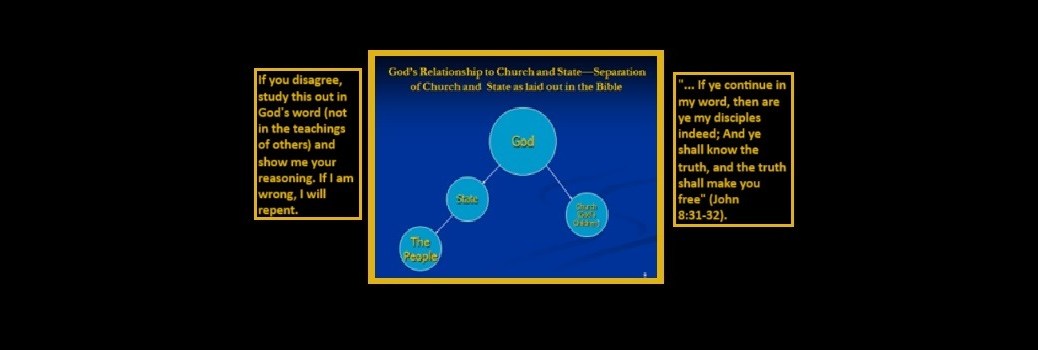
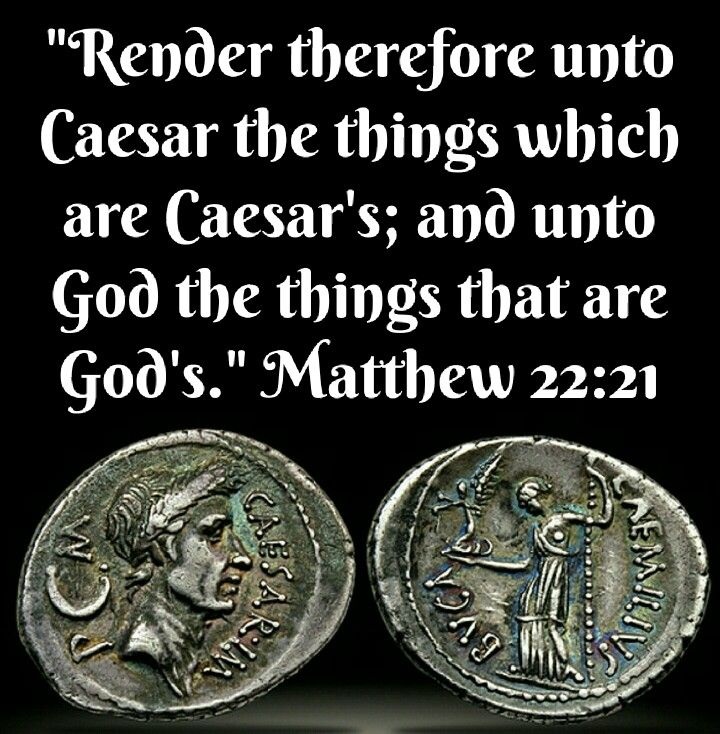
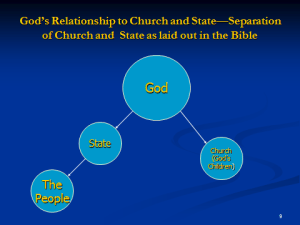
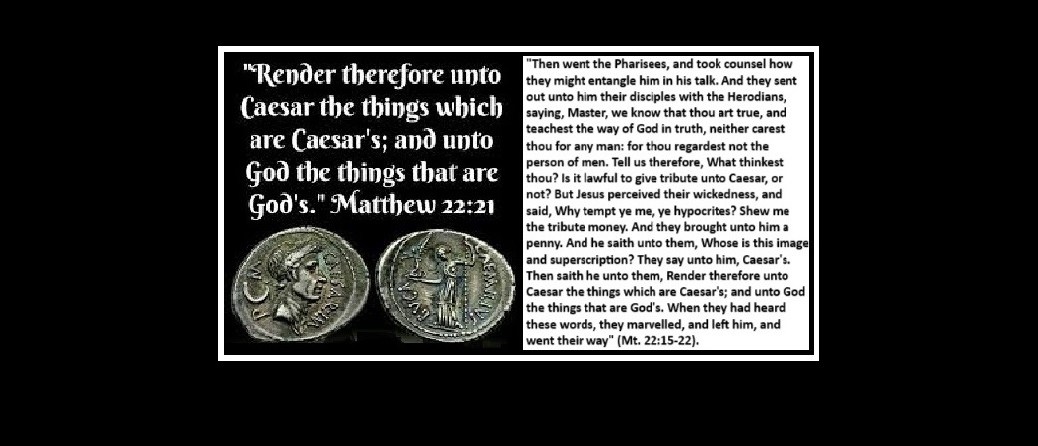
The biblical principle of “separation of church and state” is that God desires both a church and the state to choose to be under God, but desires neither to be over or to work hand in hand with the other. According to God’s word, different principles apply to church and state. A church has spiritual responsibilities. The state has earthly responsibilities. God desires the two to be totally separate entities, both ordained by God who desires both to submit to Him in love and to be guided by His principles as stated in His Word. God’s principle of separation applies to church and state. As Jesus explained to the Pharisees, “Render therefore unto Caesar the things which are Caesar’s; and unto God the things that are God’s” ()Matthew 22:21). 

A church under God remains an eternal spiritual entity only so long as she does not inadvertently or intentionally change her status to an earthly temporal entity by placing herself under the law of man, under civil government. By placing herself under the law of man, she combines church and state and makes herself, at least partially and sometimes wholly, a temporal, legal, earthly entity.

The incorporated and federal tax exempt (501(c)(3) or 508(c)(1)(A)) church is the main type of state/church union. The rules of civil government for such a church are secular and such a church agrees, when she applies for and accepts the status, to the rules which come with state non-profit corporation law and the rules that come with her tax-exempt status. She also agrees that any disputes over violation of the rules will be decided by her chosen authority—the state of incorporation or, for 501(c)(3) and 501(c)(3)(A) purposes, the federal government. God and the Bible will have no part  in disputes deemed by the state to be under their authority.

In other words, man, not God, has authority over much of what the corporate 501(c)(3) or 508(c)(1)(A) church, being an established church, does. For many activities, the First Amendment and corresponding provisions of the particular state constitution which are statements of the Bible principle of separation of church and state (not separation of God and state) no longer apply. Such a church has chosen to become a legal person under the Fourteenth Amendment. See, Incorporated Church: A Human Being with No Soul.

 2. Definition of “Established Church”

An established church is a church who is an integral part of the state and receives state support. She does this by choosing to become a legal entity. The church and state reach an agreement or enter into a contract whereby either the state runs the church, the church runs the state, or the church and state work hand in hand, as equal partners, to enforce earthly and spiritual laws and principles. In modern America state-churches are influenced, perverted, and/or perhaps dominated by state enforced satanic principles.

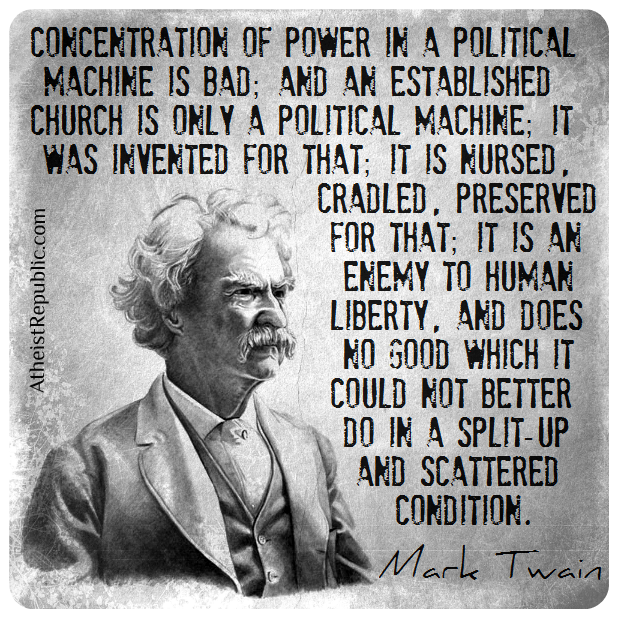
Historically, the established church has either been over the state, or the state has been over the established church. When the state has been over the church, the state directs the affairs of the church to a greater or lesser degree and vice-versa. In either case, the spiritual affairs of the church are mixed with the earthly responsibilities of the state. In the past, in either a church/state or state/church, leaders of both church and state operated under a false theology based upon false biblical principles. The results were (1) corruption of the church, corruption of the state, corruption of the clergy and political leaders and the members of society and the church, and (2) torture, imprisonment, confiscation of property, and/or the killing of those who refused to bow down to the theology of the church-state or state-church. We see the former results in the church-state activities in America today. The latter results occuried in the American colonies.

  3. Definition of Religious Freedom or Soul Liberty

“By religious freedom, or soul liberty, is meant the natural and inalienable right of every soul to worship God according to the dictates of his own conscience, and to be unmolested in the exercise of that right, so long, at least, as he does not infringe upon the rights of others; that religion is, and must be a voluntary service; that only such service is acceptable to God; and, hence that no earthly power, whether civil or ecclesiastical, has any right to compel conformity to any creed or to any species of worship, or to tax a man for its support.”

Religious freedom exists when every citizen has, by law, the choice, without persecution, of choosing God, false gods or a false god, or no god at all. Religious freedom, as shown in God’s Word, is what He desires in a Gentile nation. Even though He desires Gentile nations to provide for religious liberty, He also wants them to submit themselves to Him and His principles, and recognize that Jesus Christ is the Supreme Sovereign. Thus a nation modeled after biblical principles will provide for religious liberty while also operating under God and His principles for civil government.

Click the above to go to book.

“This principle gives to ‘Caesar’ ‘the things that are Caesar’s,’ but it denies to Caesar ‘the things that are God’s.’ It does not make it a matter of indifference what a man believes or how he acts, but it places all on the same footing before God, the only lord of the conscience, and makes us responsible to him alone for our faith and practice. [By 1900 this doctrine was] very generally accepted, not only in Virginia, but also throughout the United States. It [had] been incorporated into our National and State Constitutions, and it [was ] the basis for our civil liberties” (Charles F. James, Documentary History of the Struggle for Religious Liberty in Virginia (Harrisonburg, VA.: Sprinkle Publications, 2007; First Published Lynchburg, VA.: J. P. Bell Company, 1900), p. 9.)


1. Introduction to the Biblical Doctrine of Separation of Church and State


A Publication of Simply Church Ministry


Miss one part of the puzzle that is being put together in these studies and you will never see and understand the whole picture.


Previous Chapter:
B. Bible Doctrine of Church

Next Lesson:
2. Definitions of “Separation of Church and State,” “Established Church,” and “Religious Freedom or Soul Liberty”

Click here to go to all lessons on the Bible doctrine on the relationship of Church and State.

Click here to go to links to all written lessons.

Click here to go to the 3 1/2 to 6 minute video lectures.


Jerald Finney
Copyright © January 20, 2018


As these studies have already shown, God, the Supreme Ruler, ordained civil government and the church at different times, for different purposes, and for peoples with different natures. God ordained the state, the civil government, to deal with earthly matters, and the church to deal with spiritual matters. God’s word reveals distinct differences, some of which have already been explored in prior lessons, which render church and the state mutually exclusive. God’s desires a special, exclusive, loving  relationship with churches. As we have seen from Scripture, God is jealous over his espoused, his churches. See, for example, 2 Corinthians 11:1-3.

God leaves no doubt: the methods used by individuals, families, churches, and nations matter to God. When church and state combine, the earthly combines with the spiritual and trouble lies ahead.

God desires that both civil governments and churches choose to be under Him, to operate according to His principles. His principles for churches are very distinct from those for the government of nations. Thus, God desires separation of church and state—that is, He desires that neither the church nor the Gentile state work with or be under the other. A church who does not understand this proper relationship will be easily influenced to take earthly benefits from the state in return for forsaking her purely spiritual status and calling under Christ. Most American churches have corporate 501(c)(3) legal status; both combine church and state for earthly temporal legal reasons. Such churches are established churches, legal creatures of the state. See, EN.[i]

It is the responsibility of every church, not the state—regardless of all persecutions by the state, by the church-state alliance, and/or by the world in general—to be a light and stand for and proclaim truth. This is so because a church is the only institution made up of people privy to God’s spiritual insights, and only the church can be “the pillar and ground of the truth.” See, EN [ii] When churches leave truth in the dust, they become apostate and there is no longer any support for God’s truth. When that happens, individuals, families, churches, and the nation are headed for trouble, ultimately God’s judgment.

The first union of church in state occurred in the early fourth century. Augustine developed a theology justifying union of church and state. History proves that church state union has always resulted in the corruption of the church, the state, and the people and the persecution of those deemed to be heretics through imprisonment, torture, murder, taking of property, banishment, and other means. Catholic and Protestant establishments, when in exclusive union with the state, viciously persecute and murder those who will not bow down to their ungodly union. See, EN [iii]

The persecutions of the Old World were brought to America. Established churches in the colonies—notably, the Puritans and Anglicans—persecuted heretics. Due to constraints by England, their persecutions were not as severe as in the Old World. In the English colonies, those who refused to bow down to the established churches could not be killed; they could only be jailed, fined, imprisoned, humiliated, etc. As always, faithful Bible believers peacefully stood against the establishments. Due to the circumstances in the colonies, those heroes of the faith ultimately prevailed when the First Amendment was ratified and added to the United States Constitution.

Click the above to go to the article, “Is Separation of Church and State Found in the Constitution?

The Covenant Theology of the Puritans, a modified form of Calvinism, which is derived from Catholic church/state theology, spiritualizes and allegorizes much of the Bible. The Puritans in New England prescribed a union of church and state where the church controls the state. Anglican colonial establishments practiced a form of Augustinianism in which the state (the King) controls the church.

The main opponents of union of church and state and persecution of “heretics” in the colonies were the Baptists. Their writings and history has survived. The writings of men such as Roger Williams, Dr. John Clarke, Isaac Backus, and others reveal the colonial spiritual warfare that led to the First Amendment. Sadly, Christian Revisionists like David Barton and William Federer, have revised that history in their attempts to implement their false Presbyterian Calvinist union of church and state theology. They have deceived the great majority of believers since they control “Christian” media and Christian political activism.

Many pastors and believers come up with false reasons for uniting with the state through incorporation, federal tax-exempt status and/or other means. Many take Bible verses taken out of context to prop up their false church/state theology. They have reworded and/or misinterpreted God’s word to justify unholy union of churches with civil government. Many are just ignorant of any Bible reasoning and application and blindly follow tradition .

God’s gives clear warning to churches against building upon the wrong foundation. By the grace of God, this Simply Church Ministry will continue to sound the alarm in the midst of the almost universal hersey and apostasy of American churches. We invite those who have an ear to hear to join with us

1 Corinthians 3:9-17 (KJV) “For we are labourers together with God: ye are God’s husbandry, ye are God’s building. According to the grace of God which is given unto me, as a wise masterbuilder, I have laid the foundation, and another buildeth thereon. But let every man take heed how he buildeth thereupon. For other foundation can no man lay than that is laid, which is Jesus Christ. Now if any man build upon this foundation gold, silver, precious stones, wood, hay, stubble; Every man’s work shall be made manifest: for the day shall declare it, because it shall be revealed by fire; and the fire shall try every man’s work of what sort it is. If any man’s work abide which he hath built thereupon, he shall receive a reward. If any man’s work shall be burned, he shall suffer loss: but he himself shall be saved; yet so as by fire. Know ye not that ye are the temple of God, and that the Spirit of God dwelleth in you? If any man defile the temple of God, him shall God destroy; for the temple of God is holy, which temple ye are” (1 Corinthians 3:9-17).


Endnotes

[i] See What is an established church?

[ii] 1 Ti. 3.15. Many earthly relationships and behaviors involve the application of spiritual insights. For example, God teaches, in His Word, the responsibilities of husbands to wives, wives to husbands, parents to children, children to parents, civil government to marriages and the men and women joined in marriage, civil government to children, and so forth. Although these are spiritual teachings, they are to be applied in earthly relationships to which there is a spiritual parameter. In other words, God is involved in all relationships and has outlined the ultimate consequences for behaviors, and therefore, everything is spiritual even though it may have an earthly dimension. The trouble comes when man tries to exclude God and His principles, an impossible task.

Also, every sphere of ordained government has its own God-given jurisdiction. God desires the state to stay out of family affairs unless criminal acts are involved. He wants civil government to stay out of church affairs, and the church, as an institution to stay out of state affairs. At the same time, he wants Christians to be in authority since only Christians can apply His principles in the realm of government (of course this has almost never happened). Likewise, a church has no God-given jurisdiction over a family.

[iii] Some resources which cover history of the union of church and state under Catholic and Protestant legal establishments (established church/states) are: The History of the First AmendmentThe Trail of Blood of the Martyrs of Jesus, and Introduction to the biblical doctrine of “Separation of Church and State (Covers persecution from the crucifixion of Christ by Jews, Rome (the Catholic/Roman establishment), to the Reformation, to the American colonies).


Testimony of Joshua Burnham and family

I was saved in February of 2014. The Lord put the desire in my heart to find his church and be a faithful member of it, but I was not very grounded in the faith. My doctrinal understanding was largely undeveloped. Consistent reading of the NIV did not help me in my lack of biblical understanding. I was persuaded by a friend to attend a church in Greenville, SC. It was a non-denominational satellite campus of a megachurch based out of Charleston. The church was very worldly, and did not understand the ordinance of the Lord’s table. Still, I thought the church was sound in my ignorance, but I didn’t think the thirty-minute commute was worth it if there was a similar church near my home.

I came across a very large non-denominational charismatic church in Spartanburg. I did not understand the charismatic issue at the time and believed that the strong relationship preaching was “fiery.” They also did not disclose that they were charismatic. The worship was largely driven by emotional outbursts. I thought this church was sound and pursued membership and eventually was “baptized.” Yet, all-the-while, I was spiritually starving from the lack of doctrinal preaching. This brought about a yearning in my spirit for more of God’s truth. The church put on small group programs. I began to faithfully attend a group geared towards young adults in the hope that I would be built up in my new faith. I began to be troubled with the conditional security false doctrine taught in the NIV. I was also listening to many reformed people from a variety of perspectives, but none of the preaching was very powerful. As I was being tossed to and fro, God mercifully brought a brother in Christ to the college. He was a KJV Independent Baptist. I spoke with him about the trouble I was having with conditional security. He very plainly told me the reason I was troubled was because I was reading a perverted Bible version. I got a KJV Bible and began reading it immediately. God revealed it through his Spirit that I was reading the words of God. I changed my reading to the KJV and after reading Romans 11:29 I had peace that God would never take away his gift from me.

Having the KJV changed everything. I noticed that the passages people were reading during the small group meetings did not match up with what my Bible said. This troubled me and caused me to become frustrated with the teaching I was being exposed to. I realized that I couldn’t listen to the reformed people online anymore, but I remained loyal to the leadership of my church. Desire for learning more led me to find internet teachers that held to the KJV only position. I came across an internet ministry that taught on a variety of topics. On the same day the Lord revealed the issues of marriage licensure and 501©3. It was obvious to me that this topic was of great importance to God, so I continued to study it out. I came across brother Finney’s materials on his website, which lead me to Pastor Cooley’s sermon “Covenant vs. Contract Marriage.” That was the first sermon I listened to from OPBC.

After studying the law in South Carolina concerning marriage licensure I realized that pastors of 501©3 churches were contractually obligated to marry people with licenses if they were going to officiate the ceremony. This left me with a decision to make. I knew that if I decided to go along with the current plan for my pastor to marry my then-fiancé and me that I would be in rebellion to God and his order. I wrote a letter rebuking the church for their idolatry and spiritual adultery and resending my membership, and brought it with me to a meeting with my pastor. I handed him the letter and informed him that I was not willing for him to marry us because the church was a 501©3. I told him that God was not pleased with how the church served mammon more than God, and that God’s desire in his word was for the church to repent and dissolve the corporation, citing the church of Laodicea. He did not receive the love of the truth, and informed me that I needed to stay away from brother Finney’s materials. The interesting thing is that I had never brought up brother Finney to anyone at the church, which means he knew about the issue previously and held the truth in unrighteousness.

I went unchurched for many months because I did not trust that any of the churches in my area were non-incorporated. I was solely listening to OPBC at the time. I always liked the idea of going to OPBC, but my plans for how I was going to practice chiropractic interfered with being obedient to God’s revealed will. The brother in Christ from my school informed me that he and his wife were attending an independent, KJV only, Baptist church in Cowpens, and that he enjoyed the preaching there and believed it to be biblical. My fiancé and I began to attend the services, and I thoroughly enjoyed the preaching of the gospel. The problem was that all they preached was the gospel. There was very little doctrinal teaching and almost no preaching on separation and God’s standards for Christian conduct. They went door knocking every weekend to ask people to come to church and hear the gospel. This vexed me because I knew that God’s way was for the church to bring the gospel out of the camp by preaching on the streets. I also knew that God’s churches were spiritual entities made up of born again Bible believing Christians. The church also owned a Christian school, and I was concerned that the church was incorporated. This was the main reason I did not pursue membership, although I did not have any evidence that the church was a creature of the state. I thought that it was certainly possible for God to have provided all of it to the church, but I thought it was still a doctrine worth bringing to the church’s attention.

I attempted to communicate these ideas to the deacons and pastor of the church by sending them sermons from Pastor Cooley. My communications went largely unnoticed. I spoke with the pastor on a one-to-one basis about simply taking God at his word, using geocentricity as an example. He told me that after reading the 200+ verses which explicitly teach egocentricity he could not find geocentricity anywhere in the Bible. This greatly troubled me, and I began to worry that the pastor did not believe the Bible. In bewilderment, he asked me if all the people who had ever taught him about creation were wrong, to which I replied “yes.”

Eventually, the brother in Christ and I asked the pastor to sit down with us and the Bible to look at the scriptures concerning these doctrines. Much to my dismay, we found ourselves in front of a panel of deacons, members, and the pastor. My intent was again to use geocentricity as an example for simple Bible faith, but there was no discussion about the word of God. Not one of the “supposed” KJV Bible believing Christians opened the Bible to prove either of us wrong about what we brought up. Instead, we were told by a member which lead songs that “you have your truth and we have our truth.” I was shocked to see that nobody had anything to say about his comment. The height of relativism had fully infiltrated the church and went totally unchecked by the leadership. My brother in Christ was beside himself in trying to plead that they would consider opening the Bible and discussing the scriptures. No ground was made and out of desperation I brought up street preaching and regenerate church membership. The pastor told me that he had never heard of somebody who believed that only saved people belong in the church. I quickly realized that these people were unwilling to let the Bible correct them, and I decided to give up on trying to win them to the truth. We mutually agreed to end the conversation, and I was told that I was not welcome back. I thanked the pastor for his time and left the church. The brother in Christ was so grieved by the entire experience that he broke down in tears and wept.

I knew that God wanted me to go to OPBC, but I was unwilling to submit my plans to God. God allowed me to slowly become more and more confused about chiropractic, and eventually I dropped out of school and gave up on the profession. Having nothing to keep my wife and I in South Carolina, we moved and began our new life in Minnesota. We were baptized in March of that year.

I recently found out that the church in Cowpens had obtained state-incorporated status in January of 2018, approximately two years after the meeting. The height of rejection of God’s word was finally realized. They were handed over to their own delusion and prostituted their congregation out to the state.

10. Heresy and Apostasy


A Publication of Simply Church Ministry


If you miss one part of the puzzle that is being put together in these studies, you will never see and understand the whole picture.


Previous Lesson:
8. How To Recognize a New Testament Church

Next Chapter:
C. Bible Doctrine Concerning Relationship of Church and State

Click here to go to the video of this lesson on Heresy and Apostasy

Click here to go to all lessons on the Bible Doctrine of the Church.

Click here to go to the Written Lessons.

Click here to go to the 5 minute video lectures.


Jerald Finney
Copyright © January 9, 2018


Prior to the return of the Lord, the visible churches, except for a remnant, will go into apostasy.[i] The Endnotes quote many New Testament Scriptures which deal with the matter of church apostasy. Second Timothy, Second Peter, Jude, and Second and Third John has to do with the apostasy and the personal walk and testimony of the believer who is seeking to walk in the Spirit in a day of apostasy and declension.

“Apostasy, ‘falling away,’ is the act of professed Christians who deliberately reject revealed truth (1) as to the deity of Jesus Christ, and (2) redemption through His atoning and redeeming sacrifice.[ii] Apostasy differs therefore from error concerning truth, which may be the result of ignorance[iii] or heresy, which may be due to the snare of Satan[iv] both of which may consist with true faith. The apostate is perfectly described in 2 Timothy 4.3, 4.[v] Apostates depart from the faith, but not from the outward profession of Christianity.[vi] Apostate teachers are described in various verses in the New Testament.[vii] Apostasy in the church, as in Israel[viii] is irremediable, and awaits judgment.[ix]

Inevitably, there is no remedy for apostasy but judgment.[x] For example, Noah preached for 120 years, won no converts, and the judgment predicted by his great-grandfather fell.[xi]
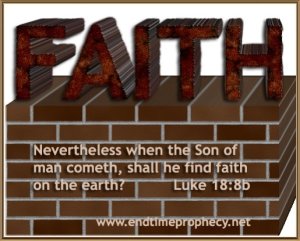
“Nevertheless, when the Son of man cometh, shall he find faith on the earth” (Lu. 18.8b)?  The reference is not to personal faith, but to belief in the whole body of revealed truth.[xii] “Now the Spirit speaketh expressly, that in the latter times some shall depart from the faith, giving heed to seducing spirits, and doctrines of devils” (1 Ti. 4.1).

In the New Testament, the apostasy was treated as having already set in. In fact, the Asian churches had not disbanded, nor ceased to call themselves Christian; but they had turned away from the doctrines of grace distinctively revealed through the Apostle Paul. Thus, even in the beginning of the church, the apostle Paul and Jude were concerned with the tendency to depart from the faith due to the influence of false teachers.[xiii]

Many of our churches today, even many of our independent Bible believing churches, have perverted the gospel of Christ and turned the grace of our God into lasciviousness even though perhaps they have not verbally denied our Lord God, and our Lord Jesus Christ.

Gentile world apostasy comes in seven stages.[xiv] As a result of this worldwide Gentile apostasy, mankind sinks to the depths of depravity.[xv] The apostasy is usually introduced by ungodly men who will “wax worse and worse, deceiving, and being deceived.”[xvi]

Our Lord warned against false teachers.[xvii] The Lord is obviously warning that many of His children will be deceived by the many false prophets which shall arise. With heresy and apostasy, the God-given doctrines and goal for churches and for Christians are left in the dust.  As a result, God is not glorified at all. Everything in the ultimate modern American church is for self—the headship, the “Bibles,” the doctrines taught, the preaching, the music, the dress, the goal, everything.

Peter, Paul, and Jude traced the origin of apostasy to false teachers, explained their methods of operation, and warned the church to beware of the apostasy.[xviii]

Only a little leaven can completely change and pervert the truth of the Gospel.[xix]

False teachers deny redemption truth.[xx] Others deny the truth concerning Christ’s person as Son of God, God himself.[xxi]

In Jude all phases of apostasy are seen. Jude mentions those who “ran after the error of Balaam for reward.” Many pastors and other Christians today, like Balaam, revert to human reasoning and, among other unbiblical practices, put God’s church under the state for reward—that is, for money, for popularity, or power. They may not have gone completely into apostasy, but heresy is the first step toward apostasy.
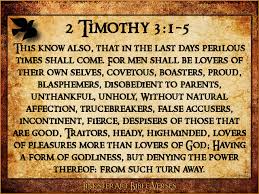
The tone of the New Testament writers when dealing with heresy and apostasy is never one of dejection or pessimism. They remained sustained and joyful.[xxii] God & His promises are still the resource of the believer.

2 Timothy, 2 Peter, Jude, and 2 & 3 John deal the personal walk and testimony of a true servant of Christ in a day of apostasy and declension. For example, Paul gives instructions for the “good soldier” in the face of apostasy.[xxiii] Paul instructed Timothy, a preacher whom Paul called his “dearly beloved son (2 Ti. 1.2)” and his “own son in the faith” (1 Ti. 1.2) as to what to do in times of apostasy.[xxiv]

“The believer’s resources in a day of general declension and apostasy  are faith (2 Ti. 1.5), the spirit (2 Ti. 1.6-7), the Word of God (2 Ti. 1.13; 3.1-17; 4.3-4), the grace of Christ (2 Ti. 2.1), separation from vessels unto dishonor (2 Ti. 2.4, 20-21), the Lord’s sure reward (2 Ti. 4.7-8), and the Lord’s faithfulness and power (2 Ti. 2.13, 19).


For more thorough studies on heresy and apostasy, to chapters numbered 4-9 at the following webpage:
The Biblical Doctrine of the Church


Endnotes

[i] “Let no man deceive you by any means: for that day shall not come, except there come a falling away first, and that man of sin be revealed, the son of perdition: who opposeth and exalteth himself above all that is called God, or that is worshipped; so that he as God sitteth in the temple of God, shewing himself that he is God” (2 Th. 2.3-4).

[ii] 1 Jn. 4.1-3: “Beloved, believe not every spirit, but try the spirits whether they are of God: because many false prophets are gone out into the world. Hereby know ye the Spirit of God: Every spirit that confesseth that Jesus Christ is come in the flesh is of God: And every spirit that confesseth not that Jesus Christ is come in the flesh is not of God: and this is that spirit of antichrist, whereof ye have heard that it should come; and even now already is it in the world.’]; Phil. 3.18: “For many walk, of whom I have told you often, and now tell you even weeping, that they are the enemies of the cross of Christ;” 2 Pe. 2.1: “But there were false prophets also among the people, even as there shall be false teachers among you, who privily shall bring in damnable heresies, even denying the Lord that bought them, and bring upon themselves swift destruction.”

[iii] Ac. 19.1-6: “And it came to pass, that, while Apollos was at Corinth, Paul having passed through the upper coasts came to Ephesus: and finding certain disciples, He said unto them, Have ye received the Holy Ghost since ye believed? And they said unto him, We have not so much as heard whether there be any Holy Ghost. And he said unto them, Unto what then were ye baptized? And they said, Unto John’s baptism. Then said Paul, John verily baptized with the baptism of repentance, saying unto the people, that they should believe on him which should come after him, that is, on Christ Jesus. When they heard this, they were baptized in the name of the Lord Jesus. And when Paul had laid his hands upon them, the Holy Ghost came on them; and they spake with tongues, and prophesied.”

[iv] 2 Ti. 2.25, 26 “In meekness instructing those that oppose themselves; if God peradventure will give them repentance to the acknowledging of the truth; And that they may recover themselves out of the snare of the devil, who are taken captive by him at his will.”

[v] 2 Ti. 4.3-4: “For the time will come when they will not endure sound doctrine; but after their own lusts shall they heap to themselves teachers, having itching ears; And they shall turn away their ears from the truth, and shall be turned into fables.”

[vi] 2 Ti. 3.5: “Having a form of godliness, but denying the power thereof, from such turn away.”

[vii] . 2 Ti. 4.3: “For the time will come when they will not endure sound doctrine; but after their own lusts shall they heap to themselves teachers, having itching ears;: 2 Pe. 2.1-19 [quoted here in part]: “But there were false prophets also among the people, even as there shall be false teachers among you, who privily shall bring in damnable heresies, even denying the Lord that bought them, and bring upon themselves swift destruction. And many shall follow their pernicious ways; by reason of whom the way of truth shall be evil spoken of.  And through covetousness shall they with feigned words make merchandise of you: … But these, as natural brute beasts, made to be taken and destroyed, speak evil of the things that they understand not; and shall utterly perish in their own corruption; …  Which have forsaken the right way, and are gone astray, following the way of Balaam the son of Bosor, who loved the wages of unrighteousness; ….These are wells without water, clouds that are carried with a tempest; to whom the mist of darkness is reserved for ever. For when they speak great swelling words of vanity, they allure through the lusts of the flesh, through much wantonness, those that were clean escaped from them who live in error.  While they promise them liberty, they themselves are the servants of corruption: for of whom a man is overcome, of the same is he brought in bondage;” Jude 4, 8, 11-13, 16: “For there are certain men crept in unawares, who were before of old ordained to this condemnation, ungodly men, turning the grace of our God into lasciviousness, and denying the only Lord God, and our Lord Jesus Christ…. Likewise also thesefilthy dreamers defile the flesh, despise dominion, and speak evil of dignities…. Woe unto them! for they have gone in the way of Cain, and ran greedily after the error of Balaam for reward, and perished in the gainsaying of Core. These are spots in your feasts of charity, when they feast with you, feeding themselves without fear: clouds they are without water, carried about of winds; trees whose fruit withereth, without fruit, twice dead, plucked up by the roots; Raging waves of the sea, foaming out their own shame; wandering stars, to whom is reserved the blackness of darkness for ever. These are murmurers, complainers, walking after their own lusts; and their mouth speaketh great swelling words, having men’s persons in admiration because of advantage.”

[viii] Isa. 1.5, 6; 5.5-7.

[ix] 2 Thes. 2.10-12: “And with all deceivableness of unrighteousness in them that perish; because they received not the love of the truth, that they might be saved. And for this cause God shall send them strong delusion, that they should believe a lie: That they all might be damned who believed not the truth, but had pleasure in unrighteousness;” 2 Pet. 2.17, 21: “These are wells without water, clouds that are carried with a tempest; to whom the mist of darkness is reserved for ever…. For it had been better for them not to have known the way of righteousness, than, after they have known it, to turn from the holy commandment delivered unto them;” Jude 11-15; Re. 3.14-16.

[x] Is. 1.2-7, 24, 25; He. 6.4-8; 10.26-31.

[xi]  Jude 14, 15; Ge. 7.11.

[xii] See, e.g., Ro. 1.5; 1 Co. 16.13; 2 Co. 13.5; Col. 1.23, 2.7; Tit. 1.13; Jude 3.

[xiii] “I marvel that ye are so soon removed from him that called you into the grace of Christ unto another gospel:  Which is not another; but there be some that trouble you; and would pervert the gospel of Christ. But though we, or an angel from heaven, preach any other gospel unto you than that which we have preached unto you, let him be accursed” (Ga. 1.6-8). “For there are certain men crept in unawares, who were before of old ordained to this condemnation, ungodly men, turning the grace of our God into lasciviousness, and denying the only Lord God, and our Lord Jesus Christ” (Jude 4).

[xiv] “Because that, when they knew God, they glorified him not as God, neither were thankful; but became vain in their imaginations, and their foolish heart was darkened. Professing themselves to be wise, they became fools. And changed the glory of the uncorruptible God into an image made like to corruptible man, and to birds, and fourfooted beasts, and creeping things” (Ro. 1.21-23).

[xv] “Wherefore God also gave them up to uncleanness through the lusts of their own hearts, to dishonour their own bodies between themselves: Who changed the truth of God into a lie, and worshipped and served the creature more than the Creator, who is blessed for ever. Amen. For this cause God gave them up unto vile affections: for even their women did change the natural use into that which is against nature: And likewise also the men, leaving the natural use of the woman, burned in their lust one toward another; men with men working that which is unseemly, and receiving in themselves that recompence of their error which was meet. And even as they did not like to retain God in their knowledge, God gave them over to a reprobate mind, to do those things which are not convenient; Being filled with all unrighteousness, fornication, wickedness, covetousness, maliciousness; full of envy, murder, debate, deceit, malignity; whisperers, Backbiters, haters of God, despiteful, proud, boasters, inventors of evil things, disobedient to parents. Without understanding, covenantbreakers, without natural affection, implacable, unmerciful: Who knowing the judgment of God, that they which commit such things are worthy of death, not only do the same, but have pleasure in them that do them”  (Ro. 1.24-32).

[xvi]  2 Ti. 3.13.

[xvii] “Beware of false prophets, which come to you in sheep’s clothing, but inwardly they are ravening wolves” (Mt. 7.15). “Not every one that saith unto me, Lord, Lord, shall enter into the kingdom of heaven; but he that doeth the will of my Father which is in heaven. Many will say to me in that day, Lord, Lord, have we not prophesied in thy name? and in thy name have cast out devils? and in thy name done many wonderful works? And then will I profess unto them, I never knew you: depart from me, ye that work iniquity” (Mt. 7.21-23). “And Jesus answered and said unto them, Take heed that no man deceive you. For many shall come in my name, saying, I am Christ; and shall deceive many” (Mt. 24.4-5). “And many false prophets shall rise, and shall deceive many” (Mt. 24.11). “For false Christs and false prophets shall rise, and shall shew signs and wonders, to seduce, if it were possible, even the elect” (Mk. 13.22). “Whosoever therefore shall break one of these least commandments, and shall teach men so, he shall be called the least in the kingdom of heaven” (Mt. 5.19). “But in vain do they worship me, teaching for doctrines the commandments of men” (Mt. 15.9).

[xviii] “Take heed therefore unto yourselves, and to all the flock, over the which the Holy Ghost hath made you overseers, to feed the church of God, which he hath purchased with his own blood. For I know this, that after my departing shall grievous wolves enter in among you, not sparing he flock: Also of your own selves shall men arise, speaking perverse things, to draw away disciples after them. Therefore watch, and remember, that by the space of three years I ceased not to warn every one night and day with tears” (Ac. 20.28-31).

“But though we, or an angel from heaven, preach any other gospel unto you than that which we have preached unto you, let him be accursed. As we said before, so say I now again, If any man preach any other gospel unto you than that ye have received, let him be accursed” (Ga. 1.8-9).

“O foolish Galatians, who hath bewitched you, that ye should not obey the truth, before whose eyes Jesus Christ hath been evidently set forth, crucified among you” (Ga. 3.1)?

“For there must be also heresies among you, that they which are approved may be made manifest among you” (1 Co. 11.19).

“For if he that cometh preacheth another Jesus, whom we have not preached, or if ye receive another spirit, which ye have not received, or another gospel, which ye have not accepted, ye might well bear with him” (2 Co. 11.4).

“For there are many unruly and vain talkers and deceivers, specially they of the circumcision; Whose mouths must be stopped, who subvert whole houses, teaching things which they ought not, for filthy lucre’s sake” (Tit. 1.10-11).

“Now the spirit speaketh expressly, that in the latter times some shall depart from the faith, giving heed to seducing spirits, and doctrines of devils; Speaking lies in hypocrisy; having their conscience seared with a hot iron” (1 Ti. 4.1-2).

“For the time will come when they will not endure sound doctrine; but after their own lusts shall they heap to themselves teachers, having itching ears; And they shall turn away their ears from the truth, and shall be turned to fables. Having a form of godliness, but denying the power thereof: from such turn away” (2 Ti. 4.3-5).

“But there were false prophets also among the people, even as there shall be false teachers among you, who privily shall bring in damnable heresies, even denying the Lord that bought them and bring upon themselves swift destruction. And many shall follow their pernicious ways; by reason of whom the way of truth shall be evil spoken of. And through covetousness shall they with feigned words make merchandise of you: whose judgment now of a long time lingereth not, and their damnation slumbereth not….  Which have forsaken the right way, and are gone astray, following the way of Balaam the son of Bosor, who loved wages of unrighteousness; But was rebuked for his iniquity: the dumb ass speaking with man’s voice forbad the madness of the prophet. These are wells without water, clouds that are carried with a tempest; to whom the mist of darkness is reserved for ever. For when they speak great swelling words of vanity, they allure through the lusts of the flesh, through much wantonness, those that were clean escaped from them who live in error. While they promise them liberty, they themselves are the servants of corruption: for of whom a man is overcome, of the same is he brought into bondage” (2 Pe. 2.1-3, 15-19. All of 2 Pe. 2 deals with false teachers.).

“Whosoever transgresseth, and abideth not in the doctrine of Christ, hath not God. He that abideth in the doctrine of Christ, he hath both the Father and the Son. If there come any unto you, and bring not this doctrine, receive him not into your house, neither bid him God speed: For he that biddeth him God speed is partaker of his evil deeds” (2 Jn. 9-11).

“Knowing this first, that there shall come in the last days scoffers, walking after their own lusts, And saying, Where is the promise of his coming? for since the fathers fell asleep, all things continue as they were from the beginning of the creation” (2 Pe. 3.3-4).

“For there are certain men crept in unawares, who were before of old ordained to this condemnation, ungodly men, turning the grace of our God into lasciviousness, and denying the only Lord God, and our Lord Jesus Christ” (Jude 4. Jude predicts the apostasy of the professing church and describes the cause and course of the apostasy. As in 2 Timothy and 2 Peter, the apostasy is treated as having already set in.

[xix] “Ye did run well; who did hinder you that ye should not obey the truth?  This persuasion cometh not of him that calleth you. A little leaven leaveneth the whole lump” (Ga. 5.7-9).

[xx] “[False teachers] shall bring in damnable heresies, even denying the Lord that bought them and bring upon themselves swift destruction” (2 Pe. 2.1).

[xxi] “BELOVED, believe not every spirit, but try the spirits whether they are of God: because many false prophets are gone out into the world. Hereby know ye the Spirit of God: Every spirit that confesseth not that Jesus Christ is come in the flesh is not of God: and this is that spirit of antichrist, whereof ye have heard that it should come; and even now already is it in the world. Ye are of God, little children, and have overcome them: because greater is he that is in you, than he that is in the world. They are of the world: therefore speak they of the world, and the world heareth them” (1 Jn. 4.1-5; see also, 1 Jn. 2.18-28).

[xxii] Although Paul as recorded in II Timothy and Peter as recorded in II Peter are aware that martyrdom is near (See 2 Ti. 4.6-8, 2 Pe. 1.14, and Jn. 21.18-19), both are apparently sustained and joyful: “For I am now ready to be offered, and the time of my departure is at hand. I have fought a good fight, I have finished my course, I have kept the faith: Henceforth there is laid up for me a crown of righteousness, which the Lord, the righteous judge, shall give me at that day: and not to me only, but unto all them also that love his appearing” (2 Ti. 4.7-8). The whole book of 2 Timothy reflects Paul’s joyful attitude as 2 Peter shows Peter to be likewise joyful and sustained.

[xxiii] “[B]e strong in the grace that is in Christ Jesus. And the things that thou has heard of me among many witnesses, the same commit thou to faithful men, who shall be able to teach others also. Thou therefore endure hardness, as a good soldier of Jesus Christ. No man that warreth entangleth himself with the affairs of this life: that he may please him who hath chosen him to be a soldier….  Remember that Jesus Christ of the seed of David was raised from the dead according to my gospel: …  It is a faithful saying: For if we be dead with him, we shall also live with him: If we suffer, we shall also reign with him: If we deny him, he also will deny us: If we believe not, yet he abideth faithful: he cannot deny himself….  Study to shew thyself approved unto God, a workman that needeth not to be ashamed, rightly dividing the word of truth. But shun profane and vain babblings: for they will increase unto more ungodliness. And their word will eat as doth a canker: …  Flee also youthful lusts: but follow righteousness, faith, charity, peace, with them that call on the Lord out of a pure heart. But foolish and unlearned questions avoid, knowing that they do gender strifes. And the servant of the Lord must not strive; but be gentle unto all men, apt to teach, patient, In meekness instructing those that oppose themselves; if God peradventure will give them repentance to the acknowledging of the truth; And that they may recover themselves out of the snare of the devil, who are taken captive by him at his will” (2 Ti. 2.1-4, 8, 11-13, 15-17a, 22-25).

[xxiv] “Preach the word: be instant in season, out of season; reprove, rebuke, exhort with all longsuffering and doctrine. For the time will come when they will not endure sound doctrine; but after their own lusts shall they heap to themselves teachers, having itching ears; And they shall turn away their ears from the truth, and shall be turned into fables. But watch thou in all things, endure afflictions, do the work of the evangelist, make full proof of thy ministry” (2 Ti. 4.2-5).
11. Conclusion to the Doctrine of the Church


A Publication of Simply Church Ministry


If you miss one part of the puzzle that is being put together in these studies, you will never see and understand the whole picture.


Jerald Finney
Copyright © January 14, 2025


This lesson will serve as a conclusion to New Testament Church Bible studies and also as a bridge to the next series of lessons on what God’s word has to say about God’s desired relationship between church and state.

Jesus, God the Son, summed it up when he said to those who were trying to “entangle him in his talk: “Render therefore unto Caesar the things which are Caesar’s; and unto God the things that are God’s.” The church belongs to God alone and is not to be mixed with what God has given to Caesar (human government); in other words, church and state, not God and state, are to be separate; they each have their own God-given jurisdiction. (See, Matthew 15:15-22 for the whole context of this encounter of our Lord with the disciples of the Pharisees. This is copied in the featured picture above).

To fully understand God’s prescribed relationship between church and state, the believer must understand what God says about church government and organization, what he says about individual, family, and civil or human government ( See, Bible Doctrine of Government), and finally what he says about his desired relationship between church and state (See, Bible Doctrine Concerning the Relationship between Church and State). These lessons are geared for a full understanding of church organization and the relationship of church and state according to God’s Word.

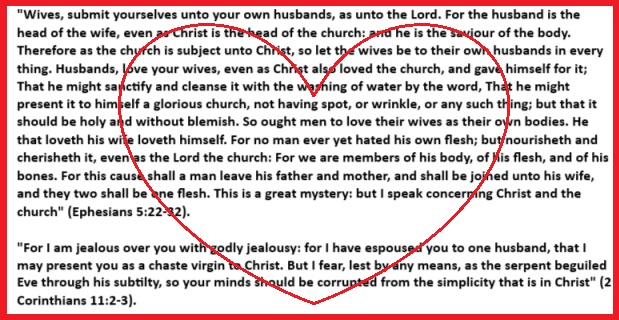
New Testament churches are God’s. God, in his word has given them extensive instructions on how he wishes them to organize and conduct themselves. He is to be their first and only love. His love for the church which he builds is the greatest love the world has ever seen. He gave himself for the church (Ephesians 5:25). He shed his own blood for it (Acts 20.28). He is jealous over it and wishes it to be presented to him as a chaste virgin (2 Corinthians 11:2).

Sadly, most churches in America today have left their first love. They work, as did the church at Ephesus, and their good works, not Christ, have become their purpose (See Revelation 2:1-7). As a result, Christ admonishes them: “Remember from whence they art fallen, and repent, and do the first works; or else I will come unto thee quickly, and will remove thy candlestick out of his place, except thou repent.” Christ was saying that the church at Ephesus (one of the seven candlesticks or churches among which he walked) would no longer have Christ in its midst, no matter their verbal proclamations concerning him. Very likely Christ has already removed the candlestick of many American churches and Christ is no longer walking in their midst. Furthermore, they do not hear his plea, “Behold, I stand at the door, and knock: if any man hear my voice, and open the door, I will come in to him, and will sup with him, and he with me.” (Revelation 3:20).

The New Testament prophecies concerning church apostasy have been at work in America since the founding of this  nation. In America, true colonial and early national history reveals that Baptist churches paid a price for standing against union of church and state. They stood strongly, against all worldly odds, as did their spiritual forefathers since the time God ordained the New Testament church. Some of them incorporated, under the leadership of traitors such as Hezekiah Smith in Massachusetts, but many stood firm.

After the ratification of the United States Constitution and the First Amendment, most of the state constitutions provided for religious freedom and soul liberty, but all still offered incorporation for those churches who desired it. (Note. In 1833, Massachusetts became the last state to do away with forced establishment  (incorporation or union of church and state)).  Many chose the latter. They become spiritual whores. They betrayed their first love. Once one takes a step away from their espoused, they will continue to take additional steps toward apostasy, except they repent.

For a brief overview of Bible teaching and prophesy concerning church apostasy, see, Heresy and Apostasy. For the true, as opposed to the Christian revisionist, history of religious and soul liberty as expressed in the First Amendment to the United States Constitution, see An Abridged History of the First Amendment. see, for more detailed studies: (1) Religious Liberty in America; (2) God Betrayed: Separation of Church and State: The Biblical Principles and the American Application; (3) The Trail of Blood of the Martyrs of Jesus: Christian Revisionism on Trial.

The pillars and ground of the truth have been destroyed. Like the Pharisees spoken of in Matthew 22:15-22, when someone presents the truth about church organization and God’s desired relationship between church and state to the average corporate 501(c)(3) or 508(c)(1)(A) pastor and believer, they leave and go their way.

9. How To Recognize a New Testament Church


A Publication of Simply Church Ministry


If you miss one part of the puzzle that is being put together in these studies, you will never see and understand the whole picture.

Previous Lesson:
7. Other Bible Metaphors for a Church: Family, Etc.

Next Lesson:
9. Heresy and Apostasy

Click here to go to all lessons on the Bible Doctrine of the Church.

Click here to go to the written lessons.

Click here to go to the 5 minute video lectures.


Jerald Finney
Copyright © January 5, 2018

Prior lessons on the church give much insight into knowing how to recognize a New Testament Church. This lesson gives some additional insights and stresses the importance of seeking a church which is organized and conducted God’s way, according to his commandments and his word.

To recognize a church, an assembly of people, which is modeled after New Testament Church principles, one must look at New Testament Church doctrine. That doctrine is given us in the epistles penned by the Apostle Paul. Prior lessons have examined much of that doctrine.

J. M. Carroll, in describing the overall organization of the church, accurately listed eleven “Marks of a New Testament Church:

  1. “Its Head and Founder—CHRIST. He is the lawgiver; the Church is only the executive. (Matt. 16:18; Col. 1:18.)
  2. “Its only rule of faith and practice—THE BIBLE. (II Tim. 3:15-17.)
  3. “Its name—‘CHURCH,’ ‘CHURCHES.’ (Matt. 16:18; Rev. 22:16.)
  4. “Its polity—CONGREGATIONAL—all members equal. (Matt. 20:24-28; Matt. 23:5- 12.)
  5. “Its members—only saved people. (Eph 2:21-22; I Peter 2:5.)
  6. “Its ordinances—BELIEVER’S BAPTISM, FOLLOWED BY THE LORD’S SUPPER. (Matt. 28:19-20.)
  7. “Its officers—PASTORS and DEACONS. (I Tim. 3:1-16.)
  8. “Its work—getting folks saved, baptizing them (with a baptism that meets all the requirements of God’s Word), teaching them (‘to observe all things whatsoever I have commanded you’). (Matt. 28:16-20.)
  9. “Its financial plan—‘Even so (TITHES and OFFERINGS) hath the Lord ordained that they which preach the gospel should live of the gospel.’ (I Cor. 9.14.)
  10. “Its weapons of warfare—spiritual, not carnal. (II Cor. 10:4; Eph. 6:10-20.)
  11. “Its independence—separation of Church and State. (Matt. 22:21.)” [i]

Certainly, a preacher on the street corner with a crowd around him as he preaches is not a church. Nor is a group of people meeting in a house and preaching the Word. However, if that house group chooses a properly ordained and baptized pastor, organizes and operates according to biblical principles, initiates a proper baptism for new believers, and begins to partake of the Lord’s Supper, an ordered New Testament church comes into existence. The Lord desires that those who are saved be baptized into a properly ordered New Testament church.

An eChurch is not a New Testament church, nor is a group who starts following someone on Facebook or other social network. As has been established in prior lessons, a church is a spiritual body or assembly ordered according to the principles of the New Testament.

Only the assembly where the true doctrine is preached is a church: “But though we, or an angel from heaven, preach any other gospel unto you than that which we have preached unto you, let him be accursed” (Ga. 1.8).  Where only false doctrines are preached, no church can exist. For example, the Catholic Church, some Baptist churches, many Protestant churches, the Church of Jesus Christ of Latter Day Saints, Islam, and the Jehovah’s Witnesses are not churches. When the preaching of a church conceals the gospel message of salvation by grace through faith alone from its members, so that the gospel message is not clearly proclaimed, and has not been proclaimed for some time, the group meeting there is not a church.

A church can exist only where the Bible is believed to be the inerrant Word of God, where the Bible is the sole basis for faith and practice, and where that Bible is taught, preached, and practiced.

Local churches assemble in His name for the breaking of bread, worship, praise, prayer, testimony, the ministry of the word, discipline, and the furtherance of the Gospel (He. 10.25; Ac. 20.7; 1 Co. 14.26; 1 Co. 5.4, 5; Ph. 4.14-18; 1 Th. 1.8; Ac. 13.1-). Every such local church has Christ in the midst, is a temple of God, indwelt by the Holy Spirit (1 Co. 3.16, 17), and is “the pillar and ground of the truth” (1 Ti. 3.15).

A church is the body of Christ of which He is the Head. Christ desires that a church remain solely under Him: “And [God] hath put all things under his feet, and gave him to be the head over all things to the church” (Ep. 1.22-23). “For the husband is the head of the wife, even as Christ is the head of the church” (Ep. 5.23). Prior lessons have covered this and other  matters mentioned in this lesson in more completely.

New Testament church doctrine and example further define what a church is to be:

  1. Click here to go to a study of Matthew 22:21, Romans 13, and related verses.

    Spiritual entity only. [ii] A church which is a legal entity such as a 501(c)(3) corporation is, at best, in God’s permissive will and out of God’s perfect will. Such a church has combined the earthly, temporal, and Satanic with the heavenly, eternal and spiritual.[iii]

  2. The body of Christ of which He is the Head. Christ desires that a church remain solely under Him: “And [God] hath put all thingsunder his feet, and gave him to be the head over all things to the church” (Ep. 1.22-23). “For the husband is the head of the wife, even as Christ is the head of the church” (Ep. 5.23). A church which is a legal entity has two heads, the Lord Jesus Christ and civil government. Such a church cannot be a New Testament church.[iv]
  3. Separate from the world. An incorporated 501(c)(3) or 508(c)(1)(A) church is not separated from the world.[v]
  4. A church is to assemble in His name for the breaking of bread, worship, praise, prayer, testimony, the ministry of the word, discipline, and the furtherance of the Gospel (He. 10.25; Ac. 20.7; 1 Co. 14.26; 1 Co. 5.4, 5; Ph. 4.14-18; 1 Th. 1.8; Ac. 13.1-).
  5. Every such local church has Christ in the midst, is a temple of God, indwelt by the Holy Spirit (1 Co. 3.16, 17), and is “the pillar and ground of the truth” (1 Ti. 3.15).
  6. A church has duties outside the meeting house. The teaching of doctrine inside, work outside.[vi] Outside, the members are to present the Gospel, including all relevant truth from God’s word, to the world through door to door and one-on-one evangelism and street ministry, in the political arena, and everywhere one is involved.
  7. Fight the spiritual warfare against powers, principalities and the rulers of darkness in this present world (Ep. 6.10-18). This fight is being waged by Satan on all fronts. Churches and believers should likewise be fighting on all fronts using God’s methods of warfare.

Click here to go to Bible Study of Ephesians. Ephesians reveals the institution of the church as God’s masterpiece. It is more wonderful that any temple made with hands, constructed of living stones, indwelt by the Holy Spirit. Ephesians 1 presents the church as a body. The book is both doctrinal and practical. The first three chapters are doctrinal and go into the heavenlies. The last three chapters are practical and cover the believers responsibilities on earth. A church and a believer are to remain connected to their heavenly head as they walk on this earth.

Bible Studies of various Books on the Doctrine of the Church.

The Biblical Doctrine of the Church.


Endnotes

[i] J. M. Carroll, The Trail of Blood, (Distributed by Ashland Avenue Baptist Church, 163 N. Ashland Avenue, Lexington KY 40502, 606-266-4341), pp. 4-5. J. M. Carroll was a leader among Baptists who studied history and the Bible in an attempt to “find the church which was the oldest and most like churches described in the New Testament.” In the course of his studies, he gathered “one of the greatest libraries on church history. This library was given at his death to the Southwestern Baptist Seminary, Ft. Worth, Texas.”

[ii] See What is a spiritual entity?; A Church Is a Mystery, an Assembly, a Spiritual Body; The Holy Spirit Forms a Church which Is a Temple, a Spiritual Body, the Body of Christ.

[iii] See What is a legal entity?; Links to Lessons on Satan.

[iv]  Christ Ordained the Church and Builds It upon the Rock; Christ, the Head/Bridegroom/Husband of the Local Church.

[v] What is an established church?; The Biblical Doctrine of Separation of Church and State.

[vi] Click here to go to Bible Study of Ephesians. Ephesians reveals the institution of the church as God’s masterpiece. It is more wonderful that any temple made with hands, constructed of living stones, indwelt by the Holy Spirit. The book is both doctrinal and practical. The first three chapters are doctrinal and go into the heavenlies. The last three chapters are practical and cover the believers responsibilities on earth. A church and a believer are to remain connected to their heavenly Head, the Lord Jesus Christ, and Him alone as they walk on this earth.

7. Other Descriptors for a New Testament Church


A Publication of Simply Church Ministry


If you miss one part of the puzzle that is being put together in these studies, you will never see and understand the whole picture.

Previous Lesson:
6. The Love between Christ and His Churches

Next Lesson:
8. How To Recognize a New Testament Church

Click here to go to all lessons on the Bible Doctrine of the Church.

Click here to go to the written lessons.

Click here to go to the 5 minute video lectures.


Jerald Finney
Copyright © January 5, 2018


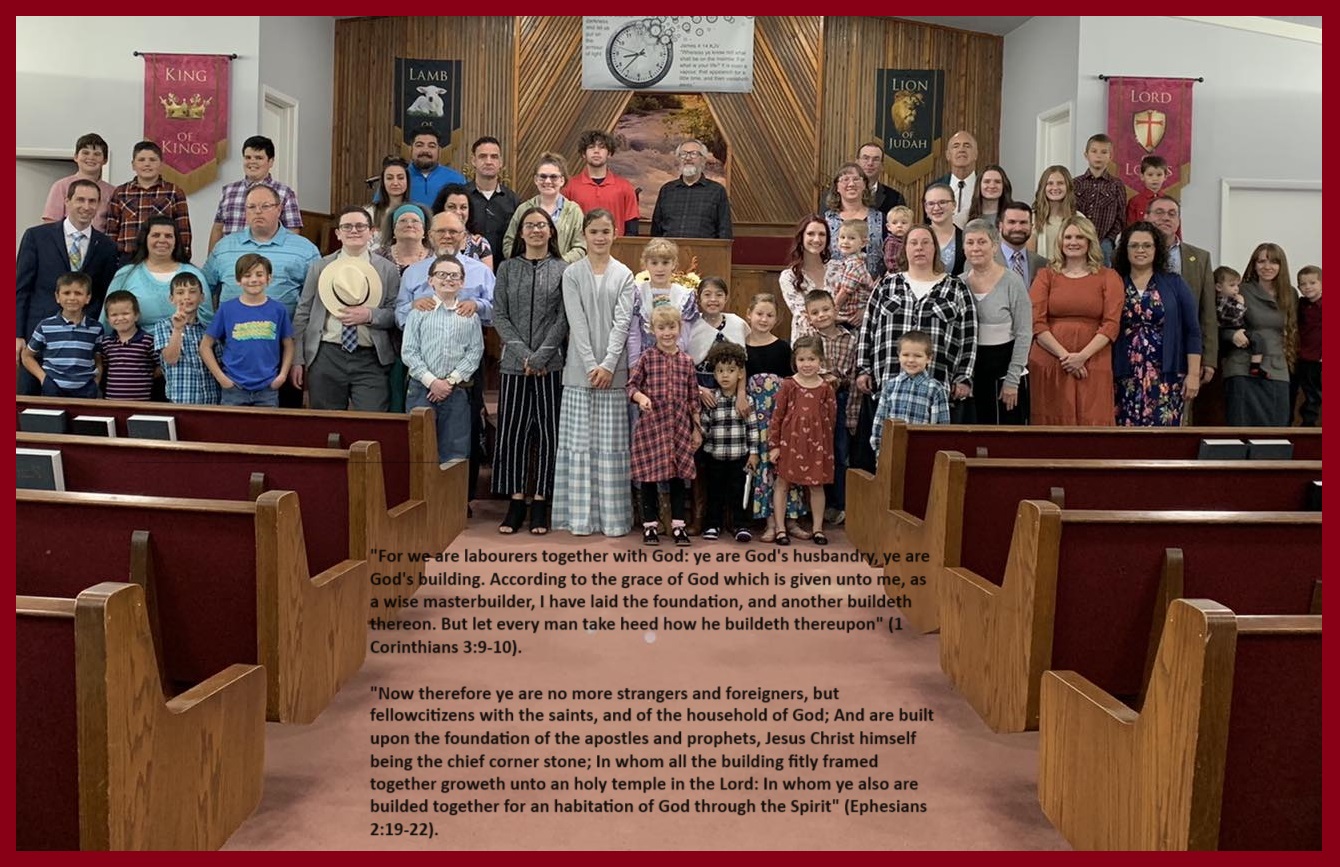
My church family

For our understanding of her nature, Scripture describes a church in many ways. Earlier lessons have examined some of them. This lesson will look at others.

One is indwelt by the Holy Spirit and becomes a member of the family of God at the moment of salvation (Ac. 10.45, 11.15-18; Romans 8:14-16; Galatians 4:4-7). God’s desire for that individual is that he then be baptized and become a member of a local church under Christ (Acts 2:41).

Thus, all members of a church, except any who have not been saved form a family; a church is a family. “Rebuke not an elder, but entreat him as a father; and the younger men as brethren; The elder women as mothers; the younger as sisters, with all purity” (1 Ti. 5.1-2). “And [I] will be a Father unto you, and ye shall be my sons and daughters, saith the Lord Almighty” (2 Co. 6.18). “And he stretched forth his hand toward his disciples, and said, Behold my mother and my brethren! For whosoever shall do the will of my Father which is in heaven, the same is my brother, and sister, and mother” (Mt. 12.49-50). Many other verses could be cited. Look for them as you read through the New Testament.

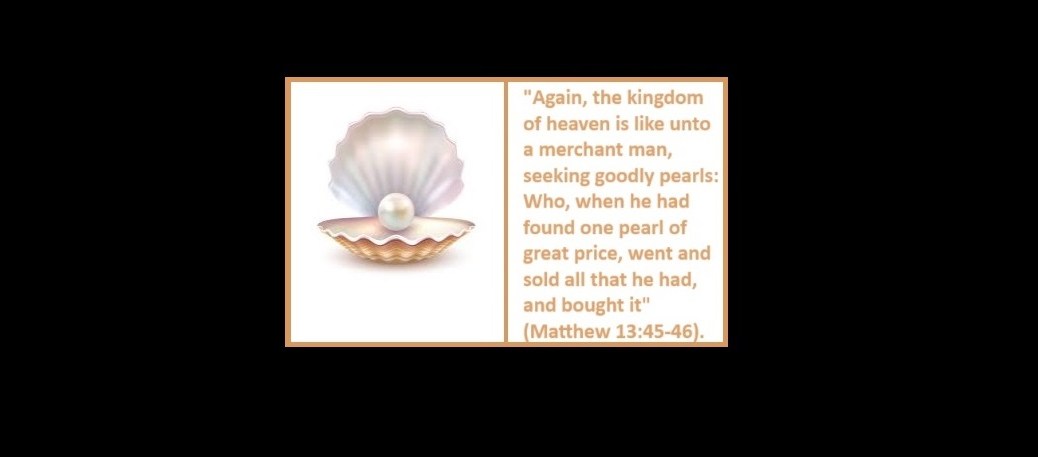
The Bible compares the church to a pearl of great price which “a merchant man sold all that he had, and bought it (Mt. 13.45-46):

  • “A church is one body formed by the Holy Spirit. As Israel is the hid treasure, so a church is a pearl of great cost. Covering the same period as the mysteries of the kingdom, is the mystery of the church (Rom. 16:25, 26; Eph. 3:3-10; 5.32). Of the true Church a pearl is a perfect symbol: (1) a pearl is one, a perfect symbol of unity (1 Cor. 10.17; 12.12, 13; Eph. 4.4-6). (2) A pearl is formed by accretion, and that not mechanically, but vitally, through a living one, as Christ adds to the Church (Acts 2.41, 47; 5.14; 11.24; Eph. 2.21; Col 2.19. (3) Christ, having given Himself for the pearl, is now preparing it for the presentation to Himself (Eph. 5.25-27).  The kingdom is not the Church, but the true children of the kingdom during the fulfillment of these mysteries, baptized by one Spirit into one body (1 Cor. 12. 12, 13), compose … the pearl.” A variation of a quote from 1917 Scofield Reference Edition, n. 3 to Matthew 13.45, p. 1017.).

Here are some other descriptions of a church from God’s word:

  1. the Father’s love gift to Jesus Christ (Jn. 17.2, 6, 9, 11, 12, 24);
  2. the bride and wife of Christ, who is the Head of the church as the husband is the head of the wife;
  3. a virgin espoused to one husband (2 Co. 11.1-2);
  4. “the household of God” and “an holy temple in the Lord” (Ep. 2.19-21; see also 1 Co. 3.16);
  5. branches on a vine (Jn. 15.5);
  6. an olive tree (Ro. 11.17-24);
  7. a field of crops (1 Co. 3.6-9);
  8. God’s husbandry and God’s building” (1 Co. 3.9);
  9. a harvest (Mt. 13.1-30; Jn. 4.35);
  10. lively stones (1 Pe. 2.5);
  11. built up a spiritual house ((1 Pe. 2.5), a spiritual body or organism (1 Cor. 13, Ep. 4.1-16, Ro. 12.3-8);
  12. an holy priesthood, to offer up spiritual sacrifices, acceptable to God by Jesus Christ (1 Pe. 2.5);
  13. Christ’s house (He. 3.6) built by Christ Himself (He. 3.3); and
  14. ‘the pillar and ground of the truth’ (1 Ti. 3.15).

God gave each description for a reason.

“Each of the [descriptors] used for the church can help us to appreciate more of the richness of privilege that God has given us by building us into a local church. The fact that a church is like a family should increase our love and fellowship with one another. The thought that the church is like the bride of Christ should stimulate us to strive for greater purity and holiness, and also greater love for Christ and submission to him. The image of the church as branches in a vine should cause us to rest in him more fully. The idea of an agricultural crop should encourage us to continue growing in the Christian life and obtaining for ourselves and others the proper spiritual nutrients to grow. The picture of the church as God’s new temple should increase our awareness of God’s very presence dwelling in our midst as we meet. The concept of the church as a priesthood should help us to see more clearly the delight God has in the sacrifices of praise and good deeds that we offer to him (See He. 13.15-16). The [descriptor] of the church as the body of Christ should increase our interdependence on one another and our appreciation of the diversity of gifts within the body. Many other applications could be drawn from these and other [descriptors] for the church listed in Scripture.”[i]


Click here to go to Bible Study of Ephesians. Ephesians reveals the institution of the church as God’s masterpiece. It is more wonderful that any temple made with hands, constructed of living stones, indwelt by the Holy Spirit. Ephesians 1 presents the church as a body.


Articles, Essays, and Other Resources Related to the Doctrine of the Church, Incorporation, 501c3, Etc.

Bible Studies of various Books on the Doctrine of the Church.

The Biblical Doctrine of the Church


Endnote

[i] This is a variation of a quote from Wayne Grudem, Systematic Theology (Grand Rapids, Michigan: Zondervan; Leicester, England: Inter-Varsity Press, 1994), p. 859.

6. The Love between Christ and His Churches, (Proof that Most American Churches Do Not Love the Lord)


A Publication of Simply Church Ministry


If you miss one part of the puzzle that is being put together in these studies, you will never see and understand the whole picture.

Previous Lesson:
5.
Christ, the Head/Bridegroom/Husband of the Local Church

Next Lesson:
7. Other Bible Metaphors for a Church: Family, Etc.

Click here to go to all lessons on the Bible Doctrine of the Church.

Click here to go to the written lessons.

Click here to go to the 5 minute video lectures.


Jerald Finney
Copyright © January 4, 2018


This lesson will prove, from the Bible, that most American churches do not love the Lord.

Christ, the bridegroom, purchased the church “with his own blood” (Acts 20:28) “and gave himself for it” (Ephesians 5:25). He is, in love, sanctifying the church, and will present the church to Himself as a reward for His sacrifice and labor of love, a glorious church, not having spot, or wrinkle, or any such thing, a perfect church without spot or blemish, “one pearl of great price” (Mt. 13.45-46).

Jesus is the Father’s love-gift to the world.[i] The believer, the church member, is His reward, given Him as a love-gift by the Father.[ii]

Just as a bridegroom gives gifts to his earthly bride, so Christ gives gifts to His bride, to those whom the Father gave Him. See En [iii] for a list of those gifts with verses quoted.

Loving God is preeminent for a believer and for a church. One does not love God by just asserting that he loves God. Jesus said, “If ye love me, keep my commandments” (Jn. 14.15). The greatest commandment is to love the Lord with all one’s heart, soul, mind, and strength (Mt. 22.37; Mk. 12.30; Lu. 10.27).

This love between Christ and His church is seen in the Song of Solomon. The Song of Solomon, primarily, is the expression of pure marital love as ordained of God in creation, and the vindication of that love as against both asceticism and lust—the two profanations of the holiness of marriage. The secondary and larger interpretation is of Christ, the Son and His heavenly bride, the Church.

“Many waters cannot quench love, neither can the floods drown it: if a man would give all the substance of his house for love, it would be utterly contemned” (Song of Solomon 8.7). See 1 En [iv] for definition of “Contemned.” God despises, scorns, slights, neglects, or rejects with disdain all that a church does, whatever professions of love she makes, if those acts and/or professions are without love. See Revelation 2:1-7.

A church who does not honor Christ as a wife is to honor her bridegroom and her husband, by remaining pure and chaste, does not display love for the Lord. Loving one’s neighbor by witnessing to him, sending missionaries to him, helping him materially or any other way in obedience to the second commandment—“Thou shalt love thy neighbor as thyself”—is vanity in God’s eyes if one ignores the greatest commandment. The love of the temporal, the worldly—e. g., worldly organization, ownership of property, worldly power and prestige, etc.–by a church infringe the total love (charity) which Christ desires of his churches.

This fact is also articulated in the New Testament. The Lord Jesus is jealous over His church.  If we do not love the Lord Jesus, He despises all the “Christian” work we do and the money we put in the offering plate. 1 Corinthians 13.1-3, quoted in En [v] along with definition of “charity,” makes this clear.

Love of a church and of a believer is an act of the will (See, I Corinthians 13:1-7). A church refutes its proclamations of love for the Lord when it wholly or partially combines with or submits to any other entity in anything or acts in any manner which is contrary to the principles for a church given in God’s word. Christ desires to be over a church in “all things” (Ephesians 2:22), to have the preeminence in “all things” (Colossians 1:28).

1 Corinthians 13 explains the kind of love God wants from his children and churches. Love “[r]ejoiceth not in iniquity, but rejoiceth in the truth” (1 Co. 13.6). Iniquity means “Injustice, unrighteousness, … [w]ant of rectitude [rightness in principle or practice], … a sin or crime; wickedness…”[vi] Bible truth makes clear that the love of Christ for His church is immense, that He wants to be the only Head and companion of the church who is likened to His bride and wife, and that for a church to even partially put herself under or associate with another entity is a great wickedness and repudiates all professions of love for the Lord. As will be seen by the believer who follows these teachings to the end, the church who incorporates and secures a 501(c)(3) tax exemption commits wicked sinful acts in violation of biblical principle, and rejoices in iniquity by putting herself partially under two other heads (the state of incorporation and the federal government).

The Lord Jesus warned the church at Ephesus that she had left her first love, the Lord Jesus Christ. See En [vii] for that warning. The Lord instructed that church, “Repent, and do the first works; or else I will come unto thee quickly, and will remove thy candlestick out of his place, except thou repent” (Re. 2.4-5). This warning was for every church who has lost her love for the Lord Jesus.[viii]

As the Lord Jesus Christ is jealous over His churches, so should pastors and church members be jealous, with a godly jealousy, over the church they belong to, just as Paul was: “For I am jealous over you with godly jealousy: for I have espoused you to one husband, that I may present you as a chaste virgin to Christ. But I fear, lest by any means, as the serpent beguiled Eve through his subtilty, so your minds should be corrupted from the simplicity that is in Christ.  For if he that cometh preacheth another Jesus, whom we have not preached, or if ye receive another spirit, which ye have not received or another gospel, which ye have not accepted, ye might well bear with him” (2 Co. 11.2-4; Lu. 18.8; 2 Ti. 3.1-8).

The church who really loves her Husband, the Lord Jesus Christ, will seek to maintain her purity, to be subject to her Husband in all things. All the professions of love, all the good deeds, the hymns sung, and the messages preached by a church who does not totally submit herself in all things to her Husband, are contemned by the Lord.

Most pastors, believers and churches do not know what God tells us about this love relationship, nor to thy understand its application.  Thus, they combine with, or submit to, another entity, (civil government) in various ways. They obtain, for example, 501(c)(3) or 508(c)(1)(A) federal “tax-exemption,” state incorporation, license to do certain things, or a permit from the state. In short, the choose to become a temporal, earthly, entity subject to the jurisdiction of earthly powers, the state and/or federal government. Such a “church,” in spite of any professions of love for the Lord, according to her acts, shows that she does not love the Lord Jesus Christ.


Click the following to go to Bible study: The Love Relationship between Christ and His Churches as Depicted in Song of Solomon


Endnotes

[i] “For God so loved the world, that he gave his only begotten Son, that whosoever believeth in him should not perish, but have everlasting life” (Jn. 3.16).

[ii] “As thou hast given him power over all flesh, that he should give eternal life to as many as thou hast given him” (Jn. 17.2). “I have manifested thy name unto the men which thou gavest me out of the world: thine they were, and thou gavest them me; and they have kept thy word” (Jn. 17.6). “I pray for them: I pray not for the world, but for them which thou hast given me; for they are thine” (Jn. 17.9). “And now I am no more in the world, but these are in the world, and I come to thee. Holy Father, keep through thine own name those whom thou hast given me, that they may be one, as we are. While I was with them in the world, I kept them in thy name: those that thou gavest me I have kept, and none of them is lost, but the son of perdition; that the scripture might be fulfilled” (Jn. 17.11-12). “Father, I will that they also, whom thou hast given me, be with me where I am; that they may behold my glory, which thou hast given me: for thou lovedst me before the foundation of the world” (Jn. 17.24).

[iii] 1. He gives His bride eternal life: “As thou hast given him power over all flesh, that he should give eternal life to as many as thou hast given him” (Jn. 17.2).
2. The Father’s name: “I have manifested thy name unto the men which thou gavest me out of the world: thine they were, and thou gavest them me; and they have kept thy word…. And I have declared unto them thy name, and will declare it: that the love wherewith thou hast loved me may be in them, and I in them…. Jesus saith unto her, Touch me not; for I am not yet ascended to my Father: but go to my brethren, and say unto them, I ascend unto my Father, and your Father; and to my God, and your God” (Jn. 17.6, 26; 20.17).
3. The Father’s words: “For I have given unto them the words which thou gavest me; and they have received them, and have known surely that I came out from thee, and they have believed that thou didst send me…. I have given them thy word; and the world hath hated them, because they are not of the world, even as I am not of the world” (Jn. 17.8, 14).
4. His own joy: “And now come I to thee; and these things I speak in the world, that they might have my joy fulfilled in themselves” (Jn 1.7.13).
5. His own glory: “And the glory which thou gavest me I have given them; that they may be one, even as we are one” (Jn. 17.22).

[iv] “Contemned” means “despised, scorned, slighted, neglected, or rejected with disdain” (AMERICAN DICTIONARY OF THE ENGLISH LANGUAGE, NOAH WEBSTER (1828), definition of “CONTEMNED”).

[v] “Though I speak with the tongues of men and of angels, and have not charity, I am become as sounding brass, or a tinkling cymbal. And though I have the gift of prophecy, and understand all mysteries, and all knowledge; and though I have all faith, so that I could remove mountains, and have not charity, I am nothing. And though I bestow all my goods to feed the poor, and though I give my body to be burned, and have not charity, it profiteth me nothing” (1 Co. 13.1-3). “Charity” speaks of God’s kind of love. “In a theological sense, [‘charity’] “includes supreme love to God and a universal good will to men. 1 Cor. xiii. Col. iii. 1 Tim. i” (AMERICAN DICTIONARY OF THE ENGLISH LANGUAGE, NOAH WEBSTER (1828), definition of “CHARITY”).

[vi] (AMERICAN DICTIONARY OF THE ENGLISH LANGUAGE, NOAH WEBSTER (1828), definitions of “INIQUITY” and “RECTITUDE”).

[vii] “I know thy works, and thy labour, and thy patience, and how thou canst not bear them which are evil: and thou hast tried them which say they are apostles, and are not, and hast found them liars: And hast borne, and hast patience, and for my name’s sake hast laboured, and hast not fainted. Nevertheless, I have somewhat against thee, because thou hast left thy first love. Remember therefore from whence thou art fallen, and repent, and do the first works; or else I will come unto thee quickly, and will remove thy candlestick out of his place, except thou repent” (Re. 2.2-5).

[viii] “It was a warning of danger of getting away from a personal and loving relationship with Jesus Christ. The real test of any believer, especially those who are attempting to serve Him, is not your little method or mode or system, or your dedication, or any of the things that are so often emphasized today. The one question is: Do you love Him? Do you love the Lord Jesus? When you love Him, you will be in a right relationship with Him, but when you begin to depart from the person of Christ, it will finally lead to lukewarmness. The apostate church was guilty of lukewarmness. It may not seem to be too bad, but it is the worst condition that anyone can be in. A great preacher in upper New York state said: ‘Twenty lukewarm Christians hurt the cause of Christ more than one blatant atheist.’ A lukewarm church is a disgrace to Christ” (J. Vernon McGee, RevelationVolume I (Pasadena, California: Thru the Bible Books, 1982), pp. 121-122).

5. Christ, the Head/Bridegroom/Husband of the Local Church


A Publication of Simply Church Ministry


If you miss one part of the puzzle that is being put together in these studies, you will never see and understand the whole picture.

Previous Lesson:
4. The Holy Spirit Forms a Church which Is a Temple, a Spiritual Body, the Body of Christ

Next Lesson:
6. The Love between Christ and His Churches

Click here to go to all lessons on the Bible Doctrine of the Church.

Click here to go to links to all written lessons.

Click here to go to the 5 minute video lectures.


Jerald Finney
Copyright © January 4, 2018

Espousal and marriage is a love story, either disastrous or glorious. God, in his word, covers the three marriages, that of man to woman, God the Father to Israel, and Christ to the church. Hosea presents the tragedy of a broken home, the personal experience of the prophet. He walks out of a broken home to speak to the nation Israel from a heart that was broken. He tells them the consequences of their unfaithfulness: that the northern kingdom will go into Assyrian captivity as Jeremiah foretold the captivity of the Southern Kingdom to Babylon. He knew how God felt because he felt the same way.

God the Son is espoused to the church. The tragic story of the marriage of Christ and His churches, and the consequences, is foretold in the New Testament. The great majority of American churches have followed the example the example of Israel in her marriage to God the Father in their relationship with God the Son. Americans have witnessed the bride of Christ, except for a remnant, become unfaithful. This religious apostasy, as always, has dire consequences: downfall of individuals, families, moral awfulness, political anarchy, and the downfall of the nation.

Song of Solomon 2:16

Christ, the Bridegroom wishes to present his bride, the church, (see Jn. 3:28-29; quoted in  En[i]) to himself a chaste virgin, glorious and without spot or wrinkle or any such thing, holy and without blemish, not corrupted from the simplicity that is in Christ. The apostle Paul stated, as inspired by God, that he was jealous over  the church and wished to present her as a chaste virgin to Christ. See, 2 Corinthians 11:1-3; See En [ii].  Paul likens the marriage relationship of husband and wife to the relationship of Christ and His churches:

Song2.1-4“For the husband is the head of the wife, even as Christ is the head of the church: and he is the savior of the body. Therefore as the church is subject unto Christ, so let the wives be to their own husbands in everything. Husbands, love your wives, even as Christ also loved the church, and gave himself for it; That he might sanctify and cleanse it with the washing of water by the word.  That he might present it to himself a glorious church, not having spot, or wrinkle, or any such thing; but that it should be holy and without blemish.  For no man ever hated his own flesh; but nourisheth and cherisheth it, even as the Lord the church: For we are members of his body, of his flesh, and of his bones.  For this cause shall a man leave his father and mother, and shall be joined unto his wife, and they two shall be one flesh.  This is a great mystery: but I speak concerning Christ and the church. Nevertheless let every one of you in particular so love his wife even as himself; and the wife see that she reverence her husband” (Ep. 5.23, 25-27, 29-33)

3At the marriage of the Lamb, Christ will marry His bride, and all members of the family of God will become part of a universal church or assembly. (Revelation 19:6-8) quoted in En[ii] and Hebrews 12:22-24 quoted in En [iii]

Various marriages in the Old Testament are types of Christ, the bridegroom, and the church, the bride. For example, Eve is a type of the church as bride and wife of Christ (2 Cor. 11:3). Rebecca was a type of the church, the “called out” virgin bride of Christ. Isaac was a type of the bridegroom, who loves through the testimony of the unnamed Servant; En [iv] he was a type of the bridegroom who goes out to meet and receive his bride. En [v]“Typically, the book of Ruth may be taken as a foreview of the church—Ruth, as the Gentile bride of Christ, the Bethlehemite who is able to redeem.” Song of Solomon pictures, for one thing, the love between Christ and His church. Song of Solomon “is the expression of pure marital love as ordained of God in creaton, and the vindication of that love as against both asceticism and lust–the two profinations of the holiness of marriage.” Two larger interpregations are of (1) God the Father and Israel, and (2) “Christ, the Son and His heavenly bride, the Church.” En [vi].

The coming of the bridegroom is cause for great rejoicing by the believer, the friend of the bridegroom. En [vii]. The marriage of the Lamb to His bride will be a glorious event which will occur in heaven, unlike the restoration of Israel which will take place on the earth. En [viii].

The husband is to be the only head of the wife, and Christ is to be the only Head of His churches. En [ix]. “After Jesus was born, “there came wise men from the east to Jerusalem, Saying, where is he that is born King of the Jews? for we have seen his star in the east, and are come to worship him” (Mt. 2.1-2).  “‘The King’ is one of the divine titles (Ps. 10.6), and so used in the worship of the Church (I Ti. 1.17), but Christ is never called ‘King of the Church.’ He is ‘King of the Jews’ (Mt. 2.2) and Lord and ‘Head of the Church’ En [x].

bridewaitingThe bridegroom is without fault. What about the local church? Has she joined with any other lover? If she is incorporated, has federal tax-exempt status, or is united with the state or any other lover in any way, she has committed spiritual fornication. If so, why not repent and return to your first love?


Bible Studies of various Books of the Bible on the Doctrine of the Church.

The Biblical Doctrine of the Church


Endnotes

[i] “Ye yourselves bear me witness, that I said, I am not the Christ, but that I am sent before him. He that hath the bride is the bridegroom: but the friend of the bridegroom, which standeth and heareth him, rejoiceth greatly because of the bridegroom’s voice: this my joy therefore is fulfilled” (Jn. 3.28, 29).

[ii] “Would to God ye could bear with me a little in my folly: and indeed bear with me. For I am jealous over you with godly jealousy: for I have espoused you to one husband, that I may present you as a chaste virgin to Christ. But I fear, lest by any means, as the serpent beguiled Eve through his subtilty, so your minds should be corrupted from the simplicity that is in Christ (2 Co. 11.1-3). “Wherefore, my brethren, ye also are become dead to the law by the body of Christ; that ye should be married to another, even to him who is raised from the dead, that we should bring forth fruit unto God” (Ro. 7.4).

[iii] “But ye are come unto mount Sion, and unto the city of the living God, the heavenly Jerusalem, and to an innumerable company of angels, To the general assembly and church of the firstborn, which are written in heaven, and to God the Judge of all, and to the spirits of just men made perfect, And to Jesus the mediator of the new covenant, and to the blood of sprinkling, that speaketh better things than that of Abel” (Hebrews 12:22-24).

[iv] “Whom having not seen, ye love; in whom, though now ye see him not, yet believing, ye rejoice with joy unspeakable and full of glory” (1 Pe. 1.8).

[v] “For if we believe that Jesus died and rose again, even so them also which sleep in Jesus will God bring with him. For this we say unto you by the word of the Lord, that we which are alive and remain unto the coming of the Lord shall not prevent them which are asleep. For the Lord himself shall descend from heaven with a shout, with the voice of the archangel, and with the trump of God: and the dead in Christ shall rise first” (1 Th. 4.14-16).

[vi] 1917 Scofield Reference Edition, Headnote to “Song of Solomon,” p. 705.

[vii] “He that hath the bride is the bridegroom: but the friend of the bridegroom, which standeth and heareth him, rejoiceth greatly because of the bridegroom’s voice: this my joy therefore is fulfilled” (Jn. 1.29).

[viii] “Let us be glad and rejoice, and give honour to him: for the marriage of the Lamb is come, and his wife hath made herself ready. And to her was granted that she should be arrayed in fine linen, clean and white: for the fine linen is the righteousness of saints. And he saith unto me, Write, Blessed are they which are called unto the marriage supper of the Lamb. And he saith unto me, “These are the true sayings of God” (Re. 19.7-9; see also Re. 21.9-22.17).

[ix] See Ep. 5.23, 25-27, 29-33 quoted in the article above. “And hath put all things under his feet, and gave him to be the head over all things to the church” (Ep. 1.22).

[x] “And hath put all things under his feet, and gave him to be the head over all things to the church, Which is his body, the fulness of him that filleth all in all. (Ep. 1.22, 23)”  “Who is the image of the invisible God, the firstborn of every creature: For by him were all things created, that are in heaven, and that are in earth, visible and invisible, whether they be thrones, or dominions, or principalities, or powers: all things were created by him and for him: And he is before all things, and by him all things consist. And he is the head of the body, the church: who is the beginning, the firstborn from the dead; that in all things he might have the preeminence” (Col. 1.15-18).


4. The Holy Spirit Forms a Church which Is a Temple, a Spiritual Body, the Body of Christ


A Publication of Simply Church Ministry


If you miss one part of the puzzle that is being put together in these studies, you will never see and understand the whole picture.
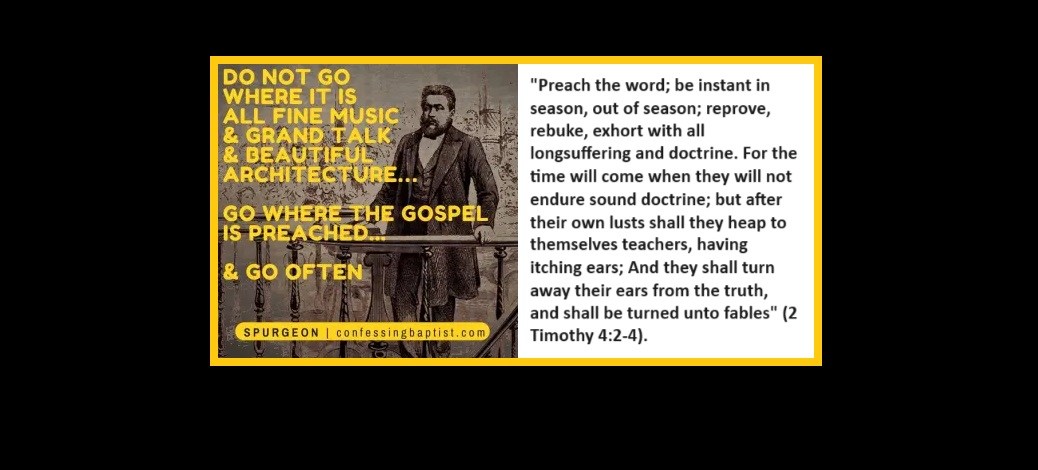

Previous Lesson:
3. A Church Is a Mystery, an Assembly, a Spiritual Body

Next Lesson:
Christ, the Head/Bridegroom/Husband of the Local Church

Click here to go to all lessons on the Bible Doctrine of the Church.

Click here to go to the written lessons.

Click here to go to the 5 minute video lectures.


Jerald Finney
Copyright © January 2, 2018


The Bible expressly declares that the Holy Spirit is a divine Person (e.g., Jn. 14.16, 16, 26; 15.26; 16.7-15; Mt. 28.19). This is everywhere implied.

The Holy Spirit forms a church. When Peter opened the door of the kingdom to the Gentiles (Ac. 10), the Holy Spirit, without delay, or other condition than faith, was given to those who believed (Ac. 10.44; 11.15-18). This is the permanent fact for the entire church-age. Every believer is born of the Spirit (Jn. 3.3, 6; 1 Jn. 5.1), indwelt by the Spirit, whose presence makes the believer’s body a temple (Ga. 4.6, Ro. 8.9-15 (“if any man have not the Spirit of Christ, he is none of his”); 1 Co. 3.16-17; 1 Co. 6.19; 1 Jn. 2.27;), thus sealing him for God (Ep. 1.13; 4.30). The Holy Spirit imparts gifts for service to every member of that body (1 Co. 12.7-11, 27, 30; Ep. 4.3-4; 11, 16), guides the members in their service and is Himself the power of that service (Lk. 2.27; 4.1; Ac. 1.8; 2.4; Ac. 16.6, 7; 1 Co. 2.4; 12.4-11). The Spirit abides in the company of believers who constitute a local church, making of them, corporately, a temple (1 Co. 3.16, 17; 2 Co. 6.16; Ep. 2.21).

A church is called the body of Christ, and therefore a living organism a spiritual body. Paul gives two metaphors of the body, the living spiritual body or organism. The first is in 1 Corinthians 12.12-27, quoted in En [i]. The second is in Ephesians 4:4-16, quoted in En [ii]

In other passages, Christ is depicted as the head of the church and the earthly members as the body. Remember that these passages are from Epistles written to local churches for their instruction.

  1. “And hath put all things under his feet, and gave him to be the head over all things to the church, Which is his body, the fulness of him that filleth all in all” (Ep. 1.22-23).
  2. “But speaking the truth in love, may grow up into him in all things, which is the head, even Christ:  From whom the whole body fitly joined together and compacted by that which every joint supplieth, according to the effectual working in the measure of every part, maketh increase of the body unto the edifying of itself in love” (Ep. 4.15-16).
  3. “And not holding the Head, from which all the body by joints and bands having nourishment ministered, and knit together, increaseth with the increase of God” (Col. 2.19).

A church is a holy temple for the habitation of God through the Spirit (Ep. 2.21, 22); is “one flesh” with Christ (Ep. 5.30, 31); and espoused to Him as a chaste virgin to one husband (2 Co. 11.2-4). By speaking the truth in love, a church “may grow up into him in all things, which is the head, even Christ.”


For more details, to include an examination of conflicting views, see Definition, Organization, and Purposes of a Church.

Click here to go to Bible Study of Ephesians. Ephesians reveals the institution of the church as God’s masterpiece. It is more wonderful that any temple made with hands, constructed of living stones, indwelt by the Holy Spirit. Ephesians 1 presents the church as a body.

Articles, Essays, and Other Resources Related to the Doctrine of the Church, Incorporation, 501c3, Etc.

The Local Church: A Building or What?

Bible Studies of various Books on the Doctrine of the Church.

The Biblical Doctrine of the Church


Endnotes

[i] 1 Corinthians 12.12-27: “For as the body is one, and hath many members, and all the members of that one body, being many, are one body: so also is Christ. For by one Spirit are we all baptized into one body, whether we be Jews or Gentiles, whether we be bond or free; and have been all made to drink into one Spirit. For the body is not one member, but many. If the foot shall say, Because I am not the hand, I am not of the body; is it therefore not of the body? And if the ear shall say, Because I am not the eye, I am not of the body; is it therefore not of the body? If the whole body were an eye, where were the hearing? If the whole were hearing, where were the smelling? But now hath God set the members every one of them in the body, as it hath pleased him. And if they were all one member where were the body? But now are they many members, yet but one body. And the eye cannot say unto the hand, I have no need of thee: nor again the head to the feet, I have no need of you.  Nay, much more those members of the body, which seem to be more feeble, are necessary: And those members of the body, which we think to be less honourable, upon these we bestow more abundant honour; and our uncomely parts have more abundant comeliness. For our comely parts have no need: but God hath tempered the body together, having given more abundant honour to that part which lacked: That there should be no schism in the body: but that the members should have the same care one for another. And whether one member suffer, all the members suffer with it; or one member be honoured, all the members rejoice with it. Now ye are the body of Christ, and members in particular” (1 Co. 12.12-27)

[ii] Ephesians 4:4-16: “There is one body, and one Spirit, even as ye are called in one hope of your calling; One Lord, one faith, one baptism, One God and Father of all, who is above all, and through all, and in you all. But unto every one of us is given grace according to the measure of the gift of Christ. Wherefore he saith, When he ascended up on high, he led captivity captive, and gave gifts unto men.  (Now that he ascended, what is it but that he also descended first into the lower parts of the earth? He that descended is the same also that ascended up far above all heavens, that he might fill all things.)  And he gave some, apostles; and some, prophets; and some, evangelists; and some, pastors and teachers; For the perfecting of the saints, for the work of the ministry, for the edifying of the body of Christ: Till we all come in the unity of the faith, and of the knowledge of the Son of God, unto a perfect man, unto the measure of the stature of the fulness of Christ:  That we henceforth be no more children, tossed to and fro, and carried about with every wind of doctrine, by the sleight of men, and cunning craftiness, whereby they lie in wait to deceive; But speaking the truth in love, may grow up into him in all things, which is the head, even Christ:  From whom the whole body fitly joined together and compacted by that which every joint supplieth, according to the effectual working in the measure of every part, maketh increase of the body unto the edifying of itself in love.”

The local church sanctified and cleansed by the washing of water by the word——————–A ministry of Charity Baptist Tabernacle of Amarillo, Texas led by Pastor Ben Hickam. "Would to God ye could bear with me a little in my folly: and indeed bear with me. For I am jealous over you with godly jealousy: for I have espoused you to one husband, that I may present you as a chaste virgin to Christ. But I fear, lest by any means, as the serpent beguiled Eve through his subtilty, so your minds should be corrupted from the simplicity that is in Christ" (2 Corinthians 11:1-3). ————————————Jerald Finney, a Christian Lawyer and member of Charity Baptist Tabernacle, having received this ministry in the Lord, explains how a church in America can remain under the Lord Jesus Christ and Him only. "As every man hath received the gift, even so minister the same one to another, as good stewards of the manifold grace of God. If any man speak, let him speak as the oracles of God; if any man minister, let him do it as of the ability which God giveth: that God in all things may be glorified through Jesus Christ, to whom be praise and dominion for ever and ever. Amen" (1 Peter 4:10-11; See also, Ephesians 4::1-16 and 1 Corinthians 12:1-25). "Take heed to the ministry which thou hast received in the Lord, that thou fulfil it" (Colossians 4:17). "And hath put all things under his feet, and gave him to be the head over all things to the church" (Ephesians 1.22; See also, e.g. Colossians 1:18).