Copyright © January, 2010 by Jerald Finney
- Martyr’s Song by Watchmen (Click link to listen to this song)
- Book: Martyr’s Mirror in online PDF (Can be downloaded)Martyrs Mirror or The Bloody Theater, first published in Holland in 1660 in Dutch by Thieleman J. van Braght, documents the stories and testimonies of Christian martyrs. This 7 minute quick paced video highlights stories of martyrs with music and drawings. Martyrs Mirror Part 1 on YouTube. Martyrs Mirror Part 2 on Youtube (6 minute 18 second video).
- Jerald Finney’s full-length version of The History of the First Amendment (with chapters on “Christian” revisionism).
Outline
I. Introduction
II. Trial of John Bunyan
III. Persecution of believers until the colonization of America
IV. Religious freedom recognized in America
V. Post disestablishment and conclusion
Endnotes
I. Introduction
The story of the First Amendment to the United States Constitution begins with the first New Testament martyr and includes all the subsequent millions who were persecuted and killed because they placed their faith in the Lord Jesus Christ, and Him alone. You see, the heroes of the faith had and have life and liberty, unlike millions of contemporary American “Christians.” Martyrs—and those truly willing to give their life for Christ but who have not suffered martyrdom—have life because they have Christ. They also have been made free through Holy Spirit led study of God’s Word: Jesus said “to those Jews which believed on him, If ye continue in my word, then are ye my disciples indeed; And ye shall know the truth, and the truth shall make you free” (Jn. 8.31-32). Although the religious crowd may persecute and perhaps kill them, no one can take either their eternal lives or their liberty.
These martyrs and persecuted ones, including those in the American colonies, comprise the remnant who have, in every age, kept the light of Christ alive in spite of their sufferings. The climax of the sufferings of the saints occurred when the United States, by adding the First Amendment to her Constitution, made America the first modern nation, and the second civil government, to recognize the God ordained principle of religious liberty or separation of church and state (not separation of God and state).
Indeed, freedom of religion was
“unknown at the time of the birth of Jesus. Even the ancient republics never recognized it…. Early did Christians avow and amplify religious liberty. The blood of persecution brought to the front this doctrine…. Freedom of religion is hardly a Protestant [or Catholic] doctrinal tenet, but it does belong to the Baptists…. The state of Teprice in Armenia, in the ninth century, gave absolute freedom of opinion and conscience for one hundred and fifty years before being overcome. All around them were persecutions for conscience sake – they themselves had lost one hundred thousand members by persecutions in the reign of Theodora – yet here was a shelter offered to every creed and unbeliever alike. The Baptists have always set up religious liberty when they had the opportunity.”
John T. Christian, A History of the Baptists, (Texarkana, Arkansas-Texas: Bogard Press), pp. 38-41, 51-52.
Religious liberty is a Baptist distinctive; and, historic Baptists are the primary people responsible for this freedom in those modern nations which recognize it. By Baptist is meant those who – regardless of identifying name such as Waldensian, Donatist, etc., adhere to certain fundamental Bible principles – one of those being separation of church and state or religious freedom and freedom of conscience. America was the first modern nation to guarantee freedom of conscience and religion (separation of church and state), and Rhode Island had set the example later followed by America and, later, some other nations. In many nations Christians are still persecuted, tortured, and ruthlessly murdered.
After this introduction and before going to the beginning, I will give the view of one very famous martyr, John Bunyan, as to the relationship between church and state. I will do this by quoting from his trial which occurred at a point in time in which both England and the United States were on the road to the rejection of the heretical biblical teaching that resulted in the union of church and state and the murders by the state-church combinations of untold millions of those labeled as “heretics” [EN1]. From there, I will give an overview of the persecution of believers from John the Baptist until the colonization of America. Then, I will summarize the theological warfare in the American colonies that culminated in the First Amendment.
Please consider that the information you will read is factual. The author is a born-again believer and lawyer who has been, since his salvation, a faithful member of an independent fundamental Baptist Church. Further consider that he has worked many years to try to bring America back under God. Like millions of other American Christians who have worked for this cause, he has experienced much frustration as he saw America continue to deteriorate morally, spiritually, and in every other way. This article presents his findings of fact gained over several years of intense study of the Bible, law, and history—the American history courses he had taken, his First Amendment class at the University of Texas School of Law, and a considerable volume of “Christian” writings censored these facts. These facts must be known, understood, and applied in order for Christians to proceed “according to knowledge” and, therefore, before God will honor the spiritual warfare of Christian soldiers (See 2 Pe. 1:4-10; Ho. 4:6-9; 2 Ti. 2:3-4; Ep. 6:10-18). I am sure that most, like the author before he searched the annals of history, do not know many of these preeminent, actual, and verifiable occurrences and writings.
II. The trial of John Bunyan [Click to go to the complete transcript of the trial]
 The trial of John Bunyan is instructive to one who wishes to please our Lord. Mr. Bunyan was arrested and charged with persistent and willful transgression of the Conventicle Act which prohibited all British subjects from absenting themselves from worship in the Church of England, and from conducting services apart from that church. He refused counsel and admitted that he had never attended services in the Church of England and stated that he never intended to do so. He continued,
“secondly, it is no secret that I preach the Word of God whenever, wherever, and to whomever He pleases to grant me opportunity to do so. I have no choice but to acknowledge the awareness of the law which I am accused of transgressing. Likewise, I have no choice but to confess my guilt in my transgression of it. As true as these things are, I must affirm that I neither regret breaking the law, nor repent of having broken it. Further, I must warn you that I have no intention of conforming to it.” I now continue with the dialogue between Bunyan and Judge Wingate.
“Judge Wingate: ‘It is obvious, sir, that you are a victim of deranged thinking. If my ears deceive me not, I must infer from your words that you believe the State to have no interest in the religious life of its subjects.’
“John Bunyan: ‘The State, M’lord, may have an interest in anything in which it wishes to have an interest. But the State has no right whatever to interfere in the religious life of its citizens.’
“Judge Wingate: ‘The evidence I hold in my hand, even apart from your own admission of guilt, is sufficient to convict you, and the Court is within its rights to have you committed to prison for a considerably long time. I do not wish to send you to prison, Mr. Bunyan. I am aware of the poverty of your family, and I believe you have a little daughter who, unfortunately, was born blind. Is this not so?’
“John Bunyan: ‘It is, M’Lord.’
 “Judge Wingate: ‘Very well. The decision of the Court is this: In as much as the accused has confessed his guilt, we shall follow a merciful and compassionate course of action. We shall release him on condition that he swear solemnly to discontinue the convening of religious meetings, and that he affix his signature to such an oath prior to quitting the Courtroom. That will be all, Mr. Bunyan. I hope not to see you here again. May we hear the next case?’
“John Bunyan: ‘M’lord, if I may have another moment of the Court’s time?’
“Judge Wingate: ‘Yes, but you must be quick about it. We have other matters to attend to. What is it?’
“John Bunyan: ‘I cannot do what you ask of me, M’lord. I cannot place my signature upon any document in which I promise henceforth not to preach. My calling to preach the Gospel is from God, and He alone can make me discontinue what He has appointed me to do. As I have no word from Him to that effect, I must continue to preach, and I shall continue to preach.’
“Judge Wingate: ‘I warn you, sir, the Court has gone the second mile to be lenient with you, out of concern for your family’s difficult straits. Truth to tell, it would appear that the Court’s concern for your family far exceeds your own. Do you wish to go to prison?’
“John Bunyan: ‘No, M’lord. Few things there are that I would wish less.’
“Judge Wingate: ‘Very well, then, Mr. Bunyan. This Court will make one further attempt in good faith to accommodate what appears to be strongly held convictions on your part. In his compassion and beneficence, our Sovereign, Charles II, has made provision for dissenting preachers to hold some limited licenses.
“‘You will not find the procedure burdensome, and even you, Mr. Bunyan, must surely grant the legitimacy of the State’s interest in ensuring that any fool with a Bible does not simply gather a group of people together and begin to preach to them. Imagine the implications were that to happen! Can you comply with this condition, Mr. Bunyan?
“‘Before you answer, mark you this: should you refuse, the Court will have no alternative but to sentence you to a prison term. Think, sir, of your poor wife. Think of your children, and particularly of your pitiful, sightless little girl. Think of your flock, who can hear you to their hearts’ content when you have secured your licenses. Think on these things, and give us your answer, sir!’
“John Bunyan: ‘M’lord, I appreciate the Court’s efforts to be as you have put it – accommodating. But again, I must refuse your terms. I must repeat that it is God who constrains me to preach, and no man or company of men may grant or deny me leave to preach. These licenses of which you speak, M’lord, are symbols not of a right, but of a privilege. Implied therein is the principle that a mere man can extend or withhold them according to his whim. I speak not of privileges, but of rights. Privileges granted by men may be denied by men. Rights are granted by God, and can be legitimately denied by no man. I must therefore refuse to comply.’
“Judge Wingate: [Proceeded to sentence Mr. Bunyan to six years in the Bedford jail which ended up costing Mr. Bunyan 12 years of his life behind bars.]”[EN2]
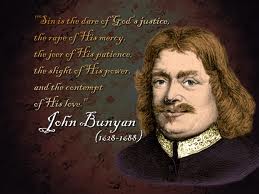
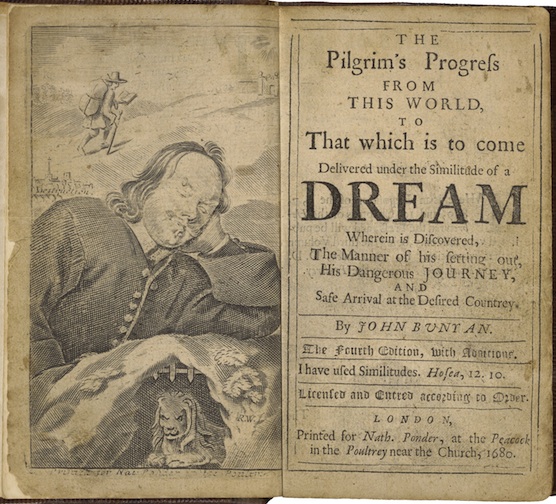
John Bunyan did not suffer the fate of many of his spiritual ancestors who had stood against union of church and state in any manner, although most of them never received a trial. The court did not sentence him to death by beheading, fire, drowning, or some other horrible means. Instead, the court sentenced him to a term in prison; but “the wrath of man was made to praise God; for had not his zealous servant been compelled to this solitude, we should not have had that masterpiece of literature,” Pilgrim’s Progress, a book full of biblical truth and a book for all people for all time.[EN3]
After being released after 12 years in prison, he continued to produce fruit for the Glory of God. For example, many Baptist churches were gathered as a result of his labors.[EN4] Mr. Bunyan followed a long line of believers, from John the Baptist forward, who had died and/or been persecuted for their faith. Starting with the apostles, all of whom except John died for their faith, true believers have always stood on the principle, “We ought to obey God rather than men (Ac. 5.29)”—refusing to give up the life given them when they placed their faith in Jesus Christ, and their liberty gained through coming to a knowledge of truth as a result of continuing in God’s Word after their salvation.
John Bunyan: A Reading and Commentary (072414)(Pastor Jason Cooley)
John Bunyan: Five Uses by way of Self-Examination (Are you saved?) w/commentary (091915)(Pastor Jason Cooley)
III. Persecution of believers until the colonization of America
Historically, Christians, as warned by Jesus and the apostles, have been persecuted for their faith. Their persecutions were usually the result of obeying God rather than a lower earthly authority—the civil authority and/or the established religion. Christians were persecuted from the beginning of the church. After union of church and state in the fourth century, the established “church,” in conjunction with the state, persecuted Christians.
 John the Baptist is of utmost importance. With him, “[a] new light had burst upon a sin cursed world. A new era had dawned. Another kingdom was about to be ushered in.” [EN5] He was the forerunner and way preparer of Jesus. “He cannot be made to fit the notion that the church of Christ and the world-that-lies-around-it are ‘of-a-piece’, that Christianity is similar to ethnic faiths.”[EN6] He introduced a thought system at odds with that of the Old Testament in which religion and state were integrated as a theocracy, a thought system that was first recognized in America, first by the governing documents of the colony of Rhode Island and second by the First Amendment to the United States Constitution. He preached a baptism that required a choice, and he preached it to all, including Jew and Gentile and including those of every position in society. The change required for his baptism required repentance on the level of the spiritual. Because of his open stand, John the Baptist became the first martyr for the faith. As most Christians are aware, John was decapitated as a result of exposing the sin of Herod—having Herodias, his brother Philip’s wife (Mt. 14:1-13; Mk. 6:14-19; Lu. 9:7-9).
 The next Christian martyr was our Lord Himself who came to earth to be persecuted and crucified, as prophesied in many Old Testament passages. Jesus continued and expanded upon this new system introduced by John the Baptist. Jesus used a modifier with the word “kingdom,” an adjective to keep two-of-a-kind apart: He spoke of the “kingdom of heaven” and the “kingdom of earth.”[EN7] He preached two kinds of sermons—one for believers and one for non-believers.[EN8] He even distinguished between two jurisdictions when he said, “Then saith he unto them, Render therefore unto Caesar the things which are Caesar’s; and unto God the things that are God’s” (Mt. 22:21). When Jesus felt the need of a sanctuary, He did not go to the temple (the center of the unified Jewish nation/religion); He, like John the Baptist, went to the desert. “His body was a replacement-of-the-temple, not only in the matter of being torn-down and then put-together again, but also as the instrument intended for contact-making between man and Maker.”[EN9] Unlike the theocracy of Israel and Gentile pagan nations which united religion and state in which the religion/state sought to unify all members of the nation walking lockstep for the same goals and which was intended to bring peace and unity through that system, Jesus said, “Think not that I am come to send peace on earth: I came not to send peace, but a sword. For I am come to set a man at variance against his father, and the daughter against her mother, and the daughter in law against her mother in law. And a man’s foes shall be they of his own household” (Mt. 10:34-36). The religious/civil system in place was so at variance with Him that the religious leaders, who should have known through Scripture who He was, used the arm of the state to put Him to death. In effect, He lay down His life for those who would call upon His name. The First Amendment was in line with Jesus’ thought system.
“Out of the thought program begun by John the Baptist, and continued by Christ, came the Church of Christ.”[EN10] Jesus’ followers continued the example set by Him and John the Baptist. They had and have the promise of persecution: “Yea, and all that will live godly in Christ Jesus shall suffer persecution” (2 Ti. 3:12). Jesus preached to the multitudes concerning persecution of His followers:
 “Blessed are they which are persecuted for righteousness’ sake: for theirs is the kingdom of heaven. Blessed are ye when men shall revile you, and persecute you, and shall say all manner of evil against you falsely, for my sake. Rejoice, and be exceeding glad: for great is your reward in heaven: for so persecuted they the prophets which were before you” (Mt. 5.10-12).
Jesus warned the disciples that His followers would suffer persecution:
“If the world hate you, ye know that it hated me before it hated you. If ye were of the world, the world would love his own: but because ye are not of the world, but I have chosen you out of the world, therefore the world hateth you. Remember the word that I said unto you, The servant is not greater than his lord. If they have persecuted me, they will also persecute you; if they have kept my saying, they will keep yours also. But all these things will they do unto you for my name’s sake, because they know not him that sent me” (Jn. 15.18-21). [Emphasis mine.]
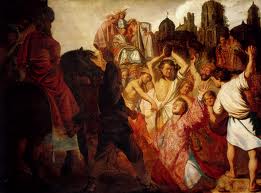
Following the crucifixion of the Savior “in rapid succession fell many other martyred heroes [in addition to Stephen, already mentioned, and Paul, infra]: … Matthew was slain in Ethiopia, Mark dragged through the streets until dead, Luke hanged, Peter and Simeon were crucified, Andrew tied to a cross, James beheaded, Philip crucified and stoned, Bartholomew flayed alive, Thomas pierced with lances, James, the less, thrown from the temple and beaten to death, Jude shot to death with arrows, Matthias stoned to death….” [EN11]
At first, the persecution of Christians was by the Jewish religious leaders. Paul (then called Saul) was present at the stoning of Stephen, the first Christian martyr after the resurrection of Christ (Ac. 8.1). Paul, before salvation, was actively involved in persecution: “As for Saul, he made havock of the church, entering into every house, and haling men and women committed them to prison” (Ac. 8.3). After Paul’s salvation, he was persecuted and finally beheaded. He was seized by the Jews during his last visit to Jerusalem. They would have killed him, but as they were beating him, the chief captain of the Romans took soldiers and centurions, intervened, and held him. At that time Paul was allowed to speak to the people. He said,
“I am verily a man which am a Jew, born in Tarsus, a city in Cilicia, yet brought up in this city at the feet of Gamaliel, and taught according to the perfect manner of the law of the fathers, and was zealous toward God, as ye all are this day. And I persecuted this way unto the death, binding and delivering into prisons both men and women” (Ac. 22.3-4).
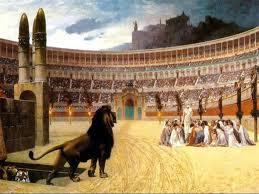 Rome persecuted Christians off and on until the early fourth century. The persecution varied in extent and duration with various emperors.[EN12] Then, some “churches” were recognized by the state and formed a union with the state and became the official state “church.”
- “[U]nder the leadership of Emperor Constantine there [came] a truce, a courtship and proposal of marriage. The Roman Empire through its emperor [sought] a marriage with Christianity. Give us your spiritual power and we will give you of our temporal power….
- “In A.D. 313, a call was made for a coming together of the Christian churches or their representatives. Many but not all came. The alliance was consummated. A Hierarchy was formed. In the organization of the Hierarchy, Christ was dethroned as head of the churches and Emperor Constantine enthroned (only temporarily, however) as head of the church. “[This was the beginning of what became the Catholic church.]
- “Let it be definitely remembered that when Constantine made his call for the council, there were very many of the Christians … and of the churches, which declined to respond. They wanted no marriage with the state, and no centralized religious government, and no higher ecclesiastical government of any kind, than the individual church.”[EN13]
 Before the union of church and state, both Judaism and Paganism, using the arm of the state, had persecuted Christians who loved their Lord and refused to obey civil or any other authority which required Christians to violate the will of the Supreme Authority. After the union, “Christians” began to persecute Christians. “Thus [began] the days and years and even centuries of a hard and bitter persecution against all those Christians who were loyal to the original Christ and Apostolic teachings.”[EN14] Some leaders of that new state “church” who had supported liberty, “forgot what they had preached in their youth” and supported persecution of dissenters. The most significant of these was Augustine:
- “Augustine made much use of the passage in Luke 14.23: ‘Go out into the highways and hedges, and compel them to come in, that my house may be filled.’ His position on religious liberty has been summarized in the maxim commonly (though erroneously) ascribed to him: ‘When error prevails, it is right to invoke liberty of conscience; but when, on the contrary, the truth predominates, it is just to use coercion.’
- “Augustine’s influence on the course of religious liberty and the relationship of church and state can hardly be measured. Fifteen hundred years have passed since his death, yet his teachings are still a potent factor in the position of the Catholic Church on the subject of religion and government. As a result of his teaching, the principle that religious unity ought to be imposed in one way or another dominates the whole of the Christian Middle Ages and finds a concise and rigorous sanction in civil as well as in ecclesiastical legislation.
- “Because of Augustine, more than any other person, ‘the Medieval church was intolerant, was the source and author of persecution, justified and defended the most violent measures which could be taken against those who differed from it.’”[EN15]
 The Donatists were among the first dissenters persecuted by the church-state union. The Council of Arles, prior to the union of church and state in 325, decided, in a Kangaroo court, against the Donatists; and “the Emperor enforced the decision with the secular arm.”[EN16] After the Council of Nicæa, Constantine issued an edict against all dissenters, including the Donatists, forbidding their meetings in private or public, ordering their places of worship torn down, their property confiscated to the Catholic Church.[EN17]
The purpose of the persecutions against the Donatists was stated by Augustine: “To crush the immodesty and to curb the audacity of the men whose madness had so overrun all Africa that the Catholic truth could not be preached in many places.”[EN18] The Catholic church, using Old Testament passages to justify their actions, committed savage cruelties and violence against dissenters. Executioners “who had obtained favor with secular princes in the deaths of the saints, when very many venerable ministers were killed, others were sent into exile, and the sacred cause of Christianity was harassed far and wide; virgins were violated, the wealthy were proscribed, the poor were spoiled, and ministers who were fleeing from their own churches were taken in their flight.”[EN19]
The Middle Ages reflected the thinking of “Augustine and Aquinas, who taught that salvation could be achieved through compulsion, and that oppression and persecution of heretics was not merely the right but the holy duty of the Church.”[EN20] “Over 50,000,000 Christians died martyr deaths … during the period of the ‘dark ages’ alone—about twelve or thirteen centuries.”[EN211]
The Inquisition was instituted in 1215 A.D. at a Council called by Pope Innocent III:
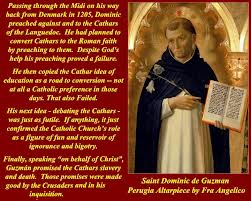 “[P]robably the most cruel and bloody thing ever brought upon any people in all the world’s history was what is known as the ‘Inquisition,’ and other similar courts, designed for trying what was called ‘heresy.’ The whole world is seemingly filled with books written in condemnation of that extreme cruelty, and yet it was originated and perpetuated by a people claiming to be led and directed by the Lord. For real barbarity there seems to be nothing, absolutely nothing in all history that will surpass it.”[EN22]
The atrocities and heresies of the Catholic “church” eventually led to an effort to reform that “church” from within. Among the greatest of the reformers were Martin Luther, who started the Lutheran church (which became the state-church of Germany), and John Calvin, founder of the Presbyterian church (which became the state-church of Scotland). During this period of reformation, there always existed those who dissented from Catholic and Reformation theology. In early sixteenth century Germany, two currents flowed in opposite directions. One, fostered by the established church, was toward a state-church. The other, promoted by dissenters, was toward separation of church and state. When a Protestant church became an established church it continued the persecution practiced by the harlot church. “Both the Lutheran and Presbyterian Churches brought out of their Catholic Mother many of her evils, among them her idea of a State Church. They both soon became Established Churches. Both were soon in the persecuting business, falling little if any, short of their Catholic Mother.”[EN23]
- Martin Luther wrote: “It is out of the question that there should be a common Christian government over the whole world. Nay, over even one land or company of people since the wicked always outnumber the good. A man who would venture to govern an entire country or the world with the Gospel would be like a shepherd who would place in one fold wolves, lions, eagles, and sheep together and let them freely mingle with one another and say, ‘Help yourselves, and be good and peaceful among yourselves. The fold is open, there is plenty of food, have no fear of dogs and clubs.’ The sheep forsooth would keep the peace and would allow themselves to be fed and governed in peace; but they would not live long nor would any beast keep from molesting another. For this reason, these two kingdoms must be sharply distinguished and both be permitted to remain. The one to produce piety, the other to bring about external peace and prevent evil deeds. Neither is sufficient to the world without the other.”[EN24]
- “When Luther was expecting excommunication and assassination, he pleaded that: Princes are not to be obeyed when they command submission to superstitious error, but their aid is not to be invoked in support of the Word of God. Heretics, he said, must be converted by the Scriptures, and not by fire. With passion he asserted:
- “I say, then neither pope, nor bishop, nor any man whatever has the right of making one syllable binding on a Christian man, unless it be done with his own consent. Whatever is done otherwise is done in the spirit of tyranny…. I cry aloud on behalf of liberty and conscience, and I proclaim with confidence that no kind of law can with any justice be imposed on Christians, except so far as they themselves will; for we are free from all.”[EN25]
- Nonetheless, Luther later, when he had made an effective alliance with the secular power, advocated that the magistrate, who does not make the law of God, enforce the law of God. According to Luther, “The law is of God and from God. The State is the law-enforcing agency, administering a law of God that exists unchangeably from all eternity….
- “The need for a state arises from the fact that all men do not hear the word of God in a spirit of obedience. The magistrate does not make the law, which is of God, but enforces it. His realm is temporal, and the proper ordering of it is his responsibility. Included in the proper ordering the maintenance of churches where the word of God is truly preached and the truly Christian life is taught by precept and example. In his realm, subject to the law of God, the Prince is supreme, nor has man the right to rebel against him. But if the Prince contravenes the law of God, man may be passively disobedient, in obedience to a higher and the only finally valid law.”[EN26]
- “Heretics are not to be disputed with, but to be condemned unheard, and whilst they perish by fire, the faithful ought to pursue the evil to its source, and bathe their hands in the blood of the Catholic bishops, and of the Pope, who is the devil in disguise.”[EN27]
Luther espoused that coercion by the state to achieve religious unity was justifiable. This was an expansion of Erastian philosophy—“the assumption of state superiority in ecclesiastical affairs and the use of religion to further state policy.” Erastianism … pervaded all Europe, with the exception of Calvin’s ecclesiocratic Geneva, after the Reformation.[EN28] Erastianism achieved its greatest triumph in England.[EN29]
Luther’s position resulted in persecution of dissenters such as Anabaptists who believed in believer’s baptism. Although there is no reason to believe that the Anabaptists were explicit believers in a separation of church and state and in religious tolerance, opposition to a state-church follows logically from their thinking behind adult baptism:
 “Believer’s baptism [was] the key to religious thought of the Anabaptists. Infant baptism implies that a child may be admitted into the Church without his understanding or personal consent. Such a church must be a formal organization, with sponsored membership possible for those whose years permit neither faith nor understanding. Adult baptism implies a different concept of the Church. The anabaptized are the elect of a visible church which is essentially a religious community of the elect. But obviously such a church could in no sense be a State Church. The Prince could neither bring it into being, regulate it, nor enforce membership in it; indeed, any connection between the State and such a church could only be injurious to the Church. Adult baptism on the surface is remote from the concept of a separated Church and State, yet such separation is implicit in the rationale of Anabaptism. The call to such a church can never come from the palace of the Prince; it must come from the Kingdom of Heaven….”[EN30] [Emphasis mine.]
J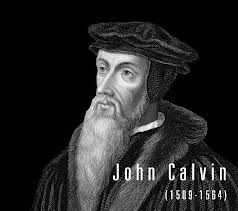 ohn Calvin pointed out that “‘these two [church and state] … must always be examined separately; and while one is being considered, we must call away and turn aside the mind from thinking about the other.’ He followed this approach in order to expound the ‘[d]ifferences between spiritual and civil government,’ insisting that ‘we must keep in mind the distinction … so that we do not (as so commonly happens) unwisely mingle these two, which have a completely different nature.’”[EN31] He taught that “the church does not assume to itself what belongs to the magistrate, nor can the magistrate execute that which is executed by the Church.”[EN32]
However, when Calvin established his ecclesiocracy (the author uses this term to denote a civil government in which the church and state work together to enforce spiritual and earthly laws unlike the theocracy in Israel in which God himself was directly over the state) in Geneva, absence from the sermon, and missing the partaking of the Sacrament were punished. “Criticism of the clergy was included in the crime of blasphemy and blasphemy was punishable by death” as was the contention that “it is unjust to put heretics and blasphemers to death.”[EN33] Government had “‘the duty of rightly establishing religion’ and had as its ‘appointed end’ to ‘cherish and protect the outward worship of God, to defend sound doctrine of piety and the position of the church.’”[EN34] Calvin’s ecclesiocratic relationship of church and state was “based on ecclesiastical supremacy and the use of state machinery to further religious interests.”[EN35]
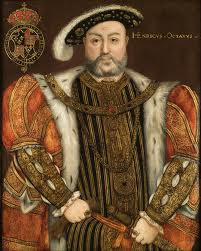
During this same period, the Church of England arose from a split or division in the Catholic ranks. Henry VIII, king of England, “threw off papal authority and made himself head of the Church of England” when the Pope refused to grant him a divorce from Catherine of Spain so that he could marry Anne Boelyn. Henry’s successor, Mary, reinstated Catholicism, but her successor, Elizabeth, re-established the Church of England.
“Thus, before the close of the Sixteenth Century, there were five established Churches—churches backed up by civil governments—the Roman and Greek Catholics [the Greek Catholics separated from the Roman Catholics in the ninth century] counted as two, then the Church of England; then the Lutheran, or Church of Germany, then the Church of Scotland now known as the Presbyterian. All of them were bitter in their hatred and persecution of the people called Ana-Baptists, Waldenses and all other non-established churches, churches which never in any way had been connected with the Catholics…. Many more thousands, including both women and children were constantly perishing every day in the yet unending persecutions. The great hope awakened and inspired by the reformation had proven to be a bloody delusion. Remnants now [found] an uncertain refuge in the friendly Alps and other hiding places over the world.”[EN36]
Sometime in the early seventeenth century, the Congregational church began. That church repudiated preacher rule and returned “to the New Testament democratic idea” while retaining many other “Catholic made errors such as infant baptism, pouring or sprinkling for baptism, and later adopted and practiced to an extreme degree the church and state idea. And, after refugeeing to America, themselves, became very bitter persecutors.”[EN37]
IV. Religious freedom recognized in America
A detailed history of the theological warfare and persecution of dissenters in the colonies is beyond the scope of this article. You may read a much more comprehensive account of the facts that led to the adoption of the First Amendment to the United States Constitution in the book, God Betrayed [EN38] or by clicking the following link: Online version of Section IV of God Betrayed, History of the First Amendment. You may also listen to much more detailed audio teachings on this subject on this blog by clicking the following link: History of the First Amendment.
Spiritual warfare in America resulted in the first and second civil governments in history (first, the colony of Rhode Island and second, the United States of America) which had complete religious freedom. In the United States, that liberty was declared by the First Amendment to the United States Constitution which says:
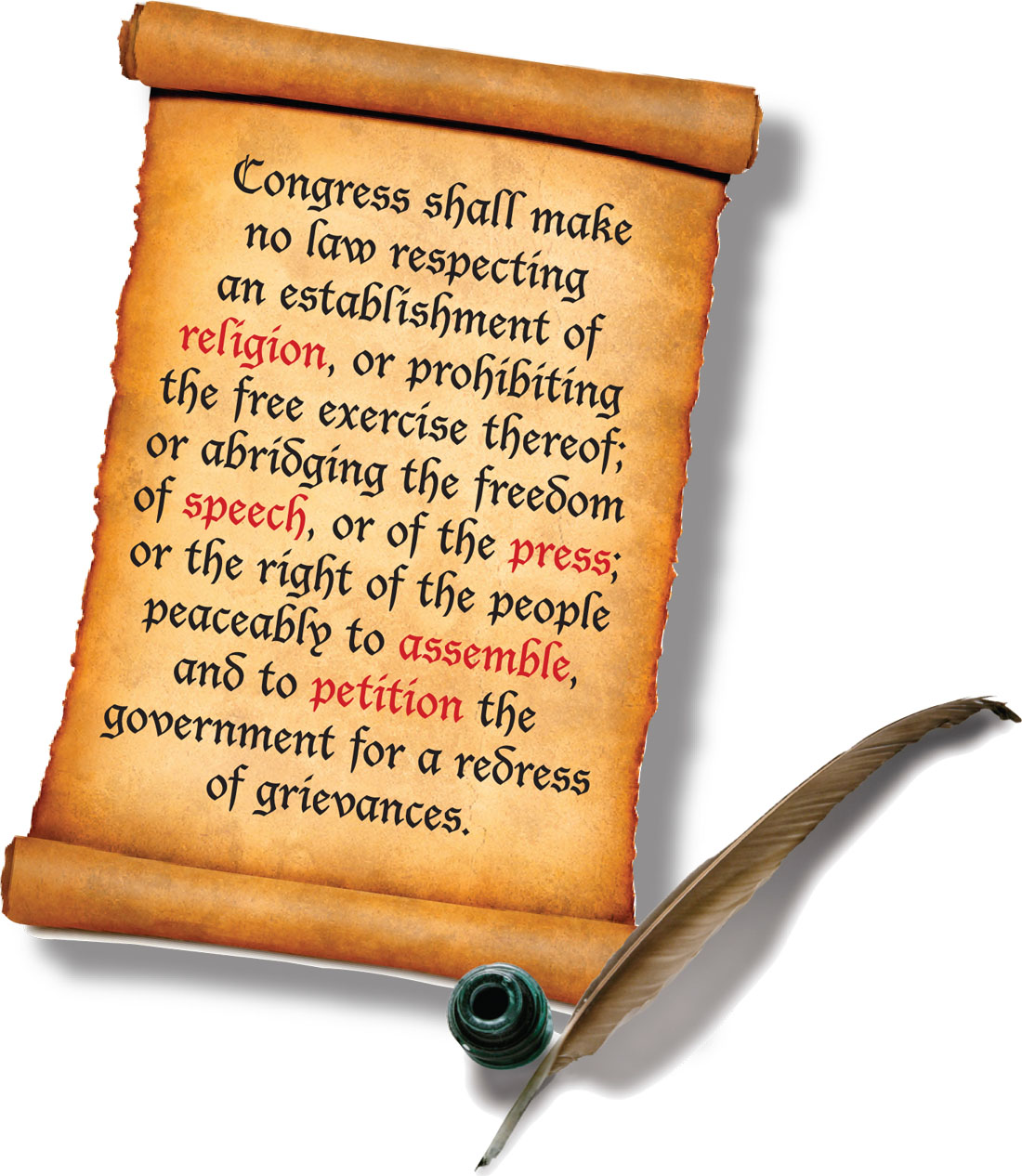
“Congress shall make no law respecting an establishment of religion, or prohibiting the free exercise thereof; or abridging the freedom of speech, or of the press; or the right of the people peaceable to assemble, and to petition the Government for a redress of grievances.”
Established churches in the American colonies persecuted dissenters. The struggle over separation of church and state moved from the old world to the new, and is probably the most important topic in the history of America. For the first time, God’s truth concerning government, church, and separation of church and state was destined to prevail, first in Rhode Island and then in the United States. Prior to this struggle and since the union of church and state in the fourth century, both Catholic and Protestant sacral doctrine which had seen church and state as a single entity working in unison for the same goals had tried unsuccessfully to stamp out all “heretics” who had never deviated from the true biblical doctrine of “separation of church and state.”
Jesus said, “They shall put you out of the synagogues: yea, the time cometh, that whosoever killeth you will think that he doeth God service” (Jn. 16:2.). In fulfillment of prophecies of the Lord, the established churches thought they were doing God’s will. “And these things will they do unto you, because they have not known the Father, nor me” (Jn. 16:3). The Old World patterns of church-state union and religious oppression were transplanted to the New World with all their rigor.[EN39] Eleven of the original thirteen colonies established a church prior to the Revolution. One of those eleven was Massachusetts which was founded by Puritans who were Congregationalists. All New England colonies, except Rhode Island, had established churches based upon the same theology. As noted by the Rhode Island Baptist, John Callender, in the early nineteenth century:
“[The Puritans] were not the only people who thought they were doing God good service when smiting their brethren and fellow-servants. All other Christian sects generally, as if they thought this was the very best way to promote the gospel of peace, and prove themselves the true and genuine disciples of Jesus Christ—‘sic,’ who hath declared, his kingdom was not of this world, who had commanded his disciples to call no man master on earth, who had forbidden them to exercise lordship over each other’s consciences, who had required them to let the tares grow with the wheat till the harvest, and who had, in fine, given mutual love, peace, long-suffering, and kindness, as the badge and mark of his religion.”[EN40]
The fight for religious liberty started in the New England colonies and then spread throughout the other colonies. The seventeenth century ended with firmly established church-states in all New England colonies except Rhode Island. The ecclesiocracies there were as absolute as the world has known, with persecution of “heretics”; but, because of intervention by England, not as brutal as past ecclesiocracies in Europe.
The Church of England was established in the southern colonies. There, “the church enjoyed the favor of the colonial governors but it lacked the one pearl without price which the Congregational Church had. No Anglican ever left England to secure freedom of worship; no Virginia Episcopalian had the fervent motivation of a Massachusetts Puritan. In Massachusetts the church was the state. In Virginia and, to a lesser degree, in the rest of the South the Church was formally part of the State although hardly a part that loomed large in southern minds.”[EN41]
The theology of the established churches in Massachusetts, Connecticut, and New Hampshire led to a combining of church and state with the established church controlling the state; enforcement of all on the Ten Commandments to include the first four; infant baptism; taxing for payment of clergy, church charities, and other church expenses; persecution of dissenters such as Baptists; and many other unscriptural practices.[EN42] Persecution of dissenters followed the example of the theocracy in Israel where, for example, Moses killed the three thousand who turned from the Lord into idolatry and immorality while he was on the mountain receiving the Ten Commandments (Ex. 32:27), and Elijah had the four hundred and fifty false prophets of Baal killed (1 K. 18:40).
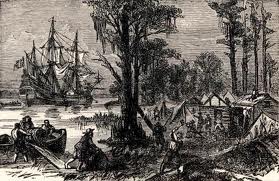
The settlers at Jamestown arrived in the New World in 1607. They set up a civil government modeled after that in England. The king was to head the state church, and those of other religious beliefs were not to be tolerated, much less be granted religious liberty.
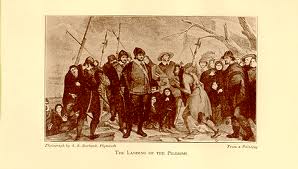 The Pilgrims landed at what was to become Plymouth, Massachusetts, in 1620. Although admirable in their quest for religious freedom for themselves, they were at first only grudgingly tolerant of those with other religious sentiments. They were few in number. “Plymouth was a Church-State ruled by a governor and a small and highly select theological aristocracy, a Church-State with various grades of citizenship and non-citizenship.”[EN43] By 1651 the government of Plymouth colony was enforcing the laws of Congregationalist Massachusetts. “By the time Plymouth was united with Massachusetts in 1691 all major differences between the two had disappeared.”[EN44]
The Puritans, unlike the Pilgrims who wanted to separate from the Church of England, wanted to purify the Church from within. “The State, in their view, had the duty to maintain the true Church; but the State was in every way subordinate to the Church.” [EN45] King James I was far more belligerently opposed to the Calvinistic church-state than even Queen Elizabeth had been, and his “determination toward the Puritans was to make them conform or to harry them out of the land.”[EN46] The Puritans who suffered under the combined pressure of accelerated persecution and the advanced moral decay in their society began to flee England for the new world.[EN47] “There was no ground at all left them to hope for any condescension or indulgence to their scruples, but uniformity was pressed with harder measures than ever.”[EN48] Cheating, double-dealing, the betrayal of one’s word were all part of the game for London’s financial district. Mercantile power brokers loved, honored, and worshipped money, and accumulated as much of it as possible and as fast as possible. The ends justified the means. “London was an accurate spiritual barometer for the rest of the country, for England had become a nation without a soul.”[EN49] England was morally awful, and this came about under the auspices of a state-church practicing its theology.[EN50] 1628 marked the beginning of the Great Migration that lasted sixteen years in which twenty thousand Puritans embarked for New England and forty-five thousand other Englishmen headed for Virginia, the West Indies, and points south.[EN51]
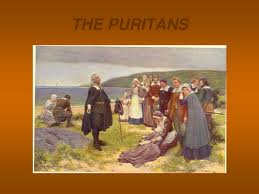
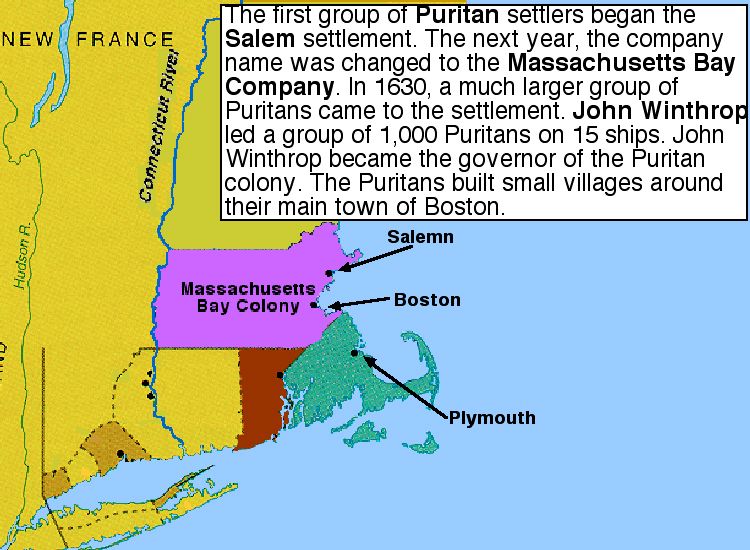 The Puritans landed at Salem at the end of June, 1629. They were motivated by religious principles and purposes, seeking a home and a refuge from religious persecution.[EN52] Having suffered long for conscience sake, they came for religious freedom, for themselves only. “They believed [in] the doctrine of John Calvin, with some important modifications, in the church-state ruled on theocratic principles, and in full government regulation of economic life.”[EN53] The Puritan churches “secretly call[ed] their mother a whore, not daring in America to join with their own mother’s children, though unexcommunicate: no, nor permit[ed] them to worship God after their consciences, and as their mother hath taught them this secretly and silently, they have a mind to do, which publicly they would seem to disclaim, and profess against.”[EN54] In 1630, 1500 more persons arrived, several new settlements were formed, and the seat of government was fixed at Boston. Thinking not of toleration of others,” they were prepared to practice over other consciences the like tyranny to that from which they had fled.”[EN55]
Roger Williams, like the Puritans, fled tyranny over thought and conscience and sought refuge for conscience amid the wilds of America. He arrived in Boston on February 5, 1631. He was highly educated and well acquainted with the classics and original languages of the Scriptures, and had been in charge of a parish in England. Although a Congregationalist, he had been exposed to and convinced of some non-congregationalist doctrines such as soul liberty or religious freedom. Immediately upon arrival, Mr. Williams, not being a man who could hide his views and principles, declared that “the magistrate might not punish a breach of the Sabbath, nor any other offence, as it was a breach of the first table.”[EN56] He also, contrary to the practice of the church at Boston, hesitated to hold communion with any church who held communion with the Church of England. “He could not regard the cruelties and severities, and oppression, exercised by the Church of England, with any feelings but those of indignation.”[EN57]
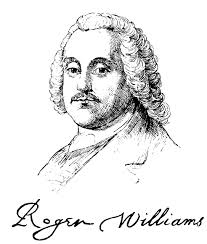 Although loved dearly by the church at Salem where he acted as pastor after he arrived, he remained at odds with the established church and government ministers in Massachusetts. In spite of the fact that “Mr. Williams appears, by the whole course and tenor of his life and conduct …, to have been one of the most disinterested men that ever lived, a most pious and heavenly minded soul,”[EN58] the Court soon summoned him “for teaching publicly ‘against the king’s patent, and our great sin in claiming right thereby to this country’” by taking the land of the natives without payment;[EN59] “and for terming the churches of England antichristian.”[EN60] Charges were brought. “He was accused of maintaining:
“(1) That the magistrate ought not to punish the breach of the first table of the law, otherwise in such cases as did disturb the civil peace.
“(2) That he ought not to tender an oath to an unregenerate man.
“(3) That a man ought not to pray with the unregenerate, though wife or child.
“(4) That a man ought not to give thanks after the sacrament nor after meat.”[EN61]

The ministers of the Court, when Mr. Williams appeared before them, “had already decided ‘that any one was worthy of banishment who should obstinately assert, that the civil magistrate might not intermeddle even to stop a church from apostasy and heresy.’”[EN62] The “grand difficulty they had with Mr. Williams was, his denying the civil magistrate’s right to govern in ecclesiastical affairs.”[EN63]
He was banished from the colony and ordered to board ship for England. Instead, he went, in the dead of winter, to what was to become Rhode Island where he was supported by the Indians whom he, throughout his long life, unceasingly tried to benefit and befriend.[EN64] He bought land from the Indians and founded the town of Providence where persecution has never “sullied its annals.”[EN65] “[T]he harsh treatment and cruel exile of Mr. Williams seem designed by his brethren for the same evil end [as that of the brethren of Joseph when they sold him into slavery], but was, by the goodness of the same overruling hand [of divine providence] turned to the most beneficent purposes.”[EN66]
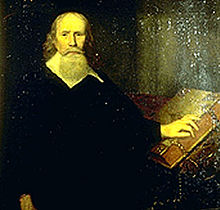
Another leader instrumental in the formation of the government of the Rhode Island colony was Dr. John Clarke, a physician. Dr. John Clarke of England moved to Boston in November of 1637. He proposed to some friends “for peace sake, and to enjoy the freedom of their consciences, to remove out of that jurisdiction.”[EN67] Their motion was granted & Dr. Clarke and eighteen families went to New Hampshire which proved too cold for their liking. They left and stopped in Rhode Island, intending to go to Long Island or Delaware Bay. There Dr. Clarke met Roger Williams. The two “immediately became fast friends and associates, working together in a most harmonious manner, both socially and politically, throughout the remainder of Clarke’s life.”[EN68] With the help of Mr. Williams they settled in that colony at Aquidneck. “The first settlement on the Island was called Pocasset; after the founding of Newport, it was renamed Portsmouth.”[EN69]
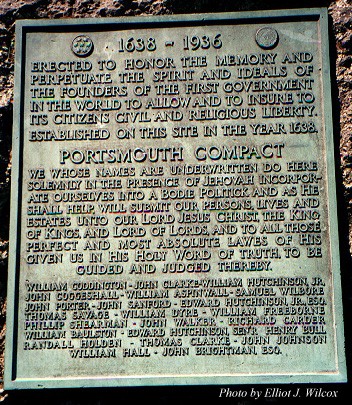
The first government in history that was to have complete freedom of conscience and religious liberty also declared that the government was to be under the Lord Jesus Christ. Signed on March 7, 1638, the Portsmouth Compact read:
“We whose names are underwritten do here solemnly, in the presence of Jehovah, incorporate ourselves into a bodie politick, and as he shall help, will submit our persons, lives and estates, unto our Lord Jesus Christ, the King of kings, and Lord of lords, and to all those perfect and most absolute lawes of his, given us in his holy word of truth, to be guided and judged thereby.” [19 signatures followed: … Three passages were marked in support of the compact: Exodus 24.3, 4; II Chronicles 11.3; and II Kings 11.17.[EN70]
This compact placed Portsmouth, Rhode Island under the one true God, the Lord Jesus Christ and His principles and laws given in the Bible. That Dr. Clarke “sought to help establish a government free of all religious restriction, one which in no way infringed upon the freedom of any religious conscience” is “evident from his remarks to the leaders of the established colonies upon his first arrival in Boston and by his subsequent activities throughout New England.”[EN71]
In August of 1638, the people of Providence approved the first public document establishing government without interference in religious matters, the Providence Compact:
“We whose names are here underwritten being desirous to inhabit in the town of Providence, do promise to submit ourselves in active or passive obedience to all such orders or agreement as shall be made for public good to the body in an orderly way, by the major consent of the present inhabitants, masters of families, incorporated together into a township, and such others whom they shall admit into the same, only in civil things.”[EN72] [Twelve signatures followed.]
As James R. Beller proclaims, the document was “the first of a series of American political documents promulgating government by the consent of the governed and liberty of conscience.”[EN73] Thus, liberty of conscience was the basis for legislation in Rhode Island, and its annals have remained to this day [when Underhill wrote this] unsullied by the blot of persecution.[EN74]
Rhode Island was ruled according to the original covenant, “til on January 2, 1639, an assembly of the freemen said:
“By the consent of the body it is agreed that such who shall be chosen to the place of Eldership, they are to assist the Judge in the execution of the justice and judgment, for the regulating and ordering of all offences and offenders, and for the drawing up and determining of all such rules and laws as shall be according to God, which may conduce to the good and welfare of the commonweal; and to them is committed by the body the whole care and charge of all the affairs thereof; and that the Judge together with the Elders, shall rule and govern according to the general rules [rule] of the word of God, when they have no particular rule from God’s word, by the body prescribed as a direction unto them in the case. And further, it is agreed and consented unto, that the Judge and [with the] Elders shall be accountable unto the body once every quarter of the year, (when as the body shall be assembled) of all such cases, actions or [and] rules which have passed through their hands, by they to be scanned and weighed by the word of Christ; and if by the body or any of them, the Lord shall be pleased to dispense light to the contrary of what by the Judge or [and] Elders hath been determined formerly, that then and there it shall be repealed as the act of the body; and if it be otherwise, that then it shall stand, (till further light concerning it) for the present, to be according to God, and the tender care of indulging [indulgent] fathers.”[EN75]
Thus, Rhode Island became a government of religious liberty. “As a servant of the people, Dr. Clarke [along with Roger Williams] would steer the colony toward a government of unprecedented civil and religious liberty—convinced that any other move would be in the direction of a self-centered autocratic theocracy.” [EN76] Under his leadership, the people followed him as he steered a course between democracy with its “attending threat of anarchy and all of its evils of disorder, violence, and ultimate chaos,” and aristocracy and its restrictions on all forms of liberty.[EN77]
In 1651, Dr. Clarke, Obadiah Holmes,[EN7] and John Crandall went to visit a friend in Boston. They were on “an errand of mercy and had traveled all the way from their church in Newport to visit one of their aging and blind members, William Witter.”[EN79] They stayed over, and held a service on Sunday. During that service, they were arrested and jailed. A friend paid Dr. Clarke’s fine and Clarke and Mr. Crandal were released.
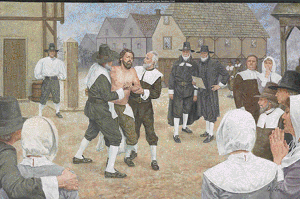
Mr. Holmes was beaten mercilessly. His infractions were denying infant baptism, proclaiming that the church was not according to the gospel of Jesus Christ, receiving the sacrament while excommunicated by the church, and other spiritual infractions.[EN80] Mr. Holmes refused to pay his fine, prepared for the whipping by “communicat[ing] with [his] God, commit[ting] himself to him, and beg[ging] strength from him.”[EN81] Holmes was confined over two months before his whipping. He related the experience of being whipped for the Lord as follows, in part:
“And as the man began to lay the strokes upon my back, I said to the people, though my flesh should fail, and my spirit should fail, yet my God would not fail. So it please the Lord to come in, and so to fill my heart and tongue as a vessel full, and with an audible voice I broke forth praying unto the Lord not to lay this sin to their charge; and telling the people, that now I found he did not fail me, and therefore now I should trust him forever who failed me not; for in truth, as the strokes fell upon me, I had such a spiritual manifestation of God’s presence as the like thereof I never had nor felt, nor can with fleshly tongue express; and the outward pain was so removed from me, that indeed I am not able to declare it to you, it was so easy to me, that I could well bear it, yea, and in a manner felt it not although it was grievous as the spectators said, the man striking with all his strength (yea spitting in [on] his hand three times as many affirmed) with a three-corded whip, giving me therewith thirty strokes. When he had loosed me from the post, having joyfulness in my heart, and cheerfulness in my countenance, as the spectators observed, I told the magistrates, You have struck me as with roses; and said moreover, Although the Lord hath made it easy to me, yet I pray God it may not be laid to your charge.”[EN82]
Mr. Holmes “could take no rest but as he lay upon his knees and elbows, not being able to suffer any part of his body to touch the bed whereupon he lay.”[EN83]
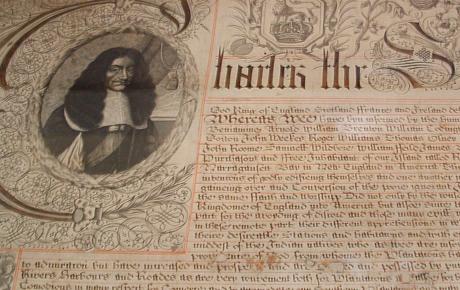
In November 1651, Dr. Clarke went to England with Roger Williams to promote the interests of Rhode Island. Mr. Williams returned to Rhode Island in the summer of 1754, but Mr. Clarke remained in England until, on July 8, 1663, he secured a new charter from Charles II. The charter granted:
“unprecedented liberties in religious concerns. Moreover representation for the people and the limit of power to public officials provided a basic check and balance to popular sovereignty. The Royal Charter of 1663 proved to be distinctive, installing safeguards in the election process through the governing body of the State Assembly, made up of a governor, deputy-governor, assistants, and representatives from each of the towns,”[EN84] each elected by the people.
“Congregationalism claimed a large class of inferior church members by 1720, baptized into the churches without conversion.”[EN85] Generally speaking, by 1740, religious decay had spread throughout New England. However, “the relentless preaching of Jonathan Edwards of complete surrender to the will of God introduced the novel phenomenon of revival in Massachusetts.”[EN86] Although the revival spread down the Connecticut Valley into Connecticut[EN87], the initial revival was of short duration … and did not touch the people of New England generally.[EN88] Then, George Whitefield, the world-famous English evangelist arrived at Newport. Great crowds greeted Whitefield wherever he went to preach. In Connecticut, he was greeted with great enthusiasm. All Connecticut was at his feet.
As a result of that great revival, many were converted and churches experienced unprecedented growth. The Great Awakening emphasized individual conversion and the new birth.[EN89] Many itinerant preachers arose as a result of this revival. Consequently, the General Court of Connecticut “forbade all itinerant preaching under penalty of loss of the right to collect one’s legal salary and imprisonment. Itinerant lay preachers or strange ministers were to be silenced or expelled from the colony.”[EN90] “In Connecticut, legal action was taken against the revivalists, their churches were deprived of legal status, and some of the preachers were thrown into jail.”[EN91]
A number converts, who were dubbed as “New Lights” and who initially tried to influence the church to return to the concept of the pure church were forced out of the established churches. The term “Separates” referred to those who believed that the church should only include regenerate members and those who separated from the state-churches on this conviction. The Separate movement started in Connecticut and moved to Massachusetts. Separate churches began to appear at various towns.
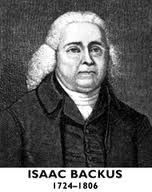
One of the most prominent of the Separates was Isaac Backus. Although he spent much of his ministry in Massachusetts, he was a native of Norwich, Connecticut. He was saved in 1741 and became the leading figure in the new movement. His shift from the Separate to the Baptist camp is central to the religious history of New England.[EN92] Mr. Backus was an ardent leader and writer for the cause of religious liberty in New England and in America. His efforts for religious liberty and other causes were non-ceasing.
Shubael Stearns and Daniel Marshall, both members of Congregationalist churches in Connecticut, separated from the established churches, later became Baptists, as had Isaac Backus, and became chief instruments in carrying the Great Awakening to the South. The Separates were subject to persecution—fines, imprisonment, placing in stocks, and whipping—for their defiance of the laws of the commonwealth. They were subjected to a more intense persecution than the dissenters such as Baptists and Quakers, and many of them were imprisoned for practicing their beliefs.
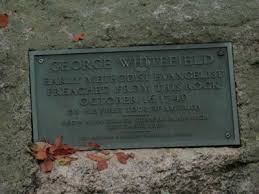 George Whitefield’s preaching had a grand effect on his converts. Stearns in 1754 and Marshall in 1751 or 1752, possessed with missionary zeal, left Connecticut as missionaries. Marshall first ministered to the Indians in New York. Then he moved to Connogig, Pennsylvania and then to Opekon, Virginia. Stearns at first went to Cacapon Creek, Virginia, but due to Indian hostility there, moved to Sandy Creek, North Carolina. There the settlers constituted the Sandy Creek Church with Mr. Stearns as minister and Daniel Marshall and Joseph Breed as assistant ministers.
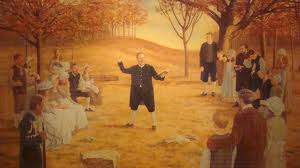
The work at Sandy Creek soon began to produce much fruit. Mr. Stearns and the other preachers in his church were in great demand to go preach at other settlements. He and Daniel Marshall decided, before having been at Sandy Creek a year, to go on a preaching mission all the way to the coast. Converts were being called into ministry, and the Separate Baptist movement was seeing the birth of new churches. Within three years, there were three churches with a combined membership of over nine hundred, and these churches had numerous branches. Young evangelists were “beginning to occupy the land of promise.” In 1758, the Sandy Creek Association was organized. The plan for the association “required careful planning, for the associational movement would usher in a grand new chapter in Separate Baptist expansion.”[EN93]
The movement exploded. Ministers and converts went all over North Carolina, then into South Carolina and Georgia. The power of God was with these Separate Baptist preachers. Churches were planted and many were converted. In North Carolina, the Anglicans and the Presbyterians were displaced by the Baptists. Daniel Marshall went to South Carolina with some others in his church and started a church there. From there, he went on preaching trips into Georgia. He was so successful in some of his forays there that he was arrested, convicted, and commanded to preach no more in Georgia. “The arresting constable and even the magistrate who tried Marshall were soon converted and baptized.” In 1771 Mr. Marshall moved to Kiokee Creek, Georgia and formed the first Baptist church in Georgia at Appling in 1772.[EN94]

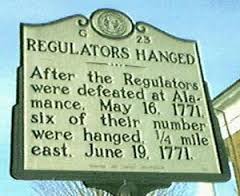 In 1771 the so-called War of the Regulation broke out. The government of North Carolina tried to suppress the Separate Baptists, but succeeded only in spreading their movement all along the southern frontier. Before the suppression began, the established church, the Anglican Church, was ineffectual in North Carolina and only had five ministers in the state in 1765.
Before 1765 the western counties, made up of frontiersman, a large percentage of whom had become Baptists, were disproportionately taxed and represented in the Assembly. “Sheriffs, judges, and other officials of county government, were notorious for their injustice, and in the western counties they were, as a rule, dishonest, haughty, and overbearing.”[EN95] A license was required for teachers, and no place of higher education could be administered, except by ministers of the Church of England. The Church of England was given exclusive rights to perform marriages. In 1755, poll and vestry taxes were imposed upon North Carolinians.[EN96] The settlers mounted protests against these injustices.
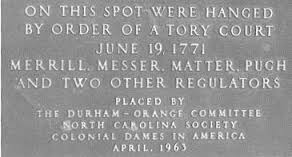 When William Tryon became governor of North Carolina in 1765, the troubles moved quickly to a crisis. Governor Tryon set out to strengthen the position of the Church of England. He called for twenty-seven more Anglican clergymen, increased taxes, and raised a military force. By 1770, Governor Tryon had established eighteen Anglican priests in thirty-two parishes in North Carolina. Property was seized for back taxes, people accused of rioting were arrested and set for trial, and others were fined and imprisoned. “In several places the Regulators yielded to mob spirit, broke up courts, and whipped the officers” and “some court records were destroyed.”[EN97] Armed conflict finally broke out. On May 16, 1771, a poorly trained and supplied force of two thousand regulators was routed by the state militiamen. Although Shubael Stearns and the Sandy Creek Association forbade Baptists to take up arms against the government, many did.
After the defeat of the regulators, Tryon “laid waste to plantations, burned homes, and sent numbers of men in chains to Hillsboro. The countryside was terrorized.”[EN98] Tryon seized Benjamin Merrill, who appears to have been a church leader. Merrill was convicted as a traitor, hung publicly, cut into pieces—quartered—and his body scattered.[EN99]
The Baptists had a mass exodus from North Carolina. By 1772, Sandy Creek Church had only fourteen members, down from six hundred and six. Little River Church went from five hundred to a dozen members. But as with the persecution of the first Christians in Jerusalem, the persecuted spread to other parts and carried out the Great Commission—the departing Baptists went into South Carolina, Georgia, and Tennessee, spreading the Gospel and reaping the harvest. What Satan meant for evil, God used for His glory.
Shubal Stearns, the chief light and the guiding genius behind the Separate Baptist movement, died on November 20, 1771 at the age of sixty-five. Forty-two churches and one hundred and twenty-five ministers had sprung from the Sandy Creek Church by 1772. Fires had been started in North Carolina and in other states, which could not be quenched.[EN100]
Although the final expression of religious freedom that would be incorporated into the Constitution came from Virginia, the final motivation came as a result of the convictions of the dissenters, mainly the Baptists, and the thrust for their growth and influence came from the Great Awakening.
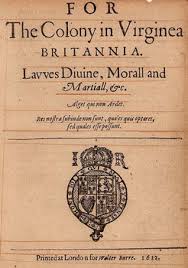 In Virginia, the established Anglican church was controlled by the state, unlike in New England where the established church controlled the state. From the beginning of the colony, the “company knew not how to control the members composing the colony but by religion and law.”[EN101] The original “Lawes Divine, Moral and Martial” which were decreed in 1612, were severe. Speaking impiously of the Trinity or of God the Father, Son, or Holy Spirit, blaspheming God, incorrigibly cursing, a third failure to attend religious services, and a third “Sabbath-breaking,” were punishable by death. Other spiritual offenses were punished by whipping and other penalties.[EN102]
These laws were repealed upon appeal to England, and the laws enacted in support of the Anglican establishment were less severe. Still, the Anglican church was established (and this establishment continued until the revolution with one short interruption), nonattendance at church services was the subject of fines, the payment of tithes were mandatory, every parson was entitled to the glebe—a piece of land—parish churches were built by taxes, and ministers were required to “conform themselves in all things according to the canons of the Church of England.”
“Puritan clergy were banished for failing to conform to Anglican services; Quakers [and Baptists] were fined, imprisoned, and banished. Catholics were disqualified for public office, and any priest who ventured to enter the colony was subject to instant expulsion. Penalties were imposed on those who having scruples against infant baptism, neglected to present their children for that purpose.”[EN103]
In 1770, there were only six Separate Baptist churches in Virginia, but the number had increased to fifteen in 1771. The number of Separate Baptists increased dramatically through 1774.
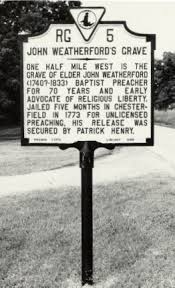
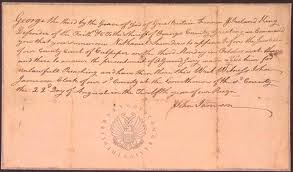 From 1768 through 1774, the Baptists were persecuted severely. “Baptist preachers were whipped, arrested, fined, imprisoned on bread and water, although the authorities sanctimoniously denied that punishment was for ‘preaching’; the crime they said, was ‘breach of the peace.’”[EN104] The first instance of actual imprisonment was on June 4, 1768 when John Waller, Lewis Craig, James Childs, James Reed, and William Marsh were arrested at Craig’s meetinghouse in Spotsylvania and charged with disturbing the peace. The magistrates offered to release them if they would promise to preach no more for a year and a day. They refused and were jailed. Many more were jailed and otherwise persecuted until 1774.[EN105]
As a result of the persecutions and oppressions, Baptists began to petition the House of Burgesses for relief in 1770. 1775 closed the period of “Intolerance, Toleration, and Persecution.” This came about because the American Revolution was on. The Baptists and others were tolerated in return for their help in the war against Great Britain. The Baptists did help, and not a Tory was found among them. But they struck for something more and something dearer to them than civil liberty—for freedom of conscience, for “just and true liberty, equal and impartial liberty.”[EN106] The battle for soul liberty continued until January 19, 1786, when Thomas Jefferson’s “Bill for Establishing Religious Freedom” became the law of the state.
During the period of intense persecution in Virginia, leaders such as James Madison and Thomas Jefferson were observing what was going on. These men were also familiar with the history of persecutions which always accompany a church-state union. They stood against union of church and state which was proposed by Patrick Henry in 1784. Here is one of several examples from Madison’s writings (from a letter to an old college friend, dated January 24, 1774):
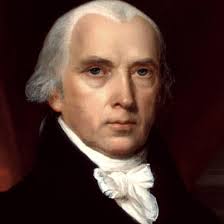
“uninterrupted harmony had prevailed throughout the continent [in matters of established religion as practiced in Virginia] it is clear to me that slavery and subjection might and would have been gradually insinuated among us. Union of religious sentiments begets a surprising confidence, and ecclesiastical establishments tend to great ignorance and corruption, all of which facilitates the execution of mischievous projects…. Poverty and luxury prevail among all sorts; pride, ignorance, and knavery among the priesthood, and vice and wickedness among the laity. This is bad enough; but it is not the worst I have to tell you. That diabolical, hell-conceived principle of persecution rages among some, and to their eternal infamy, the clergy can furnish their quota of imps for such purposes. There are at this time in the adjacent country not less than five or six well-meaning men in close jail for publishing their religious sentiments, which in the main are very orthodox. I have neither patience to hear, talk, or think of anything relative to this matter; for I have squabbled and scolded, abused and ridiculed, so long about it to little purpose, that I am without common patience…. So I must beg you to pity me, and pray for liberty of conscience to all.”[EN107]
On June 12, 1776, the House adopted a Declaration of Rights. The 16th Article provided for religious tolerance. However, [o]n motion on the floor by James Madison, the article was amended to provide for religious liberty. In committee, Madison opposed toleration because toleration “belonged to a system where there was an established church, and where it was a thing granted, not of right, but of grace. He feared the power, in the hands of a dominant religion, to construe what ‘may disturb the peace, the happiness, or the safety of society,’ and he ventured to propose a substitute, which was finally adopted.”[EN108] He probably moved to change the amendment before the whole house in order to demonstrate his position to the Baptists who were viewing the proceedings. The proposed amendment read:
“That religion, or the duty which we owe to our Creator, and the manner of discharging it, can be directed only by reason and conviction, not by force or violence; and, therefore, all men are equally entitled to the free exercise of religion according to the dictates of conscience; and that it is the mutual duty of all to practice Christian forbearance, love, and charity towards each other.”[EN109]
“The adoption of the Bill of Rights marked the beginning of the end of the establishment.”[EN110]
Where did Madison learn the distinction between religious freedom and religious toleration?
“It had not then begun to be recognized in treatises on religion and morals. He did not learn it from Jeremy Taylor or John Locke, but from his Baptist neighbors, whose wrongs he had witnessed, and who persistently taught that the civil magistrate had nothing to do with matters of religion.”[EN111]
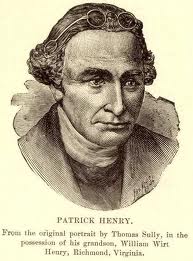 In 1784, Patrick Henry proposed a bill establishing provision for teachers of the Christian religion. George Washington, Richard Henry Lee, and John Marshall supported the bill. The bill required all persons “to pay a moderate tax or contribution annually for the support of the Christian religion, or of some Christian church, denomination or communion of Christians, or for some form of Christian worship.”[EN112]
Mr. Madison opposed Mr. Henry’s bill and prepared his famous “Memorial and Remonstrance,” in which he maintained “that religion, or the duty we owe the Creator,” was not within the cognizance of civil government. The “Memorial” presents fifteen arguments against the assessment bill.[EN113] A small sampling is offered here:
- “… Because experience witnesses that ecclesiastical establishments, instead of maintaining the purity and efficacy of religion, have had a contrary operation. During almost fifteen centuries has the legal establishment of Christianity been on trial. What have been its fruits? More or less in all places, pride and indolence in the clergy; ignorance and servility in the laity; in both, superstition, bigotry, and persecution. Inquire of the teachers of Christianity for the ages in which it appeared in its greatest luster; those of every sect point to the ages prior to its incorporation with civil policy. Propose a restoration of this primitive state, in which its teachers depended on the voluntary rewards of their flocks, many of them predict its downfall….
- “Because the establishment in question is not necessary for the support of civil government…. If religion be not within the cognizance of civil government, how can its legal establishment be said to be necessary for civil government? What influences, in fact, have ecclesiastical establishments had on civil society? In some instances, they have been seen to erect a spiritual tyranny on the ruins of the civil authority; in more instances, have they been seen upholding the thrones of political tyranny; in no instance have they been seen the guardians of the liberties of the people. Rulers who wished to subvert the publick liberty, may have found on established clergy convenient auxiliaries. A just government instituted to secure and perpetuate it needs them not. Such a government will be best supported by protecting every citizen in the enjoyment of his religion, with the same equal hand which protects his person and property; by neither invading the equal hand which protects his person and property; by neither invading the equal rights of any sect, nor suffering any sect to invade those of another.…
- “Because the policy of the bill is adverse to the light of Christianity. The first wish of those, who ought to enjoy this precious gift, ought to be, that it may be imparted to the whole race of mankind. Compare the number of those, who have as yet received it, with the number still remaining under the dominion of false religions, and how small is the former? Does the policy of the bill tend to lessen the disproportion? No; it at once discourages those who are strangers to the light of truth, from coming into the regions of it; and countenances, by example, the nations who continue in darkness, in shutting out those who might convey it to them….
- “Because, finally, ‘the equal right of every citizen to the free exercise of his religion according to the dictates of his conscience,’ is held by the same tenure with all our other rights…. Either then we must say, that the will of the Legislature is the only measure of their authority; and that in the plentitude of this authority, they may sweep away all our fundamental rights; or, that they are bound to leave this particular right untouched and sacred: either we must say, that they may control the freedom of the press; may abolish the trial by jury; may swallow up the executive and judiciary powers of the State; nay, that they have no authority our very right of suffrage, and erect themselves into an independent and hereditary assembly; or we must say that they have no authority to enact into a law, the bill under consideration.…”[EN114]
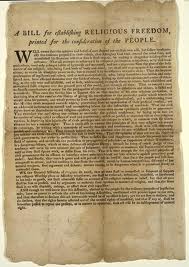
On January 16, 1786, the Virginia Act for Religious Liberty, drafted by Thomas Jefferson, was passed. That bill provided for religious liberty and freedom of conscience. It stated, in part:
“I. Well aware that Almighty God hath created the mind free; that all attempts to influence it by temporal punishments or burthens or by civil incapacitations, tend only to beget habits of hypocrisy and meanness, and are a departure from the Holy Author of our religion, who being Lord of both body and mind, yet chose not to propagate it by coercions on either, as was in his Almighty power to do;
- “that the impious presumption of legislators and rulers, civil as well as ecclesiastical, who, being themselves but fallible and uninspired men, have assumed dominion over the faith of others, setting up their own opinions and modes of thinking as the only true and infallible, and as such, endeavoring to impose them on others hath established and maintained false religions over the greatest part of the world and through all time;
- “that to compel a man to furnish contributions of money for the propagation of opinions which he disbelieves, is sinful and tyrannical; that even the forcing him to support this or that teacher of his own religious persuasion is depriving him of the comfortable liberty of giving his contributions to the particular pastor whose morals he would make his pattern, and whose powers he feels most persuasive to righteousness, … that our civil rights have no dependence on our religious opinions any more than [on] our opinions in physics or geometry;
- “that therefore the proscribing any citizen as unworthy the public confidence by laying upon him an incapacity of being called to offices of trust and emolument, unless he profess or renounce this or that religious opinion is depriving him injuriously of those privileges and advantages to which in common with his fellow citizens he has a natural right; …
- “that to suffer the civil magistrate to intrude his powers into the field of opinion and to restrain the profession or propagation of principles, on supposition of their ill tendency, is a dangerous fallacy, which at once destroys all religious liberty, because he being of course judge of that tendency, will make his opinions the rule of judgment, and approve or condemn the sentiments of others only as they shall square with, or differ from his own;
- “that it is time enough for the rightful purposes of civil government for its officers to interfere when principles break out into overt [open, or public] acts against peace and good order; ….”[EN115]
As the Anglican establishment in Virginia yielded to pressure from Baptists [and to a much lesser extent Presbyterians] so that religious liberty was established in that state, “[t]he same pressure, reinforced by the conditions of frontier living, ended the Anglican establishment in the Carolinas and Georgia…. [T]he conditions which made establishment possible never existed in the states admitted after Vermont, nor in the territories with the exception of unique Utah.”[EN116]
By the time the Constitutional Convention convened in 1787, “three states, Rhode Island, New York, and Virginia granted full religious freedom. Pennsylvania, Delaware, and Maryland demanded in different degrees adherence to Christianity. New Jersey, North Carolina, South Carolina, and Georgia demanded Protestantism.”[EN117]
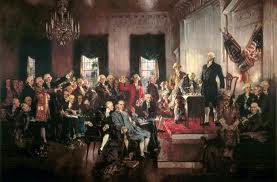
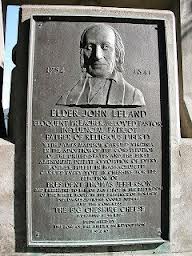 A convention was called in Philadelphia in 1787 to revise the Articles of Confederation. Instead, a new Constitution was drafted. After the drafting of the Constitution, it was submitted to the states for ratification. The Baptists of Virginia were against ratification because the Constitution did not have sufficient provision for religious liberty. Patrick Henry had declined to serve at the Convention and was against it. He posed as the champion of the Baptists in opposition to the Constitution. Of course, Madison was for ratification. However, John Leland, the most popular preacher in Virginia, was chosen by the Baptists as candidate of Orange County to the state ratification convention opposed to ratification, and his opponent was to be James Madison. Mr. Leland likely would have been elected had he not later withdrawn. Mr. Madison, when he returned from Philadelphia, stopped by Mr. Leland’s house and spent half a day communicating to him about “the great matters which were then agitating the people of the state and the Confederacy” and relieving Baptist apprehensions as to the question of religious liberty. As a result of this meeting, Mr. Leland withdrew in favor of Mr. Madison and the Baptists of Orange County were won over to the side of Madison.[EN118]
The Constitution was ratified and election of the officers of government was the next order of business. Patrick Henry, using his influence in the Legislature, prevented Madison from being elected as Senator. In addition, the Legislature drew the lines for Representative district so as to prevent Madison from being elected as Representative. However, he was able to “relieve Baptist apprehensions as to any change in his principles, and assure them of his readiness to aid in securing a proper amendment to the Constitution on the subject of religious liberty.” He was elected.
 His first act, after the First Congress was organized in 1789, was to propose, on June 8, certain amendments, including what is now the First Amendment. His purpose was to “conciliate and to make all reasonable concessions to the doubting and distrustful”—to those, the Baptists, who were concerned about the issue of religious liberty. “Of all the denominations in Virginia, [the Baptists] were the only ones that had expressed any dissatisfaction with the Constitution on that point, or that had taken any action into looking to an amendment.” The Baptists of Virginia had also corresponded with Baptists of other states to “secure cooperation in the matter of obtaining” a religious liberty amendment. No other denomination asked for this change.[EN119]
The First Amendment to the United States Constitution was adopted on September 25, 1789 and was approved by the required number of states in 1791.
V. Post disestablishment and conclusion
The First Amendment religion clause was not applied to the states until 1940.[EN120] When the First Amendment was added to the United States Constitution, only New Hampshire, Massachusetts, and Connecticut still had established churches. In 1833 Massachusetts became the last state to disestablish.
 Nonetheless, the states still provided for incorporation of churches. However, after disestablishment, incorporation became something entirely different from the corporate state-church unions of the past. The new type of incorporation did not create an established church that worked with the state to enforce the first four Commandments. Actually, under the new type of incorporation, the corporate church became a creature of the state.
For a full explanation of the ways post-disestablishment incorporation of churches violates biblical principles, one must go to other sources.[EN121] Just a few characteristics of the new type of corporate church status are listed here. Incorporation became a means for the state to control churches in many ways. For example, a corporation is legal entity created, designed, and organized by statute. The sovereign of the corporate part of an incorporated church is the state. An incorporated 501(c)(3) church gets part of her powers from God and part from the civil government. She is under two heads. Part of the church must have elected officers who conduct business meetings, meet statutory requirements, etc. The incorporated part of an incorporated church is not the bride of Christ, the wife of Christ, but rather an extramarital illicit relationship existing alongside the marriage.
In spite of the fact that American churches may now incorporate and obtain Internal Revenue Code §501(c)(3) (“501(c)(3)”)[EN122] status, they may also operate as New Testament churches outside civil government authority, without persecution and with less exposure to liability than the state incorporated, 501(c)(3) church. Because of the efforts of “Christian” lawyers and the ignorance of pastors and Christians, this truth has been much compromised; most churches and Christians have been convinced that they should incorporate and get 501(c)(3) status; and, as a result, churches which choose to remain totally outside civil government authority face some inconveniences which hardly amount to persecution. The main technique of the unscrupulous lawyers who seek to convince churches to incorporate and get 501(c)(3) status is fear mongering through lies. Biblically ignorant Christians are easy prey for these wolves in sheep’s clothing.
In conclusion, because of the First Amendment, and because of state constitutional provisions and laws, a church has a choice in America. She can operate, without persecution but with some inconveniences, either in a manner pleasing to her Lord, Bridegroom, Husband, and Head or in a manner which dishonors and displeases Him. The church who does not love the Lord will choose to dishonor Him, thereby causing Him much grief. Most American churches have chosen to dishonor our Lord, and the chickens are now coming home to roost.
[1] “Heresy,” in its modern sense, means “any opinion which is repugnant to the doctrines of Scriptures. However, as men differ in the interpretation of Scripture, an opinion deemed heretical by one body of Christians, may be deemed orthodox by another.” See AMERICAN DICTIONARY OF THE ENGLISH LANGUAGE, NOAH WEBSTER (1828), definition of “heresy.” Of course, Scripture contains truth and all at variance with truth constitute lies.
One needs to consider the original sense of the meaning of “heresy” and “heretic.” Established churches have killed millions of those whom they labeled “heretics.” They did this because they denied choice to those who disagreed with the state religion. Thus, harlot religious organizations have perverted Scripture in order to force unity. State religions, heretics themselves according to the modern sense, falsely labeled even true believers “heretics.” “The word “heresy” is derived from the Greek very hairein, which translates: “make-choice-between-alternatives” or “to exercise choice in the presence of alternatives.” See Leonard Verduin, The Reformers and Their Stepchildren (Grand Rapids, Michigan: Wm. B. Eerdmans Pub. Co., 1964), p. 72 and Leorard Verduin, The First Amendment and the Remnant (Sarasota, Florida: The Christian Hymnary Publishers, 1998), pp. xiii-xiv, 20.
The Word of God teaches that God gives everyone freedom of choice to choose truth or error, regardless of civil government laws which require imprisonment, persecution, and death for “heretics” or for those whose beliefs are deemed dangerous by the civil government or by an established church or religion.
[2] Pfeffer, p. 63.[2] Bill Bradley, Purified Seven Times (Haines City, FL: Landmark Baptist Press, 2001), pp. 88-92. For more information on the John Bunyan story, see Thomas Armitage, The History of the Baptists, Volumes 1 and 2 (New York: Bryan, Taylor, & Co.; Chicago: Morningside Publishing Co., 1887), pp. 474-539.
[3] Armitage, Volume 1, p. 477.
[4] Ibid., Volume 2, p. 538.
[5] J. A. Shackelford, Compendium of Baptist History (Louisville, Kentucky: Press Baptist book Concern, 1892), p. 17.
[6] Leonard Verduin, The First Amendment and the Remnant (Sarasota, Florida: The Christian Hymnary Publishers, 1998), p. 50.
[7] Ibid., p. 64.
[8] Ibid.
[9] Ibid., p. 85.
[10] Ibid., p. 87.
[11] J. M. Carroll, The Trail of Blood, (Distributed by Ashland Avenue Baptist Church, 163 N. Ashland Avenue, Lexington KY 40502, 606-266-4341), p. 11. See also, Thieleman J. van Braught, Martyr’s Mirror (Scottdale, PA and Waterloo, Ontario: Herald Press), pp. 67-78 (This book is the best and most comprehensive book on persecution of Christians through the seventeenth century.); John Foxe and The Voice of the Martyrs, Foxe, Voices of the Martyrs (Alachua, FL: Bridge-Logos, 2007), pp. 1-46.
[12] Thieleman, pp. 63-186; Carroll; Leo Pfeffer, Church, State, and Freedom (Boston: The Beacon Press, 1953), pp. 10-12.
[13] Carroll, p. 16; Thieleman; David Benedict, History of the Donatists (Pawtucket R.I.: Nickerson, Sibley & Co., 1875; Paris, Arkansas: The Baptist Standard Bearer, Inc.,); Leonard Verduin, The Reformers and Their Stepchildren (Grand Rapids, MI: Wm. B. Eerdmans Pub. Co., 1964; Reprinted by permission by Paris AK.: The Baptist Standard Bearer, Inc.); Leonard Verduin, The Anatomy of a Hybrid (Grand Rapids, Michigan: William B. Eerdmans Publishing Co., 1976).
[14] Carroll, p. 17.
[15] Leo Pfeffer, Church, State, and Freedom (Boston: The Beacon Press, 1953), p. 14, citing Bates, M. Searle, Religious Liberty: An Inquiry, New Your and London, International Missionary Council, 1945, p. 139; Rufinni, Francesco, Religious Liberty, New York, The Macmillan Co., 1949, p. 36; and Carlyle, Alexander J., The Christian Church and Liberty, London, J. Clarke, 1924, p. 96; See also, Leonard Verduin, The Anatomy of a Hybrid (Grand Rapids, Michigan: William B. Eerdmans Publishing Co., 1976), pp. 105-111 and other excerpts.
[16] Armitage, Volume 1, p. 202.
[17] Ibid., p. 204.
[18] Benedict, p. 99.
[19] Ibid., p. 87.
[20] Pfeffer, p. 18; Verduin, Anatomy of a Hybrid.
[21] Carroll, p. 14.
[22] Ibid., p. 28.
[23] Ibid., p. 33.
[24] Works of Martin Luther, Volume 4 (Philadelphia: A. H. Holman Co., 1931), p. 265 cited in Philip Hamburger, Separation of Church and State (Cambridge, Massachusetts: Harvard University Press, 2002), p. 22.
[25] Pfeffer, p. 21, citing Acton, “The Protestant Theory of Persecution,” in Essays on Freedom and Power, p. 92, and Wace, Henry, and Bucheim, C. A., Luther’s Primary Works, Lutheran Publication Society, Philadelphia, 1885, pp. 194-195, quoted in Noss, John B., Man’s Religions, New York, The Macmillan Co., 1949, p. 92.
[26] William H. Marnell, The First Amendment: Religious Freedom in America from Colonial Days to the School Prayer Controversy (Garden City, New York: Doubleday & Company, Inc., 1964), pp. 13-14.
[27] Acton, pp. 102-103, quoted in Pfeffer, p. 21; see also, Verduin, Anatomy of a Hybrid, pp. 158-160, 163-168, 186-198; Leonard Verduin, The Reformers and Their Stepchildren (Grand Rapids, Wm. B. Eerdsmans Pub. Co., 1964) and Thomas Armitage, The History of the Baptists, Volumes 1 and 2 (Springfield, Mo.: Baptist Bible College, 1977 Reprint).
[28] Pfeffer, pp. 23-24.
[29] See Ibid., pp. 24-25 for a concise history of Erastianism in England.
[30] Marnell, pp. 18-20; Armitage; Verduin (both cited books).
[31] Calvin, Institutes of the Christian Religion, 1:847 (IV.xix.15) 2: 1486 (IV.xx.1), trans. Ford Lewis Battles (Philadelphia: Westminster Press, 1960) cited in Hamburger, pp. 22-23, “[Calvin] also wrote: ‘But whosoever knows how to distinguish between body and soul, between the present fleeting life and that future eternal life, will without difficulty know that Christ’s spiritual Kingdom of Christ and the civil government are things completely distinct.’” Ibid., 2: 1488 (IV.xx.1).
[32] Pfeffer, p. 22, citing Institutes of the Christian Religion¸ quoted in Stokes, Anson Phelps, Church and State in the United States, New York, Harper & Brothers, 1950, I. p. 110.
[33] Pfeffer, p. 22.
[34] Philip Hamburger, Separation of Church and State (Cambridge, Massachusetts: Harvard University Press, 2002), p. 23, citing Institutes of the Christian Religion, 2: 1211 (IV.xi.1; ibid., 2: 1487-1488 (IV.xx.2-3).
[35] Pfeffer, pp. 23-24.
[36] Carroll, p. 34.
[37] Ibid., pp. 37-38.
[38] Jerald Finney, God Betrayed/Separation of Church and State: The Biblical Principles and the American Application (Austin, TX: Kerygma Publishing Company, 2008 and Xulon Press, 2008), Section IV. Go to the “Books” page of churchandstatelaw.com for ordering information.
[39] Pfeffer, p. 63.
[40] John Callender, The Civil and Religious Affairs of the Colony of Rhode-Island (Providence: Knowles, Vose & Company, 1838), p. 71.
[41] Marnell, pp. 63-64.
[42] Lumpkin, William L. Lumpkin, Baptist Foundations in the South (Eugene, Oregon: Wipf & Stock Publishers, 2006), p. 1; Edmund S. Morgan, The Puritan Dilemma: The Story of John Winthrop (Boston, Mass., Toronto, Canada: Little, Brown and Company, 1958).
[43] Ibid., p. 48.
[44] Pfeffer, p. 66, citing Sanford H. Cobb, The Rise of Religious Liberty in America (New York: The McMillan Co., 1902), pp. 70-71.
[45] Marnell, p. 40.
[46] Ibid., p. 42.
[47] Peter Marshall and David Manuel, The Light and the Glory, (Old Tappan, New Jersey: Fleming H. Revell Company, 1977), p. 146.
[48] Callender, p. 66.
[49] Marshall and Manuel, p. 148.
[50] Ibid., pp. 147-148.
[51] Ibid., p. 148.
[52] Roger Williams and Edward Bean Underhill, The Bloudy Tenent of Persecution for Cause of Conscience Discussed and Mr. Cotton’s Letter Examined and Answered (London: Printed for the Society, by J. Haddon, Castle Street, Finsbury, 1848), p. v (The Bloudy Tenent was originally published in 1644. Roger Williams was the founder of Rhode Island, the first government in history with complete freedom of conscience. Due to the efforts of Mr. Williams, Dr. John Clarke, and others who followed America has the First Amendment to the United States Constitution which gives freedom of conscience. A brief history of the efforts of Roger Williams and others is recounted in Section IV of God Betrayed.).
[53] Marnell, p. 48.
[54] Williams and Underhill, p. 244.
[55] Ibid., p. vii.
[56] Isaac Backus, A History of New England With Particular Reference to the Denomination of Christians called Baptists, Volume 1 (Eugene, Oregon: Wipf & Stock Publishers, Previously published by Backus Historical Society, 1871), p. 41; Williams and Underhill, p. ix, noting in fn. 1 that “Such is Governor Winthrop’s testimony. Knowles, p. 46.”
[57] Williams and Underhill, p. x.
[58] Callender, p. 72.
[59] Backus, A History of New England…, Volume 1, pp. 44-46. Williams and Underhill, p. xiii. (The colonies held their land under the royal patent. Under the royal right of patent, Christian kings (so called) were given the right to take and give away the lands and countries of other men); Armitage, The History of the Baptists, Volume 2 pp. 638-639.
[60] Williams and Underhill, pp. xiii-xiv.
[61] Ibid, p. xiv; Callender, p. 72; Backus, A History of New England…, Volume I, p. 53 (Backus adds item 2, as, according to footnote 1, p. 53, his is from Governor Winthrop’s Journal, Vol. 1, pp. [162, 163]).
[62] Williams and Underhill, pp. xv, 387-389.
[63] Backus, A History of New England…, Volume 1, p. 53; Armitage, The History of the Baptists, Volume 2, pp. 627-640.
[64] Williams and Underhill., p. xxiii.
[65] Ibid.
[66] Backus, A History of New England…, Volume 1, p. 59.
[67] Ibid., p. 71. See also, John Clarke, Ill News from New-England or A Narative of New-Englands Persecution (Paris, Ark.: The Baptist Standard Bearer, Inc., Reprint: 1st printed in 1652), pp. 22-25.
[68] Louis Franklin Asher, John Clarke (1609-1676): Pioneer in American Medicine, Democratic Ideals, and Champion of Religious Liberty (Paris, Arkansas: The Baptist Standard Bearer, Inc.), p. 27; Clarke.
[69] Asher, p. 29; Clarke.
[70] Backus, A History of New England…, Volume 1, pp. 77, 427. On p. 427 is the exact copy from Rhode Island records. In the margin are citations to Exodus 34.3, 4; II Chronicles 11.3, and II Kings 11, 17.
[71] Asher, p. 27.
[72] Backus, A History of New England…, Volume 1, p. 74; cited in James R. Beller, America in Crimson Red: The Baptist History of America (Arnold, Missouri: Prairie Fire Press, 2004), p. 13; Armitage, A History of the Baptists, Volume 2, p. 643.
[73] Beller, America in Crimson Red, p. 13.
[74] Williams and Underhill, p. xxviii.
[75] Backus, A History of New England…, Volume 1, pp. 427-428.
[76] Asher, p. 35.
[77] Ibid., pp. 35-36.
[78] Obadiah Holmes moved from England to Massachusetts. He and several others decided the Baptist way was right and were baptized. He and others were excommunicated in 1650. They moved to Rhode Island where Mr. Holmes became a member of the church pastored by Dr. John Clarke.
[79] Asher, p. 57; See Clarke, pp. 27-65 for a full account of the event.
[80] Backus, A History of New England…, Volume 1,, fn. 1, p. 189.
[81] Ibid., p. 190.
[82] Ibid., p. 192; Clarke, pp. 50-51.
[83] Ibid., fn. 1, p. 193. (This from a manuscript of Governor Joseph Jencks).
[84] Asher, pp. 78-79.
[85] Lumpkin, p. 2.
[86] Ibid.
[87] Asher, p. 21: Between 1635 and 1640 Congregationalism had been planted in the Connecticut colony. Callender, pp. 67-68: “As the country was more fully discovered, the lands on Connecticut river grew so famous for their fruitfulness, and convenience to keep cattle, that great numbers from New-Town, Dorchester, &c., removed there, under the conduct of Mr. Hains, Mr. Hopkins, Mr. Ludlow, and Mr. Hooker, &c., and through inexpressible hardships, through famine, and weariness, and perils of the enemy, they at length settled at Hartford, 1635 and 1636, which was the beginning of the Connecticut colony; and, in 1637, New-Haven colony was begun by a people directly from England[.]”
[88] Lumpkin, p. 2.
[89] Ibid., pp. 3-5.
[90] Ibid., p. 8; see also, for the actual wording of the act against itinerant and other preachers, Backus, A History of New England…, Volume 2, pp. 44-46.
[91] Marnell, p. 87.
[92] William G. McLoughlin, Isaac Backus and the American Piestic Tradition (Boston: Little, Brown and Company, 1967), pp. 60-61.
[93] Lumpkin, pp. 41-45.
[94] Ibid., p. 55, citing J. H. Kilpatrick, The Baptists, (Atlanta: Georgia Baptist Convention, 1911), pp. 37-38.
[95] Ibid., pp. 72-74.
[96] Beller, America in Crimson Red, pp. 181-182.
[97] Lumpkin, pp. 78-79.
[98] Ibid., p. 83.
[99] Beller, America in Crimson Red, p. 197.
[100] Lumpkin, p. 59.
[101] Charles F. James, Documentary History of the Struggle for Religious Liberty in Virginia (Harrisonburg, VA.: Sprinkle Publications, 2007; First Published Lynchburg, VA.: J. P. Bell Company, 1900), p., p. 17.
[102] See Pfeffer, p. 69 for the text of this law.
[103] Ibid.; see also, James, pp. 17-20 for a more comprehensive overview of the laws of Virginia which provided for religious persecution and the established church.
[104] Pfeffer, p. 95. citing Edward F. Humphrey, Nationalism and Religion in America (Boston: Chipman Law Publishing Co., 1924), p. 370.
[105] James, pp. 29-30. Included is a listing of some of those jailed and otherwise persecuted. See also, Beller, America in Crimson Red, pp. 230-250; Lumpkin, pp. 105-120; Grady, What Hath God Wrought, Appendix A, pp. 593-598 citing Lewis Peyton Little, Imprisoned Preachers and Religious Liberty in Virginia, (Galatin, Tenn.: Church History Research and Archives, 1987), pp. 516-520 (lists many Baptists and the persecutions they endured in Virginia; persecutions such as being jailed for preaching, civil suit, being annoyed by men drinking and playing cards, being jerked off stage and head beaten against the ground, hands being slashed, beaten with bludgeons, being shot with a shotgun, ousted as a justice for preaching, being brutally beaten by a mob, severely beaten with a stick, etc.).
[106] James, pp. 47-48.
[107] Ibid., p. 36.
[108] Ibid., pp. 62-65.
[109] Ibid., pp. 62-64; Pfeffer, p. 96.
[110] Pfeffer, p. 96.
[111] James, p. 63 quoting Dr. John Long.
[112] Pfeffer, p. 98, citing N. J. Eckenrode, The Separation of Church and State in Virginia (Richmond, Va.: Virginia State Library, 1910), p. 86. Pfeffer notes in Chapter 4 fn. 102 that the text of the bill is printed as an appendix to Justice Rutledge’s dissent in Everson, 330 U.S. 1.
[113] Pfeffer, p. 101.
[114] Beller, America in Crimson Red, pp. 512-515; Norman Cousins, In God We Trust (Kingsport, Tennessee: Kingsport Press, Inc., 1958), pp. 308-314.
[115] Cousins, pp. 125-127; see also, for an edited version, Living American Documents, Selected and edited by Isidore Starr, Lewis Paul Todd, and Merle Curti, (New York, Chicago, Atlanta, Dallas, Burlingame: Harcourt, Brace & World, Inc., 1961), pp. 67-69.
[116] Marnell, p. 130.
[117] Ibid., p. 98.
[118] James, pp. 150-158; Dr. William P. Grady, What Hath God Wrought: A Biblical Interpretation of American History (Knoxville, Tennessee: Grady Publications, Inc., 1999), pp. 166-167.
[119] James, p. 167.
[120] See, God Betrayed, Section V, Chapter 3 for the history of how the Fourteenth Amendment to the United States Constitution was used to apply the First Amendment to all levels of civil government.
[121] See, e.g., Jerald Finney, God Betrayed, Section VI, Chapters 2 and 7; Jerald Finney, Separation of Church and State/God’s Churches: Spiritual or Legal Entities? (Austin, TX: Kerygma Publishing Co., 2009), Chapters 3 and 7.
[122] See, God Betrayed, Section VI, Chapters 1, 4, 5, 8, and 10 and Separation of Church and State, Chapters 1, 4, 5, and 8 for an explanation of 501(c)(3) status for churches.

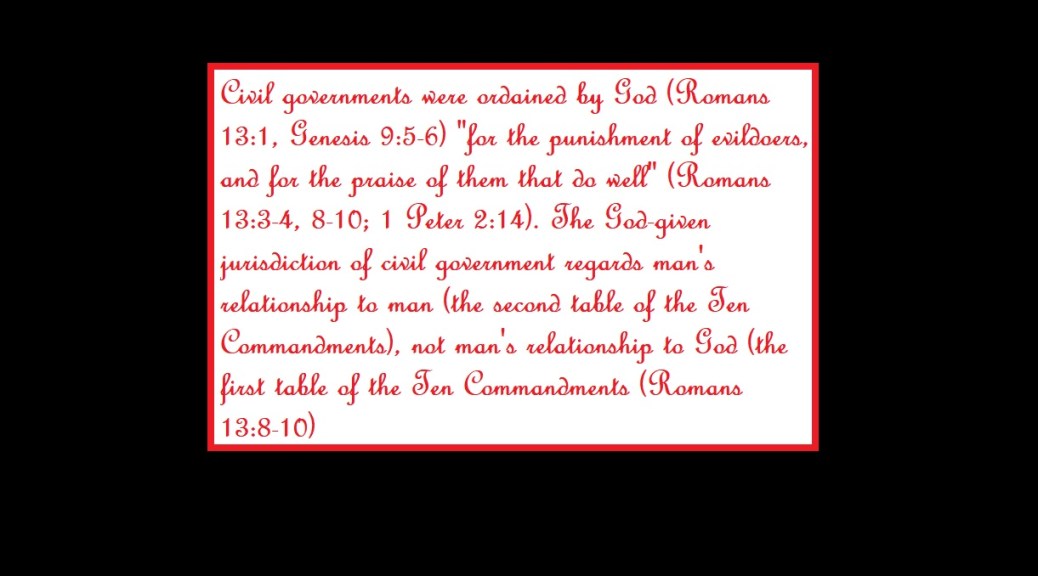
 Simply Church