Tag Archives: Isaac Backus

V. Roger Williams and the Providence Compact


A Publication of Churches Under Christ Ministry


Link to Previous Lesson:
IV. Dr. John Clarke; the Portsmouth Compact

Link to Next Lesson:
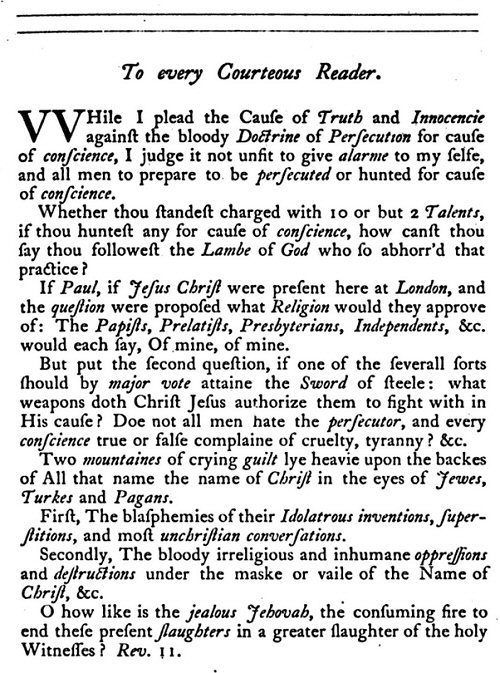
VI. Roger Williams Secures the 1644 Rhode Island Charter; Dissemination of Knowledge: The Bloudy Tenet of Persecution for Conscious Sake

Click here for links to all lessons on The Baptists in Rhode Island.


Jerald Finney
Copyright © February 27, 2018


In August of 1638, the people of Providence approved the first public document establishing government without interference in religious matters, the Providence Compact:
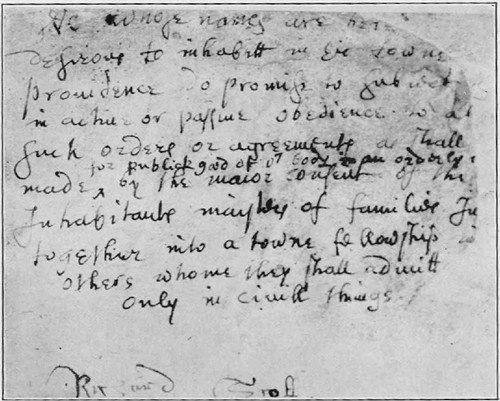
“We whose names are here underwritten being desirous to inhabit in the town of Providence, do promise to submit ourselves in active or passive obedience to all such orders or agreement as shall be made for public good to the body in an orderly way, by the major consent of the present inhabitants, masters of families, incorporated together into a township, and such others whom they shall admit into the same, only in civil things.[1] [Signed by Stukely Westcoat, William Arnold, Thomas James, Robert Cole, John Greene, John Throckmorton, William Harris, William Carpenter, Thomas Olney, Francis Weston, Richard Watearman, and Ezekiel Holliman.]

Providence Compact

As James R. Beller proclaims, the document was “the first of a series of American political documents promulgating government by the consent of the governed and liberty of conscience.[2] Thus, liberty of conscience was the basis for legislation in Rhode Island, and its annals have remained to this day [when Underhill wrote this] unsullied by the blot of persecution.[3]

Rhode Island was ruled according to the original covenant, “til on January 2, 1639, an assembly of the freemen said:

“By the consent of the body it is agreed that such who shall be chosen to the place of Eldership, they are to assist the Judge in the execution of the justice and judgment, for the regulating and ordering of all offences and offenders, and for the drawing up and determining of all such rules and laws as shall be according to God, which may conduce to the good and welfare of the commonweal; and to them is committed by the body the whole care and charge of all the affairs thereof; and that the Judge together with the Elders, shall rule and govern according to the general rules [rule] of the word of God, when they have no particular rule from God’s word, by the body prescribed as a direction unto them in the case. And further, it is agreed and consented unto, that the Judge and [with the] Elders shall be accountable unto the body once every quarter of the year, (when as the body shall be assembled) of all such cases, actions or [and] rules which have passed through their hands, by they to be scanned and weighed by the word of Christ; and if by the body or any of them, the Lord shall be pleased to dispense light to the contrary of what by the Judge or [and] Elders hath been determined formerly, that then and there it shall be repealed as the act of the body; and if it be otherwise, that then it shall stand, (till further light concerning it) for the present, to be according to God, and the tender care of indulging [indulgent] fathers.”[4]

Banished by the Puritans from Mass. colony in the 1630s. Started R.I. colony, a government with religious freedom.

In March 1639, Mr. Williams attempted to become a Baptist, together with several more of his companions in exile.[5] However, since he was never Scripturally baptized, he could not have been a Baptist. Williams, being familiar with “the General Baptist view of a proper administrator of baptism, namely, that two believers had the right to begin baptism,” [6] was baptized by immersion[7] by one Holliman. He, in turn, baptized ten others. Thus, according to some accounts, was founded the first Baptist church in America.[8] However, the fact that Roger Williams was not a genuine Baptist and many other facts prove that Dr. John Clarke started the First Baptist Church in America.[9]

Mr. Williams stepped down as pastor of the church after only a few months because his baptism was not administered by an apostle, but the church continued.[10] Isaac Backus commented on the requirement of apostolic succession for baptism at length, stating, “And if we review the text (II Tim. ii. 2-Ed.) that is now so much harped upon, we shall find that the apostolic succession is in the line of ‘faithful men;’ and no others are truly in it, though false brethren have sometimes crept in unawares.”[11]

  • Williams “turned seeker, i.e. to wait for the new apostles to restore Christianity. He believed the Christian religion to have been so corrupted and disfigured in what he called the ‘apostasy, as that there was no ministry of an ordinary vocation left in the church, but prophecy,’ and that there was need of a special commission, to restore the modes of positive worship, according to the original institution. It does not appear to [Mr. Callender], that he had any doubt of the true mode, and proper subjects of baptism, but that no man had any authority to revive the practice of the sacred ordinances, without a new and immediate commission.”[12]

Endnotes

[1] James R. Beller, America in Crimson Red: The Baptist History of America (Arnold, Missouri: Prairie Fire Press, 2004), p. 13, citing Isaac Backus, A History of New England With Particular Reference to the Denomination of Christians called Baptists, Volume 1 (Eugene, Oregon: Wipf & Stock Publishers, Previously published by Backus Historical Society, 1871), p. 74; Thomas Armitage, The History of the Baptists, Volume 2 (Springfield, Mo.: Baptist Bible College, 1977 Reprint), p. 643.

[2] Beller, America in Crimson Red, p. 13.

[3] Roger Williams and Edward Bean Underhill, The Bloudy Tenent of Persecution for Cause of Conscience Discussed and Mr. Cotton’s Letter Examined and Answered (London: Printed for the Society, by J. Haddon, Castle Street, Finsbury, 1848), p. xxviii.

[4] Backus, Volume I, pp. 427-428.

[5] Williams and Underhill, p. xxvi; Isaac Backus, Volume 1, pp. 86-89.

[6] John T. Christian, A History of the Baptists, Volume I, (Texarkana, Ark.-Tex.: Bogard Press, 1922), p. 371.

[7] Ibid., pp. 372-373.

[8] “Others suspect “that Mr. Williams did not form a Church of the Anabaptists, and that he never joined with the Baptist Church there. Only, that he allowed them to be nearest the scripture rule, and true primitive practice, as to the mode and subject of baptism. [Some who] were acquainted with the original settlers never heard that Mr. Williams formed the Baptist Church there, but always understood that [certain others] were the first founders of that church…. [Some asserted that this church hereupon crumbled to pieces.] But [John Callender] believe[d] this to be a mistake, in fact, for it certainly appears, there was a flourishing church of the Baptists there, a few years after the time of the supposed breaking to pieces; and it is known by the names of the members, as well as by tradition, they were some of the first settlers at Providence[.]” Callender, p. 110-111.

[9] See Graves, J.R., The First Baptist Church in America not Founded by Roger Williams. (Texarkana, AR/TX: Baptist Sunday School Committee, 1928).  See, for more insights, Christian, Volume I, pp. 374-375. For a more recent study, see also Joshua S. Davenport, Baptist History in America Vindicated. For more on the matter of the First Baptist Church in America, see Did Roger Williams Start The First Baptist Church In America? Is the “Baptist Church the Bride of Christ? What About Landmarkism or the Baptist Church Succession Theory By Jim Fellure and Baptist History IN AMERICA Vindicated: The First Baptist Church in America/A Resurfaced Issue of Controversy/The Facts and Importance By Pastor Joshua S. Davenport (a review of the two books mentioned).

[10] Williams and Underhill, p. xxvii; Isaac Backus, A History of New England…, Volume 1, p. 89; Christian, Volume I, pp. 373-374.

[11] Isaac Backus, A History of New England With Particular Reference to the Denomination of Christians called Baptists, Volume 1 (Eugene, Oregon: Wipf & Stock Publishers, Previously published by Backus Historical Society, 1871), p. 91.

[12] John Callender, The Civil and Religious Affairs of the Colony of Rhode-Island (Providence: Knowles, Vose & Company, 1838), pp. 110-111.

VII. The Results of Puritan Theology in Massachusetts Soon Came to Fruition


A Publication of Churches Under Christ Ministry


 Previous Lesson: VI. The Theology and Goals of the Puritans in America

Next Lesson: VIII. Organizing the Church State “Theocracy” in Massachusetts Colony

Click here for links to all lessons on The Pilgrims and Puritans in New England.


Jerald Finney
Copyright © February 24, 2018


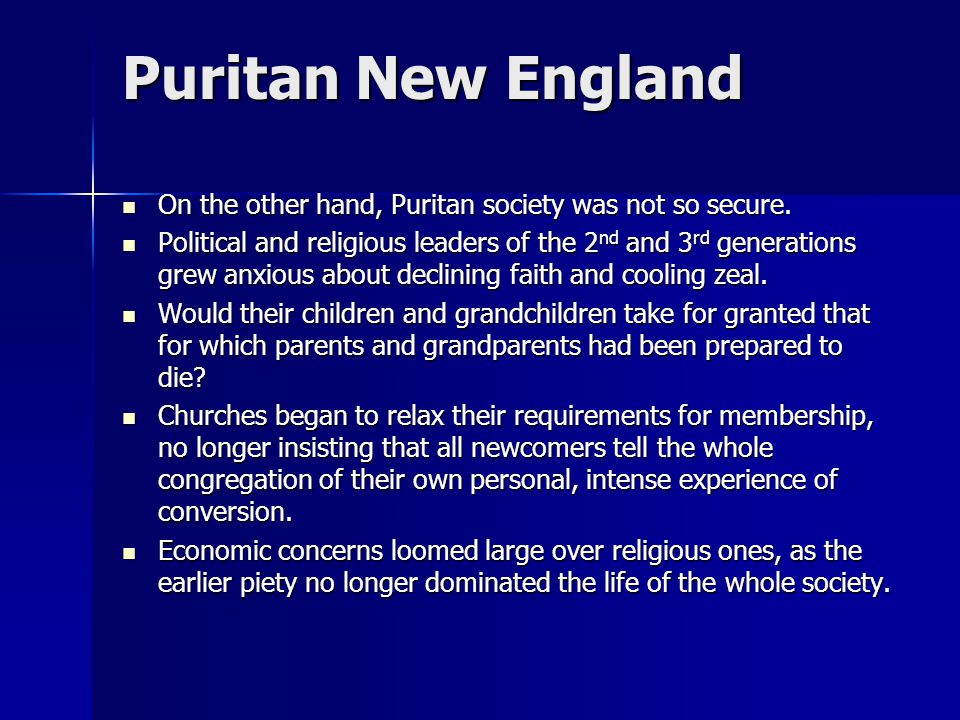
Soon after the founding of Massachusetts, events there proved the folly of their false theology and the truth of accurate biblical and historical interpretation. As Isaac Backus reported, by 1660 or 1670 Puritan theologians and pastors in New England were pointing out the “general religious declension” that was already taking place as the first generation of settlers passed away.[1] “Mr. Willard published a discourse in the year 1700 entitled, ‘The Perils of the Times Displayed,’ in which he said:

  • “That there is a form of godliness among us is manifest; but the great inquiry is, whether there be not too much of a general denying of the power of it. Whence else is it, that there be such things as these that follow, to be observed? that there is such a prevalency of so many immoralities among professors? that there is so little success of the gospel? How few thorough conversions [are] to be observed, how scarce and seldom…. It hath been a frequent observation that if one generation begins to decline, the next that follows usually grows worse, and so on, until God pours out his Spirit again upon them.  The decays which we do already languish under are sad; and what tokens are on our children, that it is like to be better hereafter…. How do young professors grow weary of the strict profession of their fathers, and become strong disputants for the [those] things which their progenitors forsook a pleasant land for the avoidance of.
  • “And forty years after, Mr. Prince said, ‘We have been generally growing worse and worse ever since.’ The greatest evils that [the founders of New England] came here to avoid were the mixture of worthy and unworthy communicants in the churches, and the tyranny of secular and ministerial Courts over them; but these evils were now coming in like a flood upon New England.”[2]

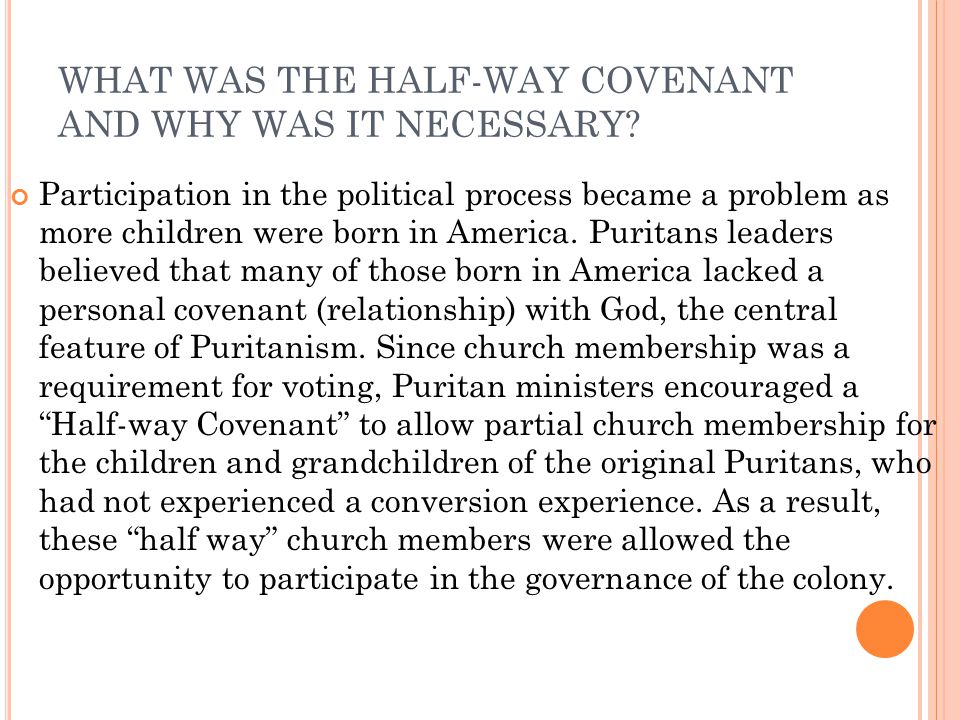
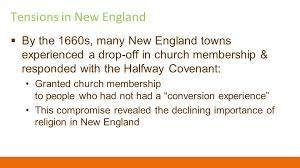
The Halfway Covenant, established by the Massachusetts synod in 1662, was witness to the spiritual decline of the Puritan Congregationalist church. This resulted in a large number of church members being baptized into the church without conversion. Any person who professed belief in the doctrines of Calvinism and who lived an upright, moral life was allowed to join the parish church and sign the covenant or membership contract. Such persons were only allowed halfway into the church—they could have their children baptized but they could not take communion or vote in church affairs. This was the method practiced in the church to which Isaac Backus’ parents belonged.[3]


Endnotes

[1] Isaac Backus, A History of New England With Particular Reference to the Denomination of Christians called Baptists, Volume 1 (Eugene, Oregon: Wipf & Stock Publishers, Previously published by Backus Historical Society, 1871), pp. 457-464. Examples of what the religious leaders were saying are given in those pages.

[2] Ibid., p. 461.

[3] Ibid., pp. 264-268; William L. Lumpkin, Baptist Foundations in the South (Eugene, Oregon: Wipf & Stock Publishers, 2006), pp. 1-2; William G. McLoughlin, Isaac Backus and the American Piestic Tradition (Boston: Little, Brown and Company, 1967), pp. 5-6.

(3) Persecuted Christians and Churches Have Always Stood for Separation of Church and State

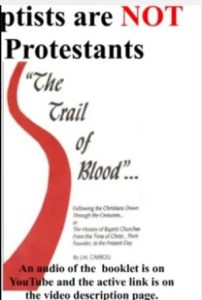
Baptists are not Protestants by Dr. Harold Sightler. Click image to go to a reading of “The Trail of Blood.”.

Jerald Finney
Copyright © February 18, 2018


If you miss one part of the puzzle that is being put together in these studies, you will never see and understand the whole picture.


A publication of Churches Under Christ Ministry


Previous Lesson:
(2) The Holy Spirit, through Paul, Explained the Temporal Earthly and the Eternal Spiritual

Next Lesson:
(4) Nine Distinct Differences Between Church and State Which Render Them Mutually Exclusive

Click here to go to all essays on “Distinct Differences Between Church and State Render Them Mutually Exclusive.”

Click here to go to the written lessons.

Click here to go to the 3 1/2 to 6 minute video lectures.


Click the above to go to the article, “Is Separation of Church and State Found in the Constitution?

Persecuted Christians down through the ages have stood for separation of church and state. They refused, even under penalty of torture, imprisonment, and/or death to submit the church and spiritual matters to the ungodly, to the established church/state. This was apparent under the Roman Empire at the time of Christ and after, and after the wedding of church and state in the early fourth century. Although they differed from the Church of England and others on some doctrines, “[t]he Puritans brought 2 principles with them from their native country, in which they did not differ from others; which are, that natural birth, and the doings of men, can bring children into the Covenant of Grace; and, that it is right to enforce & support their own sentiments about religion with the magistrate’s sword.”[1].

Click to go directly to page from which you can download the book.

“The religion of Jesus has suffered more from the exercise of this pretended right [to make religious establishments] than from all other causes put together; and it is with me past all doubt, that it will never be restored to its primitive purity, simplicity and glory, until religious establishments are so brought down as to be no more.”[2]

“But this people brought two other principles with them from their native country, in which they did not differ from others; which are, that natural birth, and the doings of men, can bring children into to the Covenant of Grace; and, that it is right to enforce and support their own sentiments about religion with the magistrate’s sword.”[3]

The “grand difficulty they [the Puritans] had with Mr. Williams was, his denying the civil magistrate’s right to govern in ecclesiastical affairs.”[4] Roger Williams correctly observed, concerning persecution of Christians by the Roman Caesars:

  • “Scripture and all history tell us, that those Caesars were not only arrogant, without God, without Christ, &c.; but professed worshippers, or maintainers, of the Roman gods or devils; as also notorious for all sorts of wickedness; and lastly, cruel and bloody lions and tigers toward the Christians for many hundred years.
  • “Hence I argue from the wisdom, love, and faithfulness of the Lord Jesus in his house, it was impossible that he should appoint such ignorant, such idolatrous, such wicked, and such cruel persons to be his chief officers and deputy lieutenants under himself to keep the worship of God, to guard his church, his wife. No wise and loving father was ever known to put his child, no not his beasts, dogs, or swine, but unto fitting keepers.
  • “Men judge it matter of high complaint, that the records of parliament, the king’s children, the Tower of London, the great seal, should be committed to unworthy keepers! And can it be, without high blasphemy, conceived that the Lord Jesus should commit his sheep, his children, yea, his spouse, his thousand shields and bucklers in the tower of his church, and lastly, his great and glorious broad seals of baptism and his supper, to be preserved pure in their administrations—I say, that the Lord Jesus, who is wisdom and faithfulness itself, should deliver these to such keepers? …
  • “[W]hen the Lord appointed the government of Israel after the rejection of Saul, to establish a covenant of succession in the type unto Christ, let it be minded what pattern and precedent it pleased the Lord to set for the after kings of Israel and Judah, in David, the man after his own heart.
  • “But now the Lord Jesus being come himself, and having fulfilled the former types, and dissolved the national state of the church, and established a more spiritual way of worship all the world over, and appointed a spiritual government and governors, it is well known what the Roman Caesars were, under whom both Christ Jesus himself, and his servants after him, lived and suffered; so that if the Lord Jesus had appointed any such deputies—as we find not a title to that purpose, nor have a shadow of true reason so to think—he must, I say, in the very first institution, have pitched upon such persons for thesecustodies utriusque tabulae, keepers of both tables, as no man wise, or faithful or loving, would have chosen in any of the former instances, or cases of a more inferior nature…” (Roger Williams and Edward Bean Underhill, The Bloudy Tenent of Persecution for Cause of Conscience Discussed and Mr. Cotton’s Letter Examined and Answered (London: Printed for the Society, by J. Haddon, Castle Street, Finsbury, 1848), pp. 204-205).
  • “Christ never delivered His sheep or children to these wolves, his wife and spouse to such adulterers, his precious jewels to such great thieves and robbers of the world, as the Roman emperors were. Paul never appealed to Caesar as judge appointed by Christ Jesus to give definitive sentence in any spiritual or church controversy; but against the civil violence and murder which the Jews intended against him, Paul justly appealed. For otherwise, if in a spiritual cause he should have appealed, he should have overthrown his own apostleship and power given him by Christ Jesus in spiritual things, above the highest kings or emperors of the world beside…” (, p. 209).
  • “A civil magistrate may be a good subject, a good magistrate, in respect of civil or moral goodness, which thousands want; and where it is, it is commendable and beautiful, though godliness, which is infinitely more beautiful, be wanting, and which is only proper to the Christian state, the commonweal of Israel, the true church the holy nation, Ephes. ii.; 1 Pet. ii” (, p. 212).

Weapons used for spiritual warfare are not suitable for earthly warfare and vice versa. Roger Williams pointed out:

  • “[T]o take a stronghold, men bring cannon, culverins, saker, bullets, powder, muskets, swords, pikes, &c., and these to this end are weapons effectual and proportionable.
  • “On the other side, to batter down idolatry, false worship, heresy, schism, blindness, hardness, out of the soul and spirit, it is vain, improper, and unsuitable to bring those weapons which are used by persecutors, stocks, whips, prisons, swords, gibbets, stakes, &c., (where these seem to prevail with some cities or kingdoms, a stronger force sets up again, what a weaker pulled down); but against these spiritual strongholds in the souls of men, spiritual artillery and weapons are proper, which are mighty through God to subdue and bring under the very thought to obedience, or else to bind fast the soul with chains of darkness, and lock it up in the prison of unbelief and hardness to eternity.”[5]
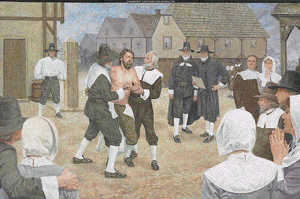
Beating of Obadiah Holmes by the Puritans in Massachusetts.

Roger Williams maintained that the civil power has five proper political means to attain its end:

  • “First, the erecting and establishing what form of civil government may seem in wisdom most meet, according the general rules of the word, and state of the people…. The magistrate has power to publish and apply such civil laws in a state, as either are expressed in the word of God in Moses’s judicials—to wit, so far as they are of general and moral equity, and so binding all nations in all ages—to be deducted by way of general consequence and proportion from the word of God.
  • “For in a free state no magistrate hath power over the bodies, goods, lands, liberties of a free people, but by their free consents. And because free men are not free lords of their own estates, but are only stewards unto God, therefore they may not give their free consents to any magistrate to dispose of their bodies, goods, lands, liberties, at large as themselves please, but as God, the sovereign Lord of all, alone. And because the word is a perfect rule, as well of righteousness as of holiness, it will be therefore necessary that neither the people give consent, nor that the magistrate take power to dispose of the bodies, goods, lands, liberties of the people, but according to the laws and rules of the word of God….
  • “Secondly, the making, publishing, and establishing of wholesome civil laws, not only such as concern civil justice, but also the free passage of true religion: for outward civil peace ariseth and is maintained from them both, from the latter as well as from the former.
  • “Civil peace cannot stand entire where religion is corrupted, 2 Chron. xv. 3, 5, 6; Judges viii. And yet such laws, though conversant about religion may still be counted civil laws; as on the contrary, an oath doth still remain religious, though conversant about civil matters.
  • “Thirdly, election and appointment of civil officers to see execution of those laws.
  • “Fourthly, civil punishments and rewards of transgressors and observers of these laws.
  • “Fifthly, taking up arms against the enemies of civil peace.”[6]
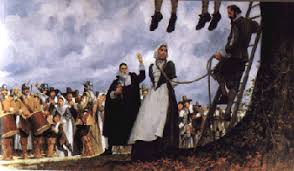
Depiction of four Quakers being hung by Puritans for returning to Massachusetts after being banned for “heresy.”

On the other hand, according to Mr. Williams,

  • “the means whereby a church may and should attain her ends, are only ecclesiastical, which are chiefly five. “First, setting up that form of church government only of which Christ hath given them a pattern in his word.
  • “Secondly, acknowledging and admitting of no lawgiver in the church but Christ, and the publishing of his laws.
  • “Thirdly, electing and ordaining of such officers only as Christ hath appointed in his word.
  • “Fourthly, to receive into their fellowship them that are approved, and inflicting spiritual censures against them that offend.
  • “Fifthly, prayer and patience in suffering any evil from them that be without, who disturb their peace.
  • “So that magistrates, as magistrates, have no power of setting up the form of church government, electing church officers, punishing with church censures; but to see the church doth her duty herein. And on the other side, the churches, as churches, have no power, though as members of the commonweal they may have power, of erecting or altering forms of civil government, electing of civil officers, inflicting civil punishments—no, not on persons excommunicated—as by deposing magistrates from their civil authority, or withdrawing the hearts of the people against them, to their laws, no more than to discharge wives, or children, or servants, from due obedience to their husbands, parents, or masters: or by taking up arms against their magistrates, though they persecute them for conscience; for though members of churches, who are public officers, also of the civil state, may suppress by force the violence of usurpers, as Jehoiada did Athaliah, yet this they do not as members of the church, but as officers of the civil state.”[7]

Paul instructed the church at Corinth to deliver a church member who was guilty of fornication with his father’s wife “to Satan for the destruction of the flesh, that the spirit may be saved in the day of the Lord Jesus.”[8] He goes on to tell them that “a little leaven leaveneth the whole lump” and that they are not to “company with fornicators” “or with the covetous, or extortioners, or with idolaters” “or a railer, or a drunkard, or an extortioner.”[9] The Corinthian church did expel the man and he repented and was restored.[10] As Roger Williams points out, “Where it is observable, that the same word used by Moses for putting a malefactor to death, in typical Israel, by sword, stoning, &c., Deut. xiii.5, is here used by Paul for the spiritual killing, or cutting off by excommunication, 1 Cor. [5] v.13, Put away that evil person, &c. ”[11]

Titus was instructed by Paul: “A man that is an heretick after the first and second admonition reject[.]”[12] Roger Williams’ insights into this verse are instructive:

  • “[F]or an erroneous and blind conscience, (even in fundamental and weighty points) it is not lawful to persecute any, til after admonition once or twice[.]”[13]
  • “First then Titus, unto whom this epistle and these directions were written, and in him to all that succeed him in the like work of the gospel to the world’s end, was no minister of the civil state, armed with the majesty and terror of a material sword, who might for offenses against the civil state inflict punishments upon the bodies of men by imprisonments, whippings, fines, banishment, death. Titus was a minister of the gospel, or glad tidings, armed only with the spiritual sword of the word of God, and [with] such spiritual weapons as (yet) through God were mighty to the casting down of strongholds, yea, every high thought of the highest head and heart in the world, 2. Cor. x. 4.
  • “Therefore, these first and second admonitions were not civil or corporal punishments on men’s persons or purses, which courts of men may lawfully inflict upon malefactors; but they were the reprehensions, convictions, exhortations, and persuasions of the word of the eternal God, charged home to the conscience in the name and presence of the Lord Jesus, in the midst of the church. Which being despised and not hearkened to, in the last place follows rejection; which is not a cutting off by heading, hanging, burning, &c., or an expelling of the country and coasts; neither [of] which (no, nor any lesser civil punishment) Titus, nor the church at Crete, had any power to exercise. But it was that dreadful cutting off from that visible head and body, Christ Jesus and his church; that purging out of the old leaven from the lump of the saints; the putting away of the evil and wicked person from the holy land and commonwealth of God’s Israel, 1 Cor. v. [6, 7.] Where it is observable, that the same word used by Moses for putting a malefactor to death, in typical Israel, by sword, stoning, &c.,, Deut. xiii. 5, is here used by Paul for the spiritual killing, or cutting off by excommunication, 1 Cor. v. 13, Put away that evil person, &c.
  • “Now, I desire the answerer, and any, in the holy awe and fear of God, to consider that—
  • “From whom the first and second admonition was to proceed, from them also was the rejecting or casting out to proceed, as before. But not from the civil magistrate, to whom Paul writes not this epistle, and who also is not bound once and twice the admonish, but may speedily punish, as he sees cause, the persons or purses of delinquents against his civil state; but from Titus, the minister or angel of the church, and from the church with him, were these first and second admonitions to proceed.
  • “And therefore, at last also, this rejecting: which can be no other but a casting out, or excommunicating of him from their church society.
  • “Indeed, this rejecting is no other than that avoiding which Paul writes of to the church of Christ at Rome, Rom. xvi. 17; which avoiding, however woefully perverted by some to prove persecution, belonged to the governors of Christ’s church and kingdom in Rome, and not to the Roman emperor, for him to rid and avoid the world of them by bloody and cruel persecution.”[14]

The lost man, the man who has not been born again, is a fleshly man who walks in the flesh without the indwelling Spirit of God. He is subject only to the law. The believer, a member of a church, a part of the body, is a heavenly man, and a stranger and pilgrim on the earth who is told to be led of the Spirit. A saved man and a church who love the Lord and want to glorify Him and who study the Word of God and specifically the Bible Doctrine of the church will stand for God’s principles regarding the church to the death; at least, that was the case of those martyrs for the faith who joyfully suffered and died rather than betray their Lord.


Endnotes

[1] Isaac Backus, A History of New England With Particular Reference to the Denomination of Christians called Baptists, Volume 2 (Eugene, Oregon: Wipf & Stock Publishers, Previously published by Backus Historical Society, 1871), pp. 34-35.

[2] Backus, Volume 2, p. 249.

[3] Backus, Volume 1,  pp. 34-35.

[4] Backus, Volume 1, p. 53; Armitage, The History of the Baptists, Volume 2, pp. 627-640.

[5] Roger Williams and Edward Bean Underhill, The Bloudy Tenent of Persecution for Cause of Conscience Discussed and Mr. Cotton’s Letter Examined and Answered (London: Printed for the Society, by J. Haddon, Castle Street, Finsbury, 1848), pp. 119-120.

[6] Ibid., pp. 212-213. See pp. 219-223 concerning the power of the magistrate in making laws.

[7] Ibid., pp. 213-214.

[8] 1 Co. 6.1-5.

[9] 1 Co. 6.7-11.

[10] See 2 Co. 7.8-11.

[11] Williams and Underhill, p. 62.

[12] Titus 3.10.

[13] Williams and Underhill, p. 20.

[14] Ibid., pp. 61-63.

(1) Introduction: Distinct Differences between Church and State Render Them Mutually Exclusive

Click the above to go to the article, “Is Separation of Church and State Found in the Constitution?

If you miss one part of the puzzle that is being put together in these studies, you will never see and understand the whole picture.


A publication of Simply Church Ministry


Previous Lesson:
3. Dispensation Theology versus Covenant Theology and Their Importance to the Issue of Church and State Relationship in America

Next Lesson:
(2) The Holy Spirit, through Paul, Explained the Temporal Earthly and the Eternal Spiritual

Click here to go to all articles on “Distinct Differences Between Church and State Render Them Mutually Exclusive.”

Click here to go to the written lessons.

Click here to go to the 3 1/2 to 6 minute video lectures.


Jerald Finney
Copyright © February
11, 2018


This series of lessons will examine Bible teaching which makes clear that state (civil government) and church are so distinct that they are mutually exclusive—that God ordained each for particular purposes and that He desires that both operate under Him but that neither work with, over, or under the other. The Old Testament develops the doctrine of civil government. There we learn that God ordained civil government to directly control evil since the restraint of conscience was insufficient to control the sinful man. God added the restraint of civil government as a further direct, worldly control over man. The Old Testament deals with Gentile civil government and the theocracy of Israel, their purposes and authorities under God, their history, and prophecies concerning, among other things, concerning their fate. The New Testament announces something new, the church, a spiritual organism made up of spiritual beings.

Combining church and state has had dire consequences, as history shows. EN [i] Catholic and Protestant theology historically justified (and continue to justify) the union of church and state by examining Scripture not literally, but allegorically or spiritually, when and where convenient to support a desired conclusion (such as union of church and state). Those religious organizations interpret Scripture in such a way as to apply the principles for Israel and Judaism to Gentile nations. Just as religion and state were combined in the Jewish theocracy, this spiritualized and allegorized theology, when implemented, unites church and state in Gentile nations.

JamesMadisonOnC&SMany of America’s founding fathers—most especially James Madison and Thomas Jefferson (see EN [ii], a copy of Virginia Bill for Religious Liberty drafted by Thomas Jefferson)—and other leaders understood that church and state should be separate. From a worldly common-sense point of view Madison and Jefferson and others arrived at their understanding by studying the consequences of such unions both historically and also contemporaneously. From a Bible or spiritual perspective, Roger Williams, Isaac Backus, John Leland and other Baptists understood and explained both the problems created by combining church and state and the true reasons for those problems. Backus wrote:

  • “Christians must be careful not to apply God’s principles for the Jewish religion and the nation Israel to church and state. The principles for the two are so distinct that they are mutually exclusive. The government of the Church of Christ is as distinct from all worldly governments, as heaven is from earth.” EN [iii]

Indeed, union of church and state is contrary to biblical principles; and, therefore, the consequences of church-state union have always been dire and will be so until the return of Christ and the establishment of the Kingdom of Heaven.

God gave both church and state certain powers. God gave the state earthly and temporal power within jurisdictional boundaries which He set out. The heavenly eternal powers God gave the church were  meant to provide a spiritual and eternal good.

The purpose of the Gentile civil government is fleshly or earthly. EN [iv] Gentile civil government, according to God, was ordained by God to deal with those temporal earthly matters assigned it by God. God gave man certain authority over man. He gave man the responsibility to rule over man under His rules. Gentile civil government has authority to punish those who commit certain crimes against their fellow man and to reward those who do good. The purpose of the Gentile civil government is to control evil men thereby maintaining some degree of peace in this present world. A civil government, as defined by God, is made up of men under God ruling over man in earthly matters.

Much of God’s word deals with actions of individuals, families, churches, and nations here upon the earth. Civil governments are not given jurisdiction over many areas of life which are governed by the Word of God. A civil government which ignores God and His Word is setting itself up for judgment.

God gave neither a church nor the state authority to rule over or with the other. Civil government does not have the authority under God or the ability (the knowledge, understanding and wisdom) to rule over God’s churches. For reasons already looked at in these lessons, a church is not to join with the civil government in any way.

God ordained a church under God, not a business under civil government, an entity that is to work hand in hand with or perhaps over the state to bring in the kingdom of God, or an entity that is to work under state rules. Admittedly, the ultimate God-given purpose of both a church and a civil government is to glorify God, each acting under God, but neither acting with or under the other. However, the underlying purposes of a church and the state are significantly different: the underlying purpose of a church is heavenly or spiritual; the underlying purpose of a civil government is earthly.

Christians are told to obey civil government as regards certain earthly matters and civil government has authority over all citizens as to some temporal earthly matters. Individuals, families, and churches are not to be under the civil government with regard to spiritual matters, which include many activities and actions as shown in the Bible.


Endnotes

[i] See the historical section of this study of this abridged course for more on this. See, for a more advanced study, (1) Section 4 of God Betrayed/Separation of Church and State: The Biblical Principles and the American Application which is available free in both PDF and online form or may be ordered in softback and Kindle by going to “Order information for books by Jerald Finney which also has links to the free PDF and Online Form of the book; (2) the section on the history of the First Amendment; and/or (3) An Abridged History of the First Amendment.).

[ii] Virginia Bill for Religious Freedom drafted by Thomas Jefferson:Virginia Bill for Religious Liberty drafted by Thomas Jefferson in 1779 and enacted in 1786.

[iii]  Isaac Backus, A History of New England With Particular Reference to the Denomination of Christians called Baptists, Volume 2 (Eugene, Oregon: Wipf & Stock Publishers, Previously published by Backus Historical Society, 1871), p. 561.

[iv] See Section I.A., The Biblical Doctrine of Government of this short course for more on government. For a more advanced analysis, “The biblical doctrine of government for more on the jurisdiction and purposes of the various God-ordained governments including civil government.

Puritan Covenant Theology Exposed in the American Colonies


A Publication of Simply Church Ministry


If you miss one part of the puzzle that is being put together in these studies, you will never see and understand the whole picture.


Click here to go to the written lessons.
Click here to go to the 3 1/2 to 6 minute video lectures.


Click here to go to Dispensation Theology versus Covenant Theology and Their Importance to the Issue of Church and State Relationship in America


Jerald Finney
Copyright © February 9, 2018


This lesson will discuss some shortcomings of Covenant Theology and give a few examples of the exposure of the Puritan Covenant Theology by colonial dissenters. Some of the quotes are quite long, so the lesson is not as condensed as in other lessons in this short course.

As one Puritan preacher, in an attempt to remove objections of some against partaking of the Lord’s Supper because of fears of not being born again, preached in order to persuade them:

“The children of those who are members of the visible church are, by the constitution of God, from their first coming into existence, members of his kingdom in common with their parents. So it was under the Jewish dispensation; and so it is now, [under the Christian] if there is any validity in one of the principal arguments, by which we vindicate our practice, in baptizing the infants of those who are members of Christ’s church.”[i]

According to Covenant Theology, the main promise God made in the Covenant of Grace was: “I will … be a God unto thee, and to thy seed after thee (Ge. 17.7);” and “includes the following promises: temporal blessings, justification, adoption, eternal life, the Spirit of God with His many ministries, and final glorification.”[ii] Establishment of religion in Christianity depends upon this covenant. Isaac Backus taught, “All establishments of worship by human laws, that ever were erected under the Christian name, were built upon calling the covenant in Gen. xvii the covenant of grace.”

Mr. Backus goes on to point out that “Those who have seen the nature of original sin, cannot tell how to keep up the idea of children’s being born in the covenant of grace, without some regard to grace in their parents. And in the same chapter where the unbelieving consort is said to be sanctified by the believer, a widow is required to marry only in the Lord….” [He then refers to a parable wherein to make his point the author thereof describes a church which advised a member to marry a certain woman of grace in the church rather than a woman he loves who is not of grace. Of the woman of grace, the church says:]

  • “As to some trifles, which a carnal man would object to, it becomes you as a spiritual man, to make no objection. It is true, she is of a mean family, and a very weak understanding; she is peevish and fretful to the highest degree; her shape is semicircular; she is what the world calls monstrous ugly; every feature is adapted to mortify carnal desires, which is much better than to have them gratified; she is the queen of sluts, and without any polite education. But she has grace, saving grace; she is regenerated; let your grace wed with hers, and a sweet bride she will be. Moreover, she is past the flower of her age, and we suppose need so requires.”
  • Backus goes on to say that this parable can be applied to no church on earth, but says “[H]ow mean and spiteful it is to treat the Word Grace [in the manner treated by Covenant Theologians]! Affixing the word to the covenant of circumcision, where God never put it, is the source of [a difficulty of a church at Stockbridge where to be sanctified by the believer, a widow is required to marry only in the Lord].”[iii]

Most Covenant Theologians have divided postfall history into two dispensations, the Mosaic dispensation sometimes called the “Old Covenant,” and the Christian dispensation, usually called the “New Covenant;” and they claim that the Covenant of Grace, although administration of that covenant differed between the dispensations, exists throughout these dispensations. “[E]ach dispensation or covenant named in the Bible is simply another stage of the progressive revelation of the nature of the Covenant of Grace.”[iv]

Covenant Theology has many problems. Many of them are pointed out in more thorough studies by Jerald Finney such as God Betrayed/Separation of Church and State: The Biblical Principles and the American Application. Several significant shortcomings of Covenant Theology follow, repeating some already discussed:

  • First its “ultimate goal of history[, also discussed supra, the Glory of God through the redemption of the elect,] is too narrow…. Second, Covenant Theology denies or weakens some of the distinctions which are in the Bible by insisting that distinctions are simply different phases of the same Covenant of Grace…. In addition, Covenant theology denies the existence of distinctive gospels in the Bible…. Covenant Theology insists that there is no essential distinction between the Mosaic Covenant (the Law) and the New Covenant…. Covenant theology also denies the distinction between the nation of Israel and the Church.… Third, Covenant Theology is mistaken when it teaches that each of the biblical covenants is a continuation and newer phase of the Covenant of Grace…. Fourth, Covenant Theology’s unifying principle is too limited or narrow. [First, Covenant Theology is too limited in that it unifies history through the Covenant of Grace from either the fall of man or the time of Abraham. It is too narrow because it deals only with God’s redemption of the elect, and it does not unify the program of redemption with all God’s other programs.] Second, … it does not unify prefall history with postfall history, which a valid exposition of the biblical philosophy of history must do…. Fifth, in order to make its system work, Covenant Theology must employ a double hermeneutic (a double system of interpretation)….”[v]

According to the Covenant Theologian, “the idea of dual covenants functioned as a warning against reliance on good works for salvation.” The Covenant of Works required obedience for salvation. According to the Covenant of Grace one could only be saved by faith in Christ.[vi]

Yet, the Covenant of Works remained in effect.

  • “This meant, first, that New Englanders whom God had not yet called effectually into salvation remained entirely under a covenant of works and subject to its moral restraint. It meant also, according to Cotton, that the burden of moral expectation should drive the sensitive conscience to Christ. It was ‘the usuall manner of God to give a Covenant of Grace by leading men first into a Covenant of works.’ Living under the covenant of works, Shepard explained, they would discover their sinfulness, and their ‘terrors, and fears, and hopes’ would turn them to Christ. And it meant, third, that even Christians safely within the covenant of grace remained subject to the moral substance of the first covenant. Abolished as a ‘covenant of life,’ Shepard said, the law still remained a ‘Rule of Life.’ These were the traditional three uses of the law in Reformed theology; covenantal language provided a lively way to restate them.”[vii]

Covenant Theologians teach that God’s commands are “too severe even for Adam in innocency, and that grace[, through the covenant of circumcision and its successor, baptism,] gives an exemption from that severity,” under the Covenant of Grace.

Covenant Theology, which does not recognize or correctly analyze the roles of the Old and New Covenants, is at odds with a correct interpretation of the Bible on this issue. Isaac Backus, in exposing the New England Puritan theology, explained:

  • “[The law is holy, just, and good]; it [is] spiritual; but [man] a carnal slave to sin, instead of having such high dignity and liberty as he before imagined he had…. A false imagination of good in the forbidden fruit, drew our first parents into rebellion against God; and such imaginations are the only source of sin in all their children. James i. 14, 15. Good is still their pursuit, but they have lost the knowledge of who can give it, or of what it is; but the regenerate soul knows both, and this is the precise difference between them. Psalm iv. 6, 7. Who does not know that debtors and criminals are not fit judges in their own causes? [Y]et that is the case with all reasoners against the truth and perfection of God’s written word…. And to hear many speaking evil of things they know not, but what they know naturally as brute beasts, and in those things to corrupt themselves; to see them tread down the good pastures, and foul the deep waters, and thrust others with side and shoulder, serves to confirm believers in the truth of revelation, and in the hope of a speedy deliverance from such evil beasts. Jude 10. Ezek. xxxiv. 18, 25.”[viii]

To show that God has “disannulled the national covenant which he made with Abraham,” Backus offered the following insights:

  • “First, Abraham had no right to circumcise any stranger, until he had bought him as a servant for money. Gen. xvii. 12, 13. But God says to his children, Ye are bought with a price, be not ye the servants of men. I Cor. vii. 23. And he says to his ministers, Feed the church of God which he hath purchased with his own blood. Acts xx. 28. He also says, Ye have sold yourselves for nought, and ye shall be redeemed without money. And this is the gospel of peace. Is. lii. 3, 7; Rom. x. 15. Thus do the apostles explain the prophets. Secondly, The children of Israel had no right to receive strangers into the church by households, until the day in which they came out of Egypt, when the Passover was instituted. And then God said, Every man’s servant that is bought for money, when thou hast circumcised him, then shall he eat thereof. Exod. xii. 44—48. Circumcision and the Passover were as binding upon servants as children; and both ordinances pointed to the blood of Christ, which he was to shed for his people. And in reference to that, God said, Behold, the days come, saith the Lord, that I will make a new covenant with the house of Israel, and with the house of Judah; not according to the covenant that I made with their fathers, in the day that I took them by the hand, to bring them out of the land of Egypt. Jer. xxxi. 31, 32. And an inspired apostle says, In that he saith, A new covenant, he hath made the first old. Now that which decayeth and waxeth old is ready to vanish away. He taketh away the first, that he may establish the second. viii. 7—13; x. 9.  And can old and new, first and second, mean but one covenant? Surely no. Thirdly, Circumcision is the name which God gave to his covenant with Abraham. Acts vii. 8. And though Jews and Mahometans are still zealous for it, yet all Christians allow that circumcision is repealed. But after the apostolic age, men took away the name which God gave to that covenant, and added the name Grace to it; and they held that dominion is founded in grace. And from thence the nations have made merchandise of all the vanities of time, and of slaves and souls of men. But the plagues of Babylon will come upon all men who add to the word of God, and take away from the words of his book, if they refuse to come out of that practice. Rev. xviii. 4—13; xxii. 18, 19. And there is not a word in all the Bible for bringing any child to baptism without his own profession of faith in Christ, nor for forcing any man to support any religious minister; and all national churches are built upon these two superstitions. Fourthly, Circumcision was the shedding of human blood; and when Abraham received it, it was a seal of righteousness of the faith which he before had in Christ, in whom believers are justified by his blood. Rom. iv. 11, 23; v. 9; Gal. iii. 16; Gen. xv. 6; xvii. 24. It was a seal to him; but neither circumcision nor baptism are ever called seals to any other person in the Bible. But God says to true believers in Christ, In whom also after that ye believed, ye were sealed with that Holy Spirit of promise. And he also says, Grieve not the Holy Spirit of God, whereby ye are sealed unto the day of redemption. Eph. i. 13; iv. 30. After believing in Christ, the Holy Spirit seals the merits of his death, and the promises of his grace to the soul. And all believers from the beginning, looked through the bloody ordinances which God appointed, to the blood of Christ for justification. And after the beast arose out of the bottomless pit, God said, All that dwell upon the earth shall worship him, whose names are not written in the book of life of the Lamb slain from the foundation of the world. Rev. xiii. 8. Force and cruelty is the general character of the beast; but Jesus, who is the root and offspring of David, will cause all evil beasts to cease out of the land. Ezek. xxxiv. 4, 25; Rev. xxii. 16. Fifthly, the believing Jews were suffered to go on in circumcision for a number of years past the death of Christ, and then God said to them, If ye be circumcised, Christ shall profit you nothing. …. Whosoever of you are justified by the law, ye are fallen from grace. Gal. v.2—4. So far was the covenant of circumcision from being the covenant of grace. That bloody sign not only pointed to the death of Christ, but also to the death of all true believers in him. Therefore Paul says, I through the law am dead to the law, that I might live unto God. I am crucified with Christ, nevertheless I live; yet not I, but Christ liveth in me; and the life which I now live in the flesh, I live by the faith of the Son of God, who loved me, and gave himself for me. … The fruit of the Spirit is love, joy, peace, long-suffering, gentleness, goodness, faith, meekness, temperance, against such there is no law. And they that are Christ’s, have crucified the flesh, with the affections and lusts. Gal. ii. 19, 20; v. 22-24. Adam and Christ are the only two public heads of mankind, as to the great affairs of the soul and eternity. For as by one man’s disobedience, many were made sinners; so by the obedience of one, shall many be made righteous. Rom. v. 19. For parents to bring up their children in the nurture and admonition of the Lord, is of infinite importance; but we can find no warrant for any to bring them to baptism without a personal profession of faith in Christ….
  • “God said of Abraham, I know him, that he will command his children and his household after him, and they shall keep the way of the Lord, to do justice and judgment; that the Lord may bring upon Abraham that which he hath spoken of him. Gen. xviii. 19. He will and They shall, was the language of God’s covenant with Abraham; but I will, and They shall, is the language of the new covenant, since the death of Christ. Heb. viii. 10; x. 9. It was the will of God that the visible church should continue in the line of Abraham’s posterity, until Christ came and died for his people, and then the holy spirit was given, and believing Jews and Gentiles were united in his church. And they never were called Christians, until believing Gentiles were received into the church without circumcision….
  • “[T]he holding that the children of believers are born into the covenant of grace, or that baptism can bring them into it, without their own knowledge or choice, is such a confounding of grace and works together as holds multitudes in blindness and bondage.”[ix]

We should look at the Dispensation of Grace to find the duties of believers today.

Who are the true seed of Abraham? Mr. Backus again correctly divided the Word of Truth in answering this question:

  • “Circumcision was only for males, but females are equally the subjects of baptism, which proves an essential change of the covenant. And our Lord gave the gospel commission to the eleven, who were all born again; and he said to them, Go teach all nations, baptizing them in the name of the Father, and of the Son, and of the Holy ghost; teaching them to observe all things, whatsoever I have commanded you; and lo, I am with you always, even unto the end of the world. Amen. Matt. xxviii. 16—20. This promise is only to his children, in the way of obedience to all his commandments. And as the covenant of circumcision gave Israel a right to buy the heathen for servants, and circumcision was only for the males, the gospel says to believers, Ye are all the children of God by faith in Christ Jesus. For as many of you as have been baptized into Christ have put on Christ. There is neither Jew nor Greek, there is neither bond nor free, there is neither male nor female; for ye are all one in Christ Jesus. And if ye be Christ’s then ye are Abraham’s seed, and heirs according to the promise. Gal. iii.26—29. Abraham was an eminent type of Christ, and none are his spiritual seed but believers in Christ.” (, pp. 370-371).

Again, this is only a small sampling. For more, see Isaac Backus Quotes from God Betrayed; Roger Williams: Quotes and Other Information from God Betrayed; or, for the most thorough treatment God Betrayed/Separation of Church and State: The Biblical Principles and the American Application.


Endnotes

[i] Isaac Backus, A History of New England With Particular Reference to the Denomination of Christians called Baptists, Volume 2 (Eugene, Oregon: Wipf & Stock Publishers, Previously published by Backus Historical Society, 1871), p. 171.

[ii] Renald E. Showers, There Really Is a Difference: A Comparison of Covenant and Dispensational Theology (Bellmawr, New Jersey: The Friends of Israel Gospel Ministry, 1990), p. 14, citing Berkhof, p. 277.

[iii] Backus, A History of New England…, Volume 2, pp. 238-241.

[iv] Showers, pp. 14-16, citing Berkhof, pp. 282-283 and Ernest Frederick Kevan, “Dispensation,” in Baker’s Dictionary of Theology, editor-in-chief, Everett F. Harrison (Grand Rapids; Baker Book House, 1960), p. 168.

[v] Showers, pp. 19-25 citing Berkof, pp. 298, 300; Bernhard W. Anderson, “The New Covenant and The Old,” in The Old Testament and Christian Faith, ed. by Bernard W. Anderson (New York: Herder and Herder, 1969), p. 232; and Johannes Behm, “kainos,” Theological Dictionary of the New Testament, Vol. III, ed. by Gerhard Kittel, trans. and ed. by Geoffrey W. Bromiley (Grand Rapids: Wm. B. Eerdmans Publishing Company, 1965, pp. 447, 448, 449. See Showers for a more detailed explanation of the deficiencies listed.

[vi] E. Brooks Holifield, Theology in America: Christian Thought from the Age of the Puritans to the Civil War (Ann Arbor, Michigan: Sheridan Books, 2003), p. 40.

[vii] Ibid.

[viii] Backus, A History of New England…, Volume 2, p. 254.

[ix] Ibid., pp. 364-366, 371-372, 373.

(2) Colonial Theological Warfare—Separation of Church and State


A Publication of Simply Church Ministry


If you miss one part of the puzzle that is being put together in these studies, you will never see and understand the whole picture.


Jerald Finney
Copyright © February 7, 2018


A complete analysis of Dispensationalism and Covenant Theology requires a long and deep study of the Bible. FN [i] These short lessons will briefly look at some of the characteristics of each and distinctions between the two. The differences were debated in the colonies during a spiritual warfare that began in the early 1630’s. Fortunately, the dispensationalist view prevailed. This resulted in the adoption of the First Amendment to the United States Constitution which, among other things, separates church and state (not God and state).

The two theologies have distinct “philosophies of history.” FN [ii] The two main systems which Bible-believing scholars have developed to exposit the Bible’s philosophy of history, Dispensationalism or Dispensational Theology and Covenant Theology, have produced two systems of theology. Dispensational Theology contains all the necessary elements of a valid philosophy of history. “Dispensationalism, [which] can be defined very simply as a system of theology which attempts to develop the Bible’s philosophy of history on the basis of the sovereign rule of God, represents the whole of Scripture and history as being covered by several dispensations[, economies, or stewardships] of God’s rule.” FN [iii]

“The essence of dispensationalism … is the distinction between Israel and the church. This grows out of the dispensationalist’s consistent employment of normal or plain or historical-grammatical interpretation, and it reflects an understanding of the basic purposes of God in all His dealings with mankind as that of glorifying Himself through salvation and other purposes as well.” FN [iv]

Covenant theologians teach that the church has replaced Israel. The Bible literally teaches that the rules for the church and state are different than the rules God ordained for the theocracy in Israel. Distinct rules, as discussed in the articles under Distinct Differences between Church and State that Render Them Mutually Exclusive, are laid down in the Bible concerning Judaism and Israel and the church and state.

Covenant theologians believe that God is through with Israel, that the church replaces Israel. This is a grave mistake to Judaize the church, a mistake which has many consequences.

“It may safely be said that the Judaizing of the Church has done more to hinder her progress, pervert her mission, and destroy her spiritually, than all other causes combined. Instead of pursuing her appointed path of separation from the world and following the Lord in her heavenly calling, she has used Jewish Scriptures to justify herself in lowering her purpose to the civilization of the world, the acquisition of wealth, the use of an imposing ritual, the erection of magnificent churches, the invocation of God’s blessing upon the conflicts of armies, and the division of an equal brotherhood into ‘clergy’ and ‘laity.’” FN [v]

The “Judaizing” of the church is based upon false biblical interpretation, upon a false philosophy of history.

The main issue in the theological warfare in the colonies was the relationship of church and state. Other issues such as believer’s baptism (Dispensational) versus infant baptism (Covenant Theology)—an issue closely related to the issue of separation of church and state—were also hotly debated. Covenant theologians believe in union of church and state. Dispensationalists take the literal meaning of the Bible on this issue—that God desires church and state to be separate in Gentile nations; both under God, but neither working over, with, or under the other. The arguments of both sides in the colonies are still available. Both secular and Christian histories of the theological warfare and the accompanying persecutions of dissenters is undeniable. Sadly, Calvinist, Protestant, and Catholic revisionism has done a masterful job of both promoting a revised version of history while hiding the truth from untold millions of “Christians.”


Endnotes

[i] For much more in-depth look at these matters, see Dispensational Theology versus Covenant Theology.

[ii] “Karl Lowith defines ‘a philosophy of history as ‘a systematic interpretation of universal history in accordance with a principle by which historical events and successions are unified and directed toward ultimate meaning’” (Charles C. Ryrie, Dispensationalism (Chicago: Moody Press, 1995), p. 17, citing Karl Lowith, Meaning in History (Chicago: Univ. of Chicago Press, 1949), p. 1; see also, Renald E. Showers, There Really Is a Difference: A Comparison of Covenant and Dispensational Theology (Bellmawr, New Jersey: The Friends of Israel Gospel Ministry, 1990), p.  1). This definition “centers on three things: (1) the ultimate goal of history; (2) the unifying principle; and (3) the recognition of ‘historical events and successions,’ or a proper concept of the progress of revelation in history” (Ryrie, p. 17). The Bible contains a philosophy of history because it deals with the issue of meaning, offers a systematic interpretation of history, covers the entire scope of history from beginning to end, including the what and why of the future, presents a unifying principle which ties together and makes sense of the whole gamut of events, distinctions, and successions, and demonstrates that history has an ultimate goal or purpose (Showers, p. 2; Ryrie, p. 17).

[iii] Renald E. Showers, There Really Is a Difference: A Comparison of Covenant and Dispensational Theology (Bellmawr, New Jersey: The Friends of Israel Gospel Ministry, 1990), p. 27.

[iv] Charles C. Ryrie, Dispensationalism (Chicago: Moody Press, 1995), p. 41.

[v] Dr C. I. Scofield, Rightly Dividing the Word of Truth (New Jersey: Loizeaux Brothers, First Edition, January, 1896), p. 12.

Introduction: Dispensation Theology versus Covenant Theology


If you miss one part of the puzzle that is being put together in these studies, you will never see and understand the whole picture.


A publication of Simply Church Ministry


Click here to go to Dispensation Theology versus Covenant Theology and Their Importance to the Issue of Church and State Relationship in America.
Click here to go to the written lessons.
Click here to go to the 3 1/2 to 6 minute video lectures.


Jerald Finney
Copyright © January 29, 2018


In order to understand religious liberty and the history of the First Amendment to the United States Constitution (freedom of speech, press, association, religion (or religious liberty); conscience; soul liberty; separation of church and state; and the right to petition the government for a redress of grievances), one must understand Dispensational Theology and Covenant Theology. This is because proponents of these two theologies fought a spiritual warfare in the colonies which led to the adoption of the First Amendment to the United States Constitution.

The Puritans were Covenant Theologians. Historic Baptists were Dispensationalists in belief, although the term Dispensational Theology was not coined until sometime in the last few hundred years. These two theologies clashed in the English colonies of America, the Baptist view prevailing at the federal level with the adoption of the First Amendment.

Christian and Secular Revisionists, as always, continue to deceive the general population in America with a revised history of the First Amendment. The contrived version of “Christian” revisionist history predominates the American Christian landscape. Endnote [i] The historical section of these studies will summarize that history, which scholars have recorded from the colonial period until this day. Endnote [ii] Contemporary Christian Revisionists use the same techniques as did their Calvinist forefathers. As Isaac Backus noted, concerning the revisionism and lies of the leaders of the established churches in the colonies:

  • “[I] appeal to the conscience of every reader, whether he can find three worse things on earth, in the management of controversy, than, first, to secretly take the point disputed for truth without any proof; then, secondly, blending that error with known truths, to make artful addresses to the affections and passions of the audience, to prejudice their minds, before they hear a word that the respondent has to say; and thirdly, if the respondent refuses to yield to such management, then to call in the secular arm to complete the argument?”[iii]

See Isaac Backus Quoted in God Betrayed to get a little understanding of the importance of his efforts and writings in the colonies for the cause of separation of church and state and religious liberty. The first major threat to the colonial establishments was instituted by Roger Williams in New England. His activities and writings forcefully revealed fallacies of Puritan (Calvinist) theology and Puritan persecution of “heretics” and led the founding of the first civil government in history with any lasing influence with religious liberty. See Roger Williams: Quotes and Other Information from God Betrayed.

Baptists in the colonies fought the Puritan and Anglican establishments. Isaac Backus came out of the Congregational (Puritan) Church, became a Baptist, and fought against establishment of churches, infant baptism, etc. His Bible studies led him to disregard significant portions of Calvinist allegorized interpretations of Scripture. He still called himself a Calvinist,  but rejected much of classic Calvinism. Through his extensive writing and activities, he fought for separation of church and state, baptismal regeneration, and other issues in the colonies.  These studies, especially the advanced studies, extensively quote Isaac Backus, and others such as Roger Williams—another hero of the faith who, as a Congregational pastor arrived in Massachusetts from England in the 1630s and soon clashed with Puritanism. It is obvious from their writings that these men took a literal view of Scripture and rejected the allegorized interpretation of Catholicism and Protestantism. Their writings totally dismantled the teachings of Puritans such as John Cotton. At the same time, Cotton and other Puritans, true to form and according to their theology, lied and misrepresented truth as always. They justified lying based upon false interpretations of Scriptures such as those dealing with Rahab the harlot and the midwives in Egypt.

The warfare between various biblical theologies continues and will continue until the kingdom of heaven is established by our Lord. Most “Baptists,” not to mention members of denominations and religions, have unknowingly succumbed to false religious beliefs and philosophies as end-time prophesy unfolds as foretold in Scripture.

This and the next few teachings will, in a nutshell, explain Dispensational Theology and Covenant Theology, distinguish them, and will be invaluable in one’s quest for understanding of the biblical principle of separation of church and state and the American application thereof. To fully understand these matters will not be the goal; only the most important matters will be covered, and those in summary form. see the citations and references for more in depth analysis and study.

Covenant theology allegorizes and spiritualizes Scripture and teaches union of church and state. Covenant theology applies selected principles regarding the theocracy of Israel to Gentile civil government and the church. Dispensational theology is based upon a literal belief in Scripture which accordingly teaches separation of church and state. Although many biblical principles run from Genesis to Revelation, the rules for church and state and for the Jewish religion-state are not the same. Under Judaism (the Jewish religion as ordained by God), religion and state operated hand-in-hand under God; that is, the religion and state were unified by God, both religion and state instructed by God to work together directly under God for the same goals.

Keep in mind that there are many variations of Covenant Theology. Likewise, Dispensationalist systems of theology deviate, some alarmingly, from accurate and literal understanding and teaching on Scripture. God will not call every believer to totally understand these systems. The best thing a believer can do with God’s Word is to study it, believing what it says. When one does that, he will by definition be a dispensationalist. The important thing is that the believer read his own Bible and verify any Bible teaching. It is a serious mistake to blindly follow anyone, especially traditional Calvinist, Reformed, Catholic, Charismatic, JW, Mormon, or similar cultic teachings and teachers.


Endnotes

[i] See, The history and Meaning of the First Amendment or The Trail of Blood of the Martyrs of Jesus/Christian Revisionism on Trial which also explains why those revisionists lie about history and seek to intentionally deceive Christians.

[ii] See, Legal and Scholarly Resources and Authorities. See also, The Trail of Blood of the Martyrs of Jesus/Christian Revisionism on Trial.

[iii] Backus, A History of New England…, Volume 1, p. 150. This comment followed and preceded illustrations of how those in favor of church/state marriage, infant baptism, etc. advance their cause.  On pp. 151-152, Mr. Backus illustrated how those in favor of infant baptism argued their position, pointing out the fallacies of their arguments. Their tactics have not changed, although in America, due to the First Amendment to the United States Constitution, they no longer can call upon civil government to enforce their beliefs. Click here for Quotes of Isaac Backus in God Betrayed.

The Separates and the Baptists in New England


Jerald Finney
Copyright © December 31, 2012


Click here to go to the entire history of religious liberty in America.


Note. This is a modified version of Section IV, Chapter 7 of God Betrayed: Separation of Church and State/The Biblical Principles and the American Application. Audio Teachings on the History of the First Amendment has links to the audio teaching of Jerald Finney on the history of the First Amendment.


The Separates and the Baptists in New England

Contents:

I. George Whitfield and the Great Awakening in New England
II.
The Separate movement, the New Lights and the Old Lights, Isaac Backus separates, persecution brings more to the New Light position
III.
The Separate movement had enduring consequences; Baptist churches sprang from it in New England; Isaac Backus became a Baptist and a Baptist leader, stood for Baptist principles, and was vilified and persecuted for his stand
IV.
The Separates and Baptists divide in love
V.
The revival died out; Separate churches disappeared; the Baptist denomination experienced unprecedented growth; the Warren Association was formed to obtain religious liberty; Backus led the fight for religious liberty, and was opposed by John Adams; Backus sought the same end as George Mason, Thomas Jefferson and James Madison as to a Bill of Rights, but from a pietistic as opposed to a humanistic point of view
VI.
The Baptists fought on, the certificates, the Baptists went to the courts, the Cutter case and other cases, persecution of Baptists continued but the Baptists continued to grow in numbers, in 1818 state support for the Congregationalist church was withdrawn in Connecticut


I. George Whitfield and the Great Awakening in New England

“Congregationalism claimed a large class of inferior church members by 1720, baptized into the churches without conversion” (William L. Lumpkin, Baptist Foundations in the South (Eugene, Oregon: Wipf & Stock Publishers, 2006), p. 2).  Generally speaking, by 1740, religious decay had spread throughout New England. However, “the relentless preaching of Jonathan Edwards of complete surrender to the will of God introduced the novel phenomenon of revival in Massachusetts” (Ibid.). The revival spread down the Connecticut Valley into Connecticut (Louis Franklin Asher, John Clarke (1609-1676): Pioneer in American Medicine, Democratic Ideals, and Champion of Religious Liberty (Paris, Arkansas: The Baptist Standard Bearer, Inc.), p. 21). Between 1635 and 1640 Congregationalism had been planted in the Connecticut colony: “As the country was more fully discovered, the lands on Connecticut river grew so famous for their fruitfulness, and convenience to keep cattle, that great numbers from New-Town, Dorchester, &c., removed there, under the conduct of Mr. Hains, Mr. Hopkins, Mr. Ludlow, and Mr. Hooker, &c., and through inexpressible hardships, through famine, and weariness, and perils of the enemy, they at length settled at Hartford, 1635 and 1636, which was the beginning of the Connecticut colony; and, in 1637, New-Haven colony was begun by a people directly from England” ((John Callender, The Civil and Religious Affairs of the Colony of Rhode-Island (Providence: Knowles, Vose & Company, 1838), pp. 67-68). The initial revival was of short duration … and did not touch the people of New England generally (Lumpkin, p. 2). Then, George Whitefield, the world-famous English evangelist arrived at Newport. Great crowds greeted Whitefield wherever he went to preach. In Connecticut, he was greeted with great enthusiasm. All Connecticut was at his feet.

As a result of that great revival, many were converted and churches experienced unprecedented growth. The Great Awakening emphasized individual conversion and the new birth (Ibid., pp. 3-5). “[T]he new converts were dubbed ‘New Lights’ by their critics because the awakened people emphasized the immediacy of the Holy Spirit’s illumination and leadership in their personal lives” (Ibid., p. 7).  The members of the old churches were called “Old Lights.” “The former favored Whitefield’s type of evangelism and the idea of the regenerate church; the latter opposed revivalism and defended the state church order” (Ibid.).

Many itinerant preachers arose as a result of this revival. Consequently, the General Court of Connecticut “forbade all itinerant preaching under penalty of loss of the right to collect one’s legal salary and imprisonment. Itinerant lay preachers or strange ministers were to be silenced or expelled from the colony” (Ibid., p. 8; see also, for the actual wording of the act against itinerant and other preachers, Isaac Backus, A History of New England With Particular Reference to the Denomination of Christians called Baptists, Volume 2 (Eugene, Oregon: Wipf & Stock Publishers, Previously published by Backus Historical Society, 1871), pp. 44-46). “In Connecticut, legal action was taken against the revivalists, their churches were deprived of legal status, and some of the preachers were thrown into jail” (William H. Marnell, The First Amendment: Religious Freedom in America from Colonial Days to the School Prayer Controversy (Garden City, New York: Doubleday & Company, Inc., 1964), p. 87).

The Great Awakening brought as many as 50,000 new converts, and brought into being, between 1740 and 1760, one hundred and fifty new Congregationalist churches and added to the number of Separatist and Baptist churches. “It brought the personal and pietistic religious tradition into a section previously dominated without challenge by Calvinistic rationalization…. As always and everywhere, the New England situation shows that such separation and disestablishment arose out of religion and not its opposite” (Ibid.).


II. The Separate movement, the New Lights and the Old Lights, Isaac Backus separates, persecution brings more to the New Light position

A number of New Lights who initially tried to influence the church to return to the concept of the pure church were forced out of the established churches. The term “Separates” referred to those who believed that the church should only include regenerate members and those who separated from the state-churches on this conviction. The Separate movement started in Connecticut and moved to Massachusetts. Separate churches began to appear at various towns.

There was great prejudice against Baptists. England forced New England to exempt Baptists from taxation in 1728, but the establishment found ways to circumvent this exemption. Operating clandestinely because of opposition by the authorities, Baptist preachers had come into Connecticut from Rhode Island, as they had done in Massachusetts, starting in 1674. They made some converts and even started some churches in Connecticut in 1704, 1710, 1735, and 1740. All dissenters were taxed to support the established church unless certified to pay the tax to their own churches. To be exempted they had to attend regularly their own church and live within five miles of their meeting place. Those who belonged to no church were also assessed the tax (Lumpkin, pp. 11-13). However, Separates were not given the privileges accorded Baptists, Quakers, and Anglicans.

One of the most prominent of the Separates was Isaac Backus. Although he spent much of his ministry in Massachusetts, he was a native of Norwich, Connecticut. In the new movement, he became the leading figure; and his shift from the Separate to the Baptist camp is central to the religious history of New England (William G. McLoughlin, Isaac Backus and the American Piestic Tradition (Boston: Little, Brown and Company, 1967); Isaac Backus on Church, State, and Calvinism, Pamphlets, 1754-1789, Edited by William G. McLoughlin (Cambridge, Mass.: The Belknap Press of Harvard University Press, 1968), pp. 60-61).

Mr. Backus was saved in 1741. On August 24, 1741, Mr. Backus, in his own words, speaking of himself, realized:

“that he had done his utmost to make himself better, without obtaining any such thing; but that he was a guilty sinner in the hands of a holy God, who had a right to do with him as seemed good in God’s sight; which he then yielded to and all his objections against it were silenced.  And soon upon this a way of relief was opened to his soul, which he never had any true idea of before, wherein truth and justice shine with luster, in the bestowment of free mercy and salvation upon objects who have nothing in themselves but badness. And while this divine glory engaged all his attention, his burthen of guilt and evil dispositions was gone, and such ideas and inclinations were implanted in his heart  as were never there before, but which have never been rooted out since, though often overclouded” (Backus, A History of New England…, Volume 2, p. 107).

Two years later, he, his mother, and some of his other relatives walked out of the established Norwich Church they belonged to and started holding meetings of their own. They left the church because the church voted to admit new members by a majority vote without evidence of conversion, the minister appeared to think that the Lord’s Supper was a converting ordinance, and the church exhibited a “strong affection for the Saybrook scheme.”

A revolution had begun.

“The essence of the religious revolution which the Separate movement began (and the Baptists finished) lay in church government and not in theology—though it became necessary eventually to modify Calvinism in order that it might conform more nearly to the unforeseen ramifications of the new practices in church discipline and polity. The major issues involved in church government were the autonomy and purity of the church, the nature of the ministry, and the relationship between Church and State” (McLoughlin, The American Pietistic Tradition, pp. 23-24).

The church and state were interwoven in New England. Into the eighteenth century the Puritan tradition continued in greater strength in Connecticut than elsewhere. All citizens were taxed for the support of religion. The Saybrook Platform was ordained by the Connecticut legislature in 1708. Under it, county associations of ministers met frequently to deal with matters of common interest, regional bodies called consociations were to handle all kinds of ecclesiastical difficulties, and a general state association exercised a general superintendency over churches and ministers. Under the Saybrook Platform, the county associations approved, licensed, and ordained the ministers of the parishes (Lumpkin, p. 11; Backus, A History of New England…, Volume 1, pp. 472-474; Backus, A History of New England…, Volume 2, p. 319). The state supported the actions of the county associations, and could deny the right of a minister to preach and collect his salary (McLoughlin, The American Pietistic Tradition, p. 24).

Various struggles arose. In 1742 and 1743 laws were passed forbidding itinerant preachers from preaching without permission of the parish minister with penalty of imprisonment, excluding settled ministers who preached in any other parish without consent of the parish minister from any benefit of the laws for their support, removing from Connecticut any minister from any other colony who preached in Connecticut, and giving the legislature authority to license dissenting churches which complied with the British Toleration Act of 1689 (Backus, A History of New England…, Volume 2, pp. 319-320). The Legislature disciplined members of the Council and General Assembly known to sympathize with the New Lights. “Unauthorized schools and colleges were forbidden and only university graduates were eligible for ministerial standing before the law” (Lumpkin, p. 15; see also, Backus, A History of New England…, Volume 2, p. 57, fn. 3). The county associations began to act. The New Haven Consociation in 1742 expelled pastors of established churches for preaching to a group of Separates and Baptists against the wishes of the established minister. In Canterbury, Windham County the majority of the church, New Lights, voted for a certain man to be pastor, but the Old Lights who were the majority in the parish voted for another. By law, both the church and parish had to concur, but the Windham Consociation declared that the minority of Old Lights in the church were the true church and ordained their choice (Backus, A History of New England…, Volume 2, pp. 68-74; McLoughlin, p. 26). In Plainfield, the Windham Consociation “reversed the position it had taken in Canterbury and sided with a minority of Old Lights in the church to choose an Old Light minister over the objection of the majority of New Lights in the parish” (McLoughlin, The American Pietistic Tradition, pp. 26-27).

The inequities and the persecutions by the established church and civil government resulted in more and more defections to the New Light position. The civil government used repressive measures to compel the Separates to return to the fold. “Revivalistic ministers were shut out of meeting houses; members were moved from civic office and, when they refused to pay taxes for support of the regular ministry, imprisoned” (Lumpkin, p. 14, citing Backus, A History of New England…, Volume 2, p. 176).  At first most Separates that left the state-churches seemed destined to become Baptists. However, great disagreement arose between those who still adhered to infant baptism and those who insisted upon believer’s baptism—baptism after a confession of faith only. As a result of this disagreement, the Baptist members left the Separate churches and formed their own churches.


III. The Separate movement had enduring consequences; Baptist churches sprang from it in New England; Isaac Backus became a Baptist and a Baptist leader, stood for Baptist principles, and was vilified and persecuted for his stand

This Separate movement had enduring consequences. One writer appropriately noted:

“[T]he Separatist movement is not appreciated as it deserves. We have too nearly forgotten our obligations to those men who dared to break away from the corrupt and worldly churches of the Standing Order, though they were armed with all the power of the State, of which they were a part, and to establish other churches in which vital godliness was the condition of membership. It was a transition movement, it is true, and of necessity only temporary, but its results were enduring. Many of the Baptist churches in New England spring from it directly, and through them, indirectly, almost all the rest; and other evangelical churches are largely indebted to it for their vitality and efficiency.—ED” (Backus, A History of New England…, Volume 2, fn. 1, p. 64).

From the point of his conversion, Mr. Backus gradually became a leader of the Baptist movement. He was asked to preach to a church at Titicut in 1748, a revival resulted, people were saved, and a Separate church was formed in February, 1748 in defiance of the authorities. Mr. Backus and sixteen men signed the church covenant which provided for election and dismissal of the ministers, deacons, and elders by a majority vote, repudiated the claim that the minister was superior in authority to the brethren, stated that the minister was to be supported by free contribution of the members, and asserted the priesthood of all believers and the right and duty of all members to exercise any ability they had to preach or pray in public (McLoughlin, The American Pietistic Tradition, pp. 42-43).

Mr. Backus was opposed by scurrilous opposition. As he said, “I had many things thrown upon me to represent my Carecter odious and hinder me in this glorious Work.” Lies were told about him, such as that he had a wife and children in the country, that he had “bastards in this place or that, that there was a girl or two with his child (Ibid., p. 46).

The members of the church were taxed to support the established church. The church protested the tax, but parish committee refused to exempt Mr. Backus and his followers from religious taxes. Their rationale was basically that the golden rule required them to do so, and that the committee would want their neighbors to force them to pay such a tax if they were in error. “[N]either doth God himself countenance or give Liberty to any men to follow the ‘Dictates of a misguided Eronius Conscience’” (Ibid., p. 52). The reply gave an argument over the separation of church and state with which Backus had to wrestle the rest of his life.

“Oppression ‘can’t mean and intend that Tis unwarrantable or sinfull for men to urge and press others to a compliance with their Duty as it is pointed out by the Laws of God or the good and wholesome Laws of the Land and in case men through obstinacy and willfulness [refuse] and so will not make good either Lawfull Contracts [&] Covenants the original good and Design of their being incorporated into Distinct [religious] societies [or parishes] and so Tis no oppression….’ Under the Golden Rule the committee said it would want their neighbors to force them to do their duty if they were in error. ‘Liberty of Conscience according to the word of god is not for men to Live as they list or Do as they please while they maintain Erors in Judgment, Disown the truth of god, Exclaim against a faithful ministry, make Light of that good order and government which Jesus Christ has set up in his church; neither does God himself countenance or give Liberty to any men to follow the Dictates of a misguided Eronius Conscience….’ ‘Let it be observed that there is a great difference between persecution and prosecution’ (Ibid.).”

In February, 1749, Backus was arrested for not paying a ministerial tax, but someone paid it for him, and he was released. Other members of the church were imprisoned or had their property confiscated for failing to pay the tax.

“Three-quarters of a century were to pass and Backus was to be in his grave before the people of Massachusetts yielded to the radical New Light view that the state should indeed allow individuals to ‘act and Conduct as they pleas’ in matters of religion even if it meant imperiling their souls, the destruction of the parish system, the end of compulsory religious taxation, and the abandonment of the Puritan ideal of a corporate Christian commonwealth” (Ibid., pp. 52-53).

Backus struggled with the issue of baptism, studied Scripture, rejected infant baptism, and was baptized by dipping on August 22, 1751 (Backus, A History of New England…, Volume 2, pp. 108-111).  He set out to refute the anti-pedobaptist position by first turning to the Bible, and then to the claims of Baptist scholars in England that infant baptism was a corruption brought into the Christian church in the 2nd or 3rd century. What he found surprised him.

Next, Backus examined the Covenant Theology which lay at the heart of New England Puritanism. The relevance of this theology to Backus was mainly its effect on the church-state issue (McLoughlin, pp. 61-63):

First, “[T]he Jewish church was clearly a national church, a theocracy in which Moses and Aaron ruled together, and thus the Puritans were able to utilize the covenant theology to justify their ecclesiastical laws and their system of territorial parishes and religious taxes.  Second, the covenant theology provided the Puritans with justifications for the Halfway Covenant, thus polluting the purity of the mystical body of Christ. And in the third place the covenant theology, by emphasizing that grace ran ‘through the loins of godly parents,’ that the baptized children of visible saints were somehow more likely than others to obtain salvation, thereby established a kind of hereditary spiritual aristocracy; it also undermined the sovereignty of God by implying that God was bound by this covenant to save certain persons rather than others. [Etc.]” (Ibid., pp. 62-64).

The Puritans supported the unity of the Abrahamic Covenant in Romans 11.17:“Here, the apostle Paul spoke of the Christian covenant as being grafted on to the Jewish covenant as a branch is grafted on to an olive tree, from whence the Puritans ‘argued the right of professors now to baptize their children, because the Jews circumcised theirs.’ This Backus rejected as misinterpretation. ‘The Jews were broken off thro’ unbelief, and the Gentiles were grafted in, and stand only by faith.’ Faith was essential to baptism. What Puritans stressed as organic continuity, Backus and the Baptists stressed as a complete break” (Ibid., p. 76).

Backus concluded that the Separates must explicitly reject the Covenant Theology, the whole conception of the corporate Christian state which the Puritans had so painstakingly constructed in the wilderness of New England. Backus decided against infant baptism and was baptized. “[H]e rejected the Covenant Theology of the Puritans by arguing as the Baptists had long done that the Bible contained two covenants, the old Covenant of Works made with the Jews, and the Covenant of Grace made with those who believe in Christ….” “[T]he Puritans had confused the gospel of grace with the doctrine of works and transformed the gospel church of visible saints into a national church with a birthright membership” (Ibid., pp. 73-76). “Backus and the Baptists stressed the discontinuity, the antithetical nature of the two, the complete and distinct break between the past and the present dispensations. That Americans were ready to grasp this new outlook after 1740 and to pursue it to its logical conclusions marks the real break with the Old World, the medieval mind and the Puritan ethos…” (Ibid., p. 74).


IV. The Separates and Baptists divide in love

At first the Separatists and Baptists desired to meet together. This proved untenable.

“[They] were bound together by the closest ties. The [Baptists] left the [Separate Congregational churches] with no ill feeling but with heartiest love, and this love continued, on both sides, after their separation. Their members had been converted together in the Great Awakening; together they had come out from the Standing Order; together they had suffered and were still suffering for the truth; they had the same enemies and oppressors; they felt the force of the same unjust and cruel laws; their plundered goods were sold at the same auctions, and their bodies confined in the same prisons; they had many kindred views and feelings, by which they sympathized most closely, and in which there were no others to sympathize with them. Moreover, they mutually desired inter-communion. Council after council and conference after conference recommended it, and there seemed to be no voice against it. And yet it failed. Practical difficulties arose…. The truth could not be escaped that Baptist churches, by renouncing infant baptism and sprinkling, and then practically recognizing them again as a proper declaration of discipleship and initiation to membership in the visible church, placed themselves in a position of direct inconsistency. One by one, reluctantly, but at last universally, they abandoned the untenable ground.—ED” (Backus, A History of New England…, Volume 2, fn. 1, p. 115; on pp. 116-119 Backus gives further arguments.).

By 1754, “the alliance between the two groups within Separatism was practically at an end, and the Baptist members left to form new churches or join existing ones” (Lumpkin, p. 18).

A Baptist church was instituted in Middleborough, Massachusetts by a number of brethren led by Mr. Backus from the Titicut Separatist church who were convinced communion should be limited to believers baptized upon a profession of their own faith. On July 23, 1756, Mr. Backus was installed as their pastor.

“He … published a discourse from Gal. iv. 31, to shew that Abraham’s first son that was circumcised was the son of the bond-woman, an emblem of the national church of the Jews; in distinction from regenerate souls, the spiritual seed of Abraham, of whom the Christian church was constituted; into which neither natural birth, nor the doings of others, can rightly bring any one soul, without its own consent. Upon these principles was the first Baptist church in Plymouth county then founded” (Backus, A History of New England…, Volume 2, pp. 117-118).


V. The revival died out; Separate churches disappeared; the Baptist denomination experienced unprecedented growth; the Warren Association was formed to obtain religious liberty; Backus led the fight for religious liberty, and was opposed by John Adams; Backus sought the same end as George Mason, Thomas Jefferson and James Madison as to a Bill of Rights, but from a pietistic as opposed to a humanistic point of view

The revival died out almost as fast as it had appeared. Conversions became rare. People turned their attention to politics and controversy. The Separate churches and groups either died, or found their way into the Baptist camp. The Baptists denomination experienced an unprecedented growth. In 1740 no more than six Calvinistic Baptist churches existed in New England; but by 1800 there were more than 325 Baptist churches, most of them Calvinistic (Lumpkin, p. 20).

The Warren Association, an association of Baptist churches, was formed in 1770. The main goal was to obtain religious liberty. This marked an important movement in the history of New England. An advertisement to all Baptists in New England was published requesting them to bring in exact accounts of their cases of persecution to the first annual meeting on September 11, 1770. The establishment feared the association and countered by dealing deceitfully with it and spreading lies about the association (Backus, A History of New England…, Volume 2, pp. 154-156; see also, pp. 408-409 concerning formation of the Warren Association).

Isaac Backus was the key member of the grievance committee of the Warren Association in September, 1771. “[He soon] became the principal spokesman for the Baptists in their efforts to disestablish the Puritan churches. As such he did more than any other man to formulate and publicize the evangelical position on Church and State which was ultimately to prevail throughout America” (McLoughlin, The American Pietistic Tradition, p. 109).

“An Appeal to the Public for Religious Liberty Against the Oppression of the Present Day” was the most important of the 37 tracts which Backus published during his lifetime and was central to the whole movement for separation of Church and State in America. “It remains the best exposition of the 18th century pietistic concept of separation” (Ibid., p. 123. The entire contents of the tract are in Isaac Backus on Church, State, and Calvinism, Pamphlets, 1754-1789, Edited by William G. McLoughlin (Cambridge, Massachusetts: The Belknap Press of Harvard University Press, 1968), pp. 303-343.). In that tract, Backus argued, among other things:

“Basic to the Baptist position was the belief that all direct connections between the state and institutionalized religion must be broken in order that America might become a truly Christian country. Backus, like Jefferson and Madison, believed that ‘Truth is great and will prevail’—but by ‘Truth’ he meant the revealed doctrines of grace. His fundamental assumption was that ‘God has appointed two different kinds of government in the world which are different in their nature and ought never to be confounded together; one of which is called civil, the other ecclesiastical government.’ The two had been ‘confounded together’ by the Emperor Constantine and the Papacy and had ultimately been brought to New England by the Puritans ‘who had not taken up the cross so as to separate from the national church before they came away.’ A ‘Brief view of how civil and ecclesiastical affairs are blended together among us [in 1773] to the depriving of many of God’s people of that liberty of conscience which he [God] has given us’ utilized also the long–forgotten arguments of Roger Williams to defend the doctrines of separation” (McLoughlin, The American Pietistic Tradition, pp. 123-124).

Amidst persecutions of Baptists for failing to pay ministerial taxes, the association met on September 1773 and voted to refrain from giving any more certificates for tax exemption to pay the established minister. Backus listed the reasons why they would no longer obey “a law requiring annual certificates to the other denomination.” “Jefferson in his preamble to the Religious Liberty Act of Virginia and Madison in his famous Remonstrance of 1785 utilized essentially deistic arguments based upon reason and natural law. Backus’s arguments were pure pietism” (Ibid., p. 126):

1. [To get a certificate] “implies an acknowledgement that religious rulers had a right to set one sect over another, which they did not have.” 2. Civil rulers have no right to impose religious taxes. 3. Such practice emboldens the “actors to assume God’s prerogative.” 4. For the church, which is presented as a chaste virgin to Christ, to place her trust and love upon others for temporal support is playing the harlot. 5. “[B]y the law of Christ every man is not only allowed but also required to judge for himself concerning the circumstantials as well as the essentials of religion, and to act according to the full persuasion of his own mind.”The practice tends to envy, hypocrisy, and confusion, and the ruin of civil society (Backus, A History of New England…, Volume 2, p. 178, citing “An Appeal to the Public for Religious Liberty.”).

An Appeal to the Public was pietistic America’s declaration of spiritual independence. Like Jefferson’s Declaration three years later, it contained a legal brief against a long train of abuses, a theoretical defense of principle, and a moral argument for civil disobedience” (McLoughlin, The American Pietistic Tradition, p. 127). No answer was ever given to “An Appeal to the Public” which was published in Boston. The collection of taxes for support of the established religion continued with confiscation of property and imprisonments occurring (Backus, A History of New England…, Volume 2, pp. 178-182).

Attempts to gain religious freedom continued. The Warren Association sent Isaac Backus to the Continental Congress in 1774 where he met with an Association of other Baptist churches from several adjacent colonies which had elected a large committee to assist. They presented their appeal for religious liberty. John Adams and Samuel Adams, neither of whom was a friend to separation of church and state, falsely asserted that Massachusetts had only a “very slender” establishment, hardly to be called an establishment, that the General Court was clear of blame and always there to hear complaints and grant reasonable help (Ibid., pp. 200-202, and fn. 1, p. 201).  While Mr. Backus was gone, the lie was spread that he had gone to Philadelphia to break the union of the colonies.

All the time these happenings were going on, the issues were being debated in the newspapers. The Warren Association continued to publish to the public instances of persecution as well as to actively seek religious liberty from the government. The Warren Association presented a memorial on July 19, 1775 requesting religious liberty and pointing out the inconsistency of rebelling against England for taxing without representation while doing the same thing in the colonies. Ultimately, nothing came of this. In 1777, Mr. Backus prepared an address which was supported by a large number from various denominations urging religious liberty to the Assembly which had been empowered to frame a new Constitution which was accomplished in 1780. The Third Article of the new constitution “excluded all subordination of one religious sect to another,” but imprisonment, and confiscation of property from men who refused to acknowledge such subordination continued (Ibid., pp. 203-204, 219-220, 225-229, 228-229).

In 1778 Mr. Backus wrote “Government and Liberty Described and Ecclesiastical Tyranny Exposed.”He quoted Charles Chauncy:

“We are in principle against all civil establishments in religion. It does not appear to us that God has entrusted the State with a right to make religious establishments…. We claim no right to desire the interposition of the State to establish that mode of worship, [church] government, or discipline we apprehend is most agreeable to the mind of Christ. We desire no other liberty than to be left unrestrained in the exercise of our principles in so far as we are good members of society.” This, said Backus, was all that Baptists asked (McLoughlin, The American Pietistic Tradition, p. 140.  The entire tract is reproduced in Isaac Backus on Church, State, and Calvinism, Pamphlets, 1754-1789, Edited by William G. McLoughlin (Cambridge, Mass.: The Belknap Press of Harvard University Press, 1968) pp. 345-365).

“Perhaps as a result of this tract, the General Assembly tried to conciliate the Baptists by appointing a Baptist minister to deliver the election sermon in May, 1779. That minister, in his sermon, remained faithful to the principle of separation” (Ibid., 141).

Massachusetts began efforts to adopt a new constitution in 1777. The proposed constitution was defeated, but a new effort which began in 1779 proved successful. John Adams worked against the Baptist position at the convention. Mr. Backus, although not a delegate, went to Boston to stand for Baptist principles during the constitutional convention. He lobbied, wrote newspaper articles, published new tracts, and informed his brethren of what was going on (Ibid., p. 142).

Mr. Backus worked at the convention for a Bill of Rights. The first basic rights he listed were:

  • “All men are born equally free and independent, and have certain natural, inherent and unalienable rights, among which are the enjoying and defending life and liberty, acquiring, possessing, and protecting property, and persuing and obtaining happiness and safety.”
  • “As God is the only worthy object of all religious worship, and nothing can be true religion but a voluntary obedience unto his revealed will, of which each rational soul has an equal right to judge for itself; every person has an unalienable right to act in all religious affairs according to the full persuasion of his own mind, where others are not injured thereby. And civil rulers are so far from having any right to empower any person or persons to judge for others in such affairs, and to enforce their judgments with the sword, that their power ought to be exerted to protect all persons and societies, within their jurisdiction, from being injured or interrupted in the free enjoyment of his right, under any pretence whatsoever” (Ibid., pp. 142-144).

Backus’ position, although seeking the same end, was from a different point of view than that of George Mason, Thomas Jefferson and James Madison:

  • “Three years earlier George Mason, with Jefferson’s approval and Madison’s amendments, had written a statement on religious freedom into the Bill of Rights in the Virginia Constitution:
  • ‘That religion, or the duty which we owe to our Creator, and the manner of discharging it, can be directed only by reason and conviction, not by force or violence and therefore all men are equally entitled to the free exercise of religion, according to the dictates of conscience; and that it is the mutual duty of all to practice Christian forbearance, love, and charity towards each other.’
  • “Backus’s tone was that of a New Light pietist; Mason’s that of an Enlightened latitudinarian. The Virginians spoke of the ‘Creator,’ Backus spoke of ‘God.’ Mason stressed reason and duty, Backus stressed ‘religious worship.’ Backus referred directly to God’s ‘revealed will’ and to the ‘soul.’ Mason omitted any reference to them.
  • “The difference was obvious and fundamental. The Virginia separationists were interested in leaving the mind free to follow its own rational direction. The Massachusetts pietists believed that separation was necessary in order to leave the ‘rational soul’ free to find ‘true religion’ as expressed in the Bible, ‘the revealed will’ of God. Implicit in both statements was a belief in God, in natural law, in man’s ability to find them. But the deistic separationists of Virginia trusted entirely to man’s reason and free will. The pietists insisted that only through the supernatural grace of God would men find the Truth that is in Jesus Christ. Though both views were individualistic, the deist was anthropocentric, the pietist theocentric” (Ibid., pp. 142-144).

The humanistic view of Mason, Jefferson, and Madison, that man, through his reason could successfully address all his problems, and the humanistic goal of the “happiness of man” were inherent in the Declaration of Independence and the Constitution, the two greatest governing documents of all time, although blended with biblical principles. The goal of “the glory of God” was not in the Declaration of Independence or the Constitution. Again, the Constitution is the greatest governing document ever conceived by a nation, but the biblical principle of “leaven”—bad doctrine always corrupts the good—has proven again, by the national experience, to be true. To understand and address a problem, one must be willing to face all the facts head on.

The Warren Association, on September 13, 1780, published a remonstrance, authored by Mr. Backus, against Article Three of that proposed constitution stating, among other things, that the provision therein requiring the majority of each parish “the exclusive right of covenanting for the rest with religious teachers,” thereby granting a power no man has a right to; and further stating that “the Legislature, by this Article, are empowered to compel both civil and religious societies to make what they shall judge to be suitable provision for religious teachers in all cases where such provision shall not be made voluntarily” (Backus, A History of New England…, Volume 2, fn. 2, pp. 229-230). But support for ministry could only be through voluntary support, not coercion which denied freedom of conscience. Backus and other Baptists “did not object to the view that Massachusetts should remain a Christian commonwealth; piety, religion, and morality could only be maintained with the institution of the public worship of God and of public instructions in piety, religion, and morality” were “generally diffused throughout the community” (McLoughlin, The American Pietistic Tradition, pp. 148-149).

“Jefferson, Mason, and Madison, designing the creation of a secular state, not only opposed all such practices but also objected to the use of chaplains in the Congress and armed forces, the authorization by the state of certain days of fasting, thanksgiving, and prayer; and the compulsory religious services in state universities. Jefferson explicitly stated that America was not and ought not to be a Christian country…. Backus never qualified his belief in a Christian commonwealth. He consistently argued for ‘a sweet harmony between’ Church and State. ‘It is readily granted,’ he wrote in 1784, ‘that piety, religion, and morality are essentially necessary for the good order of civil society’” (Ibid., pp. 149-150).


VI. The Baptists fought on, the certificates, the Baptists went to the courts, the Cutter case and other cases, persecution of Baptists continued but the Baptists continued to grow in numbers, in 1818 state support for the Congregationalist church was withdrawn in Connecticut

The Baptists fought on. They took their case to the courts. Attleboro, Massachusetts assessed a religious tax on everyone. Some members of a Baptist church in Attleboro refused to file a certificate and refused to pay the tax. The property of some was sold to pay the tax. Elijah Balkcom, after being arrested, paid the tax under protest, then sued to test the constitutionality of Article Three. They won an initial victory in county court.

However, the case was overturned two years later on appeal of the favorable trial court decision in the case of Cutter v. Frost. Cutter also held that only incorporated religious societies were entitled to legal recognition. Since most, if not all, of the Baptist churches in Massachusetts were unincorporated, they were not qualified for exemption (Ibid., pp. 160-161; see Backus’ reaction to the decision in the Balkcom case in McLoughlin, Isaac Backus on Church, State, and Calvinism, “A Door Opened for Christian Liberty,” pp. 428-438).  A lawyer advised Mr. Backus and the grievance committee to file the certificates, pay their taxes, and sue if the parish treasurer refused to turn the money over to their own pastor. The committee voted to follow this advice, Mr. Backus casting the lone negative vote. This was a reversal of the 1773 stand against giving of the certificates. “The spirit of the times did not call for martyrdom and fanaticism. The other members of the committee were more interested in improving the status and respectability of their denomination” (Ibid., pp. 163-164).

As a result, three cases were brought in three different courts and the Baptists prevailed at trial court and on appeal. In other cases over the years, much time and expense was expended to get tax money earmarked for Baptist ministers. One case required fourteen lawsuits before the town treasurer yielded the taxes. In some towns, when it was shown the Baptists would sue, the “Standing Order” ceased to argue the matter (Ibid., pp. 164-165).

Mr. Backus, being disappointed with his twelve-year battle against certificates, turned his zeal to other outlets—to fighting the threat to Baptist doctrines.

As new Baptist churches continued to be constituted, and the number of Baptists continued to increase, the persecution continued in Connecticut. In 1784 Connecticut made a new law continuing the support of established ministers by taxation. However, another act exempted all persons from that tax who filed a certificate to the effect that they regularly attended and supported worship services in any type of gospel ministry. Mr. Backus said of this act, “[I]s not this a mark of the beast? … Blood hath ever followed the support of worship by the sword of the magistrate…. And how can any man keep himself unspotted from the world, if he forces the world to support his worship” Backus, A History of New England…, Volume 2, pp. 320-321 ()?

Then, in May of 1791, Connecticut passed an addition to the ineffectual law of 1784 which held that “no certificate could be legal, until it was approbated by two justices of the peace, or only by one, if there was no more in the town where the dissenter lived,” and that such certificate was ineffective as to taxes granted before the certificate was lodged (Ibid., p. 345).  However, after a remonstrance and petition were presented, the law was repealed in October 1791 and another law made to allow every man to give in his own certificate, if he dissented from the ruling sect.

The quest for religious freedom in Connecticut continued until 1818 when state support was withdrawn from the Congregationalist Church (Marnell, p. 114).

To the New Nation


Jerald Finney
Copyright © December 31, 2012


Click here to go to the entire history of religious liberty in America.


Note. This is a modified version of Section IV, Chapter 10 of God Betrayed: Separation of Church and State/The Biblical Principles and the American Application. Audio Teachings on the History of the First Amendment has links to the audio teaching of Jerald Finney on the history of the First Amendment.


To the new nation

Summary of Contents: The Constitutional Convention, submission to states for ratification; James Madison persuaded John Leland that he would stand for religious freedom and Leland withdrew as candidate for state ratification convention in favor of Madison, the Constitution was ratified, Madison was elected as Representative and introduced several amendments, including the First Amendment; the First Amendment was adopted on September 25, 1789 and approved by the required number of sstates in 1791.

Leland-Madison Memorial ParkLeland Madison Memorial Park


A convention was called in Philadelphia in 1787 to revise the Articles of Confederation.

“In a little more than a year after the passage of the Virginia Act for Religious Liberty the convention met which prepared the Constitution of the United States. Of this convention Mr. Jefferson was not a member, he being then absent as minister to France…. Five of the states, while adopting the Constitution, proposed amendments. Three—New Hampshire, New York, and Virginia—included in one form or another a declaration of religious freedom in the changes they desired to have made, as did also North Carolina, where the convention at first declined to ratify the Constitution until the proposed amendments were acted upon. Accordingly, at the first session of the first Congress the amendment now under consideration [the First Amendment] was proposed with others by Mr. Madison. It met the views of the advocates of religious freedom, and was adopted” (Reynolds v. United States, 98 U.S. 145, 163 at 164 (1879)).

After the drafting of the Constitution, it was submitted to the states for ratification. The Baptists of Virginia were against ratification because the Constitution did not have sufficient provision for religious liberty. Patrick Henry had declined to serve at the Convention and was against it. He posed as the champion of the Baptists in opposition to the Constitution. Of course, Madison was for ratification. However, John Leland, the most popular preacher in Virginia, was chosen by the Baptists as candidate of Orange County to the state ratification convention opposed to ratification, and his opponent was to be James Madison. Mr. Leland likely would have been elected had he not later withdrawn. Mr. Madison, when he returned from Philadelphia, stopped by Mr. Leland’s house and spent half a day communicating to him about “the great matters which were then agitating the people of the state and the Confederacy” and relieving Baptist apprehensions as to the question of religious liberty. As a result of this meeting, Mr. Leland withdrew in favor of Mr. Madison and the Baptists of Orange County were won over to the side of Madison (Charles F. James, Documentary History of the Struggle for Religious Liberty in Virginia (Harrisonburg, VA.: Sprinkle Publications, 2007; First Published Lynchburg, VA.: J. P. Bell Company, 1900), pp. 150-158; Dr. William P. Grady, What Hath God Wrought: A Biblical Interpretation of American History (Knoxville, Tennessee: Grady Publications, Inc., 1999), pp. 166-167).

The Constitution was ratified and election of the officers of government was the next order of business. Patrick Henry, using his influence in the Legislature, prevented Madison from being elected as Senator. In addition, the Legislature drew the lines for Representative district so as to prevent Madison from being elected as Representative. However, he was able to “relieve Baptist apprehensions as to any change in his principles, and assure them of his readiness to aid in securing a proper amendment to the Constitution on the subject of religious liberty.” He was elected.

His first act, after the First Congress was organized, in 1789, was to propose, on June 8, certain amendments, including what is now the First Amendment. His purpose was to “conciliate and to make all reasonable concessions to the doubting and distrustful”—to those, the Baptists, who were concerned about the issue of religious liberty. “Of all the denominations in Virginia, [the Baptists] were the only ones that had expressed any dissatisfaction with the Constitution on that point, or that had taken any action into looking to an amendment.” The Baptists of Virginia had also corresponded with Baptists of other states to “secure cooperation in the matter of obtaining” a religious liberty amendment. No other denomination asked for this change (James, p. 167). A general committee of Baptist churches from Virginia presented an address to President Washington, dated August 8, 1789, expressing concern that “liberty of conscience was not sufficiently secured,” perhaps because “on account of the usage we received in Virginia, under the regal government, when mobs, bonds, fines and prisons, were [their] frequent repast” (Isaac Backus, A History of New England With Particular Reference to the Denomination of Christians called Baptists, Volume 2 (Eugene, Oregon: Wipf & Stock Publishers, Previously published by Backus Historical Society, 1871), p. 340).  President Washington assured them that he would not have signed the Constitution if he had had the slightest apprehension that it “might endanger the religious rights of any ecclesiastical society” (Ibid.).

Some Baptists and others did not see the need for a religious freedom amendment. Indeed, the First Amendment may not have been necessary to guarantee separation of church and state. Isaac Backus was elected as a delegate to the Massachusetts convention of January, 1788, which considered the issue of ratification of the new Constitution. He spoke at the convention.

“On February 4, [Backus] spoke of ‘the great advantage of having religious tests and hereditary nobility excluded from our government.’ These two items in the Constitution seemed to him a guarantee against any establishment of religion and against the formation of any aristocracy. ‘Some serious minds discover a concern lest, if all religious tests should be excluded, the congress would hereafter establish Popery, or some other tyrannical way of worship. But it is most certain that no such way of worship can be established without any religious test.’ He said ‘Popery,’ but he probably feared, as many Baptists did, that some form of Calvinism of the Presbyterian or Consociational variety was more likely. His interpretation of this article helps to explain why the Baptists [of Massachusetts] made no effort to fight for an amendment on freedom of religion along with the others which the convention sent to Congress” (William G. McLoughlin, Isaac Backus and the American Piestic Tradition (Boston: Little, Brown and Company, 1967), pp. 198-199).

Even Madison, who proposed and fought for the First Amendment, did not believe that it was necessary for the security of religion. He wrote in his Journal on June 12, 1788:

“… Is a bill of rights a security for Religion? … If there were a majority of one sect, a bill of rights would be a poor protection for liberty. Happily for the states, they enjoy the utmost freedom of religion. This freedom arises from that multiplicity of sects, which pervades America, and which is the best and only security for religious liberty in any society. For where there is such a variety of sects, there cannot be a majority of any one to oppress and persecute the rest. Fortunately for this commonwealth, a majority of the people are decidedly against any exclusive establishment—I believe it to be so in the other states…. But the United States abound in such a variety of sects, that it is a strong security against religious persecution, and it is sufficient to authorize a conclusion, that no one sect will ever be able to outnumber or depress the rest” (Norman Cousins, In God We Trust (Kingsport, Tennessee: Kingsport Press, Inc., 1958), pp. 314-315).

Others were against a bill of rights. “James Wilson argued that ‘all is reserved in a general government which is not given,’ and that since the power to legislate on religion or speech or press was not given to the Federal government, the government did not possess it, and there was therefore no need for an express prohibition” (Leo Pfeffer, Church, State, and Freedom (Boston: The Beacon Press, 1953), p. 112). “Alexander Hamilton argued that a bill of rights, not only was unnecessary, but would be dangerous, since it might create the inference that a power to deal with the reserved subject was in fact conferred” (Ibid., citing Federalist Papers, Modern Library ed., 1937, p. 559).

The amendment was adopted on September 25, 1789 and was approved by the required number of states in 1791.

Introduction to Section VI, Chapter 1 of God Betrayed: Separation of Church and State/The Biblical Principles and the American Application


Jerald Finney
Copyright © December 10, 2012


Note. This is a modified version of Section VI, Chapter 1 of God Betrayed: Separation of Church and State/The Biblical Principles and the American Application.


Many factors have contributed to the attacks on God’s Word and the apostasy of the church—for example, the enlightenment, the industrial revolution, and Darwinism. Enlightenment thought or humanism was brought into the church as religious modernism. Humanistic principles infiltrated most churches, including fundamental Bible believing churches, which moved from acting and preaching with the goal of glorifying God to acting and preaching with the goal being the happiness of man.

Religious apostasy was followed by moral awfulness which resulted in political anarchy. First, God and His principles were attacked and religious apostasy grew. Then followed moral depravity and then the denial by civil government of God’s authority and any established order under God. As to the first stage in the downfall of America, the states of the new nation invited the churches to an ungodly relationship with civil government through incorporation. Then, in the twentieth century the legislative and executive branches of the federal government, through the Internal Revenue Code (“IRC”), extended another invitation to churches to become more entangled and controlled by government. Most churches eagerly accepted that invitation. In the midst of these unions with civil government, religious modernism and revisions and interpretations of the Word of God were infiltrating churches and Christian educational institutions to one degree or another.

Jesus Christ is the head of His church in all things. However, God will permit a church to betray Him and take herself from under Christ in one thing, some things, or all things. Placing a church under some person or power in only one thing greatly displeases the Lord because doing so violates biblical precept. God’s Word did not say, “and gave him to be the head over all things to the church except one thing” or “all things except secular or earthly matters,” or “all things except property.” God’s Word says, “all things.”

“If Christ Jesus have left such power with the civil rulers of the world, [kingdoms and counties, or] for the establishing, governing, and reforming his church, what is become of his care and love, wisdom and faithfulness, since in all ages since he left the earth, for the general [beyond all exception] he hath left her destitute of such qualified princes and governors, and in the course of his providence furnished her with such, whom he knew would be [and all men find] as fit as wolves to protect and feed his sheep and people” (Isaac Backus, A History of New England With Particular Reference to the Denomination of Christians called Baptists, Volume 1 (Eugene, Oregon: Wipf & Stock Publishers, Previously published by Backus Historical Society, 1871),  p. 158, quoting from Roger Williams and Edward Bean Underhill, The Bloudy Tenent of Persecution for Cause of Conscience Discussed and Mr. Cotton’s Letter Examined and Answered (London: Printed for the Society, by J. Haddon, Castle Street, Finsbury, 1848).)!

It is impossible for a New Testament Church to remain a New Testament church if that church chooses to do one thing which may result in legal subjection to the civil government. In other words, when a New Testament church does anything contrary to Scripture which gives even partial claim of sovereignty over that church to the state, that church has committed a wicked act which subjects her to another head, thereby greatly displeasing the Lord. That church has betrayed the Lord.

Doing one thing that subjects a church to the state creates a legal entity. “Legal entity” means:

“Legal existence. An entity, other than a natural person, who has sufficient existence in legal contemplation that it can function legally, be sued or sue and make decisions through agents as in the case of corporations” (BLACK’S LAW DICTIONARY 893-894 (6th ed. 1990), definition of “legal entity.”).

Corporations are legal entities. On the other hand, a pastor/trustee may hold legal title to real and/or corporal personal property for the benefit of the Lord Jesus Christ through a Declaration of Trust without having created a legal entity. “Any kind of property, whether real or personal, freehold or leasehold, and any interest therein, whether legal or equitable, may be impressed with a trust. While the question of what property is made subject to a trust is determined by the terms of the trust, as a general proposition a property interest must be transferable to be the subject of an express trust.” (76 AM. JUR. 2D Trusts § 247 (2007)). Real property includes movable and tangible things such as furniture, merchandise, etc. (BLACK’S LAW DICTIONARY 1217, definition of “Property.”). Such a trust is not the church, and the church remains a purely spiritual entity. The pastor/trustee merely holds the property, as fiduciary, for the benefit of the beneficiary, the Lord Jesus Christ. In other words, such a trust is merely a way for a trustee to hold property for someone else’s benefit. It is important to understand that some types of trusts such as business trusts and charitable trusts are legal entities which differ legally from this type of pure trust. Some pseudo legal scholars who are above their heads in dealing with legal matters have referred to legal principles for those types of trusts in his analysis of this type of pure trust.

Furthermore, although there is no precedent in Scripture for a New Testament church, a strictly spiritual entity, to own property, a New Testament church obviously must occupy real property to exist. “Real property” means: “Land, and generally whatever is erected or growing upon or affixed to land” (Ibid., p. 1219, definition of “Real property.”). Hereinafter, the author will use the term “property” in referring to “real property.” In America, a New Testament church may occupy property in a manner consistent with biblical principle in at least three ways. As will be shown in Chapter 7 infra, a church may use property held by a pastor/trustee, under a Declaration of Trust, for the benefit of the Lord Jesus Christ. Second, a church may use and occupy property if the owner gives the church permission to do so. Or third, a pastor/trustee, under a Declaration of Trust, may lease property to be used by a church for the benefit of the Lord Jesus Christ.

A church who holds real and/or personal property through a corporation has partially placed herself under the control of someone other than the Lord Jesus Christ. Such a church is not under Christ in “all things,” and operates with two heads. A church who further seeks tax exemption under IRC § 501(c)(3) (26 U.S.C. § 501(c)(3) (2007)) (“501(c)(3)”) has agreed to further limitations and controls by a secular head.

True born again Christians in America have been blessed beyond measure. The First Amendment provided for religious liberty. Christians in America had the opportunity to keep God’s church pure and undefiled and to perform the great commission (“Go ye into all the world, and preach the gospel to every creature” (Mk. 16.15) without persecution from state or federal governments. What did they do? First, many churches ignored the sound biblical advice of men like Isaac Backus and entered into contracts with the state; that is, they incorporated. Then, when given the opportunity starting in the twentieth century, churches further submitted themselves to another head when they sought 501(c)(3) tax exemption.

To Baptists, passing from persecution to religious liberty without persecution was like God delivering the Israelites from Egyptian bondage and entering the Promised Land. God said to the Israelites in Egypt, “And I am come down to deliver them out of the hand of the Egyptians, and to bring them up out of that land unto a good land and a large, unto a land flowing with milk and honey” (Ex. 3.8a). God did deliver them into that Promised Land. God gave them many instructions and warnings prior to their entry into that land:

“And it shall be, when the LORD thy God shall have brought thee into the land which he sware unto thy fathers, to Abraham, to Isaac, and to Jacob, to give thee great and goodly cities, which thou buildedst not, And houses full of all good things, which thou filledst not, and wells digged, which thou diggedst not, vineyards and olive trees, which thou plantedst not; when thou shalt have eaten and be full; Then beware lest thou forget the LORD, which brought thee forth out of the land of Egypt, from the house of bondage.  Thou shalt fear the LORD thy God, and serve him, and shalt swear by his name. Ye shall not go after other gods, of the gods of the people which are round about you; (For the LORD thy God is a jealous God among you) lest the anger of the LORD thy God be kindled against thee, and destroy thee from off the face of the earth. Ye shall not tempt the LORD your God, as ye tempted him in Massah. Ye shall diligently keep the commandments of the LORD your God, and his testimonies, and his statutes, which he hath commanded thee. And thou shalt do that which is right and good in the sight of the LORD: that it may be well with thee, and that thou mayest go in and possess the good land which the LORD sware unto thy fathers” (De. 6.10-18).
“When the LORD thy God shall bring thee into the land whither thou goest to possess it, and hath cast out many nations before thee, the Hittites, and the Girgashites, and the Amorites, and the Canaanites, and the Perizzites, and the Hivites, and the Jebusites, seven nations greater and mightier than thou; And when the LORD thy God shall deliver them before thee; thou shalt smite them, and utterly destroy them; thou shalt make no covenant with them, nor shew mercy unto them: Neither shalt thou make marriages with them; thy daughter thou shalt not give unto his son, nor his daughter shalt thou take unto thy son. For they will turn away thy son from following me, that they may serve other gods: so will the anger of the LORD be kindled against you, and destroy thee suddenly. But thus shall ye deal with them; ye shall destroy their altars, and break down their images, and cut down their groves, and burn their graven images with fire. For thou art an holy people unto the LORD thy God: the LORD thy God hath chosen thee to be a special people unto himself, above all people that are upon the face of the earth” (De. 7.1-6).

The children of Israel did not do as the Lord had commanded them:

“And it came to pass, when Israel was strong, that they put the Caananites to tribute, and did not utterly drive them out” (Jud. 1.28).
“They did not destroy the nations, concerning whom the LORD commanded them: But were mingled among the heathen, and learned their works. And they served their idols: which were a snare unto them. Yea, they sacrificed their sons and their daughters unto devils, And shed innocent blood, even the blood of their sons and of their daughters, whom they sacrificed unto the idols of Canaan: and the land was polluted with blood. Thus were they defiled with their own works, and went a whoring with their own inventions. Therefore was the wrath of the LORD kindled against his people, insomuch that he abhorred his own inheritance. And he gave them into the hand of the heathen; and they that hated them ruled over them” (Ps. 106.34-41).

As shown in Section IV, Americans owe their religious liberty primarily to the Baptists. But many of those same Baptists who had been persecuted for so long in the fight for religious liberty proved again that man never changes—they never saw or they ignored the fact that incorporation entangled churches with the state contrary to biblical principle. Baptists—like the Israelites who, after God brought them into the Promised Land—did not complete the job God had given them. With religious freedom and material prosperity, many Baptists stopped searching the Bible for God’s truth in all matters and betrayed Christ by using their newly acquired freedom to partially subjugate themselves to an earthly power—the state. They practiced pragmatism and introduced a little leaven into many of their churches. They decided that they would proceed according to that which “worked.” God became a means, not an end. Their goal, at least partially, in the beginning became the happiness of man and not the glory of God. They had more important work to do than worrying about contending further for the sovereignty of God over His wife, the church. To remain totally under God and thereby glorify Him would be inconvenient. To incorporate would provide certain earthly benefits and give protection under the contract clause of the United States Constitution.

The results of Israel not obeying God took hundreds of years to play out. At first, the theocracy of Israel was directly under God who ruled through judges:

“[The period of the theocracy of Israel under the judges was] a time of deep declension of the people as they turned from God, the unseen Leader, and descended to the low level of ‘In those days there was no king in Israel: every man did that which was right in his own eyes’ (compare Judges 1.1 with 20.18). This should have been an era of glowing progress, but it was a dark day of repeated failure.
“The ‘hoop’ of Israel’s history [began] with the nation serving God. Then they took certain steps downward. They did evil in the sight of the Lord and served Baalim (see Judges 2.11). They forsook the Lord and they served Baal and Ashtaroth. The anger of the Lord was hot against Israel, and He delivered them into the hands of their enemies. Israel entered a time of servitude. Soon Israel cried out to God in their sad plight and distress. They turned to God and repented. God heard their prayers and raised up judges through whom they were delivered. Then again the nation served God.
“Soon the same old story repeated itself” (J. Vernon McGee, Joshua and Judges (Pasadena, California: Thru the Bible Books, 1980), p. 112-113).

Judges 17 through 21 chronicles events in Israel which represented the state of society at that time. In Judges 17 and 18 God presents the low spiritual state in Israel due to apostasy. In Judges 19 God gives an example of the moral awfulness to which Israel had descended. In Judges 20 and 21 God records the political anarchy of Israel, the final step down by a nation.

After that, the Israelites rejected the headship of God and demanded a king like the other nations. God allowed their request. Even though the nation Israel rejected God’s perfect will, Israel, before the nation split, and Judah, after the division, were blessed by God when ruled by good kings. Israel after the division never had a good king.

As long as the population at least honored the Word of God in most respects, the consequences were not dire. Why? The Bible teaches that God permits deviation from his perfect or directive will:

“It is important to distinguish between the directive and the permissive will of God…. God will take up His people and, so far as possible, bless them, even when they are out of His best. In Israel’s choice of a king (1 Sam. 8:7-9); in the turning back from Kadesh (Deut. 1:19-22); in the sending of the spies; in the case of Balaam—illustrations of this principle are seen. It is needless to say that God’s permissive will never extend to things morally wrong. The highest blessing is ever found in obedience to His directive will” (1917 Scofield Reference Edition, n. 1 to Genesis 46.3, p. 65).

Will a believer and/or a church say to God, “Thy will be done;” or will a believer and/or a church set its goal as the happiness of man and not the glory of God? God allows men to choose. He will say to a particular person and/or church who deviates from His will, “Go ahead and do it your way.” What kind of person are you? What kind of church do you belong to?

The experience of the Israelites in rejecting God and demanding a king is very similar to a church rejecting God as her only Head and seeking incorporation and 501(c)(3) status. When Samuel was judge over Israel, the Israelites demanded a king to rule over them so that they might also, as they put it, “be like all the nations; and that our king may judge us, and go out before us, and fight our battles” (1 S. 8.19). “[T]he LORD said unto Samuel, Hearken unto the voice of the people in all that they say unto thee: for they have not rejected thee, but they have rejected me, that I should not reign over them. According to all the works which they have done since the day that I brought them up out of Egypt even unto this day, wherewith they have forsaken me, and served other gods, so do they also unto thee. Now therefore hearken unto their voice: howbeit yet protest solemnly unto them, and shew them the manner of the king that shall reign over them” (1 S. 8.7-9).

Samuel, at God’s direction, told the people the bad consequences of rejecting the theocracy and choosing to be ruled by a king (1 S. 8.10-17). “Nevertheless the people refused to obey the voice of Samuel; and they said, Nay; but we will have a king over us; That we also may be like all the nations; and that our king may judge us, and go out before us, and fight our battles” (1 S. 8.19-20). Samuel later reminded them that the Lord had always, through His appointed judges, delivered them from their oppressors when  they repented of their evil (See 1 S. 12.6-11) and of their reason for seeking a king: “And when ye saw that Nahash the king of the children of Ammon came against you, ye said unto me, Nay; but a king shall reign over us: when the LORD your God was your king” (1 S. 12.12).

Although Israel’s demanding a king was called a “great wickedness” (1 S. 12.17), which they perceived after Samuel foretold and God sent “thunder and rain” (1 S. 12.17-18) on the day of the wheat harvest, the people did not repent of that evil. The people acknowledged their wickedness and asked Samuel to pray to God “that [they] die not” (1 S. 12.19), but they did not repent. Knowing that asking for a king was a great evil, they said to Samuel, “Pray for thy servants unto the LORD thy God, that we die not: for we have added unto all our sins this evil, to ask for a king” (1 S. 12.19). They were only concerned about their own temporal selves, their own happiness, and not the glory of God. Would not God have been greatly pleased and glorified had they repented, rejected their king, and asked God to rule over them as before? Samuel replied to them:

“Fear not: ye have done all this wickedness: yet turn not aside from following the LORD, but serve the LORD with all your heart; And turn ye not aside: for then should ye go after vain things, which cannot profit nor deliver; for they are vain. For the LORD will not forsake his people for his great name’s sake: because it hath pleased the LORD to make you his people. Moreover as for me, God forbid that I should sin against the LORD in ceasing to pray for you: but I will teach you the good and the right way: Only fear the LORD, and serve him in truth with all your heart: for consider how great things he hath done for you.  But if ye shall still do wickedly, ye shall be consumed, both ye and your king” (1 S. 12.20-25).

The contrast between God as King and a man as king became readily apparent. Samuel said, “Now therefore behold the king whom ye have chosen, and whom ye have desired! and, behold, the LORD hath set a king over you” (1 S. 12.13). Saul, as king, quickly revealed the contrast. David (David, with all his faults, was called a man after God’s own heart.), and Solomon to a degree, were good kings of Israel before the division; and a few good kings (but mostly bad kings) ruled Judah, and all the kings of Israel after the division were bad. Furthermore, all the administrations under the kings, as the people had been warned (See 1 S. 8.11-18), consumed resources and the services of citizens that could have been enjoyed by the people and directed toward the glory of God. Israel separated from Judah because Rehoboam, the son of Solomon, in answer to their request to “make thou the grievous service of thy father, and his heavy yoke which he put upon us, lighter and we will serve thee” (1 K. 12.4),replied to them, “And now whereas my father did lade you with a heavy yoke, I will add to your yoke: my father hath chastised you with whips, but I will chastise you with scorpions” (1 K. 12.1). With time, the people and the kings continued to sink further into evil, the nation divided, and ultimately, after hundreds of years, the nations of Israel and Judah, as God had warned them, were taken into captivity.

Many churches in America have reached the point that Israel eventually reached after rejecting God. After Judah was taken into captivity, some were not taken into captivity, but were permitted to stay in Israel. Jeremiah warned them:

“And now therefore hear the word of the LORD, ye remnant of Judah; Thus saith the LORD of hosts, the God of Israel; If ye wholly set your faces to enter into Egypt, and go to sojourn there; Then it shall come to pass, that the sword, which ye feared, shall overtake you there in the land of Egypt, and the famine, whereof ye were afraid, shall follow close after you there in Egypt; and there ye shall die.  So shall it be with all the men that set their faces to go into Egypt to sojourn there; they shall die by the sword, by the famine, and by the pestilence: and none of them shall remain or escape from the evil that I will bring upon them” (Je. 42.15-17).

Against the warnings of God’s prophet, Jeremiah, they decided to go to Egypt (See Je. 42-44). They declared (falsely as to the blessings for worshipping the queen of heaven):

As for the word that thou hast spoken unto us in the name of the LORD, we will not hearken unto thee. But we will certainly do whatsoever thing goeth forth out of our own mouth, to burn incense unto the queen of heaven, and to pour out drink offerings unto her, as we have done, we, and our fathers, our kings, and our princes, in the cities of Judah, and in the streets of Jerusalem: for then had we plenty of victuals, and were well, and saw no evil.  But since we left off to burn incense to the queen of heaven, and to pour out drink offerings unto her, we have wanted all things, and have been consumed by the sword and by the famine. And when we burned incense to the queen of heaven, and poured out drink offerings unto her, did we make her cakes to worship her, and pour out drink offerings unto her, without our men?” (Je. 44.16-19)

Jeremiah pointed out God’s judgment of Israel for their idolatry which left Israel a land of “desolation, and an astonishment, and a curse, without an inhabitant” (Je. 44.22).

Like that remnant, some churches in America who know the truth refuse to repent of their evil. Their goal remains the happiness of man, not the glory of God. Many others simply do not know how to proceed to disentangle themselves.

The spiritual apostasy of churches in America has resulted in moral awfulness (which is obvious to any American Christian) and political anarchy. America is experiencing political anarchy because God has been discarded by the federal government. The philosophy of history exemplified by Israel in the Old Testament has played out in America. America is being judged and will be judged more severely, and the fault lies at the door of believers and churches.

As shown in Section I, Christ, the prophets and other men of God, have warned individuals, families, churches, America and every nation of the consequences of failure to submit to Him and His principles. Deviation from God’s directive will always bring bad consequences, sooner or later. To dishonor God on the highest level is soon followed by dishonor in many other ways, and God’s patience and mercy extend only so far. The overall trend after disobedience to God in Israel and in America’s churches and America today was and is always downward, away from God. This principle applies to a corporate 501(c)(3) religious organization in America. With a good pastor (in matters other than the headship issue), as with Judah when she had a good king, an incorporated 501(c)(3) religious organization may still be blessed by God, but not as she would be had she honored her marriage to the Lord Jesus Christ. Even with a good pastor, such an organization does not enjoy the full power of God, since, by her own choice, part of her power and blessings come from the state. Most likely such a church will begin to compromise the Word of God and the principles of God. Sooner or later that church will have a pastor who is not good. As more people are attracted by liberal churches, the number of Bible believing individuals and churches diminishes. The remnant grows smaller by the day. This is demonstrated by the growth of liberal “Bible believing churches,” and the churches of the Faith Movement, the Church Growth Movement, and the Emerging Church Movement as shown in Section II. Many of the churches in those movements are either incorporated 501(c)(3) religious organizations with God-fearing pastors (who did not understand the importance of keeping the marriage to the Lord pure and undefiled) or religious organizations started by new pastors such as Rick Warren.  This state of affairs has been reached in a relatively short time. America, as of 2007, has, since the Constitution, existed only two hundred eighteen years, not nearly as long as Israel had been in the land before the dispersion.

Originally, before and after the ratification of the United States Constitution, the only church involvement with the state was through incorporation. Any incorporation of churches at any time was and is wicked, and modern incorporation significantly subjects churches to the state. Churches rationalized that to incorporate was the pragmatic thing to do. By incorporating, they received protection from the state. They could contract—for example, they could contract with their pastors for his salary. Churches could hold property and receive bequests. As pointed out in “Recent Accelerated Apostasy in America” and other articles on this website, their goal was the happiness of man, not the glory of God. God became a means to an end, not the end. Churches reasoned, without examining Scripture, that doing certain things “worked” and therefore that doing those things was good or even of God.

In the twentieth century incorporated churches further freely submitted to civil government in both earthly and spiritual matters. The federal government took advantage of the new status of churches in order to control, educate, and define them. 26 United States Code (“U.S.C.”)(IRC) § 501(c)(3), an unconstitutional law which violates the First Amendment religion clause when applied to churches, has lured churches into entanglement with the federal government. As did the Israelites, God’s people in America turned from serving Him fully and entered into unholy alliances with the state and federal governments. Although churches may claim that incorporation only subjects a church to civil government in earthly matters, it is obvious that corporate 501(c)(3) churches submit to the civil government in some spiritual matters. Not only that, churches and church members become entangled in satanic rules and procedures that, if honored (and they should be honored by such an incorporated church since God’s people should always strive to keep their agreements, even anti-biblical contracts they willingly enter into), consume tremendous physical and material resources. The modern American incorporated 501(c)(3) religious organization many times contends with their new sovereign over what she may say and do. (See “1,000 Pastors who pledge to defy IRS and preach on politics from pulpit ahead of election misunderstand the law and the hierarchy of lawfor more on this matter.)

By incorporating, a church creates numerous contracts—a contract between the church and the state, a contract between the members or stockholders of a corporation, and between the corporation and its members or its stockholders—which substantially affect the church and the members. Contract, as opposed to biblical covenant, is a satanic/ humanistic/enlightenment principle. A contract is “a binding agreement between two or more persons or parties; esp., one legally enforceable” (WEBSTER’S COLLEGIATE DICTIONARY 251 (10th ed. 1995), definition of “contract.”). God is not included in a civil contract, whereas biblical covenant always includes God and His principles.

Just as marriage of man and woman is a biblical covenant which includes God, the marriage of Christ and His church is a biblical covenant. The Bible compares not only Christ and His church but also Jehovah and Israel to husband and wife. “For thy maker is thine husband; the LORD of hosts is his name; and thy Redeemer the Holy one of Israel; The God of the whole earth shall he be called” (Is. 54.5).  Experience and the Word of God teach man how a husband feels when his wife is unfaithful. The Old Testament teaches that God the Father felt the same way when Israel committed spiritual whoredom. Ezekiel 16 speaks of the harlotry of Jerusalem. God said to Jerusalem: “But as a wife that committeth adultery, which taketh strangers instead of her husband! They give gifts to all whores: but thou givest thy gifts to all thy lovers, and hirest them, that they may come unto thee on every side for thy whoredom” (Eze. 16.32-33).  “Surely as a wife treacherously departeth from her husband, so have ye dealt treacherously with me, O house of Israel, saith the LORD” (Je. 3.20)  God pleaded with Israel and his people to return unto Him. “… [T]hou has played the harlot, with many lovers; yet return again to me saith the Lord…” (Je. 3.1). “Turn, O Backsliding children saith the LORD; for I am married unto you…” (Je. 3.14). God’s grief over Jerusalem was displayed by Jesus when He lamented the rebellion of Jerusalem: “O Jerusalem, Jerusalem, which killest the prophets, and stonest them that are sent unto thee; how often would I have gathered thy children together, as a hen doth gather her brood under her wings, and ye would not!” (Lu. 13.34).

God gave some object lessons as to the way He felt about Israel’s spiritual fornication. Ezekiel was made a sign to Israel: God told him not to mourn the death of his wife (Eze. 24.15-27). Likewise, God used Hosea to communicate His feelings. Hosea was told to marry a woman who, after they had children, left him and became a harlot. “For their mother hath played the harlot: she that conceived them hath done shamefully: for she said, I will go after my lovers, that give me my bread and my water, my wool and my flax, mine oil and my drink. Therefore, behold, I will hedge up thy way with thorns, and make a wall, that she shall not find her paths. And she shall follow after her lovers, but she shall not overtake them; and she shall seek them, but shall not find them: then shall she say, I will go and return to my first husband: for then was it better with me than now. For she did not know that I gave her corn, and wine, and oil, and multiplied her silver and gold, which they prepared for Baal” (Ho. 2.5-8).

Like He will restore Israel, God told Hosea to restore his wife.

The Lord Jesus, as Husband of His church, likewise grieves at the unfaithfulness of His church. Christ and His wife, the church, are one flesh. He loves the church as Himself. “Husbands, love your wives, even as Christ also loved the church, and gave himself for it; That he might sanctify and cleanse it with the washing of water by the word, That he might present it to himself a glorious church, not having spot, or wrinkle, or any such thing; but that it should be holy and without blemish. So ought men to love their wives as their own bodies. He that loveth his wife loveth himself. For no man ever yet hated his own flesh; but nourisheth and cherisheth it, even as the Lord the church” (Ep. 5.25-29).

Obviously, God, through Scripture and practical experience, has conveyed to born again believers all they need to know in order to understand Christ’s extreme love for His Church and the grief He suffers when His wife places herself, even partially, under another head.

Most churches in America, in choosing to place themselves under the state through incorporation and 501(c)(3) tax exempt status, made the same choice that the Israelites made—they chose to place themselves under someone besides God so that their new “king” may judge them, go out before them, fight their battles. They entered into an illicit relationship with the state. Good pastors who now understand church-state issues have been called to some of those churches. They are presented with a dilemma.

As could have been predicted from “rightly dividing the Word of Truth,” the civil government is doing the opposite of what the church wished (except for temporal benefits which increase the temporary “happiness of man”); and most incorporated 501(c)(3) religious organizations and members do not realize what is happening. The civil government has educated many or most “Christians” in anti-biblical principles and used the church to further its satanic purposes. In effect, many churches have become mere arms of the state. Civil government officials, who have absolutely no understanding of Romans 13 point out to miseducated or willfully ignorant church pastors and members—many of whom eagerly follow the directions of their illegitimate master—that under Romans 13 it is the duty of the church to serve the state at the whim of the state. In effect, churches have “rendered unto Caesar the things that are God’s.” Many such religious organizations use tithes and offerings, government money, money obtained from begging on street corner, and/or money from advertisements on television, radio, and elsewhere to carry on their ministries, giving donors tax-deduction acknowledgements available because of 501(c)(3) status. In other words, these incorporated 501(c)(3) religious organizations depend upon the power, authority, reasoning, and techniques of civil government to achieve their goals. Can you imagine our Lord, when Satan offered Him all the kingdoms of the world (See En1), if the Lord would bow down and worship him—that is, if the Lord would operate under satanic principles—accepting Satan’s offer (See Mt. 4.8-9; Lu. 4.5-7)? Instead, the Lord gave us the correct example by quoting Scripture: “Then saith Jesus unto him, Get thee hence, Satan; for it is written, Thou shalt worship the Lord thy God, and him only shalt thou serve” (Mt. 4.10; Lu. 4.8). Can you imagine the Apostle Paul, any other apostle, or persecuted Christians down through the ages when asked “by what authority do you these things,” responding, “by the authority of the state.”

“Churches” which operate even partially by authority of the state get some of their power from the state, not from God. If the power is not of God, it is of Satan. At least a portion of their power is earthly and temporary, not heavenly and eternal. They cannot say as did Peter to the man lame from birth, “Silver and gold have I none; but such as I have give I thee: In the name of Jesus Christ of Nazareth rise up and walk” (See Ac. 3.6). In fact, many churches have turned to another gospel, the social gospel, as their sole or primary offer to mankind. They give mankind temporary “help” but either leave out eternal spiritual matters or depend upon their methods, instead of those methods prescribed by God’s Word, to lead men to earthly “salvation.” They “[h]av[e] a form of godliness, but deny[] the power thereof” (See 2 Ti. 3.5). Paul told Christians to turn away from such (Ibid.).

Without God’s power spearheaded by New Testament churches, there will be no great revivals like those which occurred around the time of the adoption of the Constitution and for years thereafter. Without renewed and more active attention and awakening to the things of God, individuals, families, churches, and the nation will continue down the road to destruction.

Related to this issue of separation of church and state is the issue of the relationship of God and state. How would a nation under God operate? First, the goal of such a nation—the glory of God—would be clearly and emphatically stated in its constitution. According to its stated purpose, a nation under God would totally implement the principle of biblical covenant which includes two or more people or a nation and God in any agreement unleavened in any way by enlightenment principles such as the principle of contract or any other unbiblical principle. A nation under God would make known that all men have freedom of conscience as proscribed by the Word of God, but that the nation would proceed under the principles of the Word of God, the principles of Christianity, when addressing issues within its God-given jurisdiction in the criminal or civil law. Biblical principle would be used to determine the jurisdiction of civil government and civil government would operate only within the jurisdiction given it by God in His Word. A nation under God would recognize the sovereignty of God and would open up all civil government activities in Jesus name and only in Jesus name. A nation under God, although inherently recognizing the legitimacy of the New Testament church by recognizing the one true God and His principles, would not grant any type material benefits to false religions or to any churches. Such a nation would legitimately proclaim to its citizens and to all nations in the world that it is “one nation under God” whose goal was “the glory of God.”

After God called Israel to be a theocracy directly under Him, the Gentile nations continued under the dispensations of conscience and human government. “For when the Gentiles, which have not the law, do by nature the things contained in the law, these, having not the law, are a law unto themselves: Which shew the work of the law written in their hearts, their conscience also bearing witness, and their thoughts the mean while accusing or else excusing one another” (Ro. 2.14-15).

God still desired Gentile nations to choose to be under Him, but sadly both Israel and Gentile nations have governed for self and not God. The Word of God makes clear that Gentile nations, like Israel, are without excuse. “For the wrath of God is revealed from heaven against all ungodliness and unrighteousness of men, who hold the truth in unrighteousness; Because that which may be known of God is manifest in them; for God hath shewed it unto them.  For the invisible things of him from the creation of the world are clearly seen, being understood by the things that are made, even his eternal power and Godhead; so that they are without excuse” (Ro. 1.18-20). Romans 1.21-23 gives the seven stages of Gentile world apostasy, and Romans 1.24-32 gives the results of Gentile world apostasy.

Since America is not a nation under God, America has subverted the biblical concept of the relationship of church and state, God and state, and God and the church. Churches, even most “fundamental Bible believing churches,” have been willing, or willingly ignorant accomplices in this subversion. As will be shown, the states through incorporation and the Federal Government through the IRC have moved into the spiritual arena and invited churches to become established state religious organizations which are to a great degree controlled by the state. Most churches have eagerly accepted the invitations.

Civil government has no authority over a New Testament church, but it does have authority over incorporated 501(c)(3) religious organizations. Although the IRS recognizes that there is a distinction between churches and other types of religious organizations, a Moslem mosque, a Hindu temple, a “church” of Satan, a Wiccan “church,” Planned Parenthood, and any type religious organization that meets the test laid down by the Internal Revenue Service is treated exactly as or better than an incorporated 501(c)(3) “church” is treated. In the IRC, a 501(c)(3) church is included with a group of “religious organizations.” At the same time, the IRS and civil government have become involved with the exercise of religion, so that there is no “free exercise thereof” for the 501(c)(3) religious organization as intended by those who ratified the First Amendment. Some organizations which are not churches are classified as churches.

Through offering incorporation and later the 501(c)(3) tax exemption to churches, almost all of the states and the federal government opened the door, and most churches promptly entered and became incorporated 501(c)(3) religious organizations. Incorporation of churches was offered by states and did not violate the First Amendment because originally the First Amendment applied only to the federal government. However, the federal government was given some authority over the contracts created by incorporation because of the contract clause of Article I, Section 10 of the United States Constitution. Churches sought incorporation partly to gain federal government protection of the contract with the state.  The 501(c)(3) tax exemption further tied the church to the federal government. Through those devices, state and federal governments have successfully tempted most churches to entangle themselves with civil government, thereby removing themselves partially or totally from under the Headship of Christ and the First Amendment and placing themselves under the jurisdiction of the state of incorporation and the federal government.

Even though the civil government made an offer, churches did not have to accept it. Most did. Since the ratification of the First Amendment, the federal government has never forced a church to incorporate or get 501(c)(3) status. The Supreme Court still understands that the state cannot legally interfere with a church who does not willingly submit itself to the state. Inevitably, the population of America became more and more corrupted; and a time came when most Americans and most civil leaders were lost and without any understanding whatsoever of biblical principles and the nature of God. Furthermore, many or most church members were either lost or were spiritual babies who sought convenience rather than the truths of the Word of God concerning the issue of separation of church and state. As a result, churches have run to the civil government seeking incorporation and 501(c)(3) tax exempt status and put themselves under bondage to civil government.

In effect, as will be shown in this section, the incorporation-501(c)(3) tax exemption is nothing more than an exemption-education-control scheme. The state knows that it cannot control and educate a New Testament church. Civil government cannot tell a New Testament church what to believe, say, or do. The state has no control over such a church. A New Testament church will submit to only one Husband—the Lord Jesus Christ. She gets her spiritual orders from God’s Word, not the civil government. A New Testament church believes and acts upon God’s Words. On the other hand, an incorporated, 501(c)(3) religious organization, in addition to being involved in a wicked act against her Husband, is subject to the teaching and control of civil government.

Saved individuals and churches choose either to be free under God or to be in bondage under Satan. God wants His children and churches to be free. “Then said Jesus to those Jews which believed on him, If ye continue in my word, then are ye my disciples indeed; And ye shall know the truth, and the truth shall make you free…. If the Son therefore shall make you free, ye shall be free indeed” (Jn. 8.31-32, 36).

Anyone who is not saved is in bondage to sin and the devil. “A Christian is free from the guilt of sin, condemnation (Jn. 3.18, 5.24), the power of darkness (Col. 1.13), the sting of death (1 Co. 15.54-57), the law of sin and death (Ro. 8.1), the power of indwelling sin (Ro. 6), the curse of the law (Ga. 3.13), and pride (Ro. 3.27).” (Insights from a sermon by Dr. Roy Thompson at Capitol City Baptist Church in Austin, Texas, on April 20, 2008).

After salvation, one still has to make choices. A church who incorporates and gets 501(c)(3) status chooses to place herself partially under the civil government and loses part of her freedom.

This does not mean that members of a church are free to commit crimes. As to infractions against another or society, the Bible provides that the state is there “to punish evildoers.” Christians are told not to do evil. “If ye be reproached for the name of Christ, happy are ye; for the spirit of glory and of God resteth upon you: on their part he is evil spoken of, but on your part he is glorified. But let none of you suffer as a murderer, or as a thief, or as an evildoer, or as a busybody in other men’s matters” (1 Pe. 4.14-15).

How many times do Christians and churches allow fear to control, paralyze, and enslave them? God desires to deliver those “who through fear of death were all their lifetime subject to bondage” (See He. 2.15). “For he that is called in the Lord, being a servant, is the Lord’s freeman: likewise also he that is called, being free, is Christ’s servant.  Ye are bought with a price; be not ye the servants of men” (1 Co. 7.22-23).

Although the lost man should fear God, the Christian is not to be subject to fear, even the fear of death for practicing his faith. “And fear not them which kill the body, but are not able to kill the soul: but rather fear him which is able to destroy both soul and body in hell” (Mt. 10.28). “For God hath not given us the spirit of fear; but of power, and of love, and of a sound mind” (2 Ti. 1.7). If death is no cause for fear to the Christian, why should anything else frighten, control, paralyze, and/or enslave him against the will of God?

Since the founding of the nation, Christians in America have suffered little persecution. When persecution for the Lord’s sake comes, the true Christian should rejoice as did persecuted apostles and Christians down through the ages: “Blessed are ye, when men shall revile you, and persecute you, and shall say all manner of evil against you falsely, for my sake.  Rejoice, and be exceeding glad: for great is your reward in heaven: for so persecuted they the prophets which were before you” (Mt. 5.11-12).

Jesus said to the church in Smyrna, the suffering persecuted church, and only one of two churches against which the Lord had nothing bad to say: “Fear none of those things which thou shalt suffer: behold, the devil shall cast some of you into prison, that ye may be tried; and ye shall have tribulation ten days: be thou faithful unto death, and I will give thee a crown of life” (Re. 2.10).Unfortunately, most church members are more American than they are Christian; submission to biblical principles only is impractical and too contrary to the American way of life. The laws passed by the civil government provide that the church who submits to state authority will be able to attract and keep members who are more concerned about their material than their spiritual well-being; who are more concerned with temporary happiness and the absence of fear than with the glory of God. Many church members, including many pastors, either due to biblical ignorance and/or motivated by fear and greed, have misinterpreted or ignored fundamental Bible principles in order to become an arm of the state. Many times good pastors led the move to combine the churches they pastored with the state because they blindly followed their Bible college or seminary education. Also, many good pastors have inherited state-entangled churches and cannot decide what to do about it.

Endnote

The 1917 Scofield Reference Edition, n. 2 to Mt. 4.8, p. 998: “The Greek word kosmos means ‘order,’ ‘arrangement,’ and so, with the Greeks, ‘beauty’; for order and arrangement in the sense of system are at the bottom of the Greek conception of beauty.

      “When used in the N.T. of humanity, the ‘world’ of men, it is organized humanity–humanity in families, tribes, nations–which is meant. The word for chaotic, unorganized humanity–the mere mass of man is thalassa, the ‘sea’ of men (e.g. Rev. 13:1). For ‘world’ (kosmos) in the bad ethical sense, ‘world system’ John 7.7, refs.