Category Archives: History of the 1st Amendment

VII. The Results of Puritan Theology in Massachusetts Soon Came to Fruition


A Publication of Churches Under Christ Ministry


 Previous Lesson: VI. The Theology and Goals of the Puritans in America

Next Lesson: VIII. Organizing the Church State “Theocracy” in Massachusetts Colony

Click here for links to all lessons on The Pilgrims and Puritans in New England.


Jerald Finney
Copyright © February 24, 2018


Soon after the founding of Massachusetts, events there proved the folly of their false theology and the truth of accurate biblical and historical interpretation. As Isaac Backus reported, by 1660 or 1670 Puritan theologians and pastors in New England were pointing out the “general religious declension” that was already taking place as the first generation of settlers passed away.[1] “Mr. Willard published a discourse in the year 1700 entitled, ‘The Perils of the Times Displayed,’ in which he said:

  • “That there is a form of godliness among us is manifest; but the great inquiry is, whether there be not too much of a general denying of the power of it. Whence else is it, that there be such things as these that follow, to be observed? that there is such a prevalency of so many immoralities among professors? that there is so little success of the gospel? How few thorough conversions [are] to be observed, how scarce and seldom…. It hath been a frequent observation that if one generation begins to decline, the next that follows usually grows worse, and so on, until God pours out his Spirit again upon them.  The decays which we do already languish under are sad; and what tokens are on our children, that it is like to be better hereafter…. How do young professors grow weary of the strict profession of their fathers, and become strong disputants for the [those] things which their progenitors forsook a pleasant land for the avoidance of.
  • “And forty years after, Mr. Prince said, ‘We have been generally growing worse and worse ever since.’ The greatest evils that [the founders of New England] came here to avoid were the mixture of worthy and unworthy communicants in the churches, and the tyranny of secular and ministerial Courts over them; but these evils were now coming in like a flood upon New England.”[2]

The Halfway Covenant, established by the Massachusetts synod in 1662, was witness to the spiritual decline of the Puritan Congregationalist church. This resulted in a large number of church members being baptized into the church without conversion. Any person who professed belief in the doctrines of Calvinism and who lived an upright, moral life was allowed to join the parish church and sign the covenant or membership contract. Such persons were only allowed halfway into the church—they could have their children baptized but they could not take communion or vote in church affairs. This was the method practiced in the church to which Isaac Backus’ parents belonged.[3]


Endnotes

[1] Isaac Backus, A History of New England With Particular Reference to the Denomination of Christians called Baptists, Volume 1 (Eugene, Oregon: Wipf & Stock Publishers, Previously published by Backus Historical Society, 1871), pp. 457-464. Examples of what the religious leaders were saying are given in those pages.

[2] Ibid., p. 461.

[3] Ibid., pp. 264-268; William L. Lumpkin, Baptist Foundations in the South (Eugene, Oregon: Wipf & Stock Publishers, 2006), pp. 1-2; William G. McLoughlin, Isaac Backus and the American Piestic Tradition (Boston: Little, Brown and Company, 1967), pp. 5-6.

VI. The Theology and Goals of the Puritans in America


A Publication of Churches Under Christ Ministry


Previous Lesson: V. The Theology and Goals of the Puritans Up to Their Arrival in America in 1629

Next Lesson: VII. The Results of Puritan Theology in Massachusetts Soon Came to Fruition

Click here for links to all lessons on The Pilgrims and Puritans in New England.


Jerald Finney
Copyright © February 24, 2018


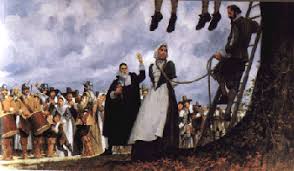
Puritans hung 4 Quakers for returning to Massachusetts after being banished for their religious beliefs.

Although they differed from the Church of England and others on some doctrines, “[t]he Puritans brought 2 principles with them from their native country, in which they did not differ from others; which are, that natural birth, and the doings of men, can bring children into the Covenant of Grace; and, that it is right to enforce & support their own sentiments about religion with the magistrate’s sword.”[1]

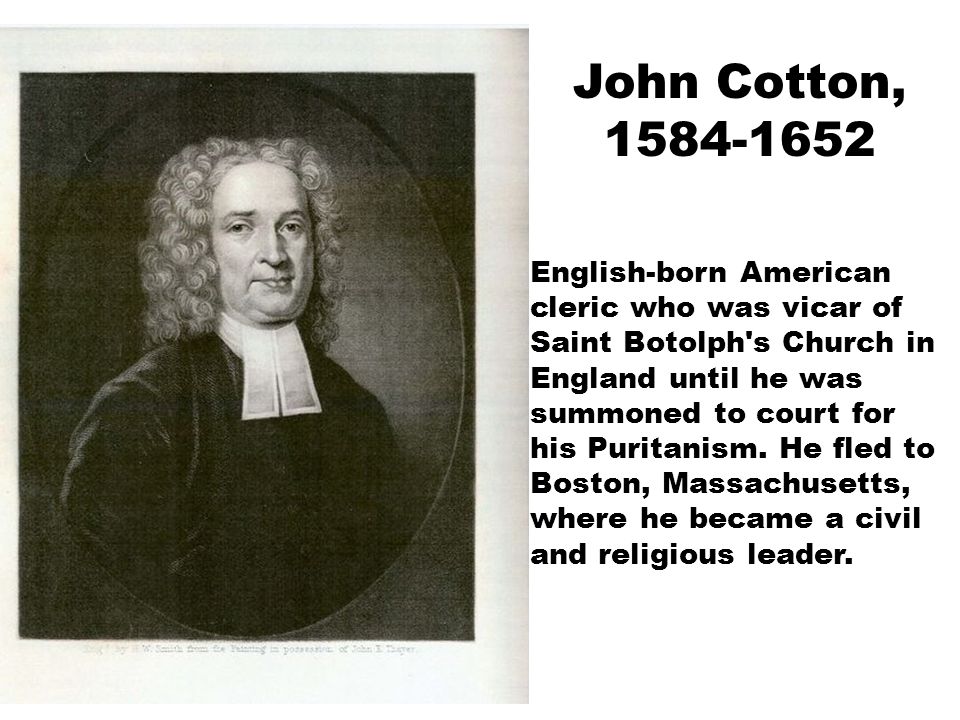
John Cotton was called upon to arrange the civil and ecclesiastical affairs of the colony.[2]  They set up a ecclesiocracy in which no one could hold office who was not a member of an approved church.[3] “The civil laws were adjusted to the polity of the church, and while nominally distinct, they supported and assisted each other.”[4]

“‘It was requested of Mr. Cotton,’ says his descendant Cotton Mather, ‘that he would from the laws wherewith God governed his ancient people, form an abstract of such as were of a moral and lasting equity; which he performed as acceptably as judiciously….  He propounded unto them, an endeavour after a theocracy, as near as might be to that which was the glory of Israel, the peculiar people.’”[5]

The goal of the Puritans was to build “city on a hill.” Two modern day Covenant Theologians and historical revisionists wrote:

  • “They determined to change their society in the only way that could make any lasting difference: by giving it a Christianity that worked. And this they set out to do, not by words but by example, in the one place where it was still possible to live the life to which Christ had called them: three thousand miles beyond the reach of the very Church they were seeking to purify.
  • “[T]he legacy of Puritan New England to this nation, which can still be found at the core of our American way of life, may be summed up in one word: covenant…. [O]n the night of the Last Supper, to those who were closest to Him, Jesus said, “This is my blood of the new covenant, which is poured out for many for forgiveness of sins….”[6]

To the contrary, covenant cannot be found, as understood by the Puritan theologians, now or anytime in the past, at the core of our American way of life. The idea of covenant at the core of our American way of life was that of the Baptists as expressed by the Warren Association at the close of the War for Independence:

“The American Revolution is wholly built upon the doctrine, that all men are born with an equal right to what Providence gives them, and that all righteous government is founded in compact or covenant, which is equally binding upon the officers and members of each community…. And as surely as Christianity is true, Christ is the only lawgiver and head of his church….”[7]

Nor is there a Bible principle that allows a nation to covenant with God contrary to the principles laid down in God’s Word. The Puritans incorrectly believed that every nation is in covenant with the Lord to enforce both His spiritual and earthly principles. They misunderstood the biblical teachings that God gives every nation a choice as to whether to follow His rules, and that nowhere in Scripture is there authority for a nation to initiate a non-biblical covenant with God. God alone initiated the Old Testament covenants to which He was a party, thereby, among other things, establishing Israel as a theocracy, and He made no such covenant with any other nation. All other nations called Gentile, and are judged by God primarily based upon their treatment of Israel.[8]

Covenant Theology[9] asserts that there are only two covenants, or three, in the Bible, with the other covenants which came after the Covenant of Grace being only a continuation thereof. The Covenant of Law, according to the covenant theologian, was made in the Garden of Eden. Covenant Theology superimposes the New Testament over the Old. Herein lies some of the fatal flaws in this interpretation of the Bible. In the Puritan formulation of those covenants, the principles and practices of the nation Israel and the Jewish religion were applied to the church and state. As has been shown, this presents irreconcilable conflicts with Old and New Testament teachings concerning law and grace and the relationship of church and state.

God permits a mutual compact or covenant between a ruler or the rulers and the people—a covenant that does not include God and His principles and that is not initiated or ordained by God.  God allowed even the people of the theocracy of Israel to reject Him and, like the Gentile nations, to have a king.[10] Isaac Backus taught as follows:

  • “Now the word of God plainly shows, that this way of mutual compact or covenant, is the only righteous foundation for civil government. For when Israel must needs have a king like the rest of the nations, and he indulged them in that request, yet neither Saul nor David, who were anointed by his immediate direction, ever assumed the regal power over the people, but by their free consent. And though the family of David had the clearest claim to hereditary succession that any family on earth ever had, yet, when ten of the twelve tribes revolted from his grandson, because he refused to comply with what they esteemed a reasonable proposal, and he had collected an army to bring them back by force, God warned him not to do it, and he obeyed him therein. Had these plain precedents been regarded in later times, what woes and miseries would they have prevented? But the history of all ages and nations shows, that when men have got the power into their hands, they often use it to gratify their own lusts, and recur to nature, religion or the constitution (as they think it will best serve) to carry, and yet cover, their wretched designs.”[11]

The Puritan ideal is disproved by correct interpretation of the Word of God, by biblical history and prophecy, and secular history, including the history of the colony of Massachusetts. Israel, populated by God’s chosen race, was directly under God, yet the Israelites rejected His theocracy so that they could have a king like all the other nations. Israel fared ill when they did things their way and were ruled by kings. Under both God and king, Israel refused to do things God’s way, and rejected his commandments and statutes. After the death of King Solomon, the nation divided in two. All of the kings of the northern kingdom, Israel, were bad. The southern Kingdom, Judah, had twenty kings—eight were good[12] and twelve were bad.  Both Israel and Judah, in accord with God’s philosophy of history, experienced religious apostasy, moral awfulness, and political anarchy. They failed to keep the commandments and statutes of God and were taken into captivity as a result.

The Puritans failed to correctly interpret both the Old and New Testaments and secular history which clearly show that all nations that have ever existed have been judged by God, are in the process of being judged by God, or will be judged by God. They misinterpreted prophecy concerning the end times to say that the church, working hand in hand with the state will establish the kingdom of heaven on earth. Oh, had and would they (have) realize(d) that the New Covenant for the church had so much better promises and procedures than the Old Testament covenants. “But now hath he [Jesus Christ] obtained a more excellent ministry, by how much also he is the mediator of a better covenant, which was established upon better promises.”[13]

The Puritans wrongly, but truly, believed they could build the Kingdom of God on earth, in their lifetime—all they needed, they felt, was “the right time, the right place, and the right people” who “were willing to commit themselves totally.”[14] The Puritans did not realize that the philosophy of history in the Bible and the basic nature of man rendered their goal impossible. God describes the cycle of every civil government, Jewish and Gentile.

  • “The book of Judges is a philosophy of history. ‘Righteousness exalteth a nation; but sin is a reproach to any people’ (Proverbs 14.34).”[15]
  • “We see that philosophy in the book of Judges. Israel at first, for a short time, served God. Then they did evil in the sight of the Lord and served Baal and Ashtaroth. The anger of the Lord was hot against Israel, and He delivered them into the hands of their enemies. Israel then entered into a time of servitude. Israel cried out to God in their plight and distress.  They turned to God and repented. God heard their prayers and raised up judges through whom they were delivered.
  • “This cycle was repeated over and over. The book of Isaiah opens with God giving his philosophy of history. Isaiah outlines three steps that cause the downfall of a nation: (1) spiritual apostasy, (2) moral awfulness, (3) and political anarchy.”[16]
  • “Every nation goes down in this order: (1) religious apostasy; (2) moral awfulness; (3) political anarchy. Deterioration begins in the [church], then to the home, and finally to the state. That is the way a nation falls.”[17]
  • “In Judges 17-21, we have presented that philosophy of history [that was mentioned above]. In Judges 17-18, we see spiritual apostasy. In Judges 19, we see moral awfulness. In Judges 20-21, we see political anarchy. This period ends in total national corruption and confusion. ‘In those days there was no king in Israel; every man did that which was right in his own eyes. (Judges 21.25).’[18]
  • “If you want to know just how up-to-date the book of Judges is, listen to the words of the late General Douglas McArthur: ‘In this day of gathering storms, as moral deterioration of political power spreads its growing infection, it is essential that every spiritual force be mobilized to defend and preserve the religious base upon which this nation is founded; for it has been that base which has been the motivating impulse to our moral and national growth. History fails to record a single precedent in which nations subject to moral decay have not passed into political and economic decline. There has been either a spiritual reawakening to overcome the moral lapse, or a progressive deterioration leading to ultimate national disaster.’”[19]

The Puritans felt that they were dedicated to serving the Lord and to doing things His way. They believed that they could set up a civil government modeled after biblical principles. They did not realize that even had they been upright in God’s eyes, future leaders would depart from the faith and lead the church and the civil government downhill into depravity just as happened in Israel and in all church-state marriages starting with the Catholics and up to the established churches after the Reformation, including the Church of England from which they were fleeing.


Endnotes

[1] Isaac Backus, A History of New England With Particular Reference to the Denomination of Christians called Baptists, Volume 1 (Eugene, Oregon: Wipf & Stock Publishers, Previously published by Backus Historical Society, 1871), pp. 34-35.

[2] Roger Williams and Edward Bean Underhill, The Bloudy Tenent of Persecution for Cause of Conscience Discussed and Mr. Cotton’s Letter Examined and Answered (London: Printed for the Society, by J. Haddon, Castle Street, Finsbury, 1848), p. xii.

[3] Backus, p. 35; Williams and Underhill, pp. x-xi.

[4] Williams and Underhill, pp. xii-xiii.

[5] Ibid., footnote 8, pp. xii-xiii, citing sources.

[6] Peter Marshall and David Manuel, The Light and the Glory, (Old Tappan, New Jersey: Fleming H. Revell Company, 1977), p. 146.

[7] Isaac Backus, A History of New England With Particular Reference to the Denomination of Christians called Baptists, Volume 2 (Eugene, Oregon: Wipf & Stock Publishers, Previously published by Backus Historical Society, 1871), pp. 265-266.

[8] See Section I.A. of these studies.

[9] See Dispensation Theology versus Covenant Theology and Their Importance to the Issue of Church and State Relationship in America.

[10] See 1 S. 8.

[11] Backus, Volume 1, APPENDIX B, p. 530

[12] Mannessa started out bad, was judged of God, then did good, making him the only bad king in Judah or Israel to repent and turn from his wicked ways. See 2 K. 21.1-18; 2 Chr. 33.1-20.

[13] He. 8.6; See all of He. 8.

[14] Marshall and Manuel, pp. 145-146.

[15] J. Vernon McGee, Joshua and Judges (Pasadena, California: Thru the Bible Books, 1980), p. 111.

[16] Ibid., pp. 112-113.

[17] Ibid, pp. 113, 203.

[18] Ibid., pp. 203-214.

[19] Ibid., p. 113.

V. The Theology and Goals of the Puritans Up to Their Arrival in America in 1629


A Publication of Churches Under Christ Ministry


Previous Lesson: IV. The Story of the Pilgrims Who Arrived in America in 1620, the Mayflower Compact

Next Lesson: VI. The Theology and Goals of the Puritans in America

Click here for links to all lessons on The Pilgrims and Puritans in New England.


Jerald Finney
Copyright © February 24, 2018


The undeniable truth from history is that the Puritans wanted religious freedom “for themselves only.”

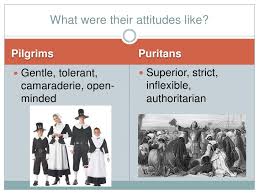
The Puritans, unlike the Pilgrims who wanted to separate from the Church of England, wanted to purify the Church from within. “The State, in their view, had the duty to maintain the true Church; but the State was in every way subordinate to the Church.”[1]

King James I was far more belligerently opposed to the Calvinistic church-state than even Queen Elizabeth had been, and his “determination toward the Puritans was to make them conform or to harry them out of the land.”[2] The Puritans who suffered under the combined pressure of accelerated persecution and the advanced moral decay in their society began to flee England for the new world.[3] “There was no ground at all left them to hope for any condescension or indulgence to their scruples, but uniformity was pressed with harder measures than ever.[4]

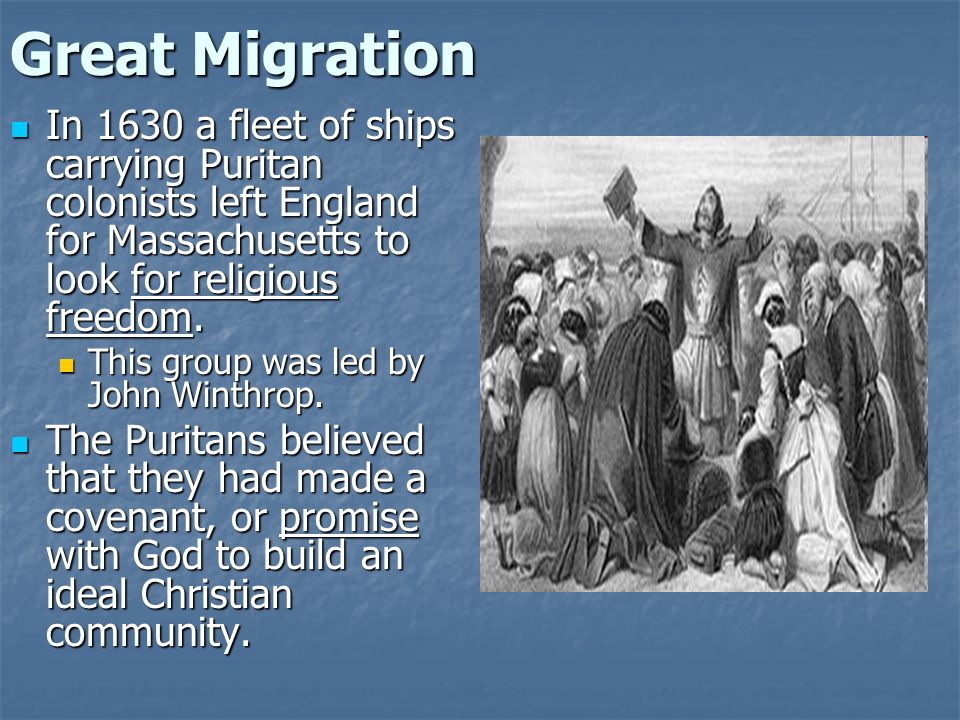
Cheating, double-dealing, the betrayal of one’s word were all part of the game for London’s financial district. Mercantile power brokers loved, honored, and worshipped money, and accumulated as much of it as possible and as fast as possible.  The ends justified the means. “London was an accurate spiritual barometer for the rest of the country, for England had become a nation without a soul.”[5] England was morally awful, and this came about under the auspices of a state-church practicing its theology.[6] 1628 marked the beginning of the Great Migration that lasted sixteen years in which twenty thousand Puritans embarked for New England and forty-five thousand other Englishmen headed for Virginia, the West Indies, and points south.[7]

A young Puritan minister named John Cotton preached a farewell sermon to the departing Puritans:

  • “He preached on 2 Samuel 7.10 (KJV): ‘Moreover, I will appoint a place for my people Israel, and will plant them, that they may dwell in a place of their own and move no more; neither shall the children of wickedness afflict them any more, as beforetime.’
  • “‘Go forth,’ Cotton exhorted, ‘… With a public spirit,’ with that ‘care of universal helpfulness…. Have a tender care … to your children, that they do not degenerate as the Israelites did….’
  • “Samuel Eliot Morison put it thus: ‘Cotton’s sermon was of a nature to inspire these new children of Israel with the belief that they were the Lord’s chosen people; destined, if they kept the covenant with Him, to people and fructify this new Canaan in the western wilderness.’”[8]

The Puritans landed at Salem at the end of June, 1629. They were motivated by religious principles and purposes, seeking a home and a refuge from religious persecution.[9] Having suffered long for conscience sake, they came for religious freedom, for themselves only. “They believed [in] the doctrine of John Calvin, with some important modifications, in the church-state ruled on theocratic principles, and in full government regulation of economic life.”[10]

The Puritan churches “secretly call[ed] their mother a whore, not daring in America to join with their own mother’s children, though unexcommunicate: no, nor permit[ed] them to worship God after their consciences, and as their mother hath taught them this secretly and silently, they have a mind to do, which publicly they would seem to disclaim, and profess against.”[11] In 1630, 1500 more persons arrived, several new settlements were formed, and the seat of government was fixed at Boston. Thinking not of toleration of others,” they were prepared to practice over other consciences the like tyranny to that from which they had fled.”[12]


Endnotes

[1] William H. Marnell, The First Amendment: Religious Freedom in America from Colonial Days to the School Prayer Controversy (Garden City, New York: Doubleday & Company, Inc., 1964), p. 40.

[2] Ibid., p. 42.

[3] Peter Marshall and David Manuel, The Light and the Glory, (Old Tappan, New Jersey: Fleming H. Revell Company, 1977), p. 146.

[4] John Callender, The Civil and Religious Affairs of the Colony of Rhode-Island (Providence: Knowles, Vose & Company, 1838), p. 66.

[5] Ibid., p. 148.

[6] Ibid., pp. 147-148.

[7] Ibid., p. 148

[8] Ibid., p. 157.

[9] Roger Williams and Edward Bean Underhill, The Bloudy Tenent of Persecution for Cause of Conscience Discussed and Mr. Cotton’s Letter Examined and Answered (London: Printed for the Society, by J. Haddon, Castle Street, Finsbury, 1848), p. v.

[10] Marnell, p. 48.

[11] Williams and Underhill, p. 244.

[12] Ibid., p. vii.

IV. The Story of the Pilgrims Who Arrived in America in 1620, the Mayflower Compact


A Publication of Churches Under Christ Ministry

Previous Lesson: III. Old World Patterns of Church-State Union Were Transplanted to the Colonies through the Puritans, Episcopalians, and Others

Next Lesson: V. The Theology and Goals of the Puritans Up to Their Arrival in America in 1629


Click here to go to all written lessons.

Click here to go to the 3 1/2 to 6 minute video lectures.

For accompanying study from God Betrayed click here.

Click here for links to all lessons on The Pilgrims and Puritans in New England.


Jerald Finney
Copyright © February 24, 2018


Note. For facts which explain documented truth (not secular or Christian revisionist history) about the influence of the Pilgrims and the Mayflower Compact on the history of the First Amendment (religious freedom and freedom of conscience, assembly, press, and speech), go to the other lessons on this matter at: Religious Liberty in America. Americans, and especially God’s children, need to seek and find truth. Sadly, Christians, as did I for many years, rely on Christian historical revisionism for their understanding of the religious history of America. For more understanding on this matter, see, The Trail of Blood of the Martyrs of Jesus, Christian Revisionism on Trial.

The original settlers of Massachusetts were the Pilgrims who landed at what was to become Plymouth, Massachusetts in 1620. The Pilgrims were Separatists in England who had left the Church of England in the autumn of 1608 and formed their own church. They were considered dangerous radicals by the Bishops of the Church of England. “They believed that the Reformation had not gone far enough, that the Reformers had assumed an infallibility no more palatable when lodged in a ruler than when lodged in the Pope, that the Church of England had rejected the Pope but not Popery, that the bishops of the Church of England had no more authority than the bishops of the Church of Rome.”[1]

Under James I, the Bishops were given a free hand to suppress the less than a thousand Separatists before they got out of hand. Calvinist historical revisionists Peter Marshall and David Manuel, who approved of the persecutions of the dissenters by the Puritan established churches in the colonies, complained that these were “dedicated followers of the Lord” who were:

  • “hounded, bullied, forced to pay assessments to the Church of England, clapped into prison on trumped-up charges, and driven underground. They met in private homes, to which they came at staggered intervals and by different routes, because they were constantly being spied upon. In the little Midlands town of Scrooby, persecution finally reached the point where the congregation to which William Bradford belonged elected to follow those other Separatists who had already sought religious asylum in Holland.”[2]
Contrary to revisionist history, the Mayflower Compact had little to do with the founding principles of America.

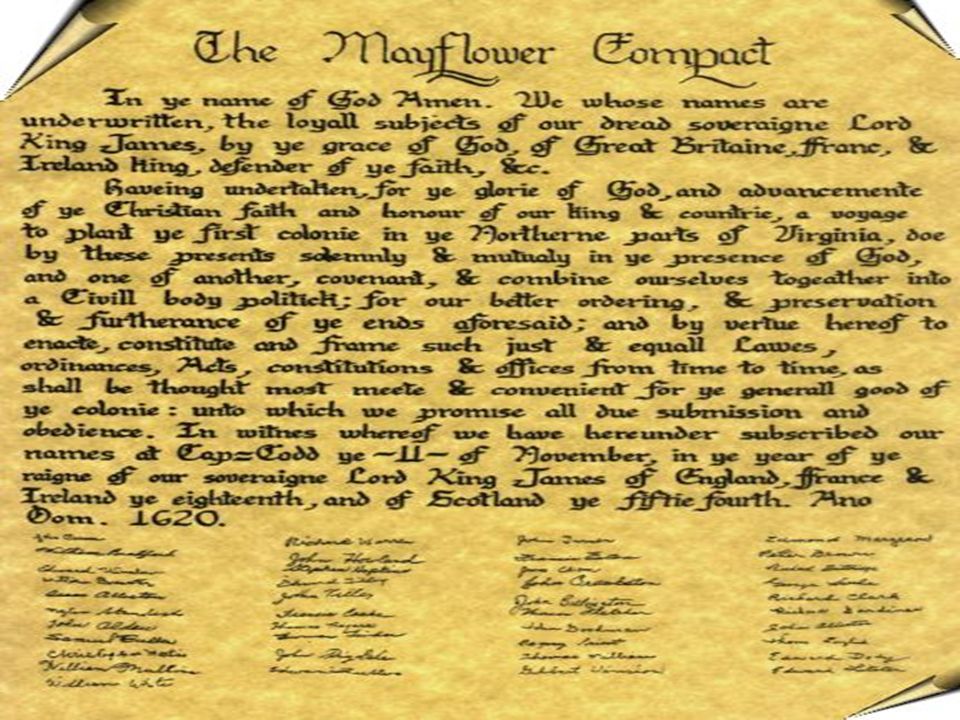
As a result of the persecution in England, some Separatists went elsewhere, going first to Leyden, Holland. After over ten years of a hard life in Holland, they decided to try to go to America. They reached an agreement with an English merchant named Thomas Weston under which they were able to set sail. They could not obtain assurance of liberty of their consciences. “However, they determined at length to remove, depending on some general promises of connivance, if they behaved themselves peaceably, and hoping that the distance and remoteness of the place, as well as the public service they should do the King and Kingdom, would prevent their being disturbed.”[3] One hundred and one Pilgrim souls sailed from Plymouth, England, on September 6, 1620, arriving at Cape Cod on November 11, 1620, and at a place they named Plymouth, in December, 1620.[4] Upon arrival, they drafted the Mayflower Compact:

  • “In the name of God, amen. We whose names are under-written, the loyall subjects of our dread Soveraigne Lord King James by ye Grace of God of Great Britain, France, Ireland king, defender of the Faith, etc., having undertaken, for ye glorie of God, and advancemente of ye Christian faith and honour of our king & countrie, a voyage to plant ye first colonie in ye Northerne parts of Virginia, doe by these presents solemnly and mutually in ye presence of God, and one of another, covenant and combine our selves together into a civill body politick, for our better ordering & preservation & furtherance of the ends aforesaid; and by vertue hereof to enacte, constitute, and frame such just and equall lawes, ordinances, acts, constitutions and offices, from time to time, as shall be thought most meete & convenient for the generall good of ye colony, unto which we promise all due submission and obedience. In witness whereof we have hereunder subscribed our names at Cap-Codd, ye 11. of November, in ye year of ye raigne of our soveraigne lord, King James of England, France, & Ireland, ye eighteenth, and by Scotland ye fiftie fourth. Ano: Dom. 1620.”

As a matter of human compassion, the Pilgrims were hospitable to all; and, at first, grudgingly tolerated those of other creeds. However, they gradually began to close their doors to those of other creeds. “Plymouth was a Church-State ruled by a governor and a small and highly select theological aristocracy, a Church-State with various grades of citizenship and non-citizenship.”[5] By 1651 the government of Plymouth colony was enforcing the laws of Congregationalist Massachusetts. “By the time Plymouth was united with Massachusetts in 1691 all major differences between the two had disappeared.”[6]

The Pilgrims overcame much adversity, such as hunger, drought, and heat which caused their corn to wither, and the failure of delivery of much needed supplies from England.[7]  They increased to three hundred souls and obtained a patent from the New England Company on January 13, 1630. The comparative handful of Pilgrims who were eventually absorbed by the Puritans are much admired by Americans. However, they had little to do with the road to religious liberty in America, and the Puritans, by whom they were absorbed, were against religious liberty and established theocracies denying freedom of religion in the colonies they founded. For more on this, see the Note below.

Note. For facts which explain documented truth (not secular or Christian revisionist history) about the influence of the Pilgrims and the Mayflower Compact on the history of the First Amendment (religious freedom and freedom of conscience, assembly, press, and speech), go to the other lessons on this matter at: Religious Liberty in America.


Endnotes

[1] William H. Marnell, The First Amendment: Religious Freedom in America from Colonial Days to the School Prayer Controversy (Garden City, New York: Doubleday & Company, Inc., 1964), p. 44.

[2] Peter Marshall and David Manuel, The Light and the Glory, (Old Tappan, New Jersey: Fleming H. Revell Company, 1977), pp. 108-109.

[3] John Callender, The Civil and Religious Affairs of the Colony of Rhode-Island (Providence: Knowles, Vose & Company, 1838), p. 64.

[4] Isaac Backus, A History of New England With Particular Reference to the Denomination of Christians called Baptists, Volume 1 (Eugene, Oregon: Wipf & Stock Publishers, Previously published by Backus Historical Society, 1871), pp. 27-28.

[5] Marnell, p. 48.

[6] Leo Pfeffer, Church, State, and Freedom (Boston: The Beacon Press, 1953), p. 66, citing Sanford H. Cobb, The Rise of Religious Liberty in America (New York: The McMillan Co., 1902), pp. 70-71

[7] Backus, pp. 28-29.

III. Old World Patterns of Church-State Union Were Transplanted to the Colonies through the Puritans, Episcopalians, and Others


A Publication of Churches Under Christ Ministry


Next Lesson: IV. The Story of the Pilgrims Who Arrived in America in 1620, the Mayflower Compact


Jerald Finney
Copyright © February 24, 2018


Jesus said, “They shall put you out of the synagogues: yea, the time cometh, that whosoever killeth you will think that he doeth God service.”[1] In fulfillment of prophecies of the Lord, the established churches thought they were doing God’s will. And these things will they do unto you, because they have not known the Father, nor me.”[2] The Old World patterns of church-state union and religious oppression were transplanted to the New World with all their rigor.[3] Eleven of the original thirteen colonies established a church prior to the Revolution. One of those eleven was Massachusetts which was founded by Puritans who were Congregationalists. All New England colonies, except Rhode Island, had established churches based upon the same theology. As noted by the Rhode Island Baptist, John Callender, in the early nineteenth century:

  • Puritans hung 4 Quakers for returning to Massachusetts after being banished for their religious beliefs.

    “[The Puritans] were not the only people who thought they were doing God good service when smiting their brethren and fellow-servants. All other Christian sects generally, as if they thought this was the very best way to promote the gospel of peace, and prove themselves the true and genuine disciples of Jesus Christ—‘sic,’ who hath declared, his kingdom was not of this world, who had commanded his disciples to call no man master on earth, who had forbidden them to exercise lordship over each other’s consciences, who had required them to let the tares grow with the wheat till the harvest, and who had, in fine, given mutual love, peace, long-suffering, and kindness, as the badge and mark of his religion.”[4]

The fight for religious liberty started in the New England colonies and then spread throughout the other colonies. The seventeenth century ended with firmly established church-states in all New England colonies except Rhode Island. The ecclesiocracies there were as absolute as the world has known, with persecution of “heretics;” but, because of intervention by England, not as brutal as past ecclesiocracies in Europe.

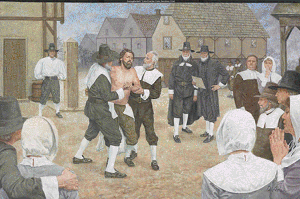
The beating of Obadiah Holmes by the Puritans in Massachusetts

The Church of England was established in the southern colonies. In the Southern colonies, “the church enjoyed the favor of the colonial governors but it lacked the one pearl without price which the Congregational Church had. No Anglican ever left England to secure freedom of worship; no Virginia Episcopalian had the fervent motivation of a Massachusetts Puritan. In Massachusetts the church was the state. In Virginia and, to a lesser degree, in the rest of the South the Church was formally part of the State although hardly a part that loomed large in southern minds” (Marnell, pp. 63-64).

The theology of the established churches in Massachusetts, Connecticut, and New Hampshire led to a combining of church and state; infant baptism; taxing for payment of clergy, church charities, and other church expenses; persecution of dissenters such as Baptists; and many other unscriptural practices.[5] Persecution of dissenters follows the example of the theocracy in Israel where, for example, Moses killed the three thousand who turned from the Lord into idolatry and immorality while he was on the mountain receiving the Ten Commandments,[6] and Elijah had the four hundred and fifty false prophets of Baal killed.[7]


Endnotes

[1] Jn. 16.2.

[2] Jn. 16.3.

[3] See, e.g., Leo Pfeffer, Church, State, and Freedom (Boston: The Beacon Press, 1953), p. 63.

[4] [4] John Callender, The Civil and Religious Affairs of the Colony of Rhode-Island (Providence: Knowles, Vose & Company, 1838),  p. 71

[5] William L. Lumpkin, Baptist Foundations in the South (Eugene, Oregon: Wipf & Stock Publishers, 2006), p. 1; Edmund S. Morgan, The Puritan Dilemma: The Story of John Winthrop (Boston, Mass., Toronto, Canada: Little, Brown and Company, 1958.

[6] Ex. 32.27.

[7] 1 K. 18.40.

I. Introduction: From the Storm Resulting from the Reformation Emerged Separation of Church and State


A Publication of Churches Under Christ Ministry


Previous Lesson: The Light Begins to Shine

Next Lesson: II. John Calvin’s Beliefs about the Relationship of Church and State, His Influence in the Colonies upon the Issue and the Impact in America; John Knox’s Beliefs on the Subject


Jerald Finney
Copyright © February 23, 2018


Being the continuation of the religious upheaval in Europe, the early history of New England was one of religious turmoil:

  • “It is acknowledged, on all hands, the first settlements of New-England were a consequence of the disputes which attended the Reformation in England; and therefore we must observe, that during this time, viz. 1517, learning having revived all over Europe, the Reformation was begun by Luther, and others in Germany, and carried on in several parts of Christendom, particularly in England, where, after a long struggle, it was finally established, by act of Parliament, under Queen Elizabeth, who began to reign November 17, 15
  • “As the whole Christian religion had been corrupted and disfigured by the inventions and impositions of Popery … it could not but be expected that many, who were justly and equally offended, at the horrid corruptions of Popery, should yet be unable entirely to agree in their sentiments, of what things were to be reformed, or how far they should carry the Reformation at the first.”[1]

The theological turmoil that resulted from the Reformation continued in the new world, and out of that storm emerged a separation of church and state that had never before existed in any nation in the history of the world.


ENDNOTE

[1] John Callender, The Civil and Religious Affairs of the Colony of Rhode-Island (Providence: Knowles, Vose & Company, 1838), pp. 60-61.

The Pilgrims and the Puritans in New England

I. Introduction: From the Storm Resulting from the Reformation Emerged Separation of Church and State
II. John Calvin’s Beliefs about the Relationship of Church and State, His Influence in the Colonies upon the Issue and the Impact in America; John Knox’s Beliefs on the Subject
III. Old World Patterns of Church-State Union Were Transplanted to the Colonies through the Puritans, Episcopalians, and Others
IV. The Story of the Pilgrims Who Arrived in America in 1620, the Mayflower Compact
V. The Theology and Goals of the Puritans Up to Their Arrival in America in 1629
VI. The Theology and Goals of the Puritans in America
VII. The Results of Puritan Theology in Massachusetts Soon Came to Fruition
VIII. Organizing the Church State “Theocracy” in Massachusetts Colony
IX. Punishing Every Sin and Persecuting “Heretics”
Appendix to “Punishing Every Sin and Persecuting ‘Heretics'”: Continuing Legislation, Persecutions of “Heretics,” Baptist Churches in Boston, and Other Matters
X. The atmosphere in Massachusetts begins to shift toward toleration and even freedom of tolerance; the second Massachusetts charter which provided for freedom of conscience to all Christians except Papists was secured in 1691; nonetheless, only in Boston was freedom of conscience honored; forced establishment remained in Massachusetts until 1733

The Light Begins to Shine


A Publication of Churches Under Christ Ministry


Jerald Finney
Copyright © February 23, 2018


Many forces came together to bring lignt and religious freedom to America. The Protestant Reformation was one step in that direction, even though the resulting Protestant denominations took from the Catholic church the idea of the church-state—the church controls the state. The colonies of Massachusetts, Connecticut, and New Hampshire established a church-state. England established a state-church—the state controls the church—and several of the early colonies in the South established a state-church.

With the Reformation, new light was beginning to shine over the English speaking world. The printing press made it possible to print and distribute the Bible in large quantities to the general public. The Bible became available in English and all could compare what they were told with the Word of God. Of course, this would result in some heresies, but no heresy could be more contrary to the Word of God and more destructive to eternal life, temporal human life, and the glory of God than the heresies of the Catholic church. Alongside new heresies would continue the light of truth—which had before been attacked mercilessly by the establishment which had attempted to brutally stamp out those who preached and practiced it—about matters such as salvation, baptism, and the relationship of church and state. In the colonies men were beginning to study the Bible and to debate issues. Those debates were published and disseminated and the light of truth further extended.[1]

While the debate was going on in the colonies, dissenters were persecuted. These persecutions gradually began to soften even members of the established churches, as people began to realize that persecution did not stand up to the test of Bible truth. The Baptists were by far the most active of all the colonial dissidents in their unceasing struggle for religious freedom and separation.

Unlike those areas of the New World settled by Catholics where only Catholics could immigrate and hold offices, and where the official religion was maintained by the government, “the English statesmen opened the gates of their American colonies to every kind of religious faith that could be found in Europe.” Additionally, unlike church-state relationships in Spain and France where no significant change occurred, England experienced changes of religion, which ranged from Catholicism (which was a minute minority) to Puritanism during the colonization of America. As a result, only in Catholic Mexico and Catholic Quebec was uniformity of religion achieved.[2]

“The individualism of the American colonist, which manifested itself in the great number of sects, also resulted in much unaffiliated religion. It is probably true that religion was widespread but was mostly a personal, noninstitutional matter.”[3]  This contributed to the growing movement toward religious liberty since “[p]ersons not themselves connected with any church were not likely to persecute others for similar independence.”[4]

The tradition which the Puritans of England and later of New England inherited was that of Geneva, where the church absorbed the state and the church-state originated.[5] New Hampshire, Massachusetts, and Connecticut had church-state establishments—the church used the state to enforce the Ten Commandments and dissenters were persecuted.

The Anglo-Catholicism of England[6] was later transferred to the southern colonies.[7] Virginia, the Carolinas, and Georgia had state-church establishments—the state was over the church.

“The Calvinists who governed New England and oppressed Anglicans were themselves persecuted in Virginia, and forced to pay taxes to support the hated Anglican establishment from which they fled.”[8] “[T]he Reformed Church was the state-church in New Amsterdam; the Quakers dominated Pennsylvania, … and, for a short time, the Catholics Maryland.”[9]  In New England—Massachusetts, Plymouth, Connecticut, and New Hampshire—Congregationalism was the established church. In Virginia and North and South Carolina, the Church of England was established. New York, New Jersey, Maryland, and Georgia experienced changes in church-state establishments. “In … Pennsylvania and Delaware, no single church ever attained the status of monopolistic establishment.”[10]

“From Maryland south to Georgia there were recurring periods of persecution and repression.”[11] In Maryland, the Calverts tolerated the Puritan settlers who later suppressed Catholicism. Anglicanism was established in 1689 after conflict in charters granted the second Lord Baltimore and William Penn.[12]

The Anglican Church was established in North and South Carolina much as in Virginia. However, dissenters were allowed to immigrate into those states due to the need for settlers. From 1700 on the major political conflict in South Carolina was shaped up around the conflict of the establishment and the dissenters, with the latter growing in the back country and a pronounced shift to Anglicanism on the coast. In 1704 a bill was jammed through to exclude all dissenters from the legislature. In 1706 the Church Act was passed, with dissenters excluded from voting; the land was divided into parishes…. Anglican clergy were frequently immoral and guilty of gross neglect of their people. In 1722 nearly one fourth of the taxes went to the established church. With independence in South Carolina came disestablishment.[13]

Emigrants from the persecuted Baptist church in Boston came to Charleston, South Carolina in 1683. The second Baptist church in South Carolina was Ashley River founded in 1736.  By 1755, there were four Baptist churches in South Carolina and the second Baptist Association in America, the Charleston Association, was founded in 1751.[14]  The General Baptists established several churches in North Carolina between 1727 and 1755. All but three of those churches converted to Particular Baptist churches in 1755 or 1756. By 1755, there were only twelve Baptist churches in North Carolina.[15]  However, as will be seen, this was about to change with the arrival of some Baptists from Connecticut.

New York colonial history was unique in some ways. Until 1664, the Dutch reformed church was established and supported by the state. Imprisonment was required for those who failed to contribute to the support of the church minister. All children were required to be baptized by a Reformed minister in the Reformed Church. Only the Reformed, the English Presbyterians, and the Congregationalists could build church buildings. Lutherans were imprisoned for holding services and Baptists were subject to arrest, fine, whipping, and banishment for so doing.

In 1664, New Amsterdam surrendered to the English, and New York extended its jurisdiction over all sects. The Protestant religion, and not one church, was established as the state religion. The head of the state was head over every Protestant church. All Protestant churches were established. Only four counties conferred preferential status upon the Church of England after attempts to confer such status throughout the state were unsuccessful.[16]

“In New Jersey agitation by Episcopal clergy for the legal establishment of the Church of England failed to attain even the partial success achieved in New York.”[17]

“In Georgia, the original charter of 1732, which guaranteed liberty of conscience to all persons ‘except Papists,’ was voided in 1752, and the Church of England was formally established.”[18] Nonetheless, Georgia had a history of public hostility toward dissenters even before the church-state establishment. Jews and Moravians were persecuted to the extent that nearly all of these peoples fled that state in 1740 or retreated to their own enclaves. “In 1754, the colony reverted to the status of a royal province and several efforts were made to enforce the Anglican establishment.”[19] There were no Baptist churches in Georgia in 1755.[20]  In 1758 the law of Anglican Establishment was passed. By 1786 there were not over five hundred active Christians in Georgia: “there were three Episcopal parishes without rectors and three Lutheran churches, three Presbyterian churches, three Baptist churches—all small and struggling.”[21]  The Constitution of 1798 provided for complete religious freedom including Catholicism.

Maryland, established in 1631 and settled by both Catholics and Protestants, practiced a degree of toleration. Catholics attempted to procure the preferred position possessed in European countries with Catholic establishments, but they were unsuccessful since they were never in the majority. Although the Maryland Act of Toleration of 1649 has been lauded as “the first decree granting complete religious liberty to emanate from an assembly,” “even a superficial examination of the law shows quite clearly that it is far from a grant of ‘complete religious liberty.’” The first three of the four main provisions of the act “were denials rather than grants of religious liberty; only the last four dealt with toleration.” The first imposed death for infractions such as blasphemy, denying Jesus Christ to be the son of God, using or uttering any reproachful speeches, words or language concerning the Holy Trinity,” etc. The second imposed fines, whipping, and imprisonment on any who called another any one of certain names. The third imposed fines or imprisonment for profaning the Lord’s day. By 1688, the Anglicans had the upper hand and the Church of England was established in Maryland.[22]

Pennsylvania, like Maryland was colonized partly as business venture and partly as a “holy experiment.” The proprietor of the colony, William Penn, joined the Quakers while a student at Oxford. Penn opposed coercion in matters of conscience and provided for it in the fundamentals of the government of Pennsylvania. “Nevertheless, profanity was penalized, and Sunday observance for church, scripture reading, and rest was required. Political privileges were limited to Christians, and complete freedom of worship, at least at the beginning, was not allowed Catholics or Jews. As in Calvert’s Maryland, Penn’s motivation was at least partly his desire to reap substantial profits and this required attracting large numbers of settlers.[23]

King James made New Hampshire a royal colony in 1679. Liberty of conscience was allowed to all Protestants, but the Church of England was “particularly countenanced and encouraged.” Each town in New Hampshire determined the church to be supported with its tax revenues. Dissenters, with submission of a certificate proving regular attendance and financial support of a dissenting church, were exempted from the tax.  However, the assembly was slow to accord financial recognition to dissenting sects.[24]

The stand of the dissenters, especially the Baptists, in the face of persecutions in the colonies gradually turned public opinion against persecution and toward religious freedom. Bible believing Baptists who stood in word and deed against colonial establishments eventually prevailed. Baptists proved to be loyal to the nation in the American Revolution was another factor which tipped the scale toward those freedoms protected by the First Amendment.


Endnotes

[1] God assures man, in His Word, that one can find truth. “Then said Jesus to those Jews which believed on him, If ye continue in my word, then are ye my disciples indeed; And ye shall know the truth, and the truth shall make you free” (Jn. 8.31-32). “Sanctify them through thy truth: thy word is truth.” Believers are told to “Study to shew thyself approved unto God, a workman that needeth not to be ashamed, rightly dividing the word of truth” (2 Ti. 2.15). Catholicism would have one believe that only the clergy has the God-given ability to understand Scripture—such a belief assures the power of the clergy, but the loss of God’s power. The Jews at Berea were commended for studying the Scriptures: “These were more noble than those in Thessalonica, in that they received the word with all readiness of mind, and searched the scriptures daily, whether those things were so” (Ac. 17.11).

[2] Leo Pfeffer, Church, State, and Freedom (Boston: The Beacon Press, 1953), pp. 74, 83.

[3] Ibid., p. 85.

[4] Ibid.

[5] William H. Marnell, The First Amendment: Religious Freedom in America from Colonial Days to the School Prayer Controversy (Garden City, New York: Doubleday & Company, Inc., 1964), p. 32, 33, 37. In the English colonies, unlike in Mexico and Quebec, no single faith dominated the others throughout the colonies and religious uniformity was very limited. On the European Continent, “the Reformation from the start was an effort to return the Church itself to the doctrines and practices of its apostolic days.” However, while discarding some of the heresies of the Catholic “church,” Protestantism, under pressure from civil governments, soon resumed the Catholic conceived theology which united church and state. The final, logical thought of the reformers was reached at Geneva, where the church absorbed the state and the church-state originated. The state became an aspect of the church.

[6] In England, the problem was to “wean the Church in England away from the Pope, but otherwise to leave it as little changed as possible.”[6]  The monarch created the state-church and became the head of the church. The church became an aspect of the state. The king was the final authority on church doctrine and practice. “[T]he Church in England [became] the Church of England, [and] the Church [became] an aspect of the State.”[6] Under Queen Elizabeth, such Catholic doctrines as transubstantiation, the communion of saints, and purgatory were abandoned and the Mass was labeled a “blasphemous fable and dangerous deceit,” but ecclesiastical organization remained mainly unchanged, and episcopacy was its principle. Because she wanted a united state, Queen Elizabeth wanted a church where the Anglo-Catholics and the Anglo-Calvinists could worship together.

[7] Ibid., pp. 37-38.

[8] Pfeffer, p. 65.

[9] Ibid.

[10] Ibid.

[11] Franklin Hamlin Littell, From State Church to Pluralism: A Protestant Interpretation of Religion in American History (Chicago: Aldine Publishing Company, 1962), p. 12.

[12] Ibid.

[13] Ibid., p. 14.

[14] James R. Beller, America in Crimson Red: The Baptist History of America (Arnold, Missouri: Prairie Fire Press, 2004), pp. 139-140, 142.

[15] Ibid., pp. 141-142.

[16] Pfeffer, pp. 70-71.

[17] Ibid., p. 71.

[18] Ibid.

[19] Littell, p. 15.

[20] Beller, America in Crimson Red, p. 142.

[21] Littell, pp. 16-17.

[22] Pfeffer, pp. 71-75.

[23] Ibid., pp. 78-79.

[24] Mark Douglas McGarvie, One Nation Under Law: America’s Early National Struggles to Separate Church and State (DeKalb, Illinois: Northern Illinois University Press, 2005), p. 153.
1. Introduction to History of the First Amendment


A Publication of Churches Under Christ Ministry


Previous Section:
Bible Doctrine Concerning Relationship of Church and State (Click here to go to links to all lessons)

Next Lesson:
2. Definitions of “Separation of Church and State,” “Established Church,” and “Religious Freedom or Soul Liberty”

Click here to go to all links to lessons on religious liberty in America.

Click here to go to links to all written lessons.

Click here to go to the 3 1/2 to 6 minute video lectures.

For accompanying for more thorough study from God Betrayed click here.


Jerald Finney
Copyright © February 22, 2018


Christians, except for a small minority who have ferreted out the truth, and secularists have accepted the brand of historical revisionism presented them by those they trust.[1] Revisionists revise in spite of the fact that he truth is available. This study presents accurate historical facts which are readily available through honest research. See [2] for link to some resources which verify this.   Both Christian revisionists (such as David Barton and Roger Federer) and secular revisionists (such as Leo Pfeffer,[3]) have distorted the true history of the First Amendment; “Christian” revisionism through manipulation of selected facts taken out of context and other dishonest devices and secular revisionism, although much more honest and accurate in reporting historical fact, through their inability to properly analyze because they leave God and the spiritual out of the equation.[4]

Revisionists, both “Christian” and secular, work on the lowest level, at the public level. They disseminate books, articles, videos, and public media interviews. They select facts out of context which support their agenda. Their adherents trust and believe them. Few followers have time to check out what they are being told. Even though legal and historical scholars have published the truth, their works remain obscure; the general public has neither the time nor inclination to examine the truth of what they are being fed. This study is based upon undeniable historic fact. Anyone can discover and verify these facts, if they have the time.

Secular revisionists such as Leo Pferrer have been very instrumental in the development of First Amendment law at the highest level—in the courts. Although Pfeffer’s work, unlike that of Christian revisionists, was for the most part factually accurate, he simply did not get it even though he did mention God. On the other hand, Christian revisionists, usually knowingly, present a factually false view of history. See [5] for link to a book which explains “Christian” revisionism. They have disseminated their history to the general public so successfully that the general Christian population who is interested in history as well as many politicians all the way up to Presidents of the United States have accepted and continued to disseminate the accepted “Christian” view of history. “Christian” revisionism has been published in briefs, memorandums of law, etc. in court cases all the way up to the Supreme Court. To present lies to such studied authorities is discrediting to Christianity in general. Although some “Christian” revisionists have now been exposed before the public in general, blind Christians continue to follow their teachings.[6] After all, most Christians believe that other “Christians” would not lie to them.

Religious freedom without persecution of “heretics” was historically rare, almost non-existent before the founding of the colony or Rhode Island. God’s people have always, regardless of persecution, come together as local churches, preached the Gospel, and helped their fellow man. Paul wrote in the midst of persecution:

  • “We are troubled on every side, yet not distressed; we are perplexed, but not in despair; Persecuted, but not forsaken; cast down, but not destroyed;”[7]
  • “We, having the same spirit of faith, according as it is written, I believed, and therefore have I spoken; we also believe, and therefore speak.”[8]

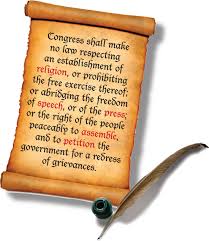
In the preceding verse, Paul quoted a portion of Psalm 116.10 which says in its entirety, “”I believed, therefore have I spoken: I was greatly afflicted:” Tied up in the liberty given believers by Christ is speaking (“And he said unto them, Go ye into all the world, and preach the gospel to every creature.”[9]), and associating or meeting together (“Not forsaking the assembling of ourselves together, as the manner of some is;”[10]). Furthermore, God gave mankind the Bible, which in certain times past, was banned and burned. The First Amendment was written and ratified with the intent of protecting God’s churches, the exercise of religion by the dissenters in the colonies, the preaching of the Gospel, the coming together to worship God, the dissemination of literature, mainly the dissemination of God’s Word, and the right to petition the civil government for a redress of grievances.

The First Amendment was the culmination of a long spiritual warfare between established churches and dissenters, mainly the Baptists. God’s power moved mightily during that period of conflict. Many believers suffered persecution. The roots of the struggle in America were embedded in New England, spread to the south, to Virginia, and then to the new nation.

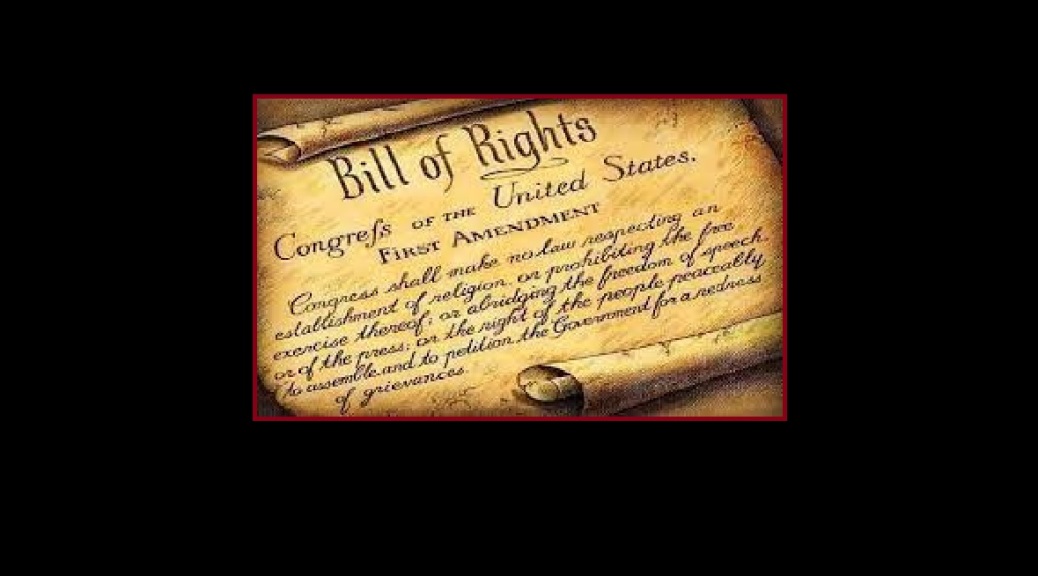
The First Amendment to the United States Constitution.

True historical facts prove that the religion clause of the First Amendment is a legal statement of the principle of religious freedom, or soul liberty, or separation of church and state which conforms to biblical principles. Bible-believing Christians, based upon their spiritual beliefs, fought the fight which resulted in the First Amendment. They made the spiritual Bible-based arguments and practiced their faith despite persecution. Their efforts and arguments gradually convinced others.

Many of the early colonists were Protestants who thought Luther and/or Calvin were correct in their belief that church and state should be united. Others, the Anglicans, brought the state-church concepts of union of church and state of England to the colonies. Dissenters believed in and fought for separation of church and state. The First Amendment was primarily the result of a spiritual warfare between those holding opposing Scriptural interpretations, the established churches versus the dissenters, primarily the Baptists.

  • “Of the Baptists, at least, it may be truly said that they entered the conflict in the New World with a clear and consistent record on the subject of soul liberty. ‘Freedom of conscience’ had ever been one of their fundamental tenets. John Locke, in his ‘essay on Toleration,’ says: ‘The Baptists were the first and only propounders of absolute liberty, just and true liberty, equal and impartial liberty.’ And the great American historian, Bancroft, says: ‘Freedom of Conscience, unlimited freedom of mind, was from the first a trophy of the Baptists.’ Vol. II., pages 66, 67.
  • “The history of the other denominations shows that, in the Old World, at least, they were not in sympathy with the Baptist doctrine of soul liberty, but in favor of the union of Church and State, and using the civil power to compel conformity to the established church….
  • “The Reformation which began with Martin Luther corrected many errors of faith and practice among those who came out of the corrupt and apostate church, but not all. It was left to the sect once ‘everywhere spoken against’ to teach their Protestant brethren the lesson of soul liberty, and this they did in the school of adversity in the New World.”[11]

At times, persecuting established churches became persecuted churches when they moved to other colonies controlled by another church/state establishment. When that happened, the persecutors generally became dissenters seeking religious tolerance or religious freedom.

Beating of Obadiah Holmes for “heresy” by the Puritans in Massachusetts.

The First Amendment to the Constitution resulted from “a factual relationship that was rapidly solidifying when the Constitution was amended by the Bill of Rights.” The First Amendment was the final product of a long struggle by men who believed strongly in the God of the Bible and who were willing to die rather than bow down to false religion. Their spirit was fused into the ordering of the affairs of the United States. “A wall of separation which would bar that spirit from making itself felt in secular concerns can never be built, because it would have to bisect the human heart.”[12] William H. Marnell correctly observed that:

  • “[t]he First Amendment was not the product of indifference toward religion. It was not the product of the deism which prevailed in the Enlightenment, however much the spirit of deism may have been present in certain of the Founding Fathers. Above, all, it was not the product of secularism, and to translate the spirit of twentieth-century secularism back to eighteenth-century America is an outrage to history. The First Amendment was rather a logical outcome of the Reformation and its ensuing developments. It was so far removed from secularism as to be the product of its exact opposite, the deep-seated concern of a people whose religious faith had taken many forms, all of them active, all of them sincerely held. It was so far removed from indifference toward religion [specifically Christianity] as to be the result of its antithesis, the American determination that the diversity of churches might survive the fact of political action.”[13]
Puritans hung 4 Quakers for returning to Massachusetts after being banished for their religious beliefs.

The dissidents in the colonies, chiefly the Baptists, were able to gain a foothold, and they played it for all it was worth. The Baptist theology of the founding era, initially under the leadership of Roger Williams and John Clarke, successfully challenged the doctrines of the established churches concerning the relationship of church and state. Among the results were the establishment of the first civil government in history of any lasting significance with religious liberty, the government of the colony of Rhode Island, and later the First Amendment to the United States Constitution which required religious freedom for churches and freedom of conscience for individuals. The First Amendment allowed churches to operate under God without persecution. The First Amendment did not apply to the states.

Primarily due to the efforts of our Baptist forefathers, a time came, as Baptist pastor and historian John Callender said in 1838, when

  • “[e]xperience has dearly convinced the world, that unanimity in judgment and affection cannot be secured by penal laws….
  • “Indulgence to tender consciences, might be a reproach to the Colony [of Rhode Island], an hundred years ago, [that is in 1738, one hundred years before Callender wrote this], but a better way of thinking prevails in the Protestant part of the Christian church at present. It is now a glory to the Colony, to have avowed such sentiments so long ago, while blindness in this article happened in other places, and to have led the way as an example to others, and to have first put the theory into practice.
  • “Liberty of conscience is more fully established and enjoyed now, in the other New-English Colonies; and our mother Kingdom grants a legal toleration to all peaceable and conscientious dissenters from the parliamentary establishment. Greater light breaking into the world and the church, and especially all parties by turns experiencing and complaining aloud of the hardships of constraint, they are come to allow as reasonable to all others, what they want and challenge for themselves. And there is no other bottom but this to rest upon, to leave others the liberty we should desire ourselves, the liberty wherewith Christ hath made them free. This is doing as we would be done by, the grand rule of justice and equity; this is leaving the government of the church to Jesus Christ, the King and head over all things, and suffering his subjects to obey and serve him.”[14]

By the time the First Amendment was added to the United States Constitution, only New Hampshire, Massachusetts, and Connecticut had established churches. In 1833 Massachusetts became the last state to disestablish.

Baptists wanted religious freedom. Some probably could foresee the ideal of a church under God, a civil government under God, with neither church nor state over the other. But few knew how to have a civil government under God without establishing a church. Why? Fifteen hundred years of history had witnessed “Christian” establishments made up of church-state or state-church unions. Therefore, one should not be too hard on those early Protestants in America who continued those unions, since, according to Isaac Backus:

  • “[many things] prove that those fathers [the leaders of the Puritans in Massachusetts] were earnestly concerned to frame their constitution both in church and state by divine rule; and as all allow that nothing teaches like experience, surely they who are enabled well to improve the experience of past ages, must find it easier now to discover the mistakes of that day, than it was for them to do it then. Even in 1637, when a number of puritan ministers in England, and the famous Mr. Dod among them, wrote to the ministers here, that it was reported that they had embraced certain new opinions, such as ‘that a stinted form of prayer and set liturgy is unlawful; that the children of godly and approved Christians are not to be baptized, until their parents be set members of some particular congregation; that the parents themselves, though of approved piety, are not to be received to the Lord’s Supper until they be admitted set members,’ &c., Mr. Hooker expressed his fears of troublesome work about answering of them, though they may appear easy to the present generation.”[15]

This chapter will succinctly summarize the true history of religious liberty in America, initially pointing out some of the misleading teachings of secular and Christian revisionists. Ultimately, Christians can accomplish nothing with lies.[16]


Endnotes

[1] Influential Christian revisionists include non-scholars such as David Barton and Roger Federer. Secular revisionsts include scholars such as Leo Pfeffer. Pfeffer’s book Church, State and Freedom, was called a “masterpiece” and the ultimate sourcebook for the history of the evolution of the all-American principle of  separation of church and state. Pfeffer was an American Jewish lawyer, constitutional scholar, and humanist who was active in movement for religious freedom in the United States, and was one of leading legal proponents of the separation of church and state.

[2] List of Scholarly Resources which Explain and Comprehensively Document the True Histor of Religious Freedom in America.

[3] Leo Pfeffer, Church, State, and Freedom (Boston: The Beacon Press, 1953), pp. 81-93.

[4] Influential constitutional “scholars” such as Leo Pfeffer, since they have no concept of God or His sovereignty, have removed the most important aspect of debate from the equation—the spiritual aspect. Pfeffer, misrepresents spiritual matters because he does not understand them. He relegates the spiritual to the merely “ideological.” He attributes Madison’s positions on the issue of separation of church and state to his reliance on John Locke, and quotes Locke; then, even though Locke, in the quotes cited by Pfeffer, talks of government interference with the care and salvation of souls which belongs to God, Pfeffer never mentions God in his discussion but rather emphasizes Locke’s “social contract theory.” He overemphasizes the influence of rationalism and deism in gaining the First Amendment. He falsely proclaims that the “first four presidents of the United States were either Deists or Unitarians.” He asserts that the Great Awakening “emphasized an emotional, personal religion” which appealed directly to the individual, stressing the rights and duties of the individual conscience and its answerability exclusively to God.[4] He, like all secular scholars, simply did not get it even though he did mention God. He had no choice but to mention God, since a controversy over what God taught in the Bible was at the center of the controversy. He simply did not and could not examine that controversy. Lost men and saved men who were spiritually ignorant have led the way in the twentieth and twenty-first centuries.

[5] The Trail of Blood of the Martyrs of Jesus/Christian Revisionists on Trial….

[6] See Exposing Catholic/Calvinist/Reformed Historic Revisionism.

[7] 2 Co. 4.8-9.

[8] 2 Co. 4.13.

[9] Mk. 16.15.

[10] He. 10.25a.

[11] Charles F. James, Documentary History of the Struggle for Religious Liberty in Virginia (Harrisonburg, VA.: Sprinkle Publications, 2007; First Published Lynchburg, VA.: J. P. Bell Company, 1900), pp. 14-15.

[12] William H. Marnell, The First Amendment: Religious Freedom in America from Colonial Days to the School Prayer Controversy (Garden City, New York: Doubleday & Company, Inc., 1964), pp.  xii-xiii.

[13] Ibid.

[14] John Callender, The Civil and Religious Affairs of the Colony of Rhode-Island (Providence: Knowles, Vose & Company, 1838), pp. 108-109.

[15] Isaac Backus, A History of New England With Particular Reference to the Denomination of Christians called Baptists, Volume 1 (Eugene, Oregon: Wipf & Stock Publishers, Previously published by Backus Historical Society, 1871), pp. 37-38.

[16] Read James R. Beller, The Coming Destruction of the Baptist People: The Baptist History of America (St. Louis, Missouri: Prairie Fire Press, 2005) and James R. Beller, America in Crimson Red: The Baptist History of America (Arnold, Missouri: Prairie Fire Press, 2004) for a thorough discussion of the theology behind the lies of the Christian nationalists, whom Beller calls catholic Reformed, and a discussion of Christian nationalists other than Peter Marshall and David Manuel.