Category Archives: Written Lessons

V. Roger Williams and the Providence Compact


A Publication of Churches Under Christ Ministry


Link to Previous Lesson:
IV. Dr. John Clarke; the Portsmouth Compact

Link to Next Lesson:
VI. Roger Williams Secures the 1644 Rhode Island Charter; Dissemination of Knowledge: The Bloudy Tenet of Persecution for Conscious Sake

Click here for links to all lessons on The Baptists in Rhode Island.


Jerald Finney
Copyright © February 27, 2018
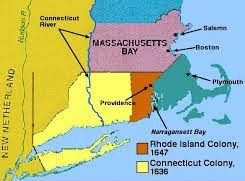

In August of 1638, the people of Providence approved the first public document establishing government without interference in religious matters, the Providence Compact:

“We whose names are here underwritten being desirous to inhabit in the town of Providence, do promise to submit ourselves in active or passive obedience to all such orders or agreement as shall be made for public good to the body in an orderly way, by the major consent of the present inhabitants, masters of families, incorporated together into a township, and such others whom they shall admit into the same, only in civil things.[1] [Signed by Stukely Westcoat, William Arnold, Thomas James, Robert Cole, John Greene, John Throckmorton, William Harris, William Carpenter, Thomas Olney, Francis Weston, Richard Watearman, and Ezekiel Holliman.]
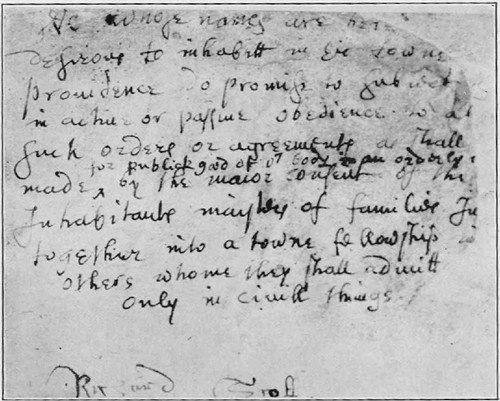
Providence Compact

As James R. Beller proclaims, the document was “the first of a series of American political documents promulgating government by the consent of the governed and liberty of conscience.[2] Thus, liberty of conscience was the basis for legislation in Rhode Island, and its annals have remained to this day [when Underhill wrote this] unsullied by the blot of persecution.[3]

Rhode Island was ruled according to the original covenant, “til on January 2, 1639, an assembly of the freemen said:

“By the consent of the body it is agreed that such who shall be chosen to the place of Eldership, they are to assist the Judge in the execution of the justice and judgment, for the regulating and ordering of all offences and offenders, and for the drawing up and determining of all such rules and laws as shall be according to God, which may conduce to the good and welfare of the commonweal; and to them is committed by the body the whole care and charge of all the affairs thereof; and that the Judge together with the Elders, shall rule and govern according to the general rules [rule] of the word of God, when they have no particular rule from God’s word, by the body prescribed as a direction unto them in the case. And further, it is agreed and consented unto, that the Judge and [with the] Elders shall be accountable unto the body once every quarter of the year, (when as the body shall be assembled) of all such cases, actions or [and] rules which have passed through their hands, by they to be scanned and weighed by the word of Christ; and if by the body or any of them, the Lord shall be pleased to dispense light to the contrary of what by the Judge or [and] Elders hath been determined formerly, that then and there it shall be repealed as the act of the body; and if it be otherwise, that then it shall stand, (till further light concerning it) for the present, to be according to God, and the tender care of indulging [indulgent] fathers.”[4]

Banished by the Puritans from Mass. colony in the 1630s. Started R.I. colony, a government with religious freedom.

In March 1639, Mr. Williams attempted to become a Baptist, together with several more of his companions in exile.[5] However, since he was never Scripturally baptized, he could not have been a Baptist. Williams, being familiar with “the General Baptist view of a proper administrator of baptism, namely, that two believers had the right to begin baptism,” [6] was baptized by immersion[7] by one Holliman. He, in turn, baptized ten others. Thus, according to some accounts, was founded the first Baptist church in America.[8] However, the fact that Roger Williams was not a genuine Baptist and many other facts prove that Dr. John Clarke started the First Baptist Church in America.[9]

Mr. Williams stepped down as pastor of the church after only a few months because his baptism was not administered by an apostle, but the church continued.[10] Isaac Backus commented on the requirement of apostolic succession for baptism at length, stating, “And if we review the text (II Tim. ii. 2-Ed.) that is now so much harped upon, we shall find that the apostolic succession is in the line of ‘faithful men;’ and no others are truly in it, though false brethren have sometimes crept in unawares.”[11]

  • Williams “turned seeker, i.e. to wait for the new apostles to restore Christianity. He believed the Christian religion to have been so corrupted and disfigured in what he called the ‘apostasy, as that there was no ministry of an ordinary vocation left in the church, but prophecy,’ and that there was need of a special commission, to restore the modes of positive worship, according to the original institution. It does not appear to [Mr. Callender], that he had any doubt of the true mode, and proper subjects of baptism, but that no man had any authority to revive the practice of the sacred ordinances, without a new and immediate commission.”[12]

Endnotes

[1] James R. Beller, America in Crimson Red: The Baptist History of America (Arnold, Missouri: Prairie Fire Press, 2004), p. 13, citing Isaac Backus, A History of New England With Particular Reference to the Denomination of Christians called Baptists, Volume 1 (Eugene, Oregon: Wipf & Stock Publishers, Previously published by Backus Historical Society, 1871), p. 74; Thomas Armitage, The History of the Baptists, Volume 2 (Springfield, Mo.: Baptist Bible College, 1977 Reprint), p. 643.

[2] Beller, America in Crimson Red, p. 13.

[3] Roger Williams and Edward Bean Underhill, The Bloudy Tenent of Persecution for Cause of Conscience Discussed and Mr. Cotton’s Letter Examined and Answered (London: Printed for the Society, by J. Haddon, Castle Street, Finsbury, 1848), p. xxviii.

[4] Backus, Volume I, pp. 427-428.

[5] Williams and Underhill, p. xxvi; Isaac Backus, Volume 1, pp. 86-89.

[6] John T. Christian, A History of the Baptists, Volume I, (Texarkana, Ark.-Tex.: Bogard Press, 1922), p. 371.

[7] Ibid., pp. 372-373.

[8] “Others suspect “that Mr. Williams did not form a Church of the Anabaptists, and that he never joined with the Baptist Church there. Only, that he allowed them to be nearest the scripture rule, and true primitive practice, as to the mode and subject of baptism. [Some who] were acquainted with the original settlers never heard that Mr. Williams formed the Baptist Church there, but always understood that [certain others] were the first founders of that church…. [Some asserted that this church hereupon crumbled to pieces.] But [John Callender] believe[d] this to be a mistake, in fact, for it certainly appears, there was a flourishing church of the Baptists there, a few years after the time of the supposed breaking to pieces; and it is known by the names of the members, as well as by tradition, they were some of the first settlers at Providence[.]” Callender, p. 110-111.

[9] See Graves, J.R., The First Baptist Church in America not Founded by Roger Williams. (Texarkana, AR/TX: Baptist Sunday School Committee, 1928).  See, for more insights, Christian, Volume I, pp. 374-375. For a more recent study, see also Joshua S. Davenport, Baptist History in America Vindicated. For more on the matter of the First Baptist Church in America, see Did Roger Williams Start The First Baptist Church In America? Is the “Baptist Church the Bride of Christ? What About Landmarkism or the Baptist Church Succession Theory By Jim Fellure and Baptist History IN AMERICA Vindicated: The First Baptist Church in America/A Resurfaced Issue of Controversy/The Facts and Importance By Pastor Joshua S. Davenport (a review of the two books mentioned).

[10] Williams and Underhill, p. xxvii; Isaac Backus, A History of New England…, Volume 1, p. 89; Christian, Volume I, pp. 373-374.

[11] Isaac Backus, A History of New England With Particular Reference to the Denomination of Christians called Baptists, Volume 1 (Eugene, Oregon: Wipf & Stock Publishers, Previously published by Backus Historical Society, 1871), p. 91.

[12] John Callender, The Civil and Religious Affairs of the Colony of Rhode-Island (Providence: Knowles, Vose & Company, 1838), pp. 110-111.
IV. Dr. John Clarke; the Portsmouth Compact


A Publication of Churches Under Christ Ministry


Link to Previous Lesson:
III. Roger Williams Flees Massachusetts; His Contributions to Religious Liberty

Link to Next Lesson:
V. Roger Williams and the Providence Compact

Click here for links to all lessons on The Baptists in Rhode Island.


Jerald Finney
Copyright © February 26, 2018


Dr. John Clarke

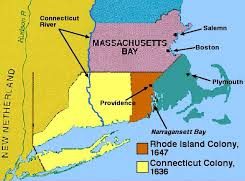
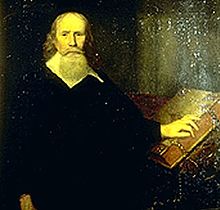
Another leader instrumental in the formation of the government of the Rhode Island colony was Dr. John Clarke, a physician from England. Dr. Clarke moved to Boston in November of 1637. He proposed to some friends “for peace sake, and to enjoy the freedom of their consciences, to remove out of that jurisdiction.”[1] Their motion was granted & Dr. Clarke and eighteen families went to New Hampshire, which proved too cold for their liking. They left and stopped in Rhode Island, intending to go to Long Island or Delaware Bay. There Dr. Clarke met Roger Williams. The two “immediately became fast friends and associates, working together in a most harmonious manner, both socially and politically, throughout the remainder of Clarke’s life.”[2] With the help of Mr. Williams, they settled in that colony at Aquidneck. “The first settlement on the Island was called Pocasset; after the founding of Newport, it was renamed Portsmouth.”[3]

Isaac Backus found it to be very extraordinary that he could find from any author or record no reflection cast upon Dr. Clarke by any one.[4] Dr. Clarke left as spotless a character as any man [Isaac Backus] knew of, that ever acted in any public station in this country.[5] “The Massachusetts writers have been so watchful and careful, to publish whatever they could find, which might seem to countenance the severities, they used towards dissenters from their way, that [Mr. Backus] expected to find something of that nature against Mr. Clarke.”[6]

Portsmouth Compact

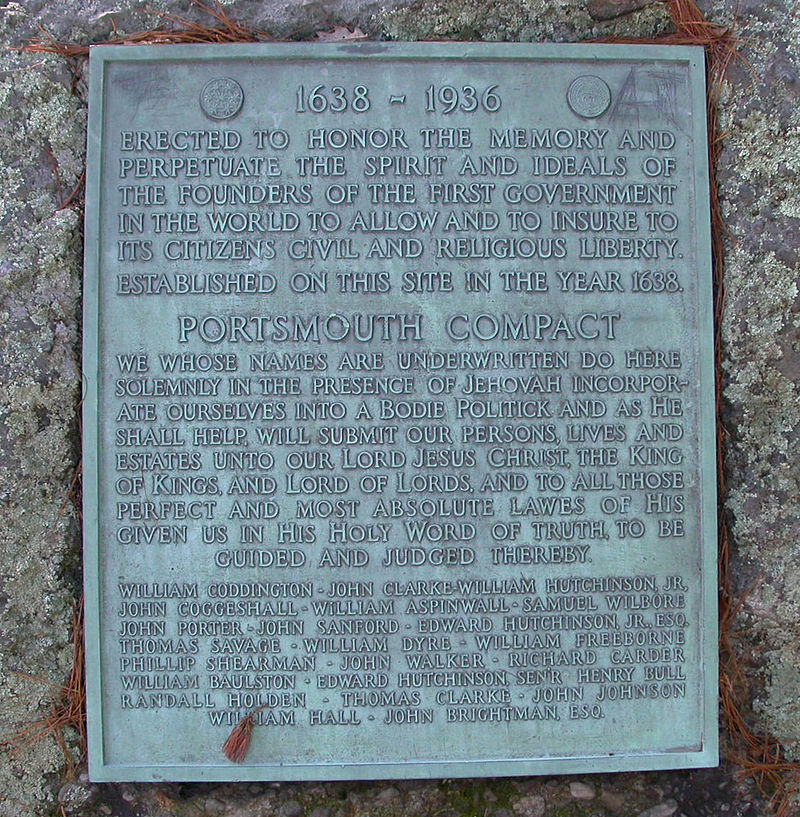
The first government of note in history that was to have complete freedom of conscience and religious liberty also declared that the government was to be under the Lord Jesus Christ. Signed on March 7, 1638, the Portsmouth Compact read:

  • “We whose names are underwritten do swear solemnly, in the presence of Jehovah, to incorporate ourselves into a body politic, and as he shall help us, will submit our persons, lives and estates, unto our Lord Jesus Christ, the King of kings, and Lord of lords, and to all those most perfect and absolute laws of his, given us in his holy word of truth, to be guided and judged thereby.” [7] [19 signatures followed: Thomas Savage, William Dyre, William Freeborne, Philip Sherman, John Walker, Richard Carder, William Baulstone, Edward Hutchinson, Sen., Henry Bull, Randal Holden, William Coddington, John Clarke, William Hutchinson, John Coggshall, William Aspinwall, Samuel Wilbore, John Porter, Edward Hutchinson, Jun., and John Sanford.].
  • Three passages were marked in support of the compact: Exodus 24.3, 4; II Chronicles 11.3; and II Kings 11.17.

The chief architect of this concise and powerful piece of political history was either William Aspinwall or Dr. John Clarke, probably Dr. Clarke.[8] This compact placed Rhode Island under the one true God, the Lord Jesus Christ and his principles and laws given in the Bible. That Dr. Clarke “sought to help establish a government free of all religious restriction, one which in no way infringed upon the freedom of any religious conscience” is “evident from his remarks to the leaders of the established colonies upon his first arrival in Boston and by his subsequent activities throughout New England.”[9] A Gentile civil government under Jesus Christ with freedom of religion is consistent with Biblical principles.

Isaac Backus commented on this compact:

“This was doubtless in their view a better plan than any of the others had laid, as they were to be governed by the perfect laws of Christ. But the question is, how a civil polity could be so governed, when he never erected any such state under the gospel?”[10]

Mr. Backus asked a good question. Too bad America’s founding fathers did not find and apply the answer. On the same day the Portsmouth Compact was signed, “[n]ineteen men incorporated into a body politic, and chose Mr. Coddington to be their judge or chief magistrate.”[11] The first General Meeting of the Portsmouth government convened on May 13, 1638. “The apportionment of land, a mutual defense of territory, and provision for a ‘Meeting House’ were ordered.” [12] Soon, a civil government was formed which invested power in the freemen, none of whom were to be “accounted delinquents for doctrine,” “provided it be not directly repugnant to or laws established.”[13]


Endnotes

[1] Isaac Backus, A History of New England With Particular Reference to the Denomination of Christians called Baptists, Volume 1 (Eugene, Oregon: Wipf & Stock Publishers, Previously published by Backus Historical Society, 1871), p. 71. See also John Clarke, Ill News from New-England or A Narative of New-Englands Persecution (Paris, Ark.: The Baptist Standard Bearer, Inc., Reprint: 1st printed in 1652), pp. 22-25.

[2] Louis Franklin Asher, John Clarke (1609-1676): Pioneer in American Medicine, Democratic Ideals, and Champion of Religious Liberty (Paris, Arkansas: The Baptist Standard Bearer, Inc.), p. 27; John Clarke, Ill News from New-England or A Narative of New-Englands Persecution (Paris, Ark.: The Baptist Standard Bearer, Inc., Reprint: 1st printed in 1652).

[3] Louis Franklin Asher, John Clarke (1609-1676): Pioneer in American Medicine, Democratic Ideals, and Champion of Religious Liberty (Paris, Arkansas: The Baptist Standard Bearer, Inc.), p. 29; Clarke.

[4] Backus, Volume 1, p. 349.

[5] Ibid., p. 348.

[6] Ibid., p. 349.

[7] Ibid., pp. 77, 427. On p. 427 is the exact copy from Rhode Island records. In the margin are citations to Exodus 34.3, 4; 2 Chr. 11.3, and 2 K. 11, 17.

[8] Asher, p. 23; James R. Beller, America in Crimson Red: The Baptist History of America (Arnold, Missouri: Prairie Fire Press, 2004), p. 24. Mr. Beller states that the author was John Clarke. Mr. Asher asserts that Clarke was probably the writer since the passages referenced in support of the agreement were marked in Dr. Clarke’s Bible.

[9] Asher, p. 27.

[10] Backus, Volume 1, p. 78.

[11] Ibid., p. 72; Asher, p. 27.

[12] Asher, p. 29.

[13] Roger Williams and Edward Bean Underhill, The Bloudy Tenent of Persecution for Cause of Conscience Discussed and Mr. Cotton’s Letter Examined and Answered (London: Printed for the Society, by J. Haddon, Castle Street, Finsbury, 1848), pp. xxvii-xxviii.

III. Roger Williams Flees Massachusetts; His Contributions to Religious Liberty


A Publication of Separation of Church and State Law Ministry.


Link to Previous Lesson: II. Roger Williams Flees English Tyranny and Comes to Massachusetts; His Banishment by the Massachusetts Court

Link to Next Lesson: IV. Dr. John Clarke; the Portsmouth Compact

Click here for links to all lessons on The Baptists in Rhode Island.


Jerald Finney
Copyright © February 26, 2018


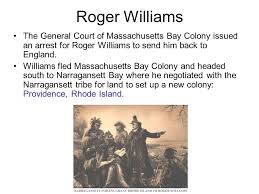
After the Massachusetts court banished Roger Williams from the colony and ordered him to board ship for England, he went instead, in the dead of winter, to what was to become Rhode Island. There he was supported by the Indians whom he, throughout his long life, unceasingly tried to benefit and befriend.[1] He bought land from the Indians and founded the town of Providence where persecution has never “sullied its annals.”[2] “[T]he harsh treatment and cruel exile of Mr. Williams seem designed by his brethren for the same evil end [as that of the brethren of Joseph when they sold him into slavery], but was, by the goodness of the same overruling hand [of divine providence] turned to the most beneficent purposes.”[3] In 1638, “[m]any Massachusetts Christians who had adopted Baptist views, and finding themselves subjected to persecution on that account, moved to Providence.”[4]

“[W]hat human heart can be unaffected with the thought that a people who had been sorely persecuted in their own country, so as to flee three thousand miles into a wilderness for religious liberty, yet should have that imposing temper cleaving so fast to them, as not to be willing to let a godly minister, who testified against it, stay even in any neighboring part of this wilderness, but it moved them to attempt to take him by force, to send him back into the land of their persecutors!”[5]

Thirty-five years later Mr. Williams wrote, “Here, all over this colony, a great number of weak and distressed souls, scattered, are flying hither from Old and New England, the Most High and Only Wise hath, in his infinite wisdom, provided this country and this corner as a shelter for the poor and persecuted, according to their several persuasions.”[6] By 1838 in Rhode Island, there were no less than thirty-two distinct societies or worshipping assemblies of Christians of varying denominations, including eight of the Quaker persuasion, eight Baptist churches, four Episcopal, and three Presbyterian or Congregationalist.[7]

Notable historians have praised Roger Williams for his contributions in the quest for religious freedom. For example:

  • Isaac Backus wrote that Rhode Island “was laid upon such principles as no other civil government had ever been, as we know of, since antichrist’s first appearance; “and ROGER WILLIAMS justly claims the honor of having been the first legislator in the world, in its latter ages, that fully and effectually provided for and established a free, full and absolute LIBERTY OF CONSCIENCE.”[8]
  • “We cannot forbear to add the oft-quoted tribute paid to Roger Williams by the historian Bancroft:—‘He was the first person in modern Christendom to assert in its plentitude the doctrine of liberty of conscience, the equality of opinions before the law; and in its defence he was the harbinger of Milton, the precursor and the superior of Jeremy Taylor. For Taylor limited his toleration to a few Christian sects; the philanthropy of Williams compassed the earth. Taylor favored partial reform, commended lenity, argued for forbearance, and entered a special plea in behalf of each tolerable sect; Williams would permit persecution of no opinion, of no religion, leaving heresy unharmed by law, and orthodoxy unprotected by the terrors of penal statutes…. If Copernicus is held in perpetual reverence, because, on his deathbed, he published to the world that the sun is the centre of our system; if the name of Kepler is preserved in the annals of human excellence for his sagacity in detecting the laws of the planetary motion; if the genius of Newton has been almost adored for dissecting a ray of light, and weighing heavenly bodies in a balance,—let there be for the name of Roger Williams, at least some humble place among those who have advanced moral science and made themselves the benefactors of mankind.’”[9]

In 1638, others driven from Massachusetts by the ruling clerical power settled in Rhode Island. Massachusetts had such great hate for Rhode Island that it passed a law prohibiting the inhabitants of Providence from coming within its bounds.


Endnotes

[1] Roger Williams and Edward Bean Underhill, The Bloudy Tenent of Persecution for Cause of Conscience Discussed and Mr. Cotton’s Letter Examined and Answered (London: Printed for the Society, by J. Haddon, Castle Street, Finsbury, 1848), p. xxiii.

[2] Ibid.

[3] Isaac Backus, A History of New England With Particular Reference to the Denomination of Christians called Baptists, Volume 1 (Eugene, Oregon: Wipf & Stock Publishers, Previously published by Backus Historical Society, 1871), p. 59.

[4] John T. Christian, A History of the Baptists, Volume II, (Texarkana, Ark.-Tex.: Bogard Press, 1922), p p. 370-371, citing Winthrop, A History of New England, I. 269.

[5] Backus, Volume 1, p. 56.

[6] Williams and Underhill, p. xxv, citing in fn. 5: Letter to Mason. Knowles, p. 398.

[7] John Callender, The Civil and Religious Affairs of the Colony of Rhode-Island (Providence: Knowles, Vose & Company, 1838), pp. 121-122.

[8] Backus, Volume 1, pp. 75-76.

[9] Ibid., p. 76, fn. 1; Thomas Armitage, The History of the Baptists, Volumes 2 (Springfield, Mo.: Baptist Bible College, 1977 Reprint), p. 644; Christian, Volume I, p. 377. Christian also includes comments of Judge Story, Straus, and the German Philosopher Gervinus.

I. Introduction and Comments on Calvinist Revisionism of the History of Rhode Island.


A Publication of Churches Under Christ Ministry


Previous Series of Lessons: The Pilgrims and Puritans in Massachusetts

Next Lesson: Appendix to “I. Introduction and Comments on Calvinist Revisionism of the History of Rhode Island”: More on Calvinist Revisionism of the History of Rhode Island

Click here for links to all lessons on The Baptists in Rhode Island.


Jerald Finney
Copyright © February 26, 2018


Heresy cannot be the friend of a Bible believing Christian.

As pointed out by John Callender in 1838:

“Bishop Sanderson says [] that ‘the Rev. Archbishop Whitgift, and learned Hooker, men of great judgment, and famous in their times, did long since foresee and declare their fear, that if ever Puritanism should prevail among us, it would soon draw in Anabaptism after it.—This Cartwright and the Disciplinarians denied, and were offended at.—But these good men judged right; they considered, only as prudent men, that Anabaptism had its rise from the same principles the Puritans held, and its growth from the same course they took; together with the natural tendency of their principles and practices toward it especially that ONE PRINCIPLE, as it was then by them misunderstood that the scripture was adequate agendorum regula, so as nothing might be lawfully done, without express warrant, either from some command or example therein contained….”[1]

History certainly proves that to have been the case in the English colonies, as shown by the establishment of Rhode Island. Biblical disagreement with Puritan theology was the force behind the creation of the first government in history of any lasting significance with religious freedom, the government of the colony of Rhode Island.

“Mr. R[oger] Williams and Mr. J[ohn] Clark[e], two fathers of [Rhode Island], appear among the first who publicly avowed that Jesus Christ is king in his own kingdom, and that no others had authority over his subjects, in the affairs of conscience and eternal salvation.”[2] “Roger Williams was the first person in modern Christendom to maintain the doctrine of religious liberty and unlimited toleration.”[3]

Although America owes its present form of government to Roger Williams, along with Dr. John Clarke, as much or more than to any men, Mr. Williams is vilified and Dr. Clarke is generally ignored by Calvinist historic revisionists Peter Marshall and David Manuel, who laughably assert that the “Puritans were the people who, more than any other, made possible America’s foundation as a Christian nation.”[4] Because Roger Williams disagreed with those in the established church in Massachusetts, Marshall and Manuel condemn him as a hopeless heretic. For example, Marshall and Manuel, in condemning and lying about Williams, reveal that Christian Revisionists condemn, in a way that praises their own views, anyone who disagrees with their contorted interpretation of Scripture. They also justify the intervention of the civil government, at the behest of the established church, into spiritual matters. Marshall and Manuel sharply criticize Williams for his views and for refusing to change his views because those views were contrary to those of the established church in Massachusetts:

  • “Williams insistence upon absolute purity in the church, beyond all normal extremes, grew out of his own personal obsession with having to be right—in doctrine, in conduct, in church associations—in short, in every area of life. This need to be right colored everything he did or thought; indeed, it drove him into one untenable position after another. For the alternative—facing up to one’s self-righteousness and repenting of it on a continuing basis—was more than he could bring himself to accept.
  • “For Williams, then, Christianity became so super-spiritualized that it was removed from all contact with the sinful realities of daily living. In his view, the saints of New England belonged to a spiritual Israel, in the same way as did all Christians everywhere. But there should be no talk of any attempt on God’s part to build his Kingdom on earth through imperfect human beings. For Winthrop and the others to even suggest that God might be creating a new Israel in this Promised Land of America was to ‘… pull God and Christ and Spirit out of Heaven, and subject them unto natural, sinful, inconstant men….’”[5]

Actually, Williams was driven by his determination not to betray his Lord, not by his desire to be right. He believed the Bible and acted according to what the Bible said. As has been pointed out, public access to the Bible set in motion forces which could not be restrained in the colonies. Men began to expose the Puritan philosophized interpretations of the Bible and to act accordingly.

A book of lies, deceit, and historic revisionism.

Revisionists Peter Marshall and Daniel Manuel glorified the Puritans for disagreeing with the Church of England, but condemned Roger Williams for disagreeing with the Puritans. They applauded the Puritans for persecuting Roger Williams and other dissenters, but condemned the Church of England for persecuting the Puritans and Pilgrims.

For more on the revisionism of Marshall and Manual, see Appendix to “I. Introduction and Comments on Calvinist Revisionism of the History of Rhode Islan”: More on Calvinist Revisionism of the History of Rhode Island. Calvinists have always revised in their attempts to promote their goals and their false religion. For more on Calvinist revisionism, see the resource linked to in [6]. A good example is seen in The Great Works of Christ in America, Volumes 1 and 2[7] by Cotton Mather.[8]


Endnotes

[1] John Callender, The Civil and Religious Affairs of the Colony of Rhode-Island (Providence: Knowles, Vose & Company, 1838), pp. 113-114.

[2] Ibid., p. 70.

[3] Ibid., Appendix IV, p. 190.

[4] Peter Marshall and David Manuel, The Light and the Glory, (Old Tappan, New Jersey: Fleming H. Revell Company, 1977), p. 146. What is a Christian nation? No such thing is mentioned in the Bible which talks only of Gentile nations and the theocratic nation Israel. Only individuals can be “Christian” (Ac. 11.26).Certainly, the Constitution does not so much as mention Jesus Christ. America is a Gentile nation. Of course, a Gentile nation can honor God as discussed in other parts of this book. See, e.g., pp. 83, 95-96.

[5] Ibid., p. 193.

[6] The Trail of Blood of the Martyrs of Jesus/Christian Revisionism on Trial.

[7] Cotton Mather, The Great Works of Christ in America: Magnalia Christi Americana (Hartford, Connecticut: Silas Andrus and Son, 1853). First published in 1702.

[8] Cotton Mather (February 12, 1663 – February 13, 1728; A.B. 1678, Harvard College; A.M. 1681, honorary doctorate 1710, University of Glasgow) was a socially and politically influential New England Puritan minister, prolific author, and pamphleteer.

II. Roger Williams Flees English Tyranny and Comes to Massachusetts; His Banishment by the Massachusetts Court


A Publication of Churches Under Christ Ministry


Link to Previous Lesson:  Appendix to I: Introduction and Comments on Calvinist Revisionism of the History of Rhode Island”: More on Calvinist Revisionism of the History of Rhode Island

Link to Next Lesson: III. Roger Williams Flees Massachusetts; His Contributions to Religious Liberty

Click here for links to all lessons on The Baptists in Rhode Island.


Jerald Finney
Copyright © February 26, 2018


Roger Williams, like the Puritans, fled tyranny over thought and conscience and sought refuge for conscience amid the wilds of America. He arrived in Boston on February 5, 1631. He was highly educated and well acquainted with the classics and original languages of the Scriptures, and had been in charge of a parish in England. In England, he had attended the preaching of Samuel Howe, a Baptist minister in London who practiced immersion. He was very intimate with Baptists in London; they uniformly pleaded liberty of conscience. By the time he arrived in Massachusetts, “[i]t is probable that Williams already believed in immersion and rejected infant baptism,” and, in “1633 he was ‘already inclined to the opinions of the Anabaptists.’”[1] “He was sorely persecuted by Archbishop Laud, and on that account he fled to America.”[2]

Upon arrival, he was invited to become pastor of the church in Boston but declined because he found that it was “an unseparated church,” and he “durst not officiate to” it.[3] Mr. Williams, not being a man who could hide his views and principles, declared, “the magistrate might not punish a breach of the Sabbath, nor any other offence, as it was a breach of the first table.”[4] He also, contrary to the practice of the church at Boston, hesitated to hold communion with any church who held communion with the Church of England. “He could not regard the cruelties and severities, and oppression, exercised by the Church of England, with any feelings but those of indignation.”[5]

BanishedFleesMr. Williams remained at odds with the established church and government ministers in Massachusetts. He was accepted by the church at Salem, but that was blocked by the General Court of the Colony. Plymouth warmly received him into the ministry where he labored two years. Exercising their right under congregational governance, the church at Salem called him, over the objections of the magistrates and ministers, to be their settled teacher. At Salem, he filled the place with principles of rigid separation tending to anabaptism.[6] In spite of the fact that “Mr. Williams appears, by the whole course and tenor of his life and conduct [], to have been one of the most disinterested men that ever lived, a most pious and heavenly minded soul,”[7] the Court soon summoned him “for teaching publicly ‘against the king’s patent, and our great sin in claiming right thereby to this country’” by taking the land of the natives without payment;[8] “and for terming the churches of England antichristian.”[9] Charges were brought. “He was accused of maintaining:

  1. “That the magistrate ought not to punish the breach of the first table of the law, otherwise in such cases as did disturb the civil peace.
  2. “That he ought not to tender an oath to an unregenerate man.
  3. “That a man ought not to pray with the unregenerate, though wife or child.
  4. “That a man ought not to give thanks after the sacrament nor after meat.”[10]

The ministers of the Court, when Mr. Williams appeared before them, “had already decided ‘that any one was worthy of banishment who should obstinately assert, that the civil magistrate might not intermeddle even to stop a church from apostasy and heresy.’”[11] The “grand difficulty they had with Mr. Williams was, his denying the civil magistrate’s right to govern in ecclesiastical affairs.”[12] The court banished him from the colony and ordered him to board a ship for England. He did not obey the order, but went to Rhode Island—the subject of the next lesson.


Endnotes

[1] John T. Christian, A History of the Baptists, Volume II, (Texarkana, Ark.-Tex.: Bogard Press, 1922), p. 360; see also Christian, Volume II, pp. 28-45.

[2] Ibid., p. 370.

[3] Ibid.

[4] Isaac Backus, A History of New England With Particular Reference to the Denomination of Christians called Baptists, Volume 1 (Eugene, Oregon: Wipf & Stock Publishers, Previously published by Backus Historical Society, 1871), p. 41; Williams and Underhill, p. ix, noting in fn. 1, “Such is Governor Winthrop’s testimony. Knowles, p. 46.”

[5] Roger Williams and Edward Bean Underhill, The Bloudy Tenent of Persecution for Cause of Conscience Discussed and Mr. Cotton’s Letter Examined and Answered (London: Printed for the Society, by J. Haddon, Castle Street, Finsbury, 1848), p. x.

[6] Backus, A History of New England, Volume 1, p. 44.

[7] Callender, p. 72.

[8] Backus, A History of New England, Volume 1, pp. 44-46. Williams and Underhill, p. xiii. The colonies held their land under the royal patent. Under the royal right of patent, Christian kings (so called) were given the right to take and give away the lands and countries of other men. Armitage, The History of the Baptists, Volume 2, pp. 638-639.

[9] Williams and Underhill, pp. xiii-xiv.

[10] Ibid, p. xiv; Callender, p. 72; Backus, A History of New England…, Volume I, p. 53 (Backus adds item 2, as, according to footnote 1, p. 53, his is from Governor Winthrop’s Journal, Vol. 1, pp. [162, 163]).

[11] Williams and Underhill, pp. xv, 387-389.

[12] Backus, A History of New England…, Volume 1, p. 53; Armitage, The History of the Baptists, Volume 2, pp. 627-640.

Appendix to “I. Introduction and Comments on Calvinist Revisionism of the History of Rhode Island”: More on Calvinist Revisionism of the History of Rhode Island


A Publication of Churches Under Christ Ministry


Previous Lesson: I. Introduction and Comments on Calvinist Revisionism of the History of Rhode Island.

Next Lesson: II. Roger Williams Flees English Tyranny and Comes to Massachusetts; His Banishment by the Massachusetts Court

Click here for links to all lessons on The Baptists in Rhode Island.


Jerald Finney
Copyright © February 26, 2018


A book of lies, deceit, and historic revisionism.

The Calvinist revisionist account of Williams does not chronicle the facts. Instead, it is a distortion of facts. Williams did not super-spiritualize Christianity. He pointed out that the Bible teaches that a church and a Gentile nation are to operate under different rules than did Judaism and the nation Israel. He did not remove Christianity from all contact with the sinful realities of daily living. He correctly argued that the church deals with those realities in a manner differing from that of Judaism and the nation Israel in the theocracy. He believed that man should have freedom of conscience in all things spiritual, a concept diametrically opposed to the theology of the established church of Massachusetts. He believed that penal laws should deal only with man’s relationship with his fellow man. He believed, contrary to Puritan theology, that the church should not merge with the state for any reason, and that the state should enforce only those commandments dealing with man’s relationship with man (the last six of the Commandments), not the first four of the Commandments which deal with man’s relationship to God. He condemned the king’s patent and taught that it was wrong to take the land of the natives without payment.

Marshall and Manuel continue their distortions and inaccuracies. They define liberty of conscience as meaning, “Nobody is going to tell me what I should do or believe.”[1] As to the issue of “liberty of conscience,” they state:

“Liberty of conscience is indeed a vital part of Christianity—as long as it is in balance with all the other parts. But taken out of balance and pursued to its extremes (which is where Williams, ever the purist, invariably pursued everything), it becomes a license to disregard all authority with which we do not happen to agree at the time. This was the boat which Williams was rowing when he landed at Boston. Since, at its extreme, liberty of conscience stressed freedom from any commitment to corporate unity, Williams was not about to hear God through Winthrop or anyone else. (And tragically, he never did.)”[2]

Williams did not believe that liberty of conscience becomes a license to disregard all authority with which we do not happen to agree. He correctly believed that the laws of a civil government should protect freedom of conscience, and that God limited the jurisdiction of every Gentile civil government to certain actions by citizens against other citizens—to the Second Table of the Ten Commandments.

Williams believed that both church and state were to be under God. He wrote and taught concerning the jurisdiction of civil government and the church. Here is one example:

  • “I acknowledge [the civil magistrate] ought to cherish, as a foster-father, the Lord Jesus, in his truth, in his saints, to cleave unto them himself, and to countenance them even to the death, yea, also, to break the teeth of the lions, who offer civil violence and injury to them.
  • “But to see all his subjects Christians, to keep such church or Christians in the purity of worship, and see them do their duty, this belongs to the head of the body, Christ Jesus, and [to] such spiritual officers as he hath to this purpose deputed, whose right it is, according to the true pattern. Abimelech, Saul, Adonijah, Athalia, were but usurpers: David, Solomon, Joash, &c., they were the true heirs and types of Christ Jesus, in his true power and authority in his kingdom.”[3]

Marshall and Manuel attribute the qualities of the leaders of the established church in Massachusetts to Roger Williams instead. They assert that he “desperately needed to come into reality and see his sin—how arrogant and judgmental and self-righteous he was.”[4] They assert that he could have been “a great general in Christ’s army” since “he was tremendously gifted: in intellect, preaching, personality, and leadership ability.”[5] However, he had one tragic flaw: he believed in freedom of conscience, held other views contrary to that of the established church, and could not be persuaded otherwise, or, as Marshall and Manuel put it:

“[H]e would not see his wrongness, and he was so bound up in his intellect that no one could get close to the man, because he was forever hammering home points on ‘the truth.’ Trying to relate to him on a personal level was like trying to relate to cold steel—highly polished and refined.”[6]

On the other hand, Marshall and Manuel have nothing but praise for the Puritans. Every page of The Light and the Glory dealing with the Puritans and their leaders is filled with praise and notations as to how the providence of God was opening the door for the right people, at the right time, in the right place to correct all the errors of Christendom. For example, they write:

  • “Since God’s will was made known to them [the Puritans] through His inspired word in the Bible, they naturally wanted to get as close to a Scriptural order of worship as possible. Indeed, what they ultimately wanted was to bring the Church back to something approximating New Testament Christianity.
  • “The Puritan dilemma was similar to that of many newly regenerate Christians of our time. They faced a difficult choice: should they leave their seemingly lifeless churches to join or start a live one, or should they stay where they were, to be used as that one small candle to which William Bradford referred?
  • “God was bringing the Puritans into compassion and humility.
  • “As historian Perry Miller would say, ‘Winthrop and his colleagues believed … that their errand was not a mere scouting expedition: it was an essential maneuver in the drama of Christendom. The [Massachusetts] Bay Company was not a battered remnant of suffering Separatists thrown up on a rocky shore; it was an organized task force of Christians, executing a flank attack on the corruptions of Christendom. These Puritans did not flee to America; they went in order to work out that complete reformation which was not yet accomplished in England and Europe.’”[7]

The Puritans grew into such compassion and humility that they horribly persecuted Christians and others who did not agree with the unbiblical doctrines which they proudly believed to be inerrant.

Marshall and Manuel follow the example of prior Puritan Revisionists such as John Quincy Adams who stated, “in the annals of religious persecution is there to be found a martyr more gently dealt with by those against whom he began the war of intolerance.”[8] Few accept this verdict. The facts are clear: they banished him because of his religious opinions. “Charles Francis Adams states the case thus:

“The trouble with the historical writers who have taken upon themselves the defense of the founders of Massachusetts is that they have tried to sophisticate away the facts…. In Spain it was the dungeon, the rack and the fagot; in Massachusetts, it was banishment, the whip and the gibbet. In neither case can the records be obliterated. Between them it is only a question of degree—one may be in color a dark drab, while the other is unmistakably a jetty black. The difficulty is with those who, expatiating with great force of language on the sooty aspect of the one, turn and twist the other in the light, and then solemnly asseverate its resemblance to driven snow. Unfortunately, for those who advocate this view of the Old and New World records, the facts do not justify it.”[9]

Williams, in his relationship to the religious leaders of Massachusetts, was a lot like the Lord Jesus and the apostles in their relationship to the religious Jews. The religious leaders of Massachusetts made a mistake—they did not call upon the civil government (which was at their disposal) to kill Williams as they did with some other dissenters. Had they done so, we might not have our present form of civil government. They only banished him, to them a tragic error of highest proportions as it turned out.

As to the issue of persecution by the established church, Marshall and Manuel are hypocrites. They condemn the persecution of the Separatists (later called Pilgrims) and the Puritans in England, but glorify the Puritans when they were persecuted and when they persecuted those dissenters such as the Baptists and Quakers who did not conform to their theology in the New World. They complain that the Separatists:

  • “were hounded, bullied, forced to pay assessments to the Church of England, clapped into prison on trumped-up charges, and driven underground. They met in private homes, to which they came at staggered intervals and by different routes, because they were constantly being spied upon. In the little Midlands town of Scrooby, persecution finally reached the point where the congregation to which Bradford belonged elected to follow those other Separatists who had already sought religious asylum in Holland.”[10]
  • As to the Puritans … they write, “[The Puritans accepted the pressure of the mounting persecution] with grace and, as persecution often does, it served to rapidly deepen and mature the movement, bonding them together in common cause and making them more determined than ever to live as God had called them…. For a number of Puritans, [the marking of the Puritans for suppression by Charles I] was a watershed. It appeared no longer possible to reform the Church of England from within.”[11]

Under the theology of Marshall and Manuel, and those of like mind, the government of Rhode Island—which provided a model for the First Amendment—would not have existed nor would the United States exist in its present form. America would have no First Amendment to the United States Constitution, the amendment written and adopted to provide for freedom of religion and conscience. Men would still be forced to accept infant baptism, pay taxes to support the established church, attend the established church, proclaim allegiance to the established church, etc. Dissenters would still be persecuted. The church would still be working with the state to build a “city set upon a hill.” Fittingly, the Puritan experiment was already falling apart by 1660 as is shown in The Results of Puritan Theology in Massachusetts Soon Came to Fruition. The Puritans, like all prior and future combinations of church and state brought corruption to Massachusetts, to the church, and to the people. True to form, Calvinism, being spiritually dead, killed the Puritan churches.


Endnotes

[1] Peter Marshall and David Manuel, The Light and the Glory, (Old Tappan, New Jersey: Fleming H. Revell Company, 1977), p. 146.

[2] Ibid., p. 194.

[3] Roger Williams and Edward Bean Underhill, The Bloudy Tenent of Persecution for Cause of Conscience Discussed and Mr. Cotton’s Letter Examined and Answered (London: Printed for the Society, by J. Haddon, Castle Street, Finsbury, 1848), pp. 100-101. In this book, The Bloudy Tenent of Persecution for Cause of Conscience Discussed and Mr. Cotton’s Letter Examined and Answered, Williams addresses the arguments presented by Covenant Theologians.

[4] Marshall and Manuel, The Light and the Glory, p.194.

[5] Ibid., pp. 194-195.

[6] Ibid., p. 195.

[7] Ibid., pp. 150, 151, 152, 159.

[8] John T. Christian, A History of the Baptists, Volume II, (Texarkana, Ark.-Tex.: Bogard Press, 1922), p. 33.

[9] Ibid., p. 33, citing Adams, Massachusetts: Its Historians and Its History, 34, 1893.

[10] Marshall and Manuel, The Light and the Glory, pp. 108-109.

[11] Ibid., p. 152.

The Baptists in Rhode Island


I. Introduction and Comments on Calvinist Revisionism of the History of Rhode Island.
Ia. Appendix to “I. Introduction and Comments on Calvinist Revisionism of the History of Rhode Island”: More on Calvinist Revisionism of the History of Rhode Island
II. Roger Williams Flees English Tyranny and Comes to Massachusetts; His Banishment by the Massachusetts Court
III. Roger Williams Flees Massachusetts; His Contributions to Religious Liberty
IV. Dr. John Clarke; the Portsmouth Compact
V. Roger Williams and the Providence Compact
VI. Roger Williams Secures the 1644 Rhode Island Charter; Dissemination of Knowledge: The Bloudy Tenet of Persecution for Conscious Sake
VII. Dr. Clarke’s Leadership in Rhode Island; Puritan Persecution of Obadiah Holmes
VIII. Roger Williams and Dr. John Clarke Go to England to Promote the Interests of Rhode Island; Dr. Clarke’s Book, Ill News from New England
IX. 1663 Rhode Island Charter; Treatment of Quakers in Rhode Island; Influence of Rhode Island on Religious Liberty


X. The atmosphere in Massachusetts begins to shift toward toleration and even freedom of tolerance; the second Massachusetts charter which provided for freedom of conscience to all Christians except Papists was secured in 1691; nonetheless, only in Boston was freedom of conscience honored; forced establishment remained in Massachusetts until 1733


A Publication of Churches Under Christ Ministry


Link to Previous Lesson: IX. Punishing Every Sin and Persecuting “Heretics”

Appendix to IX: “Punishing Every Sin and Persecuting ‘Heretics’”: Continuing Legislation, Persecutions of “Heretics,” Baptist Churches in Boston, and Other Matters

Link to Next Series of Lessons: The Baptists in Rhode Island

Click here for links to all lessons on The Pilgrims and Puritans in New England.


Jerald Finney
Copyright © February 25, 2018


The atmosphere in Massachusetts, amidst the persecutions and debate of the issues, began to shift toward toleration and even freedom of conscience. Even Governor John Winthrop, who had been a leader of the Puritans from the beginning of the colony, refused on his death bed in 1649 to sign a warrant to banish a Welsh minister, “saying, ‘I have had my hand too much in such things already.’”[1] “The second Massachusetts charter, which was dated October 7, 1691, allowed equal liberty of conscience to all Christians, except Papists.”[2]

Many of the establishment resisted the allowance of liberty of conscience contained in the 1691 charter. The ministers of the established churches construed the liberty of conscience provided for in the 1691 charter to mean “that the General Court might, by laws, encourage and protect that religion which is the general profession of the inhabitants.”[3] “For thirty-six years after … Massachusetts received [the 1691 charter], they exerted all their power, both in their legislative and executive courts, with every art that ministers could help them to, in attempts to compel every town to receive and support such ministers as they called orthodox.” Thus, despite the new charter, on October 12, 1692, in 1695, 1715, and 1723, the Assembly in Massachusetts enacted new laws requiring that every town provide a minister to be chosen and supported by all the inhabitants of the town, gave the Assembly and General Court power to determine, upon recommendation of three approved ministers, the pastor of a church, and a law requiring the towns of Dartmouth and Tiverton to tax to support ministers.  In 1693, the 1692 law was changed to allow each church to choose its own minister and exempted Boston from the requirement that all citizens be taxed to support that pastor.[4]

Thus, equal religious liberty was enjoyed in Boston, but was denied in the country. Many, including Baptists and Quakers, were taxed to support paedobaptist ministers. Those who did not pay the tax were imprisoned for failing to pay the tax, and some officials were taxed for failing to assess the tax. The cattle, horses, sheep, corn, and household goods of Quakers were from time to time taken from them by violence to support the approved ministers. In 1723, Richard Partridge presented a memorial to King George requesting that inasmuch as the Massachusetts charter allowed equal liberty of conscience to all Christians except Papists, the laws contravening the charter be declared null and void, and the prisoners who refused to pay the tax be released. In 1724, the King ordered that the prisoners be released and the taxes remitted. The Massachusetts assembly passed an act in November 1724 requiring the release of the prisoners held for failing to assess the tax.[5]

In 1728, the Assembly passed a law exempting poll tax for ministerial support and forbidding imprisonment of those Baptists and Quakers, who gave their names and regularly attended their church meetings, for failure to pay ministerial taxes assessed on their “estates or faculty.” In November 1729, an act was added that exempted their estates and faculties also, under the same conditions.[6]

The law exempting Baptists was renewed when it expired and persecutions continued. The law exempting taxes to Baptists expired in 1747, but was renewed for ten years. Nonetheless, the establishment found ways to persecute members of Baptist churches in various towns in Massachusetts for not paying the tax—some imprisoned, and property such as cows, geese, swine, oxen, cooking utensils, implements of occupation such as carpenter’s tools and spinning wheel, etc. of some was confiscated.[7] The law expired in 1757, but a new one to continue in force thirteen years was made which exempted Baptists and Quakers if certain requirements were met. The law was renewed in 1771, even though Isaac Backus wrote Samuel Adams, never a supporter of separation of church and state, warning that the Baptists “might carry their complaints before those who would be glad to hear that the Legislature of Massachusetts deny to their fellow servants that liberty which they so earnestly insist upon for themselves.’”[8] Isaac Backus said of the oppressions under this law, “[N]o tongue nor pen can fully describe all the evils that were practiced under it.”[9] Baptists, including single mothers with children, were unjustly taxed in violation of the law, property was unjustly taken from Baptists to pay established ministers, lies were disseminated about Baptists and their beliefs, and courts of law conducted grossly unfair trials and rendered obviously unjust opinions against Baptists.[10]

In 1786 the legislature passed a law which allowed each town to tax for the support of ministry, schools, and the poor, and other necessary charges arising within the same town.  This tax resulted in collectors’ efforts to get their taxes, which caused much business in courts, and a great increase in lawyers. Some citizens arose in arms but were subdued by force of arms. Before fourteen men who were condemned for their rebellion could be hanged, the Governor and over half the legislature were voted out and the men were all pardoned. [11]

On February 6, 1788, delegates from Massachusetts who were meeting in Boston voted to adopt the newly drafted and proposed constitution for the states. One of the greatest objections against it had been that no religious test for any government officer was required. During debate, prior to adoption, a Congregational minister, Reverend Philips Payson, of Chelsea, arose and said, “… I infer that God alone is the God of the conscience, and consequently, attempts to erect human tribunals for the consciences of men, are impious encroachments upon the prerogatives of God”.[12] Isaac Backus arose also and said:

“Nothing is more evident, both in reason, and in the Holy Scriptures, than that religion is ever a matter between God and individuals; and therefore no man or men can impose any religious test, without invading the essential prerogatives of our Lord Jesus Christ. Ministers first assumed this power under the Christian name; and then Constantine approved of the practice, when he adopted the profession of Christianity as an engine of State policy. And let the history of all nations be searched, from that day to this, and it will appear that the imposing of religious tests hath been the greatest engine of tyranny in the world…. The covenant of circumcision gave the seed of Abraham a right to destroy the inhabitants of Canaan, and to take their houses, vineyards, and all their estates as their own; and also to buy and hold others as servants.  And as Christian privileges are much greater than those of the Hebrews were, many have imagined that they had a right to seize upon the lands of the heathen, and to destroy or enslave them as far as they could extend their power.  And from thence the mystery of iniquity carried many into the practice of making merchandise of slaves and souls of men.”[13]

By 1794, very few if any were collecting taxes to pay ministers,[14] but forced establishment remained in Massachusetts until 1833.

The First Amendment to the United States Constitution did not prevent establishment on the state level. Opponents of establishment in Massachusetts never gained a majority. Rather, law, under the contract clause of Article I, Section 10 of the Constitution of the United States of America proved to be the tool used by the legal system to bring about disestablishment in that state. Massachusetts held a constitutional convention in 1820, but declined to eliminate a religious test for officeholders, control of Harvard, and public support for religion. However,

“[i]n 1821, the Massachusetts Supreme Court, in [Baker v. Fales, 16 Mass. 487 (1821) (known as the Dedham case),] a holding consistent with the Supreme Court of the United States in Trustees of Dartmouth College v. Woodward, 17 U.S. (3 Wheat) 1 (1819), ruled that only corporations could hold property, not amorphous societies of believers. Only in response to these court decisions did the citizens support disestablishment, putting all the churches on equal footing in 1833. Contract law succeeded where politics would not, in overcoming support of religion.”[15]

With non-forced establishment, a church is free to incorporate or assume legal entity status in some other manner (become an established church) or remain free from the legal system. A church may possess property (as a meetinghouse) without owning it. This ministry shows churches how to do this. Future lessons will deal with that issue. See [16] for links to materials which get into that.


Endnotes

[1] Isaac Backus, A History of New England With Particular Reference to the Denomination of Christians called Baptists, Volume 1 (Eugene, Oregon: Wipf & Stock Publishers, Previously published by Backus Historical Society, 1871), p. 436.

[2] Ibid., p. 445.

[3] Ibid., APPENDIX B, p. 532.

[4] Ibid., pp. 446-448, 499-505.

[5] Ibid., pp. 501-505, n. 1 pp. 501-503.

[6] Ibid., pp. 517-519 and appendix B, pp. 534-535.

[7] Isaac Backus, A History of New England With Particular Reference to the Denomination of Christians called Baptists, Volume 1 (Eugene, Oregon: Wipf & Stock Publishers, Previously published by Backus Historical Society, 1871), pp. 94-98 and fn. 1, p. 97.

[8] William G. McLoughlin, Isaac Backus and the American Piestic Tradition (Boston: Little, Brown and Company, 1967), p. 128.

[9] Backus, Volume 2, p. 141

[10] Ibid., pp. 141-166.

[11] Ibid., pp. 330-331.

[12] Ibid., p. 336.

[13] Ibid.

[14] Ibid., p. 379.

[15] Mark Douglas McGarvie, One Nation Under Law: America’s Early National Struggles to Separate Church and State (DeKalb, Illinois: Northern Illinois University Press, 2005), pp. 17-18. Establishment continued, but not forced establishment. A church could now, with legal protection, either to become established or to remain outside of the legal system entirely.

[16] Spurious rationale for church incorporation: to hold property; Trust Explained; The Bible Trust Relationship: Links to Essays and Other Resources, Law on Church Organization (Trusts, Property Tax, Etc.).

IX. Punishing Every Sin and Persecuting “Heretics”


A Publication of Churches Under Christ Ministry


Appendix to Lesson IX: “Punishing Every Sin and Persecuting ‘Heretics’”: Continuing Legislation, Persecutions of “Heretics,” Baptist Churches in Boston, and Other Matters

Previous Lesson: VIII. Organizing the Church State “Theocracy” in Massachusetts Colony

Next Lesson: X. The atmosphere in Massachusetts begins to shift toward toleration and even freedom of tolerance; the second Massachusetts charter which provided for freedom of conscience to all Christians except Papists was secured in 1691; nonetheless, only in Boston was freedom of conscience honored; forced establishment remained in Massachusetts until 1733

Click here for links to all lessons on The Pilgrims and Puritans in New England.


Jerald Finney
Copyright © February 25, 2018


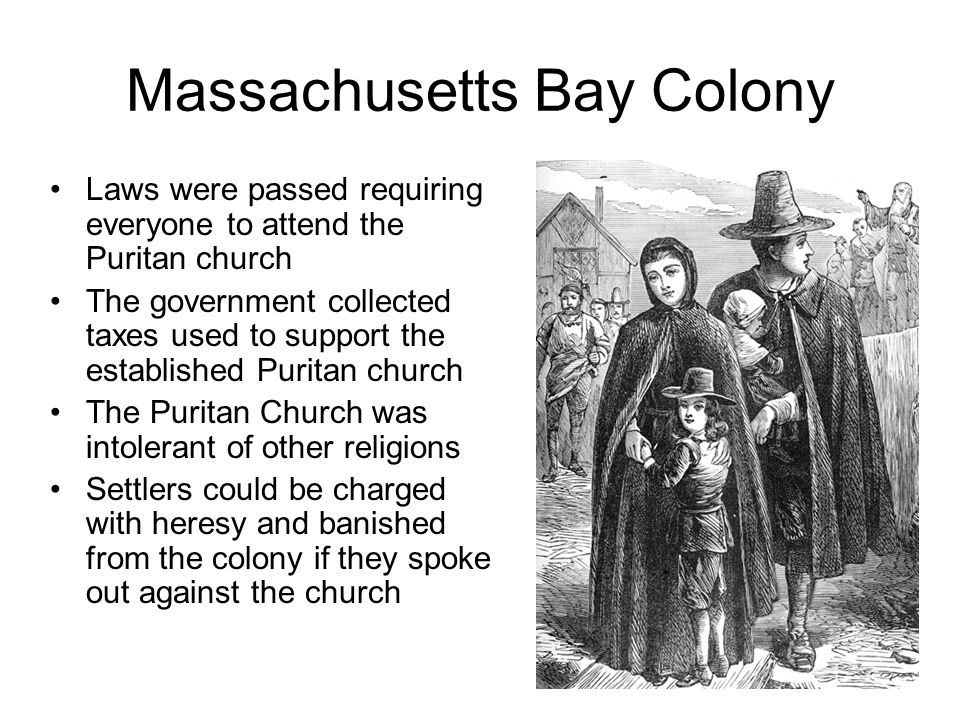
“But this people brought two other principles with them from their native country, in which they did not differ from others; which are, that natural birth, and the doings of men, can bring children into to the Covenant of Grace; and, that it is right to enforce and support their own sentiments about religion with the magistrate’s sword.”[1]  Compulsive uniformity “was planted at a General Court in Boston, May 18, 1631 when it was ordered that no one could be admitted ‘to the freedom of [the] body politic’ who was not a member of a church.”[2] “This test in after times had such influence, that he who ‘did not conform, was deprived of more civil privileges than a nonconformist is deprived of by the test in England.’”[3] Since rulers, however selected, received their authority from God, not from the people, and were accountable to God, not to the people, their business was to enforce the nation’s covenant with God.[4] Ministers were not to seek or hold public office, but were counted on to give the people sound advice and to instruct them about the kind of men who were best fitted to rule.[5] Although only church members had political rights, this was a larger group than had political rights in England.[6]

Two Men of the Puritan faith punished.

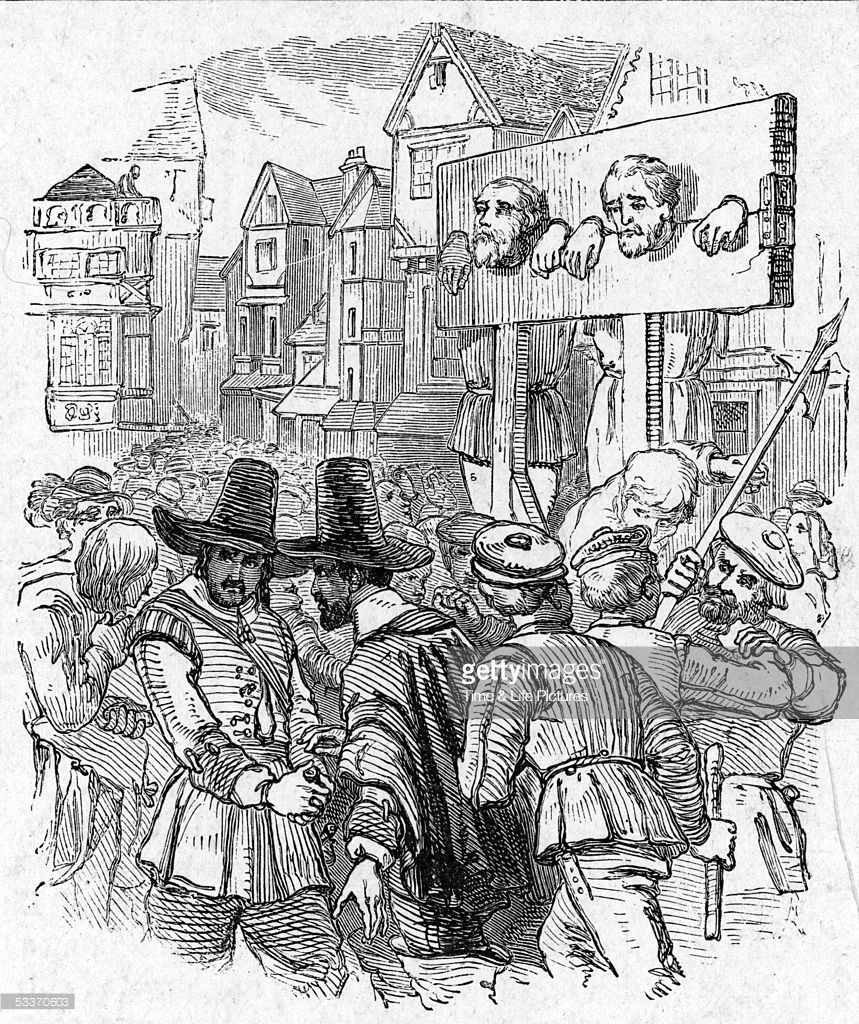
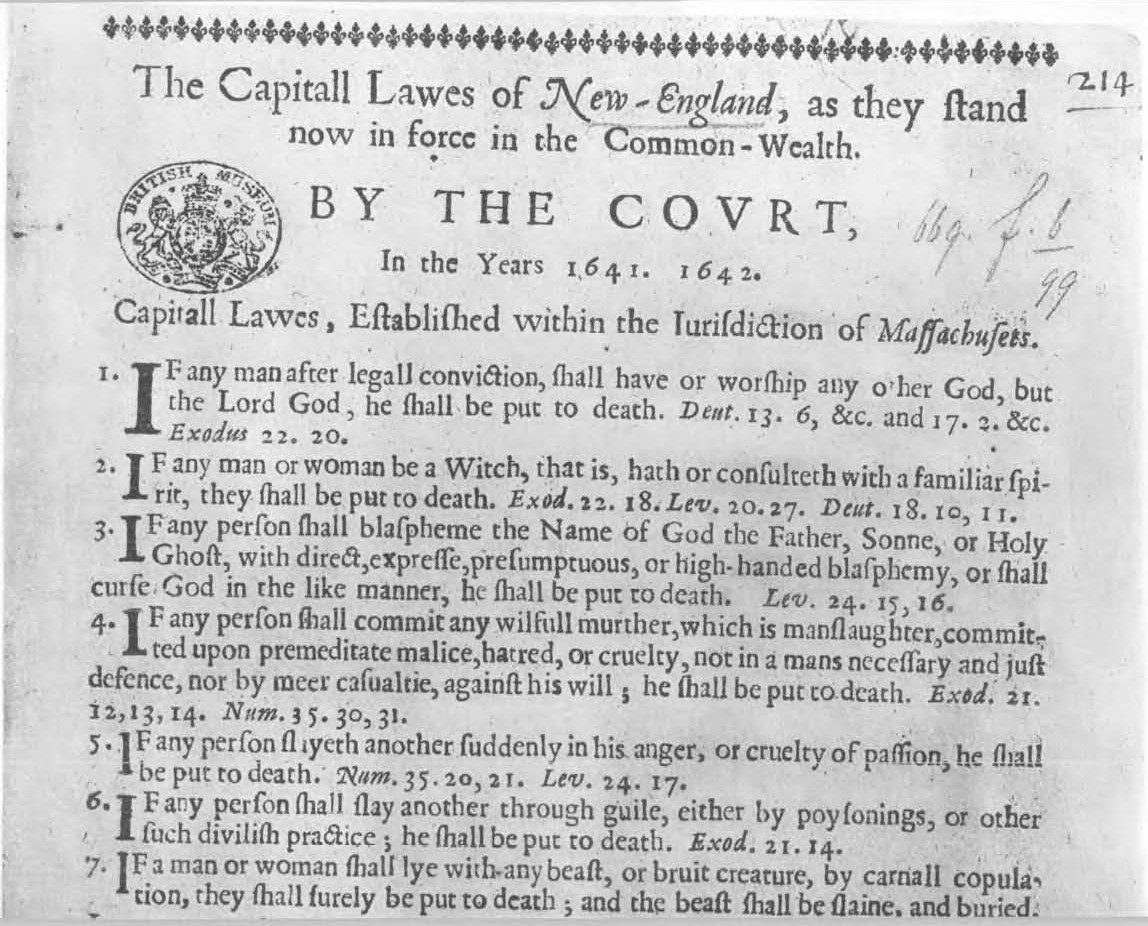
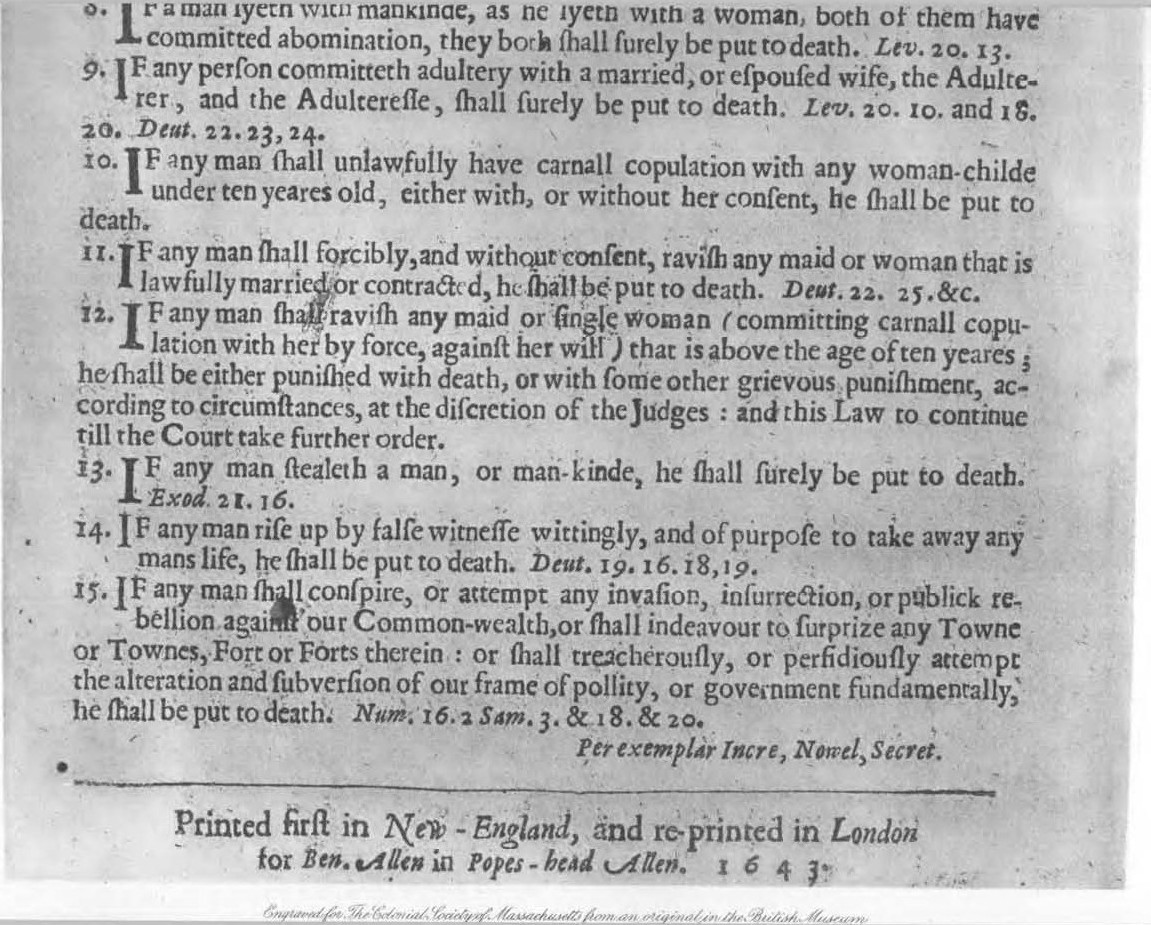
Since the Puritans believed that every nation existed by virtue of a covenant with God in which it promised to obey His commands, as a modern legal scholar has pointed out, “They knew, in the most elementary terms, that they must punish every sin committed in Massachusetts. And punish they did, with the eager cooperation of the whole community, who knew that sin unpunished might expose them all the wrath of God.”[7] Sins punished included those in the first four commandments, those dealing strictly with man’s relationship to God, as well as other sins, including those dealing with man’s relationship to man. Thus, the churches were thronged every Sunday with willing and unwilling worshipers—everyone was required to attend.[8] Although the church could not enforce the commandments, the state, which was charged with the colony’s commission, had the final and supreme responsibility for suppressing heresy as well as drunkenness and theft and murder.[9]

The Court continued to put its theology into force by act of law. At the General Assembly held March 3, 1636, it was held (1) that no church would form and meet without informing the magistrates and elders of the majority of the churches of their intentions and gaining their approval and (2) that no one who was a member of a church not approved by the magistrates and the majority of state-churches would be admitted to the freedom of the commonwealth.[10]

Soon thereafter, the Court passed an act that stated that they were entreated to make “a draught of laws agreeable to the Word of God, which may be the fundamentals of this commonwealth, and to present the same to the next General Court,” and that “in the mean time the magistrates and their associates shall proceed in the courts to hear and determine all causes according to the laws now established, and where there is no law, then as near the laws of God as they can.”[11] This act immediately led to the persecution by banishment, disfranchisement and the forbidding of speaking certain things, removal from public office, fines, and the confiscation of arms.[12] Soon to that act was added that anyone convicted of defaming any court, “or the sentence or proceedings of the same, or any of the magistrates or other judges of any such court, would be punished by ‘fine, imprisonment, or disfranchisement of banishment, as the quality and measure of the offence shall deserve.’”[13]

The banishment and the voluntary exile of many dissidents “did not put an end to the unhappy divisions and contentions in [] Massachusetts.”[14]  As a result of animosities and contentions between what were called the Legalists and the Familists or Antinomians, a synod was held, eighty erroneous opinions were presented, debated, and condemned; and a court was held which “banished a few of the chief persons, among those who were aspersed with those errors, and censured several that had been the most active, not it seems, for their holding those opinions, but for their pretended seditious carriage and behavior; and the church at Boston likewise excommunicated at least one of her members, not for those opinions, but for denying they ever held them, and the behavior which these heats occasioned.”[15]

On September 6, 1638, the Assembly at Boston made 2 laws: (1) anyone excommunicated lawfully from a church would, after six months and if not restored, be presented to the Court and there fined, imprisoned, banished or further “as their contempt and obstinacy upon full hearing shall deserve;” and (2) that every inhabitant would be taxed to pay for all common charges as well as for upholding the ordinances of the churches; and, if not so doing, would be compelled thereto by assessment and distress, to be levied by the constable or other officer of the town. The first law was repealed the next fall, but the second remained.[16]

The Puritans continued to pass repressive laws, persecute heretics, require church attendance, etc. This short article will not continue to chronicle the laws the Puritans continued to pass, the continued persecutions, etc. To read more on those matters, click: Appendix to “IX. Punishing Every Sin and Persecuting ‘Heretics’”: Continuing Legislation, Persecutions of “Heretics,” Baptist Churches in Boston, and Other Matters.


Endnotes

[1] Isaac Backus, A History of New England With Particular Reference to the Denomination of Christians called Baptists, Volume 1 (Eugene, Oregon: Wipf & Stock Publishers, Previously published by Backus Historical Society, 1871), pp. 34-35.

[2] Ibid., p. 35

[3] Ibid.

[4] Mark Douglas McGarvie, One Nation Under Law: America’s Early National Struggles to Separate Church and State (DeKalb, Illinois: Northern Illinois University Press, 2005), p. 94.

[5] Ibid., pp. 95-96.

[6] Ibid., p. 92.

[7] McGarvie,  p. 71.

[8] Ibid.

[9] Ibid., p. 82.

[10] Backus, p. 61.

[11] Ibid., pp. 62-63

[12] Ibid., pp. 64-70.

[13] Ibid., pp. 69-70.

[14] John Callender, The Civil and Religious Affairs of the Colony of Rhode-Island (Providence: Knowles, Vose & Company, 1838), p. 75.

[15] Ibid., pp. 75-76.

[16] Backus, pp. 79-80.

Appendix to “IX. Punishing Every Sin and Persecuting ‘Heretics’”: Continuing Legislation, Persecutions of “Heretics,” Baptist Churches in Boston, and Other Matters


A Publication of Churches Under Christ Ministry


Click here to go to Lesson X. The atmosphere in Massachusetts begins to shift toward toleration and even freedom of tolerance; the second Massachusetts charter which provided for freedom of conscience to all Christians except Papists was secured in 1691; nonetheless, only in Boston was freedom of conscience honored; forced establishment remained in Massachusetts until 1733

Click here for links to all lessons on The Pilgrims and Puritans in New England.


Jerald Finney
Copyright © February 25, 2018


On March 13, 1639, acts were passed which fined, disenfranchised if no repentance made, and/or committed certain men for certain acts or pronouncements against the established churches.[1] On November 13, 1644, the General Court passed an act which provided

“that if any person or persons, within this jurisdiction, shall either openly condemn or oppose the baptizing of infants, or go about secretly to seduce others from the approbation or use thereof, or shall purposely depart the congregation at the ministration of the ordinance, or shall deny the ordinance of magistry, or their lawful right and authority to make war, or to punish the outward breaches of the first table, and shall appear to the court willfully and obstinately to continue therein after due time and means of conviction, every such person or persons shall be sentenced to banishment.”[2]

As to this law, Isaac Backus appropriately commented:

The beating of Obadiah Holmes by the Puritans in Massachusetts

“A like method of treating the Baptists, in Courts, from pulpits and from the press has been handed down by tradition ever since.  And can we believe that men so knowing and virtuous in other respects, as men on that side have been, would have introduced and continued in a way of treating their neighbors, which is so unjust and scandalous, if they could have found better arguments to support that cause upon? I have diligently searched all the books, records and papers I could come at upon all sides, and have found a great number of instances of Baptists suffering for the above points that we own; but not one instance of the conviction of any member of a Baptist church in this country, in any Court, of the errors or evils which are inserted in this law to justify their making of it, and to render our denomination odious. Much has been said to exalt the characters of those good fathers; I have no desire of detracting from any of their virtues; but the better the men were, the  worse must be the principle that could  ensnare them in  such bad actions.”[3]

In 1644 a law against the Baptists was passed asserting that the Anabaptists “have been the incendiaries of the commonwealths, and the infectors of persons in main matters of religion, and the troublers of churches in all places where they have been.”[4]

Two Men of the Puritan faith punished.

In 1646 the General Court adopted the Act, imposing “banishment on any person denying the immortality of the soul, or the resurrection, or sin in the regenerate, or the need of repentance, or the baptism of infants, or ‘who shall purposely depart the congregation at the administration of that ordinance’ or endeavor to reduce others to any of these heresies.” Also, in 1646 an act against “contemptuous conduct toward’ preachers and nonattendance on divine service were made punishable, the former by ‘standing on a block four feet high’ having on the breast a placard with the words ‘An Open and Obstianate Contemner of God’s Holy Ordinances.’”[5]

The magistrates passed a bill in March, 1646 which required “the calling a synod to settle … ecclesiastical affairs,”[6] the synod to be convened not by command, but to motion only to the churches (This was agreed because some questioned the power of civil magistrates over the churches.). In August 1648 the synod met and “completed the Cambridge platform; the last article of which sa[id]:

“If any church, one or more, shall grow schismatical, rending itself from the communion of other churches, or shall walk incorrigibly or obstinately in any corrupt way of their own, contrary to the rule of the word; in such case the magistrate [Josh. 22,] is to put forth his coercive power, as the matter shall require.

“This principle the Baptists and others felt the cruel effects of for many years after.”[7]

The Assembly passed laws against gathering churches without the consent of the assembly, and another “wherein they enacted, ‘that no minister would be called unto office, without the approbation of some of the magistrates, as well as the neighboring churches.’”[8]

In 1657 laws were passed which imposed fine or whipping on those who entertained a Quaker, required citizens to report Quakers, fined those who allowed Quakers to meet on their property, and fined anyone who brought in a Quaker or notorious heretic.[9] Although these laws were repealed on June 30, 1660, they were reenacted immediately, “with slight modifications, or to give place to new laws quite as oppressive.”[10] In September, 1658, the Commissioners of the United Colonies recommended that all the New England colonies “make a law, that all Quakers formerly convicted and punished as such, shall (if they return again) be imprisoned, and forthwith banished or expelled out of the said jurisdiction, under pain of death.”[11] In October 1658, the Assembly at Boston passed a law banishing “Quakers on pain of death” but no other colony passed such a law.[12]

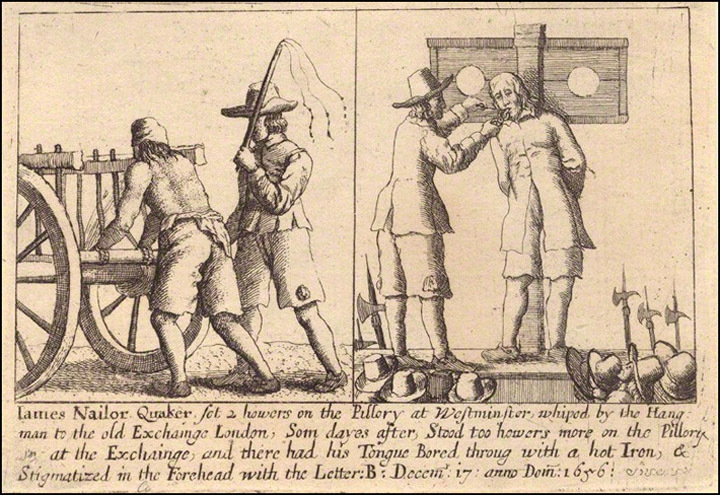
“Many [Quakers] were whipped, some were branded, and Holder, Copeland and Rouse, three single young men, had each his right ear cut off in the prison at Boston….”  Three of them who were banished, on pain of death returned again to Boston, and were condemned to die. Two of them, men, were executed. One, Mary Dyre, was released and sent away. She returned and was hanged on June 1, 1660. William Leddra was hanged on March 14, 1661. Charles II ordered that such persecutions cease, and that Quakers that offended were to be sent to England to be tried. “How justly then did Mr. Williams call the use of force in such affairs, ‘The bloody tenet!’” (Ibid., fn. 1, p. 252; pp. 258, 262-263, 265).

Members of the first Baptist church in Boston were imprisoned. Thomas Gould, Thomas Osborne, William Turner, Edward Drinker and John George were imprisoned for starting that Baptist church without approbation from other ministers and their rulers…. Isaac Backus recorded:

“But when their ministers were moved to exert such force against Baptists, though they saw the chief procurers of that sentence struck dead before the time came for its execution, and many more of them about that time, yet their posterity have approved their sayings even to this day. Robert Mascall of England wrote his Congregationalist brethren in Massachusetts pointing out that they, in England, admitted those who practiced believer’s baptism to their churches as required by the Love of God, that their persecutions of the Baptists were contrary to Scripture, that they themselves had been persecuted, and now their brethren were persecuting so that ‘Whatever you can plead for yourselves against those that persecute you, those whom you persecute may plead for themselves against you,’ and ‘Whatever you can say against these poor men, your enemies say against you;’ that ‘[Y]ou cast a reproach upon us, that are Congregational in England, and furnish our adversaries with weapons against us;” and ‘Persecution is bad in wicked men, but it is most abominable in good men, who have suffered and pleaded for liberty of conscience themselves.’”[13]

The persecutions of the Baptists in Massachusetts for withdrawing from public meetings continued.

“On May 15, 1672, the Assembly ordered their law-book to be revised and reprinted.” In it, banishment was required for those who broached and maintained any damnable heresies among which were denying justification by faith alone, denial of the fourth commandment, condemnation of or opposition to infant baptism, denial of the power of the magistrate to punish breaches of the first four commandments, and endeavoring to influence others to any of the errors and heresies mentioned in the law.[14]

After some Baptists organized a church in Boston, and erected a meeting house there, the General Court ordered:

“That no persons whatever, without the consent of the freemen of the town where they live, first orderly had, and obtained, at a public meeting assembled for that end, and license of the County Court, or in defect of such consent, a license by the special order of the General Court, shall erect or make use of any house as above said; and in case any person or persons shall be convicted of transgressing this law, every such house or houses wherein such persons shall so meet more than three times, with the land whereon such house or houses stand, and all private ways leading thereto, shall be forfeited to the use of the county, and disposed of by the County Treasurer, by sale or demolishing, as the Court that gives judgment in the case shall order.”[15]

However, a special act was procured to exempt Boston “from any compulsive power for the support of any religious ministers.” As a result, the Baptist church in Boston, which had begun in 1665, was able to build a meeting-house.[16] Thus Baptist churches in Boston had equal liberties with other denominations since 1693, but this liberty was denied throughout the rest of Massachusetts.[17]

As a result of these repressive laws, the king of England sent a letter requiring that liberty of conscience should be allowed to all Protestants, that they be allowed to take part in the government, and not be fined, subjected to forfeiture, or other incapacities, “whereas,” he said, “liberty of conscience was made a [one] principle motive for your first transportation to these parts.”[18]

Soon a synod was called which condemned Quakers and Anabaptists. The General Court agreed. The magistrates had the doors of the Baptist meeting house boarded up, fined some of their members, forbade the Baptists to meet anywhere else, and fined some who were found to have gone to Baptist meetings. Following this came much controversy between the Baptists and the establishment. [19]

The established church ignored pleas to leniency toward those with whom it disagreed. For example, they ignored the plea Sir Henry Vane wrote John Winthrop, governor of Massachusetts, in 1645: “The exercise and troubles which God is pleased to lay upon these kingdoms, and the inhabitants in them teaches us patience and forbearance one with another in some measure, though there be difference in our opinions, which makes me hope that, from the experience here, it may also be derived to yourselves….”[20]

Because of their strong bias, the Congregationalists wrote much against the dissenters, their method being asserting the disputed point taken by them:

“for truth, without any evidence, they blended that with many known facts recorded in Scripture, and thereupon rank the opposers to that point with the old serpent the devil and Satan, and with his instruments Cain, Pharoah, Herod, and other murderers; yea, with such as sacrifice their children to devils! This history contains abundant evidence of their adding the magistrate’s sword to all these hard words, which were used in their prefaces before they came to any of the Baptists arguments” (Ibid., p. 151. Mr. Backus gives examples of such establishment arguments on pp. 148-150. On pp. 151-153 he thoroughly debunks the argument for infant baptism as well as arguments that the subjects of the new covenant are the same.  For example, Backus points out that “God says his new covenant is not according to that he made with Israel. Heb. viii. 8-11…. By divine institution a whole family and a whole nation were then taken into covenant; now none are added to the church by the Lord but believers who shall be saved. Acts ii.41, 47….”).[21]


Endnotes

[1] Isaac Backus, A History of New England With Particular Reference to the Denomination of Christians called Baptists, Volume 1 (Eugene, Oregon: Wipf & Stock Publishers, Previously published by Backus Historical Society, 1871), pp. 93-94.

[2] Ibid., p. 126.

[3] Ibid., Volume 1, p. 127.

[4] Ibid., Volume 1, p. 205.

[5] Leo Pfeffer, Church, State, and Freedom (Boston: The Beacon Press, 1953), pp. 176-177.

[6] Backus, p. 155.

[7] Ibid., Volume 1,  p. 159.

[8] Ibid., Volume 1, fn. 1, p. 214.

[9] Ibid., Volume 1, fn. 3, pp. 263-264.

[10] Ibid. Volume 1.

[11] Ibid., Volume 1, p. 253.

[12] Ibid., Volume 1,  fn. 1, p. 249; pp. 254-255.

[13] Ibid., Volume 1,  pp. 287, 298, 299, 311-313.

[14] Ibid., Volume 1, pp. 321-322.

[15] Ibid., Volume 1, pp. 383-384.

[16] Isaac Backus, A History of New England With Particular Reference to the Denomination of Christians called Baptists, Volume 2 (Eugene, Oregon: Wipf & Stock Publishers, Previously published by Backus Historical Society, 1871), p. 418

[17] Ibid., Volume 1, p. 424.

[18] Backus, Volume 1, p. 384

[19] Ibid., pp. 384-404.

[20] Ibid., p. 147.

[21] Ibid., p. 151. Mr. Backus gives examples of such establishment arguments on pp. 148-150. On pp. 151-153 he thoroughly debunks the argument for infant baptism as well as arguments that the subjects of the new covenant are the same.  For example, Backus points out that “God says his new covenant is not according to that he made with Israel. Heb. viii. 8-11…. By divine institution a whole family and a whole nation were then taken into covenant; now none are added to the church by the Lord but believers who shall be saved. Acts ii.41, 47….”