Category Archives: Uncategorized

Chuck Baldwin: Right Or Wrong Concerning The History Of Religious Freedom?

Jerald Finney
Copyright © August 31, 2014

Chuck Baldwin
Chuck Baldwin

This article is not meant to condemn, but to alert Brother Baldwin and those who follow him. This author voted for Baldwin when he ran for president in 2008 on the Constitution Party Ticket. Since then, he has become somewhat familiar with the teachings of Baldwin. This author believes, from all he knows about him, that Chuck Baldwin is a sincere pastor. He has a considerable following, and his goals are worthy, yet unattainable since not according to Bible prophecy and historical accuracy. This article alerts the discerning reader only as to Baldwin’s historical revisionism. This author invites anyone to read the writings linked to below; he is very willing to discuss the accuracy of his and Baldwin’s historical teachings. We should all seek truth as to these most important matters.

Pastor Baldwin believes and teaches, as this author once did, historical revisionism. Because of his incorrect view of history, he is right about some things, but for the wrong reasons: he is right about his teaching that churches should not incorporate or get Internal Revenue Code Section 501(c)(3) status; he is right about his contention that state-owned churches are destroying America; he is right about some other things. But he is wrong about history, and he is wrong about some of his Bible teachings; for example, he is right about his conclusions concerning the false interpretation of Romans 13, but his rationale is flawed (compare his teaching on this matter with the teaching of Jerald Finney at Render Unto God the Things that Are His: A Systematic Study of Romans 13 and Related Verses). Therefore, he is not proceeding according to knowledge. When a believer does not proceed according to knowledge, he, and those who follow him, will fall (2 Peter 1.2-10; Hosea 4.6). This brief article will address Baldwin’s early American history concerning religious freedom which is summed up in one statement he made in his article “State Owned Churches Are Killing America?”:

 “Of course, colonial pastors didn’t have to worry about their churches being ‘Incorporated’ as State-created (and controlled) entities, or about IRS agents intimidating them regarding what they could or could not say. In early America, preachers where free men; they could say whatever they darned well pleased. Gasp! Beyond that, virtually everyone regarded preachers as being ‘God’s men,’ not the ‘servants of men.’”

Of course, there were no IRS with its agents. However, there were established churches in the colonies and in the United States at the beginning of the nation. Many preachers and other believers were severely persecuted in the colonies for meeting and preaching outside the auspices of the state churches; and not everyone regarded non-state church preachers as being “God’s men” as shown by the persecutions of these so-called “heretics” by the church-state establishments. Go to the links below more on the true history of religious freedom in the colonies and early America.

This author has the book Baldwin has which teaches about the preachers of the “Black Regiment.” However, this author also has many history books which teach the whole story of the road to religious liberty and the First Amendment to the United States Constitution. The author would point the interested reader to two resources which give the truth about these historical matters:

The true history of America and the American colonies absolutely demonstrates that Chuck Baldwin, like this author from the 1980’s until 2005, has accepted the historical revisionism that has been disseminated to American believers. Every so often, at least since this author was saved in 1982, another revisionist history book is printed and promoted by “Christian” media; and many Christians buy them, read them, and believe them. Then, they publicly repeat the revisionist view which then becomes an important part of Christian argumentation on the street, in the church, in the courts, and in civil government circles. All the while, Satan is amused by the gullibility and ignorance of American “Christians” while God is grieved. Read the following for an introduction to accurate history concerning religious liberty and the First Amendment.

The Trail of Blood of the Martyrs of Jesus
A Case of Premeditated Murder
Christian Revisionists on Trial
The Christian History and Meaning
of the First Amendment

History of the First Amendment

An Abridged History of the First Amendment
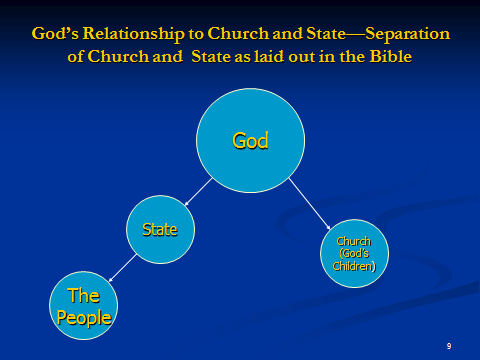
Click the image above to go to the article
Click the image above to go to the article “Is Separation of Church and State Found in the Constitution?”

The true history of America reveals that the persecution of those whom the state churches of Europe called “heretics” continued in the American colonies. Only through the sacrifice of our historic Baptist forefathers was America to add “religious freedom” to the Constitution of the United States. This is historical fact, and one must understand the spiritual battles which believers have fought as well as the persecution and martyrdom of believers starting with John the Baptist, Jesus Christ, the apostles, the early Christian martyrs, the martyrs who were relentlessly tortured and killed by the Catholic church-states and then the Protestant church-states, and those who were persecuted by the religious establishments in the American colonies can he fight spiritual warfare on solid ground. Successful warfare must be founded upon correct Bible, historical, and legal knowledge and implementation of that knowledge according to understanding and wisdom.  As proven by his prolific public writings and teachings, Chuck Baldwin does not possess that knowledge, wisdom, and understanding. Therefore, churches should never seek the help of Chuck Baldwin with any spiritual matter unless he repents and revises his history and Bible doctrines to conform with truth.

See the following articles which explain Christian historical revisionism:

Secular and Christian revisionism (Section IV, Chapter 2 of God Betrayed)

The consequences of secular and Christian revisionism (Section IV, Chapter 3 of God Betrayed)

Business Owners Try To Shut Down Street Preaching In Northfield, Minnesota

Jerald Finney
Copyright © August 17, 2014

August 8, 2014 Update on Nortfield, Minnesota Street Preaching Ministry
Click here for the website page which covers the trials and tribulations of the “No Small Stir” street preaching ministry

Brother Paul Pearson

On August 8, 2014, Northfield News, the local newspaper of Northfield, Minnesota, published an article that, if true and depending upon the future actions of the Northfield police, could have resulted in a legal battle. The author has known, since high school, that one cannot depend upon secular news for accuracy or facts, and that, as to important religious, legal, and political matters, such outlets usually, in addition to sensationalizing, portray matters in ways which support their beliefs and philosophies. However, this article could not be ignored. Fortunately, as is explained below, the Northfield police, as in the past, acted very correctly and according to the law in regards to speech in the public forum. As a result, no litigation was required, the citizens of Northfield were spared the expense of costly court intervention, and the street preachers and others were protected as they engaged in speech in the public forum at Bridge Square Park.

The Northfield News article, “Protestors question Northfield’s permit process,” stated that a group was silently protesting war at Bridge Square Park, as they had on Saturdays for the last 13 years. However, they were soon approached by a Northfield police officer, who said there had been a complaint and that the group would have to move to “another public sidewalk,” off Bridge Square.

According to the article:

  • The officer came as a result of a complaint from Anna Kochendorfer, who said she was from one of the groups with a permit to use Bridge Square and that the protestors would not leave when she asked them. The group did not leave, according to the article.
  • City Administrator Tim Madigan sent a report to city councilors stating that both the Riverwalk Market Fair and the Vintage Band groups had obtained city permits to use Bridge Square on Saturday, “which gives them control of the area for their events.”
  • Krin Finger, owner of the Rare Pair, has made use of the city’s Bridge Square reservation process to reserve the area from 1-5 p.m. every Saturday from now until the Defeat of Jesse James Days, with the plan to reserve the space again from DJJD to Christmas and beyond.
  • She said she decided to reserve the space with a community event permit, in this case titled, “Take Back Bridge Square.”

The reasons that were attributed to Ms. Finger for seeking the permits every Saturday in order to keep street preachers from preaching in the park on Saturdays were lies. The article stated that she said they were not concerned about the communication of any group or persons other than the street preachers at Bridge Square. She, according to the article, stated that [the street preachers have] become a hindrance to people walking into the door, that the business owners and their customers felt threatened by what sounds like angry and aggressive behavior by these street preachers. Of course, there are government statutes that criminalize disorderly conduct, threatening people, hindering people on sidewalks, obstructing passageways, etc. Had the street preachers done anything in violation of a criminal ordinance, they, like any other lawbreaker, could and would have been cited by the police.

The article stated that Finger said, “We felt it was becoming more aggressive, and it was just a matter of time before this becomes offensive.” Ms. Finger, in fact, has told the street preachers that she is offended by their speech. The Supreme Court of the United States has made clear that Americans have no right to not be offended. Click here to go to the PDF of tract Street Preaching in America: Is It Legal? which briefly goes over the law of communicating in the public forum (public sidewalks and parks) and answers her, and other, objections.

The article stated that, “Finger said many downtown businesses, as well as the Northfield Downtown Development Corporation and the Northfield Area Chamber of Commerce, agreed with her obtaining the permit, and added that the city had been helpful throughout the process.” According to the article, she went on to say that she was prepared to approach the street preachers and tell them that they are not invited to her event, and that she will call the police if necessary and that they will be forced to leave Bridge Square.

The article stated that Police Chief Monte Nelson said there is no official ordinance his officers can enforce regarding the permits and public space. He added he is still working to figure out how to address situations like these, and he doesn’t have a clear answer yet. The article stated that Chief Nelson said, “The problem is, when someone reserves Bridge Square, they’re reserving that area,” he said. “It’s a public area. The million dollar question is, ‘Do they have the ability, if someone comes into some conflict, to say they want them moved across the street?’ That’s what we’re working to try to get a solution to do. There’s not a black and white answer. Does this [permit] mean that a private group can keep certain kinds of people out of Bridge Square, or prevent the presence of dogs, smokers, babies, or cell phones?” he asked. “How can the city turn over a public space to a private entity and then let the private entity make up rules that contradict the U.S. Constitution?” As will be seen below, Chief Nelson and the Northfield police department answered these according to American law. I am very impressed with Northfield handling of this matter.

On August 11, 2014, someone posted a response to the above article on Northfield News: Read that by clicking here. Also, many comments have been made concerning the original article. To read them, go to the article “Protestors question Northfield’s permit process” and scroll down. Many of the opinions in those polls reflect understanding of the public forum speech rights of all Americans and are far more correct than the ridiculous opinion attributed by the Northfield News article to Kimberly Smith, who, sadly, teaches constitutional law at Carleton College. Other opinions expressed therein, like that of the downtown business owners, are against freedom, intolerant, unlearned, and/or bigoted. People who understand the history of the First Amendment usually stand for the freedoms we enjoy in this nation. The following may be read in order to gain an understanding of how we got our First Amendment to the United States Constitution.

History of the First Amendment

An Abridged History of the First Amendment

The response of the street preachers to the article

Pastor Jason Cooley
Pastor Jason Cooley

After reading the article mentioned above, the first action of the preachers was to contact the Northfield city attorney, mayor, and city council. They were assured that the police understood the law and would act accordingly.

Next, on Saturday, August 16, 2014 the preachers went to Bridge Square Park and preached, as already planned. They waited for a community affair taking place in the park to be closed down, then preached. The police came and did their job. The preachers were allowed to preach without hindrance. Ms. Finger never came to ask the street preachers to leave.

Next, Pastor Jason Cooley, pastor of Old Paths Baptist Church of Northfield and one of the street preachers involved in this situation, was inspired to preach the following sermons:

Dave Shumway
Dave Shumway

Kim Finger and other business men and women, as reflected in the above article and as expressed to the street preachers while involved in their public forum calling, obviously hate this street preaching ministry. No doubt they are trying to figure out how to get rid of the street preachers. For example, see the following link for a discussion which occurred on the streets of Northfield during a street preaching session between Pastor Jason Cooley and Dave Shumway who is CEO of First National Bank of Northfield:

http://www.youtube.com/watch?v=D7xa0GqJEKo

Should the situation change due to the hostility of a minority made up of a few influential citizens of Northfield, supplemental articles will immediately be published on this website and appropriate legal help who are on standby are prepared to come in to do all they can to make sure justice is done.

Grace Webb, the author of “Protestors question Northfield’s permit process,” the article quoted from above covers the cities of Northfield and Lonsdale, and writes about public safety. You can reach her at 645-1117.

The Monumental “666-CLA” Sermon that was Attacked by Satan: “501c3 Series-Seducers for the State-Christian Law Firms 501(c)(3) or 508(c)(1)(A)”

Jerald Finney
© May 1, 2014

1On Wednesday night, April 30, 2014, Pastor Jason Cooley preached a monumental sermon dealing with the issue of the relationship of church and state and specifically with church corporate-501(c)(3) status and the seducers who have led churches to compromise their love for the Lord Jesus Christ by working hand in hand with, over, or under the state: “501c3 Series-Seducers for the State-Christians Law Firms and 501(c)(3).” Normally, all Pastor Jason’s sermons have, for a long time, been streamed live and then archived over Youtube (Skype before that, which sermons were not archived in video form). I have listened to almost all his live sermons on Skype and Youtube; not a one that I can remember was not successfully broadcast (then archived on Youtube) although there have been a few temporary problems. Youtube never recorded this sermon.
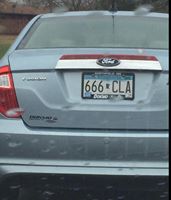
THE MONUMENTAL “666-CLA” SERMON THAT WAS ATTACKED BY SATAN: “501C3 SERIES-SEDUCERS FOR THE STATE-CHRISTIAN LAW FIRMS AND 501(C)(3)

Pastor Jason was talking over the phone with me as he and another church member were driving to the April 30 church meeting. He was telling me about his upcoming sermon. I became excited as he told me about it because the Lord has called me, as a member of Old Paths Baptist Church,  to lead under the headship of Pastor Jason Cooley, the “Separation of Church and State Law Ministry” out of Old Paths Baptist Church. As he was talking, he excitedly stated, “The car in front of me has a license plate which says, ‘666-CLA.'” I was amazed. He told me he was going to take a picture of the license plate. That picture is at left. Pastor Jason had a witness riding with him in the car. When he got to the meeting place, the services were delayed 45 minutes (See Pastor Cooley’s description of what happened below). He finally began the Wednesday night meeting. After his preliminary remarks, and just as he said that he was going to begin the sermon, Youtube went blank. I called several times to see why the broadcast was interrupted. Attempts to get it going were futile, and it was not recorded by Youtube.

DavidGibbsThe good thing is that God provided a backup which has preserved the sermon for all to hear: an audio recorder from which the sermon was transferred to sermonaudio.com.

Satan is fighting hard to prevent the truths concerning the relationship between church and state and about his tactics and emissaries. I say to you Lucifer: “This time it backfired on you.” I also say to you, “You have already lost.” Believing students of the word of God know the story of mankind from beginning to end. They know that Christ, by force, will establish and rule his earthly kingdom. They know that you will be cast into the lake of fire. Halleluiah.

The following is a comment from a person who listened to the above sermon on sermonaudio.com.

5/1/14 9:13 AM
Louise Dreves from Bloomington, Minnesota
Sermon:
Seducers For the State – Christian Law Firms…
Jason Cooley
1
comment
“ Excellent! ”
If anyone is on the fence on the 501C3 issue…this teaching will settle the issue once and for all. I pray all pastors will repent and renounce their 501C3 status and become biblical churches with Jesus Christ as Lord (not Ceasar). David Gibbs (Nahum 1:11)and the CLA are powerful tools of satan to silence the churches in this age of increasing wickedness and corruption. I praise God for Old Paths Baptist church and Pastor Cooley for speaking the truth no matter what.

Pastor Jason Cooley wrote this on Facebook:

Thu, May 1, 2014 at 10:37 AM
10:37 AM
facebook
Jason Cooley commented on a link that you’re tagged in.
Jason wrote: “The devil is what happened I had a spiritual war to get this thing out , want to know what I saw when I pulled up to the meeting house right before I was going to preach . This was right in front of me . CLA IS THE LETTERS FOR THE CHRISTIAN LAW ASSOCIATION. I WALKED INTO THE MEETING HOUSE . OUR ROOM WAS TAKEN , OUR EQUIPMENT TWOUDL NOT WORK PROPERLY ….AND THE SPIRITUALLY THE DEVIL WAS FIGHTING ME”
Reply to this email to comment on this link.
See Comment


The Force Is All Around Us – Even in Our Churches and Courtrooms

Jerald Finney © February 2014

Families attending Cosmic Christmas will be able to have their picture taken with Star Wars characters.

December 2015 addition to this article: Believe it or not, the force is also in some “churches.” See Christian Issues, Heresy, and Apostasy.
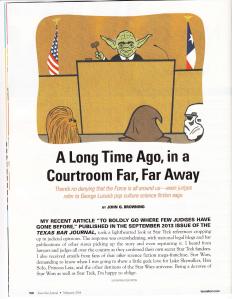
Click Image To Go To Teachings On Spiritual Warfare

Where do the judicial system and its lawyers and judges go to seek wisdom? To the Bible or to the movies? “Judges, of course, strive to be perceived as wise, so what better way to add a little Jedi wisdom to an opinion than by invoking Yoda, the Jedi Master himself?” (“A Long Time Ago, in a Courtroom Far, Far Away: There’s no denying that the Force is all around us,” 77 Texas Bar Journal, February, 2014). Do not mention the Lord Jesus Christ or his book as authority in litigation because to do so will violate the satanic version of “separation of church and state,” but it is very appropriate to “look at how George Lucas’s ‘galaxy far, far away’ openly provides insights for judges and lawyers in the resolution of cases.” In myriad ways “pop culture, in the form of Star Wars, has seeped into our legal culture. Do a quick Westlaw search for ‘Star Wars’ and you’ll find everthing from references to strategies that the ill-fated energy giant Enron code-named as ‘JEDI’ AND ‘Death Star’ to a county prosecutor in Michigan named Luke Skywalker.” (Id.). Click the following links to go to relevant articles from the Texas Bar Journal:

A Long Time Ago, in a Courtroom Far, Far Away,” by John G. Browning (77 Texas Bar Journal, February 2014, 158-161).
To Boldly Go Where Few Judges Have Gone before: How the Bench Is Using a Pop-Culture Sci-Fi Classic to Explain Its Decisions,” by John G. Browning (76 Texas Bar Journal, September 2013, 765-767).

Most of the lawyers, judges, and other personnel within the system are nice, good, decent, hardworking people when viewed from a secular perspective. However, the system is now, like the rest of society, proceeding according to the principles of the god of this world. The above two law review articles make clear that this is true, and the state of the legal system corresponds to condition of individuals, families, churches, civil governments including the state and federal governments of the United States, and the world. The Bible tells us what has happened, is happening, and will happen.

Of course one expects the world to go the way of the devil; but tragically, very few members of fundamental Baptist churches (including pastors), much less members of other so-called “churches,” are equipped for the spiritual warfare God has called believers to fight. Few can explain biblical teaching concerning the God-given motivation and goal of a believer; the doctrines,  practices, and order of a New Testament church;  the doctrine of government; the doctrine of separation of church and state; what the Bible teaches about repentance and salvation (not what they learned from a workbook on “soul-winning”); spiritual warfare; history; the relationship between church and state; the distinctions between God’s dealings with Israel and God’s dealings with Gentile nations, etc. Few have as much as a rudimentary understanding of the origin, goals, and dangers of Hollywood, movies, Disney, country music, rock and roll music, contemporary “Christian” music, the sports industry, etc. As a result, most churches and church members have succumbed to the doctrines and practices of the world.

The desertion from church by young people after they become so-called adults is a prime example of the results of this unlearned, unwise church membership. As children, parents never understood biblical doctrines (never knew that biblical doctrines even existed). Thus, they never understood the evils of, for example, rock and roll music; country music; contemporary “Christian” music;” drinking; watching movies; television; getting caught up in following sports;  making heroes of sports stars; dancing, and much more. They were never taught by their parents, the ones to whom God gave the responsibility. “Christian” parents, being spiritually ignorant and maybe even lost, depend upon unbiblical “youth programs,” “Christian” schools, and Sunday schools to ground their children in the faith. And of course church youth programs and Sunday schools do not do that delegated job. Instead, these church “ministries” have done much more harm than good, especially when viewed in light of the metamorphosis of those programs to their present condition and effect.

The great majority of youth who are brought up in “church” leave the church for the world when they grow up. They become doctors, lawyers, janitors, plumbers, carpenters, authors, etc. who believe and practice the principles of the god of this world. They are marching in step with unlearned, unwise members of the “churches” that remain to implement Satan’s agenda which includes a one world government working with a one world church, a new world order.

Ps.46.10The solution available for any person is (1) repent and trust Christ for eternal salvation; (2) get into a biblically ordered church where the pastor and members believe and preach the whole word of God; (3) remain faithful to that church in fellowship and attendance; (3) begin an intense study of the Bible; (4) follow God as he leads; (5) remember:

“God is our refuge and strength, a very present help in trouble.  Therefore will not we fear, though the earth be removed, and though the mountains be carried into the midst of the sea;  Though the waters thereof roar and be troubled, though the mountains shake with the swelling thereof. Selah. There is a river, the streams whereof shall make glad the city of God, the holy place of the tabernacles of the most High. God is in the midst of her; she shall not be moved: God shall help her, and that right early.  The heathen raged, the kingdoms were moved: he uttered his voice, the earth melted. The LORD of hosts is with us; the God of Jacob is our refuge. Selah.  Come, behold the works of the LORD, what desolations he hath made in the earth. He maketh wars to cease unto the end of the earth; he breaketh the bow, and cutteth the spear in sunder; he burneth the chariot in the fire. Be still, and know that I am God: I will be exalted among the heathen, I will be exalted in the earth. The LORD of hosts is with us; the God of Jacob is our refuge. Selah.” (Psalms 46:1-11).

A Critique of Pastor Steve Anderson’s YouTube Comments on Church Incorporation and Church 501c3 Status

Jerald Finney
Copyright © October 14, 2013

Article follows sermon links

Click here to hear Pastor Sam Adams sermon which reveals other Steven Anderson lies (Steven Anderson ignorantly attacks anti-501c3 church position, falsely claims his church is non-501-c3, makes false accusations, and blatantly lies to his church.)(Click here for Youtube of Pastor Adams’ sermon.)(To see Steven Anderson’s documents proving his church is 501c3 click here.)
Article:

"Pastor" Steven Anderson
“Pastor” Steven Anderson

Someone recently referred me to a YouTube excerpt from one of Pastor Steven Anderson’s sermons dealing with the issue of church Internal Revenue Code Section 501(c)(3): http://www.youtube.com/watch?v=p0l2EkAZwB8&feature=youtu.be [on August 6, 2020, I clicked this link, and found that you will see, “Private Video. Sign in if you have been grated access to this video.” Now, I wonder why he would do that. However, I quote directly from the video in the article which exposes Anderson on the matters confronted.] A brief review of his ridiculous tirade is in order since Pastor Anderson’s teaching in that blurb is published for the world and since it deals with the institution which Christ loved and gave Himself for. The author offers a cursory analysis in this article, but one can educate himself biblically, historically, and legally on these matters by going to the Separation of Church and State Law blog. Pastor Anderson’s statements, usually in red and parentheses, are followed by the author’s comments.

The author will address some of Anderson’s points in the order or his presentation:

(1) “I don’t go to church because all the churches are 501c3. You didn’t get that from reading the Bible….”

The Bible is a book of many principles. One such principle is separation of church and state. 501c3 churches have at least partially submitted themselves to a head other than the Lord Jesus Christ who desires to be the only head of the local New Testament church. This is explained in much detail in the materials on the above website. For specific information on 501c3 go to the following articles: Federal government control of churches through 501(c)(3) tax exemption and The church incorporation-501(c)(3) control scheme.

By the way, all churches are not 501c3 or 508(c)(1)(A), both of which grieve the Lord. See Does God and/or Civil Government Require Churches to Get 501(c)(3) Status?. For more on church 508 status, see Church Internal Revenue Code § 508 Tax Exempt Status and The Bible Answer to the Question, “Is an Incorporated 501(c)(3) or 508 Church a Church of Christ?”. I know of many such churches. If you are looking for one in your area, give me a call. Even though there are numerous such churches in America, they are a small remnant, as always.

(2)  “You got that off the internet, off some website…. ”

How does he know where they got it? The author got it from studying the Bible and 501c3 to see if 501c3 displeases our Lord. That is where the author’s pastor got it. The truth about the matter is undeniable by any knowledgeable believer. Of course, one must first understand the Biblical principles of church, government, and separation of church and state before he can fully understand some more advanced matters, but the above articles will easily be comprehended by the believer who has done some study of the Bible. One can study the Biblical principles of church, government, and separation of church and state by going to sections 1-3 (A-C) of the book God Betrayed/Separation of Church and State: The Biblical Principles and the American Application. The book is available free in both PDF and online form. Or one can order this and other books by Jerald Finney by going to Order information for books by Jerald Finney.

(3) He then swerves into an explanation of the meaning of incorporation.

To understand incorporation, go to Church Corporate-501c3 Status, and especially to the Incorporation of Churches chapter. See also, Short Answers to Some Important Questions for accurate information on church incorporation, 501c3, 508 and other matters. You will discover that he does not know what he is talking about. He is out of his field of expertise.

He states that the vehicle outside belongs to “the church” and that for the church to own it, the church has to be its own entity.

He is right about that. However, a church can take advantage of the use of a vehicle or the use of a building, for example without owning it. To own anything, a church must become a legal entity, as opposed to a spiritual entity. The Biblical principle is that God desires all His churches to remain spiritual entities only. Study the free materials above to understand this. The book, Separation of Church and State/God’s Churches: Spiritual or Legal Entities, is a short book for a pastor or believer who already has a basic knowledge of Biblical principles. Pastor Anderson does not meet that condition. The book is available in both PDF and online form, or can be ordered (see the link above). See also, Short Answers to Some Important Questions.

(4)  He then abruptly asks,Who thinks we should get rid of driver’s licenses, … birth certificates, … not carry I.d…“?

That has nothing to do with church incorporation and 501c3. Those things involve the individual, not the church. This author has a driver’s license, birth certificate, and carries an I.D. Anderson, not knowing what he is talking about, resorts to “straw men,” and attacks the straw men. Those who are not studied in these matters may be convinced by his absurdities.

(5)  He says,Running a church legally is really complicated. I spend days….

He is incorrect. His church is run illegally and it takes so much time and effort to run his religious organization that he does not have the time to also pastor a First Amendment (New Testament) church. Maybe that is why he is so ignorant about these matters. He does not have the time to do the studying a pastor is instructed by the Bible to do. He does not have time to be a pastor because his religious organization is a worldly temporal legal entity and not a heavenly eternal spiritual entity.

The non-profit corporation law requirements of the sovereign under whose laws the entity he pastors was organized by the state and overwhelm the pastor, the trustees, and the corporate offices in legal red tape. The incorporated religious organization, a legal entity, is illegally organized according to the Highest Law (God’s Law) and man’s law (The First Amendment to the United States Constitution).

According to the First Amendment, the civil government may make no law respecting an establishment of religion or preventing the free exercise thereof. Internal Revenue Code Section 501(c)(3) is a law which was made by Congress which, when applied to churches, violates the First Amendment which is a statement of the Biblical principle of separation of church and state (not separation of God and state). Even though many religious organizations run down to get their illegal 501c3 status, the First Amendment guarantees churches the freedom to do things God’s way. Again, see the website for more information on this – the following articles give a quick look at the issues: Does God and/or Civil Government Require Churches to Get 501(c)(3) Status, and Christians Who Call Evil Good and Good Evil.

(6)  Then he says,Same thing with my business. Running a business is even worse than running a church…. [It takes me days and weeks to figure out my taxes].

He runs his church like he runs his business! Exactly. Are you getting the picture? Of course, when one runs a church like he runs a business, he is grieving our Lord, according to the Bible. No wonder this man is so utterly ignorant about these matters. Here he is, running his business and running a church according to the same principles. He is so busy running his religious organization that he has no significant time to study, prepare his sermons and serve as a pastor.

(7)  “That is the way you have to do it in America to be legal in America, like you have to drive with a driver’s license…. I know a pastor in town … he has no driver’s license, he has no vehicle registration, he never files taxes, his church is totally off the grid, I mean he doesn’t report anything….. He even says to me, ‘Don’t do this’…. His church is much smaller than ours…. All of these people jumping up and screaming, ‘I don’t want to go to any church that’s incorporated,’ … you’d think he’d have 5000 people in his service this morning…. That’s shows me that these people are all just talk. They just have an excuse for not going to church….

There are plenty of non-incorporated non-501c3 churches. Refer to the author’s comments under (4) and (5) above for more relevant information. No more time will be expended to explain the obvious about these ridiculous remarks. The goal of a church under Christ is to glorify God. A church which subjects herself to any head other than the Lord Jesus Christ does not glorify God.  “And hath put all things under his feet, and gave him to be the head over all things to the church, Which is his body, the fulness of him that filleth all in all (Ephesians 1:22-23). 

The goal of a business is to find out what people want and provide it for them. Anderson probably mixes in enough Bible to entice unstudied believers and others to come to listen to his diatribes and false teachings.

(8)  “There’s all this disinformation and lies out there claiming that any church that’s incorporated is of the devil, and that it’s worshiping Satan, and the head of the IRS actually runs the church….

See Separation of Church and State Law blog, for biblically, historically, and legally reasoned and reliable teaching on these matters. Perhaps Anderson is offering his spurious verbal attacks as justification for his own presumptuous, willful, or ignorant sin.

(9)  “None of it’s Biblical, none of it came from studying of the word of God, none of it came from the Holy Spirit.

Those assertions are applicable to his arguments.

(10) “There are different levels of going off the grid against government…. [Gets back into straw men arguments as “Driver’s License.”] I render unto Caesar the things that are Caesars.

He renders unto Caesar the things that are God’s when he incorporates a church. The church the author is a member of  and the members thereof render unto God the things that are His and unto Caesar the things that are Caesars. See Render unto God the Things that Are His/A Systematic Study or Romans 13 and Related Verses, available in both PDF and online form.

(11) “I’m not going to prison…. If anyone goes to prison because of the way offerings are taken and the way the bank account is, I’m the one that’s gonna go to prison. Pastor Anderson, the money that you make pastoring, I don’t think you should pay taxes on that. You need to be off the grid, our church needs to be totally off the grid. I church needs to do everything in cash. I’m the one that’s gonna go to prison and you’re just gonna disappear off into the sunset.

Anderson speaks like a businessman or the CEO or a corporate religious organization. He speaks in secular, not Biblical terms. A religious organization pays its pastor. The members of a First Amendment (New Testament) church provide for the pastor and his family.

The church the author is a member of is a First Amendment (New Testament) church which means it is non-incorporated and non-501c3. The pastor pays income tax. Tithes, offerings, and gifts which are administered through a common law trust bank account (not a Charitable Trust, Business Trust, or other legal type of trust account). The tithes, offerings, and gifts are given to the Lord Jesus Christ, the owner of the trust estate, not to a corporate 501(c)(3) religious organization.

If any pastor or church member commits a crime and is charged and convicted, he will be punished according to the prescriptions of his state (or the federal) penal code. That is true no matter how one’s church is organized. If one commits a tort, he is subject to suit in civil court, no matter how his church is organized. See Separation of Church and State Law and resources thereon for much more on this. See the website to learn who is more subject to liability – the member of the incorporated and/or 501c3 church or the member of a church which is not a legal entity.

(12) “Most churches are 501c3 and to say they’re wicked, you’re wicked.”

His misleading and false arguments and attacks would be funny if the subject matter were not so important. Sadly, many so called “Doctors” who are pastors, presidents of Bible Colleges, etc. are as lacking in substance and reasoning ability as this man as they argue before their “herd” and before the world, thereby not only hurting the cause of Christ as they mislead the members of their corporation while giving the world a good laugh as they are turned off to what they perceive to be a ridiculous religion. If one is going to invoke the ire of the world, why not do it in a manner which honors God – that is, with knowledge, understanding, and wisdom – the way the apostles did it and the way the Lord instructs us to do it in his word.

The author chooses to stop there with the analysis. The reader has access to enough information in the links above to check the matter out for himself. He can also get the same information by studying the Bible, law, and history.

“For I am jealous over you with godly jealousy: for I have espoused you to one husband, that I may present you as a chaste virgin to Christ.” (2 Corinthians 11:2). “Husbands, love your wives, even as Christ also loved the church, and gave himself for it; That he might sanctify and cleanse it with the washing of water by the word, That he might present it to himself a glorious church, not having spot, or wrinkle, or any such thing; but that it should be holy and without blemish.” (Ephesians 5:25-27).

The incorporated churches and the 501c3 churches have taken on another lover for worldly approval, help, direction, control, power and financial gain. If a church is both incorporated and 501c3, that church has taken on two other lovers and is doubly the adulteress. These actions grieve our Lord, the Bridegroom, Husband, and Head of the church.

Jury Nullification: Article, Brief, and Requested Jury Instruction

Jerald Finney
Copyright © July 21, 2013

Jury nullification has been an issue near and dear to my heart since the time in the 1980s when the Lord was dealing with me about going to law school. After attending the University of Texas School of Law and getting my license to practice law in 1993, I attended a Fully Informed Jury Association seminar and pursued the issue in selected cases. I drafted a brief to present to the court and a Requested Jury Instruction on the issue. The judges became very antagonistic when presented with the brief and the instruction. I will not bore you with the entire battle, but present this article to you so that, by reading the brief and requested instruction you may gain some understanding of the issue. Since I have not been allowed to argue nullification in any of my Texas cases where I attempted to do so, I have come up with a few tactics devised to try to get the jury to apply their right to nullify. Visit the Fully Informed Jury Association by clicking the blue colored link. Following the brief below is a copy of the requested instruction. Note: This website will not allow me to correctly format the headings to the brief and requested instruction (some of the entries in the headings are not centered).

No. ______________

 STATE OF TEXAS               §              IN [Name of Court]
§
     VS.                       §              OF              
§
                     [NAME OF DEFENDANT]            §                [Name of county] COUNTY, TEXAS                

BRIEF IN SUPPORT OF ALLOWING DEFENDANT, THROUGH HIS ATTORNEY, TO ARGUE JURY NULLIFICATION, AND ASKING THE COURT TO INCLUDE A JURY NULLIFICATION INSTRUCTION IN THE CHARGE

Defendant, by and through his attorney, respectfully shows the court as follows:

Jury nullification is a positive force in a civilized society. Only the jury is in a position to balance compassion against the letter of the law and assure justice in a proper case.  [T]he jury stands as a bulwark against laws which it deems unjust or excessively harsh.”  Mouton v. State, 923 S.W.2d 219, 222 (Tex. App.–Houston [14th Dist.] 1996, no pet. history).  It is undisputed that a jury has the power of nullification.” Id. at 221.  “[J]ury nullification is a recognized aspect of our jury system.” Id.   The court in United States v. Burkhart, 501 F2d 993, 997 (6th Cir. 1974) noted that the law of jury nullification “allows a defense attorney “some leeway in persuading the jury to acquit out of considerations of mercy or obedience to a higher law.” Mouton at 221-22.

The majority in Sparf et al. v. United States, 156 U.S. 51 (1895), which was cited in Mouton, “suggested no way of eliminating the power of juries, sua sponte, to nullify the law. CLAY S. CONRAD, JURY NULLIFICATION 106 (Carolina Academic Press 1998).  “The case determined only that federal judges were not obligated to inform jurors of their power to bring in a verdict based on the juror’s own judgment of the law.” Id.  “The case did not hold that federal judges could not give jurors [a nullification] instruction, or that they must disingenuously inform jurors that they were bound to follow the courts instructions.” Id. (emphasis mine).  “The case determined only that federal judges were not obligated to inform jurors of their power to bring in a verdict based on the juror’s own judgment of the law.” Id. “The case did not hold that federal judges could not give jurors such [a jury nullification] instruction.” Id. at 108.

The criminal justice system which allows the defense attorney to argue jury nullification and the judge to tell the jury that it has the right to nullify the law is a better system. And there are good reasons for a jury to be told that they have the right to nullify the law.  Jurors may not be aware of their power to render a verdict according to conscience, or that they are immune from prosecution if they do so–particularly if they are under the impression that their oath binds them to enforcing the law as given in the court’s instructions. JURY NULLIFICATION at 126.  “Counting on jurors to come to  Court aware of their hidden powers runs counter to what little empirical evidence exists.” Id. at 133.  “Furthermore, psychological studies indicate that a juror may be willing to convict and impose a cruel sentence if the legal system supports and applauds his actions, because judicial instructions have deprived him of any personal moral responsibility for his verdict.” Id.

Judge Jack B. Weinstein believes that “[n]ullification is but one legitimate result in an appropriate constitutional process safeguarded by judges and the judicial system. When juries refuse to convict on the basis of what they think are unjust laws, they are performing their duty as jurors.” Id. at 145-146 citing HON. Jack B. Weinstein, Considering Jury “Nullification”: When May and Should a Jury Reject the Law to do Justice?, 30 AM. CRIM. L. REV. 239, 240 (1993).  He wrote:

“When jurors return with a “nullification” verdict, then, they have not in reality “nullified” anything: they have done their job. . . Juries are charged not with the task of blindly and mechanically applying the law, but of doing justice in light of the law, the evidence presented at trial, and their own knowledge of society and the world.  To decide some outcomes are just and some are not is not possible without drawing upon personal views.” Id. at

District Court Judge Thomas Wiseman, in the Middle District of Tennessee, wrote:

 “Argument against allowing the jury to hear information that might lead to nullification evinces a fear that the jury might actually serve its primary purpose, that is, it evinces a fear that the community might in fact think a law unjust.  The government, whose duty it is to seek justice and not merely conviction, should not shy away from having a jury know the full facts and law of a case.  Argument equating jury nullification with anarchy misses the point that in our criminal justice system the law as stated by the judge is secondary to the justice as meted out by a jury of the defendant’s peers.  We have established the jury as the final arbiter of truth and justice in our criminal justice system…” United States v. Datcher, 830 F.Supp. 411, 412 (M.D. Tenn. 1993), discussed in Kristen K. Sauer, Informed Conviction: Instructing the Jury About Mandatory Sentencing Consequences, 95 COL. L.REV. (1995) and cited in JURY NULLICICATION at 146-147.

 A Brief History of “Jury Nullification”

History demonstrates that the advent and practice of jury nullification has been a positive and compassionate force in the development and operation of our criminal justice system. “Although the use of the jury in criminal trials in England was encouraged by the Assize of Clarendon in 1166, it was not until 1215 that juries were routinely used in the trial of criminal cases.”  JURY NULLIFICATION at 17 citing SIR PATRICK DEVLIN, TRIAL BY JURY, 9 (3d ed. 1966)(Reprinted 1988).  This was the result two events: the Pope’s condemnation of the entire system of trials by ordeal and his prohibition of clerics from participating in them and the Magna Charta.  JURY NULLIFICATION at 17.

“Although originally juries which returned ‘incorrect verdicts’ were treated very harshly, the power of juries to correct oppressive or unjust laws was beginning to be recognized by the mid-seventeenth century.  Id. at 23-28.  Bushell’s Case in 1670 ushered in what has been called the heroic age of the English jury.”  Id. at 24-28.

“In Bushell’s Case, jurors acquitted the Quakers William Penn and William Mead of the capital offenses of unlawful and tumultuous assembly, disturbance of the peace and riot.  They were charged because they preached to their congregation in the street after the police locked them out of their church because the Quaker religion was illegal.  After the evidence, the court told the jurors to convict.  They did not.  They were threatened with starvation, they were held three days without food, drink, or toilet facilities, but acquitted anyway.  They were all fined a considerable sum.  Eight paid the fine, but four were imprisoned for refusing to pay.  One of those made out what was called a writ of Habeas Corpus ad Subjiciendum, which was decided 2 1/2 months later in their favor.  The opinion in  Bushell’s Case held no more than that a juror could never be punished for his verdict unless he delivered it in bad faith.” Id.

As a result, courts began to use “special verdicts.”  Id. at 28.  Nonetheless, juries insisted on returning general verdicts, especially in seditious libel cases where the law said that the fact of publication was the only element of a libel prosecution that concerned the jury.  Id. at 29.  Many pamphlets were published and distributed informing jurors of their right to judge the law. Id.  More conventional academic and legal treatise writers also began to accept and promulgate the doctrine of jury independence.  Id. at 30.

Alexander Hamilton argued “jury nullification” in Rex v. Zenger, How. St. Tr. 17:675 (1731). Id. at 32-35.  John Peter Zenger was accused of seditious libel in New York. Id. The jury acquitted Zinger after only brief deliberations. Id. at 36.  The reverberations of Hamilton’s arguments continued both in England and America for many years and prosecutions for seditious libel began to falter with increasing consistency. Id. at 36-38.  As a result, the English Parliament in 1791 passed Fox’s Libel Act which re-established the right of juries to render a general verdict in libel cases as in all other criminal cases. Id. at 41-43.  “Juries, by exercising the power implicit in the delivery of the general verdict, had demanded and received official recognition of their right to judge whether an alleged libel was in fact false, malicious and intentional.” Id. at 44.

“The founders of this country were in agreement as to the value of the trial by jury as an essential means of preventing oppression by the government. Their primary concern was more with the radical true law-finding power of the jury than with the jury’s power of amelioration.” Id. at 47-48.  Many prominent founders such as Theophilus Parsons, a member of the Massachusetts Constitutional Convention and Chief Justice of the Massachusetts Supreme Court, John Adams, Thomas Jefferson, and Alexander Hamilton argued for the rights of jurors to judge the law.  “The right of early American jurors to deliver a general verdict according to conscience was not a controversial issue during the early years of this country.” Id. at 52. Chief Justice John Jay, in a rare jury trial in front of the Supreme Court, instructed the jurors of their right to judge the law in the instructions he gave to the jury in Georgia v. Brailsford, 3 U.S. (3 Dall.) 1 (1794).  Id. at 52-53.  Other cases from the same period expressed the same conception of the role of the jury. Id. at 53.

That federal law continued to recognize the right of jury nullification is shown in Justice Van Ness’ instruction to the jury in United States v. Poyllon, 27 F.Cas. 608, 611 (D.C.D.N.Y. 1812), and by Chief Justice John Marshall’s instructions to the jury in United States v. Hastings, 26 F.Cas. 440, 442 (C.C.D.Vir. 1812): “That the jury in a capital case were judges, as well of the law as the fact, and were bound to acquit where either was doubtful.” Id. at 60-61.  For almost five decades following the adoption of the Bill of Rights, the right of jurors to judge both law and fact was uncontroversially accepted.  Id. at 60-63.

By the mid-nineteenth century, for several reasons, the prevalence of jury instructions charging jurors with the responsibility for reviewing both law and fact began to give way to increasingly constrained instructions.  Id. at 65.  For one thing, reducing the power of the jury to determine the law gave trial judges greater control in determining case outcome. Id.  Another factor was reduced perception of a need for jury independence. Id. Americans no longer had unjust laws foisted on them by a foreign power across the sea. Id.  Furthermore, most Americans were aware of their power to judge the law. Id.  Jury independence was rarely used “and most Americans thought it should only be used to curtail gross excrescences of the criminal sanction.” Id. at 66-67.

“The laws establishing and protecting the institution of slavery and punishing those who aided fugitive slaves struck many Americans–including substantial numbers of Southerners–as cruel, unjust and fundamentally un-American.” Id. at 75.  Juries in Massachusetts began ending slavery by finding in favor of slaves who sued for freedom. Id. at 75. In one case, the fate of Quock Walker, a “runaway slave,” was debated in a series of civil jury trials, culminating in a decision that “The said Quock Walker is a free man and not the property slave of the defendant,” and Mr. Walker was awarded damages for injuries suffered when his former master, Nathaniel Jennison caught and beat him. Id. at 75-76.  Then, Jennison was found guilty of assaulting Mr. Walker and fined forty shillings in the case of Commonwealth v. JennisonId. at 76.

Chief Justice William Cushing, in his charge to the jury, instructed them that:

“As to the doctrine of slavery and the right of Christians to hold Africans in perpetual servitude, and sell and treat them as we do our horses and cattle, that (it is true) has been heretofore countenanced by the Province Laws formerly, but nowhere is it expressly enacted or established…  But whatever sentiments have formerly prevailed in this particular or slid in upon us by the example of others, a different idea had taken place with the people of America, more favorable to the natural rights of mankind, and to that natural innate desire of Liberty, with which Heaven (without regard to color, complexion, or shape of noses–features) has inspired all the human race. And upon this ground our Constitution of Government, by which the people of this Commonwealth have solemnly bound themselves, sets out with declaring that all men are born free and equal–and that every subject is entitled to liberty, and to have it guarded by the laws, as well as life and property–and in short is totally repugnant to the idea of being born slaves.  This being the case, I think the idea of slavery is inconsistent with our conduct and Constitution; and there can be no such thing as perpetual servitude of a rational creature, unless his liberty is forfeited by some criminal conduct or given up by personal consent or contract…” Id. at 76 citing ALBERT P. BLAUSTEIN & ROBERT L. ZANGRANDO, CIVIL RIGHTS AND AFRICAN AMERICANS, 45-46 (1991).  “The jury of white male landowners freely chose to convict, heralding the end of slavery in Massachusetts and delivering a fatal blow to the institution throughout the Northeast.” Id. at 77.

Although slavery continued in the South, The Unconstitutionality of Slavery, by Lysander Spooner, which argued the illegality and unconstitutionality of slavery, was widely disseminated both in print and by orators such as Frederick Douglass and lead to one of the most thorough jury revolts in history. Id. at 77-78.  The Fugitive Slave Act which was passed in 1850, one of the most infamous pieces of legislation ever passed by any United States legislature provided that a person accused of being a fugitive slave could, without due process of law, be brought before a quasi-judicial commissioner for a summary hearing without a jury. Id. at 79. The commissioner, if convinced of the claimant’s veracity, could return the slave to bondage. Id. The commissioner was paid ten dollars if the slave were returned, but only five dollars if the claim was rejected. Id.  The Fugitive Slave Act also provided imprisonment of up to six months and a fine of up to one thousand dollars for anyone convicted of interfering with the recovery of fugitive slaves, or who rescued or harbored fugitives. Id.  Any person with black skin could be seized as an escaped slave wholly on ex  parte testimony. Id.  The Act deprived those arrested under its auspices of the writ of Habeas Corpus. Id.

It is clear that, for whatever reason, jurors frequently refused to convict those who harbored or assisted fugitive slaves. Id. at 80.  In one case, twenty-four men helped a captured slave named Fredrick Jenkins (alias Shadrack) escape. Id. at 81. Prosecution of the participants in Shadrack’s rescue was dropped by the government after two acquittals and several hung juries. Id.  The second defendant, a black lawyer named Robert Morris, a descendant of slaves, was acquitted by a jury of twelve white men of assisting in the escape of a fugitive slave. Id. at 81-82.  According to one authority, “[h]is lawyer told the jury that they should judge the law as well as the facts, and that if any of them conscientiously believed that the Fugitive Slave Law was unconstitutional, they should disregard any instructions by the judge to the contrary.” Id. at 81.

Other evidence that jurors were freely granted the power to deliver an independent verdict during the nineteenth century include jury independence provisions inserted into several state constitutions and state statutes granting jurors the power to judge the law. Id. at 88.  Some of those survive until this day in one form or another, but in some states, courts restricted the role of jurors during the latter half of the nineteenth century, “often striking down or limiting earlier precedents and statutes.” Id. at 88-92.

In a sense, the United States Supreme Court rejected jury independence in Sparf et al. v. United States, 156 U.S. 51 (1895).  Id. at 99-108.  But the majority in Sparf “suggested no way of eliminating the power of juries, sua sponte, to nullify the law. Id. The case determined only that federal judges were not obligated to inform jurors of their power to bring in a verdict based on the juror’s own judgment of the law. Id. The case did not hold that federal judges could not give jurors such an instruction.” Id. at 108.

In spite of Sparf, during the closing decade of the nineteenth century, the prosecution found it increasingly difficult to prevail in labor cases. Id. at 106-108.

“Jury independence is a snapshot in the law, appropriately flaring up when the criminal law exceeds the limits of social consensus, dying away when the law has been reformed, only to flare up anew when the legislative ambition [and now judicial ambition] again overtakes its legitimate bounds.”  Id. at 108.  It is not debated that the laws which prohibited alcohol manufacture, sale, and consumption were routinely rejected by independent American juries. Id. at 108-115.  In some areas of the country as many as sixty percent of alcohol-related prosecutions ended in acquittals. Id. at 109.  “Prohibition has been described as a ‘crime category in which the jury was totally at war with the law.’” Id.  “Jury independence . . . was still a strong aspect of American culture and many jurors were aware of their powers and willing to exercise them when appropriate.” Id.  “Where juries did convict, they often delivered ‘compromise verdicts’ which resulted in reduced sentences for the accused.’” Id. at 111.

“During prohibition, John Henry Wigmore defended trial by jury on several grounds: that it prevented unpopular distrust of official justice, provided necessary flexibility in legal rules, educated the citizens of the country about the administration of the laws and improved verdicts by requiring that, even after the decision in Sparf et al., juries were deciding cases based both on judicial instructions and their own views of equity:

“Law and justice are from time to time in conflict.  That is because law is a general rule (even the stated exceptions to the rules are general exceptions); while justice is the fairness of this precise case under all its circumstances.  And as a rule of law only takes account of broadly typical conditions, and is aimed on average results, law and justice every so often do not coincide. * * *

“The jury, in the privacy of its retirement, adjusts the general rule of law to the  justice of the particular case.  Thus the odium of inflexible rules of law is avoided, and popular satisfaction is preserved.

“That is what the jury trial does.  It supplies that flexibility of legal rules which is essential to justice and popular contentment.”

Id. at 112 citing John H. Wigmore, A Program for the Trial of Jury Trial, 12 J. AM. JUD. SOC. 166, 169-171 (1929).

Clarence Darrow, America’s most famous criminal defense lawyer of the period and a great opponent of Prohibition and supporter of jury nullification, stated, “Since men began making laws, the favorite form of repeal is by non-observance.  It was in this way that Christianity conquered the Roman Empire.  If Christians had obeyed the laws of Rome their religion would have died at its birth.” Id. at 114 citing DARROW, THE STORY OF MY LIFE, 293, 294 (1931).

“By the early twentieth century, it seemed that jury independence had become a doctrine of the past, anachronistically surviving in a few isolated jurisdictions and watered down and disparaged where it remained.  Rejected by the federal courts and most state courts, it served as interesting fodder for an occasional law review article.  Jury independence was not advocated openly, nor had it been a particularly lively topic of discussion since the demise of slavery and the repeal of the Fugitive Slave Act in 1850.  The political nature of jury independence allowed the doctrine largely to hibernate until the 1960s when the Vietnam war cases brought it to the forefront as a tool of social protest.

“However, as the last quarter of the twentieth century approached, the rapidly increasing number of academic law journals required an increasing number of articles, in order to fill the equally increasing number of pages.  Articles on jury independence found their way onto many of those pages.  For the first time in 88 years of history, the doctrine of jury independence had established a life of its own, apart from any particular issue or policy.” Id. at 140-141.

Juries are still nullifying the law. Id. at 143-153 (examples given: e.g., defendant found not guilty of two counts of marijuana cultivation where he admitted to growing more than 40 plants in his home and his sole defense was that smoking and eating marijuana alleviated the nausea and weight loss associated with AIDS; a Michigan jury refused to punish Dr. Kevorkian for his role in helping Thomas Hyde commit suicide; a Colorado jury refused to convict a man for assisting his mother who requested his help because her suffering got to be too much in committing suicide; cases where juries refuse to convict women who have killed their batterers, not in self-defense, after years of abuse).  Others categories of cases in which independent juries are likely to nullify the law include abortion protest cases, gun owner cases, and, should Roe v. Wade, 410 U.S. 113 (1973) ever be overturned, it is unlikely that independent juries would enforce laws criminalizing abortion.  Id. at 152.  In fact, against all reason, it seems to the attorney for defendant that the average “Pro-Choice” person is far more likely to nullify the law in the appropriate case than the average so-called “Pro-Lifer” many of whom have bought the liberal lie that “I am Pro-Life and would never have an abortion, but I don’t think the government should legislate morals.  It ought to be up to the pregnant woman.”  That reasoning would require the abolition of all our criminal laws.  I represented an abortion clinic sidewalk counselor in Austin.  At trial, the jury would have nullified the law and convicted had not the judge granted defendant’s motion for a directed verdict.  After talking with the jurors after trial, it was apparent that the jurors had lied during voir dire so that they could get onto the jury.  It was also apparent that they were angry because the judge followed the law and granted defendant’s motion for directed verdict after the close of the state’s evidence.

Conclusion

At times, jury nullification is necessary to assure that justice is done.  A judge can allow the defense lawyer to argue jury nullification.  A judge can, but is not required to instruct the jury of its power of nullification.  To deny the jury the right to be fully informed – by either the defense lawyer or the judge or both – of its power of nullification in an attempt to prevent it from exercising the full extent of its proper function will likely result in an injustice in a case where the letter of the law and justice conflict.  Sometimes, as history demonstrates, law and justice do not coincide.

Respectfully submitted,

____________________________________

Jerald C. Finney
P.O. Box 1346
Austin TX  78767
Tel. & FAX: (512)385-0761
State Bar No.:  00787466
ATTORNEY FOR DEFENDANT

VERIFICATION

STATE OF TEXAS                      §

§

COUNTY OF TRAVIS                 §

BEFORE ME, the undersigned authority, on this day personally appeared Jerald Finney who, upon being duly sworn, upon oath did acknowledge and state to me as follows:

“My name is Jerald Finney.  I have read the above and foregoing statements and they are to my personal knowledge, true and correct.”

SIGNED this ____ day of _______________, 200___.

______________________________

Jerald Finney

SUBSCRIBED AND SWORN before me on this ______ day of _______________, 201__.

______________________________

Notary Public, State of Texas

______________________________

Printed Name of Notary

My Commission Expires:_________

No. ______________

 STATE OF TEXAS               §              IN [Name of Court]
§
VS.                §                OF
§
[NAME OF DEFENDANT]          §               [Name of county] COUNTY, TEXAS

DEFENDANT’S REQUESTED INSTRUCTION NO. ___

TO THE HONORABLE JUDGE OF SAID COURT:

                                             , defendant in this action, before the Court has presented the charge to the jury and in the time and manner required by law, requests that the Court include in the charge to be submitted to the jury the following instruction.

INSTRUCTION NO. ___:

It is presumed that juries are the best judges of fact.  Accordingly, you are the sole judges of the true facts in this case.

I think it requires no explanation, however, that judges are presumed to be the best judges of the law.  Accordingly, you must accept my instructions as being correct statements of the legal principles that generally apply in a case of the type you have heard.

The order in which the instructions are given is no indication of their relative importance.  You should not single out certain instructions and disregard others but should construe each one in the light of and in harmony with the others.

These principles are intended to help you in reaching a fair result in this case.  You should give them due respect.  Moreover, justice will ordinarily be done by applying them as a whole to the facts which you find have been proven.  You should do just that if, by doing so, you can do justice in this case.

Even so, it is difficult to draft legal statements that are so exact that they are right for all conceivable circumstances.  Accordingly, you are entitled to act upon your conscientious feeling about what is a fair result in this case, and acquit the defendant if you believe that justice requires such a result.

Exercise your judgment without passion or prejudice, but with honesty and understanding.  Give respectful regard to my statements of the law for what help they may be in arriving at conscientious determination of justice in this case.  That is your highest duty as a public body and as officers of this court.

Respectfully submitted,

____________________________________

Jerald C. Finney
P.O. Box 1346
Austin TX  78767
Tel. & FAX: (512)385-0761
State Bar No.:  00787466
ATTORNEY FOR DEFENDANT

This requested instruction, having been duly and timely requested, is hereby ________________ and exception allowed.  [State modification, if any]:

SIGNED this ________ day of _____________________________, 201__.

___________________________________
JUDGE PRESIDING

The motivation and the goal


Jerald Finney
Copyright © January 20, 2012

8


Note. This is an edited version of Section I, Chapter 2 of God Betrayed. 


Highly recommended sermon: Paris Reidhead, “Ten Shekels and a Shirt,” January 1, 1980

See also, The Love of God Perfected. Are you asking, “What can I do to please my heavenly father?” That is the right question. This short audio teaching on what the word of God teaches about “the love of God perfected.”

Click here to go to a short 3 min. 23 sec. audio teaching on the God-given goal of the believer.(Also answers the question. “What is the primary purpose of missions?”)


The Motivation and the Goal
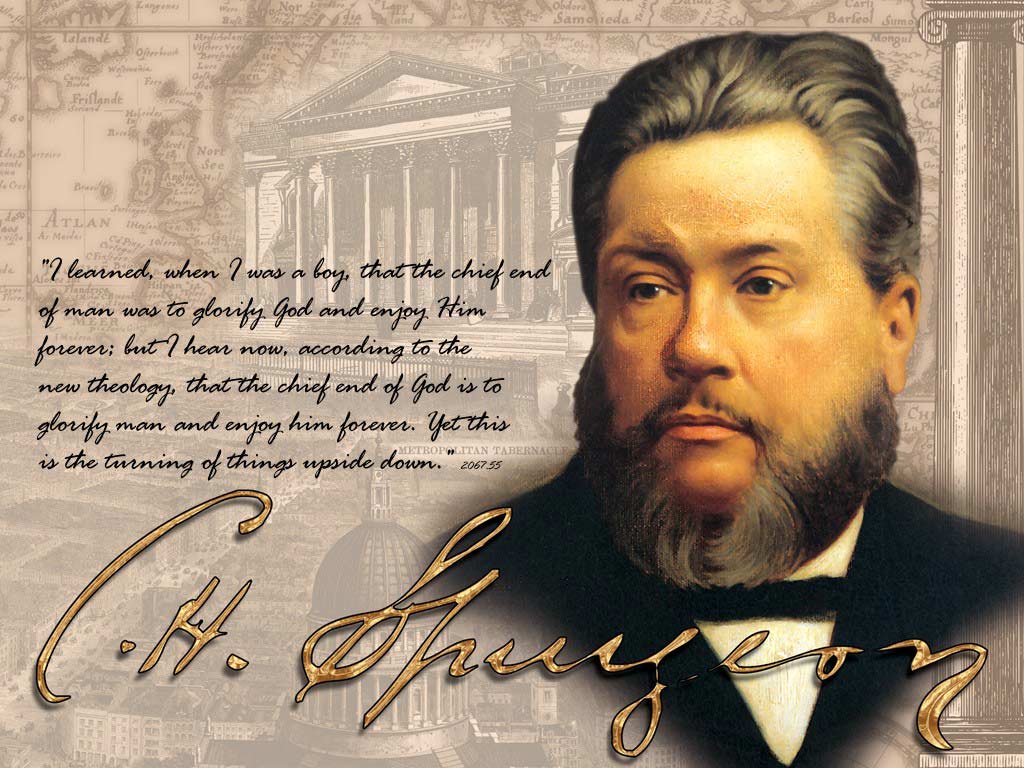
An individual, family, church, or civil government will stay on track only should it, in addition to fearing God, have the proper motivation and set the proper God-given goal. The proper motivation for the saved is love for God first, and love for man second. Love is the key. Notice the use of the word “love” throughout the articles on this website and the book God Betrayed (which is reproduced on this website)(See The Most Important Thing: Loving God and/or Winning Souls which is a revised version of the booklet by the same name.). The improper motivation is love for oneself. If one’s motivation is love for God first and man second, he will set the proper goal—the glory of God—and he will have happiness as a side-effect, at least in eternity. If one’s motivation is self-love, he will set the wrong goal—his own happiness—and sooner or later he will be unhappy.

One who is not a child of God cannot love God or neighbor. It is only natural for God’s children to love and glorify God:

“We know that we have passed from death unto life, because we love the brethren. He that loveth not his brother abideth in death. Beloved, let us love one another: for love is of God; and every one that loveth is born of God, and knoweth God. He that loveth not knoweth not God; for God is love. In this was manifested the love of God toward us, because that God sent his only begotten Son into the world, that we might live through him. Herein is love, not that we loved God, but that he loved us, and sent his Son to be the propitiation for our sins. Beloved, if God so loved us, we ought also to love one another. No man hath seen God at any time. If we love one another, God dwelleth in us, and his love is perfected in us. Hereby know we that we dwell in him, and he in us, because he hath given us of his Spirit. And we have seen and do testify that the Father sent the Son to be the Saviour of the world. Whosoever shall confess that Jesus is the Son of God, God dwelleth in him, and he in God. And we have known and believed the love that God hath to us. God is love; and he that dwelleth in love dwelleth in God, and God in him. Herein is our love made perfect, that we may have boldness in the day of judgment: because as he is, so are we in this world.  There is no fear in love; but perfect love casteth out fear: because fear hath torment. He that feareth is not made perfect in love. We love him, because he first loved us. If a man say, I love God, and hateth his brother, he is a liar: for he that loveth not his brother whom he hath seen, how can he love God whom he hath not seen? And this commandment have we from him, That he who loveth God love his brother also” (1 Jn. 3.14, 4.7-21).

“But as it is written, Eye hath not seen, nor ear heard, neither have entered into the heart of man, the things which God hath prepared for them that love him. But God hath revealed them unto us by his Spirit: for the Spirit searcheth all things, yea, the deep things of God. For what man knoweth the things of a man, save the spirit of man which is in him? even so the things of God knoweth no man, but the Spirit of God. Now we have received, not the spirit of the world, but the spirit which is of God; that we might know the things that are freely given to us of God. Which things also we speak, not in the words which man’s wisdom teacheth, but which the Holy Ghost teacheth; comparing spiritual things with spiritual. But the natural man receiveth not the things of the Spirit of God: for they are foolishness unto him: neither can he know them, because they are spiritually discerned. But he that is spiritual judgeth all things, yet he himself is judged of no man.  For who hath known the mind of the Lord, that he may instruct him? But we have the mind of Christ” (1 Co. 2.9-16).

“Goal” means “the end or final purpose; the end to which a design tends, or to which a person aims to reach or accomplish” (AMERICAN DICTIONARY OF THE ENGLISH LANGUAGE, NOAH WEBSTER (1828), definition of “GOAL”). The two ultimate and mutually exclusive goals are “the glory of God,” and the “happiness of man.” Should a person aim for the goal of “the happiness of man,” his path must differ from one whose goal is “the glory of God.” The conflict between these two goals is seen throughout Scripture and history in the life of every individual, family, church, and nation. Every entity, spiritual or earthly, sets one of these two goals.

Adam and Eve, Abel and Cain set one of the above-mentioned goals. All the heroes of the faith in the Bible understood or came to understand the importance of setting the proper goal. For example, Abraham, Joseph, Moses, King David, the prophets, the apostles, and the Christian martyrs throughout the ages understood the importance of setting the right goal. Joshua understood the importance of setting the right goal. He said, “[C]hoose you this day whom ye will serve; whether the gods which your fathers served that were on the other side of the flood, or the gods of the Amorites, in whose land ye dwell: but as for me and my house, we will serve the LORD” (Jos. 24.14-15).

Paul understood this. Amidst persecution and on his way to martyrdom, he joyfully said, “I press toward the mark for the prize of the high calling of God in Christ Jesus” (Ph. 3.14). In the midst of bonds and afflictions, he said, “But none of these things move me, neither count I my life dear unto myself, so that I might finish my course with joy, and the ministry, which I have received of the Lord Jesus, to testify the gospel of the grace of God” (Ac. 20.24).  Certainly his lifestyle would have taken a different course if his goal had been his happiness. If all he had counted his salvation for was “fire insurance,” and his own eternal happiness in heaven, he could have avoided the physical torture, pain, and martyrdom which he experienced on earth. Perhaps one who professes to know Christ as Savior only in order to obtain eternal happiness in heaven without real repentance should examine his eternal salvation. Most “Christians” today have as their goal not only eternal but also temporal happiness.

God desires the goal of every government to be “the glory of God” and not “the happiness of man.” One will set this goal only if he loves God. Should the author of this book, or anyone else, serve God his entire life and die and go to hell, he would only be getting what he deserves. Every person should realize that. But hell does not have to be the destination of sinful man: “For God so loved the world, that he gave his only begotten Son, that whosoever believeth in him should not perish, but have everlasting life” (Jn. 3.16). “We love him, because he first loved us” (1 Jn. 4.19). Eternal happiness in heaven is promised to the believer, but that is never the goal of the believer; it is only a side effect.

The Bible glorifies God and reveals that the glory of God is the God-given goal for every person and that everything was created for His pleasure. The first of the Ten Commandments, “Thou shalt have no other gods before me” (Ex. 20.3), is a concise statement of this principle. Besides that verse, the Bible makes abundantly clear that the God-given goal of man, which man can embrace or reject, is the “glory of God,” and that glory is due to God for many reasons.

“Lift up your heads, O ye gates; and be ye lift up, ye everlasting doors; and the King of glory shall come in. Who is this King of glory? The LORD strong and mighty, the LORD mighty in battle. Lift up your heads, O ye gates; even lift them up, ye everlasting doors; and the King of glory shall come in. Who is this King of glory? The LORD of hosts, he is the King of glory. Selah” (Ps. 24.7-10).

“And he said, Men, brethren, and fathers, hearken; The God of glory appeared unto our father Abraham, when he was in Mesopotamia, before he dwelt in Charran” (Ac. 7.2).

“That the God of our Lord Jesus Christ, the Father of glory, may give unto you the spirit of wisdom and revelation in the knowledge of him” (Ep. 1.17).

“And blessed be his glorious name for ever: and let the whole earth be filled with his glory; Amen, and Amen” (Ps. 72.19).. “For of him, and through him, and to him, are all things: to whom be glory for ever. Amen” (Ro. 11.36).

“… Blessed be thou, LORD God of Israel our father, for ever and ever. Thine, O LORD, is the greatness, and the power, and the glory, and the victory, and the majesty: for all that is in the heaven and in the earth is thine; thine is the kingdom, O LORD, and thou art exalted as head above all. Both riches and honour come of thee, and thou reignest over all; and in thine hand is power and might; and in thine hand it is to make great, and to give strength unto all. Now therefore, our God, we thank thee, and praise thy glorious name” (1 Chr. 29.10-13).

“Give unto the LORD, O ye mighty, give unto the LORD glory and strength. Give unto the LORD the glory due unto his name; worship the LORD in the beauty of holiness. The voice of the LORD maketh the hinds to calve, and discovereth the forests: and in his temple doth every one speak of his glory.  The LORD sitteth upon the flood; yea, the LORD sitteth King for ever” (Ps. 29.1-2, 9-10).

“Give unto the LORD, O ye kindreds of the people, give unto the LORD glory and strength. Give unto the LORD the glory due unto his name: bring an offering, and come into his courts.  O worship the LORD in the beauty of holiness: fear before him, all the earth. Say among the heathen that the LORD reigneth: the world also shall be established that it shall not be moved: he shall judge the people righteously” (Ps. 96.7-10).

“The LORD reigneth; let the earth rejoice; let the multitude of isles be glad thereof.  Clouds and darkness are round about him: righteousness and judgment are the habitation of his throne.  A fire goeth before him, and burneth up his enemies round about. His lightnings enlightened the world: the earth saw, and trembled. The hills melted like wax at the presence of the LORD, at the presence of the Lord of the whole earth. The heavens declare his righteousness, and all the people see his glory” (Ps. 97.1-6).

“The LORD is high above all nations, and his glory above the heavens. Who is like unto the LORD our God, who dwelleth on high” (Ps. 113.4-5).

“Not unto us, O LORD, not unto us, but unto thy name give glory, for thy mercy, and for thy truth’s sake. Wherefore should the heathen say, Where is now their God? But our God is in the heavens: he hath done whatsoever he hath pleased” (Ps. 115.1-3).

“All thy works shall praise thee, O LORD; and thy saints shall bless thee. They shall speak of the glory of thy kingdom, and talk of thy power; To make known to the sons of men his mighty acts, and the glorious majesty of his kingdom. Thy kingdom is an everlasting kingdom, and thy dominion endureth throughout all generations” (Ps. 145.10-13).

“In the year that king Uzziah died I saw also the Lord sitting upon a throne, high and lifted up, and his train filled the temple…. And one cried unto another, and said, Holy, holy, holy, is the LORD of hosts: the whole earth is full of his glory…. Then said I, Woe is me! for I am undone; because I am a man of unclean lips, and I dwell in the midst of a people of unclean lips: for mine eyes have seen the King, the LORD of hosts” (Is. 6.1, 3, 5).

“Do not abhor us, for thy name’s sake, do not disgrace the throne of thy glory: remember, break not thy covenant with us” (Je. 14.21).

“And there was given him dominion, and glory, and a kingdom, that all people, nations, and languages, should serve him: his dominion is an everlasting dominion, which shall not pass away, and his kingdom that which shall not be destroyed” (Da. 7.14).

“And Jesus said unto them, Verily I say unto you, That ye which have followed me, in the regeneration when the Son of man shall sit in the throne of his glory, ye also shall sit upon twelve thrones, judging the twelve tribes of Israel” (Mt. 19.28. See also, Mt. 25.31). “Now unto the King eternal, immortal, invisible, the only wise God, be honour and glory for ever and ever. Amen” (1 Ti. 1.17). “To the only wise God our Saviour, be glory and majesty, dominion and power, both now and ever. Amen” (Jude 25).

“And every creature which is in heaven, and on the earth, and under the earth, and such as are in the sea, and all that are in them, heard I saying, Blessing, and honour, and glory, and power, be unto him that sitteth upon the throne, and unto the Lamb for ever and ever” (Re. 5.13).

“Thou art worthy, O Lord, to receive glory and honour and power: for thou hast created all things, and for thy pleasure they are and were created” (Re. 4.11).

“And cried with a loud voice, saying, Salvation to our God which sitteth upon the throne, and unto the Lamb. And all the angels stood round about the throne, and about the elders and the four beasts, and fell before the throne on their faces, and worshipped God, Saying, Amen: Blessing, and glory, and wisdom, and thanksgiving, and honour, and power, and might, be unto our God for ever and ever. Amen” (Re. 7.10-12).

“The Bible indicates that God is glorified through His sovereign dealings with nations (Ezek. 39:17-21), rulers (Rom. 9:17; Dan. 4:17, 34-37), Israel (Isa. 43:1, 7; 46:13; 60:1-3; Jer. 13.11), the Church (Eph. 3:20-21), and the nonelect (Rom. 9:17-18, 21). God is glorified by His sovereign act of creation (Ps. 19:1; Rev. 4:11), His sovereign acts in storm (Ps. 29.1-3, 9-10), His sovereign judgments (Isa. 2.19, 21; 59:18-19; Ezek. 39.17-21; Rev. 11:13; 19:1-2), and His sovereign act of hiding knowledge from human beings (Prov. 25:2). God glorifies Himself by sovereignly redeeming lost human beings and sovereignly keeping those whom He has redeemed (Rom. 9:23; 15:7-9; Eph. 1:5-6, 12, 14, 18; Phil. 4:19-20; 2 Tim. 4:18). God is to be glorified through the righteous deeds of believers performed through the equipment which God sovereignly gives (1 Cor. 10:31; Phil. 1:11; Heb. 13:21)” (Renald E. Showers, There Really Is a Difference: A Comparison of Covenant and Dispensational Theology (Bellmawr, New Jersey: The Friends of Israel Gospel Ministry, 1990), p. 13).

“Christians” who do not love God and whose goal is “the happiness of man,” as opposed to “the glory of God,” probably will not respond to God’s call for active service. They will be like Micah who combined a little of the world with a little religion and employed a Levite for ten shekels, a suit, and his victuals and then said, “Now know I that the LORD will do me good, seeing I have a Levite to my priest” (Jud. 17.13). They have their goal—they will be eternally happy in heaven so why not use God to also bring temporal happiness on earth?

This principle applies to individuals, families, churches, and nations. The goal of lost people and most “Christians” is happiness, not the glory of God. Many families whose goal is “the happiness of man” will seek the American way of life into which they have been indoctrinated. Mom will work, the children will be left at day-care, will attend public schools, and will be brainwashed in Satan’s principles. Many “Christians” set out to make themselves and others happy, not to glorify God. Many nations likewise have the goal of “the happiness of man,” although that goal is only for an elite in many nations.

Individuals and families who love God and whose goal is to glorify God will get to work for the Lord. They will be seeking what they can do for God, not what God can do for them. They will be faithful to a Bible-believing, Bible-preaching church which operates according to biblical principles no matter what. They will seek to serve God, to carry out the Great Commission, and to love everyone, including their enemies. Churches and civil governments who love God will remain totally under Him and neither will seek to be over or under the other.

Saved people will one day be in heaven where they will be happy. There they will be happy, and they, along with all other creatures, will glorify God:

“And God shall wipe away all tears from their eyes; and there shall be no more death, neither sorrow, nor crying, neither shall there be any more pain: for the former things are passed away” (Re. 21.4).

“And every creature which is in heaven, and on the earth, and under the earth, and such as are in the sea, and all that are in them, heard I saying, Blessing, and honour, and glory, and power, be unto him that sitteth upon the throne, and unto the Lamb for ever and ever” (Re. 5.13).

God’s children, unlike when they get to heaven where loving and glorifying God will be natural, may now choose to love and to glorify Him.

Conclusion to “Supreme Court Religion Clause Jurisprudence”


Jerald Finney
Copyright © January 20, 2012


Click here to go to links to all Chapters in Section V.


Note. This is an edited version of Section V, Chapter 5 of God Betrayed.


Conclusion to “Supreme Court Religion Clause Jurisprudence”

America was once the greatest nation that has ever been. This was because America came closer by far than any nation to operating under God. America was so close, but yet so far, from God’s ideal.

The founding fathers incorporated some biblical principles into the body of the Constitution. For example, they recognized the depravity of man, and therefore provided for a balance of powers among executive, legislative, and judicial branches. However, they did not understand that the God-ordained goal of any nation is to glorify God. They did not, in the document, proclaim that the purpose of America was to be “the glory of God” and that America was to be a nation under God.

The founding fathers were also influenced by enlightenment principles and included some of those principles in the Constitution. According to enlightenment thought, the purpose of government is the happiness of man and that principle was incorporated into the Constitution. This can be discerned from a facial reading of the document and from a study of the history surrounding the adoption of the Constitution. Regardless of assertions that “happiness of man” is ultimately tied into a correct relationship with God, most Americans did not make that connection, and as a result set out to achieve material success and prosperity in order to obtain temporal happiness. A people of a nation had a government that catered to their happiness.

In spite of this and other fatal flaw in the Constitution, multitudes were converted to a saving knowledge of the Lord Jesus Christ in revivals which occurred after the Constitution was ratified. As a result, the nation as a people proceeded under God to a large degree for many years even though the civil law under the supreme law of the land, the Constitution, was ever so slowly changing conceptions of marriage, family, church, state, and law itself.

However, as heresy invaded the churches, the population of America became less and less “Christian” and more secular. Later, apostasy overcame many of the churches, initially those of some of the main-line Protestant denominations and later even many or most Baptist churches. Without a solid Christian base, Americans and America, especially in the mid-twentieth century and thereafter, quickly began to adopt satanic principles. America, like all nations before the return of Christ, is doomed to judgment.

Most Christians who are active in the political system have no idea that they are proceeding without knowledge as they blindly follow the teachings and leadership of people like David Barton, Glen Beck, Sean Hannity, attorneys such as David Gibbs of the Christian Law Association and others. Only a small handful have ever done any study of the relevant biblical principles, history, and law. The study of most is gleaned from leaders who don’t know, ignore, or censor those matters which conflict with their theology and or their “conservative” beliefs. The author knows this because he was among them for twenty years as he followed the leaders who avowed to return America to the status of “One nation under God.” This author read the ever repackaged false “Christian” revisionist literature. After fifteen years of such activity, he began to see that everything the Christian activist population was doing was resulting in nothing but increasing degeneration. At the same time, many “Christians” including many pastors, as did many “Christians” in Germany under Hitler, blindly confederate with civil government because of their false interpretation of Romans 13.

With the degeneration of the general public came the degeneration of the leaders they elected. President Abraham Lincoln set the example for Presidents who desire to operate outside Constitutional constraints. He became the example for presidential tyranny and eventually for the most tyrannical President this nation has ever known, Barack Obama. As of the time of this posting, America has seen some consequences, but has yet to see all the fruits, of the tyranny of Obama and prior presidents. The United States Senate, at present, is dominated by left-wing radicals. The House is said to be under the control of “conservatives”; but, in truth, a small minority are statesmen who will take a real “conservative” stand. Even “conservative” is not always biblical and therefore polluted. And, in truth, most Senators and Congressmen, like the President, are under the thumb of the elite.

Marbury v. Madison, 5 U.S. 137 (1803) laid the groundwork for later Supreme court tyranny. After the adoption of the Fourteenth Amendment, the Supreme Court gradually intruded more and more into the affairs of the states. Humanistic Supreme Court judges are nominated by the President with the advice and consent of the Senate. The reasoning of the Supreme Court was humanistic, even in the nineteenth century (although not as polluted as in the twentieth, and certainly as in the twenty-first). God was left out. In all the examples in this section, the Court only quoted Scripture once, in Stone v. Graham, 449 U.S. 39 (1980) (See page 329 of God Betrayed which is reproduced on this website.), and there in a God-defying manner. In 1940, the First Amendment was incorporated into the Fourteenth Amendment. In 1947, the Supreme Court extended the meaning of “separation of church and state” to also mean “separation of God and state.” Since that time, the Supreme Court has effectively removed almost all vestiges of the sovereign God from public affairs in America, although still upholding the original meaning of the First Amendment to keep the civil government out of the affairs of the church. The task was made much easier for the Court since the Constitution did not proclaim God, and specifically the Lord Jesus Christ, as Sovereign.

“And what is the exceeding greatness of his power to us-ward who believe, according to the working of his mighty power, which he wrought in Christ, when he raised him from the dead, and set him at his own right hand in the heavenly places, Far above all principality, and power, and might, and dominion, and every name that is named, not only in this world, but also in that which is to come” (Ep. 1.19-21).

“Wherefore God also hath highly exalted him, and given him a name which is above every name” (Ph. 2.9).

As is shown in the Section VI of God Betrayed which is reproduced on this website, America, under the god of this world, knew how to tempt even true churches, many which proceeded without knowledge and others which were knowingly disobedient, to place themselves at least partially under another lover. The apostate churches could be expected to do this since they were not churches  anyway (they were assemblies, but not churches in the biblical sense). But it is vexing to see a Bible believing pastor lead a church into such an unbiblical union; and it is sad to see a good pastor who discovers the truth struggle with whether and/or how to fully please the Lord and separate the church he pastors from the state.

How can born again Christians, even Christian lawyers, be so deceived? Most think like Americans, not like Bible-believing Christians. They are American or humanistic in their thinking. The bases for the beliefs of Christian lawyers are American statute and case law, not the Bible. Instead of applying biblical principle, they apply the revised history, the humanistic principles, and the secular reasoning and philosophies they learned in public schools, universities, and law schools. Many believe that by compromising in the political and judicial systems and counseling secular politicians and leaders they will either influence a return to God by the civil government or delay the inevitable takeover of churches by the state. Some of them undoubtedly believe that the church is destined to work hand in hand with the state in preparing the earth for the return of the Lord. Yet, as is apparent to the knowledgeable believer, they have been a party to the march to destruction.  The civil government, through its laws and courts, has at an accelerating pace rejected the sovereign God. Many pastors have taught and advocated union of church and state because of an improper understanding of biblical principles concerning church, state, and separation of church and state. Well-meaning Bible believing pastors and churches who would insist that they love the Lord, in their rallies and meetings to restore God over America, and proceed without knowledge, thereby leading the way to destruction. Bible Colleges, seminaries, and “Christian” literature have also succumbed to humanistic principles and taught those principles to multitudes of born again students who have carried those principles into their various ministries. Most Christians are too consumed with the cares of this world to make any independent study of the issues.

“Study to shew thyself approved unto God, a workman that needeth not to be ashamed, rightly dividing the word of truth” (2 Ti. 2.15).

“Whereby are given unto us exceeding great and precious promises: that by these ye might be partakers of the divine nature, having escaped the corruption that is in the world through lust. And beside this, giving all diligence, add to your faith virtue; and to virtue knowledge; And to knowledge temperance; and to temperance patience; and to patience godliness; And to godliness brotherly kindness; and to brotherly kindness charity. For if these things be in you, and abound, they make you that ye shall neither be barren nor unfruitful in the knowledge of our Lord Jesus Christ.  But he that lacketh these things is blind, and cannot see afar off, and hath forgotten that he was purged from his old sins. Wherefore the rather, brethren, give diligence to make your calling and election sure: for if ye do these things, ye shall never fall” (2 Pe. 1.4-10).

The sad fact is that most Christians are more American than they are Christian. America, not God, is the chosen sovereign and guide of most of America’s citizens, including most Christians and churches. Since America is ruled by the principles of the god of this world, the great majority of citizens, Christians, and churches are placing themselves, at least partially to one degree or another, under state control and rule and live according to American (Satanic) principles.

Some Christians can relate to Habakkuk to whom the holiness of God was more important than that Israel should be delivered. Habakkuk cried out to the Lord:

“O LORD, how long shall I cry, and thou wilt not hear! even cry out unto thee of violence, and thou wilt not save! Why dost thou shew me iniquity, and cause me to behold grievance? for spoiling and violence are before me: and there are that raise up strife and contention. Therefore the law is slacked, and judgment doth never go forth: for the wicked doth compass about the righteous; therefore wrong judgment proceedeth…. Thou art of purer eyes than to behold evil, and canst not look on iniquity: wherefore lookest thou upon them that deal treacherously, and holdest thy tongue when the wicked devoureth the man that is more righteous than he?  And makest men as the fishes of the sea, as the creeping things, that have no ruler over them?  They take up all of them with the angle, they catch them in their net, and gather them in their drag: therefore they rejoice and are glad.  Therefore they sacrifice unto their net, and burn incense unto their drag; because by them their portion is fat, and their meat plenteous.  Shall they therefore empty their net, and not spare continually to slay the nations” (Hab. 1.2-4.13-17)?

But God assured Habakkuk that He was in control and that judgment would follow the iniquities of the people and the nation. God has given us His Word which explains that judgment follows a turning away from God and His principles.

God is already judging America, but “you ain’t seen nothing yet.” Family and marriage have to a large extent been redefined and destroyed by the application of humanist principles. Crime is rampant. People are “lovers of their own selves, covetous, boasters, proud, blasphemers, disobedient to parents, unthankful, unholy, without natural affection, trucebreakers, false accusers, incontinent, fierce, despisers of those that are good, traitors, heady, highminded, lovers of pleasures more than lovers of God.” Many “have a form of godliness, but deny the power thereof” (See 2 Ti. 3.2-5). So many “Christians” turn to the state, to false religion, to psychology, or to hedonism instead of to God for answers, for help. Many Americans now look up to the sports entertainment complex, sports commentators and stars for advice and direction on moral matters (Sadly, many of those commentators and stars have better advice than do many “pastors” and spiritual leaders.). In other words, America is, and has been for some time, morally bankrupt. When America completely turns against Israel, America, if she has not ceased to exist before then, will suffer God’s final judgment.

“He which testifieth these things saith, Surely I come quickly. Amen. Even so, come, Lord Jesus” (Re. 22.20).

Separation of God and State: 1947-2007


Jerald Finney
Copyright © January 18, 2012


Click here to go to links to all Chapters in Section V.


Note. This is an edited version on Section V, Chapter 4 of God Betrayed.


Separation of God and State: 1947-2007

Contents:

I. Introduction
II.
The ACLU’s attacks on the recognition of God in state affairs
III.
The 1947 Everson decision lays the groundwork for removal of God from all civil government affairs (for a pluralistic society that rejects the God of the Bible) by adding a new twist to the First Amendment “establishment clause” while still recognizing the original meaning of that clause
IV.
An analysis of “religion clause” cases after Everson which have systematically removed the God of the Bible from practically all civil government affairs
V. Conclusion


I. Introduction

“Excessive power concentrated in the hands of sinful men is a formula for tyranny and disaster” (John Eidsmoe, God and Caesar: Biblical Faith and Political Action (Eugene, Oregon: Wipf and Stack Publishers, 1997), pp. 16-17). The Founding Fathers attempted to prevent such a concentration of powers by balancing the power of civil government among legislative, executive, and judicial branches. Nonetheless, the modern Supreme Court, not to mention the President, has become an uncontrolled tyrant by usurping power not given it by the Constitution. Wicked presidents appoint wicked Supreme Court Justices who promote the President’s philosophy and agenda and are consented to by the Senate, even when composed of a majority of “conservatives.” Instead of interpreting law, the Court makes law and overturns legitimate laws made by the representatives of the people. Judges, like all men, vary all along the scale from good to bad. Some judges have been “mentally impaired, venal, and even racist” (Mark R. Levin, Men in Black: How the Supreme Court Is Destroying America (Washington DC: Regnery Publishing, Inc., 2005), pp. 1, 11-12).  Most have been spiritually blind, guided by the god of this world. “As few as five justices can and do dictate economic, cultural, criminal, [spiritual] and security policy for the entire nation…” (Ibid.).

“Activist judges have taken over schools systems, prisons, private-sector hiring and firing practices, and farm quotas; they have ordered local governments to raise property taxes and states to grant benefits to illegal immigrants; they have expelled God, prayer, and the Ten Commandments from the public square; they’ve protected virtual child pornography, racial discrimination in law school admissions, flag burning, the seizure of private property without just compensation, [abortion,] and partial-birth abortion. They’ve announced that morality alone is an insufficient basis for legislation. Courts now second-guess the commander in chief in time of war and confer due process rights on foreign enemy combatants. They intervene in the electoral process” (Ibid.).

The Supreme Court in effect legislates and overturns constitutional laws passed by the state and federal governments, ignoring the constitutional constraints upon its authority. The tyrannical turn of the Court could have been predicted by anyone with a firm grasp of biblical principles. Even during the debates over ratification of the Constitution, some men predicted such a turn by the Court. For, example, Robert Yates, an ardent anti-federalist and delegate to the Constitutional Convention from New York, in opposing the Constitution, predicted the process by which the federal judiciary would achieve primacy over the state governments and other branches of the national government:

“Perhaps nothing could have been better conceived to facilitate the abolition of the state governments than the constitution of the judicial. They will be able to extend the limits of the general government gradually, and by insensible degrees, and to accommodate themselves to the temper of the people. Their decisions on the meaning of the constitution will commonly take place in cases which arise between individuals, with which the public will not be generally acquainted; one adjudication will form a precedent to the next, and this to a following one” (Ibid., pp. 27-29 citing Robert Yates, “Essay No. 11,” Anti-federalist Papers first published in the New York Journal, March 20, 1788. Available at http://www.constitution.org).

The balance of power intended by the founders was upset soon after ratification of the Constitution.

“In its 1803 Marbury v. Madison[, 5 U.S. 137 (1803)] decision, the Supreme Court determined that it had the power to decide cases about the constitutionality of congressional (or executive) actions and—when it deemed they violated the Constitution—overturn them. The shorthand label given to this Court-made authority is ‘judicial review.’ And this, quite literally, is the foundation for the runaway power exercised by the federal courts to this day…. [Chief Justice John] Marshall’s ruling in Marbury was nothing short of a counter-revolution. For 200 years, the elected branches have largely acquiesced to the judiciary’s tyranny” (Ibid., pp. 30, 33; see pp. 29-33 for an excellent overview of the history surrounding Marbury).

For a century and a half, Supreme Court and civil government interference with churches and attempts to make sure all vestiges of God were erased from public life were practically nonexistent. However, armed with the power of judicial review, the twentieth century Court, without the benefit of a biblical worldview, began to decide issues in a society which had abandoned many of its founding principles and to attempt to define the liberties and rights of the individual, of the minority and the majority, which had been based upon biblical principles—of which many or most of the Justices had no knowledge or understanding—written into the First Amendment. As a result, some of the Court’s assertions were and are correct but were polluted with unbiblical assertions and reasoning. The reasoning of the Court was applied in a society generally ignorant of biblical principles and which was becoming more secular with each passing day. “The application to particular factual situations of the … general rules [concerning the First Amendment religion clause as laid down by the Court], simplistic as they appear to be in the abstract, has involved a complex pattern of turns and twists of legal reasoning, cutting across almost all facets of human life” (Donald T. Kramer, J.D. Annotation: Supreme Court Cases Involving Establishment and Freedom of Religion Clauses of Federal Constitution, 37 L. Ed. 2d 1147 § 2. Kramer lists the “facets of human life” across which the religion clause as applied by the Court has cut. Then Kramer examines the cases. The reader of Kramer’s annotation must keep in mind that Kramer leaves God out of the analysis. A Christian who studies his annotation must also read and study the cases themselves (not just Kramer’s summaries and analyses) and analyze those cases in light of biblical principles. Kramer misses the most important point—the religion clause has been used to remove God from the public life of America and to insult God by eliminating Him from all consideration in civil government affairs.).

The foundational law, the Bible, agrees with a correct interpretation of the First Amendment, an interpretation which has never been fully applied by our courts or understood by the vast majority of Americans. Even Christian lawyers have looked to Court decisions, not the Bible, as the foundational law upon which they make their arguments and place their hope. The result has been a steady downward spiral toward a totally secular state and populace. Although “Christian” lawyers have sought to fight this downward spiral, for the most part they have fought in a manner, as exemplified in recent cases dealing with the display of the Ten Commandments on public property, which dishonors God. Even though “claiming” some “victories” in the legal arena, those “victories” are nothing more than compromises at best which chip away at or totally destroy recognition of the sovereignty of God, and lead deeper into a pluralistic state and society, while Christianity and the true and only God are degraded by civil government and society in general. At the same time that victories (which are rare and which are not victories) are being proclaimed by “Christian” lawyers, those lawyers and their firms are leading Bible believing pastors and church members, who have not studied the issues, down the road to destruction.


II. The ACLU’s attacks on the recognition of God in state affairs

The American Civil Liberties Union (“ACLU”) has been the preeminent instigator of lawsuits attacking the recognition of God in state affairs. The ACLU first sends threatening letters to coerce schools, agencies of civil governments and others into terminating their practice which recognizes God. Should that fail, many times they initiate lawsuits, and many of those legal battles have gone all the way to the Supreme Court. Even should they lose in court, they, and their cohorts in the secular media and in society in general sometimes begin a mass disinformation campaign to turn the tide of public opinion and eventually the tide of the law. That tactic was successful after they lost the 1925 “Scopes Trial,” which involved a state law which punished by fine the teaching of evolution in the public school classroom in Tennessee (See Edward J. Larson, Summer for the Gods: The Scopes Trial and America’s Continuing Debate Over Science and Religion (BasicBooks, A Member of the Perseus Books Group)). Only creationism was allowed to be taught in Tennessee. After the trial, in which a public school teacher who had supposedly taught evolution in a Tennessee classroom was convicted, popular writers falsely portrayed the fight as “science against a resistant fundamentalism which clung to the tenets of the Bible,” glorified science and belittled the Bible and those who believed it, portrayed the trial as a decisive defeat for old-time religion, and belittled witnesses in the trial who had been on the side of creationism while making secular saints of those on the other side.

Even then, although the great majority of the population was Christian, much of the media was liberal, having been given a closed-minded education in secular colleges and universities. Ultimately, fundamentalism withdrew from the main culture and constructed “a separate subculture with independent religious, educational, and social institutions” (Ibid., pp. 225-246).

  • “For eight decades, the ACLU has been America’s leading religious censor, waging a largely uncontested (until recently) war against America’s core values—all not only without protest but with the support of much of the media—cloaking its war in the name of liberty.”
  • “The result of this conflict is that Americans find themselves living in a country that, with each passing day, resembles less of what our nation’s Founding Fathers intended…. We now live in a country where our traditional Christian … faith and religion—civilizing forces in any society—are openly mocked and increasingly pushed to the margins. We live in a country where parental authority is undermined and children have less protection from pornography, violent crime, and the promotion of dangerous and selfish sexual behaviors. We live in a country where the value of human life has been cheapened—from the moment and manner of conception to natural or unnatural death” (Alan Sears and Craig Osten, The ACLU vs America (Nashville, Tennessee: Broadman & Holman Publishers 2005), p. 2).

When the results of this cheapening of human life and proliferation of the teaching of atheism and all manner of evil in the public schools rears its ugly head in the form of a perhaps elitist contrived mass murder by a state drugged victim of secular thought, secular society and evil leaders pounce upon the event to further its goal of setting up a world governance by waging an intense campaign of lies and deceit with the goal of taking all the guns; the reason—without the means to resist, those who oppose the goals of the elite and those who might do so can simply be eiliminated (murdered). This was the pattern in the Soviet Union, Germany under Hitler, Cambodia, Korea, etc.

In the area of religion, “in the last 40 years, [the ACLU] has banned school prayer (including silent meditation), eliminated graduation invocations, driven creches and menorahs from public parks, taken carols out of school assemblies, purged the Ten Commandments monuments, and … called into question God in the Pledge of Allegiance” (Ibid., citing Don Feder, “One Nation Under… ,” FrontPageMagazine.com, April 30, 2004).

The civil government supports humanism with its dollars. “If you doubt this, next time you go to a national park notice how much you and your children are exposed to the theory of evolution” (Eidsmoe, God and Caesar, p. 134). Books, displays, presentations, and tours promote evolution. The Supreme Court has banned God from the public schools, and the curricula of the public school classroom is based on the religion of humanism. Humanists know the importance of getting Satan’s message to the young. As one humanist leader puts it:

  • “I am convinced that the battle for humankind’s future must be waged and won in the public school classroom by teachers who correctly perceive their role as the proselytizers of a new faith: a religion of humanity that recognizes and respects the spark of what theologians call divinity in every human being. These teachers must embody the same selfless dedication as the most rabid fundamentalist preacher, for they will be ministers of another servant, utilizing a classroom instead of a pulpit to convey humanist values in whatever subjects they teach regardless of the educational level—preschool daycare or large state university. The classroom must and will become an area of conflict between the old and the new—the rotting corpse of Christianity, together with all its adjacent evils and misery and the new faith of humanism resplendent in its promise of a world in which the never realized Christian idea of ‘love thy neighbor’ will finally be achieved” (Ibid., p. 136, citing John Dumphy, The Humanist, January/February 1983, p. 26. Quoted in Cal Thomas, Book Burning, (Westchester, Ill.: Crossway Books, 1983), p. 55).

III. The 1947 Everson decision lays the groundwork for removal of God from all civil government affairs (for a pluralistic society that rejects the God of the Bible) by adding a new twist to the First Amendment “establishment clause” while still recognizing the original meaning of that clause

Everson v. Board of Education, 330 U.S. 1, 67 S. Ct. 504, 91 L. Ed. 711, 1947 U.S. LEXIS 2959; 168 A.L.R. 1392 (1947) finished laying the groundwork for the secular pluralistic state, for totally eradicating all mention of God, at least of God as who He is, from civil governmental functions in America. Everson reached the same conclusion as Cochran v. Louisiana State Board of Education, 281 U.S. 370 (1930), but by a different rationale.

In Meyer and Pierce, the First Amendment, as implemented by the Fourteenth, established the right of religious minorities to send their children to parochial schools. In Cochran and Everson, the right of minorities attending church-operated schools to share in the benefits of social legislation was established.

A Bible-believing Christian should ask, “Why was there a public school in a supposedly Christian nation since civil government was given no authority by God to educate children and since God had placed such responsibility in the hands of parents?” Obviously, the nation began early to move away from God’s principles. As could be anticipated, the movement of the public schools away from God began not long after their origin in this nation.

“[T]he religion of the public schools has changed. In the 1700s, the religion of American education was orthodox and mostly Calvinist Christianity. In the 1800s this religion was replaced by a more liberalized version of Christianity bordering on Unitarianism. And in the twentieth century the religion of the American public schools appears to be something closer to secular humanism” (Eidsmoe, God and Caesar, pp. 150-151).

The issue in Cochran was whether taxation by the state of Louisiana for the purchase of school books for school children including school children going to private, religious, sectarian, and other schools not embraced in the public educational system violated the First Amendment. The Court, in a unanimous decision delivered by Chief Justice Hughes,

“drew a distinction among the People, the State, and the Church. It held that there was no violation of the Fourteenth Amendment in a specific legislative act designed to benefit the people and the State…. The fact of education benefits the people and the State; that it may also benefit the Church is a correlative fact but not an indistinguishable one. So long as the textbooks lent were the same ones lent in the public schools and so long as they were lent for the same purpose, education in the areas of secular study, the act was a piece of social legislation within the constitutional prerogative of the State…. If a piece of legislation aids the People and the State but does not aid the Church directly, it is constitutional” (William H. Marnell, The First Amendment: Religious Freedom in America from Colonial Days to the School Prayer Controversy (Garden City, New York: Doubleday & Company, Inc., 1964), pp. 167-168, 172).

All the cases considered in the last article on this blog (Chapter 3 of God Betrayed), and in this article to this point, dealt with the protection of religious rights of minorities under the “free exercise clause.” Everson was decided under the “establishment clause.” Everson completely changed the meaning of “establishment of religion.”

The issue in Everson was whether the state could use tax money to reimburse the parents of children who attended a church school for their bus fares for riding to school. The majority reached the same conclusion as did Cochran, but using a different rationale.

“[The People] and [the Church] were fused in contradistinction to the [State], in the majority opinion as well as in the minority. Out of this fusion emerges a new pattern of thinking. Does the Constitution forbid an establishment of religion, or does it forbid an establishment of religion? … When the word establishment is italicized, the phrase has a definite historical meaning. An establishment is a state-supported church[.] But when the word religion is italicized, then an undetermined and indeterminable swarm of implications, inferences, corollaries, and conclusions emerges from the philological cacoon. They began to merge in 1948” (Ibid., pp. 172, 175-176).

The majority and minority in Everson agreed that any aid to a church through legislation that was intended to aid the people and the state was “an establishment of religion” which was forbidden by the Constitution. The majority thought that the bus fare paid for students riding to parochial schools did not aid the church. The minority disagreed.

Thus, with Everson, “establishment of religionbecame something entirely different from what it had been to that point. As described by Marnell in the above quote, “establishment of religion” or establishment of a state supported church became “establishment of religion,” which was something entirely different. The court further stated that the Constitution created “a wall of separation between church and state” (Everson, 330 U.S. 1 at 16; 67 S. Ct. 504, 91 L. Ed. 711, 1947 U.S. LEXIS 2959; 168 A.L.R. 1392 (1947)). Eventually, this rationale, all taken together, while honoring the historical First Amendment and biblical principle of separation of church and state, would also lead to the removal, or the attempt to remove, any vestige of God from civil government affairs—something which the history surrounding the time of ratification of the Constitution soundly disproves; obviously, the Constitution did not require the removal of the God of the Bible from civil government affairs although it did put a wall between church and state, a wall which was breached by churches who readily submitted themselves to the state for alleged benefits. Even when the Court would allow the mention of God, it was with the understanding that it was only historical and of no significance. God, the Ruler of the universe, the Ultimate Lawmaker, and the Judge of the Supreme Court of the universe, gave United States Supreme Court justices the right to rebel against His authority.

Supreme Court Justices in the 1940s were operating in a nation where the underlying framework of civil government had already been remolded into something contrary to the principles of God concerning civil government and something not allowed by the Constitution—the federal government was aiding individuals through all types of social legislation. Justice Black, in the majority opinion in Everson, commented upon some of the changes in direction the nation had taken:

  • “It is true that this Court has, in rare instances, struck down state statutes on the ground that the purpose for which tax-raised funds were to be expended was not a public one…. But the Court has also pointed out that this far-reaching authority must be exercised with the most extreme caution…. Otherwise, a state’s power to legislate for the public welfare might be seriously curtailed, a power which is a primary reason for the existence of states. Changing local conditions create new local problems which may lead a state’s people and its local authorities to believe that laws authorizing new types of public services are necessary to promote the general well-being of the people. The Fourteenth Amendment did not strip the states of their power to meet problems previously left for individual solution.
  • “It is much too late to argue that legislation intended to facilitate the opportunity of children to get a secular education serves no public purpose…. Nor does it follow that a law has a private rather than a public purpose because it provides that tax-raised funds will be paid to reimburse individuals on account of money spent by them in a way which furthers a public program…. Subsidies and loans to individuals such as farmers and home-owners, and to privately owned transportation systems, as well as many other kinds of businesses, have been commonplace practices in our state and national history” (Ibid., pp. 6-7).

As to the issue of separation of church and state, as pointed out in the above statement and in the dissent, states were now taxing to support individuals. Prior to independence and the Constitution, the colonies had done this, but with a difference. The difference—the money to support members of the public went to churches in the colonies and the churches used the money to pay ministers, build church buildings, and support charities. Tax money now went to government agencies, whose religion was secular humanism and which were becoming the new source of help and instruction for many Americans. The United States went from one type of illegal and destructive taxation to another. On the national level, the New Deal spearheaded by President Franklin D. Roosevelt had gone far in replacing a faith in God with a faith in government. President Roosevelt, with his proposed court-packing scheme, coerced the Justices of the Supreme Court into going along with his civil government programs. The nation was switching from the way of faith in God to the way of faith in the god of this world; and, in its instructive capacity, was leading the people down the same path.

Bible believing Christians should note that Supreme Court Justices and other government officials and agents who were not operating under God were called upon to formulate principles to guide its citizens. Supreme Court Justices in Everson were deciding an issue by incorrectly using underlying First Amendment law which had come about as a result of a spiritual conflict and which reflected a biblical principle in a nation that was becoming more and more divorced from God’s principles.

The majority opinion in Everson, of course, contained some truth in reaching its unconstitutional and unbiblical conclusion. The god of this world has from the beginning been a master of deceit and always introduces some truth into the debate. Justice Black, writing for the majority, and the dissent written by Justice Rutledge, selectively extracted accurate portions of First Amendment history while leaving out vital aspects. Justice Black wrote:

  • “A large proportion of the early settlers of this country came here from Europe to escape the bondage of laws which compelled them to support and attend government-favored churches. The centuries immediately before and contemporaneous with the colonization of America had been filled with turmoil, civil strife, and persecutions, generated in large part by established sects determined to maintain their absolute political and religious supremacy. With the power of government supporting them, at various times and places, Catholics had persecuted Protestants, Protestants had persecuted Catholics, Protestant sects had persecuted other Protestant sects, Catholics of one shade of belief had persecuted Catholics of another shade of belief, and all of these had from time to time persecuted Jews. In efforts to force loyalty to whatever religious group happened to be on top and in league with the government of a particular time and place, men and women had been fined, cast in jail, cruelly tortured, and killed. Among the offenses for which these punishments had been inflicted were such things as speaking disrespectfully of the views of ministers of government-established churches, non-attendance at those churches, expressions of non-belief in their doctrines, and failure to pay taxes and tithes to support them.
  • “These practices of the old world were transplanted to and began to thrive in the soil of the new America. The very charters granted by the English Crown to the individuals and companies designated to make the laws which would control the destinies of the colonials authorized these individuals and companies to erect religious establishments which all, whether believers or non-believers, would be required to support and attend. An exercise of this authority was accompanied by a repetition of many of the old-world practices and persecutions. Catholics found themselves hounded and proscribed because of their faith; Quakers who followed their conscience went to jail; Baptists were peculiarly obnoxious to certain dominant Protestant sects; men and women of varied faiths who happened to be in a minority in a particular locality were persecuted because they steadfastly persisted in worshipping God only as their own consciences dictated. And all of these dissenters were compelled to pay tithes and taxes to support government-sponsored churches whose ministers preached inflammatory sermons designed to strengthen and consolidate the established faith by generating a burning hatred against dissenters.
  • “These practices became so commonplace as to shock the freedom-loving colonials into a feeling of abhorrence. The imposition of taxes to pay ministers’ salaries and to build and maintain churches and church property aroused their indignation. It was these feelings which found expression in the First Amendment. No one locality and no one group throughout the Colonies can rightly be given entire credit for having aroused the sentiment that culminated in adoption of the Bill of Rights’ provisions embracing religious liberty. But Virginia, where the established church had achieved a dominant influence in political affairs and where many excesses attracted wide public attention, provided a great stimulus and able leadership for the movement. The people there, as elsewhere, reached the conviction that individual religious liberty could be achieved best under a government which was stripped of all power to tax, to support, or otherwise to assist any or all religions, or to interfere with the beliefs of any religious individual or group.
  • “The movement toward this end reached its dramatic climax in Virginia in 1785-86 when the Virginia legislative body was about to renew Virginia’s tax levy for the support of the established church. Thomas Jefferson and James Madison led the fight against this tax. Madison wrote his great Memorial and Remonstrance against the law. In it, he eloquently argued that a true religion did not need the support of law; that no person, either believer or non-believer, should be taxed to support a religious institution of any kind; that the best interest of a society required that the minds of men always be wholly free; and that cruel persecutions were the inevitable result of government-established religions. Madison’s Remonstrance received strong support throughout Virginia, and the Assembly postponed consideration of the proposed tax measure until its next session. When the proposal came up for consideration at that session, it not only died in committee, but the Assembly enacted the famous ‘Virginia Bill for Religious Liberty’ originally written by Thomas Jefferson. [Quotations from the ‘Virginia Bill for Religious Liberty’ follow in the opinion.]” (Ibid., pp. 8-14).

The majority gave its interpretation of the meaning of the First Amendment:

“The ‘establishment of religion’ clause of the First Amendment means at least this: Neither a state nor the Federal Government can set up a church. Neither can pass laws which aid one religion, aid all religions, or prefer one religion over another. Neither can force nor influence a person to go to or to remain away from church against his will or force him to profess a belief or disbelief in any religion. No person can be punished for entertaining or professing religious beliefs or disbeliefs, for church attendance or non-attendance. No tax in any amount, large or small, can be levied to support any religious activities or institutions, whatever they may be called, or whatever form they may adopt to teach or practice religion. Neither a state nor the Federal Government can, openly or secretly, participate in the affairs of any religious organizations or groups and vice versa. In the words of Jefferson, the clause against establishment of religion by law was intended to erect ‘a wall of separation between church and State.’ Reynolds v. United States, supra at 164…” (Ibid., pp. 15-16). [Emphasis mine.]

Then, the majority upheld the New Jersey law which required the state to aid parents of students of Catholic schools, in effect aiding not only parents, but also a “church.”

  • “New Jersey cannot consistently with the ‘establishment of religion’ clause of the First Amendment contribute tax-raised funds to the support of an institution which teaches the tenets and faith of any church. On the other hand, other language of the amendment commands that New Jersey cannot hamper its citizens in the free exercise of their own religion. Consequently, it cannot exclude individual Catholics, Lutherans, Mohammedans, Baptists, Jews, Methodists, Non-believers, Presbyterians, or the members of any other faith, because of their faith, or lack of it, from receiving the benefits of public welfare legislation. While we do not mean to intimate that a state could not provide transportation only to children attending public schools, we must be careful, in protecting the citizens of New Jersey against state-established churches, to be sure that we do not inadvertently prohibit New Jersey from extending its general state law benefits to all its citizens without regard to their religious belief.
  • “Measured by these standards, we cannot say that the First Amendment prohibits New Jersey from spending tax-raised funds to pay the bus fares of parochial school pupils as a part of a general program under which it pays the fares of pupils attending public and other schools. It is undoubtedly true that children are helped to get to church schools. There is even a possibility that some of the children might not be sent to the church schools if the parents were compelled to pay their children’s bus fares out of their own pockets when transportation to a public school would have been paid for by the State. The same possibility exists where the state requires a local transit company to provide reduced fares to school children including those attending parochial schools, or where a municipally owned transportation system undertakes to carry all school children free of charge. Moreover, state-paid policemen, detailed to protect children going to and from church schools from the very real hazards of traffic, would serve much the same purpose and accomplish much the same result as state provisions intended to guarantee free transportation of a kind which the state deems to be best for the school children’s welfare. And parents might refuse to risk their children to the serious danger of traffic accidents going to and from parochial schools, the approaches to which were not protected by policemen. Similarly, parents might be reluctant to permit their children to attend schools which the state had cut off from such general government services as ordinary police and fire protection, connections for sewage disposal, public highways and sidewalks. Of course, cutting off church schools from these services, so separate and so indisputably marked off from the religious function, would make it far more difficult for the schools to operate. But such is obviously not the purpose of the First Amendment. That Amendment requires the state to be a neutral in its relations with groups of religious believers and non-believers; it does not require the state to be their adversary. State power is no more to be used so as to handicap religions than it is to favor them.
  • “This Court has said that parents may, in the discharge of their duty under state compulsory education laws, send their children to a religious rather than a public school if the school meets the secular educational requirements which the state has power to impose. See Pierce v. Society of Sisters, 268 U. S. 510. It appears that these parochial schools meet New Jersey’s requirements. The State contributes no money to the schools. It does not support them. Its legislation, as applied, does no more than provide a general program to help parents get their children, regardless of their religion, safely and expeditiously to and from accredited schools” (Ibid., pp. 15-18).

True, the state has the power, but not the God-given authority, to enforce secular educational requirements. Then, Justice Black wrote:

  • “The First Amendment has erected a wall between church and state. That wall must be kept high and impregnable. We could not approve the slightest breach. New Jersey has not breached it here” (Ibid., p. 18). [Emphasis mine.]

The effect of the new rationale regarding separation of church and state was twofold. First, the Court still honored biblical separation of church and state. A church can operate under God if it so chooses. That “high and impregnable” wall allows both the civil government and a church, according to their individual choices, to remain under God only. Civil government is not over a church—if a church so chooses—and a church is not over civil government. Sadly, most churches eagerly submit to civil government by incorporating and applying for 501(c)(3) status.

Second, the opinion laid the groundwork for removal of God from the public life of America. Mr. Justice Jackson’s dissent, joined by Mr. Justice Rutledge was prophetical:

  • “The Court’s opinion marshals every argument in favor of state aid and puts the case in its most favorable light, but much of its reasoning confirms my conclusions that there are no good grounds upon which to support the present legislation. In fact, the undertones of the opinion, advocating complete and uncompromising separation of Church from State, seem utterly discordant with its conclusion yielding support to their commingling in educational matters. The case which irresistibly comes to mind as the most fitting precedent is that of Julia who, according to Byron’s reports, ‘whispering ‘I will ne’er consent,’ – consented’” (Ibid., p. 19).
  • “Thus, under the Act and resolution brought to us by this case, children are classified according to the schools they attend and are to be aided if they attend the public schools or private Catholic schools, and they are not allowed to be aided if they attend private secular schools or private religious schools of other faiths…. If we are to decide this case on the facts before us, our question is simply this: Is it constitutional to tax this complainant to pay the cost of carrying pupils to Church schools of one specified denomination? … [States] cannot, through school policy any more than through other means, invade rights secured to citizens by the Constitution of the United States. West Virginia State Board of Education v. Barnette, 319 U.S. 624. One of our basic rights is to be free of taxation to support a transgression of the constitutional command that the authorities ‘shall make no law respecting an establishment of religion, or prohibiting the free exercise thereof ….’ U.S. Const.
  • “The function of the Church school is a subject on which this record is meager. It shows only that the schools are under superintendence of a priest and that ‘religion is taught as part of the curriculum.’ But we know that such schools are parochial only in name — they, in fact, represent a world-wide and age-old policy of the Roman Catholic Church. Under the rubric ‘Catholic Schools,’ the Canon Law of the Church, by which all Catholics are bound, provides concerning the education of Catholic children, among other things, that the Catholic faith and morals are to be taught in Catholic schools; that the religious teaching of youth in any schools is subject to the authority and inspection of the Church” (Ibid., pp. 20-23).
  • “The state cannot maintain a Church and it can no more tax its citizens to furnish free carriage to those who attend a Church. The prohibition against establishment of religion cannot be circumvented by a subsidy, bonus or reimbursement of expense to individuals for receiving religious instruction and indoctrination.
    “The Court, however, compares this to other subsidies and loans to individuals and says, ‘Nor does it follow that a law has a private rather than a public purpose because it provides that tax-raised funds will be paid to reimburse individuals on account of money spent by them in a way which furthers a public program.’ Of course, the state may pay out tax-raised funds to relieve pauperism, but it may not under our Constitution do so to induce or reward piety. It may spend funds to secure old age against want, but it may not spend funds to secure religion against skepticism. It may compensate individuals for loss of employment, but it cannot compensate them for adherence to a creed.
  • “It seems to me that the basic fallacy in the Court’s reasoning, which accounts for its failure to apply the principles it avows, is in ignoring the essentially religious test by which beneficiaries of this expenditure are selected. A policeman protects a Catholic, of course — but not because he is a Catholic; it is because he is a man and a member of our society. The fireman protects the Church school — but not because it is a Church school; it is because it is property, part of the assets of our society. Neither the fireman nor the policeman has to ask before he renders aid ‘Is this man or building identified with the Catholic Church’” (Ibid., pp. 23-25)?

Mark R. Levin points out that Justice Black, a former Ku Klux Klan member who probably hated the Catholic Church, wrote the majority opinion “for the purpose of undercutting the true meaning of the religion clauses.” He “joined the majority in order to thwart them from the inside—and he succeeded.”

“[Justice Black’s opinion in Everson] drew criticism from all quarters. Black’s rhetoric and dicta contrasted too sharply with his conclusion and holding to satisfy anyone. If he had not written it as he did, he later said, ‘[Supreme Court Justice Robert] Jackson would have. I made it as tight and gave them as little room to maneuver as I could.’ [Justice Black] regarded it as going to the verge. His goal, he remarked at the time, was to make it a Pyrrhic victory and he quoted King Pyrrhus, ‘One more victory and I am undone’” (Levin, pp. 42-43 quoting Roger K. Newman, Hugo Black, A Biography (New York: pantheon Books, 1994)).

Liberals still constantly rely on Jefferson’s words, “wall of separation between church and state,” to justify their opposition to virtually any civil government intersection with God. If indeed Justice Black’s motivation was to hurt the Catholic Church, he instead hurt the nation by laying the groundwork for the severing of a recognition of the biblical doctrine of the sovereignty of God and an incorrect extension of the biblical doctrines of “government,” “church,” and “separation of church and state,” doctrines alien to the Catholic Church.

The Court was adopting the First Amendment to the conditions of a civil government that had gone outside its God-given and constitutional boundaries. All religions were to be treated equally and obviously to be given equal deference. Although the “wall of separation” originated by this Court still allowed a church to remain under God, when and if applied consistently, that wall would also be used to assure that God would not be honored as Supreme Sovereign by the United States of America. The new aspect of the First Amendment would ultimately result in chaos, especially since the other branches opened the door for churches to subjugate themselves to the civil government, as is shown in Section VI of God Betrayed which is reproduced on this website.

Even though a church can still choose to be under God only, most have chosen—by incorporating and taking “tax exemption” under an unconstitutional act of the federal government—not to do so. Justice Rehnquist was correct in stating that “[t]he ‘wall of separation between church and State’ [as interpreted by the Everson Court] is a metaphor based on bad history, a metaphor which has proved useless as a guide to judging. It should be frankly and explicitly abandoned” (Ibid., p. 45, quoting Justice Rehnquist in Wallace v. Jeffree, 472 U.S. 38, 107 (1985)). “Despite this, the ‘wall’ is part of the lexicon of many Supreme Court cases that involve religion and it has led to an inconsistent and illogical series of decisions” (Ibid.). However, one must keep in mind that the decision was partially correct in that it still proclaims that churches may choose to be under God because of the “high and impregnable wall” between church and state.


IV. An analysis of “religion clause” cases after Everson which have systematically removed the God of the Bible from practically all civil government affairs

Many cases between the decision in Everson in 1947 and the present continued to separate God and state. First, the federal and state governments had extended their authorities into areas where they were given no authority by God, into areas God desired to be left under the authority of governments other than civil government. Then the “impregnable wall of separation between church and state” was used to separate God from the United States of America. America made its God-allowed choice. The nation and its unlawful institutions and agencies are more and more guided by secular Godless and unbiblical principles.

A biblical examination of Supreme Court jurisprudence involving the removal of the nation from under God would be voluminous (See Kramer, 37 L. Ed. 2d 1147. This is an excellent summary of the cases involved. However, for a Christian to do the correct biblical and God-honoring analysis, he must read and analyze the cases from a biblical perspective.). The cases following in this chapter are just a sampling, with two 2005 cases involving public display of the Ten Commandments examined in some detail to show the depraved state of Supreme Court “separation of church and state” jurisprudence.

The “undetermined and indeterminable swarm of implications, inferences, corollaries, and conclusions which emerges from the philological cacoon” brought about by the newly defined establishment of religion began to emerge in 1948 in the McCollum case (Marnell, p. 176, citing Illinois ex rel. McCollum v. Board of Education, 333 U.S. 203 (1948)). The released time law of the state of Illinois provided for voluntary attendance by students whose parents agreed to allow their children to attend such instruction at thirty or forty-five minute religious classes conducted in the classrooms of public schools. The teachers of such classes were volunteers of various religions approved by school authorities who provided their services at no expense to the schools. Protestant, Catholic, and Jewish classes were conducted, and other religions could have established classes under the law had there been a demand. The issue in McCollum was whether the state could use its power “to utilize its tax-supported public school system in aid of religious instruction insofar as that power may be restricted by the First and Fourteenth Amendments to the United States Constitution.” The five-judge majority wrote:

  • “This is beyond all question a utilization of the tax-established and tax-supported public school system to aid religious groups to spread their faith. And it falls squarely under the ban of the First Amendment (made applicable to the States by the Fourteenth) as we interpreted it in Everson v. Board of Education…. There we said: ‘Neither a state nor the Federal Government can set up a church. Neither can pass laws which aid one religion, aid all religions, or prefer one religion over another. Neither can force or influence a person to go to or to remain away from church against his will or force him to profess a belief or disbelief in any religion. No person can be punished for entertaining or professing religious beliefs or disbeliefs, for church attendance or nonattendance. No tax in any amount, large or small, can be levied to support any religious activities or institutions, whatever they may be called, or whatever form they may adopt to teach or practice religion. Neither a state nor the Federal Government can, openly or secretly, participate in the affairs of any religious organizations or groups, and vice versa. In the words of Jefferson, the clause against establishment of religion by law was intended to erect ‘a wall of separation between Church and State’” (McCollum, 333 U.S. at 210-211). [Emphasis mine.]

Although the Supreme Court retreated somewhat from its Everson position in 1952, since Everson, America has been sliding down hill and away from recognition of God at an accelerating pace. In Zorach v. Clauson, 343 U.S. 306 (1952), the Court upheld a New York law which allowed schools to dismiss students for religious instruction given off campus and financed entirely by churches. The issue was “whether New York by this system has either prohibited the ‘free exercise’ of religion or has made a law ‘respecting an establishment of religion’ within the meaning of the First Amendment” (Ibid., p. 310).

The Court, as it has done many times, demonstrated its misunderstanding of the difference between “separation of church and state” and “separation of God and state” by equating the two:

  • “The First Amendment, however, does not say that in every and all respects there shall be a separation of Church and State. Rather, it studiously defines the manner, the specific ways, in which there shall be no concert or union or dependency one on the other…. Prayers in our legislative halls; the appeals to the Almighty in the messages of the Chief Executive; the proclamations making Thanksgiving Day a holiday; ‘so help me God’ in our courtroom oaths – these and all other references to the Almighty that run through our laws, our public rituals, our ceremonies would be flouting the First Amendment. A fastidious atheist or agnostic could even object to the supplication with which the Court opens each session: ‘God save the United States and this Honorable Court’” (Ibid., pp. 312-313).

Church and God are not the same. The First Amendment deals with separation of church and state, not separation of God and state. This seems such a simple truth; but one which, like God’s simple plan of salvation, has eluded many brilliant but foolish and vain religious and non-religious men.

  • “Let no man deceive himself. If any man among you seemeth to be wise in this world, let him become a fool, that he may be wise. For the wisdom of this world is foolishness with God. For it is written, He taketh the wise in their own craftiness. And again, The Lord knoweth the thoughts of the wise, that they are vain. Therefore let no man glory in men…” (1 Co. 3.18-21).

To replow some ground, God the Son, the Lord Jesus Christ, instituted the church, with Himself to be over each local church. When He instituted the church, He had already instituted civil government and made known that He desired that each nation choose to submit itself to His sovereignty. Prayers, references, oaths, messages of chief executives, etc. have nothing to do with the establishment of a church. If made with proper motive to the God of the universe who has revealed Himself in the Bible, they have to do with recognition of and submission to the Sovereign of the universe.

Zorach demonstrated that, even though temporarily retreating somewhat from its Everson position, the Court, ignorant of truth, was unknowingly confused and at odds with its Sovereign. The Court continued:

“We are a religious people whose institutions presuppose a Supreme Being. We guarantee the freedom to worship as one chooses. We make room for as wide a variety of beliefs and creeds as the spiritual needs of man deem necessary. We sponsor an attitude on the part of government that shows no partiality to any one group and that lets each flourish according to the zeal of its adherents and the appeal of its dogma. When the state encourages religious instruction or cooperates with religious authorities by adjusting the schedule of public events to sectarian needs, it follows the best of our traditions…. The government must be neutral when it comes to competition between sects. It may not thrust any sect on any person. It may not make a religious observance compulsory. It may not coerce anyone to attend church, to observe a religious holiday, or to take religious instruction. But it can close its doors or suspend its operations as to those who want to repair to their religious sanctuary for worship or instruction. No more than that is undertaken here” (Zorach, pp. 313-314).

If “we are a religious people whose institutions presuppose a Supreme Being,” then why do not the Court and the nation bow down to that Supreme Being? “Supreme” means “highest in rank or authority” (WEBSTER’S COLLEGIATE DICTIONARY 1185 (10th ed. 1995)).  Maybe it is because we are, for the most part, “religious” but lost. The apostle Paul said:

  • “But if our gospel be hid, it is hid to them that are lost: In whom the god of this world hath blinded the minds of them which believe not, lest the light of the glorious gospel of Christ, who is the image of God, should shine unto them” (2 Co. 4.3-4).

The retreat in Zorach was only temporary. Gradually Satan’s principles and activities were implemented, taught, and encouraged by the Supreme Court. In 1961, in McGowan v. Maryland, 366 U.S. 420, 6 L. Ed. 2d 393, 81 S. Ct. 1101 (1961) the Supreme Court secularized the “Sabbath:”

  • “Indeed, the purpose apparent from government action can have an impact more significant than the result expressly decreed: when the government maintains Sunday closing laws, it advances religion only minimally because many working people would take the day as one of rest regardless, but if the government justified its decision with a stated desire for all Americans to honor Christ, the divisive thrust of the official action would be inescapable. This is the teaching of McGowan v. Maryland, 366 U.S. 420, 6 L. Ed. 2d 393, 81 S. Ct. 1101 (1961), which upheld Sunday closing statutes on practical, secular grounds after finding that the government had forsaken the religious purposes behind centuries-old predecessor laws. Id., at 449-451, 6 L. Ed. 2d 393, 81 S. Ct. 1101” (McCreary County, Kentucky, v. ACLU, 545 U.S. 844, 860-861 (2005)).

In Torcaso v. Watkins, 367 U.S. 488 (1961)), Leo Pfeffer and Lawrence Speiser argued the cause for appellant who was denied a commission as notary public in Maryland because he would not declare his belief in God. The Maryland Constitution provided that “[N]o religious test ought ever to be required as a qualification for any office of profit or trust in this State, other than a declaration of belief in the existence of God…” (Ibid., p. 489). The Supreme Court wrote:

  • “The power and authority of the State of Maryland thus is put on the side of one particular sort of believers – those who are willing to say they believe in ‘the existence of God.’ … When our Constitution was adopted, the desire to put the people ‘securely beyond the reach’ of religious test oaths brought about the inclusion in Article VI of that document of a provision that ‘no religious Test shall ever be required as a Qualification to any Office or public Trust under the United States.’ … This Maryland religious test for public office unconstitutionally invades the appellant’s freedom of belief and religion [under the First and Fourteenth Amendments to the United States Constitution] and therefore cannot be enforced against him” (Ibid., pp. 490, 491, 496).

The Court, as did our forefathers, related a belief in the Sovereign of the universe with “religious test.”

The Court further noted:

“In discussing Article VI in the debate of the North Carolina Convention on the adoption of the Federal Constitution, James Iredell, later a Justice of this Court, said:

  • “… [I]t is objected that the people of America may, perhaps, choose representatives who have no religion at all, and that pagans and Mahometans may be admitted into offices. But how is it possible to exclude any set of men, without taking away that principle of religious freedom which we ourselves so warmly contend for” (Ibid., fn. 10, p. 495)?
  • “Among religions in this country which do not teach but would generally be considered a belief in the existence of God are Buddhism, Taoism, Ethical Culture, Secular Humanism, and others” (Ibid., fn. 11, p. 495).

Under the First Amendment, as it was intended, followers of humanism, and all followers of any other false religion were intended to be given freedom from persecution because of their beliefs. God desires that no one come to Him by force. However, the 1961 Court failed to know that there is but one God, but one Sovereign of the universe, Sovereign of nations, individuals, families, religious institutions and churches. The Court failed to understand the certain consequences brought by the failure of Judges of the Supreme Court, all civil government officials, and all people everywhere to choose to recognize Him as Sovereign.

In Engel v. Vitale, 370 U.S. 421 (1962) the Court declared that prayer in public school breaches the constitutional wall between church and state (). State officials wrote the following prayer which was required to be said aloud by each class in the presence of a teacher at the beginning of each school day:

  • “Almighty God, we acknowledge our dependence upon Thee, and we beg Thy blessings upon us, our parents, our teachers and our Country” (Ibid., p. 422).

Satan is not satisfied with merely the watering down of prayer and failure to recognize God the Son. He hates to hear the name of the God of the Bible in any form. The state of New York had made every attempt to adapt a non-sectarian prayer.

  • “Every effort was made in New York to adapt what was considered a traditional American right to the mid-twentieth-century situation in the state. The churches of the state were broadly represented in the composition of the prayer. It was limited in its theological foundation to the expression of a belief in God and a belief that human welfare was His concern. It represented, as well as human care could achieve, a non-sectarian common denominator of religious belief. It did affirm, however, a belief in God and in His providence. This belief conflicted with a minority belief…. The minority had a right not to say it, but in the view of the Court that was not enough. The Engel decision translated a minority right into minority rule” (Marnell, pp. 193-194).

The Court stated:

  • “[W]e think that the constitutional prohibition against laws respecting an establishment of religion must at least mean that in this country it is no part of the business of government to compose official prayers for any group of the American people to recite as a part of a religious program carried on by government” (Engel, 370 U.S. at 425).

One statement of the Court in Engel shows its total ignorance of the history, issues, and principles involved:

  • “It is true that New York’s establishment of its Regents’ prayer as an officially approved religious doctrine of that State does not amount to a total establishment of one particular religious sect to the exclusion of all others – that, indeed, the governmental endorsement of that prayer seems relatively insignificant when compared to the governmental encroachments upon religion which were commonplace 200 years ago” (Ibid., p. 436).

That is an incredibly arrogant and misinformed statement indeed. One can interpret this to mean that the Court declares that the founders were more guilty of violating the First Amendment than were those who formulated the New York prayer being struck down!

In 1963, the Court in Abington v. Schempp, 374 U.S. 203 (1963) again, as in McCollum and cases since, placed minority rights above the rights of the majority. The Court struck down state laws requiring the reading of Bible verses to students each day and the recitation of the Lord’s Prayer in the public schools. Two cases were combined. The Bible reading case was initiated in Abington Township, Pennsylvania, by Edward and Sidney Schempp. The Lord’s Prayer case was initiated by Madalyn Murray and her son William J. Murray, two professed atheists. At trial, parents Edward Lewis Schempp, his wife Sidney, and their children testified that as to specific religious doctrines purveyed by a literal reading of the Bible “which were contrary to the religious beliefs which they held and to their familial teaching” (Ibid, p. 208).  An “expert” testified:

  • “Dr. Solomon Grayzel testified that there were marked differences between the Jewish Holy Scriptures and the Christian Holy Bible, the most obvious of which was the absence of the New Testament in the Jewish Holy Scriptures. Dr. Grayzel testified that portions of the New Testament were offensive to Jewish tradition and that, from the standpoint of Jewish faith, the concept of Jesus Christ as the Son of God was ‘practically blasphemous…. Dr. Grayzel gave as his expert opinion that such material from the New Testament could be explained to Jewish children in such a way as to do no harm to them. But if portions of the New Testament were read without explanation, they could be, and in his specific experience with children Dr. Grayzel observed, had been, psychologically harmful to the child and had caused a divisive force within the social media of the school’” (Ibid., p. 209).

As it was in the times of Christ and the infant church, so it remains. The Jewish religion used the arm of the state to crucify Christ and to persecute His followers after His resurrection and ascension. “[T]he unbelieving Jews stirred up the Gentiles, and made their minds evil affected against the brethren” (Ac. 14.2). Jewish religious leaders have always opposed and been offended by the Lord Jesus Christ, but this nation arose because of true believers who stood on New and Old Testament principles, including the Lordship of Christ. Just as those who practiced Judaism crucified Christ in a nation destroyed because of their rebellion against God, unbelieving Jews continue their rebellion in America, many of whose founders and citizens believed in New and Old Testament principles, and as a result provided for religious freedom for all men, including religious Jews. (Note. Although the Jewish religious leaders acted to have Christ crucified, the sin of every man and woman was responsible for His crucifixion. He laid down His life that all who believe in Him would be saved.)

As to the purpose of the First Amendment, the Court quoted Mr. Justice Rutledge, joined by Justices Frankfurter, Jackson and Burton from the Everson opinion:

  • “The [First] Amendment’s purpose was not to strike merely at the official establishment of a single sect, creed or religion, outlawing only a formal relation such as had prevailed in England and some of the colonies. Necessarily it was to uproot all such relationships. But the object was broader than separating church and state in this narrow sense. It was to create a complete and permanent separation of the spheres of religious activity and civil authority…” (374 U.S. at 217, citing Everson, p. 26). [Emphasis mine.]

How could the Court be any clearer in its statement of its 1947 Everson principle of separation of God and state—that is, in its renunciation of God over civil affairs?

The Court decided the case based upon the “establishment clause” and not on the “free exercise” clause which would have required a showing of coercion, according to the Court. Since the reading of the Bible and recitation of the Lord’s prayer were prescribed as classroom activities, the Court held that “the exercising and the law requiring them are in violation of the establishment clause” (Ibid.).

Not knowing that they were bucking the sovereign God, the Court belittled God and His principles by both its rationale and its conclusions. The Court in Abington stated that the Bible may constitutionally be used in an appropriate study of history, civilization, ethics, comparative religion, or the like (Ibid., p. 225). In other words, The Bible cannot be taught as the Word of God in a public school classroom.

In Walz v. Tax Commission of the City of New York, 397 U.S. 664 (1970), another example of such lunacy, an owner of real estate in Richmond County, New York, sought an injunction in the New York courts to prevent the New York City Tax Commission from granting property tax exemptions to religious organizations for religious properties used solely for religious worship. The Court upheld the state law, stating that the law did not violate the First Amendment. Explaining that complete separation was impossible, but that neutrality was necessary, the Court declared:

  • “The legislative purpose of the property tax exemption is neither the advancement nor the inhibition of religion; it is neither sponsorship nor hostility. New York, in common with the other States, has determined that certain entities that exist in a harmonious relationship to the community at large, and that foster its ‘moral or mental improvement,’ should not be inhibited in their activities by property taxation or the hazard of loss of those properties for nonpayment of taxes. It has not singled out one particular church or religious group or even churches as such; rather, it has granted exemption to all houses of religious worship within a broad class of property owned by nonprofit, quasi-public corporations which include hospitals, libraries, playgrounds, scientific, professional, historical, and patriotic groups. The State has an affirmative policy that considers these groups as beneficial and stabilizing influences in community life and finds this classification useful, desirable, and in the public interest. Qualification for tax exemption is not perpetual or immutable; some tax-exempt groups lose that status when their activities take them outside the classification and new entities can come into being and qualify for exemption” (397 U.S. at 672-673). [Emphasis mine.]

The justices equated property owned by God’s church with other property owned by nonprofit, quasi-public corporations which include hospitals, libraries, playgrounds, scientific, professional, historical, and patriotic groups. A Christian should understand that the church, a spiritual entity, should never own any property (See Sections II, III, and VI of God Betrayed. These sections are reproduced on this website). Sadly, as is shown in Section VI of God Betrayed, although churches in America can occupy property in a manner which pleases God, most churches choose to hold property as owners under the plan laid out by the Satan through the civil government.

The Court in 1980, in Stone v. Graham, 449 U.S. 39 (1980), held that a Kentucky statute requiring the posting of a copy of the Ten Commandments, purchased with private contributions, on the wall of each public school classroom in the State has no secular legislative purpose as required by Lemon; and, therefore, is unconstitutional as violating the Establishment Clause of the First Amendment. The Court stated:

  • “The Commandments do not confine themselves to arguably secular matters, such as honoring one’s parents, killing or murder, adultery, stealing, false witness, and covetousness. See Exodus 20:12-17; Deuteronomy 5:16-21. Rather, the first part of the Commandments concerns the religious duties of believers: worshipping the Lord God alone, avoiding idolatry, not using the Lord’s name in vain, and observing the Sabbath Day. See Exodus 20:1-11; Deuteronomy 5:6-15….
  • “Posting of religious texts on the wall serves no such educational function. If the posted copies of the Ten Commandments are to have any effect at all, it will be to induce the schoolchildren to read, meditate upon, perhaps to venerate and obey, the Commandments. However desirable this might be as a matter of private devotion, it is not a permissible state objective under the Establishment Clause” (Ibid., p. 42).

The Courts opinion indicates that had the Kentucky statute left off the first four commandments (perhaps without the numbers so that no connection could be made to the commandments and God’s Word), those which deal with man’s relationship to God, the statute may have been constitutional. However, without all ten of the commandments being honored, without God being honored, students and other human beings are powerless to keep the last six commandments which deal with man’s relationship to man (prohibitions against murder, theft, adultery, dishonoring parents, lying, coveting). We see the results today in the zoos called public schools—murder, aggravated assault, lying, drug addiction, sexual sins of all kinds, prostitution, and all manner of evil. God told man the consequences of dishonoring the Sovereign of the universe. These undereducated judges had no idea about the consequences they were unleashing upon the American people.

In Wallace v. Jaffree, 472 U.S. 38 (1985), the Court held that, although a one-minute period of silence for meditation was constitutional, an Alabama law authorizing such a period is a law respecting the establishment of religion and thus violates the First Amendment. The Court used the Lemon test:

“Thus, in Lemon v. Kurtzman, 403 U.S. 602, 612-613 (1971), we wrote:

‘Every analysis in this area must begin with consideration of the cumulative criteria developed by the Court over many years. Three such tests may be gleaned from our cases. First, the statute must have a secular legislative purpose; second, its principal or primary effect must be one that neither advances nor inhibits religion, Board of Education v. Allen, 392 U.S. 236, 243 (1968); finally, the statute must not foster `an excessive [472 U.S. 38, 56] government entanglement with religion.’ Walz [v. Tax Comm’n, 397 U.S. 664, 674 (1970)]’” (Ibid., pp. 55-56).

Wallace stated that the Alabama law violated the first part of the Lemon test, noting that “[t]he sponsor of the bill that became [the law in issue] Senator Donald Holmes, inserted into the legislative record—apparently without dissent—a statement indicating that the legislation was an “effort to return voluntary prayer to the public schools” (Ibid., pp. 56-57).

In Edwards v. Aguillard, 482 U.S. 578, 107 S.Ct. 2673, 96 L. Ed. 2d 510 (1987) the Court held unconstitutional a Louisiana statute, the “Creationism Act,” which required the state’s public schools to give balanced treatment to creation science and evolution science. The statute did not require a school to teach either creation science or evolution science, but provided that if either one was taught, the other must also be taught. Edwards held that, although the Act’s stated purpose was to protect academic freedom, the actual purpose was to endorse religion, and therefore was in violation of Lemon’s first prong. The Court stated:

  • “because the primary purpose of the Creationism Act is to endorse a particular religious doctrine, the Act furthers religion in violation of the Establishment Clause. The Act violates the Establishment Clause of the First Amendment because it seeks to employ the symbolic and financial support of government to achieve a religious purpose” (Ibid., pp. 594, 597).

In reaching this conclusion, the majority opinion “reasoned:”

  • “The preeminent purpose of the Louisiana Legislature was clearly to advance the religious viewpoint that a supernatural being created humankind. The term ‘creation science’ was defined as embracing this particular religious doctrine by those responsible for the passage of the Creationism Act. Senator Keith’s leading expert on creation science, Edward Boudreaux, testified at the legislative hearings that the theory of creation science included belief in the existence of a supernatural creator.… Senator Keith also cited testimony from other experts to support the creation-science view that ‘a creator [was] responsible for the universe and everything in it.’ … The legislative history therefore reveals that the term ‘creation science,’ as contemplated by the legislature that adopted this Act, embodies the religious belief that a supernatural creator was responsible for the creation of humankind.
  • “Furthermore, it is not happenstance that the legislature required the teaching of a theory that coincided with this religious view. The legislative history documents that the Act’s primary purpose was to change the science curriculum of public schools in order to provide persuasive advantage to a particular religious doctrine that rejects the factual basis of evolution in its entirety. The sponsor of the Creationism Act, Senator Keith, explained during the legislative hearings that his disdain for the theory of evolution resulted from the support that evolution supplied to views contrary to his own religious beliefs. According to Senator Keith, the theory of evolution was consonant with the ‘cardinal principle[s] of religious humanism, secular humanism, theological liberalism, aestheticism [sic].’ … The state senator repeatedly stated that scientific evidence supporting his religious views should be included in the public school curriculum to redress the fact that the theory of evolution incidentally coincided with what he characterized as religious beliefs antithetical to his own. The legislation therefore sought to alter the science curriculum to reflect endorsement of a religious view that is antagonistic to the theory of evolution.
  • “In this case, the purpose of the Creationism Act was to restructure the science curriculum to conform with a particular religious viewpoint. Out of many possible science subjects taught in the public schools, the legislature chose to affect the teaching of the one scientific theory that historically has been opposed by certain religious sects. As in Epperson, the legislature passed the Act to give preference to those religious groups which have as one of their tenets the creation of humankind by a divine creator” (Ibid., pp. 591-593). [Emphasis mine.]

In Edwards, the Court again substituted its religious preference for that of the majority of the people of a state. The preference of the Court was to remove the God of the universe, the Creator of all, from consideration in the public schools. The Court used its twisted interpretations of the First and Fourteenth Amendments to achieve its goal. The Court used its God-given free will to establish law that is already resulting in dire consequences and will ultimately lead to the total destruction of this nation. What better way for the god of this world to achieve his purposes than providing for the perversion of the minds of children who will one day be adults. There is nothing new under the sun.

The Court, in Lee v. Weisman, 505 U.S. 577 (1992), held that the long time tradition of inviting clergy to give invocations and benedictions at high school graduation ceremonies was coercive and therefore unconstitutional. Justice Anthony Kennedy, writing for the majority, wrote:

“[T]he school districts supervision and control of a high school graduation ceremony places public pressure, as well as peer pressure, on attending students to stand as a group or, at least, maintain respectful silence during the invocation and benediction. This pressure, though subtle and indirect, can be as real as any overt compulsion” (505 U.S. at 593).

  • “So the nonexistent constitutional right not to feel uncomfortable trumped, in the Court’s logic, the First Amendment’s guarantee of the free exercise of religion, which Providence, Rhode Island, had exercised for a very long time” (Levin, p. 49).

The issue in Elk Grove Unified School District v. Newdow, 124 S. Ct. 2301 (2004) was whether the voluntary recitation of the Pledge of Allegiance, including the phrase “under God,” in a public school setting violates the establishment clause. The Justices were unanimous in ruling against Newdow, but the various opinions demonstrate the Court’s confusion. Justice Stevens ruled that Newdow had no standing, Justice O’Connor invented a new establishment clause test, Kennedy ruled against Newdow based upon lack of standing, and Thomas admitted that if the coercion test were honestly applied, the recitation would have to be struck down, arguing therefore that the establishment clause needed to be rethought by the Court. Rehnquist argued that the pledge was constitutional because “reciting the Pledge, or listening to others recite it, is a patriotic exercise, not a religious one; participants promise fidelity to our flag and our Nation, not to any particular God, faith or church” (124 S. Ct. at 2320).

Two 2005 cases which dealt with the issue of whether the Establishment Clause allows the display of a monument inscribed with the Ten Commandments on public property illustrate how far down the slippery slope to destruction this nation has fallen. In neither of those cases is there an establishment of religion. In each, there is an establishment of religion. As Douglas Laycock said, “With respect to new religious displays, the lesson to politicians is never to mention the religious reasons that are, in fact, the only source of pressure to create such displays; to talk blandly of the display’s alleged historical, cultural, or legal significance; to place some secular [or non-Christian religious] text or object nearby, whether or not it has any real relation to the religious display; and, whether plausible or not, to vigorously claim a predominantly secular purpose and effect” (Marty Lederman, “Doug Laycock on the Ten Commandments Cases,” July 5, 2005, on the web at http://www.scotusblog.com/movabletype/archives/2005/07/03-week/). A close examination of the cases reveals that Professor Laycock’s statement is totally accurate. Most, if not all but one, of the arguments for the commandments in the brief and amicus briefs for those in favor of the monuments emphasized that the monuments were not religious and had a secular purpose, while those against the commandments argued that the monuments were religious. Those for the displays made secular arguments, and those against the displays made religious arguments. God will not honor such insanity by “Christians.”

In Van Orden v. Perry, 545 U.S. 677 (2005) a plurality of four conservatives, along with the liberal Justice Breyer, upheld the display. The plurality stated that the test laid down in Lemon v. Kurtzman, 403 U.S. 602 (1971) was not useful in dealing with the sort of passive monument that Texas had erected on its capitol grounds. Instead, in holding that the Establishment Clause allowed the display, the analysis used by the Court looked to the monument’s nature and the nation’s history. In McCreary County, Kentucky, et al. v. American Civil Liberties Union of Kentucky et al, 545 U.S. 844 (2005)McCreary, the Court, using the test laid down in Lemon, declared that since the County’s purpose for the display was religious, the display was forbidden by the Establishment Clause.

In Van Orden Chief Justice Rehnquist, a conservative, joined by Justices Scalia, Kennedy, and Thomas noted that the Ten Commandments monolith challenged was one of “17 monuments and 21 historical markers commemorating the ‘people, ideals, and events that compose Texan identity located upon the 22 acres surrounding the Texas State Capitol’” (Van Orden, 545 U.S. at 681). The court stated that the attempt to reconcile the strong role played by religion and religious traditions throughout the nation’s history with the principle that governmental intervention in religious matters can itself endanger religious freedom, “requires that we neither abdicate our responsibility to maintain a division between church and state nor evince a hostility to religion by disabling the government from in some ways recognizing our religious heritage.” The church who is to be divided from the state in this case is not there. The Court effectively declared that God is severed from the state and that the display was a mere historical marker which they would allow in this limited factual situation.

Chief Justice Rehnquist then writes of the two directions toward which our Establishment Clause jurisprudence looks—first toward the strong role played by religion and religious traditions which he exemplifies by the religious people who prayed to a Supreme Lawgiver to guide them on the one hand and secondly toward the principle that governmental intervention in religious matters can itself endanger religious freedom. A better way to describe the first direction would be the strong role played by God. As has been pointed out, in some ways, the people and leaders of the nation were, for a significant period of our nation’s history, under God, although the Constitution did not state that the nation was under God. This was because a majority of the people were probably Christians for some time after the adoption of the Constitution. The opinion makes clear that at least Chief Justice Rehnquist is trying to sort all this out in a way to justify the display, and he almost has it right. He just does not seem to understand the issue of the sovereignty of God over nations and the folly of not recognizing the headship of God the Son over the nation.

The second direction he mentions is biblically correct. Chief Justice Rehnquist then writes of what he calls the role of religion in our nation’s heritage in one place and the role of God in our nation’s heritage in another. He gives examples supporting the role of religion and the role of God. It is as though he equates religion with God. He never defines religion. Religion and God are not the same. He does not understand, or if he does, he does not state his understanding in the opinion, that God wishes the nation to choose to operate under Him, nor does he understand the consequences that will come to a nation that chooses to operate outside God’s principles. He then gives examples of acknowledgements of the role played by the Ten Commandments in government buildings, including the Supreme Court building, in America’s capital and throughout America. He points out that “our opinions, like [our Supreme Court building] have recognized the role the Decalogue plays in America’s heritage.” He then acknowledges that the Ten Commandments are religious and have a religious significance, but that just having a religious content does not run afoul of the Establishment clause.

He asserts that there are “limits to the display of religious messages.”

Stone v. Graham, 449 U.S. 39 (1980)(per curiam) held that a Kentucky statute requiring the posting of the Ten Commandments in every public schoolroom ‘had an improper and plainly religious purpose.’ In the classroom context, we found that the Kentucky statute had an improper and plainly religious purpose. Id. at 41. As evidenced by Stone’s almost exclusive reliance upon two of our school prayer cases, Id., at 41-42 (citing School Dist. of Abington Township v. Schempp, 374 U.S. 203 (1963), and Engel v. Vitale, 370 U.S. 421 (1962)), it stands as an example of the fact that we have ‘been  particularly vigilant in monitoring compliance with the Establishment Clause in elementary and secondary schools,’ Edwards v. Aguillard, 482 U.S. 578, 583-584 (1987). Compare Lee v. Weisman, 505 U.S. 577, 596-597 (1992)(holding unconstitutional a prayer at a secondary school graduation), with Marsh v. Champers, [463 U.S.783 (1983)], (upholding a prayer in the state legislature). Indeed, Edwards v. Aguillard recognized that Stone—along with Schempp and Engel—was a consequence of the ‘particular concerns that arise in the context of public elementary and secondary schools.’ 482 U.S., at 584-585. Neither Stone itself nor subsequent opinions have indicated that Stone’s holding would extend to a legislative chamber, see Marsh v. Chambers, supra, or to capitol grounds” (Ibid., pp. 690-691).

Chief Justice Rehnquist concluded:

  • “The placement of the Ten Commandments monument on the Texas State Capitol grounds is a far more passive use of those texts than was the case in Stone, where the text confronted elementary school students every day. Indeed, Van Orden, the petitioner here, apparently walked by the monument for a number of years before bringing this lawsuit. The monument is therefore also quite different from the prayers involved in Schrempp and Lee v. Weisman. Texas has treated her Capitol grounds monuments as representing the several strands in the State’s political and legal history. The inclusion of the Ten Commandments monument in this group has a dual significance, partaking of both religion and government. We cannot say that Texas’ display of this monument violates the Establishment clause of the First Amendment” (Ibid., pp. 691-692).

Justice Scalia was much closer to God’s principles. He wrote that he “would prefer to reach the same result by adopting an Establishment Clause jurisprudence that is in accord with our nation’s past and present practices, and that can be consistently applied—the central relevant feature of which is that there is nothing unconstitutional in a State’s favoring religion generally, honoring God through public prayer and acknowledgment, or in a nonproselytizing manner, venerating the Ten Commandments” (Ibid., p. 692).

Justice Thomas’ concurrence was, according to the Constitution, the correct resolution. Justice Thomas was correct in asserting that the Establishment Clause does not restrain the States and should not have been incorporated against the states. He pointed out the Court should adopt the original meaning of the word “establishment”—that the “Framers understood establishment [to] involve actual legal coercion” and that “government practices that have nothing to do with creating or maintaining … coercive state establishments” simply do not “implicate the possible liberty interest of being free from coercive state establishments” (Ibid., pp. 693-694).

Justice Thomas then first points out the display in the case is not coercive; and, therefore, it is constitutional. He says, “All told, this Court’s jurisprudence leaves courts, governments, and believers and nonbelievers alike confused—an observation that is hardly new.” Amen! As to confusion, he first cites and summarizes cases where the slightest public recognition of religion have been held to be an establishment of religion (e.g., a sign at a courthouse alerting the public that the building was closed for Good Friday and containing a 4-inch high crucifix; a cross erected to honor World War I veterans on a rock in the Mohave Desert Preserve—that is, a cross in the middle of a desert establishes a religion—etc.) (Ibid., pp. 694-695).

Second, he states:

  • “in seeming attempt to balance out its willingness to consider almost any acknowledgment of religion an establishment, in other cases Members of this Court have concluded that the term or symbol at issue has no religious meaning by virtue of its ubiquity or rote ceremonial invocation…. But words such as ‘God’ have religious significance. For example, just last Term this ‘Court had before it a challenge to the recitation of the Pledge of Allegiance, which includes the phrase ‘one Nation under God.’ The declaration that our country is ‘one Nation under God’ necessarily ‘entails an affirmation that God exists.’ [Elk Grove Unified School Dist. v. Newdow, 542 U.S. 1, 48, (2004)](Thomas, J., concurring in judgment). This phrase is thus anathema to those who reject God’s existence and a validation of His existence to those who accept it. Telling either nonbelievers or believers that the words ‘under God’ have no meaning contradicts what they know to be true. Moreover, repetition does not deprive religious words or symbols of their traditional meaning. Words like ‘God’ are not vulgarities for which the shock value diminishes with each successive utterance.
  • “Even when this Court’s precedents recognize the religious meaning of symbols or words, that recognition fails to respect fully religious belief or disbelief…. [Justice Thomas continues his criticism. then he concludes:] Finally, the very ‘flexibility’ of this Court’s Establishment Clause precedent leaves it incapable of consistent application…. The inconsistency between the decisions the Court reaches today in this case and in McCreary County v. American Civil Liberties Union of Ky. … only compounds the confusion.
  • “The unintelligibility of this Court’s precedent raises the further concern that, either in appearance or in fact, adjudication of Establishment Clause challenges turns on judicial predilections…. The outcome of constitutional cases ought to rest on firmer grounds than the personal preferences of judges.
  • “Much, if not all, of this would be avoided if the Court would return to the views of the Framers and adopt coercion as the touchstone for our Establishment Clause inquiry” (Ibid., pp. 695-698).

Justice Breyer, the lone liberal who joined with the majority in Van Orden, states that this is a borderline case where none of the Court’s various tests for evaluating Establishment Clause questions can substitute for the exercise of legal judgment. He points out that the display here, taken in context, communicated not only a religious, but also a secular moral message and a historical message. He pointed out that the views of people of several faiths with ethics based motives went into finding a sectarian text. Then he stated:

  • “The physical setting of the monument … suggests nothing of the sacred.” That setting “does not readily lend itself to meditation or any other religious activity,” but “it does provide a context of history and moral ideals.” Since the monument went unchallenged for 40 years, “those 40 years suggest more strongly than can any set of formulaic tests that few individuals, whatever their system of beliefs, are likely to have understood the monument as amounting, in any significantly detrimental way, to a government effort to favor a particular religious sect, primarily to promote religion over nonreligion, to ‘engage in’ any ‘religious practic[e],’ to ‘compel’ any ‘religious practice,’ or to work ‘deterrence of any religious belief.’ Those 40 years suggest that the public visiting the capitol grounds has considered the religious aspect of the tablets’ message as part of what is a broader moral and historical message reflective of a cultural heritage” (Ibid., pp. 698-703).

Justice Stevens, joined by Justice Ginsburg, dissented. To analyze that dissent from a biblical perspective could be the subject of a book, and not a short one. The author will make only a few observations. Stevens is totally blind to truth. In belittling the obvious endorsement of the “divine code of the ‘Judeo-Christian’ God,” he betrays the fact that he does not even know that the Jewish religion and Christianity worship different Gods. The Jewish religion rejects Jesus Christ, God the Son, thereby rejecting God. He should know this since he “learned to recite the King James version … long before [he] understood the meaning of some of its words.” Many, including this author, find the words of the King James Version much easier to understand than the mumbo-jumbo being penned as law by liberal writers of Supreme Court opinions. He does not understand that the Jewish religion had nothing to do with the founding of this nation, the securing of religious liberty in America, and the blessings that God has bestowed upon America. Justice Stevens states that “[t]he adornment of our public spaces with displays of religious symbols and messages undoubtedly provides comfort, even inspiration to many individuals who subscribe to particular faiths. Unfortunately, the practice also runs the risk of ‘offend[ing] nonmembers of the faith being advertised as well as adherents who consider the particular advertisement disrespectful’” (Ibid., pp. 707-708). Obviously, he cares nothing for those who are offended by the attempt to remove the monument, for those offended that the Court relegates the monument to an historical monument with a secular purpose, allowed there because being there for 40 years with no complaints has proven that it is not considered by most to be a government endorsement of religion. With his beliefs, he would have been among those who desired to kill and eventually crucified the Savior because they were offended by what he said:

  • “Then the Jews took up stones again to stone him. Jesus answered them, Many good works have I shewed you from my Father; for which of those works do ye stone me? The Jews answered him, saying, For a good work we stone thee not; but for blasphemy; and because that thou, being a man, makest thyself God” (Jn. 10.31-33).

And, most egregiously, he knows nothing of, much less cares about, what the Sovereign of the universe, the Lord of Lords, the King of Kings, thinks or feels about the monument and this nation’s rejection of the headship of Jesus Christ over nations. Why cannot such a man understand the words of the King James Version of the Bible? Because he is either lost or he is a spiritual baby. He has chosen, as did this author until 1982, to either remain a child of the devil or to remain ignorant of biblical principles, at least as of the writing of his dissent in McCreary.

  • “Jesus answered them [the Pharisees, a Jewish religious sect], Verily, verily, I say unto you, Whosoever committeth sin is the servant of sin. And the servant abideth not in the house for ever: but the Son abideth ever. If the Son therefore shall make you free, ye shall be free indeed. I know that ye are Abraham’s seed; but ye seek to kill me, because my word hath no place in you. I speak that which I have seen with my Father: and ye do that which ye have seen with your father. They answered and said unto him, Abraham is our father. Jesus saith unto them, If ye were Abraham’s children, ye would do the works of Abraham. But now ye seek to kill me, a man that hath told you the truth, which I have heard of God: this did not Abraham. Ye do the deeds of your father. Then said they to him, We be not born of fornication; we have one Father, even God. Jesus said unto them, If God were your Father, ye would love me: for I proceeded forth and came from God; neither came I of myself, but he sent me. Why do ye not understand my speech? even because ye cannot hear my word. Ye are of your father the devil, and the lusts of your father ye will do. He was a murderer from the beginning, and abode not in the truth, because there is no truth in him. When he speaketh a lie, he speaketh of his own: for he is a liar, and the father of it. And because I tell you the truth, ye believe me not. Which of you convinceth me of sin? And if I say the truth, why do ye not believe me? He that is of God heareth God’s words: ye therefore hear them not, because ye are not of God” (Jn. 8.34-47).

[Skipping over a lot of the opinion.] Justice Stevens quotes the Fraternal Order of Eagles, the group which donated the monument:

  • “[I]n searching for a youth guidance program, [we] recognized that there can be no better, no more defined program of Youth Guidance, and adult guidance as well, than the laws handed down by God Himself to Moses more than 3000 years ago, which laws have stood unchanged through the years. They are a fundamental part of our lives, the basis of all our laws for living, the foundation of our relationship with our Creator, with our families and with our fellow men. All the concepts we live by–freedom, democracy, justice, honor–are rooted in the Ten Commandments.
  • “The erection of these monoliths is to inspire all who pause to view them, with a renewed respect for the law of God, which is our greatest strength against the forces that threaten our way of life” (Van Orden., pp. 714-715).

Justice Stevens then continues to show his lack of education. Skipping over much other foolishness, one comes to the following:

  • “The desire to combat juvenile delinquency by providing guidance to youths is both admirable and unquestionably secular. But achieving that goal through biblical teachings injects a religious purpose into an otherwise secular endeavor. By spreading the word of God and converting heathens to Christianity, missionaries expect to enlighten their converts, enhance their satisfaction with life, and improve their behavior. Similarly, by disseminating the ‘law of God’–directing fidelity to God and proscribing murder, theft, and adultery–the Eagles hope that this divine guidance will help wayward youths conform their behavior and improve their lives. In my judgment, the significant secular byproducts that are intended consequences of religious instruction–indeed, of the establishment of most religions–are not the type of ‘secular’ purposes that justify government promulgation of sacred religious messages.
  • “Though the State of Texas may genuinely wish to combat juvenile delinquency, and may rightly want to honor the Eagles for their efforts, it cannot effectuate these admirable purposes through an explicitly religious medium. See Bowen v. Kendrick, 487 U.S. 589, 639-640, 101 L. Ed. 2d 520, 108 S. Ct. 2562 (1988) (Blackmun, J., dissenting) (‘It should be undeniable by now that religious dogma may not be employed by government even to accomplish laudable secular purposes.’). The State may admonish its citizens not to lie, cheat, or steal, to honor their parents, and to respect their neighbors’ property; and it may do so by printed words, in television commercials, or on granite monuments in front of its public buildings. Moreover, the State may provide its schoolchildren and adult citizens with educational materials that explain the important role that our forebears’ faith in God played in their decisions to select America as a refuge from religious persecution, to declare their independence from the British Crown, and to conceive a new Nation. See Edwards, 482 U.S., at 606-608, 96 L. Ed. 2d 510, 107 S. Ct. 2573 (Powell, J., concurring). The message at issue in this case, however, is fundamentally different from either a bland admonition to observe generally accepted rules of behavior or a general history lesson.
  • “The reason this message stands apart is that the Decalogue is a venerable religious text. As we held 25 years ago, it is beyond dispute that ‘[t]he Ten Commandments are undeniably a sacred text in the Jewish and Christian faiths.’ Stone v. Graham, 449 U.S. 39, 41, 66 L. Ed. 2d 199, 101 S. Ct. 192 (1980) (per curiam). For many followers, the Commandments represent the literal word of God as spoken to Moses and repeated to his followers after descending from Mount Sinai. The message conveyed by the Ten Commandments thus cannot be analogized to an appendage to a common article of commerce (‘In God we Trust’) or an incidental part of a familiar recital (‘God save the United States and this honorable Court’). Thankfully, the plurality does not attempt to minimize the religious significance of the Ten Commandments. Ante, at 690, 162 L. Ed. 2d, at 619 (‘Of course, the Ten Commandments are religious–they were so viewed at their inception and so remain’); ante, at 692, 162 L. Ed. 2d, at 620 (Thomas, J., concurring); see also McCreary County v. American Civil Liberties Union of Ky. post, at 909, 162 L. Ed. 2d 729, 125 S. Ct. 2722 (Scalia, J., dissenting). Attempts to secularize what is unquestionably a sacred text defy credibility and disserve people of faith” (Ibid., pp. 715-717).

Sadly, Justice Stevens betrays his total lack of understanding of truth and wisdom. He does not understand that combating juvenile delinquency is a spiritual, not a secular battle, meant to be done by parents, operating under the principles of God laid down in the Bible. Juvenile crime should be punished, and some juvenile crime undoubtedly falls under the God-given criminal jurisdiction of the state; but in normal situations, the secular state many times assumes jurisdiction over the juveniles in this nation, a jurisdiction that God gave to parents. God wants parents to bring up the children whom He has placed in their care according to principles in the Word of God:

  • “Except the LORD build the house, they labour in vain that build it: except the LORD keep the city, the watchman waketh but in vain.  It is vain for you to rise up early, to sit up late, to eat the bread of sorrows: for so he giveth his beloved sleep. Lo, children are an heritage of the LORD: and the fruit of the womb is his reward” (Ps. 127.1-3). “And, ye fathers, provoke not your children to wrath: but bring them up in the nurture and admonition of the Lord” (Ep. 6.4).

The federal government has taken jurisdiction in many areas against God’s desires. The state has redefined the law, the role of the state, morality, the goals of individuals both male and female, marriage, the family, the roles of parents, and the roles of children. The United States is a society predominantly guided by the principles of the god of this world. Children are indoctrinated in secularism in the public schools, and by the secular media. The state attempts, successfully for the most part, to teach “Christians” to keep their “religion” behind the four walls of their “church,” and that the communication of religious beliefs has no place in the public square. The state tells the corporate 501(c)(3) religious organizations what they can say, and those organizations, even though they contracted with the state and agreed that the state would have jurisdiction over them in certain matters, fight against the state telling them what to do. Intelligent but unwise men tell us that a secular education will better prepare us to “choose our religion.” Most Americans are led by selfishness, greed, and ungodly ambition. We see the results—the ever-deteriorating condition of this nation.

The foolishness of Justice Stevens continues for twenty more pages in the opinion.

Justice Souter, joined by Justice Stevens and Justice Ginsburg, also dissent. Here is just one exemplary statement from that dissent:

  • “Thus, a pedestrian happening upon the monument at issue here needs no training in religious doctrine to realize that the statement of the Commandments, quoting God himself, proclaims that the will of the divine being is the source of obligation to obey the rules, including the facially secular ones. In this case, moreover, the text is presented to give particular prominence to the Commandments’ first sectarian reference, ‘I am the Lord thy God.’ That proclamation is centered on the stone and written in slightly larger letters than the subsequent recitation. To ensure that the religious nature of the monument is clear to even the most casual passerby, the word ‘Lord’ appears in all capital letters (as does the word ‘am’), so that the most eye-catching segment of the quotation is the declaration ‘I AM the LORD thy God.’ App. to Pet. for Cert. 21. What follows, of course, are the rules against other gods, graven images, vain swearing, and Sabbath breaking. And the full text of the fifth Commandment puts forward filial respect as a condition of long life in the land ‘which the Lord they God giveth thee.’ See ibid. These ‘words … make [the] … religious meaning unmistakably clear’” (Van Orden., pp. 738-739).

Obviously, these justices are in the dark about the sovereignty of the one and only God, His rules for nations, for judges, for other civil government officials, and the consequences of rejecting God as Sovereign.

In McCreary, the other 2005 Ten Commandments case, where is the “establishment of religion?” There is none. There is only an establishment of religion. Again, the Court’s main underlying statement was that these liberal justices choose not to recognize the principles of the true God. Justice Souter, delivered the majority opinion, joined by the three other liberals—Stevens, Ginsburg, and Breyer—and by O’Connor, the “moderate” swing vote.

The majority decided the case based upon the Lemon test, finding that the Ten Commandments monument at issue had no secular purpose. The monument considered was the third monument the counties erected. The counties made changes for the second and third monuments in an attempt to bring the display into accord with Supreme Court jurisprudence. The first monument displayed the Ten Commandments in isolation. The second monument included the statement of the county government’s purpose expressly set out in the county resolutions and juxtaposed the Commandments to other documents whose references to God were highlighted as their sole common element. The third display placed the Commandments in the company of other documents deemed significant in the historical foundation of the American government. The county cited several new purposes for the display, including a desire to educate County citizens as to the significance of the documents displayed. The attempt failed.

The majority noted that the county placed the monument, which, unlike the monument in the Texas case, displayed an abridged text of the King James Version of the Ten Commandments, in a high traffic area of the courthouse. The commandments were hung in a ceremony in which the presiding officer, a judge who was accompanied by the pastor of his church, called them “good rules to live by,” and recounted the story of an astronaut who became convinced “there must be a divine God” after viewing the Earth from the moon. The judge’s pastor called the Commandments “a creed of ethics” “and told the press that displaying the Commandments was ‘one of the greatest things the judge could have done to close out the millennium’” (McCreary County…, 545 U.S. 844 at 851).

The majority concluded, under Lemon, that the alleged secular purpose of the monuments were only a sham, and secondary to a religious objective. The majority noted:

  • “The touchstone for our analysis is the principle that the ‘First Amendment mandates governmental neutrality between religion and religion, and between religion and nonreligion.’… Manifesting a purpose to favor one faith over another, or adherence to religion generally, clashes with the ‘understanding reached … after decades of religious war, that liberty and social stability demand a religious tolerance that respects the religious views of all citizens…. By showing a purpose to favor religion, the government sends the … message to … nonadherents ‘that they are outsiders, not full members of the political community, and an accompanying message to adherents that they are insiders, favored members…” (Ibid., p. 860).

The Court teaches that this nation regards all beliefs to be equal and that a statement that acknowledges a belief in God, at least in this case, will not be tolerated because some people will be offended. Obviously, the Court was, as it had been for some time, manifesting that this is a pluralistic nation where all “religions” and all religious beliefs will be treated equally. The principles of God no longer have a place in the jurisprudence of this nation. The Court does not recognize the sovereign God.

The majority took Stone as the initial legal benchmark.

  • Stone stressed the significance of integrating the Commandments into a secular scheme to forestall the broadcast of an otherwise clearly religious message … and for good reason, the Commandments being a central point of reference in the religious and moral history of Jews and Christians. They proclaim the existence of a monotheistic god (no other gods). They regulate details of religious obligation (no graven images, no sabbath breaking, no vain oath swearing). And they unmistakably rest even the universally accepted prohibitions (as against murder, theft, and the like) on the sanction of the divinity proclaimed at the beginning of the text. Displaying that text is thus different from a symbolic depiction, like tablets with 10 roman numerals, which could be seen as alluding to a general notion of law, not a sectarian conception of faith. Where the text is set out, the insistence of the religious message is hard to avoid in the absence of a context plausibly suggesting a message going beyond an excuse to promote the religious point of view. The display in Stone had no context that might have indicated an object beyond the religious character of the text, and the Counties’ solo exhibit here did nothing more to counter the sectarian implication than the postings at issue in Stone” (Ibid., pp. 868-869).

The majority emphasizes that it must be neutral regarding religion. It attempts to explain “establishment of religion” as follows:

  • “The prohibition on establishment covers a variety of issues from prayer in widely varying government settings, to financial aid for religious individuals and institutions, to comment on religious questions. In these varied settings, issues of interpreting inexact Establishment Clause language, like difficult interpretative issues generally, arise from the tension of competing values, each constitutionally respectable, but none open to realization to the logical limit” (Ibid., p. 875).

Left-wing mumbo-jumbo at its best, but at least letting us know that the Court and the other branches of the federal government can, with enough liberals and “moderates,” reconstruct the Constitution into whatever form it so desires, completely ignoring history and logic and totally discounting God.

The Court then speaks of interpretive problems, presented by conflicts between the two religion clauses in the First Amendment. These problems occur only when one begins to twist meanings, when one has no standard upon which to base his principles, when one uses a different standard than the standard used to formulate that which he is judging, when one has no knowledge of the true history and intent of that which he is judging, and when one has no knowledge of God and the sovereignty of God.

The majority then criticizes the dissent, and is somewhat right about the point criticized. The dissent “identifies God as the God of monotheism, all of whose three principal strains (Jewish, Christian, and Muslim) acknowledge the religious importance of the Ten Commandments.” Thus, the dissent would assert that “rigorous espousal of a common element of this common monotheism, is consistent with the establishment ban” (Ibid., p. 878). The majority points out that the dissent [like the majority] fails to take into account the “full range of evidence showing what the Framers believed.” The dissent, as does the majority, cites selected historical quotes and facts from the founding era and revises the history of the founding era to support its position. The majority was as guilty as the dissent when it explained:

  • “… The dissent is certainly correct in putting forward evidence that some of the Framers thought some endorsement of religion was compatible with the establishment ban; the dissent quotes the first President as stating that ‘[n]ational morality [cannot] prevail in exclusion of religious principle,’ for example, … and it cites his first Thanksgiving proclamation giving thanks to God…. Surely if expressions like these from Washington and his contemporaries were all we had to go on, there would be a good case that the neutrality principle has the effect of broadening the ban on establishment beyond the Framers’ understanding of it (although there would, of course, still be the question of whether the historical case could overcome some 60 years of precedent taking neutrality as its guiding principle).
  • “But the fact is that we do have more to go on, for there is also evidence supporting the proposition that the Framers intended the Establishment Clause to require governmental neutrality in matters of religion, including neutrality in statements acknowledging religion. The very language of the Establishment Clause represented a significant departure from early drafts that merely prohibited a single national religion, and the final language instead extended [the] prohibition to state support for ‘religion’ in general.
  • “The historical record, moreover, is complicated beyond the dissent’s account by the writings and practices of figures no less influential than Thomas Jefferson and James Madison. Jefferson, for example, refused to issue Thanksgiving Proclamations because he believed that they violated the Constitution. See Letter to S. Miller (Jan. 23, 1808), in 5 The Founders’ Constitution, … at 98. And Madison, whom the dissent claims as supporting its thesis, … criticized Virginia’s general assessment tax not just because it required people to donate ‘three pence’ to religion, but because ‘it is itself a signal of persecution. It degrades from the equal rank of Citizens all those whose opinions in Religion do not bend to those of the Legislative authority.’ … (internal quotation marks omitted); see also Letter from J. Madison to E. Livingston (July 10, 1822), in 5 The Founders’ Constitution, … (‘[R]eligion & Govt. will both exist in greater purity, the less they are mixed together’); Letter from J. Madison to J. Adams (Sept. 1833), in Religion and Politics in the Early Republic 120 (D. Dresibach ed. 1996) (stating that with respect to religion and government the ‘tendency to a usurpation on one side, or the other, or to a corrupting coalition or alliance between them, will be best guarded against by an entire abstinence of the Government from interference’)” (Ibid., pp. 877-879).

From the above portion of the opinion, one can see that the Founders, or at least a significant number of them, recognized that God was over nations. Too bad they did not memorialize this in the text of the Constitution. Even then liberal government officials, including liberal judges, would have eventually revised the Constitution, but such illegal actions would have been obvious and would have logically left the officials engaging in such conduct open to impeachment.

Since the Constitution did not declare that God and His principles were to be the guiding light for the nation—that is, that this was to be a nation under God whose goal was the glory of God—the majority was able to declare:

  • “The fair inference is that there was no common understanding about the limits of the establishment prohibition, and the dissent’s conclusion that its narrower view was the original understanding, … stretches the evidence beyond tensile capacity. What the evidence does show is a group of statesmen, like others before and after them, who proposed a guarantee with contours not wholly worked out, leaving the Establishment Clause with edges still to be determined. And none the worse for that. Indeterminate edges are the kind to have in a constitution meant to endure, and to meet ‘exigencies which, if foreseen at all, must have been seen dimly, and which can be best provided for as they occur’” (Ibid., p. 879).

Their conclusion is therefore that one can know nothing for certain. There is no truth. All the Founding Fathers left us was a guarantee with no fixed meaning—the Constitution means what the ruling majority on the Court says it means. This is the ultimate consequence brought by a document that was a blend of enlightenment and biblical principles. Every nation in history, and every nation before the return of Christ, will eventually, if not initially, be ruled by the unregenerate. America experienced a temporary period of time when the majority of Americans honored the Word of God. That time is long gone and will never return.

As Justice Scalia wrote in the minority opinion:

  • “What distinguishes the rule of law from the dictatorship of a shifting Supreme Court majority is the absolutely indispensable requirement that judicial opinions be grounded in consistently applied principle. That is what prevents judges from ruling now this way, now that–thumbs up or thumbs down–as their personal preferences dictate. Today’s opinion forthrightly (or actually, somewhat less than forthrightly) admits that it does not rest upon consistently applied principle. In a revealing footnote, … the Court acknowledges that the ‘Establishment Clause doctrine’ it purports to be applying ‘lacks the comfort of categorical absolutes.’ What the Court means by this lovely euphemism is that sometimes the Court chooses to decide cases on the principle that government cannot favor religion, and sometimes it does not. The footnote goes on to say that ‘[i]n special instances we have found good reason’ to dispense with the principle, but ‘[n]o such reasons present themselves here.’ … It does not identify all of those ‘special instances,’ much less identify the ‘good reason’ for their existence’” (Ibid., pp. 890-891).

Liberals will not and cannot apply biblical principle. Even conservatives cannot apply biblical principle, as Justice Scalia’s dissent shows.

Justice O’Connor wrote a concurring opinion. She totally misses the point, because she does not have a grasp of history and because she understands neither the sovereignty of God nor biblical principles such as separation of church and state. She said, for example, “the goal of the Clauses is clear: to carry out the Founders’ plan of preserving religious liberty to the fullest extent possible in a pluralistic society” (Ibid., p. 882). What a perversion of truth. As has been shown in Section IV of God Betrayed which is reproduced on this website, the Founders lived in a society wherein religious liberty came about as a result of forces which differed on biblical interpretation. The correct interpretation won out as far as freedom of conscience and religious liberty was concerned.

These liberal and “moderate” justices, with their closed secular education, will probably never seek to open their minds and understand the true message that God desires a nation and its leaders to choose to send—that He is the Sovereign of all governments; that the United States chooses to be guided by His principles; that He wants a nation to proclaim to the world that it is a nation that will be guided by the principles of the Bible; that He as Sovereign gives individual, family, church, and civil governments the choice of whom they will serve. In order to understand that, they would first have to be born again and then continue in God’s Word. The confusion will continue to grow, the state will continue its illogical and God-defying ways, tyranny will continue to increase, and God’s prophecies that He laid out for all who have an open mind to read and study will come about. The lost and the unknowledgeable saved always far outnumber the Christians.

Justice Scalia was joined in the minority opinion by Chief Justice Rehnquist, Justice Thomas, and Justice Kennedy. He writes, “I shall discuss, first, why the Court’s oft repeated assertion that the government cannot favor religious practice is false; second, why today’s opinion extends the scope of that falsehood even beyond prior cases; and third, why even on the basis of the Court’s false assumptions the judgment here is wrong” (Ibid., p. 885).

His first point should have been that the one true God, the God of the Old and New Testaments, desires to be recognized as Sovereign over the nation. This portion of the opinion demonstrates that the Founders leaving this issue unresolved is speeding the nation more quickly toward God’s final judgment. He quotes selected historical facts to support his position—most of those facts would point to the recognition of a sovereign God over the nation and not to the interference with freedom of religion and conscience by the state; that is, not to the conclusion that government can favor religious practice.

Overall, although Justice Scalia makes some valid points which are much closer to the truth by far than the majority, he interjects truth with egregious falsity. At times he is off base, and at other times he dances around the truth, but never quite touches it. He is wrong to seemingly equate Christianity, Judaism, and Islam because they all are “monotheistic” and “believe the Ten Commandments were given by God to Moses,” and are “divine prescriptions for a virtuous life.” He does not understand that this nation owes its religious freedom to Christian dissenters, mainly Baptists, and to neither the Jewish religion, whose leaders were responsible for crucifying the giver of liberty even though Christ laid down His life for every sinner, nor the false theocratic and brutal Islamic religion. (Note. Christ laid down His life for the sins of every individual. Neither the Jewish religious leaders nor the Romans took His life. But, at the same time, the Jewish nation rejected the Messiah and was responsible for His crucifixion, and America, as a nation, should support Israel and oppose her enemies. (See Section I of God Betrayed which is reproduced on this website.)).

He was close to truth when he wrote:

  • “Historical practices thus demonstrate that there is a distance between the acknowledgment of a single Creator and the establishment of a religion. The former is, as Marsh v. Chambers put it, ‘a tolerable acknowledgment of beliefs widely held among the people of this country.’ … The three most popular religions in the United States, Christianity, Judaism, and Islam–which combined account for 97.7% of all believers–are monotheistic. See U. S. Dept. of Commerce, Bureau of Census, Statistical Abstract of the United States: 2004-2005, p 55 (124th ed. 2004) (Table No. 67). All of them, moreover (Islam included), believe that the Ten Commandments were given by God to Moses, and are divine prescriptions for a virtuous life. See 13 Encyclopedia of Religion 9074 (2d ed. 2005); The Qur’an 104 (M. Haleem transl. 2004). Publicly honoring the Ten Commandments is thus indistinguishable, insofar as discriminating against other religions is concerned, from publicly honoring God. Both practices are recognized across such a broad and diverse range of the population–from Christians to Muslims–that they cannot be reasonably understood as a government endorsement of a particular religious viewpoint” (McCreary, 545 U.S. at 894).

Justice Scalia was wrong, according to the Word of God. He was wrong to bring false religions such as Judaism and Islam into the equation. His first sentence immediately above is correct when applied only to Christianity. Theocracy with persecution (as perverted by Jewish religious leaders) is the rule for Judaism, and counterfeit theocracy of the god of this world with persecution is the rule for Islam. He does not understand that Judaism and Islam, unlike the Baptists in the founding era, reject “the way, the truth, and the life” (See, e.g., Jn. 14.6).  He obviously does not understand that the Jewish religion rejected God the Son, the Lord Jesus Christ, and that the God of Islam is nothing more than an idol. He does not understand the purpose of the Commandments. “Wherefore the law was our schoolmaster to bring us unto Christ, that we might be justified by faith” (Ga. 3.24).  “For all have sinned, and come short of the glory of God” (Ro. 3.23). “For the wages of sin is death; but the gift of God is eternal life through Jesus Christ our Lord” (Ro. 6.23). Pursuant to Jesus Christ, the only way to a pious or godly life and eternal life is through Him. Both Judaism and Islam, contrary to the beliefs of those who were responsible for giving us the First Amendment, deny that He is the only way, the only truth, and the only life.

Justice Scalia relies on official acts and proclamations of civil government and its officials. He writes:

  • “‘[R]eliance on early religious proclamations and statements made by the Founders is … problematic,’ Justice Stevens says in his criticism in the Van Orden and , ‘because those views were not espoused at the Constitutional Convention in 1787 nor enshrined in the Constitution’s text.’ … But I have not relied upon (as he and the Court in this case do) mere ‘proclamations and statements’ of the Founders. I have relied primarily upon official acts and official proclamations of the United States or of the component branches of its Government, including the First Congress’s beginning of the tradition of legislative prayer to God, its appointment of congressional chaplains, its legislative proposal of a Thanksgiving Proclamation, and its reenactment of the Northwest Territory Ordinance; our first President’s issuance of a Thanksgiving Proclamation; and invocation of God at the opening of sessions of the Supreme Court. The only mere ‘proclamations and statements’ of the Founders I have relied upon were statements of Founders who occupied federal office, and spoke in at least a quasi-official capacity–Washington’s prayer at the opening of his Presidency and his Farewell Address, President John Adams’ letter to the Massachusetts Militia, and Jefferson’s and Madison’s inaugural addresses. The Court and Justice Stevens, by contrast, appeal to no official or even quasi-official action in support of their view of the … –only James Madison’s Memorial and Remonstrance Against Religious Assessments, written before the Federal Constitution had even been proposed, two letters written by Madison long after he was President, and the quasi-official inaction of Thomas Jefferson in refusing to issue a Thanksgiving Proclamation…. The Madison Memorial and Remonstrance, dealing as it does with enforced contribution to religion rather than public acknowledgment of God, is irrelevant; one of the letters is utterly ambiguous as to the point at issue here, and should not be read to contradict Madison’s statements in his first inaugural address, quoted earlier; even the other letter does not disapprove public acknowledgment of God, unless one posits (what Madison’s own actions as President would contradict) that reference to God contradicts ‘the equality of all religious sects.’ See Letter from James Madison to Edward Livingston (July 10, 1822), in 5 The Founders’ Constitution 105-106 (P. Kurland & R. Lerner eds. 1987). And as to Jefferson: The notoriously self-contradicting Jefferson did not choose to have his nonauthorship of a Thanksgiving Proclamation inscribed on his tombstone. What he did have inscribed was his authorship of the Virginia Statute for Religious Freedom, a governmental act which begins ‘Whereas, Almighty God hath created the mind free….’ Va. Code Ann. §57-1 (Lexis 2003)” (McCreary, pp. 895-896).

The Constitution did not require those acts and proclamations, but allowed them. So long as God and His Word were at least respected by the majority, God and His Word were uplifted. God and His Word presently are respected and followed by only a very small minority of the population.

Justice Scalia then analyzes the majority opinion showing how it is logically inconsistent with the facts and the law, how the majority changes the Lemon test in order to arrive at the desired result (Ibid., pp. 900-903), how the displays were constitutional “even accepting the Court’s Lemon-based premises” (Ibid., pp. 903-908), and how “the Courts conclusion that the Counties exhibited the Foundation’s Displays with the purpose of promoting religion is doubtful” (Ibid., pp. 908-912).

V. Conclusion

Declarations within the Constitution that God and His principles are to be honored by the nation, and that the goal of the nation is to glorify God would have served useful purposes. The document itself would have glorified God and pointed people to truth. But eventually, just as unbelieving men have attacked God, the Bible, and truth, so would they have attacked God and such a Constitution. Inevitably, lost men would have prevailed, albeit not as quickly and easily as they have under the present Constitution, and the nation would have rejected the fact of the sovereignty of God. The nation would someday have been where it is today. God gave man free will to make his own choices. No man can be forced to honor God. Most men and all nations prior to Armageddon (all includes the United States) reject and will reject God.