A Publication of Separation of Church and State Law Ministry
Previous Lesson:
I. Convention to Amend Articles of Confederation; Constitution Drafted; John Leland’s Influence on James Madison; Constitution Ratified by the States
Next Lesson:
Conclusion to Lessons on Religious Liberty in America
Click here to go to links to all written lessons.
Click here to go to the 3 1/2 to 6 minute video lectures.
For accompanying more thorough study from God Betrayed click here.
Jerald Finney
Copyright © March 5, 2018
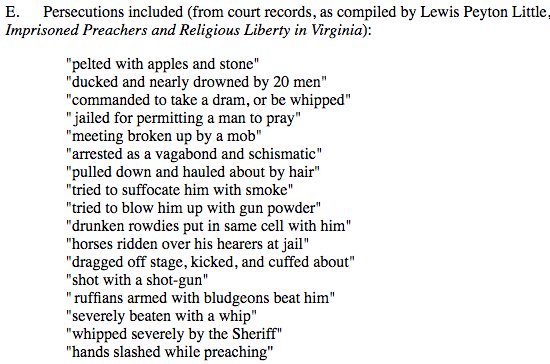
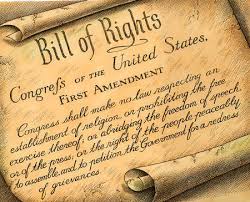 James Madisons first act, after the First Congress was organized, in 1789, was to propose, on June 8, certain amendments, including what is now the First Amendment. His purpose was to “conciliate and to make all reasonable concessions to the doubting and distrustful”—to those, the Baptists, who were concerned about the issue of religious liberty. “Of all the denominations in Virginia, [the Baptists] were the only ones that had expressed any dissatisfaction with the Constitution on that point, or that had taken any action into looking to an amendment.” The Baptists of Virginia had also corresponded with Baptists of other states to “secure cooperation in the matter of obtaining” a religious liberty amendment. No other denomination asked for this change.[1] A general committee of Baptist churches from Virginia presented an address to President Washington, dated August 8, 1789, expressing concern that “liberty of conscience was not sufficiently secured,” perhaps because “on account of the usage we received in Virginia, under the regal government, when mobs, bonds, fines and prisons, were [their] frequent repast.”[2] President Washington assured them that he would not have signed the Constitution if he had had the slightest apprehension that it “might endanger the religious rights of any ecclesiastical society.”[3]
 Some Baptists and others did not see the need for a religious freedom amendment. Indeed, the First Amendment may not have been necessary to guarantee separation of church and state. Isaac Backus was elected as a delegate to the Massachusetts convention of January, 1788, which considered the issue of ratification of the new Constitution. He spoke at the convention.
- “On February 4, [Backus] spoke of ‘the great advantage of having religious tests and hereditary nobility excluded from our government.’ These two items in the Constitution seemed to him a guarantee against any establishment of religion and against the formation of any aristocracy. ‘Some serious minds discover a concern lest, if all religious tests should be excluded, the congress would hereafter establish Popery, or some other tyrannical way of worship. But it is most certain that no such way of worship can be established without any religious test.’ He said ‘Popery,’ but he probably feared, as many Baptists did, that some form of Calvinism of the Presbyterian or Consociational variety was more likely. His interpretation of this article helps to explain why the Baptists [of Massachusetts] made no effort to fight for an amendment on freedom of religion along with the others which the convention sent to Congress.”[4]
 Even Madison, who proposed and fought for the First Amendment, did not believe that it was necessary for the security of religion. He wrote in his Journal on June 12, 1788:
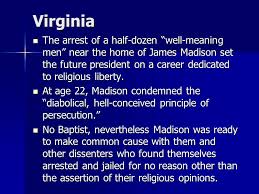
- “… Is a bill of rights a security for Religion? … If there were a majority of one sect, a bill of rights would be a poor protection for liberty. Happily for the states, they enjoy the utmost freedom of religion. This freedom arises from that multiplicity of sects, which pervades America, and which is the best and only security for religious liberty in any society. For where there is such a variety of sects, there cannot be a majority of any one to oppress and persecute the rest. Fortunately for this commonwealth, a majority of the people are decidedly against any exclusive establishment—I believe it to be so in the other states…. But the United States abounds in such a variety of sects, that it is a strong security against religious persecution, and it is sufficient to authorize a conclusion, that no one sect will ever be able to outnumber or depress the rest.”[5]
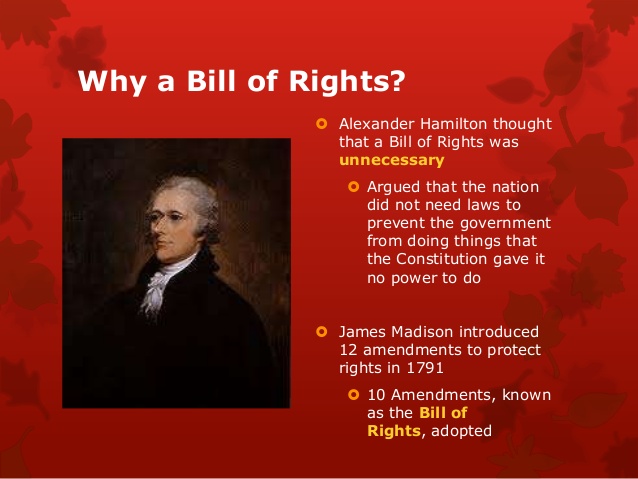
Others were against a bill of rights. “James Wilson argued that ‘all is reserved in a general government which is not given,’ and that since the power to legislate on religion or speech or press was not given to the Federal government, the government did not possess it, and there was therefore no need for an express prohibition.”[6] “Alexander Hamilton argued that a bill of rights, not only was unnecessary, but would be dangerous, since it might create the inference that a power to deal with the reserved subject was in fact conferred.”[7]
The amendment was adopted on September 25, 1789, and was approved by the required number of states in 1791.
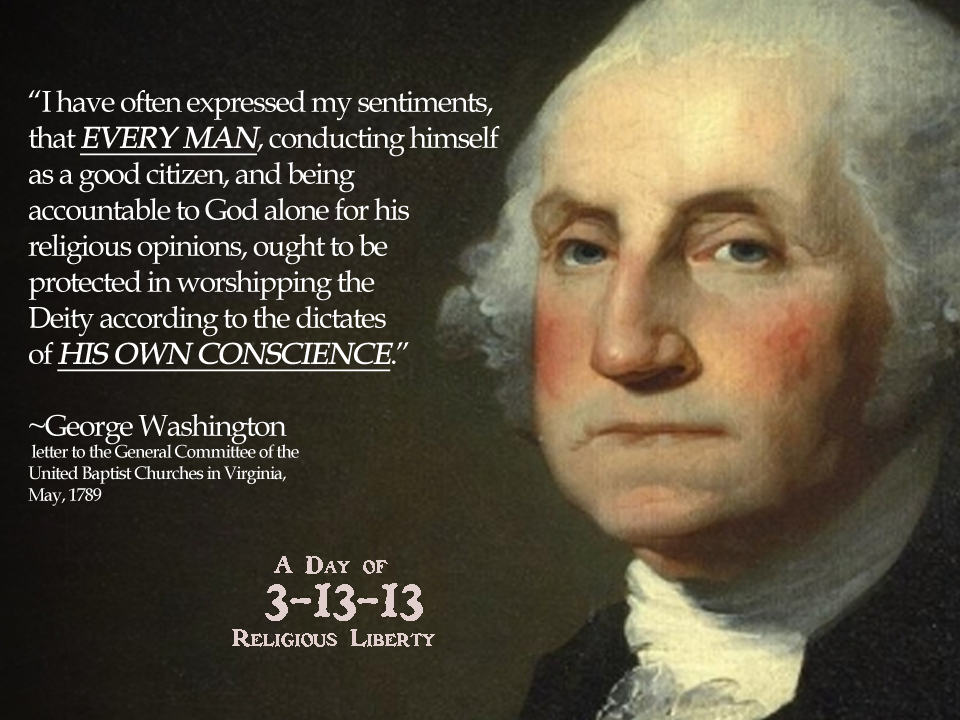
“No more fitting conclusion can be had … than to quote the language of the Father of his country. The days of persecution, of blood and of martyrdom were passed. Civil and soul liberty, the inalienable rights of man, enlargement, benevolent operations, educational advantages, and worldwide missionary endeavor, all had been made possible by the struggles of the past. The Baptists consulted George Washington to assist in the securing freedom of conscience. He replied:
- “I have often expressed my sentiments, that every man, conducting himself as a good citizen, and being accountable to God alone for his religious opinions, ought to be protected in worshipping the Deity according to the dictates of his own conscience. While I recognize with satisfaction, that the religious society of which you are members have been, throughout America, uniformly and almost unanimously the firm friends to civil liberty, and the persevering promoters of our glorious revolution, I cannot hesitate to believe, faithful supporters of a free, yet efficient general government. Under this pleasing expectation, I rejoice to assure them, that they may rely on my best wishes and endeavors to advance their prosperity.”[8]
Endnotes
[1] Charles F. James, Documentary History of the Struggle for Religious Liberty in Virginia (Harrisonburg, VA.: Sprinkle Publications, 2007; First Published Lynchburg, VA.: J. P. Bell Company, 1900), p. 167.
[2] Isaac Backus, A History of New England With Particular Reference to the Denomination of Christians called Baptists, Volume 2 (Eugene, Oregon: Wipf & Stock Publishers, Previously published by Backus Historical Society, 1871), p. 340.
[3] Ibid.
[4] William G. McLoughlin, Isaac Backus and the American Piestic Tradition (Boston: Little, Brown and Company, 1967), pp. 198-199.
[5] Norman Cousins, In God We Trust (Kingsport, Tennessee: Kingsport Press, Inc., 1958), pp. 314-315.
[6] Leo Pfeffer, Church, State, and Freedom (Boston: The Beacon Press, 1953), p. 112.
[7] Ibid., citing Federalist Papers, Modern Library ed., 1937, p. 559.
[8] John T. Christian, A History of the Baptists, Volume I, (Texarkana, Ark.-Tex.: Bogard Press, 1922), pp. 392-393, citing Sparks, Writings of George Washington, SII, 155. Boston, 1855.


 “For the husband is the head of the wife, even as Christ is the head of the church: and he is the savior of the body. Therefore as the church is subject unto Christ, so let the wives be to their own husbands in everything. Husbands, love your wives, even as Christ also loved the church, and gave himself for it; That he might sanctify and cleanse it with the washing of water by the word. That he might present it to himself a glorious church, not having spot, or wrinkle, or any such thing; but that it should be holy and without blemish. For no man ever hated his own flesh; but nourisheth and cherisheth it, even as the Lord the church: For we are members of his body, of his flesh, and of his bones. For this cause shall a man leave his father and mother, and shall be joined unto his wife, and they two shall be one flesh. This is a great mystery: but I speak concerning Christ and the church. Nevertheless let every one of you in particular so love his wife even as himself; and the wife see that she reverence her husband” (Ep. 5.23, 25-27, 29-33)
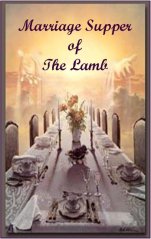 At the marriage of the Lamb, Christ will marry His bride, and all members of the family of God will become part of a universal church or assembly. (Revelation 19:6-8) quoted in En
 The bridegroom is without fault. What about the local church? Has she joined with any other lover? If she is incorporated, has federal tax-exempt status, or is united with the state or any other lover in any way, she has committed spiritual fornication. If so, why not repent and return to your first love?

 This study is designed for the born again believer who wishes to learn what the Bible teaches about government, church, separation of church and state, and how those principles have been and are applied in America. The topics covered are extremely important to our Lord Jesus Christ, to individuals, to families, to churches, and to the nation. The guiding light is the Bible.
 This course is presented at the spiritual grade school level. Each lesson will be only about five to eight minutes in length. The course presents basic knowledge. At first, only an elementary analysis and understanding is taught and required by the student. For those who are already more advanced, they can listen to the study and go to the resources cited in the accompanying written (and probably more thorough, but still grade school level) study for more in depth and detailed studies which will connect to further studies. One can progress as far as he wants, even to the graduate level, if he continues to follow the links to the top studies such as God Betrayed. At that level, meditation, analysis, and study become very important.
 A child of God should never just accept what he is told. He should make sure what he is told is in line with the Word of God. Even on the grade school level, some verses will be cited as the basis for a teaching. The more mature student will want to make sure those verses are not taken out of their immediate context and the overall context of Scripture.
 One should not attempt to start with the final phase of the course without understanding the foundational principles and the application of those principles.
 Simply Church