Tag Archives: church

What is 508(c)(1)(A)?


A Publication of Churches Under Christ Ministry


Click here to go to All Written Course Segments
Click here to go to General Questions Answered
Click here To Go to Links to All 5 Minute Youtube Course Segments


Jerald Finney
Copyright © December 8, 2017

See Church Internal Revenue Code § 508(c)(1)(A) Tax Exempt Status for full explanation of church 508(c)(1)(A) status. That article explains why 508(c)(1)(A) status puts a church under the same rules and regulations that come with 501(c)(3) and the authority of the Internal Revenue Service regardless of whether the IRS has the resources to enforce the rules and regulations that come with the status. This short article is very basic.

126 United States Code § 508(c)(1)(A), also referred to as Internal Revenue Code § 508(c)(1)(A), is a law which was enacted by Congress and signed by the President.

Some churches rely on this law rather than another law, § 501(c)(3) of the Internal Revenue Code, to establish tax exempt status.

§ 508(c)(1)(A). Special rules with respect to section 501(c)(3) organizations. “(a) New organizations must notify secretary that they are applying for recognition of section 501(c)(3) status. “(c) Exceptions. “(1) Mandatory exceptions. Subsections (a) and (b) shall not apply to— “(A) churches, their integrated auxiliaries, and conventions or associations of churches” (26 U.S.C. § 508). [Emphasis mine.]

508(c)(1)(A) churches are subject to the same rules which 501c3 churches are subject to. En1, En2; En3 (full explantion of church 508(c)(1)(A) status)


The Bible Answer to the Question, “Is an Incorporated 501(c)(3) or 508(c)(1(A) Church a Church of Christ?” (Prepared for a talk given at the September 16-19 Liberty Baptist Church of Albuquerque, NM, Southwest Baptist Heritage Camp Meeting. Click here to go to Part I of the video of that presentationClick here to go to Part II of that presentation, “Why a Church Is Not a Business.” Part II was removed from Part I. In Part II, Jerald Finney invited Evangelist and Pastor Terry Woodside to tell his story which demonstrates that a church which is a non-legal entity cannot be sued in America. Click here to go to the page which has links to all sermons and presentations at that meeting.)


Endnotes


En1 See Should a Church Be a 508(c)(1)(A) Church?

En2 See What is 501(c)(3)?

En3 Church Internal Revenue Code § 508(c)(1)(A) Tax Exempt Status. This article gives a thorough explanation of church 508 status.

Does a church in America need a Tax Id Number?


A Publication of Churches Under Christ Ministry


Click here to go to All Written Course Segments
Click here to go to General Questions Answered
Click here To Go to Links to All 5 Minute Youtube Course Segments


Click here for video of this lesson.


Jerald Finney
Copyright © November 25, 2017


The answer to the question depends on the type of church. Is the church a spiritual entity built by the Lord Jesus Christ only or is the church a temporal earthly legal entity organized and built according to the laws of man. I will answer this question as to the church which is a legal, earthly, temporal entity such the corporate 501c3 or 508 church. I will also answer it as to the church which is a spiritual eternal entity only. I will describe how OPBC is the latter—a spiritual eternal entity—which operates in the light and proclaims to the world exactly what they are doing.

A church that chooses to become a legal entity such as a corporate 501c3 or 508 organization will need a tax number.

A legal entity is an entity that can sue, be sued, act legally, enter into contracts and so forth. A corporation is a “person” in that sense. The essay, Church Internal Revenue Code § 508 Tax Exempt Status gives some insights on the legal fiction that makes a corporation a legal “person.”

Unlike a church who chooses to become a temporal earthly entity such as a corporation with 501c3 or 508 status, the New Testament church, a church which has not voluntarily given up her New Testament and First Amendment status, cannot have an EIN or TIN. Why? Because by doing so that church is acting as an earthly temporal as opposed to eternal spiritual organization. That church is putting money in the bank, for example, in the name of the church.

What is wrong with that? First, the church is acting temporally, legally, earthly. Believers are to give to God, not to an earthly temporal organization created by man. When church members give to an incorporated church, the money is put in the corporate bank account. If the church is not incorporated and the money is put in a bank account in the name of the church, the money is put into an earthly account which belongs to the church. Legally and temporally, the money belongs to the church, not to God. I realize that many people who are in such churches believe in their heart that they are giving to God and I believe that God honors that. However, he is grieved by the fact that they are proceeding without knowledge, understanding and wisdom.

A church that is a New Testament Church, a spiritual entity only, cannot have a Tax or Employment Identification Number. Having a TIN or EIN makes a church a legal entity.

OPBC members give to God, not to the church. The money they give is put in a trust bank account which does not belong to OPBC. The true owner of the money in the trust bank account is the Lord Jesus Christ. OPBC openly proclaims this without fear. The pastor of OPBC showed the bank the trust papers which established the Lord’s trust. The bank opened the account. See, Lessons on the Bible/Common Law Trust.

OPBC does not lease or own the facility they meet in. OPBC does not have insurance on the meetinghouse; but the meetinghouse is insured. The pastor/trustee of OPBC showed the insurance company the paperwork which makes this possible, the paperwork which declares to the world what OPBC is doing. The insurance company sold a policy, not to OPBC, but to the trust relationship with property created by the church in accordance with Bible principles.

Why can a church do this in America? Because American law recognizes the type trust established by OPBC. OPBC established the trust relationship, but the trust is not OPBC nor is OPBC the trust. The trust is simply a fiduciary relationship with property. See, for more information and links to more resources on the trust relationship, Is Old Paths Baptist Church a Spiritual or Legal Entity?

The trust is not a legal entity, like a business trust or charitable trust. The highest man-made law in America, the First Amendment, and also corresponding state constitutional provisions honor the Bible principle of separation of church and state. Those laws guarantee that churches and non-Christian religious organizations such as the Mormons, the Jehovah’s Witnesses, the Catholics, the Moslems, the Hindus, the Buddhists and so forth can choose to operate outside government intervention.

You see, the legal system in America recognizes, but did not create, the fiduciary relationship with money and property which OPBC uses in order to remain a non-legal, eternal, spiritual entity.

As a lawyer and a believer, I proclaim these matters to the world. I would not utilize the tactic of lying so as to displease the Lord, mislead other believers, and lose my law license. Not only that, if OPBC members found that I intentionally or unknowingly lied to them or misled them, they would point out my error and give me a chance to repent. I will not knowingly disgrace God’s churches.


Recommended resources for further study:

Separation of Church and State/God’s Churches: Spiritual or Legal Entities. This is online PDF form of the 2nd edition of the book. OPBC plans to print this in paperback form.

Links to articles on these matters:

Essays and Articles on Church Organization, Separation of Church and State, and Other Church Issues

Essays, Articles, and Other Resources Related to the Doctrine of the Church, Incorporation, 501c3, Etc.

Church Internal Revenue Code § 508 Tax Exempt Status

Trust Explained

What God Has Committed to Man’s Trust: “Ye cannot serve God and mammon”: Steward or Trustee?

Jerald Finney
Copyright  November 8, 2017

“Trust” is a Bible relationship that is recognized, not created, by man’s law. See Endnote 1. Many historic churches have honored this Bible relationship so as to keep their churches free from entanglement with civil government. See Endnote 2. Many American churches are presently declaring this trust relationship. See Endnote 3. 

Recently, at an Unregistered Baptist Fellowship Conference, a gentleman said to me something others have commented on over the years, “We use the term steward because Biblical law is over man’s law.” His statement raises the question: “Why not use the term ‘steward’ instead of ‘trustee’ in describing the ‘trust’ relationship with property?” This article will look at Bible teaching for the answer and address some collateral matters:  the meanings of the words “steward,” “trust,” “trustee,” “beneficiary,” “trust estate;” the eternal and temporal applications of the relationship; just versus unjust stewardship according to God; and the consequences of just and unjust application of the relationship.

Both “steward” and “trust” are Bible terms. “Steward” refers to the person to whom someone commits the care and management of his goods for his benefit. The term “trust” refers to the relationship created. The term “trustee,” a derivative of the word “trust,” is the equivalent of the term “steward.”

The term “trust” refers to both temporal/earthly and eternal/heavenly or spiritual relationships. “Trust” relationships are found throughout the Bible, even when the word “trust” or “steward” is not mentioned. Luke 16 speaks of a temporal material trust, and relates that trust to an eternal spiritual trust. 1 Thessalonians 2.4, and Titus 1.11 speak specifically and solely of the eternal spiritual trust. The first time the relationship is mentioned is in Genesis 1.27-31, where obviously although not explicitly stated, the relationship is both earthly and spiritual:

  • “27 So God created man in his own image, in the image of God created he him; male and female created he them. 28 And God blessed them, and God said unto them, Be fruitful, and multiply, and replenish the earth, and subdue it: and have dominion over the fish of the sea, and over the fowl of the air, and over every living thing that moveth upon the earth. 29 And God said, Behold, I have given you every herb bearing seed, which is upon the face of all the earth, and every tree, in the which is the fruit of a tree yielding seed; to you it shall be for meat. 30 And to every beast of the earth, and to every fowl of the air, and to every thing that creepeth upon the earth, wherein there is life, I have given every green herb for meat: and it was so. 31 And God saw every thing that he had made, and, behold, it was very good. And the evening and the morning were the sixth day.”

All such earthly and spiritual relationships have several essentials: the possession(s); the true, equitable, and beneficial owner of the possession(s); the commitment by the true owner of the possession(s) to another’s care and management; and the one to whom is entrusted the care and management of the possession(s) for the benefit of the true owner. Every Bible dispensation presents a specific stewardship under God.

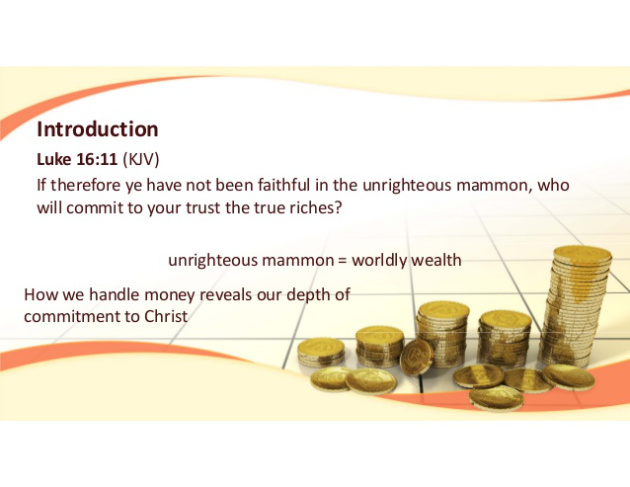
Only once in the Bible, in Luke 16.1-13, are the words “steward” and “trust” used in the same passage. That passage is concerned with an earthly steward dealing with earthly possessions of his earthly master, the true owner of the possessions. There, “steward” refers to the person who has a duty to manage the goods of his master, for his master’s benefit. However, the Lord makes a connection between one’s earthly stewardship and his eternal stewardship (“Stewardship” means the office of a steward). The Lord says, “If therefore ye have not been faithful in the unrighteous mammon, who will commit to your trust the true riches? … “Ye cannot serve God and mammon” (Lk. 16.11, 13).

As has been pointed out, “steward” has the same meaning as “trustee.” So why not use “steward” instead of using derivatives of the word “trust,” to include “trustee.” The conclusion will answer this question; but first, this brief article takes a further look at “steward” and “trust.”

God entrusted mankind with all possessions, real and personal as well as spiritual. He owned all things—even the body, soul and spirit of man—but left all things, including the real estate, to man to be used for Him. God trusted man with all His earthly and eternal possessions. God committed all to his trust. He was “steward” or “trustee,” the one to whom God entrusted management and care of His possessions.

Now, let us examine the term “steward” and “stewardship” from a Bible perspective. Then we will look at “trust” and related terms—“trustor,” “trustee,” and “trust estate.”

The term “steward” is found in Genesis 15.2, 43.19, 44.1, 44.4; 1 Kings 16.9; Daniel 1.11; Matthew 20.8; Luke 8.3, 12.42; 16.1,2, 3, 8; 1 Corinthians 4.1,2; Titus 1:7. The word “stewardship” is used only three times in the Bible, all in Luke 16, verses 2, 3, and 4. “Stewardship” simply means “The office of a steward.”

A steward is a man who has charge of another’s goods. As defined in the Webster’s 1828 Dictionary, “steward” means: “(1) A man employed in great families to manage the domestic concerns, superintend the other servants, collect the rents or income, keep the accounts, &c. See Gen. xv. 2—xliii. (2) In Scripture and theology, a minister of Christ, whose duty is to dispense the provisions of the gospel, to preach its doctrines and administer its ordinances. It is required in stewards, that a man be found faithful. 1 Cor. iv.”

The first meaning of “steward” is reflected in several passages of the Bible: Genesis 15.2, 43.19, 44.1, 44.4; 1 Kings 16.9; Matthew 20.8; Luke 8.3, 12.42, 16.1-13 (parable of the unjust steward). Certainly, although not directly dealing with the eternal meaning, many of those stewardships have spiritual applications: Matthew 20.8; Luke 12.42-48 (levels of punishment based upon whether or not the steward knew the Lord’s will), 16.1-13.

The eternal application alone is seen in 1 Corinthians 4.1, 2: “Let a man so account of us, as of the ministers of Christ, and stewards of the mysteries of God.  Moreover it is required in stewards, that a man be found faithful.”; and Titus 1.7: “For a bishop must be blameless, as the steward of God; not selfwilled, not soon angry, not given to wine, no striker, not given to filthy lucre.”.

The story of a rich man and his unjust steward, which is related in Luke 16.1-13, is very instructive. The terms “trust” and “steward” are used in that parable. The master committed his goods to the steward’s trust (verses 1 and 11). The master was the beneficiary, “the true, beneficial, and equitable owner.”

The steward in this parable was an out-and-out-crook. He was guilty of malfeasance in office and misappropriation of funds. He wasted the goods of his master. His day of reckoning had come (Lk. 16.3). He was afraid of losing his stewardship, felt he could not do manual work, and was ashamed to beg. However, he, like many, was not ashamed to steal (verse 3). He did not repent, nor did he have regret or remorse for his actions. He was crooked—called “clever” by the world’s standards. He had no training for other work, his age was probably against him, he was too proud to beg, but he was not ashamed to be dishonest. He called all his master’s debtors and gave them big discounts.

The Bible tells us that the world loves its own but hates those who belong to God. “If the world hate you, ye know that it hated me before it hated you. If ye were of the world, the world would love his own: but because ye are not of the world, but I have chosen you out of the world, therefore the world hateth you” (Jn. 15:18-19). In Galatians 1.3-4, Paul says, “Grace be to you and peace from God the Father, and from our Lord Jesus Christ, Who gave himself for our sins, that he might deliver us from this present evil world, according to the will of God and our Father.” Again in Romans 12.2 Paul says, “And be not conformed to this world: but be ye transformed by the renewing of your mind, that ye may prove what is that good, and acceptable, and perfect, will of God.” “Love not the world, neither the things that are in the world. If any man love the world, the love of the Father is not in him” (1 Jn. 2:15).

The first commandment of the world is “self-preservation.” A shady business deal is winked at, questionable practices countenanced, and a clever crook is commended by the world. The law is on the side of the crook and the criminal many times. Every man, according to the world’s law, is innocent until proven guilty. God takes the opposite approach. God says that a man is guilty until proven innocent. “For all have sinned and come short of the glory of God” (Ro. 3.23). A man can never be innocent before God, but he can be justified before Him. When a man trusts Jesus Christ as his Savior, he is justified by faith. See, e.g., Ro. 8.1.

The master did not punish the unjust steward, but commended him. Apparently the rich man got rich using the same kind of principles that his unjust steward used and he commended him, saying that the steward had done wisely. In what way? According to the principles of the world. This is the world that hates Christ. It makes its own rules. The law of the world is “dog eat dog.” The worldly master commended his worldly steward for his worldly wisdom according to his worldly dealings. The Lord Jesus said, “… For the children of this world are in their generation wiser than the children of light.” That is, the children of this world, of this age, use their money more wisely than do the children of light.

Then, our Lord makes the most shocking and startling statement of all. It concerns the relationship of the “mammon of righteousness,” that is, riches, money: “Make to yourselves friends of the mammon of unrighteousness; that, when ye fail, they may receive you into everlasting habitations” (Lk. 16.9). Money is not evil in itself; it is amoral. The love of money is the root of all evil. For believers, money is to be spiritual. Our Lord said that we should lay up for ourselves treasures in heaven. We should be wise in the way we use our money. Then when we “fail” or come to the end of life, we will be welcomed in heaven.

Believers are spiritual stewards (trustees) of all that God commits to their trust; all of which is spiritual. We own nothing as believers. We are responsible to God for how we use His goods. We are to use the “mammon of unrighteousness” to gather spiritual wealth:

“He that is faithful in that which is least is faithful also in much: and he that is unjust in the least is unjust also in much. If therefore ye have not been faithful in the unrighteous mammon, who will commit to your trust the true riches?  And if ye have not been faithful in that which is another man’s, who shall give you that which is your own. No servant can serve two masters: for either he will hate the one, and love the other; or else he will hold to the one, and despise the other. Ye cannot serve God and mammon.” (Lk. 16.10-13).

In this parable, the Lord Jesus is saying, “Do you think God is going to trust you with heavenly riches if you are not using properly or rightly the earthly possessions which He has given you?” Are you serving God or mammon? You cannot serve both.

Now, let us look at “trust” and related terms. “Trustor,” “trustee,” and “trust estate” are derivatives of the word “trust.” The concept of trust if found throughout the Bible. The suffix “-ee” added to trust results in a new word meaning a person with to whom something is entrusted. A “trustor” is one who entrusts monies and properties to a “trustee” who holds the money and property entrusted to him in “trust” for the benefit of the true, equitable, and beneficial owner, the “beneficiary.”

Some meanings of trust, as given in the 1828 Webster’s Dictionary, are:(1) Confidence; a reliance or resting of the mind on the integrity, veracity, justice, friendship or other sound principle of another person. He that putteth his trust in the Lord shall be safe. Proverbs 20.25. (2) Something committed to a person’s care for use or management, and for which an account must be rendered. Every man’s talents and advantages are a trust committed to him by his Maker, and for the use or employment of which he is accountable.”

In the context of definition (2), the word “trust” is mentioned four times in the Bible:

  1. “But as we were allowed of God to be put in trust with the gospel, even so we speak; not as pleasing men, but God, which trieth our hearts” (1 Thes. 2.4).
  2. “According to the glorious gospel of the blessed God, which was committed to my trust” (1 Ti. 1:11).
  3. “O Timothy, keep that which is committed to thy trust, avoiding profane and vain babblings, and oppositions of science falsely so called” (1 Ti. 6:20).
  4. “If therefore ye have not been faithful in the unrighteous mammon, who [what trustor] will commit to your trust the true riches? And if ye have not been faithful in that which is another man’s, who shall give you that which is your own” (Lk. 16:11-12)?

In all these references, that which God entrusted was not material and spiritual, but spiritual only—“the true riches.”

The Lord spoke of this concept of trust, in conjunction with an earthly temporal example, in Matthew 25.14-30 and Luke 19.12-27, although He used neither the word “trust” nor “steward or stewardship.” He spoke of an earthly master leaving certain amounts of his goods or money with his servants, according to their abilities. Actually, the more important parallel spiritual meaning was to the Lord and His servants. The master had an absolute right to his own goods, but he distributed to his servants to be used for the benefit of the master, the servants to be awarded according to their profitable use of the property entrusted to them. Some used the money productively and upon the master’s return presented him with a profit. The property belonged to the master, and the servants were to use it for the master’s benefit, not for their own benefit. Of course, they would be rewarded if they used the property wisely for the benefit of the master. One servant in each example returned only the original amount left in trust with them. The master instructed that the goods which he had left with the unprofitable servants be taken from them, and they were left with nothing. The profitable servants were rewarded by the master. In the story found in Matthew, the Master said, “[C]ast ye the unprofitable servant into outer darkness: there shall be weeping and gnashing of teeth” (Mt. 25.30). Men, as servants of the Master are likewise left in trust of all things for His benefit and will be rewarded or punished according to their use of His goods.

In conclusion, the words “steward” and “trustee” signify the same thing. However, the use of the term “trustee,” a word derived from the word “trust” by adding the suffix “-ee”  is preferable to the use of “steward” when describing the entire relationship. Why? For five reasons taken together. First, the terms “steward” and “trustee” mean the same thing.

Second, the one time “trust” and “steward” are used in the same immediate verses, “steward” denotes the person with the responsibility over another’s goods and “trust” is used to signify the fiduciary relationship with the master’s goods or property (Lk. 16). Even though “steward” is the one with the duty to rightly administer the goods the master commits to his trust, the name given to the arrangement is “trust.”

Third, no where in the Bible are all the terms involved in the relationship reduced to singular (as “trustor”) or modified terms (as “trust estate”).

Thus, fourth, the use of “trust” and derivatives is more practical. The term “trust” as a noun (and as an adjective) and its derivatives, more succinctly describe all aspects of the relationship: “trustor,” “trustee,” and “trust estate.” On the other hand, the term “stewardship” is less adaptable: one can interchange “steward” and “trustee;” but the word “trust” describes the overall relationship. No word derived from “steward” describes the person who establishes the stewardship (the “trustor”). No word derived from “steward” describes the estate the steward is responsible for (“trust estate”)—er, perhaps the “stewardship estate?”; but stewardship means the office of a steward. Parallel words leave less room for argument and misunderstanding. Imagine trying to explain these matters to a lost person.

Finally, American law, although not establishing the Bible concept of trust, recognizes it. In so doing, American law uses the Bible term “trust” and its derivatives.  For example, American Jurisprudence 2d Trusts, a highly regarded encyclopedia of American law, describes “trust” in § 1, as follows:

  • “The fundamental nature of a trust is the division of title, with the trustee being the holder of legal title and the beneficiary that of equitable title. By definition, the creation of a trust must involve a conveyance of property.
  • “A ‘trust’ exists where the legal title to property is held by one or more persons, under an equitable obligation to convey, apply, or deal with such property for the benefit of other persons. A trust has been defined as a fiduciary relationship with respect to property, subjecting the person by whom the title to the property is held to equitable duties to deal with the property for the benefit of another person, which arises as a result of a manifestation of an intention to create it. The Restatement definition is similar, providing that a trust, when not qualified by the word ‘resulting’ or ‘constructive,’ is a fiduciary relationship with respect to property, arising from a manifestation of intention to create that relationship and subjecting the person who holds title to the property to duties to deal with it for the benefit of charity or for one or more persons, at least one of whom is not the sole trustee.
  • “Caution: A trust consists not only of property, but also of the trust instrument, the trust’s beneficiaries and trustees, and the trust administrator [if any].”

American Jurisprudence 2d, Trusts § 2 makes clear that a “trust” is not a legal entity, but merely a fiduciary relationship with property. For one thing, this means that the one cannot sue the trust, since it is not recognized as a legal entity. This is not true of a “business trust,” a “charitable trust” or some other legal extensions of the “trust” relationship.

“No particular words are necessary to create a trust if there exists reasonable certainty as to the intended property, object, and beneficiary. Further, the purpose and intention, rather than the use of any particular term, determines whether a valid trust has been established.” American Jurisprudence 2d, Trusts § 65.

The important thing for the born again believer, regardless of the terms used, is that he handle the use of God’s properties, all of which are spiritual to a born again believer, according to the principle of trust as described in the Bible. Those faithful and wise churches who remain under God only will be blessed by their Lord. However, churches who choose to leave their first love by placing themselves at least partially under the state (for example, corporate (aggregate of sole) 501(c)(3) or 508 churches), have left their first love and betrayed their Lord’s trust. They are unfaithful and act unwisely; they act either knowingly or unknowingly and will  punished accordingly (see Lk. 12.42-48; see also Lk. 16 discussed above).

See En 4 for links to additional resources.

Endnotes

En 1: See, for explanation, How a Church Can Organize To Remain a New Testament Church (Holding Property in Trust for God Is a Scriptural Principle Recognized by the Legal System).

En 2: In WAUSHARA COUNTY v. Sherri L. GRAF, 157 Wis.2d 539 (1990), 461 N.W.2d 143, Court of Appeals of Wisconsin. Submitted on briefs December 8, 1989. Decided August 2, 1990 the court reviewed pertinent Wisconsin  statutes back to 1849 to determine if a church or religious organization must be incorporated for its property to be tax exempt [under state law]. Annotation to the law said: “A church consists of those who are communicants, have made a public profession of religion and are united by a religious bond of common spiritual welfare. It is the spiritual body…. we must hold that the mere fact that [a] church or religious society had not yet been incorporated at the time of the delivery of [a] deed in no way frustrated the trust thereby created, if such trust was otherwise valid.” Fadness v. Braunborg, 73 Wis. 257, 278-79, 41 N.W. 84, 90 (1889) (emphasis in original)….  In Holm v. Holm, 81 Wis. 374, 382, 51 N.W. 579, 581 (1892), the facts included that the Norwegian Evangelical Lutheran Church of Roche-a-Cree was a voluntary association until February 7, 1889. The court noted that “[p]rior to that date the title to the churches in which the members of the association worshiped was vested in trustees named in . . . deeds, and their successors in office. . . . The trusts imposed by such deeds appear to have been valid upon the principles stated by this court in Fadness v. Braunborg. . . .Id. …In Franke v. Mann, 106 Wis. 118, 131, 81 N.W. 1014, 1018-19 (1900), the court further said that ‘[w]hat has been said is in harmony with the law regarding trusts for religious uses….’ The Basic Bible Church established that title to the real estate subject to foreclosure was held in the name of the trustees for the benefit of the church. We conclude that the trust constituted an ‘entity’ which could claim tax exemption under sec. 70.11(4), Stats., for the benefit of the Basic Bible Church.”

On appeal, the Wisconsin Supreme Court in WAUSHARA COUNTY v. Sherri L. GRAF, 166 Wis.2d 442 (1992), 480 N.W.2d 16,  1992 approved, but did not restate, the reasoning above.

In KOPSOMBUT-MYINT BUDDHIST CENTER, v. STATE BOARD OF EQUALIZATION, 728 S.W. 2d 327 (1986) Court of Appeals of Tennessee, Middle Section, at Nashville. Permission to Appeal Denied, April 6, 1987, the court inferred a “trust” from the wording of a “joint venture” in 1982 and held that property held in trust for a Buddhist Temple qualifies for a property tax exemption, if the property is used for religious purposes and the owner, any stockholder, officer, member or employee of such institution is not lawfully entitled to receive and pecuniary profit from the operations of that property in competition with like property owned by others which is not exempt. The court stated, as regards trusts:

  • “A valid trust need not be in writing. It can be created orally unless the language of the written conveyance excludes the existence of a trust. Sanderson v. Milligan,585 S.W.2d 573, 574 (Tenn. 1979); Linder v. Little, 490 S.W.2d 717, 723 (Tenn. Ct. App. 1972); and Adrian v. Brown, 29 Tenn. App. 236, 243, 196 S.W.2d 118, 121 (1946). However, when a party seeks to establish an oral trust, it must do so by greater than a preponderance of the evidence. Sanderson v. Milligan, 585 S.W.2d 573, 574 (Tenn. 1979); Hunt v. Hunt, 169 Tenn. 1, 9, 80 S.W.2d 666, 669 (1935); and Browder v. Hite, 602 S.W.2d 489, 493 (Tenn. Ct. App. 1980).
  • “The existence of a trust requires proof of three elements: (1) a trustee who holds trust property and who is subject to the equitable duties to deal with it for the benefit of another, (2) a beneficiary to whom the trustee owes the equitable duties to deal with the trust property for his benefit, and (3) identifiable trust property. See G.G. Bogert & G.T. Bogert, The Law of Trusts and Trustees § 1, at 6 (rev. 2d ed. 1984) and Restatement (Second) of Trusts § 2 comment h (1957). We find that the Kopsombut-Myint Buddhist Center has proved the existence of each of these elements by clear and convincing evidence.” [p. 333].

Efforts of scholars to trace the origin have been futile. Trusts, Trust-Like Concepts and Ius Commune, 8 Eur. Rev. Private L. 453 (2000), C. H. van Rhee: ” … Whether these origins are Roman, Canonical or Germanic [or of some other origin] remains an unresolved question. …” Of course, scholars went to ancient history, but did not go to the most ancient history, the Bible. For more insights on this, see How a Church Can Organize To Remain a New Testament Church (Holding Property in Trust for God Is a Scriptural Principle Recognized by the Legal System).

En 3: Many churches are now organized in accordance with the Bible trust relationship. More are honoring God in this matter on a regular basis: the Biblical Law Center has organized over a dozen in the last year and a half, as well as scores of churches over the last 30 years.  No matter what terms a Christian uses, he should do all in accordance with Bible principle for the glory of God.

En 4: Click here to go to links to studies which show, from the law books, exactly what incorporation and Internal Revenue Code Section 501(c)(3) are.

How a Church Can Organize To Remain a New Testament Church (Holding Property in Trust for God Is a Scriptural Principle Recognized by the Legal System)

Powerpoint: The Basics of the Bible Principle of Trust in Church Organization Explanation of “Trust,” as opposed to “Business Trust,” “Charitable Trust,” and other kinds of trusts. How can you know who to trust for the truth about these matters? How can you know if what is presented here is the truth? Etc.

Click here to go to PDF of comments which help explain the Powerpoint directly above. The presenter also stated other things, but these notes cover the most important matters.

What is a Church under Christ (a New Testament church), and What Upholds Her Integrity?


Jerald Finney
Copyright © November 6, 2017


Endnote 1 gives James Madison’s objections to a bill that would have incorporated a church in federal jurisdiction which he included with his veto and links to the whole story concerning that matter.

Endnote 2 quotes some court cases, with online links directly to those cases, on church incorporation and other matters. One case explains that, with an incorporated church, as opposed to a church which is not a legal entity, there are two entities, the one spiritual and the other legal. Another court in WATSON v. JONES, 80 U.S. 679 (____), 13 Wall. 679. Supreme Court of the United Statesconcludes that it has no jurisdiction over the matter. The important thing to notice is that the authority is the court. Since the church contracted with the state by incorporating, the members (individual or groups of members) can go to their authority not only for resolution of disputes but also for decision as to whether the authority has jurisdiction. A member can sue a member, members, the church or the state; members can sue a member, members, the church, or the state; the church can sue a member or members, etc. The contract makes clear that the controlling party is the state.

Endnote 3 briefly explains the meaning of “the church” as used in the Bible and in this article.


What is a Church, and What Upholds Her Integrity?

Christ’s church or assembly was a mystery that was not revealed in the Old Testament; it was “kept secret since the world began, But is now made manifest, and by the scriptures of the prophets, according to the commandment of the everlasting God, made known to all nations for the obedience of faith” (Ro. 16.25-26; see also, Ep. 2.9, 3.9). Jesus announced it and the Epistles of the Apostle Paul explained it. That the Gentiles were to be saved was no mystery (Ro. 9.24-33, 10.19-21). The mystery “hid in God” was the divine purpose to make of Jew and Gentile a wholly new thing—the institution of the church to be manifested in local New Testament churches until the marriage of the lamb (Heb. 12.22-24; Re. 19.7-10)—Christ’s body.  In the church, and in the church only, the distinction between Jew and Gentile disappears, and there is one “new man,” the church where there is neither Greek nor Jew, circucmcision nor uncircumcision, Barbarian, Scythian, bond nor free: but Christ is all, and  in all.” (Ep. 2.14, 15; Col. 3.10, 11). The revelation of this mystery which was foretold but not explained by Christ (Mt. 16.18) was committed to the Apostle Paul. God “made known unto us [believers together with Christ in a local church body] the mystery of his will, according to his will, according to his good pleasure which he hath proposed in himself” (Ep. 1.9, 2.5-6).

Our Lord announced the purpose of His churches, His assemblies, but wholly without explanation as to how, when, or of what materials, those churches should be built, or what should be their position, relationships, privileges or duties. The Epistles of Paul develop the doctrine of the church. In those epistles, the New Testament church, the “mystery which from the beginning of the world hath been hid in God” (Ep. 3.9), is fully revealed, and fully instructed as to her unique place in the counsels and purposes of God. Through Paul alone we know that a church is not an organization, but an organism, the body of Christ, instinct with His life, and heavenly in calling, promise, and destiny. Through him alone we know the nature, purpose, and form of organization of local churches, and the right conduct of such gatherings. This article will not address all those facets of a church, but will concentrate on the nature of a local church body.

The Apostle Paul was a man well educated in earthly and temporal matters before his salvation. As an apostle, Paul rejected his worldly wisdom gained in “higher education.” Before his conversion, he studied in Tarsus under Gamaliel (Ac. 22.3). He was a Pharisee of Pharisees.

  • “Tarsus was actually the center of Greek learning to that day. The finest Greek university in Paul’s day was in Tarsus, not in Athens or Corinth which had passed their zenith. Tarsus was a thriving Greek city and an educational center…. Undoubtedly Paul had been brought up in that university in Tarsus and had a Greek background, but he had also been in Jerusalem where he had studied under Gamaliel. He had worked on his doctorate in Jerusalem under the outstanding scholar of that day, Gamaliel.” (J. Vernon McGee, Acts, Volume II (Pasadena, California: Thru the Bible Books, 1984), p. 258)

Despite his worldly education, which he obtained before his conversion, Paul declared:

  • “And I, brethren, when I came to you, came not with excellency of speech or of wisdom, declaring unto you the testimony of God. For I determined not to know any thing among you, save Jesus Christ, and him crucified. And I was with you in weakness, and in fear, and in much trembling. And my speech and my preaching was not with enticing words of man’s wisdom, but in demonstration of the Spirit and of power. Howbeit we speak wisdom among them that are perfect: yet not the wisdom of this world, nor of the princes of this world, that come to nought: But we speak the wisdom of God in a mystery, even the hidden wisdom, which God ordained before the world unto our glory: Which none of the princes of this world knew: for had they known it, they would not have crucified the Lord of glory. But as it is written, Eye hath not seen, nor ear heard, neither have entered into the heart of man, the things which God hath prepared for them that love him. But God hath revealed them to us by his Spirit: for the Spirit searcheth all things, yea, the deep things of God. For what man knoweth the things of a man, save the spirit of man which is in him? even so the things of God knoweth no man, but the Spirit of God. Now we have received, not the spirit of the world, but the spirit which is of God; that we might know the things that are freely given to us of God. Which things also we speak, not in the words which man’s wisdom teacheth, but which the Holy Ghost teacheth; comparing spiritual things with spiritual. But the natural man receiveth not the things of the Spirit of God: for they are foolishness unto him: neither can he know them, because they are spiritually discerned. But he that is spiritual judgeth all things, yet he himself is judged of no man. For who hath known the mind of the Lord, that he may instruct him? But we have the mind of Christ” (1 Co. 2.1-16) [Bold emphasis mine].

Thus Paul first made clear that, as a spiritual man called as an Apostle, he discarded his worldly education gained as a lost carnal man. After he got saved he relied only upon his knowledge of God; and he made clear that only the born-again believer, led by the Spirit, was qualified to handle spiritual matters. Paul also asserted that rulers, “the princes of this world,” do not possess spiritual wisdom, indicating that most leaders are not Christians (undoubtedly, almost all leaders, and almost all leaders of civil government when he wrote the above words, are not and were not Christians) and are blind to spiritual matters.

Persecuted Christians down through the ages have understood this and therefore have refused, even under penalty of torture, imprisonment, and/or death to submit the church and spiritual matters to the ungodly. This was especially apparent under the Roman Empire at the time of Christ and after. See The Trail of Blood of the Martyrs of Jesus.

  • “Scripture and all history tell us, that those Caesars were not only arrogant, without God, without Christ, &c.; but professed worshippers, or maintainers, of the Roman gods or devils; as also notorious for all sorts of wickedness; and lastly, cruel and bloody lions and tigers toward the Christians for many hundred years.
  • “Hence I [Roger Williams] argue from the wisdom, love, and faithfulness of the Lord Jesus in his house, it was impossible that he should appoint such ignorant, such idolatrous, such wicked, and such cruel persons to be his chief officers and deputy lieutenants under himself to keep the worship of God, to guard his church, his wife. No wise and loving father was ever known to put his child, no not his beasts, dogs, or swine, but unto fitting keepers.
  • “Men judge it matter of high complaint, that the records of parliament, the king’s children, the Tower of London, the great seal, should be committed to unworthy keepers! And can it be, without high blasphemy, conceived that the Lord Jesus should commit his sheep, his children, yea, his spouse, his thousand shields and bucklers in the tower of his church, and lastly, his great and glorious broad seals of baptism and his supper, to be preserved pure in their administrations—I say, that the Lord Jesus, who is wisdom and faithfulness itself, should deliver these to such keepers? …
  • “[W]hen the Lord appointed the government of Israel after the rejection of Saul, to establish a covenant of succession in the type unto Christ, let it be minded what pattern and precedent it pleased the Lord to set for the after kings of Israel and Judah, in David, the man after his own heart.
  • “But now the Lord Jesus being come himself, and having fulfilled the former types, and dissolved the national state of the church, and established a more spiritual way of worship all the world over, and appointed a spiritual government and governors, it is well known what the Roman Caesars were, under whom both Christ Jesus himself, and his servants after him, lived and suffered; so that if the Lord Jesus had appointed any such deputies—as we find not a title to that purpose, nor have a shadow of true reason so to think—he must, I say, in the very first institution, have pitched upon such persons for these custodies utriusque tabulae, keepers of both tables, as no man wise, or faithful or loving, would have chosen in any of the former instances, or cases of a more inferior nature…”(Roger Williams and Edward Bean Underhill, The Bloudy Tenent of Persecution for Cause of Conscience Discussed and Mr. Cotton’s Letter Examined and Answered (London: Printed for the Society, by J. Haddon, Castle Street, Finsbury, 1848), pp. 204-205).
  • “Christ never delivered His sheep or children to these wolves, his wife and spouse to such adulterers, his precious jewels to such great thieves and robbers of the world, as the Roman emperors were. Paul never appealed to Caesar as judge appointed by Christ Jesus to give definitive sentence in any spiritual or church controversy; but against the civil violence and murder which the Jews intended against him, Paul justly appealed. For otherwise, if in a spiritual cause he should have appealed, he should have overthrown his own apostleship and power given him by Christ Jesus in spiritual things, above the highest kings or emperors of the world beside”(Id., p. 209).
  • “A civil magistrate may be a good subject, a good magistrate, in respect of civil or moral goodness, which thousands want; and where it is, it is commendable and beautiful, though godliness, which is infinitely more beautiful, be wanting, and which is only proper to the Christian state, the commonweal of Israel, the true church the holy nation, Ephes. ii.; 1 Pet. ii” (Id., p. 212).

God, through the Apostle Paul, described what a church under Christ is to be: a local autonomous body of believers; and, as such, a holy temple for the habitation of God through the Spirit (Ep. 2.21, 22); “one flesh” with Christ (Ep. 5.30, 31); and espoused to Him as a chaste virgin to one Husband (2 Co. 11.2-4). A church, under God, owes no allegiance to any tribunal in the universe, except to that of the Lord Jesus Christ unless she willingly and wrongly places herself under the jurisdiction of another (Mt. 16.13-18), and is the body of Christ of which He is the Head (Ep. 1.22, 23).

A church under Christ is made up of born again believers in Christ. A person who was first born of the flesh (a temporal birth) must, in order to be saved, be born again (a spiritual birth) (Jn. 3.3-8). God “quickens” (brings to life; animates) those who are born again; those who before “were dead in trespasses and sins” (Ep. 2.1). For this new creature “old things are passed away; behold, all things are become new” (2 Co. 5.17).

The new creature in Christ is a spiritual being who is instructed by God to walk in the Spirit. “Except a man be born again, he cannot see the kingdom of God” (John 3.3). “Except a man be born of water and of the Spirit he cannot enter the kingdom of God” (Jn. 3.5). John the Baptist said, “I indeed baptize you with water, but he shall baptize you with the Holy Ghost.” (Mk. 1.8.  See also, Mt. 3.11 and Lk. 3.16). “That which is born of the flesh is flesh; and that which is born of the Spirit is spirit” (Jn. 3.6). Therefore if any man be in Christ, he is a new creature: old things are passed away; behold, all things are become new” (1 Co. 5.17). The Word of God instructs the believer as to his walk:

  • “And you hath he quickened, who were dead in trespasses and sins: Wherein in time past ye walked according to the course of this world, according to the prince of the power of the air, the spirit that now worketh in the children of disobedience: Among whom also we all had our conversation in times past in the lusts of our flesh, fulfilling the desires of the flesh and of the mind; and were by nature the children of wrath, even as others. But God, who is rich in mercy for his great love wherewith he loved us, Even when we were dead in sins, hath quickened us together with Christ, (by grace ye are saved;) And hath raised us up together and made us sit together in heavenly places in Christ Jesus” (Ep. 2.1-6).
  • “Walk in the Spirit, and ye shall not fulfil the lust of the flesh. For the flesh lusteth against the Spirit, and the Spirit against the flesh: and these are contrary the one to the other: so that ye cannot do the things that ye would. But if ye be led of the Spirit, ye are not under the law. Now the works of the flesh are manifest, which are these; Adultery, fornication, uncleanness, lasciviousness, Idolatry, witchcraft, hatred, variance, emulations, wrath, strife, seditions, heresies, Envyings, murders, drunkenness, revellings, and such like: of the which I tell you before, as I have also told you in time past, that they which do such things shall not inherit the kingdom of God. But the fruit of the Spirit is love, joy, peace, longsuffering, gentleness, goodness, faith, Meekness temperance: against such there is no law. And they that are Christ’s have crucified the flesh with the affections and lusts. If we live in the Spirit, let us also walk in the Spirit” (Ga. 5.16-25; see also, Ep. 5.1-17, Jn. 6.63, Ro. 8.1-13).

Thus, the lost man, the man who has not been born again, is a fleshly man, who walks in the flesh without the indwelling Spirit of God. He is subject only to the law. The believer, a member of a church, a part of the body, is a heavenly man, and a stranger and pilgrim on the earth who is told to be led of the Spirit. He is told that if he is led of the Spirit, he is not subject to the law.

  • “Blessed be the God and Father of our Lord Jesus Christ, who hath blessed us with all spiritual blessings in heavenly places in Christ” (Ep. 1.3).
  • “But God, who is rich in mercy, for his great love wherewith he loved us, Even when we were dead in sins, hath quickened us together with Christ, (by grace are ye saved;) And hath raised us up together, and made us sit together in heavenly places in Christ Jesus” (Ep. 2.4-5).
  • “If I have told you earthly things, and ye believe not, how shall ye believe, if I tell you of heavenly things” (Jn. 3.12)?
  • “WHEREFORE, holy brethren, partakers of the heavenly calling, consider the High Priest of our profession, Christ Jesus” (Heb. 3.1).
  • “Dearly beloved, I beseech you as strangers and pilgrims, abstain from fleshly lusts, which war against the soul” (1 Pe. 2.11).

The word “heavenly” signifies that which is heavenly in contradistinction to that which is “earthly.” The ‘heavenlies’ [or ‘heavenly places’] may be defined as the sphere of the believer’s spiritual experience as identified with Christ in:

  1. nature (2 Pet. 1.4“Whereby are given unto us exceeding great and precious promises: that by these ye might be partakers of the divine nature, having escaped the corruption that is in the world through lust.”);
  2. life (Col. 3.4: “When Christ, who is our life, shall appear, then shall ye also appear with him in glory.”; 1 Jn. 5.12“He that hath the Son hath life; and he that hath not the Son of God hath not life.”);
  3. relationships (Jn. 20.17“Jesus saith unto her, Touch me not; for I am not yet ascended to my Father: but go to my brethren, and say unto them, I ascend unto my Father, and your Father; and to my God, and your God.” Heb. 2.11“For both he that sanctifieth and they who are sanctified are all of one: for which cause he is not ashamed to call them brethren.”);
  4. service (Jn. 17.18“As thou hast sent me into the world, even so have I also sent them into the world.”; Mt. 28.20Teaching them to observe all things whatsoever I have commanded you: and, lo, I am with you alway, even unto the end of the world. Amen.);
  5. suffering (Phil. 1.29“For unto you it is given in the behalf of Christ, not only to believe on him, but also to suffer for his sake;”; 3.10“That I may know him, and the power of his resurrection, and the fellowship of his sufferings, being made conformable unto his death;”; Col. 1.24“Who now rejoice in my sufferings for you, and fill up that which is behind of the afflictions of Christ in my flesh for his body’s sake, which is the church.”);
  6. inheritance (Rom. 8.16, 17“The Spirit itself beareth witness with our spirit, that we are the children of God: And if children, then heirs; heirs of God, and joint-heirs with Christ; if so be that we suffer with him, that we may be also glorified together.”);
  7. and future glory in the kingdom (Rom. 8.18-21“For I reckon that the sufferings of this present time are not worthy to be compared with the glory which shall be revealed in us. For the earnest expectation of the creature waiteth for the manifestation of the sons of God. For the creature was made subject to vanity, not willingly, but by reason of him who hath subjected the same in hope, Because the creature itself also shall be delivered from the bondage of corruption into the glorious liberty of the children of God.”; 1 Pet. 2.9“But ye are a chosen generation, a royal priesthood, an holy nation, a peculiar people; that ye should shew forth the praises of him who hath called you out of darkness into his marvellous light.”; Rev. 1.6“And hath made us kings and priests unto God and his Father; to him be glory and dominion for ever and ever. Amen.”; 5.10 “And hast made us unto our God kings and priests: and we shall reign on the earth.”).

The believer is a heavenly man, and a stranger and pilgrim on the earth (Heb. 3.1: “Wherefore, holy brethren, partakers of the heavenly calling, consider the Apostle and High Priest of our profession, Christ Jesus.” 1 Pet. 2.11: “Dearly beloved, I beseech you as strangers and pilgrims, abstain from fleshly lusts, which war against the soul.”)

Corporately, believers are to come together as a local spiritual body, a church of Christ. A church under Christ is a local autonomous body of believers; and, as such, it is a holy temple for the habitation of God through the Spirit (Ep. 2.21-22); is “one flesh” with Christ (Ep. 5.30-31); and espoused to Him as a chaste virgin to one Husband (2.Co. 11.2-4). A church, under God, owes no allegiance to any tribunal in the universe, except to that of the Lord Jesus Christ unless she willingly and wrongly places herself under the jurisdiction of another (Mt. 16.13-18), and is the body of Christ of which He is the Head (Ep. 1.22, 23). God gave no one other than Christ the authority to rule over His churches. Churches are not to concern themselves  with temporal matters.

Again, a church of Christ is made up of believers. “And the Lord added to the church daily such as should be saved” (Ac. 2.47). A New Testament church, made up of spiritual beings, is a spiritual or heavenly body whose ultimate purpose is to glorify God. “The word ‘spiritual,’ found 23 times in the Bible, always means heavenly minded, godly, holy, never self-centered” (Questions and Answers, The Berean Call, January 2007, Volume XXII, No. 1, p. 5, available at www.thebereancall.org.). “Whether therefore ye eat, or drink, or whatsoever ye do, do all to the glory of God” (1 Co. 10.31). A church, as a spiritual body, is told to be subject to Christ, the Head of the body, in all things (Ep. 1.22-23).

God gives the newly borne spiritual creature a new home. His old home was a temporal earthly home; his new home is an eternal heavenly home. God raises up believers together (the church body), and makes them to sit together “in heavenly places in Christ Jesus” (Ep. 2.6). Such a body is “quickened with Christ” (Ep. 2.5).

The believer and a church are quickened with Christ. Where is Christ? God set Christ “at his own right hand in the heavenly places, far above all principality, and power, and might, and dominion, and every name that is named, not only in this world, but also that which is to come.” (Ep. 1.20-21).

Again, believers in a New Testament church are quickened together and built on the chief corner stone, Jesus Christ, who now sits in heaven (Phill. 2.9, Mt.16.19):

  • “To whom coming, as unto a living stone, disallowed indeed of men, but chosen of God, and precious, Ye also, as lively stones, are built up a spiritual house, an holy priesthood, to offer up spiritual sacrifices, acceptable to God by Jesus Christ. Wherefore also it is contained in the scripture, Behold, I lay in Sion a chief corner stone, elect, precious: and he that believeth on him shall not be confounded. Unto you therefore which believe he is precious: but unto them which be disobedient, the stone which the builders disallowed, the same is made the head of the corner, And a stone of stumbling, and a rock of offence, even to them which stumble at the word, being disobedient: whereunto also they were appointed.” (1 Pe.2.4-8)

To repeat, the chief corner stone of a New Testament church is Jesus Christ and He now sits in heaven. Churches and believers are to sit with him (Ep. 2.5). A church body is to sit together with Christ in heavenly places, not heavenly and earthly places (Ep. 2.5-6). How can one have a body that is not joined? The body is joined to the head. The head is in heaven. Believers are to sit with Christ and obey Him as they walk on this earth. Yes, believers are the body, on earth, but they are to be connected and subject to their Head which is in heaven.

“Ephesians is the church epistle. Many expositors consider this the highest peak of spiritual truth, the very apex and acme of Bible revelation. Some have even suggested that Ephesians is so profound that none but the very elect (in other words, the chosen few) can understand it. Ephesians reveals the institution of the church as God’s masterpiece, a mystery not revealed in the Old Testament (Ep. 2.10). It is more wonderful than any temple made with hands, constructed of living stones, indwelt by the Holy Spirit.” Dr. J. Vernon McGee, Ephesians.

Ephesians 1-3 is about the heavenly calling of a church and is doctrinal; 4-6 is about the earthly conduct of a church and is  practical. A church is a body, the body of Christ (Ep. 1). A church is a temple (Ep. 2). A church is a mystery (Ep. 3). A church is to walk as He would walk; a believer and a church is a new man and is to walk as a new man (Ep. 4). A church, as the betrothed of the Lord Jesus, is to walk as God’s dear child (Ep. 5). The believer is to walk spiritually in his/her domestic life, his work, and on the field of spiritual battle (Ep. 6). and to wrestle against the wiles of the devil (Ep. 6.10-17, the warfare of the Spirit-filled believer).

The relationship and walk of the spiritual body, the local church, is beautifully described in Ephesians 4:

1 I therefore, the prisoner of the Lord, beseech you that ye walk worthy of the vocation wherewith ye are called 2 With all lowliness and meekness, with longsuffering, forbearing one another in love; 3 Endeavouring to keep the unity of the Spirit in the bond of peace. 4 There is one body, and one Spirit, even as ye are called in one hope of your calling; 5 One Lord, one faith, one baptism, 6 One God and Father of all, who is above all, and through all, and in you all. 7 But unto every one of us is given grace according to the measure of the gift of Christ. 8 Wherefore he saith, When he ascended up on high, he led captivity captive, and gave gifts unto men. 9 (Now that he ascended, what is it but that he also descended first into the lower parts of the earth? 10 He that descended is the same also that ascended up far above all heavens, that he might fill all things.) 11 And he gave some, apostles; and some, prophets; and some, evangelists; and some, pastors and teachers; 12 For the perfecting of the saints, for the work of the ministry, for the edifying of the body of Christ: 13 Till we all come in the unity of the faith, and of the knowledge of the Son of God, unto a perfect man, unto the measure of the stature of the fulness of Christ: 14 That we henceforth be no more children, tossed to and fro, and carried about with every wind of doctrine, by the sleight of men, and cunning craftiness, whereby they lie in wait to deceive; 15 But speaking the truth in love, may grow up into him in all things, which is the head, even Christ: 16 From whom the whole body fitly joined together and compacted by that which every joint supplieth, according to the effectual working in the measure of every part, maketh increase of the body unto the edifying of itself in love.”
Spiritual matters include all things involving a church, including the use of property for the assembly of the saints. God grieves when a church corrupts the body of Christ by putting herself under civil government in order to own anything. A church who chooses to become an earthly entity by incorporating (aggregate or sole) or getting 501(c)(3) or 508 status has betrayed her first love, corrupted the body, profaned the holy, joined with a harlot, and committed spiritual fornication. President James Madison understood this. See Endnote 1 for his letter vetoing a bill which would have incorporated a church in Washington D.C. which was subject to federal law and the First Amendment. See also, Legal Explanation of Incorporation of Churches. Church corporate status puts a church partially under the authority of the state under which the church incorporated. Internal Revenue Code Section 501(c)(3) or 502 status puts a church partially under the authority of the federal government. See Federal government control of churches through IRS Code Sections 501(c)(3) and 508 tax exemption and The incorporation-501(c)(3) control scheme.

A purely spiritual body can hold no temporal or material possessions. If a church owns property, she is an earthly temporal organization working in conjunction with an eternal spiritual organism. She has one Head in heaven, Christ, and another on the earth, civil government. She has agreed to go to her head on earth to resolve many matters. See Endnote 2 for quotes from some courts which state that an incorporated church, as opposed to a church which is not a legal entity, with an incorporated church, as opposed to a church which is not a legal entity, there are two entities, the one spiritual and the other legal.

A church can utilize property without owning it. How? Like the New Testament believers did. They can meet in a house or building owned by someone, not owned by the church (See The Only Way a Church Can Organize to Remain a New Testament Church for explanation of how a church can meet in a permanent meetinghouse without owning it and in accord with Bible principles). No church in the New Testament owned anything temporal or material. To have done so would have violated New Testament church doctrine.

Now that the basics of what a New Testament church is have been explained, one needs to know what the Bible says about how a church maintains her integrity.

Jesus’ first and greatest commandment is: “Thou shalt love the Lord thy God with all thy heart, and with all thy soul, and with all thy mind.” “And the second is like unto it, Thou shalt love thy neighbour as thyself. On these two commandments hang all the law and prophets” (Mt. 22.37-40. See also, Mk. 12.28-34 and Lk. 10.25-28; these commandments were also in the Old Testament. (De. 6.5, 30.6 and Le. 19.18)). For a church, a spiritual organism or entity, all gifts and actions must be governed by love. If not, the church “is become as sounding brass, or a tinkling cymbal,” is “nothing,” and her actions “profiteth” that church “nothing” (1 Co. 13.1-3). A church cannot buy love; a church nullifies all that it does if it has not love for the Lord Jesus Christ (Song of Solomon 8.7; see The Love Relationship between Christ and His Churches as Depicted in Song of Solomon to gain an understanding of the love between Christ and His churches). If a church leaves her first love to commune with another power, and earthly power such as a civil government, that church may as well forget doing things God’s way and do things man’s way.

Love is shown by action—that is, it is an act of the will and not lust or just an emotion or a verbal profession (See 1 Co. 13). Jesus said,

  • “He that hath my commandments, and keepeth them, he it is that loveth me: and he that loveth me shall be loved of my Father, and I will love him, and will manifest myself to him” (Jn. 14.21).
  • “If ye keep my commandments, ye shall abide in my love; even as I have kept my Father’s commandments, and abide in his love…. Ye are my friends, if ye do whatsoever I command you” (Jn. 15.10, 14).

Only God’s people can exhibit God’s love.  If one loves God and his neighbor as commanded by God, he will automatically keep the New Testament Commandments (which repeat all the Old Testament Commandments except those dealing with the ceremonial law of Israel which included the commandment to keep the Sabbath). The New Testament also adds many more commandments for the believer.

Most rulers are lost. A church, when she incorporates as gets 501(c)(3) or 508 status or becomes a legal entity in any way entangles herself with worldly concerns which consume an inordinate amount of her time and energy by creating new offices and duties which must be performed by her members, and makes the civil government an authority over some, if not most, of her affairs.  She must now work alongside and subject herself to those who are lost. The saved and the lost, those who are to love and those who cannot love, truth and error, earthly and heavenly, temporal and eternal, spiritual life and spiritual death, love and fear, God’s law and man’s law become intertwined.

  • “They are of the world: therefore speak they of the world, and the world heareth them. We are of God: he that knoweth God heareth us; he that is not of God heareth not us. Hereby know we the spirit of truth, and the spirit of error. Beloved, let us love one another: for love is of God; and every one that loveth is born of God, and knoweth God. He that loveth not knoweth not God; for God is love. In this was manifested the love of God toward us, because that God sent his only begotten Son into the world, that we might live through him. Herein is love, not that we loved God, but that he loved us, and sent his Son to be a propitiation for our sins. Beloved, if God so loved us, we ought also to love one another. No man hath seen God at any time. If we love one another, God dwelleth in us, and his love is perfected in us. Hereby know we that we dwell in him, and he in us, because he hath given us of his Spirit. And we have seen and do testify that the Father sent the Son to be the Saviour of the world…. There is no fear in love; but perfect love casteth out fear: because fear hath torment. He that feareth is not made perfect in love. We love him, because he first loved us. If a man say, I love God, and hateth his brother, he is a liar: for he that loveth not his brother whom he hath seen, how can he love God whom he hath not seen? And this commandment have we from him, That he who loveth God love his brother also.” (1 Jn. 4.5-14, 18-21) [Emphasis mine.]

A church who does not love the Lord may as well ignore God’s doctrine of the church. Such a church may as well do things man’s way and depend upon temporal, man-made means for help. She may as well incorporate, get Internal Revenue Code Section 501(c)(3) or 508 status and/or use worldly devises and schemes to attain her goals.  “For in Jesus Christ neither circumcision availeth any thing, nor uncircumcision; but faith which worketh by love” (Ga. 5:6).

The author is doing a book by book study of the doctrine of the church. Click the following to go to that study: Bible Studies on the Doctrine of the Church.

Endnote

En 1: On February 21, 1811 President James Madison vetoed a bill entitled “An Act incorporating the Protestant Episcopal Church in the town of Alexander, in the District of Columbia” the District of Columbia being under federal jurisdiction. He returned the bill with the following objections:

  • Because the bill exceeds the rightful authority to which governments are limited by the essential distinction between civil and religious functions, and violates in particular the article of the Constitution of the United States which declares ‘Congress shall make no law respecting a religious establishment.
  • “The bill enacts into and establishes by law sundry rules and proceedings relative purely to the organization and policy of the church incorporated, and comprehending even the election and removal of the minister of the same, so that no change could be made therein by the particular society or by the general church of which it is a member, and whose authority it recognizes.
  • “This particular church, therefore, would so far be a religious establishment by law, a legal force and sanction being given to certain articles in its constitution and administration. Nor can it be considered that the articles thus established are to be taken as the descriptive criteria only of the corporate identity of the society, inasmuch as this identity must depend on other characteristics, as the regulations established are in general unessential and alterable according to the principles and canons by which churches of the denomination govern themselves, and as the injunctions and prohibitions contained in the regulations would be enforced by the penal consequences applicable to the violation of them according to the local law…”

(Norman Cousins, In God We Trust (Kingsport, Tennessee: Kingsport Press, Inc., 1958), p. 317; also quoted in a book Edited by Lenni Brenner, Jefferson and Madison on Separation of Church and State (Fort Lee, New Jersey: Barricade Books, 2004), p. 198; read the rest of the story online at: http://www.constitution.org/jm/jm_estab.htm).

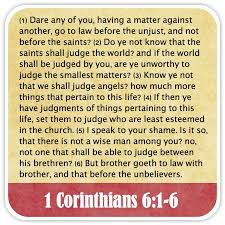
En 2: Of course, a lot of cases could be cited to show how contracting with the state through incorporation (aggregate or sole), getting 501(c)(3) or 508 status, or becoming a legal entity of any kind places another head, other than the Lord Jesus Christ over a church. This is just a very small sampling. Click case names in blue to go directly to cases online.1Co.6.1-6

WILLIAMS et al. v. JONES et al. 61 So.2d 101, 101-103 (1952) 6 Div. 313. Supreme Court of Alabama. October 23, 1952:

“Wherever there is an incorporated church, there are two entities, the one the church as such, not owing its ecclesiastical or spiritual existence to the civil law, and the legal corporation, each separate though closely allied. The spiritual entity of a church made up of members belonging to it, existing without any special law to that effect, is a different and distinct body in the contemplation of the law from the same body when incorporated under statutes for [103] the purpose—the two having different functions to perform, the one religious and the other civil. Under our statutes for the incorporation of churches, it is to be noted that the members of the church become incorporated, and not simply the trustees required to be elected preparatory to proceeding in the court of probate to obtain incorporation. Each member is an incorporator, recognized as a legal civil body, distinct from the church as a spiritual body, theretofore and thereafter continuously existing. §§ 124, 125, Title 10, Code 1940; Hundley v. Collins, supra; Dismukes v. State, 176 Ala. 616, 58 So. 195Blount v. Sixteenth St. Baptist Church, supra.”

WAUSHARA COUNTY v. Sherri L. GRAF, 166 Wis.2d 442 (1992), 480 N.W.2d 16, Supreme Court of Wisconsin. Submitted on briefs October 4, 1991.Decided February 17, 1992.

“The court of appeals concluded that the circuit court erred as a matter of law and, accordingly, reversed. We agree that the circuit court was indeed in error in holding that incorporation was a requirement for the religious exemption. The opinion of the court of appeals convincingly demonstrates that “the church was not required to show that it was incorporated as a religious society or corporation under ch. 187, Stats., or otherwise, to establish that its property was exempt from [454] taxation.” We need not reiterate the excellent discussion and analysis underpinning that conclusion that appears in the court of appeals opinion. 157 Wis. 2d at 539-49.” “The controlling issue on this review is whether Basic Bible is a ‘church’ or ‘religious association’ entitled to property tax exemption under sec. 70.11(4), Stats” [456].

The excellent discussion and analysis referred to above was rendered in WAUSHARA COUNTY v. Sherri L. GRAF, 157 Wis.2d 539 (1990), 461 N.W.2d 143, Court of Appeals of Wisconsin. Submitted on briefs December 8, 1989. Decided August 2, 1990. The following is from that case: The following is from the analysis:

“The procedures for the incorporation of religious societies were included in ch. 91, Revised Statutes of 1878. Nash’s Wisconsin Annotations (1914), sec. 1990, ch. 91 at 753, states:

“The revisers of 1878 in their note said: ‘Chapter 411, 1876, is taken to have been intended as a revision of the law for the incorporation of religious societies. The privilege of organizing a corporation is extended to all classes and denominations, it not being supposed the law means to be intolerant of any religious belief or to be partial in its offer of privileges.’

[548] The same annotation at page 755 states:

“‘Church” and “Congregation.’ A church consists of those who are communicants, have made a public profession of religion and are united by a religious bond of common spiritual welfare. It is the spiritual body, not the legal one. But a religious society or congregation, under the statute, is a voluntary association of persons, generally but not necessarily in connection with a church proper, united for the purpose of having a common place of worship and to provide a proper teacher to instruct them in doctrines and duties, etc. [Citations omitted.]

“Thus, the legislature distinguished a church, as the spiritual body, from a religious society, incorporated under the statute, as the legal body of a voluntary association of persons united for religious purposes.”

Taylor v. Paradise Missionary Baptist Church. No. 1160034. Supreme Court of Alabama. July 28, 2017:

[Case involved in incorporated 501(c)(3) church] Further, “[a]s is the case with all churches, the courts will not assume jurisdiction, in fact [have] none, to resolve disputes regarding their spiritual or ecclesiastical affairs. However, there is jurisdiction to resolve questions of civil or property rights.” Abyssinia Missionary Baptist Church v. Nixon, 340 So. 2d 746, 748 (Ala. 1976) (citing Williams, supra). As it pertains to the removal of a minister from the church’s pulpit, this Court has stated:

“The civil courts will not take jurisdiction of a controversy arising out of the removal of a minister if the right to the position is merely spiritual or ecclesiastical. But if he has a civil or property right in his position, the civil courts will protect that right. But if there is such right in the minister, which will give the courts jurisdiction, it is well settled that his removal by the appropriate church tribunal is conclusive upon the courts, if there is no violation of contractual right.

“Odoms v. Woodall, 246 Ala. 427, 429, 20 So. 2d 849, 851 (1945). See also Putman v. Vath, 340 So. 2d 26 (Ala. 1976)

“As noted above, ‘it is well settled that [a pastor’s] removal by the appropriate church tribunal is conclusive upon the courts, if there is no violation of contractual right.” Odoms, 246 Ala. at 429, 20 So. 2d at 851. The question then arises as to the jurisdiction of the court to go behind the decision of that tribunal to inquire into its jurisdiction and regularity of its proceedings. . . .’ Id. Although the trial court concluded in its order that it lacked subject-matter jurisdiction to remove Taylor as the pastor of PMBC, it went on to conclude that it had subject-matter jurisdiction to determine whether the removal of Taylor was valid under church law. [The court then cited and discussed several cases which supported this conclusion.]

“The foregoing authorities demonstrate this Court’s willingness to recognize subject-matter jurisdiction in a trial court to determine whether church procedure or law has been followed when a church decides an ecclesiastical matter such as the removal of a pastor from the pulpit or the expulsion of members from the congregation. However, authorities to the contrary also exist. [The court then cited and discussed several cases which contradicted this conclusion.]

“As discussed above, the removal of Taylor as the pastor of PMBC was purely an ecclesiastical matter not involving a property right and the trial court lacked the jurisdiction to consider it. The determination of whether his removal was valid and in accordance with PMBC’s bylaws necessarily required the trial court to delve into matters relating to PMBC’s internal organization and its ecclesiastical or spiritual rule, custom, or law. Based on the decisions in Hundley, supra, Putman, supra, Milivojevich, supra, and Lott, supra, the trial court lacked the jurisdiction to make that inquiry. Accordingly, to the extent that the trial court determined that the removal of Taylor as the pastor of PMBC was valid and, to that end, ordered that his removal be effective immediately, the trial court lacked the subject-matter jurisdiction to make such a determination because the matter was purely ecclesiastical in nature.”

Author’s comments on this case: The church, by becoming a legal entity, a 501(c)(3) corporation, contracted with the state and gave the court jurisdiction over many matters. She went to her authority on a matter some of her members felt was not and others felt was “ecclesiastical,” Her authority had to first decide whether the matter was “ecclesiastical.” In this case here authority decided not. However, with different facts, as shown by some cases which the court analyzed, the court had found the issue to be “ecclesiastical.” All this required tremendous time and energy, time and energy which could have been used doing God’s work in God’s way. A New Testament church is subject to no other tribunal in the world, other than the Lord Jesus Christ.

WATSON v. JONES, 80 U.S. 679 (____), 13 Wall. 679. Supreme Court of the United States:

Note. The court in this case concludes that it has no jurisdiction over the matter. The important thing to notice is that the authority is the court. Since the church contracted with the state by incorporating, the members (individual or groups of members) can go to their authority not only for resolution of disputes but also for decision as to whether the authority has jurisdiction. A member can sue a member, members, the church or the state; members can sue a member, members, the church, or the state; the church can sue a member or members, etc. The contract makes clear that the controlling party is the state.

“This case belongs to a class, happily rare in our courts, in which one of the parties to a controversy, essentially ecclesiastical, resorts to the judicial tribunals of the State for the maintenance of rights which the church has refused to acknowledge, or found itself unable to protect. Much as such dissensions among the members of a religious society should [714] be regretted, a regret which is increased when passing from the control of the judicial and legislative bodies of the entire organization to which the society belongs, an appeal is made to the secular authority; the courts when so called on must perform their functions as in other cases.

“Religious organizations [an incorporated church, in this case] come before us in the same attitude as other voluntary associations for benevolent or charitable purposes, and their rights of property, or of contract, are equally under the protection of the law, and the actions of their members subject to its restraints. Conscious as we may be of the excited feeling engendered by this controversy, and of the extent to which it has agitated the intelligent and pious body of Christians in whose bosom it originated, we enter upon its consideration with the satisfaction of knowing that the principles on which we are to decide so much of it as is proper for our decision, are those applicable alike to all of its class, and that our duty is the simple one of applying those principles to the facts before us.

“[T]he sole inquiry to which we are restricted in our opinion is, whether Avery, McNaughtan, and Leach are also ruling elders, and therefore members of the session of the church…. This is a case of a division or schism in the church. It is a question as to which of two bodies shall be recognized as the Third or Walnut Street Presbyterian Church. There is a controversy as to the authority of Watson and Galt to act as ruling elders [717]….

“The questions which have come before the civil courts concerning the rights to property held by ecclesiastical bodies, may, so far as we have been able to examine them, be profitably classified under three general heads, which of course do not include cases governed by considerations applicable to a church established and supported by law as the religion of the state. [722]

“1. The first of these is when the property which is the subject of controversy has been, by the deed or will of the donor, or other instrument by which the property is held, by the express terms of the instrument devoted to the teaching, support, or spread of some specific form of religious doctrine or belief. [722]

“2. The second is when the property is held by a religious congregation which, by the nature of its organization, is strictly independent of other ecclesiastical associations, and so far as church government is concerned, owes no fealty or obligation to any higher authority. [722]

“3. The third is where the religious congregation or ecclesiastical body holding the property is but a subordinate member of some general church organization in which there are superior ecclesiastical tribunal with a general and ultimate power of control more or less complete, in some supreme [723] judicatory over the whole membership of that general organization. [722-723] …

[The court then explains the rules for deciding the issue in each of the above organizational types and states that the case involved the third type.]

“In this class of cases we think the rule of action which should govern the civil courts, founded in a broad and sound view of the relations of church and state under our system of laws, and supported by a preponderating weight of judicial authority is, that, whenever the questions of discipline, or of faith, or ecclesiastical rule, custom, or law have been decided by the highest of these church judicatories to which the matter has been carried, the legal tribunals must accept such decisions as final, and as binding on them, in their application to the case before them.

“We concede at the outset that the doctrine of the English courts is otherwise. …

“But we need pursue this subject no further. Whatever may have been the case before the Kentucky court, the appellants in the case presented to us have separated themselves wholly from the church organization to which they belonged when this controversy commenced. They now deny its authority, denounce its action, and refuse to abide by its judgments. They have first erected themselves into a new organization, and have since joined themselves to another totally different, if not hostile, to the one to which they belonged when the difficulty first began. Under any of the decisions which we have examined, the appellants, in their present position, have no right to the property, or to the use of it, which is the subject of this suit. [734]

“The novelty of the questions presented to this court for the first time, their intrinsic importance and far-reaching influence, and the knowledge that the schism in which the case originated has divided the Presbyterian churches throughout Kentucky and Missouri, have seemed to us to justify the careful and laborious examination and discussion which we [735] have made of the principles which should govern the case. For the same reasons we have held it under advisement for a year; not uninfluenced by the hope, that since the civil commotion, which evidently lay at the foundation of the trouble, has passed away, that charity, which is so large an element in the faith of both parties, and which, by one of the apostles of that religion, is said to be the greatest of all the Christian virtues, would have brought about a reconciliation. But we have been disappointed. It is not for us to determine or apportion the moral responsibility which attaches to the parties for this result. We can only pronounce the judgment of the law as applicable to the case presented to us, and that requires us to affirm the decree of the Circuit Court as it stands. [734-735]

En 3: “The church” refers to the institution of the church made up of local visible spiritual assemblies just as marriage refers to the the institution of marriage made up of all unions of one man and one woman. “The church” is a synechdoche, a singular noun that stands in the place of a plurality.
 

WAUSHARA COUNTY v. Sherri L. GRAF, 157 Wis.2d 539 (1990), 461 N.W.2d 143, Court of Appeals of Wisconsin. Submitted on briefs December 8, 1989. Decided August 2, 1990

The complete opinion may be accessed online by clicking here.

This case was appealed to the Wisconsin Supreme Court. To go to my brief of that case click: WAUSHARA COUNTY v. Sherri L. GRAF, 166 Wis.2d 442 (1992), 480 N.W.2d 16, Supreme Court of Wisconsin. Submitted on briefs October 4, 1991.Decided February 17, 1992.

The Wisconsin Supreme Court stated, in its opinion, that:

  • The court of appeals had no obligation to look beyond the issues raised by Bible Baptist, but had the discretion to do so. The “church” was organized as a trust. The principle issue which it in its discretion addressed was the circuit court’s conclusion that for a ‘church’ to claim a tax exemption, it must be incorporated under the laws of Wisconsin or another state. The Supreme Court of Wisconsin agreed with the conclusion of the appeals court that the church need not be incorporated to claim a tax exemption.The Court stated: “We need not reiterate the excellent discussion and analysis underpinning that conclusion that appears in the court of appeals opinion. 157 Wis. 2d at 539-49” [the citation for this case].

This page will look at only the circuit courts analysis that led to the conclusion that a church, which was organized as a trust, need not be incorporated to claim a tax exemption. The following excerpt is from  the opinion of the court of appeals, 157 Wis. 2d at 539-49, on that matter:

We hold only that the church was not required to show that it was incorporated as a religious society or corporation under ch. 187, Stats., or otherwise, to establish that its property is exempt from taxation under sec. 70.11(4).

[2]

We recognize that “[o]ne who seeks to have his property exempt from taxation is required to bring himself within the terms of the exemption statute…. The taxpayer has the burden of demonstrating that it is entitled to tax-exempt status…. This is especially true in situations where, as here, there is a great potential for abuse because a church is controlled by an individual, a family or a small group of individuals. Id. The church must come forward with candid disclosure of the facts bearing on the exemption application. Id. What the ninth circuit said with respect to the Church of Scientology’s request for exemption from income tax under sec. 501(c)(3), I.R.C., is equally applicable to the Basic Bible Church’s claim of exemption under sec. 70.11(4), Stats. However, the county, on appeal, does not argue that the church has not brought itself within sec. 70.11(4), Stats., except for the insufficiency of its organization.

We turn therefore to the issue of whether the Basic Bible Church was required to show that it was incorporated to establish that it was an “entity” which could claim tax exemption under sec. 70.11(4), Stats. The statute does not impose the requirement. Ordinarily, this finding would end the case. A combination of factors, however, creates an ambiguity which persuaded the circuit court that to be exempt from taxation under sec. 70.11(4), a church or religious association must be an incorporated entity.

[3]

The first factor is the church’s failure to take formal action under state or federal law to “charter” the church. The court cited ch. 187, Stats., and I.R.C. sec. 501(c)(3). Ambiguity may be created by the interaction of separate statutes. State v. Kenyon, 85 Wis. 2d 36, 49, 270 N.W.2d 160, 166 (1978).

The second factor is the church’s failure to seek exemption from federal income tax under I.R.C. sec. 501(c)(3). Section 501(c)(3), I.R.C., however, does not provide for the incorporation or chartering of churches or religious organizations. Tax exemption thereunder is limited to a corporation, community chest, fund, or foundation. The Basic Bible Church does not claim it qualifies as one of the enumerated organizations. No significance can be attached to the church’s failure to seek tax exemption under I.R.C. sec. 501(c)(3).

The final factor is the decision in In re Zarling, 70 Bankr. 402 (Bankr. E.D. Wis. 1987). In Zarling, the court voided a transfer by the debtor of his interest in his farm to the Universal Life Church Charter No. 22406. The court found that the transfer was fraudulent. The court held that because a certificate acknowledging the existence of the Church as a corporation was not filed pursuant to secs. 187.01(2) or 187.09, Stats., prior to the conveyance, the Church-grantee was “a non-existent entity.” The court’s holding must be viewed in context. The debtor, Zarling, filed a certificate of incorporation under sec. 187.09 five years after the transfer, and attempted to make the filing “nunc pro tunc” the transfer. If Zarling is limited to its holding that the filing did not incorporate the Church “nunc pro tunc,” it is good law. To the extent that the decision declares all unincorporated churches or unincorporated religious associations “non-existent entit[ies],” we reject it.

We conclude, however, that these factors are sufficient to make it uncertain whether a church or religious organization must be incorporated for its property to be exempt under sec. 70.11(4), Stats. We therefore examine the legislative history of the pertinent statutes. “One of the most valuable extrinsic aids of judicial construction is legislative history.” [Citations omitted}.

The first exemption from taxation of the property of churches and religious organizations appears in sec. 24, ch. 47, Revised Statutes of 1849. Chapter 47 prescribed the procedure by which persons belonging to a church congregation or religious society, “not already incorporated,” could incorporate. Section 24 exempted from taxation every church, parsonage and schoolhouse belonging to any religious society, with the land belonging thereto, not to exceed three acres in any one town, village or township, or one city lot. The exemption was not limited to religious societies incorporated under ch. 47.

Chapter 130, Laws of 1868, provided for the assessment of property for taxation and for exemptions therefrom. Section 2, 3d exempted “[p]ersonal property owned by any religious, scientific, literary or benevolent association, used exclusively for the purposes of such association, and the real property necessary for the location and convenience of the buildings of such association . . . not exceeding ten acres. . . .” Chapter 130 did not define “association.”

Section 2 of ch. 130, Laws of 1868, was incorporated, without substantial change, in sec. 1038, subd. 3, Wisconsin Statutes of 1898. Section 1038, subd. 3 was renumbered sec. 70.11(4), Stats., by sec. 16, ch. 69, Laws of 1921. Throughout its history, the exemption from taxation of property of churches and religious associations has been accorded in substantially the same language. No “linkage” has existed between the exemption statutes and those affecting the organization of churches and religious associations or societies.

Chapter 411, Laws of 1876, provided for the incorporation of religious societies. Apparently this act replaced ch. 47 of the revised statutes of 1849. Chapter 411 is silent as to the taxation or exemption of the property of religious societies incorporated thereunder.

The procedures for the incorporation of religious societies were included in ch. 91, Revised Statutes of 1878. Nash’s Wisconsin Annotations (1914), sec. 1990, ch. 91 at 753, states:

The revisers of 1878 in their note said: “Chapter 411, 1876, is taken to have been intended as a revision of the law for the incorporation of religious societies. The privilege of organizing a corporation is extended to all classes and denominations, it not being supposed the law means to be intolerant of any religious belief or to be partial in its offer of privileges.”

The same annotation at page 755 states:

“Church” and “Congregation.” A church consists of those who are communicants, have made a public profession of religion and are united by a religious bond of common spiritual welfare. It is the spiritual body, not the legal one. But a religious society or congregation, under the statute, is a voluntary association of persons, generally but not necessarily in connection with a church proper, united for the purpose of having a common place of worship and to provide a proper teacher to instruct them in doctrines and duties, etc. [Citations omitted.]

Thus, the legislature distinguished a church, as the spiritual body, from a religious society, incorporated under the statute, as the legal body of a voluntary association of persons united for religious purposes.

Decisions interpreting ch. 91, Revised Statutes of 1878, make plain that failure of a church or religious organization to incorporate thereunder did not affect the power of the church or religious organization to hold title to property.Under the repeated decisions of this court, we must hold that the mere fact that [a] church or religious society had not yet been incorporated at the time of the delivery of [a] deed in no way frustrated the trust thereby created, if such trust was otherwise valid.” Fadness v. Braunborg, 73 Wis. 257, 278-79, 41 N.W. 84, 90 (1889) (emphasis in original). The county does not claim that the trust pursuant to which the subject property was conveyed to Sherri L. Graf and Barbara J. Pogue as trustees for the church is invalid.

In Holm v. Holm, 81 Wis. 374, 382, 51 N.W. 579, 581 (1892), the facts included that the Norwegian Evangelical Lutheran Church of Roche-a-Cree was a voluntary association until February 7, 1889. The court noted that “[p]rior to that date the title to the churches in which the members of the association worshiped was vested in trustees named in . . . deeds, and their successors in office. . . . The trusts imposed by such deeds appear to have been valid upon the principles stated by this court in Fadness v. Braunborg. . . .” Id.

In Franke v. Mann, 106 Wis. 118, 131, 81 N.W. 1014, 1018-19 (1900), the court said that the power given to trustees of a religious corporation formed under ch. 91, R.S. 1878, was limited to the particular purposes expressly or impliedly named in the act of incorporation. The court further said that “[w]hat has been said is in harmony with the law regarding trusts for religious useswhether the trustees be officers of a religious corporation or of an unincorporated ecclesiastical body. . . .” Id. at 131-32, 81 N.W. at 1019 (emphasis added).

It is plain from these decisions that the court did not consider that the legislature, by offering to ecclesiastical bodies the advantages of incorporation, intended to impose corporate structure upon such bodies. The property of unincorporated ecclesiastical bodies was commonly held in trust for the benefit of the members.

[4]

The Basic Bible Church established that title to the real estate subject to foreclosure was held in the name of the trustees for the benefit of the church. We conclude that the trust constituted an “entity” which could claim tax exemption under sec. 70.11(4), Stats., for the benefit of the Basic Bible Church. We further conclude that the legislative history of the pertinent statutes does not disclose a legislative intent to require that a church or religious association be incorporated before it may claim tax exemption under sec. 70.11(4).

By the Court.—Judgment reversed.


Lesson 7: The Church Is a New Man: The Exhibition and Inhibition of the New Man

The Church Is a New Man: The Exhibition and Inhibition of the New Man – Ephesians 4.1-16
(17 questions from with answers following)

For help in answering the questions, you may refer to Outline and Teaching on Ephesians.

Click here to go to Lesson 8

Click here to go to the links to 14 lessons on Ephesians – a Local Church is a Body (Questions and Answers)

Click here to go to Bible Studies: The Doctrine of the Church

Added on March 25, 2017

Answers at the end, following the questions
Those who disagree with anything please see the note at the end. Reasoned dialogue is encouraged and any Bible or fact based comments, if made in a Christian manner in an attempt to get to the truth will be considered.

  1. Ephesians 4.1-6 consider the _______________ of the new man. The only way people can tell if you are a real child of God through faith in Christ is by your _______.

    “I therefore, the prisoner of the Lord, beseech you that ye _______ __________ of the vocation wherewith ye are called” (Ep. 4.1)
  2. Paul begs believers to walk “With all ____________ and ____________, with __________________, forbearing one another in _______: Endeavoring to keep the _________ of the Spirit in the bond of __________” (Ep. 4.2-3).

    Lowliness is the flagship of all Christian virtues and is the opposite of _________. (See also, Philippians 2.3).

    Meekness means mildness but it does not mean ____________. Meekness is __________ yourself to the will of God. (McGee, Ephesians, p. 111).

    Longsuffering, a ________ of the Spirit, means that we don’t have a ________

    “Forbearing one another in love” means to hold one’s self _______ in the spirit of _______. (See also, Col. 3.13)
  3. “Endeavoring to keep the ________ of the Spirit” (See also, Jn. 17.21). There are seven unities to be kept: one _______, one __________, one _______ of your calling, one _______, one ________, one baptism, one _____ and Father of all, who is above _____, and through _____, and in you _____. (Ep. 4.3-6). God is not the _________ of unbelievers.
  4. In Ephesians 4.1-6, Paul started with the individual _____________. Then he widens out to the entire __________ which is one _______ and one __________. Then, he brings this passage to a great crescendo, which pictures the imminence and transcendence of _____.

Questions 5 through 17 are based on Ephesians 4.7-16

  1. In Ephesians 4.7-16, we learn of the ____________ of the new man. (Inhibition = Something that restrains, blocks, or suppresses).
  2. God has given ________ to every believer, not that he may develop him spiritually, but in order that each believer may function in the ______ of believers to ____________ and bless the __________. (See Ro. 12, 1 Co. 12.7, 1 Co. 12, 13, and 14). Every member of my body needs to work __________. My eyes, brain, legs, etc. need to work __________. When one member of a body is not exercising his gift, he throws the whole body out of tune.
  3. God “led captivity _____________, and gave ________ to men” “when he __________ up on high.” (Ep. 4.8). He first received those ________ for men (Ps. 68.18). Then He came to earth and went back to the Father and is now distributing the ________ among men. “When he ascended up on high” (the ascension) he did two things: (1) He “led captivity ____________” (referring to the redeemed of the ______ _______________ who went to _____________ when they died). (2) When He ascended, He conferred ________ on living believers in the church so that they might __________ to the world. At the day of __________, the Holy Spirit endowed ___________ with certain ________, enabling them to function as members of the _________ (the church at Jerusalem). The Holy Spirit put each of them in a certain place in the _______, and He has been doing that ever since.
  4. Christ takes certain men who have been given certain ________ and gives them to the ________:

    “And he [ __________ ] gave some, apostles; and some, ____________; and some, evangelists; and some, ___________ and teachers” (Ep. 4.11)
  5. An apostle had seen the Lord Jesus Christ but had also been directly and personally commissioned by Him to be an __________. He enjoyed special ______________. (See Ga. 1.1, 2).
  6. “Prophets” refers to New Testament prophets, men with particular insight into the ____________ of faith. (cf. Ep. 3.5).
  7. “Evangelists” were traveling missionaries. Paul was an example. They went ________ into new territory with the __________ of ______ who went before them.
  8. He also gave “pastors” who were _____________ of the flock.
  9. He gave some “teachers” who were to ____________ the flock. (See also, 1 Co. 12.28, 29, and 1 Ti. 3.2).
  10. He gave these men to the church for specified purposes:

    “For the ______________ of the saints, for the ______ of the ministry, for the ____________ of the body of Christ: (Ep. 4.12).
  11. A church has a purpose which is to complete itself that it might grow up:

    “Till we all come in the unity of the ________, and of the __________ of the Son of God, unto a __________ man, unto the __________ of the stature of the __________ of Christ: That we ______________ be no more ____________, tossed to and fro, and carried about with every wind of ____________, by the sleight of _____, and cunning __________, whereby they lie in wait to __________;” (Ep. 4.13-14).
  12. A church is not to make a “nut” of herself before the ________; she is not to appear ignorant before the ________. All these men are to prepare the _________ so that the believers might do the work of _____________ and ____________ up the body of Christ. The pastor has a special ______, a ______ of teaching the Word of God so that his __________, those who are under him, might do the work of the ____________. A __________ or other member of a church cannot be all things. No man has ______ the gifts. The business of the pastor is to ________ the members of the church for the ______ of the ministry. All believers need to be ___________ in the Word of God so they can do the ______ of the ministry. Christ’s purpose in giving men with different ______ to a __________ is to __________ believers from babyhood to full maturity. (See McGee, Ephesians, p. 119-122).
  13. The final goal:“But speaking the truth in ______, may ______ up into him in all things, which is the ______, even Christ: From whom the whole ______ fitly joined together and compacted by that which every joint ___________, according to the effectual working in the measure of every part, _________ increase of the ______ unto the edifying of itself in ______.” (Ep. 4.15-16)

Answers

  1. Ephesians 4.1-6 consider the exhibition of the new man. The only way people can tell if you are a real child of God through faith in Christ is by your walk.

    “I therefore, the prisoner of the Lord, beseech you that ye walk worthy of the vocation wherewith ye are called” (Ep. 4.1)
  2. Paul begs believers to walk “With all lowliness and meekness, with longsuffering, forbearing one another in love: Endeavoring to keep the unity of the Spirit in the bond of peace” (Ep. 4.2-3).

    Lowliness is the flagship of all Christian virtues and is the opposite of pride. (See also, Philippians 2.3).

    Meekness means mildness but it does not mean weakness. Meekness is bowing yourself to the will of God. (McGee, Ephesians, p. 111).

    Longsuffering, a fruit of the Spirit, means that we don’t have a short

    “Forbearing one another in love” means to hold one’s self back in the spirit of love. (See also, Col. 3.13)
  3. “Endeavoring to keep the unity of the Spirit” (See also, Jn. 17.21). There are seven unities to be kept: one body, one Spirit, one hope of your calling, one Lord, one faith, one baptism, one God and Father of all, who is above all, and through all, and in you all. (Ep. 4.3-6). God is not the father of unbelievers.
  4. In Ephesians 4.1-6, Paul started with the individual believer. Then he widens out to the entire church which is one body and one Spirit. Then, he brings this passage to a great crescendo, which pictures the imminence and transcendence of God.

Questions  through  are based on Ephesians 4.7-16

  1. In Ephesians 4.7-16, we learn of the inhibition of the new man. (inhibition = Something that restrains, blocks, or suppresses).
  2. God has given gifts to every believer, not that he may develop him spiritually, but in order that each believer may function in the body of believers to benefit and bless the church. (See Ro. 12, 1 Co. 12.7, 1 Co. 12, 13, and 14). Every member of my body needs to work together. My eyes, brain, legs, etc. need to work together. When one member of a body is not exercising his gift, he throws the whole body out of tune.
  3. God “led captivity captive, and gave gifts to men” “when he ascended up on high.” (Ep. 4.8). He first received those gifts for men (Ps. 68.18). Then He came to earth and went back to the Father and is now distributing the gifts among men. “When he ascended up on high” (the ascension) he did two things: (1) He “led captivity captive” (referring to the redeemed of the Old Testament who went to Paradise when they died). (2) When He ascended, He conferred gifts on living believers in the church so that they might witness to the world. At the day of Pentecost, the Holy Spirit endowed believers with certain gifts, enabling them to function as members of the body (the church at Jerusalem). The Holy Spirit put each of them in a certain place in the body, and He has been doing that ever since.
  4. Christ takes certain men who have been given certain gifts and gives them to the church:

    “And he [Christ] gave some, apostles; and some, prophets; and some, evangelists; and some, pastors and teachers” (Ep. 4.11)
  5. An apostle had seen the Lord Jesus Christ but had also been directly and personally commissioned by Him to be an apostle. He enjoyed special inspiration. (See Ga. 1.1, 2).
  6. “Prophets” refers to New Testament prophets, men with particular insight into the doctrines of faith. (cf. Ep. 3.5).
  7. “Evangelists” were traveling missionaries. Paul was an example. They went alone into new territory with the Spirit of God who went before them.
  8. He also gave “pastors” who were shepherds of the flock.
  9. He gave some “teachers” who were to instruct the flock. (See also, 1 Co. 12.28, 29, and 1 Ti. 3.2).
  10. He gave these men to the church for specified purposes:

    “For the perfecting of the saints, for the work of the ministry, for the edifying of the body of Christ: (Ep. 4.12).
  11. A church has a purpose which is to complete itself that it might grow up:

    “Till we all come in the unity of the faith, and of the knowledge of the Son of God, unto a perfect man, unto the measure of the stature of the fulness of Christ: That we henceforth be no more children, tossed to and fro, and carried about with every wind of doctrine, by the sleight of men, and cunning craftiness, whereby they lie in wait to deceive;” (Ep. 4.13-14).
  12. A church is not to make a “nut” of herself before the world; she is not to appear ignorant before the world. All these men are to prepare the church so that the believers might do the work of ministering and building up the body of Christ. The pastor has a special gift, a gift of teaching the Word of God so that his members, those who are under him, might do the work of the ministry. A pastor or other member of a church cannot be all things. No man has all the gifts. The business of the pastor is to build the members of the church for the work of the ministry. All believers need to be trained in the Word of God so they can do the work of the ministry. Christ’s purpose in giving men with different gifts to a church is to develop believers from babyhood to full maturity. (See McGee, Ephesians, p. 119-122).
  13. The final desired result for a church:“But speaking the truth in love, may grow up into him in all things, which is the head, even Christ: From whom the whole body fitly joined together and compacted by that which every joint supplieth, according to the effectual working in the measure of every part, maketh increase of the body unto the edifying of itself in love.” (Ep. 4.15-16)

Should you disagree with an answer given, please explain why you disagree in the comment section below the article. All reasoned comments will be published, perhaps with reply. The purpose of this website is the Glory of God. God cannot be glorified by shutting out honest disagreement in the search for truth. The author would be interested in your explanation. The comments are required by the website to be approved or disapproved. The author is very busy with many matters and may or may not immediately notice your comment. He will address it as soon as he notices it. He almost always approves comments presented with a godly spirit. He never alters comments. Sometimes, he replies to comments.

Lesson 5: The Church Is a Mystery

The Church Is a Mystery – Ephesians 3
(9 questions with answers following)

For help in answering the questions, you may refer to Outline and Teaching on Ephesians.

Click here to go to Lesson 6

Click here to go to the links to 14 lessons on Ephesians – a Local Church is a Body (Questions and Answers)

Click here to go to Bible Studies: The Doctrine of the Church

Added on March 23, 2017

Answers at the end, following the questions
Those who disagree with anything please see the note at the end. Reasoned dialogue is encouraged and any Bible or fact based comments, if made in a Christian manner in an attempt to get to the truth will be considered.

  1. The theme of Ephesians 3 is that the church is a __________.
  2. The meaning of mystery in this context is “something that had not ____________ been revealed but is currently made __________.” This mystery being revealed by Paul was made known to him by the ________. (See Ep. 3.3-5).

    “Which in other ages was not made known unto the sons of men, as it is now revealed unto his holy apostles and prophets by the Spirit” (Ep. 3.5).

    “ Now to him that is of power to stablish you according to my gospel, and the preaching of Jesus Christ, according to the revelation of the _________, which was kept secret since the world began” (Ro. 16.25).

    Even the _________ which hath been hid from ages and from generations, but now is made manifest to his saints” (Col. 1.26).
  1. The institution of the ________ was not revealed in the _____ Testament but is solely revealed in the _____ ____________.
  2. Paul, unlike the other apostles, was sent to the ___________. He became a prisoner because he took the Gospel to the ___________.

    For this cause I Paul, the prisoner of Jesus Christ for you ___________” (Ep. 3.1).
  3. A brand _____thing is taking place. It is a new ________________or _________ from what they had in the Old Testament.

    ”If ye have heard of the _______________ of the grace of God which is given me to you-ward” (Ep. 3:2).
  4. This mystery had not been made known before, “as it is now revealed unto his holy __________ and __________by the ________” (Ep. 3.5).
  5. The mystery was not that the Gentiles would be __________. (See, e.g., Is. 11.10; 42.6; Zec. 2.11; Mal. 1.11).
  6. This new mystery was not to be __________or argued, but___________!

    “And to make all men ______what is the fellowship of the___________, which from the beginning of the world hath been hid in God, who created all things by Jesus Christ” (Ep. 3.9).
  7. Another purpose of the mystery is revealed. God’s created intelligences are learning something of the _________ of God through the_________. They not only see the love of God displayed and lavished upon us, but the _________of God is revealed to his angels.

    “To the intent that now unto the principalities and powers in heavenly places might be known by the church the manifold _________of God, According to the eternal purpose which he purposed in Christ Jesus our Lord” (Ep. 3.10-11).

Answers

  1. The theme of Ephesians 3 is that the church is a mystery.
  2. The meaning of mystery in this context is “something that had not previously been revealed but is currently made manifest.” This mystery being revealed by Paul was made known to him by the Spirit. (See Ep. 3.3-5).

    “Which in other ages was not made known unto the sons of men, as it is now revealed unto his holy apostles and prophets by the Spirit” (Ep. 3.5).

    “Now to him that is of power to stablish you according to my gospel, and the preaching of Jesus Christ, according to the revelation of the mystery, which was kept secret since the world began” (Ro. 16.25).

    Even the mystery which hath been hid from ages and from generations, but now is made manifest to his saints” (Col. 1.26).
  1. The institution of the church was not revealed in the Old Testament but is solely revealed in the New Testament.
  2. Paul, unlike the other apostles, was sent to the Gentiles. He became a prisoner because he took the Gospel to the Gentiles

    “For this cause I Paul, the prisoner of Jesus Christ for you Gentiles” (Ep. 3.1).
  3. A brand new thing is taking place. It is a new dispensation or economy from what they had in the Old Testament.

    “If ye have heard of the dispensation of the grace of God which is given me to you-ward” (Ep. 3:2).
  4. This mystery had not been made known before, “as it is now revealed unto his holy apostles and prophets by the Spirit” (Ep. 3.5).
  5. The mystery was not that the Gentiles would be saved. (See, e.g., Is. 11.10; 42.6; Zec. 2.11; Mal. 1.11).
  6. This new mystery was not to be debated or argued, but preached!

    “And to make all men see what is the fellowship of the mystery, which from the beginning of the world hath been hid in God, who created all things by Jesus Christ” (Ep. 3.9).
  7. Another purpose of the mystery is revealed. God’s created intelligences are learning something of the wisdom of God through the church. They not only see the love of God displayed and lavished upon us, but the wisdom of God is revealed to his angels.

    “To the intent that now unto the principalities and powers in heavenly places might be known by the church the manifold wisdom of God, According to the eternal purpose which he purposed in Christ Jesus our Lord” (Ep. 3.10-11).

Should you disagree with an answer given, please explain why you disagree in the comment section below the article. All reasoned comments will be published, perhaps with reply. The purpose of this website is the Glory of God. God cannot be glorified by shutting out honest disagreement in the search for truth. The author would be interested in your explanation. The comments are required by the website to be approved or disapproved. The author is very busy with many matters and may or may not immediately notice your comment. He will address it as soon as he notices it. He almost always approves comments presented with a godly spirit. He never alters comments. Sometimes, he replies to comments.

Lesson 4: A Church Is a Temple and the Method and Materials of Construction

A Church Is a Temple and the Method and Materials of Construction – Ephesians 2
(17 questions with answers following)

For help in answering the questions, you may refer to Outline and Teaching on Ephesians.

Click here to go to Lesson 5

Click here to go to the links to 14 lessons on Ephesians – a Local Church is a Body (Questions and Answers)

Click here to go to Bible Studies: The Doctrine of the Church

Added on March 23, 2017

Answers at the end, following the questions
Those who disagree with anything please see the note at the end. Reasoned dialogue is encouraged and any Bible or fact based comments, if made in a Christian manner in an attempt to get to the truth will be considered.

  1. To whom was Ephesians written?
  2. What is the theme of Ephesians 2?
  3. Paul said to the church at Ephesus:

    “19 Now therefore ye are no more _________ and _________, but _________ with the saints, and of the _________ of God; 20 And are built upon the foundation of the _________ and__________________, Jesus Christ himself being the chief _________ _________; 21 In whom all the _________ fitly framed together groweth unto an holy _________ in the Lord: 22 In whom ye also are _________ together for an _________ of God through the _________.” (Ep. 2:19-22).

    Verses 19-22 tell us that the “saints which are at Ephesus and the faithful in Christ Jesus” are identified three distinct ways: (1) As ___________________ (of heaven-see verses 6-7) (2) who are of the household (_________) of God along with all the saints no matter which local church they are members of. They are also identified as (3) a ________ or spiritual ___________ or _______ made up of the _________ of the ________ at Ephesus who are united together by the ________ to be an habitation of ________. All believers, individually, are indwelt by the Holy Spirit and are an individual temple of God (See 1 Co. 3.16-17, 6.19. Ep. 2.1-10). Paul says, “ye also are _________ together.” Who is the ye he is speaking to? They are, in context, the saints which are at _________ and the faithful in Christ Jesus to whom he is writing (Ep. 1.1); and, in applicability, to all individual believers and all New Testament churches from that day until the marriage of the lamb.
  4. Thus, the saints at Ephesus and the faithful in Christ Jesus are builded ________ for an ___________ of God through the _______. (Ep. 2.22). They are built upon the foundation of the ________ and _______, _______ _______ himself being the chief corner stone. Every local New Testament ________ fits this model.
  5. Paul’s epistles were always written to a________ assembly, a local _______, but the principles he spoke were and are applicable to every New Testament ______ body and the saints in each _________.
  6. Thus, as to the local “habitation of God,” “the saints at Ephesus and the faithful in Christ Jesus” were builded _________ for an habitation of God through the Spirit. (Ep. 2.22). They are “_________ _________” All parts of a building must be connected—they must be “_________—that is, __________  __________, each being a part of the same _________ organism (See also, Ep. 2.21, Ep. 4, and 1 Co. 12). Every local New Testament ________ fits this model. If they are not “________,” they are not a ________, they are not a ________. A believer in China may or may not be a member of a church. He definitely is not a member of a church such as Old Paths Baptist Church in Minnesota, a church he has never heard of.
  7. Paul’s epistles were always to a local church whose members were connected. The members came together spiritually for _________, _________, _________, and ___________. Every member attended _________ meetings unless sick or for some other acceptable absence. They were members of a particular local _______ (such as the Church at Ephesus).
  8. The principles Paul spoke were and are ___________ to every New Testament ___________ body and the saints in each ___________.
  9. All Bible references to a church here on the earth refer to an local autonomous ________ of Jewish and/or Gentile believers and not to a ___________or catholic church. Nowhere in the New Testament is a ___________ here on the ________ever referred to as anything other than a local spiritual body and nowhere does Scripture teach that a church is to have any type __________ above it other than the Lord Jesus Christ. Some examples of references to churches as they existed in the New Testament follow:

    “Then had the churches rest throughout all Judaea and Galilee and Samaria, and were edified; and walking in the fear of the Lord, and in the comfort of the Holy Ghost, were multiplied” (Ac. 9.31).

    Paul said, “Likewise greet the church that is in their house. (Ro. 16.5)” Notice that the church refers to the local body of baptized believers. The house was just the place where they met; it was not a church.

    Paul wrote to the church in Corinth, “Paul … Unto the church of God which is at Corinth, to them that are sanctified in Christ Jesus, called to be saints, with all that in every place call upon the name of Jesus Christ our Lord, both their’s and our’s” (1 Co. 1.1-2).”

    “If therefore the whole church be come together into one place…” (1 Co. 14.23).

    “The churches [Not “the church of Asia”] of Asia salute you. Aquila and Priscilla salute you much in the Lord, with the church that is in their house” (1 Co. 16.19).

    “Paul … unto Philemon … and to the church in thy house” (Philemon 1-2).

    In Revelation, the Lord speaks to “the church of Ephesus” (Re. 2.1), “the church in Smyrna” (Re. 2.8), “the church in Pergamos” (Re. 2.12), “the church in Thyatira” (Re. 2.18), “the church in Sardis” (Re. 3.1), “the church in Philadelphia” (Re. 3.7), and “the church of the Laodiceans” (Re. 3.14).
  10. Those believers who spiritually unite together in a local body are a ________. A body must be __________; without unification and connection to the other parts, a ________ cannot exist.
  11. The building which Paul is speaking of is___________, ___________, and ___________, not ___________, ___________, and ___________.“Wherein in time past ye walked according to the course of this world, according to the prince of the power of the air, the spirit that now worketh in the children of disobedience: Among whom also we all had our conversation in times past in the lusts of our flesh, fulfilling the desires of the flesh and of the mind; and were by nature the children of wrath, even as others. (Ep. 2:2-3)”“But God, who is rich in mercy, for his great love wherewith he loved us, Even when we were dead in sins, hath quickened us together with Christ, (by grace ye are saved;) And hath raised us up together, and made us sit together in heavenly places in Christ Jesus: That in the ages to come he might shew the exceeding riches of his grace in his kindness toward us through Christ Jesus.” (Ep. 2:4-7)

    “In whom ye also are builded together for an habitation of God through the Spirit” (Ep. 2.22).
  12. The material for the construction of a church does not include those:

    “who were ______ in trespasses and ______; Wherein in time past ye walked according to the course of this ________, according to the ________ of the power of the air, the spirit that now worketh in the children of ______________: Among whom also we all had our _______________ in times ______ in the lusts of our _______, fulfilling the desires of the ________ and of the ________; and were by nature the children of _________, even as others” (Ep. 2.1-3).
  13. The material for the construction of a church is:

    Those (speaking in context to the members of the Church at Ephesus, but also in applicability to all believers) whom He hath _______________. See Ep. 2.1, 5 et seq.
  14. Thus, a church is a __________ organism, since it is built by bringing together __________beings. “Ye also, as lively stones, are built up a ___________ house, an holy priesthood, to offer up __________ sacrifices, acceptable to God by Jesus Christ” (1 Pe. 2:5).
  15. The first step in the construction of a church is the combining of believers, Jew and _________, into a ______ ______ (See Ep. 2.11-16).
  16. The new man has a new citizenship and family. All believers, including the “saints which are at Ephesus, and the faithful in Jesus Christ” are, along with all believers, no matter their local church affiliation, “________________ with the _________, and of the ______________of God,” who sit in “___________ places in Christ Jesus.” Ep. 2.1, 5, 19. Being a _______________ and “of the household of God,” speaks of _______________ and _________, not of local _________ body. All believers are therefore citizens of heaven and members of the family or household of God.
  17. Those believers in the church at Ephesus are (1) ________________ with the saints, (2) members of a new _________, the household of God, and (3) a local New Testament church assembly, an holy _________ of the Lord.

    “19 Now therefore ye are no more ___________ and _________, but _______________ with the saints, and of the _______________ of God; 20 And are built upon the foundation of the apostles and prophets, Jesus Christ himself being the chief ________ ________; 21 In whom all the building fitly framed together ___________ unto an holy ________ in the Lord: 22 In whom ye also are _________ together for an___________ of God through the ___________” (Ep. 2:19-22).

Answers

  1. Ephesians was written to “to the saints which are at Ephesus, and to the faithful in Christ Jesus” (Ep. 2.1.)
  2. The theme of Ephesians 2 is that “A church is an holy temple in the Lord.” (The answers below which examine Ephesians 2 will make this clear.)
  3. Paul said to the church at Ephesus:

    “19 Now therefore ye are no more strangers and foreigners, but fellowcitizens with the saints, and of the household of God; 20 And are built upon the foundation of the apostles and prophets, Jesus Christ himself being the chief corner stone; 21 In whom all the building fitly framed together groweth unto an holy temple in the Lord: 22 In whom ye also are builded together for an habitation of God through the Spirit.” (Ep. 2:19-22).

    Verses 19-22 tell us that the “saints which are at Ephesus and the faithful in Christ Jesus” are identified three distinct ways: (1) As fellowcitizens (of heaven-see verses 6-7) (2) who are of the household (family) of God along with all the saints no matter which local church they are members of. They are also identified as (3) a temple or spiritual building or body made up of the members of the church at Ephesus who are united together by the Spirit to be an habitation of God. All believers, individually, are indwelt by the Holy Spirit and are an individual temple of God (See 1 Co. 3.16-17, 6.19. Ep. 2.1-10). Paul says, “ye also are builded together.” Who is the ye he is speaking to? They are, in context, the saints which are at Ephesus and the faithful in Christ Jesus to whom he is writing (Ep. 1.1); and, in applicability, to all individual believers and all New Testament churches from that day until the marriage of the lamb.
  4. Thus, the saints at Ephesus and the faithful in Christ Jesus are builded together for an habitation of God through the Spirit. (Ep. 2.22). They are built upon the foundation of the apostles and prophets, Jesus Christ himself being the chief corner stone. Every local New Testament church fits this model.
  5. Paul’s epistles were always written to a local assembly, a local church, but the principles he spoke were and are applicable to every New Testament church body and the saints in each church.
  6. Thus, as to the local “habitation of God,” “the saints at Ephesus and the faithful in Christ Jesus” were builded together for an habitation of God through the Spirit. (Ep. 2.22). They were “builded together.” All parts of a building must be connected—they must be “together”—that is, connected spiritually, each being a part of the same spiritual organism (See also, Ep. 2.21, Ep. 4, and 1 Co. 12). Every local New Testament church fits this model. If they are not “together,” they are not a body, they are not a church. A believer in China may or may not be a member of a church. He definitely is not a member of a church such as Old Paths Baptist Church in Minnesota, a church he has never heard of.
  7. Paul’s epistles were always to a local church whose members were connected. The members came together spiritually for worship, preaching, teaching, and fellowship. Every member attended church meetings unless sick or for some other acceptable absence. They were members of a particular local church (such as the Church at Ephesus).
  8. The principles Paul spoke were and are applicable to every New Testament church body and the saints in each church.
  9. All Bible references to a church here on the earth refer to an local autonomous body of Jewish and/or Gentile believers and not to a universal or catholic church. Nowhere in the New Testament is a church here on the earth ever referred to as anything other than a local spiritual body and nowhere does Scripture teach that a church is to have any type authority above it other than the Lord Jesus Christ. Some examples of references to churches as they existed in the New Testament follow:

    “Then had the churches rest throughout all Judaea and Galilee and Samaria, and were edified; and walking in the fear of the Lord, and in the comfort of the Holy Ghost, were multiplied” (Ac. 9.31).

    Paul said, “Likewise greet the church that is in their house” (Ro. 16.5). Notice that the church refers to the local body of baptized believers. The house was just the place where they met; it was not a church.

    Paul wrote to the church in Corinth, “Paul … Unto the church of God which is at Corinth, to them that are sanctified in Christ Jesus, called to be saints, with all that in every place call upon the name of Jesus Christ our Lord, both their’s and our’s” (1 Co. 1.1-2).

    “If therefore the whole church be come together into one place…” (1 Co. 14.23).

    “The churches [Not “the church of Asia”] of Asia salute you. Aquila and Priscilla salute you much in the Lord, with the church that is in their house” (1 Co. 16.19).

    “Paul … unto Philemon … and to the church in thy house” (Philemon 1-2).

    In Revelation, the Lord speaks to “the church of Ephesus” (Re. 2.1), “the church in Smyrna” (Re. 2.8), “the church in Pergamos” (Re. 2.12), “the church in Thyatira” (Re. 2.18), “the church in Sardis” (Re. 3.1), “the church in Philadelphia” (Re. 3.7), and “the church of the Laodiceans” (Re. 3.14).
  10. Those believers who spiritually unite together in a local body are a church. A body must be united; without unification and connection to the other parts, a body cannot exist.
  11. The building which Paul is speaking of is spiritual, heavenly, and eternal, not fleshly, earthly, and temporal.“Wherein in time past ye walked according to the course of this world, according to the prince of the power of the air, the spirit that now worketh in the children of disobedience: Among whom also we all had our conversation in times past in the lusts of our flesh, fulfilling the desires of the flesh and of the mind; and were by nature the children of wrath, even as others. (Ep. 2:2-3)”“But God, who is rich in mercy, for his great love wherewith he loved us, Even when we were dead in sins, hath quickened us together with Christ, (by grace ye are saved;) And hath raised us up together, and made us sit together in heavenly places in Christ Jesus: That in the ages to come he might shew the exceeding riches of his grace in his kindness toward us through Christ Jesus.” (Ep. 2:4-7)

    “In whom ye also are builded together for an habitation of God through the Spirit” (Ep. 2.22).

    The Testament temple (the church) will be contrasted with the Old Testament temple in Lesson 6.
  12. The material for the construction of a church does not include those:

    “who were dead in trespasses and sins; Wherein in time past ye walked according to the course of this world, according to the prince of the power of the air, the spirit that now worketh in the children of disobedience: Among whom also we all had our conversation in times past in the lusts of our flesh, fulfilling the desires of the flesh and of the mind; and were by nature the children of wrath, even as others” (Ep. 2.1-3).
  13. The material for the construction of a church are:

    Those [speaking in context to the members of the Church at Ephesus, but also in applicability to all believers] whom He hath quickened. See Ep. 2.1, 5 et seq.
  14. Thus, a church is a spiritual organism, since it is built by bringing together spiritual beings. “Ye also, as lively stones, are built up a spiritual house, an holy priesthood, to offer up spiritual sacrifices, acceptable to God by Jesus Christ” (1 Pe. 2:5).
  15. The first step in the construction of a church is the combining of believers, Jew and Gentile, into a new man (See Ep. 2.11-16).
  16. The new man has a new citizenship and family. All believers, including the “saints which are at Ephesus, and the faithful in Jesus Christ” are, along with all believers, no matter their local church affiliation, “fellowcitizens with the saints, and of the household of God,” who sit in “heavenly places in Christ Jesus.” Ep. 2.1, 5, 19. Being a fellowcitizen and “of the household of God,” speaks of citizenship and family, not of local church. All believers are citizens of heaven and members of the family or household of God. All believers are not members of a church.
  17. Those believers in the church at Ephesus were (1) fellowcitizens with the saints, (2) members of a new family, the household of God, and (3) a local New Testament church assembly, an holy temple of the Lord.

    “19 Now therefore ye are no more strangers and foreigners, but fellowcitizens with the saints, and of the household of God; 20 And are built upon the foundation of the apostles and prophets, Jesus Christ himself being the chief corner stone; 21 In whom all the building fitly framed together groweth unto an holy temple in the Lord: 22 In whom ye also are builded together for an habitation of God through the Spirit.” (Ep. 2:19-22).

For more on the universal church doctrine, see
C.I. Scofield’s “true church” doctrine

Should you disagree with an answer given, please explain why you disagree in the comment section below the article. All reasoned comments will be published, perhaps with reply. The purpose of this website is the Glory of God. God cannot be glorified by shutting out honest disagreement in the search for truth. The author would be interested in your explanation. The comments are required by the website to be approved or disapproved. The author is very busy with many matters and may or may not immediately notice your comment. He will address it as soon as he notices it. He almost always approves comments presented with a godly spirit. He never alters comments. Sometimes, he replies to comments.

Lesson 3: The Work of the Holy Spirit in Protecting the Church

The Work of the Holy Spirit in Protecting the Church – Ephesians 1.13-14
(14 questions with answers following)

For help in answering the questions, you may refer to Outline and Teaching on Ephesians.

Click here to go to Lesson 4

Click here to go to the links to 14 lessons on Ephesians – a Local Church is a Body (Questions and Answers)

Click here to go to Bible Studies: The Doctrine of the Church

Added on March 21, 2017

Answers at the end, following the questions
Those who disagree with anything please see the note at the end. Reasoned dialogue is encouraged and any Bible or fact based comments, if made in a Christian manner in an attempt to get to the truth will be considered.

The work of the Holy Spirit in protecting the church

  1. Ephesians 1:13-14: “In whom ye also trusted, after that ye heard the word of truth, the gospel of your salvation: in whom also after that ye believed, ye were ________ with that holy Spirit of __________, Which is the earnest of our inheritance until the redemption of the ___________ ___________, unto the praise of his glory.”
  2. The believer is a purchased possession, as explained in Ephesians 1.14.
  3. The body of the believer is the __________ of the ________ __________.
  4. To whom does the body of the believer belong?
  5. Who is in the body of the believer?
  6. Ephesians 4:30: “And grieve not the holy Spirit of God, whereby ye are sealed unto the _____ of _____________.”
  7. From the above, it is clear that one who has been saved is regenerated. He is not the same as before. 2 Corinthians 5.17: “Therefore if any man be in Christ, he is a new creature: old things are passed away; behold, all things are become new.”

    Romans 8:16 “The _________ itself beareth witness with our spirit, that we are the __________ of ______:”

    Romans 8:21 “Because the___________ itself also shall be___________ from the ___________ of ___________ into the glorious __________ of the ________ of _____.”
  1. Before, (2) the believer did not ________ to _____; (2) he was not the _______ of God; (3) the ____ _________ did not live in him; (5) he was not a ___ _________; (4) ____ things had not passed away; (5) all things had not become _____; (6) he was not a _____ of God; (7) he had not been delivered from the_________ of _________ into the glorious ________ of the _________ of God.
  2. There is a two-fold purpose in the sealing work of the Holy Spirit. He implants the _________ of God upon the heart to give reality to the believer. When a seal is put down on a document, that document has the ________ of the seal on it. John 3:33: “He that hath received his testimony hath set to his _________ that God is true.”
  3. The second purpose of sealing is to denote rightful ___________. 2 Timothy 2:19 “Nevertheless the foundation of God standeth sure, having this ________, The Lord __________ them that are _______. And, Let every one that nameth the name of Christ depart from iniquity.”
  4. The ______ ________ is the seal, and that guarantees that God is going to ________ We are _________ unto the day of redemption. The day will come when the _______  _________will _________ us to Christ.
  5. The third and final work of the Holy Spirit in protecting the church is to serve as the ______ _______ for the __________ and the ______. The Holy Spirit is our ________ ________.

    Ephesians 1:14 “Which is the _________ of our ___________ until the redemption of the ___________ ______________, unto the praise of his glory.”
  6. Earnest money is put down as a ____ ________ and _______ on a piece of property to _______ the property for the ________. It also promises more ________ to follow. He has been given as a pledge and token that there is more to follow in the way of ___________ ___________.
  7. Believers in a _________ _________, as in the church at Ephesus, combine to build up a spiritual house, the local New Testament _________.

    1 Peter 2:5 “Ye also, as lively stones, are built up a ________ _________, an holy _____________, to offer up ___________ sacrifices, acceptable to_________ by Jesus Christ.”

Answers

  1. Ephesians 1:13-14: “In whom ye also trusted, after that ye heard the word of truth, the gospel of your salvation: in whom also after that ye believed, ye were sealed with that holy Spirit of promise, Which is the earnest of our inheritance until the redemption of the purchased possession, unto the praise of his glory.”

    1 Corinthians 6.19 “What? know ye not that your body is the temple of the Holy Ghost which is in you, which ye have of God, and ye are not your own? 1 Corinthians 6:20 “For ye are bought with a price: therefore glorify God in your body, and in your spirit, which are God’s.”
  1. The believer is a purchased possession, as explained in Ephesians 1.14.
  2. The body of the believer is the temple of the Holy Ghost?
  3. The body of the believer belongs to God (not to the believer)?
  4. The Holy Ghost is in the body of the believer?
  5. Ephesians 4:30: “And grieve not the holy Spirit of God, whereby ye are sealed unto the day of redemption.”
  6. From the above, it is clear that one who has been saved is regenerated. He is not the same as before. 2 Corinthians 5.17: “Therefore if any man be in Christ, he is a new creature: old things are passed away; behold, all things are become new.”

    Romans 8:16 “The Spirit itself beareth witness with our spirit, that we are the children of God:”

    Romans 8:21 “Because the creature itself also shall be delivered from the bondage of corruption into the glorious liberty of the children of God.”
  7. Before, (2) the believer did not belong to God; (2) he was not the temple of God; (3) the Holy Ghost did not live in him; (5) he was not a new creature; (4) old things had not passed away; (5) all things had not become new; (6) he was not a child of God; (7) he had not been delivered from the bondage of corruption into the glorious liberty of the children of God.
  8. There is a two-fold purpose in the sealing work of the Holy Spirit. He implants the image of God upon the heart to give reality to the believer. When a seal is put down on a document, that document has the image of the seal on it. John 3:33: “He that hath received his testimony hath set to his seal that God is true.”
  9. The second purpose of sealing is to denote rightful ownership. 2 Timothy 2:19 “Nevertheless the foundation of God standeth sure, having this seal, The Lord knoweth them that are his. And, Let every one that nameth the name of Christ depart from iniquity.”
  10. The Holy Spirit is the seal, and that guarantees that God is going to deliver We are sealed unto the day of redemption. The day will come when the Holy Spirit will deliever us to Christ.
  11. The third and final work of the Holy Spirit in protecting the church is to serve as the earnest money for the believer and the church. The Holy Spirit is our earnest money.

    Ephesians 1:14 “Which is the earnest of our inheritance until the redemption of the purchased possession, unto the praise of his glory.”
  12. Earnest money is put down as a down payment and pledge on a piece of property to hold the property for the buyer. It also promises more money to follow. He has been given as a pledge and token that there is more to follow in the way of spiritual blessings.
  13. Believers in a church body, as in the church at Ephesus, combine to build up a spiritual house, the local New Testament church.

    1 Peter 2:5 “Ye also, as lively stones, are built up a spiritual house, an holy priesthood, to offer up spiritual sacrifices, acceptable to God by Jesus Christ.”

Should you disagree with an answer given, please explain why you disagree in the comment section below the article. All reasoned comments will be published, perhaps with reply. The purpose of this website is the Glory of God. God cannot be glorified by shutting out honest disagreement in the search for truth. The author would be interested in your explanation. The comments are required by the website to be approved or disapproved. The author is very busy with many matters and may or may not immediately notice your comment. He will address it as soon as he notices it. He almost always approves comments presented with a godly spirit. He never alters comments. Sometimes, he replies to comments.

Lesson 1: The Church Is a Spiritual Body (Ephesians)

The Church is a Body – Ephesians 1
(38 questions on the Bible Doctrine of the Church and the American application of that Doctrine with answers at the end)

For help in answering the questions, you may refer to Outline and Teaching on Ephesians.

Click here to go to Lesson 2
Added on March 20, 2017

Click here to go to the links to 14 lessons on Ephesians – a Local Church is a Body (Questions and Answers)

Click here to go to Bible Studies: The Doctrine of the Church

Answers follow the questions.
Those who disagree with anything please see the note at the end. Reasoned dialogue is encouraged and any Bible or fact based comments, if made in a Christian manner in an attempt to get to the truth will be considered.

1. The theme of Ephesians chapter 1 is that a church is a ___________.

Questions 2-7 below are from Ephesians 1.1 which says: “Paul, an apostle of Jesus Christ by the will of God, to the saints which are at Ephesus, and to the faithful in Christ Jesus:”

  1. Paul says he is an apostle. An apostle is the highest ____________ a church has ever had.
  2. A church today cannot have an apostle today because they cannot meet _____ ____________.
  3. The requirements of an apostle are that: (a) The apostles received their commission directly from the living lips of __________. Paul made that claim. He said in Galatians 1.1, “_______, an apostle, (not of men, neither by man, but by Jesus Christ, and God the Father, who raised him from the dead;)” The disciples named___________, but the word of God never states that Jesus made him an apostle. (b) The apostles saw the ______________ after His resurrection. Paul could meet that requirement. 1 Corinthians 9.1. (c) The apostles spoke directly with the Savior. Paul met that requirement. Acts 9.3-6. (d) They expounded and wrote Scripture. See John 14.26, 16.13; Galatians 1.11, 12. (e) They exercised supreme authority. See John 20.22, 23; 2 Corinthians 10.8. (f) The badge of their authority was the power to work miracles. Mark 6.13; Luke 9.1, 2; Acts 2.43. (g) They were given a universal commission to found churches. 2 Corinthians 11.28.
  1. Paul rested his apostleship on the _________ of ______ rather than any personal ambition or will of ______ or request of a _____________. For more on this, see, e.g., Galatians 1.15, 16; 1 Timothy 1. 12, 13; 1 Corinthians 1.1; 2 Corinthians 1.1; 1 Colossians 1.1; 2 Timothy 1.1.
  2. Paul addressed this epistle to the ___________ which are at ____________ and to the ___________ in Christ Jesus.
  3. A saint is a ___________ and a believer is a ___________.
  4. In Ephesians 1.3-6, we learn that God the _______________ planned the church.
  5. In Ephesians 1.7-12, we learn that God the _________ paid the price for the church.
  6. In Ephesians 1.13, 14, we learn that God the ________ ____________ protects the church.
  7. God the Father set ___________ “at his own right hand in the heavenly places, Far above all _____________ and ___________, and _____________, and _______________, and every ________________ that is named, not only in this world, but also in that which is to come: And hath put _____________ things under his feet, and gave him to be the _____________ over ____ _____________ to the ___________, Which is his ___________, and the fullness of him that filleth all in all.” Ephesians 1.20-23.
  8. God clearly states in His word that He wants to be over _____ things to the church.
  9. Which church in the New Testament was under any authority other than Jesus Christ?
  10. What church in the New Testament went to any civil government for non-profit corporation and/or tax exempt status or for recognition, organization, favor, power, or any other perceived advantage?
  11. Who provides the basis for non-profit corporation and/or Internal Revenue Code § 501(c)(3) status?
  12. Who creates the corporate part of a church who is a non-profit corporation?
  13. Who defines a non-profit corporation church?
  14. Who is the authority or authorities over a non-profit corporation?
  15. Who is over a church who is a non-profit corporation?
  16. Is any church in America required by civil law to attain and receive non-profit corporation and/or Internal Revenue Code § 501(c)(3) status?
  17. Does any civil law require a church to obtain non-profit corporation and/or Internal Revenue Code § 501(c)(3) status?
  18. When a church asks for and receives non-profit corporation status, does the state of her incorporation become her authority for many matters?
  19. If the answer to the last question is “yes,” will the authority allow Bible arguments in deciding the controversy?
  20. What is the term for the relationship created by non-profit corporation status?
  21. What is a non-profit corporation contract?
  22. Which New Testament church in the Bible contracted with the state through incorporation and/or tax exempt status?
  23. Who is the controlling party of the contract created between the non-profit corporation and the state of incorporation?
  24. What rules come with 501(c)(3) status?
  25. Who officiates over a dispute which a non-profit corporation takes to her state authority?
  26. According to whose plan is a church who is a non-profit corporation operated?
  27. To whom does a church who is a non-profit corporation report?
  28. To whom does a church who is a non-profit corporation pay a yearly fee?
  29. To whom does a church who is a non-profit corporation go for resolution of many matters?
  30. What officers does a non-profit corporation have?
  31. What are the only church officers authorized by the New Testament?
  32. What New Testament church had any of the following officers: CEO, President, Secretary?
  33. What New Testament church had corporate trustees?
  34. Does corporate and/or 501(c)(3) or 508 status combine church and state?

Answers

For help with questions 15-38 click here to go to Separation of Church and State/God’s Churches: Spiritual or Legal Entities?

  1. The theme of Ephesians Chapter 1 is that a church is a body.
  2. Paul says he is an apostle. An apostle is the highest office a church has ever had.
  3. A church today cannot have an apostle today because they cannot meet the requirements.
  4. The requirements of an apostle are that: (a) The apostles received their commission directly from the living lips of Jesus. Paul made that claim. He said in Galatians 1.1, “Paul, an apostle, (not of men, neither by man, but by Jesus Christ, and God the Father, who raised him from the dead;)” The disciples named Matthias, but the word of God never states that Jesus made him an apostle. (b) The apostles saw the Saviour after His resurrection. Paul could meet that requirement. 1 Corinthians 9.1. (c) The apostles spoke directly with the Savior. Paul met that requirement. Acts 9.3-6. (d) They expounded and wrote Scripture. See John 14.26, 16.13; Galatians 1.11, 12. (e) They exercised supreme authority. See John 20.22, 23; 2 Corinthians 10.8. (f) The badge of their authority was the power to work miracles. Mark 6.13; Luke 9.1, 2; Acts 2.43. (g) They were given a universal commission to found churches. 2 Corinthians 11.28.
  1. Paul rested his apostleship on the will of God rather than any personal ambition or will of man or request of a church. For more on this, see, e.g., Galatians 1.15, 16; 1 Timothy 1. 12, 13; 1 Corinthians 1.1; 2 Corinthians 1.1; 1 Colossians 1.1; 2 Timothy 1.1.
  2. Paul addressed this epistle to the saints which are at Ephesus and to the faithful in Christ Jesus.
  3. A saint is a believer and a believer is a saint.
  4. In Ephesians 1.3-6, we learn that God the Father planned the church.
  5. In Ephesians 1.7-12, we learn that God the Son paid the price for the church.
  6. In Ephesians 1.13, 14, we learn that God the Holy Spirit protects the church.
  7. God the Father set Christ “at his own right hand in the heavenly places, Far above all principality, and power, and might, and dominion, and every name that is named, not only in this world, but also in that which is to come: And hath put all things under his feet, and gave him to be the head over all things to the church, Which is his body, and the fullness of him that filleth all in all.” Ephesians 1.20-23.
  8. God clearly states in His word that He wants to be over all things to the church.
  9. No church in the New Testament was under any authority other than Jesus Christ.
  10. No church in the New Testament went to any civil government for non-profit corporation and/or tax exempt status or for recognition, organization, favor, power, or any other perceived advantage.
  11. The state of incorporation provides the basis for non-profit corporation and/or Internal Revenue Code § 501(c)(3) status.
  12. The law of the state of incorporation creates the corporate part of a church who is a non-profit corporation.
  13. The state of incorporation defines a non-profit corporation church.
  14. The state of incorporation through her courts (and maybe the Lord Jesus Christ for some churches in some matters) is the authority or authorities over a non-profit corporation.
  15. The state of incorporation through her courts (and maybe the Lord Jesus Christ for some churches in some matters) is over a church who is a non-profit corporation.
  16. No church in America is required by civil law to attain and receive non-profit corporation and/or federal (Internal Revenue Code § 501(c)(3)) tax exempt status.
  17. No civil law in America requires a church to obtain non-profit corporation and/or Internal Revenue Code § 501(c)(3) status. On the other hand, the First Amendment to the United States Constitution and corresponding state constitutional provisions protect churches from civil government entanglement (corporate and/or tax exempt status). Churches must seek such status, of their own free will, from the civil government.
  18. When a church asks for and receives non-profit corporation status, the state of her incorporation becomes her authority for many matters.
  19. If the answer to the last question is “yes,” the state authority will not allow Bible arguments in deciding the controversy.
  20. The term for the relationship created by non-profit corporation status is contract.
  21. A non-profit corporation contract is an agreement between the state and the church.
  22. No New Testament church contracted with the state through incorporation and/or tax exempt status.
  23. The state is the controlling party of the contract created between the non-profit corporation and the state of incorporation.
  24. What rules come with 501(c)(3) status? Five rules come with the status. I have listed and explained those rules in my writings.
  25. A court of the state of incorporation officiates over a dispute which a non-profit corporation takes to her state authority.
  26. A church who is a non-profit corporation is operated according to the non-profit corporation laws of the state of incorporation.
  27. A church who is a non-profit corporation reports to the state of her incorporation.
  28. A church who is a non-profit corporation pays a yearly fee to the state of her incorporation.
  29. A church who is a non-profit corporation goes to the courts of her state of incorporation for resolution of many matters.
  30. A non-profit corporation must have officers such as President, CEO, treasurer, etc.
  31. The only church officers authorized by the New Testament are pastors, deacons, and elders.
  32. No New Testament church had any of the following officers: CEO, President, Secretary, etc.
  33. No New Testament church had corporate trustees.
  34. Church corporate and/or 501(c)(3) or 508 status combines church and state.

Should you disagree with an answer given, please explain why you disagree in the comment section below the article. All reasoned comments will be published, perhaps with reply. The purpose of this website is the Glory of God. God cannot be glorified by shutting out honest disagreement in the search for truth. The author would be interested in your explanation. The comments are required by the website to be approved or disapproved. The author is very busy with many matters and may or may not immediately notice your comment. He will address it as soon as he notices it. He almost always approves comments presented with a godly spirit. He never alters comments. Sometimes, he replies to comments.