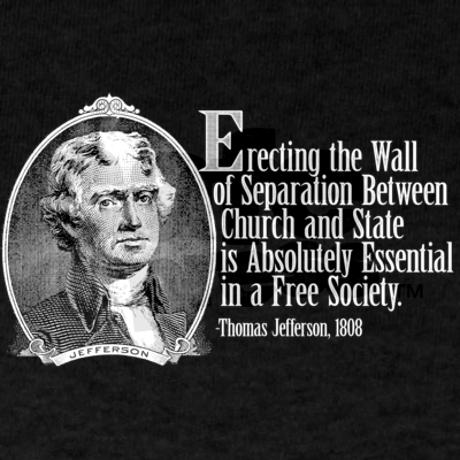
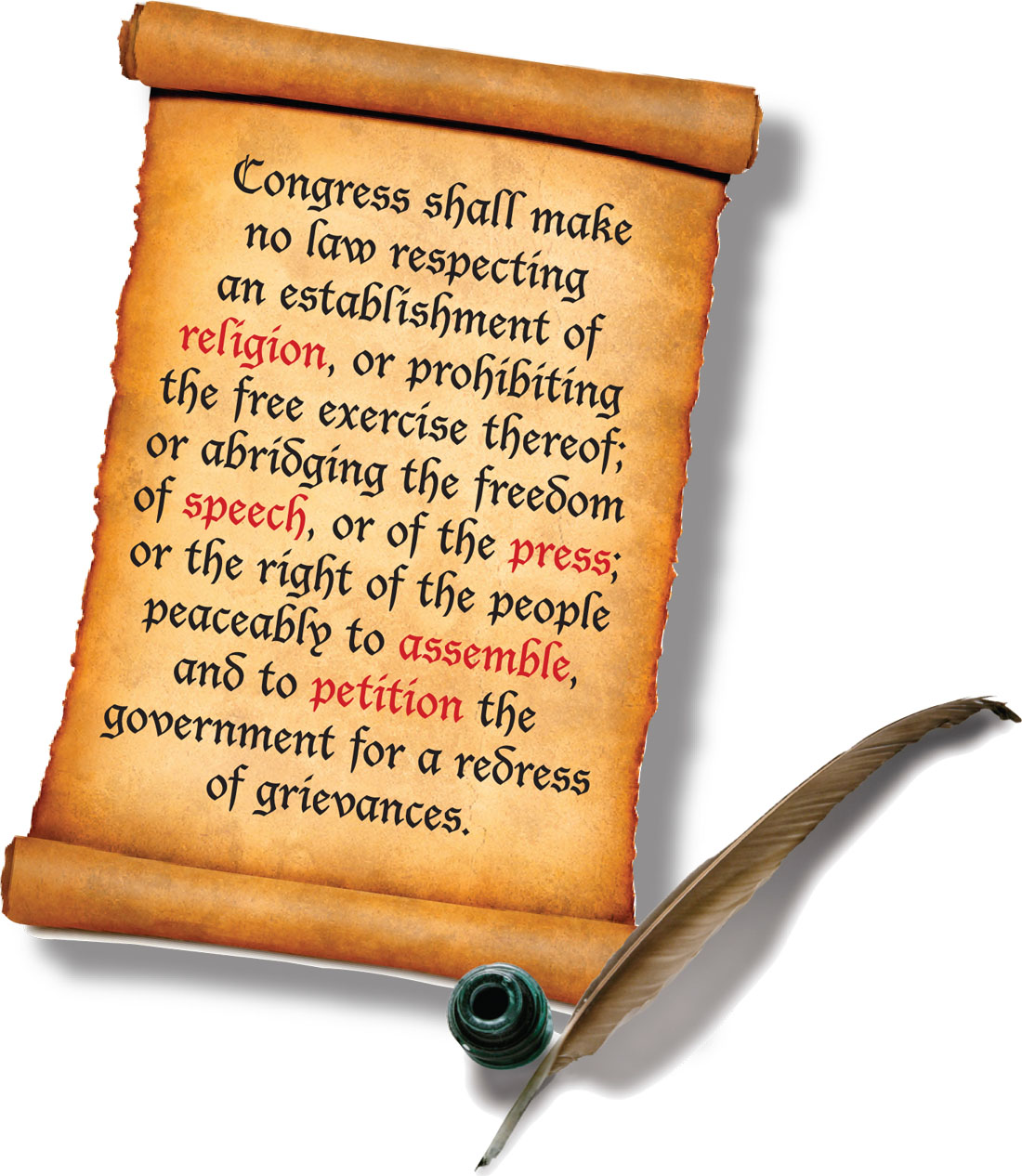
Tag Archives: James Madison

VIII. Backus Presents Appeal for Religious Liberty at Continental Congress; Debate in the Newspapers; Warren Association Activities; Backus Urges Religious Liberty in New Massachusetts Constitution; John Adams Works against Religious Liberty


A Publication of Churches Under Christ Ministry


Previous Lesson:
VII. The Revival Dies; Separate Churches Die; Baptist Denomination Grows; Formation of the Warren Association in 1770 To Obtain Religious Liberty; Isaac Backus’s Efforts; An Appeal to the Public

Next Lesson:
IX. The Baptists Fight in the Courts; Reject Backus’s Advice; Backus Changes His Focus to Baptist Doctrines; Connecticut Continues To Persecute Dissidents; Connecticut Rejects Forced Establishment in 1818

Click here for links to all lessons on “The Separates and the Baptists in New England.”

Click here to go to the written lessons.

Click here to go to the 3 1/2 to 6 minute video lectures.

For accompanying more thorough study from God Betrayed click here.


Jerald Finney
Copyright © February 28, 2018


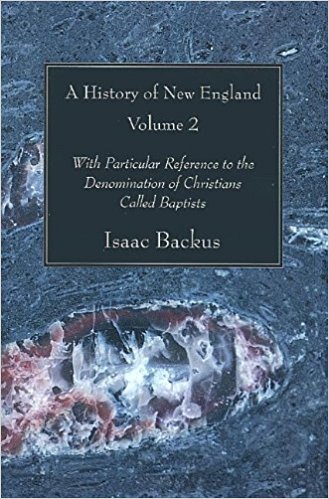
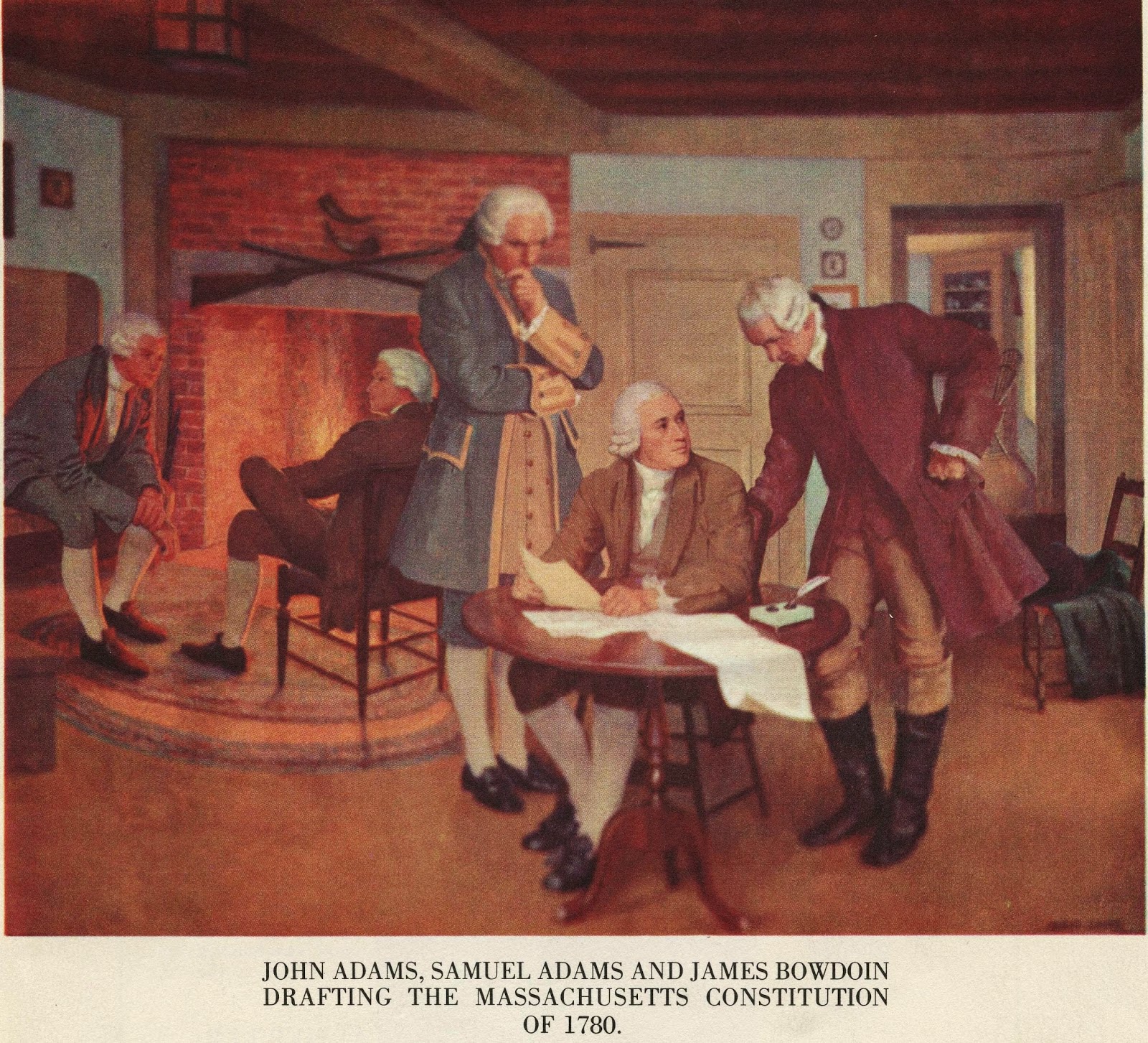
Attempts to gain religious freedom continued. The Warren Association sent Isaac Backus to the Continental Congress in 1774 where he met with an Association of other Baptist churches from several adjacent colonies which had elected a large committee to assist. They presented their appeal for religious liberty. John Adams and Samuel Adams, neither of whom was a friend to separation of church and state, falsely asserted that Massachusetts had only a “very slender” establishment, hardly to be called an establishment, that the General Court was clear of blame and always there to hear complaints and grant reasonable help.[1] While Mr. Backus was gone, the lie was spread that he had gone to Philadelphia to break the union of the colonies.

All the time these happenings were going on, the issues were being debated in the newspapers. The Warren Association continued to publish to the public instances of persecution as well as to actively seek religious liberty from the government. The Warren Association presented a memorial on July 19, 1775, requesting religious liberty and pointing out the inconsistency of rebelling against England for taxing without representation while doing the same thing in the colonies. Ultimately, nothing came of this. In 1777, Mr. Backus prepared an address, which was supported by a large number from various denominations, urging religious liberty to the Assembly which had been empowered to frame a new Constitution which was accomplished in 1780. The Third Article of the new constitution “excluded all subordination of one religious sect to another,” but imprisonment, and confiscation of property from men who refused to acknowledge such subordination continued.[2]

In 1778, Mr. Backus wrote “Government and Liberty Described and Ecclesiastical Tyranny Exposed.” He quoted Charles Chauncy:

  • “We are in principle against all civil establishments in religion. It does not appear to us that God has entrusted the State with a right to make religious establishments…. We claim no right to desire the interposition of the State to establish that mode of worship, [church] government, or discipline we apprehend is most agreeable to the mind of Christ. We desire no other liberty than to be left unrestrained in the exercise of our principles in so far as we are good members of society.” This, said Backus, was all that Baptists asked. [3]
  • “Perhaps as a result of this tract, the General Assembly tried to conciliate the Baptists by appointing a Baptist minister to deliver the election sermon in May 1779. That minister, in his sermon, remained faithful to the principle of separation.”[4]

Massachusetts began efforts to adopt a new constitution in 1777. The proposed constitution was defeated, but a new effort which began in 1779 proved successful. John Adams worked against the Baptist position at the convention. Mr. Backus, although not a delegate, went to Boston to stand for Baptist principles during the constitutional convention. He lobbied, wrote newspaper articles, published new tracts, and informed his brethren of what was going on.[5]

Mr. Backus worked at the convention for a Bill of Rights. The first basic rights he listed were:

  • “All men are born equally free and independent, and have certain natural, inherent and unalienable rights, among which are the enjoying and defending life and liberty, acquiring, possessing, and protecting property, and persuing and obtaining happiness and safety.”
  • “As God is the only worthy object of all religious worship, and nothing can be true religion but a voluntary obedience unto his revealed will, of which each rational soul has an equal right to judge for itself; every person has an unalienable right to act in all religious affairs according to the full persuasion of his own mind, where others are not injured thereby. And civil rulers are so far from having any right to empower any person or persons to judge for others in such affairs, and to enforce their judgments with the sword, that their power ought to be exerted to protect all persons and societies, within their jurisdiction, from being injured or interrupted in the free enjoyment of his right, under any pretence whatsoever.”[6]

Backus’ position, although seeking the same end, was from a different point of view than that of George Mason, Thomas Jefferson and James Madison.

“Three years earlier George Mason, with Jefferson’s approval and Madison’s amendments, had written a statement on religious freedom into the Bill of Rights in the Virginia Constitution:

  • ‘That religion, or the duty which we owe to our Creator, and the manner of discharging it, can be directed only by reason and conviction, not by force or violence and therefore all men are equally entitled to the free exercise of religion, according to the dictates of conscience; and that it is the mutual duty of all to practice Christian forbearance, love, and charity towards each other.’
  • “Backus’s tone was that of a New Light pietist; Mason’s that of an Enlightened latitudinarian. The Virginians spoke of the ‘Creator,’ Backus spoke of ‘God.’ Mason stressed reason and duty, Backus stressed ‘religious worship.’ Backus referred directly to God’s ‘revealed will’ and to the ‘soul.’ Mason omitted any reference to them.
  • “The difference was obvious and fundamental. The Virginia separationists were interested in leaving the mind free to follow its own rational direction. The Massachusetts pietists believed that separation was necessary in order to leave the ‘rational soul’ free to find ‘true religion’ as expressed in the Bible, ‘the revealed will’ of God. Implicit in both statements was a belief in God, in natural law, in man’s ability to find them. But the deistic separationists of Virginia trusted entirely to man’s reason and free will. The pietists insisted that only through the supernatural grace of God would men find the Truth that is in Jesus Christ. Though both views were individualistic, the deist was anthropocentric, the pietist theocentric.”[7]

The humanistic view of Mason, Jefferson, and Madison that man, through his reason could successfully address all his problems, and the humanistic goal of the “happiness of man” were inherent in the Declaration of Independence and the Constitution, the two greatest governing documents of all time, although blended with Biblical principles. Neither the name of Jesus nor the goal of “the glory of God” was in the Declaration of Independence or the Constitution.[8]

The Warren Association, on September 13, 1780, published a remonstrance, authored by Mr. Backus, against Article Three of the proposed constitution. The remonstrance stated, among other things, that the provision therein requiring the majority of each parish “the exclusive right of covenanting for the rest with religious teachers,” thereby granting a power no man has a right to; and further stating that “the Legislature, by this Article, are empowered to compel both civil and religious societies to make what they shall judge to be suitable provision for religious teachers in all cases where such provision shall not be made voluntarily.”[9] However, support for ministry could only be through voluntary support, not coercion that denied freedom of conscience. Backus and other Baptists “did not object to the view that Massachusetts should remain a Christian commonwealth; piety, religion, and morality could only be maintained with the institution of the public worship of God and of public instructions in piety, religion, and morality” were “generally diffused throughout the community.[10]

  • “Jefferson, Mason, and Madison, designing the creation of a secular state, not only opposed all such practices but also objected to the use of chaplains in the Congress and armed forces, the authorization by the state of certain days of fasting, thanksgiving, and prayer; and the compulsory religious services in state universities. Jefferson explicitly stated that America was not and ought not to be a Christian country…. Backus never qualified his belief in a Christian commonwealth. He consistently argued for ‘a sweet harmony between’ Church and State. ‘It is readily granted,’ he wrote in 1784, ‘that piety, religion, and morality are essentially necessary for the good order of civil society.’”[11]

Endnotes

[1] Isaac Backus, A History of New England With Particular Reference to the Denomination of Christians called Baptists, Volume 2 (Eugene, Oregon: Wipf & Stock Publishers, Previously published by Backus Historical Society, 1871), pp. 200-202, and fn. 1, p. 201.

[2] Ibid., pp. 203-204, 219-220, 225-229, 228-229.

[3] William G. McLoughlin, Isaac Backus and the American Piestic Tradition (Boston: Little, Brown and Company, 1967), p. 140. The entire tract is reproduced in Isaac Backus on Church, State, and Calvinism, Pamphlets, 1754-1789, Edited by William G. McLoughlin (Cambridge, Massachusetts: The Belknap Press of Harvard University Press, 1968), pp. 345-365.

[4] Ibid., 141.

[5] Ibid., p. 142.

[6] Ibid., pp. 142-144.

[7] Ibid., pp. 142-144.

[8] Again, the Constitution is the greatest governing document ever conceived by a nation, but the Biblical principle of “leaven”—bad doctrine always corrupts the good—has proven again, by the national experience, to be true. To understand and address a problem, one must be willing to face all the facts head on.

[9] Backus, A History of New England…, Volume 2, fn. 2, pp. 229-230.

[10] McLoughlin, Isaac Backus and the American Piestic Tradition, pp. 148-149.

[11] Ibid., pp. 149-150.

(1) Introduction: Distinct Differences between Church and State Render Them Mutually Exclusive

Click the above to go to the article, “Is Separation of Church and State Found in the Constitution?

If you miss one part of the puzzle that is being put together in these studies, you will never see and understand the whole picture.


A publication of Simply Church Ministry


Previous Lesson:
3. Dispensation Theology versus Covenant Theology and Their Importance to the Issue of Church and State Relationship in America

Next Lesson:
(2) The Holy Spirit, through Paul, Explained the Temporal Earthly and the Eternal Spiritual

Click here to go to all articles on “Distinct Differences Between Church and State Render Them Mutually Exclusive.”

Click here to go to the written lessons.

Click here to go to the 3 1/2 to 6 minute video lectures.


Jerald Finney
Copyright © February
11, 2018


This series of lessons will examine Bible teaching which makes clear that state (civil government) and church are so distinct that they are mutually exclusive—that God ordained each for particular purposes and that He desires that both operate under Him but that neither work with, over, or under the other. The Old Testament develops the doctrine of civil government. There we learn that God ordained civil government to directly control evil since the restraint of conscience was insufficient to control the sinful man. God added the restraint of civil government as a further direct, worldly control over man. The Old Testament deals with Gentile civil government and the theocracy of Israel, their purposes and authorities under God, their history, and prophecies concerning, among other things, concerning their fate. The New Testament announces something new, the church, a spiritual organism made up of spiritual beings.

Combining church and state has had dire consequences, as history shows. EN [i] Catholic and Protestant theology historically justified (and continue to justify) the union of church and state by examining Scripture not literally, but allegorically or spiritually, when and where convenient to support a desired conclusion (such as union of church and state). Those religious organizations interpret Scripture in such a way as to apply the principles for Israel and Judaism to Gentile nations. Just as religion and state were combined in the Jewish theocracy, this spiritualized and allegorized theology, when implemented, unites church and state in Gentile nations.

JamesMadisonOnC&SMany of America’s founding fathers—most especially James Madison and Thomas Jefferson (see EN [ii], a copy of Virginia Bill for Religious Liberty drafted by Thomas Jefferson)—and other leaders understood that church and state should be separate. From a worldly common-sense point of view Madison and Jefferson and others arrived at their understanding by studying the consequences of such unions both historically and also contemporaneously. From a Bible or spiritual perspective, Roger Williams, Isaac Backus, John Leland and other Baptists understood and explained both the problems created by combining church and state and the true reasons for those problems. Backus wrote:

  • “Christians must be careful not to apply God’s principles for the Jewish religion and the nation Israel to church and state. The principles for the two are so distinct that they are mutually exclusive. The government of the Church of Christ is as distinct from all worldly governments, as heaven is from earth.” EN [iii]

Indeed, union of church and state is contrary to biblical principles; and, therefore, the consequences of church-state union have always been dire and will be so until the return of Christ and the establishment of the Kingdom of Heaven.

God gave both church and state certain powers. God gave the state earthly and temporal power within jurisdictional boundaries which He set out. The heavenly eternal powers God gave the church were  meant to provide a spiritual and eternal good.

The purpose of the Gentile civil government is fleshly or earthly. EN [iv] Gentile civil government, according to God, was ordained by God to deal with those temporal earthly matters assigned it by God. God gave man certain authority over man. He gave man the responsibility to rule over man under His rules. Gentile civil government has authority to punish those who commit certain crimes against their fellow man and to reward those who do good. The purpose of the Gentile civil government is to control evil men thereby maintaining some degree of peace in this present world. A civil government, as defined by God, is made up of men under God ruling over man in earthly matters.

Much of God’s word deals with actions of individuals, families, churches, and nations here upon the earth. Civil governments are not given jurisdiction over many areas of life which are governed by the Word of God. A civil government which ignores God and His Word is setting itself up for judgment.

God gave neither a church nor the state authority to rule over or with the other. Civil government does not have the authority under God or the ability (the knowledge, understanding and wisdom) to rule over God’s churches. For reasons already looked at in these lessons, a church is not to join with the civil government in any way.

God ordained a church under God, not a business under civil government, an entity that is to work hand in hand with or perhaps over the state to bring in the kingdom of God, or an entity that is to work under state rules. Admittedly, the ultimate God-given purpose of both a church and a civil government is to glorify God, each acting under God, but neither acting with or under the other. However, the underlying purposes of a church and the state are significantly different: the underlying purpose of a church is heavenly or spiritual; the underlying purpose of a civil government is earthly.

Christians are told to obey civil government as regards certain earthly matters and civil government has authority over all citizens as to some temporal earthly matters. Individuals, families, and churches are not to be under the civil government with regard to spiritual matters, which include many activities and actions as shown in the Bible.


Endnotes

[i] See the historical section of this study of this abridged course for more on this. See, for a more advanced study, (1) Section 4 of God Betrayed/Separation of Church and State: The Biblical Principles and the American Application which is available free in both PDF and online form or may be ordered in softback and Kindle by going to “Order information for books by Jerald Finney which also has links to the free PDF and Online Form of the book; (2) the section on the history of the First Amendment; and/or (3) An Abridged History of the First Amendment.).

[ii] Virginia Bill for Religious Freedom drafted by Thomas Jefferson:Virginia Bill for Religious Liberty drafted by Thomas Jefferson in 1779 and enacted in 1786.

[iii]  Isaac Backus, A History of New England With Particular Reference to the Denomination of Christians called Baptists, Volume 2 (Eugene, Oregon: Wipf & Stock Publishers, Previously published by Backus Historical Society, 1871), p. 561.

[iv] See Section I.A., The Biblical Doctrine of Government of this short course for more on government. For a more advanced analysis, “The biblical doctrine of government for more on the jurisdiction and purposes of the various God-ordained governments including civil government.

Is Separation of Church and State Found in the Constitution?

SeparationOfChurchAndState

Jerald Finney © February, 2014

Click the above for information on this book.

Is Separation of Church and State found in the Constitution?  Knowing the correct answer to that question is vital in the success of the spiritual warfare of the Christian political activist in America. Does the First Amendment to the United States Constitution establish a wall which is to keep church out of state and state out of church; or does it set up a one way wall: that is, does it forbid state to stay out of church matters, but allow church to enter into state matters? If the latter, since “churches” vary in belief so dramatically, which church is to control in the affairs of state? Most Christians assert that the phrase “One nation under God” on our currency and in our Pledge of Allegiance make clear that the Constitution forbids separation of church and state. They state that the phrase “separation of church and state” is not found in the Constitution; that the Constitution through the First Amendment does not separate church and state. Are they correct in their understanding? [For a thorough analysis of the source of the misunderstandings-revisionist history-set alongside the easily verifiable history with complete citations, see information page on The Trail of Blood of the Martyrs of Jesus by clicking here.]

cropped-separationofchurchandstate_3.jpgI begin with an actual encounter with a “Christian” political activist over this matter of the meaning of separation of church and state. Then I:

1)     briefly explain my position with reference particularly to the beliefs of Thomas Jefferson and James Madison (with links to more extensive and in depth studies);

2)     briefly reveal those who are promoting the incorrect version of “separation of church and state” to conservative Americans (and more specifically to “Christians”) today and their motives;

3)     briefly answer the question of whether the Constitution or any other governing document requires the federal government to be guided by God and His principles and explain how a nation can proceed under God without combining church and state;

4)     briefly address biblical teaching on the downfall of a nation;

5)     conclude.

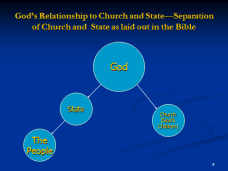
20In 2008, I started a seminar in El Paso, Texas with the diagram at left. A activist Christian lady immediately raised her hand and pointed out that the diagram separated church and state and that she did not agree with this. I had anticipated this question because I had struggled with the issue of separation of church and state for many years. Some years before this seminar I had begun to read in books and articles and to hear on Christian radio and from other Christians that “separation of church and state is not found in the Constitution.” I repeated that sound bite many times myself, but I was always perplexed as to where to go from the simple statement. I had read that the Supreme Court totally misinterpreted Jefferson’s Danbury Letter to mean that the First Amendment created a wall between church and state that was never intended. I had also read that the original intent of the religion clause of the First Amendment was to keep the state out of church affairs but not to keep the church out of state affairs; that the wall only functioned one way. Was this true? I found the answers to these questions after years of historical and legal studies.

This sign gets it wrong: we want Separation of Church and State not Separation of God and State

I answered the lady’s concerns by stating that I believed that she and I were on the same page; that I believe that most of our founding fathers never intended to separate God and state, but that they did indeed intend to separate church and state. I mentioned that the writings of James Madison, Thomas Jefferson, and most of our Founding Fathers showed that they understood this. They knew that church-state unions have always, without exception, resulted in the corruption of both church and state as well as individual citizens, horrible persecutions (imprisonments, murder and torture) of those who did not bow down to the established “church” and its theology, and many other undesirable consequences. The history of the First Amendment proves this (See the “History of the First Amendment” which is available online in the PDF of God Betrayed Section IV and in Online form). Madison and Jefferson were eyewitnesses to the persecutions of dissenting Baptists in Virginia and they understood the history of the persecutions of all those who exercised their God-given freedom to choose a theology contrary to that of the church-state unions, the establishment. They were aware that all church-state unions, beginning with the marriage of church and state in the early fourth century, continuing throughout the dark and middle ages, the reformation, and in the American colonies up until the time they lived resulted in horrible persecutions of those who would not bow down to the established beliefs.

4Jefferson’s writings make clear his position on separation of church and state. For example, in 1779 he wrote the Virginia Act for Religious Liberty which was passed in 1786. The act included three factors: church, state, and the individual. It protected the individual from loss at the hands of state incursion into his church affiliation, and implicitly banned church establishment. See En1 to read the entire act and another quote from Jefferson. Jefferson never swerved from his devotion to the complete independence of church and state (See also pp. 264-283 of God Betrayed to read more about Jefferson’s position. Click here to go directly to PDF of God Betrayed.).

Madison also fought for separation of church and state in Virginia. He wrote, in his famous “Memorial and Remonstrance:”

  • 18“… Because experience witnesses that ecclesiastical establishments, instead of maintaining the purity and efficacy of religion, have had a contrary operation. During almost fifteen centuries has the legal establishment of Christianity been on trial. What have been its fruits? More or less in all places, pride and indolence in the clergy; ignorance and servility in the laity; in both, superstition, bigotry, and persecution. Inquire of the teachers of Christianity for the ages in which it appeared in its greatest luster; those of every sect point to the ages prior to its incorporation with civil policy. Propose a restoration of this primitive state, in which its teachers depended on the voluntary rewards of their flocks, many of them predict its downfall….
  • “Because the establishment in question is not necessary for the support of civil government…. If religion be not within the cognizance of civil government, how can its legal establishment be said to be necessary for civil government? What influences, in fact, have ecclesiastical establishments had on civil society? In some instances, they have been seen to erect a spiritual tyranny on the ruins of the civil authority; in more instances, have they been seen upholding the thrones of political tyranny; in no instance have they been seen the guardians of the liberties of the people. Rulers who wished to subvert the publick liberty, may have found on established clergy convenient auxiliaries. A just government instituted to secure and perpetuate it needs them not. Such a government will be best supported by protecting every citizen in the enjoyment of his religion, with the same equal hand which protects his person and property; by neither invading the equal hand which protects his person and property; by neither invading the equal rights of any sect, nor suffering any sect to invade those of another….”
George Carlin is wiser concerning church/state separation than most Christians. Caveat: He knows nothing about true churches under Christ, since heretical, apostate, and unlearned churches and believers predominate the landscape.

See pages 278-279 of God Betrayed (Click here to go directly to online PDF of God Betrayed) for more extensive excerpts from “Memorial and Remonstrance.” Click here to go directly to the complete Memorial and Remonstrance online.

Thus, when the First Amendment was introduced and promoted by James Madison, the only question was the exact wording of the Amendment. The representatives at the Constitutional Convention understood that the purpose of the religion clause was (1) to place a two way wall between church and state (This purpose is stated in the establishment clause: “Congress shall make no law respecting an establishment of religion.”) and (2) to provide for freedom of conscious, also known as free will or soul liberty (This purpose is stated in the free exercise clause: “or prohibiting the free exercise thereof.”). These two purposes go hand in hand. The historical established churches, beginning with the spiritual harlot called the Catholic “church” and then her offspring-Protestant “churches”- violently persecuted (hung, burnt at the stake, drowned, buried alive, imprisoned, tortured with unspeakable horror) those who exercised their God-given free will in contradiction to the doctrines of the church-state establishment and were labeled “heretics” by the established church.

19At the seminar, I explained my position in more detail and showed that the same theology that justified union of church and state was initially developed and expanded upon from earlier sources by Augustine, practiced by the Catholic church, and later by Protestant churches (in modified form). Proponents of those same theologies remain at work to achieve the impossible goals of their adherents (peace and unity throughout the earth) in America today. In fact, many adherents of those theologies are very active in, and are leaders in, the contemporary American political warfare. Many believe that they will set up the kingdom of heaven on earth, the millennium, either through the efforts of the church or through a church-state combination and without the intervention our Lord Jesus Christ. Others believe that there is no millennium, and that a worldwide church-state combination will bring peace and unity to the earth. Others, such as myself, are totally convinced that the Bible teaches that Christ Himself will return at Armageddon and set up and reign over the earth for a thousand years by power. See En2 for various explanations of millennialism.

1Along with the question of whether First Amendment separates church and state, another question that needs to be addressed is whether the Constitution or any other governing document requires the federal government to be guided by God and His principles? The Founding Fathers while implementing the biblical principle of separation of church and state in the First Amendment did not understand that a nation should, within her organic governing documents, recognize that the God of the Bible, the only God, that He should be honored and hailed as the ruler of nations, and that His principles should be recognized and applied within the laws of the nation and in the interpretation of those laws.

A nation can proceed under God without combining church and state. How? The constitution of such a nation will:

1)     name the name of Jesus as the Supreme ruler;

2)     make clear that the nation will look to the biblical doctrines of government, church, and separation of church and state in ordering and carrying out its responsibilities under God;

3)     lay out its God-given jurisdiction as explained in the Bible;

The First Amendment to the U.S. Constitution

4)     separate church and state. The First Amendment implements the biblical principle of separation of church and state.

5)     provide for religious liberty (also called soul liberty or freedom of conscience). The First Amendment does this.

6)     guarantee freedom of speech, press, assembly and the right to petition the government for a redress of grievances. The First Amendment does this.

See En3 for information on an historical example of governing documents which proved that this can be done.

1The Constitution allows, but does not require, Americans to recognize the God of the Universe, the God of creation, almighty God, and to operate according to His principles and to pray in the name of Jesus even at government functions. This is obvious from a study of history including the multitude of statements made by Presidents, senators, representatives, government officials at all levels of government; and from a reading and study of state constitutions, laws, and federal and state legal cases.

History also shows that almost everyone in America at the time of the adoption of the Constitution reverenced the Bible and the God of the Bible and that prayers were made to Him at official government functions. Of course, the United States Supreme Court has removed the recognition of God (and especially the Lord Jesus Christ) from practically all civil government affairs. See for an explanation of how the Supreme Court has done this: The Supreme Court Reinterprets the First Amendment and Removes God or Section V of God Betrayed.

However, sad to say, neither the Constitution nor any other federal governing document names the name of Jesus and requires that the United States government be guided by God and His principles (being guided by God and His principles is something entirely different from establishing a church). If you disagree, show me one Constitutional provision or federal law which either requires recognition of God (and specifically the Lord Jesus Christ) and/or His principles as laid out in His Word. I submit that there is none.

Unlearned Christians (this author was once in their fold) argue that the implementation of certain biblical principles in the Constitution prove that the Constitution is a “Christian” document. However, they fail to point out the enlightenment principles which pollute the Constitution. I deal more in depth with these matters in God Betrayed.

Unstudied Christians argue, as this author once did, that the Declaration of Independence did recognize God and that Americans march behind the banner of the Declaration. However, the Declaration was written over a decade before the adoption of the Constitution and the First Amendment, and the Declaration is not law despite the rhetoric which says, “We proceed under the banner of the Declaration of Independence.” This author contends that even the Declaration is flawed when biblically analyzed. Even if the contention that it is not flawed were correct,  the Declaration is not controlling law and an examination of the Declaration and the Constitution leaves open the obvious contention that Americans had changed between the time of the writing of the Declaration and the adoption of the Constitution.

1The Bible teaches that a Gentile nation, as well as the nation Israel, that rejects the one true God, the God of the Bible, and His principles will become more and more morally bankrupt, will digress to political tyranny, and ultimately be judged by God. The United States is a moral cesspool and is well into the political tyranny stage. You may go to the following audio teaching for a thorough examination of Scripture on this matter: “The Biblical Doctrine of Government.” That teaching is also available in detailed form in Section I God Betrayed in PDF form or which can be ordered by going to Order Information for Books by Jerald Finney. A thorough analysis is impossible in a short article such as this, but here are a few verses from the Old Testament which substantiate this conclusion:

  • “The LORD is high above all nations, and his glory above the heavens” Psm. 133:4.
  • “Let all the earth fear the LORD: let all the inhabitants of the world stand in awe of him…. “Blessed is the nation whose God is the LORD; and the people whom he hath chosen for his own inheritance…. There is no king saved by the multitude of an host: a mighty man is not delivered by much strength.” (Psm. 33.8, 12, 16; see the whole chapter of Psm. 33). [Bold emphasis mine]
  • “Why do the heathen rage, and the people imagine a vain thing?  The kings of the earth set themselves, and the rulers take counsel together, against the LORD, and against his anointed, saying, Let us break their bands asunder and case their cords from us. He that sitteth in the heavens shall laugh: the LORD shall have them in derision. Then shall he speak unto them in his wrath, and vex them in his sore displeasure.…. Thou [Jesus] shalt break them with a rod of iron; thou shalt dash them in pieces like a potter’s vessel. Be wise now therefore, O ye kings: be instructed, ye judges of the earth. Serve the LORD with fear, and rejoice with trembling. Kiss the Son, lest he be angry, and ye perish from the way, when his wrath is kindled but a little. Blessed are all they that put their trust in him.” Psm. 2:1-5, 9-12 (The 2nd Psalm gives the order of the establishment of the kingdom.).

The Old Testament details God’s principles for nations, both Jew and Gentile, and lays out the complete history and fate of nations from beginning to end. God ordained civil government, and the fact that God desires nations to submit to Him and His principles is undeniable. That no nation ever has or ever will do so before He returns and establishes His Kingdom on earth is clear from a literal interpretation of scripture.

SeparationOfChurchAndState14In spite of the flaws in the Constitution, America, to a great extent, originally honored God. Of course, the First Amendment was not a flaw; the religion clause was a statement of the biblical principle of separation of church and state. With the passing of time, the flaws in the document have made it easier for the natural progression of moral awfulness and political tyranny. This author, like most politically active “Christians”  worked-not according to knowledge, understanding and wisdom-to “bring America back under God.” As a result of those efforts in the Republican Party (1982-beginning of the twenty-first century), I saw that America continued to grow worse in every way and at an accelerated pace in spite of our efforts. By 2002, I realized that America had become a grossly immoral nation. America is now a tyrannical and morally awful nation much worse than it was in 2002.

In 2005 God focused my efforts on His doctrine of the church, which is where they should have been in the first place. If Christians cannot get the doctrine of the church right in understanding and practice, how in the world do they think they can get civil government right? Even though many “believers” still seek to honor God in the political arena, they are not proceeding according to knowledge, wisdom, and understanding in either their government or their church efforts. God makes clear that when His people do not act according to knowledge (among other things), they will fall (See, e.g., 2 Pe. 1.2-10; Ho. 4).

For more in depth studies of the First Amendment, one can go to the following resources:

The History of the First Amendment
An Abridged History of the First Amendment

Endnotes

En1. Jefferson wrote: “Is uniformity attainable? Millions of innocent men, women, and children, since the introduction of Christianity, have been burnt, tortured, fined, imprisoned; yet we have not advanced one inch towards uniformity. What has been the effect of coercion? To make one half the world fools, and the other half hypocrites. To support roguery and error all over the earth.” Jefferson understood that establishment of a church (a church working with, over, or under civil government) always brings the worst of persecution of those who do not bow down to the church-state or state-church union.”

Virginia Bill for Religious Liberty drafted by Thomas Jefferson in 1779 and enacted in 1786.

The Virginia Bill for Religious Liberty written by Jefferson and passed in 1786 stated:

“I. Well aware that Almighty God hath created the mind free; that all attempts to influence it by temporal punishments or burthens or by civil incapacitations, tend only to beget habits of hypocrisy and meanness, and are a departure from the Holy Author of our religion, who being Lord of both body and mind, yet chose not to propagate it by coercions on either, as was in his Almighty power to do;

that the impious presumption of legislators and rulers, civil as well as ecclesiastical, who, being themselves but fallible and uninspired men, have assumed dominion over the faith of others, setting up their own opinions and modes of thinking as the only true and infallible, and as such, endeavoring to impose them on others hath established and maintained false religions over the greatest part of the world and through all time;

that to compel a man to furnish contributions of money for the propagation of opinions which he disbelieves, is sinful and tyrannical; that even the forcing him to support this or that teacher of his own religious persuasion is depriving him of the comfortable liberty of giving his contributions to the particular pastor whose morals he would make his pattern, and whose powers he feels most persuasive to righteousness, … that our civil rights have no dependence on our religious opinions any more than [on] our opinions in physics or geometry;

that therefore the proscribing any citizen as unworthy the public confidence by laying upon him an incapacity of being called to offices of trust and emolument, unless he profess or renounce this or that religious opinion is depriving him injuriously of those privileges and advantages to which in common with his fellow citizens he has a natural right; …

that to suffer the civil magistrate to intrude his powers into the field of opinion and to restrain the profession or propagation of principles, on supposition of their ill tendency, is a dangerous fallacy, which at once destroys all religious liberty, because he being of course judge of that tendency, will make his opinions the rule of judgment, and approve or condemn the sentiments of others only as they shall square with, or differ from his own;

that it is time enough for the rightful purposes of civil government for its officers to interfere when principles break out into overt [open, or public] acts against peace and good order;

and, finally, that truth is great and will prevail if left to herself, that she is proper and sufficient antagonist to error and has nothing to fear from the conflict, unless by human interposition disarmed of her natural weapons, free argument and debate, errors [cease] to be dangerous when it is permitted freely to contradict them.

“II. Be it enacted by the General Assembly that no man shall be compelled to frequent or support any religious worship, place, or ministry whatsoever, nor shall be enforced, restrained, molested, or burdened in his body or goods, nor shall otherwise suffer on account of his religious opinions or belief; but that all men shall be free to profess, and by argument to maintain, their opinion in matters of religion, and that the same shall in no wise diminish, enlarge, or affect their civil capacities.

“III. And though we well know that this assembly, elected by the people for the ordinary purposes of legislation only, have no power to restrain the acts of succeeding assemblies, constituted with powers equal to her own, and that therefore to declare this act irrevocable would be of no effect in law, yet, as we are free to declare, and do declare,  that the rights hereby asserted are of the natural right of mankind, and that if any act shall hereafter be passed to repeal the present or to narrow its operation, such act will be an infringement of natural rights.”

En2. The word millennium means “1000 years” and comes from Re. 20. 4-6 where it says that certain people “came to life, and reigned with Christ a thousand years. There are three major views on the time and nature of the millennium.

Amillennialism takes the position that this is a period during which Satan’s influence has been greatly reduced so that the gospel can be preached throughout the world. Christ does not bodily reign during this period, and there is no future millennium yet to come. Amillennialists believe that the term “thousand years” is a figure of speech for a long period of time in which God’s will will be accomplished. Christ will return at the end of this period, believers and unbelievers will be resurrected, unbelievers will be eternally condemned and believers reunited with their spirits, judged, and will enjoy heaven forever.

According to postmillennialism, Christ will return after the millennium. The church and state, operating during the period in which we now live, will establish peace and righteousness and a millennial age will occur when this occurs. At the end of that thousand years, Christ will return to earth, believers and unbelievers will be raised, the final judgment will occur, a new heaven and a new earth will be established, and we will enter into the eternal state.

Premillennialism teaches that Christ  will return before the millennium, believers who have died will be raised from the dead, their bodies reunited with their spirits, will reign with Christ 1000 years.  During this 1000 years, Satan will be bound. At the end of that period, he will be loosed and will lead the unbelievers of the millennium in rebellion against Christ. Satan and his followers will be defeated, Christ will raise the dead and they will be judged. Those whose names are not found written in the book of life will be cast, as was Satan, into the lake of fire. At the final judgment, believers will enter into the eternal state.

There are two main premillennial positions. Classic premillennialism says Christ will return after the great tribulation, rapture believers, and that believes will reign with Christ on earth for 1000 years. Pretribulational premillennialism teaches that Christ will return part way to earth before the tribulation, call believers to Himself, , and return to heaven with those believers. This will be followed by a seven year period of great tribulation. At the end of that time, Christ will return, crush all the Gentile armies which have come against Israel, and set up His millennial reign. See, e.g., Wayne Gruden, Systematic Theology (Grand Rapids, Michigan: Zondervan, 2000), pp. 1109-1113.

En3. The first government in history with complete religious freedom was the government of the colony or Rhode Island (See the online version, “The Baptists in Rhode Island” or go to Section IV, Chapter 6 of God Betrayed available in PDF form – for ordering information go to the following link: Order information for Books by Jerald Finney.).

The first government in history that was to have complete freedom of conscience and religious liberty also declared that the government was to be under the Lord Jesus Christ. Signed on March 7, 1638, the Portsmouth Compact read:

“We whose names are underwritten do swear solemnly, in the presence of Jehovah, to incorporate ourselves into a body politic, and as he shall help us, will submit our persons, lives and estates, unto our Lord Jesus Christ, the King of kings, and Lord of lords, and to all those most perfect and absolute laws of his, given us in his holy word of truth, to be guided and judged thereby.” 38 [19 signatures followed: Thomas Savage, William Dyre, William Freeborne, Philip Sherman, John Walker, Richard Carder, William Baulstone, Edward Hutchinson, Sen., Henry Bull, Randal Holden, William Coddington, John Clarke, William Hutchinson, John Coggshall, William Aspinwall, Samuel Wilbore, John Porter, Edward Hutchinson, Jun., and John Sanford.].

Three passages were marked in support of the compact: Exodus 24.3, 4; II Chronicles

2.3; and II Kings 11.17.

In August of 1638, the people of Providence approved the first public document establishing government without interference in religious matters, the Providence Compact:

“We whose names are here underwritten being desirous to inhabit in the town of Providence, do promise to submit ourselves in active or passive obedience to all such orders or agreement as shall be made for public good to the body in an orderly way, by the major consent of the present inhabitants, masters of families, incorporated together into a township, and such others whom they shall admit into the same, only in civil things.” [Signed by Stukely Westcoat, William Arnold, Thomas James, Robert Cole, John Greene, John Throckmorton, William Harris, William Carpenter, Thomas Olney, Francis Weston, Richard Watearman, and Ezekiel Holliman.]

As James R. Beller proclaims, the document was “the first of a series of American political documents promulgating government by the consent of the governed and liberty of conscience” (James R. Beller, America in Crimson Red: The Baptist History of America (Arnold, Missouri: Prairie Fire Press, 2004), p. 13). Thus, liberty of conscience was the basis for legislation in Rhode Island, and its annals have remained to this day [when Underhill wrote this] unsullied by the blot of persecution. (Roger Williams and Edward Bean Underhill, The Bloudy Tenent of Persecution for Cause of Conscience Discussed and Mr. Cotton’s Letter Examined and Answered. (London: Printed for the Society, by J. Haddon, Castle Street, Finsbury, 1848 (Reprint)), p. xxviii).

To the New Nation


Jerald Finney
Copyright © December 31, 2012


Click here to go to the entire history of religious liberty in America.


Note. This is a modified version of Section IV, Chapter 10 of God Betrayed: Separation of Church and State/The Biblical Principles and the American Application. Audio Teachings on the History of the First Amendment has links to the audio teaching of Jerald Finney on the history of the First Amendment.


To the new nation

Summary of Contents: The Constitutional Convention, submission to states for ratification; James Madison persuaded John Leland that he would stand for religious freedom and Leland withdrew as candidate for state ratification convention in favor of Madison, the Constitution was ratified, Madison was elected as Representative and introduced several amendments, including the First Amendment; the First Amendment was adopted on September 25, 1789 and approved by the required number of sstates in 1791.

Leland-Madison Memorial ParkLeland Madison Memorial Park


A convention was called in Philadelphia in 1787 to revise the Articles of Confederation.

“In a little more than a year after the passage of the Virginia Act for Religious Liberty the convention met which prepared the Constitution of the United States. Of this convention Mr. Jefferson was not a member, he being then absent as minister to France…. Five of the states, while adopting the Constitution, proposed amendments. Three—New Hampshire, New York, and Virginia—included in one form or another a declaration of religious freedom in the changes they desired to have made, as did also North Carolina, where the convention at first declined to ratify the Constitution until the proposed amendments were acted upon. Accordingly, at the first session of the first Congress the amendment now under consideration [the First Amendment] was proposed with others by Mr. Madison. It met the views of the advocates of religious freedom, and was adopted” (Reynolds v. United States, 98 U.S. 145, 163 at 164 (1879)).

After the drafting of the Constitution, it was submitted to the states for ratification. The Baptists of Virginia were against ratification because the Constitution did not have sufficient provision for religious liberty. Patrick Henry had declined to serve at the Convention and was against it. He posed as the champion of the Baptists in opposition to the Constitution. Of course, Madison was for ratification. However, John Leland, the most popular preacher in Virginia, was chosen by the Baptists as candidate of Orange County to the state ratification convention opposed to ratification, and his opponent was to be James Madison. Mr. Leland likely would have been elected had he not later withdrawn. Mr. Madison, when he returned from Philadelphia, stopped by Mr. Leland’s house and spent half a day communicating to him about “the great matters which were then agitating the people of the state and the Confederacy” and relieving Baptist apprehensions as to the question of religious liberty. As a result of this meeting, Mr. Leland withdrew in favor of Mr. Madison and the Baptists of Orange County were won over to the side of Madison (Charles F. James, Documentary History of the Struggle for Religious Liberty in Virginia (Harrisonburg, VA.: Sprinkle Publications, 2007; First Published Lynchburg, VA.: J. P. Bell Company, 1900), pp. 150-158; Dr. William P. Grady, What Hath God Wrought: A Biblical Interpretation of American History (Knoxville, Tennessee: Grady Publications, Inc., 1999), pp. 166-167).

The Constitution was ratified and election of the officers of government was the next order of business. Patrick Henry, using his influence in the Legislature, prevented Madison from being elected as Senator. In addition, the Legislature drew the lines for Representative district so as to prevent Madison from being elected as Representative. However, he was able to “relieve Baptist apprehensions as to any change in his principles, and assure them of his readiness to aid in securing a proper amendment to the Constitution on the subject of religious liberty.” He was elected.

His first act, after the First Congress was organized, in 1789, was to propose, on June 8, certain amendments, including what is now the First Amendment. His purpose was to “conciliate and to make all reasonable concessions to the doubting and distrustful”—to those, the Baptists, who were concerned about the issue of religious liberty. “Of all the denominations in Virginia, [the Baptists] were the only ones that had expressed any dissatisfaction with the Constitution on that point, or that had taken any action into looking to an amendment.” The Baptists of Virginia had also corresponded with Baptists of other states to “secure cooperation in the matter of obtaining” a religious liberty amendment. No other denomination asked for this change (James, p. 167). A general committee of Baptist churches from Virginia presented an address to President Washington, dated August 8, 1789, expressing concern that “liberty of conscience was not sufficiently secured,” perhaps because “on account of the usage we received in Virginia, under the regal government, when mobs, bonds, fines and prisons, were [their] frequent repast” (Isaac Backus, A History of New England With Particular Reference to the Denomination of Christians called Baptists, Volume 2 (Eugene, Oregon: Wipf & Stock Publishers, Previously published by Backus Historical Society, 1871), p. 340).  President Washington assured them that he would not have signed the Constitution if he had had the slightest apprehension that it “might endanger the religious rights of any ecclesiastical society” (Ibid.).

Some Baptists and others did not see the need for a religious freedom amendment. Indeed, the First Amendment may not have been necessary to guarantee separation of church and state. Isaac Backus was elected as a delegate to the Massachusetts convention of January, 1788, which considered the issue of ratification of the new Constitution. He spoke at the convention.

“On February 4, [Backus] spoke of ‘the great advantage of having religious tests and hereditary nobility excluded from our government.’ These two items in the Constitution seemed to him a guarantee against any establishment of religion and against the formation of any aristocracy. ‘Some serious minds discover a concern lest, if all religious tests should be excluded, the congress would hereafter establish Popery, or some other tyrannical way of worship. But it is most certain that no such way of worship can be established without any religious test.’ He said ‘Popery,’ but he probably feared, as many Baptists did, that some form of Calvinism of the Presbyterian or Consociational variety was more likely. His interpretation of this article helps to explain why the Baptists [of Massachusetts] made no effort to fight for an amendment on freedom of religion along with the others which the convention sent to Congress” (William G. McLoughlin, Isaac Backus and the American Piestic Tradition (Boston: Little, Brown and Company, 1967), pp. 198-199).

Even Madison, who proposed and fought for the First Amendment, did not believe that it was necessary for the security of religion. He wrote in his Journal on June 12, 1788:

“… Is a bill of rights a security for Religion? … If there were a majority of one sect, a bill of rights would be a poor protection for liberty. Happily for the states, they enjoy the utmost freedom of religion. This freedom arises from that multiplicity of sects, which pervades America, and which is the best and only security for religious liberty in any society. For where there is such a variety of sects, there cannot be a majority of any one to oppress and persecute the rest. Fortunately for this commonwealth, a majority of the people are decidedly against any exclusive establishment—I believe it to be so in the other states…. But the United States abound in such a variety of sects, that it is a strong security against religious persecution, and it is sufficient to authorize a conclusion, that no one sect will ever be able to outnumber or depress the rest” (Norman Cousins, In God We Trust (Kingsport, Tennessee: Kingsport Press, Inc., 1958), pp. 314-315).

Others were against a bill of rights. “James Wilson argued that ‘all is reserved in a general government which is not given,’ and that since the power to legislate on religion or speech or press was not given to the Federal government, the government did not possess it, and there was therefore no need for an express prohibition” (Leo Pfeffer, Church, State, and Freedom (Boston: The Beacon Press, 1953), p. 112). “Alexander Hamilton argued that a bill of rights, not only was unnecessary, but would be dangerous, since it might create the inference that a power to deal with the reserved subject was in fact conferred” (Ibid., citing Federalist Papers, Modern Library ed., 1937, p. 559).

The amendment was adopted on September 25, 1789 and was approved by the required number of states in 1791.

Book Review: The Writings of John Leland

Book Review
The Writings of John Leland
Edited by L.F. Greene, ARNO PRESS & THE NEW YOUR TIMES, New  York, 1969,
Reprinted 2010 by Local Church Bible Publishers, http://www.LocalChurchBiblePublishers.com

Jerald Finney
Copyright © December 2, 2011

Recommended reading: Outcome Based Religion (Click to see review)
TheWritingsOfJohnLeland

Preface

Truth is as essential to history as the soul is to the body.—Frederick.
Quoted on 92 of The Writings of John Leland
“Truth needs no apology, and error deserves none. Prefatory lies have often atoned for ignorance and ill-will in the Eastern and European worlds; but let the sons of America be free. It is more essential to learn how to believe, than to learn what to believe” (92)

Note. Unless otherwise indicated, all quotes are from the book The Writings of John Leland, and only the page numbers are noted. Several years ago, I tried to find a copy of the writings of John Leland. I discovered a two volume set of the writings of John Leland online, but the price was $200.00. Two days later, I decided to “bite the bullet” and pay the $200.00. It was too late. The books were no longer available, and I could not find any other sources. Recently, Pastor Jason Cooley informed me that John Leland’s writings are now available for $20.00 from Local Church Bible Publishers, www.LocalChurchBiblePublishers.com. I bought the book from that source.

Book Review: The Writings of John Leland

John Leland was both a Baptist hero and an American hero. His contributions to religious liberty in America should be known by every American, and especially to every American Baptist. He was a constant and effective promoter the Baptist distinctive of separation of church and state, soul liberty, or religious liberty both before and after the ratification of the United States Constitution. His exploits and thoughts on liberty should stand next to those of George Washington, James Madison, and Thomas Jefferson.

Before the adoption of the Constitution, he was a leader for religious liberty in Virginia: “The Baptists fought to have the act incorporating the Episcopal church repealed. Reuben Ford and John Leland attended the first 1787 assembly meeting as agents in behalf of the Baptist General Committee (Charles F. James, Documentary History of the Struggle for Religious Liberty in Virginia (Harrisonburg, Virginia: Sprinkle Publications, 2007; first published in Lynchburg, Virginia: J. P. Bell Company, 1900), pp. 142-146). On August 10, 1787, the act incorporating the Episcopal church was repealed, and until 2001—when Jerry Falwell and trustees of the Thomas Road Baptist Church, who were joined by the American Civil Liberties Union, challenged the Virginia Constitutional provision forbidding the incorporation of churches in federal district court—no church in Virginia could be incorporated (See Falwell v. Miller, 203 F. Supp. 2d 624 (W.D. Va. 2002).”  God Betrayed, p. 282.

“It is sad that Christian revisionists, in their successful effort to deceive the entire Christian community and advance their agenda by combining church and state, so that the resulting union of church and state can bring in the kingdom of heaven, have belittled, misrepresented, and/or totally ignored great men such as Roger Williams, Dr. John Clarke, Isaac Backus, Shubal Stearns, John Leland and others. Their efforts have done great and irreparable damage to the cause of Christ.” God Betrayed/Separation of Church and State: The Biblical Principles and the American Application (Austin, Texas: Kerygma Publishing Company, 2008), p. 208; See EN for more information on books by Jerald Finney; God Betrayed/Separation of Church and State: The Biblical Principles and the American Application (Link to preview of God Betrayed). Tragically, even most Baptists have been deceived by the revisionists, and believe and teach the revisionist lies.

“John Leland, the most popular preacher in Virginia, was chosen by the Baptists as candidate of Orange County to the state ratification convention opposed to ratification of the United States Constitution, and his opponent was to be James Madison. Mr. Leland likely would have been elected had he not later withdrawn. Mr. Madison, when he returned from Philadelphia, stopped by Mr. Leland’s house and spent half a day communicating to him about ‘the great matters which were then agitating the people of the state and the Confederacy’ and relieving Baptist apprehensions as to the question of religious liberty. As a result of this meeting, Mr. Leland withdrew in favor of Mr. Madison and the Baptists of Orange County were won over to the side of Madison” (Charles F. James, Documentary History of the Struggle for Religious Liberty in Virginia (Harrisonburg, Virginia: Sprinkle Publications, 2007; first published in Lynchburg, Virginia: J. P. Bell Company, 1900), pp. 150-158; William P. Grady, What Hath God Wrought: A Biblical Interpretation of American History. (Knoxville, Tennessee: Grady Publications, Inc., 1999) pp. 166-167.” God Betrayed, p. 285.

In compiling The Writings of John Leland, “Great care has been taken to ascertain truth, and few assertions have been made that are not sustained by documentary evidence of undoubted authenticity.” The book combines what the Elder Leland believed, preached and lived with evidences of a pious character, preaching style, life history and accomplishments, personal demeanor, and his effect on those whom he converted and those to whom he preached” (65).

Reading John Leland’s writings reveals the mind of a brilliant believer. His political insights were, for like of a better word, awesome. His historical and biblical knowledge were of the highest order, but, more importantly, his analyses were brilliant, reflecting the mind of God. Through a short biography, compilation of letters, speeches to political bodies, essays, sermons, etc., The Writings of John Leland reveals, of special interest to this author, the political and spiritual life and beliefs of John Leland. Mr. Leland’s spiritual activities resulted in the salvation of many souls; and, as already noted, he was very instrumental in the adoption of the First Amendment the United States Constitution. He remained active until  his death. He wrote, “I [John Leland] close, by observing that here is an arm seventy years old, which, as long as it can rise to heaven in prayer, or wield a pen on earth, shall never be inactive, when the religious rights of men are in jeopardy. Was there a vital fibre in my heart, that did not plead for rational religious liberty, I would chase the felon from his den, and roast him in the flames” (507).

The remainder of this review will consist of two parts: (1) A summary of Events in the Life of John Leland,” and (2) “A sampling of quotes and matters which Leland addresses in the essays, sermons, addresses, poems, etc. which are included in the book”.

Events in the Life of John Leland (9-40)

Born in Grafton, Massachusetts on May 14, 1754. As a boy, he lost all desire for youthful diversions and, due to conviction in his mind, and would talk on no subject but religion. “Reading the Bible and meditating on the shortness of time, and the importance of being prepared for death and judgment, occupied the chiefest of [his] time.” He began to earnestly seek the Lord (11), and reached conclusions about salvation. While less than twenty years old, he, although naturally bashful publically disputed on the matter of salvation freely by grace with a very respectable preacher (13), then prayed and gave the people present a word of exhortation. The next day, reproaching himself for his forwardness and presumption, he told some that they need not mind anything that he had said, since he was a poor unconverted sinner. He and another young man about his age began to set up evening meetings, to sing, pray, and speak according to their proportion of faith as the Spirit gave them utterance (15). He struggled with his moral evil in himself and “want of will,” and worried about preaching. He was baptized in June, 1774 (16).  He preaches from Malachi 9: “If ye will not hear, and if ye will not lay it to heart, to give glory unto my name saith the Lord of Hosts, I will even send a curse upon you ——.” He continued to preach and doors opened. He finally surrendered to the ministry, without any condition, evasion, or mental reservation (18). [Lady blamed him for being a closed communicant; he asked why he should be blamed for not communing with those who have no fellowship with him (18-19). Joined Bellingham church which gave him a license to do that which he had been doing for a year (19). Oct. 1775 went to Virginia for 8 mo. Married Sally Devine on 9/30/1776. Moved to Culpepper, Virginia. Ordained by the choice of the church, travelled and preached.  Moved to Orange county. Travailed in the desire for salvation of sinners, prays much, baptizes (130), preaches from Orange to York. (20-21). This continues through p. 40.

Pp 41- “Further sketches of the Life of John Leland.” Additional incidents from the editor which continue the history to the time of Leland’s death (1835 to the death of John Leland), including more on the life and character of Mrs. Leland (liberality, courage (e.g., saved her husband from a murderer’s sword (42), life of unceasing toil, always busy, always quiet (43), more on her life history on (43), , her faith firm in Christ, etc. Sketch of John Leland’s last sermon preached 1/8/1841 (46-47). “Thus died John Leland—a man eminent above many for piety and usefulness, whose name is connected with all that is pure in patriotism, lovely in the social and domestic virtues, philanthropic in feeling and action, arduous, disinterested, and self-denying in the labors of the ministerial calling; one whose place in society, in the church, and in the ranks of the ministry, will not soon be filled—in the hearts of those who knew him, never (49).

He died as a witness for the truth, testifying, with his last breath, the value of religion, and that only, which has its seat in the heart. His life had been unostentatious; his aspirations after worldly honors, ever low and feeble; his humility and sense of dependence on God, deep-felt and abiding—and thus he died….” His tombstone read: “Here lies the body of the Rev. John Leland, who labored 67 years to promote piety and vindicate the civil and religious rights of all  men. He died January, 14, 1841, aged 86 years and 8 months (50).” His religious creed (50-1).

“Through a long life, Elder Leland sustained, with uniform consistency, the two-fold character of the Patriot and the Christian. For His religious creed he acknowledged no director but the Bible. He loved the pure, unadulterated word of truth and as a minister of that word, zealous and faithful, he preached it, as far as he was able, unmixed with the doctrines and commandments of men, ‘not for filthy lucre, but of a ready mind.’ He was clear in exposition, happy in illustration, often powerful and eloquent in appeals to the conscience and heart. He insisted, in absolute and unqualified terms, on the great fundamental truths of the gospel, the necessity of regeneration, faith and repentance; but, on points not essential to salvation, though his opinions were no less firmly established, and he never shrunk from advocating them on proper occasions, yet he did not censure or denounce those who differed from him, nor  exclude from fellowship, ass Christians, any who gave evidence of a gracious change, whatever might be their peculiar doctrinal views. He never engaged in controversy; and when any of his published opinions were disputed, or commented upon, as was sometimes the case, with severity, he preferred to  ‘let the matter rest a little, and then give another thrust,’ as he expressed it, to the wwast of time, repetitions, and tediousness of reviews and replies.” (51-52).

His political creed was based upon those ‘sufficient truths’ of equality, and of inherent and inalienable rights recognized by the master spirits of the revolution as the principles for the support of which they pledged ‘their lives, their fortunes, and their sacred honor.’ As a politician, he was above the influence of any but sincere and patriotic motives. He was a statesman, rather than a politician. He studied the fundamental principles of government, and drew his conclusions directly from them, without any intervening medium of self or party interest…. His sentiments, on particular measures, it is unnecessary to comment upon, as they are clearly expressed in his writings. His feelings on the subject of slavery may be gathered from the fact that, during his fourteen years’ residence in Virginia he never owned a slave, as well as from his remarks in the Virginia Chronicle, and from the resolution offered by him, when a member of the Baptist General Committee, and passed by them, in 1789, in the following words: …” (51-52).

 “The great object, (next in importance to his mission as a preacher of Christ,) for which he seems to have been raised up by a special Providence, was to promote the establishment of religious liberty in the United States. His efforts, perhaps, contributed as much  as those of any other man, to the overthrow of ecclesiastical tyranny in Virginia, the state of his adoption, and exerted a beneficial influence, though less successful, towards the promotion of the same end in that of his nativity. In the former, in the years 1786-7-8, we find his name in the doings of the Baptist General Committee, with which he stood connected, as messenger to the General Assembly, appointed to draft and present memorials respecting the Incorporating  act, the application of the glebe lands to public use, etc. Though the cause of religious freedom was the common cause of all dissenters, yet the Baptists, as a sect, took the lead in those active, energetic, and persevering measures, which at length prevailed in its establishment. Many individuals of other denominations took an active part, and aided materially in bringing about the glorious result; nay, that even many of the more conscientious and patriotic among the members of the established church, made praiseworthy exertions in its favor, is a fact too honorable to themselves, and to the state that produced them, to be passed unnoticed. Enrolled among the ardent champions of religious liberty, are the names of Virginia’s most illustrious sons—of Washington, Henry, Jefferson, Madison. To particularize, in regard to the efforts made, and the good accomplished by each, is unnecessary in this place; the following Address an Reply, which are inserted entire, will serve to exhibit the enlarged views and the unselfish spirit of the patriots of that day, as well as the harmony, one might almost say identity, of sentiment that prevailed among them.” … (Address to President Washington: see pp. 52-54.). George Washington’s reply on pp. 54-55, says, in part: “If I could have entertained the slightest apprehension that the Constitution framed by the Convention where I  had the honor to preside, might possibly endanger the  religious  rights of any ecclesiastical society, certainly I would never have placed my signature to it; and if I could now conceive that the  general government might even be so administered, as to render the liberty of conscience insecure, I beg you will be persuaded, that no one would be more zealous than myself, to establish effectual barriers against the horrors of spiritual tyranny, and every species of religious persecution. For you, doubtless, remember, I have often expressed my sentiments, that any man, conducting himself as a good citizen, and being accountable to God alone for his religious opinions, ought to be protected  in worshiping the Deity according to the dictates of his own conscience… (52).”

Leland moved to New England in 1791. Immediately “commenced anew the warfare against religious  intolerance, and the defence of the cause that had so signally triumphed in Virginia. During his stay in New London, he published his ‘Rights of Conscience Inalienable,’ and afterwards, from time to time, other works of the same character; some of which will be found in [this volume], and others it has been impossible to obtain. “Our limits do not allow us to enter upon the history and progress of religious liberty in Massachusetts. This may be found elsewhere…. At length, in the beginning of 1811, a decision by Judge Parsons, that no society, not incorporated by law, could claim even the pitiful privilege of drawing back money, awakened the fears of the dissenters, and a circular Address, accompanied by a petition to the legislature, praying for a revision of the laws respecting public worship, was circulated through the state. At the solicitation of the people of Cheshire, Mr. Leland accepted a seat in the legislature, for the special purpose of aiding the measures petitioned for. His speech, delivered during the debate on the subject, may be found in another part of the work (55).”

“A law was finally passed that gave some relief, but not complete satisfaction. The ‘stump’ of the tree of ecclesiastical oppression, so carefully preserved ‘with a band of iron and brass,’ continued, therefore to furnish a subject for his animadversion, in various essays, addresses, etc.  and he improved such opportunities as were offered him, as a matter of duty, and in fulfillment of the public pledge he had  given, that ‘as long as he could speak with his tongue, wield a pen, or heave a cry to heaven, whenever the rights of men, the liberty of conscience, or the good of his country were invaded by fraud or force, his feeble efforts should not lie dormant.’”

A sampling of quotes and matters which Leland addresses in the book

59- His views on church discipline, communion, etc.
65 – Excerpt from Semple’s Virginia Baptists on John Leland.
68- 69 Leland on God’s Sovereignty vs. free will.
69 – 70 Criticisms of John Leland.

 70 “There is evidently a wide difference between searching the Scriptures to find a system of truth, and searching them for evidence to support one already adopted….”

78 (In Preface to “The Bible Baptist): “Truth needs no apology, and error deserves none. Prefatory lies have often atoned for ignorance and ill-will in the Eastern and European worlds; but let the sons of America be free. It is more essential to learn how to believe, than to learn what to believe.
“The doctrine and spirit of the following remarks, are left for the reader to judge of for himself. Truth is in the least danger of being lost, when free examination is allowed.”

78 “Christian writers generally agree to reproach the Jews, for treating the Rabbies with as much respect as they did the prophets; giving as great credit to their traditions as they did to the sacred volume. But many Christian writers are guilty of the same absurdity. It is no more significant for Jews to quote the Talmud or the Targum, to prove a Mosaic rite, than it is for Christians to depend on Tertullian, Cyprian, Origen, and the other fathers of the church, for a gospel ordinance.”

73-77 “The History of Jack Nips”: (The boy Leland examiners the teaching of the church; also state constitutions) This examines doctrines of the Presbyterian church: preaching in tones, their orthography, infant baptism of non-believers (who gave their child to God) 73-, baptism of infants who are out of the church and of infants of those who are enemies of the church (75). He does his Bible study of baptism 76. His dad intended him for a minister. His question: “But does God. Those who are sent by men to preach, must look to men for their pay; but those that are sent by God, must depend on him.” He studies all the state constitutions at age 22. He found that “there were not two of them that agreed. What said I, do great men differ? Boys, women, and little souls do; but can learned wise patriots disagree so much in judgment? If so, they cannot all be right, but they may all be wrong, and therefore, Jack Nipps for himself. What encouraged me to search and judge for myself, was this: when I was a small boy, I fancied that I stood in the middle of the world, and that the earth extended no further than my eye-sight explored: but people told me that I was wrong in my judgment; but after a few years study, I found I was half right. That the earth exceeded my eye-sight, I soon found by experience; herein I was wrong. But that I am always on the centre spot of the surface of the globe, is an undeniable truth. And as mature experience convinced me that my boyish thoughts were some of them right, I concluded it might be so with my study in politics” 77.

78- Excellent examination of “baptism” including infant baptism. John the Baptist 79. Inconsistencies of those who promote infant baptism 81. On “Mk. 16.15-16 “Go ye into all the world, and preach the gospel to every creature. He that believeth and is baptized, shall be saved; but he that believeth not, shall be damned” 81-2. On Peter’s teaching on baptism 82-3. On Philip 83-4. The next baptizer, Ananias 84. Then Paul 84-6. Baptism of the Holy Ghost 87. The argument that many great reformers and preachers, in past ages, believed and practiced infant sprinkling; if error, would not God have convinced them of it, when he was with them, in so great a degree 89?

91- :The Virginia Chronicle.” Account of the different religious sects in Virginia. Settlement, population 94-95.  The Quakers (persecuted by not put to death) 94. Of the slaves 94-8. Wishes its dissolution, but points out the great problems in so doing. Briefly on their religious worship etc. “THE UNIFORMITY OF RELIGION FOR ONE HUNDRED AND THIRTY YEARS 98-99. OF THE PRESBYTERIANS 99-100. OF THE METHODISTS (Armenian) (Tremendous footnote on 101 about baptism) 100-1. OF THE TUNKERS 102-3. OF THE MENNONISTS 103-4 (Excellent comments on civil government). OF THE BAPTISTS 104-5. THE PERSECUTION OF BAPTISTS (Excellent reasons why no religious test should be required for office) 105-7. THE REASONS FOR THEIR DISSENT (107-109). THREE GREAT PRINCIPLES (The 3 great principles which divide the Christian world) 109-11. OF MARRIAGE 111-2. THE DECLENSION AMONG THE BAPTISTS (“But as they gained this piece of freedom, so the cares of war, the spirit of trade, and moving to the western waters, seemed to bring on a general declension. The ways of Zion mourned. They obtained their hearts’ desire, (freedom,) but had leanness in their souls. Some of the old watchmen stumbled and fell, iniquity did abound, and the love of many waxed cold…. FN 9N 114 WHY A CONFESSION OF FAITH?) 112-4. THE GREAT WORK (The declension ended in 1785 with revival) 114-6. THE NUMBER OF BAPTISTS 116-7. ON DRESS 117. THE EXCESS OF CIVIL POWER ESPLODED (Tremendous insights on freedom of conscience, chaplains paid by govt. (in army or legislature or elsewhere, the extent of power of civil govt. (can’t use Israel as example), govt. maintenance of religion) 117-9. WASHING OF FEET AND DRY CHRISTENING 120. THE VIRGINIA BAPTISTS COMPARED WITH THE GERMAN 120-1. SOME REMARKS 121-2. THE RIGHTS AND BONDS OF CONSCIENCE 122-3. THOUGHTS ON SYSTEMS 123-4.

125-171 “The First Rise of Sin.” “If the decalogue (the Ten Commandments) is all of a moral nature, the injunction is binding on all nations; and if all nations were under the bond of regarding the seventh day in a holy manner, it is strange that St. Paul never had occasion to reprove the Gentiles, for the breach of it, fas the Jewish prophet had to reprove their own nation; and, besides … If, in the New Testament, Christians are commanded to keep the first day, by Christ or his apostles, that divine appointment is sufficient; human legislatures have nothing to do in ordaining fixed holy days, establishing creeds of faith, requiring religious tests, certificates, or anything of the kind. 146.” [God could not have prevented sin. God decreed that angels and men should not sin. No law was given men or angels to sin. If it was the design, decree, or secret will of God, that creatures should sin, how can it be sin? for sin is the transgression of his will…. If sin is the cause of general good, all creatures should love it; and if creatures should love it, why are they called upon to repent of, and hate it? … And as it was not possible for God to sin, or make creatures sin, so, likewise, (considering him in the character of a moral governor, it was not possible for him to prevent it. Should a legislature do more than make laws, forbidding crimes; … the only means he could make use of to prevent it, would make them entirely miserable…. So it was with God; he loved his creatures, and sought to make them happy; and, as rational creatures cannot be happy without the freedom of their will, this freedom was established in them by God; and, in this point of view, it was not possible for God to have prevented their sin; as the only means that would have secured them from sin, would have made them completely miserable. 141-2.]

171-75: “Letter of Valediction on Leaving Virginia, in 1791.” To slave owners and slaves 173-4.

177-192 “The Rights of Conscience Inalienable, and therefore, Religious Opinions not Cognizable by Law. 1791.” “Did not the Christian religion prevail during the first three centuries, in a more glorious manner than ever it has since, not only without the aid of law, but in opposition to all the laws of haughty monarchs? And did not religion receive a deadly wound by being fostered in the arms of civil power and regulated by law? These things are so 181.” … “To say that ‘religion cannot stand without a state establishment,’ is not only contrary to fact, (as has been already proved), but is a contradiction in phrase. Religion must have stood a time before any law could have been made about it; and if it did stand almost three hundred years without law, it can still stand without it (182).” “… The evils of establishment are many. First, second, third (Uniformity. “Millions of men, women, and children, have been tortured to death, to produce uniformity, and tet the world has not advanced one inch towards it…. The duty of the magistrates is, not to judge of the divinity or tendency of doctrines; but when those principles break out into overt acts of violence, then to use the civil sword and punish the vagrant for what he has done, and not for the religious phrenzy that he acted from. 184), fourth (Leland completely obliterates the objection “that the ignorant part of the community are not capacitated to judge for themselves” which “supports the Popish hierarchy, and all Protestant, as well as Turkish and Pagan establishments in idea.”), fifth(182-6). He shows the biblical problems with the establishment of religion in Conn. (186-90).

193-95. The Modern Priest.

Circular Letter of the Stratsbury Association, 1794. 196-99. The deists and infidels are] “equally-assiduous in declaring what is not true, and never tell us what truth is. With all their boasted illumination in the ground and laws of nature, they never tell us what natural religion is, nor how the God of nature is to be worshiped (197). Tremendous!

213- .The Yankee Spy …, 1794. By Jack Nips. Answers questions about civil govt. including pre-flood, post flood (Nimrod, Gentile nations, the nation of Israel. Sample question with part answer: “Q. Has the ecclesiastical part of the Mosaic constitution ever been abused as well as the political part? A. Yes, and that to a degree. The church of Israel took in the whole nation, and none of that nation: Whereas, Christi’s church takes no whole nation, but those who fear God and work righteousness in every nation….” Circumcision and baptism 217-18. About English govt. 218-19. About the U.S. Const. 219-20. Const. of Mass. 220. A Bill of Rights with that of Mass. examined 22029. “If a  man worships one God, three Gods, twenty Gods, or not God—if he pays adoration one day in a week seven days, or no day—wherein does he injure the life, liberty or property of another? Let any or all these actions be supposed to be religious evils of an enormous size, yet they are not crimes to be punished by the laws of state, which extend no further, in justice, that to punish the man who works ill to his neighbor. (221).”

233-55. A Blow at the Root: Being a Fashionable Fast-Day Sermon Delivered 0409 1801. On liberty of conscience 239-. On persecution and murder of heretics by Papists, by Protestants, in Eng., in Mass. (Roger Williams banned, persecution, art. 3 of Mass. Const.), the  reasons given for establishment (to prevent error, to effect and preserve uniformity of sentiment, to support the gospel) examined.

273-81. The Government of Christ a Christocracy, 1804. [On Mass. 279-81].
283-300.An Elective Judiciary, with other things recommended in a speech…, 1805. Addresses the two arguments against electing judges: (1) the people have not wisdom and sedateness enough to select from among themselves , those who are best qualified to be judges and (2) if judges hold their office by t tenure of periodical elections, they will have such strong temptations to please  the strongest party, in order to secure their next election, that they will not judge uprightly.
301-314. Ordination Sermon. Isaiah/s seraphims, Ezekiel’s cherubims, John’s four beasts are the same. What do they represent?
322-29. Various poems.
330-. Essays, 1810. [Why Christ was God 331-2].

[353-358. SPEECH: DELIVERED I THE HOUSE OF REPRESENTATIVES OF MASSACHUSETTS, ON THE SUBJECT OF RELIGIOUS FREEDOM, 1811. “Let Christianity stand upon its on basis, it is the greatest blessing that ever was among men; but incorporate it into the civil code and it becomes the mother of cruelties” 356.

356. “If, to escape this-dilemma, we adopt Papal maxim, that government is founded in grace, and, therefore, none but gracious men have a right to rule; and that these gracious rulers have both right and knowledge to legislate about religion, we shall find, what other nations have found, that these divine rulers, will be the most cruel tyrants: under this notion, Mr. Chairman, the crusades were formed in the eleventh century, which lasted about two hundred years, and destroyed nearly two millions of lives. In view of all this, and ten thousand times as much, is it to be wondered at, that the present petitioners, should be fearful of attaching corporate power to religious societies…. The interference of legislatures and magistrates, in the faith, worship, or support of religious worship, is the first step in the case, which leads in regular progression to inquisition; the principle I the same, the only difference is  in the degree of usurpation…” 357.the Gospel, was now the point at issue. On which I reasoned thus: the New Testament I in existence: it as written either by bad men or by good men: to believe that bad men wrote it, requires a a faith more marvelous that it does to believe the truth of any article contained in it. Or bad men to form a book that condemns every species of sin—that lays the honors, pleasures, and wealth of the world in t dust—that enjoins patience under injury, and goof for evil—in short, to sacrifice everything that is pleasing to bad men: who can believe it? … The belief of the gospel never makes good men worse, but often makes bad men better…. 363. Proof of the resurrection 366. What the Bible teaches about disembodied spirits 369-70.

373-5: ADDRESS TO THE ASSOCIATIO OF THE SONS OF LIBERTY, CHESHIRE, MARCH 4, 1813.
381-405. THE JARRING INTERESTS OF HEAVEN RECONCILED BY THE BLOOD OF THE CROSS, 1814. [396-405. The works which were necessary for Christ to accomplish.]
406-39. MISCELLANEOUS ESSAYS, IN PROSE AND VERSE. [419-20. Age and Egotism. “We come into the world ignorant. To aa child, every thing is new and impressive, and more so to a young man, that one of a greater age. The young man of genius, is charmed with the logic of his author, and feels impressed with his own arguments. He lays down his thesis, supports it with metaphysical [metaphysics means “a study of what is outside objective experience”] arguments, forms his syllogism, and draws his conclusion, with little or no doubt of the reality of the whole….” If I use this, continue with the rest on p420.][423 “So it is with metaphysical reasoning: the smallest error, in the outset, though undiscovered by the writer or reader, if pursued, under the pretext of consistency, will lead to an amazing distance from the truth.”][426-28: !!!!!!!! NIMROD, MOSES, CHRIST, AND THE UNITED STATES!!!!!!!!!!!!!!][440-46. ON SABBATICAL LAWS!!!!!!!!!!!!!!!!!!][450-53: CATECHISM!!!!!!!!!!!!!!!!][496-7. EXTRACT OF AA LETTER FROM J. L. TO HIS INQUISITIVE FRIEND][497-9. SHORT REFLECTIONS.][499-500. THE THIRD EPISTLE OF JOHN][501-7. ADDRESS DELIVERED AT THE REQUEST OF THE REPUBLICAN COMMITTEE OF ARRANGEMENTS, AT PITTSSFIELD, ON THE ANNIVERSARY OF AMERICAN  INDEPENDENCE, JULY 4, 1824][508-16.FORM OF A CHARGE TO A CNADIDATE AT HIS ORDINATION]

 [572-82. SHORT SAYINGS ON TIMES, MEN, MEASURES AND RELIGION, EXHIBITED IN AN ADDRESS, DELIVERED AT CHESHIRE, JULY 5, 1830. On the national debt, the population, the office of Pope created in 606, (religious freedom, marriage of church and state 579-80), ][583-96. THE RESULT OF OBSERVATION, 1830. “In some governments, universal toleration is granted to all kinds of religious opinions. This sounds humane and benevolent, but has a deadly root. If government has power to grant it as a favor, it has equal power to withhold it. In such cases, the citizens enjoy their liberty by a tenure no better than the good will of those in power. But the freedom of religious opinions, not only with societies, but with individuals, is a right inalienable, that cannot be surrendered. Of course, no government can tolerate or prohibit it but by tyrannical usurpation. If men commit overt acts under a pretence of religious impression, let the magistrate punish them for the overt acts, and pity them for their delusion” 594. On the kingdom and also on Daniel Marshall 594.]

[597-9. OATHS, 1830.]

Etc.

Endnote

God Betrayed/Separation of Church and State: The Biblical Principles and the American Application (Link to preview of God Betrayed): may be ordered from Amazon by clicking the following link: God Betrayed on Amazon.com or from Barnes and Nobel by clicking the following link: God Betrayed on Barnes and Noble. All books by Jerald Finney as well as many of the books he has referenced and read may also be ordered by left clicking “Books” (on the “Church and State Law” website) or directly from amazon.com at the following links: (1) Render Unto God the Things that Are His: A Systematic Study of Romans 13 and Related Verses (Kindle only); (2) The Most Important Thing: Loving God and/or Winning Souls (Kindle only); (3) Separation of Church and State/God’s Churches: Spiritual or Legal Entities? (Link to preview of Separation of Church and State/God’s Churches: Spiritual or Legal Entities?) which can also be ordered by clicking the following Barnes and Noble link: Separation of Church and State on Barnes and Noble.
Radio Broadcasts of Jerald Finney’s teaching on “The History of the Religious Freedom in America”

One can find links to all articles on this blog by going to the following link: “Separation of Church and State Law Blog: Links to all articles” (This link is to the “Blog” page of churchandstatelaw.com.).

As this study progresses, the Christian who has listened closely to the previous broadcasts will begin to understand the importance of all the prior broadcasts to the issue of separation of church and state and the history of the First Amendment. The historical facts presented in this section should be taught in every American History class. Only when one knows history (plus biblical theology and law) can he understand where he came from, where he is, and where he is going. Only when one knows the facts presented in these studies and included in books by Jerald Finney in more detail, can he understand how we got our First Amendment to the United States Constitution.

This begins the study of the American application of the biblical principle of separation of church and state. Since the beginning of the church, Christians believed and practiced separation of church and state. They paid dearly for this practice. In the fourth century certain religious leaders were seduced by Constantine to join hands with the state. Over a thousand years of the worst persecutions imaginable followed as religion worked hand in hand with the state to enforce all ten of the commandments. Anyone who did not bow down to the theology of the state church was imprisoned, horriby tortured, burned alive, drowned, buried alive, beheaded, etc. as the state religion tried to stamp out all forms of what they called “heresy.” The Protestant churches followed the theology of their mother in this matter and continued the persecution. However, forces and circumstances were such in the American colonies that the final result was the first nation, the second civil government behind the colony of Rhode Island, to have religious liberty.

Jerald Finney’s broadcasts on Liberty Works Radio Network are aired and streamed over the internet on Sunday mornings at 8:00 a.m. Central Time (7:00 a.m. ET, 9:00 a.m. MT, 10 a.m. PT). Click the following link and scroll to the bottom to go to LWRN radio: LWRN (this link is also on the “Radio Broadcast” page of churchandstatelaw.com).

God Betrayed/Separation of Church and State: The Biblical Principles and the American Application (Link to Preview of God Betrayed) is a comprehensive study of the issue of separation of church and state and may be ordered from Amazon by clicking the following link: God Betrayed on Amazon.com or from Barnes and Nobel by clicking the following link: God Betrayed on Barnes and Noble. All books by Jerald Finney as well as many of the books he has referenced and read may also be ordered by left clicking “Books” (on the “Church and State Law” website) or directly from Amazon by going to the following links: (1) Render Unto God the Things that Are His: A Systematic Study of Romans 13 and Related Verses (Kindle only); (2) The Most Important Thing: Loving God and/or Winning Souls (Kindle only); (3) Separation of Church and State/God’s Churches: Spiritual or Legal Entities? Separation of Church and State/God’s Churches: Spiritual or Legal Entities? can also be ordered by clicking the following Barnes and Noble link: Separation of Church and State on Barnes and Noble.

Introduction to the History of the First Amendment (August 23, 2009 and July 25, 2010, 3rd 15 min. segment):

Introduction to the History of the First Amendment and The Light Begins to Shine (August 30, 2009 and August 1, 2010, 1st 15 min. segment):

The light begins to shine (August 30, 1009 and August 1, 2010, 2nd 15 min. segment):

The Pilgrims and Puritans in Massachusetts (1) (August 30, 2009 and August 1, 2010, 3rd 15 min. segment):

The Pilgrims and Puritans in Massachusetts (2) (September 6, 2009 and August 8, 2010, 1st 15 min. segment):

The Pilgrims and Puritans in Massachusetts (3) (September 6, 2009 and August 8, 2010, 2nd 15 min. segment):

The Pilgrims and Puritans in Massachusetts (4) (September 6, 2009 and August 8, 2010, 3rd 15 min. segment):

The Pilgrims and Puritans in Massachusetts (5) (September 13, 2009 and August 15, 2010, 1st 15 min. segment):

The Baptists in Rhode Island (1) (September 13, 2009 and August 15, 2010, 2nd 15 min. segment):

The Baptists in Rhode Island (2) (September 13, 2009 and August 15, 2010, 3rd 15 min. segment):

The Baptists in Rhode Island (3) (September 20, 2009, August 22, 2010, 1st 15 min. segment):

The Baptists in Rhode Island (4) (September 20, 2009, August 22, 2010, 2nd 15 min. segment):

The Baptists in Rhode Island (5) , the Separates and Baptists in New England (1) (September 20, 2009, August 22, 2010, 3rd 15 min. segment):

The Separates and Baptists in New England (2) (September 27, 2009, August 29, 2010, 1st 15 min. segment):

The Separates and Baptists in New England (3) (September 27, 2009, August 29, 2010, 2nd 15 min. segment):

The Separates and Baptists in New England (3) (September 27, 2009, August 29, 2010, 3rd 15 min. segment):

From New England to the South (October  4, 2009, September 5, 2010, 1st 15 min. segment):

To Virginia (1) (October 4, 2009, September 5, 2010, 2nd 15 min. segment):

To Virginia (2) (October 4, 2009, September 5, 2010, 3rd 15 min. segment):

To Virginia (3) (October 11, 2009, September 12, 2010, 1st 15 min. segment):

To Virginia (4) (October 11, 2009, September 12, 2010, 2nd 15 min. segment):

To Virginia (5) (October 11, 2009, September 12, 2010, 3rd 15 min. segment):

To the new nation and conclusion (October 18, 2009, September 19, 2010, 1st 15 min. Segment):

END

History of the First Amendment

Jerald Finney
© October, 2009

Do you know the history of how America got her First Amendment which gives Americans freedom of religion, press, speech, assembly, and the right to petition their government for a redress of grievances? If not, you can learn that history by listening to the following audio teachings. You can learn what happened in the colonies between the time of the arrival of the Pilgrims, Puritans, and others that led to the ratification of the First Amendment. You will learn what Baptists as opposed to Protestants such as the Pilgrims, Puritans, and Anglicans believed about the issue of separation of church and state. You will learn of the theological warfare that went on in the colonies that led to the First Amendment. Every American, and especially every Christian, should know this history.

This blog is made up of the edited radio broadcasts of Jerald Finney which follow the outline of Section IV of God Betrayed/Separation of Church and State: The Biblical Principles and the American Application (Ordering information on this and other books is on the “Books” page of churchandstatelaw.com)The broadcasts are an edited version of God Betrayed.

To play, just click the link. To download, right click link and then left click “Save link as.”

I. Introduction to “History of the First Amendment” Introduction (20 min. 44. sec).

II. The Light Begins to shine The Light Begins to Shine (22 min. 26 sec. Includes introductory song, remarks, and prayer).

III. The Pilgrims and Puritans in Massachusetts  (62 min.).

IV. The Baptists in Rhode Island (63 min. 14 sec.).

V. The Separates and the Baptists in New England (45 min. 42 sec.).

VI. From New England to the South (14 min. 36 sec.).

VII. To Virginia (70 min. 6 sec.).

VIII. To the new nation (10 min. 43 sec.).

IX. Conclusion of “The History of the First Amendment” (3 min. 17 sec.).

End

For His Glory,
Jerald Finney
Christian and practicing attorney