All posts by Jerald Finney

Jerald Finney was the lead counsel for the Biblical Law Center ("BLC") from May, 2005 until 2011. The BLC helps churches who desire to organize according to New Testament principles. In 2016, he again worked with the BLC and still does, but he now heads up the Churches under Christ Ministry which is under the authority of Charity Baptist Tabernacle of Amarillo TX. Finney is a licensed attorney who can be reached at 512-785-8445 jerald.finney@sbcglobal.net. Over the last few years he has lectured and preached on the issues concerning government, church, and separation of church and state. God called Finney, a Christian and fundamental Baptist since his salvation, to enter the University of Texas School of Law in 1990 at the age of 43 to stand in the gap concerning legal issues facing Christians. Since being saved, he has been a faithful and active member of a local fundamental, Bible-believing Baptist church. He received his JD degree in 1993 and has followed the Lord in the practice of law since that time. Finney received his law license in November 1993 and began practicing law in January, 1994. All along he was seeking the Lord’s direction. The Lord initially led Finney to practice criminal law. He knew that not many, if any, of the Christian law firms dealt with or specialized in criminal law, and that some Christians were being charged with crimes for their Christian behavior and for taking a stand for God’s principles. The Lord confirmed Finney's choice. Very soon after he started practicing, he helped an Eastern Orthodox priest with a criminal charge. He was charged under a criminal statute for trying to expose the promotion of sodomy and other sins within a Catholic Church. God gave the victory in that case. Then Steve, a Christian who counseled outside abortion clinics, called Finney. He was charged with a crime under the Austin, Texas Sign Ordinance for his activities outside an abortion clinic. Being a new lawyer, Finney called the Rutherford Institute. They asked him to send them a summary of the facts and a copy of the Sign Ordinance. Then they told him that the case could not be won and that they would not help. Steve lost at trial, but God gave the victory on appeal. The Austin Police Department immediately cited Steve for violation of the state sign ordinance. The Lord gave the victory at trial. Finney's first felony trial came about a year and six months after he started practicing law. A single Christian mother was charged with third degree felony injury to a child for spanking her six year old son. She left some prominent stripes across his rear end and also a stripe across his face when he turned suddenly during the spanking. The Lord gave the victory at trial. At the same time, Finney was also representing another Christian married lady who was charged with the same crime for spanking her little girl with a switch. On the date the trial in that case was to begin, the prosecutor, with prompting by the judge, lowered the offer to deferred adjudication probation of short duration on a misdemeanor charge with very few conditions on the probation. In a deferred adjudication in Texas, there is never a judgment of guilt if the probationer successfully completes the term of the probation, (and, with successful completion of the probation, the probationer can now file a Motion for Nondisclosure which, if granted, requires the file to be sealed so that the general public has no access to it). The mother decided to take the offer. The Lord has also allowed Finney to help Christian parents in numerous situations involving Child Protective Services (“CPS”) infringement into parental rights. God has given the victory in all those situations. The Lord has also used Finney to intervene in numerous situations where government officials or private companies tried to deny certain Christians their rights to do door-to-door evangelization, preach on the street, hand out gospel literature in the public forum, and pass out gospel tracts and communicate the gospel at their place of employment. Finney has also fought other legal spiritual battles including a criminal case in San Antonio. A peaceful pro-life advocate was arrested and charged with criminal trespass for handing pro-life literature giving information about the development of the unborn baby, places to go for help, and other information to women entering an abortion clinic. All the above-mentioned cases as well as others not mentioned were handled free of charge (except the last spanking case for which Finney received $750). In 2005 Finney became lead counsel for the Biblical Law Center. Since his early Christian life, he has considered the issue of separation of church and state as taught in the Bible to be one of the primary issues facing New Testament churches today. He believes, based upon what the Bible teaches, that operating as a corporation (sole or aggregate), unincorporated association, or any other type of legal entity and/or getting a tax exempt status from the federal government at the very least puts the church under the headship of both the Lord and the state, and may even take the church from under the headship of Christ and put the church under the headship of the state. He believes that taking scriptures out of context and applying human reasoning contrary to biblical teaching (such as “Obey every ordinance of man,” or “We should be good stewards and incorporation is good stewardship”) in order to justify unbiblical marriage with the state causes our Lord much grief. Once he took on the position as counsel for the BLC, it was necessary to do an in-depth study of the issue of separation of church and state. He began with the Bible. He initially read through the Bible at least five times (and many more times since then) primarily seeking the answer to the question, “Does the Bible have anything to say about this issue?” He was amazed at what He learned. The Bible gives God’s principles concerning separation of church and state, the purpose of a church, the purpose of the civil government, the headship of church, the headship of civil government, the principles by which each is to be guided, and much more concerning these two God ordained institutions. He continued to read the Bible daily seeking insights into these and other issues. He also began to read other books. he had already read starting shortly after being saved, books and other information by Christian authors. For example, he had read, among other works, A Christian Manifesto[1], The Light and the Glory,[2] From Sea to Shining Sea,[3] The Myth of Separation and some other works by David Barton, [4]Rewriting America’s History,[5] and America’s God and Country.[6] These resources inspired, influenced and guided him and millions of other Christians, gave them philosophical and historical underpinning, and led them into battlefields such as politics, law, and education armed with what they learned from those resources. Sometime in 2006 he began to realize that some of the books by Christian authors which he had come to depend upon were misleading, at the very least. Other books revealed to him that some of the above mentioned books had misinformed and misled sincere Christians by revising and/or misrepresenting the true history of separation of church and state in America. In 2006, he read One Nation Under Law[7] which cites a wealth of resources for one seeking to understand the history of separation of church and state in the United States and of the First Amendment to the United States Constitution.[8] Reading One Nation Under Law, some of the books it cited, and some other books was a launching pad into the universe of historical information which he never dreamed existed. He had expected to be misled in the secular law school he attended. He was amazed that he had been misled by Christian brothers. I asked myself, “How could Peter Marshall and others have missed this vital information?” At an Unregistered Baptist Fellowship conference in Indianapolis, Indiana, James R. Beller, a Baptist historian, gave a PowerPoint presentation which gave him the answer to this question. Finney bought two of Beller's books and read them. Those books filled in the details not mentioned in Pastor Beller’s concise PowerPoint presentation. Since that time, God has led Finney into an in depth study of the issues of government, church, and separation of church and state. God Betrayed/Separation of Church and State: The Biblical Principles and the American Application and the other books he has written and listed on this website were written as a result of those studies. God Betrayed is not a rehash of the same information that has been circulated in the Fundamental Baptist and Christian community through sermons, books, seminars, etc. since at least 1982, the year Finney was saved. God Betrayed and Finney's other books reveal facts and information that must be understood in order for a pastor and other Christians to begin to successfully (in God's eyes) fight the spiritual warfare we are engaged in according to knowledge. Finney believes that the lack of attention to the biblical doctrines concerning government, church (which is likened to the wife and bride of Christ), and separation of church and state, has had dire consequences for individuals, families, churches, and America. Unless pastors educate themselves on these doctrines and their application in America, the rapid downhill slide will continue at an accelerating pace. [1] Francis A. Schaeffer, A Christian Manifesto, (Westchester, Illinois: Crossway Books, 1981). [2] Peter Marshall and David Manuel, The Light and the Glory, (Old Tappan, New Jersey: Fleming H. Revell Company, 1977). [3] Peter Marshall and David Manuel, From Sea to Shining Sea (Old Tappan, New Jersey: Fleming H. Revell Company, 1986). [4] David Barton, The Myth of Separation, What is the Correct relationship between Church and State? (Aledo, Texas: Wallbuilder Press, 1992). [5] Catherine Millard, Rewriting America’s History (Camp Hill, Pennsylvania: Horizon House Publishers, 1991). [6] William J. Federer, America’s God and Country, Encyclopedia of Quotations (Coppell, Texas: FAME Publishing, Inc., 1994). [7] Mark Douglas McGarvie, One Nation Under Law: America’s Early National Struggles to Separate Church and State (DeKalb, Illinois: Northern Illinois University Press, 2005). [8] The First Amendment to the United States Constitution states: “Congress shall make no law respecting an establishment of religion, or prohibiting the free exercise thereof; or abridging the freedom of speech, or of the press; or the right of the people peaceably to assemble, and to petition the Government for a redress of grievances.” The religion clause, properly interpreted, as is shown in God Betrayed, is a correct application of the biblical principle of separation of church and state.

The Local Church: Organization or Organism?

Jerald Finney
December 8, 2023

Most churches in America, including most so called “Bible believing Baptist Churches,” deny the power of God by organizing and conducting themselves according to the traditions of men as opposed to the commandments of God. Many, through study of God’s word and the prompting of the Holy Spirit, are realizing their sin, repenting, and committing themselves to glorifying and pleasing God in the matter of church organization and conduct.

Those churches needing help in the matter of transitioning from worldly organization to heavenly organism as well as those who are planting a new church may contact this ministry. This is a God-called ministry of love. There are no charges for our services.

Click here to go to PDF of a RESOLUTION ON CHURCH ORGANIZATION AND CONDUCT.

God bless,
Jerald Finney
Born-again believer and licensed attorney
Texas Bar Number: 00787466 (See texasbar.com)
512-785-8445

Charity Baptist Tabernacle of Amarillo, Texas

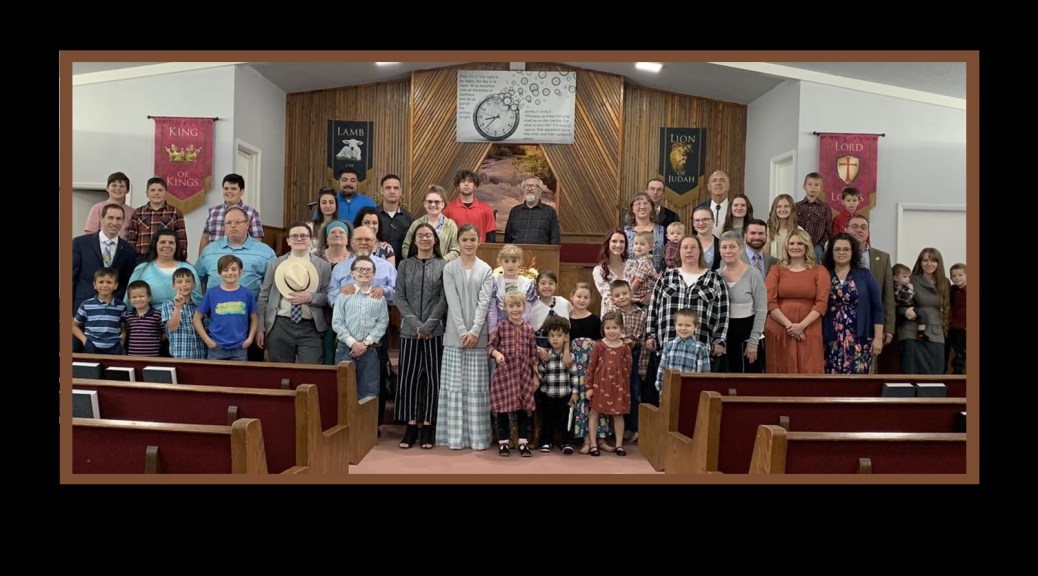
Charity Baptist Tabernacle was planted 30 years ago by Pastor Larry Hickam and has always been exclusively under the Lord Jesus Christ. At one meeting with other pastors in Amarillo, someone once asked Pastor Hickam if CBT had a constitution. His response was to lift his King James Bible and say, “Yes, and here it is.” CBT remains, to this day a First Amendment, non-statutory, non-incorporated, non-501(c)(3), non-508(c)(1)(a) church which gives the preeminence to the Bridegroom, the Lord Jesus Christ.

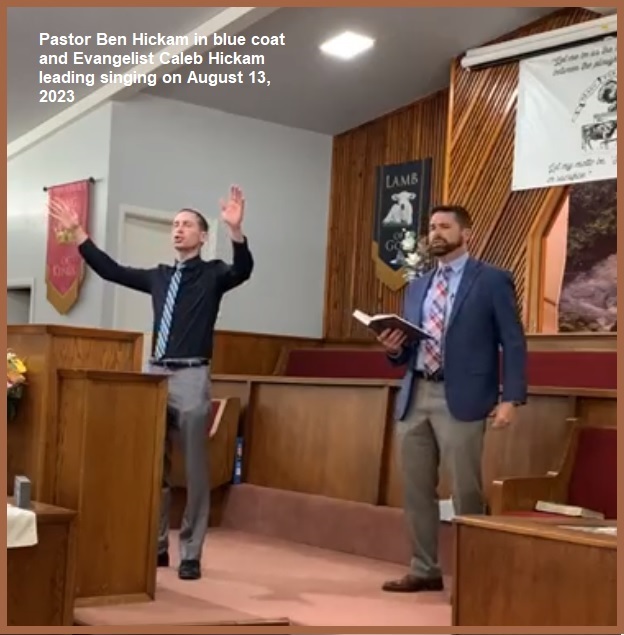
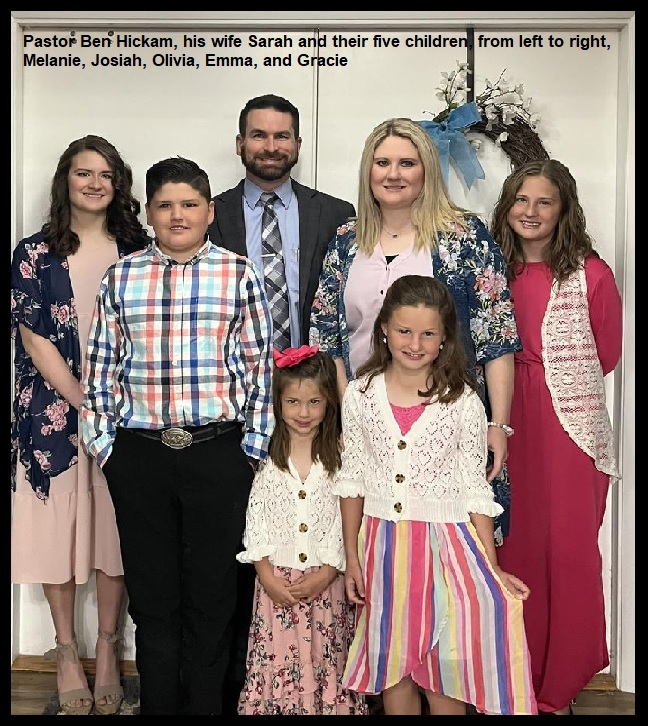
Pastor Larry’s son,  Ben Hickam became Pastor when his dad, Larry Hickam, stepped down in July, 2018. Like his dad, his sole authority for all matters of faith and practice (individual, family, and church) is the King James Bible.

After becoming pastor, he led CBT in executing a Declaration of Trust laying out relevant Bible and legal principles regarding the holding and management of God’s property and the relationship of church and state; something CBT already knew and practiced.

To hear more Charity Baptist Tabernacle sermons and lessons, go to: Charity Baptist Tabernacle: Sermons and Lessons.

Contact information for Pastor Ben Hickam
Cell phone: 806-220-9622
Email: benhickam@gmail.com

Appendix 2 to Simply Church: Common Law versus Statutory Law

Click here to go to the following webpage for Table of Contents with links to all chapters of: Simply Church: The Holy Union of Christ and His Local Church

Jerald Finney
Copyright May 30, 2023

See Endnote for links to state adaptations of the Uniform Trust Code

General Considerations

The concept of the trust fiduciary relationship with property (both material and spiritual) was originated by God. See, The Bible Trust Relationship with Property Is Not Something New: It was God’s Plan Starting with Adam and Eve.  Common law and statutory law, whichever is in effect in a given jurisdiction, recognize the relationship. Courts, under the common law, before government legislated rules for deciding trust issues, decided matters regarding abuse of the trust relationship when petitioned by an interested party or parties, using prior case law, and/or Bible or religious principles, and/or principles of ethics. Under statutory law, courts look at the statutory rules, and/or common law rules, and/or principles of ethics in deciding issues.

Under both the common law and statutory law the trust relationship is private and requires no filing, contract, or registration with or regulation by the state. Thus, the trust relationship with property is dramatically distinct from trusts which are a product of man’s law and creatures of the state—charitable trusts, business trusts, etc.

Both the common law and the codified adaptations of the common law of trusts define trust in the same way. The statutory rules, many of which are adopted directly from the common law, standardize some of the rules for deciding issues, but defer also to the common law if need be. Both the common law and code or statutory law require that a trust be declared and practiced (whether orally or in writing) for a legal purpose. As long as a trust is declared solely as a means of holding and managing property outside the realm of tax laws, inheritance laws, and other laws the courts will apply the applicable statutory or common law rules. Under both common law and statutory law, a court will not intervene in the administration of a trust unless its jurisdiction is invoked by an interested party. If contested, jurisdiction must be established by the petitioning party.

The Bible trust relationship with property declared and/or practiced by churches as a means of holding and managing God’s property invoke no tax consequences. The First Amendment is a statement of the Bible principle of separation of church and state. See for explanation, God Betrayed/Separation of Church and State: The Biblical Principles and the American Application; or Separation of Church and State/God’s Churches: Spiritual or Legal Entities. Thus, a church who remains totally separate from civil government is non-taxable whereas a church who has established a legal connection with civil government is tax exempt. To understand the difference see the essay Church Internal Revenue Code  508(c)(1)(A) Tax Exempt Status and the essays linked to in that article. The property held in a church Bible trust involve no tax matters. The trust is a private fiduciary relationship with property, and assuming that the trust is properly declared and managed, the only reason any party could have for petitioning the court regarding a trust matter would have to involve a violation by the trustee of his fiduciary duties in holding and administering the trust estate. This is true under both common law and statutory law, whichever is applicable.

Trusts are commonly used as part of an individual’s estate plan, to avoid probate and/or to obtain favorable tax consequences. Churches who love the Lord and wish to please their espoused, the Lord Jesus Christ, use God’s trust plan; they declare the trust relationship with material and spiritual properties. Some churches orally apply the concept, others execute trust documents declaring the trust relationship with property given to the Lord Jesus Christ, to God. Generally, the preferred method is for the church to execute written trust documents.

Specific Considerations

Under the common law of trusts, there were no statutes to guide the courts, only prior court decisions and principles of equity. Statutory trust law gives rules to guide courts in the event trust matters are brought to the court for resolution.

Most or all states in America now have codified rules for courts to follow in cases where an interested party has petitioned the court to take jurisdiction over a matter involving a trust relationship with property. The prior law governing the trust relationship is fundamentally American common law. Now, statutes in most states provide rules for courts to look at in deciding issues involving the trust relationship.

Thirty-six states have adopted, usually with some modifications, the Uniform Trust Code (UTC). The UTC is a model law in the United States created by the Uniform Law Commission, which although not binding, is influential in the states, and used by many as a model law.  As of May 19, 2021, 34 states had adopted, usually with modifications, the UTC (See, EN [i] for listing of those states; see also, States that Have Adopted the Uniform Trust Code. Hawaii and the District of Columbia enacted the UTC as of January 1, 2022.

In 2000 the National Conference of Commissioners on Uniform State Laws (NCCUSL) adopted the first national codification of the law of trusts with the Uniform Trust Code (UTC). According to the NCCUSL, the purpose of the Uniform Trust Code is to provide a comprehensive model for codifying the law on trusts. The UTC has its basis in common law sources. The objective of the UTC is a codification of existing law, but with elements of law reform. According to NCCUSL, the reforms are intended to conform trust law to modern needs. The UTC provides fundamental rules that apply to all voluntary trusts. According to NCCUSL, the UTC “does not try to incorporate detailed rules for every conceivable kind of trust, nor does it incorporate all of the kinds of trusts there are.”

The UTC is intended to enable states that enact it to specify their rules on trusts with precision and to provide individuals with a readily available source for determining their state’s law on trusts.

Trust statutes direct courts to the common law when necessary. Section 106 of the UTC states: “The common law of trusts and principles of equity supplement this [Code], except to the extent modified by this [Code] or another statute of this State.” This is also true of trust statutes of states who have not adopted the UTC. For example, The California Probate Code, Division 9, Trust Law, Part 1, Section 15002 states: “Except to the extent that the common law rules governing trusts are modified by statute, the common law as to trusts is the law of this state.” Subtitle B – Texas Trust Code, Chapter 111 Section 111.005 – Reenactment of Common Law states, “If the law codified in this subtitle repealed a statute that abrogated or restated a common law rule, that common law rule is reestablished, except as the contents of the rule are changed by this subtitle.”

Statutory trust law gives uniformity of rules when a court accepts a petition involving a matter involving tax implications.  This can be readily seen by a reading of the Code. The common law was perfectly adequate for dealing with any church Bible trust issue; with a caveat for the church and believer: see I Corinthians 5 and 6,  King James Bible. Under statutory law, if a matter involving a church Bible trust is ever presented to a court, and the court accepts jurisdiction, the court will likely have to refer to the common law and principles of equity. The reason for this is that the trust codes are usually necessary to deal with matters involving matters involving various types of taxes, and the church Bible trust fiduciary relationship with property does not implicate any such concern.

There can be no tax consequences for the Settlor, the Trustee, the Trust Estate, the Beneficiary or anyone else regarding a church Bible trust relationship with property as when a trust is used in estate planning, to avoid probate or to obtain favorable tax consequences. Why? Because:

  • The church Bible trust is not an organization. It is a fiduciary relationship with property. It has no income, no employees, pays no salaries, etc. What is given to God is held in trust to be used according to the will of the Lord Jesus Christ as given in his word, the holy King James Bible. There is no profit to the Settlor, the Trust, Trustee, or anyone else. The matter of use of the trust related to any taxation is not a factor which man’s law must address.

Uniform Trust Code with Comments

Uniform Trust Code – Background Memorandum Prepared by the North Dakota Legislatve Council staff for the Judiciary Committee, September 2005

UNIFORM TRUST CODE (Last Revised or Amended in 2010) Drafted by the NATIONAL CONFERENCE OF COMMISSIONERS ON UNIFORM STATE LAWS and by it APPROVED AND RECOMMENDED FOR ENACTMENT IN ALL THE STATES (General Comment. The Uniform Trust Code is primarily a default statute. Most of the Code’s provisions can be overridden in the terms of the trust.): https://dta0yqvfnusiq.cloudfront.net/fifel38841394/2018/12/Uniform-Trust-Code-5c12a36374cd4.pdf

Massachusetts UTC with Comments: https://www.fieldsdennis.com/uniform-trust-code-report-with-commentary

I would be glad to discuss these matters with you in more detail. You can call me (Jerald Finney) at 512-785-8445.


Endnote

EN[i] Alabama (Ala. Code §§ 19-3B-101et seq.). Creditor’s Claims Against Settlor.

Arizona (Ariz. Rev. Stat. §§ 14-10101et seq.). Creditor’s Claims Against Settlor.

Arkansas (Ark. Code Ann. §§ 28-73-101et seq.). Creditor’s Claim Against Settlor.

Colorado (CO Rev Stat 15-5-101et seq). Creditor’s Claim Against Settlor (Introduced to be Section 15-5-505).

Connecticut (Connecticut General Statutes 45a-499a)

District of Columbia (D.C. Code §§ 19-1301.01et seq.). Creditor’s Claim Against Settlor.

Florida (Fla. Stat. §§ 736.0101et seq.). Creditor’s Claim Against Settlor.

Illinois (760 Illinois Compiled Statutes 3). Creditor’s Claim Against Settlor – 760 ILCS 3/505.

Kansas (Kan. Stat. Ann. §§ 58a-101et seq.). Creditor’s Claim Against Settlor.

Kentucky (Ken. Rev. Stat. §§ 386B.1-010et seq.). Creditor’s Claim Against Settlor.

Maine (Me. Rev. Stat. Ann. Tit. 18-B, §§ 101–1104et seq.). Creditor’s Claim Against Settlor.

Maryland (MD Est & Trusts Code §§ 14.5-101et seq.). Creditor’s Claim Against Settlor.

Massachusetts (Mass. Gen. Law Chapter 203E). Creditor’s Claim Against Settlor.

Michigan (Mich. Compiled Laws §§ 700.7101et seq.). Creditor’s Claim Against Settlor.

Minnesota (Minnesota Statutes §§ 501C.0101et seq. Creditor’s Claim Against Settlor. Until July 2021, Minnesota had a trust-buster statute that effectively nullified Medicaid Asset Protection Trusts. However, this statute was recently struck down (with some help from Evan Farr) by Minnesota’s Court of Appeals.

Mississippi (MS Code §§ 91-8-101et seq.). Creditor’s Claim Against Settlor not yet enacted.

Missouri (Mo. Rev. Stat. §§ 456.1-101et seq.). Creditor’s Claim Against Settlor.

Montana (Mont. Code. Ann. §§ 72-38-101et seq.). Creditor’s Claim Against Settlor.

Nebraska (Neb. Rev. Stat. §§ 30-3801et seq.). Creditor’s Claim Against Settlor.

New Hampshire (N.H. Rev. Stat. Ann. §§ 564-B-101et seq.). Creditor’s Claim Against Settlor.

New Jersey (N.J.S. 3B:31-1et seq.). Creditor’s Claim Against Settlor.

New Mexico (N.M. Stat. Ann. §§ 46A-1-101et seq.). Creditor’s Claim Against Settlor.

North Carolina (N.C. Gen. Stat. §§ 36C-1-101et seq.). Creditor’s Claim Against Settlor.

North Dakota (N.D. Cent. Code §§ 59-09-01et seq.). Creditor’s Claim Against Settlor.

Ohio (Ohio Rev. Code Ann. §§ 5801.01et seq.). Creditor’s Claim Against Settlor.

Oregon (Or. Rev. Stat. §§ 130.001et seq.). Creditor’s Claim Against Settlor.

Pennsylvania (20 Pa. Cons. Stat §§ 7701et seq.). Creditor’s Claim Against Settlor.

South Carolina (S.C. Code Ann. §§ 62-7-101et seq.). Creditor’s Claim Against Settlor.

Tennessee (Tenn. Code Ann §§ 35-15-101et seq.). Creditor’s Claim Against Settlor.

Utah (Utah Code Ann §§ 75-7-101et seq.). Creditor’s Claim Against Settlor.

Vermont (Verm. Stat. §§ 14.A-101et seq.). Creditor’s Claim Against Settlor.

Virginia (Va. Code Ann. §§ 55-541.01et seq.). Creditor’s Claim Against Settlor.

West Virginia (W. Va. Code §§ 44D-1-101et seq.). Creditor’s Claim Against Settlor.

Wisconsin (Wis. Stats. §§ 701.0101et seq.). Creditor’s Claim Against Settlor.

Wyoming (Wyo. Stat. Ann. §§ 4-10-101et seq.). Creditor’s Claim Against Settlor.

The Uniform Trust Code went into effect in Hawaii and the District of Columbia on January 21, 2022.


Section I, Chapter 6: The Bible Trust Relationship with Property is Not Something New: It was God’s plan starting with Adam and Eve

Click here to go to the following webpage for Table of Contents with links to all chapters of: Simply Church: The Holy Union of Christ and His Local Church

Appendix 1 gives links to resources which explain why church incorporation, federal tax exempt status, and other statutory or legal status of churches betray the love relationship between Christ and His churches.

Appendix 2 looks at common law versus statutory law church Bible Trust considerations.

Copyright © by Jerald Finney
March 4, 2023

Introduction

Legal scholars have unsuccessfully sought to uncover the origin of the trust relationship with property. They did not go to the source which would have given them the answer: the Word of God. The Bible Trust relationship with property is a concept, a plan created by God. He was the trustor, settlor, or grantor. The property held in trust is the trust estate. Man is the trustee or steward, the person who has a fiduciary duty to hold and manage the trust estate solely for the glory and benefit of the true owner, God.

The Bible Trust is inherent in the execution of God’s plan for the relationship of mankind with His creation. God owns the earth and all that is in it, to include every person. He entrusted man with the responsibility of holding and managing His properties, earthly and spiritual, solely for His benefit, for His glory. After creating man, “God blessed them, and God said unto them, Be fruitful, and multiply, and replenish the earth, and subdue it: and have dominion over the fish of the sea, and over the fowl of the air, and over every living thing that moveth upon the earth” (Genesis 1:28). “And the LORD God took the man, and put him into the garden of Eden to dress it and to keep it.” (Genesis 2:15).

That same trust relationship is still in effect. Everyone is responsible to God for managing His properties. God will hold everyone who has reached the age of accountability responsible for how he exercises his fiduciary duty to hold and manage all that God entrusts him with.

When one examines New Testament Church doctrine, one finds that God’s plan is for the local church to be exclusively a heavenly, spiritual, eternal organism only, not an earthly, material, temporal organization or a hybrid of the two. This is thoroughly examined in Part I of God Betrayed/Separation of Church and State: The Biblical Principles and the American Application. God has entrusted civil government with earthly matters and the church with spiritual matters. Distinct difference between church and state render them mutually exclusive.

New Testament churches were organized according to God’s plan. They had no relationship whatsoever with the state. They acted as spiritual entities only. They entered into no contract with the state or any other entity, owed no debt, depended upon God for everything and the state for nothing, owned nothing, had no employees and therefore paid no salaries, held no bank accounts, held title to no real estate, leased no property, etc.

Of course, as is made clear in Romans 13:8-10 and other New Testament passages, believers and church members are subject to civil government for their relationship with man (the Second Table of the Law), but not for their relationship with  God (the First Table of the Law). God gave civil government temporal earthly jurisdiction over evil doers, those who commit crimes against another or others. He gave the church eternal heavenly jurisdiction over His children. Thus, as to heavenly matters, the church and the believer are to “obey God rather than men.” They are to have no authority over them in those matters other than the Lord Jesus Christ and His Word. Again, see Part I of God Betrayed.

A local church can organize and operate according to God’s will as did churches in the New Testament. As to organization, she can do so by practicing God’s Bible Trust plan. Even better, she can declare the Bible Trust Relationship with both God’s earthly and spiritual properties in writing.

This lesson will explain that:

  1. Although man recognizes the concept of trust, secular scholars have not found its origin.
  2. God originated the Bible (common law) Trust relationship with property, both material/temporal and spiritual/eternal.
  3. There is only one way which a church may organize in compliance with Bible Church Doctrine. The churches in the New Testament all recognized and applied the doctrine of the Bible Trust.

 1. Although man recognizes the concept of trust, secular scholars have not found its origin.

Efforts of scholars to trace the origin have been futile. Whether these origins are Roman, Canonical or Germanic [or of some other origin] remains an unresolved question. …” Trusts, trust-like concepts and ius commune, 8 Eur. Rev. Private L. 453 (2000), C. H. Van Rhee See,  En[i],  (This article can be viewed and/or downloaded at: https://www.academia.edu/5937188/Trusts_Trust_like_Concepts_and_Ius_Commune. It can also be downloaded and viewed at https://www.academia.edu/3568421/On_the_Origin_of_the_Uses_and_Trusts?email_work_card=view-paper.)

The Roman Catholic “Church,” with all its heresies understood this matter, although with some distortion, a long time ago:

  • “Trust-like devices were popular in the Church [speaking of the Roman Catholic ‘church’], since they allowed this institution to accumulate the necessary means to discharge its tasks. At the same time, these devices preempted the criticism that the Church was not practising [sic] its own teachings on the spiritual dangers of wealth. The wealth accumulated by the Church was not regarded as property owned by the Church itself. According to S. Herman, it was said to belong to God the Father as sovereign Lord, the Pope and his clerical lieutenants acting as His stewards. In trust terminology: God acted as ‘settlor’, while the Pope and his clerical lieutenants acted as trustees. Christ, the meek, the poor and the congregation were usually designated as ‘beneficiaries’. God, as the settlor, also figured as the ultimate beneficiary of creation. In this way, the wealth of the Church could be justified, since the Church simply acted as a depositary of goods created for all. Church officials were charged with managing the goods entrusted to them as ‘trustees’ and with using them for the good of the community. ” See Trusts, Trust-Like Concepts and Ius Commune…;Op Cit.

Of course, this Catholic misunderstanding allowed the Institution of the Roman Catholic “Church” to prosper and store up tremendous wealth while the clergy lived a luxurious life (the “beneficiaries” in practice although not in name) since the trust estate was not used for the benefit of God according to his will, the true owner of everything. Nonetheless, even though misapplying the concept, Catholicism recognized it.

2. God originated the Bible (common law) Trust relationship with property, both material/temporal and spiritual/eternal.

Had scholars considered all the evidence, they would have discovered that the concept of trust was originated by God in the manner in which He ordered things. The plan started when God created and covenanted with man; it is evident throughout the Word of God. “Trust” (also explicitly stated), “trust estate,” “trustor,” (or “grantor” or “settlor”), “trustee” or “steward,” “beneficiary,” and “fiduciary” are all found in the Bible. The concept is just part of the way things work, the way God arranged things, as He explains in His Word.

The principle of trust originated with God. God embedded this precept in His word and it is seen from Genesis to Revelation and in all dispensations. God has administered his rule over the world in various dispensations or economies as He progressively works out His purpose of world history. Primarily, dispensations are stewardships. All in a particular dispensational economy are stewards (trustees), although one man usually stands out. For example, Paul was used by God more than any other to reveal His grace and to record the doctrine of the church as dictated by God. Nonetheless, all the apostles and every other believer are also stewards of God’s grace. All have a responsibility to respond to that grace. God will judge those who fail to do so. (Charles C. Ryrie, Dispensationalism (Chicago: Moody Press, 1995), pp. 56-57; for an more detailed analysis of dispensations and dispensationalism, see the short article The Essence of Dispensationalism).

Some meanings of trust, as given in the 1828 Webster’s Dictionary, are:

  1. Confidence; a reliance or resting of the mind on the integrity, veracity, justice, friendship or other sound principle of another person. He that putteth his trust in the Lord shall be safe. Proverbs 29:25.
  2. Something committed to a person’s care for use or management, and for which an account must be rendered. Every man’s talents and advantages are a trust committed to him by his Maker, and for the use or employment of which he is accountable.

This article will deal with definition 2 above. From that definition, one can see that the God ordained a trust arrangement with mankind.

God owns everything—the land, everyone, and everything. That ownership is implicit in the fact that He created it all. (Ge. 1). He clearly stated His ownership of all in His Word:

  • God said, “Now therefore, if ye will obey my voice indeed, and keep my covenant, then ye shall be a peculiar treasure unto me above all people: for all the earth is mine:” (Ex. 19.5).
  • God said, “The land shall not be sold for ever: for the land is mine; for ye are strangers and sojourners with me.” (Le. 25.23).
  • “Thine, O LORD, is the greatness, and the power, and the glory, and the victory, and the majesty: for all that is in the heaven and in the earth is thine; thine isthe kingdom, O LORD, and thou art exalted as head above all. Both riches and honour come of thee, and thou reignest over all; and in thine hand is power and might; and in thine hand it is to make great, and to give strength unto all” (1 Chronicles 29:11-12).
  • “The earth isthe LORD’S, and the fulness thereof; the world, and they that dwell therein.” (Ps. 24.1).
  • God said, “For every beast of the forest is mine, and the cattle upon a thousand hills.” (Ps. 50.10).
  • “The heavens are thine [God’s], the earth also is thine: as for the world and the fulness thereof, thou hast founded them.” (Ps. 89.11).
  • “The silver is mine, and the gold is mine, saith the LORD of hosts.” (Hag. 2.8).
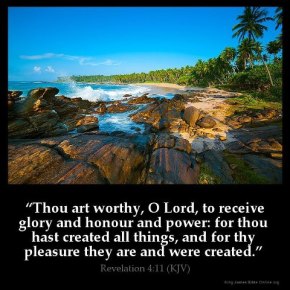
Re.4.11God, the true owner of all things, entrusted man, under God, with the earth and all that is in it. God entrusted man with His property. Man was put in trust to administer God’s earthly property according to God’s plan. Man benefited from use of the property entrusted him. Man was to use the property God entrusted him with for the glory of God, for God’s pleasure (Revelation 4.11). God entrusted a New Testament church to the members of the church. Church members are trustees of the church they are members of.

Man is a fiduciary under God. Fiduciary, as a noun, means “One who holds a thing in trust; a trustee.” Man, as trustee, had a fiduciary duty to hold and administer God’s property for the benefit of God. Church members have a fiduciary duty to organize and operate the church they belong to according to God’s guidelines as stated in the New Testament. Fiduciary as an adjective means, “Not to be doubted; as fiduciary obedience” or “Held in trust.” Man benefits from use of God’s property and church members benefit from belonging to a church under God only.

God, the trustor, ordered man, the trustee, in the Garden of Eden, “Of every tree of the garden thou mayest freely eat: But of the tree of the knowledge of good and evil, thou shalt not eat of it: for in the day that thou eatest thereof thou shalt surely die.” (Ge. 2:16-17). Eating of the tree of knowledge of good and evil was a violation of man’s fiduciary duty to administer God’s property according to the will of the true, beneficial, and equitable owner of the property.

When God entrusted Adam and Eve with the earth and all that is in it, he gave them responsibilities:
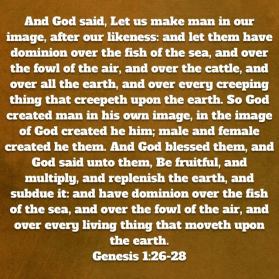
Ge.1.26-28“And God blessed them, and God said unto them, Be fruitful, and multiply, and replenish the earth, and subdue it: and have dominion over the fish of the sea, and over the fowl of the air, and over every living thing that moveth upon the earth.  And God said, Behold, I have given you every herb bearing seed, which is upon the face of all the earth, and every tree, in the which is the fruit of a tree yielding seed; to you it shall be for meat.  And to every beast of the earth, and to every fowl of the air, and to every thing that creepeth upon the earth, wherein there is life, I have given every green herb for meat: and it was so.  And God saw every thing that he had made, and, behold, it was very good. And the evening and the morning were the sixth day.” (Ge. 1.28-31).

Man violated his duty and God held him accountable. Satan lied to the woman and tempted her to eat of the fruit of the tree of the knowledge of good and evil. “And when the woman saw that the tree was good for food, and that it was pleasant to the eyes, and a tree to be desired to make one wise, she took of the fruit thereof, and did eat, and gave also unto her husband with her; and he did eat.  And the eyes of them both were opened, and they knew that they were naked; and they sewed fig leaves together, and made themselves aprons.” (Ge. 3:6-7).

God then judged man, woman, and Satan. Things changed. “And the LORD God said, Behold, the man is become as one of us, to know good and evil: and now, lest he put forth his hand, and take also of the tree of life, and eat, and live for ever: Therefore the LORD God sent him forth from the garden of Eden, to till the ground from whence he was taken. So he drove out the man; and he placed at the east of the garden of Eden Cherubims, and a flaming sword which turned every way, to keep the way of the tree of life.” (Ge. 3:22-24)

Man remained in trust of all that God gave him. Mankind continued as trustee of God’s earthly property. Man had legal (temporal earthly) title to God’s earthly property. Later, after the flood, God divided the earth into the nations and instituted civil government–the rule of man by man under God for the purpose of controlling evil doers. The perpetual principle that nations—Gentile nations and Israel—and individuals were left in trust of land and all things for the benefit of God continues.
3. There is only one way which a church may organize in compliance with Bible Church Doctrine. The churches in the New Testament all recognized and applied the doctrine of the Bible Trust.

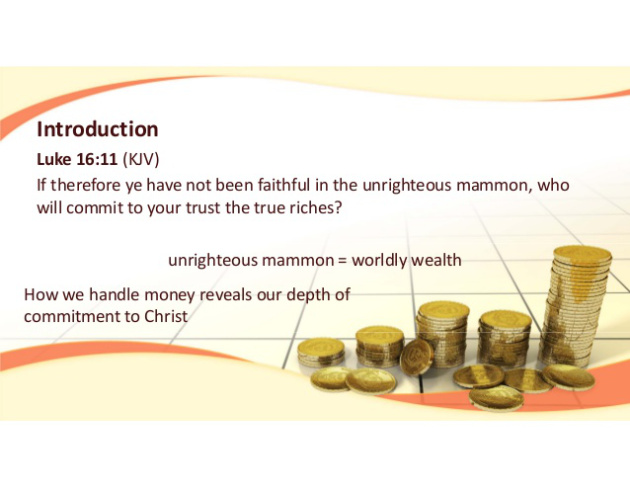
He that is faithful in that which is least is faithful also in much: and he that is unjust in the least is unjust also in much. If therefore ye have not been faithful in the unrighteous mammon, who will commit to your trust the true riches? And if ye have not been faithful in that which is another man’s, who shall give you that which is your own? No servant can serve two masters: for either he will hate the one, and love the other; or else he will hold to the one, and despise the other. Ye cannot serve God and mammon.” Luke 16:10-13

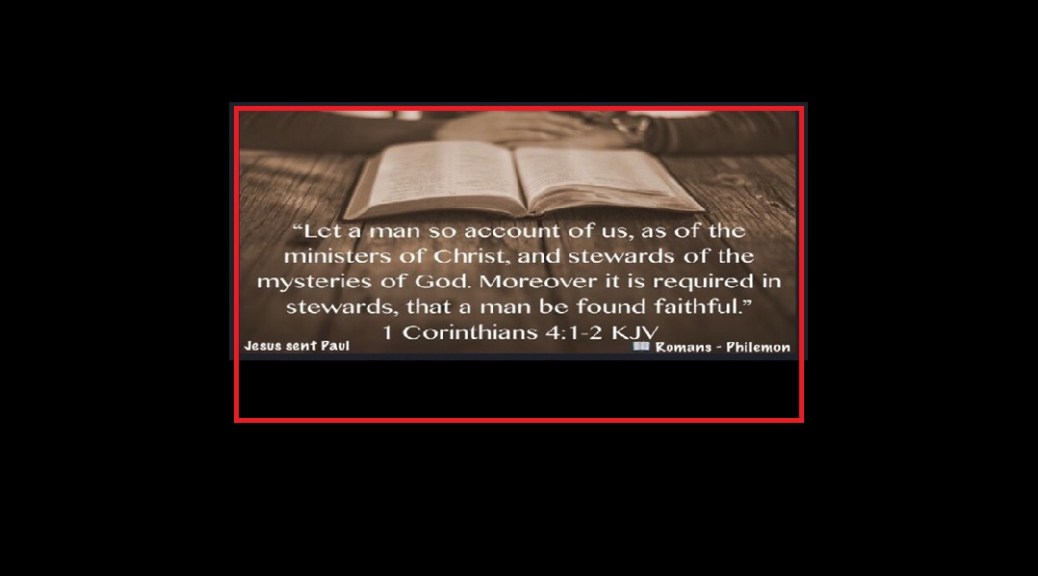
Let a man so account of us, as of the ministers of Christ, and stewards of the mysteries of God. Moreover it is required in stewards, that a man be found faithful.” 1 Corinthians 4.1-2

But as we were allowed of God to be put in trust with the gospel, even so we speak; not as pleasing men, but God, which trieth our hearts.” 1 Thessalonians 2:4

According to the glorious gospel of the blessed God, which was committed to my trust.” 1 Timothy 1:11

O Timothy, keep that which is committed to thy trust, avoiding profane and vain babblings, and oppositions of science falsely so called:” 1 Timothy 6:20

As recorded in the New Testament, God ordained his church, an institution made up of local autonomous spiritual bodies. The churches in the New Testament followed the doctrine given them by God through the apostle Paul. They were “built upon the foundation of the apostles and prophets, Jesus Christ himself being the chief corner stone” and were built “together for an habitation of God through the spirit” (Ephesians 2:20-22). They were spiritual, not earthly, entities. God made them to “sit together in heavenly [not earthly] places in Christ Jesus” (Ephesians 2:6). They entered into no contract with the state or any other entity, owed no debt, depended upon God for everything and the state for nothing, owned nothing, had no employees and therefore paid no salaries, held no bank accounts, held title to no real estate, leased no property, and acted legally in no way. Church members were the church. Church members therefore gave to God, not to the church, not to themselves. Someone was entrusted with managing their gifts for the glory of God (See Acts 4:34-37) and according to His will with His Word as their guide.

They were under the authority of the Lord Jesus Christ, and him alone, entirely separate from all civil government. Of course, civil government unlawfully took authority over individual believers, as they had done with our Lord.

God’s doctrine for his churches has not changed. Man’s doctrine has changed. Thus, most churches in America choose to unite with civil government for many purposes. They choose to become legal entities such as non-profit corporations, charitable trusts, and Internal Revenue Code Section 501(c)(3) or Section 508(c)(1)(A) tax exempt worldly organizations.

A church can choose to remain a spiritual entity only by utilizing the Bible concept of trust, by practicing the God’s Bible Trust plan. Churches in any nation can do things God’s way. In many countries they will be persecuted for so doing. Churches in America can, without persecution, choose to operate as did the original churches. They can do so without any documentation other than the Holy King James Bible. However, should they wish their gifts and offerings to God to be held in a checking account, they will need to execute documents which establish a Bible Trust; then the trustee of the trust, not the church, can open a checking account whose owner is the Lord Jesus Christ. Should they wish some of their offerings to God to be used to rent or lease a meeting facility or to buy such a facility, they will need documentation so that the title or lease will be held in the name of the trust signed by the trustee, the owner being the Lord Jesus Christ.

Remember that the true owner of the trust estate is the Lord Jesus Christ; the trustee is merely the legal owner whose duty is to hold and manage the trust estate solely for the benefit of the Lord Jesus Christ. In other words, the trustee as legal owner acts solely for the true owner, the Lord Jesus, not for himself.

The trustor church declares the trust relationship. The  trustee is the appointed temporal and legal owner of the trust estate, and the Lord Jesus Christ is the true, beneficial, and equitable owner of the property held in the trust estate. Gifts, tithes, and offerings are to God (to the trust estate which is owned by God), not to the church. The church is the giver, God is the recipient and owner. God’s money is placed in a checking account owned by Him, not in a checking account owned by the church or by the church corporation.

The trust is not an entity or organization, but merely a relationship with property. The church remains totally under the authority of the Lord Jesus Christ and His word as long as she does not act legally (See, Chapter 3: How a Church Can Nullify the Bible Trust Relationship with Property).

The trustee does not hold the property for the church. The trustee holds and manages the property for the benefit of, and according to the will of, the true owner of the property, the Lord Jesus Christ. The trustee is the legal owner of the property and the Lord Jesus Christ is the true, equitable, and beneficial owner. The trustee has a fiduciary duty under God to use the property, not for his own or the trustor church’s benefit, but for the benefit of the Lord Jesus Christ.

When a church assembles together, God owns the land upon which they meet. Although the trustee has the temporal and legal title to the land, God is the true, beneficial, and equitable owner. An equitable owner is “[o]ne who is recognized in equity as owner of the property, because real and beneficial use and title belong to him, even though bare legal title is invested in another.” (BLACK’S LAW DICTIONARY (6th Ed. 1990), 539). “In a trust relationship, as distinguished from a ‘contract,’ there is always a divided ownership of property, to which the trustee usually has legal title and cestui [que trust] an equitable title.” (90 C.J.S. Trusts § 1, fn. 13 (2007). C.J.S., like AM. JUR 2D, is a highly respected, used, and cited legal encyclopedia). The church does not make Jesus the owner since he is the owner no matter what the church does. The church merely declares and practices the truth: that Jesus Christ is the owner of all, including the real estate upon which the church assembles.

God’s plan requires that man hold legal title to His real property. A church under Christ alone, a spiritual entity only (See, e.g., Ephesians 2:19-22), cannot hold title (an earthly legal declaration of temporal ownership) to property. Nor can a church under Christ alone hold “church property” through a trustee or trustees. If title to property is in the name of church, or if the church holds property through a trustee of a trust, the church has acted legally and is a temporal earthly entity and not a spiritual entity only because she has entwined herself with man’s earthly legal system. Some trusts improperly state that church property will be held by a trustee for the benefit of the Lord Jesus Christ. That is a type of trust arrangement, but it compromises the spiritual only status of the church and combines the holy with the unholy, the church and the state. Corporations (aggregate of sole, profit or non-profit), charitable trusts, business trusts, and Internal Revenue Code § 501(c)(3) and § 508 organizations are legal entities. A church who owns property through one of these legal devises is asserting ownership, as she is if she owns property in the name of the church.

A  church who does not hold property but puts property into a trust estate of a properly structured Bible Trust is not acting legally. By definition, that trust is not a legal entity. The trustee of such a trust holds legal or earthly title to the property in the trust estate. He, like every citizen in his right mind, is a legal entity. Of course, if he is born again, he is also a spiritual entity (1 Corinthians 2:14-16). Thus, any property a church meets on is temporarily held by a legal entity, whether a person, a corporation, a charitable trust, or some other kind of legal entity. However, only with a properly structured Bible Trust is the property declared to be owned by the Lord Jesus Christ.

The Bible instructs the saved man to obey man as to certain temporal earthly matters and God as to eternal spiritual  matters (See Romans 13 and Render Unto God the Things That Are His/A Systematic Study of Romans 13 and Related Verses). A church under Christ alone is eternal and spiritual and subject to the jurisdiction of God only. God’s desires total separation of civil government and the church: separation of church and state, separation of the temporal and earthly from the eternal and spiritual (See, God Betrayed/Separation of Church and State: The Biblical Principals and the American Application).

Real property is temporal and earthly and must have a legal owner. The legal owner is entrusted with God’s property; and God, the trustor, desires that the legal owner use the property solely for His benefit. This is true regardless of whether the legal owner knows this or not. He is to administer the property, if any, for the benefit of the true owner of the property, the Lord Jesus Christ.

When a church establishes the Bible Trust:

  1. She obeys God’s will;
  2. She lessens the chances that the property, and especially the buildings, will become idols. “Their idols are … the work of men’s hands.  … They that make them are like unto them; so is every one that trusteth in them.” (Psalm 115.4-8);
  3. She has not prostituted herself by combining the holy with the unholy;
  4. She has chosen not to be structured like a business or a government created organization;
  5. She can operate according to the principles in the New Testament;
  6. Members of His churches give to Him, not to their church. If church members (a church is made of her members ) give to a church, that church gives to herself. The money given by members of an incorporated church go into the church, inc. bank account. The corporation is owned by the members. When members of a church who give to the church, they are technically giving to themselves since they are the church. Of course, many believers in churches not organized according to the principles of the New Testament, while giving to the churches they are members of, not to God, believe in their heart they are giving to God. I believe God will honor their giving, even though not according to knowledge, understanding and wisdom. However, when one grows to understand the truth about giving to God, he has a responsibility to begin to do things God’s way.
  7. The minds of the members have not been corrupted from he simplicity that is in Christ (See, 2 Corinthians 11:1-3).

Endnote

[i] Trusts, Trust-Like Concepts and Ius Commune, 8 Eur. Rev. Private L. 453 (2000), C. H. van Rhee:  This article concludes:

Trust and Ius Commune: an Assessment
On the basis of the above, several conclusions may be drawn. Firstly, it may be concluded that it is very likely that the origins of the trust cannot completely be traced. Whether these origins are Roman, Canonical or Germanic remains an unresolved question. A link between Romanocanonical usus -Roman usus in a Canonical guise- and the trust seems the most promising of all possible links. However, much research needs to be conducted of ecclesiastical records both on the continent and in England. Examining these records should be the primary aim of legal historians interested in the origins of the trust.

“Secondly, the nineteenth-century shift from Roman law to indigenous law as the alleged origins of the trust did not change the position of the trust as a concept which may be placed in the ius commune tradition. Both the Germanic and Romano-canonical origins of the trust are of interest to scholars studying the question of whether trusts are part of a shared European tradition. As we know, ius commune comprised elements from both the Germanic and the Romano-canonical legal traditions.

“And thirdly, it may be concluded that it is very unlikely that there has been an exact
continental equivalent to the English ‘use’ or trust. The conclusion may be drawn that trust law cannot be viewed as an amalgam of concepts from the Corpus Iuris. This conclusion has also been drawn by Kenneth Reid (see his paper), who alleges that the modern trust is a relatively new concept, which cannot be explained solely by a contract/real right model. Nevertheless, we must continue to ask the question whether the uncovered similarities amount to more than parallels reflecting similar social conditions. My answer to this question is that it is very likely that English trust law was influenced by ideas on the Continent. This is not too bold a statement paying regard to the influence of the ecclesiastical courts in England as well as to the fact that English civilians frequently used Roman and Canon law texts when describing trusts.”

An interesting except from the article:

“Trust-like devices were popular in the Church [speaking of the Roman Catholic ‘church’], since they allowed this institution to accumulate the necessary means to discharge its tasks. At the same time, these devices preempted the criticism that the Church was not practising [sic] its own teachings on the spiritual dangers of wealth. The wealth accumulated by the Church was not regarded as property owned by the Church itself. According to S. Herman, it was said to belong to God the Father as sovereign Lord, the Pope and his clerical lieutenants acting as His stewards. In trust terminology: God acted as ‘settlor’, while the Pope and his clerical lieutenants acted as trustees. Christ, the meek, the poor and the congregation were usually designated as ‘beneficiaries’. God, as the settlor, also figured as the ultimate beneficiary of creation. In this way, the wealth of the Church could be justified, since the Church simply acted as a depositary of goods created for all. Church officials were charged with managing the goods entrusted to them as ‘trustees’ and with using them for the good of the community.”
Christ Has Removed the Candlesticks of Most Traditional American “Bible Believing Churches”

Jerald Finney
February 27, 2023

Bible teaching on heresy and apostasy (from God Betrayed, published in 2008):

Essays by others:

Tracts:

Every year for decades, Christ has removed the candlesticks of untold numbers of traditional American “Bible Believing Churches,” churches who do not have the power of God. Those churches are either ceasing to exist or going into apostasy (Emerging Church, Charismatic Movement, etc.). Sadly, most believers and churches have no clue as to why this is happening since they have not diligently studied and applied God’s Word. “Jesus answered and said unto them, Ye do err, not knowing the scriptures, nor the power of God” (Matthew 22:29). Without knowing the Scriptures, a church cannot have the power of God. Christ does not come upon churches unawares. He admonishes before chastising, warns before laying waste.

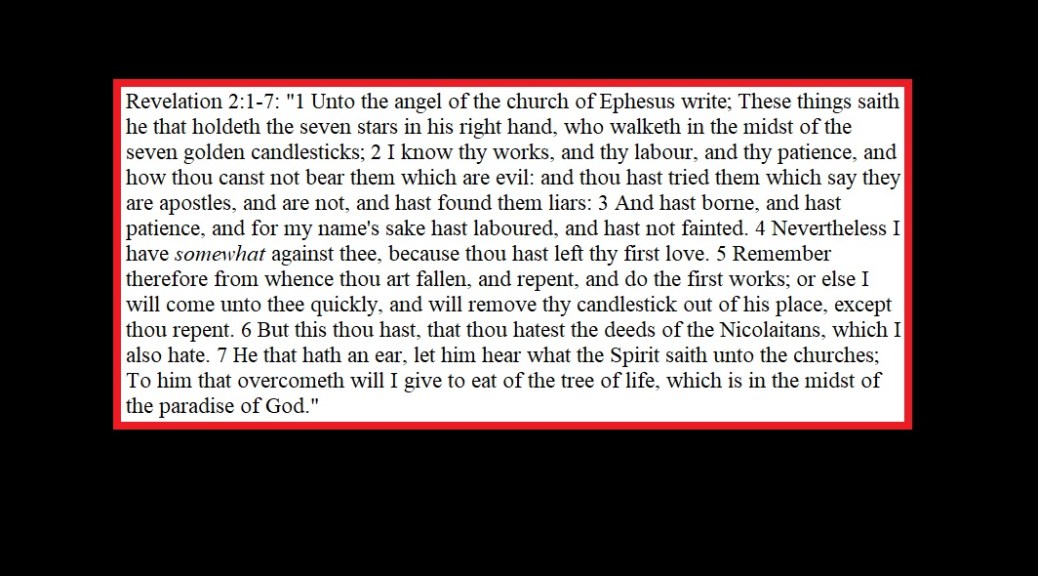
Many of these “Bible Believing Churches” revel in their good works, bragging as to the multitude of souls that are allegedly being saved. God is saving some souls, but not the multitudes claimed. See, Revelation 2:2-3, 6. God tells a church who is doing a lot of good works, but has left her first love: “Remember therefore from whence thou art fallen, and repent, and do the first works; or else I will come unto thee quickly, and will remove thy candlestick out of his place, except thou repent” (Revelation 2:5).

One first work involves falling in love with, studying and applying God’s Word. The church who does so will find her zeal for the Lord renewed; she will seek to purify her holy relationship with the Lord Jesus Christ; she will watch, fast, pray, reprove sin, carefully attend all the ordinances of God, walk as in His sight, and rest not till she has recovered all her lost ground, and got back the evidence of her acceptance with her Bridegroom.

Except for a small remnant in America, even “Bible Believing Churches” do not know that Scripture says salvation is just the beginning. God’s purposes extend far beyond soul winning. Once saved, God’s plan for believers is to be added to a local church where they can be discipled and grow in knowledge, understanding and wisdom. Then, God desires that they, and their churches, fight spiritual warfare on all fronts.  Sadly, many times the believer who is called to fight on a front which has been neglected of abandoned is blackballed by those trapped within their system and traditions.

Section I, Chapter 5: The Bible Trust Relationship with Property Does Not Organize a Church as a Trust

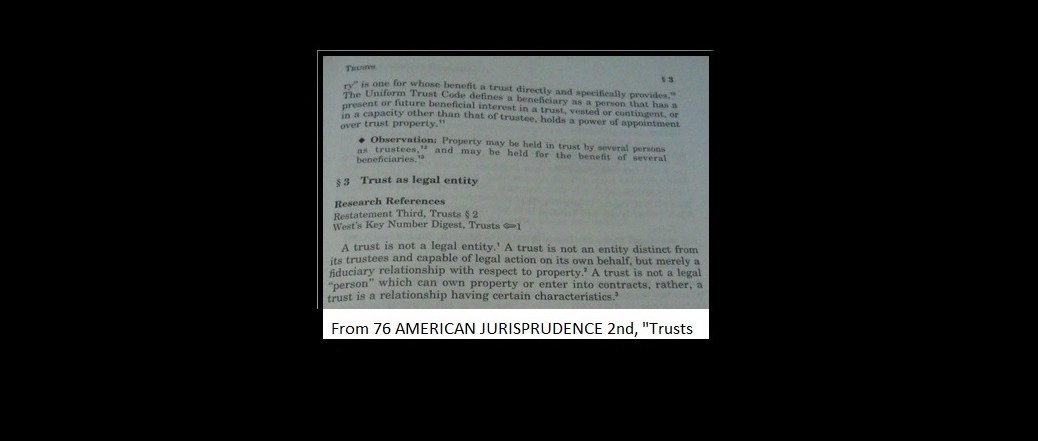
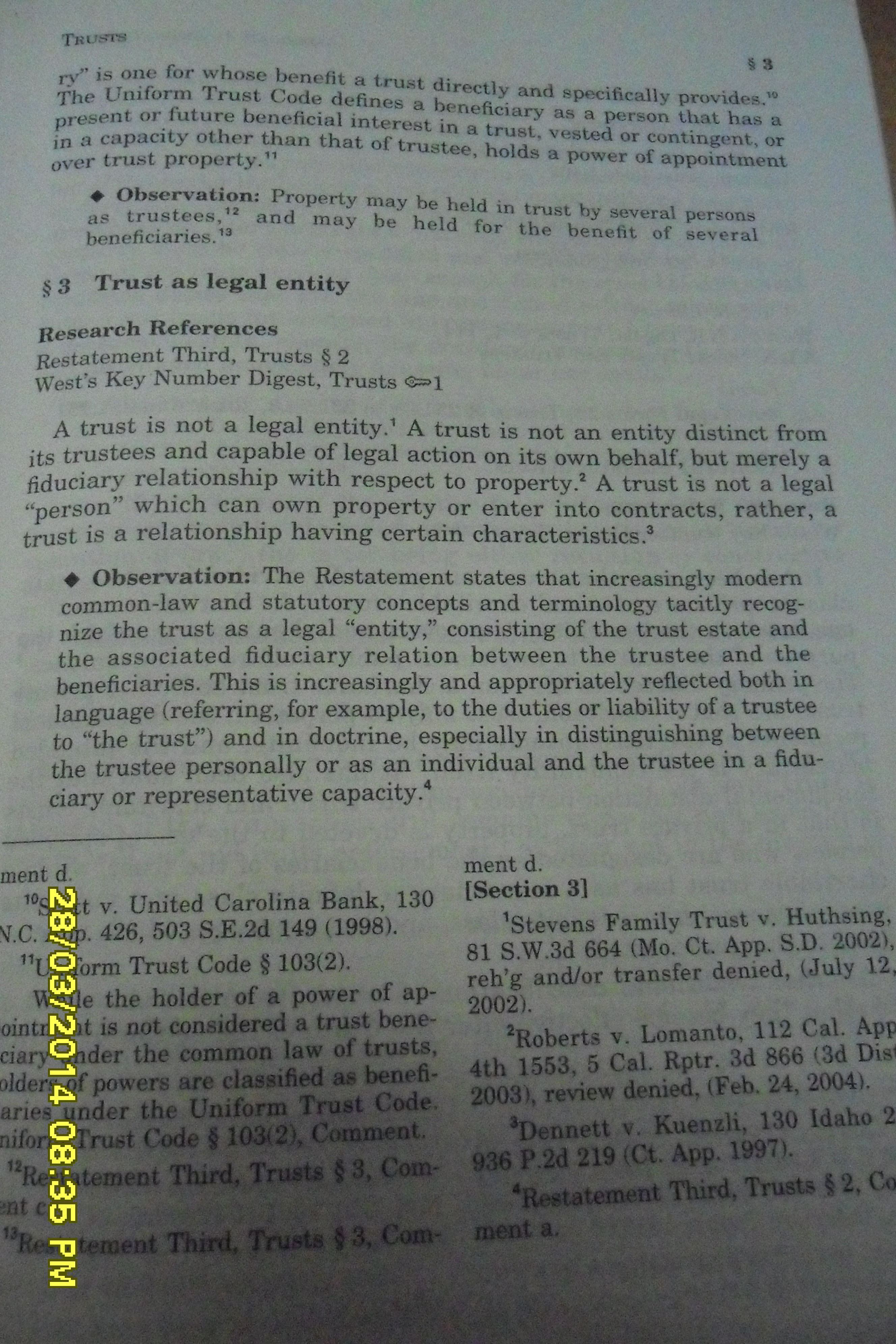
76 American Jurisprudence 2d, Trusts § 3

Click here to go to the following webpage for Table of Contents with links to all chapters of: Simply Church: The Holy Union of Christ and His Local Church

Appendix 1 gives links to resources which explain why church incorporation, federal tax exempt status, and other statutory or legal status of churches betray the love relationship between Christ and His churches.

Appendix 2 looks at common law versus statutory law church Bible Trust considerations.

Copyright © by Jerald Finney
February 21, 2021

Sometimes pastors or other members of churches who have declared a Bible Trust will say, “Our church is organized as a trust.” That is not true. A Bible (common law) Trust is not a legal entity or an organization. It is merely a relationship with property with a trustor, trustee, trust estate and beneficiary (the owner of all the property in the trust estate).

As explained in prior lessons, a Bible Trust is nothing more than a fiduciary relationship with property. See, Basics and Elements of a Church Bible Trust Relationship with Property. When a church applies and practices the concept of the Bible Trust and other New Testament church doctrine, she is not organizing as a trust and she is not becoming a legal entity under man’s law. Neither the church nor the trust is an organization.

The Bible Trust is different from trusts whose creator and sovereign is the state. For example, charitable and business trusts are legal organizations formed by contracting with state government. When the state grants the application, the church becomes a charitable or business trust, a legal entity, subject to the authority of state government for many purposes. Like other types of legal entities, such trusts are bound by state rules and regulations of state law and agency regulation; any disputes are decided by the controlling party, the state, through her agencies and/or courts.

No documents are necessary for a church to declare and practice the Bible Trust relationship with property. She can simply do things God’s way and operate as did the churches in the New Testament. She is not subject to the jurisdiction of state law. However, should someone name her in a lawsuit, the pastor or other church representative must make a court appearance to contest jurisdiction. Remember that a church must not slip and do something which disqualifies her status as a non-legal entity in order to remain under God alone. See, How a Church Can Nullify the Bible Trust Relationship with Property.

However, should a church wish God’s money to be held in a bank account, title to God’s real estate for a meetinghouse, etc., she will need to execute proper trust documents. When the trustee opens a bank account or buys real estate to be held in the trust estate, neither the trust nor the church owns the money held in the trust bank account or the real estate. As explained in other chapters, the true owner is the Lord Jesus Christ; and the earthly, legal owner is the  trustee. The trustee is to hold and manage the property solely for the benefit of the true owner of the property in accordance with His will as expressed in His word, the Holy King James Bible. Properly executed trust documents assure that funds from the sale of real estate or any other asset being held in trust cannot inure to the benefit of the trustee or any other person.

God is jealous over his churches and wishes them to remain true to Him in all matters. A church who declares and applies Bible Trust doctrine and all other New Testament church doctrine is in God’s perfect will; she pleases and glorifies God. A church which organizes as a legal entity commits spiritual fornication and can be, at best, in God’s permissive will. She may be exemplary in many ways; but having left her first love and God says to her, “Repent, and do the first works; or else I will come unto thee quickly, and will remove thy candlestick out of this place, except thou repent…. He that hath an ear, let him hear what the Spirit sayeth unto the churches; To him that overcometh will I give to eat of the tree of life, which in the midst of the paradise of God.” (Revelation 2:1-7).

Analysis of “’Freedom of Conscience:’ Rhode Island founder Roger Williams “Wall of Separation” as understood by Jefferson – American Minute with Bill Federer”

Click here to go to homepage with links to all analyses of “An American Minute by Bill Federer” Challenged

For a documented history of the spiritual warfare in America that started in the colonial period and continues to this day, see The Trail of Blood of the Martyrs of Jesus/Christian Revisionism on Trial.

Jerald Finney
February 18, 2023

This article challenges Bill Federer’s American Minute publication: “Freedom of Conscience:” Rhode Island founder Roger Williams “Wall of Separation” as understood by Jefferson – American Minute with Bill Federer. In that article, Federer subtly challenges the historical fact that “separation of church and state” as used with reference to the First Amendment and to Bible principle is not meant to keep a church out of civil government, only civil government out of church matters. Keep in mind that the phrase “separation of church and state,” although not found in the federal or state constitutions, is a succinct way of describing the concept of the historical wall of separation between church and state as intended by the First Amendment.

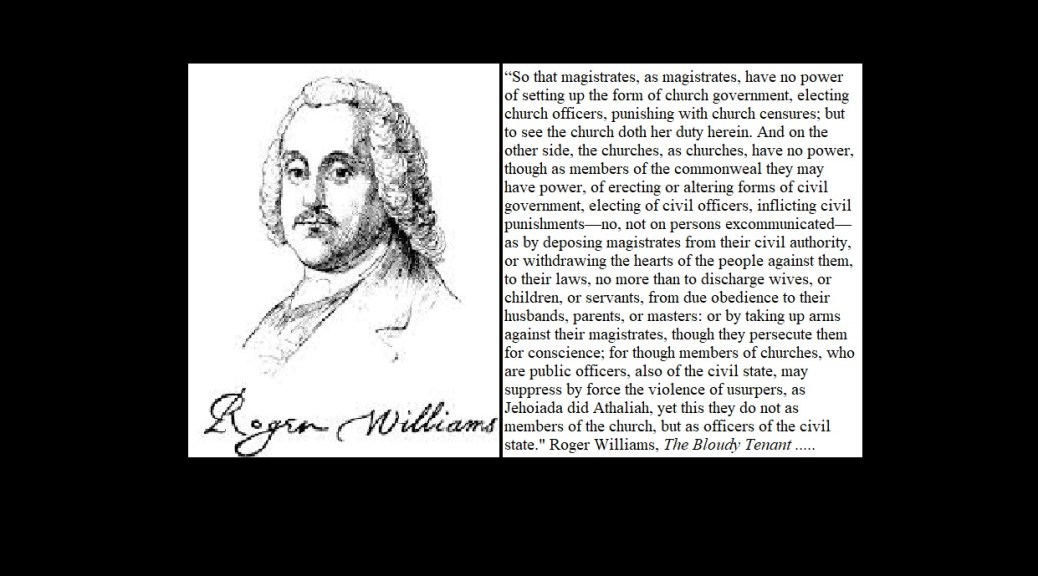
Right off the bat, in the title, Federer begins to mislead the uneducated reader. Roger Williams’ writings and documented history make abundantly clear that he upheld Bible teaching and believed in and practiced both the “two-way wall of separation” as well as “freedom of conscience.” He was banished by Puritan Massachusetts for his disagreements with the established church on matters such as their denial of freedom of conscience through enforcement of all Ten of the Commandments and their “union of church and state,” with church over the colonial Massachusetts government. Instead of waiting to be shipped back to England, Williams and a group of followers left Massachusetts and started the colony of Rhode Island, the first civil government with any lasting influence with both separation of church and state and freedom of conscience (soul liberty). Thomas Jefferson, a deist who believed in a secular state, also believed in a two-way wall of separation as well as freedom of conscience. His beliefs were based upon human reasoning. Of course, Jefferson knew that the states had chosen to allow voluntary establishment of churches and that many churches had chosen to remain separate from the state. I deal with that matter more extensively in other challenges to Federer. See, Roger Williams: Quotes and other selected information from God Betrayed. For a documented history of Roger Williams as well as that of Thomas Jefferson (on the matter or church/state relationship), see God Betrayed/Separation of Church and State: The Biblical Principles and the American Application. (For specifics on Roger Williams, see the index of the book.).

Unlike Federer, Roger Williams did not confuse “freedom of conscience” with the matter of “separation of church and state.” Williams knew that these were two separate matters although inextricably linked when a nation has one established church. Federer constantly refers to freedom of conscious when trying to make the point that church and state should not be separated (that the “wall” is only one way).

In his confusion, Federer mis-defines the true and historical meaning and application of the relationship of church and state in the American colonial and early republic context. He does this, in large part, by selectively choosing from historical quotes, writings, sermons, etc. He misrepresents the beliefs of many, to include those of the Puritans, Roger Williams, Dr. John Clarke, Thomas Jefferson, James Madison, the Apostle Paul, and many others. For example, both our Lord Jesus Christ and the apostle Paul were clearly against union of church and state and for freedom of conscience. In fact, the believer has a choice, no matter the laws of civil government or an establishment of church or religion and state: honor God even unto the death of the body or dishonor God and bow down to the church/state establishment. Our Lord said, “And fear not them which kill the body, but are not able to kill the soul: but rather fear him which is able to destroy both soul and body in hell” (Matthew 10:28). Jesus said it. Paul laid down his life practicing it.

Since the Danbury letter, Jefferson’s reply, and selected out-of-context quotes are widely misrepresented in “Christian” revisionist writings, as in this article by Federer, I will specifically address it. Federer claims that Jefferson explained who was limited by the “wall” in his letter to Samuel Miller, January 23, 1808, that being the federal government. Of course, that letter does not also explain something else that Jefferson believed, fought for, and wrote on extensively: the “wall” was definitely intended to keep the church (not Christians) out of civil government. As stated above, Jefferson was a deist who believed in a secular state. Furthermore, he did not believe in the trinity or in the miracles of Jesus. He went so far as to write his own Bible. Federer treats Madison and what he believed about the matter in like fashion. For more details see, God Betrayed; see also, Dispensation Theology versus Covenant Theology and Their Importance to the Issue of Church and State Relationship in America and Religious Liberty in America.

Along the way, Federer, again dwelling on freedom of conscience rather than separation of church and state, asks, “Freedom of Conscience”: how did it become enshrined in America’s legal tradition?” His answer is designed to carry the uneducated reader down the yellow brick road to a preconceived conclusion—that the wall of separation was meant to keep the government out of church matters but not the church out of government matters; i.e., that the church was intended by God to run the state and enforce all of God’s law. The Puritans in England and also in the colonies definitely did not believe that the King (the state) should be over the church. They came to America for religious freedom, for themselves only. Their colonial establishments in New England persecuted dissenters to the extent they could get away with. After hanging four Quakers for returning to Massachusetts after being banished by the establishment, England forbade them to execute any other dissenters. However, they continued to concoct every way they could to continue persecutions.

The colonial New England colonies combined church (not God) and civil government, the church being in the driver’s seat. They were Judaizers who believed the impossible—due to their wrong division of the word of God inherited from Augustine and John Calvin with modifications: that the rules for the only true theocracy ever ordained by God, the nation Israel, should be applied by a Gentile government. God was directly over both the civil government and the religion of Israel, and all the law and the Ten Commandments were strictly enforced. The Puritans substituted the Congregational Church for God. Their experiment quickly fell apart.

Federer states, that, throughout the Scriptures, Israel and the Church are referred to as the Lord’s “bride,” etc. and takes quotes out of context to support this matter. A contextual literal examination of Scripture makes clear that Israel was referred to as the bride of God the Father, but the bridegroom of the church is the Lord Jesus Christ. Again, all this is explained in God Betrayed. Scripture also makes clear to one who believes it, but not to one who wrongly divides it, that the relationship of “religion” and state in Gentile nations are not the same as those for God, religion, and state for the theocracy of Israel.

Of course, Federer is right when he states that God desires man to have free will and that man, in exercising that free will, choose to love God. God also gives nations a free will—honor or dishonor God and His Word. Believers in North Korea and other God rejecting nations have free will, but they may give their lives for exercising it, as did all the Apostles except John and untold millions of believers who have been viciously tortured and murdered because of their refusal to bow down to Catholic and Protestant church/state establishments. For example, the government of North Korea has chosen, of its own free will, not to honor God and God’s Word. If ta believer in North Korea is caught saying the name of Jesus in a positive way, handing out a Gospel Tract, possessing a Bible, or witnessing to another, he will be killed, and sometimes on the spot.

Federer states, “A controversy raged among inhabitants of Massachusetts, between ‘a covenant of grace’ versus ‘a covenant of works.’” There was no controversy in the colony of Massachusetts between “a covenant of grace” versus “a covenant of works.” How this inaccurate statement, and much more in the article fits together is beyond me. The spiritual battle in the New England colonies was between those who held a literal dispensational view—i.e., Dispensationalists—and the Puritans who believed a spiritualized, allegorized interpretation—i.e., Covenant Theologians. Covenant theology “represents the whole of history on the basis of two or three covenants called the the Covenant of Works, the Covenant of Grace, and, according to some Covenant Theologians, the Covenant of Redemption.” For explanation of the distinctions between the opposing factions in Massachusetts, between those holding the dispensational view and those holding to covenant theology, see Part I, Section I, Chapter 3 and also Part II Section I of God Betrayed; see also, Dispensation Theology versus Covenant Theology and Their Importance to the Issue of Church and State Relationship in America and Religious Liberty in America.

On the matter of separation of church and state, Federer misrepresents Roger Williams, Dr. John Clarke, statesmen such as Thomas Jefferson, James Madison, John Leland and many pastors, writers, statesmen, judges, etc.. He emphasizes their stand for soul liberty, but leaves out their stand for total separation of church and state and what that means. To get the true and documented history of the spiritual conflict in the colonies and early republic, see the histories in God Betrayed, The Trail of Blood of the Martyrs of Jesus/Christian Revisionism on Trial, and Religious Liberty in America.

State Constitutional provisions protect soul liberty (freedom of conscience) and forced establishment of churches. Soul liberty is the freedom to choose and follow God, a god, or no god without persecution by civil government. Religious establishment is the combining of church and state. The religion clause of the First Amendment states, “Congress shall make no law respecting an establishment of religion, or prohibiting the free exercise thereof.” The First Amendment and corresponding state constitutional provisions separate church and state, absolutely on the federal level and by choice on the state level. Federal mandatory separation has never been forced upon the states, so churches in all the states still have the choice of either pleasing God (not combining with the state through man’s law) or grieving God (combining with the state as an established church though statutory contract—incorporation or charitable trust law).

When a church chooses to combine with a state, she gives up much of her First Amendment and state constitutional protections or religious liberty and becomes a legal person under the Fourteenth Amendment for many purposes. See, Short Answers to Some Important Questions.

Separation of church and state means exactly what it says. The highest federal and state laws were meant in their historical context to separate church and state, with the caveat explained in the last paragraph. Allowing state into church matters or church into state matters does not separate church and state.

Neither the First Amendment nor corresponding state constitutional provisions were meant to separate God and state which is something entirely different from separating church and state. See, Biblical Teaching of Self-Government, the online version of Part I, Section I, Chapter 3 of God Betrayed, for a basic understanding of the relationship of God (not the church) and state. From a more comprehensive understanding, especially in the American context, read the whole book.

Church establishment is always a product of man’s law. The first established church was the Roman Catholic church. Protestant churches which came out of Catholicism combined with the state when the opportunity presented itself. The Puritans in the New England colonies established the Congregational Church and the church was over the state. The Anglicans established the Church of England in the Southern colonies and the King was the head of the church. In all those colonies, as with prior unions of church and state, the colonial establishment legislated all ten of the commandments. Penalties for going against the establishment were severe and violation of any of the commandments were subject to extreme punishment.

Federer starts his article with quotes and comments to show that mankind has always believed in God. A better authority for that conclusion is the Word of God, and especially Romans 1:18-32 which states, in part: “

  • “For the wrath of God is revealed from heaven against all ungodliness and unrighteousness of men, who hold the truth in unrighteousness; Because that which may be known of God is manifest in them; for God hath shewed it unto them. For the invisible things of him from the creation of the world are clearly seen, being understood by the things that are made, even his eternal power and Godhead; so that they are without excuse” (Romans 1:18-20).

The following stood for a two-way wall of separation between church and state:

  • Roger Williams. Federer notes that this (Rhode Island) was “the first place where the church was not controlled by the state.” That is inaccurate. “The state of Teprice in Armenia, in the ninth century, gave absolute freedom of opinion and conscience for one hundred and fifty years before being overcome. All around them were persecutions for conscience sake – they themselves had lost one hundred thousand members by persecutions in the reign of Theodora – yet here was a shelter offered to every creed and unbeliever alike. The Baptists have always set up religious liberty when they had the opportunity” (John T. Christian, A History of the Baptists, (Texarkana, Arkansas-Texas: Bogard Press), pp. 38-41, 51-52). The Catholic establisment in the Old World controlled the civil governments of many nations. In the Puritan colonies of Massachusetts, New Hampshire, and Connecticut, the church controlled the state. The correct statement is, “Rhode Island was second civil government–the first with any lasting influence–in history to honor separation of church and state and soul liberty.”
  • Dr. John Clarke.
  • Thomas Jefferson.
  • James Madison.
  • John Leland
  • Many other men (and women) who were instrumental in the colonial warfare which led to the First Amendment.

The following were for union of church and state

  • The Puritans (The church in the New England colonies ran the state (church over state).
  • The Anglicans (the King was head over the church).
  • Many other Protestants, although, for the most part none of them achieved the status of the established church of a colony. After the advent of multiple establishments, many different churches chose to contract with the state for establishment. Under multiple establishment in America, the state is given much control over the church, but the church is given no control over the state.

Honest Biblical and historical scholarship disproves the Christian Historical Revisionism which predominates the “Christian” landscape on America. Christians, and especially Christian political activists in America, blindly continue to follow a refuge of lies even though educated secularists, who themselves revise to support their satanic goals, have extensively exposed the lies and the ignorance of the Christian community in general thereby causing millions to view Christians as uneducated ignoramuses and to blaspheme the name of God. God wants his children and churches to proceed with knowledge, wisdom, and understanding. The methods of spiritual warfare matter to God; he has not and will not honor such efforts. This is a principle that runs throughout Scripture from Genesis to Revelation.

“Judgment also will I lay to the line, and righteousness to the plummet: and the hail shall sweep away the refuge of lies, and the waters shall overflow the hiding place. And your covenant with death shall be disannulled, and your agreement with hell shall not stand; when the overflowing scourge shall pass through, then ye shall be trodden down by it” (Isaiah 28:17-18).

Section I, Chapter 4: Which Term, “”Steward” or “Trustee,” Is More Appropriate?

Click here to go to the following webpage for Table of Contents with links to all chapters of: Simply Church: The Holy Union of Christ and His Local Church

Appendix 1 gives links to resources which explain why church incorporation, federal tax exempt status, and other statutory or legal status of churches betray the love relationship between Christ and His churches.

Appendix 2 looks at common law versus statutory law church Bible Trust considerations.

Copyright © by Jerald Finney
February 9, 2023

Why not use the term “steward” instead of “trustee?” Over the years, several have suggested that “steward” should be used. For example, a gentleman at an Unregistered Baptist Fellowship Conference said to me something others have commented on over the years, “We use the term steward because Biblical law is over man’s law.”  This chapter will look at Bible teaching to address this and related matters:  the meanings of the words “steward,” “trust,” “trustee,” “beneficiary,” “trust estate;” the eternal and temporal applications of the relationship; just versus unjust stewardship according to God; and the consequences of just and unjust application of the relationship. This lesson will explain why the use of “trustee” is appropriate and preferable.

The Bible explains the God-ordained trust relationship with all property and the functions of each party to the trust relationship. That relationship has a trustor, a trustee or steward, a beneficiary, and a trust estate. The term “trust” is used in the Bible; “trustee” is explained but the term “trustee” is not used in the Bible. “Steward” is used in the Bible. Like “Trustee,” “Steward” refers to the person to whom someone commits the care and management of his goods for his benefit.

One use of term “trust” references a relationship with property, either material or spiritual. “Trust,” in the context of the trust relationship with property, means: “Property committed to a person’s care for use or management, and for which an account must be rendered. Every man’s talents and advantages are a trust committed to him by his Maker, and for the use or employment of which he is accountable.”

The suffix -or means a person who is something, such as lessor (a person who leases property) or trustor (a person who declares a trust relationship with property). A trustor commits, to the care of someone, God’s property for the sole benefit of God, the owner of the property, the owner of the property held in the trust estate. New Testament churches never owned or falsely claimed ownership of property; they were spiritual entities only, entirely separate from civil government and worldly entanglements. See, Is a Church a Spiritual or Legal Entity? In the context of the Bible trust declareded by a church, the trustor, a derivative of the term “trust,” declares the trust relationship—not with property of the church, since the church, when in obedience to the Word of God, claims ownership of no earthly property, but with property of the true owner of all things, God..

The suffix -ee is used (1) with some verbs to make nouns meaning someone who is affected by an action—as a trainee or an employee-and (2) with some verbs to make nouns meaning someone who performs an action—as a lessee, escapee. When added to the word trust, we have “trustee,” someone who performs an action. A trustee property held in trust for the true owner of the property holds and manages property for the benefit of the owner of the property. Thus, even though the term “trustee” is not specifically mentioned in the Bible, trustee accurately describes the one to whom God has entrusted His property.

The beneficiary – that is, the true, equitable, and beneficial owner – of the property held in a Bible trust is the Lord Jesus Christ, and all of the properties of the trust estate are held in trust, by the trustee, solely for the benefit of the Lord Jesus Christ who is the true, equitable, and beneficial owner of all property including all property held in the trust. The trustor, in declaring the church Bible trust relationship with property is not naming or making the Lord Jesus Christ the Beneficiary or the Trust Estate; Christ is the Beneficiary–the true, equitable, and beneficial owner of the earth and all that is in it (Exodus 19:5, Leviticus 25:23, 1 Chronicles 29:11-12, Psalm 24:1, Psalm 50:10, Psalm 89:11, Haggai 2:8).

The term “trust” refers to both temporal/earthly or material and eternal/heavenly or spiritual relationships. “Trust” relationships are found throughout the Bible, even when the word “trust,” “trustee,” or “steward” is not mentioned. Luke 16 speaks of a temporal material trust, and relates that trust to an eternal spiritual trust. 1 Thessalonians 2.4, and Titus 1.11 speak specifically and solely of the eternal spiritual trust.

The first time the relationship is mentioned is in Genesis 1.27-31, where obviously, although not explicitly stated, the relationship is both earthly and spiritual:

  • “27 So God created man in his own image, in the image of God created he him; male and female created he them. 28 And God blessed them, and God said unto them, Be fruitful, and multiply, and replenish the earth, and subdue it: and have dominion over the fish of the sea, and over the fowl of the air, and over every living thing that moveth upon the earth. 29 And God said, Behold, I have given you every herb bearing seed, which isupon the face of all the earth, and every tree, in the which isthe fruit of a tree yielding seed; to you it shall be for meat. 30 And to every beast of the earth, and to every fowl of the air, and to every thing that creepeth upon the earth, wherein there is life, I have given every green herb for meat: and it was so. 31 And God saw every thing that he had made, and, behold, it was very good. And the evening and the morning were the sixth day.”

All such earthly and spiritual relationships have several essentials: the possession(s); the true, equitable, and beneficial owner of the possession(s); the commitment by the true owner of the possession(s) to another’s care and management; and the one to whom is entrusted the care and management of the possession(s) for the benefit of the true owner. Every Bible dispensation presents a specific stewardship under God.

Only once in the Bible, in Luke 16.1-13, are the words “steward” and “trust” used in the same passage. That passage is concerned with an earthly steward dealing with earthly possessions of his earthly master, the true owner of the possessions. There, “steward” refers to the person who has a duty to manage the goods of his master, for his master’s benefit. However, the Lord makes a connection between one’s earthly stewardship and his eternal stewardship. “Stewardship” means the office of a steward. The Lord says, “If therefore ye have not been faithful in the unrighteous mammon, who will commit to your trust the true riches? … “Ye cannot serve God and mammon” (Lk. 16.11, 13).

As has been pointed out, “steward,” in one context, has the same meaning as “trustee.” So why not use “steward” instead of using derivatives of the word “trust,” to include “trustee.” The conclusion will answer this question; but first, let us take a further look at “steward” and “trust.”

God entrusted mankind with all possessions, real and personal as well as spiritual. He owned all things—even the body, soul and spirit of man—but left all things, including the real estate, to man to be used for Him. God trusted man with all His earthly and eternal possessions. God committed all to man’s trust. He was “steward” or “trustee,” the one to whom God entrusted management and care of His possessions.

Now, let us examine the terms “steward” and “stewardship” from a Bible perspective. Then we will look more at “trust” and related terms—“trustor,” “trustee,” and “trust estate.”

The term “steward” is found in Genesis 15.2, 43.19, 44.1, 44.4; 1 Kings 16.9; Daniel 1.11; Matthew 20.8; Luke 8.3, 12.42; 16.1,2, 3, 8; 1 Corinthians 4.1,2; Titus 1:7. The word “stewardship” is used only three times in the Bible, all in Luke 16, verses 2, 3, and 4. “Stewardship” simply means “The office of a steward.”

A steward is a man who has charge of another’s goods. As defined in the Webster’s 1828 Dictionary, “steward” means: “(1) A man employed in great families to manage the domestic concerns, superintend the other servants, collect the rents or income, keep the accounts, &c. See Gen. xv. 2—xliii. (2) In Scripture and theology, a minister of Christ, whose duty is to dispense the provisions of the gospel, to preach its doctrines and administer its ordinances. It is required in stewards, that a man be found faithful. 1 Cor. iv.”

The first meaning of “steward” is reflected in several passages of the Bible: Genesis 15.2, 43.19, 44.1, 44.4; 1 Kings 16.9; Matthew 20.8; Luke 8.3, 12.42, 16.1-13 (parable of the unjust steward). Certainly, although not directly dealing with the eternal meaning, many of those stewardships have spiritual applications: Matthew 20.8; Luke 12.42-48 (levels of punishment based upon whether or not the steward knew the Lord’s will), 16.1-13.

The eternal application alone is seen in 1 Corinthians 4.1, 2: “Let a man so account of us, as of the ministers of Christ, and stewards of the mysteries of God.  Moreover it is required in stewards, that a man be found faithful.”; and Titus 1.7: “For a bishop must be blameless, as the steward of God; not selfwilled, not soon angry, not given to wine, no striker, not given to filthy lucre.”.

The story of a rich man and his unjust steward, which is related in Luke 16.1-13, is very instructive. The terms “trust” and “steward” are used in that parable. The master committed his goods to the steward’s trust (verses 1 and 11). The master was the beneficiary—“the true, beneficial, and equitable owner.”

The steward in this parable was an out-and-out-crook. He was guilty of malfeasance in office and misappropriation of funds. He wasted the goods of his master. His day of reckoning had come (Lk. 16.3). He was afraid of losing his stewardship, felt he could not do manual work, and was ashamed to beg. However, he, like many, was not ashamed to steal (verse 3). He did not repent, nor did he have regret or remorse for his actions. He was crooked—called “clever” by the world’s standards. He had no training for other work, his age was probably against him, he was too proud to beg, but he was not ashamed to be dishonest. He called all his master’s debtors and gave them big discounts.

The Bible tells us that the world loves its own but hates those who belong to God. “If the world hate you, ye know that it hated me before it hated you. If ye were of the world, the world would love his own: but because ye are not of the world, but I have chosen you out of the world, therefore the world hateth you” (Jn. 15:18-19). In Galatians 1.3-4, Paul says, “Grace be to you and peace from God the Father, and from our Lord Jesus Christ, Who gave himself for our sins, that he might deliver us from this present evil world, according to the will of God and our Father.” Again, in Romans 12.2, Paul says, “And be not conformed to this world: but be ye transformed by the renewing of your mind, that ye may prove what is that good, and acceptable, and perfect, will of God.” “Love not the world, neither the things that are in the world. If any man love the world, the love of the Father is not in him” (1 Jn. 2:15).

The first commandment of the world is “self-preservation.” A shady business deal is winked at, questionable practices countenanced, and a clever crook is commended by the world. The law is on the side of the crook and the criminal many times. Every man, according to the world’s law, is innocent until proven guilty. God takes the opposite approach. God says that a man is guilty until proven innocent. “For all have sinned and come short of the glory of God” (Ro. 3.23). A man can never be innocent before God, but he can be justified before Him. When a man trusts Jesus Christ as his Savior, he is justified by faith. See, e.g., Ro. 8.1.

The master did not punish the unjust steward, but commended him. Apparently the rich man got rich using the same kind of principles that his unjust steward used and he commended him, saying that the steward had done wisely. In what way? According to the principles of the world. This is the world that hates Christ. It makes its own rules. The law of the world is “dog eat dog.” The worldly master commended his worldly steward for his worldly wisdom according to his worldly dealings. The Lord Jesus said, “… For the children of this world are in their generation wiser than the children of light.” That is, the children of this world, of this age, use their money more wisely than do the children of light.

Then, our Lord makes the most shocking and startling statement of all. It concerns the relationship of the “mammon of righteousness,” that is, riches, money: “Make to yourselves friends of the mammon of unrighteousness; that, when ye fail, they may receive you into everlasting habitations” (Lk. 16.9). Money is not evil in itself; it is amoral. The love of money is the root of all evil. For believers, money is to be spiritual. Our Lord said that we should lay up for ourselves treasures in heaven. We should be wise in the way we use our money. Then when we “fail” or come to the end of life, we will be welcomed in heaven.

Believers are spiritual stewards (trustees) of all that God commits to their trust; all of which is spiritual. We own nothing as believers. We are responsible to God for how we use His goods. We are to use the “mammon of unrighteousness” to gather spiritual wealth:

  • “He that is faithful in that which is least is faithful also in much: and he that is unjust in the least is unjust also in much. If therefore ye have not been faithful in the unrighteous mammon, who will commit to your trust the true riches?  And if ye have not been faithful in that which is another man’s, who shall give you that which is your own. No servant can serve two masters: for either he will hate the one, and love the other; or else he will hold to the one, and despise the other. Ye cannot serve God and mammon.” (Lk. 16.10-13).

In this parable, the Lord Jesus is saying, “Do you think God is going to trust you with heavenly riches if you are not using properly or rightly the earthly possessions which He has given you?” Are you serving God or mammon? You cannot serve both.

Now, let us review and supplement “trust” and related terms. “Trustor,” “trustee,” and “trust estate” are derivatives of the word “trust,” a concept found throughout the Bible. The suffix “-ee” added to trust results in a new word meaning a person with to whom something is entrusted. A “trustor” is one who entrusts monies and properties to a “trustee” who holds the money and property entrusted to him in “trust” for the benefit of the true, equitable, and beneficial owner, the “beneficiary.”

Some meanings of trust, as given in the 1828 Webster’s Dictionary, are: “(1) Confidence; a reliance or resting of the mind on the integrity, veracity, justice, friendship or other sound principle of another person. He that putteth his trust in the Lord shall be safe. Proverbs 20.25. (2) Something committed to a person’s care for use or management, and for which an account must be rendered. Every man’s talents and advantages are a trust committed to him by his Maker, and for the use or employment of which he is accountable.” In the context of definition (2), the word “trust” is mentioned four times in the Bible:

  1. “But as we were allowed of God to be put in trust with the gospel, even so we speak; not as pleasing men, but God, which trieth our hearts” (1 Thes. 2.4).
  2. “According to the glorious gospel of the blessed God, which was committed to my trust” (1 Ti. 1:11).
  3. “O Timothy, keep that which is committed to thy trust, avoiding profane and vain babblings, and oppositions of science falsely so called” (1 Ti. 6:20).
  4. “If therefore ye have not been faithful in the unrighteous mammon, who [what trustor] will commit to your trust the true riches? And if ye have not been faithful in that which is another man’s, who shall give you that which is your own” (Lk. 16:11-12)?

In all these references, that which God entrusted was not material and spiritual, but spiritual only—“the true riches.”

The Lord spoke of this concept of trust, in conjunction with an earthly temporal example in Matthew 25.14-30 and Luke 19.12-27, although He used neither the word “trust” nor “steward” or “stewardship.” He spoke of an earthly master leaving certain amounts of his goods or money with his servants, according to their abilities. Actually, the more important parallel spiritual meaning was to the Lord and His servants. The master had an absolute right to his own goods, but he distributed to his servants to be used for the benefit of the master, the servants to be awarded according to their profitable use of the property entrusted to them. Some used the money productively and upon the master’s return presented him with a profit. The property belonged to the master, and the servants were to use it for the master’s benefit, not for their own benefit. Of course, they would be rewarded if they used the property wisely for the benefit of the master. One servant in each example returned only the original amount left in trust with them. The master instructed that the goods which he had left with the unprofitable servants be taken from them, and they were left with nothing. The profitable servants were rewarded by the master. In the story found in Matthew, the Master said, “[C]ast ye the unprofitable servant into outer darkness: there shall be weeping and gnashing of teeth” (Mt. 25.30). Men, as servants of the Master are likewise left in trust of all things for His benefit and will be rewarded or punished accordingly.

In conclusion, the words “steward” and “trustee” signify the same thing. However, the use of the term “trustee,” a word derived from the word “trust” by adding the suffix “-ee”  is preferable to the use of “steward” when describing the entire relationship. Why? For six reasons taken together. First, in only one context do the terms “steward” and “trustee” mean the same thing.

Second, the one time “trust” and “steward” are used in the same immediate verses, “steward” denotes the person with the responsibility over another’s goods and “trust” is used to signify the fiduciary relationship with the master’s goods or property (Lk. 16). Even though “steward” is the one with the duty to rightly administer the goods the master commits to his trust, the name given to the arrangement is “trust.”

Third, nowhere in the Bible are all the terms involved in the relationship reduced to singular (as “trustor”) or modified terms (as “trustee” or “trust estate”); yet, those terms accurately explain elements of the trust relationship even though the specific terms are not in the Bible.

Thus, fourth, the use of “trust” and derivatives is more practical. The term “trust” as a noun (and as an adjective) and its derivatives, more succinctly describe aspects of the relationship: “trustor,” “trustee,” and “trust estate.” On the other hand, the term “stewardship” is less adaptable: one can interchange “steward” and “trustee;” but the word “trust” describes the overall relationship. No word derived from “steward” or from which “steward is derived” describes the person who declares the stewardship (the “trustor”). No word derived from “steward” or from which “steward is derived” describes the estate the steward is responsible for (“trust estate”)—er, perhaps the “stewardship estate?”; but stewardship means the office of a steward. Parallel words leave less room for argument and misunderstanding. Imagine trying to explain these matters to a lost person.

Fifth, the church, not God, declares a Bible Trust relationship with property. To repeat: “Steward” refers to the person to whom someone commits the care and management of his goods for his benefit. In the church Bible Trust context, the church, the trustor, not God, consistent with Bible principle, commits the care and management of God’s goods for God’s benefit.

Finally, American law, although not legalizing or setting up the Bible concept of trust, recognizes and defines the trust elements consistent with Bible principle. American law uses the Bible term “trust” and its derivatives.  For example, American Jurisprudence 2d Trusts, a highly regarded encyclopedia of American law, describes “trust” in § 1, as follows:

  • “The fundamental nature of a trust is the division of title, with the trustee being the holder of legal title and the beneficiary that of equitable title. By definition, the creation of a trust must involve a conveyance of property.
  • “A ‘trust’ exists where the legal title to property is held by one or more persons, under an equitable obligation to convey, apply, or deal with such property for the benefit of other persons. A trust has been defined as a fiduciary relationship with respect to property, subjecting the person by whom the title to the property is held to equitable duties to deal with the property for the benefit of another person, which arises as a result of a manifestation of an intention to create it. The Restatement definition is similar, providing that a trust, when not qualified by the word ‘resulting’ or ‘constructive,’ is a fiduciary relationship with respect to property, arising from a manifestation of intention to create that relationship and subjecting the person who holds title to the property to duties to deal with it for the benefit of charity or for one or more persons, at least one of whom is not the sole trustee.
  • “Caution: A trust consists not only of property, but also of the trust instrument, the trust’s beneficiaries and trustees, and the trust administrator [if any].”

American Jurisprudence 2d, Trusts § 2 makes clear that a “trust” is not a legal entity, but merely a fiduciary relationship with property. For one thing, this means that the one cannot sue the trust, since it is not recognized as a legal entity. This is not true of a “business trust,” a “charitable trust” or some other legal extensions of the “trust” relationship.

Even though particular words are not necessary to create the Bible Trust relationship, as a study of God’s Word reveals, using certain words is a simplified way of declaring the Bible Trust relationship. “No particular words are necessary to declare a trust if there exists reasonable certainty as to the intended property, object, and beneficiary. Further, the purpose and intention, rather than the use of any particular term, determines whether a valid trust has been established.” American Jurisprudence 2d, Trusts § 65. The preservation of God’s Word exactly as inspired by the Holy Spirit is very important to God. See, e.g., Psalm 12:6-7, Deuteronomy 4:1-2, Proverbs 30:5-6; Revelation 22:19. Within those Words are concepts which God wishes His children to understand, apply, and obey.

The important thing for the born-again believer, regardless of the terms used, is that he handle the use of God’s properties, both material and spiritual, according to the principle of trust as described in the Bible. Those faithful and wise churches who remain under God only will be blessed by their Lord. However, churches who choose to leave their first love by placing themselves at least partially under the state (for example, corporate (aggregate or sole) 501(c)(3) or 508(c)(1)(A) churches), have left their first love and betrayed their Lord’s trust. They are unfaithful and act unwisely; they act either knowingly or unknowingly and will  be judged accordingly (see Lk. 12.42-48; see also Lk. 16 discussed above).

Section I, Chapter 3: How a Church Can Nullify the Bible Trust Relationship with Property

Click here to go to the following webpage for Table of Contents with links to all chapters of: Simply Church: The Holy Union of Christ and His Local Church

Appendix 1 gives links to resources which explain why church incorporation, federal tax exempt status, and other statutory or legal status of churches betray the love relationship between Christ and His churches.

Appendix 2 looks at common law versus statutory law church Bible Trust considerations.

Jerald Finney
February 7, 2023

A church who practices New Testament doctrine concerning the trust relationship with property can nullify that relationship when she acts legally. By acting legally, a church places herself under another jurisdiction for many purposes. There are two ways a church may act legally. (1) Churches combine with the state—through contracting with a state for statutory status (incorporation, charitable trust, etc.) or the federal government for tax exempt status under Internal Revenue Code § 501(c)(3) or § 508(c)(1)(A). See, Church Internal Revenue Code § 508(c)(1)(A) Tax Exempt Status and the essays linked to thereon for explanation. (2) Other churches who do not contract with the state or federal government through some statutory means simply act legally and thereby become legal entities subject to civil government jurisdiction for many purposes.

Churches who act legally are legal entities who have given up much of their First Amendment status and placed themselves under the Fourteenth Amendment for many purposes. A legal entity is an entity that can be sued, sue, charged with a crime, enter into contracts, or act legally in some other way.

A legal entity is a creature which is entirely distinct from a spiritual entity. See, Short Answers to Some Important Questions for explanations of matters such as the meaning of “legal entity” and “spiritual entity.” A corporation, for example, is an “artificial person” with no soul to save and no body to resurrect. See, for explanation, Corporation: A human being without a soulIn other words, when a church acts in a temporal worldly matter, that church becomes a legal entity and subjects herself to man’s law and the courts of the world as opposed to a spiritual entity subject to Christ and Christ alone. That church has “left her first love” by joining herself with another lover. She has chosen to abandon her First Amendment spiritual only status in favor of Fourteenth Amendment legal status and civil government control and jurisdiction for many purposes.

Remember, should a church who is not a legal entity be named in a criminal or civil suit, she should not submit to suit; the pastor or another mature church member with knowledge, wisdom, and understanding of these matters should make a special appearance contesting jurisdiction of the court over the church, pointing out that the church is not an earthly legal entity subject to court jurisdiction. The court cannot claim jurisdiction over a non-legal entity.

How can a non-statutory church act legally? She can, for example, hold a credit card, hold deed to real property, open a bank account, get an Employee Identification Number (EIN), hold title to motor vehicle(s), hold insurance, contract, borrow money, incorporate the church or a ministry of the church, apply for or claim federal tax-exempt status for the church or a ministry of the church, have employees, pay salaries, adopt a constitution and/or by-laws or do anything else in accordance with or subject to man’s legal system and not according to New Testament church guidelines and example. Our Lord looks at only one disregarded aspect of honoring the church relationship with Him as a serious infraction, especially when committed knowingly. Negligence and recklessness are no excuse. Church members should be diligent in the matter of the purity of God’s churches.

A church who holds insurance admits that she is a legal worldly entity who can be sued. Should a church Bible Trust obtain insurance (such as liability insurance on real estate) in the name of the trust, the insurance policy does not implicate the church. Some trustees get insurance in the name of the trust, but the insurance policy explicitly covers the church. The trustee must be careful to  make sure that the policy is not a church policy with the name of the trust on it. Insurance sellers are not familiar with the church Bible Trust and will, if the trustee of the trust allows, simply put the name of the trust on the standard church policy, thereby nullifying the Bible Trust by setting the church up as a legal entity.

A pastor of a church may also compromise the position of the church as a church under Christ alone by taking a license from the state to act in a pastoral capacity; a license to conduct marriage ceremonies, for example.

God gave churches and civil government distinct jurisdictions. However, he gave neither jurisdiction over the other. See, God Betrayed/Separation of Church and State: The Biblical Principles and the American Applicaiton. As long as a church honors God’s principles, no civil government has God-given jurisdiction over that church. The First Amendment to the Constitution and corresponding state constitutional provisions recognize this Bible principle. There are two caveats: (1) States allow churches a choice: remain under Christ alone or contract with the state for legal status. (2) The Federal government allows churches to apply for legal status under Internal Revenue Code § 501(c)(3) or claim such status under§  508(c)(1)(A). ). See, Church Internal Revenue Code § 508(c)(1)(A) Tax Exempt Status and the essays linked to thereon for explanation.

God gave civil government authority to punish evildoers and reward those who do good:: jurisdiction over any evil doer, to include church members, who commit crime or violate their duty to another or others and thereby injure them. However, God gave civil government no jurisdiction over individuals who do good and honor God. A civil government who acts outside its God-given jurisdiction is tyrannical. In a tyrannical nation—such as North Korea, China, and many other nations—individual believers who come to the attention of the state are summarily executed, tortured, or imprisoned. No matter, “churches and believers should obey God rather than man,” even to the point of martyrdom. A tyrannical civil government such as North Korea can kill the body but cannot send the body, soul, and spirit to hell.

A properly implemented trust relationship with money and/or property keeps a church entirely out of man’s earthly legal systems and under the Lord Jesus Christ in all things. That is, if the church does not misstep and declare herself to be a legal entity subject to the law of man in some other way. Thank the Lord and the martyrs of Jesus who, in putting Christ first in all things, paid the price that led to the protections of religious freedom and soul liberty in First Amendment to the United States Constitution and corresponding state constitutional provisions; churches in America can do things God’s way without persecution. Sadly, only a small remnant do so.