Tag Archives: automatically exempt

Does a Church Need 501(c)(3) or 508(c)(1)(A) Status? A Biblical and Legal Answer

Jerald Finney
Copyright © June 23, 2024

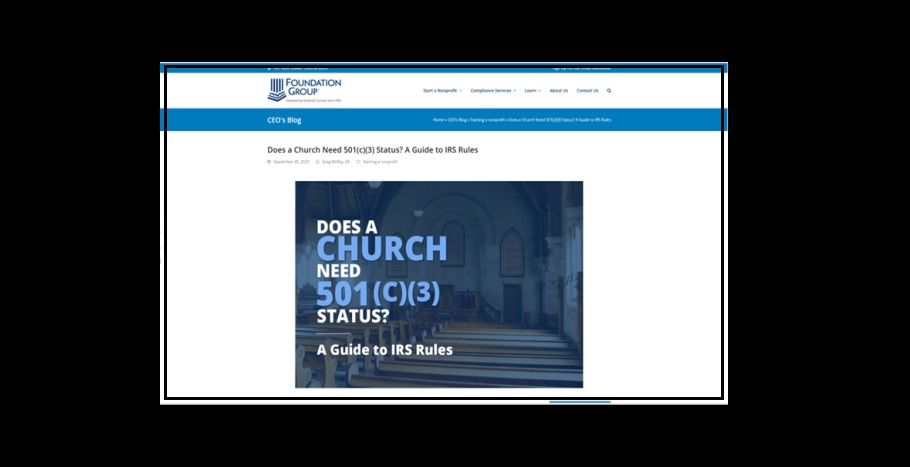
This article will briefly address some, but not all, false and misleading statements in Does a Church Need 501(c)(3) Status? A Guide to IRS Rules, a publication of Foundation Group, that uninformed “Christians” choose to believe and follow. This article applies to Foundation Group, and almost all Christan organizations, lawyers, legal firms, believers and churches; only a small remnant have any understanding of God’s definition of and principles and commandments for God’s churches. Thus, the church they are concerned about is man’s church, not God’s church; they apply man’s, not God’s, definition and principles.

It is apparent that Foundation Group has no concept of what a church-as defined by the word of God-is. Their article defines a church as “an organization with activities that are religious, not commercial.” What a joke! For God’s definition of “church” see, Bible Doctrine of Church.

It is also apparent that the Foundation Group does not understand some other matters. They do not understand that a church who remains solely under the First Amendment is non-taxable. The only way any entity–whether individual, business, religious, etc.–is required to pay taxes is by law. The First Amendment forbids a law taxing churches.

Nor does the Foundation Group understand that the use of the term “tax-exempt” in the context of 501(c)(3) is misleading. Like all other churches, churches who freely choose to dishonor God by accepting the federal government offer for “tax-exempt” status pay no taxes. Churches simply do not pay taxes. That is not why churches choose to become “tax-exempt.” The real reason for their choice is that the Internal Revenue Service will allow deductions claimed on income tax returns by donors to the church.

Their article states: “A tiny handful of churches have given up 501(c)(3) status in order to do and say whatever they choose without regard to limits otherwise placed on charities. However, this comes at the cost of tax exemption and privileges, as well as the ability to have donors give tax-deductible gifts.” This is an admission that churches who reject 501(c)(3) tax exempt status remain free to do and say the things God lays on their heart and that tax-exempt status limits their ability as to what they can to do and say. Unlike 501(c)(3) and 508(c)(1)(A) churches, they are free to follow the commandments, principles, and examples in the word of God. The second part of that quote is addressed below.

The real government purpose for federal tax-exempt status is government control over churches, not to free churches from paying taxes or to give them “tax exemption and privileges.” See, e.g., A Quiet Fatih? Taxes, Politics, and the Privatization of Religion” (Richard W. Garnett, A Quiet Faith? Taxes, Politics, and the Privatization of Religion, 42 B.C.L. Rev. 771 (2001). See also, The Rules and Regulations that Come with Church IRS Code Sections 501(c)(3) and 508(c)(1)(A) Tax-Exempt Status.

Their article states: “By default, the US government considers churches to be 501(c)(3) organizations automatically, simply by virtue of existing. Because no corporate structure is needed, a church (generally) is a 501(c)(3). …” This conclusion has no basis and is patently false. No law or regulation declares such a thing. Such a conclusion would deny the religious liberty guaranteed by the First Amendment. See, Are Churches Automatically Tax Exempt?

The First Amendment to the United States Constitution states:

  • “Congress shall make no law respecting an establishment of religion, or prohibiting the free exercise thereof; or abridging the freedom of speech, or of the press; or the right of the people peaceably to assemble, and to petition the Government for a redress of grievances.

Notice that the Amendment says “no law.” As one Supreme Court Justice said, “no law” means “no law.” By the way, 501(c)(3) is a law made by Congress, and, when applied to churches, respects an establishment of religion and prevents the free exercise thereof.

All parts of the First Amendment are related to and the result of the fight for religious (not business) freedom by Baptists in the colonial period. The first clause in the Amendment is the Religion Clause. That clause prohibits union of church and state (the establishment clause) and legislates freedom of conscious (the free exercise clause) on the federal level. For unrevised documented explanation, see:

The Religion Clause applies only to churches (and other religions in this pluralistic society). Churches and businesses have a distinct history and are entirely different types of entities. A church in America has a choice of whether to obtain federal tax-exempt status and become a fake church (if she is not already fake through incorporation or some other union with civil government) or to remain a true non-taxable church modeled after the examples and principles in God’s word and legislated in the highest law of America, the United States Constitution, Amendment 1. A fake tax-exempt church, as does a fake church incorporated under state law, submits herself to an authority other than to the Lord Jesus Christ. She agrees to abide by the rules and regulations that come with tax exempt status. See, The Rules and Regulations that Come with Church IRS Code Sections 501(c)(3) and 508(c)(1)(A) Tax-Exempt Status and Church Internal Revenue Code § 508(c)(1)(A) Tax Exempt Status.

The status of a church who chooses to honor God by maintaining her non-taxable status is protected by the First Amendment; she remains a church and is not classified by the government as a business if she chooses to reject the status. The government has no law or regulation which states that a church who rejects the status is now to be treated as a business; such would be in violation of the First Amendment establishment and free exercise clauses. Even if that were not true, a local church under Christ makes no profit whatsoever and therefore cannot be taxed. Even a business which makes no profit cannot be taxed, even though, unlike a church, it is required to file an income tax return.

The statement in their article, “Because no corporate structure is needed, a church (generally) is a 501(c)(3), ” is nonsensical.

Here is a statement in their article that comes from somewhere in the wild and creative imagination of its author who is obviously preying upon the ignorance of churches in his attempt to convince churches to use the services of Foundation Group: “If for some reason you and your church leadership decide that you don’t want to be a 501(c)(3), you are simply deciding to be treated like a taxable, for-profit business. …” I have already discredited this, so let us move on.

As their article indicates, it may be more convenient for a church to bow down to the federal government. For example:

1. In some few cases it may be less convenient to get the state religious tax exemption on property owned by the Lord Jesus Christ which is held and managed by a trustee (the legal or earthly owner of the property) and used by the church (not owned by the church). This ministry has encountered only two situations in which action by the trustee of God’s property being used for church purposes required legal action by the trustee of God’s property, not by the church. Both resulted in granting of the exemption. See The Indiana Board of Tax Review Determines that Property Held in Trust for the Lord Jesus Christ Must Be Granted Property Tax Exemption and Another Victory for a Church under Christ.

Sometimes glorifying and pleasing God in America can be inconvenient, but not as much so as in many nations to this very day and by followers of Christ for the last two thousand years. Our Lord Jesus Christ, the apostles, and millions of other believers from the beginning of the church age until this day were persecuted, imprisoned, beheaded, drowned, burnt at the stake, have had to hide out from church state establishments, etc. Their only way out of these “inconveniences” was to obey man rather than to God. Note: By the way, all state religious property tax exemption laws come with no strings attached and are just a courtesy from a time in this nation when God and the Bible were revered by almost everyone in the nation.

2. Some donors may not join or remain in a church who does not apply for (IRS Form 1023) and receive 26 U.S. Code (Internal Revenue Code) § 501(c)(3) tax exempt status from their new master. Some donors may not join in or remain in a church who claims IRC § 508(c)(1)(A) status. See, 26 U.S. Code § 508 – Special rules with respect to § 501(c)(3)) organizations. Of course, God desires His children to give for His glory and because they love Him, not because they get a tax deduction.

A believer dishonors God when he joins a church (e.g., a corporate and/or federally tax-exempt church) which serves mammon and is unequally yoked with any entity other than the Lord Jesus Christ.

This author, Jerald Finney, has written extensively on these matters. One who wishes to understand all aspects of the issues from a Bible based perspective can find a wealth of resources on the Simply Church Ministry Website, jeraldfinney.com. A good law review article on the Federal Tax Exemption is IGNORE THE RUMORS-CAMPAIGNING FROM THE PULPIT IS OKAY: THINKING PAST THE SYMBOLISM OF SECTION 501(c)(3) by Michael Hatfield, Associate Professor of Law, Texas Tech University School of Law. LAW REVIEW ARTICLES: 501(C)(3), 1ST AMENDMENT HISTORY, ETC. links to other law review articles on this and related First Amendment matters.
Are Churches Automatically Tax Exempt?

Jerald Finney
Copyright © April 8, 2022

Regardless of what one has been told or believes, an honest examination of the evidence proves that churches are not automatically tax exempt. See the essay below, and other resources linked to below, for proof of this conclusion. However, “Churches that meet the requirements of § 501(c)(3) are automatically considered tax exempt [under § 508(c)(1)(A)] and are not required to apply for and obtain recognition of tax-exempt status from the IRS.” This quote is from IRS publications and is the correct position. If a church does not meet the requirements of 501(c)(3) that church is not “tax exempt.”

Furthermore, according to principles in the Word of God, church tax exempt status is spiritual fornication since she has submitted herself to man’s law, become a temporal legal – as opposed to spiritual eternal only – entity,  and chosen to submit to an authority other than the Lord Jesus Christ as to many church matters. A church can choose to remain under Christ only as a eternal spiritual organism as opposed to a temporal earthy organizaion. In America, the First Amendment and corresponding state constitutional provisions protect this choice from persecution. This essay, and the other essays and articles on this website explain these matters more comprehensively.

See also:

Jerald Finney
Copyright © April 8, 2022

Many Christians and churches take the position that churches who do not file Form 1023 in order to obtain federal tax exempt status are “automatically exempt.” They believe that Internal Revenue Code § 508(c)(1)(A) grants automatic tax exempt status to churches. Is this position correct? For emphasis, this brief essay will go directly to that one question which I have already answered in more extensive and comprehensive writings such as Church Internal Revenue Code § 508(c)(1)(A) Tax Exempt Status, and  The Rules and Regulations that Come with Church IRS Code Sections 501(c)(3) and 508(c)(1)(A) Tax-Exempt Status.

A church, because of the First Amendment, can choose either to be automatically non-taxable without any civil government control; or it can choose to be a 501(c)(3) or 508(c)(1)(A) tax exempt organization if(explained below). No if can come with automatic status. Automatically means: “(with reference to a device or process) by itself with no human control.” According to that definition, churches definitely are not “automatically tax exempt.”  Both 501(c)(3) and 508(c)(1)(A) tax exempt status come with IRS rules and regulations. See, The Rules and Regulations that Come with Church IRS Code Sections 501(c)(3) and 508(c)(1)(A) Tax-Exempt Status.  Please let me explain.

The complete title to “508” is “26 U.S. Code § 508 – Special rules with respect to section 501(c)(3) organizations.” This title makes clear that a 508 church is 501(c)(3) tax exempt.

508(a),(c)(1)(A) states:

“(a) New organizations must notify Secretary that they are applying for recognition of section 501(c)(3) status

“(c) Exceptions
“(1) Mandatory exceptions Subsections (a) and (b) shall not apply to
“(A) churches, their integrated auxiliaries, and conventions or associations of churches….”

508(c)(1)(A) does not state that churches are “automatically exempt.” Clearly, 508(c)(1)(A) states that churches are mandatory exceptions to the requirement for filing for Internal Revenue Code § (501)(c)(3) tax exempt status. “Churches, their integrated auxiliaries, and conventions or associations of churches” (not other types of other organizations)  may claim 501(c)(3) tax exempt status without filing for it.

To claim tax exempt status under 508(c)(1)(A) instead of submitting IRS Form 1023 for tax exempt status under 501(c)(3), a church must, like a 501(c)(3) church, make clear to the public and to its members that the church is tax exempt (that givers may deduct their gifts on their income tax returns); and, like a 501(c)(3) church, give IRS Acknowledgements to givers.

Rules and regulations come with 501(c)(3) and 508(c)(1(A) tax exempt status.  One cannot separate the status from attributes, rules, and regulations that go with it. The attributes, rules, and regulations of the status define the status. According to 508(c)(1)(A), a church may claim the status without filing for it. Contrary to unlearned “Christian” propaganda, churches who do so are to comply with the IRS rules and regulations that come with the status. The requirements of 501(c)(3) and 508(c)(1)(A) status are given in The Rules and Regulations that Come with Church IRS Code Sections 501(c)(3) and 508(c)(1)(A) Tax-Exempt Status.

The IRS understands this. Page 2 (the page may vary from year to year) of IRS Publication 1828 states, “churches that meet the requirements of § 501(c)(3) are automatically considered tax exempt and are not required to apply for and obtain recognition of tax-exempt status from the IRS” [Bold red emphasis mine]. The IRS repeats this on page 24 (the page may vary from year to year) of IRS Publication 557, “Tax –Exempt Status for Your Organization.” Under “Organizations Not Required To File Form 1023” churches are listed. The following sentence is included: “These organizations are exempt automatically if they meet the requirements of section 501(c)(3).” [Bold italicized emphasis added.].

By placing a church under a civil government law, either 501(c)(3) or 508(c)(1)(A), a church rejects her First Amendment non-taxable status and accepts the federal government offer for tax exempt status.  Offer and acceptance are necessary for the agreement, the contract, to be completed. The First Amendment makes clear that a church may choose to retain religious freedom without persecution. IRS  §§ 501(c)(3) and 508(c)(1)(A) give churches an alternative: give up First Amendment status as a non-legal entity in favor of Fourteenth Amendment status as a legal entity.

Most churches who obtain either 501(c)(3)  or 508(c)(1)(A) status have already given up much of their First Amendment protection and status by submitting themselves to state non-profit incorporation law, charitable trust law, etc. Churches who are corporations,  Internal Revenue Code Section 501(c)(3) or 508(c)(1)(A) tax exempt, or legal entities of any kind have forsaken higher law by submitting to authorities other than the Lord Jesus Christ.

With 508(c)(1)(A) the government declared in law that they trusted churches and “Christians,” of all people, to understand their actions and to honor their agreements. The government made it more convenient for churches, and for no other type of organization, to obtain tax exempt status. They falsely believed that Christians and churches were bound by a higher law and could be trusted to diligently honor their word.

As mentioned above, one requirement for 501(c)(3) or 508(c)(1)(A) tax exempt status is that the church give donors IRS Acknowledgements for tithes, offerings, and gifts. Should the IRS audit a donor who claimed a deduction for gifts to a church, the IRS will want the IRS Acknowledgment; and proof that the giver of the Acknowledgement was a church. If the church has 501(c)(3) status, the proof is on the IRS list of tax exempt churches. If the church has 508(c)(1)(A) status, the IRS may require the person claiming the exemption to prove that the gift was to a “church” even though they should have a copy of the IRS Acknowledgement for the gift.

The real reason churches file for or claim  tax exempt status is to motivate people to give, and to give more. Some Christians will not give to a church who is approved by the Internal Revenue Service for tax exempt status. See, for an interesting study on this matter, “Churches, Politics, and the Charitable Deduction” (Ellen P. Aprill, Churches, Politics, and the Charitable Contribution Deduction, 42 B.C.L. Rev. 843 (2001).

To reject the offer of the federal government for “tax exempt” status, all a church must do is to reject all offers of state and/or federal government for combination with civil government (incorporation, charitable trust status, tax exempt status under 501(c)(3) or 508(c)(1)(A), or union with the state in any other way); refuse to give IRS Acknowledgements for tithes, offerings, and gifts; and make it known that the church is a First Amendment church solely under the authority of the Lord Jesus Christ.

Some Christians argue that they don’t care what the government requires in order for granting them the “benefits” of tax-exempt status. They know that their authority, the IRS, probably will not catch them since they do not have the resources to monitor churches and pastors. These Christians and churches take God out of the equation. The Lord knows all and does not honor such behavior by believers and churches. He expects his children to honor their word and their agreements which they voluntarily enter into. They are dishonoring God and man, and ignorance will not excuse their misdeeds:

According as his divine power hath given unto us all things that pertain unto life and godliness, through the knowledge of him that hath called us to glory and virtue:  Whereby are given unto us exceeding great and precious promises: that by these ye might be partakers of the divine nature, having escaped the corruption that is in the world through lust. And beside this, giving all diligence, add to your faith virtue; and to virtue knowledge; And to knowledge temperance; and to temperance patience; and to patience godliness; And to godliness brotherly kindness; and to brotherly kindness charity. For if these things be in you, and abound, they make you that ye shall neither be barren nor unfruitful in the knowledge of our Lord Jesus Christ.  But he that lacketh these things is blind, and cannot see afar off, and hath forgotten that he was purged from his old sins. Wherefore the rather, brethren, give diligence to make your calling and election sure: for if ye do these things, ye shall never fall” (2 Peter 1:1-10).