Tag Archives: doctrine of the church

Lesson 2: The Work of the Son of God on Behalf of the Church (Ephesians)

The Work of the Son of God on Behalf of the Church –
Ephesians 1.7-12
(9 questions with answers following)

For help in answering the questions, you may refer to Outline and Teaching on Ephesians.

Click here to go to Lesson 3

Click here to go to the links to 14 lessons on Ephesians – a Local Church is a Body (Questions and Answers)

Click here to go to Bible Studies: The Doctrine of the Church

Added on March 21, 2017

Answers at the end, following the questions
Those who disagree with anything please see the note at the end. Reasoned dialogue is encouraged and any Bible or fact based comments, if made in a Christian manner in an attempt to get to the truth will be considered.

  1. What was the first work of God the Son on behalf of the church? (See Ephesians 1.7)
  2. What was the second work of God the Son on behalf of the church? (See Ephesians 1.8-10)
  3. How many mysteries are there in the New Testament?
  4. A mystery in Scripture means that God is ______________ something that, up to that time, He had not ___________. There are two elements which always enter into a New Testament mystery: (1) It cannot be discovered by __________ agencies, for it is always a revelation of _________; (2) It is _____________ to establish the _______ without all the ___________ being disclosed.
  5. The mystery of the church was ______ _________ in the Old Testament.
  6. What was the third work of God the Son on behalf of the church? (See Ephesians 1.11, 12)
  7. In the third work of God the Son on behalf of the church, Christ gives us an inheritance. He ________ us for something ___ ______ _______ ________.
  8. Paul writes in Romans 8.17: “And if children, then _______; _______ of God, and joint-______ with Christ; if so be that we _________ with him, that we may be also _________ _________.”
  9. 1 Corinthians 3:21-23: Therefore let no man ________ in men. For all things are _________; Whether ________, or Apollos, or Cephas, or the _________, or _________ or _________, or things _________, or __________ to come; all are ___________; And ye are ___________; and Christ is ___________.

Answers

  1. The first work of God the Son on behalf of the church was redemption. He paid the price for the sin of church members. (Ephesians 1.7). Remember, Ephesians is addressed to “the saints which are at Ephesus” (Ephesians 1.1); that is the body of believers at Ephesus over which He is the Head (See Ephesians 1.22).
  2. The second work of God the Son on behalf of the church was to reveal the mystery of His will. (Ephesians 1.8-10).
  3. There are eleven mysteries in the New Testament. They are: (1) The mysteries of the kingdom of heaven (Mt. 13.3-50); (2) the mystery of Israel’s blindness during this age (Ro. 11.25, with context); (3) the mystery of the translation of living saints at the end of this age (1 Co. 15.51, 52; 1 Thes. 4.14-17); (4) the mystery of the NT church as one body composed of Jew and Gentile (Ep. 3.1-11; Ro. 16.25; Ep. 6.19; Col. 4.3); (5) the mystery of the church as the bride of Christ (Ep. 5.28-32); (6) the mystery of the inliving Christ (Ga. 2.20; Col. 1.26, 27); (7) the “mystery of God even Christ,” i.e., Christ as the incarnate fullness of the Godhead embodied, in whom all the divine wisdom for man subsists (Col. 2.2, 9; 1 Co. 2.7); (8) the mystery of the processes by which godlikeness is restored to man (1 Ti. 3.16); (9) the mystery of iniquity (2 Thes. 2.7; Mt. 13.33); (10) the mystery of the seven stars (Re. 1.20); (11) the mystery of Babylon (Re. 17.5, 7).
  4. A mystery in Scripture means that God is revealing something that, up to that time, He had not revealed. There are two elements which always enter into a New Testament mystery: (1) It cannot be discovered by human agencies, for it is always a revelation of God; (2) It is revealed to establish the fact without all the details being disclosed. The mystery of the church was not revealed in the Old Testament.
  5. The mystery of the church was not revealed in the Old Testament.
  6. The third work of God the Son on behalf of the church was that Christ rewards us with an inheritance.
  7. In the third work of God the Son on behalf of the church, Christ gives us an inheritance. He rewards us for something we have not done.
  8. Paul writes in Romans 8.17: “And if children, then heirs; heirs of God, and joint-heirs with Christ; if so be that we suffer with him, that we may be also glorified together.”
  9. 1 Corinthians 3:21-23: Therefore let no man glory in men. For all things are yours; Whether Paul, or Apollos, or Cephas, or the world, or life, or death, or things present, or things to come; all are yours; And ye are Christ’s; and Christ is God’s.

Should you disagree with an answer given, please explain why you disagree in the comment section below the article. All reasoned comments will be published, perhaps with reply. The purpose of this website is the Glory of God. God cannot be glorified by shutting out honest disagreement in the search for truth. The author would be interested in your explanation. The comments are required by the website to be approved or disapproved. The author is very busy with many matters and may or may not immediately notice your comment. He will address it as soon as he notices it. He almost always approves comments presented with a godly spirit. He never alters comments. Sometimes, he replies to comments.

Lesson 1: The Church Is a Spiritual Body (Ephesians)

The Church is a Body – Ephesians 1
(38 questions on the Bible Doctrine of the Church and the American application of that Doctrine with answers at the end)

For help in answering the questions, you may refer to Outline and Teaching on Ephesians.

Click here to go to Lesson 2
Added on March 20, 2017

Click here to go to the links to 14 lessons on Ephesians – a Local Church is a Body (Questions and Answers)

Click here to go to Bible Studies: The Doctrine of the Church

Answers follow the questions.
Those who disagree with anything please see the note at the end. Reasoned dialogue is encouraged and any Bible or fact based comments, if made in a Christian manner in an attempt to get to the truth will be considered.

1. The theme of Ephesians chapter 1 is that a church is a ___________.

Questions 2-7 below are from Ephesians 1.1 which says: “Paul, an apostle of Jesus Christ by the will of God, to the saints which are at Ephesus, and to the faithful in Christ Jesus:”

  1. Paul says he is an apostle. An apostle is the highest ____________ a church has ever had.
  2. A church today cannot have an apostle today because they cannot meet _____ ____________.
  3. The requirements of an apostle are that: (a) The apostles received their commission directly from the living lips of __________. Paul made that claim. He said in Galatians 1.1, “_______, an apostle, (not of men, neither by man, but by Jesus Christ, and God the Father, who raised him from the dead;)” The disciples named___________, but the word of God never states that Jesus made him an apostle. (b) The apostles saw the ______________ after His resurrection. Paul could meet that requirement. 1 Corinthians 9.1. (c) The apostles spoke directly with the Savior. Paul met that requirement. Acts 9.3-6. (d) They expounded and wrote Scripture. See John 14.26, 16.13; Galatians 1.11, 12. (e) They exercised supreme authority. See John 20.22, 23; 2 Corinthians 10.8. (f) The badge of their authority was the power to work miracles. Mark 6.13; Luke 9.1, 2; Acts 2.43. (g) They were given a universal commission to found churches. 2 Corinthians 11.28.
  1. Paul rested his apostleship on the _________ of ______ rather than any personal ambition or will of ______ or request of a _____________. For more on this, see, e.g., Galatians 1.15, 16; 1 Timothy 1. 12, 13; 1 Corinthians 1.1; 2 Corinthians 1.1; 1 Colossians 1.1; 2 Timothy 1.1.
  2. Paul addressed this epistle to the ___________ which are at ____________ and to the ___________ in Christ Jesus.
  3. A saint is a ___________ and a believer is a ___________.
  4. In Ephesians 1.3-6, we learn that God the _______________ planned the church.
  5. In Ephesians 1.7-12, we learn that God the _________ paid the price for the church.
  6. In Ephesians 1.13, 14, we learn that God the ________ ____________ protects the church.
  7. God the Father set ___________ “at his own right hand in the heavenly places, Far above all _____________ and ___________, and _____________, and _______________, and every ________________ that is named, not only in this world, but also in that which is to come: And hath put _____________ things under his feet, and gave him to be the _____________ over ____ _____________ to the ___________, Which is his ___________, and the fullness of him that filleth all in all.” Ephesians 1.20-23.
  8. God clearly states in His word that He wants to be over _____ things to the church.
  9. Which church in the New Testament was under any authority other than Jesus Christ?
  10. What church in the New Testament went to any civil government for non-profit corporation and/or tax exempt status or for recognition, organization, favor, power, or any other perceived advantage?
  11. Who provides the basis for non-profit corporation and/or Internal Revenue Code § 501(c)(3) status?
  12. Who creates the corporate part of a church who is a non-profit corporation?
  13. Who defines a non-profit corporation church?
  14. Who is the authority or authorities over a non-profit corporation?
  15. Who is over a church who is a non-profit corporation?
  16. Is any church in America required by civil law to attain and receive non-profit corporation and/or Internal Revenue Code § 501(c)(3) status?
  17. Does any civil law require a church to obtain non-profit corporation and/or Internal Revenue Code § 501(c)(3) status?
  18. When a church asks for and receives non-profit corporation status, does the state of her incorporation become her authority for many matters?
  19. If the answer to the last question is “yes,” will the authority allow Bible arguments in deciding the controversy?
  20. What is the term for the relationship created by non-profit corporation status?
  21. What is a non-profit corporation contract?
  22. Which New Testament church in the Bible contracted with the state through incorporation and/or tax exempt status?
  23. Who is the controlling party of the contract created between the non-profit corporation and the state of incorporation?
  24. What rules come with 501(c)(3) status?
  25. Who officiates over a dispute which a non-profit corporation takes to her state authority?
  26. According to whose plan is a church who is a non-profit corporation operated?
  27. To whom does a church who is a non-profit corporation report?
  28. To whom does a church who is a non-profit corporation pay a yearly fee?
  29. To whom does a church who is a non-profit corporation go for resolution of many matters?
  30. What officers does a non-profit corporation have?
  31. What are the only church officers authorized by the New Testament?
  32. What New Testament church had any of the following officers: CEO, President, Secretary?
  33. What New Testament church had corporate trustees?
  34. Does corporate and/or 501(c)(3) or 508 status combine church and state?

Answers

For help with questions 15-38 click here to go to Separation of Church and State/God’s Churches: Spiritual or Legal Entities?

  1. The theme of Ephesians Chapter 1 is that a church is a body.
  2. Paul says he is an apostle. An apostle is the highest office a church has ever had.
  3. A church today cannot have an apostle today because they cannot meet the requirements.
  4. The requirements of an apostle are that: (a) The apostles received their commission directly from the living lips of Jesus. Paul made that claim. He said in Galatians 1.1, “Paul, an apostle, (not of men, neither by man, but by Jesus Christ, and God the Father, who raised him from the dead;)” The disciples named Matthias, but the word of God never states that Jesus made him an apostle. (b) The apostles saw the Saviour after His resurrection. Paul could meet that requirement. 1 Corinthians 9.1. (c) The apostles spoke directly with the Savior. Paul met that requirement. Acts 9.3-6. (d) They expounded and wrote Scripture. See John 14.26, 16.13; Galatians 1.11, 12. (e) They exercised supreme authority. See John 20.22, 23; 2 Corinthians 10.8. (f) The badge of their authority was the power to work miracles. Mark 6.13; Luke 9.1, 2; Acts 2.43. (g) They were given a universal commission to found churches. 2 Corinthians 11.28.
  1. Paul rested his apostleship on the will of God rather than any personal ambition or will of man or request of a church. For more on this, see, e.g., Galatians 1.15, 16; 1 Timothy 1. 12, 13; 1 Corinthians 1.1; 2 Corinthians 1.1; 1 Colossians 1.1; 2 Timothy 1.1.
  2. Paul addressed this epistle to the saints which are at Ephesus and to the faithful in Christ Jesus.
  3. A saint is a believer and a believer is a saint.
  4. In Ephesians 1.3-6, we learn that God the Father planned the church.
  5. In Ephesians 1.7-12, we learn that God the Son paid the price for the church.
  6. In Ephesians 1.13, 14, we learn that God the Holy Spirit protects the church.
  7. God the Father set Christ “at his own right hand in the heavenly places, Far above all principality, and power, and might, and dominion, and every name that is named, not only in this world, but also in that which is to come: And hath put all things under his feet, and gave him to be the head over all things to the church, Which is his body, and the fullness of him that filleth all in all.” Ephesians 1.20-23.
  8. God clearly states in His word that He wants to be over all things to the church.
  9. No church in the New Testament was under any authority other than Jesus Christ.
  10. No church in the New Testament went to any civil government for non-profit corporation and/or tax exempt status or for recognition, organization, favor, power, or any other perceived advantage.
  11. The state of incorporation provides the basis for non-profit corporation and/or Internal Revenue Code § 501(c)(3) status.
  12. The law of the state of incorporation creates the corporate part of a church who is a non-profit corporation.
  13. The state of incorporation defines a non-profit corporation church.
  14. The state of incorporation through her courts (and maybe the Lord Jesus Christ for some churches in some matters) is the authority or authorities over a non-profit corporation.
  15. The state of incorporation through her courts (and maybe the Lord Jesus Christ for some churches in some matters) is over a church who is a non-profit corporation.
  16. No church in America is required by civil law to attain and receive non-profit corporation and/or federal (Internal Revenue Code § 501(c)(3)) tax exempt status.
  17. No civil law in America requires a church to obtain non-profit corporation and/or Internal Revenue Code § 501(c)(3) status. On the other hand, the First Amendment to the United States Constitution and corresponding state constitutional provisions protect churches from civil government entanglement (corporate and/or tax exempt status). Churches must seek such status, of their own free will, from the civil government.
  18. When a church asks for and receives non-profit corporation status, the state of her incorporation becomes her authority for many matters.
  19. If the answer to the last question is “yes,” the state authority will not allow Bible arguments in deciding the controversy.
  20. The term for the relationship created by non-profit corporation status is contract.
  21. A non-profit corporation contract is an agreement between the state and the church.
  22. No New Testament church contracted with the state through incorporation and/or tax exempt status.
  23. The state is the controlling party of the contract created between the non-profit corporation and the state of incorporation.
  24. What rules come with 501(c)(3) status? Five rules come with the status. I have listed and explained those rules in my writings.
  25. A court of the state of incorporation officiates over a dispute which a non-profit corporation takes to her state authority.
  26. A church who is a non-profit corporation is operated according to the non-profit corporation laws of the state of incorporation.
  27. A church who is a non-profit corporation reports to the state of her incorporation.
  28. A church who is a non-profit corporation pays a yearly fee to the state of her incorporation.
  29. A church who is a non-profit corporation goes to the courts of her state of incorporation for resolution of many matters.
  30. A non-profit corporation must have officers such as President, CEO, treasurer, etc.
  31. The only church officers authorized by the New Testament are pastors, deacons, and elders.
  32. No New Testament church had any of the following officers: CEO, President, Secretary, etc.
  33. No New Testament church had corporate trustees.
  34. Church corporate and/or 501(c)(3) or 508 status combines church and state.

Should you disagree with an answer given, please explain why you disagree in the comment section below the article. All reasoned comments will be published, perhaps with reply. The purpose of this website is the Glory of God. God cannot be glorified by shutting out honest disagreement in the search for truth. The author would be interested in your explanation. The comments are required by the website to be approved or disapproved. The author is very busy with many matters and may or may not immediately notice your comment. He will address it as soon as he notices it. He almost always approves comments presented with a godly spirit. He never alters comments. Sometimes, he replies to comments.

Introductory Lesson on Ephesians

Introductory Lesson on Ephesians
(9 questions with answers at the end)
Added on March 20, 2017

For help in answering the questions, you may refer to Outline and Teaching on Ephesians.

Click here to go to
Lesson 1: A Church is a Body – Ephesians 1

Click here to go to the links to 14 lessons on Ephesians – a Local Church is a Body (Questions and Answers)

Click here to go to Bible Studies: The Doctrine of the Church

Answers at the end, following the questions
Those who disagree with anything please see the note at the end. Reasoned dialogue is encouraged and any Bible or fact based comments, if made in a Christian manner in an attempt to get to the truth will be considered.

  1. In what verse(s) does the Bible record the out calling of the church?
  2. Please quote the verse(s) referred to in question 1.
  3. Those verses (in the prior 2 questions) record the words of whom?
  4. What New Testament writer explains, as inspired by the Holy Spirit, how, when, or of what materials, that church would be built?
    a. Jude.
    b. Luke.
    c. John.
    d. Paul.
  5. What New Testament writer, as inspired by the Holy Spirit, explains what should be the position, relationships, privileges, and duties of that church?
    a. Jude.
    b. Luke.
    c. John.
    d. Paul.
  6. Where is the doctrine of the church developed?
    a. The book of Jude.
    b. The writings of Luke.
    c. The writings of John.
    d. The Epistles of Paul.
  7. What Epistles present a composite picture of the Christ, the church, the Christian life, and the interrelationship and functioning of all?
    a. Galatians, Ephesians, Philippians, Philemon
    b. Ephesians, Philippians, Colossians, Philemon (the prison epistles)
    c. Galatians, Philippians, Colossians, Titus
    d. Ephesians, Colossians, 1 Timothy, Philemon
  8. The epistle to the Ephesians is written to the church at _________________.
  9. The church, as an institution is made up of _____________, autonomous, _______________ bodies.

Answers

1. Matthew 16.18.
2. Matthew 16:18-19: “18 And I say also unto thee, That thou art Peter, and upon this rock I will build my church; and the gates of hell shall not prevail against it. 19  And I will give unto thee the keys of the kingdom of heaven: and whatsoever thou shalt bind on earth shall be bound in heaven: and whatsoever thou shalt loose on earth shall be loosed in heaven.”
3. Jesus.
4. d. Paul, in his Epistles. In his letters to seven Gentile churches (in Rome, Corinth, Galatia, Ephesus, Philippi, Colosse, and Thessalonica).
5. d. Paul, in his Epistles. In his letters to seven Gentile churches (in Rome, Corinth, Galatia, Ephesus, Philippi, Colosse, and Thessalonica).
6. d. The Epistles of Paul.
7. b. Ephesians, Philippians, Colossians, Philemon (the prison epistles)
8. The epistle to the Ephesians is written to the church at Ephesus.
9. The church, as an institution is made up of local, autonomous, spiritual bodies.

Should you disagree with an answer given, please explain why you disagree in the comment section below the article. All reasoned comments will be published, perhaps with reply. The purpose of this website is the Glory of God. God cannot be glorified by shutting out honest disagreement in the search for truth. The author would be interested in your explanation. The comments are required by the website to be approved or disapproved. The author is very busy with many matters and may or may not immediately notice your comment. He will address it as soon as he notices it. He almost always approves comments presented with a godly spirit. He never alters comments. Sometimes, he replies to comments.

Book Review: [The first Baptist church in America: Two recent books reviewed] Did Roger Williams Start The First Baptist Church In America? Is the “Baptist Church the Bride of Christ? What About Landmarkism or the Baptist Church Succession Theory and Baptist History IN AMERICA Vindicated: The First Baptist Church in America/A Resurfaced Issue of Controversy/The Facts and Importance

Book Review:

Did Roger Williams Start The First Baptist Church In America? Is the “Baptist Church the Bride of Christ? What About Landmarkism or the Baptist Church Succession Theory?
By Jim Fellure

Baptist History IN AMERICA Vindicated: The First Baptist Church in America/A Resurfaced Issue of Controversy/The Facts and Importance
By Pastor Joshua S. Davenport

For information on other books click: Books page of “Church and State Law”

Jerald Finney
Copyright © July 30, 2012

Preface

After this “Preface,” Finney will review (1) Did Roger Williams Start The First Baptist Church In America? Is the “Baptist Church the Bride of Christ? What About Landmarkism or the Baptist Church Succession Theory by Jim Fellure; and (2) Baptist History IN AMERICA Vindicated: The First Baptist Church in America/A Resurfaced Issue of Controversy/The Facts and Importance by Joshua S. Davenport. This preface will explain the importance of writing this review including important issues which are raised by Jim Fellure’s booklet and Finney’s belief as to which was the first Baptist church in America.

Jim Fellure wrote in Did Roger Williams Start the First Baptist Church In America? Is the “Baptist Church the Bride of Christ? What About Landmarkism or the Baptist Church Succession Theory: “Now brethren, please believe me when I say that it is not our intention to create contention and strife…. I will, however, as have historical Baptists, fight for one’s right to freedom of conscious, but I will also ‘earnestly contend for the faith which was once delivered unto the saints.’”  Jerald Finney, the reviewer, seconds that by writing this review because the truth and the Glory of God are preeminent. Our Lord has instructed believers to “earnestly contend for the faith which was once delivered unto the saints.”

Jim Fellure’s booklet started a debate in that it summarily deals with issues at the very heart of the faith which was once delivered to the saints. Joshua Davenport entered the debate and countered Brother Fellure with the publication of Baptist History IN AMERICA Vindicated: The First Baptist Church in America/A Resurfaced Issue of Controversy/The Facts and Importance.

The reviewer, Jerald Finney, attended the April 17-20, 2012 Baptist Heritage Revival Tour which was planned and executed by Evangelist Ted Alexander. A few days before he left for the tour, he came across a book he had in his library entitled Did Roger Williams Start the First Baptist Church In America? by Jim Fellure. Finney did not ask for or buy the book. Brother Fellure handed him a copy of the book in April, 2011 at a camp meeting, explaining that he did not realize that the publication of the book would start a firestorm. Perhaps reading the book just before attending the tour was a coincidence, or perhaps God wanted Finney to read it at that very time. At any rate, after reading the book, further study of relevant historical facts and consideration of biblical principles surrounding issues raised in the book was placed on his agenda. Fortunately, others, as he was to discover very soon, had already done and published such studies concerning, especially, Brother Fellure’s historical conclusions and the facts upon which he based those conclusions.

On the tour, Finney bought several books, two of which addressed the issue of which was the first Baptist church in America: Baptist History IN AMERICA Vindicated: The First Baptist Church in America/A Resurfaced Issue of Controversy/The Facts and Importance by Joshua S. Davenport and The First Baptist Church in America: Not Started by Roger Williams by J. R. Graves, first published in 1887. Finney read Baptist History IN AMERICA Vindicated on the tour bus. He later read The First Baptist Church in America: Not Started by Roger Williams. Brother Ted Alexander, the tour organizer and leader, did not ever address or discuss Brother Jim Fellure or his booklet, either to the entire group or to Finney individually.

Finney is always seeking truth on important issues relevant to the topic of separation of church and state. The subject of this book review is one which God has impressed upon him as a result of the above-mentioned events. In earnestly contending for the faith, Finney was compelled to write this review. As will become apparent as one reads this review, the issues raised by the search to find out which was the first Baptist church started in America are extremely important both doctrinally and historically. An open-minded honest search for truth in the matter should be the goal. Finney has based his conclusions on the Bible and historical facts, nothing more. He knows both Jim Fellure and Joshua Davenport and loves them both. Brother Fellure has been a friend for many years. Finney has known Brother Davenport only a short time, but has grown to love him as well.

The first Baptist church in America was started by either Roger Williams at Providence, Rhode Island, or Dr. John Clarke at Newport, Rhode Island. Searching for the answer to the question as to which of these churches was first is of immense significance because Roger Williams, when he arrived in Rhode Island, was immersed by a man who was not only himself unbaptized, unordained, and a member of no church; and then Williams, after being thus baptized and also being unordained except by the Anglican Church in England, baptized others and started what he temporarily called a Baptist church in Providence, Rhode Island. Dr. John Clarke was baptized and ordained a Baptist and started a Baptist church in Newport, Rhode Island.

Brother Fellure concludes, among other things, that Roger Williams started the first Baptist church in America at Providence, Rhode Island. Brother Davenport concludes that Dr. John Clarke started the first Baptist church in America at Newport, Rhode Island. Two questions are inherent in the debate: (1) Was the church Roger Williams started a Baptist church in name only? (2) Which church was started first?

In answering the question of whether the church Roger Williams started was a Baptist church, other very important questions are implicated:

(1) Have the gates of hell prevailed against Christ’s church such that there was no continual succession of true churches? In other words, were there time periods in history since the beginning of New Testament churches during which no true churches existed?
(2) Are all so-called churches valid and biblically ordered, according to God and the Bible? If not, which churches are biblically valid and ordered? Is there a biblical order for the planting of a local church? If so, what is that order?
(3) Does the Bible teach an order for the ordination of pastors? For example, is it within God’s perfect will for a man to ordain himself? Is it within God’s perfect will for an unbaptized, unordained person to baptize and/or ordain another man? Is mail order ordination valid and/or within God’s perfect will?
(4) Is an ordination valid if administered by a man who believes that there is no biblical order for ordination?
(5) Is an ordination valid if conducted by some who were biblically ordained and baptized and some who were not (if there is a biblical order for ordination and baptism)?
(6) Did God set up a biblical order for baptism? Can a man who was unordained and unbaptized be baptized by an unordained, unbaptized man then administer valid baptism to others and form a biblically ordered church?  Quoting from The First Baptist Church in America: Not started by Roger Williams by J. R. Graves:

“Suppose a person, baptized by a man, who takes upon himself to preach the gospel, and proceeds to administer the ordinances without a regular call or ordination from any church, whether the person so baptized may be admitted into any orderly church—yea or nay?”

Can a person get saved, have a friend baptize him, baptize that person and others, and from that group form and pastor a biblically ordered church? Can an unsaved person have a friend baptize him, baptize that person and others, and from that group form and pastor a biblically ordered church?

(7) Can orderly ordinances come from disorderly ones (if there is a biblical order for ordinances)?
(8) Can orderly churches be planted by a disorderly church (if there is a biblical order for churches)?
(9) Does the Bible teach that God established both a universal invisible church and local autonomous churches (assemblies), or does the Bible teach the concept of the institution of the church and local autonomous churches?
(10) What are the true historical facts concerning the formation of the church in Providence by Roger Williams, Roger Williams’ view of the validity of that church, and the subsequent history of that church?
(11) What are the historical facts concerning the formation of the Baptist church at Newport and the subsequent history of that church?

Of course, some facts about history are subject to debate, and sometimes one cannot prove a fact or issue by a preponderance of the evidence, by clear and convincing evidence, or beyond a reasonable doubt (the highest standard in the legal system). The only way one can know some facts beyond all doubt is by being a witness. Sometimes, even then, one cannot know the truth for sure. One can correctly understand biblical principles but still be misled (1) by inaccurate facts, facts taken out of context, only some of the facts, or by a distortion of true facts; (2) by failing to look at all arguments (unless one looks at all facts and arguments, he definitely is in danger of coming to the wrong conclusion(s)); (3) or by failing to apply the true principles in the Word of God to the facts.

Finney is always open-minded on any issue and will consider all facts, doctrines, and positions in reaching his conclusions. After reading the books which are the subject of this review, having already built a sound foundation in the religious history of the colonies through thousands of hours of study, Finney is convinced beyond a reasonable doubt that Dr. John Clarke started the first Baptist Church in America. His conclusion is based upon facts and biblical principles. Furthermore, this question of who started the first Baptist church in America can be answered without resort to a reference to the Baptist Bride, Landmark, or Baptist church succession beliefs. Finney has not studied the Baptist Bride, Church succession, or Landmark positions, although he believes that the Bible teaches a continuing succession of true New Testament churches; in other words, by faith alone Finney believes in such a succession. He also believes that many facts, both circumstantial and concrete, demonstrate that there has never been a time in history that New Testament churches and the institution of the church (as opposed to false or non-New Testament churches and false institutions which label themselves “churches” and “the church”) since ordained by the Lord Jesus were non-existent. Finney believes Christ’s promise that the “gates of hell will not prevail against his church [that is, when correctly and contextually interpreted, the institution of the church and his local churches].”

Did Roger Williams Start The First Baptist Church In America? Is the “Baptist Church the Bride of Christ? What About Landmarkism or the Baptist Church Succession Theory?
by Jim Fellure

The title and subtitle to Brother Fellure’s booklet present not only one, but three, very important questions for a serious student of history and the Word of God. Does Brother Fellure successfully and convincingly answer the primary and secondary questions presented in his short, 22 page, double-spaced pamphlet? Is it necessary to address the sub-questions in order to answer the primary question?

Two important questions in the debate over which was the first Baptist church in America are:

(1) Was Roger Williams qualified to start a Baptist church or, put another way, was the church he started Baptist?
(2) Did Roger Williams start the church in Providence before John Clarke started the church in Newport?

The first question is important because Roger Williams was not ordained in a Baptist church (he was only ordained as an Anglican) and because of the order of his baptism. Williams was baptized by one of the men who joined him in Rhode Island. Williams then baptized that man and the others who became part of the church he started.

Roger WilliamsConcerning question 1 above, Brother Fellure concluded in his booklet that the church Roger Williams started was Baptist. He certainly did not biblically support that conclusion in any way except through explicit or implicit assertions such as: “Just trust me since I have studied these matters;” “You certainly can’t rationally believe otherwise because anyone who is saved is a member of the universal invisible church;” and “as a saved person, one is qualified to baptize.” Furthermore, he most likely understands that his short and perfunctory defense of the “universal invisible church” position and his selective references to the Baptist Bride position and Landmarkism or Baptist Church Succession theory and his conclusions based thereon are in no way adequate to convince a serious student of history and the Word of God.

He asserts that opposition to his conclusions on these matters “has come from those who follow the Baptist Bride, Landmark, or the Baptist Church Succession philosophy.” However, those are not the only sources of opposition. Interestingly, among those who opposed Fellure’s conclusions concerning the authenticity of the church Williams started, as a matter of historical fact, was Roger Williams himself who made known his belief that the church was not authentic and withdrew therefrom a few weeks after starting it, as pointed out in many reliable historical works including the opposing work which is the subject of this review. This reviewer is among many who are not Baptist Briders, Landmarkers, or per se Baptist Successionists who are convinced that Brother Fellure’s conclusions are wrong. Brother Fellure also has asserted that James Beller, a pastor who opposes his view that Roger Williams started the First Baptist Church in America, is a “Brider.” Brother Beller wrote an open letter and published it over the internet. In that letter, Brother Beller replies to certain assertions made by Brother FellureSee En4 for the entire letter and the online link.

Brother Fellure’s analysis indicates that he believes that any baptism by a saved person, and even a baptism by an unsaved man, may be valid; perhaps he does not believe the latter, but if not, he needs to make clear what he believes concerning that issue and why. He also needs to give some convincing biblical reasoning to support his belief that one who is saved, yet unbaptized, can perform a biblically acceptable baptism. He quotes a few verses and states some conclusions and selected facts concerning baptism, ordination, the church, and other doctrines but does not give the issue and his conclusions anywhere near the degree of analysis needed to support his positions.

As to question 2, Brother Fellure concludes that Roger Williams started the church in Providence before Dr. John Clarke started the church at Newport. Even if one assumes or concludes, as does Brother Fellure, that the answer to question 1 above is that Williams was qualified to start a Baptist church, historical facts which are available from various  sources and which are presented in Joshua Davenport’s book which is reviewed below prove that Clarke started the Newport church before Williams started the Providence church. Fellure states on page 14 of his booklet:

“[O]ut of all the books and documents I have read, I have not found one historical record stating Dr. John Clarke started any Baptist church before 1644. Some historians claim 1639 as the most probable date, but all records I have found agree Roger Williams did start the First Baptist Church in America.”

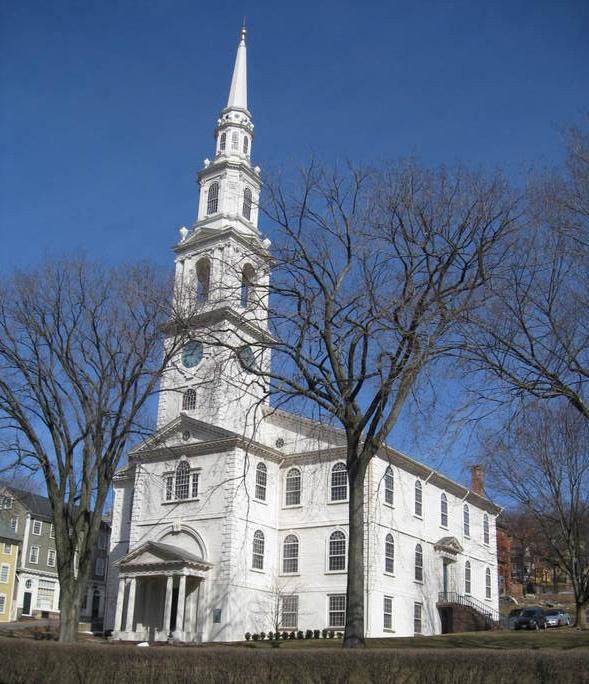
First Baptist Church Building of Providence, Rhode Island

That statement alone totally discredits his analysis and proves that he is not qualified to write on the subject. There are many historical records which refute the conclusion that Roger Williams started the church in Providence before Dr. John Clarke started the Baptist church at Newport. In other words, Brother Fellure was not qualified to comment on the issue because, by his own admission as applied to all the facts, he did not know of and consider all the facts.

Brother Fellure not only fails to consider all the historical facts concerning the issue of who started the first Baptist church in America, he also, within this 22 page, 5 ¼ by 8 ½ inch double spaced book, addresses many other matters. 22 double spaced pages are woefully inadequate for such a task. In 22 short pages, Brother Fellure, among other things:

  1. attempts to discredit the followers of Baptist Bride, Landmark or Baptist Church succession “philosophies” who opposed his position that Roger Williams started the first Baptist church in America, proclaiming that their conclusions are guided by ulterior motives only. This was completely off point and unnecessary and to have any credibility would require a very voluminous and painstaking study and written refutation and not a few paragraphs interspersed within a very short, 22 page book;
  2.  attempts to discredit the history utilized by the Baptist Succession theory (the author in his own studies has encountered facts which would refute some of Fellure’s cursory historical assertions about Baptist Succession);
  3. attempts to explain some parts of his version of the biblical doctrine of the church. The universal church doctrine of the Catholic and Protestant churches may not be the same as Brother Fellure’s version in all respects, but understanding and explaining any version of the doctrine requires a lot more than a few paragraphs out of a 22 page pamphlet. He summarily describes his versions of both a universal invisible church versus local autonomous New Testament churches. All these matters have been painstakingly analyzed by serious students of the Word over the centuries. Brother Fellure does a disservice to the cause of Christ in this ill-conceived effort. Serious biblical study (perhaps aided by the study of relevant scholarly works) would be required for a believer to arrive at correct conclusions concerning the issues he raises.

To comprehensively address the universal invisible church theory would be a voluminous undertaking, but one of Brother Fellure’s statements will be summarily addressed. On page 4, he writes:

“Where Victory Baptist Press differs with such a philosophy is that out of the fifteen times the word ‘Baptist’ is used in the Bible, it is always referring to John, the man who was baptizing, and there is no indication John was starting a church, and when Jesus said ‘upon this rock I will build my church…’ (Matthew 16.18), He was not referring to a local Baptist Church, He was referring to the ‘church of the firstborn, which are written in heaven…’ (Hebrews 12:23). ‘…written is heaven’ is a very interesting phrase. It would be hard to support the idea that God will wait until a saved person is baptized in water by a ‘qualified Baptist’ to write their name in heaven.”

The reviewer agrees that when one is saved, his name is written in the “book of life.” However, please notice that Brother Fellure makes a quantum leap in his statement in the above paragraph in his supposed identification of the church Jesus was referring to in Matthew 16.18. He quotes one verse, Hebrews 12.23, to make his point, but he does not refer to any context. Hebrews 12.22-24, which includes the immediate contest of Hebrews 12.23, states:

“22 But ye are come unto mount Sion, and unto the city of the living God, the heavenly Jerusalem, and to an innumerable company of angels. 23  To the general assembly and church of the firstborn, which are written in heaven, and to God the Judge of all, and to the spirits of just men made perfect, 24 And to Jesus, the mediator of the new covenant, and to the blood of sprinking, that speaketh better things than that of Abel.”

Clearly, “the church of the firstborn” spoken of in verse 23 exists at the time of “the city of the living God and the heavenly Jerusalem,” and in the presence of “an innumerable company of angels” (see verse 22). Historic Baptists have never believed that a universal visible or invisible church, a city of God and the Kingdom operate at present. From what he says in his booklet, it appears that Brother Fellure, at least to some degree, agrees with Catholic and Protestant doctrines of the church; while necessarily disagreeing with the historical Baptist and biblical position. Finney believes that not only the verses surrounding Hebrews 12.23, but also all verses in the New Testament which deal with the doctrine of the church, disprove his version of “church of the firstborn,” and universal invisible church.” For example, the Lord Jesus stood among the seven golden candlesticks and wrote a message to each.  (See Revelation 1.9-3.22; those “candlesticks” are local churches, not a universal invisible church (Revelation 1.20). That said, the reviewer knows that this brief review is no more adequate to explain the doctrine of the church than are the few paragraphs in Brother Fellure’s booklet, but a few insights are appropriate.)

Furthermore, the name “Baptist” is just an identifier used by many Baptist authors to refer to those churches, although not always called “Baptist,” which, since the time of Christ, held to, at all costs, certain principles which have been called “Baptist distinctives.”

For the last ten years, the reviewer has done and continues to do extensive biblical studies and, during the course of those studies, has pondered upon on the doctrine of the church. He agrees with Pastor Jason Cooley that the New Testament speaks of no “true” church (as it is called by C. I. Scofield), or “universal invisible (or visible) church” terms adopted by Catholicism, Protestantism, and by many modern churches including so-called Fundamental Independent Baptist churches.  When the Bible speaks of “the church,” it is referring to the institution of the church which consists of all local autonomous assemblies in which born again believers are instructed to be baptized, to be added to the institution of the church (in a local autonomous assembly), to observe the Lord’s supper, and to exercise their God-given gifts as they glorify God by growing in spiritual knowledge and obeying and following the Lord Jesus Christ and his precepts.

In other words, when the New Testament refers to “the church,” it is referring to the institution of the church. Can a universal visible or invisible church have a pastor, teachers, etc. who are functioning? How can they function as an all-encompassing visible or invisible institution? Are the local churches then subject to or part of an alleged “universal visible or invisible church?” If so, how can that be since the Bible in no way explains the organization, methods, jurisdiction, etc. of such such a universal institution—only local autonomous churches? Does God desire that a person be saved and remain only in a universal church and not a local autonomous New Testament church? Is it within God’s perfect will for a person to be saved and then to become, or remain, a member of a spiritual harlot who claims to be a church (but only God can remove a candlestick, but he has warned that He will do so in some cases) or even a non-New Testament church? Of course, there are no perfect churches, but one can glean principles from the Bible to guide him in his search for a New Testament church or to help him disciple new converts on finding and joining with a New Testament church and many other important matters. Is it God’s will for one, in his attempts to lead others to the Lord, to state, “I am not concerned about which church you attend. I am only concerned about your eternal salvation”?

The questions and insights in the preceding paragraph are very important because one must believe in some type of “universal church” in order to buy the conclusion that Roger Williams started a Baptist church. Finney believes that “universal church” doctrine makes no sense biblically or in reality.

(4) states (notice, in relation to local autonomous churches), “If a Church is found today believing and practicing the same thing the churches believed and practiced 2000 years ago, I would not assume they were linked to each other through an unbroken chain of Baptist Church Succession. My assumption would be that both churches had been influenced by the truths of the same Book.” Must one’s conclusion on this matter be based upon Jim Fellure’s or any other person’s assumption? One can be influenced by the truths of the Bible but still be in error on any number of biblical doctrines. How much does a church have to be “influenced” by the truths of the Bible to be either within or outside the will of God as to organization, practice, methodology, etc.? In examining whether a church believes and practices the same thing the churches believed and practiced 2000 years ago, one must answer many questions such as:

(a) What was the New Testament model for planting a church? What New Testament church was first started by an unordained man who was baptized by another unordained unbaptized man, and who then baptized that man and others and formed a church which believed and practiced the things a New Testament church was to believe and practice?
(b) What is to be the biblically acceptable motive of church members for giving: one’s love for God or for some other reason such as, partially or wholly, a tax deduction? Biblically, to whom are tithes and offerings given: to the Lord Jesus Christ for His purposes or to, for example, a non-profit, incorporated, 501(c)(3) tax exempt organization? Is the church (which is the body made up of individual members) the giver or the receiver?
(c) What is the biblically correct view of pastoral leadership?
(d) What about the exercise of gifts by members of the local church body? Certainly exercise of such gifts cannot take place in an invisible organization; the exercise must be in a local assembly.
(e) What is the role of deacons? What place would deacons have in an invisible body?
(f) What is the biblical order, if any, concerning, for example, ordination, baptism, the Lord’s Supper, the marriage of a man and a woman, the marriage of Christ and His church, etc.?
(g) What about the doctrine of separation including separation of church and state? All New Testament churches in the Bible and thereafter have believed in and practiced separation of church and state. Is a church which combines with state through incorporation and/or through 501(c)(3) tax exempt status practicing the same thing the churches believed and practiced 2000 years ago?
(h) What are the biblical principles for organization of a church?
(i) Is there a biblical order concerning the methods practiced by a church? For example, is it within God’s perfect will for a church to utilize business and/or worldly methods which conflict with the methodology laid out in the Bible in reaching its goals? To what extent?

(5) raises the issue of the definition of a Baptist church.
(6) raises the issue of whether the Baptist Bride, Landmark, and Baptist Church Succession theories are true. Can this debate be decided upon biblical teaching and/or facts? Does one have to trash the Baptist Bride position, Landmarkism, and the belief in church Succession to prove that Roger Williams started the First Baptist church in America?
(7) raises the issue of whether there is a proper order for churches, baptism, ordination, etc. What should a church do should she, from a study of Scripture, decide that she is not biblically ordered? See Endnotes 1 and 2 examples of what some churches have done if out of order as to ordination and baptism.
(8) quotes from doctrinal statements of two Baptist churches who follow the “Baptist Bride of Baptist Church Succession” theory (pp. 2-3). He assumes that those brief statements will be sufficient to discredit those theories.

In addition to his conclusions about the “universal invisible church,” the Baptist Bride position and Landmarkism or the Baptist Succession theory which raise the above questions, Brother Fellure presents quotes from some records of history to support his position that Roger Williams started the church at Providence before Dr. John Clarke started the church at Newport. Finney, in his book God Betrayed (see pages 241-242) which was published in 2008, pointed out that the issue was factually disputed and that Dr. John Clarke may have started a Baptist church in Newport Rhode Island in 1838, but did not do further study on the issue at that time. That was written in the midst of a voluminous study of the issue of separation of church and state in which Finney came across, in the natural course of his studies, some disputed facts on the issue of which was the first Baptist church in America. Certainly one who has done a serious historical study of the facts would have come across at least some of those facts.

Brother Fellure states on page 20 of his booklet: “At Victory Press we have no intention of ‘revising’ history or reading into the historical records events that did not happen in order to promote our agenda,” yet he does just that plus more which is not in the interest of serious study in the name of Christ. This is a hard thing to say to a man the reviewer loves, but it is something that must be said. Brother Fellure’s booklet is a result of either a biased selection of facts or incomplete research. Now that Brother Davenport has published his reply, Brother Fellure has access to many facts which he did not consider when writing his book.

Brother Fellure is put on alert, by this review, of the folly of his offering. He states that his pamphlet is an “expanded edition;” but a study of his booklet by one who has some understanding of biblical doctrine and Baptist history reveals that he has bitten off more than he can chew in such a short publication. The task he assumes requires a treatise, not a tract. Whether he will do the research needed to uphold his conclusions and publish the results thereof remains to be seen. This reviewer believes that the Bible, history, and honesty render that an impossible task.

Baptist History IN AMERICA Vindicated: The First Baptist Church in America/A Resurfaced Issue of Controversy/The Facts and Importance
by Pastor Joshua S. Davenport

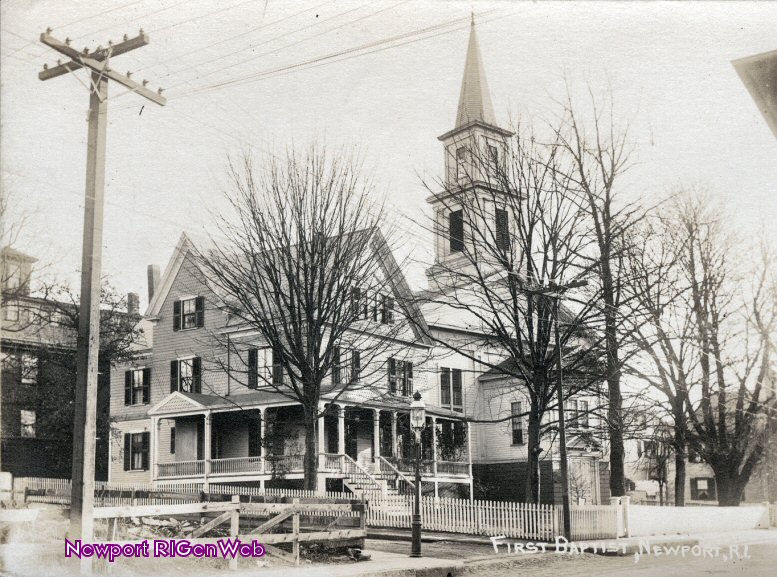
First Baptist Church building of Newport, Rhode Island

Pastor Joshua Davenport’s book shows a keen understanding of the issue presented and its importance. He backs up his position that Dr. John Clarke founded the first Baptist church in America with studied facts and analyses. Davenport bases his conclusion that the Newport church started by Dr. John Clarke in 1638 was the first Baptist church in America on historical research and facts. His conclusions are enhanced by correctly recorded citations of the historical sources he relies upon. Many other sources could be cited to support Brother Davenport’s conclusion, but the reviewer does not expect that anyone has the time to cover all possible sources. Finney is convinced beyond a reasonable doubt that Baptist History IN AMERICA is correct factually and historically and proves that the church started by Dr. John Clarke in Newport, Rhode Island was the first Baptist church in America, even should one consider the church started by Roger Williams to be a Baptist church.

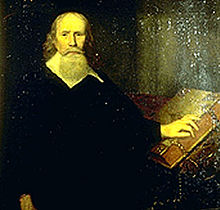
Dr. John Clarke
Dr. John Clarke

Brother Davenport does not address Landmarkism, the Baptist Bride theory, or Baptist Church succession, but “a matter of mere historical correctness and facts.” Like any good advocate who believes in the factual and doctrinal truth of his position on a very important issue, he considers some facts concerning Jim Fellure’s possible personal motivation for writing his booklet. Then he gives the four necessary categories of facts that need to be considered in order for the issue to be correctly understood. His well-documented facts are very persuasive in supporting his conclusion.

In addition to the facts, Davenport explains the importance of the issue and the importance of accurate facts. He correctly and with great insight points out that “Once one starts changing history, one changes who he is, where he came from and where he is going.” As he explains, (1) “Integrity for Historical Correctness is at Stake. (2) Proper Examples of Doctrinal Soundness is at Stake. In this section, Davenport gives his argument for a biblical order for baptism. (3) Regard for our Baptist Heritage and Identity is at Stake. (4) Historical Influence on American Principles is at Stake.” In this last section, Davenport declares something which Finney discovered himself after an intensive study over several years: “One cannot truly understand American history until he understands Baptist history.”

Finney, without equivocation, recommends that all true Baptists read and study Davenport’s jewel, Baptist History IN AMERICA Vindicated: The First Baptist Church in America/A Resurfaced Issue of Controversy/The Facts and Importance. This booklet is the kind of writing and teaching those seeking the truth of the matter need to read and digest, and the quality of writing that needs to come forth from one who is contending for the faith. From a foundation of intense study over many years, Finney attests to Davenport’s biblical, historical, and analytical acuity. See En3 for information on books by Jerald Finney.

Endnotes

En1. The following concerning ordination is from J. A. Shackelford, Compendium of Baptist History (Louisville, Kentucky: Press Baptist Book Concern, 1892 (Reprint), pp. 123-124. (Can be ordered from Local Church Bible Publishers):

“‘Commenius, who published a synopsis of the discipline of the churches of Bohemia, dwells particularly upon this article and shows that ‘a stated ministry was always considered as a matter of great importance among the Waldensean churches.’ A dreadful persecution broke out among the Bohemian brethren in the days of Commenius, which produced such havoc among them that he himself ‘was the only surviving bishop that escaped.’ The scattered brethren, in process of time, elected three persons as qualified for the pastoral office, but ‘found themselves greatly perplexed about their ordination.’

“‘Having understood that there were some Waldensean churches on the confines of Moravia and Austria, to satisfy their own scruples, as well as those of others, they resolved to send Michael Zambergius, one of their pastors, with two other persons to find out those Waldenses, and give them an account of what has passed among them, and especially to ask their advice upon the matter in hand. They met with one Stephen, a Waldensean bishop, who sent for others also residing in that quarter, with whom they had a conference upon the doctrines of the gospel, and the state of their churches, and by them the said three pastors were ordained by the imposition of hands. ‘Hence,’ says Dr. Allix, ‘it is abundantly evident, that as the Waldenses have preserved the faith that was committed to them, so have they been as careful to preserve entire among them the ancient discipline of the church.’

“These Waldensean brethren regarded regular ordination so much of importance, that they sent the three brethren some five or six hundred miles that they might be ‘examined upon the doctrines of the gospel,’ and receive ordination at the hands of a regularly ordained ministry. In this way have the pure doctrines of the gospel been preserved through all ages.”

En2. From the May 12 entry concerning baptism of This Day in Baptist History Past, “The Conversion of a Church”:

The Congregational church in Sedgwick, Maine, had enjoyed the ministry of the Reverend Danil Merrill for twelve years. During which time it became one of the largest of the denomination’s churches in the state. However, when several of his ministerial students became Baptists, the rev. Mr. Merrill determined to restudy the matter of baptism and write a book on the subject which would protect against such losses, and such a volume would be invaluable to many in refuting what he considered heresy taught by the Baptists. After more than two years of studying the scriptures he concluded that the Bible did not support his long-held position of sprinkling.

The matter came to a head when a group of children were presented to be sprinkled and the pastor could no longer with good conscience perform the rite. For several months Merrill continued in agony of heart for, as he confessed, he “could not bear the idea of being called one .

On February 28, 1805, after a series of sermons on the biblical mode of baptism, the congregation voted unanimously to call for a council of Baptist ministers to administer New Testament immersion, to constitute them as a Baptist church, and to ordain Daniel Merrill as their pastor. In all, sixty-six candidates were baptized on May 13, 1805, and nineteen more were baptized on the following day.

En3. Notice that two of Finney’s books listed below have already been fully reproduced on the “Separation of Church and State Law” website; links are included below. Also, God Betrayed has already been reproduced in audio form on the website, and much of the book is already reproduced, in written form, on the website. Soon, all the books will be in written form on the website. Finney is concerned with imparting truth, not with making money, in his God-called “Separation of Church and State Law” ministry. If one does not want to buy the books, but wishes to read them, he can do so at no cost.

God Betrayed/Separation of Church and State: The biblical Principles and the American Application (Link to preview of God Betrayed): may be ordered from Amazon by clicking the following link: God Betrayed on Amazon.com or from Barnes and Nobel by clicking the following link: God Betrayed on Barnes and Noble. All books by Jerald Finney as well as many of the books he has referenced and read may also be ordered by left clicking “Books” (on the “Church and State Law” website) or directly from Amazon by going to the following links: (1) Render Unto God the Things that Are His: A Systematic Study of Romans 13 and Related Verses (Kindle only) which has been reproduced on the “Separation of Church and State Law” website at Render Unto God the Things that Are His: A Systematic Study of Romans 13 and Related Verses; (2) The Most Important Thing: Loving God and/or Winning Souls (Kindle only) which has been reproduced on the “Separation of Church and State Law” website at The Most Important Thing: Loving God and/or Winning Souls; (3) Separation of Church and State/God’s Churches: Spiritual or Legal Entities? (Link to preview of Separation of Church and State/God’s Churches: Spiritual or Legal Entities?) which can also be ordered by clicking the following Barnes and Noble link: Separation of Church and State on Barnes and Noble.

En4. Letter from James Beller replying to assertions made by Jim Fellure in his booklet. The online link to this e-mail is: http://www.21tnt.com/index.php?view=article&catid=47:ancient-nature-of-the-baptists&id=25:a-letter-to-jim-fellure-of-victory-baptist-press&format=pdf

1 / 3A Letter to Jim Fellure of Victory Baptist Press

March 13, 2011

Bro. Fellure,

Thank you for your time on the phone on March 3, 2011. I had called to clarify some things with you concerning the “Open Letter To Those Who have Questioned Our Stand On The Baptist Bride, Lankmarkism, or Baptist Church Succession Theory,” which was dated March 3, 2011. This email letter was sent to over 15,000 recipients and, as I shared with you, had references to me, describing me as a Baptist “brider.” In this you linked me with a group of people I do not represent. I mean no disrespect in this short answer and I believe you to be a good man, but I mean to try to set the record straight.

Even though I am not a part of this group, nor have I ever denominated myself as a “landmarker,” you painted me as such. As I mentioned on the phone, I would have wished you had contacted me before you painted me with such a broad brush.  I will say that some of what is called “landmarkism” I embrace, as do a large number of independent Baptists. For instance, our church does not accept immersions for membership from any organization that has its roots in the Roman Catholic, or catholic Reformed. This is an ancient practice. We also believe in the local church as the only church found in the Bible. We also believe strongly that churches are to birth churches. We also, like many, many Baptists believe in the succession of principles. This was believed by Henry D’Anvers, Theilman Van Braght, Charles Spurgeon and the late David L. Cummins. This is nothing new. You seem to misunderstand both “brider” and “landmark” positions, mixing them together.  I am going to answer your letter in detail at a latter time, but you promised me a retraction:

1. On page 2 you write:

“The Baptist Bible Fellowship, the Bible Baptist Fellowship, the World Baptist Fellowship, and the Independent Baptist Fellowship International can all trace their history back to Dr. J. Frank Norris, an ordained Southern Baptist pastor who left the SBC and promoted and influenced the independent, fundamental Baptist movement. Men such as Dr. John R. Rice, Dr. Jack Hyles, Dr. Lee Roberson, Dr. Harold Sightler, Dr. Shelton Smith, Lester Roloff and many others had their roots in the Southern Baptist Convention, and the Southern Baptist Convention has its roots in the American Baptist Convention, which is linked back to Roger Williams and the First Baptist Church in America at Providence, Rhode, Island.“ It is a grievous error to claim “the independent, fundamental Baptist movement…had their roots in the Southern Baptist Convention, and the Southern Baptist Convention has its roots in the American Baptist Convention, which is linked back to Roger Williams and the First Baptist Church in America at Providence, Rhode, Island.” ANY Baptist historian, Cathcart, Armitage, McBeth, etc. knows the SBC has its roots in the Separate Baptist Revival through Shubal Stearns. Stearns was baptized by Wait Palmer and the line of baptism does go back to Newport, Rhode Island. However, all that aside, you…

2. On page 3 state:

“The Landmark theory would teach that not one of the pastors mentioned previously, or the converts that were saved and baptized under their ministry, are legitimate Baptists, and none of them will be in the Bride of Christ.”

I know of no “landmarker” that believes this and even if they did, I don’t believe it and have never said such a thing. But you make me one of the number that would say this by…

3. Writing on page 3:

“Some writers that follow the Landmark theory have some great historical information. Examples of two of these mens’ books are, The Trail of Blood, by J. M. Carroll, which VBP prints and sells, and America in Crimson Red, by Brother James Beller which we sell in our bookstore.”

You have made me a companion of those you claim “would teach that not one of the pastors mentioned previously, or the converts that were saved and baptized under their ministry, are legitimate Baptists, and none of them will be in the Bride of Christ.”

I do not believe this, nor do I know of any “landmarker” who believes it either. You made me out to say things I have never said, nor believed.

Bro. Fellure, you said you would print a retraction, but instead you re-sent the same email letter on March 10 (even though it was still dated March 3). Is this a retraction?

James Beller

Conclusion to Bible Studies on the Biblical Doctrine of Church


Jerald Finney
Copyright © February 9, 2011


Click here to go to Self-exam Questions on the Biblical Doctrine of the Church

Click here to listen to Jerald Finney’s audio teaching on the “Conclusion to articles on the biblical doctrine of ‘Church’”.


Conclusion to Articles on the Biblical Doctrine of “Church”

41The Supreme Ruler ordained the church, as He ordained civil government. He gave churches—as He has given individual, family and civil governments—His Word wherein they can learn God’s guidelines which He wishes His churches, as well as all other governments, to follow. Satan has successfully misled most churches and other governments, and most have followed his principles. He has used false teachers from the beginning. As a result, apostasy crept into the church shortly after its inception. That apostasy has accelerated in America as the  tribulation approaches.

Many or most people in American churches today are materially rich, but spiritually blind. “Because thou sayest, I am rich, and increased with goods, and have need of nothing; and knowest not that thou art wretched, and miserable, and poor, and blind, and naked” (Re. 3.17).

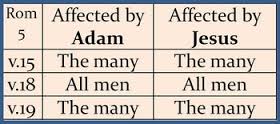
1Ti.2.14Ep.5.23-27Adam was not deceived, but the woman being deceived was in the transgression (1 Ti. 2.14, Ro. 5.14, Ge. 3.1-6).  Christ was not deceived, but His bride was. “As the first Adam had to give up a perfect existence in order to be with his wife, so the last Adam, Christ (1 Co. 15.22, 45), stepped down from heaven to save his bride. While the first Adam ‘blew it,’ the last Adam would make everything right! (Ro. 5:12-21) Charles Wesley set this doctrine to music with the words, ‘Second Adam from above, reinstate us with thy love.’ … “The all-important verse that connects this typology to the present Laodicean apostasy is Ec. 1:9a: ‘The thing that hath been, it is that which shall be; and that which is done is that which shall be done….’ Thus, the history of mankind will undoubtedly end the same way it began—with a bride being deceived!” (William P. Grady, How Satan Turned America Against God (Knoxville, Tennessee: Grady Publications, Inc., 2005), p. vii.).

Jn.3.16“For God so loved the world, that he gave his only begotten Son, that whosoever believeth in him should not perish, but have everlasting life. For God sent not his Son into the world to condemn the world; but that the world through him might be saved. He that believeth on him is not condemned: but he that believeth not is condemned already, because he hath not believed in the name of the only begotten Son of God. And this is the condemnation, that light is come into the world, and men loved darkness rather than light, because their deeds were evil” (Jn. 3.16-19).

Ro.5.12-21“[Jesus], being in the form of God, thought it not robbery to be equal with God: But made himself of no reputation, and took upon him the form of a servant, and was made in the likeness of men: And being found in fashion as a man, he humbled himself, and became obedient unto death, even the death of the cross” (Ph. 2.6-8).

3Regardless of this inevitable apostasy and the events that are to follow, things are looking good for you and me—that is, if you are a Christian! Christians have the ultimate hope: they will reign with the Lord. This should be a cause for great rejoicing as well as incentive to be responsible members of a local autonomous New Testament church and to make sure that every effort is made to glorify God and assure that a church remains totally under Christ in every way. The Holy Spirit is now calling out, not the subjects, but the co-heirs and co-rulers of the kingdom.

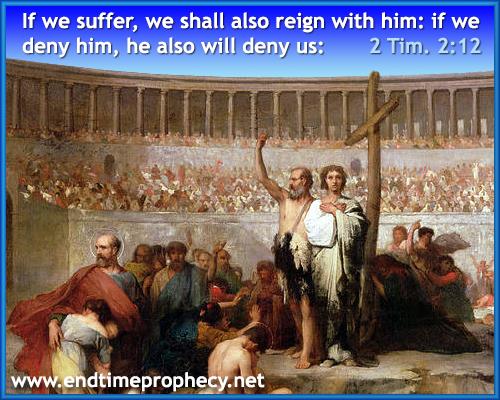
2Ti.2.12“It is a faithful saying: For if we be dead with him, we shall also live with him: If we suffer, we shall also reign with him: if we deny him, he also will deny us” (2 Ti. 2.11-12).

“And hath made us kings and priests unto God and his Father; to him be glory and dominion for ever and ever. Amen” (Re. 1.6).

Ro.8.18_2“To him that overcometh will I grant to sit with me in my throne” (Re. 3.21).

“And hast made us unto our God kings and priests: and we shall reign on the earth” (Re. 5.10).

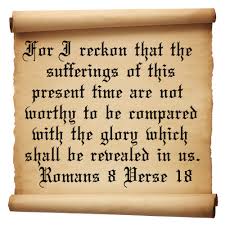
“For ye have not received the spirit of bondage again to fear; but ye have received the Spirit of adoption, whereby we cry, Abba, Father.’ The Spirit itself beareth witness with our spirit, that we are the children of God: And if children, then heirs; heirs of God, and joint heirs with Christ; if so be that we suffer with him, that we may be also glorified together. For I reckon that the sufferings of this present time are not worthy to be compared with the glory which shall be revealed in us” (Ro. 8.15-18).

“Do ye not know that the saints shall judge the world? and if the world shall be judged by you, are ye unworthy to judge the smallest matters? Know ye not that we shall judge angels? how much more things that pertain to this life” (1 Co. 6.2-3)?

Christ, the Bridegroom/Husband/Head of His Churches


Jerald Finney
Copyright © January 8, 2011


Click here to go to “Self-exam Questions: Christ, the Bridegroom/Husband/Head of His Churches


Preface

This series of articles develops the biblical doctrine of the church. This article is the third in this series. The first is “Introduction to articles on the doctrine of ‘church.” The second is “Definition, organization, and purposes of a church” (Note. Simply left click blue underlined links to go directly to link). In order to understand why incorporated 501(c)(3) churches have violated biblical principle and grieve our Lord Jesus Christ, one must first be saved. Second, he must understand the biblical principles of government, church, and separation of church and state. He must then understand the facts about and legalities of incorporation and 501(c)(3). Finally, he must apply principles to facts and law. May we believers continue to grow in knowledge, understanding, and wisdom as we seek to please our God and Savior.


Christ, the Bridegroom/Husband/Head of His churches

11_head-bodyThe Bible teaches that Christ desires to be the Bridegroom/Husband/Head of His churches. As to the issue of separation of church and state, this is particularly important. This article will look at biblical teaching on this issue. To understand how churches violate the biblical principle of the headship of Christ over His churches, one must apply the biblical principles to the facts and law—e.g., what is incorporation, what is Internal Revenue Code § 501(c)(3) (See, for thorough studies, Sections III, IV, and VI of God Betrayed/Separation of Church and State: The Biblical Principles and the American Application which is reproduced on this website in both PDF and online form. See Review of Books by Jerald Finney and Order infomration for books by Jerald Finney for information on this and other books by Jerald Finney.). This blog publishes articles that will systematically examine the biblical principles as well as historical and legal facts necessary to understand the mind of God on the issue of separation of church and state in general and specifically applied to the American landscape.

Churches are called the bride of the Lamb. Christ is the bridegroom of the church: “Ye yourselves bear me witness, that I said, I am not the Christ, but that I am sent before him. He that hath the bride is the bridegroom: but the friend of the bridegroom, which standeth and heareth him, rejoiceth greatly because of the bridegroom’s voice: this my joy therefore is fulfilled” (Jn. 3.28, 29).

The New Testament speaks of a church as a virgin espoused to one Husband; Eve is a type of the church as bride and wife of Christ:

  • “Would to God ye could bear with me a little in my folly: and indeed bear with me. For I am jealous over you with godly jealousy: for I have espoused you to one husband, that I may present you as a chaste virgin to Christ. But I fear, lest by any means, as the serpent beguiled Eve through his subtilty, so your minds should be corrupted from the simplicity that is in Christ. For if he that cometh preacheth another Jesus, whom we have not preached, or if ye receive another spirit, which ye have not received, or another gospel, which ye have not accepted, ye might well bear with him” (The Holy Spirit writing to the church at Corinth in 2 Co. 11.1-4).
  • “Wherefore, my brethren, ye also are become dead to the law by the body of Christ; that ye should be married to another, even to him who is raised from the dead, that we should bring forth fruit unto God” (Ro. 7.4).

Paul likens the marriage relationship of husband and wife to the relationship of Christ and His churches:

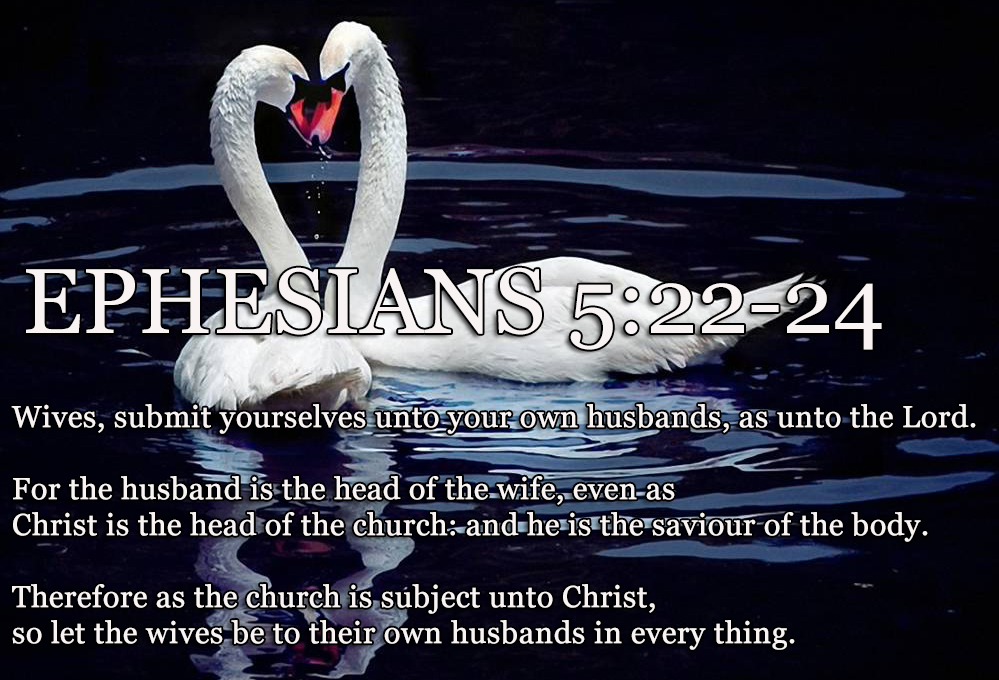
Ep.5.25“For the husband is the head of the wife, even as Christ is the head of the church: and he is the savior of the body. Therefore as the church is subject unto Christ, so let the wives be to their own husbands in everything. Husbands, love your wives, even as Christ also loved the church, and gave himself for it; That he might sanctify and cleanse it with the washing of water by the word.  That he might present it to himself a glorious church, not having spot, or wrinkle, or any such thing; but that it should be holy and without blemish.  For no man ever hated his own flesh; but nourisheth and cherisheth it, even as the Lord the church: For we are members of his body, of his flesh, and of his bones.  For this cause shall a man leave his father and mother, and shall be joined unto his wife, and they two shall be one flesh.  This is a great mystery: but I speak concerning Christ and the church. Nevertheless let every one of you in particular so love his wife even as himself; and the wife see that she reverence her husband” (Ep. 5.23, 25-27, 29-33).

The Lamb will marry His wife:

Rapture (1)“And I heard as it were the voice of a great multitude, and as the voice of many waters, and as the voice of mighty thunderings, saying, Alleluia: for the Lord God omnipotent reigneth. Let us be glad and rejoice, and give honour to him: for the marriage of the Lamb is come, and his wife hath made herself ready. And to her was granted that she should be arrayed in fine linen, clean and white: for the fine linen is the righteousness of saints” (Re. 19.6-8).

All believers will be married to Christ at the marriage of the Lamb:

“But ye are come unto mount Sion, and unto the city of the living God, the heavenly Jerusalem, and to an innumerable company of angels, To the general assembly and church of the firstborn, which are written in heaven, and to God the Judge of all, and to the spirits of just men made perfect,  And to Jesus the mediator of the new covenant, and to the blood of sprinkling, that speaketh better things than that of Abel” (He. 12:22-24).

Various people in the Old Testament are types of Christ, the Bridegroom, and the church, the bride. For example, Rebecca was a type of the church, the “called out” virgin bride of Christ. Isaac was a type of the Bridegroom, who loves through the testimony of the unnamed Servant: “Whom having not seen, ye love; in whom, though now ye see him not, yet believing, ye rejoice with joy unspeakable and full of glory” (1 Pe. 1.8). Isaac was a type of the Bridegroom who goes out to meet and receive his bride:

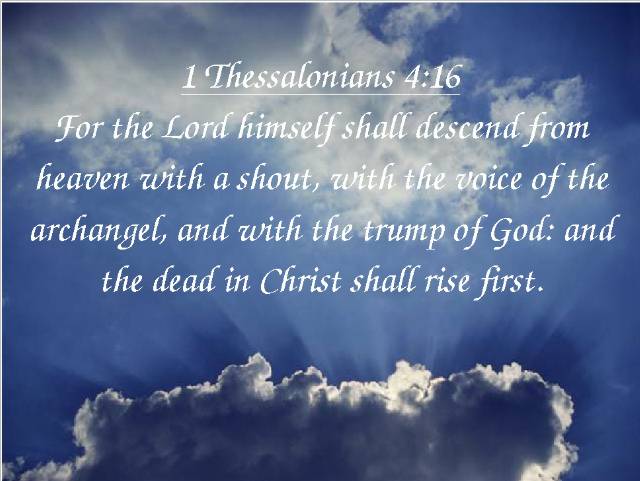
“For if we believe that Jesus died and rose again, even so them also which sleep in Jesus will God bring with him. For this we say unto you by the word of the Lord, that we which are alive and remain unto the coming of the Lord shall not prevent them which are asleep. For the Lord himself shall descend from heaven with a shout, with the voice of the archangel, and with the trump of God: and the dead in Christ shall rise first” (1 Th. 4.14-16).

“Typically, the book of Ruth may be taken as a foreview of the church—Ruth, as the Gentile bride of Christ, the Bethlehemite who is able to redeem” (1917 Scofield Reference Edition, Headnote to Ruth, p. 315. The author quotes Scofield only when he agrees with the quote. Scofield was not right about everything, but he was right about some matters. A open-minded Holy Spirit led study of the word of God will lead one to truth, including the truth of the biblical teachings of any man.).

3The coming of the Bridegroom is cause for great rejoicing by the believer, the friend of the Bridegroom: “He that hath the bride is the bridegroom: but the friend of the bridegroom, which standeth and heareth him, rejoiceth greatly because of the bridegroom’s voice: this my joy therefore is fulfilled” (Jn. 1.29).  The marriage of the Lamb to His bride will be a glorious event which will occur in heaven, unlike the restoration of Israel which will take place on the earth:

“Let us be glad and rejoice, and give honour to him: for the marriage of the Lamb is come, and his wife hath made herself ready. And to her was granted that she should be arrayed in fine linen, clean and white: for the fine linen is the righteousness of saints. And he saith unto me, Write, Blessed are they which are called unto the marriage supper of the Lamb. And he saith unto me, “These are the true sayings of God” (Re. 19.7-9; see also Re. 21.9-22.17).

The husband is to be the only head of the wife, and Christ is to be the only Head of His churches. See Ephesians 5.23, 25-27, 29-33 quoted above. “And hath put all things under his feet, and gave him to be the head over all things to the church” (Ep. 1.22).  After Jesus was born, “there came wise men from the east to Jerusalem, Saying, where is he that is born King of the Jews? for we have seen his star in the east, and are come to worship him” (Mt. 2.1-2).  “‘The King’ is one of the divine titles (Psa. 10.6), and so used in the worship of the Church (I Tim. 1.17), but Christ is never called ‘King of the Church.’ He is ‘King of the Jews’ (Mt. 2.2) and Lord and ‘Head of the Church’ (Eph. 1.22, 23)” (1917 Scofield Reference Edition, n. 1 to Matthew 2.2, p. 995). “Who is the image of the invisible God, the firstborn of every creature: For by him were all things created, that are in heaven, and that are in earth, visible and invisible, whether they be thrones, or dominions, or principalities, or powers: all things were created by him and for him: And he is before all things, and by him all things consist. And he is the head of the body, the church: who is the beginning, the firstborn from the dead; that in all things he might have the preeminence” (Col. 1.15-18).

Christ, likened unto a husband, because of His love for the church, gave Himself to redeem the church. He is, in love, sanctifying the church, and will present the church to Himself as a reward for His sacrifice and labor of love, a glorious church, not having spot, or wrinkle, or any such thing, a perfect church without spot or blemish, “one pearl of great price” (Mt. 13.45-46).

Jesus is the Father’s love-gift to the world. “For God so loved the world, that he gave his only begotten Son, that whosoever believeth in him should not perish, but have everlasting life” (Jn. 3.16).

The believer, the church member, is His reward, given Him as a love-gift by the Father. 1917 Scofield Reference Edition, n. 3 to John 17.2, p. 1139. “As thou hast given him power over all flesh, that he should give eternal life to as many as thou hast given him” (Jn. 17.2). “I have manifested thy name unto the men which thou gavest me out of the world: thine they were, and thou gavest them me; and they have kept thy word” (Jn. 17.6). “I pray for them: I pray not for the world, but for them which thou hast given me; for they are thine” (Jn. 17.9). “And now I am no more in the world, but these are in the world, and I come to thee. Holy Father, keep through thine own name those whom thou hast given me, that they may be one, as we are. While I was with them in the world, I kept them in thy name: those that thou gavest me I have kept, and none of them is lost, but the son of perdition; that the scripture might be fulfilled” (Jn. 17.11-12). “Father, I will that they also, whom thou hast given me, be with me where I am; that they may behold my glory, which thou hast given me: for thou lovedst me before the foundation of the world” (Jn. 17.24).

Just as a bridegroom gives gifts to his earthly bride, so Christ gives gifts to His bride, to those whom the Father gave Him (1917 Scofield Reference Edition, n. 3 to John 17.2, p. 1139). (1) He gives His bride eternal life: “As thou hast given him power over all flesh, that he should give eternal life to as many as thou hast given him” (Jn. 17.2). (2) The Father’s name: “I have manifested thy name unto the men which thou gavest me out of the world: thine they were, and thou gavest them me; and they have kept thy word…. And I have declared unto them thy name, and will declare it: that the love wherewith thou hast loved me may be in them, and I in them…. Jesus saith unto her, Touch me not; for I am not yet ascended to my Father: but go to my brethren, and say unto them, I ascend unto my Father, and your Father; and to my God, and your God” (Jn. 17.6, 26; 20.17). (3) The Father’s words: “For I have given unto them the words which thou gavest me; and they have received them, and have known surely that I came out from thee, and they have believed that thou didst send me…. I have given them thy word; and the world hath hated them, because they are not of the world, even as I am not of the world” (Jn. 17.8, 14). (4) His own joy: “And now come I to thee; and these things I speak in the world, that they might have my joy fulfilled in themselves” (Jn 1.7.13). (5) His own glory: “And the glory which thou gavest me I have given them; that they may be one, even as we are one” (Jn. 17.22).

bridewaitingLoving God is preeminent for a believer and for a church. One does not love God by just asserting that he loves God. Jesus said, “If ye love me, keep my commandments” (Jn. 14.15) The greatest commandment is to love the Lord with all one’s heart, soul, mind, and strength (Mt. 22.37; Mark 12.30; Lu. 10.27).

Love is action. This love between Christ and His church is seen in the Song of Solomon. The Song of Solomon, “[p]rimarily, is the expression of pure marital love as ordained of God in creation, and the vindication of that love as against both asceticism and lust—the two profanations of the holiness of marriage. The secondary and larger interpretation is of Christ, the Son and His heavenly bride, the Church (2 Cor. 11.1-4, refs.)” (1917 Scofield Reference Edition, Headnote to Song of Solomon, p. 705). “Many waters cannot quench love, neither can the floods drown it: if a man would give all the substance of his house for love, it would be utterly contemned” (Song of Solomon 8.7). “Contemned” means “despised, scorned, slighted, neglected, or rejected with disdain” (AMERICAN DICTIONARY OF THE ENGLISH LANGUAGE, NOAH WEBSTER (1828), definition of “CONTEMNED”). God despises, scorns, slights, neglects, or rejects with disdain all that a church does, whatever professions of love she makes, if those acts and/or professions are without love. A church who does not honor Christ as a wife is to honor her bridegroom and her husband, by remaining pure and chaste, does not display love for the Lord. Thus, loving ones neighbor by witnessing to him, sending missionaries to him, helping him materially or any other way in obedience to the second commandment—“Thou shalt love thy neighbor as thyself”—is vanity in God’s eyes if one ignores the greatest commandment. The love of the temporal—e. g., worldly organization, ownership of property, worldly power and prestige, etc.) by a church infringe the total love (charity) which Christ desires of his churches.

This fact is also articulated in the New Testament. The Lord Jesus is jealous over His church.  If we do not love the Lord Jesus, He despises all the “Christian” work we do and the money we put in the offering plate. “Though I speak with the tongues of men and of angels, and have not charity, I am become as sounding brass, or a tinkling cymbal. And though I have the gift of prophecy, and understand all mysteries, and all knowledge; and though I have all faith, so that I could remove mountains, and have not charity, I am nothing. And though I bestow all my goods to feed the poor, and though I give my body to be burned, and have not charity, it profiteth me nothing” (1 Co. 13.1-3). “Charity” speaks of God’s kind of love. “In a theological sense, [‘charity’] “includes supreme love to God and a universal good will to men. 1 Cor. xiii. Col. iii. 1 Tim. i” (AMERICAN DICTIONARY OF THE ENGLISH LANGUAGE, NOAH WEBSTER (1828), definition of “CHARITY”). Love is an act of the will. A church refutes its proclamations of love for the Lord when it wholly or partially takes the church from under the headship of her Husband, the Lord Jesus Christ or operates in any manner which is contrary to the principles for a church given in God’s word.

Love “[r]ejoiceth not in iniquity, but rejoiceth in the truth” (1 Co. 13.6). Iniquity means “Injustice, unrighteousness, … [w]ant of rectitude [rightness in principle or practice], … a sin or crime; wickedness…” (AMERICAN DICTIONARY OF THE ENGLISH LANGUAGE, NOAH WEBSTER (1828), definitions of “INIQUITY” and “RECTITUDE”). Bible truth makes clear that the love of Christ for His church is immense, that He wants to be the only Head and companion of the church who is likened to His bride and wife, and that for a church to even partially put herself under or associate with another entity is a great wickedness and repudiates all professions of love for the Lord. As is shown in Section VI of God Betrayed (online version or link to PDF) and Separation of Church and State/God’s Churches: Spiritual or Legal Entities? (online version or link to PDF), the church who incorporates and secures a 501(c)(3) tax exemption commits wicked sinful acts in violation of biblical principle, and rejoices in iniquity by putting herself partially under two other heads (the state of incorporation and the federal government),.

Re.2.4The Lord Jesus gave a warning to the church at Ephesus:

“I know thy works, and thy labour, and thy patience, and how thou canst not bear them which are evil: and thou hast tried them which say they are apostles, and are not, and hast found them liars: And hast borne, and hast patience, and for my name’s sake hast laboured, and hast not fainted. Nevertheless, I have somewhat against thee, because thou hast left thy first love. Remember therefore from whence thou art fallen, and repent, and do the first works; or else I will come unto thee quickly, and will remove thy candlestick out of his place, except thou repent” (Re. 2.2-5).

As Dr. J. Vernon McGee teaches us, this warning was for every church who has lost her love for the Lord Jesus:

“It was a warning of danger of getting away from a personal and loving relationship with Jesus Christ. The real test of any believer, especially those who are attempting to serve Him, is not your little method or mode or system, or your dedication, or any of the things that are so often emphasized today. The one question is: Do you love Him? Do you love the Lord Jesus? When you love Him, you will be in a right relationship with Him, but when you begin to depart from the person of Christ, it will finally lead to lukewarmness. The apostate church was guilty of lukewarmness. It may not seem to be too bad, but it is the worst condition that anyone can be in. A great preacher in upper New York state said: ‘Twenty lukewarm Christians hurt the cause of Christ more than one blatant atheist.’ A lukewarm church is a disgrace to Christ” (J. Vernon McGee, RevelationVolume I (Pasadena, California: Thru the Bible Books, 1982), pp. 121-122).

Ep.5.31-32As the Lord Jesus Christ is jealous over His churches, so should pastors and church members be jealous, with a godly jealousy, over the church they belong to, just as Paul was: “For I am jealous over you with godly jealousy: for I have espoused you to one husband, that I may present you as a chaste virgin to Christ. But I fear, lest by any means, as the serpent beguiled Eve through his subtilty, so your minds should be corrupted from the simplicity that is in Christ.  For if he that cometh preacheth another Jesus, whom we have not preached, or if ye receive another spirit, which ye have not received or another gospel, which ye have not accepted, ye might well bear with him” (2 Co. 11.2-4; Lu. 18.8; 2 Ti. 3.1-8).

The church who really loves her Husband, the Lord Jesus Christ, will seek to maintain her purity, to be subject to her Husband in all things. All the professions of love, all the good deeds, the hymns sung, and the messages preached by a church who does not totally submit herself in all things to her Husband, are contemned by the Lord. A church who takes a 501(c)(3) tax exemption, an incorporation, a license, or any type permit from the state, or puts herself under the state in any way, becomes an earthly legal entity subject to the jurisdiction of earthly powers, the state and federal government. Such a “church” is in fact a two headed monster. Such a “church,” in spite of any professions of love for the Lord, according to her acts shows that she does not love the Lord Jesus Christ.

Introduction to Bible Studies on the Biblical Doctrine of Church


Jerald Finney
Copyright © December, 2010


Click here to go to “Self-exam Questions: Introduction to the Biblical Doctrine of Church”

Sermon by Pastor Jason Cooley: “The Gifts of the Body,” September 5, 2012 (Left click to listen to sermon)

Click here to listen to other sermons which deal with church doctrine
Click here to listen to Jerald Finney’s audio teaching on the “Introduction to ‘The Biblical Doctrine of the Church'”

15


Introduction to the Biblical Doctrine of the Church

These teachings are based upon a literal interpretation of Scripture. Of course, the Bible uses metaphors, personifications, similes, and other figures of speech.  However, untold damage to the cause of Christ has been caused by unbridled allegorization or spiritualization of Scripture by Catholics, Protestants, Jehovah’s witnesses and others. Some of those religions, due to their heinous theologies (false interpretations of Scripture) have violently persecuted and murdered others, including true believers who stood on God’s Word in spite of persecutions and martyrdom, down through the last 2,000 years. Sadly, perversions of Scripture by such religions and the resulting atrocities based upon false interpretations have been attributed to true Christians by the world in general—true Christians and churches have been lumped together with imposters by both secular and Christian revisionists.

10This series of articles, a revised and updated version of Section II of God Betrayed/Separation of Church and State: The Biblical Principles and the American Application, will develop the biblical doctrine of the church. In order to understand why church incorporation and 501(c)(3) status violates biblical principles and grieves our Lord Jesus Christ, one must first be saved. Second, he must understand the biblical principles of government, church, and separation of church and state. He must then understand the facts about and legalities of incorporation and 501(c)(3). Finally, he must apply principles to facts and law. To fully understand this requires a lot of time and study, and God wants His children, and especially pastors, to take the time to do the studying (1 Ti. 2.15). Most pastors are so consumed with their ministries that they need to rely on specialists within the local church body-for example, born again, Bible believing, God honoring lawyers or others who have the time, gifts, abilities, and love for the Lord necessary to examine these matters. Those requirements eliminate many so called Christian “lawyers” who are using “churches” and “Christians” to enrich their coffers while dishonoring and grieving God and His principles. The author has done such a systematic study and published the results in God Betrayed. He is now step by step presenting that study in academic course form on this “Separation of Church and State Law” blog. This series of articles will develop the biblical doctrine of the church.

Matthew3.1-3As foretold by Isaiah (Is. 40.3), John the Baptist announced: “Repent ye: for the kingdom of heaven is at hand. For this is he that was spoken of by the Prophet Esaias, saying, The voice of one crying in the wilderness, Prepare ye the way of the Lord, make his paths straight” (Mt. 3.2-3. See also, Mk. 1.2-3; Lu. 3.4; and Jn. 1.23). The phrase “kingdom of heaven” “is peculiar to Matthew and signifies the Messianic earth rule of Jesus Christ, the Son of David. It is called the kingdom of the heavens because it is the rule of the heavens over the earth (Mt. 6.10). The phrase is derived from Daniel, where it is defined (Dan. 2.34-36, 44; 7.23-27) as the kingdom which ‘the God of heaven’ will set up after the destruction by ‘the stone cut without hands’ of the Gentile world-system. It is the kingdom covenanted to David’s seed (2 Sam. 7.7-10, refs.); described in the prophets (Zech. 12.8, note); and confirmed to be Jesus the Christ, the Son of Mary, through the angel Gabriel (Lk. 1.32, 33)” (1917 Scofield Reference Edition, n.1 to Matthew 3.2, p. 996; See also, J. Vernon McGee, Matthew, Volume I (Pasadena, California: Thru the Bible Books, 1980 revised printing), pp. 8-10. The author has diligently studied the biblical principles of government, church, separation of church and state, as well as other principles for years. His studies include extensive study of the Bible and commentaries upon the Bible. He does not agree with Scofield’s doctrine of the church (See C.I. Scofield’s ‘true church’ doctrine). However, he does agree with much of what Scofield includes in his notes and margins. Quoting Scofield indicates agreement unless otherwise indicated.).

After Israel morally rejected the kingdom of heaven, Jesus predicted judgment on the places chosen for the testing of the nation, Chorazin, Bethsaida, and Capernaum, “wherein most of his mighty works were done, because they repented not” (Mt. 11.20-24). Jesus, at that point, turned from the rejecting nation, offered rest and service to individuals in the nation, and turned to the Gentiles (Mt. 11.28-30; Mt. 12.18). “In fulfillment this awaited the official rejection, crucifixion, and resurrection of Christ, and the final rejection of the risen Christ” (Lk. 24.46, 47; Acts 9.15; 13.46; 28.25-28; Rom. 11.11; 1917 Scofield Reference Edition, n. 2 to Mt. 12.18, p. 1012).

Just as God ordained civil government, He also ordained His churches after the nation Israel rejected Him and the kingdom of heaven. The power given by God to His churches on earth was to secure a spiritual good for their members. When Christ asked His disciples whom they thought Him to be (Mt. 16.15, Mk. 8.29, Lu. 9.20), Peter answered, “Thou art the Christ, the Son of the living God” (Mt. 16.16; see also, Mk. 8.29, Lu. 9.20). At that point, our Lord announced the out calling of the church when He said: “And I say also unto thee, [t]hat thou art Peter, and upon this rock I will build my church; and the gates of hell shall not prevail against it. And I will give unto thee the keys of the kingdom of heaven: and whatsoever thou shalt bind on earth shall be bound in heaven: and whatsoever thou shalt loose on earth shall be loosed in heaven” (Mt. 16.18-19).

Mt.16.18_1The building of the church is on the rock of Peter’s confession, the Christ he confessed. Peter makes clear that the rock upon which the Lord will build the institution of the church which is made to be made up of local, autonomous churches, which are spiritual houses made up of spiritual beings offering up spiritual sacrifices, and not physical houses made by man, is Christ Himself:

“To whom coming, as unto a living stone, disallowed indeed of men, but chosen of God, and precious, Ye also, as lively stones, are built up a spiritual house, an holy priesthood, to offer up spiritual sacrifices, acceptable to God by Jesus Christ. Wherefore also it is contained in the scripture, Behold, I lay in Sion a chief corner stone, elect, precious: and he that believeth on him shall not be confounded. Unto you therefore which believe he is precious: but unto them which be disobedient, the stone which the builders disallowed, the same is made the head of the corner. And a stone of stumbling, and a rock of offence, even to them which stumble at the word, being disobedient: whereunto also they were appointed” (1 Pe. 2.4-9).

3“This is the stone which was set at nought of you builders, which is become the head of the corner” (Ac. 4.11, part of Peter’s address to the Sanhedrin). From the context, it is obvious that Peter is speaking of the Lord as being the chief corner stone. Nowhere in the Bible is there any indication that Peter was the cornerstone of a universal visible or invisible church. The words used also make clear that Christ was referring to Himself as the rock on which the church would be built. “There is in the Greek [in Matthew 16.18] a play upon the words, “thou art Peter [petros—literally, ‘a little rock’], and upon this rock [Petra] I will build my church.” He does not promise to build His church upon Peter, but upon Himself, as Peter himself is careful to tell us (1 Pet. 2.4-9)” (1917 Scofield Reference Edition, n. 1 to Mt. 16.18, p. 1021).

Re.1.18Jesus Christ, Head of the church, “loved the church and gave Himself for it” (Ep. 5.25). Jesus did not give Peter the keys—a key being a badge of power or authority (see, e.g., Is. 22.22 and Re. 3.7)—to the church, but to “the kingdom of heaven,” the keys in the sense of Matthew 13, that is of the sphere of Christian profession. Peter assumed no other authority. In the council at Jerusalem as recorded in Acts 15, James seems to have presided. Peter claimed nothing more than to be an apostle by gift and an elder by office (See 1 Pe. 1.1 and 5.1). The power of binding and loosing was shared by the other apostles (See Mt. 18.18 and Jn. 20.23). Since only Christ held the keys of death and the place of departed spirits, “this did not involve the determination of the eternal destiny of souls” (1917 Scofield Reference Edition, n. 1 to Mt. 16.19, p. 1022).  “I [Jesus Christ] am he that liveth, and was dead; and, behold, I am alive for evermore, Amen; and have the keys of hell and of death” (Re. 1.18).

Isaac Backus, the great Baptist leader in New England, elaborated upon the faith confessed by Peter:

keysToKingdom“This faith is the foundation of the church; against this faith the gates of hell shall not prevail; this faith hath the keys of the kingdom of heaven; what this faith shall loose or bind on earth, is bound and loosed in heaven…. Now it followeth, that whatsoever person hath received the same precious faith with Peter, as all the faithful have, 2 Pet. i. 1, that person hath a part in this gift of Christ. Whosoever doth confess, publish, manifest or make known Jesus to be the Christ, the Son of the living God, and Saviour of the world, that person opens heavens gates, looseth sin, and partakes with Peter in the use of the keys; and hereupon it followeth necessarily, that one faithful man, yea, or woman either, may loose and bind, both in heaven and earth, as all the ministers in the world” (Isaac Backus, A History of New England With Particular Reference to the Denomination of Christians called BaptistsVolume 1 (Eugene, Oregon: Wipf & Stock, Publishers, Previously published by Backus Historical Society, 1871), p. 12 quoting John Robinson, A Justification of Separation from the Church of England.).

God’s Word describes the church as being the bride of Christ and the wife of Christ. Those designations carry connotations about how He feels about His relationship with His churches, and the Word of God gives ample instruction Ep.5.22-24to alert churches to what this relationship entails. The Lord while on earth did not explain how, when, or of what materials local church bodies on this earth should be built, or what should be their position, relationships, privileges or duties. Instead, He revealed to Paul the mystery of the churches who were to be made up of both Jewish and Gentile believers in autonomous local assemblies. Paul’s epistles develop the doctrine to be followed by the churches. God, through the Apostle Paul, explained the purpose, membership, make-up, and operation of the churches, and the relationship of His churches to the Lord Jesus. Through Paul alone we know that churches are not earthly organizations, but spiritual organisms, local spiritual bodies.

The Bible makes clear that churches here on earth are to be visible, local, autonomous bodies, each operating under the principles of the Word of God. Paul wrote to local churches or assemblies—the church of God which is at Corinth (1 Co. 1.2, 2 Co. 2.1), the churches of Galatia (Ga. 1.2), the church at Ephesus (See Re. 2.1), the church of the Thessalonians (1 Th. 1.1; 2 Th. 2.1). Christ stood in the in the midst of seven golden candlesticks (local churches still on earth) (Re. 1.11-13); and He instructed John to write to those seven churches (Re. 1.19-20). The Lord delivered individual messages to each of those local assemblies (Re. 2.1-3.22).

Although the Lord made clear that He wants every church to be under Him in all things, God allows men in a church free-will to decide whether to do things His way. Our Lord warned against false teachers to come and some writers of the New Testament warned of already existing apostasy in the church and revealed that before the return of Christ true believers would all be raptured and those left behind in the visible “church” would go into total apostasy, be called a whore and not a church, and be destroyed by the nations. Religious apostasy of some churches in America began with the importation from Europe of modernism and has recently accelerated as seen in the recent Church Growth Movement and, after that, the Emerging Church Movement.

Christ is described as the only head, husband, and bridegroom, of His churches. He will conduct a marriage ceremony, the wedding of the Lamb (Re. 19.7-10). The bride who will be called to the marriage supper of the Lamb will be arrayed in fine linen, which is the righteousness of the saints (Ibid). Because of the signs of the times, as related to biblical prophecy, true believers should be vigilant in seeking the salvation of the lost since it appears that the Lord will return soon. Only true believers have the ultimate hope: they will reign with the Lord. The Holy Spirit is now calling out, not the subjects, but the co-heirs and co-rulers of the kingdom. Since the Lord told believers to love others, since believers will be eternally with God, and since nonbelievers will be eternally separated from God for all eternity, those who are saved should have a great burden for the salvation of the lost.

DoctrineIn order to maximize the witness of the local church, believers should be careful to do all they do as individuals, families, as a church body, and as citizens according to the principles of the Word of God. Initial compromise of God’s principles on the church level inevitably leads to further compromise, to heresy, and in most cases to apostasy. Compromise introduces leaven which in turn infects the whole body. Thus, for example, the initial compromise of many Baptist churches after the adoption of the United States Constitution in getting corporate status introduced a little poison into churches. Corporate churches, generally speaking, had no problem with further compromises such as the abandonment of God’s Word in English, and Internal Revenue Code § 501(c)(3) status. The religious apostasy in America among God’s churches has accelerated at an alarming pace.

This section will delve into what the Bible teaches about God’s institution of the church and the local churches which make up that institution.

Church Incorporation, 501c3, Heresy, and Apostasy


Jerald Finney
Copyright © November, 2010
Click the following for links to articles on:
Christian Issues, Heresy, And Apostasy
When Did the Church Become a Business?” a by Jason Bellard


Contents: 

I. Preface
II. Introduction
III. Church apostasy in America has followed the pattern of apostasy in Israel
IV. Church incorporation in the American colonies and after ratification of the Constitution
V. The relationship of God and state (Gentile nations)
VI. Government control over incorporated 501(c)(3) religious organizations
VII. Free under God or in bondage under Satan?
VIII. Apostasy at the end of the church age
IX. Conclusion
Endnotes [Endnote 1 has information on books by Jerald Finney]


 Note. Go directly to blue underlined articles, books, etc. by left clicking.


I. Preface

As ye have therefore received Christ Jesus the Lord, so walk ye in him: Rooted and built up in him, and stablished in the faith, as ye have been taught, abounding therein with thanksgiving. Beware lest any man spoil you through philosophy and vain deceit, after the tradition of men, after the rudiments of the world, and not after Christ” (Col. 2.6-8).

In the next series to be printed on this blog, the author will explain biblical doctrine of the church, a doctrine that must be correctly understood in order to understand that Christ is not pleased when a church subjects herself to the civil government in any manner, including incorporation and 501(c)(3). In that series the author will go into some detail concerning the doctrine of the church. For now, the following is offered as a brief comment concerning the biblical doctrine concerning churches:

“A church is a local visible assembly of persons who have made a profession of faith in Jesus Christ. Only in the sense that since one cannot see the spiritual condition of people’s hearts is the church invisible. We can see the local assembly and those who outwardly attend a church, and we can see outward evidences of inward spiritual change, but we cannot actually see people’s hearts and view their spiritual state. Therefore, one can be in the visible church, yet unregenerate, lost, and destined for hell. As shown in God Betrayed/Separation of Church and State: The Biblical Principles and the American Application (See En1 for link to preview of this book and ordering information), all references in the New Testament to a church here on earth refer to an autonomous local body of Jewish and/or Gentile believers and not to a universal or catholic church (Ibid. at pp. 72-73). Paul wrote to local bodies here on earth (e.g., to the church at Corinth, the church at Ephesus, the churches of Galatia, etc.). Jesus walked in the midst of seven golden candlesticks (churches or assemblies: Re. 1.13; 2.1), not in the midst of a candlestick, and instructed John to write distinct messages to each of those seven churches or assemblies, each message to address the condition of and a warning to and/or approval of the particular church to whom the message was sent (Re. 1.1-3.22). His message to those churches and other messages to the churches in the New Testament are to local church bodies or assemblies. His messages to churches in Revelation as well as in other New Testament passages are to be studied and applied by each believer and each local New Testament church until the Rapture occurs. Every church should aim to please the Lord completely as did the church at Smryna and the church at Philadelphia.”

The present series addresses biblical teaching on heresy and apostasy of New Testament churches and the application of that teaching to churches in America. Heresy and apostasy of churches received thorough coverage in the New Testament. As understood by Jude, the principle of apostasy was also addressed thoroughly in the Old Testament, but in the context of God’s Old Testament people, the Jews, and their nation and religion. The New Testament predicted the apostasy of the professing church, treated the apostasy as having already set in, and described the cause and course. These biblical teachings are there for the instruction and admonition of individual believers, families, the nation, and the churches. By studying and applying biblical principle in faith, a church will please the Lord. Dire consequences result for individuals, families, the nation, and for every church which fails to do so.

In the first article of this series on heresy and apostasy,  “On Jack Hyles’ Sermon, ‘The Treasure is in a Field,’” the author pointed to what is viewed by many as a great American church. Dr. Hyles missed a preeminent principle in the Word of God as to the organization of God’s churches in his sermon, “The Treasure is in a Field.” Dr. Hyles either did not understand biblical principle concerning the two types of marriage—the marriage of Christ and His churches the marriage of man and woman—or he disregarded those principles. As a result of his error, the chickens may already be coming home to roost at the First Baptist Church of Hammond, Indiana (referred to hereinafter as “First Baptist”). As the author has long pointed out, when a church and pastor compromise basic biblical principle regarding separation of church and state, that church has dishonored her love relationship with the Lord Jesus Christ and has headed down the road to heresy and apostasy. When compromise is made, even by a great man of God like Jack Hyles, the church he pastors has dishonored God, taken a step toward apostasy, and will sooner or later be led by one who will further compromise biblical truth.

In the next article in this series, “Jack Schaap, First Baptist of Hammond, Heresy and Apostasy,” the author pointed to some heretical teachings at First Baptist which Dr. Hyles would never have tolerated, and – in Part II of that article – summarized biblical teaching on heresy and apostasy in God’s churches.

As a result of the first two articles mentioned above, pastors and Christians sent e-mail letters expressing their support or opposition to the articles mentioned above. Some of those letters and my responses may be read in the third article in this series, “Letters from pastors regarding Hyles/Schaap and other articles.”

In the third article in this series “Recent accelerated apostasy in the United States,” the author examined the accelerating pace of apostasy in today’s American churches. Churches are now concerned with growth and appealing to the self and to the flesh rather than with biblical principle and spiritual growth. As a result of these spiritually dead churches and their efforts, a smaller and smaller percentage of people are being saved.

This article, the fourth in this series, traces the beginning and development of heresy and apostasy in American churches beginning in the early history of the United States of America.

The thinking that sacrifices truth for unity and superficial peace is not biblical. Christians are instructed to examine doctrinal differences in light of Scripture. Christians have a duty to expose and condemn unbiblical teaching and behavior. Paul rebuked people by name (Phil. 4.2-3; 1 Ti. 1.20; 2 Ti. 2.17). John condemned Diotrophes, a church leader who rejected the apostolic letters and authority (3 Jn.).

Believers are to speak the truth in love. This series of articles on heresy and apostasy does just that. The ultimate goal is to glorify and please our Lord by presenting truth in the hopes that some Christians and churches will wake up, reject heresy and apostasy, place themselves solely under the authority of the Lord Jesus Christ, and again proclaim the Gospel with power in order that more souls will be saved. Does not the Lamb of God deserve the reward of His suffering? Should a Christian not bear his cross for the glory of the One who gave His all for him?

Spiritual treasure is being lost and abandoned and no one seems to know why. This series of articles explain why.


II. Introduction

Many factors have contributed to the attacks on God’s Word and the apostasy churches—for example, the enlightenment, the industrial revolution, and Darwinism. Enlightenment thought or humanism was brought into churches as religious modernism. Humanistic principles infiltrated most churches, including fundamental Bible believing churches, which moved from acting and preaching with the goal of glorifying God to acting and preaching with the goal being the happiness of man.

Religious apostasy was followed by moral awfulness which resulted in political anarchy. First, God and His principles were attacked and religious apostasy grew. Then followed moral depravity and then the denial by civil government of God’s authority and any established order under God. As to the first stage in the downfall of America, the states of the new nation invited the churches to an ungodly relationship with civil government through incorporation. Then, in the twentieth century the legislative and executive branches of the federal government, through the Internal Revenue Code (“IRC”), extended another invitation to churches to become more entangled and controlled by government. Most churches eagerly accepted that invitation. In the midst of these unions with civil government, religious modernism and revisions of the Word of God were infiltrating churches and Christian educational institutions to one degree or another.

Jesus Christ is the head of His churches in all things. However, Christ will permit a church to betray Him and take herself from under His authority in one thing, some things, or all things. Placing a church under some person or power in only one thing greatly displeases the Lord because doing so violates biblical precept. God’s Word did not say, “and gave him to be the head over all things to the church except one thing” or “all things except secular or earthly matters,” or “all things except property.” God’s Word says, “all things.” Isaac Backus, the great Baptist leader in the colony of Massachusetts wrote: “If Christ Jesus have left such power with the civil rulers of the world, [kingdoms and counties, or] for the establishing, governing, and reforming his church, what is become of his care and love, wisdom and faithfulness, since in all ages since he left the earth, for the general [beyond all exception] he hath left her destitute of such qualified princes and governors, and in the course of his providence furnished her with such, whom he knew would be [and all men find] as fit as wolves to protect and feed his sheep and people!” (Isaac Backus, A History of New England With Particular Reference to the Denomination of Christians called Baptists, Volume I, (Eugene Oregon: Wipf & Stock Publishers, Previously published by Backus Historical Society, 1871), fn. 1, p. 158, quoting Roger Williams, Bloody Tenent.

When a New Testament church does anything contrary to Scripture which gives even partial claim of sovereignty over that church to the state, that church has committed a wicked act which subjects her to another head, thereby greatly displeasing the Lord. That church has betrayed the Lord.

Doing one thing that subjects a church to the state creates a legal entity. “Legal entity” means: “Legal existence. An entity, other than a natural person, who has sufficient existence in legal contemplation that it can function legally, be sued or sue and make decisions through agents as in the case of corporations” (BLACK’S LAW DICTIONARY 893-894 (6th ed. 1990), definition of “legal entity.”).

Corporations are legal entities. On the other hand, a pastor/trustee may hold legal title to real and/or corporal personal property (which includes movable and tangible things such as furniture, merchandise etc. BLACK’S LAW DICTIONARY 1217, definition of “Property.”) for the benefit of the Lord Jesus Christ through a Declaration of Trust without having created a legal entity. Such a trust relationship cannot sue or be sued. “Any kind of property, whether real or personal, freehold or leasehold, and any interest therein, whether legal or equitable, may be impressed with a trust. While the question of what property is made subject to a trust is determined by the terms of the trust, as a general proposition a property interest must be transferable to be the subject of an express trust.” 76 AM. JUR. 2D Trusts § 247 (2007).).

Furthermore, although there is no precedent in Scripture for a New Testament church, a strictly spiritual entity, to own property, a New Testament church obviously must occupy real property to exist. “Real property” means: “Land, and generally whatever is erected or growing upon or affixed to land” (Ibid., p. 1219, definition of “Real property.”). Hereinafter, the author will use the term “property” in referring to “real property.” In America, a New Testament church may occupy property in a manner consistent with biblical principle in at least three ways. As is shown in “Analysis of another reason given for church corporate status: to hold property” (an article on this blog) and in  Chapter 7 God Betrayed/Separation of Church and State: The Biblical Principles and the American Application (See En1 for link to preview of this book and ordering information), a church may use property held by a pastor/trustee, under a Declaration of Trust, for the benefit of the Lord Jesus Christ. Second, a church may use and occupy property if the owner gives the church permission to do so. Or third, a pastor/trustee, under a Declaration of Trust, may lease property to be used by a church for the benefit of the Lord Jesus Christ.

A church who holds real and/or personal property through a corporation has partially placed herself under the control of someone other than the Lord Jesus Christ. Such a church is not under Christ in “all things,” and operates with two heads. A church who further seeks tax exemption under IRC § 501(c)(3) (26 U.S.C. § 501(c)(3) (2007)) (hereinafter referred to as “501(c)(3)”) has agreed to further limitations and controls by a secular head.


III. Church apostasy in America has followed the pattern of Apostasy in Israel

True born again Christians in America have been blessed beyond measure. The First Amendment provided for religious liberty. Christians in America had the opportunity to keep God’s church pure and undefiled and to perform the great commission (“Go ye into all the world, and preach the gospel to every creature” (Mk. 16.15)) without persecution from state or federal governments. What did they do? First, many churches ignored the sound biblical advice of men like Isaac Backus and entered into contracts with the state; that is, they incorporated. Then, when given the opportunity starting in the twentieth century, churches further submitted themselves to another head when they sought 501(c)(3) tax exemption.

To Baptists, passing from persecution to religious liberty without persecution was like God delivering the Israelites from Egyptian bondage and entering the Promised Land. God said to the Israelites in Egypt, “And I am come down to deliver them out of the hand of the Egyptians, and to bring them up out of that land unto a good land and a large, unto a land flowing with milk and honey” (Ex. 3.8a). God did deliver them into that Promised Land. God gave them many instructions and warnings prior to their entry into that land:

“And it shall be, when the LORD thy God shall have brought thee into the land which he sware unto thy fathers, to Abraham, to Isaac, and to Jacob, to give thee great and goodly cities, which thou buildedst not, And houses full of all good things, which thou filledst not, and wells digged, which thou diggedst not, vineyards and olive trees, which thou plantedst not; when thou shalt have eaten and be full; Then beware lest thou forget the LORD, which brought thee forth out of the land of Egypt, from the house of bondage.  Thou shalt fear the LORD thy God, and serve him, and shalt swear by his name. Ye shall not go after other gods, of the gods of the people which are round about you; (For the LORD thy God is a jealous God among you) lest the anger of the LORD thy God be kindled against thee, and destroy thee from off the face of the earth. Ye shall not tempt the LORD your God, as ye tempted him in Massah. Ye shall diligently keep the commandments of the LORD your God, and his testimonies, and his statutes, which he hath commanded thee. And thou shalt do that which is right and good in the sight of the LORD: that it may be well with thee, and that thou mayest go in and possess the good land which the LORD sware unto thy fathers[.]” (De. 6.10-18).

“When the LORD thy God shall bring thee into the land whither thou goest to possess it, and hath cast out many nations before thee, the Hittites, and the Girgashites, and the Amorites, and the Canaanites, and the Perizzites, and the Hivites, and the Jebusites, seven nations greater and mightier than thou; And when the LORD thy God shall deliver them before thee; thou shalt smite them, and utterly destroy them; thou shalt make no covenant with them, nor shew mercy unto them: Neither shalt thou make marriages with them; thy daughter thou shalt not give unto his son, nor his daughter shalt thou take unto thy son. For they will turn away thy son from following me, that they may serve other gods: so will the anger of the LORD be kindled against you, and destroy thee suddenly. But thus shall ye deal with them; ye shall destroy their altars, and break down their images, and cut down their groves, and burn their graven images with fire. For thou art an holy people unto the LORD thy God: the LORD thy God hath chosen thee to be a special people unto himself, above all people that are upon the face of the earth” (De. 7.1-6).

The children of Israel did not do as the Lord had commanded them:

“And it came to pass, when Israel was strong, that they put the Caananites to tribute, and did not utterly drive them out (De. 7.1-6).” “They did not destroy the nations, concerning whom the LORD commanded them: But were mingled among the heathen, and learned their works. And they served their idols: which were a snare unto them. Yea, they sacrificed their sons and their daughters unto devils, And shed innocent blood, even the blood of their sons and of their daughters, whom they sacrificed unto the idols of Canaan: and the land was polluted with blood. Thus were they defiled with their own works, and went a whoring with their own inventions. Therefore was the wrath of the LORD kindled against his people, insomuch that he abhorred his own inheritance. And he gave them into the hand of the heathen; and they that hated them ruled over them” (Ps. 106.34-41).

As shown in Section IV of God Betrayed, in the article “An Abridged History of the First Amendment,” and in the audio teachings by Jerald Finney – “History of the First Amendment,” and “Radio Broadcasts of Jerald Finney’s teachings on the ‘History of the First Amendment” – Americans owe their religious liberty primarily to the Baptists. But many of those same Baptists who had been persecuted for so long in the fight for religious liberty proved again that man never changes—they never saw or they ignored the fact that incorporation entangled churches with the state contrary to biblical principle. Baptists—like the Israelites who, after God brought them into the Promised Land—did not complete the job God had given them. With religious freedom and material prosperity, many Baptists stopped searching the Bible for God’s truth in all matters and betrayed Christ by using their newly acquired freedom to partially subjugate themselves to an earthly power—the state. They practiced pragmatism and introduced a little leaven into many of their churches. They decided that they would proceed according to that which “worked.” God became a means, not an end. Their goal, at least partially, in the beginning became the happiness of man and not the glory of God. They had more important work to do than worrying about contending further for the sovereignty of God over His wife, the church. To remain totally under God and thereby glorify Him would be inconvenient. To incorporate would provide certain earthly benefits and give protection under the contract clause of the United States Constitution.

The results of Israel not obeying God took hundreds of years to play out. At first, the theocracy of Israel was directly under God who ruled through judges.  “[The period of the theocracy of Israel under the judges was] a time of deep declension of the people as they turned from God, the unseen Leader, and descended to the low level of ‘In those days there was no king in Israel: every man did that which was right in his own eyes’ (compare Judges 1.1 with 20.18). This should have been an era of glowing progress, but it was a dark day of repeated failure.

“The ‘hoop’ of Israel’s history [began] with the nation serving God. Then they took certain steps downward. They did evil in the sight of the Lord and served Baalim (see Judges 2.11). They forsook the Lord and they served Baal and Ashtaroth. The anger of the Lord was hot against Israel, and He delivered them into the hands of their enemies. Israel entered a time of servitude. Soon Israel cried out to God in their sad plight and distress. They turned to God and repented. God heard their prayers and raised up judges through whom they were delivered. Then again the nation served God. Soon the same old story repeated itself” (J. Vernon McGee, Joshua and Judges (Pasadena, California: Thru the Bible Books, 1980), pp. 112-113.).

Judges 17 through 21 chronicles events in Israel which represented the state of society at that time. In Judges 17 and 18 God presents the low spiritual state in Israel due to apostasy. In Judges 19 God gives an example of the moral awfulness to which Israel had descended. In Judges 20 and 21 God records the political anarchy of Israel, the final step down by a nation.

After that, the Israelites rejected the headship of God and demanded a king like the other nations. God allowed their request. Even though the nation Israel rejected God’s perfect will, Israel, before the nation split, and Judah, after the division, were blessed by God when ruled by good kings. Israel after the division never had a good king.

As long as the population at least honored the Word of God in most respects, the consequences were not dire. Why? The Bible teaches that God permits deviation from his perfect or directive will:

“It is important to distinguish between the directive and the permissive will of God…. God will take up His people and, so far as possible, bless them, even when they are out of His best. In Israel’s choice of a king (1 Sam. 8:7-9); in the turning back from Kadesh (De. 1:19-22); in the sending of the spies; in the case of Balaam—illustrations of this principle are seen. It is needless to say that God’s permissive will never extend to things morally wrong. The highest blessing is ever found in obedience to His directive will.” (1917 Scofield Reference Edition, n. 1 to Genesis 46.3, p. 65)

Will a believer and/or a church say to God, “Thy will be done;” or will a believer and/or a church set its goal as the happiness of man and not the glory of God? God allows men to choose. He will say to a particular person and/or church who deviates from His will, “Go ahead and do it your way.” What kind of person are you? What kind of church do you belong to?

The experience of the Israelites in rejecting God and demanding a king is very similar to a church rejecting God as her only Head and seeking incorporation and 501(c)(3) status. When Samuel was judge over Israel, the Israelites demanded a king to rule over them so that they might also, as they put it, “be like all the nations; and that our king may judge us, and go out before us, and fight our battles” (1 S. 8.19).

“[T]he LORD said unto Samuel, Hearken unto the voice of the people in all that they say unto thee: for they have not rejected thee, but they have rejected me, that I should not reign over them. According to all the works which they have done since the day that I brought them up out of Egypt even unto this day, wherewith they have forsaken me, and served other gods, so do they also unto thee. Now therefore hearken unto their voice: howbeit yet protest solemnly unto them, and shew them the manner of the king that shall reign over them” (1 S. 8.7-9).

Samuel, at God’s direction, told the people the bad consequences of rejecting the theocracy and choosing to be ruled by a king (1 S. 8.10-17). “Nevertheless the people refused to obey the voice of Samuel; and they said, Nay; but we will have a king over us; That we also may be like all the nations; and that our king may judge us, and go out before us, and fight our battles” (1 S. 8.19-20) Samuel later reminded them that the Lord had always, through His appointed judges, delivered them from their oppressors when  they repented of their evil (See 1 S. 12.6-11) and of their reason for seeking a king: “And when ye saw that Nahash the king of the children of Ammon came against you, ye said unto me, Nay; but a king shall reign over us: when the LORD your God was your king” (1 S. 12.12).

Although Israel’s demanding a king was called a “great wickedness” (I S. 12.12) which they perceived after Samuel foretold and God sent “thunder and rain” (1 S. 12.17-18) on the day of the wheat harvest, the people did not repent of that evil. The people acknowledged their wickedness and asked Samuel to pray to God “that [they] die not” (1 S. 12.19), but they did not repent. Knowing that asking for a king was a great evil, they said to Samuel, “Pray for thy servants unto the LORD thy God, that we die not: for we have added unto all our sins this evil, to ask for a king” (1 S. 12.19).  They were only concerned about their own temporal selves, their own happiness, and not the glory of God. Would not God have been greatly pleased and glorified had they repented, rejected their king, and asked God to rule over them as before? Samuel replied to them:

“Fear not: ye have done all this wickedness: yet turn not aside from following the LORD, but serve the LORD with all your heart; And turn ye not aside: for then should ye go after vain things, which cannot profit nor deliver; for they are vain. For the LORD will not forsake his people for his great name’s sake: because it hath pleased the LORD to make you his people. Moreover as for me, God forbid that I should sin against the LORD in ceasing to pray for you: but I will teach you the good and the right way: Only fear the LORD, and serve him in truth with all your heart: for consider how great things he hath done for you.  But if ye shall still do wickedly, ye shall be consumed, both ye and your king” (1 S. 12.20-25).

The contrast between God as King and a man as king became readily apparent. Samuel said, “Now therefore behold the king whom ye have chosen, and whom ye have desired! and, behold, the LORD hath set a king over you” (1 S. 12.13).  Saul, as king, quickly revealed the contrast. David—who was called a man after God’s own heart—and Solomon to a degree, were good kings of Israel before the division; and a few good kings (but mostly bad kings) ruled Judah, and all the kings of Israel after the division were bad. Furthermore, all the administrations under the kings, as the people had been warned (See 1 S. 8.11-18), consumed resources and the services of citizens that could have been enjoyed by the people and directed toward the glory of God. Israel separated from Judah because Rehoboam, the son of Solomon, in answer to their request to “make thou the grievous service of thy father, and his heavy yoke which he put upon us, lighter and we will serve thee” (1 K. 12.4), replied to them, “And now whereas my father did lade you with a heavy yoke, I will add to your yoke: my father hath chastised you with whips, but I will chastise you with scorpions” (1 K. 12.1). With time, the people and the kings continued to sink further into evil, the nation divided, and ultimately, after hundreds of years, the nations of Israel and Judah, as God had warned them, were taken into captivity.

Many churches in America have reached the point that Israel eventually reached after rejecting God. After Judah was taken into captivity, some were not taken into captivity, but were permitted to stay in Israel. Jeremiah warned them:

“And now therefore hear the word of the LORD, ye remnant of Judah; Thus saith the LORD of hosts, the God of Israel; If ye wholly set your faces to enter into Egypt, and go to sojourn there; Then it shall come to pass, that the sword, which ye feared, shall overtake you there in the land of Egypt, and the famine, whereof ye were afraid, shall follow close after you there in Egypt; and there ye shall die.  So shall it be with all the men that set their faces to go into Egypt to sojourn there; they shall die by the sword, by the famine, and by the pestilence: and none of them shall remain or escape from the evil that I will bring upon them” (Je. 42.15-17).

Against the warnings of God’s prophet, Jeremiah, they decided to go to Egypt (See Je. 42-44). They declared (falsely as to the blessings for worshipping the queen of heaven):

As for the word that thou hast spoken unto us in the name of the LORD, we will not hearken unto thee. But we will certainly do whatsoever thing goeth forth out of our own mouth, to burn incense unto the queen of heaven, and to pour out drink offerings unto her, as we have done, we, and our fathers, our kings, and our princes, in the cities of Judah, and in the streets of Jerusalem: for then had we plenty of victuals, and were well, and saw no evil.  But since we left off to burn incense to the queen of heaven, and to pour out drink offerings unto her, we have wanted all things, and have been consumed by the sword and by the famine. And when we burned incense to the queen of heaven, and poured out drink offerings unto her, did we make her cakes to worship her, and pour out drink offerings unto her, without our men?” (Je. 44.16-19)

Jeremiah pointed out God’s judgment of Israel for their idolatry which left Israel a land of “desolation, and an astonishment, and a curse, without an inhabitant” (Je. 44.22).

Like that remnant, some churches in America who know the truth refuse to repent of their evil. Their goal remains the happiness of man, not the glory of God. Many others simply do not know how to proceed to disentangle themselves.

The spiritual apostasy of churches in America has resulted in moral awfulness (which is obvious to any American Christian) and political anarchy. America is experiencing political anarchy because God has been discarded by the federal government. The philosophy of history exemplified by Israel in the Old Testament has played out in America. America is being judged and will be judged more severely, and the fault lies at the door of believers and churches.

As shown in Section I of God Betrayed, Christ, the prophets, and other men of God have warned America and every nation of the consequences of failure to submit to Him and His principles. Deviation from God’s directive will always bring bad consequences, sooner or later. To dishonor God on the highest level is soon followed by dishonor in many other ways, and God’s patience and mercy extend only so far. The overall trend after disobedience to God in Israel and in America’s churches and America today was and is always downward, away from God. This principle applies to a corporate 501(c)(3) religious organization in America. With a good pastor (in matters other than the headship issue), as with Judah when she had a good king, an incorporated 501(c)(3) religious organization may still be blessed by God, but not as she would be had she honored her marriage to the Lord Jesus Christ. Even with a good pastor, such an congregation is a religious organization and does not enjoy the full power of God, since, by her own choice, part of her power and blessings come from the state. Most likely such an organization will begin to compromise the Word of God and the principles of God. It must, because it either does not understand the biblical doctrine of the church or it understands and refuses through fear and/or other motive to comply with God’s Word. Sooner or later that organization will have a pastor who is not good. As more people are attracted by liberal religious organizations, the number of Bible believing individuals and churches diminishes. The remnant grows smaller by the day. This is demonstrated by the growth of liberal religious organizations, the congregations of the Faith Movement, the “Church” Growth Movement, and the Emerging “Church” Movement as shown in Section II of God Betrayed and in the earlier articles on apostasy on this blog referred to in the “Preface” above. Many of the organizations in those movements are either incorporated 501(c)(3) religious organizations with God-fearing pastors (who did not understand the importance of keeping the marriage to the Lord pure and undefiled) or religious organizations started by pastors such as Rick Warren.  This state of affairs has been reached in a relatively short time. America, as of 2007, has, since the Constitution, existed only two hundred eighteen years, not nearly as long as Israel had been in the land before the dispersion.


IV. Church incorporation in the American colonies
and after ratification of the Constitution

Originally, before and after the ratification of the United States Constitution, the only church involvement with the state was through incorporation. Any incorporation of churches at any time was and is wicked, and modern incorporation significantly subjects churches to the state. The incorporation in the colonies differed in respects to modern incorporation in that, at least in Massachusetts, Connecticut, and New Hampshire, the state church more or less ran the state whereas under modern incorporation, the state has power over incorporated churches, but incorporated churches have no power over the state. Churches rationalized that to incorporate was the pragmatic thing to do. By incorporating, they received protection from the state. They could contract—for example, they could contract with their pastors for his salary. Churches could hold property and receive bequests. As pointed out in Section II, Chapter 5 of God Betrayed, their goal was the happiness of man, not the glory of God. God became a means to an end, not the end. Churches reasoned, without examining Scripture, that doing certain things “worked” and therefore that doing those things was good or even of God.

In the twentieth century incorporated churches further freely submitted to civil government in both earthly and spiritual matters. The federal government took advantage of religious organizations in order to control, educate, and define them. 26 United States Code (“U.S.C.”)(IRC) § 501(c)(3), an unconstitutional law passed in the early twentieth century which violates the First Amendment religion clause when applied to churches, has lured churches into entanglement with the federal government. As did the Israelites, God’s people in America turned from serving Him fully and entered into unholy alliances with the state and federal governments. Although churches may claim that incorporation only subjects a church to civil government in earthly matters, it is obvious that corporate 501(c)(3) churches submit to the civil government in some spiritual matters. Not only that, churches and church members become entangled in satanic rules and procedures that, if honored (and they should be honored by such a church since a God’s people should always strive to keep their agreements, even anti-biblical contracts they willingly enter into), consume tremendous physical and material resources. Modern American incorporated 501(c)(3) religious organizations are many times at odds with their new sovereign over what they may say and do.

By incorporating, a church creates numerous contracts—a contract between the church and the state, a contract between the members or stockholders of a corporation, and between the corporation and its members or its stockholders—which substantially affect the church and the members. Contract, as opposed to biblical covenant, is a satanic/ humanistic/enlightenment principle. A contract is “a binding agreement between two or more persons or parties; esp., one legally enforceable” (WEBSTER’S COLLEGIATE DICTIONARY 251 (10th ed. 1995), definition of “contract.”). God is not included in a civil contract, whereas biblical covenant always includes God and His principles.

Just as marriage of man and woman is a biblical covenant which includes God, the marriage of Christ and His church is designed by God to be a biblical covenant. The Bible compares not only Christ and His church, as shown in Section III, Chapter 7 of God Betrayed, but also Jehovah and Israel to husband and wife. “For thy maker is thine husband; the LORD of hosts is his name; and thy Redeemer the Holy one of Israel; The God of the whole earth shall he be called” (Is. 54.5).  Experience and the Word of God teach man how a husband feels when his wife is unfaithful. The Old Testament teaches that God the Father felt the same way when Israel committed spiritual whoredom. Ezekiel 16 speaks of the harlotry of Jerusalem. God said to Jerusalem: “But as a wife that committeth adultery, which taketh strangers instead of her husband! They give gifts to all whores: but thou givest thy gifts to all thy lovers, and hirest them, that they may come unto thee on every side for thy whoredom” (Eze. 16.32-33).  “Surely as a wife treacherously departeth from her husband, so have ye dealt treacherously with me, O house of Israel, saith the LORD” (Je. 3.20).  God pleaded with Israel and his people to return unto Him.”… [T]hou has played the harlot, with many lovers; yet return again to me saith the Lord… (Je. 3.1).” “Turn, O Backsliding children saith the LORD; for I am married unto you… (Je. 3.14).”  God’s grief over Jerusalem was displayed by Jesus when He lamented the rebellion of Jerusalem: “O Jerusalem, Jerusalem, which killest the prophets, and stonest them that are sent unto thee; how often would I have gathered thy children together, as a hen doth gather her brood under her wings, and ye would not!” (Lu. 13.34).

God gave some object lessons as to the way He felt about Israel’s spiritual fornication. Ezekiel was made a sign to Israel: God told him not to mourn the death of his wife (Eze. 24.15-27).  Likewise, God used Hosea to communicate His feelings. Hosea was told to marry a woman who, after they had children, left him and became a harlot:

“For their mother hath played the harlot: she that conceived them hath done shamefully: for she said, I will go after my lovers, that give me my bread and my water, my wool and my flax, mine oil and my drink. Therefore, behold, I will hedge up thy way with thorns, and make a wall, that she shall not find her paths. And she shall follow after her lovers, but she shall not overtake them; and she shall seek them, but shall not find them: then shall she say, I will go and return to my first husband: for then was it better with me than now. For she did not know that I gave her corn, and wine, and oil, and multiplied her silver and gold, which they prepared for Baal” (Ho. 2.5-8).

Like He will restore Israel, God told Hosea to restore his wife.

The Lord Jesus, as Husband of His church, likewise grieves at the unfaithfulness of His church. Christ and His wife, the church, are one flesh. He loves the church as Himself:

“Husbands, love your wives, even as Christ also loved the church, and gave himself for it; That he might sanctify and cleanse it with the washing of water by the word, That he might present it to himself a glorious church, not having spot, or wrinkle, or any such thing; but that it should be holy and without blemish. So ought men to love their wives as their own bodies. He that loveth his wife loveth himself. For no man ever yet hated his own flesh; but nourisheth and cherisheth it, even as the Lord the church[.]” (Ep. 5.25-29)

Obviously, God, through Scripture and practical experience, has conveyed to born again believers all they need to know in order to understand Christ’s extreme love for His churches and the grief He suffers when His wife places herself, even partially, under another head.

Most churches in America, in choosing to place themselves under the state through incorporation and 501(c)(3) tax exempt status, made the same choice that the Israelites made—they chose to place themselves under someone besides God so that their new “king” may judge them, go out before them, fight their battles. They entered into an illicit relationship with the state. Good pastors who now understand church-state issues have been called to some of those churches. They are presented with a dilemma.

As could have been predicted from “rightly dividing the Word of Truth,” the civil government is doing the opposite of what the churches wished (except for temporal benefits which increase the temporary “happiness of man”); and most incorporated 501(c)(3) religious organizations and members do not realize what is happening. The civil government has educated many or most “Christians” in anti-biblical principles and used the churches to further its satanic purposes. In effect, many churches have become mere arms of the state. Civil government officials, who have absolutely no understanding of Romans 13 point out to miseducated or willfully ignorant church pastors and members—many of whom eagerly follow the directions of their illegitimate master—that under Romans 13 it is the duty of the church to serve the state at the whim of the state. In effect, churches have “rendered unto Caesar the things that are God’s.” Many such religious organizations use tithes and offerings, government money, money obtained from begging on street corner, and/or money from advertisements on television, radio, and elsewhere to carry on their ministries, giving donors tax-deduction acknowledgements available because of 501(c)(3) status. In other words, these incorporated 501(c)(3) religious organizations depend upon the power, authority, reasoning, and techniques of civil government to achieve their goals. Can you imagine our Lord, when Satan offered Him all the kingdoms of the world, En 2 if the Lord would bow down and worship him—that is, if the Lord would operate under satanic principles—accepting Satan’s offer (See Mt. 4.8-9; Lu. 4.5-7)? Instead, the Lord gave us the correct example by quoting Scripture: “Then saith Jesus unto him, Get thee hence, Satan; for it is written, Thou shalt worship the Lord thy God, and him only shalt thou serve” (Mt. 4.10; Lu. 4.8). Can you imagine the Apostle Paul, any other apostle, or persecuted Christians down through the ages when asked “by what authority do you these things,” responding, “by the authority of the state.”

“Churches” which operate even partially by authority of the state get some of their power from the state, not from God. If the power is not of God, it is of Satan. At least a portion of their power is earthly and temporary, not heavenly and eternal. They cannot say as did Peter to the man lame from birth, “Silver and gold have I none; but such as I have give I thee: In the name of Jesus Christ of Nazareth rise up and walk” (See Ac. 3.6). In fact, many churches have turned to another gospel, the social gospel, as their sole or primary offer to mankind. They give mankind temporary “help” but either leave out eternal spiritual matters or depend upon their methods, instead of those methods prescribed by God’s Word, to lead men to earthly “salvation.” They “[h]av[e] a form of godliness, but deny[] the power thereof” (See 2 Ti. 3.5). Paul told Christians to turn away from such (Ibid.).

Without God’s power spearheaded by New Testament churches, there will be no great revivals like those which occurred around the time of the adoption of the Constitution and for years thereafter. Without renewed and more active attention and awakening to the things of God, individuals, families, churches, and the nation will continue down the road to destruction.


V. The relationship of God and state (Gentile nations)

Related to this issue of separation of church and state is the issue of the relationship of God and state. How would a nation under God operate? First, the goal of such a nation—the glory of God—would be clearly and emphatically stated in its constitution. According to its stated purpose, a nation under God would totally implement the principle of biblical covenant which includes two or more people or a nation and God in any agreement unleavened in any way by enlightenment principles such as the principle of contract or any other unbiblical principle. A nation under God would assure that all men have freedom of conscience as proscribed by the Word of God, but that the nation would proceed under the principles of the Word of God, the principles of Christianity, when addressing issues within its God-given jurisdiction in the criminal or civil law. Biblical principle would be used to determine the jurisdiction of civil government and civil government would operate only within the jurisdiction given it by God in His Word. A nation under God would recognize the sovereignty of God and would open up all civil government activities in Jesus name and only in Jesus name. A nation under God, although inherently recognizing the legitimacy of New Testament churches by recognizing the one true God and His principles, would not grant any type material benefits to false religions or to any churches. Such a nation would legitimately proclaim to its citizens and to all nations in the world that it is “one nation under God” whose goal was “the glory of God.”

After God called Israel to be a theocracy directly under Him, the Gentile nations continued under the dispensations of conscience and human government.

“For when the Gentiles, which have not the law, do by nature the things contained in the law, these, having not the law, are a law unto themselves: Which shew the work of the law written in their hearts, their conscience also bearing witness, and their thoughts the mean while accusing or else excusing one another” (Ro. 2.14-15).

God still desired Gentile nations to choose to be under Him, but sadly both the theorcracy of Israel as well as Gentile nations have governed for self and not God. The Word of God makes clear that Gentile nations, like Israel, are without excuse.

“For the wrath of God is revealed from heaven against all ungodliness and unrighteousness of men, who hold the truth in unrighteousness; Because that which may be known of God is manifest in them; for God hath shewed it unto them.  For the invisible things of him from the creation of the world are clearly seen, being understood by the things that are made, even his eternal power and Godhead; so that they are without excuse” (Ro. 1.18-20).

Romans 1.21-23 gives the seven stages of Gentile world apostasy, and Romans 1.24-32 gives the results of Gentile world apostasy.

Since America is not a nation under God, America has subverted the biblical concept of the relationship of church and state, God and state, and God and the church. Churches, even most “fundamental Bible believing churches,” have been willing, or willingly ignorant accomplices in this subversion. As will be shown, the states through incorporation and the federal government through the IRC and the courts have moved into the spiritual arena and invited churches to become established state religious organizations which are to a great degree controlled by the state. Most churches have eagerly accepted the invitations.


VI. Government control over incorporated 501(c)(3) religious organizations

Civil government has no authority over a New Testament church, but it does have authority over incorporated 501(c)(3) religious organizations. Although the IRS recognizes that there is a distinction between churches and other types of religious organizations, a Moslem mosque, a Hindu temple, any type religious organization that meets the test laid down by the Internal Revenue Service is treated exactly as or better than an incorporated 501(c)(3) “church” is treated. In the IRC, a 501(c)(3) church is included with a group of “religious organizations.” At the same time, the IRS and civil government have become involved with the exercise of religion, so that there is no “free exercise thereof” for the 501(c)(3) religious organization as intended by those who ratified the First Amendment. Some organizations which are not churches are classified as churches.

Through offering incorporation and later the 501(c)(3) tax exemption to churches, almost all of the states and the federal government opened the door, and most churches promptly entered and became incorporated 501(c)(3) religious organizations. Incorporation of churches was offered by states and did not violate the First Amendment because originally, as explained in Sections IV and V of God Betrayed, the First Amendment applied only to the federal government. However, the federal government was given some authority over the contracts created by incorporation because of the contract clause of Article I, Section 10 of the United States Constitution. Churches sought incorporation partly to gain federal government protection of the contract with the state.  The 501(c)(3) tax exemption tied the church to the federal government. Through those devices, state and federal governments have successfully tempted most churches to entangle themselves with civil government, thereby removing themselves partially or totally from under the Headship of Christ and placing themselves under the jurisdiction of the state of incorporation and the federal government.

Even though the civil government made an offer, churches did not have to accept it. Most did. Since the ratification of the First Amendment, the federal government has never forced a church to incorporate or get 501(c)(3) status. The Supreme Court still understands that the state cannot legally interfere with a church who does not willingly submit itself to the state. Inevitably, the population of America became more and more corrupted; and a time came when most Americans and most civil leaders were lost and without any understanding whatsoever of biblical principles and the nature of God. Furthermore, many or most church members were either lost or were spiritual babies who sought convenience rather than the truths of the Word of God concerning the issue of separation of church and state. As a result, churches have run to the civil government seeking incorporation and 501(c)(3) tax exempt status and put themselves under bondage to civil government.

In effect, as is shown in “The Internal Revenue Code § 501(c)(3) Exemption-Definition-Control Scheme”, the audio teaching “Union of Church and State in America: Incorporation and 501(c)(3) Tax Exemption,”, in the radio broadcasts “God Betrayed: Union of Church and State,”and in Section VI, Chapter 5 of God Betrayed, the incorporation-501(c)(3) tax exemption is nothing more than an exemption-education-control scheme. The state knows that it cannot control and educate a New Testament church. Civil government cannot tell a New Testament church what to believe, say, or do. The state has no control over such a church. A New Testament church will submit to only one Husband—the Lord Jesus Christ. She gets her spiritual orders from God’s Word, not the civil government. A New Testament church believes and acts upon God’s Words. On the other hand, an incorporated, 501(c)(3) religious organization, in addition to being involved in a wicked act against her Husband, is subject to the teaching and control of civil government.


VII. Free under God or in bondage under Satan?

Saved individuals and churches choose either to be free under God or to be in bondage under Satan. God wants His children and churches to be free.

“Then said Jesus to those Jews which believed on him, If ye continue in my word, then are ye my disciples indeed; And ye shall know the truth, and the truth shall make you free…. If the Son therefore shall make you free, ye shall be free indeed” (Jn. 8.31-32, 36).

Anyone who is not saved is in bondage to sin and the devil. “A Christian is free from the guilt of sin, condemnation (Jn. 3.18, 5.24), the power of darkness (Col. 1.13), the sting of death (1 Co. 15.54-57), the law of sin and death (Ro. 8.1), the power of indwelling sin (Ro. 6), the curse of the law (Ga. 3.13), and pride (Ro. 3.27).”

After salvation, one still has to make choices. A church who incorporates and gets 501(c)(3) status chooses to place herself partially under the civil government and loses part of her freedom.

This does not mean that members of a church are free to commit crimes. As to infractions against another or society, the Bible provides that the state is there “to punish evildoers.” Christians are told not to do evil.

“If ye be reproached for the name of Christ, happy are ye; for the spirit of glory and of God resteth upon you: on their part he is evil spoken of, but on your part he is glorified. But let none of you suffer as a murderer, or as a thief, or as an evildoer, or as a busybody in other men’s matters” (1 Pe. 4.14-15).How many times do Christians and churches allow fear to control, paralyze, and enslave them? God desires to deliver those “who through fear of death were all their lifetime subject to bondage” (See He. 2.15). “For he that is called in the Lord, being a servant, is the Lord’s freeman: likewise also he that is called, being free, is Christ’s servant.  Ye are bought with a price; be not ye the servants of men” (1 Co. 7.22-23).

Although the lost man should fear God, the Christian is not to be subject to fear, even the fear of death for practicing his faith. “And fear not them which kill the body, but are not able to kill the soul: but rather fear him which is able to destroy both soul and body in hell” (Mt. 10.28). “For God hath not given us the spirit of fear; but of power, and of love, and of a sound mind” (2 Ti. 1.7).

If death is no cause for fear to the Christian, why should anything else frighten, control, paralyze, and/or enslave him against the will of God?

Since the founding of the nation, Christians in America have suffered little persecution. When persecution for the Lord’s sake comes, the true Christian should rejoice as did persecuted apostles and Christians down through the ages: “Blessed are ye, when men shall revile you, and persecute you, and shall say all manner of evil against you falsely, for my sake.  Rejoice, and be exceeding glad: for great is your reward in heaven: for so persecuted they the prophets which were before you” (Mt. 5.11-12) .

Jesus said to the church in Smyrna, the suffering persecuted church, and only one of two churches against which the Lord had nothing bad to say: “Fear none of those things which thou shalt suffer: behold, the devil shall cast some of you into prison, that ye may be tried; and ye shall have tribulation ten days: be thou faithful unto death, and I will give thee a crown of life” (Re. 2.10).

Unfortunately, most church members are more American than they are Christian; submission to biblical principles only is impractical and too contrary to the American way of life. The laws passed by the civil government provide that the church who submits to state authority will be able to attract and keep members who are more concerned about their material than their spiritual well-being; who are more concerned with temporary happiness and the absence of fear than with the glory of God. Many church members, including many pastors, either due to biblical ignorance and/or motivated by fear and greed, have misinterpreted or ignored fundamental Bible principles in order to become an arm of the state. Many times good pastors led the move to combine the churches they pastored with the state because they blindly followed their Bible college or seminary education. Also, many good pastors have inherited state-entangled churches and cannot decide what to do about it.


VIII. Apostasy at the end of the church age

The Lord says to the church of the Laodiceans, at the end of the church age and at the final stage of the apostasy:

“I know thy works, that thou art neither cold nor hot: I would thou wert cold or hot. So then because thou art lukewarm, and neither cold nor hot, I will spue thee out of my mouth. Because thou sayest, I am rich, and increased with goods, and have need of nothing; and knowest not that thou art wretched, and miserable, and poor, and blind, and naked: I counsel thee to buy of me gold tried in the fire, that thou mayest be rich; and white raiment, that thou mayest be clothed, and that the shame of thy nakedness do not appear; and anoint thine eyes with eyesalve, that thou mayest see. As many as I love, I rebuke and chasten: be zealous therefore, and repent.” (Re. 3.15-19)

Many pastors believe that the saved will go to heaven but be without rewards should they not follow after Christ after salvation. Pastor Joey Faust states the following concerning the church at Laodicea:

“To fall from, one has to be in something first. I believe Laodicea is a church made up of TRUE (thus real) Christians, who nevertheless have fallen away from truth and fellowship with Jesus in their materialism, pride, etc. This church and its pastor (and all true churches in the last days who are Laodicean) will lose the right to reign and fellowship with Jesus when He appears—thus the Lord’s command to be zealous and repent!” (See J.D. Faust, The Rod: Will God Spare It? (Hanesville, N.C.: Schoettle Publishing Co., Inc. 2002))

Whether one agrees with Pastor Faust or not concerning this issue, the Bible shows that at the end of the church age, the Lord will be outside the Laodicean church (Re. 3.20). Nonetheless, He will still be there for the individual, just as He, while on earth as the second Adam, still appealed to the individual after the nation Israel rejected His rule over the nation: “If any man will hear my voice, I will come in to him, and will sup with him, and he with me” (Ibid.).

The final result of the apostasy will be the great ecclesiastical harlot spoken of in Revelation 17 and 18. In Revelation 17 is mystery Babylon, the apostate church (J. Vernon McGee, Revelation, Volume 1 (Pasadena, California: Thru the Bible Books, 1980), p. 89).

“… The church of Thyatira, described in Revelation 2.18-29, which permitted Jezebel to teach, will become the apostate church of the great tribulation. It will attain the goal of the present-day apostates of all the great systems of the world: Romanism, Protestantism, pagan religions, cults and isms. Even in our so-called independent Bible churches there will be those who are not believers, and during the tribulation they will join this great organization that may call itself a church but is not. The Bible calls it a harlot….  This is ecumenical ecclesiasticism of the one-world church….”  (Ibid., pp. 89-91)

Believers will not go through God’s wrath; they will be raptured out before the God pours out his wrath…. The rest of the church members will be left here on this earth. As Dr. George Gill used to say, some churches will meet the Sunday after the rapture and will not miss a member…. They are part of a pseudo-religious system,

True believers will be glorified (Mt. 13.36-43; Ro. 8.18-23). The Lord will rapture the dead in Christ and those who are born again: “For the Lord himself shall descend from heaven with a shout, with the voice of the archangel, and with the trump of God: and the dead in Christ shall rise first: Then we which are alive and remain shall be caught up together with them in the clouds, to meet the Lord in the air: and so shall we ever be with the Lord” (1 Th. 4.16-17).

Ecclesiastical Babylon (apostate Christendom, the harlot whom many biblical scholars logically conclude will be headed up under the Papacy and which will at that time condone every iniquity of the rich and will be corrupted to the core by commercialism, wealth, and luxury) will be destroyed by political Babylon, that is by the nations; and political Babylon, the nations, will be crushed by Christ when they come against Israel at the end of the tribulation (See Re. 17.15-18). All this will happen because men choose to succumb to Satan’s principles in order to satisfy their lusts.


IX. Conclusion

The Supreme Ruler ordained churches. He gave churches—as He has given individual, family and civil governments—His Word wherein they can learn God’s guidelines which He wishes His body, His churches, as well as all other governments to follow. Satan has successfully misled most churches and other governments, and most have followed his principles. He has used false teachers from the beginning. As a result, apostasy crept into churches shortly after its inception. That apostasy has accelerated in America as the rapture and the tribulation approaches.

Many or most people in American churches today are materially rich, but spiritually poor and blind. “Because thou sayest, I am rich, and increased with goods, and have need of nothing; and knowest not that thou art wretched, and miserable, and poor, and blind, and naked” (Re. 3.17). As He was not deceived, but His bride was, “… Adam was not deceived, but the woman being deceived was in the transgression” (1 Ti. 2.14, Ro. 5.14, Ge. 3.1-6).  As the first Adam had to give up a perfect existence in order to be with his wife, so the last Adam, Christ (1 Co. 15.22, 45), stepped down from heaven to save his bride.

“For God so loved the world, that he gave his only begotten Son, that whosoever believeth in him should not perish, but have everlasting life. For God sent not his Son into the world to condemn the world; but that the world through him might be saved. He that believeth on him is not condemned: but he that believeth not is condemned already, because he hath not believed in the name of the only begotten Son of God. And this is the condemnation, that light is come into the world, and men loved darkness rather than light, because their deeds were evil” (Jn. 3.16-19).

“[Jesus], being in the form of God, thought it not robbery to be equal with God: But made himself of no reputation, and took upon him the form of a servant, and was made in the likeness of men: And being found in fashion as a man, he humbled himself, and became obedient unto death, even the death of the cross” (Ph. 2.6-8).

“While the first Adam “blew it,” the last Adam would make everything right! (Romans 5:12-21) Charles Wesley set this doctrine to music with the words, ‘Second Adam from above, reinstate us with thy love.’ … “The all-important verse that connects this typology to the present Laodicean apostasy is Ecclesiastes 1:9a: ‘The thing that hath been, it is that which shall be; and that which is done is that which shall be done….’ Thus, the history of mankind will undoubtedly end the same way it began—with a bride being deceived!” (William P. Grady, How Satan Turned America Against God (Knoxville, Tennessee: Grady Publications, Inc., 2005), p. vii.)

Regardless of this inevitable apostasy and the events that are to follow, things are looking good for you and me—that is, if you are a Christian! A Christian, as opposed to one who is merely saved, is a saved person who also dies to self and seeks to follow God’s principles. As verified by reality and by biblical teachings, many saved people are not Christians.


Endnotes

En 1 All books, except An Abridged History of the First Amendment, by Jerald Finney are available free in both PDF and online form. One may go to Order information for books by Jerald Finney should he desire to order any of the books which are in print.

En2 The 1917 Scofield Reference Edition, n. 2 to Matthew 4.8, p. 998: “The Greek word kosmos means ‘order,’ ‘arrangement,’ and so, with the Greeks, ‘beauty’; for order and arrangement in the sense of system are at the bottom of the Greek conception of beauty.

      “When used in the N.T. of humanity, the ‘world’ of men, it is organized humanity–humanity in families, tribes, nations–which is meant. The word for chaotic, unorganized humanity–the mere mass of man is thalassa, the ‘sea’ of men (e.g. Rev. 13:1). For ‘world’ (kosmos) in the bad ethical sense, ‘world system’ John 7.7, refs.

On Jack Hyles’ Sermon, “The Treasure is in a Field”


Jerald Finney
Copyright © August, 2010


See also, Jack Schaap, First Baptist of Hammond, Heresy and Apostasy. This article follows up with some of the consequences of  Jack Hyles’ heretical preaching and actions. The lessons from this should be taken to heart by every church and church member.


Contents:

I. Introduction
II. The Problem
III. The Reason for the Problem
IV. Conclusion
Note (First Baptist of Hammond’s statement of doctrine of the church)

Book information (Information on books by Jerald Finney)

Note. (Some excerpts from church doctrine of First Baptist Church of Hammond, Indiana)


I. Introduction

3As any good fundamental Baptist knows, Jack Hyles was a great leader. Under his leadership from 1959-2001, the First Baptist Church of Hammond, Indiana (which will be referred to as “First Baptist,” hereinafter), a fundamentalist Independent Baptist church in Hammond, Indiana which was founded in 1887, became one of the megachurches in the United States and during the 1970s had the highest Sunday school attendance of any church in the world. (Left-click: Wikipedia, “First Baptist Church of Hammond, Indiana”; “The History of the First Baptist Church of Hammond” for an brief audio presention).” First Baptist  also operates Hyles-Anderson College,, and two K-12 schools, called City Baptist Schools (for children of the bus route of the church) and Hammond Baptist Schools (for children of the members of the church). Jack Schaap, Hyles’ son-in-law, succeeded as pastor after Hyles’ death in 2001 (Wikipedia).

9Dr. Hyles was a great teacher and preacher. His teachings and ministry were set forth as examples to fundamental Baptists everywhere. He preached, he taught, he wrote books and articles that influenced untold numbers of people. He was loved by many, hated by some: being loved as well as hated and criticized comes with being a pastor, especially a pastor of his influence, leadership ability, and views (most of which the author would agree with, having served under some powerful Baptist preachers since his salvation in 1982).

Left click the above to go to the transcript of “The Treasure Is in the Field”

The purpose of this article is not to criticize Dr. Hyles or any of his teachings other than the sermon referred to below. Rather, the purpose is to teach to those saved readers who have an ear to hear what the spirit is saying unto the churches the doctrine of the church and how that doctrine has been and continues to be violated by First Baptist and thousands upon thousands of other “Bible-believing” Baptist churches, not to speak of churches of other denominations, in America. Articles which will follow will show how Dr. Hyles, the great man of God that he was, violated a biblical principle regarding the church and how that error has now come home to roost, negatively affecting untold multitudes of people at First Baptist and worldwide.

Hyles’ preached the sermon, “The Treasure is in a Field” (Left-click to go directly to transcript of the sermon.). His text for the sermon was Matthew 13.36-44. Mr. Hyles stated, after giving his text and in the introduction to that sermon:

11I want you to listen to me very carefully. I’m going to tell you the main cause for divorce in our country. I’m going to tell you the main cause for church splits and church troubles in your country. I’m going to tell you the main cause for broken friendships in our country, in our church, in our land, and in your family. I’m going to tell you why sometimes even families have strained relationships. I want you to listen to me. I have no desire to preach a great sermon. I have a tremendous desire to help you. I know as I speak on the subject, ‘The Treasure is in a Field,’ that the treasure is in a field. I want to read for you my text verse. ‘Again, the kingdom of heaven is like unto a treasure hid in a field:’ notice the word hid. You’ve got to find it. You’ve got to look for it, and then it’s in a field. You’ve got to go to a field and look for the treasure. “…in a field: the which when a man hath found, he hideth, and for joy thereof goeth and selleth all that he hath, and buyeth that field.’ Now please, let me have your attention. I promise you, I can help your marriage. I can help your relationship with your friends, I speak this morning a very important message entitled, ‘The Treasure is in a Field.’” [Emphasis mine.]

12Dr. Hyles then asserted that First Baptist church, spouses (both husbands and wives), friends, leaders, parents, and teachers are treasures; but all these treasures come with fields (sins, flaws, irritants). Finally, he concluded by preaching on the One who has no field, the Lord Jesus Christ.

First Baptist, according to Dr. Hyles’ sermon, was a “treasure.” He said that First Baptist was “the greatest soul winning church since Jerusalem,” and “the greatest soul winning church in the history of this world.” He pointed out that Hyles-Anderson College and its leaders—including President Wendell Evans; Vice President Jack Schaap, Executive Vice President Darrel Moore, and others—were treasures. He points out that all these treasures, including himself, have fields which are filled with sins, but that one should never leave a treasure because of sins.


II. The Problem

4Dr. Hyles, as does any knowledgeable fundamental Bible-believing Christian, knew that divorce and church trouble were rampant when he preached his sermon “The Treasure is in a Field.” Things have only gotten worse and continue to get worse at an ever accelerated rate. The divorce rate of couples in American churches has skyrocketed and is now at 50% or more. At the same time, untold numbers of fundamental Baptist churches are betraying our Lord; abandoning the fundamental doctrines and teachings of the Word of God as well as the Word of God itself; turning to corrupted interpretations of the Bible instead of the tried and true translation; resorting to psychology and other humanistic and business devices in order to increase attendance; feeding milk instead of meat to envying, striving, divided church bodies who are not able to bear the deeper things of God; teaching and/or practicing heresy; and some are falling into apostasy. Every year, droves of fundamental Baptist preachers are abandoning or betraying the faith and scores or hundreds of fundamental, Bible-believing Baptist churches are ceasing to exist. In other words, spiritual treasure is being abandoned and lost and, sadly, very few understand why.

Again, and for emphasis, Dr. Hyles stated in his introduction:

“I’m going to tell you the main cause for divorce in our country. I’m going to tell you the main cause for church splits and church troubles in your country.”

The Word of God, as applied to reality in America, gives the true reason for the downfall of both types of marriages in America—the marriage of man and woman and the marriage of Christ and His church (See the Note at the end of this article which gives excerpts from the doctrinal statement of First Baptist concerning certain aspects of the biblical doctrine of the church and which makes clear that the marriage of Christ and His church is like unto God-ordained marriage of man and woman. Whether First Baptist actually applies this and other biblical principles is not considered in this article, nor is the state of marriage and family at First Baptist.). Dr. Hyles points to a symptom and to a solution to easing that symptom, but he does not point to the underlying reason for and solution to the destruction of these marriage relationships.


III. The Reason for the Problem

The reason for the problem is simple: spouses who seek divorces and most churches have an earthly love, not a “heavenly” or spiritual love, for their spouse and for God. Solomon loved a thousand women, but obviously his love for those women was not the love described as “charity” (supreme love for God and for one’s fellow man) in I Corinthians 13 (see also 1 John 2.15-17:

3“Love not the world, neither the things that are in the world. If any man love the world, the love of the Father is not in him. For all that is in the world, the lust of the flesh, and the lust of the eyes, and the pride of life, is not of the Father, but is of the world. And the world passeth away, and the lust thereof: but he that doeth the will of God abideth for ever.”)

Thus, one can love, in an earthly manner, but that love is far from God’s type of love, charity. Earthly love is egocentric and results in problems and betrayal. Godly love is God centered and brings loyalty and fidelity.

When a wife or a church takes the first step away from her Husband, the Lord Jesus Christ, by putting herself even partially under another lover, she has started down the road to the destruction of the marriage relationship. A church takes that first step to dishonor her Husband by entangling herself with the contracts which are created by incorporation. Usually, when she does this, she also subjugates herself further to the federal government through Internal Revenue Code 501(c)(3) tax exempt status. She has, as did Israel when she demanded a king, taken herself from under the total headship of God and committed a wicked act (See I Samuel 8 and 12.). She has now placed herself under the permissive, as opposed to the perfect, will of God. As long as she has a good pastor who obeys God, honors His Word, and adheres to His principles in other matters, God will still bless her. However, the church is now a “religious organization” as well as a “spiritual organism;” and, when viewed by the spiritual eye, adverse effects immediately begin to contaminate the newly incorporated  church.  All state churches have agreed to a multitude of rules formulated unilaterally by their new sovereign which determine the procedures, operation, and functioning of the church body. Incorporation is much more than a way to hold property. In most cases, sooner or later a state church will no longer have a good pastor, and the church body will have become so contaminated that no good pastor would want to be associated with that church anyway.

2A couple takes the first step in the contamination of the marriage when they treat their  marriage as a contract. Biblical covenant marriage is a three-way relationship, a covenant to which God is the controlling party. God’s rules and principles are all that apply to such a marriage, at least as entered into and agreed to by the parties to the covenant. State marriages are contracts and the controlling party to the contract of marriage is the state—a couple who marries under state license and contract voluntarily submit to contract or agreement and state control. If one does not believe this, the author would herein make only two of  many points which verify this: (1)  a civil court will not allow biblical principles into the divorce suit; and (2) in Texas, and I believe in most or all states, no reason is needed for a divorce (“no-fault divorce”). My conclusion is not affected by the fact that states will take control of any marriage, whether sanctioned by the state or not. A couple who understand and apply God-ordained covenant marriage are far less likely to see divorce through the state or by any other means, since they probably love the Lord and are taking into consideration biblical principles before marrying, and they are more likely to apply biblical principles concerning marriage and family after they marry. A spouse who marries under biblical covenant as opposed to earthly or state contract is also more likely to be aware of God’s rules and  feelings concerning the marrriage relationship and therefore less likely to rebel against God by seeking a divorce.

Full explanation of this thesis is beyond the scope of this article. Thorough development requires an application of the biblical principles of government, church, separation of church and state as applied to an accurate understanding of history and civil law. The author respectfully contends that Dr. Hyles came short in the understanding, knowledge, and wisdom as to this matter, as do most fundamental Baptists. As to marriage of man and woman, the author has actually heard from a secular counselor (who also gave much more good advice than Dr. Hyles gave) the same advice which Dr. Hyles gave in his sermon.

Of course, there is always a remnant, and the author knows many Baptists who are very knowledgeable and wise as to spiritual matters. Since this is such an important topic, please consider the remainder of this article. Obviously, most preachers do not have the solution to the problem, so why not consider a rationale based upon the application of biblical principle to facts and civil law?

Having the knowledge, understanding, and wisdom to understand the reason for the problem of divorce and problems of churches and the solution thereto requires intense Holy Spirit led study of the biblical principles of church, state, and separation of church and state, marriage of man and woman, and marriage of the Lord and His church as well as the application of those principles to historical and legal facts. This is where most fundamental Baptists have fallen short.

The spiritual state of churches in America varies widely. Some churches teach the biblical doctrine of salvation; some do not. Some churches seek to please God by getting out the message of salvation and seeking the salvation of the lost; some do not. Some who actually evangelize and see people saved and added to the church continue to “preach the word, and to reprove, rebuke, and exhort with all longsuffering and doctrine, even though the time has come when many will not endure sound doctrine: but after their own lusts heap to themselves teachers, having itching ears and turn away their ears from the truth and are turned into fables” (see. II Ti. 4.2-4); most do not. Some churches are good on the low end of the spiritual education—that is on the kindergarten, maybe grade school level. Few teach on the spiritual middle school level, and fewer on the spiritual high school level. Even more tragic, very few Bible Institutes, Colleges, Seminaries and other Christian institutions of higher learning correctly teach the doctrines of marriage of man and woman, church, state, and separation of church and state. To understand the problem and solution, a believer must understand those doctrines along with a factual application of those doctrines to history and law. To comprehend the problem and solution, a Christian must understand and apply the relevant biblical principles to the history and secular interpretation of “separation of church and state” and the laws concerning incorporation and Internal Revenue Code § 501(c)(3)).

Obviously, a thorough study of these matters is beyond the scope of this article, but please left click the following link to see an online outline of the book God Betrayed/Separation of Church and State: The Biblical Principles and the American Application: free online version; free online PDFLink to preview of God Betrayed. God Betrayed may be ordered from Amazon and other sources by left clicking the following link: Order information for books by Jerald Finney.

PictureOfBookForPostcardsEtcGod Betrayed/Separation of Church and State: The Biblical Principles and the American Application was written at the graduate or post-graduate school level for mature educated Christians who desire to understand the issue of church incorporation and 501(c)(3) status for churches and the state marriage contract for man and wife. The main empahses of the book are reflected in the outline of the book, that is, the Table of Contents. By going to the Table on Contents, one can left-click a chapter, the Bibliography, the Index, or the Index of Scripture verses and go directly to the clicked site. For example, if one left clicks Section VI, Chapter 2 “Incorporation of churches,” in the Table of Contents of the preview of God Betrayed, he will learn about  the law of incorporation in America. Section VI, Chapter 7, “Spurious Rationale for incorporating: to hold property” biblically compares a legal and God-honoring manner for a church to hold property with God-dishonoring church incorporation.

The index is more specific. If one goes to the Index in the preview of God Betrayed above, he can click on a particular page he wants to look at. For example, go to Internal Revenue Code § 501(c)(3) in the “Index” (this is on page 442 of the book which will be noted at the top). Notice the entry, “386 (IRS requirements for recognition of tax exemption)” and left click to go directly to page 386 to read the requirements. Note that this is a preview and some pages are omitted. God Betrayed only touches upon the state marriage contract of man and woman and principles concerning family. God Betrayed may be ordered from Amazon and other sources by left clicking the following link: Order information for books by Jerald Finney.

In addition to God Betrayed, other resources include:

(1) Books which deal with the underlying problem and solution for marriage of man and woman and marriage of Christ and His churches which can be obtained on the Order information for books by Jerald Finney.
(2) A radio show aired at 9:00 a.m. ET, 8:00 a.m. CT, 7:00 a.m. MT, and 6:00 a.m. PT each Sunday morning and which can be heard by going to the “Audio Series” page.
(3) Articles and audio teachings on “Separation of Church and State Law” blog (opbcbibletrust.wordpress.com). You can subscribe to this blog and receive notification as new articles are posted.


IV. Conclusion

The author humbly submits that in the fundamental Baptist church world in America in general , the blind lead the blind in many matters. Most do not consider and apply verses such as II Timothy 2.2-4, 15-26, Ephesians 6.10-18, II Corinthians 10.3-5, II Peter 1.3-10, etc. Instead, Christians follow fables cunningly devised by pastors; Bible school professors; lawyers who have not done a serious examination of the biblical principles, law, and facts; and other teachers. The Lord through Peter wrote:

“We have also a more sure word of prophecy; whereunto ye do well that ye take heed, as unto a light that shineth in a dark place, until the day dawn, and the day star arise in your hearts: Knowing this first, that no prophecy of the scripture is of any private interpretation. For the prophecy came not in old time by the will of man: but holy men of God spake as they were moved by the Holy Ghost.” (II Peter 1.19-21).


Note

First Baptist, as of August 6, 2010, correctly states the doctrine of the church on her website (see Church, Church-2, Church-3). Here are some excerpts:

(1) “The Church must be viewed from two perspectives. The church is not a physical body but a spiritual body. There is the local church, which is a physical expression of the Body of Christ where a group of Christians meet in a physical location. It may be a house, a particular building designated for meeting, a cave or whatever. The people are the church, not the physical structure” (Church).
(2) “The word ‘church’ does not mean the building in which the congregation meets; neither is it as the Catholics say, the Papal system. Others contend that it is a company, or a club, just an organization. The Church is not an organization, but an organism” (Church-2).
(3) “The Body is an organism composed of many members. All members do not have the same function. The Church is not a physical body, but a spiritual body. Believers in Christ are made members of that spiritual body by the Spirit’s baptism” (Ibid.).
(4) “[The Church] Is the Body of Which Christ Is the Head” (Ibid.).
(5) “Remember that the Body is an organism and must be considered as such” (Ibid.).
(6) Under the heading “It Is a Building,” is explained that a church is a spiritual building, not an earthly building. “’Ye also, as lively stones, are built up a spiritual house, an holy priesthood, to offer up spiritual sacrifices, acceptable to God by Jesus Christ’ (I Peter 2:5). We believers are living stones of this new building of God. When the temple of old was erected, there was no sound of hammer, chisel, or saw. All materials were formed beforehand. So are we, for we were selected before the foundation of the earth was laid. The inside stones of the temple could not be seen, for they were covered with cedarwood and gold. Only the gold could be seen. We, the living stones of the Building of God, are not to be seen. Christ only is to be seen” (Ibid.).
(7) Under the heading “It Is a Bride,” is explained that the church is purchased by Christ, is espoused to Christ, and is married to Christ (Ibid.).
(8) Under the heading “It’s Organization,” the doctrinal statement correctly points out the biblically correct organization of a church (Ibid.).
(9) Under the heading “Its Purpose,” the doctrinal statement correctly says, “The purpose of the Church is to glorify God in the building up of the Body of Christ in the holy faith; and to spread the Gospel to the ends of the earth, winning, baptizing, teaching.” (Ibid.)
(10) “Christ is the Head of the church. Colossians 1:18-19; Ephesians 1:22-23. No man may claim this position. Where Christ is acknowledged as Head, the church will look to Him and to Him alone for dictation and guidance” (Church-3).
(11) “The authority of the Holy Spirit should be recognized. Whether in worship or in service, ministry or discipline, there should be liberty for the Holy Spirit to direct. His guidance and authority ought not to be limited by man-made ceremonies or human organization. II Corinthians 3:17; Ephesians 4:3. To summarize, then, a young believer should fellowship with those who acknowledge the Bible as their only guide, who are sound as to the Person and work of Christ, and who seek to carry out the teachings of the New Testament with regard to the church and its functions” (Ibid.).

Book Information

Order Information and free Online versions and online PDFs for books by Jerald Finney

Radio Broadcasts of Jerald Finney’s Teaching on “The Biblical Principles Doctrine of the Church”

This purpose of this page is to record the radio broadcasts of Jerald Finney’s teachings on the biblical principles of the church. One can find links to all articles on this blog by going to the following link: “Separation of Church and State Law Blog: Links to all articles” (This link is to the “Blog” page of churchandstatelaw.com.).

Jerald Finney’s broadcasts on Liberty Works Radio Network are aired and streamed over the internet on Sunday mornings at 8:00 a.m. Central Time (7:00 a.m. ET, 9:00 a.m. MT, 10 a.m. PT). Click the following link and scroll to the bottom to go to LWRN radio: LWRN (this link is also on the “Radio Broadcast” page of churchandstatelaw.com).

God Betrayed/Separation of Church and State: The Biblical Principles and the American Application (Link to Preview of God Betrayed) is a comprehensive study of the issue of separation of church and state and may be ordered from Amazon by clicking the following link: God Betrayed on Amazon.com or from Barnes and Nobel by clicking the following link: God Betrayed on Barnes and Noble. All books by Jerald Finney as well as many of the books he has referenced and read may also be ordered by left clicking “Books” (on the “Church and State Law” website) or directly from Amazon by going to the following links: (1) Render Unto God the Things that Are His: A Systematic Study of Romans 13 and Related Verses (Kindle only); (2) The Most Important Thing: Loving God and/or Winning Souls (Kindle only); (3) Separation of Church and State/God’s Churches: Spiritual or Legal Entities? Separation of Church and State/God’s Churches: Spiritual or Legal Entities? can also be ordered by clicking the following Barnes and Noble link: Separation of Church and State on Barnes and Noble.

Introduction to the biblical doctrine of the church (June 13, 2010, 38th Broadcast, 1st 15 min. segment): 

Definition,  organization, and purposes of a church (June 13, 2010, 38th Broadcast, 2nd 15 minute segment): 

Definition,  organization, and purposes of a church (June 13, 2010, 38th Broadcast, 3rd 15 minute segment): 

Heresy and apostasy – 1 (June 20, 2010, 39th Broadcast, 1st 15 minute segment): 

Heresy and apostasy – 2 (June 20, 2010, 39th Broadcast, 2nd 15 minute segment):

Recent accelerated apostasy in the United States (June 20, 2010, 39th Broadcast, 3rd 15 minute segment):

“Apostasy at the end of the church age,” “The church will reign with the Lord,” and “Conclusion of the biblical principles concerning the church.” 

END