Category Archives: Uncategorized

On how a church can operate legally if not incorporated and 501c3, the pastoral authority heresy and other matters

Published online on July 6, 2018:
Questions:
From: ______________________________
To: jerald.finney@sbcglobal.net
Sent: Friday, July 6, 2018 2:07 PM
Subject: _________________________ inquiries regarding 501c3….
Greetings Mr. Jerald.
Grace and peace to you in Jesus name.
1. How should a new church operate and open up legally,  if they are not incorporated and or 501c3, 508??
2. Is habeas corpus null and or obliterated because of executive order Obama ndaa act 2012? Does ndaa give military to detain citizens without warrants and up to execution?
3. Why do most churches take 501c3, or the incorporated route? Especially if its unbiblical? What verses should i study to prove that its unbiblical?
4. If a church is incorporated or 501c3, or 508, can they be sued if they refuse to marry homosexual or lesbian couples legally,  because they are created by the government state?
Same question about abortion,  can they preach against abortion if they are a mega church or could they be sued?
5. I am looking seeking for a church that is not 501 c3, incorporated ect, how do i find them?
 –
Thank you
These are the main ones for now.
God bless in Jesus name.

In Christ,


MY ANSWER:

Dear Brother _______________:

Thank you for your interest in organizing a church in a way that pleases our Lord. I have spent thousands upon thousands of hours over the last 15 years (not to mention my less intense but sincere studies before that time) seeking the Bible answers to some of your questions and the application of those answers in church organization. I had to study relevant Bible principles, law, and history in the process. I have discussed the issues with pastors and other believers who were interested in the issues and sought their insights. Sadly, those who do not like what I say have been unwilling to have a studied discourse; instead, they, like liberals in the political realm, refuse to have a studied and logical, much less spiritual discourse about the issues. They call me names, insult me, warn people against my teachings (without explanation other than, perhaps, “he is a heretic; stay away from him and what he has to say,” etc.).

I can only give you resources that will help you in your search for the truth about the spiritual matters you inquire about.

As to questions 1 and 3, the one that covers them more succinctly than others on the website is:

https://jeraldfinney.com/god-betrayed/books/separation-of-church-and-state-gods-churches-spiritual-or-legal-entities/

Some essays and articles that address question no. 4 are linked to at:

Essays, Articles, and Other Resources Related to the Doctrine of the Church, Incorporation, 501c3, Etc.

For studies on the relevant Bible teachings, see the following pages for links to teachings:

Online version of God Betrayed/Separation of Church and State: The Biblical Principles and the American Application

For a short course, see:

As to question 2, I would have to do a lot of legal study and research to answer that question. I do not have time to keep up with every matter, so I choose to limit my work to eternal matters.

As to question 5, my advice is that you not only earnestly pray but also seek. However, keep in mind that many churches and pastors teach and practice various heresies which are detrimental to the believers and also to the cause of Christ. There are many heresies; examples include those taught and practiced by Charismatics, Catholics, most Protestants, Calvinists, etc.

Let me give you one specific example of a damnable heresy which is proliferating, I believe, in many American churches: the heresy of “pastoral authority.” Many who practice that heresy are cults, according to what I believe to be the definition of “cult.” Some adhere to some Bible principles and even preach and teach a lot of truth, according to the Bible. But, no matter what truth they may preach, teach, and practice, the “pastoral authority” heresy leads to some very bad consequences for the members and for the glory of God, even leading many lost people to blaspheme the name of Christ for the wrong reasons.

Now of course, there are degrees of this heresy, and some churches are still basically sound even though they, to a lesser extent, have fallen for this heresy. What was once one of the largest churches (maybe the largest) in America practiced this heresy of pastoral authority; the chickens came home to roost, a pastor of the church (and the church) was disgraced before the entire nation, membership of the church, the attached College, and other ministries have declined tremendously, and the elite now actively use the testimonies of former members and proven immoralities and “cultic” and other practices of pastors, present and past, of the church and other pastors and churches who have followed the teachings of the church to cause millions to blaspheme the name of the Lord.

Of course, the church mentioned in the last paragraph was one of the largest (or the largest) church corporate, 501c3 religious organizations in America; and the pastors and many members bragged about it. When a church takes corporate 501c3 status, that church, by practicing heresy as to the matter of church organization, has compromised her love for the Lord Jesus Christ and started down a slippery road toward more heresy and apostasy. Yet the church continues on to this day without ever having repented of her sins, a major one of which is corporate 501c3 legal status.

What does “pastoral authority” mean?  It simply means that the pastor of each local church is the final authority in all matters of faith and practice (no matter what the Bible says), so he has the authority to control the thinking and actions of all his  [emphasis on “his”] members down to with whom they can have fellowship, to whom and about what they can and cannot talk, where they can spend their money, where they can go to school and how to finance it (making sure, for one example that I was informed of, that they give a considerable amount of their student loans to the them), whether or not they could sell their homes or cars, and whom they can or cannot not marry, etc.  Versions of this heresy teach that the Holy Spirit speaks to the Pastor about every matter involving every member of the church, that if the Holy Spirit did not speak to the Pastor about a matter, the Holy Spirit did not speak to a particular member about that matter, or that only the pastor has the “vision” to lead the ministries of a church. The members of the church become agents of the pastor who fits them into his agenda, which is supposedly from God.

A church can be properly organized according to the Bible and still be heretical (or even apostate) about other important matters. Some churches are properly organized but teach and practice, for example, the gross heresy of “pastoral authority.”

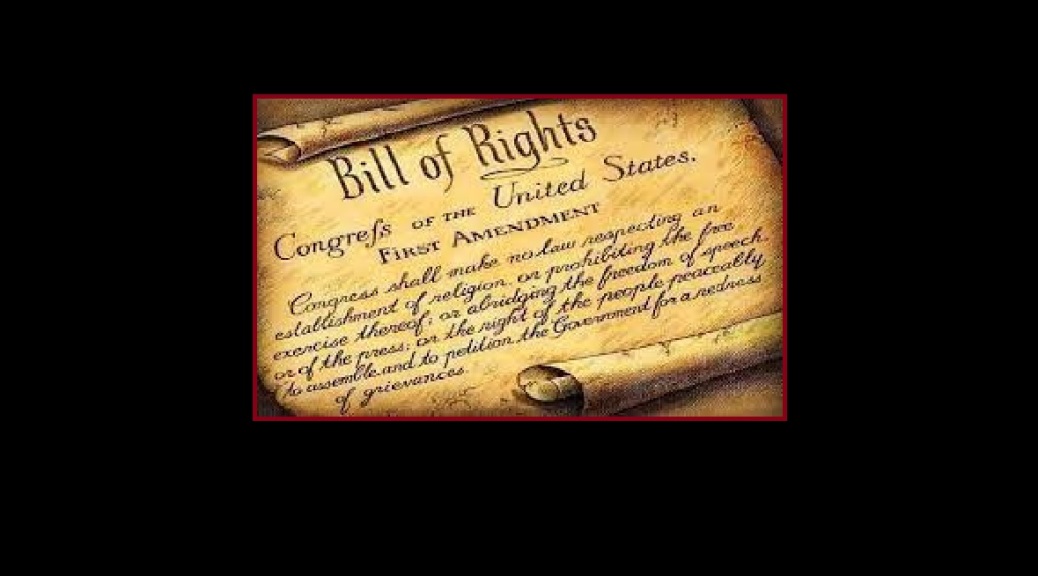
One other comment. God does not want legal churches (churches organized according to man’s law). He wants spiritual churches (churches organized according to God’s Bible precepts). Due to the First Amendment of the US Const. and corresponding state constitutional provisions, one can organize a church in the United States according to Bible principles without persecution.

May the Lord richly bless you as you seek to know and understand His truths regarding these important matters you inquire about.  The believer must study (not just read) the Bible to avoid becoming the victim of religious charlatans.  “Study to shew thyself approved unto God, a workman that needeth not to be ashamed, rightly dividing the word of truth” (2 Timothy 2:15; read the verse in context to make the application).

For His Glory,
Brother Jerald Finney
____________________

Questions Answered by the Berean Call

From Berean Call, July 27, 2018:
What a Sovereign God Cannot Do. This includes teaching on the Calvinist heresy concerning the sovereignty of God, love, and some other matters.
From Berean Call, Psychology and Psychotherapy (part 1), January 6, 2018:
 –
Question: You emphasize that salvation is based on the fact that Christ “paid the penalty for our sins.”  Strong’s Exhaustive Concordance has no entry for “penalty,” nor did Jesus or the apostles ever mention that a penalty for our sins was paid. If I ask fellow Christians where to find this view in the Bible, either they don’t know the answer or they imply that I’m not saved. I pose that question to you.
 
Response: Nor is the word “trinity” found in either the Bible or Strong’s, yet it’s a basic teaching of Scripture. Was not the casting of Adam and Eve out of the Garden a penalty for their sin? Isn’t the death that came upon Adam and Eve and all of their descendants to this day also a penalty for sin that would continue in eternal separation from God without His pardon? In declaring, “the soul that sinneth, it shall die (Eze 18:13, 20); sin bringeth forth death (Jas 1:15); the strength of sin is the law” (1 Cor 15:56), isn’t Scripture saying that death is the penalty for sin? Does not a penalty have to be paid? Granted, the Bible nowhere uses that exact terminology about Christ paying the penalty for sin. But isn’t that what’s implied when it says, “He was wounded for our transgressions, he was bruised for our iniquities: the chastisement of our peace was upon him; and with his stripes we are healed” (Is 53:5), or “Christ died for our sins” (1 Cor 15:3), or “that he by the grace of God should taste death for every man” (Heb 2:9), as well as in many similar verses? If death is the penalty for sin and Christ died for all, then surely He paid the penalty in full for all of us, or we would have to pay [it] ourselves. Our salvation is a matter of God’s justice, “that he by the grace of God should taste death for every man” (Heb 2:9), et al. Our salvation is a matter of God’s justice, “that he [God] might be just, and the justifier of him which believeth in Jesus” (Rom 3:26).
I don’t understand your objection to saying that the penalty was paid. Wasn’t the force of Christ’s triumphant cry from the cross, “It is finished [tetelestai]” (Jn 19:30), meaning “paid in full”? I am grateful that Christ paid the full penalty for my sins so that God can be just in pardoning me, the sinner! There is no other means of salvation.
 
Question: We’re told that “one day is with the Lord as a thousand years, and a thousand years as one day” (2 Pt 3:8); and that “a thousand years in thy sight are but as yesterday when it is past, and as a watch in the night” (Ps 90:4). Is there any special prophetic significance that might tell us how close we are to the Lord’s return?
 
Response: There is no prophetic significance. The phrases “with the Lord” and “in thy sight” are the keys to understanding this rather simple and straightforward declaration: God is outside of time and therefore, in relation to Him, time is meaningless. Thus Paul can say that we are already seated “together in heavenly places in Christ Jesus” (Eph 2:6). God, being independent of time, sees not only what to us is past but also our present and future as having already happened. Thus His foreknowledge of what in our experience hasn’t yet occurred would have no effect upon its happening and would leave us free to make genuine choices.
Here is what John Wesley said in a sermon more than 200 years ago: “There is no such thing as either foreknowledge or afterknowledge in God. All time, or rather all eternity (for time is only that small fragment of eternity which is allotted to the children of men), being present to God at once, He does not know one thing from another, or one thing after another; but sees all things in one point of view, from everlasting to everlasting. As all time, with everything that exists therein, is preset with Him at once, so he sees at once whatever was, is, or will be to the end of time” (John Wesley, Sermons on Several Occasions, 1833, p. 39).
 
Question: What did Paul mean when he said that he and the other Apostles were “the last appointed unto death”? Did that mean that no one else after them would ever be martyred for their faith? If so, he was wrong.
 
Response: Paul wasn’t wrong when he wrote these words: “For I think that God hath set forth us the apostles last, as it were appointed to death: for we are made a spectacle unto the world, and to angels, and to men” (1 Cor 4:9). Some argue that Paul and the other Apostles thought that the Rapture would occur in their day. Not so. Although he taught believers to expect the Rapture at any moment (Php 3:20-21; 1 Thess 1:9-10; Titus 2:13, etc.), Paul knew that he would be martyred before it occurred: “For I know…that after my departing shall grievous wolves enter in…” (Acts 20:29); “For I am now ready to be offered, and the time of my departure is at hand” (2 Tm 4:6). Likewise, Peter wrote, “Knowing that shortly I must put off this my tabernacle…I will endeavor that ye may be able after my decease to have these things always in remembrance” (2 Pt 1:14-15). The Apostles didn’t expect to be raptured but knew they must each die for their Lord.
Christ declared that His disciples in all ages would be hated by the world and would suffer the same as He had at its hands (Jn 15:18-21); Paul implied that Christians would continue to suffer martyrdom (Rom 8:35-37) and warned that “all that will live godly in Christ Jesus shall suffer persecution” (2 Tm 3:12). We know that has been the case throughout history, and even greater numbers of believers will be killed by Antichrist (Rv 6:9-11; 13:7, 15; 20:4). Obviously Paul did not mean that the Apostles were the last who would be martyred for Christ. They were the last who were “appointed unto death;” i.e., who must die for Christ. Their lives would have been spared had they denied Christ. No one is fool enough to die for what he knows is a lie. The fact that not one of the disciples retracted anything to save his life is powerful evidence of the validity of the Gospels and the Book of Acts. It was thus essential that they die as martyrs, and they were the last upon whom that necessity was imposed.
 
Question: The Apostles’ Creed says that Jesus “descended into hell.” I’ve read your rejection of the Hagan/Copeland teaching that Jesus was tortured in hell by Satan. Did Jesus descend into hell or not? I searched the Scriptures and have no answer.
 

Response: The word sheol, “place of the dead,” is translated “hell” or sometimes as “grave.” In telling the fate of the rich man and Lazarus, Jesus taught that before the Cross, there were two compartments in sheol: one for the lost, and one for the saved, called “Abraham’s bosom” (Lk 16:22). To the latter Christ went in death, as did the thief crucified with Him to whom He said, “Today shalt thou be with me in paradise” (Lk 23:43). There He proclaimed to the redeemed the good news of His death having paid for their sins. Those in sheol could hear what Jesus said (see Lk 16:23-31); and He may even have addressed a few words to them. Thus Peter writes, “He preached to the spirits in prison [sheol]; which sometime were disobedient…” (1 Pt 3:19-20). After His resurrection, Jesus took the souls and spirits of the redeemed to heaven (“he led captivity captive” [Eph 4:8]). Now the souls and spirits of the redeemed upon death go immediately to be with Christ (“absent from the body, present with the Lord” [2 Cor 5:6-8]), when He will bring them to rejoin their resurrected bodies at the Rapture (1 Thess 4:13-18).


Questions answered in From Berean Call, Psychology and Psychotherapy (part 2), Feb. 1, 2018:

Question: The Bible says, “For it is God which worketh in you both to will and to do of his good pleasure” (Philippians 2:13). Then why do I so often fail to do His will and to please Him? I more often please myself by doing my own will. Why?
 
Question: You justify God for sending people to hell because He has provided salvation for them in Christ. That won’t do, for millions and probably billions will spend eternity in hell. God knew that! How could a good God create anyone whom He knew would suffer eternally?
 
Question: “Broad is the way, that leadeth to destruction, and many there be which go in thereat” (Mt 7:13). How has God “won” if there are more souls in hell than in heaven?
Question: Is it really biblical for you or anyone else to point out others’ faults? Isn’t this judging when we are not to judge? Doesn’t the Scripture say that the servant is to be left to the correction of his master, who is Christ?

Question from a Church Concerning Church Organization

E-mail received May 11, 2018. Note. This is one of many inquiry about church organization which I receive on a regular basis.

The church Elders of [] Church have asked me if I could help find answers about getting “organized” since I have a bit more computer experience than they.

I found your website and felt that this was important information and am hoping that you may give advice.

We have a small fellowship of about 35 – 40 people (including children) in a small, remote community in [name of state]. Our church has had it’s “doors open” for over 25 years, the pastor has transitioned the church into an Elder led church of (currently) five elders, of which he is one. We are not, nor have ever been organized as either a 501(c)(3) or a 508(c)(1)(a). We have simply been a group of believers who meet together in a building on the corner of a brother’s property.

So our questions are this….

What is the best way for the church to enter into a lease agreement? The building is on the property of a brother …. He would like to grant the church a … lease, but we are not a legal entity to do this. Any ideas as to how to proceed?

The elders have been encouraged by other pastors to form a 501(c)(3), but after much prayer have determined that isn’t the direction they want to pursue. The next avenue was to look at 508(c)(1)(a), but it would appear that we are already that by definition.

The other question is how to deal with banking? For the last 25 years everything has been run through the pastor’s personal bank account. We’ve considered just adding the other four elders to the account and leaving it as it is. Not certain at this point if the bank would be okay with that.

I read through your article on a trust and the portions I understood sounded like a good direction to take.

Your insights and advice are welcome.

Sincerely,
[Name omitted]
[] Church

My Answer:

Dear []

The way to take care of this is for the church to establish a trust, the right kind of trust. The bank account would be held in the name of the trust, not the church. A lease would be taken out in the name of the trust. If property is acquired, the name of the owner of the property on the deed would be the trust.

You are not a 508 church unless you choose to be so. If you choose to be a 508 church, you submit the church to the rules that come with 501c3. For more on church 508 status, see the following article:

Church Internal Revenue Code § 508 Tax Exempt Status

If your church enters into a lease agreement, opens a bank account, buys property, etc. in the name of the church, the church becomes a legal entity, but not the same type of legal entity as a non-profit corporation. If your church adopts a constitution, by-laws or similar documents, but does not incorporate, your  church may be setting herself up as a legal entity, an unincorporated association, which is viewed much like a non-profit corporation legal entity.

When a church establishes the right kind of trust (not a business trust, a charitable trust, an ELC trust, etc.), the church does not become a legal entity. All money and assets are held in the name of the trust. The money and assets in the trust estate so held are owned by the Lord Jesus Christ. The trust estate does not hold church property and assets. The trust estate holds property owned by the Lord Jesus Christ. The trust estate is managed by a named trustee who has a duty to manage the estate, not for his benefit, but for the benefit of the owner of the trust estate.

From your inquiry, I assume that you wish to have a church ordered according to the principles of the New Testament, a spiritual entity only, an entity under the Lord Jesus Christ only. A legal entity is under man; that is, it is subject to man’s law. The only way a church can be subject to man’s law in America is to voluntarily act legally, or to organize under man’s law. A spiritual entity is under God only.

This does not mean that church members in a New Testament church are not under man’s law for certain God-ordained purposes, for earthly purposes. If one steals, murders, etc. man’s law is authorized by God to assert jurisdiction. God does not authorize man (civil government) to assert jurisdiction over spiritual matters: “We should obey God rather than man” when man’s law contradicts God’s law. The purpose of organizing a church according to the principles of the New Testament is keep the church under God’s rules only. A church who chooses non-profit corp., 501c3, or 508, business trust, charitable trust, etc. status has voluntarily submitted herself to man’s law. When she does so, she has made the civil governments (state and federal) her authority for many purposes.

Feel free to call me for any reason. I would be glad to talk with you concerning these matters.

For His Glory,
Jerald Finney
512-785-8445

Trust

Religious Freedom in America!

I. Convention to Amend Articles of Confederation; Constitution Drafted; John Leland’s Influence on James Madison; Constitution Ratified by the States
II. The Continuing Fight for a Religious Freedom Amendment; The First Amendment Is Adopted and Approved


To Virginia

I. Motivation for the Final Thrust for the First Amendment-the Convictions of Dissenters, mainly the Baptists; the thrust for the growth of the Baptists Came from the Great Awakening
II. Only the Church of England Was Tolerated in Virginia Colony
III. Presbyterians in Virginia
IV. Baptists in Virginia Colony; The Bad Character of the Anglican Clergy; Colonel Sam Harris and Other Baptist Preachers; The Separate and Regular Baptists
V. Virginia Persecution of Baptists from 1768-1774; Baptist Petitions; James Madison on Religious Establishment and Persecution
VI. The Period of Intolerance and Persecution in Virginia Ends in 1775 with the Beginning of the Revolution; The Baptists Push for Religious Freedom
VII. Virginia Adopts a New Constitution; Recognizes Religious Liberty (as opposed to Religious Tolerance); Patrick Henry for Religious Tolerance; James Madison for Religious Liberty
VIII. Virginia Baptists Alone in Seeking Freedom of Conscience; The Battle for Soul Liberty in Virginia; Jefferson Fights for Religious Liberty
IX. The Battle for Religious Liberty Continues, 1784-1785; Baptists Uncompromising in Their Stand for Religious Liberty; Presbyterians Take a Middle Ground to Which Madison Takes Issue
X. Alliance Between the Episcopalians and the Presbyterians; Bill for Provisions for Teachers of Christian Religion; Madison’s Opposition to the Bill and His Famous Memorial and Remonstrance
XI. The Fight against the Assessment Bill Continues; The Virginia Act for Religious Liberty, Drafted by Thomas Jefferson, Passes instead; Thomas Jefferson’s Unswerving Position on Religious Liberty, All Vestiges of the Establishment Removed


From New England to the South

I. Shubal Stearns and Daniel Marshall, Congregationalists in Connecticut, Were Converted in the Whitefield Revival, and Become Separatists and then Baptists
II. Shubal Stearns and Daniel Marshall Go To Virginia, then to Sandy Creek North Carolina, and Anglican Colony; The Work at Sandy Creek Explodes
III. Religious Injustice in Anglican North Carolina; Governor Tryon Moves to Strengthen the Anglican Church in North Carolina; The War of the Regulation Spread the Separate Baptists throughout the South and Started a Fire that Could Not Be Put Out


The Separates and the Baptists in New England

I. Religious Decay in New England by 1720; Whitefield Great Revival; Many New Converts Dubbed New Lights; The Puritan Reaction; The Separates
II. The Baptists and Separates; Isaac Backus from Puritan to Separate to Baptist; A Revolution Begins
III. The Puritan Tradition in Connecticut; The Saybrook Platform; Persecutions and Inequities Drive Many to the New Light Position as Separatists; Many Became Baptists
IV. Backus Becomes a Baptist Leader; His Differences with the Established Church; Taxes Supporting the Established Church
V. Backus Struggles with the Issues of Baptism and Covenant Theology; Rejects Infant Baptism and Covenant Theology
VI. Separates and Baptists Desire To Meet Together; This Proves Untenable; Backus Leads Brethren to Start a Baptist Church at Titicut
VII. The Revival Dies; Separate Churches Die; Baptist Denomination Grows; Formation of the Warren Association in 1770 To Obtain Religious Liberty; Isaac Backus’s Efforts; An Appeal to the Public
VIII. Backus Presents Appeal for Religious Liberty at Continental Congress; Debate in the Newspapers; Warren Association Activities; Backus Urges Religious Liberty in New Massachusetts Constitution; John Adams Works against Religious Liberty
IX. The Baptists Fight in the Courts; Reject Backus’s Advice; Backus Changes His Focus to Baptist Doctrines; Connecticut Continues To Persecute Dissidents; Connecticut Rejects Forced Establishment in 1818


IV. Dr. John Clarke; the Portsmouth Compact


A Publication of Churches Under Christ Ministry


Link to Previous Lesson:
III. Roger Williams Flees Massachusetts; His Contributions to Religious Liberty

Link to Next Lesson:
V. Roger Williams and the Providence Compact

Click here for links to all lessons on The Baptists in Rhode Island.


Jerald Finney
Copyright © February 26, 2018


Dr. John Clarke

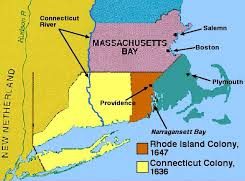
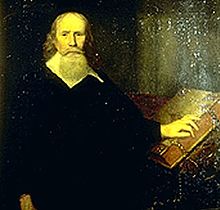
Another leader instrumental in the formation of the government of the Rhode Island colony was Dr. John Clarke, a physician from England. Dr. Clarke moved to Boston in November of 1637. He proposed to some friends “for peace sake, and to enjoy the freedom of their consciences, to remove out of that jurisdiction.”[1] Their motion was granted & Dr. Clarke and eighteen families went to New Hampshire, which proved too cold for their liking. They left and stopped in Rhode Island, intending to go to Long Island or Delaware Bay. There Dr. Clarke met Roger Williams. The two “immediately became fast friends and associates, working together in a most harmonious manner, both socially and politically, throughout the remainder of Clarke’s life.”[2] With the help of Mr. Williams, they settled in that colony at Aquidneck. “The first settlement on the Island was called Pocasset; after the founding of Newport, it was renamed Portsmouth.”[3]

Isaac Backus found it to be very extraordinary that he could find from any author or record no reflection cast upon Dr. Clarke by any one.[4] Dr. Clarke left as spotless a character as any man [Isaac Backus] knew of, that ever acted in any public station in this country.[5] “The Massachusetts writers have been so watchful and careful, to publish whatever they could find, which might seem to countenance the severities, they used towards dissenters from their way, that [Mr. Backus] expected to find something of that nature against Mr. Clarke.”[6]

Portsmouth Compact

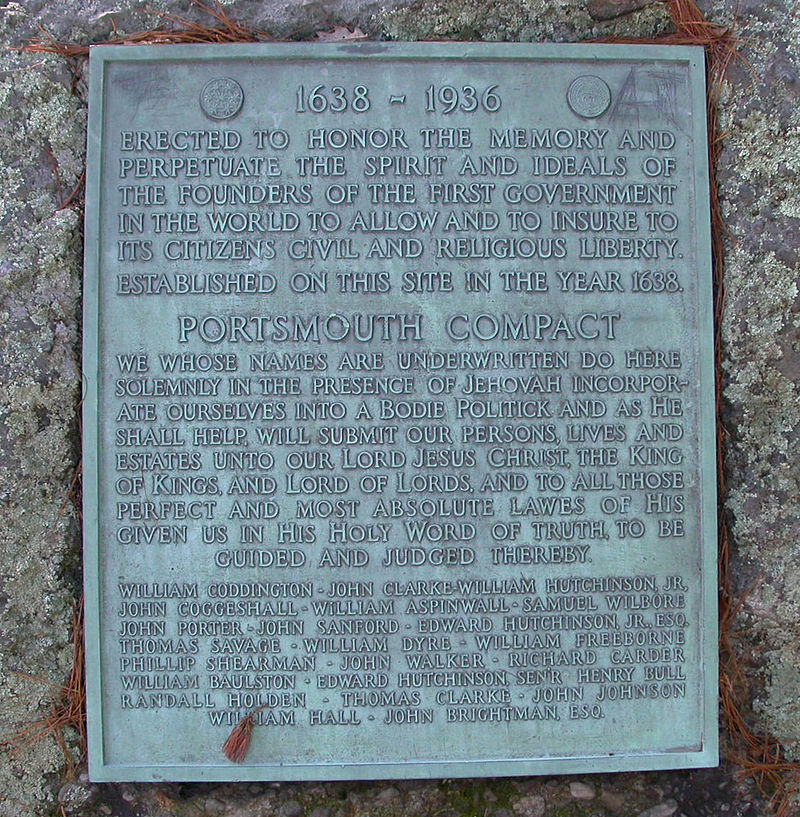
The first government of note in history that was to have complete freedom of conscience and religious liberty also declared that the government was to be under the Lord Jesus Christ. Signed on March 7, 1638, the Portsmouth Compact read:

  • “We whose names are underwritten do swear solemnly, in the presence of Jehovah, to incorporate ourselves into a body politic, and as he shall help us, will submit our persons, lives and estates, unto our Lord Jesus Christ, the King of kings, and Lord of lords, and to all those most perfect and absolute laws of his, given us in his holy word of truth, to be guided and judged thereby.” [7] [19 signatures followed: Thomas Savage, William Dyre, William Freeborne, Philip Sherman, John Walker, Richard Carder, William Baulstone, Edward Hutchinson, Sen., Henry Bull, Randal Holden, William Coddington, John Clarke, William Hutchinson, John Coggshall, William Aspinwall, Samuel Wilbore, John Porter, Edward Hutchinson, Jun., and John Sanford.].
  • Three passages were marked in support of the compact: Exodus 24.3, 4; II Chronicles 11.3; and II Kings 11.17.

The chief architect of this concise and powerful piece of political history was either William Aspinwall or Dr. John Clarke, probably Dr. Clarke.[8] This compact placed Rhode Island under the one true God, the Lord Jesus Christ and his principles and laws given in the Bible. That Dr. Clarke “sought to help establish a government free of all religious restriction, one which in no way infringed upon the freedom of any religious conscience” is “evident from his remarks to the leaders of the established colonies upon his first arrival in Boston and by his subsequent activities throughout New England.”[9] A Gentile civil government under Jesus Christ with freedom of religion is consistent with Biblical principles.

Isaac Backus commented on this compact:

“This was doubtless in their view a better plan than any of the others had laid, as they were to be governed by the perfect laws of Christ. But the question is, how a civil polity could be so governed, when he never erected any such state under the gospel?”[10]

Mr. Backus asked a good question. Too bad America’s founding fathers did not find and apply the answer. On the same day the Portsmouth Compact was signed, “[n]ineteen men incorporated into a body politic, and chose Mr. Coddington to be their judge or chief magistrate.”[11] The first General Meeting of the Portsmouth government convened on May 13, 1638. “The apportionment of land, a mutual defense of territory, and provision for a ‘Meeting House’ were ordered.” [12] Soon, a civil government was formed which invested power in the freemen, none of whom were to be “accounted delinquents for doctrine,” “provided it be not directly repugnant to or laws established.”[13]


Endnotes

[1] Isaac Backus, A History of New England With Particular Reference to the Denomination of Christians called Baptists, Volume 1 (Eugene, Oregon: Wipf & Stock Publishers, Previously published by Backus Historical Society, 1871), p. 71. See also John Clarke, Ill News from New-England or A Narative of New-Englands Persecution (Paris, Ark.: The Baptist Standard Bearer, Inc., Reprint: 1st printed in 1652), pp. 22-25.

[2] Louis Franklin Asher, John Clarke (1609-1676): Pioneer in American Medicine, Democratic Ideals, and Champion of Religious Liberty (Paris, Arkansas: The Baptist Standard Bearer, Inc.), p. 27; John Clarke, Ill News from New-England or A Narative of New-Englands Persecution (Paris, Ark.: The Baptist Standard Bearer, Inc., Reprint: 1st printed in 1652).

[3] Louis Franklin Asher, John Clarke (1609-1676): Pioneer in American Medicine, Democratic Ideals, and Champion of Religious Liberty (Paris, Arkansas: The Baptist Standard Bearer, Inc.), p. 29; Clarke.

[4] Backus, Volume 1, p. 349.

[5] Ibid., p. 348.

[6] Ibid., p. 349.

[7] Ibid., pp. 77, 427. On p. 427 is the exact copy from Rhode Island records. In the margin are citations to Exodus 34.3, 4; 2 Chr. 11.3, and 2 K. 11, 17.

[8] Asher, p. 23; James R. Beller, America in Crimson Red: The Baptist History of America (Arnold, Missouri: Prairie Fire Press, 2004), p. 24. Mr. Beller states that the author was John Clarke. Mr. Asher asserts that Clarke was probably the writer since the passages referenced in support of the agreement were marked in Dr. Clarke’s Bible.

[9] Asher, p. 27.

[10] Backus, Volume 1, p. 78.

[11] Ibid., p. 72; Asher, p. 27.

[12] Asher, p. 29.

[13] Roger Williams and Edward Bean Underhill, The Bloudy Tenent of Persecution for Cause of Conscience Discussed and Mr. Cotton’s Letter Examined and Answered (London: Printed for the Society, by J. Haddon, Castle Street, Finsbury, 1848), pp. xxvii-xxviii.

VIII. Organizing the Church State “Theocracy” in Massachusetts Colony


A Publication of Churches Under Christ Ministry


Previous Lesson: VII. The Results of Puritan Theology in Massachusetts Soon Came to Fruition

Next Lesson: IX. Punishing Every Sin and Persecuting “Heretics”

Appendix to IX. “Punishing Every Sin and Persecuting ‘Heretics’”: Continuing Legislation, Persecutions of “Heretics,” Baptist Churches in Boston, and Other Matters

Click here for links to all lessons on The Pilgrims and Puritans in New England.


Jerald Finney
Copyright © February 25, 2018


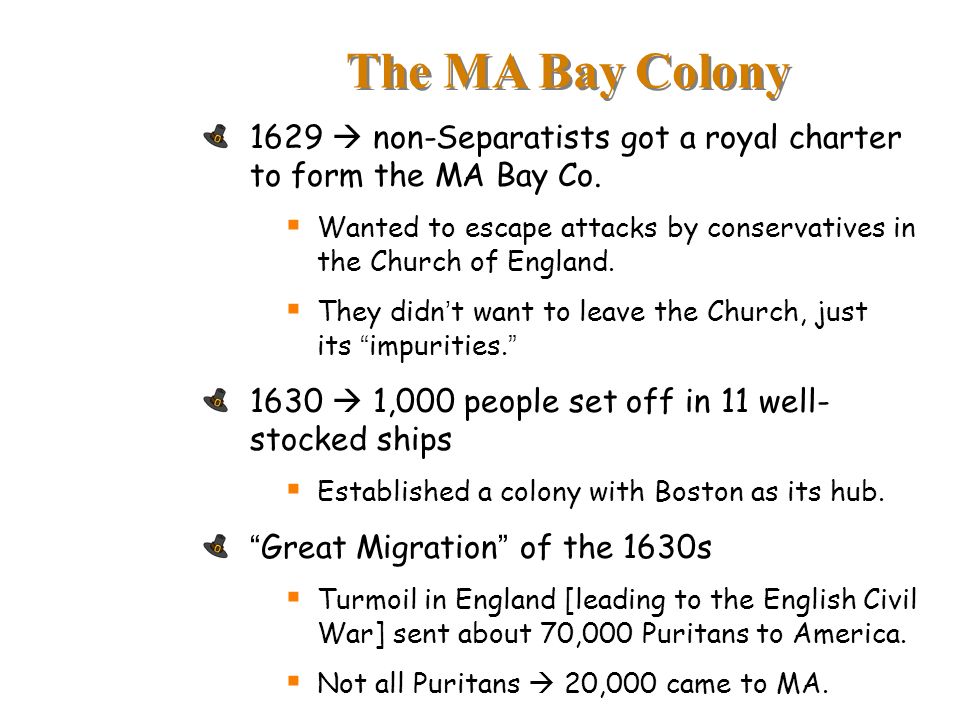
The Puritans, unlike the Separatists, although continuing to acknowledge canonical authority, desired to purify the church from within. Puritans were enlisted by the Massachusetts Bay Company, a trading corporation with powers of ownership and government over a specified area. The leaders of this company devised a plan to effectively remove the colony of Massachusetts from control of the Crown.[1] Their purpose was to become a self-governing commonwealth able to enforce the laws of God and win divine favor—a citadel of God’s chosen people, a spearhead of world Protestantism, a government of Christ.[2] They believed this was a common goal which all must seek together, with church and state working side by side.[3]  They believed that the pure church they intended to establish in New England would someday, somehow, rescue its English parent from the mire of corruption.[4]

In 1629 the trading company in Massachusetts was transformed into a commonwealth.[5] According to the Puritan theology of these early Massachusetts settlers, after the people joined in covenant with God, agreeing to be bound by his laws, they had to establish a government to see those laws enforced, for they did not have enough virtue to carry out their agreement without the compulsive force of government.[6]

  • “[They] soon discovered themselves as fond of uniformity, and as loath to allow liberty of conscience to such as differed from themselves, as those from whose power they had fled. Notwithstanding all their sufferings and complaints in England, they seemed incapable of mutual forbearance; perhaps they were afraid of provoking the higher powers at home, if they countenanced other sects; and perhaps those who differed from them took the more freedom, in venting and pressing their peculiar opinions, from the safety and protection they expected, under a charter that had granted liberty of conscience.
  • “In reality, the true grounds of liberty of conscience were not then known, or embraced by any sect or party of Christians; all parties seemed to think that as they only were in the possession of the truth, so they alone had a right to restrain, and crush all other opinions, which they respectively called error and heresy, where they were the most numerous and powerful; and in other places they pleaded a title to liberty and freedom of their consciences. And yet, at the same time, all would disclaim persecution for conscience sake, which has something in it so unjust and absurd, so cruel and impious, that all men are ashamed of the least imputation of it. A pretence of public peace, the preservation of the Church of Christ from infection, and the obstinacy of the heretics, are always made use of, to excuse and justify that, which stripped of all disguises, and called by its true name, the light of nature, and the laws of Christ Jesus condemn and forbid, in the most plain and solemn manner….”[7]
Church and Town Administration Were One

After arriving in Massachusetts, they quickly formed churches. Mainly under the leadership of the Reverend John Cotton, they arranged ecclesiastical and state matters. “Whatever he delivered in the pulpit was soon put into an order of court, if of a civil, or set up as a practice in the church, if of an ecclesiastical concernment.”[8] The established Congregational church differed from other churches in four main points:

  1. “The visible church was to consist of those who made an open profession of faith, and did not ‘scandalize their profession by an unchristian conversation.’
  2. “A particular visible church should preferably explicitly covenant to walk together in their Christian communion, according to the rules of the gospel.
  3. “Any particular church ought not to be larger in number than needed to meet in one place for the enjoyment of all the same numerical ordinances and celebrating of divine worship, nor fewer than may conveniently carry on church work.
  4. “Each particular church was subject to no other jurisdiction.[9]

By 1635, the General Court regulated the affairs of the local churches and passed on the qualifications of preachers and elders, since:

“[t]he civil authority … hath the power and liberty to see the peace, ordinances, and rules of Christ observed in every Church, according to His word…. It is the duty of the Christian magistrate to take care that the people be fed with wholesome and sound doctrine.”[10]


Endnotes

[1] Mark Douglas McGarvie, One Nation Under Law: America’s Early National Struggles to Separate Church and State (DeKalb, Illinois: Northern Illinois University Press, 2005), p. 46

[2] Ibid., pp. 46-47, 48.

[3] Ibid., p. 132.

[4] Ibid., p. 51.

[5] Ibid., pp. 84-100.

[6] Ibid., p. 93.

[7] John Callender, The Civil and Religious Affairs of the Colony of Rhode-Island (Providence: Knowles, Vose & Company, 1838), pp. 69-70.

[8] Backus, p. 33.

[9] Ibid., pp. 33-34.

[10] Leo Pfeffer, Church, State, and Freedom (Boston: The Beacon Press, 1953), p. 66.

II. John Calvin’s Beliefs about the Relationship of Church and State, His Influence in the Colonies upon the Issue and the Impact in America; John Knox’s Beliefs on the Subject


A Publication of Churches Under Christ Ministry


Previous Lesson: I. Introduction: From the Storm Resulting from the Reformation Emerged Separation of Church and State

Next Lesson: III. Old World Patterns of Church-State Union Were Transplanted to the Colonies through the Puritans, Episcopalians, and Others

Click here for links to all lessons on The Pilgrims and Puritans in New England.   

Click here to go to the written lessons.

Click here to go to the 3 1/2 to 6 minute video lectures.

For accompanying study from God Betrayed click here.


Jerald Finney
Copyright © February 23, 2018


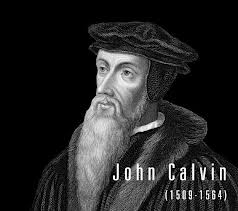
John Calvin had the greatest influence of any continental reformer on the relationship of church and state in the American colonies.[1] The founders of the Massachusetts Bay Company modeled the Massachusetts church-state after the church-state constructed by Calvin.

Calvin taught a perversion of Biblical predestination; he taught that God predestined men to heaven or hell effectively denying choice, at least for the lost person. The Bible teaches that God “predestinated” those who choose to repent toward God and put their faith in the Lord Jesus Christ “to be conformed to the image of his son” (See Romans 8.29-30 in the context of Romans 1-8 and in context of the entire Bible). Calvin further taught that the Prince (as well as the religious leader), to whom God grants his power and who is responsible directly to God, is God’s leader on earth, and men had a duty to absolutely honor and obey him. Those who rebel against the ruler rebels against God, even if the ruler rules contrary to the Word of God.

The state, according to Calvin, must enforce God’s spiritual and moral laws. That is, the state is responsible for enforcing all of the commandments, including the first four. Therefore, the state must suppress, for example, “idolatry, blasphemy, and other scandals to religion.” Church and state must work together although the church is “competent to declare what is the godly life.” Calvin believed that “there is but one possible correct interpretation of the Word of God, and it is the only interpretation possible for an honest man of sound intelligence to reach.”[2]

At the same time, “we should obey God rather than men;” when the law of the ruler contradicts the law of God, according to Calvin, man should obey God, but only passively. The Calvinistic ideal, the superiority of an aristocratic republic form of civil government, led naturally to election of both pastors and civil rulers and was implemented in the Mayflower Compact the night before the Pilgrims first came onto shore in America. Subsequent leaders of Calvinistic thought “added the right of rebellion against the wicked Prince to their spiritual arsenal. The United States of America was born when that right was exercised, and none exercised it with greater enthusiasm that the Calvinists of Boston.”[3]

One inheritor of Calvinism, John Knox, most forcefully added:

“the one conviction at which the legalistic mind of Calvin quailed…. If the Prince does not perform [his God given duty] said Knox, the people have the duty to put him to the sword of vengeance. In Calvinism the Church is the State, but in Knox far more than in Calvin the State and the Church both are the People. In neither man is there the faintest glimmer that even suggests to the backward-looking eye the distant dawn of tolerance. But in Knox the sword of the Almighty’s vengeance in the hands of an outraged People is the first strange symbol of what some day will be democracy.”[4]

Thankfully, Calvin’s theology did not prevail in America. Due to the stand of the Baptists against the colonial church state establishments, the atmosphere in the colonies gradually changed until by the adoption of the First Amendment in 1791 most states and the new federal government rejected forced establishment. In 1833, Massachusetts became the last state to reject state mandated union of church and state.


Endnotes

[1] For more information on the colonial and comtemporary impact of Calvinism in America see The Trail of Blood of the Martyrs of Jesus.

[2]John Callender, The Civil and Religious Affairs of the Colony of Rhode-Island (Providence: Knowles, Vose & Company, 1838), pp. 21-28; see also, Verduin, Anatomy of a Hybrid, pp. 198-211 for insight into Calvin’s church-state theology.

[3] William H. Marnell, The First Amendment: Religious Freedom in America from Colonial Days to the School Prayer Controversy (Garden City, New York: Doubleday & Company, Inc., 1964), pp. 21-28.

[4] Ibid., pp. 28-30.