VIII. Virginia Baptists Alone in Seeking Freedom of Conscience; The Battle for Soul Liberty in Virginia; Jefferson Fights for Religious Liberty


A Publication of Churches Under Christ Ministry


Previous Lesson:
VII. Virginia Adopts a New Constitution; Recognizes Religious Liberty (as opposed to Religious Tolerance); Patrick Henry for Religious Tolerance; James Madison for Religious Liberty

Next Lesson:
IX. The Battle for Religious Liberty Continues, 1784-1785; Baptists Uncompromising in Their Stand for Religious Liberty; Presbyterians Take a Middle Ground to Which Madison Takes Issue

Click here for links to all lessons on “To Virginia.

Click here to go to the written lessons.

Click here to go to the 3 1/2 to 6 minute video lectures.

For accompanying more thorough study from God Betrayed click here.


Jerald Finney
Copyright © March 3, 2018
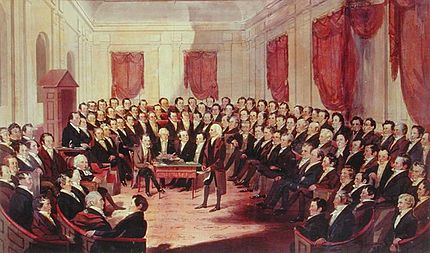

Virginia Constitution

It appears that the Baptists were the only denomination of Christians that addressed the 1775 and 1776 conventions on the subject of the rights of conscience. Not until the Revolution in Virginia were the Presbyterians free from the agreement with Governor Gooch. When the Assembly met in October 1776, they were “powerful allies of the Baptists and other dissenters in the war against the Establishment.”[1]

“From that time down to January 19, 1786, when Jefferson’s ‘Bill for Establishing Religious Freedom,’ became the law of the State, the battle for soul liberty was on,”[2] and the process of disestablishment gathered momentum. The legislature of 1776 repealed the laws punishing heresy and absence from worship and exempted dissenters from paying taxes for support of the Church. Although this bill was a compromise, it sounded the death knell of the Anglican establishment. A later statute removed the law fixing the salaries of clergymen, and the position of the Established church was limited more and more until the Declaratory Act of 1787 ended establishment in Virginia.[3]

“From 1776 to 1779 the assembly was engaged almost daily in the desperate contests between the contending factions.”[4] Whereas only one Baptist petition had been presented to the first Convention in 1776, and that after the adoption of the Bill of Rights, the Legislature that assembled on October 7, 1776, was immediately flooded with petitions both for and against establishment. “None of the petitions against establishment were from Baptists as such. However, historians of the times admit that Baptists ‘were not only the first to begin the work, but also the most active in circulating petitions for signatures.’” “Among the signers were some of all denominations of Christians, and many of no denomination. This explains why the Baptist petition or petitions were from dissenters in general, instead of from Baptist dissenters in particular.”[5] The Reverend E. G. Robinson, in his review of Rives’ Life and Times of James Madison, Christian Review of January 1860, said, “The [Presbyterians] argued their petitions on various grounds, and indeed sought for different degrees of religious freedom, while the [Baptists] were undeviating and uncompromising in their demands for a total exemption from every kind of legal restraint or interference in matters of religion.”[6] The Methodists and the established church presented petitions for establishment.[7]
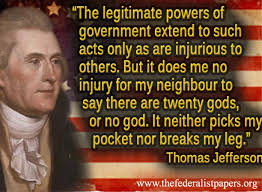
The established church did not give up. Thomas Jefferson gave an account of the struggle through which the Legislature, meeting in late 1776, had just passed:

  • “The first republican Legislature, which met in 1776, was crowded with petitions to abolish this spiritual tyranny. These brought on the severest contest in which I have ever been engaged…. The petitions were referred to a Committee of the Whole House on the State of the Country; and, after desperate contests in the committee almost daily from the 11th of October to the 5th of December, we prevailed so far only as to repeal the laws which rendered criminal the maintenance of any religious opinions (other than those of the Episcopalians), the forbearance of repairing to the (Episcopal) church, or the exercise of any (other than the Episcopal) mode of worship; and to suspend only until the next session levies on the members of that church for the salaries of its own incumbents. For, although the majority of our citizens were dissenters, as has been observed, a majority of the legislature were churchmen. Among these, however, were some reasonable and liberal men, who enabled us on some points to obtain feeble majorities. But our opponents carried, in the general resolutions of November the 19th, a declaration that religious assemblies ought to be regulated, and that provision ought to be made for continuing the succession of the clergy and superintending their conduct. And in the bill now passed was inserted an express reservation of the question whether a general assessment should not be established by law on every one to the support of the pastor of his choice; or whether all should be left to voluntary contributions; and on thus question, debated at every session from 1776 to 1779 (some of our dissenting allies, having now secured their particular object, going over to the advocates of a general assessment,) we could only obtain a suspension from session to session until 1779, when the question against a general assessment was finally carried, and the establishment of the Anglican church entirely put down.”[8]
Legislative meetings from 1776 to December 1779 were presented with memorials both for and against establishment.[9]

When the House met in June 1779, petitions presented to the Assembly showed that the old establishment and its friends were fighting for some sort of compromise based on a general assessment. In 1779, the assembly repealed all laws requiring members of the Episcopal Church to contribute to the support of their own ministry.[10] In December 1779, a bill passed which “cut the purse strings of the Establishment, so that the clergy could no longer look for support to taxation. But they still retained possession of the rich glebes, and enjoyed a monopoly, almost, of marriage fees.”[11] It took until 1779 to pass a bill taking away tax support for the clergy because the dissenters, with the exception of the Baptists, “having been relieved from a tax which they felt to be both unjust and degrading, had no objection to a general assessment.”[12]

“Jefferson sought to press the advantage, and introduced his Bill for Establishing Religious Freedom, but Virginia was not quite ready to formalize the separation which had in effect taken place, and the bill was not voted on.”[13] Instead “a bill was introduced which declared that “the Christian Religion shall in all times coming be deemed and held to be the established Religion of this Commonwealth.” This bill required everyone to register with the county clerk stating which church he wished to support.[14]


Endnotes

[1] Charles F. James, Documentary History of the Struggle for Religious Liberty in Virginia (Harrisonburg, VA.: Sprinkle Publications, 2007; First Published Lynchburg, VA.: J. P. Bell Company, 1900), p p. 66-67.

[2] Ibid., p. 10.

[3] William H. Marnell, The First Amendment: Religious Freedom in America from Colonial Days to the School Prayer Controversy (Garden City, New York: Doubleday & Company, Inc., 1964), pp. 94-95; Leo Pfeffer, Church, State, and Freedom (Boston: The Beacon Press, 1953), p. 96.

[4] Pfeffer, p. 97.

[5] James, p. 74. See pp. 68-74 for the petitions against establishment.

[6] Ibid., p. 82.

[7] Ibid., pp. 75-78. The petitions of the Methodists and the established church are quoted and the author comments on the petition of the established church.

[8] Ibid., pp. 80-81; See also Pfeffer, p. 96.

[9] James, pp. 84-91 quotes those memorials.

[10] Pfeffer, p. 97.

[11] James, p. 95.

[12] Ibid., pp. 96-98.

[13] Pfeffer, p. 97.

[14] Ibid., citing R. Freeman Butts, The American Tradition in Religion and Education (Boston: Beacon Press, 1950), pp. 53-56.
VII. Virginia Adopts a New Constitution; Recognizes Religious Liberty (as opposed to Religious Tolerance); Patrick Henry for Religious Tolerance; James Madison for Religious Liberty


A Publication of Churches Under Christ Ministry


Previous Lesson:
VI. The Period of Intolerance and Persecution in Virginia Ends in 1775 with the Beginning of the Revolution; The Baptists Push for Religious Freedom

Next Lesson:
VIII. Virginia Baptists Alone in Seeking Freedom of Conscience; The Battle for Soul Liberty in Virginia; Jefferson Fights for Religious Liberty

Click here for links to all lessons on “To Virginia.

Click here to go to the written lessons.

Click here to go to the 3 1/2 to 6 minute video lectures.

For accompanying more thorough study from God Betrayed click here.


Jerald Finney
Copyright © March 3, 2018


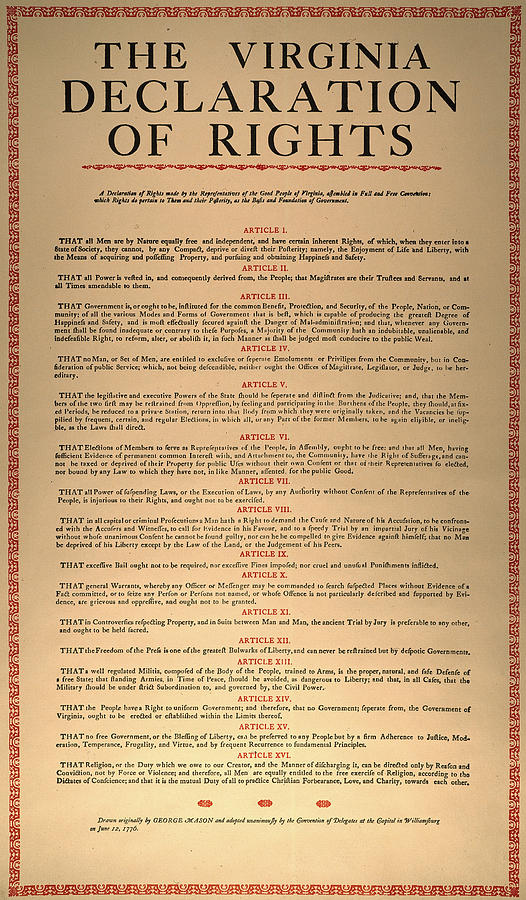
The Virginia Declaration of Rights is a document drafted in 1776 to proclaim the inherent rights of men, including the right to reform or abolish “inadequate” government. It influenced a number of later documents, including the United States Declaration of Independence (1776) and the United States Bill of Rights (1789). The Declaration was adopted unanimously by the Fifth Virginia Convention at Williamsburg, Virginia on June 12, 1776 as a separate document from the Constitution of Virginia which was later adopted on June 29, 1776. In 1830, the Declaration of Rights was incorporated within the Virginia State Constitution as Article I, but even before that Virginia’s Declaration of Rights stated that it was ‘”the basis and foundation of government” in Virginia. A slightly updated version may still be seen in Virginia’s Constitution, making it legally in effect to this day.

Virginia adopted a new constitution in 1776. The Convention of 1776 was, by its act, made the “House of Delegates” of the first General Assembly under the new constitution. Twenty-nine new members in this meeting were not in the 1775 Convention. “[W]hen there was anything near a division among the other inhabitants in a county, the Baptists, together with their influence, gave a caste to the scale, by which means many a worthy and useful member was lodged in the House of Assembly and answered a valuable purpose there.”[1] Among those favorable to Baptist causes was James Madison. On May 12, the Congress met in Philadelphia “and instructed the colonies to organize independent governments of their own. The war was on.” On May 15, the Convention resolved to declare the “colonies free and independent states” and that a committee be appointed to prepare Declaration of Rights and a plan of government which would “maintain peace and order” and “secure substantial and equal liberty to the people.”[2]

Other than Rhode Island, Virginia was the first colony to recognize religious liberty “in her organic law, and this she did in Article XVI. of her Bill of Rights, which was adopted on the 12th day of June 1776.”[3] In 1776, petitions from all over Virginia seeking religious freedom and freedom of conscience beset the Virginia state convention. Patrick Henry proposed the provision to section sixteen of the Virginia Bill of Rights, which granted religious tolerance.[4] On June 12, the House adopted a Declaration of Rights. The 16th Article provided for religious tolerance. However, [o]n motion on the floor by James Madison, the article was amended to provide for religious liberty. See [5] for short explanation of where Madison learned the distinction between religious toleration and religious liberty. In committee, Madison opposed toleration because toleration “belonged to a system where there was an established church, and where it was a thing granted, not of right, but of grace. He feared the power, in the hands of a dominant religion, to construe what ‘may disturb the peace, the happiness, or the safety of society,’ and he ventured to propose a substitute, which was finally adopted.”[6] He probably moved to change the amendment before the whole house in order to demonstrate his position to the Baptists who were viewing the proceedings. The amendment as passed by the convention read:

  • “That religion, or the duty which we owe to our CREATOR, and the manner of discharging it, can be directed only by reason and conviction, not by force or violence; and, therefore, all men are equally entitled to the free exercise of religion according to the dictates of conscience; and that it is the mutual duty of all to practice Christian forbearance, love, and charity towards each other.”[7]

“The adoption of the Bill of Rights marked the beginning of the end of the establishment.”[8]


Endnotes

[1] Charles F. James, Documentary History of the Struggle for Religious Liberty in Virginia (Harrisonburg, VA.: Sprinkle Publications, 2007; First Published Lynchburg, VA.: J. P. Bell Company, 1900), p. 58.

[2] Ibid., pp. 58-62.

[3] Ibid., p. 10.

[4] William H. Marnell, The First Amendment: Religious Freedom in America from Colonial Days to the School Prayer Controversy (Garden City, New York: Doubleday & Company, Inc., 1964), pp. 94-95; James, pp. 62-65.

[5] Where did Madison learn the distinction between religious freedom and religious toleration? “It had not then begun to be recognized in treatises on religion and morals. He did not learn it from Jeremy Taylor or John Locke, but from his Baptist neighbors, whose wrongs he had witnessed, and who persistently taught that the civil magistrate had nothing to do with matters of religion.” (Charles F. James, Documentary History of the Struggle for Religious Liberty in Virginia (Harrisonburg, VA.: Sprinkle Publications, 2007; First Published Lynchburg, VA.: J. P. Bell Company, 1900), p.  63 quoting Dr. John Long.)[5]

Madison studied for the ministry at Princeton University, then the College of New Jersey, under John Witherspoon. When he returned to Virginia, he continued his theological interests and developed a strong concern for freedom of worship.

“At the time of Madison’s return from Princeton, several ‘well-meaning men,’ as he described them, were put in prison for their religious views. Baptists were being fined or imprisoned for holding unauthorized meetings. Dissenters were taxed for the support of the State Church. Preachers had to be licensed. Madison saw at first hand the repetition of the main evils of the Old Country. But he also saw a deep dissatisfaction among the people—the kind of dissatisfaction that would grow and that would serve as a mighty battering ram for religious freedom.” (Norman Cousins, In God We Trust (Kingsport, Tennessee: Kingsport Press, Inc., 1958), p. 296.)

[6] See Lenni Brenner, editor, Jefferson and Madison on Separation of Church and State (Fort Lee, NJ: Barricade Books, Inc, 2004), pp. 21-22 for George Mason’s Article, Madison’s Amendment to Mason’s Article, The  Proposal of Committee of Virginia’s Revolutionary Convention, Madison’s Amendment to the Committee’s Article, and the Article as Passed); James, pp. 62-65.

[7] James, pp. 62-64; Leo Pfeffer, Church, State, and Freedom (Boston: The Beacon Press, 1953), p. 96.

[8] Pfeffer, p. 96.

VI. The Period of Intolerance and Persecution in Virginia Ends in 1775 with the Beginning of the Revolution; The Baptists Push for Religious Freedom


A Publication of Churches Under Christ Ministry


Previous Lesson:
V. Virginia Persecution of Baptists from 1768-1774; Baptist Petitions; James Madison on Religious Establishment and Persecution

Next Lesson:
VII. Virginia Adopts a New Constitution; Recognizes Religious Liberty (as opposed to Religious Tolerance); Patrick Henry for Religious Tolerance; James Madison for Religious Liberty 

Click here for links to all lessons on “To Virginia.

Click here to go to the written lessons.

Click here to go to the 3 1/2 to 6 minute video lectures.

For accompanying more thorough study from God Betrayed click here.


Jerald Finney
Copyright © March 2, 2018


1775 closed the period of “Intolerance, Toleration, and Persecution.”

  • “The colony is involved in trouble with the mother country. Virginia has denounced the ‘Boston Port Bill,’ and made common cause with Massachusetts. The First Continental Congress has already met in Philadelphia. Patrick Henry has electrified the country by his memorable speech in the popular Convention which met March, 1775…. The Battles of Lexington and Concord have been fought (April 19), and Virginia has taken steps to enroll companies of volunteers in every county. The war of the Revolution is on, and the times call for union and harmony among all classes. Hence, there is no more persecution of Baptists. There are no more imprisonments in 1775, and that obnoxious Toleration Bill is indefinitely postponed. The same ruling class that admitted the Presbyterians to Virginia and to the benefits of the Act of Toleration, on condition that they occupied the frontier counties, and thus protected them against Indian raids, are now inclined to tolerate, not only the Presbyterians, but the Baptists also, with all their ‘pernicious doctrines,’ if only they will help in the struggle with Great Britain. The Baptists will help, and not a Tory will be found among them. But they will strike for something more and something dearer to them than civil liberty—for freedom of conscience, for ‘just and true liberty, equal and impartial liberty.’”[1]

The Baptists were ready to push for religious freedom and abolition of the establishment. In their Association meeting on the fourth Saturday of May 1775, “they were to a man favorable to any revolution by which they could obtain freedom of religion. They had known from experience that mere toleration was not a sufficient check, having been imprisoned at a time when that law was considered by many as being in force.” “The Revolutionary War opened up possibilities to overthrow the entire system of persecution…. [Baptists] were everywhere the friends of liberty…. There was not a tory among the Baptists of America.”[2] They received the highest praise for their patriotic endeavors.[3]

The Baptists decided to circulate petitions throughout the state calling for abolition of the church establishment and freedom of religion, and also to appoint commissioners to present their address for military resistance to British oppression and “offering the services of their young men as soldiers and asking only that, so far as the army was concerned, their ministers might enjoy like privileges with the clergy of the Established church” to the State Convention which was the House of Burgess under a new name and in a different character. The Convention, still controlled by “the same class that had, a few years before made concessions to the … Presbyterians on condition that they settle on the western counties forming a line of defense against the Indians, resolved to allow those dissenters in the military who so desired to attend divine worship administered by dissenting preachers. This first step towards placing all Virginia clergy on an equal footing, came as a result of the need for the numerical strength of the Baptists in what was considered by the establishment in 1775 a “struggle for their rights ‘in the union’ [with England].” The Convention maintained their “faith and true allegiance to His Majesty, George the Third, [their] only lawful and rightful King.” “It would have been very impolitic, even if their petitions had been ready, to have sprung the question of disestablishment upon [the Convention] before they had committed themselves to the cause of independence.”[4]


Endnotes

[1] Charles F. James, Documentary History of the Struggle for Religious Liberty in Virginia (Harrisonburg, VA.: Sprinkle Publications, 2007; First Published Lynchburg, VA.: J. P. Bell Company, 1900), pp. 47-48. See also John T. Christian, A History of the Baptists, Volume I, (Texarkana, Ark.-Tex.: Bogard Press, 1922), p p. 381-384.

[2] Christian, Volume I, p. 386-387.

[3] Ibid., pp. 390-391.

[4] James, pp. 49-57.

V. Virginia Persecution of Baptists from 1768-1774; Baptist Petitions; James Madison on Religious Establishment and Persecution


A Publication of Churches Under Christ Ministry


Previous Lesson:
IV. Baptists in Virginia Colony; The Bad Character of the Anglican Clergy; Colonel Sam Harris and Other Baptist Preachers; The Separate and Regular Baptists

Next Lesson:
VI. The Period of Intolerance and Persecution in Virginia Ends in 1775 with the Beginning of the Revolution; The Baptists Push for Religious Freedom

Click here for links to all lessons on “To Virginia.

Click here to go to the written lessons.

Click here to go to the 3 1/2 to 6 minute video lectures.

For accompanying more thorough study from God Betrayed click here.


Jerald Finney
Copyright © March 2, 2018


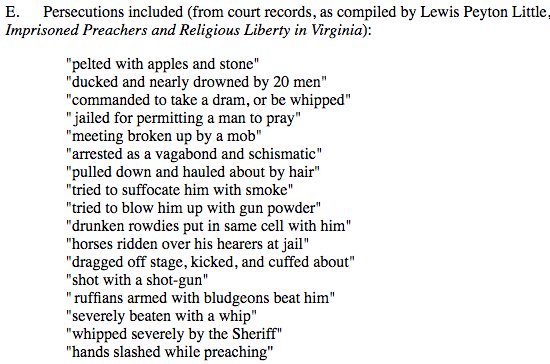
From 1768 through 1774, the Baptists were persecuted severely. “Baptist preachers were whipped, arrested, fined, imprisoned on bread and water, although the authorities sanctimoniously denied that punishment was for ‘preaching’; the crime they said, was ‘breach of the peace.’”[1] The first instance of actual imprisonment was on June 4, 1768, when John Waller, Lewis Craig, James Childs, James Reed, and William Marsh were arrested at Craig’s meetinghouse in Spotsylvania and charged with disturbing the peace. The magistrates offered to release them if they would promise to preach no more for a year and a day. They refused and were jailed. Many more were jailed and otherwise persecuted until 1774.[2]

  • “[The persecutors] seemed sometimes to strive to treat the Baptists and their worship with as much rudeness and indecency as was possible. They often insulted the preacher in time of service, and would ride into the water and make sport when they administered baptism. They frequently fabricated and spread the most groundless reports, which were injurious to the characters of the Baptists. When any Baptist fell into any improper conduct, it was always exaggerated to the utmost extent.”[3]
  • “The enemy, not contented with ridicule and defamation, manifested their abhorrence to the Baptists in another way. By a law then in force in Virginia, all were under obligation to go to church several times a year; the failure subjected them to fine. [Little action against members of the Established church was taken under this law, but] as soon as the ‘New Lights’ were absent, they were presented by grand jury, and fined…. [Others were imprisoned for preaching without a license.] ‘When persecutors found religion could not be stopped … by ridicule, defamation, and abusive language, the resolution was to take a different step and see what they could do; and the preachers in different places were apprehended by magisterial authority, some of whom were imprisoned and some escaped. Before this step was taken, the parson of the parish was consulted [and he advised that] the ‘New Lights’ ought to be taken up and imprisoned, as necessary for the peace and harmony of the old church….’”[4]
  • “[An Episcopalian wrote,] No dissenters in Virginia experienced, for a time, harsher treatment than did the Baptists. They were beaten and imprisoned, and cruelty taxed its ingenuity to devise new modes of punishment and annoyance.”[5]

Because of the persecutions and oppressions, Baptists began to petition the House of Burgesses for relief. Their first petition in 1770 requesting that Baptist ministers “not be compelled to bear arms or attend musters” was rejected. Other petitions from Baptists in several counties were submitted in 1772 requesting that they “be treated with the same indulgence, in religious matters, as Quakers, Presbyterians, and other Protestant dissenters enjoy.” The petitions continued until 1775.[6] The Presbyterians petitioned also, but for the right to incorporate so that they could receive and hold gifts of land and slaves for the support of their ministers. One of the Presbyterian petitions was improperly hailed as proof “that the Presbyterians anticipated the Baptists in their memorials asking for religious liberty.” An examination of that petition reveals that it “contemplate[d] nothing more than securing for Presbyterians and others in Virginia the same privileges and liberties which they enjoyed in England under the Act of Toleration,” and contained no “attack upon the Establishment, or any sign of hostility to it.”[7]

During this time, James Madison wrote to his old college friend, Bradford of Philadelphia, in a letter dated January 24, 1774. He expressed his belief that if

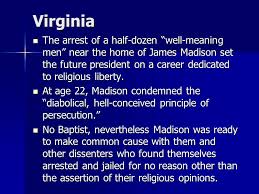
  • “uninterrupted harmony had prevailed throughout the continent [in matters of established religion as practiced in Virginia] it is clear to me that slavery and subjection might and would have been gradually insinuated among us. Union of religious sentiments begets a surprising confidence, and ecclesiastical establishments tend to greatly ignorance and corruption, all of which facilitates the execution of mischievous projects…. Poverty and luxury prevail among all sorts; pride, ignorance, and knavery among the priesthood, and vice and wickedness among the laity. This is bad enough; but it is not the worst I have to tell you. That diabolical, hell-conceived principle of persecution rages among some, and to their eternal infamy, the clergy can furnish their quota of imps for such purposes. There are at this time in the adjacent country not less than five or six well-meaning men in close jail for publishing their religious sentiments, which in the main are very orthodox. I have neither patience to hear, talk, or think of anything relative to this matter; for I have squabbled and scolded, abused and ridiculed, so long about it to little purpose, that I am without common patience…. So I must beg you to pity me, and pray for liberty of conscience to all.”[8]
  • [In another letter to Bradford dated April 1, 1774, Madison wrote that he doubted that anything would be done to help the dissenters in the Assembly meeting beginning May 1, 1774.] He spoke of “the incredible and extravagant stories [which were] told in the House of the monstrous effects of the enthusiasm prevalent among the sectaries, and so greedily swallowed by their enemies…. And the bad name they still have with those who pretend too much contempt to examine into their principles and conduct, and are too much devoted to ecclesiastical establishment to hear of the toleration of the dissentients…. The liberal, catholic, and equitable way of thinking, as to the rights of conscience, which is one of the characteristics of a free people, and so strongly marks the people of your province, is little known among the zealous adherents to our hierarchy…. [Although we have some persons of generous principles in the legislature] the clergy are a numerous and powerful body, have great influence at home by reason of their connection with and dependence on the bishops and crown, and will naturally employ all their arts and interest to depress their rising adversaries; for such they must consider dissentients, who rob them of the good will of the people, and may in time endanger their livings and security.
  • “… Religious bondage shackles and debilitates the mind, and unfits if for every enterprise, every expanded prospect.”[9]

Endnotes

[1] Leo Pfeffer, Church, State, and Freedom (Boston: The Beacon Press, 1953), p. 95 citing Edward F. Humphrey, Nationalism and Religion in America (Boston: Chipman Law Publishing Co., 1924), p. 370.

[2] Charles F. James, Documentary History of the Struggle for Religious Liberty in Virginia (Harrisonburg, VA.: Sprinkle Publications, 2007; First Published Lynchburg, VA.: J. P. Bell Company, 1900), pp. 29-30. Included is a listing of some of those jailed and otherwise persecuted. See also James R. Beller, America in Crimson Red: The Baptist History of America (Arnold, Missouri: Prairie Fire Press, 2004), pp. 230-250; William L. Lumpkin, Baptist Foundations in the South (Eugene, Oregon: Wipf & Stock Publishers, 2006), pp. 105-120; William P. Grady, What Hath God Wrought: A Biblical Interpretation of American History (Knoxville, Tennessee: Grady Publications, Inc., 1999), Appendix A, pp. 593-598 citing Lewis Peyton Little, Imprisoned Preachers and Religious Liberty in Virginia, (Galatin, Tenn.: Church History Research and Archives, 1987), pp. 516-520 (lists many Baptists and the persecutions they endured in Virginia; persecutions such as being jailed for preaching, civil suit, being annoyed by men drinking and playing cards, being jerked off stage and head beaten against the ground, hands being slashed, beaten with bludgeons, being shot with a shotgun, ousted as a justice for preaching, being brutally beaten by a mob, severely beaten with a stick, etc.).

[3] James, p. 30, citing Semple, p. 19.

[4] Ibid., pp. 30-31, citing William Fristoe, “History of the Ketocton Baptist Association,” p. 69.

[5] Ibid., citing Dr. Hawks, “History of the Protestant Episcopal Church of Virginia,” p. 121.

[6] Ibid., pp. 31-35.

[7] Ibid., pp. 42-47.

[8] Lenni Brenner, editor, Jefferson and Madison on Separation of Church and State (Fort Lee, NJ: Barricade Books, Inc, 2004), pp. 11-12; James, p. 36.

[9] Brenner, pp. 12-13; James, pp. 35-38, citing Rives Life and Times of Madison, Vol. I, pp. 43, 53; Norman Cousins, In God We Trust (Kingsport, Tennessee: Kingsport Press, Inc., 1958), pp. 299-301.

IV. Baptists in Virginia Colony; The Bad Character of the Anglican Clergy; Colonel Sam Harris and Other Baptist Preachers; The Separate and Regular Baptists


A Publication of Churches Under Christ Ministry


Previous Lesson:
III. Presbyterians in Virginia

Next Lesson:
V. Virginia Persecution of Baptists from 1768-1774; Baptist Petitions; James Madison on Religious Establishment and Persecution

Click here for links to all lessons on “To Virginia.

Click here to go to links to all written lessons.

Click here to go to the 3 1/2 to 6 minute video lectures.

For accompanying more thorough study from God Betrayed click here.


Jerald Finney
Copyright © March 2, 2018


Different bodies of Baptists came to Virginia during the colonial period. The “Regular Baptists,” like the Presbyterians, “applied for license and took the prescribed oaths.” As for the “Separate Baptists,” the “body spread so rapidly throughout the State from 1755 to the … Revolution,” and “did not recognize the right of any civil power to regulate preaching or places of meeting.” They were the “most active in evangelizing Virginia and most severely persecuted, and … had the largest share of the work of pulling down the ‘Establishment’ and securing religious liberty for all.” “While yielding a ready obedience to the civil authorities in all civil affairs, in matters of religion they recognized no lord but Christ. They were truly apostolic in refusing to obey man rather than God.”[1]

Conditions were favorable for the rapid growth of Baptist principles. “First, the distress of the colonists, consequent upon the French and Indian wars, inclined them towards religion.” Secondly, the distressed people could find no solace or comfort in the immoral established clergy.

  • “The great success and rapid increase of the Baptists in Virginia must be ascribed primarily to the power of God working with them. Yet it cannot be denied but that there were subordinate and cooperating causes; one of which, and the main one, was the loose and immoral deportment of the Established clergy, by which the people were left almost destitute of even the shadow of true religion. ‘Tis true, they had some outward forms of worship, but the essential principles of Christianity were not only not understood among them, but by many never heard of. Some of the cardinal precepts of morality were discarded, and actions plainly forbidden by the New Testament were often proclaimed by the clergy as harmless and innocent, or, at worst, foibles of but little account. Having no discipline, every man followed the bent of his own inclination. It was not uncommon for the rectors of parishes to be men of the lowest morals. The Baptist preachers were, in almost every respect, the reverse of the Established clergy.’”[2]

Their own authorities prove the bad character and actions of the established clergy. Many of that clergy came to Virginia “to retrieve either lost fortune or lost character….” “Many of them had been addicted to the race-field, the card-table, the theatre—nay, more, to drunken revel, etc….” “They could babble in a pulpit, roar in a tavern, exact from their parishioners, and rather by their dissoluteness destroy than feed the flock.”[3]

The Baptists grew stronger and more numerous in Virginia. Robert Nordin, when he arrived from England in 1714, established the first Baptist church in Virginia. By 1755, there were six Baptist churches in Virginia.[4] 1758 to 1769 was a period of slow but persistent growth in the face of a determined popular hostility. The early opposition to the Baptists came from the lower classes and was based upon prejudice.

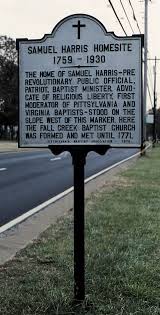
The Virginia expansion was intimately tied up with the ministry of Colonel Samuel Harris. Harris—who served at various times as churchwarden, sheriff, justice of the peace, colonel of the county, and captain and commissary of Fort Mayo and its military garrison—was the first person of prominence to join the Separates in Virginia and was just one of many examples of the power of this movement. He was saved at a house meeting after hearing a sermon preached by a Separate Baptist from North Carolina. He resigned from his official positions and narrowed his business interests almost to the vanishing point in order to preach. He began to preach throughout Virginia, and many were converted because of his ministry.[5]

Harris was a fearless preacher. “The excellence of his preaching lay chiefly in ‘addressing the heart,’ and Semple holds that ‘perhaps even Whitefield did not surpass him in this.’”[6] He had the assistance of several North Carolina itinerant evangelists planting the earliest Separate churches in south central Virginia. In 1760, Daniel Marshall and Philip Mulkey with seventy-four charter members, eleven of whom were Negroes, started the Dan River Church. Other churches were soon constituted from the Dan River Church.[7]

Wherever the Baptist itinerants preached, great crowds came to hear them. Many were converted in Virginia, and many Baptist churches were started. In 1770, there were only two Separate churches north of the James River, four south of it. The General Association of Separate Baptists of Virginia was held in May 1771 in Orange County with twelve churches represented, and three not represented.

By 1772, the Separate Churches outnumbered those of the Regular churches. In that year, as many as forty thousand Virginians may have heard the gospel. By 1773, thirty-four churches were represented at the General Association meeting, and they reported a combined membership of 3,195. By May 1774, when Baptist expansion and Baptist persecution were at high tide, the Southern District in Virginia had twenty-seven churches with 2,033 members and the Northern District had twenty-four churches with 1,921 members. By the end of 1774, there was at least one Separate Baptist church in twenty-eight of the sixty counties of Virginia. During the Revolution, Baptist growth continued, but at a much slower pace.[8]


Endnotes

[1] Charles F. James, Documentary History of the Struggle for Religious Liberty in Virginia (Harrisonburg, VA.: Sprinkle Publications, 2007; First Published Lynchburg, VA.: J. P. Bell Company, 1900), pp. 12-14, 26.

[2] Ibid., pp. 26-27, citing Robert B. Semple, “History of the Baptists of Virginia,” 1810, p. 25.

[3] Ibid., pp. 27-28, citing Foote, p. 38 quoting from the Bishop of London; Bishop Meade, “Old Parishes and Families of Virginia” (Vol. I, 118, 385, etc.; Dr. Hawks, “History of the Protestant Episcopal Church of Virginia,” p. 65.).

[4] James R. Beller, America in Crimson Red: The Baptist History of America (Arnold, Missouri: Prairie Fire Press, 2004), pp. 140-142.

[5] Lumpkin, pp. 48-49.

[6] Ibid., p. 90, citing A. B. Semple, A History of the Rise and Progress of the Baptists of Virginia (Richmond: Pitt & Dickinson, 1894), p. 380.

[7] Ibid., pp. 90-98.

[8] Ibid., pp. 90-103.

III. Presbyterians in Virginia Colony


A Publication of Churches Under Christ Ministry


Previous Lesson:
II. Only the Church of England Was Tolerated in Virginia Colony

Next Lesson:
IV. Baptists in Virginia Colony; The Bad Character of the Anglican Clergy; Colonel Sam Harris and Other Baptist Preachers; The Separate and Regular Baptists

Click here for links to all lessons on “To Virginia.

Click here to go to the written lessons.

Click here to go to the 3 1/2 to 6 minute video lectures.

For accompanying more thorough study from God Betrayed click here.


Jerald Finney
Copyright © March 2, 2018


Although some Presbyterians settled in Virginia from 1670 to 1680, the number & influence of Presbyterians in Virginia was small until the mid-1700s. In the mid-1700s an influential body of Presbyterians settled in Hanover County as a result of a 1738 agreement between the Presbyterian Synod of Philadelphia and Virginia governor William Gooch which allowed “emigrants to occupy the frontier portions of Virginia and enjoy the benefits of the Act of Toleration.”[1]

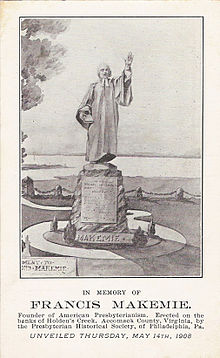
The first non-Anglican minister to receive a license under the Act of Toleration passed by the British Parliament in 1689, which instructed liberty of conscience for all but Papists, was Francis Makemie, a Presbyterian minister in Accomac County. By 1725, no more than five conventicles, “three small meetings of Quakers and two of Presbyterians,” were licensed, and these in poorer counties who were unable to pay the established minister enough to stay. In 1725, a similar license was granted to “certain parties (doubtless Presbyterians)” in Richmond County.[2]

Presbyterian families from Pennsylvania and Maryland began to move to remote parts of Virginia on the western frontier in 1738. The Presbyterian Synod of Pennsylvania wrote Governor Gooch of Virginia asking for religious freedom for those Presbyterians. Governor Gooch, knowing these people “to be firm, enterprising, hardy, brave, good citizens and soldiers,” and desiring “to form a complete line of defense against the savage inroads,” welcomed them. “At so great a distance from the older settlements, he anticipated no danger to the established church.” The conditions of settlement were that they “were not only to settle in the frontier counties as a buffer between the Churchmen and the Indians, but they had to swear allegiance to ‘His Magesty’s person and government,’” pay the taxes levied in support of the Established Church, and never by word or deed seek to injure the said church…. “Houses for public worship could not be occupied without permission from the civil authorities, and each application for a house of worship was heard on its own merits.” “[Those early Presbyterians] did not break their promise nor violate their oaths.” Up to the Revolution, “they never demanded anything more than their rights under the Act of Toleration, and … not until the Revolution was accomplished, and Virginia had thrown off allegiance to Great Britain, did they (the Presbyterians) strike hands with the Baptists in the effort to pull down the Establishments.” However, with the fury of the French and Indian War, which broke out in 1755, Presbyterians east of the Blue Ridge occupied houses of worship without license or molestation.[3]


Endnotes

[1] Charles F. James, Documentary History of the Struggle for Religious Liberty in Virginia (Harrisonburg, VA.: Sprinkle Publications, 2007; First Published Lynchburg, VA.: J. P. Bell Company, 1900), pp. 11-12.

[2] Ibid., pp. 20-22.

[3]Ibid., pp. 22-25, citing Foote, “Sketches of Virginia,” pp. 99, 160-162, 307, 308.

II. Only the Church of England Was Tolerated in Virginia Colony


A Publication of Churches Under Christ Ministry


Previous Lesson:
I. Motivation for the Final Thrust for the First Amendment-the Convictions of Dissenters, mainly the Baptists; the thrust for the growth of the Baptists Came from the Great Awakening

Next Lesson:
III. Presbyterians in Virginia

Click here for links to all lessons on “To Virginia.

Click here to go to the written lessons.

Click here to go to the 3 1/2 to 6 minute video lectures.

For accompanying more thorough study from God Betrayed click here.


Jerald Finney
Copyright © March 2, 2018


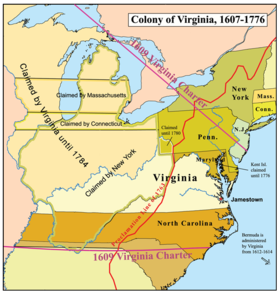
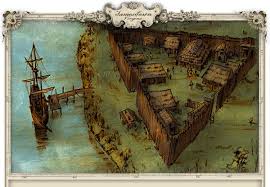
Virginia “was founded by members of the Church of England and none others were tolerated in its jurisdiction.”[1] The Episcopal church, the Church of England, in Virginia was established from the founding of Jamestown in 1607.

  • “It was known, also, as the ‘Established Church,’ because it was made, by legal enactment, the church of the State and was supported by taxation. Not only so, but it was designed to be the established church, to the exclusion of all others. Rigid laws, with severe penalties affixed, were passed, having for their object the exclusion of all Dissenters from the colony, and the compelling of conformity to the established, or State, religion. Even after the Revolution of 1688, which placed William and Mary upon the throne of England and secured the passage of the ‘Act of Toleration’ the following year, the ‘General Court of the Colony’ of Virginia construed that act to suit themselves, and withheld its benefits from Dissenters … until they were compelled to yield to the force of circumstances.”[2]

The Church of England was stronger in Virginia than in any colony.

1612 Virginia Charter

In Virginia, the established Anglican church was controlled by the state, unlike in New England where the established church controlled the state. From the beginning of the colony, the “company knew not how to control the members composing the colony but by religion and law.”[3] The original “Lawes Divine, Moral and Martial” which were decreed in 1612, were severe. Speaking impiously of the Trinity or of God the Father, Son, or Holy Spirit, blaspheming God, incorrigibly cursing, a third failure to attend religious services, and a third “Sabbath-breaking,” were punishable by death. Other spiritual offenses were punished by whipping and other penalties.[4]

Upon appeal to England, these laws were repealed. The laws enacted in support of the Anglican establishment were less severe. Still, the Anglican church was established (and this establishment continued until the revolution with one short interruption), nonattendance at church services was the subject of fines, the payment of tithes were mandatory, every parson was entitled to the glebe—a piece of land—parish churches were built by taxes, and ministers were required to “conform themselves in all things according to the canons of the Church of England.”

“Puritan clergy were banished for failing to conform to Anglican services; Quakers [and Baptists] were fined, imprisoned, and banished. Catholics were disqualified from public office, and any priest who ventured to enter the colony was subject to instant expulsion. Penalties were imposed on those who having scruples against infant baptism, neglected to present their children for that purpose.”[5]

A 1643 law forbade anyone to teach or preach religion, publicly or privately, who was not a minister of the Church of England, and instructed governor and council to expel all nonconformists from the colony.[6] In 1643, three Congregationalist ministers from Boston were forced to leave the colony. Also in 1643, “Sir William Berkeley, Royal Governor of Virginia, strove, by whippings and brandings, to make the inhabitants of that colony conform to the Established church, and thus drove out the Baptists and Quakers, who found a refuge in … North Carolina.” Quakers first came to Virginia in “1659-60, and … the utmost degree of persecution was exercised towards them.” “During the period of the Commonwealth in England, there had been a kind of interregnum as to both Church and State in Virginia; but in 1661, the supremacy of the Church of England was again fully established.” Only ministers of the Church of England were permitted to preach, and only ministers of that church could “celebrate the rites of matrimony,” and only “according to the ceremony prescribed in the Book of Common Prayer.”[7]


Endnotes

[1] John T. Christian, A History of the Baptists, Volume I, (Texarkana, Ark.-Tex.: Bogard Press, 1922), p, 381.

[2] Charles F. James, Documentary History of the Struggle for Religious Liberty in Virginia (Harrisonburg, VA.: Sprinkle Publications, 2007; First Published Lynchburg, VA.: J. P. Bell Company, 1900), pp. 10-11.

[3] Ibid., p. 17.

[4] See Leo Pfeffer, Church, State, and Freedom (Boston: The Beacon Press, 1953), p. 69 for the text of this law.

[5] Ibid.; see also James, pp. 17-20 for a more comprehensive overview of the laws of Virginia which provided for religious persecution and the established church.

[6] William L. Lumpkin, Baptist Foundations in the South (Eugene, Oregon: Wipf & Stock Publishers, 2006), p. 105.

[7] James, pp. 17-20.

I. Motivation for the Final Thrust for the First Amendment-the Convictions of Dissenters, mainly the Baptists; the thrust for the growth of the Baptists Came from the Great Awakening


A Publication of Churches Under Christ Ministry


Previous Series of Lessons:
From New England to the South

Next Lesson:
II. Only the Church of England Was Tolerated in Virginia Colony

Click here for links to all lessons on To Virginia.

Click here to go to the written lessons.

Click here to go to the 3 1/2 to 6 minute video lectures.

For accompanying more thorough study from God Betrayed click here.


Jerald Finney
Copyright © March 2, 2018


Although the final expression of religious freedom that would be incorporated into the Constitution came from Virginia, the final motivation came because of the convictions of the dissenters, mainly the Baptists, and the thrust for their growth and influence came from the Great Awakening.

  • “[T]he early Baptists of Virginia, … while they could not boast of great wealth, or culture, or refinement, they possessed some things of more real value, and which the Commonwealth greatly needed. In the first place they had religion—genuine religion; not a sham, nor an empty form, but the old time religion of the heart. Then they had a personal worth or character, that character which always follows from having genuine religion. And then, again, those early Baptists had an unquenchable love of liberty. The truth of the New Testament makes men free indeed, and it inspires them with a love of freedom, not for themselves only, but for all men. And it was because they possessed these traits that they resisted the temptations of the General Incorporation and General Assessment, and stood their ground amid the general desertion. They resolved to continue to fight.”[1]

The conflict in Virginia originally involved the Anglicans and Presbyterians, neither of which originally believed in either religious freedom or separation of church and state. Religious freedom and separation are owed mainly to the Baptists who believed in both. What Jefferson and Madison wrote about and did for religious freedom resulted from their observance of the conflict among Christians and is not to be found in the pages of philosophers of the Enlightenment.[2]

  • “The Presbyterians [in Virginia] won religious liberty for themselves against the opposition of the Episcopalians. Next the Baptists won religious liberty for themselves against the opposition of the Episcopalians and the Presbyterians. By 1775 about three quarters of the people of Virginia were outside the Church of England, but many of the most influential Virginians were inside. When the war started, there were ninety-five Anglican parishes in Virginia. The war killed off at least a quarter of them. Nowhere in the colonies was Tory sentiment stronger than among the Anglican clergy of Virginia, and they found themselves at the gravest of odds with their flocks.”[3]

Endnotes

[1] Charles F. James, Documentary History of the Struggle for Religious Liberty in Virginia (Harrisonburg, VA.: Sprinkle Publications, 2007; First Published Lynchburg, VA.: J. P. Bell Company, 1900), Appendix A, pp. 207-208.

[2] See, e.g., Marnell, pp. 89-90.

[3] Ibid., p. 93.

To Virginia

I. Motivation for the Final Thrust for the First Amendment-the Convictions of Dissenters, mainly the Baptists; the thrust for the growth of the Baptists Came from the Great Awakening
II. Only the Church of England Was Tolerated in Virginia Colony
III. Presbyterians in Virginia
IV. Baptists in Virginia Colony; The Bad Character of the Anglican Clergy; Colonel Sam Harris and Other Baptist Preachers; The Separate and Regular Baptists
V. Virginia Persecution of Baptists from 1768-1774; Baptist Petitions; James Madison on Religious Establishment and Persecution
VI. The Period of Intolerance and Persecution in Virginia Ends in 1775 with the Beginning of the Revolution; The Baptists Push for Religious Freedom
VII. Virginia Adopts a New Constitution; Recognizes Religious Liberty (as opposed to Religious Tolerance); Patrick Henry for Religious Tolerance; James Madison for Religious Liberty
VIII. Virginia Baptists Alone in Seeking Freedom of Conscience; The Battle for Soul Liberty in Virginia; Jefferson Fights for Religious Liberty
IX. The Battle for Religious Liberty Continues, 1784-1785; Baptists Uncompromising in Their Stand for Religious Liberty; Presbyterians Take a Middle Ground to Which Madison Takes Issue
X. Alliance Between the Episcopalians and the Presbyterians; Bill for Provisions for Teachers of Christian Religion; Madison’s Opposition to the Bill and His Famous Memorial and Remonstrance
XI. The Fight against the Assessment Bill Continues; The Virginia Act for Religious Liberty, Drafted by Thomas Jefferson, Passes instead; Thomas Jefferson’s Unswerving Position on Religious Liberty, All Vestiges of the Establishment Removed


III. Religious Injustice in Anglican North Carolina; Governor Tryon Moves to Strengthen the Anglican Church in North Carolina; The War of the Regulation Spread the Separate Baptists throughout the South and Started a Fire that Could Not Be Put Out


A Publication of Churches Under Christ Ministry


Previous Lesson:
II. Shubal Stearns and Daniel Marshall Go To Virginia, then to Sandy Creek North Carolina, and Anglican Colony; The Work at Sandy Creek Explodes

Next Series of Lessons:
To Virginia

Click here for links to all lessons on “From New England to the South.”

Click here to go to the written lessons.

Click here to go to the 3 1/2 to 6 minute video lectures.

For accompanying more thorough study from God Betrayed click here.


Jerald Finney
Copyright © March 1, 2018


Before 1765 the western counties, made up of frontiersman, a large percentage of whom had become Baptists, were disproportionately taxed and represented in the Assembly. “Sheriffs, judges, and other officials of county government, were notorious for their injustice, and in the western counties they were, as a rule, dishonest, haughty, and overbearing.”[1] A license was required for teachers, and no place of higher education could be administered, except by ministers of the Church of England. The Church of England was given exclusive rights to perform marriages. In 1755, poll and vestry taxes were imposed upon North Carolinians.[2] The settlers mounted protests against these injustices.

Governor William Tryon

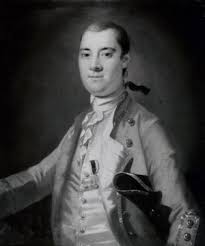
When William Tryon became governor of North Carolina in 1765, the troubles moved quickly to a crisis. Governor Tryon set out to strengthen the position of the Church of England. He called for twenty-seven more Anglican clergymen, increased taxes, and raised a military force. By 1770, Governor Tryon had established eighteen Anglican priests in thirty-two parishes in North Carolina. Property was seized for back taxes, people accused of rioting were arrested and set for trial, and others were fined and imprisoned. “In several places the Regulators yielded to mob spirit, broke up courts, and whipped the officers” and “some court records were destroyed.”[3] Armed conflict finally broke out.

Battle of Alamac, War of the Regulation

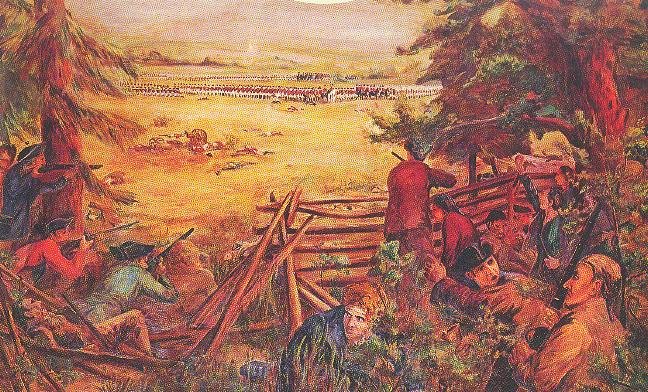
In 1771, the so-called War of the Regulation broke out. The government of North Carolina tried to suppress the Separate Baptists, but succeeded only in spreading their movement all along the southern frontier. Before the suppression began, the established church, the Anglican Church, was ineffectual in North Carolina and only had five ministers in the state in 1765. On May 16, 1771, the state militiamen routed a poorly trained and supplied force of two thousand regulators. Although Shubal Stearns and the Sandy Creek Association forbade Baptists to take up arms against the government, many did.

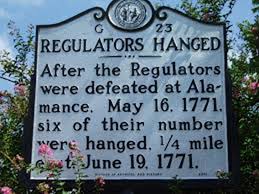
After the defeat of the regulators, Tryon “laid waste to plantations, burned homes, and sent numbers of men in chains to Hillsboro. The countryside was terrorized.”[4] Tryon seized Benjamin Merrill, who appears to have been a church leader. Merrill was convicted as a traitor, hung publicly, cut into pieces—quartered—and his body scattered.[5]

The Baptists had a mass exodus from North Carolina. By 1772, Sandy Creek Church had only fourteen members, down from six hundred and six. Little River Church went from five hundred to a dozen members. Nevertheless, as with the persecution of the first Christians in Jerusalem, the persecuted spread to other parts and carried out the Great Commission. The departing Baptists went into South Carolina, Georgia, and Tennessee, spreading the Gospel and reaping the harvest. What Satan meant for evil, God used for His glory.

Shubal Stearns, the chief light and the guiding genius behind the Separate Baptist movement, died on November 20, 1771, at the age of sixty-five. Forty-two churches and one hundred and twenty-five ministers had sprung from the Sandy Creek Church by 1772. Fires, which could not be quenched, had been started in North Carolina and in other states.[6]


Endnotes

[1] William L. Lumpkin, Baptist Foundations in the South (Eugene, Oregon: Wipf & Stock Publishers, 2006), pp. 72-74.

[2] James R. Beller, America in Crimson Red: The Baptist History of America (Arnold, Missouri: Prairie Fire Press, 2004), pp. 181-182.

[3] Lumpkin, pp. 78-79.

[4] Ibid., p. 83.

[5] Beller, p. 197.

[6] Lumpkin, p. 59.

The local church sanctified and cleansed by the washing of water by the word——————–A ministry of Charity Baptist Tabernacle of Amarillo, Texas led by Pastor Ben Hickam. "Would to God ye could bear with me a little in my folly: and indeed bear with me. For I am jealous over you with godly jealousy: for I have espoused you to one husband, that I may present you as a chaste virgin to Christ. But I fear, lest by any means, as the serpent beguiled Eve through his subtilty, so your minds should be corrupted from the simplicity that is in Christ" (2 Corinthians 11:1-3). ————————————Jerald Finney, a Christian Lawyer and member of Charity Baptist Tabernacle, having received this ministry in the Lord, explains how a church in America can remain under the Lord Jesus Christ and Him only. "As every man hath received the gift, even so minister the same one to another, as good stewards of the manifold grace of God. If any man speak, let him speak as the oracles of God; if any man minister, let him do it as of the ability which God giveth: that God in all things may be glorified through Jesus Christ, to whom be praise and dominion for ever and ever. Amen" (1 Peter 4:10-11; See also, Ephesians 4::1-16 and 1 Corinthians 12:1-25). "Take heed to the ministry which thou hast received in the Lord, that thou fulfil it" (Colossians 4:17). "And hath put all things under his feet, and gave him to be the head over all things to the church" (Ephesians 1.22; See also, e.g. Colossians 1:18).