All posts by Jerald Finney

Jerald Finney was the lead counsel for the Biblical Law Center ("BLC") from May, 2005 until 2011. The BLC helps churches who desire to organize according to New Testament principles. In 2016, he again worked with the BLC and still does, but he now heads up the Churches under Christ Ministry which is under the authority of Charity Baptist Tabernacle of Amarillo TX. Finney is a licensed attorney who can be reached at 512-785-8445 jerald.finney@sbcglobal.net. Over the last few years he has lectured and preached on the issues concerning government, church, and separation of church and state. God called Finney, a Christian and fundamental Baptist since his salvation, to enter the University of Texas School of Law in 1990 at the age of 43 to stand in the gap concerning legal issues facing Christians. Since being saved, he has been a faithful and active member of a local fundamental, Bible-believing Baptist church. He received his JD degree in 1993 and has followed the Lord in the practice of law since that time. Finney received his law license in November 1993 and began practicing law in January, 1994. All along he was seeking the Lord’s direction. The Lord initially led Finney to practice criminal law. He knew that not many, if any, of the Christian law firms dealt with or specialized in criminal law, and that some Christians were being charged with crimes for their Christian behavior and for taking a stand for God’s principles. The Lord confirmed Finney's choice. Very soon after he started practicing, he helped an Eastern Orthodox priest with a criminal charge. He was charged under a criminal statute for trying to expose the promotion of sodomy and other sins within a Catholic Church. God gave the victory in that case. Then Steve, a Christian who counseled outside abortion clinics, called Finney. He was charged with a crime under the Austin, Texas Sign Ordinance for his activities outside an abortion clinic. Being a new lawyer, Finney called the Rutherford Institute. They asked him to send them a summary of the facts and a copy of the Sign Ordinance. Then they told him that the case could not be won and that they would not help. Steve lost at trial, but God gave the victory on appeal. The Austin Police Department immediately cited Steve for violation of the state sign ordinance. The Lord gave the victory at trial. Finney's first felony trial came about a year and six months after he started practicing law. A single Christian mother was charged with third degree felony injury to a child for spanking her six year old son. She left some prominent stripes across his rear end and also a stripe across his face when he turned suddenly during the spanking. The Lord gave the victory at trial. At the same time, Finney was also representing another Christian married lady who was charged with the same crime for spanking her little girl with a switch. On the date the trial in that case was to begin, the prosecutor, with prompting by the judge, lowered the offer to deferred adjudication probation of short duration on a misdemeanor charge with very few conditions on the probation. In a deferred adjudication in Texas, there is never a judgment of guilt if the probationer successfully completes the term of the probation, (and, with successful completion of the probation, the probationer can now file a Motion for Nondisclosure which, if granted, requires the file to be sealed so that the general public has no access to it). The mother decided to take the offer. The Lord has also allowed Finney to help Christian parents in numerous situations involving Child Protective Services (“CPS”) infringement into parental rights. God has given the victory in all those situations. The Lord has also used Finney to intervene in numerous situations where government officials or private companies tried to deny certain Christians their rights to do door-to-door evangelization, preach on the street, hand out gospel literature in the public forum, and pass out gospel tracts and communicate the gospel at their place of employment. Finney has also fought other legal spiritual battles including a criminal case in San Antonio. A peaceful pro-life advocate was arrested and charged with criminal trespass for handing pro-life literature giving information about the development of the unborn baby, places to go for help, and other information to women entering an abortion clinic. All the above-mentioned cases as well as others not mentioned were handled free of charge (except the last spanking case for which Finney received $750). In 2005 Finney became lead counsel for the Biblical Law Center. Since his early Christian life, he has considered the issue of separation of church and state as taught in the Bible to be one of the primary issues facing New Testament churches today. He believes, based upon what the Bible teaches, that operating as a corporation (sole or aggregate), unincorporated association, or any other type of legal entity and/or getting a tax exempt status from the federal government at the very least puts the church under the headship of both the Lord and the state, and may even take the church from under the headship of Christ and put the church under the headship of the state. He believes that taking scriptures out of context and applying human reasoning contrary to biblical teaching (such as “Obey every ordinance of man,” or “We should be good stewards and incorporation is good stewardship”) in order to justify unbiblical marriage with the state causes our Lord much grief. Once he took on the position as counsel for the BLC, it was necessary to do an in-depth study of the issue of separation of church and state. He began with the Bible. He initially read through the Bible at least five times (and many more times since then) primarily seeking the answer to the question, “Does the Bible have anything to say about this issue?” He was amazed at what He learned. The Bible gives God’s principles concerning separation of church and state, the purpose of a church, the purpose of the civil government, the headship of church, the headship of civil government, the principles by which each is to be guided, and much more concerning these two God ordained institutions. He continued to read the Bible daily seeking insights into these and other issues. He also began to read other books. he had already read starting shortly after being saved, books and other information by Christian authors. For example, he had read, among other works, A Christian Manifesto[1], The Light and the Glory,[2] From Sea to Shining Sea,[3] The Myth of Separation and some other works by David Barton, [4]Rewriting America’s History,[5] and America’s God and Country.[6] These resources inspired, influenced and guided him and millions of other Christians, gave them philosophical and historical underpinning, and led them into battlefields such as politics, law, and education armed with what they learned from those resources. Sometime in 2006 he began to realize that some of the books by Christian authors which he had come to depend upon were misleading, at the very least. Other books revealed to him that some of the above mentioned books had misinformed and misled sincere Christians by revising and/or misrepresenting the true history of separation of church and state in America. In 2006, he read One Nation Under Law[7] which cites a wealth of resources for one seeking to understand the history of separation of church and state in the United States and of the First Amendment to the United States Constitution.[8] Reading One Nation Under Law, some of the books it cited, and some other books was a launching pad into the universe of historical information which he never dreamed existed. He had expected to be misled in the secular law school he attended. He was amazed that he had been misled by Christian brothers. I asked myself, “How could Peter Marshall and others have missed this vital information?” At an Unregistered Baptist Fellowship conference in Indianapolis, Indiana, James R. Beller, a Baptist historian, gave a PowerPoint presentation which gave him the answer to this question. Finney bought two of Beller's books and read them. Those books filled in the details not mentioned in Pastor Beller’s concise PowerPoint presentation. Since that time, God has led Finney into an in depth study of the issues of government, church, and separation of church and state. God Betrayed/Separation of Church and State: The Biblical Principles and the American Application and the other books he has written and listed on this website were written as a result of those studies. God Betrayed is not a rehash of the same information that has been circulated in the Fundamental Baptist and Christian community through sermons, books, seminars, etc. since at least 1982, the year Finney was saved. God Betrayed and Finney's other books reveal facts and information that must be understood in order for a pastor and other Christians to begin to successfully (in God's eyes) fight the spiritual warfare we are engaged in according to knowledge. Finney believes that the lack of attention to the biblical doctrines concerning government, church (which is likened to the wife and bride of Christ), and separation of church and state, has had dire consequences for individuals, families, churches, and America. Unless pastors educate themselves on these doctrines and their application in America, the rapid downhill slide will continue at an accelerating pace. [1] Francis A. Schaeffer, A Christian Manifesto, (Westchester, Illinois: Crossway Books, 1981). [2] Peter Marshall and David Manuel, The Light and the Glory, (Old Tappan, New Jersey: Fleming H. Revell Company, 1977). [3] Peter Marshall and David Manuel, From Sea to Shining Sea (Old Tappan, New Jersey: Fleming H. Revell Company, 1986). [4] David Barton, The Myth of Separation, What is the Correct relationship between Church and State? (Aledo, Texas: Wallbuilder Press, 1992). [5] Catherine Millard, Rewriting America’s History (Camp Hill, Pennsylvania: Horizon House Publishers, 1991). [6] William J. Federer, America’s God and Country, Encyclopedia of Quotations (Coppell, Texas: FAME Publishing, Inc., 1994). [7] Mark Douglas McGarvie, One Nation Under Law: America’s Early National Struggles to Separate Church and State (DeKalb, Illinois: Northern Illinois University Press, 2005). [8] The First Amendment to the United States Constitution states: “Congress shall make no law respecting an establishment of religion, or prohibiting the free exercise thereof; or abridging the freedom of speech, or of the press; or the right of the people peaceably to assemble, and to petition the Government for a redress of grievances.” The religion clause, properly interpreted, as is shown in God Betrayed, is a correct application of the biblical principle of separation of church and state.

1. Introduction to History of the First Amendment


A Publication of Churches Under Christ Ministry


Previous Section:
Bible Doctrine Concerning Relationship of Church and State (Click here to go to links to all lessons)

Next Lesson:
2. Definitions of “Separation of Church and State,” “Established Church,” and “Religious Freedom or Soul Liberty”

Click here to go to all links to lessons on religious liberty in America.

Click here to go to links to all written lessons.

Click here to go to the 3 1/2 to 6 minute video lectures.

For accompanying for more thorough study from God Betrayed click here.


Jerald Finney
Copyright © February 22, 2018

Christians, except for a small minority who have ferreted out the truth, and secularists have accepted the brand of historical revisionism presented them by those they trust.[1] Revisionists revise in spite of the fact that he truth is available. This study presents accurate historical facts which are readily available through honest research. See [2] for link to some resources which verify this.   Both Christian revisionists (such as David Barton and Roger Federer) and secular revisionists (such as Leo Pfeffer,[3]) have distorted the true history of the First Amendment; “Christian” revisionism through manipulation of selected facts taken out of context and other dishonest devices and secular revisionism, although much more honest and accurate in reporting historical fact, through their inability to properly analyze because they leave God and the spiritual out of the equation.[4]

Revisionists, both “Christian” and secular, work on the lowest level, at the public level. They disseminate books, articles, videos, and public media interviews. They select facts out of context which support their agenda. Their adherents trust and believe them. Few followers have time to check out what they are being told. Even though legal and historical scholars have published the truth, their works remain obscure; the general public has neither the time nor inclination to examine the truth of what they are being fed. This study is based upon undeniable historic fact. Anyone can discover and verify these facts, if they have the time.

Secular revisionists such as Leo Pferrer have been very instrumental in the development of First Amendment law at the highest level—in the courts. Although Pfeffer’s work, unlike that of Christian revisionists, was for the most part factually accurate, he simply did not get it even though he did mention God. On the other hand, Christian revisionists, usually knowingly, present a factually false view of history. See [5] for link to a book which explains “Christian” revisionism. They have disseminated their history to the general public so successfully that the general Christian population who is interested in history as well as many politicians all the way up to Presidents of the United States have accepted and continued to disseminate the accepted “Christian” view of history. “Christian” revisionism has been published in briefs, memorandums of law, etc. in court cases all the way up to the Supreme Court. To present lies to such studied authorities is discrediting to Christianity in general. Although some “Christian” revisionists have now been exposed before the public in general, blind Christians continue to follow their teachings.[6] After all, most Christians believe that other “Christians” would not lie to them.

Religious freedom without persecution of “heretics” was historically rare, almost non-existent before the founding of the colony or Rhode Island. God’s people have always, regardless of persecution, come together as local churches, preached the Gospel, and helped their fellow man. Paul wrote in the midst of persecution:

  • “We are troubled on every side, yet not distressed; we are perplexed, but not in despair; Persecuted, but not forsaken; cast down, but not destroyed;”[7]
  • “We, having the same spirit of faith, according as it is written, I believed, and therefore have I spoken; we also believe, and therefore speak.”[8]

In the preceding verse, Paul quoted a portion of Psalm 116.10 which says in its entirety, “”I believed, therefore have I spoken: I was greatly afflicted:” Tied up in the liberty given believers by Christ is speaking (“And he said unto them, Go ye into all the world, and preach the gospel to every creature.”[9]), and associating or meeting together (“Not forsaking the assembling of ourselves together, as the manner of some is;”[10]). Furthermore, God gave mankind the Bible, which in certain times past, was banned and burned. The First Amendment was written and ratified with the intent of protecting God’s churches, the exercise of religion by the dissenters in the colonies, the preaching of the Gospel, the coming together to worship God, the dissemination of literature, mainly the dissemination of God’s Word, and the right to petition the civil government for a redress of grievances.

The First Amendment was the culmination of a long spiritual warfare between established churches and dissenters, mainly the Baptists. God’s power moved mightily during that period of conflict. Many believers suffered persecution. The roots of the struggle in America were embedded in New England, spread to the south, to Virginia, and then to the new nation.
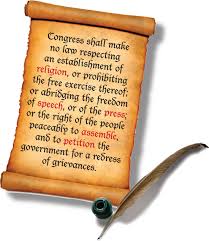
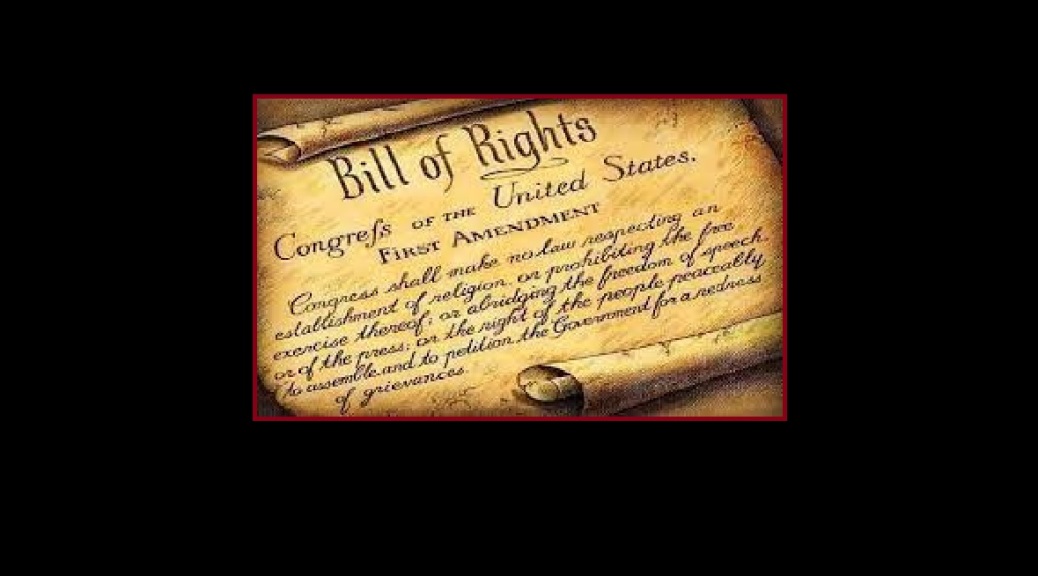
The First Amendment to the United States Constitution.

True historical facts prove that the religion clause of the First Amendment is a legal statement of the principle of religious freedom, or soul liberty, or separation of church and state which conforms to biblical principles. Bible-believing Christians, based upon their spiritual beliefs, fought the fight which resulted in the First Amendment. They made the spiritual Bible-based arguments and practiced their faith despite persecution. Their efforts and arguments gradually convinced others.

Many of the early colonists were Protestants who thought Luther and/or Calvin were correct in their belief that church and state should be united. Others, the Anglicans, brought the state-church concepts of union of church and state of England to the colonies. Dissenters believed in and fought for separation of church and state. The First Amendment was primarily the result of a spiritual warfare between those holding opposing Scriptural interpretations, the established churches versus the dissenters, primarily the Baptists.

  • “Of the Baptists, at least, it may be truly said that they entered the conflict in the New World with a clear and consistent record on the subject of soul liberty. ‘Freedom of conscience’ had ever been one of their fundamental tenets. John Locke, in his ‘essay on Toleration,’ says: ‘The Baptists were the first and only propounders of absolute liberty, just and true liberty, equal and impartial liberty.’ And the great American historian, Bancroft, says: ‘Freedom of Conscience, unlimited freedom of mind, was from the first a trophy of the Baptists.’ Vol. II., pages 66, 67.
  • “The history of the other denominations shows that, in the Old World, at least, they were not in sympathy with the Baptist doctrine of soul liberty, but in favor of the union of Church and State, and using the civil power to compel conformity to the established church….
  • “The Reformation which began with Martin Luther corrected many errors of faith and practice among those who came out of the corrupt and apostate church, but not all. It was left to the sect once ‘everywhere spoken against’ to teach their Protestant brethren the lesson of soul liberty, and this they did in the school of adversity in the New World.”[11]

At times, persecuting established churches became persecuted churches when they moved to other colonies controlled by another church/state establishment. When that happened, the persecutors generally became dissenters seeking religious tolerance or religious freedom.
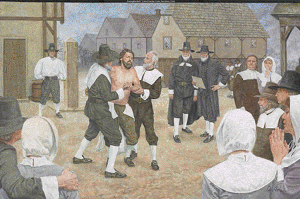
Beating of Obadiah Holmes for “heresy” by the Puritans in Massachusetts.

The First Amendment to the Constitution resulted from “a factual relationship that was rapidly solidifying when the Constitution was amended by the Bill of Rights.” The First Amendment was the final product of a long struggle by men who believed strongly in the God of the Bible and who were willing to die rather than bow down to false religion. Their spirit was fused into the ordering of the affairs of the United States. “A wall of separation which would bar that spirit from making itself felt in secular concerns can never be built, because it would have to bisect the human heart.”[12] William H. Marnell correctly observed that:

  • “[t]he First Amendment was not the product of indifference toward religion. It was not the product of the deism which prevailed in the Enlightenment, however much the spirit of deism may have been present in certain of the Founding Fathers. Above, all, it was not the product of secularism, and to translate the spirit of twentieth-century secularism back to eighteenth-century America is an outrage to history. The First Amendment was rather a logical outcome of the Reformation and its ensuing developments. It was so far removed from secularism as to be the product of its exact opposite, the deep-seated concern of a people whose religious faith had taken many forms, all of them active, all of them sincerely held. It was so far removed from indifference toward religion [specifically Christianity] as to be the result of its antithesis, the American determination that the diversity of churches might survive the fact of political action.”[13]
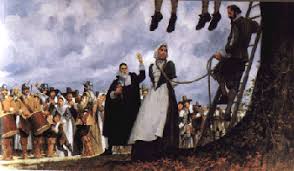
Puritans hung 4 Quakers for returning to Massachusetts after being banished for their religious beliefs.

The dissidents in the colonies, chiefly the Baptists, were able to gain a foothold, and they played it for all it was worth. The Baptist theology of the founding era, initially under the leadership of Roger Williams and John Clarke, successfully challenged the doctrines of the established churches concerning the relationship of church and state. Among the results were the establishment of the first civil government in history of any lasting significance with religious liberty, the government of the colony of Rhode Island, and later the First Amendment to the United States Constitution which required religious freedom for churches and freedom of conscience for individuals. The First Amendment allowed churches to operate under God without persecution. The First Amendment did not apply to the states.

Primarily due to the efforts of our Baptist forefathers, a time came, as Baptist pastor and historian John Callender said in 1838, when

  • “[e]xperience has dearly convinced the world, that unanimity in judgment and affection cannot be secured by penal laws….
  • “Indulgence to tender consciences, might be a reproach to the Colony [of Rhode Island], an hundred years ago, [that is in 1738, one hundred years before Callender wrote this], but a better way of thinking prevails in the Protestant part of the Christian church at present. It is now a glory to the Colony, to have avowed such sentiments so long ago, while blindness in this article happened in other places, and to have led the way as an example to others, and to have first put the theory into practice.
  • “Liberty of conscience is more fully established and enjoyed now, in the other New-English Colonies; and our mother Kingdom grants a legal toleration to all peaceable and conscientious dissenters from the parliamentary establishment. Greater light breaking into the world and the church, and especially all parties by turns experiencing and complaining aloud of the hardships of constraint, they are come to allow as reasonable to all others, what they want and challenge for themselves. And there is no other bottom but this to rest upon, to leave others the liberty we should desire ourselves, the liberty wherewith Christ hath made them free. This is doing as we would be done by, the grand rule of justice and equity; this is leaving the government of the church to Jesus Christ, the King and head over all things, and suffering his subjects to obey and serve him.”[14]

By the time the First Amendment was added to the United States Constitution, only New Hampshire, Massachusetts, and Connecticut had established churches. In 1833 Massachusetts became the last state to disestablish.

Baptists wanted religious freedom. Some probably could foresee the ideal of a church under God, a civil government under God, with neither church nor state over the other. But few knew how to have a civil government under God without establishing a church. Why? Fifteen hundred years of history had witnessed “Christian” establishments made up of church-state or state-church unions. Therefore, one should not be too hard on those early Protestants in America who continued those unions, since, according to Isaac Backus:

  • “[many things] prove that those fathers [the leaders of the Puritans in Massachusetts] were earnestly concerned to frame their constitution both in church and state by divine rule; and as all allow that nothing teaches like experience, surely they who are enabled well to improve the experience of past ages, must find it easier now to discover the mistakes of that day, than it was for them to do it then. Even in 1637, when a number of puritan ministers in England, and the famous Mr. Dod among them, wrote to the ministers here, that it was reported that they had embraced certain new opinions, such as ‘that a stinted form of prayer and set liturgy is unlawful; that the children of godly and approved Christians are not to be baptized, until their parents be set members of some particular congregation; that the parents themselves, though of approved piety, are not to be received to the Lord’s Supper until they be admitted set members,’ &c., Mr. Hooker expressed his fears of troublesome work about answering of them, though they may appear easy to the present generation.”[15]

This chapter will succinctly summarize the true history of religious liberty in America, initially pointing out some of the misleading teachings of secular and Christian revisionists. Ultimately, Christians can accomplish nothing with lies.[16]


Endnotes

[1] Influential Christian revisionists include non-scholars such as David Barton and Roger Federer. Secular revisionsts include scholars such as Leo Pfeffer. Pfeffer’s book Church, State and Freedom, was called a “masterpiece” and the ultimate sourcebook for the history of the evolution of the all-American principle of  separation of church and state. Pfeffer was an American Jewish lawyer, constitutional scholar, and humanist who was active in movement for religious freedom in the United States, and was one of leading legal proponents of the separation of church and state.

[2] List of Scholarly Resources which Explain and Comprehensively Document the True Histor of Religious Freedom in America.

[3] Leo Pfeffer, Church, State, and Freedom (Boston: The Beacon Press, 1953), pp. 81-93.

[4] Influential constitutional “scholars” such as Leo Pfeffer, since they have no concept of God or His sovereignty, have removed the most important aspect of debate from the equation—the spiritual aspect. Pfeffer, misrepresents spiritual matters because he does not understand them. He relegates the spiritual to the merely “ideological.” He attributes Madison’s positions on the issue of separation of church and state to his reliance on John Locke, and quotes Locke; then, even though Locke, in the quotes cited by Pfeffer, talks of government interference with the care and salvation of souls which belongs to God, Pfeffer never mentions God in his discussion but rather emphasizes Locke’s “social contract theory.” He overemphasizes the influence of rationalism and deism in gaining the First Amendment. He falsely proclaims that the “first four presidents of the United States were either Deists or Unitarians.” He asserts that the Great Awakening “emphasized an emotional, personal religion” which appealed directly to the individual, stressing the rights and duties of the individual conscience and its answerability exclusively to God.[4] He, like all secular scholars, simply did not get it even though he did mention God. He had no choice but to mention God, since a controversy over what God taught in the Bible was at the center of the controversy. He simply did not and could not examine that controversy. Lost men and saved men who were spiritually ignorant have led the way in the twentieth and twenty-first centuries.

[5] The Trail of Blood of the Martyrs of Jesus/Christian Revisionists on Trial….

[6] See Exposing Catholic/Calvinist/Reformed Historic Revisionism.

[7] 2 Co. 4.8-9.

[8] 2 Co. 4.13.

[9] Mk. 16.15.

[10] He. 10.25a.

[11] Charles F. James, Documentary History of the Struggle for Religious Liberty in Virginia (Harrisonburg, VA.: Sprinkle Publications, 2007; First Published Lynchburg, VA.: J. P. Bell Company, 1900), pp. 14-15.

[12] William H. Marnell, The First Amendment: Religious Freedom in America from Colonial Days to the School Prayer Controversy (Garden City, New York: Doubleday & Company, Inc., 1964), pp.  xii-xiii.

[13] Ibid.

[14] John Callender, The Civil and Religious Affairs of the Colony of Rhode-Island (Providence: Knowles, Vose & Company, 1838), pp. 108-109.

[15] Isaac Backus, A History of New England With Particular Reference to the Denomination of Christians called Baptists, Volume 1 (Eugene, Oregon: Wipf & Stock Publishers, Previously published by Backus Historical Society, 1871), pp. 37-38.

[16] Read James R. Beller, The Coming Destruction of the Baptist People: The Baptist History of America (St. Louis, Missouri: Prairie Fire Press, 2005) and James R. Beller, America in Crimson Red: The Baptist History of America (Arnold, Missouri: Prairie Fire Press, 2004) for a thorough discussion of the theology behind the lies of the Christian nationalists, whom Beller calls catholic Reformed, and a discussion of Christian nationalists other than Peter Marshall and David Manuel.

7. Conclusion to the Bible Doctrine of Separation of Church and State


A Publication of Separation of Churches Under Christ Ministry.


If you miss one part of the puzzle that is being put together in these studies, you will never see and understand the whole picture.


Click here to go to I. C. BIBLE DOCTRINE CONCERNING RELATIONSHIP OF CHURCH AND STATE

Previous Lesson:
6. Christ-church, Husband-Wife, Bridegroom-bride

Next Section:
Religious liberty in America (Click here to go to links to all lessons)

Click here to go to all lessons on the Bible Doctrine Concerning the Relationship of Church and State.

Click here to go to the written lessons.

Click here to go to the 3 1/2 to 6 minute video lectures.


For accompanying study from God Betrayed click here.


Jerald Finney
Copyright © February 22, 2018


God’s principles separate church and state. The God-ordained purpose of both is to glorify God, but neither will do so if operated outside the jurisdictional boundaries set by God. The two are so distinct that the possibility of the two operating together, or the possibility of one assuming leadership over the other without the very nature of the church being distorted and corrupted is a nullity. The church is a heavenly institution to be operated by men who are walking in the Spirit. The state is an earthly institution usually run by fleshly men whose purpose and goals are earthly. Even should born-again believers be the rulers of civil government (a temporary possibility at best), a state-church or church-state society is doomed to failure because God does not desire such a union and has made the two so different that it is impossible for the church to continue to be pure while the two operate together.

Men, walking in the flesh and not in the Spirit, have gone to great lengths to distort Scripture to justify an unholy alliance of church and state. And it is only a church, not the state, that is responsible for an alliance between church and state. Christ instructed Christians:

  • “Ye are the salt of the earth: but if the salt have lost his savour, wherewith shall it be salted? it is thenceforth good for nothing, but to be cast out, and to be trodden under foot of men. Ye are the light of the world. A city that is set on an hill cannot be hid. Neither do men light a candle, and put it under a bushel, but on a candlestick; and it giveth light unto all that are in the house. Let your light so shine before men, that they may see your good works and glorify your Father which is in heaven.”[1]  “The seven candlesticks which thou sawest are the seven churches.”[2]
  • Lay not up for yourselves treasures upon earth, where moth and rust doth corrupt, and where thieves break through and steal: But lay up for yourselves treasures in heaven, where neither moth nor rust doth corrupt, and where thieves do not break through nor steal: For where your treasure is, there will your heart be also. The light of the body is the eye: if therefore thine eye be single, thy whole body shall be full of light. But if thine eye be evil, thy whole body shall be full of darkness. If therefore the light that is in thee be darkness, how great is that darkness. No man can serve two masters: for either he will hate the one, and love the other; or else he will hold to the one, and despise the other. Ye cannot serve God and mammon.”[3]
  • “For God sent not his Son into the world to condemn the world; but that the world through him might be saved. He that believeth on him is not condemned: but he that believeth not is condemned already, because he hath not believed in the name of the only begotten Son of God. And this is the condemnation, that light is come into the world, and men loved darkness rather than light, because their deeds were evil. For every one that doeth evil hateth the light, neither cometh to the light, lest his deeds should be reproved. But he that doeth truth cometh to the light, that his deeds may be made manifest, that they are wrought in God.”[4]
  • “For God, who commanded the light to shine out of darkness, hath shined in our hearts, to give the light of the knowledge of the glory of God in the face of Jesus Christ.”[5]
  • “Be not unequally yoked with unbelievers: for what fellowship hath righteousness with unrighteousness: and what communion hath light with darkness? And what concord hath Christ with Belial: or what part hath he that believeth with an infidel? And what agreement hath the temple of God with idols? for ye are the temple of the living God; as God hath said, I will dwell in them, and walk in them; and I will be their God, and they shall be my people. Wherefore come out from among them, and be ye separate saith the Lord, and touch not the unclean thing; and I will receive you, and will be a Father unto you, and ye shall be my sons and daughters, saith the Lord Almighty.”[6]
  • “…God is light, and in him is no darkness at all. If we say we have fellowship with him, and walk in darkness, we lie, and do not the truth: But if we walk in the light, as he is in the light, we have fellowship one with another, and the blood of Jesus Christ his Son cleanseth us from all sin.”[7]
  • No servant can serve two masters: for either he will hate the one, and love the other; or else he will hold to the one, and despise the other. Ye cannot serve God and mammon.[8]

The Lord, who loved His future wife and gave Himself for her, desires to be her only Head, her only Mate. But He has given the espoused a choice. She can be a light to the world showing forth the purity of the heavenly marriage, or she can spend part of her time with another partner or lover, taking instructions, advice, and material help from him. She can put her light wholly or partially under a bushel where it is subdued. The result will be a partially or wholly worldly “church.” Fewer people will be drawn to the light, since the light is dimmed or completely hidden. The question is. “How much does a church love her espoused and her fellow man?” As Roger Williams said,

“A chaste wife will not only abhor to be restrained from her husband’s bed as adulterous and polluted, but also abhor (if not much more) to be constrained to the bed of a stranger. And what is abominable in corporal, is much more loathsome in spiritual whoredom and defilement.”[9]


Endnotes

[1] Mt. 5.13-16; see also, Lu. 11.33 and Mk. 4.20-21.

[2] Re. 1.20.

[3] Mt. 6.19-24; see also Lu. 11.34-36.

[4] Jn. 3.17-21.

[5] 2 Co. 4.6.

[6] 2 Co. 6.14-18.

[7] 1 Jn. 1.5-7.

[8] Lu. 16.13.

[9] Roger Williams and Edward Bean Underhill, The Bloudy Tenent of Persecution for Cause of Conscience Discussed and Mr. Cotton’s Letter Examined and Answered (London: Printed for the Society, by J. Haddon, Castle Street, Finsbury, 1848), p. 38.

6. Christ-church, Husband-wife, Bridegroom-bride


A Publication of Churches Under Christ Ministry


If you miss one part of the puzzle that is being put together in these studies, you will never see and understand the whole picture.


Click here to go to I. C. BIBLE DOCTRINE CONCERNING RELATIONSHIP OF CHURCH AND STATE                                               J

Previous Chapter:
Render Unto God the Things That Are His: A Study of Romans 13 and Other Verses Taken Out of Context to Support Union of Church and State

Next Lesson:
Conclusion to the Bible Doctrine of Separation of Church and State

Click here to go to all lessons on the Bible Doctrine Concerning the Relationship of Church and State.

Click here to go to the written lessons.

Click here to go to the 3 1/2 to 6 minute video lectures.


For accompanying study from God Betrayed click here.


Jerald Finney
Copyright © February 22, 2018


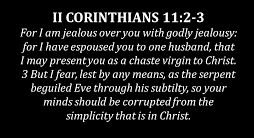
Husbands, love your wives, even as Christ also loved the church, and gave himself for it.”[1]

The Word of God reveals the mind of God. The Bible tells the believer how God feels concerning certain actions of His children. The Husband-wife and Bridegroom-bride analogies depicting Christ and His church (discussed in Section II, Chapter 3) have important implications. From the Husband-wife analogy, we know that Christ, likened to a husband, wants to be over His wife, the church, in all things and is jealous when His wife, even if remaining for some purposes under Christ, also puts herself under another head. Why else would God have given this analogy? He wants us to know how important this relationship is.

What godly husband would not be jealous if his wife came to him, arms around another man, and said,

“You know that I love you very much. I appreciate your love for me and all you do for me. I have entered into an agreement with Joe. I want you to know that I have decided that I am going to meet with Joe a couple of times a week for breakfast, or lunch, or dinner; and maybe occasionally meet with him just to talk. He cares for me, and he can give me additional advice and information which will be very helpful to me and which you are not able to give, although the advice you do give is most appreciated and helpful as far as it goes and as far as it is correct. He will also help me financially, since you cannot give me all that I need and want. I will still love and honor you. I know that my relationship with Joe will be alright with you.”

How would a husband feel about such an arrangement? Would it affect the marriage in any way? Would not it affect the way the husband and wife treat and respond to one another? Would the husband be jealous? Is not Christ jealous of His church? Is not the Lord grieved when His wife, the church, puts herself under the state through incorporation and tax exempt status or in any other manner?

We see pictures of the Husband-wife relationship in the Old Testament, between Jehovah God the Father and the nation Israel:

  • Isaiah 54 deals with Israel the restored wife of Jehovah & security and blessing of restored Israel. God the Father was the husband of Israel. “For thy maker is thine husband; the LORD of hosts is his name; and thy Redeemer the Holy one of Israel; The God of the whole earth shall he be called.”[2]
  • Jeremiah 2-6 discusses the harlotry of Israel toward her husband, Jehovah and His warnings and promises to her depending upon whether she repents. “Turn, O backsliding children saith the LORD; for I am married unto you…. Surely as a wife treacherously departeth from her husband, so have ye dealt treacherously with me, O house of Israel, saith the LORD.”[3]
  • Hosea depicts the dishonored wife (Israel), and the sinful people. “… Plead with your mother, plead: for she is not my wife, neither am I her husband. Let her  therefore put away her  whoredoms out of her  sight, and her adulteries from between her breasts; Lest I  strip her naked, and set her  as in the day that she was born, and make her as a wilderness, and set her like a dry land, and slay her with thirst. And  I will not have mercy on her children; for they be the children  of whoredoms. For their mother hath played the harlot: she that conceived them hath  done shamefully: for she said, I will go after other lovers, that  give me  my bread and  my water, my wool and my flax, mine oil and my drink….”[4]
  • Hosea 4.6-11 speaks of the willful ignorance of Israel: “My people are destroyed for lack of knowledge: because thou hast rejected knowledge, I will also reject thee, that thou shalt be no priest to me: seeing thou has forgotten the law of thy God, I will also forget my children….”[5]

Sadly, many of our leading Christians and pastors today, like the Israelites spoken of by the prophets, are either willfully ignorant or allow their reasoning to blind their eyes as to the importance of this issue to God.

What happens when a wife starts to have an affair, even a non-sexual affair? She may be able to hide her earthly affair from her husband, but she cannot hide the effects of the affair. (Of course, a church cannot hide her affair from the Lord.) The attitude, speech, and actions of the wife change. Does not her relationship with her husband change? Her husband now has to share his time with another who is partially over his wife. Does not the joy leave the marriage? Many times, if she does not repent, is not the marriage destroyed? Even if she repents, she and her husband will never forget. Hopefully, he will forgive.

In many ways it is the same with the local assembly that enters into an unholy union with the civil government. Perhaps the church who does this tries to cover up the fact that the church has dishonored and grieved her Husband, the Lord Jesus Christ—those who even think about what is going on say, “Well, if my new partner ever tells me that I cannot preach salvation, he will have gone too far.” The pastor says, “The Lord and his ways are not sufficient. The civil government takes better care of me than does the Lord. The civil government protects the church, allows the church to enter into contracts, gives the church limited liability, gives the church tax exemption (not realizing that God makes the church non-taxable which is not good enough), allows my people to deduct their contributions, etc.” This pastor either does not understand or ignores the Word of God in these matters. He does not understand that God instructs him that the Lord is to be over His church, that he is at the very least combining the holy with the unholy, or at worst committing spiritual adultery, and that disastrous consequences are ahead. Unlike an earthly husband, God can and will forgive and forget if a church repents and turns back to the Lord.

“Wherefore, my brethren, ye also are become dead to the law by the body of Christ; that ye should be married to another, even to him who is raised from the dead, that we should bring forth fruit unto God.”[6]


Endnotes

[1] Ep. 5.25.

[2] Is. 54.5.

[3] Je. 3.14, 20.

[4] Ho. 2.2-5.

[5] Ho. 4.

[6] Ro. 7.4.

(7) Conclusion: Render Unto God the Things that Are His


A Publication of Churches Under Christ Ministry


If you miss one part of the puzzle that is being put together in these studies, you will never see and understand the whole picture.


Previous Lesson:
(6) Pray for all rulers? (1 Ti. 2.1-6).

Next Lesson (Chapter):
Christ-church, Husband-Wife, Bridegroom-bride

Click here to go to Links to all lessons on Render Unto God the Things That Are His: A Study of Romans 13 and Other Verses Taken Out of Context to Support Union of Church and State.

Click here to go to the written lessons.

Click here to go to the 3 1/2 to 6 minute video lectures.


For accompanying study from Render Unto God the Things that Are His click here.


Jerald Finney
Copyright © February 21, 2018


Click the above to go to the article, “Is Separation of Church and State Found in the Constitution?

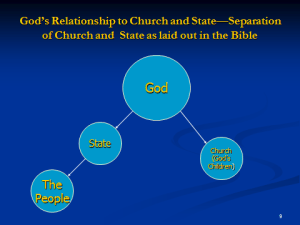
God ordained civil government as an earthly institution and limited its jurisdiction to certain earthly matters.[1] God ordained His churches to be spiritual institutions and limited their jurisdiction to spiritual matters.

He desires every state to remain both under Him and within her God-given jurisdiction, but every nation that has ever existed has failed to honor God sooner or later. America herself, which was to a large degree a nation under God for much of her history, has now rejected God and His principles.

Many Christians in America have been persuaded by false interpretations of Scripture that civil government is the highest power. Many believe that civil government is led by God to do all that they do, no matter how evil. In fact, civil governments, like all other governments, insofar as they choose to operate outside the principles of God, are under the god of this world.

The unity of world power prophesied in the Bible appears to be in the making. The world is being prepared to accept the last days. At the same time that America has almost totally removed God from all civil government affairs, many Christians, largely because of a false interpretation of the Word of God, almost deify America. One would fare better in many fundamental Bible believing churches should he lash out at Jesus Christ rather than speaking ill of America. Many believers, due to an erroneous interpretation of Scripture, think that God Himself bows down to civil government.

In America, Christian misunderstanding of biblical principles concerning separation of church and state has resulted in most Bible believing churches uniting with the state by becoming 501(c)(3) tax exempt legal entities such as corporations, charitable trusts, corporation soles, or unincorporated associations. Churches have willingly placed themselves, to a great extent, under the authority, rules, procedures, and principles of civil government. As a result, most churches are to some degree earthly, not spiritual.

Many misled believers hold huge rallies, preach in their churches, and work in other ways to try to have an influence in bringing America back under God. Most of those believers are in churches which have dishonored their love relationship with their Husband, the Lord Jesus Christ, by uniting with the state through the methods mentioned many times in these studies. They incorrectly apply to America, a Gentile nation, God’s admonition to the people of the nation Israel in 2 Chronicles 7.14: “If my people, which are called by my name, shall humble themselves, and pray, and seek my face, and turn from their wicked ways; then will I hear from heaven, and will forgive their sin, and will heal their land.” God’s people today are saved individuals who are members of local churches. The correct application of 2 Chronicles 7.14 today is that if Christians and churches “shall humble themselves, and pray, and seek [God’s] face, and turn from their wicked ways; then [He] will hear from heaven, … will forgive their sin, and will heal” believers, their families, and churches.” How can God’s people hope to have any affect on their nation if they overlook the wickedness of their churches?

Click above image to to to “Is Separation of Church and State Found in the Constitution?

More appropriate for churches would be:

  • “Be ye not unequally yoked together with unbelievers: for what fellowship hath righteousness with unrighteousness? and what communion hath light with darkness? And what concord hath Christ with Belial? or what part hath he that believeth with an infidel? And what agreement hath the temple of God with idols? for ye are the temple of the living God; as God hath said, I will dwell in them, and walk in them; and I will be their God, and they shall be my people. Wherefore come out from among them, and be ye separate, saith the Lord, and touch not the unclean thing; and I will receive you, And will be a Father unto you, and ye shall be my sons and daughters, saith the Lord Almighty.”[2]

Other appropriate verses include, e.g., John 15.19; Romans 6.16-23, 12.1-2; 1 Corinthians 6.15-17, 19-20; Galatians 1.4; Ephesians 5.14-17; Philippians 2.12-16; Colossians 2.6-8, 3.1-4, 15-17, 23-25; James 4.4-8; 1 Peter 1.13-16; 2 Peter 1.4-10; and 1 John 2.15-17.

Banished by the Puritans from Mass. colony in the 1630s. Started R.I. colony, a government with religious freedom.

Persecuted Christians have refused, even under penalty of torture, imprisonment, and/or death to submit churches and spiritual matters to the ungodly, usually the civil government, and/or the state-church. Christians were labeled as heretics and persecuted after some churches united with Rome under Constantine. Roger Williams, the man who established Rhode Island, the first civil government in history to honor the biblical principle of separation of church and state, wrote:

  • “Scripture and all history tell us, that those Caesars were … arrogant, without God, without Christ, &c.; … [and] worshippers, or maintainers, of the Roman gods or devils; … notorious for all sorts of wickedness; … cruel and bloody lions and tigers toward the Christians for many hundred years.
  • “Hence … it was impossible that he should appoint such ignorant, … idolatrous, … wicked, and … cruel persons to be his chief officers and deputy lieutenants under himself to keep the worship of God, to guard his church, his wife. No wise and loving father was ever known to put his child, no not his beasts, dogs, or swine, but unto fitting keepers.
  • “Men judge it matter of high complaint, that the records of parliament, the king’s children, the Tower of London, the great seal, should be committed to unworthy keepers! And can it be, without high blasphemy, conceived that the Lord Jesus should commit his sheep, his children, yea, his spouse, his thousand shields and bucklers in the tower of his church, and lastly, his great and glorious broad seals of baptism and his supper, to be preserved pure in their administrations—I say, that the Lord Jesus, who is wisdom and faithfulness itself, should deliver these to such keepers? …
  • “[W]hen the Lord appointed the government of Israel after the rejection of Saul, to establish a covenant of succession in the type unto Christ, let it be minded what pattern and precedent it pleased the Lord to set for the after kings of Israel and Judah, in David, the man after his own heart.
  • “But now the Lord Jesus being come himself, and having fulfilled the former types, and dissolved the national state of the church, and established a more spiritual way of worship all the world over, and appointed a spiritual government and governors, it is well known what the Roman Caesars were, under whom both Christ Jesus himself, and his servants after him, lived and suffered; so that if the Lord Jesus had appointed any such deputies—as we find not a title to that purpose, nor have a shadow of true reason so to think—he must, I say, in the very first institution, have pitched upon such persons for these custodies utriusque tabulae, keepers of both tables, as no man wise, or faithful or loving, would have chosen in any of the former instances, or cases of a more inferior nature….” [3]
  • “Christ never delivered His sheep or children to these wolves, his wife and spouse to such adulterers, his precious jewels to such great thieves and robbers of the world, as the Roman emperors were. Paul never appealed to Caesar as judge appointed by Christ Jesus to give definitive sentence in any spiritual or church controversy; but against the civil violence and murder which the Jews intended against him, Paul justly appealed. For otherwise, if in a spiritual cause he should have appealed, he should have overthrown his own apostleship and power given him by Christ Jesus in spiritual things, above the highest kings or emperors of the world beside….”[4]
  • “A civil magistrate may be a good subject, a good magistrate, in respect of civil or moral goodness, which thousands want; and where it is, it is commendable and beautiful, though godliness, which is infinitely more beautiful, be wanting, and which is only proper to the Christian state, the commonweal of Israel, the true church the holy nation, Ephes. ii.; 1 Pet. ii.”[5]

Roger Williams correctly maintained that the civil power has five proper political means to attain its end:

  • “First, the erecting and establishing what form of civil government may seem in wisdom most meet, according the general rules of the word, and state of the people…. The magistrate has power to publish and apply such civil laws in a state, as either are expressed in the word of God in Moses’s judicials—to wit, so far as they are of general and moral equity, and so binding all nations in all ages—to be deducted by way of general consequence and proportion from the word of God.
  • “For in a free state no magistrate hath power over the bodies, goods, lands, liberties of a free people, but by their free consents. And because free men are not free lords of their own estates, but are only stewards unto God, therefore they may not give their free consents to any magistrate to dispose of their bodies, goods, lands, liberties, at large as themselves please, but as God, the sovereign Lord of all, alone. And because the word is a perfect rule, as well of righteousness as of holiness, it will be therefore necessary that neither the people give consent, nor that the magistrate take power to dispose of the bodies, goods, lands, liberties of the people, but according to the laws and rules of the word of God….
  • “Secondly, the making, publishing, and establishing of wholesome civil laws, not only such as concern civil justice, but also the free passage of true religion: for outward civil peace ariseth and is maintained from them both, from the latter as well as from the former.
  • “Civil peace cannot stand entire where religion is corrupted, 2 Chron. xv. 3, 5, 6; Judges viii. And yet such laws, though conversant about religion may still be counted civil laws; as on the contrary, an oath doth still remain religious, though conversant about civil matters.
  • “Thirdly, election and appointment of civil officers to see execution of those laws.
  • “Fourthly, civil punishments and rewards of transgressors and observers of these laws.
  • “Fifthly, taking up arms against the enemies of civil peace.”[6]

On the other hand, Mr. Williams wisely observed that:

  • “the means whereby a church may and should attain her ends, are only ecclesiastical, which are chiefly five. “First, setting up that form of church government only of which Christ hath given them a pattern in his word.
  • “Secondly, acknowledging and admitting of no lawgiver in the church but Christ, and the publishing of his laws.
  • “Thirdly, electing and ordaining of such officers only as Christ hath appointed in his word.
  • “Fourthly, to receive into their fellowship them that are approved, and inflicting spiritual censures against them that offend.
  • “Fifthly, prayer and patience in suffering any evil from them that be without, who disturb their peace.
  • “So that magistrates … have no power of setting up the form of church government, electing church officers, punish-ing with church censures…. And on the other side … churches, have no power, though as members of the common-weal they may have power, of erecting or altering forms of civil government, electing of civil officers, inflicting civil punishments—no, not on persons excommunicated—as by deposing magistrates from their civil authority, or withdrawing the hearts of the people against them, to their laws, no more than to discharge wives, or children, or servants, from due obedience to their husbands, parents, or masters: or by taking up arms against their magistrates, though they persecute them for conscience; for though members of churches, who are public officers, also of the civil state, may suppress by force the violence of usurpers, as Jehoiada did Athaliah, yet this they do not as members of the church, but as officers of the civil state.”[7]

The failure of churches to honor God is far worse than the failure of civil government to honor God. One expects civil government, made up mostly of unregenerate people who cannot understand or honor God’s Word, to dishonor God; but it is vexing to see God’s people follow the principles of the god of this world. How our Savior must be grieved to see His Holy Word being perverted to condone union of His bride and wife with civil government.


Endnotes

[1] See God Betrayed for an explanation of biblical principles concerning government, church, separation of church and state as well as the American application of those principles. See, especially, Section II, Chapters 2 and 3 and Section III, Chapter 3 for insights into the differences between church and state, the spiritual nature of churches and the earthly nature of nations.

[2] 2 Co. 6.14-18.

[3] Roger Williams and Edward Bean Underhill, The Bloody Tenent of Persecution for Cause of Conscience Discussed and Mr. Cotton’s Letter Examined and Answered (London: Printed for the Society, by J. Haddon, Castle Street, Finsbury, 1848), pp. 204-205.

[4] Ibid., p. 209.

[5] Ibid., p. 212.

[6] Ibid., pp. 212-213. See pp. 219-223 concerning the power of the magistrate in making laws.

[7] Ibid., pp. 213-214.

(6) Pray for all rulers? 1 Timothy 2.1-6


A Publication of Churches Under Christ Ministry


If you miss one part of the puzzle that is being put together in these studies, you will never see and understand the whole picture.


Previous Lesson:
(5) Submit to every ordinance of man? (1 Pe. 2.13).

Next Lesson:
(7) Conclusion.

Click here to go to Links to all lessons on Render Unto God the Things That Are His: A Study of Romans 13 and Other Verses Taken Out of Context to Support Union of Church and State.

Click here to go to the written lessons.

Click here to go to the 3 1/2 to 6 minute video lectures.


Jerald Finney
Copyright © February 21, 2018


Three God-given purposes of Gentile civil government are stated or can be inferred from Scripture. Perhaps the most important purpose of civil government is to teach. Just as “[t]he law is a “schoolmaster” to bring us unto Christ,”[1] a nation, by its laws, teaches. The laws of a nation have a didactic effect—they teach. Lawrence McGarvie observed:

“American law tended to operate as if it had a life of its own, shaping society to conform to legal values by directing the actions of individuals. Recognizing law’s relative autonomy, [some] scholars … contend that law acted to infuse the new society—including the judges—with a system of rules and principles derived from liberal ideology. Many authors have noted the incremental pace of legal change. Law’s structural dependence on the Constitution, common-law precedent, and the procedural dictates of pleading recognizable legal arguments mitigated any societal tendencies toward rapid transformation. Instrumentalism, as a theory of understanding law, fails to fully appreciate its institutional inertia, the multiplicity of forces involved in its creation, and its hegemonic role as a relatively autonomous body of values, beliefs, and doctrine that provides the means of ‘discourse’ in a nation of law.”[2]

God also ordained civil government to control evil.[3]

The third God-ordained purpose of Gentile civil government is to operate under Him; and He gives each nation a choice of whether or not that nation will do so.

The Bible instructs Christians to pray for their leaders, but within the framework laid out within His Word:

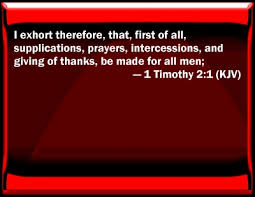
  • “1 I exhort therefore, that, first of all, supplications, prayers, intercessions, and giving of thanks, be made for all men; 2 For kings, and for all that are in authority; that we may lead a quiet and peaceable life in all godliness and honesty. 3 For this is good and acceptable in the sight of God our Saviour; 4 Who will have all men to be saved, and to come unto the knowledge of the truth. 5 For there is one God, and one mediator between God and men, the man Christ Jesus; 6 Who gave himself a ransom for all, to be testified in due time.”[4]

The above admonition of Paul to Timothy, which tells Christians to pray for all men including their leaders, also instructs Christians that such prayers should be that leaders be saved and come to a knowledge of the truth so that they will organize society under God—that is, according to God’s principles so that Christians can “lead a quiet and peaceable life in all godliness and honesty.”

An application of God’s principles in civil law would be laws regulating hunting. God told mankind in the Noahic covenant: “Every living thing that liveth shall be food for you.”[5] Thus, God gave man the authority to hunt animals, but not the “right to engage in mass and wanton slaughter of the animal kingdom.” Likewise, God placed man in the Garden of Eden to “dress it and keep it,”[6] not to destroy it. “So God requires man to exercise wise stewardship in his use of the animal kingdom and of natural resources in general.”[7]

God wants every Gentile nation to choose to operate under Him—that is, under His principles as given in His Word. If a nation will do that, Christians and non-Christians will live a quiet and peaceable life; and everyone will be free to choose God, no god, or false gods or gods since, as is shown in God Betrayed, separation of church and state is a biblical principle for Gentile nations.


Endnotes

[1] Ga. 3.24.

[2] Mark Douglas McGarvie, One Nation Under Law: America’s Early National Struggles to Separate Church and State (DeKalb, Illinois: Northern Illinois University Press, 2005), p. 12.

[3] Ro. 13.3-4; see also, 1 Pe. 2.13-14, 1 Ti. 1.9-11, Short Written Lessons I.A., and God Betrayed, Section I for a thorough discussion of civil government and its God-given purposes.

[4] 1 Ti. 2.1-6.

[5] Ge. 9.3a.

[6] Ge. 2.15.

[7] John Eidsmoe, God and Caesar: Biblical Faith and Political Action (Eugene, Oregon: Wipf and Stack Publishers, 1997), p. 8.

(5) Submit to every ordinance of man? 1 Peter 2.13


A Publication of Churches Under Christ Ministry


If you miss one part of the puzzle that is being put together in these studies, you will never see and understand the whole picture.


Previous Lesson:
(4) Doth not your master pay tribute? (Mt. 17.24-27).

Next Lesson:
(6) Pray for all rulers? (1 Ti. 2.1-6).

Click here to go to Links to all lessons on Render Unto God the Things That Are His: A Study of Romans 13 and Other Verses Taken Out of Context to Support Union of Church and State.

Click here to go to the written lessons.

Click here to go to the 3 1/2 to 6 minute video lectures.


Jerald Finney
Copyright © February 21, 2018


For accompanying study from Render Unto God the Things that Are His click here.


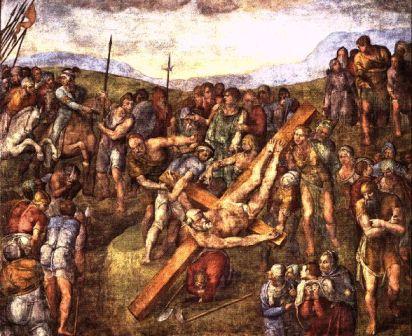
Crucifixion of Peter

“The forming of the constitution and appointment of the particular orders and offices of civil government is left to human discretion, and our submission thereto is required under the name of their being the ordinances of men for the Lord’s sake, 1 Pet. ii, 13, 14. Whereas in ecclesiastical affairs we are most solemnly warned not to be subject to ordinances after the doctrines and commandments of men, Col. ii, 20, 22.”[1]

1 Peter 2.13, quoted below along with 1 Peter 2.9-12 and 14-20 to put the verse into it’s immediate context, is often cited, again alone and out of context, to support almost total submission to civil government.

  • “9 But ye are a chosen generation, a royal priesthood, an holy nation, a peculiar people; that ye should shew forth the praises of him who hath called you out of darkness into his marvellous light: 10 Which in time past were not a people, but are now the people of God: which had not obtained mercy, but now have obtained mercy. 11 Dearly beloved, I beseech you as strangers and pilgrims, abstain from fleshly lusts, which war against the soul; 12 Having your conversation honest among the Gentiles: that, whereas they speak against you as evildoers, they may by your good works, which they shall behold, glorify God in the day of visitation. 13 Submit yourselves to every ordinance of man for the Lord’s sake: whether it be to the king, as supreme; 14 Or unto governors, as unto them that are sent by him for the punishment of evildoers, and for the praise of them that do well. 15 For so is the will of God, that with well doing ye may put to silence the ignorance of foolish men: 16 As free, and not using your liberty for a cloke of maliciousness, but as the servants of God. 17 Honour all men. Love the brotherhood. Fear God. Honour the king. 18 Servants, be subject to your masters with all fear; not only to the good and gentle, but also to the froward. 19 For this is thankworthy, if a man for conscience toward God endure grief, suffering wrongfully. 20 For what glory is it, if, when ye be buffeted for your faults, ye shall take it patiently? but if, when ye do well, and suffer for it, ye take it patiently, this is acceptable with God..”[2]

If the above verses had only stated, “Submit yourselves to every ordinance of man” and nothing more, the statement would have contradicted the entirety of Scripture. However, the verse in its immediate context can only be analyzed as was Romans 13, and such an analysis renders the verse consistent with the rest of God’s Word. Much of the analysis of Romans 13 in Chapter 4, supra, included an analysis of 1 Peter 2.13 and will not be repeated.

The Americanized interpretation of 1 Peter 2.13a, “Submit yourselves to every ordinance of man for the Lord’s sake,” leaves out or misinterprets, “for the Lord’s sake.” 1 Peter 2.13a, even when considered alone and out of context, does not say what the Americanized version asserts that it says. Usually, an uninformed Christian or a lost person, in asserting that one is to obey all civil government laws, will merely state, “Obey every ordinance of man” without even knowing where the verse can be found in Scripture. In the context of Scripture, that phrase indicates that Christians are to submit to every ordinance of man which man made “for the Lord’s sake”—that is, which God granted civil government jurisdiction to make. In other words, believers are not to obey any ordinance of man which is outside civil government’s God-given jurisdiction and which restricts Christians in the exercise of their spiritual responsibilities. As with Romans 13, the immediate context of 1 Peter 2.13 as well as the context within Scripture as a whole make clear that God grants civil government jurisdiction over only certain matters regarding man’s relationship to man, and not over any matters regarding man’s relationship to God. As has been stated, this does not mean that God does not desire civil governments to operate under Him—He gives civil governments (and all other governments) the free will as to whether or not they will operate under Him.

Bible scholars have commented on 1 Peter 2.13:

  • “Every ordinance of man; all human laws which are not in opposition to the law of God. For the Lord’s sake; for the purpose of honoring him.”[3]
  • “Verse 13. Submit yourselves to every ordinance of man. Gr., ‘to every creation of man,’ (anqrwpinh ktisei.) The meaning is, to every institution or appointment of man; to wit, of those who are in authority, or who are appointed to administer government. The laws, institutes, and appointments of such a government may be spoken of as the creation of man; that is, as what man makes. Of course, what is here said must be understood with the limitation everywhere implied, that what is ordained by those in authority is not contrary to the law of God. Cmt. on Ac. 4:19. On the general duty here enjoined of subjection to civil authority, Cmt. on Ro. 13:1. For the Lord’s sake. Because he has required it, and has intrusted this power to civil rulers. Cmt. on Ro 13:6. Comp. Cmt. on Eph 6:7. Whether it be to the king. It has been commonly supposed that there is reference here to the Roman emperor, who might be called king, because in him the supreme power resided. The common title of the Roman sovereign was, as used by the Greek writers, autokratwr, and among the Romans themselves, imperator, (emperor;) but the title king was also given to the sovereign. John 19:15, ‘We have no king but’ Ac. 17:7, ‘And these all do contrary to the decrees of Cesar, saying that there is another king, one Jesus.’ Peter undoubtedly had particular reference to the Roman emperors, but he uses a general term, which would be applicable to all in whom the supreme power resided, and the injunction here would require submission to such authority, by whatever name it might be called. The meaning is, that we are to be subject to that authority whether exercised by the sovereign in person, or by those who are appointed by him.
  • As supreme. Not supreme in the sense of being superior to God, or not being subject to him, but in the sense of being over all subordinate officers.”[4]
  • “Our apostle having exhorted them in general to take care that their conversation be honest among the Gentiles, he now decends to particular duties, which he advises them to be very exemplary in the performance of.
  • “And the first is, in their subjection to governors and government; submit yourselves, says he, to every civil ruler, both supreme and subordinate.
  • “Where observe, 1. How the apostle calls magistracy and civil government, though originally of divine institution, an ordinance of man. First, As to the end of it, it being appointed and ordained for the good and benefit of man. “Secondly, In reference to the kind of it, every nation having a liberty to choose what kind and form of government human prudence shall direct them to, as most agreeable to, and commodious for, the people.
  • “Observe, 2. The quality of that obedience and subjection which is to be given unto magistrates, it must be for the Lord’s sake, that is, in obedience to the command of God, and with an eye at the honour and glory of God. Christianity is no enemy to the civil right of princes, it requires subjection for conscience, 8:15.
  • “By me, says God, kings reign; some read it, for me kings reign; both are true: princes then hold not their crowns either from the pope or from the people, to be kicked off by the one, or to be plucked off by the other, at their pleasure: Submit yourselves, says our apostle, to every ordinance of man for the Lord’s sake.
  • “Observe, 3. The reasons assigned why magistrates should be thus subjected and submitted to; namely,

“1. Because they are sent by God for the punishment of evil-doers, and the praise of them that do well; the magistrate’s office is to punish evil-doers; the fear of the magistrate’s sword awes many men more than the fear of God’s hand. If some men were not gods among men, many men would be devils among men; there would be no living among those who fear not the invisible God in heaven, if there were not some visible gods on earth to fear.

“2. Because God will, by this their subjection given to magistrates and governors, silence, or, as the word signifies, put a muzzle upon the mouth of, foolish and unreasonable men, who rage against his people, as if they were enemies to order and government: by this kind of well-doing in particular, namely, by subjection and obedience to rulers in the Lord, and for the Lord’s sake, we put to silence the foolishness of wicked men.”[5]

  • “Submit yourselves to every ordinance of man – In every settled state, and under every form of political government, where the laws are not in opposition to the laws of God, it may be very soundly and rationally said: ‘Genuine Christians have nothing to do with the laws but to obey them.’ Society and civil security are in a most dangerous state when the people take it into their heads that they have a right to remodel and change the laws. See the whole of this subject fully handled in the notes on 13:1, etc., to which I beg every reader, who may wish to know the political sentiments of this work, to have recourse….”[6]

1 Peter 2.13 is therefore consistent with all of Scripture and consistent within itself. Men are to obey all laws of man which are within the God-given jurisdiction of civil government. God gave man responsibility to rule over man only with regard to certain matters involving man’s relationship with his fellow man. On the other hand, God gave civil government no jurisdiction over matters involving man’s relationship with God. As to spiritual matters, God wants man to have free will as long as their free will does not violate criminal laws which are within the God-given jurisdiction of civil government. Christians in America are protected in the exercise of their free will by the First Amendment to the United States Constitution.


Endnotes

[1] Isaac Backus, “An Appeal to the Public for Religious Liberty,” Boston 1773, an essay found in Isaac Backus on Church, State, and Calvinism, Pamphlets, 1754-1789, Edited by William G. McLoughlin (Cambridge, Massachusetts, 1968), p. 313.

[2] 1 Pe. 2.9-20.

[3] SWORDSEARCHER software, Family Bible Notes.

[4] SWORDSEARCHER software, Albert Barnes’….

[5] SWORDSEARCHER software, William Burkitt’s Expository Notes.

[6] SWORDSEARCHER software, Adam Clarke’s Commentary on the Bible.

(4) Doth not your master pay tribute? Matthew 17.24-27


A Publication of Churches Under Christ Ministry


If you miss one part of the puzzle that is being put together in these studies, you will never see and understand the whole picture.


Previous Lesson:
(3) Let every soul be subject to the higher powers? (Ro. 13.1 and Ro. 13 in general).

Next Lesson:
(5) Submit to every ordinance of man? (1 Pe. 2.13).

Click here to go to Links to all lessons on Render Unto God the Things That Are His: A Study of Romans 13 and Other Verses Taken Out of Context to Support Union of Church and State.

Click here to go to the written lessons.

Click here to go to the 3 1/2 to 6 minute video lectures.


Jerald Finney
Copyright © February 21, 2018


For accompanying study from Render Unto God the Things that Are His click here.


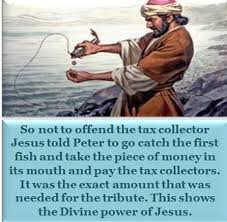
Christians who advocate unlimited obedience to the civil government sometimes refer to the miracle of the tribute money in Matthew 17.24-27, but that incident does not support their belief. Rather, that incident is consistent with all Scripture. Jesus, who is God the Son, is the Highest Power or Government and cannot and will not be required to pay any type tribute to any other power. God has given no lower power the jurisdiction to tax the Supreme Ruler.

Some authorities define the tax spoken of in Matthew 17.24-27 as the voluntary atonement money of half a shekel given as an offering to God that was used for maintenance of the Jerusalem temple.[1] However, others disagree as to whether the tribute spoken of was voluntary. One source defines the tribute spoken of in these verses as:

  • “a tax imposed by a king on his subjects (2 S. 20:24; 1 K. 4:6; 13:6). In Mt. 17:24-27 the word denotes the temple rate (the ‘didrachma,’ the ‘half-shekel,’ as rendered by the R.V.) which was required to be paid for the support of the temple by every Jew above twenty years of age (Ex. 30:12; 2 K. 12:4; 2 Chr. 24:6,9). It was not a civil but a religious tax.”[2]

Those who received the tribute money asked Peter, not Jesus, if Jesus paid the tribute. “And when they were come to Capernaum, they that received tribute money came to Peter, and said, Doth not your master pay tribute?” “He saith, Yes.”[3] Certainly Peter answered the question of those who received the tribute money before he reflected. Jesus anticipated and addressed Peter’s question before he asked Him. Our Lord began by asking Peter a question. “And when he was come into the house, Jesus prevented[4] him, saying, What thinkest thou, Simon? of whom do the kings of the earth take custom or tribute? of their own children, or of strangers?”[5] “Peter saith unto him, Of strangers. Jesus saith unto him, Then are the children free.”[6] “That is, Jesus, as the Son of God, might justly have claimed exemption from taxes assessed for the service of his Father.”[7] Here are some expert analyses concerning this statement of Jesus in Matthew 17.26:

  • “Then are the children free – As this money is levied for the support of that temple of which I am the Lord, then I am not obliged to pay the tax; and my disciples, like the priests that minister, should be exempted from the necessity of paying.”[8]
  • “Free; not expected to pay tribute. According to that rule, Christ, the Son of God, for the support of whose worship the money was paid would be free.”[9]
  • “Peter saith unto him, Of strangers—‘of those not their children.’ Jesus saith unto him, Then are the children free–By ‘the children’ our Lord cannot here mean Himself and the Twelve together, in some loose sense of their near relationship to God as their common Father. For besides that our Lord never once mixes Himself up with His disciples in speaking of their relation to God, but ever studiously keeps His relation and theirs apart (see, for example, on the last words of this chapter)–this would be to teach the right of believers to exemption from the dues required for sacred services, in the teeth of all that Paul teaches and that He Himself indicates throughout. He can refer here, then, only to Himself; using the word ‘children’ evidently in order to express the general principle observed by sovereigns, who do not draw taxes from their own children, and thus convey the truth respecting His own exemption the more strikingly:–namely, ‘If the sovereign’s own family be exempt, you know the inference in My case’; or to express it more nakedly than Jesus thought needful and fitting: ‘This is a tax for upholding My Father’s House. As His Son, then, that tax is not due by Me–I AM FREE.’”[10]
  • “Therefore the sons are free. The argument is this: If the sons of kings are free from the payment of tribute, I, the Son of God, am free from God’s tribute. The half-shekel was regarded as given to God (Josephus, The Antiquities of the Jews,9.1).”[11]
  • “Then are the sons free – The sense is, This is paid for the use of the house of God. But I am the Son of God. Therefore I am free from any obligation of paying this to my own Father.”[12]
  • “Every Jew throughout the world was required to pay an annual tribute or capitation-tax of half a shekel, about twenty-five cents, in acknowledgment of God’s sovereignty and for the maintenance of the temple service, 30:12-15. It was with reference to this that Christ says, in effect, Mt. 17:25-26, ‘If this tribute be levied in the name of The Father, then I, The Son, am free.’ In other New Testament passages, tribute means the tax levied by the Romans. On the question of paying tribute to foreigners and idolaters, Mt. 22:16-22, Christ gave a reply which neither party could stigmatize as rebellious, or as unpatriotic and irreligious. By themselves using Caesar’s currency, both parties acknowledged the fact of his supremacy. Christ warns them to render to all men their dues; and above all to regard the claims of him whose superscription is on every thing, 1 Co. 10:31; 1 Pe. 2:9, 13.”[13]

Jesus then states: “Notwithstanding, lest we should offend them, go thou to the sea, and cast an hook, and take up the fish that first cometh up; and when thou hast opened his mouth, thou shalt find a piece of money: that take, and give unto them for me and thee.”[14]

  • Notwithstanding, lest we should offend them. That is, lest they should think that we despise the temple and its service, and thus provoke needless opposition, though we are not under obligation to pay it, yet it is best to pay it to them.
  • Go thou to the sea. This was at Capernaum, on the shore of the sea of Tiberias.
  • Thou shalt find a piece of money. In the original, thou shalt find a stater, a Roman silver coin of the value of four drachms, or one shekel, and of course sufficient to pay the tribute for two, himself and Peter. In whatever way this is regarded, it is proof that Jesus was possessed of Divine attributes. If he knew that the first fish that came up would have such a coin in his mouth, it was proof of omniscience. If he created the coin for the occasion, and placed it there, then it was proof of Divine power. The former is the most probable supposition. It is by no means absurd that a fish should have swallowed a silver coin. Many of them bite eagerly at anything bright, and would not hesitate, therefore, at swallowing a piece of money. {t} ‘offend’ 14:21; 15:1-3; 2 Co. 6:3; {2} ‘stater’, ‘which was half an ounce of silver.”[15]
  • “Lest we – offend them – Be a stumbling-block to the priests, or rulers of the Jews, I will pay the tribute – go thou to the sea – cast a hook, and take the first fish – thou shalt find a piece of money, στατηρα , a stater. This piece of money was equal in value to four drachms, or two shekels, (five shillings of our money), and consequently was sufficient to pay the tribute for our Lord and Peter, which amounted to about half-a-crown each. If the stater was in the mouth or belly of the fish before, who can help admiring the wisdom of Christ, that discovered it there? If it was not before in the mouth of the fish, who can help admiring the power of Christ, that impelled the fish to go where the stater had been lost in the bottom of the sea, take it up, come towards the shore where Peter was fishing, and, with the stater in its mouth or stomach, catch hold of the hook that was to draw it out of the water? But suppose there was no stater there, which is as likely as otherwise, then Jesus created it for the purpose, and here his omnipotence was shown; for to make a thing exist that did not exist before is an act of unlimited power, however small the thing itself may be….”[16]

Fausset’s Bible Dictionary discusses Matthew 17.24-27:

  • “In 17:24-27, ‘the didrachma receivers said to Peter, Doth not your Master pay the didrachma? He saith, Yes?’ Their question implies it was the religious impost; no civil tax would have been asked in such a tone, as if its payment dare be questioned. The half-shekel or half-stater or didrachma (fifteen pence) was the universally recognized due required from every Israelite grown male in support of the sanctuary services, in the benefits of which he had a share: according to Ex. 30:11-15. (See MONEY; JESUS CHRIST; PETER.)
  • “Collected both before and after the Babylonian captivity (2 K. 12:4; 2 Chr. 24:9) from all Jews wherever sojourning (Josephus 18:9, section 1; Philo Monarch. 2:2, section 224). Hence Peter at once recognized the obligation. But Christ, while to avoid offense (wherein Paul imitated his Master in a different case, 1 Co. 9:4-19) He miraculously supplied the stater in the fish, for Himself and Peter, yet claimed freedom from the payment to the temple, seeing He was its Lord for whose service the tribute was collected. As Son of the heavenly King He was free from the legal exactions which bound all others, since the law finds its antitypical realization in Him the Son of God and ‘the end of the law’ ( 10:4).
  • “The temple offerings, for which the half shekels were collected, through Him become needless to His people also; hence they, by virtue of union with Him in justification and sanctification, are secondarily included in His pregnant saying, ‘then are the children (not merely the SON) free’ (John 8:35-36; 4:3-7; 5:1). As children with Him, they are sons of the King and share the kingdom (Ro. 8:15-17). The legal term ‘the didrachma’ Matthew uses as one so familiar to his readers as to need no explanation; he must therefore have written about the time, alleged, namely, some time before the destruction of Jerusalem and the temple, after which an explanatory comment would have been needed such as Josephus gives (Ant. 18:10, section 1). The undesigned omission in Matthew confirms the genuineness and truth of his Gospel.”[17]

Thus, Jesus indicated first that He could not be required to pay the tribute and then used the occasion to show that He was God. He could have paid the tribute by taking money from the money bag carried by Judas; but instead He demonstrated His deity by performing a supernatural miracle and giving the money to them in order not to offend them. Only God could have arranged such a miracle.


Endnotes

[1] See Abbott New Testament Commentary, Albert Barnes’ Notes on the Bible, and Jamieson-Fausett-Brown Commentary available on SWORDSEARCHER software. Go to http://www.swordsearcher.com for information on SWORDSEARCHER software.

[2] See Easton’s Bible Dictionary, definition of “Tribute,” on SWORDSEARCHER software.

[3] Mt. 17.24-25.

[4] “Prevented” in the above verses means that Jesus anticipated Peter’s question and answered it without Peter asking. See, e.g., SWORDSEARCHER software, Abbott… and Albert Barnes’….

[5] Ibid.

[6] Mt. 17.26.

[7] SWORDSEARCHER software, Abbott….

[8] SWORDSEARCHER software, Adam Clarke’s Commentary on the Bible.

[9] SWORDSEARCHER software, Family Bible Notes.

[10] SWORDSEARCHER software, Jamieson-Fausset-Brown Commentary.

[11] SWORDSEARCHER software, The Fourfold Gospel and Commentary on Acts.

[12] SWORDSEARCHER software, John Wesley’s Notes on the Bible.

[13] SWORDSEARCHER software, American Tract Society Dictionary, definition of “Tribute.”

[14] Mt. 17.27.

[15] SWORDSEARCHER software, Albert Barnes’….

[16] SWORDSEARCHER software, Adam Clarke’s Commentary….

[17] SWORDSEARCHER software, Fausset’s Bible Dictionary, definition of “Tribute.”

(2) Render unto Caesar…? Luke 20.25, Matthew 22.21, and Mark 12.17


A Publication of Churches Under Christ Ministry


If you miss one part of the puzzle that is being put together in these studies, you will never see and understand the whole picture.


Previous Lesson:
(1) Introduction: Render Unto God the Things that Are His.

Next Lesson:
(3) Let every soul be subject to the higher powers? (Ro. 13.1 and Ro. 13 in general).

Click here to go to Links to all lessons on Render Unto God the Things That Are His: A Study of Romans 13 and Other Verses Taken Out of Context to Support Union of Church and State.

Click here to go to links to all written lessons.

Click here to go to the 3 1/2 to 6 minute video lectures.


Jerald Finney
Copyright © February 21, 2018


For a more thorough study on this, click here.


Another scripture relied upon to support the false teaching of unlimited submission to the civil government is Luke 20.25 (also recorded in Matthew 22.21; and Mark 12.17). The Bible teaches that God is over is over all governments including civil government.[1] Nonetheless, many Americans, in spite of the teaching of the Bible, grab the following words of Jesus and apply the incorrect Americanized interpretation: “Render unto Caesar the things that are Caesar’s; and unto God the things that are God’s.”[2]

Obviously, Jesus is saying that both Caesar and God have jurisdictions. What are those jurisdictions? Are America and many pastors correct in teaching church members that they cannot depend totally upon God to supply their needs, that they need and can better serve the Lord with civil government contrived protection through incorporation and tax-exemption, and/or that America, not God, is to be their omniscient, omnipotent benefactor?[3]

To understand what Jesus was saying, one must understand both the immediate and the overall context of Scripture. Did Jesus say something contrary to scriptural teaching as a whole when He said these words? No, Jesus said those words with a perfect knowledge of Scripture, and in the context of Scripture. He said those words to practicing religious Jews who were well versed in Scripture and most likely understood the contextual meaning of what He said.

In the immediate context, the Pharisees were instigating an attack upon the Lord Jesus. “Then went the Pharisees, and took counsel how they might entangle him in his talk.”[4] The chief priests and the scribes “sought to lay hands on [Jesus]; and they feared the people.”[5]

  • “And they watched him, and sent forth spies, which should feign themselves just men, that they might take hold of his words, that so they might deliver him unto the power and authority of the governor. And they asked him, saying, Master, we know that thou sayest and teachest rightly, neither acceptest thou the person of any, but teachest the way of God truly: Is it lawful for us to give tribute unto Caesar, or no?”[6]

They wanted the civil government to do the dirty work which they would not do themselves because they feared the people.

  • “If Jesus said, ‘No, you are not to pay tribute to Caesar,’ He could be accused of being a traitor to Rome which ruled over Israel at that time. If He had said, ‘Yes, you are to pay tribute to Caesar,’ He could not be the true Messiah. They thought they had our Lord on the horns of a dilemma.”[7]

The Lord, being God, knew their plan: “But Jesus perceived their wickedness, and said, Why tempt ye me, ye hypocrites?”[8] Jesus said, “Shew me a penny. Whose image and superscription hath it?”[9]  When “[t]hey answered and said, Caesar’s,”[10] He gave His famous reply which left them amazed and unable to fulfill their plan.

In the overall context of Scripture, what was the Lord saying? The Pharisees knew the Old Testament. When Jesus asked whose image and superscription were on the coin, they most likely knew that He was saying that mankind, which included Caesar, was created by God in the image of God, and that Caesar as a ruler was given his authority with limitations by God. They knew the Scripture that said, “So God created man in his own image, in the image of God created he him; male and female created he them.”[11] They knew the Scriptures that taught that God was the Supreme Ruler, that His was the Supreme Government as well as those Scriptures that taught that God ordained civil government and all other governments. They also knew that Jesus claimed to be God. For example, when Jesus asked the Jews for which of His good works they took up stones to stone Him, “The Jews answered him, saying, For a good work we stone thee not; but for blasphemy; and because that thou, being a man, makest thyself God.”[12]  In one short statement, the Lord, as only He could, summarized, in the context of Scripture, God’s jurisdiction (rulership over all men and governments including civil governments) and civil government’s God-given jurisdiction (as laid out in the Bible and discussed in Section I of God Betrayed).

The result of this interchange was the opposite of what the Pharisees had hoped for. Since it was not yet His time to be crucified, God defeated their purpose by the power of His Word. “And they could not take hold of his words before the people: and they marveled at his answer, and held their peace[,]”[13] “and left him, and went their way.”[14]

Men today, as did these Pharisees, prefer to trust in their own doings instead of the perfect righteousness of Christ. Isaac Backus, the great eighteenth century Baptist leader, pointed out the darling of such men:


Endnotes

[1] See Section I.A. The Bible Doctrine of Government of these studies; for a more in-depth study, see God Betrayed, especially the first Section on the Bible doctrine of Government.

[2] Lu. 20.25; see also Mt. 22.21; and Mk. 12.17.

[3] Section VI of God Betrayed and Separation of Church and State deal with the incorporation and tax exemption issues.

[4] Mt. 22.15; see also, Mk. 12.13; Lu. 20.19.

[5] Lu. 20.19.

[6] Lu. 20.20-22.

[7] J. Vernon McGee, Matthew, Volume II (Pasadena, California: Thru the Bible Books, revised printing, 1980), p. 101.

[8] Mt. 22.18; see also, Mk. 12.15; Lu. 20.23.

[9] Lu. 20.24; see also, Mt. 21.19-20; Mk. 12.15-16.

[10] Lu. 20.24; see also, Mt. 22.21; Mk. 12.16.

[11] Ge. 1.27.

[12] Jn. 10.32-33.

[13] Lu. 20.26; see also, Mk. 12.17.

[14] Mt. 22.22.

[15] Isaac Backus, A History of New England With Particular Reference to the Denomination of Christians called Baptists, Volume 2 (Eugene, Oregon: Wipf & Stock Publishers, Previously published by Backus Historical Society, 1871), p. 563.

(3) Romans 13: Let Every Soul Be Subject to the Higher Powers


A Publication of Churches Under Christ Ministry


If you miss one part of the puzzle that is being put together in these studies, you will never see and understand the whole picture.


Previous Lesson:
(2) Render unto Caesar…? (Lk. 20.25, Mt. 22.21, and Mk. 12.17).

Next Lesson:
(4) Doth not your master pay tribute? (Mt. 17.24-27).

Click here to go to Links to all lessons on Render Unto God the Things That Are His: A Study of Romans 13 and Other Verses Taken Out of Context to Support Union of Church and State.

Click here to go to the written lessons.

Click here to go to the 3 1/2 to 6 minute video lectures.


Jerald Finney
Copyright © February 20, 2018


Important note. This short lesson is a very condensed version of Chapter 4, pp. 17-36, of Render Unto God the Things That Are His: A Systematic Study of Romans 13 and Related Verses; for the online version click here For full understanding, the student should read that chapter. Just click the link above to go to the online PDF of the book.


Romans 13.1 first makes clear that every soul is to be subject to the higher powers. Thus, even human leaders, since they also have souls, are subject to a higher power. According to the Bible, God is the power higher than all other governments. As shown in I.A. of these studies, God ordains all governments, is above all governments, and lays out the jurisdiction of all governments. Man is to be subject to civil government concerning those earthly matters over which God has given civil government jurisdiction. According to Romans 13.3-4, civil government was ordained by God to be a minister of God to execute judgment over evil doers and to reward those who do good.

Romans 13, consistent with Old and New Testament principles, proclaims the God-ordained purpose of civil government, and that God—the highest power—ordained and is over civil government. According to Romans 13.7, Christians are to render to civil government tribute, custom, fear, and honor—where due under the God-given jurisdiction of civil government.

Romans 13.3-4 and 1 Peter 2.13-14 lay out, consistent with the rest of Scripture, the God-given jurisdiction of civil government over man. In those verses, God grants civil governments jurisdiction over certain earthly, not spiritual, matters, and instructs man to do good and to refrain from doing evil. Many Christians point to those Scriptures and incorrectly declare: “That settles it. The Bible orders blind obedience to civil government in all matters, period;” or they proclaim that those verses require Christians to obey civil government in all things with the possible exception of the preaching of salvation.

Even with the establishment of the church, as recorded in the New Testament, God found it necessary to continue the institution of civil government. The original God-given purpose and jurisdiction of Gentile civil government was to continue. In Romans 13.3 He proclaims that “rulers are not a terror to good works, but to the evil” since if citizens “do that which is good,” rulers will praise them. The word from which “evil” in Romans 13.4 is translated means “generally opposed to civil goodness or virtue, in a commonwealth, and not to spiritual good, or religion, in the church.”Fn[1] Romans 13.4 proclaims that this is because a ruler is a “minister of God to thee for good,” just as he is “a revenger to execute wrath upon him that doeth evil.”

Many civil governments go beyond their God-given jurisdiction. See Fn[2] for examples. How does God feel about Christians who obey God and thereby disobey civil governments which go beyond their jurisdiction? See Fn[3].

The Bible, history, and reality show that some rulers, according to Romans 13, exceed their God-ordained power. America does not honor God and His principles.Fn[4]

Although the early colonial dissenters such as the Baptists were persecuted by the established churches in the colonies, they were nonetheless free. On the other hand, today’s Americans, including Christians in churches which place themselves under civil government, are in bondage. The eighteenth century words of Isaac Backus apply to Americans today. See Fn[5] for quote from Backus.

The biblical truth is that God gives Gentile civil government control only over certain earthly sins involving man’s relationship to man as is attested to by Romans 13 and I Peter 2.13 in their immediate context and in the context of Scripture as a whole. As at His original establishment of civil government at the flood, God never mentions one act which involves man’s relationship to God in any Scripture involving the authority of civil government. Even in Israel after God allowed the people to have a king, as they requested, the civil ruler was not to intrude into the affairs of the priest (See, e.g., I S. 13.8-14). In Romans 12.9-20 and 13.8-14, the verses immediately surrounding Romans 13.1-7, the Word of God, speaking to Christians, elaborates upon the Christian responsibility to his neighbor and to civil government. Nothing is said about the Christian’s responsibility to God (Notwithstanding, treating one’s neighbor as God desires is a responsibility to God.).  See, e.g. Romans 12.9-20, quoted in F[6]. See also, Romans 13.8-14.

Notice in those verses that, in regard to obeying the ordinances of men, Paul only dealt with the law of love toward one’s neighbor; that is, with man’s relationship to man, and not man’s relationship to God. God did not give Gentile civil government responsibility for exercising authority over spiritual matters, over the first four commandments dealing with man’s relationship to God.

Civil government has no authority over matters dealing with man’s relationship to God since such matters are spiritual. Spiritual matters, according to God, the Supreme Ruler of the highest government, include both our duties, as individual believers and as members of a church, to God and to man. Christians are to love both God and their neighbor.

Religious and secular rulers, being led by the god of this world to satisfy their own lusts, have always been concerned with their authority. Not knowing God, they are their own gods. We see that over and over again in the Old and New Testaments. Jesus faced that problem (See, e.g., Jn. 10.31-38).

The apostles always obeyed God in regard to spiritual matters, even when, in so doing, they violated ordinances of man. Disregarding threats, imprisonments, and beatings, the apostles continued both to do for their fellow man and to preach, both in the name of Jesus, repeatedly violating Romans 13, and 1 Peter 2.13 as interpreted by most contemporary “ Christians.”

The rulers would have had no complaint had Peter and John and the other apostles done what they did under the authority of the rulers. Obviously, Peter and John had not yet been taught that Romans 13 and 1 Peter 2.13 required them to obey the earthly authorities over them in all matters, including spiritual matters. Of course, the apostles, under the authority of the rulers, would not have been able to heal and do other miracles, nor to preach in the power of the Holy Ghost. They still understood that the Highest Power, God himself, told them to do what they were doing and gave them the power to do it, that no earthly power was given the authority to direct them concerning spiritual matters, and that even had an earthly power given the authority to do those matters under earthly authority, they could not have done the miracles or preached the true gospel with power. Many “Christians” today believe that they and the church can simultaneously achieve God’s spiritual goals while operating under the authority of the god of this world. “Having a form of godliness, but denying the power thereof: from such turn away” (2 Ti. 3.5).

Paul knew that Satan would continue to come against the church through earthly powers, through civil government.  He also knew that God wanted His children to fight this warfare using only spiritual, not earthly, means. His goal was the glory of God, not the happiness of man.


Endnotes

[1] Roger Williams and Edward Bean Underhill, The Bloody Tenent of Persecution for Cause of Conscience Discussed and Mr. Cotton’s Letter Examined and Answered (London: Printed for the Society, by J. Haddon, Castle Street, Finsbury, 1848), p. 133.

[2] Was Rome a minister of God for good when she executed untold numbers of Christians before the marriage of church and state in the fourth century? What about those governments during the Middle Ages that worked in conjunction with the Roman Catholic “church” to persecute and kill millions of Christians labeled as heretics for refusing to bow down to a false theology? Was Hitler a minister of God for good when he forbade, on penalty of imprisonment and/or death, authentic biblical teaching which condemned his actions against the Jews and true Christians? How about Lenin and Stalin who were not only responsible for the murder of tens of millions of Christians, but who also required the teaching of atheism and established atheism as the official faith of the Soviet Union? How about the governments of Red China, Korea, Iran, Saudi Arabia, and many others at the present time? Are such civil governments legitimately operating under God and His principles? Is the Christian who lives under such civil governments expected by God to follow all their rules?

[3] Were those Christians who conspired against Hitler wrong? Were Corrie Ten Boom and others wrong to save Jews from extermination? Were Moses’ parents wrong to save their son against the order of Pharaoh (Ex. 2.3)? Was the writer of the New Testament book of Hebrews wrong to praise them for hiding Moses, not being “afraid of the king’s commandment” (He. 11.23)? How about the Egyptian midwives when they “feared God, and did not as the king of Egypt commanded them but saved the male children alive” (Ex. 1.17)? Was God wrong in dealing well with those midwives for saving the male babies and lying to Pharaoh” (Ex. 1.20)?  Was Moses wrong when he “refused to be called the son of Pharaoh’s daughter; [c]hoosing rather to suffer affliction with the people of God, than to enjoy the pleasures of sin for a season; [e]steeming the reproach of Christ greater riches than the treasures in Egypt: for he had respect unto the recompence of the reward” (He. 11.24-26).

Was God wrong when He told Moses to defy Pharaoh (Ex. 3.2-12; 3.15-22; 4.21-23)? Was Moses wrong to exercise his faith, obey God, and defy Pharaoh”(Ex. 5.12; He. 11.27)? Was Rahab the harlot wrong to lie to the authorities about the whereabouts of the Jewish spies in her land in order to save their lives (Jos. 2)? Was Joshua wrong for allowing her to live as a reward for defying her governing authorities (Jos. 6.22-25)? Was God wrong to include Rahab in the hall of faith, along with such people as Enoch, Noah, Abraham and Sara, Isaac and Jacob, Joseph, Moses, Joshua, and other heroes of the faith (See He. 11 and 11.31)? What about Ehud who killed King Eglon (Jud. 3.15-26); Joshua who attacked the governing authorities by God’s command (See the book of Jos.); Jael, who nailed her governing authority to the ground with a tent stake (Jud. 4.17-22); Samson who revolted against the governing authorities (Jud. 13.24-16.30); David who ran from Saul (See I S. 18.8 through chapter 31); Mordecai who refused to bow down and worship Haman (Est. 3.5); Elijah who ignored the order of a wicked King even when fifty soldiers showed up, then stood against King Ahab, Jezebel, and their false prophets (1 K. 18.17-41; 2 K. 1.9-16); Daniel and Shadrach, Meshach, and Abed-nego (See the book of Daniel); the apostles including Peter who said, “We ought to obey God rather than men” (Ac. 5.29); Paul who disobeyed many of his ruling authorities; all those down through the ages since Jesus’ resurrection and return to glory who have suffered persecution and death for the cause of Christ, including all the apostles, eleven of whom were ultimately martyred for the faith; Christians down through the last 2000 years from Christ to this very day who were imprisoned, tortured, and killed because they would not submit to the governing authorities in spiritual matters, many times religious organizations such as the Lutheran or Catholic churches, or renounce Christ, or quit rebaptizing, or quit street preaching, or succumb to false doctrines and/or worship the governing authorities; and those contemporary Christians in the underground churches of China, Cuba, Korea, Indonesia, Iran, Saudi Arabia, Turkmenistan, Pakistan, Bangladesh, Vietnam,, Laos, Malay, the Sudan, Morocco, Libya, Somalia, Algeria, Malaysia, Afghanistan, Colombia, the former Soviet Union, and many other nations? (An excellent source to keep abreast of the ongoing persecutions of Christians throughout the world is “The Voice of the Martyrs,” 1-800-747-0085; e-mail: thevoice@vom-usa.org; web site: www.persection.com; children’s web site: www.kidsofcourage.com; address: The Voice of the Martyrs, P.O. Box 443, Bartlesville, OK 74005-0443.)

Did the blessed Savior and God, the Lord Jesus Christ, sin when He chose to continue to do His miracles, to preach to the people, to condemn the religious leaders of His day and their errors, to proclaim that He was the Messiah even though He was upsetting the religious rulers of His day who ultimately used the governing authorities to crucify Him?

[4] America is now a pluralistic nation. All religions are regarded equally, except for Christianity which is now attacked from all quarters. America allows abortion, the murder of unborn babies, to go unpunished. (Jb. 31.15: “Did not he that made me in the womb make him? and did not one fashion us in the womb?” Is. 44.24: “Thus saith the LORD, thy redeemer, and he that formed thee from the womb, I am the LORD that maketh all things; …” Is. 49.1: “… the LORD hath called me from the womb; from the bowels of my mother hath he made mention of my name.”  Je. 1.5: “Before I formed thee in the belly I knew thee; and before thou camest forth out of the womb I sanctified thee, and I ordained thee a prophet unto the nations.”).  Abortion is the ultimate attack on God and the legitimacy of God’s supreme rule (Ge. 1.27: “So God created man in his own image, in the image of God created he him; male and female created he them.”). Abortion is an attack on the first institution ordained by God in that it tells men, and especially women, that they can discard God’s rules concerning sex before marriage and engage in sex outside the marriage vows with impunity (See, e.g., Ro. 1.29; 1 Co. 5.1; 6.9-10 (“… Be not deceived: neither fornicators … shall inherit the kingdom of God.”), 13; 18 (“Flee fornication. Every sin that a man doeth is without the body; but he that committeth fornication sinneth against his own body.”); 7.2; 10.8; 2 Co. 12.21; Ga. 5.19; Ep. 5.3; Col. 3.5-6; 1 Th. 4.3. In Mt. 19.4-6 Jesus confirms the Genesis narrative of creation ([Jesus said to the Pharisees who were attempting him,] “Have ye not read, that he which made them at the beginning made them male and female, And said, For this cause shall a man leave father and mother, and shall cleave to his wife: and they twain shall be one flesh. What therefore God hath joined together, let not man put asunder.”). See Ge. 1.27 and 2.23-24 (God created male and female in his own image).  See also, for example, Mt. 5.31-32, 32; Mk. 10.1-12; Lu. 16.18; and I Co. 7.10-15 which deal with dishonoring the marriage relationship.). Abortion attacks individuals by tempting them to ignore God’s rules regarding fornication and adultery. Women who have their babies killed risk great emotional, and spiritual damage. Likewise, men who allow their babies to be murdered suffer, at the very least, spiritual and emotional harm. Abortion is the ultimate attack on the God-ordained institution of marriage, the basic building block of society.

America has also redefined marriage and the family contrary to biblical definitions and principles. In fact, what authority has the state to define marriage other than it is defined by God? Who—the state or God—ordained marriage? America has redefined marriage as a contract between two equal people. God said marriage is a covenant between a man, a woman, and God (See, e.g., Mt. 5.31-2; 19.3-9; Mk. 10.1-12; Lu. 16.18). America has redefined the family to be a group of people living together all of whom should have an equal voice, even children. Are fathers and mothers wrong to structure and operate their families according to biblical principles, denying their children an equal voice? Perhaps they are if the state married them since they willingly submitted their marriage and family to the authority of the state. If married by the authority of the state, perhaps they are also wrong to operate their family according to biblical principles because they willingly submitted their family to state authority. Are couples wrong to choose to marry under the authority of a God-ordained minister who refuses to pronounce them man and wife by the authority given him by a God-hating government which operates under Satan’s principles (See God Betrayed, Section VI for more insights into this civil government attack on the marriage of man and woman and the family as well as the marriage of Christ and His church.)?

America has enticed churches, as will be developed, to operate by the authority given them by the state. Are pastors wrong to continue to operate solely under the Headship of God? By the way, a church can still preach, teach, and operate solely by the authority of the Lord Jesus Christ in this nation. Yet, most pastors choose the government cheese and ease over the principles and promises in the Word of God. Why? The Christian who walks in the flesh does not cherish at least one of the promises of God for the Christian—persecution. “Yea, and all that will live godly in Christ Jesus shall suffer persecution” (2 Ti. 3.12). Most American “Christians” reject suffering instead of accepting it as instructed (“For unto you it is given in the behalf of Christ, not only to believe on him, but also to suffer for his sake” (Ph. 1.29); as mild as it would be compared to the suffering of Paul, Peter, and the other apostles and Christians down through the last two thousand years. Those “Christians” do not know what they are missing: “That I may know him, and the power of his resurrection, and the fellowship of his sufferings, being made conformable unto his death” (Ph. 3.10)[.]”  And how almost non-existent is the persecution to be suffered by the church and the Christian who refuses to put himself or herself under the American civil government in spiritual matters. What would the American Christian today—who bows down to civil government despite the very mild inconveniences that would result from doing things God’s way—do should he face the persecutions endured by the early Christians; persecutions by, for example, the Apostle Paul and others who lived in a society in which Paul, before his conversion, had “imprisoned and beat in every synagogue them that believed on [the Lord] (Ac. 22.19),” and persecution by others after Paul’s conversion. Paul noted, shortly before his martyrdom, that he had endured many persecutions (2 Co. 11.23-27: [speaking of the persecutions he endured for serving the Supreme Ruler] “… in stripes above measure, in prisons more frequent, in deaths oft.  Of the Jews five times received I forty stripes save one.  Thrice was I beaten with rods, once was I stoned, thrice I suffered shipwreck, a night and a day I have been in the deep; In journeying often, in perils of waters, in perils of robbers, in perils by mine own countrymen, in perils by the heathen, in perils in the city, in perils in the wilderness, in perils in the sea, in perils among false brethren; in weariness and painfulness, in watchings often, in hunger and thirst, in fastings often, in cold and nakedness….”), but that “out of them all the Lord delivered [him]” (2 Ti. 3.12). Let it be emphasized that despite the fact that America is no longer a nation under God, Christians are required by Scripture to obey, for the Lord’s sake, every legitimate biblically consistent American law dealing with wrongdoing against one’s fellow man.

  • [5] “Now how often have we been told that he is not a freeman but a slave whose person and goods are not at his own but another’s disposal? And to have foreigners come and riot at our expense and in the fruit of our labors, has often represented as to be worse than death…. But how is our world filled with such madness concerning spiritual tyrants! How far have pride and infidelity, covetousness and luxury, yea, deceit and cruelty, those foreigners which came from Hell, carried their influence, and spread their baneful mischiefs in our world! Yet who is willing to own that he has been deceived and enslaved by them? … All acknowledge that these enemies are among us, and many complain aloud of the mischiefs that they do, yet even those who lift up their heads so high as to laugh at the atonement of Jesus and the powerful influences of the Spirit and slight public and private devotion are at the same time very unwilling to own that they harbor pride, infidelity, or any other of those dreadful tyrants. And nothing but the divine law … brought home with convincing light and power, can make them truly sensible of the soul-slavery that they are in. And ’tis only the power of the Gospel that can set them free from sin so as to become the servants of righteousness, can deliver them from these enemies so as to serve God in holiness all their days.
  • “… Therefore the divine argument to prove that those who promise liberty while they despise government are servants of corruption is this: For of whom a MAN is overcome, of the same is he brought in bondage, 2 Pet. ii. 18, 19. He is so far from being free to act the man that he is a bond-slave to the worst of tyrants. And not a little of this tyranny is carried on by such an abuse of language as to call it liberty for men to yield themselves up to be so foolish, disobedient and deceived as to serve divers lusts and pleasures, Tit. iii. 3” (Isaac Backus, “An Appeal to the Public for Religious Liberty,” Boston 1773, an essay found in Isaac Backus on Church, State, and Calvinism, Pamphlets, 1754-1789, Edited by William G. McLoughlin (Cambridge, Massachusetts, 1968), pp. 311-312.)

[6]Let love be without dissimulation. Abhor that which is evil; cleave to that which is good. Be kindly affectioned one to another with brotherly love; in honour preferring one another;  Not slothful in business; fervent in spirit; serving the Lord; Rejoicing in hope; patient in tribulation; continuing instant in prayer; Distributing to the necessity of saints; given to hospitality. Bless them which persecute you: bless, and curse not. Rejoice with them that do rejoice, and weep with them that weep. Be of the same mind one toward another. Mind not high things, but condescend to men of low estate. Be not wise in your own conceits.  Recompense to no man evil for evil. Provide things honest in the sight of all men. If it be possible, as much as lieth in you, live peaceably with all men. Dearly beloved, avenge not yourselves, but rather give place unto wrath: for it is written, Vengeance is mine; I will repay, saith the Lord. Therefore if thine enemy hunger, feed him; if he thirst, give him drink: for in so doing thou shalt heap coals of fire on his head.”

(1) Introduction: Render Unto God the Things that Are His


A Publication of Churches Under Christ Ministry


If you miss one part of the puzzle that is being put together in these studies, you will never see and understand the whole picture.


Previous Series of Lessons:
4. Distinct Differences between Church and State Which Render Them Mutually Exclusive

Next Lesson:
(2) Render unto Caesar…? (Lk. 20.25, Mt. 22.21, and Mk. 12.17) .

Click here to go to Links to all lessons on Render Unto God the Things That Are His: A Study of Romans 13 and Other Verses Taken Out of Context to Support Union of Church and State.

Click here to go to links to all written lessons.

Click here to go to the 3 1/2 to 6 minute video lectures.


Jerald Finney
Copyright © February 20, 2018


Some Bible verses are taken out of context to support the argument that individual believers and churches are to totally submit to the civil government in all things except (perhaps) the preaching of salvation. Those verses include:

  • Render unto Caesar…? (Lk. 20.25, Mt. 22.21, and Mk. 12.17)
  • Let every soul be subject to the higher powers? (Ro. 13.1 and Ro. 13 in general).
  • Doth not your master pay tribute? (Mt. 17.24-27).
  • Submit to every ordinance of man? (1 Pe. 2.13).
  • Pray for all rulers? (1 Ti. 2.1-6).

Certainly, those who believe in this total submission have not studied the Bible doctrines of church, government (to include civil government and state), and separation of church and state as is being done in these short lessons and accompanying more advanced lessons.

To believe that the above and other verses teach blind obedience by individuals and by churches to civil government would make those verses inconsistent with the rest of biblical teaching concerning God’s total authority over the individual believer’s spiritual life, God’s total authority over the church, and God’s total authority over the state. For example, the Bible teaches that the authors of Romans 13 (Paul) and 1 Peter 2.13 (Peter) consistently violated these verses as wrongly interpreted by the lost and most “Christians” in America. Second, these verses would be inconsistent within their immediate context and the overall context of Scripture. The Word of God is never inconsistent.

The United States of America became the second civil government in history, after the colony of Rhode Island, to reject unity of religion and state and implemented the biblical principle of soul liberty which is also called religious liberty or separation of church and state.[1] America came closer than any nation to following God’s principles for church and state, and she included many of the principles of the Word of God in her founding documents.

America is no longer a nation under God and is experiencing the consequences of failing to operate under God and abide by His principles.[2] This inevitable turnabout was caused, to a large degree, by the union of church and state. Although the First Amendment guaranteed freedom from civil government, many churches chose to become state churches through incorporation shortly after the ratification of the Constitution.[3] The First Amendment originally applied only to the federal government.[4] States were free to and did offer to incorporate churches; and many churches, against the warnings of leaders like Isaac Backus, ran to incorporate.[5]

Because of the First Amendment which recognizes and implements the biblical principle of separation of church and state, churches can still choose to be spiritual entities and no church is required by any civil law to become a legal entity.[6] Nonetheless, many “Christians” incorrectly assume or believe that church and state should be united in America; that civil law requires such a union; and/or that churches should become legal entities because Romans 13 and other Bible verses are taken out of context and perverted to mean what they do not mean.

This book analyzes Luke 20.25 (also recorded in Matthew 22.21; and Mark 12.17), Romans 13, 1 Peter 2.13, Matthew 17.24-27 and I Timothy 2.1-6. What those scriptures teach concerning submission by individual Christians and churches to civil government is the subject of this section of lessons.[7]

Note. The historical section of lessons will give a religious history of the First Amendment which makes clear, as historical and legal scholars have written, that the Amendment meant to separate church and state. For the student who wishes to go ahead and look at more advanced studies before the historical section is finished, see:


Endnotes

[1] See God Betrayed, Section IV, for a history of separation of church and state and the First Amendment religion clause in America. These short lessons will also teach on that history in due time. Check the online “Written Lesson” section occasionally to see if the lessons have been added.

[2] See Ibid., Section V for an analysis of how the United States Supreme Court has systematically removed/ God from practically all civil government affairs.

[3] See God Betrayed, Section VI, Chapter 3.

[4] The United States Supreme Court extended First Amendment protection to all levels of civil government in the twentieth century. See Ibid., Section V.

[5] See Ibid., Section VI, Chapter 3 and for more details incorporation of churches in the colonies and in the states of the new nation.

[6] Jerald Finney, Separation of Church and State/God’s Churches: Spiritual or Legal Entities (Austin TX: Kerygma Publishing Co.; also published by Xulon Press, 2009) explains the distinctions between legal and spiritual entities, and the various ways churches can become legal entities. See also, God Betrayed.

[7] To totally understand the issue of God’s teachings concerning submission to civil government, one must understand other sub-issues or principles. God Betrayed offers a more comprehensive look at all the issues involved.