IV. Analysis of False Reasons of Christians and Lawyers for Church Corporate, 501(c)(3) and 508(c)(1)(A) tax exempt Status or Legal Status of Any Kind.
V. Answers to Questions and Comments from Pastors and Other Believers Concerning Church Organization
VI. Contact Information for this Simply Church Ministry
I. Introduction
Most believers in America have never considered whether or not God’s Word communicates teachings, doctrines, and principles concerning Christ’s churhes which are at odds with the organization and conduct of the church they attend. They never ask, “Has my church been corrupted from the simplicity that is in Christ” (See, 2 Corinthians 11:3).
Most have not considered whether violation of His principles is important to God or whether there are long term negative consequences for deviating from God’s church rules. Most pastors were never taught, and do not teach, New Testament Church doctrine and its application. They assume that their practices handed them by tradition are in line with God’s will. That would be OK if, indeed, their tradition were in line with God’s Word.
Is a church, according to God, to be:
a temporal worldly organization,
or an organism, the body of Christ; instinct with His life, and heavenly in calling, promise, and destiny,“
or a combination of the two?
How is one to know “the nature, purpose, and form of organization of local churches, and the right conduct of such gatherings?” God’s Word, mainly in the epistles of Paul, answers these questions.
As the serpent beguiled Eve, has your church been corrupted from the simplicity that is in Christ?” Will you turn your back on God’s Word as regards God’s church principles?
II. Bible Principles
What are the principles and how can a church in America apply them? The essential principles are relatively easy to grasp, but some Bible study is needed to get into the deeper waters of the doctrine.
The basic principles for church organization are rather simple:
Christ purchased the church with His own blood (Acts 20:28).
He “also loved the church, and gave himself for it; That he might sanctify and cleanse it with the washing of water by the word, That he might present it to himself a glorious church, not having spot, or wrinkle, or any such thing; but that it should be holy and without blemish” (Ephesians 5:25-27).
God gave God the Son “to be the head over all things to the church (Ephesians 1:22).
Christ “is the head of the body, the church: who is the beginning, the firstborn from the dead; that in all things he might have the preeminence” (Colossians 1:18).
A church is to be espoused to one husband, to be presented “as a chaste virgin to Christ” (2 Corinthians 11:3).
God desires that a church have no relationship with any other lover, any other entity, than the Lord Jesus Christ.
In other words, God desires His churches to love and glorify Him by remaining 100% faithful as shown by the fact that they are in relationship with no entity other than the Lord Jesus Christ.
other methods of operation and organization by which a church which entangles herself with another lover by becoming a “legal entity“?
The answer to the three questions above is yes. To understand this, one must understand the Bible principles and then make the application of those principles to a particular type of organization. For links to short answers explaining the facts about church incorporation, tax exempt status, etc. Go to Short Answers to Some Important Questions (each short answer links to additional more in depth studies.)
See the following for short answers which link to additional resources which give more in depth answers:
Sadly, Satan, through his subtilty, has beguiled most churches in America, as he did Eve, from the simplicity that is in Christ. Most are temporal worldly organizations who, to one degree or another name the name of Christ but keep the commandments of men as opposed to the principles of God.
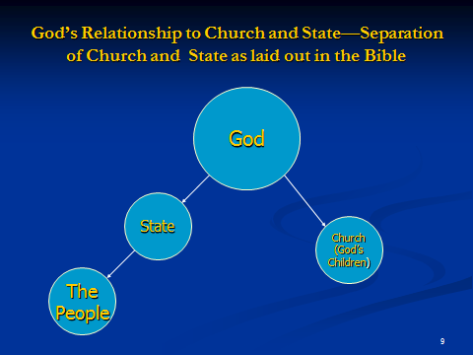
In America, the First Amendment to the United States Constitution (the highest man-made law of the land) and corresponding provisions of the Constitutions of all the states allow a church the freedom, without persecution, to apply God church principles. See, Religious Liberty in America, The History and Meaning of the First Amendment, or An Abridged History of the First Amendment. Even though man’s highest laws in America regarding the relationship of church and state protect those churches who choose to honor God in the matter, most churches follow American tradition rather than God’s word in their relationship to civil government, mainly by incorporating and applying for Internal Revenue Code § 501(c)(3) status or claiming 501(c)(3) status under Internal Revenue Code § 508(c)(1)(A).
How can a church organize as did the churches in the New Testament and according to the New Testament Church doctrine? This website gives you God’s principles, the way to apply those principles, and information on many related matters. For a concise explanation of the Bible principles and application of those principles, see Simply Church: The Holy Union of Christ and His Local Church; see also, for more information and links to more resources, Bible Trust: Principles and Application.
Among false reasons given for church incorporation, federal tax exempt status under Internal Revenue Code §§ 501(c)(3) or 508(c)(1)(A), or become some other kind of legal entity are:
A. To Own Property
B. The church must operate as a business
C. So that the church can go into debt
D. So that the church may enter into contracts
E. So that the church can manage their employee payroll and tax matters
F. Limited liability
G. Romans 13 and other verses require a believer and church “to obey every ordinance of ma”
H. Just follow your convictions, but it is best to incorporate your church and get federal tax exempt status
I. To be “practical” a church must incorporate and get federal tax exempt status
J. etc.
V. Answers to Questions and Comments Concerning Church Organization from Pastors and Others:
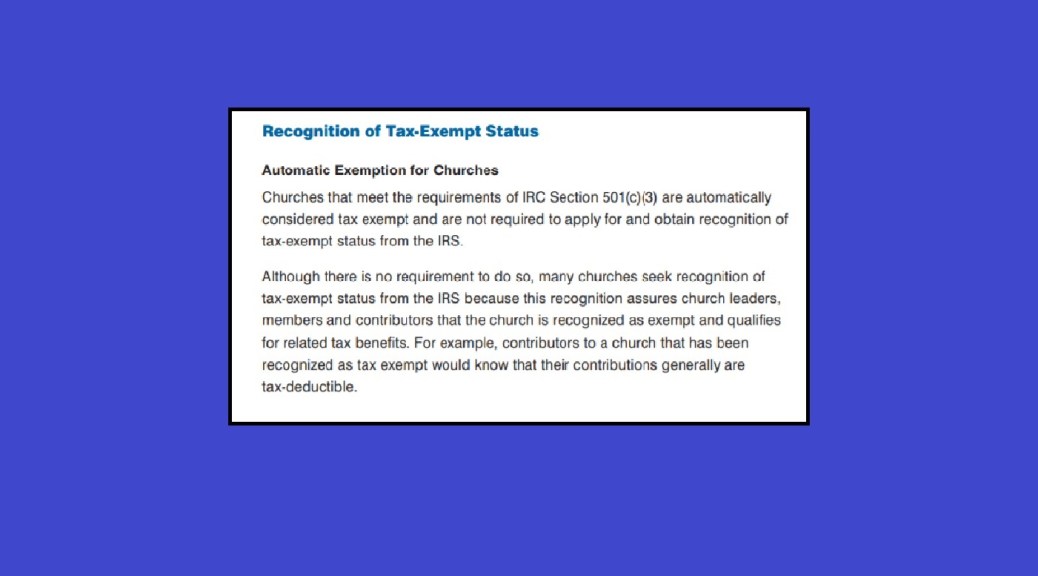
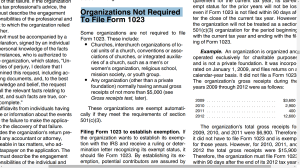
Notice that the above featured image, taken from IRS publications given below, says, “churches that meet the requirements of § 501(c)(3) are automatically considered tax exempt and are not required to apply for and obtain recognition of tax-exempt status from the IRS.” This is the correct position.
According to 508(c)(1)(A) a church can claim status without filing for 501(c)(3) status. 508(c)(1)(A) is a subsection of §508. Special rules with respect to section501(c)(3) organizations; this alone makes clear that a 508(c)(1)(A) church is a 501(c)(3) church. As such, it is subject to the requirements (the rules and regulations) that come with 501(c)(3). This conclusion is further explained in this article.
Furthermore, according to principles in the Word of God, church tax exempt status is spiritual fornication since she has submitted herself to man’s law, become a temporal legal – as opposed to spiritual eternal only – entity, and chosen to submit to an authority other than the Lord Jesus Christ as to many church matters.
A church can choose to remain under Christ only as a eternal spiritual organism as opposed to a temporal earthy organization. In America, the First Amendment and corresponding state constitutional provisions protect this choice from persecution. The essay below, and other essays, articles, and books on this website explain these matters more comprehensively.
Ignorance, and especially willful ignorance, is no excuse for dishonoring our Lord.
Click the above to go to online version of God Betrayed.
In the book God Betrayed/Separation of Church and State: The Biblical Principles and the American Application (“God Betrayed”) as well as in other books and writings, I originally taught that a New Testament church could depend upon Internal Revenue Code (“IRC”) § 508(c)(1)(A) for her non-taxable status (See Endnote 1for links to the two free versions of God Betrayed or for ordering information should you desire a softback copy as well as information on other books and resources by Jerald Finney.). I was wrong. After years of study, I have learned that a New Testament church cannot depend upon 508(c)(1)(A) for her non-taxable status because, in so doing, the church gives up her New Testament and First Amendment status; the church becomes tax exempt as opposed to non-taxable. However, I am more certain than ever of the correctness of my original biblically based conclusions that a church grieves the Lord when they intentionally, knowingly, recklessly, or negligently attain church corporate and/or 501(c)(3)/508(c)(1)(A) status or legal entity status (See Endnote 1) of any kind. I ask those who have followed my teachings to forgive me for misleading them concerning church 508 status. This brief article explains church 508 status and its effect.
A New Testament Church is also a First Amendment Church. This is because the First Amendment is a law which corresponds with biblical principles to include freedom of religion and conscience (separation of church and state), freedom of speech, freedom of press, and freedom of association. The First Amendment is a part of the second highest law of the land, the United States Constitution.
“Congress shall make no law respecting an establishment of religion, or prohibiting the free exercise thereof; or abridging the freedom of speech, or of the press; or the right of the people peaceably to assemble, and to petition the Government for a redress of grievances.”
Notice especially that the First Amendment says, “… no law ….”
Are not those words very clear? No law means “no law.” What is IRC § 508(c)(1)(A)? It, like IRC 501(c)(3), is a law made by Congress and signed by the President. IRC § 508(c)(1)(A) and IRC 501(c)(3) are, when applied to churches, laws “respecting an establishment of religion and preventing the free exercise thereof.”
Why would a church take themselves from First Amendment status and protection to either IRC § 508(c)(1)(A) or IRC § 501(c)(3)? One reason is lack of knowledge, wisdom, and understanding. When a church claims either 508(c)(1)(A) or 501(c)(3) status, she has rejected her First Amendment non-taxable status and freely accepted the offer of the federal government to enter into an agreement (contract) for tax exempt status as provided by a law.
Let me repeat: First Amendment churches under God are non-taxable. 501(c)(3) and 508(c)(1)(A) religious organizations are tax exempt. IRC § 508 (the codification of Public Law 91-172 ratified in 1969) provides in relevant part:
A portion of Internal Revenue Code § 508. Click the above to go to § 508.
“§ 508. Special rules with respect to section 501(c)(3) organizations. “(a) New organizations must notify secretary that they are applying for recognition of section 501(c)(3) status. … “(c) Exceptions. “(1) Mandatory exceptions. Subsections (a) and (b) shall not apply to— “(A) churches, their integrated auxiliaries, and conventions or associations of churches” (26 U.S.C. § 508). [Emphasis mine.]
§ 508(c)(1)(A) says churches are excepted from applying for IRC § 501(c)(3) tax exempt status (See Endnote 2for links to articles which fully explain church IRC § 501(c)(3)) status). 508 churches are an exception to the civil government requirement that certain organizations file for 501(c)(3) tax exempt status.
A church should rely on the First Amendment to the United States Constitution, not on508(c)(1)(A) status for three reasons. First, the First Amendment is a statement of the biblical principle of separation of church and state (See, for a short explanation with links to more in depth studies, Is Separation of Church and State Found in the Constitution?). When a church relies on the First Amendment, they are relying on a biblical principle. Should the biblical principle be abused or ignored by the civil government, so be it—a church should then rely and act only on the biblical principle. Endnote 3.
A law of man which enacts some biblical principles.
Second, to rely on 508(c)(1)(A) contradicts the First Amendment. To repeat, the First Amendment religion clause states:
“Congress shall make no law respecting an establishment of religion, or prohibiting the free exercise thereof; or abridging the freedom of speech, or of the press; or the right of the people peaceably to assemble, and to petition the Government for a redress of grievances.”
IRS Publication 1828. Click the above to go directly to IRS Pub. 1828.
Obviously, 508(C)(1)(A) is a law made by Congress which regards an establishment of religion; 508(C)(1)(A) also prevents the free exercise of religion because a church which claims 508(C)(1)(A) status thereby submits themselves to some control by the federal government in that the church becomes subject to the rules that come with IRC 501(c)(3) status. 508(C)(1)(A) does not state that the First Amendment forbids Congress from making any law in violation of the First Amendment; and that, therefore, a church is non-taxable. 508(C)(1)(A) is a law made by Congress which states that Congress, by law, is declaring an exemption for churches. Thus, by a clear reading of the First Amendment, 508(C)(1)(A) is clearly unconstitutional. Most churches and pastors could care less about this technicality.
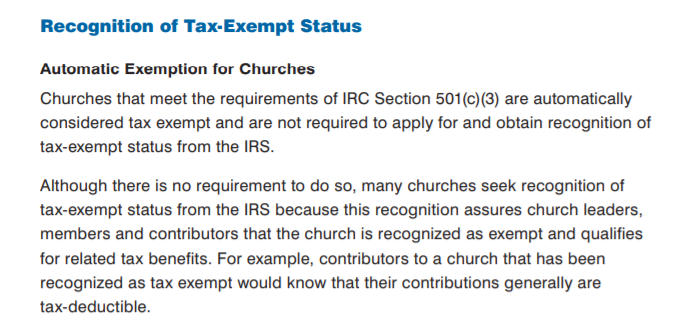
From IRS Publication 1828
The correct position which is held by the Internal Revenue Service (“IRS”) is that a church has submitted herself to IRC § 501(c)(3) regulation and ignored her First Amendment status by relying on 508(C)(1) (a law passed by Congress) instead of the First Amendment. The IRS makes this position clear. Page 3 of IRS Publication 1828 states that “churches that meet the requirements of § 501(c)(3) are automatically considered tax exempt and are not required to apply for and obtain recognition of tax-exempt status from the IRS” [Bold red emphasis mine]. The IRS repeats this on page 24 of IRS Publication 557, “Tax –Exempt Status for Your Organization.” Under Organizations Not Required To File Form 1023 churches are listed. The following sentence is included: “These organizations are exempt automatically if they meet the requirements of section 501(c)(3).” [Bold red emphasis added.]
IRS Publication 557, p. 24. Click the image to go directly to the publication.
One should also understand that the New Testament (First Amendment) church will not be involved with the IRS for several reasons: the church claims no 501(c)(3) or 508(c)(1)(A) status; is not a legal entity such as a corporation aggregate or sole, an unincorporated association, or a charitable trust; is not a business; has no income; has no employees or staff; has no constitution or by-laws; and, no matter what the particular civil government does, honors the biblical principle of separation of church and state which is reflected in the First Amendment in America.
The New Testament (First Amendment) church who loves the Lord will be prepared for the eventuality that the Internal Revenue Service, some other Federal agency, the President (recent presidential actions and orders as well as the actions of many prior presidents demonstrate what a tyrannical president can and will do), and/or the Supreme Court of the United States may someday misinterpret and apply the First Amendment; and a New Testament church, who loves the Lord and is committed to pleasing Him, will remain submitted to the higher authority. God Betrayed (see above for free links to the book) explains all this and also shows how churches are operating in America without becoming legal entities such as incorporated 501(c)(3) religious organizations thereby retaining their First Amendment and biblical status. For specifics on how to organize a church under the Bible principle of separation of church and state, one can also go to: The CUCM Bible Trust.
Third, a New Testament church (a church organized according to the principles of the New Testament), among other things, receives no income, is not a 501(c)(3) or 508 religious organization, has no constitution or by-laws, has no employees or staff, and runs no businesses (daycare controlled or licensed by the state, “Christian” schools, “Bible” colleges, seminaries, cafes, etc.). Church members of a New Testament Church give their tithes and offerings to God, not to a religious organization, for use in ways consistent with New Testament teaching. All monies given to God are disbursed in accordance to the guidelines of the New Testament, and no money is left over. Let us use our common sense, if not our biblical sense: Even a business which makes no profit pays no taxes. A church which has no income cannot be taxed. A church which does have net income should be taxed since (1) she is operating as a business and not as a New Testament church; and (2) (if she is a legal entity such as a non-profit corporation (includes corporation sole – see Critique of “Church Freedom and the Corporation Sole” Website), or unincorporated association she is set up as a non-profit religious organization and therefore violates not only biblical principles for the organization of a church but also her non-profit agreements with the state of incorporation by making a profit.
Uncle Sam Wants God’s Churches
If a church does not apply for 501(c)(3) tax exempt status or claim 508(c)(1)(A) tax exempt status, and if she is organized as a New Testament church, according to the First Amendment which agrees with the biblical principle of separation of church and state, the non-taxable status of that church must be honored. A church claims 508(c)(1)(A) status by giving IRS acknowledgements for tithes, offerings, and gifts. No matter what the civil government claims, a church who has no income cannot be taxed; she gives her tithes, offerings, and gifts to God, not to a government created religious organization. Said another way, the church (the members) give to God, not to the church, inc. or the church (an unincorporated association).
Always keep in mind matters which I cover in detail in other writings and teachings: a church who incorporates (non-profit corporation or corporation sole), or becomes a charitable trust, unincorporated association or some other type legal entity has voluntarily given up her exclusive First Amendment status in favor of partial and substantial Fourteenth Amendment status since she has become a legal entity.
There are other ways a church may violate biblical principles concerning the doctrine of the church thereby becoming some type church other than a New Testament church. Understanding these matters requires a believer to grow in knowledge, understanding, and wisdom through dedicated Bible study.
If a church successfully applies for 501(c)(3) status or claims 508(c)(1)(A) exempt status, the government is granted some jurisdiction over the church since the civil government now, by law, declares and grants an exemption.
Please, God’s dear churches, do not lose your New Testament status by becoming a legal entity of any kind. Please learn to love the Lord as he loves you and gave Himself for you;
“That he might sanctify and cleanse it with the washing of water by the word. That he might present it to himself a glorious church, not having spot or wrinkle, or any such thing; but that it should be holy and without blemish” (Ephesians 5.25-27).
Please, dear believer, learn to think Biblically (spiritually), not practically from the human perspective (fleshly). Please become more Christian than American, more heavenly than earthly. God made clear that Christ in heaven is to be the only authority (power or head) “over all things to” His churches. Put another way, a church, the body whose feet walk and work on earth, is to be connected to only one head, Christ in heaven. A church with two heads (authorities or powers) is a monstrosity.
“And what is the exceeding greatness of his power to us-ward who believe, according to the working of his mighty power, Which he wrought in Christ, when he raised him from the dead, and set him at his own right hand in the heavenly places, Far above all principality, and power, and might, and dominion, and every name that is named, not only in this world, but also in that which is to come: And hath put all things under his feet, and gave him to be the head over all things to the church, Which is his body, the fulness of him that filleth all in all” (Ep. 1.19-23).
“Now therefore ye are no more strangers and foreigners, but fellowcitizens with the saints, and of the household of God; And are built upon the foundation of the apostles and prophets, Jesus Christ himself being the chief corner stone; In whom all the building fitly framed together groweth unto an holy temple in the Lord: In whom ye also are builded together for an habitation of God through the Spirit” (Ep. 2.19-23).
“And he is the head of the body, the church: who is the beginning, the firstborn from the dead; that in all things he might have the preeminence” (Col. 1.18).
From the above verses, and many more that could be quoted, one sees that God desires his churches to be spiritual entities or bodies (See also, e.g., Ep. 4 and the whole book of Ep., Col., and 1 Co. 12 for more on churches as spiritual bodies) connected to their only God ordained Head, the Lord Jesus Christ in heaven, while walking as spiritual entities only here on the earth. Churches are to be “builded together for an habitation of God through the Spirit,” not built together as a corporate 501(c)(3) or 508 organization according to man’s earthly, legal laws.
Please repent and turn from the deceits of the god of this world to the precepts of God. Please prepare for the day when believers and churches will have to choose either to lay it all down for God and for eternal reward or to lay it all up for Satan for a perceived earthly security. That day has not yet arrived for believers and churches in America, but that day appears to be fast approaching.
Endnotes
1. For the definition of and more information on “legal entity” see the index of God Betrayed/Separation of Church and State:The Biblical Principles and the American Applicationwhich is available free in PDF, in online form (no index), or which may be ordered by clicking Order information for books by Jerald Finney.
All books, except An Abridged History of the First Amendment, by Jerald Finney are available free in both PDF and online form. One may go to Order information for books by Jerald Finney should he desire to order any of the books which are in print.
Click here to go to the article “Is Separation of Church and State Found in the Constitution?”
A biblical and historical Baptist principle is that God desires separation of church and state, not separation of God and church or separation of God and state. Study Jerald Finney’s writings and/or audio teachings to discover the truth about and how to apply the principle. Finney’s teachings prove that the revisionist view of Separation of Church and State accepted without examination by most American “Christians” is false and has done great damage to the cause of Christ and to America.
The local church sanctified and cleansed by the washing of water by the word——————–A ministry of Charity Baptist Tabernacle of Amarillo, Texas led by Pastor Ben Hickam. "Would to God ye could bear with me a little in my folly: and indeed bear with me. For I am jealous over you with godly jealousy: for I have espoused you to one husband, that I may present you as a chaste virgin to Christ. But I fear, lest by any means, as the serpent beguiled Eve through his subtilty, so your minds should be corrupted from the simplicity that is in Christ" (2 Corinthians 11:1-3). ————————————Jerald Finney, a Christian Lawyer and member of Charity Baptist Tabernacle, having received this ministry in the Lord, explains how a church in America can remain under the Lord Jesus Christ and Him only. "As every man hath received the gift, even so minister the same one to another, as good stewards of the manifold grace of God. If any man speak, let him speak as the oracles of God; if any man minister, let him do it as of the ability which God giveth: that God in all things may be glorified through Jesus Christ, to whom be praise and dominion for ever and ever. Amen" (1 Peter 4:10-11; See also, Ephesians 4::1-16 and 1 Corinthians 12:1-25). "Take heed to the ministry which thou hast received in the Lord, that thou fulfil it" (Colossians 4:17). "And hath put all things under his feet, and gave him to be the head over all things to the church" (Ephesians 1.22; See also, e.g. Colossians 1:18).




 Simply Church