Tag Archives: 501(c)(3)

Have They Gotten Rid of the “Johnson Amendment” as President Trump Promised?

Essays and article on federal tax exemption and the rules, including the Johnson Amendment, which comes with tax-exempt status:

  1. Federal government control of churches through IRS Code Sections 501(c)(3) and 508(c)(1)(A) tax exemption (121012)
  2. The church incorporation-501(c)(3) control scheme (121021)
  3.  The Rules and Regulations that Come with Church IRS Code Sections 501(c)(3) and 508(c)(1)(A) Tax-Exempt Status (031722)
  4. Are Churches Automatically Tax Exempt? (040822)
  5. A Biblical and Legal Analysis of the Helping Hand Outreach Publication, “WHY ALL CHURCHES SHOULD BE A 508(c)(1)(a).”
  6. Legal answer to Pastor’s inquiry concerning whether a potential donor of substantial gift an claim a tax deduction under IRC Section 508 even though the church will not give an IRS acknowledgement (123118)
  7. Does a Church Need 501(c)(3) or 508(c)(1)(A) Status? A Biblical and Legal Answer (062324)
  8. Church Internal Revenue Code § 508(c)(1)(A) Tax Exempt Status (042814)

Have They Gotten Rid of the “Johnson Amendment” as President Trump Promised?

Jerald Finney
Copyright © September 9, 2025

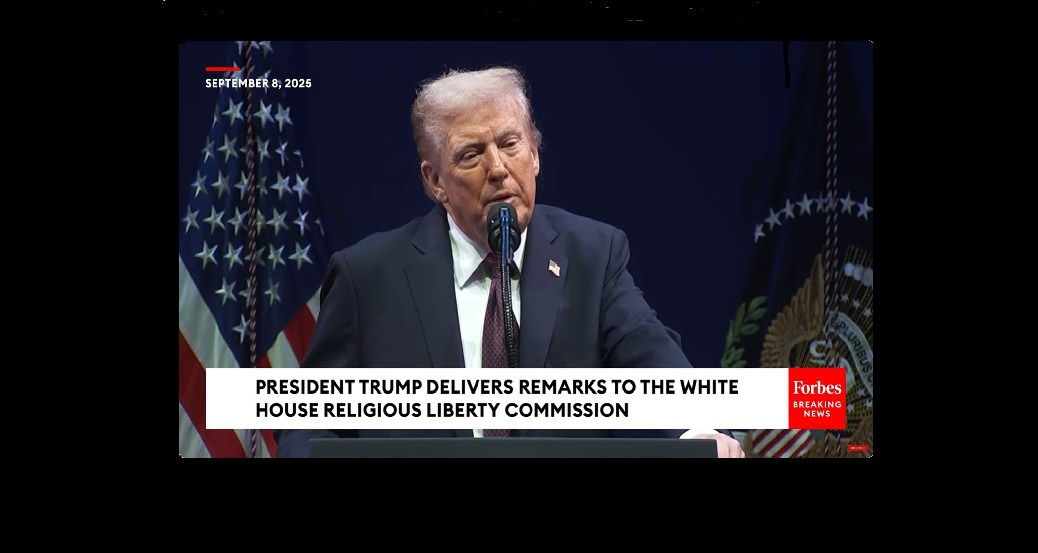
President Trump honors believers in the Lord Jesus Christ and wishes to return the nation to her founding principles.  He is trying to clean up the federal government and rescue America from the Woke Agenda, DEI, government waste, high taxes etc. He is not afraid to confront anyone, including the United Nations assembly, with truth. Many of his appointments and advisers are believers in the Lord Jesus Christ. Remember what Kamala Harris told a person at a Democrat rally who said, “Jesus Christ is King?” She, with a condescending tone of voice and silly grin on her face said, “You belong at that smaller rally down the street?” She was letting him know that the Lord was not welcomed by the Democrats.  Thank the Lord that Trump is our President.

This article, in speaking to his statements and actions concerning the “Johnson Amendment,” are not meant to demean our President.

President Trump, early in his campaign for President in 2016, became aware of the “Johnson Amendment.” He stated, in his speech at the Museum of the Bible, that it prohibits all 501(c)(3) tax exempt organizations (including churches), to whom contributions are tax deductible, from participating in political campaigns (specifically, supporting or opposing a candidate). In 2016, he promised that they would get rid it.

The “Johnson Amendment” is one of four rules in Internal Revenue Code § 501(c)(3) which religious organizations who ask for and obtain 501(c)(3) status agree to abide by. The purpose of the rule is to prevent tax-deductible money from being used to support or oppose candidates for public office. The Johnson Amendment does not prohibit all electoral activity, and 501(c)(3) organizations may still actively participate in the election process, but with significant limitations, if enforced. This article speaks to President Trump’s statements and actions concerning the “Johnson Amendment.”

He, after speaking at a board meeting to pastors and rabbis in 2016, asked for their support for president. But they did not respond. After the meeting, he was told about the “Johnson Amendment;” that because of that “Amendment” churches and religious organizations lose their tax-exempt status if “a pastor, minister, rabbi, imam, or anybody says anything about politics, you can lose your tax exempt status.” His response was, “You got to be kidding.” He said that the religious leaders were petrified about it and nobody wanted to talk about it; they became a different group of people. He pledged to them in a later meeting, “If I win, we’re going get rid of the Johnson Amendment.” He then gave an account of how the Johnson Amendment was passed. He gained their support. He recently stated that they got rid of the Amendment. See his comments by clicking here. See, Speech at the Museum of the Bible for the entire speech.

Have they gotten rid of the Johnson Amendment? The short answer is “No (with some caveats).”  I answered this and related questions in a prior article: Did President Trump do away with 501(c)(3) requirements? Published on December 2, 2017. The answers in that article are still applicable.

I am not sure what President Trump believes about the matter of separation of church and state. I do know that he has some advisors who  hold an incorrect view on that issue. The Trail of Blood of the Martyrs of Jesus: Christian Revisionists on Trial; The Christian History of the First Amendment explains the warfare going on in American politics from a Christian and historical perspective. Christian historical and Biblical revisionists have led the political activist fight in American politics and lead the way for Christian political activists. They have revised the true history of religious freedom and soul liberty in America as well as God’s guidelines for their activities.

President Trump does not have the time to do a thorough study of these matters to seek out the truth so that he can determine the truth of what he is told by religious people. He stated in his speech,

  • “I don’t want to hear from a lot of people. We hear from the people we respect” and named some of them. He said, “All of the people that are up here, I want to hear from these people. They come from a different place than me. I come from a business place rough people, bad people, not really religious people; there are some …. That’s why we go to church on Sunday, where ever we are to listen to people of faith. …”

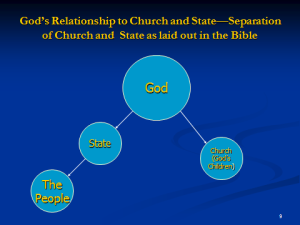
Hopefully, President Trump will not follow bad counseling on the proper relationship between church and state. God, in his word, teaches that he does not wish for church and state to work hand in hand, state over church, or church over state. God’s word does reveal that God wishes both church and state to be under God, but neither to be under, over, or combined with the other. See Part I of God Betrayed: Separation of Church and State: The Biblical Principles and the American Application for explanation. The First Amendment is consistent with God’s plan.

The Trail of Blood of the Martyrs of Jesus: Christian Revisionists on Trial; The Christian History of the First Amendment proves the truth about the true history and meaning of the First Amendment religion clause. It is not a long read and gives citations for all authorities relied upon. Read it and study it out for yourself.

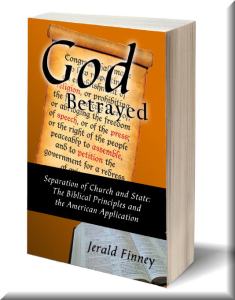
TABLE OF CONTENTS OF GOD BETRAYED:

Preface……………………………………………………………….. i
Introduction…………………………………………………………. xi
PARTONE
The Biblical Principles

Section I: Government………………………………………… 1
Chapter 1: Introduction……………………………………………………………….. 3
Chapter 2: The motivation and the goal……………………………………. 9
Chapter 3: Self-government……………………………………………………… 13
Chapter 4: Family government and conscience……………. 19
Chapter 5: Civil government……………………………………………………….. 21
Chapter 6: God desires nations to choose to glorify Him………….. 27
Chapter 7: Israel—the only theocracy ordained by God…………… 31
Chapter 8: God is the God of Israel……………………………………………… 39
Chapter 9: God desires Gentile nations to glorify Him………………. 51
Chapter 10: God judges nations……………………………………………….. 53
Chapter 11: Satan orchestrates the world-system ……………………. 59
Chapter 12: Conclusion……………………………………………………………….. 63

Section II: Church………………………………………………..…..65
Chapter 1: Introduction……………………………………………………………….. 67
Chapter 2: Definition, organization, and purposes of a church……. 71
Chapter 3: Christ, the Bridegroom/Husband/Head of the church…… 79
Chapter 4: Heresy and apostasy……………………………………………….. 85
Chapter 5: Recent accelerated apostasy in the United StateS……. 93
Chapter 6: Apostasy at the end of the church age…………………….119
Chapter 7: The church will reign with the Lord…………………………121
Chapter 8: Conclusion……………………………………………….…………123

Section III: Separation of Church and State……………………………125
Chapter 1: Introduction……………………………………………………………..127
Chapter 2: Definitions………………………………………………………………135
Chapter 3: Dispensational Theology versus Covenant Theology.137
Chapter 4: Distinct differences between church and state……….153
Chapter 5: Render unto Caesar……………………………………………………169
Chapter 6: Romans 13 and I Peter 2.13……………………………………….173
Chapter 7: Christ-church, Husband-wife, Bridegroom-bride…….185
Chapter 8: Conclusion……………………………………………………………187

PART TWO
The American Application

Section IV: History of Religious Freedom in America……….189
Chapter 1: Introduction……………………..………………………………….191
Chapter 2: Secular and Christian revisionism…………………………….197
Chapter 3: The consequences of secular and Christian revisionism 205
Chapter 4: The light begins to shine………………………………………..209
Chapter 5: The Pilgrims and the Puritans in Massachusetts……..215
Chapter 6: The Baptists in Rhode Island………………………………….233
Chapter 7: The Separates and the Baptists in New England………..249
Chapter 8: From New England to the South……………………………..261
Chapter 9: To Virginia…………………….…..…………………………………….265
Chapter 10: To the new nation..…………………………..…………………285
Chapter 11: Conclusion…………………………..…………………………………..289
Section V: Religion Clause Jurisprudence………………………………….291
Chapter 1: Introduction…………………………..………………………………….293
Chapter 2: The 19th Century Supreme Court interpretation
of “separation of church and state” …………………….299
Chapter 3: Application of the First Amendment
to the states: 1868-1947…………………………..……………………….307
Chapter 4: Separation of God and state: 1947-2007………………..313
Chapter 5: Conclusion…………………………..…………………………………..345

Section VI: God Betrayed: Union of Church and State…….349
Chapter 1: Introduction…………………………..……          …..………..351
Chapter 2: Incorporation of churches………………………………………365
Chapter 3: Incorporation of churches in the colonies and the new natioNn……………………………………………………………………………………………………379
Chapter 4: Federal government control of churches through 501(c)(3) tax exemption………………………………………………………………………………..385
Chapter 5: The incorporation-501(c)(3) control scheme…………395
Chapter 6: Spurious rationale for incorporating: limited liability 401
Chapter 7: Spurious rationale for incorporating: to hold property 405
Chapter 8: Spurious rationale for corporate-501(c)(3) status:
tax exemption and tax deduction for contributions………………. 419
Chapter 9: The results of ignoring the biblical principle of
separation of church and state……………………………………………..425
Chapter 10: Conclusion…………………………..………………………………427

Bibliography…………………………………………………………431
Index………………………………………………………………….437
Index of Scripture Verses………………………………………….451

Isaiah 28:14-18 “Wherefore hear the word of the LORD, ye scornful men, that rule this people which is in Jerusalem. Because ye have said, We have made a covenant with death, and with hell are we at agreement; when the overflowing scourge shall pass through, it shall not come unto us: for we have made lies our refuge, and under falsehood have we hid ourselves: Therefore thus saith the Lord GOD, Behold, I lay in Zion for a foundation a stone, a tried stone, a precious corner stone, a sure foundation: he that believeth shall not make haste. Judgment also will I lay to the line, and righteousness to the plummet: and the hail shall sweep away the refuge of lies, and the waters shall overflow the hiding place. And your covenant with death shall be disannulled, and your agreement with hell shall not stand; when the overflowing scourge shall pass through, then ye shall be trodden down by it.”

 

Foundation Group Exposed

Jerald Finney
Copyright © May 17, 2025

The First Amendment to the Constitution and corresponding state constitutional provisions, the highest law of the United States and the highest laws of each state, guarantee religious freedom and soul liberty and declare that churches in America can organize and do things God’s way without persecution or taxation. Many churches are doing just that; they are organizing under their Bridegroom, and Him alone.

Many companies market money-making schemes in which they convince uneducated Christians to organize churches outside God’s principles. Foundation Group is one of those companies. Under their scheme, they teach and implement church incorporation and LLC status. Any kind of legal status for churches, to include incorporation and LLC, grieve our Lord and violate church doctrine given by God in his word, the Bible. Christ is jealous of His Bride and wishes her to remain under Him and Him alone.

The Simply Church Ministry website has books, articles, essays, and video teachings which explain the Bible doctrines of church, state, church and state, and the proper application of those doctrines. Only one who has studied the word of God and various legal forms of organization will understand the lies of Foundation Group. The Simply Church website gives the believer and church all the resources they need to understand God’s church organizational doctrine and His desired relationship between church and state.

Foundation Group is right about some matters. For example, they are correct in teaching that church 508(c)((1)(A) status makes a church a 501(c)(3) tax-exempt organization. They are dead wrong in advising churches to organize as corporations or LLC’s. Both types of organizations are creatures of the state organized under state law, and subject to all the rules and regulations that come with the organization. See, for example, Legal Explanation of Incorporation of Churches | Simply Church. If a church incorporates or gets LLC status, they may as well get 501(c)(3) tax-exempt state as well.

I welcome the opportunity to do a published video debate with a Foundation Group representative. However, I do not believe they would agree to this because it would expose them for what they are. I left a comment on their website challenging them to a debate, but have not heard back from them. I believe they removed the comment. I cannot find it.

The following posts on the Simply Church website give short answers to some important questions with links to more in-depth studies. These short articles will get you started in your study of church organizational matters.:

The New Testament of Jesus Christ: His Executor Named and Empowered

1. Is it illegal for a church in America not to incorporate? Does a church have to be a 501c3?
2. Are churches automatically tax exempt?
3. What is a Spiritual entity?
4.What is a legal entity?
5
Is a church a Spiritual entity, a legal entity, or a Spiritual/legal entity? See also, Spiritual versus Legal Entities
6. 
Does God Care if our Church is Incorporated?
7. 
Should a Church Be a 508 Church?
8. 
Does a church in America need an Employer (Tax) ID Number?
9.What does church, inc. mean?
10. Who Is the head of an incorporated church?
11. What is 501c3?
12. What is 508?
13. What is the history of the First Amendment?
14. What is the History and Meaning of “Establishment of Religion” in America?
15. What is an established church?
16. What is a First Amendment Church?
17. Question from a Church Concerning Church Organization
18. The Bible Answer to the Question, “Is an Incorporated 501(c)(3) or 508 Church a Church of Christ?”

Does a Church Need 501(c)(3) or 508(c)(1)(A) Status? A Biblical and Legal Answer

Jerald Finney
Copyright © June 23, 2024

This article will briefly address some, but not all, false and misleading statements in Does a Church Need 501(c)(3) Status? A Guide to IRS Rules, a publication of Foundation Group, that uninformed “Christians” choose to believe and follow. This article applies to Foundation Group, and almost all Christan organizations, lawyers, legal firms, believers and churches; only a small remnant have any understanding of God’s definition of and principles and commandments for God’s churches. Thus, the church they are concerned about is man’s church, not God’s church; they apply man’s, not God’s, definition and principles.

It is apparent that Foundation Group has no concept of what a church-as defined by the word of God-is. Their article defines a church as “an organization with activities that are religious, not commercial.” What a joke! For God’s definition of “church” see, Bible Doctrine of Church.

It is also apparent that the Foundation Group does not understand some other matters. They do not understand that a church who remains solely under the First Amendment is non-taxable. The only way any entity–whether individual, business, religious, etc.–is required to pay taxes is by law. The First Amendment forbids a law taxing churches.

Nor does the Foundation Group understand that the use of the term “tax-exempt” in the context of 501(c)(3) is misleading. Like all other churches, churches who freely choose to dishonor God by accepting the federal government offer for “tax-exempt” status pay no taxes. Churches simply do not pay taxes. That is not why churches choose to become “tax-exempt.” The real reason for their choice is that the Internal Revenue Service will allow deductions claimed on income tax returns by donors to the church.

Their article states: “A tiny handful of churches have given up 501(c)(3) status in order to do and say whatever they choose without regard to limits otherwise placed on charities. However, this comes at the cost of tax exemption and privileges, as well as the ability to have donors give tax-deductible gifts.” This is an admission that churches who reject 501(c)(3) tax exempt status remain free to do and say the things God lays on their heart and that tax-exempt status limits their ability as to what they can to do and say. Unlike 501(c)(3) and 508(c)(1)(A) churches, they are free to follow the commandments, principles, and examples in the word of God. The second part of that quote is addressed below.

The real government purpose for federal tax-exempt status is government control over churches, not to free churches from paying taxes or to give them “tax exemption and privileges.” See, e.g., A Quiet Fatih? Taxes, Politics, and the Privatization of Religion” (Richard W. Garnett, A Quiet Faith? Taxes, Politics, and the Privatization of Religion, 42 B.C.L. Rev. 771 (2001). See also, The Rules and Regulations that Come with Church IRS Code Sections 501(c)(3) and 508(c)(1)(A) Tax-Exempt Status.

Their article states: “By default, the US government considers churches to be 501(c)(3) organizations automatically, simply by virtue of existing. Because no corporate structure is needed, a church (generally) is a 501(c)(3). …” This conclusion has no basis and is patently false. No law or regulation declares such a thing. Such a conclusion would deny the religious liberty guaranteed by the First Amendment. See, Are Churches Automatically Tax Exempt?

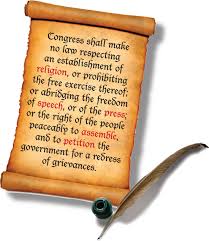
The First Amendment to the United States Constitution states:

  • “Congress shall make no law respecting an establishment of religion, or prohibiting the free exercise thereof; or abridging the freedom of speech, or of the press; or the right of the people peaceably to assemble, and to petition the Government for a redress of grievances.

Notice that the Amendment says “no law.” As one Supreme Court Justice said, “no law” means “no law.” By the way, 501(c)(3) is a law made by Congress, and, when applied to churches, respects an establishment of religion and prevents the free exercise thereof.

All parts of the First Amendment are related to and the result of the fight for religious (not business) freedom by Baptists in the colonial period. The first clause in the Amendment is the Religion Clause. That clause prohibits union of church and state (the establishment clause) and legislates freedom of conscious (the free exercise clause) on the federal level. For unrevised documented explanation, see:

The Religion Clause applies only to churches (and other religions in this pluralistic society). Churches and businesses have a distinct history and are entirely different types of entities. A church in America has a choice of whether to obtain federal tax-exempt status and become a fake church (if she is not already fake through incorporation or some other union with civil government) or to remain a true non-taxable church modeled after the examples and principles in God’s word and legislated in the highest law of America, the United States Constitution, Amendment 1. A fake tax-exempt church, as does a fake church incorporated under state law, submits herself to an authority other than to the Lord Jesus Christ. She agrees to abide by the rules and regulations that come with tax exempt status. See, The Rules and Regulations that Come with Church IRS Code Sections 501(c)(3) and 508(c)(1)(A) Tax-Exempt Status and Church Internal Revenue Code § 508(c)(1)(A) Tax Exempt Status.

The status of a church who chooses to honor God by maintaining her non-taxable status is protected by the First Amendment; she remains a church and is not classified by the government as a business if she chooses to reject the status. The government has no law or regulation which states that a church who rejects the status is now to be treated as a business; such would be in violation of the First Amendment establishment and free exercise clauses. Even if that were not true, a local church under Christ makes no profit whatsoever and therefore cannot be taxed. Even a business which makes no profit cannot be taxed, even though, unlike a church, it is required to file an income tax return.

The statement in their article, “Because no corporate structure is needed, a church (generally) is a 501(c)(3), ” is nonsensical.

Here is a statement in their article that comes from somewhere in the wild and creative imagination of its author who is obviously preying upon the ignorance of churches in his attempt to convince churches to use the services of Foundation Group: “If for some reason you and your church leadership decide that you don’t want to be a 501(c)(3), you are simply deciding to be treated like a taxable, for-profit business. …” I have already discredited this, so let us move on.

As their article indicates, it may be more convenient for a church to bow down to the federal government. For example:

1. In some few cases it may be less convenient to get the state religious tax exemption on property owned by the Lord Jesus Christ which is held and managed by a trustee (the legal or earthly owner of the property) and used by the church (not owned by the church). This ministry has encountered only two situations in which action by the trustee of God’s property being used for church purposes required legal action by the trustee of God’s property, not by the church. Both resulted in granting of the exemption. See The Indiana Board of Tax Review Determines that Property Held in Trust for the Lord Jesus Christ Must Be Granted Property Tax Exemption and Another Victory for a Church under Christ.

Sometimes glorifying and pleasing God in America can be inconvenient, but not as much so as in many nations to this very day and by followers of Christ for the last two thousand years. Our Lord Jesus Christ, the apostles, and millions of other believers from the beginning of the church age until this day were persecuted, imprisoned, beheaded, drowned, burnt at the stake, have had to hide out from church state establishments, etc. Their only way out of these “inconveniences” was to obey man rather than to God. Note: By the way, all state religious property tax exemption laws come with no strings attached and are just a courtesy from a time in this nation when God and the Bible were revered by almost everyone in the nation.

2. Some donors may not join or remain in a church who does not apply for (IRS Form 1023) and receive 26 U.S. Code (Internal Revenue Code) § 501(c)(3) tax exempt status from their new master. Some donors may not join in or remain in a church who claims IRC § 508(c)(1)(A) status. See, 26 U.S. Code § 508 – Special rules with respect to § 501(c)(3)) organizations. Of course, God desires His children to give for His glory and because they love Him, not because they get a tax deduction.

A believer dishonors God when he joins a church (e.g., a corporate and/or federally tax-exempt church) which serves mammon and is unequally yoked with any entity other than the Lord Jesus Christ.

This author, Jerald Finney, has written extensively on these matters. One who wishes to understand all aspects of the issues from a Bible based perspective can find a wealth of resources on the Simply Church Ministry Website, jeraldfinney.com. A good law review article on the Federal Tax Exemption is IGNORE THE RUMORS-CAMPAIGNING FROM THE PULPIT IS OKAY: THINKING PAST THE SYMBOLISM OF SECTION 501(c)(3) by Michael Hatfield, Associate Professor of Law, Texas Tech University School of Law. LAW REVIEW ARTICLES: 501(C)(3), 1ST AMENDMENT HISTORY, ETC. links to other law review articles on this and related First Amendment matters.

God’s Principles for New Testament Church Organization, Application of Those Principles, and Answers to Questions From Pastors and Others

Jerald Finney
February 16, 2024

Contents

 I. Introduction

II. Bible Principles

 III. Application of Principles

 IV. Analysis of False Reasons of Christians and Lawyers for Church Corporate, 501(c)(3) and 508(c)(1)(A) tax exempt Status or Legal Status of Any Kind.

V. Answers to Questions and Comments from Pastors and Other Believers Concerning Church Organization

VI. Contact Information for this Simply Church Ministry

I. Introduction

Most believers in America have never considered whether or not God’s Word communicates teachings, doctrines, and principles concerning Christ’s churhes which are at odds with the organization and conduct of the church they attend. They never ask, “Has my church been corrupted from the simplicity that is in Christ” (See, 2 Corinthians 11:3).

Most have not considered whether violation of His principles is important to God or whether there are long term negative consequences for deviating from God’s church rules. Most pastors were never taught, and do not teach, New Testament Church doctrine and its application. They assume that their practices handed them by tradition are in line with God’s will. That  would be OK if, indeed, their tradition were in line with God’s Word.

Is a church, according to God, to be:

  1. a temporal worldly organization,
  2. or an organism, the body of Christ; instinct with His life, and heavenly in calling, promise, and destiny,
  3. or a combination of the two?

How is one to know “the nature, purpose, and form of organization of local churches, and the right conduct of such gatherings?” God’s Word, mainly in the epistles of Paul, answers these questions.

As the serpent beguiled Eve, has your church been corrupted from the simplicity that is in Christ?” Will you turn your back on God’s Word as regards God’s church principles?

II. Bible Principles

What are the principles and how can a church in America apply them? The essential principles are relatively easy to grasp, but some Bible study is needed to get into the deeper waters of the doctrine.

The basic principles for church organization are rather simple:

  • Christ purchased the church with His own blood (Acts 20:28).
  • He “also loved the church, and gave himself for it; That he might sanctify and cleanse it with the washing of water by the word, That he might present it to himself a glorious church, not having spot, or wrinkle, or any such thing; but that it should be holy and without blemish” (Ephesians 5:25-27).
  • God gave God the Son “to be the head over all things to the church (Ephesians 1:22).
  • Christ “is the head of the body, the church: who is the beginning, the firstborn from the dead; that in all things he might have the preeminence” (Colossians 1:18).
  • A church is to be espoused to one husband, to be presented “as a chaste virgin to Christ” (2 Corinthians 11:3).
  • God desires that a church have no relationship with any other lover, any other entity, than the Lord Jesus Christ.

In other words, God desires His churches to love and glorify Him by remaining 100% faithful  as shown by the fact that they are in relationship with no entity other than the Lord Jesus Christ.

For more thorough studies of the Bible doctrines of government, church, and relationship of church and state, see Separation of Church and State/God’s Churches, Spiritual or Legal Entities?God Betrayed/Separation of Church and State: The Biblical Principles and the American ApplicationThe Bible Doctrine of Government; The Bible Doctrine of the ChurchThe Bible Doctrine Concerning the Relationship of Church and State

 III. Application of Principles

Do the following methods of church organization by which a church becomes a “legal entity”  violate God’s principles:

  1. non-profit corporation organization under man’s law,
  2. federal tax exempt status under Internal Revenue Code §§ 501(c)(3) or 508(c)(1)(A),
  3. other methods of operation and organization by which a church which entangles herself with another lover by becoming a “legal entity“?

The answer to the three questions above is yes.  To understand this, one must understand the Bible principles and then make the application of those principles to a particular type of organization. For links to short answers explaining the facts about church incorporation, tax exempt status, etc. Go to Short Answers to Some Important Questions (each short answer links to additional more in depth studies.)

See the following for short answers which link to additional resources which give more in depth answers:

Sadly, Satan, through his subtilty, has beguiled  most churches  in America, as he did Eve, from the simplicity that is in Christ. Most are temporal worldly organizations who, to one degree or another name the name of Christ but keep the commandments of men as opposed to the principles of God.

In America, the First Amendment to the United States Constitution (the highest man-made law of the land) and corresponding provisions of the Constitutions of all the states allow a church the freedom, without persecution, to apply God church principles. See, Religious Liberty in AmericaThe History and Meaning of the First Amendmentor An Abridged History of the First Amendment. Even though man’s highest laws in America regarding the relationship of church and state protect those churches who choose to honor God in the matter, most churches follow American tradition rather than God’s word in their relationship to civil government, mainly by incorporating and applying for Internal Revenue Code § 501(c)(3) status or claiming 501(c)(3) status under Internal Revenue Code § 508(c)(1)(A).

How can a church organize as did the churches in the New Testament and according to the New Testament Church doctrine? This website gives you God’s principles, the way to apply those principles, and information on many related matters. For a concise explanation of the Bible principles and application of those principles, see Simply Church: The Holy Union of Christ and His Local Church; see also, for more information and links to more resources, Bible Trust: Principles and Application.

 IV. Analysis of False Reasons of Christians and Lawyers for Church Corporate, 501(c)(3) and 508(c)(1)(A) tax exempt Status or Legal Status of Any Kind [Click link]

Among false reasons given for church incorporation, federal tax exempt status under Internal Revenue Code §§ 501(c)(3) or 508(c)(1)(A), or become some other kind of legal entity are:

A.  To Own Property
B. The church must operate as a business
C. So that the church can go into debt
D. So that the church may enter into contracts
E. So that the church can manage their employee payroll and tax matters
F. Limited liability
G. Romans 13 and other verses require a believer and church “to obey every ordinance of ma”
H. Just follow your convictions, but it is best to incorporate your church and get federal tax exempt status
I. To be “practical” a church must incorporate and get federal tax exempt status
J. etc.

V. Answers to Questions and Comments Concerning Church Organization from Pastors and Others:

VI. Contact Information

JERALD C. FINNEY
BAB, HB, BBA, JD

801 Elgin St.
Amarillo, TX 79118
Phone : (512) 785-8445
E-MAIL: jeraldfinney157@gmail.com


My reply to pastor teaching on Matthew 16.18 and Ephesians 1.22 thereafter questioned by accountant about church non-taxable status and the First Amendment

CLICK HERE TO GO TO
LETTERS AND QUESTIONS FROM PASTORS AND OTHERS ANSWERED

Jerald Finney
Copyright © January 14, 2019

CONTENTS:
1. THE PASTOR’S E-MAIL
2. MY REPLY

 1. THE PASTOR’S E-MAIL

Hello Brother Finney,

I have been preaching/teaching on Mt. 16:18 and Eph. 1:22 for the last two weeks. After the service one gentleman (who is an accountant) asked me to show him where in the First Amendment it says that churches are non-taxable.

Just checking with you if I answered him correctly. The phrase, “Congress shall make no law respecting an establishment of religion OR PROHIBITING THE FREE EXERCISE THEREOF….”  Would not taxing the church fall under, “…prohibiting the free exercise thereof…”?

Thanks for the 15 page article it was very helpful, also the one about Sovereignty.

And to your question, yes our church would like to be one of your “Lighthouse Churches”.

Keeping the Faith,
Brother ________________ for
________________________

 2. MY REPLY

Dear Brother ____________________,

What a blessing to hear that you are teaching these matters. By so doing, you are already a “lighthouse church.” I hope to set up some online conferences for pastors and churches who are fighting this battle for Christ’s churches. I will let you know when we get that going. Keep up the good work and let us keep in contact.

The only way a church, an individual, or a business can become taxable is for Congress to pass a law taxing them. For Congress to pass a law taxing churches is forbidden by the First Amendment. You correctly pointed out to the accountant that for Congress to tax a church would violate the First Amendment free exercise clause. It would also violate the First Amendment establishment clause because taxing churches would require a law made by Congress which would control churches, a law respecting an establishment of religion.

It does not violate the First Amendment for civil government to tax individuals and businesses. Only churches and religions have First Amendment protections. Of course, due to the 501(c)(3) and 508 laws made by Congress in 1954, churches can choose to place themselves under federal government controls by becoming tax exempt as opposed to non-taxable. First Amendment churches are non-taxable. 501(c)(3) and 508 churches are tax exempt. When a church freely applies for 501(c)(3) status or claims 508 status, that church becomes tax exempt, not non-taxable. Tax exempt status places another authority over a church other than the Lord Jesus Christ; and certain rules enforceable by the Internal Revenue Service come with that status. First Amendment non-taxable status gives churches protection from federal government intervention in any way, unless the church has chosen to become a legal entity by applying for state non-profit corporation status or has made herself a legal entity by some other action.

I believe 501(c)(3) and 508 are unconstitutional as applied to churches in that they violate the First Amendment religion clause: “Congress shall make no law respecting an establishment of religion or preventing the free exercise thereof.” 501(c)(3) or 508 status for churches respects an establishment of religion and prevents the free exercise thereof. Yet most churches, not being churches of Christ or churches under Christ, freely embrace 501(c)(3) and 508 status, thereby betraying their first love.

The accountant, like almost all attorneys, including myself until 2005, never knew the true history of the First Amendment. I had studied a Christian revisionist history of the First Amendment. The real history of the First Amendment makes very very clear that the First Amendment was meant to separate church and state and, in so doing, it was meant, among other things, to prevent the federal government from taxing churches and/or using tax money to support any religion or church.

In addition, the United States Supreme Court, although wrong about removing God from civil government matters, was right to declare that the First Amendment has erected a high and impregnable wall between church and state, a wall that was meant to keep church and the federal government completely separate:

  • “The constitutional inhibition of legislation on the subject of religion has a double aspect. On the one hand it forestalls compulsion by law of the acceptance of any creed or the practice of any form of worship…. On the other hand, it safeguards the free exercise of the chosen form of religion…. The interrelation of the ‘establishment’ and ‘free exercise’ clauses [according to the United States Supreme Court] has been well summarized as follows: ‘The structure of our government has, for the preservation of civil liberty, rescued the temporal institutions from religious interference. On the other hand, it has secured religious liberty from the invasion of the civil authority.’” Donald T. Kramer, J.D. Annotation: Supreme Court Cases Involving Establishment and Freedom of Religion Clauses of Federal Constitution, 37 L. Ed. 2d 1147 § 2 citing Everson v. Board of Education, 330 U.S. 1, 91 L. Ed. 711, 67 S. Ct. 504, 168 A.L.R. 1392 (1947), reh’g denied 330 U.S. 855, 91 L. Ed. 1297, 67 S. Ct. 962. For a full discussion of Everson and the removal of God from practically all civil government affairs, see Section V of God Betrayed.

In the words of Jefferson, the clause against establishment of religion by law was intended to erect ‘a wall of separation between Church and State.’” McCollum v. Board of Education, 333 U.S. 203, 210-211 (1948). Jefferson, contrary to the assertions of Christian revisionists, clearly believed in a secular state and separation of church and state.

Separation of church and state does not equate to separation of God and state. It does not mean that civil government should keep God out of civil government. God ordained civil government in order for man to have direct control over certain matters: the protection of life, liberty, and property. God desires every individual, family, civil, and church government to choose to recognize Him and to operate within the jurisdictional boundaries He set out in His Word. He also desires total separation of church and state. See Part I of God Betrayed for explanation.

I would also suggest that you refer the accountant to the Law Review Articles linked to on the following webpage: LAW REVIEW ARTICLES: 501(C)(3), 1ST AMENDMENT HISTORY, ETC.

May the Lord continue to richly bless you and and this Churches Under Christ Ministry as we go forward for His Glory.

Brother Jerald Finney

Did President Trump do away with 501(c)(3) requirements?


A Publication of Churches Under Christ Ministry


Follow-up article published on December 9, 2025:
Have They Gotten Rid of the “Johnson Amendment,
as President Trump Promised?


Click here to go to All Written Course Segments
Click here to go to General Questions Answered
Click here To Go to Links to All 5 Minute Youtube Course Segments


Jerald Finney
Copyright © December 2, 2017


Speech by President Trump: We are giving our churches their voices back


President Trump, desiring to help churches and “Christians,” and according to the advice of those “Christians” and other religious leaders  who surround him, pledged to eliminate the Johnson Amendment which limits all nonprofits from endorsing and opposing political candidates. See Endnote 1 for links to articles on this matter. I believe he is sincerely trying to help churches. Accordingly, he signed an executive order easing restrictions on political activity by non-profits. Of course, he cannot unilaterally change the law; but he did all he could do to help – ease but not eliminate one of the five restrictions which come with 501(c)(3) status. Just as non-profit corporation status puts the state of incorporation over a church for many matters, 501(c)(3), a man made law, still puts the federal government and the IRS agency over churches with respect to certain rules and a multitude of regulations that come with the chosen 501(c)(3) status. See Endnote 2 for list of some of the regulations that come with 501(c)(3) and links to resources which explain 501(c)(3) and 508(c)(1)(A) tax exempt status in some detail.

Does this action by the President correct the problem with 501(c)(3)? No. I explain why in this article.

Click the above to go to the article, “Is Separation of Church and State Found in the Constitution?

One should be aware that the highest man made law in America, the First Amendment to the United States Constitution, and corresponding state constitutional provisions make clear that churches have a choice – remain under Christ only or submit to the state and federal governments through corporate 501(c)(3) status.

Keep in mind, for example:

  • Matthew 16:18 “And I say also unto thee, That thou art Peter, and upon this rock I will build my church; and the gates of hell shall not prevail against it.” Is a church built partially or wholly by man (man’s law) a church of Christ? Is such a church His church?
  • Ephesians 1:22 “And hath put all things under his feet, and gave him to be the head over all things to the church.” Is Christ the head over all things to an incorporated 501(c)(3) or 508 church? The simple to comprehend answer is an emphatic, “No!”
  • Colossians 1:18 “And he is the head of the body, the church: who is the beginning, the firstborn from the dead; that in all things he might have the preeminence.”

Let us first briefly examine or look at what church 501(c)(3) status really is. This will highlight the real issue. We will have to touch on incorporation since the two are intertwined.

Most churches choose to apply for both corporate and 501(c)(3) or 508(c)(1)(A) tax exempt status even though a choice not to do so is protected by the First Amendment and corresponding state constitutional provisions. 508(c)(1)(A) status puts a church in the same position as 501(c)(3) status. See, Church Internal Revenue Code § 508 Tax Exempt Status. Churches who incorporate and/or get 501(c)(3) or 508(c)(1)(A) status are established churches. They combine with civil government under man-made law. They get some perceived “benefits” and powers from civil government. In return, they agree to abide by the non-profit corporation laws of the state of incorporation and the commandments which come with the federal 501(c)(3) law they sought and agreed to. They also agree that, in the event they have issue with a commandment imposed by the law, the authority who will decide the issue is the government through its court systems. Their authority for many matters is the civil government, not the Lord Jesus Christ. One might call those churches who constantly defy and complain about the rules or commandments they agreed to “hypocrites.”

Churches who seek and obtain 501(c)(3) agree to abide by the rules and regulations that come with 501(c)(3), and also to any future rules added by the federal government though legislation, or by the Internal Revenue Service and upheld by the courts. Maybe some do not realize what they are doing when they get such status; some may proceed without knowledge, understanding, and wisdom. Nonetheless, when they get the status, they agree to the rules and commandments which come with the status and they agree that, in the event their authority who will decide the issue is the first the agency process with appeal to federal court available to the losing side, not the Word of God. Corporate 501(c)(3) churches proudly proclaim victory when their authority rules in favor of their position and moan and groan when their authority decides against them. They cannot understand that they lost no matter what their authority decides because they have put themselves under the wrong authority, according to the Word of God; and even their so-called victories are riddled with compromise.

Originally, a church who chose 501(c)(3) status agreed to 4 commandments or rules, added by legislative law. The IRS added a fifth. Prior to Bob Jones University v. United States, 461 U.S. 574 (1983), there were four rules. Bob Jones University upheld the IRS “shall not violate fundamental public policy” rule. Now there are five commandments. The fifth one has not yet been applied, as far as I know, to a church. However, many pastors do not preach of certain matters because they fear that they will be in violation of that rule—they do not wish to offend their master, their authority, by preaching certain matters covered by the Word of God. Many pastors openly preach on prohibited matters knowing that the state may exercise their authority and command them to comply or lose their status and suffer other penalty imposed by their master. The only authority to which a church can appeal, should the IRS agency rule against them, is the civil court system. By the way, the court will not allow such a church to make Bible based arguments.

As one can see, corporate 501(c)(3) status comes with the loss of many of the church’s First Amendment rights. A corporate 501(c)(3) church is a “legal entity,” an artificial person who has placed herself under the Fourteenth Amendment for many purposes thereby giving up much of her First Amendment protection. A First Amendment church cannot be sued for violation of the rules that come with 501(c)(3) or 508(c)(1)(A) because such a church has not submitted herself to the Internal Revenue Code Section 501(c)(3) or Section 508(c)(1)(A). She cannot be forced to get such status because the First Amendment religion clause says, “Congress shall make no law respecting the establishment of religion or prohibiting the free exercise thereof.”

A 501(c)(3) church also agrees to many regulations. See Endnote 2 for list of some of the regulations that come with 501(c)(3) and links to resources which explain 501(c)(3) and 508(c)(1)(A) tax exempt status in some detail.

One who does just a little study can easily understand that the governments of the state of incorporation and the federal government are the authorities, for many purposes, of a corporate 501(c)(3) church. The Lord Jesus Christ is, at most, only one of their authorities or heads. For many churches, Christ is completely eliminated from the equation and their sole authority is civil government. Churches grieve our Lord by submitting to another head. Christ is not over “over all things to” those churches.  According to the Bible, this raises a very important question, “Are corporate 501(c)(3) churches of Christ, built by Christ and Him alone?” They are churches, but are they Christ’s churches? The answer is obvious.

So the main issue is one of authority. Looking beyond that, only the legislature, not the President, can eliminate the Johnson Amendment or any other rule that comes with 501(c)(3) status. It is a law, passed by Congress and signed by the President. The President, of course, is the law enforcer. Like any law enforcer, he can choose to ease or relax his efforts to enforce what he deems to be an unjust law, you might say. He cannot do away with the fact that the authority of the 501(c)(3) church, as to the rules that come with it, is the federal government through its agent, the IRS. The courts, not the President, decide unresolved clashes between 501(c)(3) churches and the IRS. Only the legislature, not the President, can repeal a law subject to his signature of approval. The legislature has taken no action to overrule the Johnson Amendment in the many months since President Trump filed his executive order nor has President Trump encouraged the legislature to do away with either 501(c)(3) status or any of the other rules that come with 501(c)(3).

Even should the Johnson Amendment be eliminated by legislative law signed by the President, there would still be four other rules that churches agreed to comply with when they chose to apply for 501(c)(3) tax exemption. It is no secret that churches and so called “Christian” lawyers have also been worried about rule number five, the fundamental public policy rule, for at least 15 or 20 years. Their advice: “pray about it.” I would like to hear one of their prayers. I do not think they will pray, “Lord, forgive us for dishonoring you and causing you much grief by prostituting your churches. We repent. Help us to honorably withdraw from our unholy alliances.”

I have touched on the main issue. Let me restate some of the above points and list some other matters. President Trump’s speeches and his executive order reflect Christian revisionist history. They:

  1. ignore the fact that churches are required to give up some of their First Amendment protections when they choose to become 501(c)(3) organizations who submit to the federal government as to certain matters;
  2. ignore the fact that churches voluntarily put themselves under 501(c)(3) with all the rules and regulations that accompany their choice ;
  3. ignore the fact that churches voluntarily give up much of their First Amendment protection when they place themselves under a law which commands them not to do certain things;
  4. ignore the fact that churches who incorporate and get 501(c)(3) status put themselves, for many purposes, under the Fourteenth Amendment;
  5. do not take into account that 501(c)(3) was a law implemented in 1954, 164 plus years after the adoption of the First Amendment;
  6. ignore the question of whether 501(c)(3) is even constitutional since the First Amendment religion clause says, “Congress shall make no law respecting an establishment of religion or preventing the free exercise thereof;”
  7. reflect a lack of understanding of the true history of the First Amendment;
  8. reflect the “Christian” revised history of the First Amendment;
  9. misrepresent what church/state establishment meant when the Constitution and First Amendment were adopted;
  10. misrepresent what Thomas Jefferson, for example, stood for (He stood for a secular state with complete separation of church and state); (See, Endnote 3 for links to an unrevised history of the First Amendment)
  11. disregard and go contrary to Bible principles concerning church, state, and the relationship God desires between church and state;
  12. ignorantly work for the end-time one world union of church and state under the beast;
  13. etc.

I wish to make one other point: I believe that freeing 501(c)(3) non-profit organizations to become active in politics will unleash liberal 501(c(3) organizations–atheist, secular, and religious–who will fight for liberal candidates, and that those organizations substantially outnumber and have much more money and power than the conservative churches who constantly attack the rule. Those liberal organizations include Planned Parenthood, Inc. (an organization that gets a lot of government money), the Church of Wicca,  Inc. and many many other incorporated 501(c)(3) organizations and churches who will support liberal candidates.

In conclusion, I believe that President Trump is sincerely trying to help the cause of religious liberty. But he is being misled by certain religious persons and organizations who will use any means necessary to achieve their goals. Their false Biblical interpretations and goals hasten fulfillment of end time prophecies—religion and government will unify and bring in a 3 ½ year of peace followed by 3 ½ year period of great tribulation, and finally the appearance of our Lord who will crush the world powers who are coming against Israel and then establish His 1000 year reign on the earth.


Endnotes

Endnote 1: Links to some articles: Trump Vow: ‘Totally Destroy’ 501(c)(3) Political Activity Ban, February 3, 2017.  President Trump vowed to He signed an executive order easing restrictions on religious participation in politics. See Trump signs executive order to ease restrictions on religious participation in politics, May 4, 2017. TRUMP RELAXES 501(C)(3) POLITICAL ACTIVITY RULES, May 5, 2017.

Endnote 2: 501(c)(3) and 508(c)(1)(A) tax exempt status not only come with five government imposed rules, such status also invokes a myriad of regulations. See, e.g., Publication 557 (01/2019), Tax-Exempt Status for Your OrganizationApplication for Recognition of ExemptionExempt Organizations Treasury RegulationsCharities and Nonprofits A-Z Site Index (F-J)Exempt Organization Revenue RulingsPub. 1828, Tax Guide for Churches and Religious Organizations (PDF)Common Tax Law Restrictions on Activities of Exempt OrganizationsExempt Organizations – Ruling and Determinations LettersrExempt Organizations – Private Letter Rulings and Determination LettersExempt Organizations AnnouncementsAnnual Filing Requirements for Supporting OrganizationsExempt Organizations NoticesPublic Disclosure and Availability of Exempt Organizations Returns: Copies of Exempt Organizations Tax DocumentsExempt Organization Revenue ProceduresExempt Organizations UpdateExempt Organizations – Employment TaxesThe Truth About Frivolous Tax Arguments – Section IITermination of Exempt Organization (“… Internal Revenue Code Section 6043(b) and Treasury Regulations Section 1.6043-3 establish rules for when a tax-exempt organization must notify the IRS that it has undergone a liquidation, dissolution, termination, or substantial contraction. Generally, most organizations must notify the IRS when they terminate. Among other things, notice to the IRS of a termination will close the organization’s account in IRS records. …).

See also, for analysis of 501(c)(3) and 508(c)(1)(A): (1) Questionnaire 2, I. Elementary Questions for Those Who Wish to Organize a Church under Christ Alone as opposed to either a Church under Man or a Church under Christ and Man, (2) Federal government control of churches through 501(c)(3) tax exemption; (3)  The church incorporation-501(c)(3) control scheme.

Endnote 3: The History of the First Amendment; An Abridged History of the First Amendment; List of Scholarly Resources Which Explain and Comprehensively Document the True History of Religious Freedom in America.

A Call to Anguish: Churches Reject God’s Authority


Recommended sermon which further explains this preliminary article:
Authority, the Greatest Thing in the Universe
Dr. Greg Dixon 2005.
This sermon explains the two meanings of power as used in the Bible and the importance of authority and power and correct doctrine to a church. It explains how great men of God can proceed according to some false doctrine and the consequences thereof.

Recommended: listen to this 7 min. 24 sec. excerpt from a sermon, in conjunction with this article:
A Call to Anguish


Jerald Finney
Copyright © November 21, 2017


A Call to Anguish: Churches Reject God’s Authority

1God grieves because His people neither understand nor honor His authority and His precepts. God’s grief calls churches and believers to anguish, but few grieve, few cry, few pray, few even know that there is a call to anguish. The call started a long time ago. Authentic churches in the colonies and then the new nation, even though warned by God’s remnant, betrayed their roots and compromised the authority of God. Their betrayal passed on to future churches. The betrayal of God increased exponentially for 225 plus years to this very day. This article points out one proof of the consequences of this betrayal that should call believers and churches to anguish.

God ordained civil government and laid out its jurisdiction. God gave civil government no authority or ability to define “church.” God defines “church” in the New Testament.  God also made clear that church and state were to remain totally separate. Yet, that was never the case, except for a remnant, in either the American colonies or the states.

How far off base would civil government go in the definition of “church” as multitudes of organizations sought and continue to seek non-profit corporation and tax exempt status? Let us look at an illustration. “A New Religion Forms That Will Worship A ‘Godhead’ Based On AI” states in the introduction:

“Anthony Levandowski has already filed paperwork with the IRS for the nonprofit corporation that is going to run this new religion.  Officially, this new faith will be known as ‘Way Of The Future.’” The article goes on to explain the tenets of the “Way Of The Future,” which include a faith in science which will create a “Godhead” which will make things better and a denial of the existence of God.

Had God remained the sole authority for churches, organizations  like “Way of the Future” could have existed, but they could not have received official sanction and “benefits” from any authority, earthly or heavenly.

Religious Americans, to include many Baptists alongside obviously heretical or apostate Protestants and Catholics, gave civil government the power, the authority to define “church.” Civil government took to the task, first in issues involving state non-profit corporate status; then, later in the twentieth century, income tax exemption status.

As to federal tax exemption law, the authority has developed a process and rationale to determine whether an organization applying for 501(c)(3) tax exempt status is a “church.” When determining whether an organization is a “church,” a “religious organization,” or a “religious society,” the IRS (and court, if the IRS ruling is appealed), has a 14 part criteria, which—though not all-conclusive since other factors will be considered when deemed appropriate by the IRS—is a man-made definition; a definition which is partially contrary to the Word of God. En 1 gives the IRS definition of church with link to online IRS webpage; En 2 discusses a sample IRS ruling; En 3 briefly discusses some cases which have attempted to define church and links directly to those cases.

The IRS agency makes initial determinations, but the ultimate authority is the judiciary. Regardless of the ruling of the IRS, the losing party can appeal to the appropriate court asking for reversal and laying out their arguments for their position. Ultimately, the case could go all the way to man’s highest authority on issues such as this, the United States Supreme Court.

What is wrong with this? God made clear that Christ in heaven is to be the only authority (power or head) “over all things to” His churches. Put another way, a church, the spiritual body whose feet walk and work on earth, is to be connected to only one spiritual head, Christ in heaven. This connection was made after Christ ascended to heaven and filled the members of the church with the Holy Ghost on the day of Pentecost (Ac. 2.4). God the Son, before his ascension, walked with his disciples and apostles. God the Holy Ghost now indwelt them, thereby giving them a direct spiritual link to their God-ordained Head who was now in heaven.

  • “And what is the exceeding greatness of his power to us-ward who believe, according to the working of his mighty power, Which he wrought in Christ, when he raised him from the dead, and set him at his own right hand in the heavenly places, Far above all principality, and power, and might, and dominion, and every name that is named, not only in this world, but also in that which is to come: And hath put all things under his feet, and gave him to be the head over all things to the church, Which is his body, the fulness of him that filleth all in all” (Ep. 1.19-23).
  • “Now therefore ye are no more strangers and foreigners, but fellowcitizens with the saints, and of the household of God; And are built upon the foundation of the apostles and prophets, Jesus Christ himself being the chief corner stone; In whom all the building fitly framed together groweth unto an holy temple in the Lord: In whom ye also are builded together for an habitation of God through the Spirit” (Ep. 2.19-23).
  • “And he is the head of the body, the church: who is the beginning, the firstborn from the dead; that in all things he might have the preeminence” (Col. 1.18).

From the above verses, and many more that could be quoted, one sees that God desires his churches to be spiritual entities or bodies (See also, e.g., Ep. 4 and the whole book of Ep., Col., and 1 Co. 12 for more on churches as spiritual bodies) connected to their only God ordained Head, the Lord Jesus Christ in heaven, while walking and working for the glory of God as heavenly, spiritual, eternal entities only here on the earth. Churches are to be “builded together for an habitation of God through the Spirit,” not built together as corporate 501(c)(3) or 508 organizations according to man’s earthly, temporal, legal laws.

Most of the credit for the door being opened to Godless “religions” to gain the ability to be labeled as “churches” lies with not only with Protestants and Catholics but also with the progenitors of those martyrs who gave their lives standing for New Testament principles, one of which is separation of church and state. Once they had an opportunity to do so, the majority of even authentic Baptist believers and churches who honored and even died standing for the principle of separation of church and state while persecuted betrayed their head, their authority, the Lord Jesus Christ. They incorporated, and with the advent of tax exempt law, they applied for tax exempt status; along with many new breeds of “churches.”

All incorporated and/or 501(c)(3) and 508 “churches” operate under the authority of both the state government of incorporaton and the federal government, even those who also have or once had some connection to the Lord Jesus Christ. The latter sometimes operate partially under Jesus Christ and partially under civil government; sometimes solely under the authority of civil government.

New Testament churches who obtain state non-profit corporation status and get federal tax exempt status partially or totally lose the power of God.  They are no longer spiritual entities only under the authority, headship or power of Christ alone. They have chosen to become earthly legal entities partially or totally connected to earthly heads, the government of the state of incorporation and the federal government. Without the power of God, they are ill-equipped to do their work: the perfecting of the saints (inside the assembly), the work of the ministry, the edification of the body of Christ, going into all the world and preaching the gospel to every creature (Mk. 16.15), and performance of other duties outside the assembly. They no longer resemble the spiritual bodies described in the New Testament:

  • “And he gave some, apostles; and some, prophets; and some, evangelists; and some, pastors and teachers; For the perfecting of the saints, for the work of the ministry, for the edifying of the body of Christ: Till we all come in the unity of the faith, and of the knowledge of the Son of God, unto a perfect man, unto the measure of the stature of the fulness of Christ: That we henceforth be no more children, tossed to and fro, and carried about with every wind of doctrine, by the sleight of men, and cunning craftiness, whereby they lie in wait to deceive; But speaking the truth in love, may grow up into him in all things, which is the head, even Christ:  From whom the whole body fitly joined together and compacted by that which every joint supplieth, according to the effectual working in the measure of every part, maketh increase of the body unto the edifying of itself in love.” (Ep. 4.11-16)[Bold emphasis mine]
  • See also, e.g., 1 Co. 12.

Aditionally, by mixing church and state, churches opened the door to the untenable situation where an earthly temporal civil government which has neither the authority nor the ability to understand spiritual matters is granted power over the church and put in charge of defining “church,” “religious organization,” “religious society,” etc. This mixing of the holy with the unholy has resulted in the inevitable consequences we see shaping up as a result of civil government definition of “church.”

2In conclusion, should the IRS and/or the court decide that “Way Of The Future” is a qualified tax exempt religious organization or church, true churches will coexist as earthly legal entities alongside not only already existing corporate 501(c)(3) organizations such as Planned Parenthood, the Church of Wicca, and the Church of Satan, but also another Godless and God-defying organization which directly challenges God and His existence. Because they do not remain under their God-ordained authority (power or headship)—the Lord Jesus Christ—they will possess either no power of God or, at best, a watered down power of God. They betray their Lord, they lose God’s power, God grieves, and they could care less!

Churches have betrayed God, lost the power of God, and caused our Lord who loved the church and gave himself for it to grieve by incorporating and getting 501(c)(3) status.  Where is the anguish?

Listen to the powerful clip from sermon A Call to Anguish.

[For complete studies which cover all issues (such as the Ro. 13 issue, the incorporation issue, etc.) see the resources linked to in En 4.]

Endnotes

En 1 Churches Defined

“The term church is found, but not specifically defined, in the Internal Revenue Code. With the exception of the special rules for church audits, the use of the term church also includes conventions and associations of churches as well as integrated auxiliaries of a church.

“Certain characteristics are generally attributed to churches.  These attributes of a church have been developed by the IRS and by court decisions.  They include:

  • Distinct legal existence
  • Recognized creed and form of worship
  • Definite and distinct ecclesiastical government
  • Formal code of doctrine and discipline
  • Distinct religious history
  • Membership not associated with any other church or denomination
  • Organization of ordained ministers
  • Ordained ministers selected after completing prescribed courses of study
  • Literature of its own
  • Established places of worship
  • Regular congregations
  • Regular religious services
  • Sunday schools for the religious instruction of the young
  • Schools for the preparation of its members

“The IRS generally uses a combination of these characteristics, together with other facts and circumstances, to determine whether an organization is considered a church for federal tax purposes.

“Source:  Publication 1828, Tax Guide for Churches and Religious Organizations.”

See DEFINING “CHURCH” – THE CONCEPT OF A CONGREGATION by Robert Louthian and Thomas Miller for a discussion of court application of the above criteria.

En 2: Internal Revenue Service Private Letter Ruling 8833001, 1988 PRL LEXIS 1594:

Just one illustration of what can happen when the civil government determines if an organization is a church, when IRS officials determine what constitutes a church within the meaning of IRC § 170(b)(1)(A)(i), follows. The threshold question in determining whether an organization is a church described in § 170(b)(1)(A)(i) is whether the organization qualifies as a religious organization described in § 501(c)(3). Using the 14-part IRS test to determine whether a religious organization was a church, IRS officials held that an organization with the following purpose as stated in its articles of incorporation and bylaws was a church: “[T]o establish an ecumenical church to help people learn to pay attention, wake up, and discover what both Christ and Buddha referred to as one’s true self.

The ruling stated:

“The organization was established to develop an ecumenical form of religious practice, place greater significance on the modes of religious expression that would unify western and eastern modes of religious practice, place greater significance on the mystical or interior experience of religious truth than that of most western church denominations, and be more spiritually satisfying to members than other existing church organizations.”

In other words, the IRS determined that an organization whose purpose was directly contrary to the principles for a church laid down by the Lord in His Word was a church.

Note. The above ruling is available on LEXIS, a legal website which charges for its services. The website can be assessed in some public law libraries and law firm libraries.

En 3: A small sampling of cases which have attempted to define church and links directly to those cases. These cases cite many other cases which deal with the definition of “church”:

PARSHALL CHRISTIAN ORDER v. BOARD OF REVIEW, COUNTY OF MARION, 315 N.W.2d 798 (1982)(Supreme Court of Iowa)

A family organized as an incorporated 501(c)(3) “religious society” and claimed property tax exemption. “People may not transform their families into religious organizations and thereby obtain exemption for property over which their dominion and use remain unaffected. Granting tax exempt status to PCO would exalt form over substance and violate the rule of construction that exemption statutes are strictly construed.” The case cites and discusses various cases from other jurisdictions.

Ideal Life Church of Lake Elmo v. Washington County, 1981, 304 N.W.2d 308 (Supreme Court of Minnesota)

Purported religious organization which was organized and operated primarily for motive of tax avoidance by private individuals in control of 501(c)(3) corporation, had no formally trained or ordained ministry, had no sacraments, rituals, education classes or literature of its own, had no liturgy other than simple meetings resembling mere social gatherings or discussion groups and did not require a belief in any supreme being or other being, and whose doctrine and beliefs were intentionally vague and nonbinding upon its members and whose members freely continued to practice other religions, was not a “church” as such term was used in state’s tax exemption laws.

In re Collection of Delinquent Real Property Taxes, State of MN v. American Fundamentalist Church, 1995, 530 N.W.2d 200 (S.Ct. Minnesota) rehearing denied

Threshold question in determining whether real property is “church” entitled to tax exemption is whether entity claiming exemption is “church” within meaning of statute…. The organization in this case was an incorporated 501(c)(3) church. Test for determining whether organization is “church” entitled to tax exemption is subjective one, focusing on sincerity of belief and taking into account evidence on objective issues. … Principal motivation for organizing religious corporation was tax minimization and therefore, organization was not “church” and, therefore was not entitled to real property tax exemption in view of evidence that most of financial contributions to organization came from individual founder, that most of founder’s income came from taxpayer, that founder was primary beneficiary of organization’s financial actions, and that founder and his wife, who was co-founder, dominated meetings of organization’s board of trustees.

FELLOWSHIP OF HUMANITY (a Nonprofit Corporation) v. COUNTY OF ALAMEDA, 153 Cal.App.2d 673 (California Court of Appeals. First Dist., Div. One1957)

The precise question involved in the instant case–whether the reverence of a deity is a prerequisite to the receiving of a tax exemption for church property. A humanist organization organized as a nonprofit corporation under the laws of California, Fellowship of Humanity, applied for property tax exemption on the ground that the property was used “solely and exclusively for religious worship….” The fundamental question–is a belief in God or gods essential to “religious worship,” as those terms are used in the state Constitution? The answer of the court: “No.”

WAUSHARA COUNTY v. Sherri L. GRAF, 166 Wis.2d 442 (1992), 480 N.W.2d 16, Supreme Court of Wisconsin. Submitted on briefs October 4, 1991.Decided February 17, 1992

The Supreme Court of Wisconsin reviewed the evidence and concluded that “The evidence indicates that Basic Bible was established to evade taxation. Basic Bible failed to meet its burden of proving that it is a “church” or “religious association” under [Wisconsin law]. The court held that Basic Bible was not property tax exempt.” The fact that the church held “in trust” the property for which a property tax exemption was sought was not a factor in the decision. The Court concluded that incorporation and 501(c)(3) status is not a prerequisite for church property tax exemption; and, again, made clear that the fact that the church held the property “in trust” did not disqualify the church from property tax exemption.

En 4 For further study for the interested believer:

·  Render Unto God the Things that Are His: A Systematic Study of Romans 13 and Related Verses

·  The Biblical Doctrine of Government

·  The Biblical Doctrine of the Church

·  The Biblical Doctrine of Separation of Church and State

·  The History of the Religious Freedom in America

·  God Betrayed/Union of Church and State in America (covers church incorporation and 501c3 and 508 status, among other things)

·  Separation of Church and State: God’s Churches – Spiritual or Legal Entities?

· The Trail of Blood of the Martyrs of Jesus/A Case of Premeditated Murder: Christian Revisionists on Trial

Can a church force a homosexual to turn straight to stay in the church?

Jerald Finney
Copyright © September 9, 2015

This article presents a question on AVVO, a legal website, asked by person who practices homosexual conduct, and my answer. On September 14, 2014, I was notified that the question asker picked mine as the best answer. The following, before the article, is a copy of that notification:

BestAnswer

The following question was asked on AVVO, a legal website on 090815:

A church which is a legal entity (e.g. incorporated 501c3 church) grieves our Lord and is partially, at the least, under a head other than the Lord Jesus Christ.

I am homosexual and my new pastor says that I have to turn straight to stay in my church. Can force me to it to be able to stay?

“I have gone to the same church for 11 years. I have never had a problem in my church even if I am openly gay and dress quite feminine. We have a new pastor since a year and he has tried to talk me into becoming straight since day one. Clearly, he is quite homophobic…. I have been able to laugh about if until now, but he is now trying to put pressure on my by the other pastors.

“They have never had a problem with me before. Suddenly they want me to dress differently and “become straight”.

“I am feeling harassed by my pastor and he even talked about me in church yesterday. It was clearly about me and I could feel the hostility.

“What can I do? Can I even try to do something legal against my pastor or is he protected by the law since he is God’s voice?”

My answer  to the above question was as follows:

“Yours is not like the case in which the baker refused to do a wedding cake for homosexuals. That was a business. Your dispute is with a church. The First Amendment religion clause covers establishment of religion and free exercise of religion. The First Amendment says:

4“‘Congress shall make no law respecting an establishment of religion, or prohibiting the free exercise thereof; or abridging the freedom of speech, or of the press; or the right of the people peaceably to assemble, and to petition the Government for a redress of grievances.’

“One can read the history of the First Amendment at: https://opbcbibletrust.wordpress.com/contents/onl….

“An abbreviated version of that history is at: https://opbcbibletrust.wordpress.com/2010/01/06/a….

For the history incorporated with an examination of both Christian and Secular Historical revisionism of the history of the First Amendment see https://opbcbibletrust.wordpress.com/god-betrayed/books/the-trail-of-blood-of-the-martyrs-of-jesus/ 

“I cannot fully answer your question in this forum, but I will give you an answer in a nutshell with additional resources for more detailed study.

“If your church is totally under the First Amendment (has not become a legal entity by incorporating, getting Internal Revenue Code Section 501c3 or Section 508 status, etc.), you have no legal recourse whatsoever against your church.

9“On the other hand, should your church be a legal entity, she has voluntarily taken herself, for many purposes, out from under First Amendment protections. For example, your church may be held in violation of the rule which says that the 501c3 religious organization shall not violate fundamental public policy. This rule was set in place by the IRS and upheld by the United States Supreme Court as to a religious organization – a religious school named Bob Jones University. The fundamental public policy rule has not yet been enforced against a church. What the court would do in the church religious organization setting is not certain: the result would be determined by the makeup of court, ultimately, the Supreme Court.

I believe that the court should enforce the “against public policy” exception as to any religious organization. After all, if a church has voluntarily agreed to 501c3 status, she has agreed -as do religious schools, charitable trusts, Planned Parenthood, the Church of Wicca, and other organizations – to abide by the rules that go along with the status. The religious organization is getting benefits, so she should be willing to abide by the give and take contract she eagerly sought. There are many arguments one can make to support upholding the rules for all 501c3 organizations, not just select organizations.

Click the above to go to online version of God Betrayed.

“I don’t have the room to cover all the arguments, the law, etc. in this short space. This is all covered in much detail on the website, jeraldfinney.com. A link to the PDF of the comprehensive book on these matters is at https://opbcbibletrust.wordpress.com/contents/boo…. One can go to the index and look up Bob Jones University, and many other specific issues, or the Table of Contents to get general subjects such as incorporation, 501c3, etc. The online version has updates and is at: https://opbcbibletrust.wordpress.com/contents/boo…. The online version does not have an index.

“To look at church legal entity status one can go online to https://opbcbibletrust.wordpress.com/contents/boo….

Again, “the courts have not yet addressed the question of violation of fundamental public policy in the church (religious organization) context. As I said above, the courts have no jurisdiction over the purely spiritual church (the non-legal entity) church; such a church in America may still operate according to the principles in the Bible without civil government jurisdiction and persecution.

“You will need someone to help you who is well-versed in the law should you desire to proceed legally. The res
End – out of characters”

To go the the webpage of the above question with answers from other attorneys, click here.

Virginia Passes Legislation Forcing Churches to Allow “Transgender” Males into Women’s Bathrooms (040720)(Of course, this will be contested in court. Regardless of the outcome of such contest(s), keep in mind that the established church (incorporated, 501(c)(3) or 501(c)(1)(A) churches have voluntarily given up much of their First Amendment protections and placed themselves under the 14th Amendment for many purposes. Churches who choose to remain under the First Amendment for all purposes are not subject to state legislation. Contact this Churches under Christ Ministry for more information.)

Will Churches in America Have a Choice about Sodomite Marriage: A short critique of the article “Christian schools will have no choice about gay marriage: Column” as it relates to churches

Michael Farris
Michael Farris

Equality Act Creates LGBT Rights Everywhere! (102315)(Revealed: LGBT Nuclear Bomb Against Churches – Will apply to state churches, such as incorporated 501c3 churches, only. The article  below explains how this applies to state churches, but not to New Testament churches.)

Virginia Passes Legislation Forcing Churches to Allow “Transgender” Males into Women’s Bathrooms(04720)(Of course, this will be contested in court. Regardless of the outcome of such contest(s), keep in mind that the established church (incorporated, 501(c)(3) or 501(c)(1)(A) churches have voluntarily given up much of their First Amendment protections and placed themselves under the 14th Amendment for many purposes. Churches who choose to remain under the First Amendment for all purposes are not subject to state legislation. Contact this Churches under Christ Ministry for more information.)

Cross dressing Teachers in “Christian” Schools in Virginia?
Questions Answered Regarding the Article “Liberty Counsel: New VA LGBTQ Bill Would Mean Baptist Schools Can’t Fire Cross-Dressing Teachers

Jerald Finney
Copyright © May 23, 2015

A new article was just posted:

The article, “Christian schools will have no choice about gay marriage: Column,” again puts the ignorance of “Christians” on display. The author of the article, Michael Farris, laments the fact that the United States Supreme Court is posed to deny 501(c)(3) status to Christian colleges and even to churches which oppose same-sex “marriage” (Actually, any union outside that of a male and a female is not marriage. See Jerald Finney’s letter on the webpage “The Sodomite Agenda, Religious Organizations, And Government Tyranny.”). I limit this reply to that article to churches only, even though I could say much about so-called “Christian” schools and institutions of higher learning.

6The author of the article, Michael Farris, is a good lawyer who has done much for the cause of homeschooling in America; but his article reveals that he, like most American “Christians,”  has no clue as to the important Bible doctrines of church, state, and separation of church and state and their application in America (See the first three sections of God Betrayed/Separation of Church and State: The Biblical Principles and the American Application which is available free in both online and PDF form. The first three sections of the online version are updated. One may study the website Separation of Church and State Law for articles, books and other resources concerning the issue of church organization.). Nor does he understand church incorporation law or Internal Revenue Code section 501(c)(3) as applied to churches.

Farris does not understand that churches who incorporate, get 501(c)(3) status, or become legal entities in any way have grieved our Lord by combining church and state (See section VI of God Betrayed/Separation of Church and State: The Biblical Principles and the American Application). Believers should have realized this long ago and should have shunned any type combination with the state. When a church in America incorporates and/or claims either 501(c)(3) or 508(c)(1)(A) status, she has subjected herself to a head other than the Lord Jesus Christ. That is a gross violation of New Testament church doctrine. For more understanding of Internal Revenue Code Section 508(c)(1)(A) status see Church Internal Revenue Code § 508 Tax Exempt Status.

In the article, Farris states:

“Christian colleges and churches need to get prepared. We must decide which is more important to us — our tax exemption or our religious convictions. Keep in mind, it is not the idea that the college itself might have to pay taxes that is the threat. Schools like Patrick Henry College, which I started, never run much of a profit. But since PHC refuses all government aid, all of our donations for scholarships and buildings come from tax deductible gifts. Cutting off that stream of revenue is effectively the end of such colleges absent a team of donors who simply don’t care if gifts are deductible.” [Bold red emphasis added]

Had the convictions of churches in America concerning the relationship of church and state been based upon Bible principles instead of misguided “convictions,” no church in America would have ever incorporated, applied for 501(c)(3) status or become a legal entity in any way; they would have all maintained their First Amendment status thereby remaining under God only. By the way, the First Amendment implements into the highest law of the land the principle of separation of church and state (See The History of the First Amendment or An Abridged History of the First Amendment; Is Separation Of Church And State Found In The Constitution? See also, The Trail of Blood of the Martyrs of Jesus which explains not only the history of the First Amendment but also Christian and Secular revisonist history.)

Mr. Farris’ article points out something that I have pointed out for many years. He states:

“Keep in mind, it is not the idea that the college itself might have to pay taxes that is the threat. Schools like Patrick Henry College, which I started, never run much of a profit. But since PHC refuses all government aid, all of our donations for scholarships and buildings come from tax deductible gifts. Cutting off that stream of revenue is effectively the end of such colleges absent a team of donors who simply don’t care if gifts are deductible.”

5

One will find on the Partrick Henry College website the following statement:

Patrick Henry College is a not-for-profit corporation created and authorized to operate under the laws of the Commonwealth of Virginia. Under Section 501(c)(3) of the Internal Revenue Code, the College is a qualified charitable institution and contributions to PHC are tax deductible to the full extent of the law.

Patrick Henry College, like incorporated churches, is a creature of the state. The state of Virginia created the corporation and authorizes her to operate under and according to the laws of Virginia, not under the laws of God. PHC is further controlled by the federal government by the rules and regulations that go along with 501(c)(3) status. More rules can be added as shown in Bob Jones University, 461 U.S. 574; 103 S. Ct. 2017; 76 L. Ed. 2d 157; 1983 U.S. LEXIS 36; 51 U.S.L.W. 4593; 83-1 U.S. Tax Cas. (CCH) P9366; 52 A.F.T.R.2d (RIA) 5001 (1983)(See pp. 386-388 of God Betrayed for an analysis of Bob Jones University). The college has turned to the state of Virginia and the federal government, specifically the Internal Revenue Service, for aid. The aid comes in the form of gifts given by donors who claim tax deductions for their gifts. People give for a tax deduction, not for the glory of God. In return for state aid, the non-profit 501(c)(3) organization agrees to abide by the rules and regulations, present and future, set unilaterally by their benefactor. Therefore, the statement that Patrick Henry College refuses all government aid is patently false. Churches who become non-profit corporate religious organizations and/or claim 501(c)(3) status have turned to state and the federal government for financial aid.

Churches who are not non-profit 501(c)(3) or 508(c)(1)(A) tax exempt religious organizations are not concerned about being taxed because they are non-taxable if they are correctly organized as spiritual entities only and have as their goal the glory of God. Furthermore, the First Amendment protects the non-legal status of New Testament  churches. The First Amendment states:

“Congress shall make no law respecting an establishment of religion, or prohibiting the free exercise thereof; or abridging the freedom of speech, or of the press; or the right of the people peaceably to assemble, and to petition the government for a redress of grievances.”

Those churches who become legal entities place themselves under the Fourteenth Amendment for many purposes. The First Amendment guarantees that no church has to incorporate or place themselves under the rules of 501(c)(3). See, Does God and/or Civil Government Require Churches to Get 501(c)(3) Status?. One big change for a church who takes 501(c)(3) or 508(c)(1)(A) status is that the church becomes “tax exempt” as opposed to non-taxable; they place themselves under Internal Revenue Code Sections 501(c)(3) or 508(c)(1)(A), laws made by Congress (notice that the First Amendment says “Congress shall make no law respecting….”) and signed by the President. Before they do that, if they are not some type of legal entity such as a non-profit corporation, they are wholly protected by the First Amendment and are free to exercise their “religion” in conformity to New Testament principles.

Churches can make no profit if operated according to the principles of the New Testament. Without profit there are no taxes anyway. Even a business (something entirely different from a New Testament church but very like most American state churches) pays no taxes if it makes no profit. It is interesting that most American churches today are run like businesses, not like New Testament churches. That was another inevitable result of ordering a church according to the precepts of man, not those of God. Most are glorified social clubs or nightclubs. They are really businesses which pay no taxes because they call themselves churches and organize under state non-profit incorporation law.

What churches which become legal entities are really concerned about, since there is no need to worry about being taxed, is maximizing donations. They believed, after section 501(c)(3) was added to the Internal Revenue Code, that they would get more donations from people who were more concerned about getting a tax deduction than they were about glorifying God by honoring His precepts, from those whose motivation for giving was American “practicality” and not God’s pleasure. You see, God’s precepts often do not seem practical to most American believers. Churches cannot afford to operate the way they want without bringing in huge amounts of money and they cannot bring in that type of money through the tithes and offerings of born-again believers each of whom loves the Lord with all their heart, soul, mind, and strength because most of their members do not fit that description and would not tolerate teaching, preaching, and practice of all Bible doctrines. I explain all this and more in God Betrayed/Separation of Church and State: The Biblical Principles and the American Application and in other articles and teachings on the Separation of Church and State Law website-see Section VI of God Betrayed for a thorough study of the relevant law.

The inevitable results of  proceeding without biblical knowledge, understanding, and wisdom are now coming to fruition, and the vast majority of American “Christians” are in panic mode. They fear man more than they fear God. It is a good thing for them to be in panic mode. Maybe some of them will, as a last resort, wake up and study the word of God, repent, and reorder their churches.

The June 2010 article Preaching on Sodomy in a Hate Crime Atmosphere explained what a both state churches (a church organized as a legal entity) and New Testament churches must do when they take issue with the civil government.

Endnote

I must mention that I believe that God has preserved his word in English. Since all English versions differ, and since there can only be one word of God, which English version is God’s word? One must answer this question or he has no Bible and no authority.

See the Separation of Church and State Law website and the newly launched website abibletrust.com for help with New Testament church organization.

For more information on incorporation of church see:

  1. Church corporate 501(c)(3) status: Union of church and state
  2. Corporation: A human being without a soul

To learn more about the church 501(c)(3) education control scheme specifically see:

  1. Federal government control of churches through 501(c)(3) tax exemption (Section VI, Chapter 4 of God Betrayed; Chapter 4 of Separation of Church and State)
  2. The church incorporation-501(c)(3) control scheme (Section VI, Chapter 5 of God Betrayed; Chapter 5 of Separation of Church and State)

END

The Sodomite Agenda, Religious Organizations and Government Tyranny

I Pledge Allegiance to God and His Kingdom, Not to America

The Proper Response by believers and churches to Obergefell, the United States Supreme Court same sex marriage decision (063010)

The Republican Response to Obergefell – Wrong!!!!!! (070715)

The Hierarchy of Law as it relates to sodomy and sodomite marriage (060115)

Preaching on Sodomy in a Hate Crime Atmosphere (06_10)

The Monumental “666-CLA” Sermon that was Attacked by Satan: “501c3 Series-Seducers for the State-Christian Law Firms 501(c)(3) or 508(c)(1)(A)”

Jerald Finney
© May 1, 2014

1On Wednesday night, April 30, 2014, Pastor Jason Cooley preached a monumental sermon dealing with the issue of the relationship of church and state and specifically with church corporate-501(c)(3) status and the seducers who have led churches to compromise their love for the Lord Jesus Christ by working hand in hand with, over, or under the state: “501c3 Series-Seducers for the State-Christians Law Firms and 501(c)(3).” Normally, all Pastor Jason’s sermons have, for a long time, been streamed live and then archived over Youtube (Skype before that, which sermons were not archived in video form). I have listened to almost all his live sermons on Skype and Youtube; not a one that I can remember was not successfully broadcast (then archived on Youtube) although there have been a few temporary problems. Youtube never recorded this sermon.

THE MONUMENTAL “666-CLA” SERMON THAT WAS ATTACKED BY SATAN: “501C3 SERIES-SEDUCERS FOR THE STATE-CHRISTIAN LAW FIRMS AND 501(C)(3)

Pastor Jason was talking over the phone with me as he and another church member were driving to the April 30 church meeting. He was telling me about his upcoming sermon. I became excited as he told me about it because the Lord has called me, as a member of Old Paths Baptist Church,  to lead under the headship of Pastor Jason Cooley, the “Separation of Church and State Law Ministry” out of Old Paths Baptist Church. As he was talking, he excitedly stated, “The car in front of me has a license plate which says, ‘666-CLA.'” I was amazed. He told me he was going to take a picture of the license plate. That picture is at left. Pastor Jason had a witness riding with him in the car. When he got to the meeting place, the services were delayed 45 minutes (See Pastor Cooley’s description of what happened below). He finally began the Wednesday night meeting. After his preliminary remarks, and just as he said that he was going to begin the sermon, Youtube went blank. I called several times to see why the broadcast was interrupted. Attempts to get it going were futile, and it was not recorded by Youtube.

DavidGibbsThe good thing is that God provided a backup which has preserved the sermon for all to hear: an audio recorder from which the sermon was transferred to sermonaudio.com.

Satan is fighting hard to prevent the truths concerning the relationship between church and state and about his tactics and emissaries. I say to you Lucifer: “This time it backfired on you.” I also say to you, “You have already lost.” Believing students of the word of God know the story of mankind from beginning to end. They know that Christ, by force, will establish and rule his earthly kingdom. They know that you will be cast into the lake of fire. Halleluiah.

The following is a comment from a person who listened to the above sermon on sermonaudio.com.

5/1/14 9:13 AM
Louise Dreves from Bloomington, Minnesota
Sermon:
Seducers For the State – Christian Law Firms…
Jason Cooley
1
comment
“ Excellent! ”
If anyone is on the fence on the 501C3 issue…this teaching will settle the issue once and for all. I pray all pastors will repent and renounce their 501C3 status and become biblical churches with Jesus Christ as Lord (not Ceasar). David Gibbs (Nahum 1:11)and the CLA are powerful tools of satan to silence the churches in this age of increasing wickedness and corruption. I praise God for Old Paths Baptist church and Pastor Cooley for speaking the truth no matter what.

Pastor Jason Cooley wrote this on Facebook:

Thu, May 1, 2014 at 10:37 AM
10:37 AM
facebook
Jason Cooley commented on a link that you’re tagged in.
Jason wrote: “The devil is what happened I had a spiritual war to get this thing out , want to know what I saw when I pulled up to the meeting house right before I was going to preach . This was right in front of me . CLA IS THE LETTERS FOR THE CHRISTIAN LAW ASSOCIATION. I WALKED INTO THE MEETING HOUSE . OUR ROOM WAS TAKEN , OUR EQUIPMENT TWOUDL NOT WORK PROPERLY ….AND THE SPIRITUALLY THE DEVIL WAS FIGHTING ME”
Reply to this email to comment on this link.
See Comment