Category Archives: Uncategorized

Section I, Chapter 4: Which Term, “”Steward” or “Trustee,” Is More Appropriate?

Click here to go to the following webpage for Table of Contents with links to all chapters of: Simply Church: The Holy Union of Christ and His Local Church

Appendix 1 gives links to resources which explain why church incorporation, federal tax exempt status, and other statutory or legal status of churches betray the love relationship between Christ and His churches.

Appendix 2 looks at common law versus statutory law church Bible Trust considerations.

Copyright © by Jerald Finney
February 9, 2023

Why not use the term “steward” instead of “trustee?” Over the years, several have suggested that “steward” should be used. For example, a gentleman at an Unregistered Baptist Fellowship Conference said to me something others have commented on over the years, “We use the term steward because Biblical law is over man’s law.”  This chapter will look at Bible teaching to address this and related matters:  the meanings of the words “steward,” “trust,” “trustee,” “beneficiary,” “trust estate;” the eternal and temporal applications of the relationship; just versus unjust stewardship according to God; and the consequences of just and unjust application of the relationship. This lesson will explain why the use of “trustee” is appropriate and preferable.

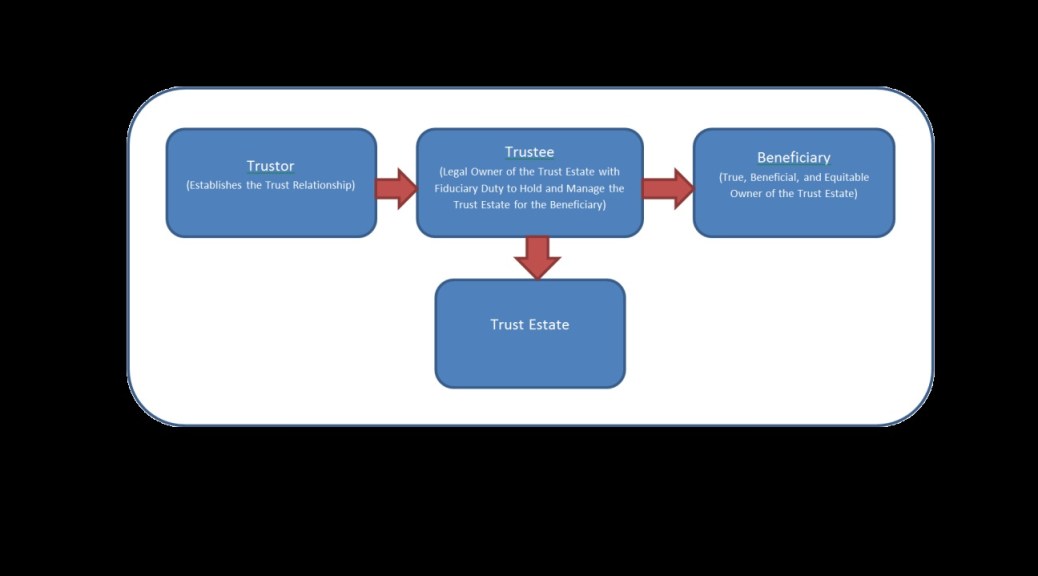
The Bible explains the God-ordained trust relationship with all property and the functions of each party to the trust relationship. That relationship has a trustor, a trustee or steward, a beneficiary, and a trust estate. The term “trust” is used in the Bible; “trustee” is explained but the term “trustee” is not used in the Bible. “Steward” is used in the Bible. Like “Trustee,” “Steward” refers to the person to whom someone commits the care and management of his goods for his benefit.

One use of term “trust” references a relationship with property, either material or spiritual. “Trust,” in the context of the trust relationship with property, means: “Property committed to a person’s care for use or management, and for which an account must be rendered. Every man’s talents and advantages are a trust committed to him by his Maker, and for the use or employment of which he is accountable.”

The suffix -or means a person who is something, such as lessor (a person who leases property) or trustor (a person who declares a trust relationship with property). A trustor commits, to the care of someone, God’s property for the sole benefit of God, the owner of the property, the owner of the property held in the trust estate. New Testament churches never owned or falsely claimed ownership of property; they were spiritual entities only, entirely separate from civil government and worldly entanglements. See, Is a Church a Spiritual or Legal Entity? In the context of the Bible trust declareded by a church, the trustor, a derivative of the term “trust,” declares the trust relationship—not with property of the church, since the church, when in obedience to the Word of God, claims ownership of no earthly property, but with property of the true owner of all things, God..

The suffix -ee is used (1) with some verbs to make nouns meaning someone who is affected by an action—as a trainee or an employee-and (2) with some verbs to make nouns meaning someone who performs an action—as a lessee, escapee. When added to the word trust, we have “trustee,” someone who performs an action. A trustee property held in trust for the true owner of the property holds and manages property for the benefit of the owner of the property. Thus, even though the term “trustee” is not specifically mentioned in the Bible, trustee accurately describes the one to whom God has entrusted His property.

The beneficiary – that is, the true, equitable, and beneficial owner – of the property held in a Bible trust is the Lord Jesus Christ, and all of the properties of the trust estate are held in trust, by the trustee, solely for the benefit of the Lord Jesus Christ who is the true, equitable, and beneficial owner of all property including all property held in the trust. The trustor, in declaring the church Bible trust relationship with property is not naming or making the Lord Jesus Christ the Beneficiary or the Trust Estate; Christ is the Beneficiary–the true, equitable, and beneficial owner of the earth and all that is in it (Exodus 19:5, Leviticus 25:23, 1 Chronicles 29:11-12, Psalm 24:1, Psalm 50:10, Psalm 89:11, Haggai 2:8).

The term “trust” refers to both temporal/earthly or material and eternal/heavenly or spiritual relationships. “Trust” relationships are found throughout the Bible, even when the word “trust,” “trustee,” or “steward” is not mentioned. Luke 16 speaks of a temporal material trust, and relates that trust to an eternal spiritual trust. 1 Thessalonians 2.4, and Titus 1.11 speak specifically and solely of the eternal spiritual trust.

The first time the relationship is mentioned is in Genesis 1.27-31, where obviously, although not explicitly stated, the relationship is both earthly and spiritual:

  • “27 So God created man in his own image, in the image of God created he him; male and female created he them. 28 And God blessed them, and God said unto them, Be fruitful, and multiply, and replenish the earth, and subdue it: and have dominion over the fish of the sea, and over the fowl of the air, and over every living thing that moveth upon the earth. 29 And God said, Behold, I have given you every herb bearing seed, which isupon the face of all the earth, and every tree, in the which isthe fruit of a tree yielding seed; to you it shall be for meat. 30 And to every beast of the earth, and to every fowl of the air, and to every thing that creepeth upon the earth, wherein there is life, I have given every green herb for meat: and it was so. 31 And God saw every thing that he had made, and, behold, it was very good. And the evening and the morning were the sixth day.”

All such earthly and spiritual relationships have several essentials: the possession(s); the true, equitable, and beneficial owner of the possession(s); the commitment by the true owner of the possession(s) to another’s care and management; and the one to whom is entrusted the care and management of the possession(s) for the benefit of the true owner. Every Bible dispensation presents a specific stewardship under God.

Only once in the Bible, in Luke 16.1-13, are the words “steward” and “trust” used in the same passage. That passage is concerned with an earthly steward dealing with earthly possessions of his earthly master, the true owner of the possessions. There, “steward” refers to the person who has a duty to manage the goods of his master, for his master’s benefit. However, the Lord makes a connection between one’s earthly stewardship and his eternal stewardship. “Stewardship” means the office of a steward. The Lord says, “If therefore ye have not been faithful in the unrighteous mammon, who will commit to your trust the true riches? … “Ye cannot serve God and mammon” (Lk. 16.11, 13).

As has been pointed out, “steward,” in one context, has the same meaning as “trustee.” So why not use “steward” instead of using derivatives of the word “trust,” to include “trustee.” The conclusion will answer this question; but first, let us take a further look at “steward” and “trust.”

God entrusted mankind with all possessions, real and personal as well as spiritual. He owned all things—even the body, soul and spirit of man—but left all things, including the real estate, to man to be used for Him. God trusted man with all His earthly and eternal possessions. God committed all to man’s trust. He was “steward” or “trustee,” the one to whom God entrusted management and care of His possessions.

Now, let us examine the terms “steward” and “stewardship” from a Bible perspective. Then we will look more at “trust” and related terms—“trustor,” “trustee,” and “trust estate.”

The term “steward” is found in Genesis 15.2, 43.19, 44.1, 44.4; 1 Kings 16.9; Daniel 1.11; Matthew 20.8; Luke 8.3, 12.42; 16.1,2, 3, 8; 1 Corinthians 4.1,2; Titus 1:7. The word “stewardship” is used only three times in the Bible, all in Luke 16, verses 2, 3, and 4. “Stewardship” simply means “The office of a steward.”

A steward is a man who has charge of another’s goods. As defined in the Webster’s 1828 Dictionary, “steward” means: “(1) A man employed in great families to manage the domestic concerns, superintend the other servants, collect the rents or income, keep the accounts, &c. See Gen. xv. 2—xliii. (2) In Scripture and theology, a minister of Christ, whose duty is to dispense the provisions of the gospel, to preach its doctrines and administer its ordinances. It is required in stewards, that a man be found faithful. 1 Cor. iv.”

The first meaning of “steward” is reflected in several passages of the Bible: Genesis 15.2, 43.19, 44.1, 44.4; 1 Kings 16.9; Matthew 20.8; Luke 8.3, 12.42, 16.1-13 (parable of the unjust steward). Certainly, although not directly dealing with the eternal meaning, many of those stewardships have spiritual applications: Matthew 20.8; Luke 12.42-48 (levels of punishment based upon whether or not the steward knew the Lord’s will), 16.1-13.

The eternal application alone is seen in 1 Corinthians 4.1, 2: “Let a man so account of us, as of the ministers of Christ, and stewards of the mysteries of God.  Moreover it is required in stewards, that a man be found faithful.”; and Titus 1.7: “For a bishop must be blameless, as the steward of God; not selfwilled, not soon angry, not given to wine, no striker, not given to filthy lucre.”.

The story of a rich man and his unjust steward, which is related in Luke 16.1-13, is very instructive. The terms “trust” and “steward” are used in that parable. The master committed his goods to the steward’s trust (verses 1 and 11). The master was the beneficiary—“the true, beneficial, and equitable owner.”

The steward in this parable was an out-and-out-crook. He was guilty of malfeasance in office and misappropriation of funds. He wasted the goods of his master. His day of reckoning had come (Lk. 16.3). He was afraid of losing his stewardship, felt he could not do manual work, and was ashamed to beg. However, he, like many, was not ashamed to steal (verse 3). He did not repent, nor did he have regret or remorse for his actions. He was crooked—called “clever” by the world’s standards. He had no training for other work, his age was probably against him, he was too proud to beg, but he was not ashamed to be dishonest. He called all his master’s debtors and gave them big discounts.

The Bible tells us that the world loves its own but hates those who belong to God. “If the world hate you, ye know that it hated me before it hated you. If ye were of the world, the world would love his own: but because ye are not of the world, but I have chosen you out of the world, therefore the world hateth you” (Jn. 15:18-19). In Galatians 1.3-4, Paul says, “Grace be to you and peace from God the Father, and from our Lord Jesus Christ, Who gave himself for our sins, that he might deliver us from this present evil world, according to the will of God and our Father.” Again, in Romans 12.2, Paul says, “And be not conformed to this world: but be ye transformed by the renewing of your mind, that ye may prove what is that good, and acceptable, and perfect, will of God.” “Love not the world, neither the things that are in the world. If any man love the world, the love of the Father is not in him” (1 Jn. 2:15).

The first commandment of the world is “self-preservation.” A shady business deal is winked at, questionable practices countenanced, and a clever crook is commended by the world. The law is on the side of the crook and the criminal many times. Every man, according to the world’s law, is innocent until proven guilty. God takes the opposite approach. God says that a man is guilty until proven innocent. “For all have sinned and come short of the glory of God” (Ro. 3.23). A man can never be innocent before God, but he can be justified before Him. When a man trusts Jesus Christ as his Savior, he is justified by faith. See, e.g., Ro. 8.1.

The master did not punish the unjust steward, but commended him. Apparently the rich man got rich using the same kind of principles that his unjust steward used and he commended him, saying that the steward had done wisely. In what way? According to the principles of the world. This is the world that hates Christ. It makes its own rules. The law of the world is “dog eat dog.” The worldly master commended his worldly steward for his worldly wisdom according to his worldly dealings. The Lord Jesus said, “… For the children of this world are in their generation wiser than the children of light.” That is, the children of this world, of this age, use their money more wisely than do the children of light.

Then, our Lord makes the most shocking and startling statement of all. It concerns the relationship of the “mammon of righteousness,” that is, riches, money: “Make to yourselves friends of the mammon of unrighteousness; that, when ye fail, they may receive you into everlasting habitations” (Lk. 16.9). Money is not evil in itself; it is amoral. The love of money is the root of all evil. For believers, money is to be spiritual. Our Lord said that we should lay up for ourselves treasures in heaven. We should be wise in the way we use our money. Then when we “fail” or come to the end of life, we will be welcomed in heaven.

Believers are spiritual stewards (trustees) of all that God commits to their trust; all of which is spiritual. We own nothing as believers. We are responsible to God for how we use His goods. We are to use the “mammon of unrighteousness” to gather spiritual wealth:

  • “He that is faithful in that which is least is faithful also in much: and he that is unjust in the least is unjust also in much. If therefore ye have not been faithful in the unrighteous mammon, who will commit to your trust the true riches?  And if ye have not been faithful in that which is another man’s, who shall give you that which is your own. No servant can serve two masters: for either he will hate the one, and love the other; or else he will hold to the one, and despise the other. Ye cannot serve God and mammon.” (Lk. 16.10-13).

In this parable, the Lord Jesus is saying, “Do you think God is going to trust you with heavenly riches if you are not using properly or rightly the earthly possessions which He has given you?” Are you serving God or mammon? You cannot serve both.

Now, let us review and supplement “trust” and related terms. “Trustor,” “trustee,” and “trust estate” are derivatives of the word “trust,” a concept found throughout the Bible. The suffix “-ee” added to trust results in a new word meaning a person with to whom something is entrusted. A “trustor” is one who entrusts monies and properties to a “trustee” who holds the money and property entrusted to him in “trust” for the benefit of the true, equitable, and beneficial owner, the “beneficiary.”

Some meanings of trust, as given in the 1828 Webster’s Dictionary, are: “(1) Confidence; a reliance or resting of the mind on the integrity, veracity, justice, friendship or other sound principle of another person. He that putteth his trust in the Lord shall be safe. Proverbs 20.25. (2) Something committed to a person’s care for use or management, and for which an account must be rendered. Every man’s talents and advantages are a trust committed to him by his Maker, and for the use or employment of which he is accountable.” In the context of definition (2), the word “trust” is mentioned four times in the Bible:

  1. “But as we were allowed of God to be put in trust with the gospel, even so we speak; not as pleasing men, but God, which trieth our hearts” (1 Thes. 2.4).
  2. “According to the glorious gospel of the blessed God, which was committed to my trust” (1 Ti. 1:11).
  3. “O Timothy, keep that which is committed to thy trust, avoiding profane and vain babblings, and oppositions of science falsely so called” (1 Ti. 6:20).
  4. “If therefore ye have not been faithful in the unrighteous mammon, who [what trustor] will commit to your trust the true riches? And if ye have not been faithful in that which is another man’s, who shall give you that which is your own” (Lk. 16:11-12)?

In all these references, that which God entrusted was not material and spiritual, but spiritual only—“the true riches.”

The Lord spoke of this concept of trust, in conjunction with an earthly temporal example in Matthew 25.14-30 and Luke 19.12-27, although He used neither the word “trust” nor “steward” or “stewardship.” He spoke of an earthly master leaving certain amounts of his goods or money with his servants, according to their abilities. Actually, the more important parallel spiritual meaning was to the Lord and His servants. The master had an absolute right to his own goods, but he distributed to his servants to be used for the benefit of the master, the servants to be awarded according to their profitable use of the property entrusted to them. Some used the money productively and upon the master’s return presented him with a profit. The property belonged to the master, and the servants were to use it for the master’s benefit, not for their own benefit. Of course, they would be rewarded if they used the property wisely for the benefit of the master. One servant in each example returned only the original amount left in trust with them. The master instructed that the goods which he had left with the unprofitable servants be taken from them, and they were left with nothing. The profitable servants were rewarded by the master. In the story found in Matthew, the Master said, “[C]ast ye the unprofitable servant into outer darkness: there shall be weeping and gnashing of teeth” (Mt. 25.30). Men, as servants of the Master are likewise left in trust of all things for His benefit and will be rewarded or punished accordingly.

In conclusion, the words “steward” and “trustee” signify the same thing. However, the use of the term “trustee,” a word derived from the word “trust” by adding the suffix “-ee”  is preferable to the use of “steward” when describing the entire relationship. Why? For six reasons taken together. First, in only one context do the terms “steward” and “trustee” mean the same thing.

Second, the one time “trust” and “steward” are used in the same immediate verses, “steward” denotes the person with the responsibility over another’s goods and “trust” is used to signify the fiduciary relationship with the master’s goods or property (Lk. 16). Even though “steward” is the one with the duty to rightly administer the goods the master commits to his trust, the name given to the arrangement is “trust.”

Third, nowhere in the Bible are all the terms involved in the relationship reduced to singular (as “trustor”) or modified terms (as “trustee” or “trust estate”); yet, those terms accurately explain elements of the trust relationship even though the specific terms are not in the Bible.

Thus, fourth, the use of “trust” and derivatives is more practical. The term “trust” as a noun (and as an adjective) and its derivatives, more succinctly describe aspects of the relationship: “trustor,” “trustee,” and “trust estate.” On the other hand, the term “stewardship” is less adaptable: one can interchange “steward” and “trustee;” but the word “trust” describes the overall relationship. No word derived from “steward” or from which “steward is derived” describes the person who declares the stewardship (the “trustor”). No word derived from “steward” or from which “steward is derived” describes the estate the steward is responsible for (“trust estate”)—er, perhaps the “stewardship estate?”; but stewardship means the office of a steward. Parallel words leave less room for argument and misunderstanding. Imagine trying to explain these matters to a lost person.

Fifth, the church, not God, declares a Bible Trust relationship with property. To repeat: “Steward” refers to the person to whom someone commits the care and management of his goods for his benefit. In the church Bible Trust context, the church, the trustor, not God, consistent with Bible principle, commits the care and management of God’s goods for God’s benefit.

Finally, American law, although not legalizing or setting up the Bible concept of trust, recognizes and defines the trust elements consistent with Bible principle. American law uses the Bible term “trust” and its derivatives.  For example, American Jurisprudence 2d Trusts, a highly regarded encyclopedia of American law, describes “trust” in § 1, as follows:

  • “The fundamental nature of a trust is the division of title, with the trustee being the holder of legal title and the beneficiary that of equitable title. By definition, the creation of a trust must involve a conveyance of property.
  • “A ‘trust’ exists where the legal title to property is held by one or more persons, under an equitable obligation to convey, apply, or deal with such property for the benefit of other persons. A trust has been defined as a fiduciary relationship with respect to property, subjecting the person by whom the title to the property is held to equitable duties to deal with the property for the benefit of another person, which arises as a result of a manifestation of an intention to create it. The Restatement definition is similar, providing that a trust, when not qualified by the word ‘resulting’ or ‘constructive,’ is a fiduciary relationship with respect to property, arising from a manifestation of intention to create that relationship and subjecting the person who holds title to the property to duties to deal with it for the benefit of charity or for one or more persons, at least one of whom is not the sole trustee.
  • “Caution: A trust consists not only of property, but also of the trust instrument, the trust’s beneficiaries and trustees, and the trust administrator [if any].”

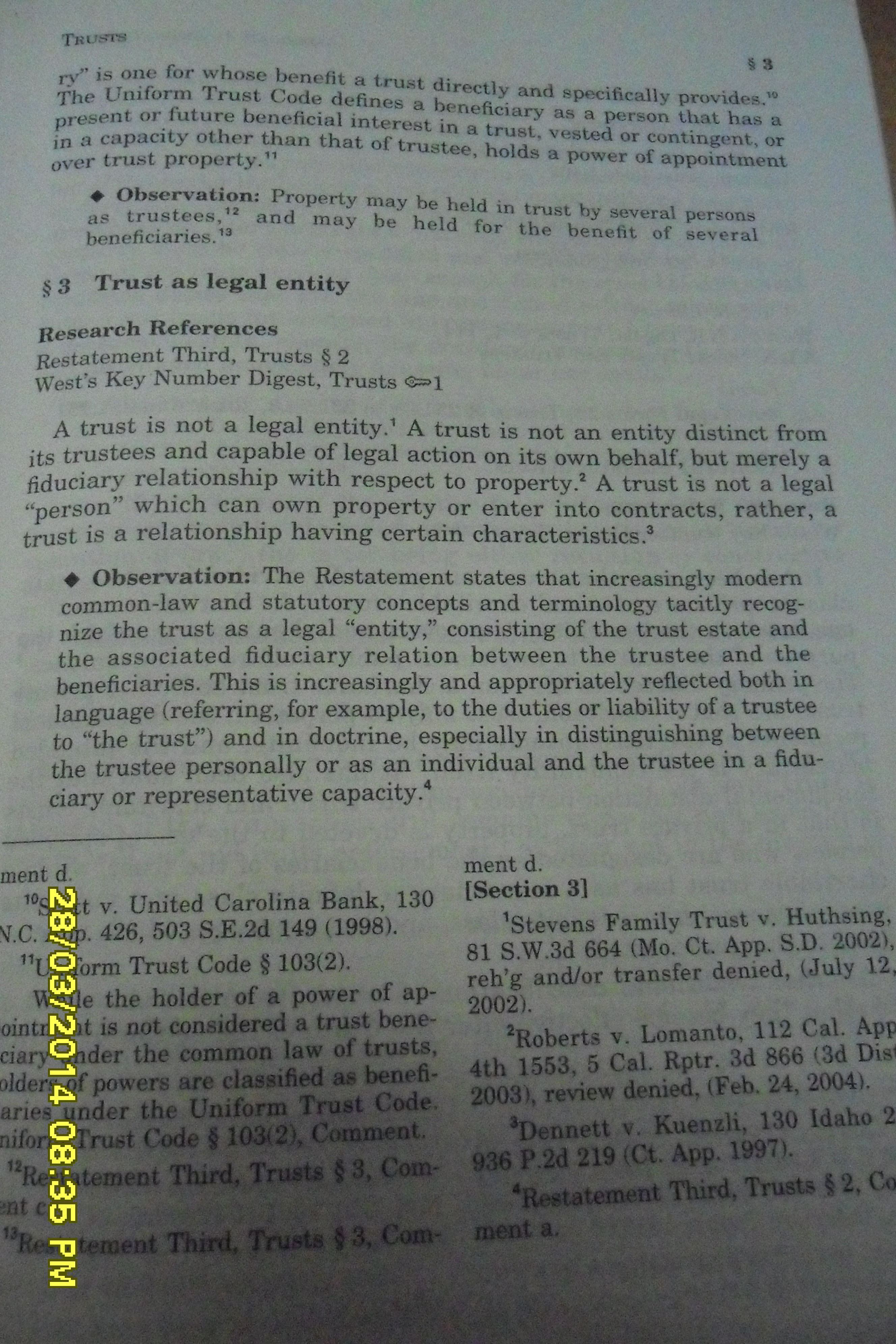
American Jurisprudence 2d, Trusts § 2 makes clear that a “trust” is not a legal entity, but merely a fiduciary relationship with property. For one thing, this means that the one cannot sue the trust, since it is not recognized as a legal entity. This is not true of a “business trust,” a “charitable trust” or some other legal extensions of the “trust” relationship.

Even though particular words are not necessary to create the Bible Trust relationship, as a study of God’s Word reveals, using certain words is a simplified way of declaring the Bible Trust relationship. “No particular words are necessary to declare a trust if there exists reasonable certainty as to the intended property, object, and beneficiary. Further, the purpose and intention, rather than the use of any particular term, determines whether a valid trust has been established.” American Jurisprudence 2d, Trusts § 65. The preservation of God’s Word exactly as inspired by the Holy Spirit is very important to God. See, e.g., Psalm 12:6-7, Deuteronomy 4:1-2, Proverbs 30:5-6; Revelation 22:19. Within those Words are concepts which God wishes His children to understand, apply, and obey.

The important thing for the born-again believer, regardless of the terms used, is that he handle the use of God’s properties, both material and spiritual, according to the principle of trust as described in the Bible. Those faithful and wise churches who remain under God only will be blessed by their Lord. However, churches who choose to leave their first love by placing themselves at least partially under the state (for example, corporate (aggregate or sole) 501(c)(3) or 508(c)(1)(A) churches), have left their first love and betrayed their Lord’s trust. They are unfaithful and act unwisely; they act either knowingly or unknowingly and will  be judged accordingly (see Lk. 12.42-48; see also Lk. 16 discussed above).

Section I, Chapter 3: How a Church Can Nullify the Bible Trust Relationship with Property

Click here to go to the following webpage for Table of Contents with links to all chapters of: Simply Church: The Holy Union of Christ and His Local Church

Appendix 1 gives links to resources which explain why church incorporation, federal tax exempt status, and other statutory or legal status of churches betray the love relationship between Christ and His churches.

Appendix 2 looks at common law versus statutory law church Bible Trust considerations.

Jerald Finney
February 7, 2023

A church who practices New Testament doctrine concerning the trust relationship with property can nullify that relationship when she acts legally. By acting legally, a church places herself under another jurisdiction for many purposes. There are two ways a church may act legally. (1) Churches combine with the state—through contracting with a state for statutory status (incorporation, charitable trust, etc.) or the federal government for tax exempt status under Internal Revenue Code § 501(c)(3) or § 508(c)(1)(A). See, Church Internal Revenue Code § 508(c)(1)(A) Tax Exempt Status and the essays linked to thereon for explanation. (2) Other churches who do not contract with the state or federal government through some statutory means simply act legally and thereby become legal entities subject to civil government jurisdiction for many purposes.

Churches who act legally are legal entities who have given up much of their First Amendment status and placed themselves under the Fourteenth Amendment for many purposes. A legal entity is an entity that can be sued, sue, charged with a crime, enter into contracts, or act legally in some other way.

A legal entity is a creature which is entirely distinct from a spiritual entity. See, Short Answers to Some Important Questions for explanations of matters such as the meaning of “legal entity” and “spiritual entity.” A corporation, for example, is an “artificial person” with no soul to save and no body to resurrect. See, for explanation, Corporation: A human being without a soulIn other words, when a church acts in a temporal worldly matter, that church becomes a legal entity and subjects herself to man’s law and the courts of the world as opposed to a spiritual entity subject to Christ and Christ alone. That church has “left her first love” by joining herself with another lover. She has chosen to abandon her First Amendment spiritual only status in favor of Fourteenth Amendment legal status and civil government control and jurisdiction for many purposes.

Remember, should a church who is not a legal entity be named in a criminal or civil suit, she should not submit to suit; the pastor or another mature church member with knowledge, wisdom, and understanding of these matters should make a special appearance contesting jurisdiction of the court over the church, pointing out that the church is not an earthly legal entity subject to court jurisdiction. The court cannot claim jurisdiction over a non-legal entity.

How can a non-statutory church act legally? She can, for example, hold a credit card, hold deed to real property, open a bank account, get an Employee Identification Number (EIN), hold title to motor vehicle(s), hold insurance, contract, borrow money, incorporate the church or a ministry of the church, apply for or claim federal tax-exempt status for the church or a ministry of the church, have employees, pay salaries, adopt a constitution and/or by-laws or do anything else in accordance with or subject to man’s legal system and not according to New Testament church guidelines and example. Our Lord looks at only one disregarded aspect of honoring the church relationship with Him as a serious infraction, especially when committed knowingly. Negligence and recklessness are no excuse. Church members should be diligent in the matter of the purity of God’s churches.

A church who holds insurance admits that she is a legal worldly entity who can be sued. Should a church Bible Trust obtain insurance (such as liability insurance on real estate) in the name of the trust, the insurance policy does not implicate the church. Some trustees get insurance in the name of the trust, but the insurance policy explicitly covers the church. The trustee must be careful to  make sure that the policy is not a church policy with the name of the trust on it. Insurance sellers are not familiar with the church Bible Trust and will, if the trustee of the trust allows, simply put the name of the trust on the standard church policy, thereby nullifying the Bible Trust by setting the church up as a legal entity.

A pastor of a church may also compromise the position of the church as a church under Christ alone by taking a license from the state to act in a pastoral capacity; a license to conduct marriage ceremonies, for example.

God gave churches and civil government distinct jurisdictions. However, he gave neither jurisdiction over the other. See, God Betrayed/Separation of Church and State: The Biblical Principles and the American Applicaiton. As long as a church honors God’s principles, no civil government has God-given jurisdiction over that church. The First Amendment to the Constitution and corresponding state constitutional provisions recognize this Bible principle. There are two caveats: (1) States allow churches a choice: remain under Christ alone or contract with the state for legal status. (2) The Federal government allows churches to apply for legal status under Internal Revenue Code § 501(c)(3) or claim such status under§  508(c)(1)(A). ). See, Church Internal Revenue Code § 508(c)(1)(A) Tax Exempt Status and the essays linked to thereon for explanation.

God gave civil government authority to punish evildoers and reward those who do good:: jurisdiction over any evil doer, to include church members, who commit crime or violate their duty to another or others and thereby injure them. However, God gave civil government no jurisdiction over individuals who do good and honor God. A civil government who acts outside its God-given jurisdiction is tyrannical. In a tyrannical nation—such as North Korea, China, and many other nations—individual believers who come to the attention of the state are summarily executed, tortured, or imprisoned. No matter, “churches and believers should obey God rather than man,” even to the point of martyrdom. A tyrannical civil government such as North Korea can kill the body but cannot send the body, soul, and spirit to hell.

A properly implemented trust relationship with money and/or property keeps a church entirely out of man’s earthly legal systems and under the Lord Jesus Christ in all things. That is, if the church does not misstep and declare herself to be a legal entity subject to the law of man in some other way. Thank the Lord and the martyrs of Jesus who, in putting Christ first in all things, paid the price that led to the protections of religious freedom and soul liberty in First Amendment to the United States Constitution and corresponding state constitutional provisions; churches in America can do things God’s way without persecution. Sadly, only a small remnant do so.

Section 1, Chapter 2: THE BASICS AND ELEMENTS OF A CHURCH BIBLE TRUST relationship with property

76 American Jurisprudence 2d, Trusts § 3

Click here to go to the following webpage for Table of Contents with links to all chapters of: Simply Church: The Holy Union of Christ and His Local Church

Appendix 1 gives links to resources which explain why church incorporation, federal tax exempt status, and other statutory or legal status of churches betray the love relationship between Christ and His churches.

Appendix 2 looks at common law versus statutory law church Bible Trust considerations.

Jerald Finney
January 19, 2023

The Basics

The church Bible Trust is a plan or concept of God in Scripture, as Chapter 6 explains. The church who honors this plan does not organize as a trust; rather, she declares and practices the same relationship with property as did churches in the New Testament.

The Bible Trust is a fiduciary relationship with real and personal property (personal property includes intangible property such as money and bank accounts). This relationship is recognized, but not created by, man’s law. It is created by an agreement between a trustor and trustee, is private, creates no contract with the state (the state is not a party), and is not subject to control by civil government and its courts. Trust documents, if any, are never required to be filed in man’s legal system through any of its courts or agencies. Under both the common law and statutory law, if applicable, oral trusts are recognized. Upon petition by an interested party regarding trust affairs and/or administration, a court may, if proper, take jurisdiction over any issue or issues raised. Court decisions will be based upon the common law and/or statutes of the state, as well as principles of equity.

A church does not apply to the state, according to state law, for Bible Trust status, as with a corporation, charitable trust, business trust, or some other type of legal organization. No trust papers are filed with the state because the trust relationship is private. A church who declares the Bible Trust Relationship with property, either orally or in writing, remains totally under the authority of the Lord Jesus Christ and His word as long as she does not act as a legal entity. Even a deed naming, for example “the Lord Jesus Christ” and signed by two deacons, for example, is a written declaration of the trust relationship; the deacons who sign the deed are “trustees” even though another term is used. However, the used of an document which declares the trust relationship and all related matters is the best way to declare the relationship for numerous reasons.

The trustee(s) of trust holds and manages, according to his (their) fiduciary duty, the property in the trust estate for the benefit of the true owner of the property, the Lord Jesus Christ, not for the church. Gifts are to God and are held in His trust estate, not in a corporate or a church bank account. The trustee is the legal (temporary earthly) owner of the property and the Lord Jesus Christ is the true, equitable, and beneficial owner.

The trustor implicitly or explicitly declares the relationship and names a trustee who agrees to administer a trust estate funded by the trustor (and others, if any, who wish to contribute to the trust estate) solely for the benefit of another, the true owner of the trust estate, the beneficiary (the Lord Jesus Christ). The trustor merely establishes the trust relationship. The trustee administers the trust estate solely for the benefit of the owner of the trust estate. Once assets are placed in the trust estate, those assets are owned by the beneficiary, the true owner of the property in the trust estate, and are to be used according to his will.

The Elements

Since a Bible Trust relationship is one in which church reaches an agreement with a person to hold and manage property for the benefit of the owner of the property, the Lord Jesus Christ, convenient, but not necessary, terms for the elements of the relationship are trustor, trustee, beneficiary, and trust estate.

A trustor or settlor is the one who establishes a trust agreement. God was trustor of all things. He appointed man as trustee. The earth and the things that are in it compose the earthly trust estate of the trust relationship with property established by God, the beneficiary (true, equitable, and beneficial owner of the earth and all that is in it).

A church can implicitly operate according to God’s plan of organization by observing God’s concept of trust without written documents as a spiritual entity only. Either way, every church who declares the Bible Trust, and the mature church members, should understand its principles and application. In order for the trustee to, for example, open a trust bank account to hold God’s money, or to hold title to real estate to be used for a meetinghouse, the church must declare the relationship in writing. Every mature church member should understand, among other things:

  1. That the elements of the trust relationship are trustor, trustee, trust estate, and beneficiary.
  2. That the trustor church declares the trust relationship and appoints a trustee:
  3. That the trustee agrees to become the legal (earthly, temporal) owner of the trust estate. He agrees to hold and manage the trust estate solely for the benefit of the Lord Jesus Christ, the owner of the trust estate, according to His will as expressed in His Word, the Holy King James Bible. The trustee receives no compensation for serving as trustee.
  4. That the trustee has a fiduciary duty to use the trust estate for purposes consistent with the will of God as laid out in God’s Word.
  5. That the beneficiary, the Lord Jesus Christ, is the true, equitable, and beneficial owner of everything in the trust estate.
  6. That all ll property in the trust estate is to be held and managed by the trustee, the legal (earthly) owner of the trust estate, solely for the benefit of and according to the will of the true, equitable and beneficial owner of the property, the Lord Jesus Christ.

An inactive trust is no trust at all. Without all four elements, there is no trust relationship with property. There must be a trustor, a trustee, a beneficiary, and a trust estate.  If no property is in the trust estate, there is no trust relationship with property and no Bible trust. Some churches have properly drafted and executed documents establishing a proper trust relationship in order to remain under the Lord Jesus Christ only; but they have nullified their efforts by never listing trust property to the trust estate in an appendix to the trust document. All property and assets in the trust estate should be listed in the appendix. Again, if no property is placed in the trust estate, the trust is non-existent. The Appendix should list all personal property (song books, pews, musical instruments, etc., checking account, real property, motor vehicles, and other assets held in trust estate.

Real property in the trust estate, if any, is held in the name of the trust, or in the name of the trustee as follows: “John Doe, Trustee of ABC Trust]. Should property be held in the name of the trust, the trustee is the legal owner of the trust (the one who holds and manages the property in the trust estate solely for the benefit of the true owner of the property, the Lord Jesus Christ)]. Both the state and the Lord require someone to hold temporary earthly title to His real property. As to property on which a church meets, if no one holds legal title and if it is brought to the attention of the state, the state will declare someone to be legal owner of that property.

Titles to motor vehicles, if any, in the trust estate are held in the name of the trust, or by the trustee as follows: John Doe, Trustee of ABC Trust.

Banks accounts, if any, holding funds in the trust estate are held in the name of the trust, or by the trustee as follows: John Doe, Trustee of ABC Trust.

The pastor should be trustee named in a church Bible trust agreement although a deacon or other mature male church member can serve as trustee. The pastor should be as qualified or more qualified as any man in the church to hold and manage God’s earthly property. Of course, the pastor can appoint others to perform certain duties; but he is the one ultimately responsible. See Endnote [i]. The trust relationship can be modified to accommodate churches who are led by a plurality of elders.

The trust document, if any, should include language which prohibits the trustee from using any property, or proceeds from the conveyance of any property in the trust estate, for the benefit of himself or anyone else. The document should make clear that in no event will the ownership of any property in the trust estate ever inure to the benefit of or be transferred to any member or members of the church except as consistent with Bible guidelines. For example, “Even so hath the Lord ordained that they which preach the gospel should live of the gospel” (1 Corinthians 9:14).

A written document declaring the trust relationship with property should include language such as:

“God, as declared in His Word has designated the Lord Jesus Christ to be the true, equitable, and beneficial owner of the earth and all that is in it (Exodus 19:5, Leviticus 25:23, 1 Chronicles 29:11-12, Psalm 24:1, Psalm 50:10, Psalm 89:11, Haggai 2:8). This document is merely declaring that truth:

  • “The Beneficiary of this Trust is the Lord Jesus Christ, and all of the properties of the Trust Estate are held in Trust, by the Trustee, solely for the benefit of the Lord Jesus Christ who is the true, equitable, and beneficial owner of all property including all property held in Trust.”

Endnote

[i] Timothy was a preacher with a special position of trust. Timothy was a trustee of a spiritual heritage: “O Timothy, keep that which is committed to thy trust, avoiding profane and vain babblings, and oppositions of science falsely so called:” (1 Ti. 6.20). Likewise, elders, which includes pastors, must meet specific requirements which not every man in a church can meet. (See, for example, Tit. 1.5-9). An elder must hold fast the Word of God, “that he may be able by sound doctrine both to exhort and to convince the gainsayers” (Tit. 1.9-16, 2.2; see also, Ac. 11.30, 14.23, (ordained elders in every church), 15.2, 4, 6, 22-23, 16.4, 20.17, 21.18; 1 Ti. 5.1 (“rebuke not an elder, but entreat him as a father”), 1 Ti. 5.17-19; Ja. 5.14-15; He. 13.7, 17; 1 Pe. 5.1 (Peter the Apostle was an elder, here writing to “the elders who are among you”; 1 Pe. 5.5 (younger to submit to the elder, and all to submit to one another); 2 Jn. 1 and 3 Jn. 1 (John the Apostle was also an elder);

Biblically, a pastor must meet stringent God-given requirements:

  • “This is a true saying, If a man desire the office of a bishop [pastor], he desireth a good work. A bishop then must be blameless, the husband of one wife, vigilant, sober, of good behaviour, given to hospitality, apt to teach; Not given to wine, no striker, not greedy of filthy lucre; but patient, not a brawler, not covetous; One that ruleth well his own house, having his children in subjection with all gravity; (For if a man know not how to rule his own house, how shall he take care of the church of God?) Not a novice, lest being lifted up with pride he fall into the condemnation of the devil.  Moreover he must have a good report of them which are without; lest he fall into reproach and the snare of the devil.” (1 Ti. 3.1-7).
  • “For a bishop must be blameless, as the steward of God; not selfwilled, not soon angry, not given to wine, no striker, not given to filthy lucre;” (Tit. 1.7).

These requirements are strict because a pastor, and every member of a church, is entrusted by God to “take care of the church of God.” (1 Ti. 3.5).

“The elders [pastors included] which are among you I exhort, who am also an elder, and a witness of the sufferings of Christ, and also a partaker of the glory that shall be revealed: Feed the flock of God which is among you, taking the oversight thereof, not by constraint, but willingly; not for filthy lucre, but of a ready mind; Neither as being lords over God’s heritage, but being ensamples to the flock. And when the chief Shepherd shall appear, ye shall receive a crown of glory that fadeth not away.” (1 Pe. 5.1-5).

The Bible proclaims: “Remember them which have the rule over you, who have spoken unto you the Word of God: whose faith follow, considering the end of their conversation.” (He. 13.7). “Obey them that have the rule over you, and submit yourselves: for they watch for your souls, as they that must give account, that they may do it with joy, and not with grief: for that is unprofitable for you.” ( He. 13.17). “Salute all them that have the rule over you, and all the saints….” (He. 13.24). “Them” is plural, and includes the pastor and other elders of a church.

The elders, including the pastor, are to oversee a church: “Take heed therefore unto yourselves, and to all the flock, over the which the Holy Ghost hath made you overseers, to feed the church of God, which he hath purchased with his own blood.” (Ac. 20.28). Paul was speaking to the elders of the church at Ephesus (Ac. 20.17-18).

A pastor is responsible to act as a ruler, trustee, steward, and overseer of a church. As such, he should be as qualified as any other church member to be the trustee of God’s trust estate.

Analysis of “Jefferson’s Virginia Statute & How Courts Twisted Meaning of First Amendment to make Government Hostile to Religious Liberty” on American Minute by Bill Federer

Click here to go to homepage with links to all analyses of “An American Minute by Bill Federer” Challenged

For a documented history of the spiritual warfare in America that started in the colonial period and continues to this day, see The Trail of Blood of the Martyrs of Jesus/Christian Revisionism on Trial.

The real problem in America is that the United States Supreme Court removed God all civil government matters. To understand how that happened, see Section V of God Betrayed/Separation of Church and State: The Biblical Principles and the American Application, p. 194, available in online PDF.

Jerald Finney
January 18, 2023

This article challenges Bill Federer’s American Minute publication: Jefferson’s Virginia Statute & How Courts Twisted Meaning of First Amendment to make Government Hostile to Religious Liberty.

CONTENTS:

Introduction
A. Challenge to Bill Federer’s understanding of the Virginia Statute for Religious Freedom
B. Challenge to Federer’s contention that religion was left up to the states
C. Challenge to Federer’s understanding of how the courts twisted the meaning of the First Amendment to make government hostile to religious liberty
Conclusion

Introduction
As is the case with all Christian Revisionist publications, Jefferson’s Virginia Statute & How Courts Twisted Meaning of First Amendment to make Government Hostile to Religious Liberty ignores a significant portion of the spiritual warfare in the colonies which resulted in the adoption of the First Amendment, the period from the early 1630s until the incomplete Virginia portion of the conflict starting in 1760s (leaving out relevant Virginia history before then, and after the passage of the Virginia Statute for Religious Liberty). The warfare began in the Calvinist New England colonies and spread to other colonies. Christian Revisionists do not want to open what to them is a can of worms, the truth about the New England Calvinist church/state theology and the accompanying persecutions of dissenters by a controlling Calvinist establishment (union of church and state).

That is why Christian (Calvinist) historical revisionists falsely claim that the movement toward religious freedom in America started with the American Revolution and that the Virginia Statute for Religious Liberty birthed religious freedom in America. This is not new. In the late 1980s, I began to realize that their histories left blank the colonial history after the first few years of the Jamestown and New England settlements in the early 1600s until the Virginia persecutions of dissenters immediately prior to the Revolution (1760s) and forward.

Calvinist revisionists have always sanitized their Christian Revisionist histories of Puritan New England, by leaving out significant historical facts, by praising the Puritan Calvinists, and by reaching untenable conclusions (such as their partially true claim, “The Puritans came to New England for religious liberty” leaving out a significant fact, “for themselves only.”).

Revisionists never get into the Calvinist theology which denies religious liberty and calls for harsh and strict enforcement, by the church/state alliance, of all Ten of the Commandments and many moral, not criminal, matters. Had Calvinist theology prevailed, America would not have religious liberty; there would be no First Amendment. Never do they report the persecutions of dissenters by the original Calvinist church/state alliances. Never do they mention books, tracts, speeches etc. written by persecuted dissenters like Roger Williams, Isaac Backus, and others. For example, The Bloudy Tenent of Persection for Cause of Conscience by Roger Williams, published in 1644, chronicled the persections of dissenters in New England; and, equally important, it exposed (and continues to expose to those who read it) the Puritan theology for what it was and is.  The writings of Williams, and their actions, were preeminent in the battle for religious liberty in American.

The original New England Calvinist histories revised history as it occurred. That same revisionism continues until this day.  I explain this in some detail in The Trail of Blood of the Martyrs of Jesus/Christian Revisionism on Trial (This book also exposes the motives and techniques of Calvinist revisionists). When one knows the the whole story, this Amerian Minute, Jefferson’s Virginia Statute & How Courts Twisted Meaning of First Amendment to make Government Hostile to Religious Liberty is another easily dissected bit of revisionism.

Other revisions are on display in Federer’s article. Christian Revisionists are experts in the use of soundbites. For example, they say, “Separation (or complete separation) of church and state is not in the Constitution.” Those words are not there, but the law meant for complete separation of church and state is, the First Amendment. An honest historical review and analysis proves this beyond any doubt. To support the soundbite, revisionists select quotes and facts completely out of context. They leave out portions of history, caselaw, that disprove their conclusions and soundbites and shine light on their theologies.

They say that the First Amendment “left religion under the control of the states” and try to prop up that statement with more inaccuracies. By the time of the adoption of the First Amendment, most of the colonies which had established churches had abandoned one church establishment in favor of multiple church establishment and this carried over to statehood. Three more states followed suit soon thereafter. Two more, Virginia and West Virginia forbade incorporation (establishment of churches). Rhode Island had never allowed union of church and state. in 1833 Massachusetts become the last state to do away with state mandated establishment. Every state now allows churches a choice: (1) become an earthly entity by combining with state government (establish) through incorporation or some other statutory means, or (2) remain a spiritual entity totally separate from civil government.

Below is a more complete analysis of the revisionism in Jefferson’s Virginia Statute & How Courts Twisted Meaning of First Amendment to make Government Hostile to Religious Liberty.

A. Challenge to Bill Federer’s understanding of the Virginia Statute for Religious Freedom

Let us first look at Federer’s comments on the Virginia Statute for Religious Liberty in this American Minute; second, let us look at a summarized version of the relevant history for the truth of the matter.

Federer begins by praising religious freedom, the Virginia Statute for Religious Liberty, and the First Amendment. He states out of context and unanalyzed quotes and conclusions to show that the movement toward religious freedom in America started with the American Revolution and that the we owe the Amendment and our religious freedom to the Virginia Statute for Religious liberty which “preceded the First Amendment by five years.” Nothing could be further from the truth. As will be shown below, the First Amendment and its protections for religion, soul liberty, press, association, speech, and the right to petition the government for a redress of grievances was the product of spiritual warfare that was continued from the Old World long before the colonization of America and continued in the colonies under different circumstances.

As truthful documented historical research shows, the Virginia Statute for Religious Liberty, authored by Thomas Jefferson in 1779 and passed in 1786, was just one brick in the brick road that led to the adoption of the First Amendment.

Federer states that the American Revolution brought a need to work together amongst all the colonists. He says, “Like dropping a pebble in a pond and the ripples go out, individual States began to expand religious liberty at their own speeds: [he lists those to whom religious liberty extended, to include atheists.].” First, there were colonies, not states, at that time. The dissenters in each colony had already made much progress in their fight for religious liberty. One colony had won that battle with its founding in the 1630s, the colony of Rhode Island. The pebble had been dropped in the pond in the early 1630s with the arrival of Roger Williams in Congregational (Puritan) Massachusetts.

Williams, a brilliant and charismatic man, was earmarked to be a pastor and leader. However, he took issue with the ecclesiocratic (falsely called theocratic) union of church and state in Massachusetts and the legislation of all Ten of the Commandments. The Congregationalists tried to persuade him that he was wrong on that and some other matters, but he refused to budge from the truths of the Word of God. As a result, he was sentenced to banishment to England. Instead, he with some followers left in the middle of New England winter and went to what was to become the colony of Rhode Island. There he founded the first civil government in the history of the world with complete religious liberty. Then came others. Dr. John Clark and some men who came with him from England also ended up in Rhode Island shortly after Williams and his followers arrived there. Clarke shared Williams’ views on the relationship of church and state. Every American would do well to read their writings and history which are still available today for the interested student with an open mind.

Williams and Clark wrote and published books exposing the truth about the Puritan theology and the persecutions of the dissenters against the established church in the New England colonies. And there were others in this fight which continued up until the adoption of the First Amendment.

The opposing parties in the spiritual warfare were from different lines. On one side were the Calvinists, the persecutors, and on the other side were the “dissenters,” mainly the Baptists. The Baptists were in the line that came through the first churches and Antioch. The Calvinist line came from Alexandria and Rome. The former were used by God to meticulously preserve Scripture always stood for Bible truth; for example, believer’s baptism and separation of church and state. The latter revised Scripture and important Bible truths to fit their theology; for example, they instituted infant baptism and, with the marriage of some of the churches to the state under Emperor Constantine, union of church and state. The latter began with Catholicism and continued with Protestantism in the Old World and into the colonies. The colonial establishments (unions of church and state) in New England traced their origins back to the theology of John Calvin. Calvin’s church/state theology, as were other Protestant theologies regarding the relationship between church and state, was a modification of the theology of Augustine.

Calvinists incorrectly apply the principles of the “theocracy” of Israel to Gentile nations. “Theocracy” was a term used by Josephus to define the union of religion and state under God in Israel. According to the Old Testament, all nations were Gentile until God called out Israel. In Israel, and Israel only, God was directly over both the state and the religion. In Israel, the religion and state were to work together, under God; He was the lawgiver, judge, and king, over the nation and the Jewish religion. Israel was the only theocracy God ever ordained. God’s Abrahamic, Mosaic, Palestinian, and Davidic covenants were to Israel only. Gentile nations, as ordained by God, were to continue under the covenants given to Adam (Genesis 3:14-19) and Noah (Genesis 9:1-7). Of course, the Bible makes clear that God is Supreme over all nations, but God’s treatment of  Israel and Gentile nations is distinct, as is the God-ordained relationship between church and state.

Those “Christians” who support union of church and state spiritualize much of the Bible instead of believing all of it. They contend that the church replaced Israel, and that the principles for the theocracy of Israel apply to the church and Gentile nations. They “Judaize” the church and the state. The Bible is very clear: God made “everlasting” promises to the nation Israel, promises which he did not make to Gentile nations. Gentile nations like America were never under the law, as was Israel. Gentile nations are judged by God based primarily upon their treatment of Israel as well as their morality.

No Gentile nation can be a theocracy, since God only ordained one theocracy, the nation Israel. He did so for specific purposes. Catholic and Calvinist theologians call their unauthorized unions of church and state (not God and state) “theocracy.” Their churches have always worked hand in hand with the states they unite with: the church over the state, the state over the church, or partners working together for the same goals. When, as in the Old World and in most of the colonies, at first, one particular church united with the state the established church/state severely persecuted dissenting believers.

Church/state unions, before the advent of multiple establishments in America, enforced all Ten of the Commandments and persecuted those who would not bow down to the official alliance; in this way they were like the Jewish religion and state which originally worked hand in hand, under God. As we know, Israel asked for a king, like the other nations, to lead and judge her. They were not satisfied with God’s direct lawgiving, leadership, and judgment of the nation. God always gives the people what they want, even if it is against His will. All this is covered in some detail in God Betrayed/Separation of Church and State: The Biblical Principles and the American Application ,available in online PDF.

Thankfully, the Judaizers in America lost the battle on the national level with the adoption of the First Amendment. They partially won on the state level, with most of the colonies, and then states which had not done so during the colonial period, doing away with forced establishment, but allowing churches to choose to establish by contracting with the states for corporate status or other legal status. Sadly, most churches chose to betray God.

By the time the First Amendment was added to the United States Constitution, only New Hampshire, Massachusetts, and Connecticut had mandatory establishment of churches. In 1833, Massachusetts became the last state to do away with required establishment. In almost all the states after 1833, establishment was voluntary. A couple did not allow church incorporation for a long time thereafter. A couple did not allow church incorporation. A church could and can choose to either remain separate from civil government or to combine or unite with civil government through non-profit corporation status, charitable trust status, or some other statutory manner. Of course, any church could choose to become established unlike in Europe to that point where only one church could establish and dissenting believers were persecuted. See, for a relatively concise history, see The History and Meaning of “Establishment of Religion” in America; see also, What Is an Established Church?

I chronicle the documented historical facts of this history in much more detail in in The Trail of Blood of the Martyrs of Jesus; see also Section IV of God Betrayed/Separation of Church and State: The Biblical Principles and the American Application ,available in online PDF.

Federer, and other revisionists on the Calvinistic side of these matters, seek to cover up this complete history. Their ultimate goal is to set up both state and federal government ecclesiocracies which they call theocracies. Their ultimate goal is union of church and state with the two as equal partners, the church over the state (as in the New England colonies, Germany under Lutheranism, Geneva under Calvinism), or the state over the church (the southern colonies, England). See The Trail of Blood of the Martyrs of Jesus for much more on this.

The American Revolution and the Virginia Statute for Religious Liberty were pieces of the puzzle that led to the adoption of the First Amendment, but only pieces, and not the largest pieces to be sure.

B. Challenge to Federer’s contention that religion was left up to the states

Next, Federer goes to the state level. The point he tries to make is that control of religion was left up to the states. He asserts that the people of the states are to decide the level of religious freedom and that control of religion was left to the states. Again, inaccurate conclusions. He also incorrectly states that all the states supported, financially aided, both the church and the government. That is not true. Rhode Island originally did not allow incorporation of churches and church and state were entirely separate. After the war for religious freedom was over in Virginia, Virginia did not allow incorporation of churches until 2002. See, Fallwell v. Miller, 203 F. Supp. 2d 624 (W.D. Va. 2002). Nor did West Virginia permit church incorporation. Article VI, Section 47 of the West Virginia Constitution explicitly states: “No charter of incorporation shall be granted to any church or religious denomination.” However, most states originally, and all now, allow union of church and state through various statutory means: incorporation, charitable trust, business trust are examples.

Every state Constitution has provisions which protect all, or almost all, the freedoms embodied in the First Amendment. They all protect religious freedom, soul liberty, speech, association and press. Every state allows churches the choice of remaining totally outside government statutory status and control. To see this for yourself online google, “Constitution of [name of state].”

Here is an example of what you will find. Indiana law recognizes that churches should be free to organize under Christ and Christ alone; and protects the soul liberty of the citizens of Indiana. The Preamble to the Indiana Constitution states:

“TO THE END, that justice be established, public order maintained, and liberty perpetuated; WE, the People of the State of Indiana grateful to ALMIGHTY GOD for the free exercise of the right to choose our own form of government, do ordain this Constitution.”

The Indiana Constitution in Article I, Bill of Rights, states:

Section 1. Inherent Rights. WE DECLARE, That all people are created equal; that they are endowed by their CREATOR with certain inalienable rights; that among these are life, liberty, and the pursuit of happiness; that all power is inherent in the people; and that all free governments are, and of right ought to be, founded on their authority, and instituted for their peace, safety, and well-being. For the advancement of these ends, the people have, at all times, an indefeasible right to alter and reform their government.

Section 2. Right to Worship. All people shall be secured in the natural right to worship ALMIGHTY GOD, according to the dictates of their own consciences.

Section 3. Freedom of Religious Opinions. No law shall, in any case whatever, control the free exercise and enjoyment of religious opinions, or interfere with the rights of conscience.

Section 4. Freedom of Religion. No preference shall be given, by law, to any creed, religious society, or mode of worship; and no person shall be compelled to attend, erect, or support, any place of worship, or to maintain any ministry, against his consent.

Section 5. No Religious Test or Office. No religious test shall be required, as a disqualification for any office of trust or profit.

Section 9. Freedom of Thought and Speech. No law shall be passed, restraining the free interchange of thought and opinion, or restricting the right to speak, write, or print, freely, on any subject whatever: but for the abuse of that right, every person shall be responsible.”

State church non-profit incorporation statutes were carried over from the colonial period when establishment or incorporation of churches was the norm in almost all the colonies. Isaac Backus, John Leland and their followers fought against incorporation in the colonies and continued their fight in the early republic. However, they could not totally overcome forced establishment in the colonies and then in the states. Not all of the colonies, before becoming states, had done away with forced establishment in favor of chosen establishment. The religious freedom of those churches who now choose to remain separate from the state are now protected by both the First Amendment and corresponding state constitutional provisions. Those churches who choose to become established do so out of ignorance of the will of God as expressed in His Word or because they are Judaizers who misinterpret God’s Word to require union of church and state.

One can also suppose, from other Federer comments, that the states should legislate morality. To what extent cannot be determined from what he says. God’s Word makes clear that all crimes are sin, but not all sin is criminal. The state should criminalize only those sins which are crimes.

Then Federer asks, “What things did change?” In his brief explanation, he considers George Hagel’s dialectic; Charles Darwin’s theory that species could evolve; Spencer who “proposed that the theory of evolution could influence other areas of academia, including law,” Justice Oliver Wendell Holmes, Jr. who developed a theory of “legal realism,” how it took some years for “them to come around to the view that the law was flexible, responsive to changing and economic climates; the development of the “case precedent” method as a means to change the Constitution; the use of the 14th Amendment and Commerce Clause as tools to take jurisdiction away from the states over various issues; the changing the definition of a few words within the Constitution so as to change the views of the majority of the people. Sounds like a tactic of the Christian Revisionists. Ever hear Christian Revisionists say that “complete separation of church and state is not found in the Constitution” or “separation of church and state is not found in the constitution.” One can also ask, on the matters on historical fact and Bible interpretation, what things have Catholics, Protestants (such as Calvinists, Presbyterians, Lutherans, Anglicans) left out, added to, selectively quoted and spiritualized in effecting their changes?

Federer states, “The broadening of the definition of religion by the federal government after Hugo Black’s opinion which took religion out of the states’ jurisdiction and put under Federal jurisdiction.” This is not accurate–see the next section for explanation. What the court proceeded to do was to remove God from practically all civil government matters on the city, county, state, and federal level. State laws combining church and state were still in effect. All, or almost all, of the freedoms protected by the First Amendment were also protected by the Constitutions of every state. The preambles to most of the state constitutions still explicitly reverenced the God of the Bible, something not true of the United States Constitution.

 C. Challenge to Federer’s understanding of how the courts twisted the meaning of the First Amendment to make government hostile to religious liberty

The next question Federer asks is, “How did meaning of the First Amendment get twisted to make government hostile to religious liberty?” Then he incorrectly states, “Below is an extended explanation of its evolution.” What he follows with is not an explanation and it is not extended.

First, Federer does not ask the right question. The Supreme Court did twist the meaning of the religion clause of the Amendment for the purpose of removing God and any reference to or reverence for God from practically all civil government matters on, not only the federal, but also on the city, county, and state levels. The First Amendment originally applied only to the federal government. Therefore, the right question is actually twofold: (1) Has the Supreme Court done away with the original meaning and application of the First Amendment? (2) Has the Supreme Court added to the jurisdiction and meaning of the First Amendment.

Second, Federer does not answer the question he raises. This challenge will answer the right question after first examining pages 40-50 of Federer’s American Minute.

I start with an analysis of pages 40-50 of Federer’s Jefferson’s Virginia Statute & How Courts Twisted Meaning of First Amendment to make Government Hostile to Religious Liberty because, on those pages, he most strikingly reveals the primary error of his, and other “Christian” revisionists’—their misunderstanding of the difference between separation of church and state and separation of God and state. The First Amendment dealt with the relationship between church and state (establishment clause), soul liberty (the free exercise clause), and related freedoms: speech, press, assembly, and the petitioning of the government for a redress of grievances, all of which were denied dissenters by the original colonial establishments. Dissenters in the colonies, starting in the 1630s, fought the established churches, in the face of severe persecution, for freedom of religion, soul liberty, speech, press, assembly, and the right to petition their colonial governments for “a redress of grievances” They won the war with the adoption of the First Amendment. The establishments (the Judaizers) lost.

Federer correctly concludes that “the First Amendment was never intended to insulate our public institutions from any mention of God, the Bible or religion.” He also concludes, “When such insulation occurs, another religion, such as secular humanism, is effectively established.” (page 40) Yes to that also. He then offers quotes, conclusions, etc.

He quotes Ronald Reagan and others regarding the fact that the Constitution “was never meant to prevent people from praying” but was meant to protect their freedom to pray” or “to prevent those who believe in God from expressing their faith.” That is true.

He then gives a list of quotes out of context and without any analysis [Bold comments in brackets are mine):

  • The ACLU agenda which includes elimination of prayer or any phase of religious expression in the schools on the ground that it violates the principle of ‘separation of church and state.” [For a look at an analysis of ACLU, look up “American Civil Liberties Union” in God Betrayed/Separation of Church and State: The Biblical Principles and the American Application ,available in online PDF.]
  • A comment from Judge Richard Suhrheinrich stated in ACLU v Mercer County, 6th Circuit Court of Appeals, December 20, 2005: “The ACLU makes repeated reference to ‘the separation of church and state.’ This extra-constitutional construct has grown tiresome. The First Amendment does not demand a wall of separation between church and state. Our nation’s history is replete with governmental acknowledgment and in some case, accommodation of religion.” [This is a 6th Circuit case. To understand its significance would require a study of the facts, procedural history (was it overturned by the Supreme Court, etc.) of the case.]
  • A statement from In Committee for Public Education & Religious Liberty v. Nyquist, 413 U.S. 756, 760 (197): “This Nation’s history has not been one of entirely sanitized separation between Church and State. It has never been thought either possible or desirable to enforce a regime of total separation.”
  • A statement from the Supreme Court in Lemon v. Kurtzman, 403 U.S. 602 (1971): “Our prior holdings do not call for total separation between church and state; total separation is not possible in an absolute sense.”
  • Supreme Court statement in Lynch v Donnelly, 1984: “The Constitution does not ‘require complete separation of church and state’… The concept of a ‘wall’ of separation is a … figure of speech … but the metaphor itself is not a wholly accurate description of the practical aspects of the relationship that in fact exists between church and state.”
  • A U.S. Supreme Court decision, McCullum v Board of Education, statement: “Rule of law should not be drawn from a figure of speech.” [referring to “separation of church and state.]
  • Associate Justice William Rehnquist wrote in the U.S. Supreme Court case Wallace v. Jafree, 1985, dissent, 472 U. S., 38, 99: “The ‘wall of separation between church and state’ is a metaphor based on bad history, a metaphor which has proved useless as a guide to judging. It should be frankly and explicitly abandoned. It is impossible to build sound constitutional doctrine upon a mistaken understanding of Constitutional history … The establishment clause had been expressly freighted with Jefferson’s misleading metaphor for nearly forty years … There is simply no historical foundation for the proposition that the framers intended to build a wall of separation … Recent court decisions are in no way based on either the language or intent of the framers … But the greatest injury of the ‘wall’ notion is its mischievous diversion of judges from the actual intentions of the drafters of the Bill of Rights.” [Notice that this is in the dissent. The majority disagreed. History disagrees. Other Supreme Court decisions, especially Everson v. Board of Education, 330 U.S. 1, 67 S. Ct. 504, 91 L. Ed. 711, 1947 U.S. LEXIS 2959, 168 A.L.R. 1392 (1947). I explain Everson and its supreme importance to a correct analysis of the matter of “separation of church and state” below.]
  • He continues with similar quotes from other Supreme Court Justices concerning “separation of church and state.”
  • A quote from President Reagan concerning criticism of the ACLU for his 1983 proclamation of the year of the Bible.
  • He states (page 46), “There is freedom for all religions in America, but sharia Islam is not just a religion; it is also a political and military system which feels it has a divine mandate to subdue or eliminate all other religions.” “Groups hostile to the Judeo-Christian values of America’s founders, such as aggressive LGBT activists or the fundamental Islamist brotherhood, endeavor to use the newly evolved “broad definition of religion” to take liberties away from the majority of Americans — liberties the First Amendment, as well as Jefferson’s Virginia Statute of Religious Freedom, were intended to guarantee?”
  • An example of broadening a definition was published by FoxNews, June 4, 2022: “California court rules a bumblebee is a fish under environmental law.”
  • He quotes President Dwight Eisenhower: “The Bill of Rights contains no grant of privilege for a group of people to destroy the Bill of Rights. A group — like the Communist conspiracy — dedicated to the ultimate destruction of all civil liberties, cannot be allowed to claim civil liberties as its privileged sanctuary from which to carry on subversion of the Government.” He follows with a similar quote from President Reagan.
  • He follows this with (page 48): “Did Jefferson, author of the Virginia Statute of Religious Freedom, intend to outlaw the acknowledgment of God and limit students, teachers, coaches, chaplains, schools, organizations, and communities from public religious expression? Did Jefferson intend to force the Little Sisters of the Poor to violate their consciences and support abortion? Did he intend to force cake bakers or wedding photographers who believe in natural marriage to violate their consciences or be put out of business?”
  • He quotes from the Virginia Statute for Religious Freedom (pages 49-50). [Again, out of context as to its historical significance. See “Challenge to Bill Federer’s understanding of the Virginia Statute for Religious Freedom” above for correct understanding of that statute.]
  • He ends with a quote from President Reagan: “The First Amendment of the Constitution was not written to protect the people of this country from religious values; it was written to protect religious values from government tyranny.”

The above summary of the contents of pages 40-50 clearly show that Federer does not ask the right question, nor does he answer the question. I will now answer the right questions: (1) Has the Supreme Court done away with the original meaning and application of the First Amendment? (2) Has the Supreme Court added to the jurisdiction and meaning of the First Amendment.

Here are the abbreviated answers. The short answer to the first question is “No.” The short answer to the second question is that the Supreme Court twisted the meaning of the religion clause of the Amendment for the purpose of removing God and any reference to or reverence for God from practically all civil government matters on not only the federal, but also on the city, county, and state levels. The First Amendment originally applied only to the federal government.

What follows in this section is a nut-shell view of relevant First Amendment history and meaning, and an analysis of United States Supreme Court First Amendment jurisprudence. I will show how the Supreme Court, in 1947, correctly upheld the original meaning of the First Amendment while also adding a new twist, thereby laying a foundation for the future removal by the Court of God, the God of the Bible, from practically all civil government matters. I will then give the results of that twisting. For much more detail, see The Trail of Blood of the Martyrs of Jesus/Christian Revisionism on Trial; and God Betrayed/Separation of Church and State: The Biblical Principles and the American Application ,available in online PDF.

The Anglicans arrived in 1607 in Jamestown, the Pilgrims in 1619, and the Puritans in 1629. By 1660, the Puritan experiment was falling apart. Persecuted dissenters fought a spiritual warfare against the colonial establishments in New England and other colonies. That warfare eventually led to victory for the dissenters: the First Amendment to the United States Constitution was a law which set in concrete the Bible principles of complete separation of church and state, and freedom of speech, press, assembly, and the right to petition the government from a redress of grievances. See, Section IV of God Betrayed. and Part II of The Trail of Blood of the Martyrs of Jesus.

The courts have never addressed the foundational principles for church and state—those expressed in God’s Word. That was to be expected, even in the early Republic, since there were many diverse Biblical interpretations, as the history of the colonial period and the early republic proves. However, the Supreme Court has recognized that, according to American history, the First Amendment was meant to separate church and state—to keep the state out of church and the church out of state. In Section V of God Betrayed available in online PDF I explain the 19th Century Supreme Court interpretation of “separation of church and state,” the application of the First Amendment to the States: 1868-1947, and Separation of God and state (how the United States Supreme Court removed God from practically all civil government matters while still recognizing that the First Amendment was meant to create a two-way wall of separation between church and state): 1947-2007.

Because the population was predominantly Christian, or at least honored God and His Word, American civil government, to a great degree, initially operated partially, and probably predominantly, according to principles in the Word of God. Many Presidents, Congressmen, Legislators, Judges to include Supreme Court Justices, and the majority of Americans in the nineteenth century were either Christian or at least had a reverence for the Bible and Christianity. In 1892, the Court declared that this nation would go by the principles of Christianity, not by the principles of other religions which the Court called imposters of the true religion. See, Rector, Etc., of Holy Trinity Church v. United States, 143 U.S. 457, 12 S. Ct. 511 (1892).

God was honored by almost all civil government organizations and officials in their public proclamations, speeches, and prayers. Official prayers were given in Jesus’ name. God was recognized by leaders and judges who acknowledged that only the God of the Bible could bring blessings and curses to the nation. God was honored at all levels of government, but the church and state, according to the First Amendment were to be separate on the federal level, neither meddling in the affairs of the other. Among the myriad examples of this reverence for God is the Thanksgiving Day Proclamation of President George Washington who agreed with other Founding Fathers that church and state should be separate:

  • “Whereas it is the duty of all Nations to acknowledge the providence of Almighty God, to obey his will to be grateful for his benefits, and humbly implore his protection and favor, and Whereas both Houses of Congress have by their joint Committee requested me to ‘recommend to the People of the United States a day of public thanks-giving and prayer to be observed by acknowledging with grateful hearts the many signal favors of Almighty God, especially by affording them an opportunity peaceably to establish a form of government for their safety and happiness.
  • “Now, therefore, I do recommend and assign Thursday, the 26th day of November, next, to be devoted by the people of these States to the service of that great and glorious Being who is the beneficent author of all the good that was, that is, or that will be; that we may then unite in rendering unto Him our sincere and humble thanks for His [many blessings before becoming a nation, during the late war, etc.]….
  • “And also that we may then unite in most humbly offering our prayers and supplications to the great Lord and Ruler of Nations, and beseech Him to pardon our national and other transgressions….”

See, George Washington’s Thanksgiving Proclamation: Does It Support Union of Church and State or Separation of Church and State? for more analysis.

Honest, complete history is clear: The First Amendment was intended to erect a two-way wall between church and state, but it was never intended to separate God, and the practice of his principles, and state. See, for a concise, but complete, documented history of the First Amendment, Section IV of God Betrayed available in online PDF.

Everson v. Board of Education, 330 U.S. 1, 67 S. Ct. 504, 91 L. Ed. 711, 1947 U.S. LEXIS 2959, 168 A.L.R. 1392 (1947) correctly held that the First Amendment created a two-way wall of separation between church and state. However, the Court also incorporated the First Amendment into the Fourteenth Amendment, a twist which was used in future cases to remove God and the mention of God or anything to do with God from practically all civil government matters at all levels of government—city, county, state, and federal. Everson twisted the meanings of “establishment of religion and “separation of church and state.” Eventually, the new rationale of the Court in Everson, while honoring the historical First Amendment and biblical principle of “separation of church and state,” laid the foundation for the removal of God and His principles from practically all civil government affairs in America.

After Everson, the convenient term, “separation of church and state,” was now used in cases which had nothing to do with the relationship of church and state. The new twisted “separation of church and state” concept would lead to the removal by the Court, of any vestige of God from civil government related affairs: prayers and Bible reading in public schools, posting the Ten Commandments in the public schools, in government buildings or on government property, etc.  Even when the Court would allow the mention of God, it was with the understanding that God was only historical and of no significance. God, the Ruler of the universe, the Ultimate Lawmaker, and the Judge of the Supreme Court of the Universe, gave United States Supreme Court Justices the right to rebel. Again, see Section V of God Betrayed, available in online PDF.

As stated above, Everson did not do away with the original two-way wall which the First Amendment erected between church and state. The First Amendment forbade union of church and state only on the federal level. Everson did not change that. Since Everson, the Supreme Court has not touched state laws which allow union of church and state. Thus, most, but not all churches can and do, as always since the ratification of the Constitution and First Amendment, choose to “establish”—that is, to put themselves under the authority of civil government as legal Fourteenth Amendment entities for many purposes as opposed to remaining purely First Amendment spiritual entities. Why? Because they want to be practical in the worldly or business, not Biblical, sense.

There is no reason why civil government officials, led by the principles of the god of this world, would wish to do away the ability of God’s churches to commit spiritual fornication. The prince of this world system “has organized the world of unbelieving mankind upon his cosmic principles of force, greed, selfishness, ambition, and pleasure (Matthew 4:8, 9; John 12:31; 14:30; 18:36; Ephesians 2:2; 6:12; 1 John 2:15-17).” His goal is to dethrone God (See Isaiah 14:12-17). When a church unites with the state, she joins herself to an earthly power and submits to laws which redefine the status, organization, and operation of the church. Union of a former Bible believing and practicing church with the state puts that church on a slippery slope downward to heresy and apostasy. Many basically sound American churches who chose man’s cheese above God’s principles are now apostate and the others are heretical to one degree or another; they are nothing more than businesses who, at best, honor Jesus Christ with their tongues, and possibly to a degree in their actions (see, Revelation 2:1-7), while their hearts are far from him.

Satan, I am sure, gets great pleasure from observing and pointing out to God how well his plan has worked in America where only a small remnant of local churches still honor our Lord. Most have prostituted themselves through uniting with the state through corporate, charitable trust, or some other statutory status. Some remain true to the Lord in some ways, but many are highly heretical or apostate.

For a century and a half before Everson, the Supreme Court and civil government interference with churches and attempts to make sure all vestiges of God were erased from public life were practically nonexistent. However, armed with the power of judicial review, the twentieth century Court, beginning with Everson, without the benefit of a biblical worldview, began to decide issues and to attempt to define the liberties and rights of the individual, of the minority and the majority, which had been based upon biblical principles—of which many or most of the Justices had no knowledge or understanding. As a result, some of the Court’s assertions were and are correct but were polluted with unbiblical assertions and reasoning.

The reasoning of the Court was applied in a society generally ignorant of biblical principles and which was becoming more secular with each passing day. “The application to particular factual situations of the … general rules [concerning the First Amendment religion clause as laid down by the Court], simplistic as they appear to be in the abstract, has involved a complex pattern of turns and twists of legal reasoning, cutting across almost all facets of human life.” (Donald T. Kramer, J.D. Annotation: Supreme Court Cases Involving Establishment and Freedom of Religion Clauses of Federal Constitution, 37 L. Ed. 2d 1147§ 2. Kramer lists the “facets of human life” across which the religion clause as applied by the Court has cut. Then Kramer examines the cases. The reader of Kramer’s annotation must keep in mind that Kramer leaves God out of the analysis. A Christian who studies his annotation must also read and study the cases themselves (not just Kramer’s summaries and analyses) and analyze those cases in light of biblical principles. Kramer misses the most important point—the religion clause has been used to remove God from the public life of America and to insult God by eliminating Him from all consideration in civil government affairs.). See Section V of God Betrayed available in online PDF.

The foundational law, the Bible, agrees with a correct interpretation of the First Amendment, an interpretation which has never been fully applied by our courts or understood by the vast majority of Christians, much less Americans. Even Christian lawyers have looked to Court decisions, not the Bible, as the foundational law upon which they make their arguments and place their hope. Their legal arguments have not and do not honor God and His Word; they cannot since churches and Christians have not practiced Bible principle in their organization and practice. The result has been a steady downward spiral toward a totally secular state, church, and populace.

Although “Christian” lawyers have sought to fight this downward spiral, for the most part they have fought in a manner, as exemplified in recent cases dealing with the display of the Ten Commandments on public property, which dishonors God. Even though “claiming” some “victories” in the legal arena, those “victories” are nothing more than compromises, at best, which chip away at or totally destroy recognition of the sovereignty of God, and lead deeper into a pluralistic, Godless, state and society, while Christianity and the true and only God are degraded by civil government and society in general. At the same time that victories (which are rare and which are not victories at all) are being proclaimed by “Christian” lawyers, those lawyers and their firms are leading Bible believing pastors and church members, who have not studied the Bible and the issues, down the road to destruction. Almost all “Christian” lawyers say that churches must incorporate and give their unlearned opinions as to why. For an examination of their excuses for betraying God, see Analysis of False Reasons of Christians and Lawyers for Church Corporate, 501(c)(3) and 508(c)(1)(A) tax Exempt Status or Legal Status of Any Kind; See also, Section VI of God Betrayed available in online PDF.

Since Everson, the Supreme Court has, among other things and in the name of separation of church and state, banned school prayer (including silent meditation), eliminated graduation invocations, driven creches and menorahs from public parks, removed the Ten Commandments from display in the public schools, banned God from the public schools (the public school classroom is now based on the religion of humanism where Satan’s messages are taught to the youth of America), taken carols out of school assemblies, purged the Ten Commandments monuments, laid the groundwork for a secular pluralistic—or more accurately Satanic—state.

On the civil government front, Satan, through those who were following his principles, has been doing more than removing God from practically all civil government matters. Because of the change in Supreme Court First Amendment jurisprudence, states were now taxing to support individuals—aiding individuals through all types of social legislation. Tax money now went to government agencies, whose religion was secular humanism and which were becoming the new source of help and instruction for many Americans. On the national level, the New Deal spearheaded by President Franklin D. Roosevelt had gone far in replacing a faith in God with a faith in government. President Roosevelt, with his proposed court-packing scheme, coerced the Justices of the Supreme Court into going along with his civil government programs. The nation was switching from the way of faith in God to the way of faith civil government; and, in its instructive capacity, was leading the people down the same path.

On another front, that of the church, Satan was also replacing faith in God with faith in the government. Churches have prostituted themselves with the federal and state governments. They have abandoned their Biblical First Amendment status in favor of Fourteenth Amendment status for many purposes. They have chosen to become creatures of the state, to “worship the creature more than the creator” (Romans 1:25). On the state level, through choosing corporate, charitable trust, or some other legal entity (Fourteenth Amendment) status; on the federal level through Internal Revenue Code § 501(c)(3) or § 508(c)(1)(A) tax exempt status. By the way, 501(c)(3) and 508(c)(1)(A), when applied to churches, are unconstitutional in violation of the First Amendment on their face. They are laws passed by Congress which respect and establishment of religion and prevent the free exercise thereof. See, Church Internal Revenue Code § 508(c)(1)(A) Tax Exempt Status and the links therein.

The tyrannical turn of the Court could have been predicted by anyone with a firm grasp of biblical principles. Even during the debates over ratification of the Constitution, some men predicted such a turn by the Court. For, example, Robert Yates, an ardent anti-federalist and delegate to the Constitutional Convention from New York, in opposing the Constitution, predicted the process by which the federal judiciary would achieve primacy over the state governments and other branches of the national government:

  • “Perhaps nothing could have been better conceived to facilitate the abolition of the state governments than the constitution of the judicial. They will be able to extend the limits of the general government gradually, and by insensible degrees, and to accommodate themselves to the temper of the people. Their decisions on the meaning of the constitution will commonly take place in cases which arise between individuals, with which the public will not be generally acquainted; one adjudication will form a precedent to the next, and this to a following one.” Mark R. Levin, Men in Black: How the Supreme Court Is Destroying America (Washington DC: Regnery Publishing, Inc., 2005), pp. 27-29 citing Robert Yates, “Essay No. 11,” Anti-federalist Papers first published in the New York Journal, March 20, 17 Available at www.constitution.org.

The abridged history and analysis above, especially when one goes to the more comprehensive sources cited, prove that Federer  (1) asked the wrong question, a question which he did not answer; (2) is totally wrong in stating, “The First Amendment does not demand a wall of separation between church and state.” He produces statements from judges stating that that the court holdings do not call for a total separation between church and state without explaining the facts and issues in those cases. Analysis of those cases prove that the courts are not considering the relationship between a church or churches and the state; they are considering matters which were never envisioned by First Amendment “separation of church and state,” matters which separated God and state. One can go to those cases to verify what I say. Here are the links: ACLU v Mercer County, 6th Circuit Court of Appeals, December 20, 2005  (this is as Federer cited the case); Lemon v. Kurtzman, 403 U.S. 602 (1971); McCullum v Board of Education, 333 U.S. 203, Wallace v. Jafree, 1985, dissent, 472 U. S., 38, 99 (dissent), Engel v. Vitale, 1962, dissent (as cited by Federer), Zorach v Clausen, 1952 (as cited by Federer).

“When the righteous are in authority, the people rejoice: but when the wicked beareth rule, the people mourn” (Proverbs 29:2).

Conclusion

Federer’s method, in the American Minute publications I have read, is to grab a lot of facts, including quotes, from all kinds of sources. Standing alone, the “facts” he presents sound good and even inspirational, but taken together they are disjointed, out of context, and woefully incomplete. He leaves out a lot or relevant historical material. He leaves out immediate and overall context. For example, his quotes from court cases are out of the context of the entire case and also omit the overall context of related cases, history, etc. When contextually examined, his material is inaccurate and/or misleading. He intersperses conclusions, assumptions, questions, and incomplete explanations. Under honest learned examination, his writings are incomplete, confusing, incorrect, and hard to decipher.

An honest analysis of any historical matter must include all the facts. An honest analysis of quotes seeks the truth of those quotes. An honest use of quotes from a legal case must include an analysis of the entire case to include the facts of the case, the legal arguments being made, the context of any given quote, the cases cited to support or oppose the holding, whether the quote is from a majority or dissenting opinion, and whether the case overrules or upholds precedent, and the views of the writer of the quote—was he a strict constructionist or did he embrace the “living breathing Constitution that could be changed with the winds of time?  Primarily he should look to the Word of God for God’s judgment on spiritual matters. What does God say about it?

The weapons of Christian warfare are:

  1. Truth.
  2. Righteousness: “Purity of heart and rectitude of life; conformity of heart and life to the divine law. righteousnessas used in Scripture and theology, in which it is chiefly used, is nearly equivalent to holiness, comprehending holy principles and affections of heart, and conformity of life to the divine law. It includes all we call justice, honesty and virtue, with holy affections; in short, it is true religion.”
  3. The gospel of peace.
  4. Faith.
  5. Salvation.

Ephesians 6:13-17.

American Christianity has been a victim of Christian revisionist teaching. That is why all their efforts, which have been concentrated in the political, not the spiritual, realm, have been counterproductive. After decades of fighting, the slide of America toward the judgment of God is accelerating at an alarming rate. The reason—Revisionists leaders and their pastor and church allies who have predominated the Christian landscape have led the way. God will not honor a warfare which is not fought His way and according to His principles. How in the world can “Christians” save American when they ignore the fact that they have destroyed their churches?
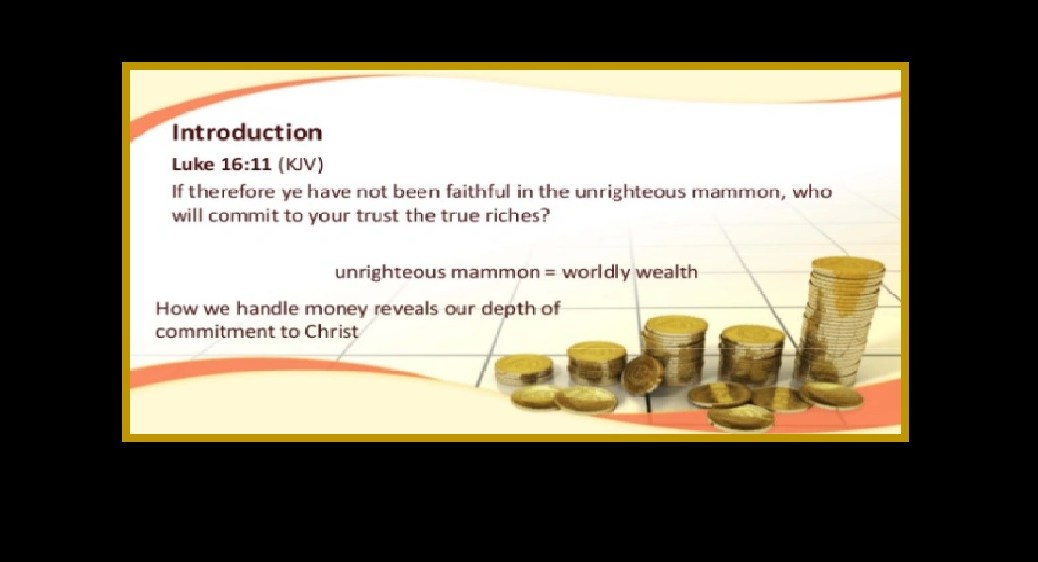

Section I Chapter 1 of Simply Church: Introduction

76 American Jurisprudence 2d, Trusts § 3

Click here to go to the following webpage for Table of Contents with links to all chapters of: Simply Church: The Holy Union of Christ and His Local Church

Appendix 1 gives links to resources which explain why church incorporation, federal tax exempt status, and other statutory or legal status of churches betray the love relationship between Christ and His churches.

Appendix 2 looks at common law versus statutory law church Bible Trust considerations.

Jerald Finney
January 17, 2023

Acting without knowledge, understanding and wisdom is not prudent for the believer who loves, or says he or she loves, the Lord. A believer and a church cannot love and glorify God by just following what someone else says. Sadly, most churches and believers act on the matter of church organization without thinking and as instructed by unthinking pastors, Bible Colleges, Seminaries, “Christian” media, and/or “Christian” lawyers and law firms. They act on misinformation without checking it out against the Word of God. Before organizing a church, they should fully answer and understand answers to questions like:

  • Does God desire union of church and state or separation of church and state?
  • What is church incorporation and federal tax exemption?
  • Do church incorporation and federal tax exemption establish unholy alliances with another lover?
  • Do church incorporation and federal tax exemption violate Bible principle and displease our Lord?
  • What is the Bible Trust relationship with property?
  • Is the Bible Trust relationship with property Biblical?
  • And the list goes on. For a thorough look at answers to all the above and many more relevant questions, see the resources linked to in Appendix 1.

Local church use of the Bible Trust for holding and managing properties given to God for use according to His will comports with New Testament Church Doctrine. The heavens, the earth and all that are in them belong to God.[1] God entrusts man with all His earthly property, and he entrusts His children with all things spiritual. An individual, a family, a nation, and a church are to hold and manage God’s property for his glory. A church should do a thorough Holy Spirit led study of the Word of God concerning God’s principles for church organization, and the Bible Trust Concept and its application.

This Section will explain God’s Bible Trust Doctrine. The Bible Trust does not organize a church as a trust. it is nothing more than a fiduciary relationship with property which is recognized, but not created, by man’s law Although it is not a product of man’s law, a court will entertain a petition by an interested party involving trust affairs or misuse. If jurisdiction of such a matter is accepted by the court, the court will look to the common law and/or statutory law for guidelines in deciding the issues raised.

Chater 6. The Bible Trust Relationship with Property is Not Something New: It was God’s plan starting with Adam and Eve covers the concept of God’s Bible Trust and its application by New Testament churches. For example, no church in the New Testament owned property. Why? Because those churches were eternal spiritual organisms made up of children of God indwelt by the Holy Spirit, not temporal worldly organizations.[2] Never were they told to put Caesar above God as to heavenly matters, those things having to do with their relationship with God. As to those matters, they were to “obey God rather than men.”[3] Of course, they were also worldly citizens of their nation, but their duty to the nation was temporal. They were instructed to be ideal earthly citizens who also, as members of local churches, were to go out of their churches into all the world and perform a spiritual heavenly mission, the preaching of the gospel.[4]

Oh, that we believers could have the attitude, actions, and goal of the Apostle Paul expressed in Philippians 3:7-14:

“7 But what things were gain to me, those I counted loss for Christ. 8 Yea doubtless, and I count all things but loss for the excellency of the knowledge of Christ Jesus my Lord: for whom I have suffered the loss of all things, and do count them but dung, that I may win Christ, 9 And be found in him, not having mine own righteousness, which is of the law, but that which is through the faith of Christ, the righteousness which is of God by faith: 10 That I may know him, and the power of his resurrection, and the fellowship of his sufferings, being made conformable unto his death; 11 If by any means I might attain unto the resurrection of the dead. 12 Not as though I had already attained, either were already perfect: but I follow after, if that I may apprehend that for which also I am apprehended of Christ Jesus. 13 Brethren, I count not myself to have apprehended: but this one thing I do, forgetting those things which are behind, and reaching forth unto those things which are before, 14 I press toward the mark for the prize of the high calling of God in Christ Jesus.”

Footnotes

[1] See, e.g., 1 Chronicles 29:11; Psalm 24:1; 89:11-12;  Jeremiah 32:17-24; 2 Corinthians 5:18-20; Colossians 1:16;

[2] See, e.g., Ephesians 4, and 1 Corinthians 12.

[3] Acts, 5:29. See, Render Unto God the Things that Are His: A Systematic Study of Romans 13 and Related Verses (https://jeraldfinney.com/god-betrayed/books/render-unto-god-the-things-that-are-his-a-systematic-study-of-romans-13-and-related-verses/).

[4] Romans 12:17-21, Romans 13:8-10, 1Peter 4:12-19 (the actions of the believer toward those who temporally persecute them for being Christians); Matthew 28:19-20; Mark 16:15; Luke 24:47-48; Acts 1:8.

Appendix 1 to Simply Church: Links to Books, Essays, & Articles

Click here to go to the following webpage for Table of Contents with links to all chapters of: Simply Church: The Holy Union of Christ and His Local Church

Links to books, essays, and articles which explain all matters related to the church/state relationship from God’s perspective as prescribed in His Word. These resources explain why church non-profit corporation status, federal tax-exempt status, charitable trust status, or legal entity status of any kind is spiritual prostitution; combine the heavenly with the earthly, the holy with the unholy, the eternal with the temporal; grieve our Lord; start a church on a downward slide toward heresy and apostasy; and corrupt the church, the state, and the people. All aspects of these matters are covered in the materials linked to below.

All resources and links below are from on jeraldfinney.com.

Bible Studies on the Doctrine of the Church

Separation of Church and State: God’s Churches: Spiritual or Legal Entities. This book explains why church corporate status, church Internal Revenue Code § 501(c)(3) or § 508(c)(1)(A) tax-exempt status or legal status of any kind is spiritual fornication. Churches who obtain such status betray their first love.

God Betrayed/Separation of Church and State: The Biblical Principles and the American Application. This book covers the Bible principles regarding God’s desired relationship between church and state and the American application of those principles. Section VI, “God Betrayed: Union of Church and State,” is an amplified version of Separation of Church and State: God’s Churches: Spiritual or Legal Entities.

Short Course covering the material in God Betrayed/Separation of Church and State: The Biblical Principles and the American Application.

Short Answers to Some Important Questions
gives links to short relevant articles which serve as good quick references:

The New Testament of Jesus Christ: His Executor Named and Empowered

  1.  What is a Spiritual entity?
  2.  What is a legal entity?
  3. Is a church a Spiritual entity, a legal entity, or a Spiritual/legal entity?
  4. Is it illegal for a church in America not to incorporate? Does a church have to be a 501c3?
  5. Does God Care if our Church is Incorporated?
  6. Should a Church Be a 508 Church?
  7. Does a church in America need an Employer (Tax) ID Number?
  8. Did President Trump do away with 501(c)(3) Requirements?
  9. What does church, inc. mean?
  10. Who Is the head of an incorporated church? 
  11. What is 501c3?
  12. What is 508?
  13. What is the history of the First Amendment?
  14. What is the History and Meaning of “Establishment of Religion” in America?
  15. What is an established church?
  16. What is a First Amendment Church?
  17. Question from a Church Concerning Church Organization
  18. The Bible Answer to the Question, “Is an Incorporated 501(c)(3) or 508 Church a Church of Christ?”

 Analysis of False reasons of Christians and Lawyers for church corporate, 501(c)(3) or 508(c)(1)(A) tax-exempt status or legal status of any kind

Essays and articles linked to at https://jeraldfinney.com/miscellaneous-articles/.
Here are links to articles there which are relevant to church/state relationship:

Why Understanding and Applying Church and State Law Is Important for Believers and Churches

Introduction to Simply Church: God’s Simple Plan for Local Church Organization

Click here to go to the following webpage for Table of Contents with links to all chapters of: Simply Church: The Holy Union of Christ and His Local Church

Appendix 1 gives links to resources which explain why church incorporation, federal tax exempt status, and other statutory or legal status of churches betray the love relationship between Christ and His churches.

Appendix 2 looks at common law versus statutory law church Bible Trust considerations.

“Would to God ye could bear with me a little in my folly: and indeed bear with me. For I am jealous over you with godly jealousy: for I have espoused you to one husband, that I may present you as a chaste virgin to Christ. But I fear, lest by any means, as the serpent beguiled Eve through his subtilty, so your minds should be corrupted from the simplicity that is in Christ” (II Corinthians 11:1-3).

Jerald Finney
January 13, 2023

All individuals and institutions—families, nations, and churches—would do well to go to the Word of God, the Bible, for direction in their affairs. Things would be much simpler, far more fulfilling and rewarding, full of the blessings of God, and free from the judgments of God. Sadly, rarely does this occur. This booklet is concerned only with the matter of doing things God’s way, the Bible way, in the matter of the ordering the God-ordained institution of the church made up of local churches in their relationships to the God-ordained institution of civil government.

Doing things God’s way in the matter of local church organization is really simple, very simple. On the other hand, organizing a church man’s way is very complex, changes the very nature of a church from an eternal, heavenly organization to a temporal, earthly organization, and brings in man-made complexities that change the nature and functioning of a church. Joining church and state combines an temporal earthly power (civil government) with an eternal heavenly power (the local church). Such unions either place the church over the state, the state over the church, or makes them coequal partners. As history amply proves, all such unions inevitably corrupt the church, the state, and the people.

In America, churches may, without persecution, choose either to remain in relationship with Christ alone or to enter into an unholy union with state government (e.g., through non-profit corporation status and/or federal government “tax-exempt” status). A church who chooses to enter into unholy union with the state grieves our Lord, starts a slide toward heresy and apostasy, and profanes that which God desires, according to His Word, to remain holy, set apart for Him and Him alone.

God wishes the relationship of both husband and wife and Christ and his churches to be holy, set apart for God. Christ likens the relationship between his churches to the marriage relationship: “Husbands, love your wives, even as Christ also loved the church, and gave himself for it; That he might sanctify and cleanse it with the washing of water by the word, That he might present it to himself a glorious church, not having spot, or wrinkle, or any such thing; but that it should be holy and without blemish.” (Ephesians 5:25-27).

Christ paid a high price for the local churches. He has given church leaders a great responsibility in maintaining their holy status. “Take heed therefore unto yourselves, and to all the flock, over the which the Holy Ghost hath made you overseers, to feed the church of God, which he hath purchased with his own blood” (Acts 20:28).

Suppose that one day, John Smith is at home when his wife Alice walks in the front door with her arms around another man, Joe. Alice says to her husband John,

“Hello, dear. I want you to meet Joe. I met him a couple of months ago and he and I have become good friends. We have talked over the phone and had lunch together a few times. That’s all. I have found him to be a very wise and compassionate man, concerned with my well-being, and yours as well. He has some wonderful suggestions as to how this marriage should be run. His ways are much better than your ways as to many matters. I think we should bring him into our relationship for wise counseling and direction. Not only that, he is a rich man and wants to help us out financially. You must agree with me that this new relationship will be far better?”

What would a husband who loved his wife say to her in this eventuality?

Sadly, most churches, like Eve, have been beguiled by the serpent through his subtilty, so that their minds have been corrupted from the simplicity that is in Christ. They have left their first love as did the church at Ephesus. They have chosen to combine with the state. They usually do so through contracting with the state and federal government for non-profit corporation status, federal tax-exempt status, charitable trust status. Some few do so by setting themselves up as legal entities by acting legally, entities subject to civil government control. A church acts legally when, for example, she takes out insurance on the church, holds property in the name of the church, opens a bank account in the name of the church.[1]

Churches have followed the wrong advice in structuring their relationship with the state. Many know that the example of the churches in the Word of God is complete separation of church and state. Nonetheless, they argue that times have changed and that churches can no longer follow the doctrine and practice of the original New Testament churches. They reason that the church must combine with the state:

  1. So that she can own property, hold a bank account, or act legally in some other manner.
  2. So that she can enter into contracts.
  3. To limit the liability of church members.
  4. So that one’s tithes, offerings and gifts will be tax deductible.
  5. Winning souls is the most important thing, even more important than loving God.
  6. My “Christian” lawyer disagrees with your opinion and advises me such and such.
  7. The church must combine with the state according to Romans 13, 1 Peter 2:13, or some other Scripture.
  8. The Word of God teaches that a church can choose to either combine with the state or not and that one should follow his convictions on the matter.
  9. ad nauseum.

After nineteen years working in the arena of church state relationships, I have found the excuses are seemingly endless. See, [2] for a link to webpages on all related issues including analyses of false reasons for church legal status. Pastors and churches who wish to do things man’s way are always backed up by other pastors, believers Bible colleges, seminaries, churches, and lawyers who will agree with them that their way is the right way. A small minority who have not already come to the knowledge of the truth on the matter defer to the Word of God, study the matter out, repent, and cast aside their unholy alliances.

For two thousand years, a remnant of believes, according to civil and religious laws of those in unholy union with one another, have been persecuted—beheaded, drowned, burned at the stake, mercilessly tortured, imprisoned, banished, deprived of all their property, etc.—because they refused to dishonor their relationship with the Lord Jesus Christ. Except for a small remnant, churches in America choose to profane their relationship with the Lord Jesus Christ by becoming legally entwined with civil government. This is true in spite of the fact that the First Amendment to the United States Constitution and corresponding state constitutional provisions grant religious and soul liberty. Churches in the United States can do things God’s way with the protection of man’s laws.

This booklet will show churches how to do things God’s way, the simple way, as to their relationship with Christ; the same way that New Testament churches did so by following a concept, a plan utilized by God as to both earthly material and heavenly spiritual possessions from the creation of man until the end of time. Keep reading to see if these things are not so.[3]


Endnotes

[1] See Appendix 1 for links to resources which explain in detail why a church commits spiritual fornication and betrays her first love by choosing church corporate status, charitable trust status, federal tax exempt status or legal status of any kind.

[2]False reasons of Christians and Lawyers for church corporate, 501(c)(3) or 508(c)(1)(A) tax-exempt status or legal status of any kind” (https://jeraldfinney.com/posts/false-reasons-of-christian-lawyers-and-pastors-for-combining-church-and-state/). Other resources which analyze all related questions include: Separation of Church and State: God’s Churches: Spiritual or Legal Entities (https://jeraldfinney.com/god-betrayed/books/separation-of-church-and-state-gods-churches-spiritual-or-legal-entities/ ); God Betrayed/Separation of Church and State: The Biblical Principles and the American Application (https://jeraldfinney.com/god-betrayed/books/god-betrayedseparation-of-church-and-state-the-biblical-principles-and-the-american-application/ ); Essays and articles linked to at https://jeraldfinney.com/miscellaneous-articles/.

[3] The Appendix gives links to resources which explain why church incorporation, federal tax exempt status, and other statutory or legal status of churches create unholy relationships between Christ and his local churches. These relationships are spiritual fornication since, by choosing to engage in them, a church takes on another lover besides the Lord Jesus Christ.


Preface to Simply Church: “Nevertheless I have somewhat against thee, because thou hast left thy first love”

Click here to go to the following webpage for Table of Contents with links to all chapters of: Simply Church: The Holy Union of Christ and His Local Church

Appendix 1 gives links to resources which explain why church incorporation, federal tax exempt status, and other statutory or legal status of churches betray the love relationship between Christ and His churches.

Appendix 2 looks at common law versus statutory law church Bible Trust considerations.

Jerald Finney
January 11, 2023

Revelation 1-3, as well as other New Testament books, have many lessons for the churches. [1] One lesson has to do with the proper motivation for the relationship between Christ and the local church. Just as the relationship of husband wife can be profaned, so can the relationship between a church and Christ:

“Husbands, love your wives, even as Christ also loved the church, and gave himself for it; That he might sanctify and cleanse it with the washing of water by the word, That he might present it to himself a glorious church, not having spot, or wrinkle, or any such thing; but that it should be holy and without blemish” (Ephesians 5:25-27).

Just as a husband who does not uncompromisingly love his wife can be guilty of adultery, so can a church who does not love the Lord Jesus Christ with all her heart, soul, mind, and strength. A church can profane her love for the Lord by entering into unholy unions with other lovers, most notably with federal and/or state government.

Motive influences action. Love for Christ is the proper motivation for service, for preaching, teaching, contending for the faith, for good works, for all that the believer and church do.

Revelation 1-3 reveals that Christ is walking in the midst of every one of his churches, inspecting and judging them. He is observing their actions, attitudes, hearts, and motives. He sees their strengths and weaknesses. Every church should study Revelation 1-3 as well as other New Testament Scripture regarding the doctrine of the church so that she can measure, judge, and bring herself into line with the heart of God.

Many churches in America have “left their first love” (Revelation 2:4). Some, like the church at Ephesus, have hard workers who persevere for His name’s sake, work diligently even though weary, remain patient and steadfast, hate and condemn that which is morally wrong, remain moral in spite of surrounding immorality, abhor that which is wrong, hate false teachings, exercise spiritual discernment and keep themselves pure from doctrinal error. They stay in the battle even though it is wearisome to carry on.

Nonetheless, Christ has a solemn rebuke against many of these churches because they have left their first love. He knows their hearts. He knows that their motivation for service is not a love for Him.  The Church at Ephesus once had an unwavering love for Jesus Christ (Acts 19:17-21). However, within a generation, the church membership had an insensitive disregard for Christ and lacked a yieldedness to Him due to their waning love for Him.

Christ commanded the church at Ephesus to “remember.” They were to recall the joy of their salvation that they first experienced when they were abiding in Christ and feeling the peace of God in their hearts.

He then commanded them to repent and do the first works—that is, to return to Him, to a simple faith in, and genuine love for Him, and for what he had done for them on Calvary’s cross. History records the persecutions—burning at the state, beheading, drowning, extreme torture, imprisonment, banishment—of believers in Christ, members of churches who refused to prostitute their churches by remaining true to the Word of God.

The result of failing to heed Christ’s counsel are serious. Christ said that—if the church at Ephesus did not repent—He would cause her to lose her influence to the point that she would no longer exist as a light in the midst of darkness. Eventually, their light did burn out. Like the church at Ephesus, that of any church not motivated by love for the Savior and acting according to His Word is empty and futile. Their light is not shining, and many, because unrepentant, have ceased to exist.

The size of a church is not evidence of favor with God. The church at Philadelphia was small and insignificant compared to the church at Sardis, but God said that the large, “successful” church at Sardis was dead in his sight while this small, unpopular church at Philadelphia was spiritually thriving. (Revelation 3:1-6; 3:7-13). [2]


Endnotes

[1] Much insight for this preface gleaned from, Matt Costello,  “Christ Speaks to the Seven Churches” (Fresno, CA: Fundamentalist Evangelistic Association, http://www.feasite.org).

[2] Appendix 1 gives links to resources which explain why church incorporation, federal tax exempt status, and other statutory or legal status of churches betray the love relationship between Christ and His churches.

George Washington’s Thanksgiving Proclamation: Does It Support Union of Church and State or Separation of Church and State?

Click here to go to an online copy of the Proclamation
The Proclamation is also pasted in the Endnote

Click here to go to homepage with links to all analyses of “An American Minute by Bill Federer” Challenged

Jerald Finney
Copyright © November 24, 2022

This brief article will address the question: “What does George Washington’s Thanksgiving Proclamation have to say about the relationship of church and state?” The Proclamation as well as facts outside the Proclamation prove that President Washington believed in separation of church and state; the Proclamation also proves that he believed in and supported union of God and state. The difference between the two is explained in both The Trail of Blood of the Martyrs of Jesus and also God Betrayed/Separation of Church and State: The Biblical Principles and the American Application.

The Proclamation does not:

  1. mention “church;”
  2. state that church and state should be united in any way; or
  3. explicitly state that church and state should be separate.

My comments on six statements in the Proclamation are in red.

The Proclamation does:

  1. mention “Almighty God.” The Bible makes clear that God is almighty. Washington agrees.
  2. refer to the “providence of Almighty God.”
  3. implicitly state that church and state should be separate.
  4. state that it is the “duty of all nations to obey his will, to be grateful for his benefits, and humbly to implore his protection and favor.” All these statements make clear that Washington believed that God is over all nations and that all nations have a duties to God. He makes clear that he does not believe in separation of God and state.

President Washington stated several conclusions. All are consistent with the Word of God. It is clear from God’s Word that, for the good of man, he wishes all nations to proceed under him, both Jew and Gentile, with distinctions that should be recognized and followed.

The Old Testament deals much with nations and human government. At first, all nations were Gentile. There was no theocracy—God directly over civil government and religion with both working lockstep for the same purposes. Later God covenanted with Israel to be  a theocracy, the only theocracy, other than the church, that God ever ordained.

During the time between the fall and the flood, God forbade human government (control of man by man; man taking vengeance for evil doing by men). As a result, since the imagination of man’s heart was only evil continually, “the wickedness of man was great in the earth,” “the earth was corrupt” and “filled with violence.” God’s only remedy was judgment, the judgment of the flood.

God ordained the nations and human government providing for the rule of man by man under God at the flood. He ordained civil government for the temporal earthly purposes of providing a direct control over evil-doers and rewarding those who do good. At first all nations were Gentile.

Later, God called out a nation unto himself, the nation Israel, when he made his covenant with Abraham who was to be the father of Israel.  Israel was to be a theocracy. God has never covenanted with any other nation to be a theocracy with the political and religious combined, working together for the same goals, each doing its part, but both directly under God, according to covenant he he made with Israel through Moses. That covenant dealt with both man’s relationship to God (the first table of the law) and man’s relationship to man (the second table). God later made additional covenants with Israel.

God did not give the law to Gentile nations, as the Old and New Testaments make clear. “For when the Gentiles, which have not the law, do by nature the things contained in the law, these, having not the law, are a law unto themselves: Which shew the work of the law written in their hearts, their conscience also bearing witness, and their thoughts the mean while accusing or else excusing one another” (Romans 2:14-15).

None of God’s covenants with Israel apply to Gentile nations. Gentile nations were and are to continue under the covenants  God made with Adam (recorded in Genesis 3:14-19) and Noah (see, Genesis 8:21-9:27).

For much more detail, see The Biblical Doctrine of Government.

America is a Gentile nation. Christian revisionists attempt the impossible: application of the history, covenants, promises, principles, etc. for Israel to America (and other Gentile nations). They want to “Judaize” America and the church. History clearly proves that all unions of church and state have resulted in corruption of the “church,” corruption of the state, and corruption of the people. Of course, God has always had a remnant who stood against the church/state establisment even under penalty of death. Many of our founding fathers understood and proclaimed this.

  5. state, “whereas both Houses of Congress have by their joint Committee requested me “to recommend to the People of the United States a day of public thanksgiving and prayer to be observed by acknowledging with grateful hearts the many signal favors of Almighty God especially by affording them an opportunity peaceably to establish a form of government for their safety and happiness.”

Washington is agreeing with God’s Word which makes clear that all individuals, families, and nations should give such thanks to Him for many reasons. However, the God-given purpose of all governments (individual, family, human, and church) is to glorify God, not happiness, no matter the situation, whether safe or unsafe. Christ wishes that his children might have his joy, not happiness, fulfilled in them (see, e.g., John 17:13). King David prayed, after committing his great sins of adultery and murder, “Restore unto me the joy of thy salvation; and uphold me with thy free spirit” (Psalms 51:12). Since God has afforded safety, his children should be thankful and use the occasion for doing his will in all things.

6. “personally recommend and assign Thursday the 26th day of November next to be devoted by the People of these States to the service of that great and glorious Being, who is the beneficent Author of all the good that was, that is, or that will be—That we may then all unite in rendering unto him our sincere and humble thanks—for his kind care and protection of the People of this Country previous to their becoming a Nation—for the signal and manifold mercies, and the favorable interpositions of his Providence which we experienced in the course and conclusion of the late war—for the great degree of tranquillity, union, and plenty, which we have since enjoyed—for the peaceable and rational manner, in which we have been enabled to establish constitutions of government for our safety and happiness, and particularly the national One now lately instituted—for the civil and religious liberty with which we are blessed; and the means we have of acquiring and diffusing useful knowledge; and in general for all the great and various favors which he hath been pleased to confer upon us.”

Here, President Washington implicitly states that church and state should be separate. Notice that he mentions “civil and religious liberty with which we are blessed.” This is consistent with facts outside this proclamation which make clear that President Washington believed in separation of church and state. One can have both civil and religious liberty only when they have the religious freedom and soul liberty provided by the First Amendment and now by corresponding provisions in all the state constitutions. Massachusetts became the last state to do away with forced establishment in 1833. Both federal and state laws give temporal earthly liberty to the born again believer, who – no matter the state of his temporal earthly liberty – has eternal spiritual liberty “wherewith Christ hath made us free” (Galatians 5:1).

The federal and state laws which provide for civil and religious liberty protect everyone from temporal earthly persecution by the state for their “religious” beliefs; one is free to worship the true God, a false god or gods,  or no god. One cannot have civil and religious liberty when union of church and state are mandated. Without Christ’s liberty, one is a slave; with it, one is free even if the state does not provide for civil liberty.  “If the Son therefore shall make you free, ye shall be free indeed” (John 8:36).

President Washington—as did James Madison, Thomas Jefferson, and many other Founding Fathers—believed in separation of church and state, as history proves. They did not believe in “Judaizing” America, something that can only be simulated and justified by a false interpretation of Scripture and propped up by historical revisionism. For documented proof of the beliefs of the founders, see The Trail of Blood of the Martyrs of Jesus/Christian Revisionism on Trial, especially Section II Christian History of the First Amendment. The index of the free online PDF version, or the printed book will guide you quickly to pages covering particular persons, places, events, etc.

7. conclude: “and also that we may then unite in most humbly offering our prayers and supplications to the great Lord and Ruler of Nations and beseech him to pardon our national and other transgressions—to enable us all, whether in public or private stations, to perform our several and relative duties properly and punctually—to render our national government a blessing to all the people, by constantly being a Government of wise, just, and constitutional laws, discreetly and faithfully executed and obeyed—to protect and guide all Sovereigns and Nations (especially such as have shewn kindness unto us) and to bless them with good government, peace, and concord—To promote the knowledge and practice of true religion and virtue, and the encrease of science among them and us—and generally to grant unto all Mankind such a degree of temporal prosperity as he alone knows to be best.”

Amen. Notice that he said, “To promote the knowledge and practice of true religion.” He did not say, “To force men to practice any religion,” including that of any Protestant, Baptist, Quaker, Catholic, Jewish etc. denomination or sect. That precludes union of church and state and requires separation of church and state. As history proves, all such unions have always forced, under severe penalty for disobedience – imprisonment, death, banishment, torture, etc. – all citizens to bow down to the official church/state union. Again, for emphasis, all such unions always resulted in the corruption of the people (who bowed down to the unified religion and state), the state, and the official state “church.” See what Jefferson, Madison, Roger Williams, Isaac Backus, John Leland and others involved in the colonial spiritual warfare said on this matter in the book cited above and also in God Betrayed/Separation of Church and State: The Biblical Principles and the American Application (go to the index of the PDF or printed version to find pages for particular persons).

So there you have it. President Washington in his Thanksgiving Proclamation – as did Jefferson, Madison, Backus, Leland, Williams – supported separation of church and state. He, as he proclaimed, along with other founding fathers, also believed in and union of God and state, in God over state. This is Biblical. God and church are not the same. God ordained the church long after he ordained civil government. He ordained Gentile human government to deal with termporal earthly matters. He ordained the church with jurisdiction over eternal heavenly matters. Combining the two violates Bible principles. See, God Betrayed for comprehensive explanation.

Christian revisionists cite Washington’s Thanksgiving Day Proclamation, and other historical speeches and documents, out of the context of all relevant historical facts, in their effort to convince Americans, and especially American “Christians,” that church and state should combine. Because of their inability to correctly believe Scripture, they cannot understand the difference between separation of church and state and separation of God and state. Because they believe it is alright to lie to those who do not share their views, they revise Scripture and history. Like their Catholic and Protestant forefathers, their goal is to “Judaize” American civil government and the church. They say, ad nauseum, “Separation of church and state is not found in the constitution.” I fell for that line and their other soundbites as I began to read and hear Christian revisionists after my salvation in 1980. Over the years, God revealed the truth to me. I had a choice. Go with truth or go with lies. Read the whole story in The Trail of Blood of the Martyrs of Jesus/Christian Revisionism on Trial/A Case of Premeditated Murder/Christian Revisionism on Trial/The Christian History of the First Amendment (Available in free PDR, softback, online version).


Endnote

Thanksgiving Proclamation, 3 October 1789

[New York, 3 October 1789]

By the President of the United States of America. a Proclamation.

Whereas it is the duty of all Nations to acknowledge the providence of Almighty God, to obey his will, to be grateful for his benefits, and humbly to implore his protection and favor—and whereas both Houses of Congress have by their joint Committee requested me “to recommend to the People of the United States a day of public thanksgiving and prayer to be observed by acknowledging with grateful hearts the many signal favors of Almighty God especially by affording them an opportunity peaceably to establish a form of government for their safety and happiness.”

Now therefore I do recommend and assign Thursday the 26th day of November next to be devoted by the People of these States to the service of that great and glorious Being, who is the beneficent Author of all the good that was, that is, or that will be—That we may then all unite in rendering unto him our sincere and humble thanks—for his kind care and protection of the People of this Country previous to their becoming a Nation—for the signal and manifold mercies, and the favorable interpositions of his Providence which we experienced in the course and conclusion of the late war—for the great degree of tranquillity, union, and plenty, which we have since enjoyed—for the peaceable and rational manner, in which we have been enabled to establish constitutions of government for our safety and happiness, and particularly the national One now lately instituted—for the civil and religious liberty with which we are blessed; and the means we have of acquiring and diffusing useful knowledge; and in general for all the great and various favors which he hath been pleased to confer upon us.

and also that we may then unite in most humbly offering our prayers and supplications to the great Lord and Ruler of Nations and beseech him to pardon our national and other transgressions—to enable us all, whether in public or private stations, to perform our several and relative duties properly and punctually—to render our national government a blessing to all the people, by constantly being a Government of wise, just, and constitutional laws, discreetly and faithfully executed and obeyed—to protect and guide all Sovereigns and Nations (especially such as have shewn kindness unto us) and to bless them with good government, peace, and concord—To promote the knowledge and practice of true religion and virtue, and the encrease of science among them and us—and generally to grant unto all Mankind such a degree of temporal prosperity as he alone knows to be best.

Given under my hand at the City of New-York the third day of October in the year of our Lord 1789.

Go: Washington

Open Letter from Christian Attorney to Amarillo Mayor Concerning Her Letter Addressing “A Drag Queen Christmas” Event

The picture above is being plastered on billboards in Amarillo, Texas.

This letter was hand delivered and emailed to the Amarillo Mayor and Amarillo city counsel members. Satan and his henchmen are working hard to corrupt every noon and cranny of America. Amarillo is in one of the more coservative areas of the United States, but, like the rest of America, is quickly sliding toward the judgment of God.

Other articles on this matter which also include a copy of the Mayor’s letter:

Amarillo Mayor responds to concerns surrounding drag Show

Organizations ‘upset’ after letter from Amarillo mayor on drag show (Wicked organizations use every opportunity to publish their evil philosophies and influence others to accept or join in their practices and warfare against God.)

Drag Queen brags about what he can do in the open, says children should be exposed to his abomination

“The woman shall not wear that which pertaineth unto a man, neither shall a man put on a woman’s garment: for all that do so are abomination unto the LORD thy God” ( Deuteronomy 22:5).

Jerald Finney
Attorney at Law
801 Elgin Street
Amarillo, TX 79118

November 22, 2022

RE: Open letter concerning Mayor Ginger Nelson’s letter to churches concerning “A Drag Queen Christmas”

Mayor Ginger Nelson
ginger.nelson@amarillo.gov
601 Buchanan Street
Amarillo TX 79101

To the Honorable Mayor Ginger Nelson:

In this letter, I wish to introduce myself, thank the Amarillo Police Department, and express both my agreements and also my disagreements regarding your letter concerning the use of city facilities for “A Drag Queen Christmas.”

I am a citizen of Amarillo, Texas, and the United States of America; a member of Charity Baptist Tabernacle in Amarillo; and a lost sinner saved by the blood of Jesus. In obedience to our Lord’s commission to God’s children, I, and other members of Charity Baptist Tabernacle, will be outside the “A Drag Queen Christmas” event with signs telling people about Jesus and how to become a child of God. Some may preach, and we will all be available to council those who wish to know how to become a born-again child of God. We will also be available to discuss deeper spiritual matters involved in the spiritual warfare presented by this wicked event with those who already know the Lord as their Savior. Thankfully, First Amendment protections allow us to speak the truth in the public forum without persecution and with the protection of the government.

We appreciate all Amarillo Police Department Officers and personnel. They honor their God-ordained duties including the protection of peaceful and law-abiding speakers and speech in the public forum. We understand and apply our God-given duty as spiritual soldiers to remain peaceful and not to obstruct the movement of others. We understand that law enforcement has a duty to make sure we, and those who disagree with and oppose us, honor that duty. Pastor Larry Hickam, now retired, has explained to me that, due largely to his efforts years ago, the Amarillo Police Department has diligently done their job in protecting those involved in speech in the public forum and especially street preachers.

In your letter, you extend your leadership as mayor to include spiritual leadership and advice. You encourage citizens who are concerned about the “messages and possible content of this show” to take certain actions. Your letter to selected church groups around the city, and others by extension, stated among other things:

“I am praying that this event will give our city an opportunity to engage with people who do not know Jesus and don’t share our beliefs. I pray that our kindness and compassion will be attractive to them as they visit our city and that it will lead to questions and curiosity about our beliefs. … Most of all, I’m praying that those who don’t know Jesus or His grace will meet Him in Amarillo and be changed forever. I hope you will pray with me for these things.”

Do you agree with Charity Baptist Tabernacle that the authority in all matters of faith and practice for the believer in Jesus Christ, for you and the other leaders and employees of the City of Amarillo, is the Word of God? Based upon that understanding, let me briefly address some questions raised by your comments quoted above.

  1. First, if you, in referring to one who “knows Jesus,” mean that such a person is a child of God through the new birth, we are in agreement on that matter. To be born-again, a child of God, a believer in the Lord Jesus Christ, God says in His Word that one must realize that he can do nothing to earn his salvation, agree with God concerning his sin, repent (turn to God) with a humble and contrite (not proud) spirit, and trust Jesus Christ to save him from His sin. At the moment of salvation, the newly born child of God is a spiritual baby. The baby Christian is then to be discipled—taught the Word of God and how to study the Word of God and its application in this world. He is to test all that he is taught against the Word of God.
  2. I believe that your call to prayer is according to the will of God, but woefully incomplete. Of course, God instructs his children to pray about all things, but God’s Word makes clear that this matter calls for more than prayer. This is spiritual warfare against principalities, against powers, against the rulers of darkness of this world, against spiritual wickedness in high places. The instigator of this warfare and the influencer of the “Drag Queens” and their supporters is the “god of this world,” not God. The following gives children of God their marching orders:

“Finally, my brethren, be strong in the Lord, and in the power of his might. Put on the whole armour of God, that ye may be able to stand against the wiles of the devil. For we wrestle not against flesh and blood, but against principalities, against powers, against the rulers of the darkness of this world, against spiritual wickedness in high places. Wherefore take unto you the whole armour of God, that ye may be able to withstand in the evil day, and having done all, to stand.  Stand therefore, having your loins girt about with truth, and having on the breastplate of righteousness; And your feet shod with the preparation of the gospel of peace; Above all, taking the shield of faith, wherewith ye shall be able to quench all the fiery darts of the wicked. And take the helmet of salvation, and the sword of the Spirit, which is the word of God: Praying always with all prayer and supplication in the Spirit, and watching thereunto with all perseverance and supplication for all saints” (Ephesians 6:10-18).(Bold emphasis added).

God’s Word is truth (John 17:17). It covers knowledge of all aspects of every spiritual warfare, including the one at hand. God’s Word lays out His truths and principles for all governments—individual government, family government, human government, and church government—their God-given jurisdictions, interrelationships, and much more. God desires that His soldiers apply God’s doctrines, testimonies, precepts, commandments, principles, etc. as they represent Him in this world. By the way, God makes clear that children of believers are to obey their parents and that born-again parents are to bring up their children in the nurture and admonition of the Lord (Ephesians 6:1-4). The home is to be the bootcamp for the spiritual warfare that children will face when they come of age.

“The powers that be are ordained of God” (Romans 13:1c, the context is human government). Human governments have limited God-given jurisdiction (Romans 13:3-4, 8-9; 1 Peter 2:14; those verses and others in the New Testament reflect the much more detailed Old Testament teaching on human government). The God-given jurisdiction of human government extends to matters dealing with man’s relationship with man but not to matters dealing with man’s relationship to God as expressed in the first four of the Ten Commandments (Romans 13:8-9; much more can be learned about these matters from a study of the Old Testament). Render Unto God the Things that Are His: A Systematic Study of Romans 13 and Related Verses (https://jeraldfinney.com/god-betrayed/books/render-unto-god-the-things-that-are-his-a-systematic-study-of-romans-13-and-related-verses/ ), explains the details about man’s obligation to human government. When a human government rule conflicts with what God commands, “We should obey God rather than men” (Acts 5:29).

Civil governments are to “punish evildoers.” Sinners are evil doers; but according to God’s Word, all crimes are sins, but not all sins are crimes. Thus, civil governments are not to punish all sins. Are adultery, homosexual conduct, lesbianism, transgenderism, and men acting as women and vice-versa sins? Definitely. Does God desire that civil government punish them as crimes? I have given much thought to that matter, with God’s Word as my authority.

One thing I know for sure, God will judge individuals, families, churches, and nations who commit, promote, and/or take pleasure in such things (See, e.g., Romans 1:32; for context read Romans 1:18-32 King James Bible, the Bible which was the authority of those persecuted dissenters in colonial America whose stand for religious liberty, freedom of press, freedom of speech, and freedom of assembly paved the way for the First Amendment to the United States Constitution. For a history of that spiritual warfare in the American colonies, see  Section II of The Trail of Blood of the Martyrs of Jesus: Christian Revisionism on Trial)( https://jeraldfinney.com/god-betrayed/books/the-trail-of-blood-of-the-martyrs-of-jesus/ ).

Does God desire that a human government allow such practices to be openly practiced and promoted. I think not. Although God’s Word teaches that God desires separation of church and state, it also teaches that God does not desire governments to apply and practice separation of God (and His principles) and state. I explain that in some detail in Part I of God Betrayed: Separation of Church and State/The Biblical Principles and the American Application (https://jeraldfinney.com/god-betrayed/books/god-betrayedseparation-of-church-and-state-the-biblical-principles-and-the-american-application/ ).

Allowing sinners to openly and pridefully practice abominable sins in an open public forum corrupts and leads to the eventual judgment of God, not to mention the natural consequences of sin. Pride is an abomination to God (Proverbs 6:16-17). “Be not deceived: evil communications corrupt good manners” (1 Corinthians 15:33). The principle of separation runs from Genesis to Revelation. When one combines the holy with the unholy, the unholy always corrupts the holy, and never the other way around. What happens when one puts a teaspoon of arsenic in a glass of water. The concerns for the effects of “A Drag Queen Christmas” on the children of Amarillo (as well as many adults) are well founded. This event is to occur in a city owned facility, paid for by Amarillo taxpayers. Thus, Amarillo, by not taking a firm stand against this event is implicating the political leaders and employees of the city, but also all the taxpayers and citizens of Amarillo. I personally believe not only that you should apologize to but also recompense all Amarillo taxpayers who disagree with your stand on this matter.

America has witnessed the growing acceptance of adultery, fornication, perversions of all kinds, immorality in general, and pride in that immorality. The increase in immorality and acceptance of such over the last ten or twenty years has been at an ever-accelerating rate. This increase has been fueled by postmodernism—the idea that all lifestyles, philosophies and truth claims are equal and no one has a right to say that his truth is superior to that of another—has been taught by our public schools and universities and disseminated by liberal news outlets, magazines, and all kinds of literature. To the postmodernist, the most hateful thing one can is God’s principle that we should hate the sin but love the sinner. Postmodernism is a direct frontal attack on God and His Word. Much of America is now in the grips of this wicked philosophy. Amarillo is still behind and is still somewhat conservative. Yet even Amarillo has it’s “gay pride” parades and other events, as well as businesses, churches, and organizations which are corrupting this city and the citizens who still believe in God and His Word. Sadly, the resistance is not according to God’s knowledge, understanding and wisdom. I have heard church-going people condone sodomy, lesbianism, and same sex marriage. As a sidenote, there is no such thing as same sex marriage. God ordained and defined marriage in the Garden of Eden and never gave civil government any jurisdiction regarding the marriage relationship. See what Jesus said about marriage in Matthew 19:3-6.  No matter what the Supreme Court or any other earthly power says, the marriage union is available only to one man and one woman.

At the very least, the individual believer—no matter his station in life—is to warn everyone of the nature of sin and the consequences for the unrepentant sinner. One cannot be saved if he takes pride in his sin and/or refuses to turn to God and trust Jesus to save him from his sin.

So what is a believer who is a political leader to do? Every believer, whatever his or her post in life, should “obey God rather than men.” The highest law is God’s law, not man’s law. When man’s law contradicts God’s law, the believer should stand on God’s law. Many in America like to proclaim that America is “one nation under God.” The truth is that every nation is under God. However, for the time being, every nation and human government past, present, and future is on probation. There comes a time in the existence of every nation when it will be judged by God; when God’s only remedy is judgment. That time is fast approaching for America, Texas, and Amarillo. For details from the Word of God on this matter, see The Biblical Doctrine of Government (https://jeraldfinney.com/god-betrayed/books/god-betrayedseparation-of-church-and-state-the-biblical-principles-and-the-american-application/online-version-of-the-book-god-betrayed/the-biblical-doctrine-of-government/ ); see also, for more on the hierarchy of law, First Amendment Protection of New Testament Churches/Federal Laws Protecting State Churches (Religious Organizations) (https://jeraldfinney.com/2010/02/26/laws-protecting-new-testament-churches-in-the-united-states-read-them-for-yourself/ )

  1. You stated:

“I am are praying that this event will give our city an opportunity to engage with people who do not know Jesus and don’t share our beliefs. I Pray that our kindness and compassion will be attractive to them as they visit our city and that it will lead to questions and curiosity about our beliefs.”

I agree that individual believers in a city like Amarillo—a city whose leaders have failed to perform their God-given responsibilities—should be kind and compassionate, according to God’s way. One does that by giving forth and exemplifying the truths of God’s Word in a straightforward manner. We should speak the truth in love. We should openly proclaim that their practices are sin; an abomination to God; an attack on God and God’s order for the individual, the family, and human government. We should give them God’s eternal solution. We should do this with the hope that they will recognize their hopeless condition, repent, and trust Jesus Christ to save them from their sin.

Thank you for taking the time to read and consider my concerns and the concerns of some other Amarillo citizens and taxpayers. Hopefully, those who wish to unite against the evils of our day can come together in truth according to the Word of God. Again, my heart-felt thanks to Amarillo law enforcement as they maintain order and protect the rights of all citizens of this city.

Very truly yours,

Jerald Finney

Cc:

Cole Stanley, Councilmember Place 1 cole.stanley@amarillo.gov, 601 Buchanan Street, Amarillo TX 79101

Freda Powell, Councilmember Place 2 freda.powell@amarillo.gov, 601 Buchanan Street, Amarillo TX 79101

Eddie Sauer, Councilmember Place 3 eddy.sauer@amarillo.gov, 601 Buchanan Street, Amarillo TX 79101

Howard Smith, Councilmember Place 4 howard.smith@amarillo.gov, 601 Buchanan Street, Amarillo TX 79101